THE HOFSTRA
HEMPSTEAD, NY VOLUME 94 ISSUE 1
CHRONICLE
TUESDAY SEPTEMBER 15, 2026
KEEPING THE HOFSTRA COMMUNITY INFORMED SINCE 1935
NEWS
‘We’re being gutted:’ Center for ‘Race,’ Hofstra University faculty Culture and Social Justice faces bud- ratify five-year contract af-
get cuts shy of 10-year anniversary
By Kumba Jagne MULTIMEDIA EDITOR
After nearly a decade, Jonathan Lightfoot, the director of the Center for “Race,” Culture and Social Justice (CRSCSJ) and associate professor of teaching, learning and technology at Hofstra University is considering resigning after his compensation to run the center was reduced along with his course release time. “We’re being gutted,” said Veronica Lippencott, associate director of the center and adjunct professor of global studies and geography. The CRCSJ encourages faculty to engage with students on diversity, equity and inclusion issues, puts on a monthly Colloquia series, brings public speakers to campus and hires student fellows. According to Lightfoot, the center laid the groundwork for the Office of Equity and Inclusion. Skyler Holmes, a senior double
major in public relations and African studies, found the center’s programming vital to her African studies major which, she said, lacks course options. “As a senior, I’ve had the privilege of seeing and reaping the benefits of the center,” Holmes said. “And I hope Hofstra students for years to come get to
sors’ last contract negotiations. A charter from 2016 sent by the former provost and senior vice president for academic affairs, Gail Simmons, to former president, Stuart Rabinowitz, recommended that the university create CRSCJ and provide 12 hours of course release every year to divide among the directors.
“When I walk around, I know I’m a Black, queer [and] Hispanic man,” Pierre said. “I look around and see ‘Where is my culture being represented?’” experience the same.” Lightfoot advocated for the center’s mission to support hiring and retainment of diverse faculty a decade ago, during American Association of University Profes-
Course release time reduces the hours a professor would teach to free up time for other projects and positions on campus. It is unclear whether this charter serves as a
CONTINUED ON A5
ter months of negotiations
By Sahana Shastry and Kumba Jagne
NEWS EDITOR AND MULTIMEDIA EDITOR
After months of negotiations with the Hofstra University administration, members of Hofstra’s chapter of the American Association of University Professors (AAUP) overwhelmingly voted to ratify a new collective bargaining agreement on Wednesday, Sept. 9. In an email statement, Hofstra AAUP credited the agreement to the work of its bargaining team, union members and community support. “Months of hard work, extensive negotiations and active participation by our membership and community achieved this outcome,” the statement read. “Our shared goal is to keep Hofstra a well-regarded, growing and suc-
cessful institution that continues to attract talented students and exceptional faculty.”
CONTINUED ON A3
Lindsay Clancy: The courtroom vs. the comment section
NEWS EDITOR
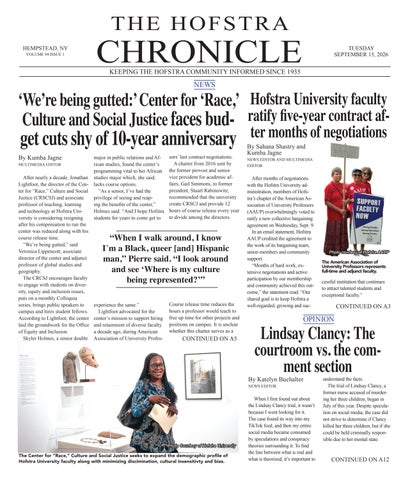
The Center for “Race,” Culture and Social Justice seeks to expand the demographic profile of Hofstra University faculty along with minimizing discimination, cultural insensitivty and bias.
The American Association of University Professors represents full-time and adjunct faculty.
OPINION
By Katelyn Buchalter
Photo Courtesy of Hofstra University
Photo courtesy of Hofstra AAUP
When I first found out about the Lindsay Clancy trial, it wasn’t because I went looking for it. The case found its way into my TikTok feed, and then my entire social media became consumed by speculations and conspiracy theories surrounding it. To find the line between what is real and what is theorized, it’s important to
understand the facts. The trial of Lindsay Clancy, a former nurse accused of murdering her three children, began in July of this year. Despite speculation on social media, the case did not strive to determine if Clancy killed her three children, but if she could be held criminally responsible due to her mental state.
CONTINUED ON A12
A2 • SEPTEMBER 15, 2026
hofstrachronicle@gmail.com
Severe budget cuts reshape Writing Center
By Katelyn Buchalter NEWS EDITOR
Editor-in-Chief Gianna Costanzo Managing Editor Hannah Mudry Secretary Paula Amoroso Lomelí Business Managers Katelyn Buchalter Anthony Favilla News Editors Katelyn Buchalter Sahana Shastry Assistant News Editor Natalia Rivera Arts & Entertainment Editors Matt Fisher Vanessa Flanagan Kimberly Lopez Sports Editors Shannon Bickert Ethan Poole Assistant Sports Editors Royce Dickson-Child Samantha Nadler Evan Papadopolus Features Editors Emilie Morrissette Denivia Rivera Opinion Editors Anthony Favilla Tom Saxa Copy Chiefs Madison Demko Emily Hyman Assistant Copy Chiefs Paula Amoroso Lomelí Juliana Calcao Ellen McCarville Multimedia Editors Kumba Jagne Joe Orovitz Marilyn Steele Assistant Multimedia Editor Kim Nadler Social Media Managers Mariana Agustin Mariya Morales Madi Valentin
THE CHRONICLE
NEWS
Budget cuts to centers at Hofstra University continue to spark conversation throughout the halls. These cuts play a direct role in student access to departments like Hofstra’s Writing Center. The Writing Center’s mission statement highlights its dedication to assisting students through oneon-one tutoring sessions. According to its website, the center offers a “structured and safe learning environment that helps undergraduate and graduate students excel in college-level writing and helps them develop skills that lead to both academic persistence and success beyond graduation.” However, this year that mission may prove to be more difficult with both the elimination of the Writing Center’s associate director position and a 50-60% decrease in the center’s budget. “We have been told that the Writing Center has experienced drastic budget cuts,” said Jamel Hudson, a professor of writing studies and rhetoric and faculty tutor who has been with the center since 2017. “Going forward, those cuts will limit staffing and the number of tutoring hours we can offer, which will ultimately affects students’ access to appointments and support.” Along with severe cuts to the budget, the firing of the center’s associate director, Jesse Priest, is expected to play a significant role in the center’s accessibility. “[On] Aug. 12, we received an email from our associate director saying that he had unfortunate, unexpected news, and that due to budget cuts, their position was eliminated,” said Caroline Hempy, a graduate student and tutor. Hempy graduated from Hofstra with a bachelor’s degree in English. There was no warning to the elimination of the role prior to the email received on Aug. 12. “This very much came out of the blue to everyone, it seemed,” said Hempy.
Jennifer Marx, professor of writing studies and rhetoric and faculty writing tutor, commented on the valuable role the associate director position played. “The Associate Director coordinated components such as programming, so it is reasonable to expect that we will not be able to continue all of those activities in the same capacity,” Marx stated. “[Priest] did all the finer detail work, [he was] the reason why the space was always so clean and everything was set up and we always had access to stuff; the reason why we were doing training and meetings, all of that really comes to head with [Priest],” said Emerald Funk, a junior rhetoric and public advocacy major. “Almost immediately, the Writing Center feels empty because [Priest’s] office door is closed.” Priest was unable to be contacted for a statement. Budget cuts limit much more than the associate director position. “We have had to severely limit the number of hours that we can offer this semester,” said Scott Jarvis, a professor of writing studies and rhetoric and faculty writing tutor. “We’re not doing any online tutoring.” Last year, the Writing Center operated Monday through Thursday from 10 a.m. to 5 p.m., Friday from 10 a.m. to 2 p.m. and had online options in line with tutor availability. This year, the Writing Center is only open Monday through Thursday from 10 a.m. to 5 p.m. These changes also affect student commuters who make up nearly 62% of the undergraduate student body. “I have a couple of friends who are commuters and they were like, ‘Hey, what happened to the online hours?’” Funk said. “They don’t want to drive 30 minutes, maybe, in traffic to get an appointment, even though they might really need the help, or maybe they’re needed at home.” Hofstra’s comment in response to the Writing Center is attributed to Hofstra spokesper-
Marilyn Steele / The Hofstra Chronicle
Students can book up to three 45-minute appointments per week with a trained tutor.
son Terry Coniglio. “Centers and institutes, as well as all campus units, were asked to review their operations this summer,” the statement read. “Decisions regarding staffing and budgets were made to ensure the student experience remains a priority.” According to Professor of writing studies and rhetoric and faculty writing tutor Patricia Navarra, the budget cuts to the center disproportionately affect the student population at Hofstra. “Budget cuts to the Writing Center will especially affect our first-year students as well as students with disabilities,” Navarra said. “The Writing Center is a sanctuary for all writers; it’s a place to brainstorm and plan and engage with professional tutors. Recent cuts diminish this service for all students. If we are concerned with enrollment, we should also be concerned with retention. A vital connection between students and the university has been compromised.” Along with the Writing Center, many departments around Hofstra are facing similar slashes to budgets without notice. “What we’re being told is [there is] a financial crisis on Hofstra’s part,” Hempy said. “It just feels like there’s this discrepancy between, well, if we are in a financial crisis, why are we
paying attention to these cosmetic changes? If any other business is in our financial crisis, you think they’re going to look toward those essential elements, and maybe [Hofstra] doesn’t view the Writing Center as essential, but I would hope that they view it as more central than signs.” Beginning in May 2025, the university has been working on a rebrand, including new signage that, according to the Hofstra website, will provide “Easier navigation and parking identification [that] will help guide visitors and residents throughout our spaces.” Hempy, along with other undergraduate and graduate peer tutors, call on Hofstra to understand the effects these cuts and decisions have on the department and university body as a whole. “It’s just creating this overall environment at Hofstra [where] our students are like, ‘How can we trust the higher ups of this administration to take care of the people who have made this institution such a wonderful place that made me want to go here?’” Hempy said.
Disclosure: There are members of The Hofstra Chronicle Staff who work in the Writing Center. No employee participated in the writing, editing or producing of this article.
The Hofstra Chronicle is published on Tuesdays during the academic year by the students of Hofstra University. The Chronicle is located in Room 203 Student Center, 200 Hofstra University, Hempstead, New York 11549. Advertising and subscription rates may be obtained by contacting the chronicle.business@gmail.com. The Chronicle reserves the right to blood drive lasted 12 reject any submission, in accordance with our written policies. All advertising which may be considered fraudulent, misleading, libelous orThe offensive to the university community, from or8 its a.m. The Chronicle or its advertisers may refuse. The products and opinions expressed within an advertisement are not endorsed byhours, The Chronicle staff.to 8 p.m.
THE CHRONICLE
NEWS
What you may have missed
Hofstra University faculty ratify five-year contract after months of negotiations cont.
CONTINUED FROM A1 7:45 AM
Israeli airstrikes in southern Lebanon kill 12 people – Monday, Sept. 7 Israeli airstrikes hit the southern Lebanese village of Kfar Rumman, killing at least 12 people. The deaths included two children, four women and a medic. The Israeli military stated that it targeted several Hezbollah militants who were allegedly transferring weapons into Kfar Rumman. The strikes came during a new round of escalation between Israel and an Iran-backed Hezbollah, raising tensions.
UK travelers face hundreds of canceled flights due to NATS system technical glitch – Tuesday, Sept. 8 A technical glitch in the United Kingdom’s National Air Traffic Services (NATS) caused hundreds of flights to be delayed or canceled on Tuesday, Sept. 8, and Wednesday, Sept. 9, disrupting travel at major airports across the nation. The NATS system was fixed after several hours as airlines worked to clear the backlog. More than 1,000 flights were affected by the glitch, leading to thousands of passengers being stranded or facing delays.
Bangladesh struggles to contain measles outbreak as death toll nears 1,000 – Wednesday, Sept. 9 Bangladesh is experiencing the worst measles outbreak in decades as death rates increase. On Wednesday, Sept. 9, the death toll from suspected measles cases reached 1,000, with more than 166,000 suspected cases and 19,835 confirmed infections recorded since March, according to the Ministry of Health. The government launched an emergency vaccination drive with multiple organizations focusing first on young children before expanding nationwide.
Heavy Rain in Japan causes landslide on Mount Fuji – Wednesday, Sept. 9 Heavy rain hit large parts of central Japan overnight on Tuesday, Sept. 8, and continued into the morning of Wednesday, Sept. 9, causing a landslide at one of the main starting points for climbers on Mount Fuji. During the rainfall, two climbers were found unconscious on Mount Fuji, while another landslide in the town of Kawanehon, Japan, killed one worker. Torrential rain in nearby Japanese prefectures of Aichi and Gifu also caused flooding and injured 41 people.
Graphic designed and information compiled by Natalia Rivera
SEPTEMBER 15, 2026 • A3
Under the five-year agreement, full-time and part-time faculty will receive a 3.5% raise in the first year, followed by 3% raises in the next three years and a 3.25% raise in the final year. According to Mary Anne Trasciatti, professor of rhetoric, director of labor studies and a member of the faculty’s bargaining unit, the contractual raises are the highest Hofstra’s faculty has received in at least 15 years. The administration’s merit pay proposal, which previously received a lot of backlash from faculty, was substantially revised and approved by both sides. The revised proposal will award faculty members through a merit system every two years. According to Trasciatti, the earlier version of the proposal would have required faculty to compete with colleagues within their departments for merit raises. Under the revised system, all eligible faculty members will be considered “on a school-wide basis.” The additional raise will go to salaries, funds for research, travel for conferences, digital archiving and other areas of compensation. “[The changes show] the university’s commitment to research,” Trasciatti said. Among other changes, faculty members have the option to take on 15 credits a year instead of 18 credits. This would allow for the additional time to conduct research. The university will be hiring specific teaching track faculty who are not tenured nor expected to research in order to help cover the reduced teaching load. The contract also includes additional benefits for adjunct faculty members. “We’ve created another category to recognize adjunct faculty who are teaching at the university for an extended period of time to reward their loyalty,” Trasciatti said. “Adjunct faculty are really important
members of the bargaining unit, and we advocated not just for the full-timers, but also for them.” However, the agreement additionally includes significant changes to the healthcare provisions. Faculty members will now have to pay for co-insurance and deductibles they did not pay under the prior contract. Trasciatti confirms that these costs will also be the same for the administration. Lila Halper, a junior anthropology and criminology double major, said the contract’s ratification provides relief to many students who were concerned about how negotiations could affect their professors’ focus on classes. She highlighted the importance of students knowing their tuition money is being distributed equally across the university. “A lot of us pay a lot of money to attend this university,” Halper said. “If the money isn’t being equally distributed to the professors who are actually doing the teaching, it does affect the quality of, not only the students learning, but also the environment that we are living in.” Callie Holiway, a junior early childhood and childhood education and English double major, said that she wore red on her first day of classes to show support for the faculty. As a future educator, Holiway said that it is important for educators to be paid what they
are worth. “I think it’s really important for me as a student to know that my professors are getting paid enough to have a living – to be able to live, have food, have a home and have their necessities covered,” Holiway said. Hofstra President Susan Poser also thanked both bargaining teams in a statement to The Hofstra Chronicle. “We are pleased that [Hofstra University] and the AAUP Faculty Union have reached a new fiveyear agreement,” the statement read. “We thank both bargaining teams for their work throughout this process and look forward to moving ahead together with a shared focus on Hofstra students and [Hofstra’s] future.” Trasciatti said faculty solidarity and community support contributed to securing a fair contract. Hofstra faculty members will next negotiate their five-year contract in 2031. “Both sides were willing to negotiate for as long as it took to get a deal,” Trasciatti said. “Both the faculty union and the administration were committed to the bargaining process.” Disclosure: The Hofstra Chronicle’s faculty advisor Brian McFadden is a member of AAUP. The faculty advisor provides guidance on professional standards and supports student staff but does not affect content.
Kumba Jagne / The Hofstra Chronicle
Under the new five-year contract, faculty will have the option to focus on additional research with a reduced class load.
A4 • SEPTEMBER 15, 2026
THE CHRONICLE
NEWS
Hofstra’s new parking system leaves commuters to face new challenges
By Natalia Rivera
ASSISTANT NEWS EDITOR
As the number of commuter students and vehicles at Hofstra University continues to grow, students, faculty and staff deal with limited parking spots amid new changes. On Aug. 5, Public Safety sent a mass email announcing the university’s parking system for the upcoming fall semester. The new system reinforced the parking rule that was implemented during the spring 2026 semester, which prohibited residential students from parking on the academic south side of campus between 6 a.m. and 4 p.m. on weekdays. The original rule was intended to prevent residential students from taking commuter students’ parking spots which could leave commuters searching for other spaces before class or receiving parking tickets for parking in unauthorized areas. However, in addition to the old system, Hofstra has also changed where students are allowed to park and created a new permit database to identify and register vehicles and their parking categories. Each vehicle is represented by a color-coded category: yellow for commuters, green for residents, purple for law students and blue for faculty and staff. These new categories help determine where the vehicle is eligible to park. The permits remain free, but students, faculty and staff must register their vehicles each academic year, including vehicles previously registered under the old parking system. For commuter students, one of the biggest limitations is not being able to park behind Breslin Hall, a location that was convenient for many students with classes in that area. Commuter parking has moved to lots behind the Science and Innovation Center, across the street by California Ave and by Hagedorn Hall. For sophomore nursing student Jacquelin Avila, the change has meant leaving home earlier than she did under the previous system. “Back then, I used to be able
to arrive to campus maybe 15 minutes before class [started] to either park behind Breslin or next to Berliner [Hall] since most of my classes were either at those or near those buildings,” Avila said. “But since the policy changed, now I have to wake up earlier and leave my house earlier just so I could get to my class on time.” Avila said the issue is not necessarily the number of spaces available, but where those spaces are located in relation to classes. “Technically there actu-
at Hofstra is larger than anything else, so it feels like we’re basically being excluded.” Lopez said that the lots closer to her classes are already full by 8:30 a.m., which can make arriving on campus feel like a race to find a convenient space. To help students who park farther away, Hofstra has expanded its on-campus shuttle service. The shuttle routes connect North Campus parking areas, such as the Colonial Square Complex and the David S. Mack Sports and
having to deal with that.” The new parking system also includes an interactive parking map to its website, flags identifying parking lots along with who is allowed to park in them and signs displaying designated numbers for each parking lot. According to Public Safety, the new parking program was developed after a comprehensive review of vehicle registration, signage, safety, parking availability, lot usage and the needs of students, faculty and staff. They
“But since the policy changed, now I have to wake up earlier and leave my house earlier just so I could get to my class on time.” ally might be enough [parking spots],” Avila said. “But it’s just that this available parking is far away from where I think most commuters have classes.” The university said the number of dedicated commuter spaces on South Campus has actually increased from 329 spaces under the previous system to 940 under the new program. According to Jovanni Ortiz, director for Community Engagement, Special Projects and Campus Transportation, in a statement to The Hofstra Chronicle, commuters are also not limited to those designated lots and may park in North Campus green lots with a valid Hofstra parking permit. While the university has increased the number of dedicated spaces, students said the distance from those lots to their classes has created a different problem. Shelya Castillo Lopez, a junior geology major and a commuter student with an hour-long commute to Hofstra, said she now has to plan additional time in her morning to find parking in order to get to class on time. “I don’t think there are enough convenient parking spaces given that we’re being pushed away from the main campus,” Lopez said. “The commuter population
Exhibition Complex parking lots to the Sondra and David S. Mack Student Center. From there, students can walk on Hofstra’s Unispan to get to South Campus. The statement from Ortiz explained that the shuttle routes operate on approximately four to six minute loops throughout the day, allowing students to travel from farther parking areas without having to walk the entire distance to class. However, for some commuters, the shuttle system adds another step between parking and getting to class. Avila said she does not think using the shuttle will be convenient for every student. “It might work for some students, but then again, I feel like parking and then finding a shuttle bus are extra steps that are unnecessary,” Avila said. “I think it would also be difficult since I think some shuttle buses have a scheduled pickup time.” Lopez is also not interested in relying on the shuttles, especially once the winter weather sets in. “Now that it’s going to get cold, it’ll be even worse trying to decide whether to stand in the freezing weather waiting for a bus or walk 10 plus minutes in the cold just to reach our cars,” Lopez said. “Commuters go through enough already without
said the goal is to provide students and employees with clearer and more predictable parking options while improving access and mobility across campus. Despite the university’s reasoning for the changes, some commuter students feel their concerns were not fully considered. “Hofstra [definitely] did not listen to us commuters enough,” Avila said. “I think they should’ve taken into fact that the majority of students are commuters. Also, the fact that most
commuter students have classes all spread out across the campus. So maybe limited parking was not such a good idea.” Lopez said the new system feels as though the university moved students farther away without addressing the underlying demand for parking. “It doesn’t feel like Hofstra listened to us at all,” Lopez said. “If they had actually talked to commuters, they would’ve realized how much harder it is to deal with traffic, bad weather and carrying heavy bags just to walk from the farthest lots, and I think all commuters can agree on this.” The university said it recognizes the transition to a new parking system will require an adjustment, particularly for commuter students. The statement from Ortiz also said that Hofstra will continue monitoring parking availability, shuttle ridership, traffic patterns and the overall effectiveness of the program and will make adjustments as appropriate. For commuters such as Avila and Lopez, however, the success of the new system will ultimately depend on whether the changes make parking and getting to class easier. “I think it just made it worse for the commuter systems,” Avila said. “In my opinion, this parking system is a no-no.”
Kumba Jagne / The Hofstra Chronicle
To help with the new parking program, Hofstra University implemented shuttle lines running in four and six-minute intervals to aide communter students’ walk to class.
THE CHRONICLE
SEPTEMBER 15, 2026 • A5
NEWS
‘We’re being gutted:’ Center for ‘Race,’ Culture and Social Justice faces budget cuts shy of 10-year anniversary cont.
CONTINUED FROM A1 legally binding contract. Full-time tenure-track professors generally teach 18 credit hours per academic year. Under the original CRSCJ mandate, Lightfoot received six hours of course release time. Over the summer, the Provost’s Office cut Lightfoot’s course release time to three credit hours, according to a memo Lippencott sent to the center’s advisory board Aug. 20. “I’m a scholar, I’m a professor and I’m a center director,” Lightfoot said. “For [the university] to treat me in a way that steals my compensation, it’s an insult. I’m offended.” The university, Lightfoot said, asked him to continue running the center at the same capacity, given he teaches the classes he “owes” the school within three years. In this scenario, Lightfoot would need to run the center in addition to taking on teaching assignments for the same pay.
“So, you’re forcing me to resign because I’m not working for free,” Lightfoot said. “I didn’t come to this place of employment to work for free.” The cut in release time came after the university asked all campus units, including centers and institutes, to draft plans where their budget would be cut by 5%, 10% and 15% in May, according to a statement from Hofstra spokesperson Terry Coniglio. “Decisions were made to ensure the student experience remains a priority,” Coniglio said in a statement to The Hofstra Chronicle. Lightfoot added that the center works all year long, with no downtime to pick up an extra class. As of this semester, he plans to stay on as director and a professor but will consider resigning if nothing changes. “This is all things that have been verbally confirmed,” Light-
Kumba Jagne / The Hofstra Chronicle
The Center for “Race,” Culture and Social Justice was established in January 2017.
foot said. “Nothing has been put in writing.” As an adjunct, Lippencott is paid on stipend. In her memo she said Comila Shahani-Denning, senior vice provost for Academic Affairs, and Richard Apollo, vice president for Budget and Planning, agreed to cut student fellow compensation to pay for her stipend. “They’re cutting our leg and
serving it to us,” said Jean Pierre, the center’s undergraduate fellow and a junior political science major and journalism minor. The original 2016 mandate allocated $8,000 a year for student research assistants. Pierre is the only fellow and makes around $2,000 a year. Pierre said the reduction in student aides, along with Lippencott and Lightfoot spending less time
in the office, would increase his workload. He highlighted the center’s role in providing a space for difficult conversations, adding that diversity is “not a trend.” “When I walk around, I know I’m a Black, queer [and] Hispanic man,” Pierre said. “I look around and see, ‘Where is my culture being represented?’”
Public Safety Briefs Compiled by Sahana Shastry
Key: PS – Public Safety HU – Hofstra University NCPD – Nassau County Police Department UFD – Uniondale Fire Department
On Aug. 30, 2026, at 2:15 p.m., three HU students reported to PS that they entered the Pride Den of the Sondra and David S. Mack Student Center and discovered flooding inside the room. Equipment belonging to the Hofstra Concerts club was damaged.
On Tuesday, Sept. 1, 2026, at 10 a.m., the fire alarm in the Student Center activated due to an unknown cause. The fire alarm sounded, and the building was evacuated within eight minutes without incident. PS, Plant Department and UFD responded to the location. The situation was corrected, and the fire alarm was reset. On Tuesday, Sept. 1, 2026, at 8:21 p.m., the fire alarm in Memorial Hall activated due to an unknown cause. The fire alarm sounded, and the building
was evacuated within one minute without incident. PS, Plant and UFD responded to the location. The situation was corrected, and the fire alarm was reset. On Friday, Sept. 4, 2026, at 8:44 a.m., the fire alarm in Hofstra USA activated due to dirt or dust by the north stage door. The fire alarm sounded, and the building was unoccupied at the time. PS and Plant responded to the location. The situation was corrected, and the fire alarm was reset.
On Friday, Sept. 4, 2026, at 1:50 p.m., while backing out of a parking spot on Stadium Road by Joseph M. Margiotta Hall, vehicle one was struck by vehicle two, which was traveling northbound. Vehicle one sustained damage to the right rear bumper, while vehicle two sustained damage to the front quarter panel and front bumper. There were no injuries. NCPD responded and took a report. On Saturday, Sept. 5, 2026, at 7:18 a.m., the fire alarm in Bill of Rights
Hall activated due to smoke from a toaster. The fire alarm sounded, and the building was evacuated within three minutes without incident. PS, Plant and UFD responded to the location. The situation was corrected, and the fire alarm was reset.
A6 • SEPTEMBER 15, 2026
THE CHRONICLE
FEATURES
Personal Essay: The Ethical Dilemma of Graduating Early
Kumba Jagne / The Hofstra Chronicle
By Hannah Mudry MANAGING EDITOR
I had a meeting with a Hofstra University dean at the end of my first semester of freshman year. I told him I couldn’t fit his program into my schedule moving forward. I didn’t have the time or the credits. I came to Hofstra with 28 credits from Advanced Placement and Early College Experience classes, meaning I was almost at sophomore standing. I took 18 credits my freshman year with the hope of entering my second year at Hofstra as a junior and graduating an entire year early. I was able to make it happen. Anyway, I was at this meeting (I’m leaving the dean’s name concealed), and the dean looks me dead in the eye and says, “Give me one good reason why you want to graduate early, and don’t tell me it’s be-
cause of money.” I was struck. Hofstra charges approximately $59,960 in tuition per year – obviously, I want to graduate early to save thousands of dollars. Two years later, I sit and wonder if money really was the
slept. I was a sports copy editor of the school newspaper, stage manager and actor in my drama club, president of the Fine Arts National Honor Society, historian of the Science National Honor Society and a receptionist at a hair salon in my hometown. When I committed to Hofstra, I told myself I wouldn’t be obnoxious and would keep my schedule plain and simple. Spoiler alert: that didn’t happen. I’m now president of Her Campus at Hofstra, managing editor of The Hofstra Chronicle, recruitment chair of Zeta Phi Eta, marketing and communications director of Thursday Nite Live, a Pride Guide and a dues-paying member of the Public Relations Student Society of America. To be honest, I’m exhausted. Balancing clubs, work, classes and a social life is taxing. Sometimes I wonder
Photo courtesy of Evan Moo
sional and social settings to where people trust 20-year-old me to be running their extracurricular activities. Sometimes, I want to tell others I’m technically in my junior year because, performatively, doing everything in three years is an incredible accomplishment. Hold-
“I’m eager to find the path that is right for me, and I believe it’s hard to discover passion in a classroom.” deciding factor in my graduating early. I mean, it totally was, but what else goes into the decision? In high school, I was the girl who did a little too much. People would genuinely ask me if I
if being as involved as I am is even worth it because I’m leaving in May 2027. Taking on higher positions in multiple organizations for my last year feels right. I’ve worked my way up in profes-
Photo provided by Hannah Mudry
ing these positions means I’m planting the seeds for growth and opportunity in the future. I like being the person to plant the seeds; however, maybe it is a little disappointing to not see the follow-through of plans just because I want to save a penny. Another reason I debate staying is for the ease of a flexible schedule. Currently, I need exactly three history courses, one public relations course and one journalism course to complete my academic experience. There’s no room for a pickleball class or an art class or another language. My family constantly tells stories about the wild classes they took in college. The most interesting class I took? Italian films, which was not all that exciting. It was a good class, don’t get
me wrong, but it was no Taekwondo with the Hofstra men’s basketball team. On the flip side of this ethical dilemma, I’m so excited to get out into the industry. Last fall, I interned with FOX’s “The Big Money Show.” It was the coolest experience of my life. I worked through the historic government shutdown, the assassination of Charlie Kirk and met Shark Tank’s Kevin O’Leary. Obviously, every day in the office won’t be as action-packed as that internship was, but the experience helped me realize there is so much excitement that comes with graduating: finding an industry I love, releasing some commitments and setting daily habits. Hard news isn’t the path for me. I’m eager to find the path that is right for me, and I believe it’s hard to discover passion in a classroom. I interview; I write press releases; I create digital content; I express myself creatively at college, but it all feels fake. I’m ready for the fast-paced world of communication outside the four walls of The Lawrence Herbert School of Communication. I’m disappointed that I’m leaving Hofstra a little ahead of schedule. I’m disappointed I’ll miss out watching the plants bloom following the seeds I’ll plant this year. Nevertheless, I know there is a lot more waiting for me when I receive my cap and gown in May 2027.
THE CHRONICLE
FEATURES
By Emilie Morrissette FEATURES EDITOR
Au Bon Pain, one of Hofstra University’s campus dining spots, was recently shut down permanently and removed as one of the school’s dining options. Hofstra outsources from multiple food chains. Au Bon Pain’s menu included a variety of breakfast and lunch sandwiches, soups, mac and cheese, beverages and to-go snacks. They also offered various baked goods ranging from bagels to muffins, scones, cookies, brownies and, a personal favorite, their cinnamon roll with icing. Students were used to the familiarity of Au Bon Pain; it was considered a staple to many during the school year. James Stevens, a junior music business major, expressed his disappointment after hearing that Au Bon Pain wouldn’t be available to students starting this fall. “[Au Bon Pain] was my go-to breakfast spot,” Stevens said. “I loved their power protein wrap; I would get it every single day. I had my routine and got to know
SEPTEMBER 15, 2026 • A7
Hofspots: Au Bon Pain
a lot of the workers there. It was just a really positive way to start my day.” Au Bon Pain maintained a reputation for being one of the healthier choices on campus, using more mindful ingredients and a selection of fresh bread. This made a difference for many students, as it provided an alternative to resorting to cheeseburgers and chicken tenders every day. Esa Gadson, a junior broadcast journalism major, had plenty to say about the food quality at Au Bon Pain. “I really liked how fresh the food was, which sounds weird because you would think that all campus food is fresh, but there was something very different about [Au Bon Pain] that I appreciated,” Gadson said. “[Au Bon Pain] added a different spin on breakfast for me, and they have healthier options and more customizable options, which I appreciated.” While larger chains like Starbucks and Dunkin’ remain on campus, Au Bon Pain offered a wider variety of breakfast alternatives.
Being located on the academic side of campus, it was an easily accessible spot for a quick bite between classes. While many places had lengthy lines, Au Bon Pain worked diligently to beat an excessively long queue of students. Evan Moore, a junior double major in writing for the screen and psychology, valued Au Bon Pain as a quick and easy place to grab a bite between classes and club activities. “Being someone who’s pretty busy all day, the lines at Bits & Bytes can get pretty long, so it was good to have another option where there was food without having to go over the Unispan,” Moore said. “They also had a sandwich there that I loved, and I’ve been craving it extra since.” In addition to the familiarity, quality and efficiency of Au Bon Pain, it was one of the cheaper options on campus. Jacob Castillo, a sophomore filmmaking major, commented on the affordability of Au Bon Pain. “[Au Bon Pain] was cheap and quick, especially as a commuter who had a small dining plan last year,” Castillo said. “Their sev-
en-dollar meals helped me save a lot. An average meal with a drink is fourteen [dollars] anywhere else.” Au Bon Pain will be turned into a study space for students, although some students complained that this feels unnecessary. “I feel a little convicted on that, I feel like we have a lot of awesome spots around campus already,” Stevens said. “I’d love to see Hofstra do something a little more unique with our campus than that.” While there are already many places to study on campus, Gadson suggested that replacing Au Bon Pain with another dining
option on the academic side of campus would have been a better change. “I think it’s kind of boring, honestly; I feel that we have plenty of places on campus to study,” Gadson said. “If anything, I think that adding a different food chain would’ve been nice because it would’ve just spiced up campus a little bit more.” Au Bon Pain is not only being removed from Hofstra’s campus but also several other locations have been shut down due to downsizing with only four locations remaining in the state of New York according to the official Au Bon Pain website.
station was already popular at Bits & Bytes. Charlie Nathe, sophomore drama major, noticed the difference immediately. “It was one of the most popular items in [Bits & Bytes], so I just don’t completely understand why they would move it,” Nathe said. “Also, why change the menu items of something that already works?” If a dining option is already successful, moving it and changing part of what made it successful seems confusing. “You’d walk into Bits & Bytes last semester and see at least 20 people with ramen, and now I see like maybe two in line at the [Student Center],” Nathe said. The location of the ramen station also mattered. Bits & Bytes is conveniently located for students who spend much of their time in nearby academic buildings. For students with demanding schedules, having multiple
meal options nearby can make a significant difference. Cassandra Till, senior drama major, said she preferred the old ramen location, as it was particularly convenient because of her rehearsal schedule. “I also live off campus and I’m a drama major, so I spend a lot of my time in the building right next to [Bits & Bytes],” Till said. “Having the ramen there just gave me more options for dinner throughout my rehearsal weeks when I don’t have time to walk home or to the [Student Center].” The change has also affected the variety students can choose from. Till said her usual order included chicken, veggie broth, mushrooms, seaweed and bean sprouts. When she visited the Student Center location, she was surprised by the reduced selection. Now, you can only select a broth and a meat. For many students, customization was a strength of the original
ramen station. Students could create a meal based on their personal preferences, rather than choosing from a limited set of predetermined options. The original ramen location was also catered toward students with gluten allergies. The new ramen location doesn’t include a gluten free option, further limiting the gluten free dining options on campus. Even if the goal was to simplify the menu or make the station easier to operate, accessibility and variety should not have been sacrificed. Addison Ferrari, junior mechanical engineering major, criticized the rebrand beyond personal preference, highlighting a broader concern about the loss of diversity on Hofstra’s academic side of campus. Ferrari said the change has “stripped away the diversity of food we had,” replacing options such as the original burger place that was already there and the ramen with “another burger
place,” even though there were already two burger spots on campus. Ferrari also criticized the lack of customization in the new ramen location, noting that “you can’t add any ingredients” because ramen was simply added to an existing establishment’s menu rather than offering it as a distinct dining option. Ultimately, the rebrand is seen not as an expansion of campus dining, but as a narrowing of choices. Campus dining should evolve, but the evolution should mean improving what works, rather than removing it. The ramen station had popularity, customization, variety and convenience. Moving it while simultaneously taking away what made it great for many students has changed the dining experience on campus. If the goal is to give students better food choices, the answer must be more beneficial than taking away the ones that already work.
Emilie Morrissette / The Hofstra Chronicle
Chron Critique: Relocation of the Ramen
By Cassidy Isaacson SPECIAL TO THE CHRONICLE
College dining should offer students convenient, affordable and varied options, especially for students who spend long hours on campus; however, the change in location and menu of the ramen station at Hofstra University has done the opposite for some students. While many students have responded positively to the new diner-style food replacement Yella’s, the movement of the original ramen station from Bits & Bytes to the Sondra and David S. Mack Student Center has reduced the variety and customizations of the previous menu. The gluten-free noodle option was also removed. The change removed one of the more popular and flexible dining choices from a location many students relied on. The decision is especially confusing because the ramen
A8 • SEPTEMBER 15, 2026
FEATURES
MAN ON THE UNISPAN “What are your thoughts on Yella’s?”
By Denivia Rivera
THE CHRONICLE
Overheard @ hofstra “My right arm has the strength of a starving child.”
FEATURES EDITOR
“I think we could seriously sell photos of us holding toes.”
“Tell Maddie to get hype. I have her aloe vera.” “I just tried it for the first time. Based on what I had, I would eat it again. It was good.”
“The amount I just spent on groceries is giving me heart palpitations.”
- Mariarosa Sessa, junior
“Anger gives folks wrinkles.”
“My dog got stung by bees crazy style.” “I have not been yet.” - Madison Hogan, junior
“I’m doing your mom as a birthday gift.”
“Her curly hair is so tea, and I don’t care that it’s a wig.”
“She came to the interview in booty shorts at 24 years old.” “I like it. I think that their sandwiches are different and a good variation of the normal food.”
If there’s something funny you overhear, you can now submit it here!
- Rez Orosa, sophomore
Marilyn Steele / The Hofstra Chronicle
Spread by Emilie Morrissette and Denivia Rivera
THE CHRONICLE
FEATURES
SEPTEMBER 15, 2026 • A9
Personal Essay: The summer that changed my perspective By Denivia Rivera FEATURES EDITOR
readings and reflections to learn about different teaching styles, techniques and the importance
Denivia Rivera / The Hofstra Chronicle
Entering yet another summer of programming with Park Avenue Armory, I never expected my professional goals to shift so dramatically. I started working at Park Avenue Armory during my senior year of high school, participating in their High School Youth Corps program. I found the Armory’s atmosphere and pedagogy to be unlike any other experience I had up to that point. I was getting paid to create, collaborate and share my ideas with other high school students. Since my senior year, I have participated in Armory programming every semester – in-person during the summer and remotely during school months. This summer, I decided to apply for the Armory’s Teaching Apprentice Program (T.A.P). T.A.P is meant to teach a group of post-high school individuals about Park Avenue Armory’s teaching team pedagogy and arts education. During the program, we had required
of arts education. I was able to develop and improve my skills in public speaking, lesson planning and facilitation while expanding my knowledge of arts education as a whole. It was truly life changing to participate in this program alongside other creatives my age who shared my goals. I learned about becoming a teaching artist for a non-profit organization, opening my eyes to the many possibilities for me as a dance major post-graduation. I’ve always visualized myself working multiple jobs after graduating, but teaching wasn’t one of them. Entering college as a dance and journalism double major was not due to a lack of being able to choose one study; rather, it was a decision I made for myself as someone who has many passions and enjoys pursuing everything that interests me – even when there is not always a clear intersection between the disciplines. While participating in T.A.P and developing this new interest in arts education, I was in the
process of applying for the position of Advanced Youth Corps Intern at the Armory. In this role, I would be returning to my high school Youth Corps roots but now in the role of a mentor and facilitator. With my new knowledge on the Armory’s pedagogy and the skills necessary for arts education, I felt well prepared and fit for this role. My time as a high school Youth Corps allowed me to break out of my shell, work with different art mediums, work collaboratively on a large project and develop myself as an artist. After expressing my interest, carefully crafting my resume and participating in an interview preparation session, I secured an interview and was given the position. Over the course of six weeks, I worked alongside another intern, my two bosses and 15 high school students for the Summer 2026 iteration of the Youth Corps program. During this time, I was tasked with maintaining the space, as well as encouraging and supporting the creativity of the students. I was also in charge of creating and facilitating activities based on the summer’s overarching theme of play. This summer, Park Avenue Armory hosted the installation “Clinamen” in The Wade Thompson Drill Hall. Youth Corps explored themes of play and childhood, taking inspiration from the installation. Over the summer, Youth Corps engaged with various art mediums through activities, games and residencies all while still exploring the theme of play. This summer of exploration led up to the students’ final project, which they titled “Playrooms.” “Playrooms” was a multidisciplinary project that incorporated four of the five senses: taste, touch, sound and visual art. I was paired with the sound team, where four students created DJ sets using music that reminded them of their childhood. My group created a party-like ambiance, decorating the room with
lights, balloons and streamers for Armory staff to enjoy during the sharing. The stories I can tell about this summer’s Youth Corps program are endless, but what stuck with me this summer is my new passion for education. My time as an Advanced Youth Corps Intern challenged me, pushed me out of my comfort zone, taught me about working with high school students and, most importantly, gave me the chance to practice and find my facilitation style. Going into this internship, I wanted to challenge my facilitation ability and learn how to engage with the Youth Corps in an arts education setting. This was my opportunity to put what I had learned during T.A.P to use. I was given numerous opportunities to plan and facilitate activities, games and check-in questions with the Youth Corps, which has made me more comfortable with my public speaking and has helped me find my facilitation voice. My experience this summer has taught me how to engage with young people and how to create activities around their interests. Observing the Youth Corps in their activities, discussions,
art-making and the residencies allowed me to pick up on their interests, which in turn helped me when planning activities. As the summer progressed, I found that talking with the students, engaging with them and assisting them in their art-making made them more comfortable with me. I learned how to be a mentor and someone they could come to if needed, while still maintaining a leadership role. Closing out my fourth summer with Park Avenue Armory, I have discovered new possibilities for job opportunities in the future. As someone who has benefited from arts education my entire life, I want to give back to future generations of students. When I started at Hofstra University, I never considered the possibility of going into education because I doubted my abilities. The programs I participated in this summer not only revealed the need for arts educators, but also taught me that I am capable of pursuing education as a career path. I’m grateful for the opportunity to add another discipline to my many passions I plan to pursue.
Denivia Rivera / The Hofstra Chronicle
Photo courtesy of Aidan Pearsall
Kumba Jagne / The Hofstra Chronicle
Kumba Jagne / The Hofstra Chronicle
WELCOME TO THE BLOCK
Kumba Jagne / The Hofstra Chronicle
Kumba Jagne / The Hofstra Chronicle
Photo courtesy of Aidan Pearsall
CAREER-MAKING CONNECTIONS
Photo courtesy of Aidan Pearsall
Photo courtesy of Aidan Pearsall
Black Student Union’s (BSU) third annual “Block Party” event drew nearly 150 students to Pride Park on Friday, Sept. 11. BSU collaborated with multiple Black organizations to provide classic African-American food, performances from Hofstra University’s dance groups Strictly Steppin’ and Creativz and connection with other Black students on campus. Kumba Jagne / The Hofstra Chronicle Background by Kumba Jagne / The Hofstra Chronicle
Photo courtesy of Aidan Pearsall Background photo courtesy of Aidan Pearsall
Photo courtesy of Aidan Pearsall
Almost 700 students attended Hofstra University’s Fall All-Majors Career & Internship Fair. The fair, hosted by the Career Center, also included a professional headshot station and Career Center Pop-Up Boutique. Over 100 employers and the military lined the David S. Mack Sports and Exhibition Complex while they spoke to students with a wide variety of interests.
Spread by Kumba Jagne, Kim Nadler and Joe Orovitz
Arts and Entertainment
VOLUME 94 ISSUE 1
Photo courtesy of Britannica
B2 • SEPTEMBER 15, 2026
THE CHRONICLE
A&E
Slayyyter is here to stay By Kimberly Lopez ARTS & ENTERTAINMENT EDITOR
If you’re anywhere on TikTok, there’s a 90% chance you’ve heard a song by Slayyyter, whether it be “DANCE…” or “brand new chanel$.” Her music has taken over the internet all summer. By the looks of it, Slayyyter will continue to enter our music catalogues far past the sunlit season. Born Catherine Grace Garner in Kirkwood, Missouri, the 29-year-old singer-songwriter started making music as early as when she was in high school. Like many up-and-coming artists, Slayyyter started by posting music to the streaming platform Soundcloud under the name “Slayer.” Her first song, titled “Swimming Pools,” was uploaded in 2017. Slayyyter made her official debut in 2019 with “BFF,” a collaboration with Ayesha Erotica. Much of her early music fell under electropop and hyperpop, with heavy distorted synths and
robotic sounding effects. While this still rings true to her music today, her sound has been developed further. Her fame first peaked in 2019 with her single “Mine” being released on Valentine’s Day. I’m sure that although you may not recognize the song by its title, if you click play, you’ll realize you’ve heard it before. It was heavily popular on Instagram edits and on X memes. From 2020 to 2023, Slayyyter was heavily active in the industry. She released two albums, “Troubled Paradise” in 2021 and “STARF*CKER” in 2023. Neither were critically acclaimed releases, but by this point, Slayyyter already had a dedicated fanbase and had been on multiple tours. Her whole world changed in July 2025 when she began teasing a new era. Slayyyter had fulfilled her contract with the label FADER and had signed to Records LLC, under Colombia Records. She was gearing up to release her third studio album,
“WOR$T GIRL IN AMERICA.” Her biggest breakthrough yet came from the album’s third single, “CRANK.” It ties electroclash, industrial hip-hop and club genres all in one. All of this is layed on top of outrageous lyrics you can’t help but love, like, “I get so gay off that tequila.” “CRANK” was everywhere right after its release and was particularly popular on “Stan Twitter,” a community on X. It was posted with memes everywhere and praised for how loud and vibrant it was. With the success of “CRANK,” anticipation for Slayyyter’s next single and upcoming album grew. “WOR$T GIRL IN AMERICA” was officially released on March 27, with Slayyyter continuing to blossom in the limelight since. After the album’s release, the fourth single, “DANCE…,” became viral on TikTok. With growing traction on the singles, more people tuned into the album, and by June, her fame was solidified.
Quick Hits After being cheated on, Slayyyter got inspired to reimagine her hit album. In a sit-down interview with Rolling Stone, she revealed she wanted to make a “brother” album instead of a traditional deluxe, where she would flip all the songs into opposites or different meanings. The first installment of this project was with a new single, “brand new chanel$,” released on July 31, which is supposed to be the flip to the original song, “BEAT UP CHANEL$.” The new song has a higher pop focus but still maintains her usual sounds of hyperpop and electropop. It talks in detail about being cheated on and about how her ex-partner wanted “brand new Chanels,” in other words, a brand-new woman. Slayyyter is here to stay, and she brings a uniqueness we haven’t seen in a longtime in the music industry. She worked for her crown, and there’s no doubt the masses will stay for her reign.
The first Daisy Chain Fields Music Festival
By Hailey Hernandez STAFF WRITER
Olivia Rodrigo brought the Daisy Chain Fields Music Festival to life on Aug. 29 through art, fun and, of course, music. The event’s mission statement, posted on the Daisy Chain Fields’ website, stated “Daisy Chain Fields is a music festival founded on the belief that joy, community and creativity can inspire meaningful change.” The core purpose of the festival was to cultivate joy and create a space for meaningful moments of connection across generations and communities. The mission statement expands on how Daisy Chain is more than just live performances; it aims to be a provider of opportunities for education, dialogue and engagement around issues targeting women and girls everywhere. Located at Great Park in Irvine, California, the festival hosted 14 performances from various female artists. Rodrigo and her band, women and non-binary musi-
cians, headlined the festival with surprise guests Alanis Morissette, Sarah McLachlan and Stevie Nicks. Artists such as Chappell Roan, Mitski, Not For Radio and Doechii took the stage by storm with amazing performances. The festival began at 11:20 a.m. on the Marigold Stage and lasted until 10 p.m., ending on the Dandelion Stage. The performances alternated between the two stages with no overlapping set times. In addition to the musical aspect of the event, there were immersive art installations and creative spaces for attendees to engage with. The “Wish Tree” by Yoko Ono was a space where attendees could write their personal hopes and dreams on tags and tie them to the tree. A LEGO floral arch and garden space were prominent, encouraging festival goers to build their own LEGO tile and add it alongside others to reveal a final piece. There was also an array of places on site to shop handcrafted goods from women-led businesses and makers.
Furthermore, festival partner Taco Bell gave away free drinks titled “You Seem Pretty Pink for a Baja Blast,” a pink twist on Taco Bell’s iconic drink in honor of Rodrigo’s recent album, “you seem pretty sad for a girl so in love.” A base total of $10 million was raised through ticket sales, sponsorships and waived artist fees – an amount that exceeded all initial expectations. This outcome was then doubled when philanthropist Melinda French Gates matched the amount, raising the final total donated to $20 million. According to Forbes, all of the net proceeds from the festival were directed to and divided equally among 10 nonprofit organizations that are dedicated to advocating for reproductive rights, maternal health, gender equity and the safety and economic empowerment of women and girls. Some of the organizations receiving these donations include the National Women’s Law Center, the National Institute for Reproductive Health and the National Domestic
Workers Alliance. The festival sold out, hosting about 45,000 people. Massive crowds of fans and supporters turned out to take part in what is now the inaugural Daisy Chain Fields festival, since Rodrigo confirmed that she plans on returning next year. There is no doubt that Daisy Chain Fields had a successful and joyous run and will continue to generate more attention and support as time goes on. The result of the event proved that efforts toward good causes are possible. As women and girls across the globe continue to grapple with society’s constraints, the Daisy Chain Fields festival serves as a symbol that all hope is not lost. In the words of the festival’s founder, “Daisies are wild and beautiful. As a chain, they are strong and unbreakable.”
Want more A&E Content? Scan to learn more about what's happening in the world of entertainment!
Photo courtesy of Vulture 'Saturday Night Live' announced the hosts and musical guests for the first four shows of Season 52.
Photo courtesy of The New York Times
Famed fashion designer Bob Mackie, who created iconic looks for Cher, Madonna and Tina Turner, died at 87.
Photo courtesy of the Television Academy
Jean Smart makes history as the first woman to win an Emmy award for every season of a series for "Hacks."
Photo courtesy of ELLE
Lady Gaga welcomes her first child with fiancé Michael Polansky.
THE CHRONICLE
Editor's Picks
A&E
Country music legend Dolly Parton passes away By Matt Fisher ARTS & ENTERTAINMENT EDITOR
Photo courtesy of IMDb
MOVIE
'Tony' (2026) Director: Matt Johnson
Photo courtesy of Spotify
SONG
'brand new chanel$' (2026) Artist: Slayyyter
Photo courtesy of Variety
MOVIE
'Obsession' (2026) Director: Curry Barker
Photo courtesy of Spotify
ALBUM
'Do That Again' (2026) Artist: Malcolm Todd
Photo courtesy of Prime Video
TV SHOW
'Hacks' (2021) Director: Lucia Aniello
SEPTEMBER 15, 2026 • B3
The world has lost a little of its rhinestone sparkle. On Aug. 25, legendary country music artist Dolly Parton passed away at 80 years old. The Grammy-winning singersongwriter, famous for tunes including “Jolene,” “I Will Always Love You” and “9 to 5,” died peacefully in her home state of Tennessee following a “brief battle with cancer,” as confirmed by her representatives. Parton’s nephew, Bryan Seaver, was the first to share the news in a video posted to the beloved entertainer’s Instagram account. “I am representing the Parton and Owens family today, announcing the passing of my aunt, Dolly Rebecca Parton Dean. Sister, Sis [and] Aunt Granny to one generation and Gigi to the next,” Seaver said in the recorded message where he claimed, “[Parton] asked of [him] years ago” to make. Seaver continued by reflecting on growing up with the actress and philanthropist and the impact she had on others in the music industry. “I first went on the road with [Parton] as a kid, getting a taste of the road life in the early 1980s,” Seaver recalled. “[Parton] opened doors, not just for me, but for her entire family to reach the potential we didn’t even know was possible. [Parton] also opened doors for generations of singers, songwriters, musicians and dreamers from every walk of life and across every continent.” The impact of Parton’s death was felt worldwide, as celebrities and public figures shared heartfelt tributes to the global superstar. “She was many things ... lyricist, songstress, player of many instruments, writer, prankster, visionary [and]
loyal friend,” said Parton’s “9 to 5” co-star, Jane Fonda, in a post to Instagram. “She had a survivor’s instinct and seemed to always know just what to do, just what to say, to make things right … She was the voluptuous embodiment of empathy.” The Tennessee native’s other “9 to 5” co-star, Lily Tomlin, also shared a message of her own, calling the AcademyAward nominee “The Great Harmonizer of Humanity,” in a post to X. Miley Cyrus, whose father Billy Ray Cyrus became close to Parton after opening for her 1992 concert tour, shared a touching tribute to Parton, who was her godmother. “The feeling of losing my Aunt Dolly is beyond what feels right to share,” Cyrus wrote. “Our most sacred moments were private, and they’ll stay there behind the stage, beneath the glamour [and] between our hearts.” “I will always love her and want to make her proud,” Cyrus added. “My heart breaks for the world, her family and friends who will miss her deeply. We’re in this loss together and we will see her in all of the most beautiful things.” President Donald Trump also shared his condolences and ordered American flags to be flown at half-staff the week following Parton’s death. “Very sad to report that [Parton], one of the greatest Country singers, and far beyond, EVER, has just passed away,” Trump wrote on Truth Social. “This is a true loss for millions of people. There has never been anyone like her and never will.” Days before her death, Parton missed a scheduled public appearance on Aug. 14 at her Dollywood theme park after doctors advised her not to travel amid ongoing “health issues.” Instead, she sent a prerecorded message address-
ing her absence and sharing her excitement for the theme park’s new roller coaster, NightFlight Expedition. “I’m still in Nashville, and I’m sorry about that,” Parton shared during what would become her last appearance. “I’m supposed to be there in person, like we planned … Now, I’ve told you before, all my fans, that I have had a few little health issues … so my Nashville doctor clipped my wings, saying, ‘You ain’t traveling this week.’” Almost a year ago, Parton announced she was postponing her Las Vegas residency due to “health challenges” and a “few procedures.” In May of this year, she canceled her residency altogether, but continued updating fans on her ongoing health challenges. “I have some good news and a little bad news,” Parton said in a video posted on May 4. “The good news is I’m responding really well to [medications] and treatments, and I’m improving every day. Now, the bad news is it’s going to take me a little while before I’m up to stage-performance level.” Despite telling fans she was sick, Parton never clarified with what. “I am dealing with some health issues that I just didn’t pay attention to when I was watching over Carl,” Parton told PEOPLE during an interview published on Aug. 21, referring to caring for her late husband Carl Thomas Dean who died in March 2025. Parton’s team revealed her cause of death after she passed, writing in a statement, “After bravely facing a brief battle with cancer, [Parton] departed her Earthly life today at the Vanderbilt-Ingram Cancer Center surrounded by loved ones.” During an appearance on CBS Mornings, the six-time Golden Globe nominee’s sister, Stella Parton, revealed
the country music icon hid her cancer battle not only from fans but also from family, not wanting to taint her career with sadness. “She would not have wanted her fans worried about it,” Stella told co-host Gayle King. “She didn’t want a lot of the family worried about it. Some of us knew, the ones that were closer, but not every relative.” And while she is gone, Parton’s longtime manager, Danny Nozell, confirms her work is not over. Prior to her death, Parton “handpicked” a team and worked with them to create a long-term plan for projects she wanted to see through. “[Parton] worked up until the day she died,” Nozell said in a statement on August 26. “She loved seeing her dreams come to life and loved knowing her work brought people joy. Ever the planner, [Parton] worked with the team that she handpicked, for the past several years to build a project roadmap that will guide us for decades to come.” Among the projects already in development are Dolly’s Tennessean Travel Stops, Dolly Parton’s SongTeller Hotel, Dolly’s Life of Many Colors Museum and the Broadway show “DOLLY: A True Original Musical,” which chronicles her career and is set to open on Jan. 19, 2027, what would have been the singer’s 81st birthday. Her team has also announced “DOLLYFEST,” billed as a “lifetime star-studded two-day festival,” honoring the late singer that will take place over two consecutive weekends in 2027, first in Nashville and then in London. While Parton may have left us, her pivotal impact on society is hard to ignore. Her legacy continues for those around the world.
B4 • SEPTEMBER 15, 2026
A&E
THE CHRONICLE
developed a thicker New York accent and throws out quips like Spider-Man is known to do. On the “Happy Sad Confused” podcast, hosted by Josh Horowitz, Holland said he has a plan for his version of Peter to pass the
connection in times of loneliness and doubt. Peter and Jean share a sweet moment at the end of the film where they realize they do not have to go through hard things alone and that they can still live normal lives while having special abilities. Previous MCU movies that share this lesson are “Thunderbolts*” and “The Fantastic Four: First Steps.” The film’s stars have had a blockbuster summer. Alongside “Spider-Man: Brand New Day,” Holland, Zendaya and Bernthal all starred in Christopher Nolan’s “The Odyssey.” While Holland is not officially confirmed to be coming back in upcoming MCU projects, the movie’s post-credit scene promised a return from Spider-Man and we’re manifesting that Holland will hold onto the suit a little bit longer. The next MCU movie, “Avengers: Doomsday,” is coming out this December with Pugh confirmed to return as Yelena. Sink will return as Jean in Jake Schreier’s “X-Men,” set to release in 2028.
Tom Holland cements himself as Spider-Man By Vanessa Flanagan ARTS & ENTERTAINMENT EDITOR
*SPOILER WARNING* The long-awaited fourth installment of Tom Holland’s SpiderMan franchise, “Spider-Man: Brand New Day,” became one of the highest grossing films of all time, making over $2 billion at the box office worldwide. The movie features many veteran Marvel Cinematic Universe (MCU) characters, including the Hulk (Mark Ruffalo), the Punisher (Jon Bernthal) and Yelena Belova (Florence Pugh), as well as introduces X-Men member Jean Grey (Sadie Sink), establishing the character in preparation for the MCU X-Men franchise. Though Marvel kept Sink’s role in the film a secret, many assumed she would be playing Mary Jane as Sink’s red hair matches MJ’s in the comic books. The secret was successful, and Jean’s reveal came as a surprise. The movie didn’t need to rely on returning characters and an anticipated introduction to do well, as Spider-Man is perfectly capable of
getting an audience on his own. This is the first MCU SpiderMan movie where Peter Parker lives his classic comic book storyline. He’s completely alone, broke and depressed while he fights street-level enemies throughout New York City. Fans were relieved to see him finally live this typical lifestyle instead of getting around on Tony Stark’s dime with hightechnology gadgets and suits. To amplify this, Peter develops organic webs that shoot directly from his wrists like Tobey Maguire’s SpiderMan, who came before him. Peter undergoes a metamorphosis where his DNA mixes with his spider biology and his “spideysense” becomes heightened. This is Holland’s best performance as Spider-Man. He makes the character feel more lived-in since we last saw him. He has
endearing dynamic throughout the film. They squabble like crazy but always have each other’s backs. The two actors actually met over 10 years ago while filming “Pilgrimage,” when Holland was only 17. They remained in touch over the years, and Bernthal became a mentor figure to Holland. Their chemistry shines as a highlight of the film. In an interview with Polygon, the film’s director, Destin Daniel Cretton, said people from the stunt department loved playing Insomniac’s Spider-Man video Photo courtesy of Gizmodo games. The stunt team even brought torch over to the next generain screen grabs as inspiration to tion’s Spider-Man; however, after recreate certain moves on the big his performance in “Spider Man: screen. The games are incredible, Brand New Day,” fans hope he so it was awesome to see them continues the role for years to come to life in the movie. come. The movie follows a recent Holland and Bernthal share an MCU theme of needing human
Alex Warren’s tour showcases both joy and grief on stage By Lily Hiebert STAFF WRITER
On July 10, Alex Warren took to the stage at the Xfinity Mobile Arena in Philadelphia as part of his “Finding Family on the Road” tour. The show featured an opening act from Noah Cyrus, who performed her most popular songs, including “July.” As Cyrus exited the stage, the audience waited in anticipa-
tion for the headliner to begin. A spotlight hit Warren, and the artist began singing the chorus to “Troubled Waters” as red lights and fireworks exploded on stage. His excited fans sang along as the band brought energy to the space. Warren, who is relatively new to the music scene, has made a real connection with his fans. Whether it’s inviting them on stage during shows, reading out
Photo courtesy of Pioneer Press
signs or noticing the costumes fans wear to his shows, he has created a great relationship with them. His acoustic set included more ballad-like songs, such as “Catch My Breath,” “Heaven Without You” and “FINE PLACE TO DIE.” Warren then gave a moving speech about grief. Warren, who lost his father at a young age, described the way he struggled to cope and how music helped him. He stated, “No one could help me; no one would talk about it. There wasn’t an outlet. There wasn’t music for me. There wasn’t anything about it because no one wanted to talk. I felt so alone when my dad died, yet I was surrounded by so many people, until I started playing these shows.” He emphasized the impact his shows and fans have had on his outlook on grief and his freedom to talk about it.
Afterward, Warren surprised fans with a special performance of an unreleased song titled “Same Stars.” It is a beautiful song that talks about the idea of living life without those you love and that the world still goes on without them. The song had me sobbing. It was the only moment during the show where he asked fans not to record. The song gave me more excitement for an album I was already looking forward to. “Same Stars” remains one of my favorite songs from the now released album WILDCHILD, and seeing it live played a role in that. For an artist to not shy away from grief and instead use it to connect with others is something I haven’t experienced at a concert before. Warren’s ability to beautifully balance grief and love while reminding us to hold our loved ones close blew me away and stuck with me. Another one of Warren’s inspirations throughout his career has
been his wife, Kouvr Annon. The two met in high school and have gone through a lot together, including living in Warren’s car and becoming internet personalities as young adults. They got married in 2024 in Annon’s home state, Hawaii. Many songs on Warren’s album highlight his relationship with his wife and parents and how they’ve all helped him become the man and artist he is. The show ended with a beautiful performance of his viral song “Ordinary,” which featured lights, confetti and excitement. The crowd was absolutely crazy as the all-too-familiar cords began for the song that made Warren a household name. When the confetti went off, the audience exploded in cheers and Warren made his way up stage to exit with a bang. His sophomore album, “WILDCHILD,” was released on Aug. 28.
A12 • SEPTEMBER 15, 2026
THE CHRONICLE
OPINION
The views and opinions expressed in the Opinion section are those of the authors. They are not an endorsement of the views of the Chronicle or its staff. The Chronicle does not discriminate based on the opinions of the authors.
Lindsay Clancy: The courtroom vs. the comment section cont. CONTINUED FROM A1
optimized engagement for trials like these; once you interact with the case, suddenly it has consumed your feed. In a Boston University study, Kathryn Coduto, assistant professor of media science, highlighted the idea of “Forensic Fandom” and how it influences people. Coduto describes Forensic Fandom as a phenomenon where people treat narratives, public events or real-life trials
have courtroom and testimony clips, screenshots, headlines and thousands of interpretations, the public does not have a complete evidentiary record. Whereas the jury, having spent weeks listening, is qualified to make deliberations on the case. This problem with Forensic Fandom isn’t entirely the people’s fault. Many content creators presented their theories with a value of certainty, even without supporting evidence.
very poorly understood.” Social media should be looking at the Clancy case as an urgent call to action regarding researching women’s mental health and postpartum support. If the media insists on involving itself to the point of assumed obligation, then let the media focus on what is important. The speculations and conspiracies around the Clancy case may be harming efforts
The defense argued that Clancy was not responsible because she was experiencing postpartum psychosis; however, after seven days of deliberation, the jury, made up of nine women and three men, declared that they were unable to come to a unanimous decision, leading Judge William Sullivan to declare a mistrial. Announcement of a mistrial stirred debate between Clancy’s defense attorney, Kevin Reddington, and Sullivan. With the case being widespread over social media, Reddington brought up the conflict of retrying the case and the possible inability to find an impartial jury. It raises the question: Does social media play a role in public trials and should it? If you have been following the case purely on social media, what you may actually have been following is a myriad of conspiracy theories. People have doubted the evidence presented in the trial and have begun asking their own questions. The Guardian specifically documented how online commenters began suspecting and Anthony Favilla / The Hofstra Chronicle pointing fingers at Patrick Under the Lindsay Clancy hashtag on TikTok, there are roughly 216,800 posts. Clancy, Clancy’s husband and and cases like puzzles to be Because of this, the case spread to destigmatize and raise father of their three children, solved by collecting clues, rapidly online. Social media awareness around postpartum despite the lack of existing analyzing details and building doesn’t reward the most accupsychosis. evidence. theories. rate information; it rewards the It seems that people are It seems to me that social Media involvement in trimost interesting. uncomfortable with the idea media – TikTok in particular als doesn’t have to be bad. However, I can’t say that sothat motherhood does not – allows people to easily jump However, there is a line and a cial media is entirely bad, even always fall into a patriarchal in and participate in true crime severe danger when speculain cases like these. The light on narrative. Motherhood doesn’t culture. Because of the popution becomes “fact” and when this case has brought important always come with joy, serenlarity of this trial while it was people begin forming parasoawareness to the issue of postity and fulfillment. There are in session, people used it as cial relationships with those partum disorders – postpartum mothers out there who struggle easy access to input their ideas involved in the issue. psychosis, specifically. with everyday life, let alone and create an entirely new narThe people involved in the Medical Science Monitor the 85% of women who suffer rative. Clancy trial are real people, in 2023 estimated that 85% of from a postpartum mood disorIt begs the question: At what including the children who women suffer from some sort der on top of that. point does analyzing a trial of postpartum mood disorder By sitting online and scrollstop being journalism and civic passed and the family who is still alive suffering the conafter giving birth whilst 40% of ing and taking in the Clancy engagement and become a new sequences. Public interest women suffer from postpartum case as pieces of a puzzle to reality TV show? shouldn’t immediately mean psychosis. The journal specifisolve, you are contributing to This is not the first expublic consumption. cally highlights how “the exact the social misogyny that’s still ample of social media creating The public almost never has pathophysiological mechanisms deeply rooted in cases like obsessive engagement with the full story. While they may of postpartum psychosis remain these. trials. TikTok, specifically, has
Social media has and can expose people to information on postpartum disorders. It can encourage people to recognize symptoms, create communities for people with similar experiences and even bring attention to existing problems in healthcare. The problem doesn’t lie in people not talking. The problem festers when people’s talking turns to making conclusions without evidence. What happens if the case goes to retrial? Research on social media and juries has been concerned for years with the possibility that online information can interfere with impartiality and bias in the courtroom. Now, it’s right in front of us. Even if social media is not the cause for the mistrial, the case demonstrates how difficult it has become to separate a courtroom from the hungry and enormous audience that is social media. I didn’t choose to become involved in the Clancy trial; instead, I was swept away by the social storm and TikTok algorithm. The question isn’t whether we should stop talking about criminal cases online; it’s whether we have become too comfortable treating real criminal trials like bingeable entertainment. We don’t have to stop talking about criminal cases. We should, however, recognize the difference between asking questions and deciding we already know the answer.
Katelyn Buchalter is a sophomore journalism major. You can find her on Instagram @bykatelynb.
THE CHRONICLE
SEPTEMBER 15, 2026 • A13
OPINION
The views and opinions expressed in the Opinion section are those of the authors. They are not an endorsement of the views of the Chronicle or its staff. The Chronicle does not discriminate based on the opinions of the authors.
Back at Hofstra ACROSS 1 Snow gear resembling overalls, colloquially 7 Opposite of present 13 "No hard feelings, dude" 14 Largest city in England 15 Coy response to a compliment 16 "I mess with it" 17 Newly renovated dining hall inside Memorial Hall 19 "Me too," formally 20 ___ pet 22 Prefix with "present" and "vore" 25 Freshmen dorm complex, familiarly "The ____" 26 "Bye-bye Miss American ___" 28 Purple and gold university whose mascot is a tiger 29 Hofstra University's main pedestrian bridge 32 Secondary social media accounts, informally 33 A deep breath 34 Flat-topped hills
Graphic by Nola Dunnaway
37 Where a Hofstra student might purchase their textbooks 42 "Light" swords 43 Like a convenient washer and dryer 44 Nova ___ 45 It makes the Statue of Liberty green 46 Main part of the human body 47 Uses money DOWN 1 Q-Tip 2 "Felicity" star Russell 3 American rapper and actor 4 Grown and shaped miniature trees 5 Greek "I," plural 6 To be without vision 7 Said, "She was with me all day" 8 ___ language 9 To tell on someone, informally 10 Alternative rock band with the hit "Doubletake" 11 Loudest 12 Explosive block in Minecraft 18 Mafia boss, colloquially
1
2
3
4
5
6
7
13
14
15
16
17
8
10
11
12
18 19
22
9
23
20
24
25
26
27
29
30
28 31
33
34 37
21
32 35
36
38
39
42
43
44
45
46
47
21 Taiwanese manufacturer of thin computers 22 Magnum ___ 23 Bite-sized version of traditional Mexican dish 24 One who lives next door 27 Fried Indian pastries with a savory filling 30 Bed linens 31 Prefix with "classic" or "liberal" 32 Insightful 35 Bypasses, as online ads 36 Easy as can be 38 Con ___ - with vigor, musically
39 "Door's open, come ___!" 40 Unwanted part of an orange 41 When planes are due, for short 42 Sound barrier breaker, for short
Email us at huchronicle.op.ed@gmail.com for the answers.
40
41
A14 • SEPTEMBER 15, 2026
THE CHRONICLE
OPINION
The views and opinions expressed in the Opinion section are those of the authors. They are not an endorsement of the views of the Chronicle or its staff. The Chronicle does not discriminate based on the opinions of the authors.
Chris Hansen is wrong about ‘Primetime’ By Tom Saxa OPINION EDITOR
Lance Oppenheim and A24’s biopic “Primetime,” which is about Chris Hansen, opens on Thursday, Sept. 24. For people active on social media, it’s expected to be a deconstruction of the morally corrupting nature of the entertainment industry. According to an interview with The Hollywood Reporter about the movie, Hansen believes the film is turning him into an object of public ridicule, leading to the broader question: Does he deserve it? “To Catch a Predator” was a docuseries chronicling a team of researchers, writers and detectives enacting vigilante justice on men who would prey on underage children online. The show was enticing enough to capture
the subsequent attention of the American people due to the cathartic promise of witnessing a person get what they deserve. During the show’s most prolific year, 2006, sting target Bill Conradt killed himself as a direct result of his public shaming at the hands of Hansen. Whether or not what Hansen and his team were doing could be classified as justice, the entertainment industry historically thrives on content that requires a target of ridicule. If American audiences wanted peace, TMZ would be out of business, and the Wendy Williams show would have lasted a single season. In my opinion, Hansen loses the moral high ground as soon as cameras and producers are involved. Hansen stated in the aforemented interview, “I guess it’s not surprising that a Hollywood
studio would act in such an exploitative or predatory manner.” This very same criticism could apply to Hansen’s show. He also told The Hollywood Reporter that he did not have any regrets about the handling of the sting on Conradt. Just as the predators on the show should face justice, it’s also true that the show was enacting that justice in a predatory and exploitative manner. Both can be true. Yet, Hansen and his associates insist that the public shaming faced by the people who they catch is justified punishment. The obvious flaw with this line of thinking is that the justice system is already in place, so it’s not the role of a television host to be the arbiter of justice. One such “predator” named Joseph Roisman, who was targeted by Hansen’s team, was acquitted by
conviction to documentary could a St. Louis jury. To be clear, this last as few as 17 days, making is not said to excuse the despicable actions taken by the people documentaries about murder one of Netflix’s most profitable they catch; however, the show endeavors. takes justice in their own hands Hearing Hansen be so publicly and effectively becomes the new critical of “Primetime” is bizarre court of public opinion. when taking into consideration Compare the “To Catch a that he made his career profiting Predator” brand of sensationalized justice with the contemoff of pedophiles. His flimsy excuse that “How to Catch a Predaporary equivalent: Netflix true tor” was a necessary prevention crime documentaries. At first method breaks down when teleglance, these shows exist to vision producers are involved in inform the public about the evils the job of both the justice system lurking beneath modern society, and greater society itself. If he but this veneer is extremely thin. really wanted to make a differTragedy means attention, and ence, he should have turned the both Netflix and Hansen undercameras off. stand America’s macabre hunger better than anyone. Netflix’s new documentary series, “Instadocs,” seeks to Tom Saxa is a senior film studies satisfy this hunger. Installments and production major. You can find are made to be topical, with fast him on Instagram @tomphsaxa. turnaround times. The time from
Enes Freedom doesn’t care about women’s sports By Anthony Favilla OPINION EDITOR
The WNBA was mired in controversy in August after former NBA player Enes Kanter Freedom declared for the WNBA draft, claiming that he identified as a woman. He did this as a way to protest the WNBA allowing only women to play in their league while not having official guidelines explaining how transgender athletes fit into the terms. He believes only women who were assigned female at birth should be able to play in the league. More recently, Freedom was kicked out of a match between the Chicago Sky and visiting Indiana Fever after getting into an altercation with the Sky’s Natasha Cloud. He was sitting courtside, wearing a shirt that read “WOMAN: noun. Adult human female.” He has since been banned from Wintrust Arena, the Sky’s home court. If you asked Freedom, he would tell you that he is doing
all this to protect women’s sports. What he is actually doing is throwing a tantrum over a non-issue and bringing the WNBA down as a result. Even though he claims that transgender athletes are a potential threat to the WNBA, no transgender athlete has ever played in the league. As of 2024, there were only about 10 transgender athletes playing at the collegiate level out of 510,000 total athletes. In 2025, the NCAA barred people assigned male at birth from competing in women’s sports. What Freedom claims as a legitimate issue hardly registers as a blip on the radar and has been banned at the college level. The few transgender athletes that have played at professional or collegiate levels often become targets of harassment campaigns online due to their identity. Lia Thomas, who was the first transgender athlete to win an NCAA Division I championship, faced major backlash after her win. Other
athletes who are not transgender but have more masculine physical features also become targets, often being questioned on if they were actually born a woman as part of a phenomenon known as “transvestigating.” What Freedom is doing here is punching down on a very small and marginalized community over the idea that men can simply dress up as women and gain an unfair advantage; however, the actual process for transgender women to compete is not that simple. Since 2010, transgender women in the NCAA were required to take at least one year of testosterone-suppressing hormonal therapy in order to compete. The policy was lightened in 2022 to be on a sport-by-sport basis. From 2015 to 2021, the International Olympic Committee (IOC) required that transgender women’s testosterone levels be below a certain threshold that is considered low for a cisgendered man. The IOC ended up
hears about the WNBA. Instead, banning transgender athletes from competing in the Olympics it is about this issue because Freedom wanted to cause a in March of this year. If transgender athletes already distraction and bring attention to himself. He knows that going to must go through certain tests in a Chicago Sky game and causorder to compete, have never competed in a WNBA game and ing a ruckus over transgender athletes will cause controversy. are barred from competing in The WNBA draft is in April the Olympics and college sports, and the deadline to declare is what is Freedom protecting the 10 days prior to the draft. This WNBA from? Women’s basketball has only is not a serious bid or protest, just a ruse. gotten more popular each year, If Freedom actually cared especially with stars like A’ja about women’s basketball, he Wilson, Paige Bueckers and would support this blossoming Sabrina Ionescu in the WNBA women’s sports league full of garnering large fanbases. Led talent. His childish actions on by rookie phenom Olivia the sidelines of a game takes Miles and star power forward away from the players’ accomNapheesa Collier, the Minplishments and serves to bully a nesota Lynx are on a dominant tiny minority of people who just run and own the best record in want to play ball. the league. The Golden State Valkyries are not far behind, having the second-best record overall in only their second season of existing. These should be the headAnthony Favilla is a junior jourlines coming out of the league. nalism major. You can find him Healthy discourse should be on Instagram @antho_fav_jrnl. the things the casual sports fan
THE CHRONICLE
SPORTS
SEPTEMBER 15, 2026 • A15
Early goal proves to be not enough against Bears
By Kayla Leibowitz STAFF WRITER
In a non-conference matchup, the Hofstra University women’s soccer team lost its second consecutive match, falling 2-1 to Brown University on Sunday, Sept. 13. The previous two meetings between the Pride and Bears resulted in draws. Although Brown came away with the win, the match continued the trend of being close and competitive. Hofstra came into the match hungry, dominating from the kickoff. The Pride had total control in the midfield, winning every loose ball and playing a high-pressure defense. These efforts paid off as Hofstra’s Amy Meadows found the back of the net only 1:31 into the game. Meadows played all 90 minutes of the match and lead the team with seven points and three goals. Meadows has not only been an asset offensively, but also a defensive powerhouse.
“She’s leading from the front, and she’s been consistently our best player – or one of them – and she’s our biggest offensive threat,” said Hofstra head coach Simon Riddiough. “So proud of [Meadows].” The Pride made very few errors in the first half, so when there was a defensive error, Brown’s Angelina Vargas capitalized, scoring the Bears’ first goal of the game in the eighth minute. Hofstra refused to let Brown steal the momentum after allowing a goal. The Pride continued to switch the field and utilize the width while fighting for every ball. This was the best first half from Hofstra this season. “Today, we played well in the first half and on [Thursday, Sept. 10] we played really well in the first half,” Riddiough said. “In many regards, we probably deserved to get a bit more, but we didn’t.” Going into the second half, it was crucial that the Pride came out just as they did in the first,
hungry and aggressive, but they did not deliver. The Pride looked flat, losing multiple battles over the ball. Brown’s Vargas had an easy time getting around Hofstra’s defense. Eight minutes into the second half, Vargas collided with the Pride’s goaltender, Lilly Bailey, knocking her down. Vargas was able to stay on her feet and tap the ball past Bailey to secure the winning goal. This was a controversial goal, causing the point to go under review for goalkeeper interference. Ultimately, the goal call remained. After Brown took the lead, Hofstra stepped up defensively and looked to find an equalizer. Brown later gained possession following a Hofstra penalty kick, creating a dangerous opportunity with Bailey out of position. With the net left open, defender Jessica Martin intervened and received a red card for denying a goal-scoring opportunity. Martin has been a strong presence on the Pride’s back
Royce Dickson-Child / The Hofstra Chronicle Amy Meadows leads the Pride with seven points – three goals and one assist.
line, playing all 90 minutes in each game. Her absence will be felt when Hofstra takes the field for its next match. Hofstra continues to struggle in the second half of games, losing leads and control. “Usually this time of year, we demand them to work really hard defensively, and they’re not fully fit to work hard for 90 minutes, and so there’s going to be a drop-off in that second
half,” Riddiough said. “The question is, ‘When is it going to be, and how can we rebound from it?’” The Pride are now 1-5-1 on the season and will seek to gain a win before Coastal Athletic Association play. On Thursday, Sept. 17, Hofstra will take on Seton Hall University at Captains Field. Kickoff is set for 7 p.m.
Pride unable to claw back against Friars By Shannon Bickert SPORTS EDITOR
The Hofstra University field hockey team fell 2-1 in a tightly contested game against Providence College on Sunday, Sept. 13. With the loss, Hofstra fell below .500 for the first time this season, moving to 2-3 on the year. Luci Hollister made five saves
while conceding two goals between the posts for the Pride. Ava Porter allowed one goal and tallied three saves for Providence. Sarah Smalley tallied the Pride’s lone goal in the contest on an assist from Greta Krimmel. “[Smalley’s] great,” said Hofstra head coach Hillary Fitts. “She wins free balls, she wins good fouls [and she] earns corners. I just love her tenacity, and I think
Jason Stoller / The Hofstra Chronicle
Sarah Smalley is tied for the team lead in goals this season with four.
she’s gonna get a couple more goals as the season keeps going, but she definitely gives us a lot of that attacking momentum as well with her speed.” The Pride and Friars matched their total shots, notching 12 apiece. Hofstra was awarded seven corners to Providence’s four. The Friars pulled ahead less than two minutes into the game. When a loose ball got away from Hollister in the circle, Providence took advantage. Lily Procaccianti found Piper Cline, who put it away in the upper right side of the net, past Hollister’s stick. The Pride had their lone opportunity of the first quarter on a corner with just 33 seconds remaining in the frame, but Hofstra was unable to tuck it away. Kesia Richardson inserted the ball to Smalley, who gathered it and let one rip, but her shot was blocked, and the Pride were held to zero shots on goal in the first stanza. The Hofstra offense began to
look stronger as they saw several chances on net late in the second quarter. Tess Satterfield took Hofstra’s first shot on goal 11 minutes into the second quarter, but the shot was knocked away by Porter. Krimmel continued to add pressure. With less than two minutes before the half, Krimmel took a shot that landed just wide. The play resulted in a corner opportunity for the Pride. Richardson inserted again and found freshman phenom Malena Bertone. Bertone elevated a shot, but Porter made an incredible acrobatic save, diving to her right to keep the Friars’ lead intact heading into the second half. The Friars padded their lead in the third quarter. At the 39-minute mark, Martu Torre Festa found Cline to her right, and Cline found a gap, shooting a laser past a sliding Hollister and into the bottom left side of the net. In the final second of the third quarter, Smalley came through
with a buzzer-beater. Krimmel found Smalley to her side, who tucked away her fourth goal of the season and put the Pride within one. Despite the goal in the third, the Pride were unable to use the momentum to push past in the fourth and tie the game. A positive for the Pride is that sophomore Gwenn van Dijk tallied her first minutes of the season after being sidelined for the first games of the year with an injury. “I’m happy [van Dijk’s] back,” Fitts said. “I think having her is an option, definitely a couple more minutes. [She] likes to see the ball, so it’s definitely a great use of her when she comes back into play, and [when] she gets a little bit more fit, she can play longer games, longer minutes.” The Pride return to Cindy Lewis Stadium on Friday, Sept. 18, to open conference play against Northeastern University. Game time is scheduled for 3 p.m.
A16 • SEPTEMBER 15, 2026
THE CHRONICLE
SPORTS
Constanza Perez Sain shines in reverse sweep victory By Shannon Bickert SPORTS EDITOR
The Hofstra University volleyball team reverse-swept the United States Military Academy in an electric five-set victory on Saturday, Sept. 12. “It’s the passion that they found to play and the courage, I think, that with this group and the young players coming, that’s something huge for us,” said Hofstra head coach Emily Mansur. “We were down, we could have had the choice to stop playing – they didn’t – and the momentum changed, and we took the game.” With the win, Hofstra moved to 5-3 in non-conference play. Constanza Perez Sain dazzled with a 19-kill day, leading the Pride with a .311 hitting percentage. “She’s playing as an intelligent volleyball player. Not just [with] power, she’s seeing the game, she’s making choices and that, for her, that’s a world of difference,” Mansur said. Ellie Pamatat put on a showcase as the primary setter, tallying a season-high 39
assists, working seamlessly alongside Perez Sain. “[Pamatat and Perez Sain] love to set each other,” Mansur said. “I know we have played around with connection, trying different things, but at the moment, we needed to go back to what we know, and what we know usually works.” Beatriz Braga had another strong showing, recording a double-double with 18 kills and 11 digs. The match started off slowly for the Pride. Hofstra struggled at the service line, committing five service errors in the first set. Army held the Pride to a .100 hitting percentage in the frame. What started as a tightly contested battle quickly turned in favor of Army. The Black Knights finished the first set on a five-point run with a 25-18 final. The Pride started the second set on the right foot, tallying the first four points. Army answered with their own fivepoint run to take the early lead. Braga ended the run, providing Hofstra with a much-needed point and spark, as Braga came
alive in the second set with six kills. Army continued to match the Pride throughout the set in a thrilling back-and-forth second stanza. Down by one point late in the set, Braga came through once again with backto-back kills to put the Pride up. Hofstra failed to close out the set, and Army took the 2-0 match advantage on a 25-23 set victory. Despite the set loss, Hofstra saw progress offensively and hit at a .229 clip. The Pride also cleaned up at the service line, making four fewer service errors. Army jumped out to an early start in the third set, riding the momentum from their late-set theatrics in the second. The Pride continued to battle and came all the way, trimming their deficit to one point on three straight points, two of which were kills by Braga. Army sandwiched a point between two Pride rallies, but a combined block-assist from Braga and Julia Amorim and a solo block from Amorim closed out the 25-23 Pride set victory on a four-point run.
Joe Orovitz / The Hofstra Chronicle Constanza Perez Sain matched her career-high in kills with 19. She also tallied 19 kills against Yale University this season.
Army faltered late in the set as the Pride held the Black Knights to a .067 hit percentage. The Pride were in the driver’s seat with a 25-18 fourth-set victory. The set was led by the Pride’s junior captain Perez Sain, who recorded seven kills in the stanza alone. Hofstra hit at a .394 mark, only committing three attack errors throughout the set. “[Perez Sain] really took over,” Mansur said in reference
to what the difference was after the first two sets. “[Perez Sain and Pamatat] worked really well, and [Perez Sain] took the momentum and took the game.” Hofstra commanded the floor in the fifth, opening the final set with five straight points. Army cut the deficit to two, but the Pride hit at an incredible .500 clip in the set, allowing them to complete the match win with a 15-11 fifth-set victory.
The Pride draw against conference foe
By Conner Keough STAFF WRITER
The Hofstra University men’s soccer team drew the Monmouth University Hawks 1-1 on Saturday, Sept. 12, in West Long Branch, New Jersey. The Pride fell to 4-0-2 overall and 1-0-2 in Coastal Athletic Association (CAA) matches. Hofstra’s lone goal came in the contest’s sixth minute when Bastian Carlman buried a
rebound inside the six-yard box for his fourth goal of the season. Lewis Matton took the initial shot and was credited with the assist. Monmouth tied the game late in the first half on a set piece from Brady Orendac. The No. 15 team, Hofstra, received positive news pregame when graduate defender and team captain Pietro Santi returned to the lineup. Santi had not played since Aug. 29 at Stony Brook University. The second-year member of the Pride needed no adjustment period, notching his third game playing a full 90 minutes this season. The game started with Hofstra controlling the bulk of early possession. Hofstra’s first shot of the game was Matton’s on the inside of the 18-yard box. Monmouth’s keeper, Herman Seierstad Johnsen, dove to his
left to deny the shot, but the rebound was left for Carlman on the doorstep. The Swedish-born forward notched his fourth goal for the blue and gold. Following the goal, Hofstra continued to press. The Pride used a 3-3-4 formation with Santi reinserted into the center-back position, which helped them control the bulk of play in the first half, outshooting the Hawks 3-1. The defense’s only blemish ended up in the back of their net inside the final three minutes of the first half. Johnsen made two saves in the first 45 minutes. Coming out in the second half, the Pride pressed for offense, outshooting Monmouth 6-1, but most of their chances didn’t find the net. The Pride was held to one shot on goal in the second half, while Monmouth didn’t force Hofstra keeper Milo Risenhoover to make a save all
match. Inside the final minute, Carlman gained the Pride a free kick from the attacking side of midfield, but Lewis Johnson’s feed into the 18 was short and cleared by Monmouth. The Hawks held on to draw the Pride in West Long Branch. The Pride were picked to finish first in the CAA North Division, but they are just 1-0-2 in their first three conference matches. Conference play pauses until Saturday, Sept. 26, when Hofstra plays Northeastern University at Captains Field. The Pride will be back in action on Tuesday, Sept. 15, hosting No. 13 University of Vermont Catamounts. Hofstra defeated Vermont in the second round of the 2025 NCAA tournament and ended UVM’s unbeaten streak at 29 matches. It will be Vermont’s first
trip to Captains Field since 2024, when the Catamounts defeated Hofstra in the second round of the NCAA tournament en route to a national championship. The Pride only returns with six players from last season’s victory over the Catamounts, and the match will be Hofstra head coach Stephen Roche’s first against a ranked opponent. Kickoff from Captains Field is set for 7 p.m.
Want to cover Division I sports? Email us at chroniclesports@ gmail.com.
THE CHRONICLE
SPORTS
SEPTEMBER 15, 2026 • A17
Hofstra baseball’s dog days of summer By Ethan Poole SPORTS EDITOR
Every summer, college baseball players from all over the country leave school and disperse across the continent to play for a summer team. There are hundreds of summer collegiate teams playing in over 80 leagues across the United States and Canada, and members of the Hofstra University baseball team joined the fun this summer. Hofstra baseball assistant coach Frank Battaglia is the leading member of Hofstra’s staff who handles getting players onto summer teams. “Each year when we come in, we want to make sure that we put our guys in the best leagues possible,” Battaglia said. Head coach Frank Catalanotto recognized how crucial summer ball can be for a young player’s development, even if occasionally a player may be better served working on their own for a summer. “We encourage [playing summer ball] quite a bit, we think it’s important for their development,” Catalanotto said. “[But] sometimes a kid needs to put on weight and get in the weight room, we might say, ‘Hey, you’re a type of kid that we don’t want to go to summer ball.’ Because if they’re playing all summer, they’re not going to be able to put on weight. There might be kids [who] don’t get a lot of at bats or innings during
our season and we need them to get at bats and innings … The best way to get better is to play in [summer] games.” Players are often given goals from the coaching staff before they go to summer ball. “We send them [to summer ball] with things in mind,” Catalanotto said. “They work on the certain things we ask them to work on, and it seems to help quite a bit.” The relationships between college baseball programs and summer league teams are crucial and take a long time to build. “If you have a good relationship [with a team], they’re more likely to take a player that you recommend,” Catalanotto said. “If there’s a player [who] you give them and after a week [the player says], ‘Nah, I don’t want to do this, I want to go home,’ it starts to create a strained relationship because they don’t want your players if they’re going to go home. It takes a while to build that rapport, and, obviously, it looks good for us as coaches when a kid goes there and he’s a good kid, the coach likes him, he stays the whole summer and he does well there.” Several Pride players had success in summer ball this past summer. Daniel Escalante excelled for the Tarboro River Bandits in Tarboro, North Carolina. Escalante was awarded Old North State League player of the week of July 22, for his 10-20 week,
Joe Orovitz / The Hofstra Chronicle Michael Brown hit .314 for the Pride last season.
which included three home runs. Trent Jenks was shipped up to Massachusetts for his summer season, hitting .344 in nine games for the Westfield Starfires of the Futures Collegiate Baseball League. Two of Jenks’ teammates joined him in New England, but competed in the New England Collegiate Baseball League. Michael Brown suited up in 17 games for the North Shore Navigators and hit .209. Tyler Castrataro played about three hours southwest for Connecticut’s Danbury Westerners, hitting .195 in 14 games before suffering a wrist injury. Reno Spagnoli suited up in four games for the Jamestown Tarp Skunks of Jamestown, New York, and the Perfect Game League; he did not record a hit. Pitchers specifically have some complications when it comes to summer ball. College pitchers are often on pitch or inning limits, which can interfere with summer plans. “Placing pitchers is the toughest part; we can place them early because we start in September,” Battaglia said. “We might have some guys that log a ton of innings [for Hofstra] and we might have to pull them back from whatever teams they were on … We might send some of our pitchers and tell them that we want them to get as many innings as they can, and we might get some guys where we tell them we only want them throwing once or twice a week.” CJ Griggs and Maddon McArthur were not only the sole Pride players to be placed on a team together, but they were also the only two to play their home games outside of the U.S. They suited up for the Kelowna Falcons of Kelowna, British Columbia, in the West Coast League. McArthur pitched to a 5.09 ERA in 10 games, while Griggs hit .295 with two homers. Griggs kept up his momentum from the end of last season into the summer. “It wasn’t really a long time between the end of the spring and the start of the summer, it definitely took a couple of days in the cage to feel my swing
Photo courtesy of Ricardo De Masi / Hofstra Athletics CJ Griggs hit .301 with nine homers for the Pride this season.
again, but I got off to a hot start,” Griggs said. “I was in a groove and I stayed in it.” Griggs and McArthur stayed with the same host family, but that didn’t stop Griggs from branching out and making new friends. “I got to meet new people along the way, and it was a really good time,” Griggs said. “Those are guys that I still talk to. I knew them for a month, and I still talk to them.” Summer ball is a grind, especially coming after a long spring season, and Griggs felt fatigued before settling in. “I was burnt out; I wanted to be home with my parents and my cats; I just wanted to be hanging out watching TV,” Griggs said. Despite the difficulties, Griggs loved his time in
Kelowna. “It was a really great time; I really enjoyed my time there even though it was a short amount of time,” Griggs said. Summer baseball has become rooted in the small-town culture of the U.S. and Canada, as thousands of ballplayers leave home and go to a new place to do one thing for two months straight: play baseball. For those two months, the players, employees, interns and volunteers become entrenched in each other’s lives, and when it ends, they go their separate ways. Even though everyone might stay in touch or even cross paths again, things will never be the same as they were for that one summer. It’s the beauty and the heartbreak of summer ball.
Phtoto courtesy of Stephen Blue / Hofstra Athletics Chris Bedford pitched 4.2 innings for the Upper Valley Nighthawks.
A18 • SEPTEMBER 15, 2026
THE CHRONICLE
SPORTS
Preview: Volleyball digging deep for a championship By Shannon Bickert SPORTS EDITOR
After falling one point shy of an NCAA Tournament berth in the 2025 season, the Hofstra University Volleyball team is looking to make the push this season and win their first Coastal Athletic Association (CAA) Championship since 2018. The Pride are coming off a historic 22-4 season with a co-CAA Regular Season Title. Hofstra dominated during conference play, coasting to the CAA Tournament title match. The Pride led 24-21 in the fourth set with a match point, just a play away from punching their ticket to the big dance, but Campbell University came all the way back, stealing the victory and winning the tournament. “I think as a coach we don’t move on,” said Hofstra
proved to be a spark plug off the bench in her final season with the Pride, earning AllCAA Second Team honors and posting over 1,000 career kills. “There’s no question that number-wise, that is huge,” Mansur said. “We are going to have to create and maximize every player that we have because we knew what [Bal] was going to produce; we knew what [Stedile] was going to produce. When we talk straight volleyball, we are losing a lot
of points that we have to make up, and then we have to help this group create. We are losing two amazing people that were just such big parts of our program.” Despite these losses, Hofstra Kim Nadler / The Hofstra Chronicle returns much of head coach Emily Mansur. their production, which has “You take, you learn and you earned them a second place got to keep a little bit of it ranking in CAA Preseason with you on the long term, but we are right now reformulating rankings. Hofstra will look to threewhat is the message, ‘How do year captain Beatriz Braga, we really move on as a team?’ So, I think for us as a coaching who was named the Preseason CAA Player of the Year, in the staff, it’s breaking down every absence of Stedile and Bal. decision that we did, [from Braga is fresh off a spectacular the] beginning to end of the season to help us get to the end 2025 campaign, averaging 3.92 kills per set while averaging and find the one point that we 2.28 digs per set. needed.” “It’s exciting to see her The Pride will have to move grow, but she is the one that on from the excitement that we trust that’s going to lead the 2025 season brought as by example,” Mansur said. they lost several contributors, “She’s the first person in; including the CAA Player she’s the last one out; she is of the Year Izadora Stedile, very mindful about resting who graduated. She spent her and about her academic part two seasons of eligibility at – everything that makes a at the University of Hawai’i successful athlete. And that’s at Mānoa and University of really what we need from her.” Texas at Austin playing beach Mansur also sees the volleyball. returning middle blockers, Hofstra also graduated fourJulia Amorim and Valentina year member Clara Bal, who
Lopez Moya, as well as rightside hitter Constanza Perez Sain, playing a large role in the Pride’s offense this season. Perez Sain was named to the Preseason All-CAA Team and captain of this year’s squad. She enters her junior season after averaging 2.18 kills per set in the 2025 season. She has already made a splash early in the season, putting up two career-best 19-kill appearances against Yale University and the United States Military Academy. Another loss this offseason was CAA Setter of the Year, Nina Jioshvili-Ravva, who transferred to the University of South Florida. Jioshvili-Ravva recorded 915 assists, 209 digs, 46 total blocks and 44 kills – a production that will be hard to replicate. Junior Ellie Pamatat proved to be a productive setter during her freshman season, earning time on the court due to Beatriz Alves’ injury. Pamatat is one of Hofstra’s setter options alongside freshman Sonja Rundcrantz. “It’s on [Pamatat] to keep [the setter role],” Mansur said. “We do have another great setter coming in, and they’re gonna be fighting for the spot. [Pamatat’s] a great volleyball player. She needs to stay healthy, and we have 100% trust that she can do the job.” Rundcrantz and Pamatat have split the role thus far this season. Runcrantz has averaged 4.83 assists per set and 1.60 digs per set, while Pamatat has averaged 5.32 assists per set. Defensively, the Pride made great strides in the 2025 season, especially in the blocking department. Hofstra ranked 13th in the NCAA, averaging 2.78 blocks per set. In the prior season, the Pride averaged just 1.9 blocks per set. The blocking prowess was led by Amorim, who ranked sixth in the nation in blocks per set. Amorim struggled with injuries throughout the duration of the 2025 season, but in her time on the court proved to make a difference, averaging 1.53 blocks per set.
Joe Orovitz / The Hofstra Chronicle Beatriz Braga has anchored the Pride this season, leading the team with 113 kills and 25 service aces.
Lopez Moya has yet to record time on the court this season, but averaged 1.73 kills per set in her 2025 campaign. “[Amorim] and [Lopez Moya] are gonna be a big, big part that we really focused on during the spring because [Braga] is great,” Mansur said. “She made a lot of points, but she had the help of two people ahead of her in order to let her not be the focus of other coaches. Now [Braga] is the focus of all the coaches, so she’s going to need a lot of people to help her in order to maintain her performance.” The defensive structure of the Pride will look similar, with libero Nil Kayaalp entering her senior season and sophomore blocker Amorim looking to continue the Pride’s net-front presence. Freshman outside hitter Geovanna Gonçalves Rocha proved to be another versatile option for the Pride early in the season. The Brazilian player leads the Pride in blocks with 38 through 30 sets played, helping the Pride fill the gap
up front. Newcomers have already made noise for the Pride. Maria Afonso, the Pride’s lone transfer addition this season, has been stellar to start the season. In her first match sporting blue and gold, the Brazil native tallied nine kills, a service ace, two digs and contributed five blocks. This season, Afonso has totaled 73 kills, 39 digs, 16 total blocks and nine aces. Another offensive option who has contributed up front is freshman outside hitter Dawn Pena, who sparkled in her eight-kill performance against Yale. Pena has tallied 37 kills while adding 14 total blocks. Through non-conference play, the Pride are 5-3, completing two sweeps. Hofstra looks to start their conference schedule off against Hampton University, who are 2-7 and on a four match losing skid. First serve from the David S. Mack Physical Education Building is set for Friday, Sept. 18, at 5 p.m.
Kim Nadler / The Hofstra Chronicle Freshman Geovanna Gonçalves Rocha averaged 1.27 blocks per set, the best mark by any member of the Pride.
THE CHRONICLE
SPORTS
SEPTEMBER 15, 2026 • A19
Preview: A new voice with the same mission By Royce Dickson-Child ASSISTANT SPORTS EDITOR
Hofstra University men’s soccer has long held a high standard for success. Under former head coach Richard Nuttall, the Pride won eight Coastal Athletic Association (CAA) titles and made it as far as the third round in the NCAA tournament three times, one of which was last season. As Nuttall bows away from the spotlight, Stephen Roche enters the picture for Hofstra as the 10th head coach in program history. Roche, who has been with the program since 2016, is picking up where Nuttall left off with an ever-burning desire and expectation of success. “We take one game at a time, but our long-term [goal is] to win the conference,” Roche said. “We know the tradition of Hofstra is to make deep runs in the national tournament, and that’s the minimum requirement this year.” The Pride are looking for vengeance this season in CAA play, since Stony Brook University pulled off a 2-1 upset over Hofstra at Captains Field in the semifinals last fall. Roche’s squad will also look to improve upon last season’s national tournament run in which the Pride defeated Syracuse University and No. 1 University of Vermont, before falling to No. 16 Furman University 4-3 in penalty kicks. “For me, we failed last
year,” said Hofstra captain Pietro Santi. “Win the conference is the first goal, the second is ‘Go get better in the national tournament.’” Santi, the only returning player who appeared in last season’s tournament run, could have easily followed the rest of his team in hitting the transfer portal. Instead, he chose to return to Hofstra and help lead Roche’s new-look team. “[Returning] was quite easy, to be fair, because nothing is better than Hofstra,” Santi said. “I never thought to get into the portal, and I’m quite confident to say that a lot of guys that left, maybe now are thinking about it – they got wrong.” This season Roche will be leaning on Santi to set an example for the team because he is one of six returning players from last year’s squad. Santi, who carries 1,046 of the 1,084 returning minutes to this year’s team, was also tabbed as the CAA Preseason Player of the Year. “[Santi has] been an amazing leader [and] amazing captain,” Roche said. “It was difficult in the spring with so many new bodies. And, you know, he was a great leader throughout the spring.” Joining Santi in wearing the captain’s armband is Sean Keane, an Auburn
Royce Dickson-Child / The Hofstra Chronicle Bastian Carlman leads the Pride with nine points.
University at Montgomery transfer. Selected as a member of the All-Gulf South Conference Second Team, Keane tallied two goals and three assists for the Warhawks last season. “[Making Keane a captain] was always in the back of our mind when we recruited [him],” Roche said. “We knew he was a high-character guy. There’s a lot of responsibility being the captain of a college team. It’s not just showing up and training and playing games; there’s so much more that goes into it. [Santi’s] done a lot on his own for nine months and now [Keane] can help.” Santi and Keane will be leading an entirely newlook roster for
Hofstra, consisting of six returning players, fourteen incoming transfers and seven incoming freshmen. “We got presented with a lot of players, a lot of Royce Dickson-Child / The Hofstra Chronicle
people want to come and play for Hofstra,” Roche said. “We got to make sure they’re the right caliber of player for the way that we play, and then we’ve got to make sure that they’re the right people. We’ve got 27 really good people who get along very well, so I know that our culture’s really good, and so far, I would say our talent is pretty good too.” In addition to the large roster turnover, the Pride are returning with zero goals or assists from last year’s squad. There have been and will continue to be plenty of opportunities for players to step up offensively. Keane,
Joe Orovitz / The Hofstra Chronicle Sean Keane is the nephew of Roy Keane, former Irish soccer player.
for example, has contributed early. He has collected three goals and one assist through his first five matches. With his 6-foot-5-inch frame, Keane is a problem for opposing defenders in the box since he poses an aerial threat for corners, crosses and free kicks. In addition to Keane, Fort Hays State University transfer Bastian Carlman has proved himself a key addition to the Pride. Carlman racked up nine goals and seven assists at the Division II level last season in 21 games. The junior forward has become a fixture in the starting lineup, accumulating three goals and one assist so far. “[Carlman and Keane] have both started the season well,” Roche said. “Being in the right place at the right time is a very important attribute.” In the midfield, Roche has so far relied on Australian newcomers Jack Benham and James York’s play. Benham and York are of the few players that have played every minute through the first five games of the season. Benham, a sophomore transfer from the University of Queensland, has recorded two assists so far. On the back line, Santi is expected to lead the way for the Pride; however, injury has held him out of the lineup for games against St. John’s University and Drexel University. Alongside Santi patrolling the defensive third is Joel Bona, a fifthyear student who transferred in from the University of Rhode Island. Bona started all
seventeen games for the Rams last season, accumulating 1,451 minutes of playing time. “That spine of our team is great,” Roche said. “We’ve got a lot of guys coming back from injuries who are going to be pushing for places, so we’re really happy where the squad is at the moment.” Milo Risenhoover, a fifthyear student from Portland, Oregan, has been in goal for Hofstra this season. Risenhoover spent his first three years of college action at Saint Francis University before spending last season at the University of the Pacific, where he appeared in six games. The 6-foot-3-inch goalkeeper is already leaving an impact, claiming CAA Defensive Player of the Week honors in the first week of the season. “[Risenhoover has] had a good start to the season,” Roche said. “He’s showcasing a lot of attributes, so he’ll make the big saves when you need him to.” The Pride are off to a 4-0-2 start in the 2026 campaign, with a 1-0-2 CAA record. Hofstra began the year ranked at No. 20 in the nation and have since worked their way up to No. 15 in the Tuesday, Sept. 8, poll. Hofstra is scheduled for two top-20 matchups this season. They will face No. 13 University of Vermont on Tuesday, Sept. 15, and No. 16 Princeton University on Oct. 6. Both matches will be home contests for the Pride.
THE HOFSTRA CHRONICLE SPORTS SEPTEMBER 15, 2026
H ow reverse sweep it is
Constanza Perez Sain led the Pride to a reverse sweep of United States Military Academy with a 19-kill performance. Joe Orovitz / The Hofstra Chronicle