

Turningthe Tide


PULSE
Table of Contents

Read more in A Butterfly, a Chameleon and a
Surfers watch the waves at Lido Beach West.
Photo by Isabella Plante
Bluejay Walk into a Bar ...
Photo courtesyof Christopher Robin Baker
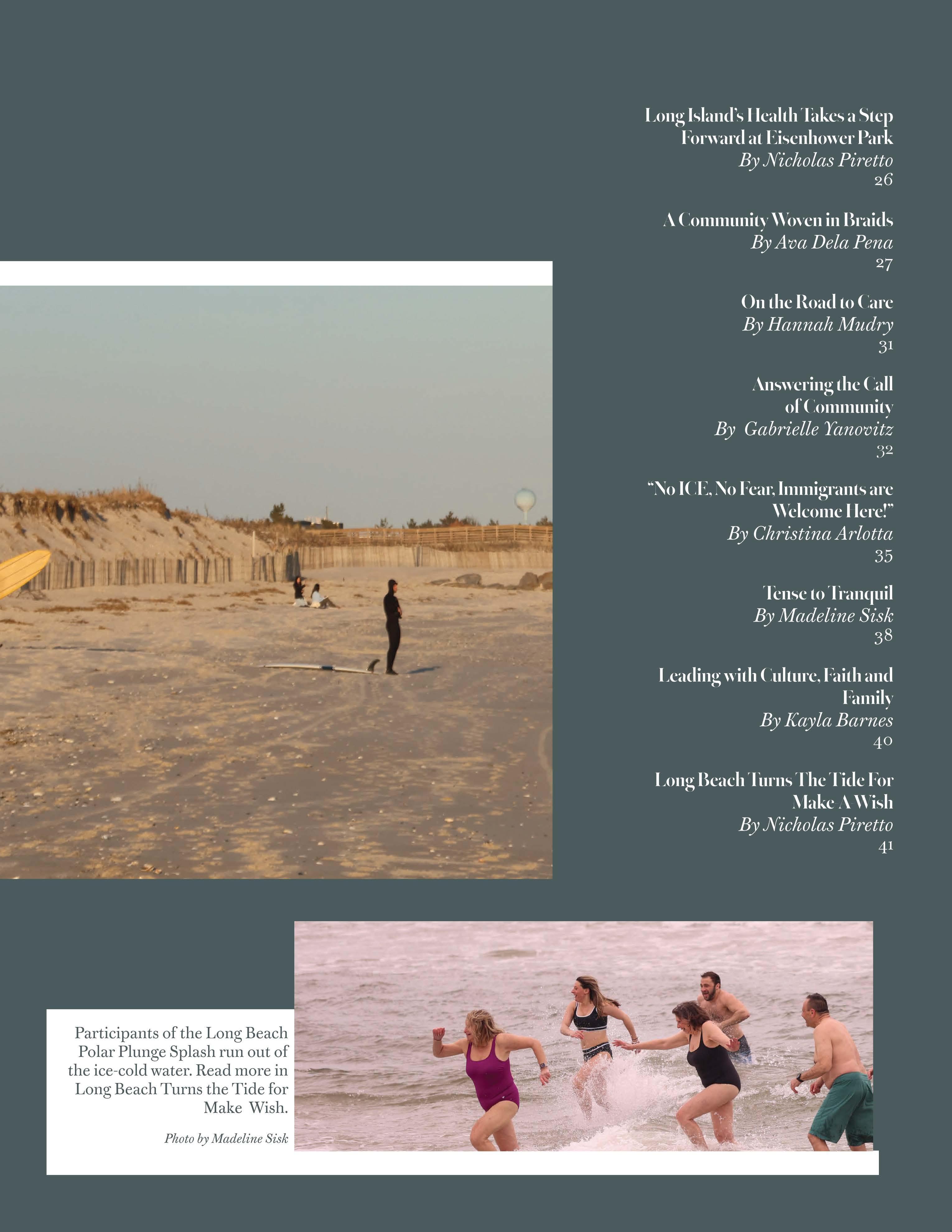
Participants of the Long Beach Polar Plunge Splash run out of the ice-cold water. Read more in Long Beach Turns the Tide for Make Wish.
Photo by Madeline Sisk

EDITOR'S LETTER
Dear Reader,
We built Turning the Tide around our mutual curiosity of the communities that surround Hofstra University with a desire to explore how Long Island is embracing hope in a time of uncertainty. While some of us are native to this place and others are only temporary residents, we share a common admiration for the dozens of grassroots organizations, individual voices and local enterprises that make Long Island unique. We joined together in this mission to expand our reporting skills and uncover the stories that often go unheard.
When creating the 2026 edition of Pulse, we anchored the magazine in the concept of resilience amid unprecedented societal change-how people and communities are standing up to make a difference and finding ways to support themselves and others mentally, physically and spiritually.
Thank you to the past editors and writers of Pulse for paving the way for our edition. We were able to take inspiration from their contributions and the standards they set to build our very own edition, which is unique to our voices but reminiscent of those who came before us.
We wish to thank Professor Brinton for guiding us through every step of the editorial process. From crafting our story pitches to designing each page, Professor Brinton was there to offer advice, words of encouragement and good-humored stories from the past.
Over three months, our staff combined our voices, experiences and words to create something powerful: a comprehensive representation of Long Island's tenacious, diverse and vibrant communities. While embarking on this daunting task as 10 college students, we too found solace in the stories that we discovered.
We hope they inspire you to reflect on your power to turn the tide.
Sincerely,
rile Pulse Team
By IsabellaPlante
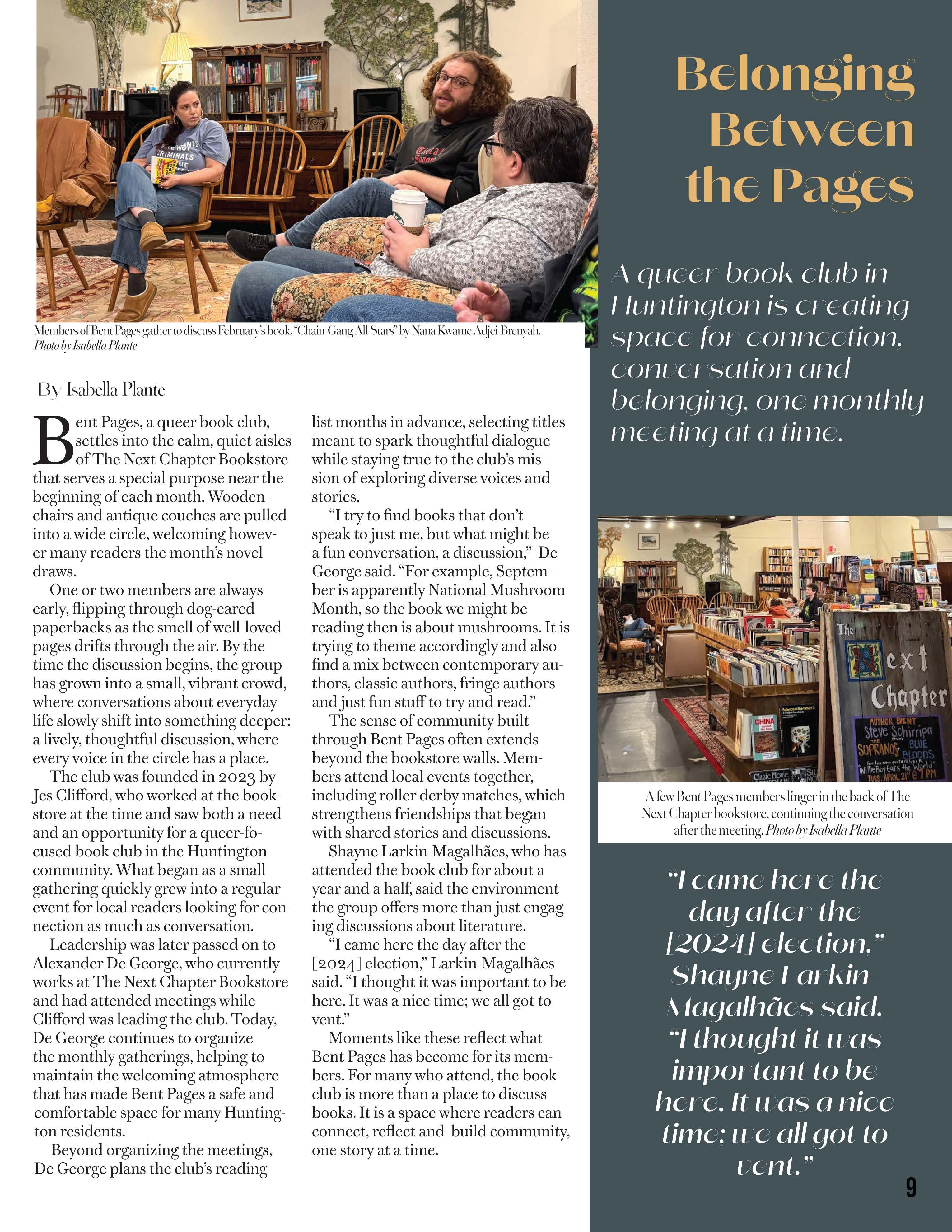
Bent Pages, a queer book club, settles into the calm, quiet aisles of The Next Chapter Bookstore that serves a special purpose near the beginning of each month. Wooden chairs and antique couches are pulled into a wide circle, welcoming however many readers the month's novel draws.
One or two members are always early, flipping through dog-eared paperbacks as the smell of well-loved pages drifts through the air. By the time the discussion begins, the group has grown into a small, vibrant crowd, where conversations about everyday life slowly shift into something deeper: a lively, thoughtful discussion, where every voice in the circle has a place.
The club was founded in 2023 by Jes Clifford, who worked at the bookstore at the time and saw both a need and an opportunity for a queer-focused book club in the Huntington community. What began as a small gathering quickly grew into a regular event for local readers looking for connection as much as conversation.
Leadership was later passed on to Alexander De George, who currently works at The Next Chapter Bookstore and had attended meetings while Clifford was leading the club. Today, De George continues to organize the monthly gatherings, helping to maintain the welcoming atmosphere that has made Bent Pages a safe and comfortable space for many Huntington residents.
Beyond organizing the meetings, De George plans the club's reading
list months in advance, selecting titles meant to spark thoughtful dialogue while staying true to the club's mission of exploring diverse voices and stories.
"I try to find books that don't speak to just me, but what might be a fun conversation, a discussion," De George said. "For example, September is apparently National Mushroom Month, so the book we might be reading then is about mushrooms. It is trying to theme accordingly and also find a mix between contemporary authors, classic authors, fringe authors and just fun stuff to try and read."
The sense of community built through Bent Pages often extends beyond the bookstore walls. Members attend local events together, including roller derby matches, which strengthens friendships that began with shared stories and discussions.
Shayne Larkin-Magalhaes, who has attended the book club for about a year and a half, said the environment the group offers more than just engaging discussions about literature.
"I came here the day after the [2024] election," Larkin-Magalhaes said. "I thought it was important to be here. It was a nice time; we all got to vent."
Moments like these reflect what Bent Pages has become for its members. For many who attend, the book club is more than a place to discuss books. It is a space where readers can connect, reflect and build community, one story at a time.
\ki nbcrs of'Bci11Pagesgather to discussFcbruarv'sbook,"Chai,1( ;ang;:\11Stars"bv :\,11 ia Kwa1ne, \cljciBrei1vah.
Photoiv IsabellaPlante
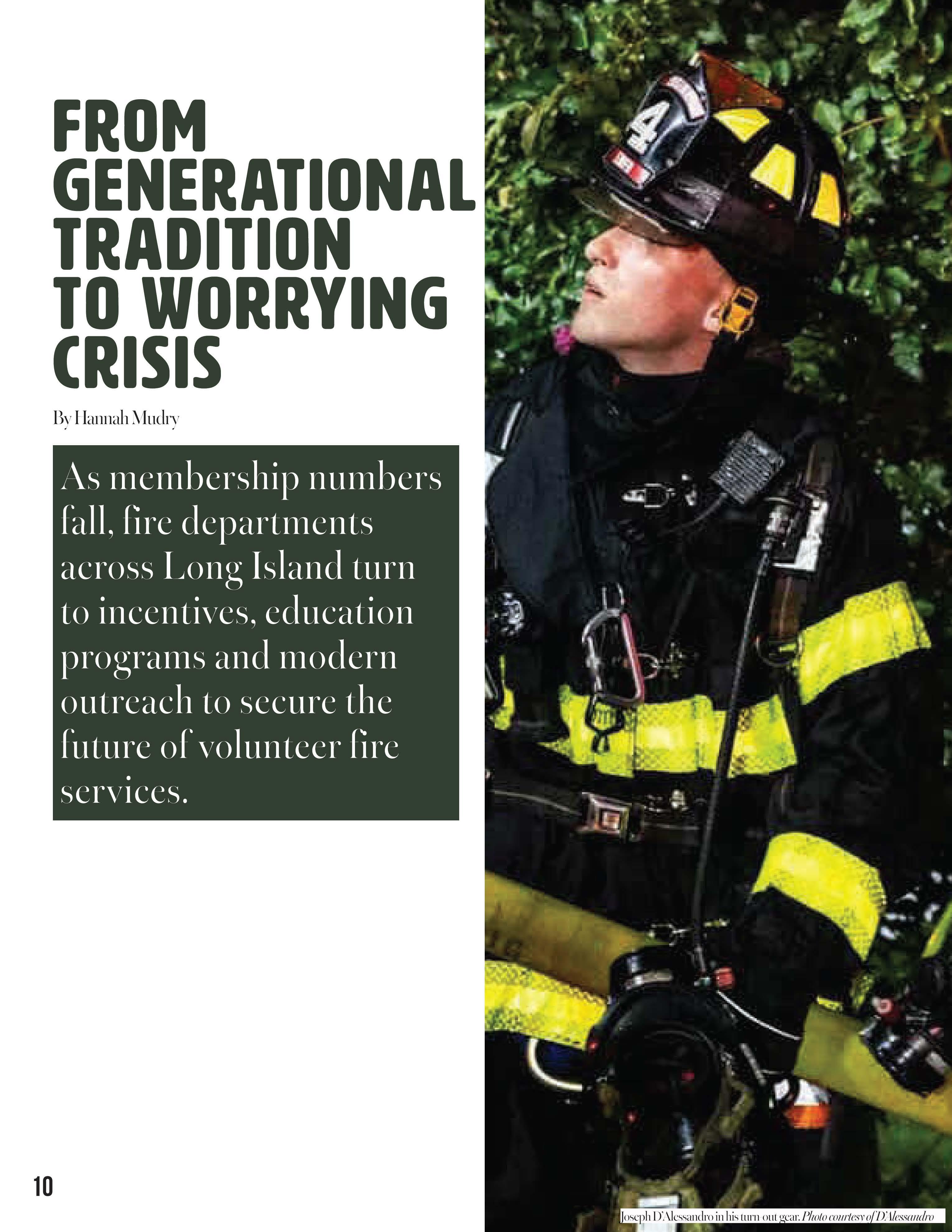
FROM GENERATIONAL TRADITION TOWORRYING CRISIS
BvI-IannahMudrv ; ;
f\s n1en1bership nun1lJers fall, fire departn1ents
across Long Island turn to incentives, education programs and modern outreach to secure the future of volunteer fire . services.
Joseph D'Alessandro, a senior Hofstra University what they're making at one of those other retail outlets, student, volunteers at the East Meadow Fire Depart they're helping the community," Raymond said. "They're ment Station 4. He began his training in October there, they're helping the community, but not only help2023, three days after his 18th birthday. Throughout ing the community, they're providing fire protection. It's his childhood, D'Alessandro visited the station with his a public safety issue." uncle, who volunteered in Nassau County, and dreamed Raymond said other states such as Connecticut, New of serving like him. Jersey and Massachusetts are finding ways to offer such
"The firehouse was part of my life," D'Alessandro said. compensation. New Jersey is introducing nominal com"As a kid, you always want to be a police officer or a pensation to firefighters. firefighter. I always remember being around the trucks, As another way to encourage students to serve the comseeing the camaraderie and family of it." munity, New York State offers high school students credit
D'Alessandro takes pride in his volunteer work and toward higher education degrees through the training and learns skills like empathy and patience that he brings recruitment classes. D'Alessandro received scholarships into his everyday life. In recent years, though, the num toward his higher education from being in the service. ber of volunteer firefighters like him has rapidly de Required training prevents many individuals from joincreased. Still, department leaders remain resilient as ing volunteer services. "You have 30-to 40-year-old men they pursue changes to promote recruitment for young who don't have the two weeks of time to spend in the fire firefighters with D'Alessandro's drive. academy to get all their qualifications, and you're not get
Ralph Raymond, second vice president of the Associa ting the I 7-year-olds who have all the time in the world tion of Fire Districts, is working to increase volunteerism to take all their training during the summer," Thomas and promote younger individuals to join. As a stake Scida, Manhasset-Lakeville Fire Department Company 5 holder in New York fire services, he is advocating for a volunteer, said. bill in the New York State D'Alessandro encourages Legislature that would allow individuals to sign up for firefighters to receive nominal training, even though the
As a kid,
you always compensation, a small mone time commitment can be tary stipend, for their efforts.
want to be a police
taxing. "Dive head first and Raymond sat recently don't stop," D'Alessandro with Gov. Kathy Hochul and
officer or a firefighter.
said. "The more time you representatives from the state
I always remember
put in, the more you'll get legislature to promote two out of it. The training is the
' '
programs that would bring
being around the
best thing I've gotten out of nominal compensation to it -EMT, fire training. It's trucks, seeing the volunteer services: the Length made me the fireman I am of Service Award Program
camaraderie and
today. I've been in numerous (LOSAP), a tax-deferred incidents where I've jumped income program designed
family of it.
right into my training."
to reward active volunteer D'Alessandro said he
''-Joseph D' Alessandro
firefighters and Emergency believes the way to reach Medical Service (EMS) personnel, and the Volunteer younger volunteers is through social media. "A lot of Firefighters' Benefit Law (VFBL), a law to bring nominal departments have an old mentality that they don't need compensation to firefighters primarily by covering them to focus on social media or showing positives of the job under a specialized, state-mandated insurance program through that," D'Alessandro said. "To reach younger that would offer cash benefits for injuries, illnesses or audiences, you have to show fun little things like going to death in the line of duty. Islanders games with your company or going to parades with the guys. Bring socials to the forefront."
A push for pay and policy change
Rising pressurewith fewerresponders
"New York does not allow nominal compensation," Raymond said. "We're sounding the whistle to the leg"[The decrease in volunteers] is extremely significant," islators. Change the law. Change the law to allow the said Raymond. "Ninety-three percent of fire stations in authority-having jurisdiction to come up with a program New York state are volunteer-based. In the last seven to that's going to increase the members so we can continue to 10 years, there's been a significant decrease in volunprovide fire protection to the residents of New York State." teers. I'm a fire commissioner in North Massapequa. So, Raymond said he believes the measures would help in North Massapequa alone, we started with 125 guys ensure that younger generations volunteer. about four years ago. We're down to 85 guys."
"You have somebody working at a McDonald's or a Scida responds to 25% of the station calls. His departTarget. If we can substitute that and have them be at the ment receives about 400 to 500 calls per year, meaning firehouse and nominally compensate them to substitute Scida responses to roughly 10 o calls.
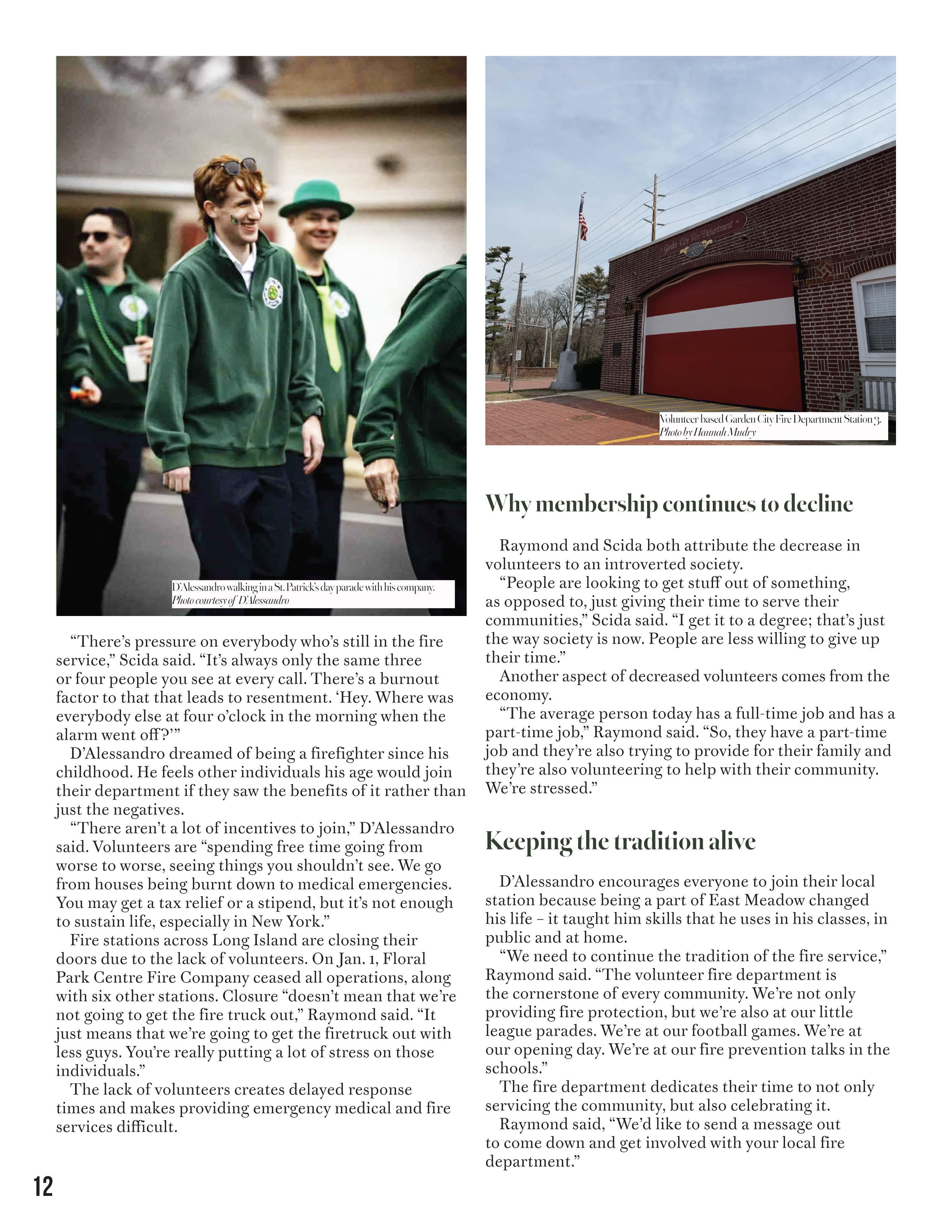
D~\l~ssanclrowalking;in a SL.Patrick·,dav parade withhisc0111panv. ,lmlow111tc~vo//J:lhm11dm
"There's pressure on everybody who's still in the fire service," Scida said. "It's always only the same three or four people you see at every call. There's a burnout factor to that that leads to resentment. 'Hey. Where was everybody else at four o'clock in the morning when the alarm went off?"'
D'Alessandro dreamed of being a firefighter since his childhood. He feels other individuals his age would join their department if they saw the benefits of it rather than just the negatives.
"There aren't a lot of incentives to join," D'Alessandro said. Volunteers are "spending free time going from worse to worse, seeing things you shouldn't see. We go from houses being burnt down to medical emergencies. You may get a tax relief or a stipend, but it's not enough to sustain life, especially in New York."
Fire stations across Long Island are closing their doors due to the lack of volunteers. On Jan. I, Floral Park Centre Fire Company ceased all operations, along with six other stations. Closure "doesn't mean that we're not going to get the fire truck out," Raymond said. "It just means that we're going to get the firetruck out with less guys. You're really putting a lot of stress on those individuals."
The lack of volunteers creates delayed response times and makes providing emergency medical and fire services difficult.
,\ 1hy n1e111hershipcontinues to decline
Raymond and Scida both attribute the decrease in volunteers to an introverted society.
"People are looking to get stuff out of something, as opposed to, just giving their time to serve their communities," Scida said. "I get it to a degree; that's just the way society is now. People are less willing to give up their time."
Another aspect of decreased volunteers comes from the economy.
"The average person today has a full-time job and has a part-time job," Raymond said. "So, they have a part-time job and they're also trying to provide for their family and they're also volunteering to help with their community. We're stressed."
Keeping the tradition alive
D'Alessandro encourages everyone to join their local station because being a part of East Meadow changed his life -it taught him skills that he uses in his classes, in public and at home.
"We need to continue the tradition of the fire service," Raymond said. "The volunteer fire department is the cornerstone of every community. We're not only providing fire protection, but we're also at our little league parades. We're at our football games. We're at our opening day. We're at our fire prevention talks in the schools."
The fire department dedicates their time to not only servicing the community, but also celebrating it.
Raymond said, "We'd like to send a message out to come down and get involved with your local fire department."
\\Jluntccr based ( ;,mienCitvFire
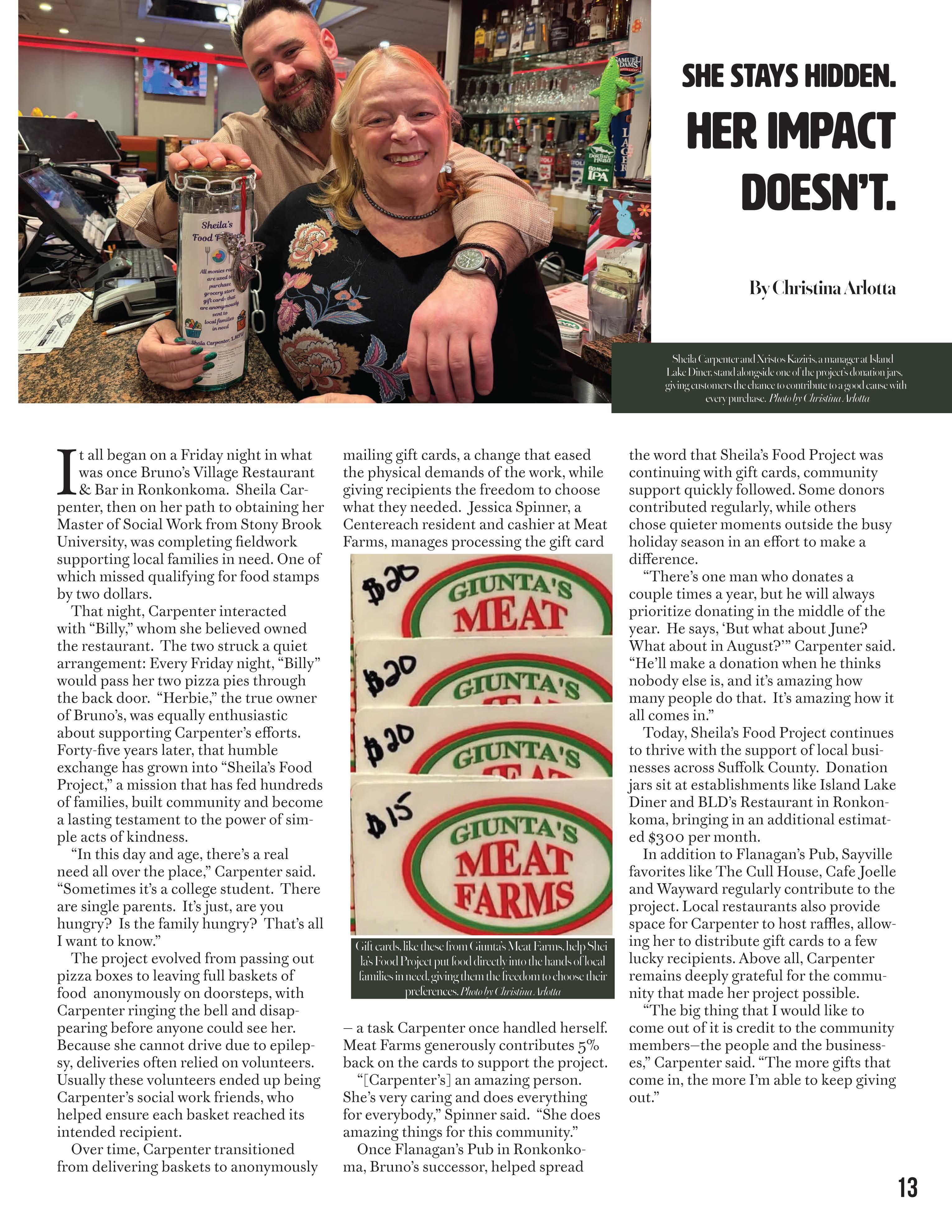
It all began on a Friday night in what was once Bruno's Village Restaurant & Bar in Ronkonkoma. Sheila Carpenter, then on her path to obtaining her Master of Social Work from Stony Brook University, was completing fieldwork supporting local families in need. One of which missed qualifying for food stamps by two dollars.
That night, Carpenter interacted with "Billy,"whom she believed owned the restaurant. The two struck a quiet arrangement: Every Friday night, "Billy" would pass her two pizza pies through the back door. "Herbie," the true owner of Bruno's, was equally enthusiastic about supporting Carpenter's efforts. Forty-five years later, that humble exchange has grown into "Sheila's Food Project," a mission that has fed hundreds of families, built community and become a lasting testament to the power of simple acts of kindness.
"In this day and age, there's a real need all over the place," Carpenter said. "Sometimes it's a college student. There are single parents. It's just, are you hungry? Is the family hungry? That's all I want to know."
The project evolved from passing out pizza boxes to leaving full baskets of food anonymously on doorsteps, with Carpenter ringing the bell and disappearing before anyone could see her. Because she cannot drive due to epilepsy, deliveries often relied on volunteers. Usually these volunteers ended up being Carpenter's social work friends, who helped ensure each basket reached its intended recipient.
Over time, Carpenter transitioned from delivering baskets to anonymously
mailing gift cards, a change that eased the physical demands of the work, while giving recipients the freedom to choose what they needed. Jessica Spinner, a Centereach resident and cashier at Meat Farms, manages processing the gift card
- a task Carpenter once handled herself. Meat Farms generously contributes 5% back on the cards to support the project.
"[Carpenter's] an amazing person. She's very caring and does everything for everybody," Spinner said. "She does amazing things for this community."
Once Flanagan's Pub in Ronkonkoma, Bruno's successor, helped spread
HERIMPACT DOESN'T.
ByChrislinaArloua
the word that Sheila's Food Project was continuing with gift cards, community support quickly followed. Some donors contributed regularly, while others chose quieter moments outside the busy holiday season in an effort to make a difference.
"There's one man who donates a couple times a year, but he will always prioritize donating in the middle of the year. He says, 'But what about June? What about in August?"' Carpenter said. "He'll make a donation when he thinks nobody else is, and it's amazing how many people do that. It's amazing how it all comes in."
Today, Sheila's Food Project continues to thrive with the support oflocal businesses across Suffolk County. Donation jars sit at establishments like Island Lake Diner and BLD's Restaurant in Ronkonkoma, bringing in an additional estimated $300 per month.
In addition to Flanagan's Pub, Sayville favorites like The Cull House, Cafe Joelle and Wayward regularly contribute to the project. Local restaurants also provide space for Carpenter to host raffles, allowing her to distribute gift cards to a few lucky recipients. Above all, Carpenter remains deeply grateful for the community that made her project possible.
"The big thing that I would like to come out of it is credit to the community members-the people and the businesses," Carpenter said. "The more gifts that come in, the more I'm able to keep giving out."
Small Team,
Big Impact
An intimate team runs the Nassau County Office of the New York Civil Liberties Union, but they're at the heart of a coalition of Long Island-based activist groups.
The fight for justice on Long Island remains tumultuous. In the 2024 presidential election, a Newsday analysis found that voters on Long Island voted for President Donald Trump by just a slim majority.
Since his inauguration, however, Long Islanders have protested consistently against injustices. Demonstrations across the east and west end of Long Island have resulted in protesters chanting "Abolish ICE! Hands off! No Kings!"
A number of groups have taken to the streets to make their voices heard, but behind their efforts is an intimate team dedicated to uniting these groups and facilitating a broader network.
The Nassau County Office of the New York Civil Liberties Union is run by just two people. But for NYCLU Director Susan Gottehrer, action is maximized through collaboration with activist groups.
Among these groups are those specializing in immigrant rights, laborer organization and LGBTQ+ rights, to name a few.
"We do partner with all these other organizations to help build capacity," she said. "And that's how you build power. There are a lot of people working on all of this right now. And it feels empowering."
"It t1lleviates the feeling of powerlessness to hop in. It t1lleviates the feeling of being t1lone t1nd sct1r1edbect1use you·re t1ctut1llygoing to be with 8 lm,,gegroup of people." -Susm1 Gottehrer
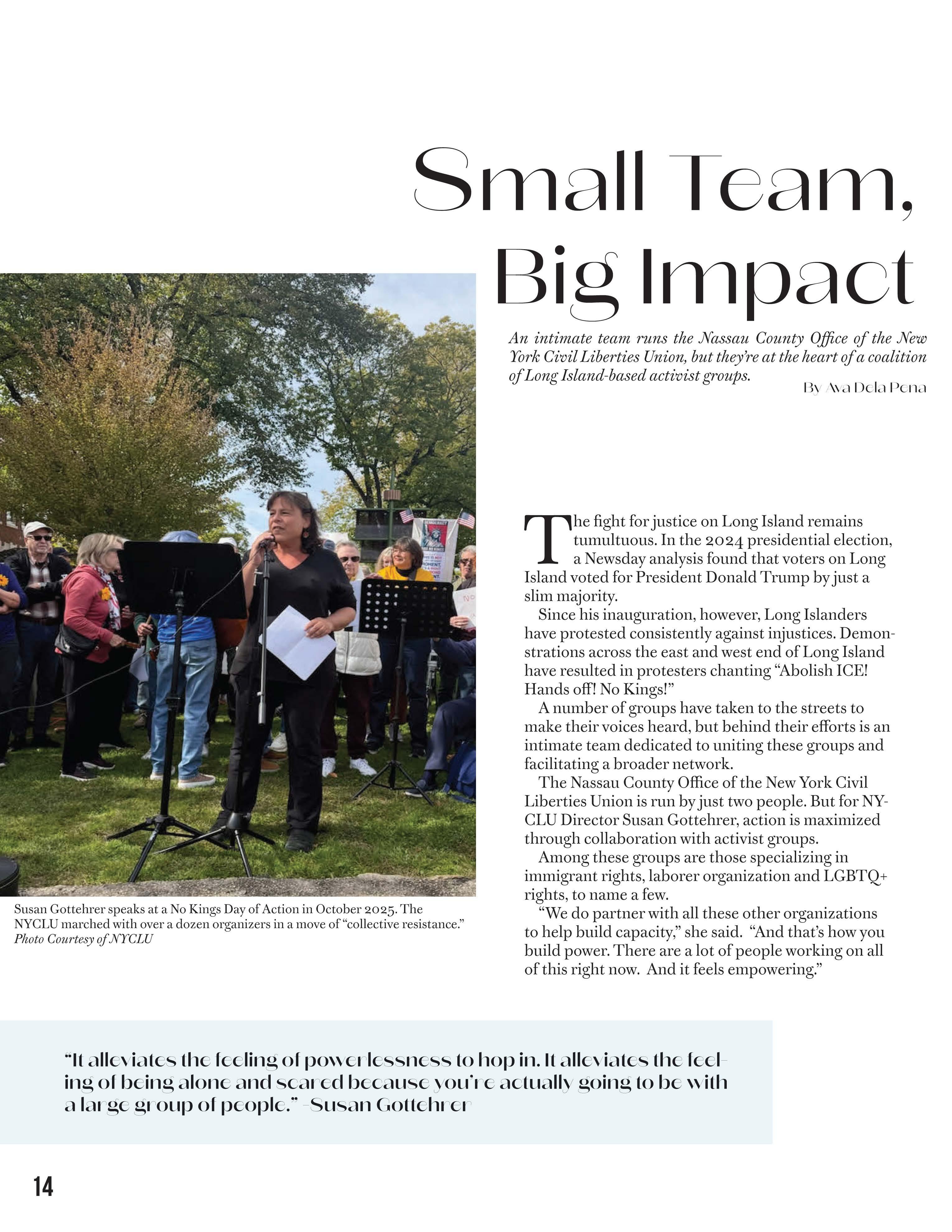
Susan Gottehrer speaks at a No Kings Day of Action in October 2025. The NYCLU marched with over a dozen organizers in a move of"collective resistance."
Photo Courtesy of NYCLU
13yAvo Dela Pena
These protests are not always organized by the NYCLU, but they do play a key role in ensuring the safety of demonstrators. They work with those looking to get involved as protesters, those looking to organize protests and those looking to participate in 'rapid response'-a form of protesting in which individuals challenge ongoing activity in real time. Most recently, 'rapid response' has been a reaction to I CE efforts.
"People need to be making sure that they know their rights before, especially if they're going to get involved in rapid response," Gottehrer said.
The NYCLU offers workshops and training for each level of involvement. These
workshops include 'Know Your
Rights' demonstrations as well
as town hall meetings where
individuals can connect with local issues. They are held on a request basis, but no request is too small. "I will also sometimes, depending on demand, [...] get on a Zoom with one person or two people to give them some advice," Gottehrer said. Making these resources accessible for young people is the key to prepping the next generation of activists. Gottehrer said youths are "not immune" from the injustices unfolding around them. "They should get involved because it's their future," she said.
"It's not like I'm one person, and I'm not going to make a difference," Gottehrer said. "If every single person said, 'I'm only one person, and I'm not going to make a difference,' then, the streets would be empty."
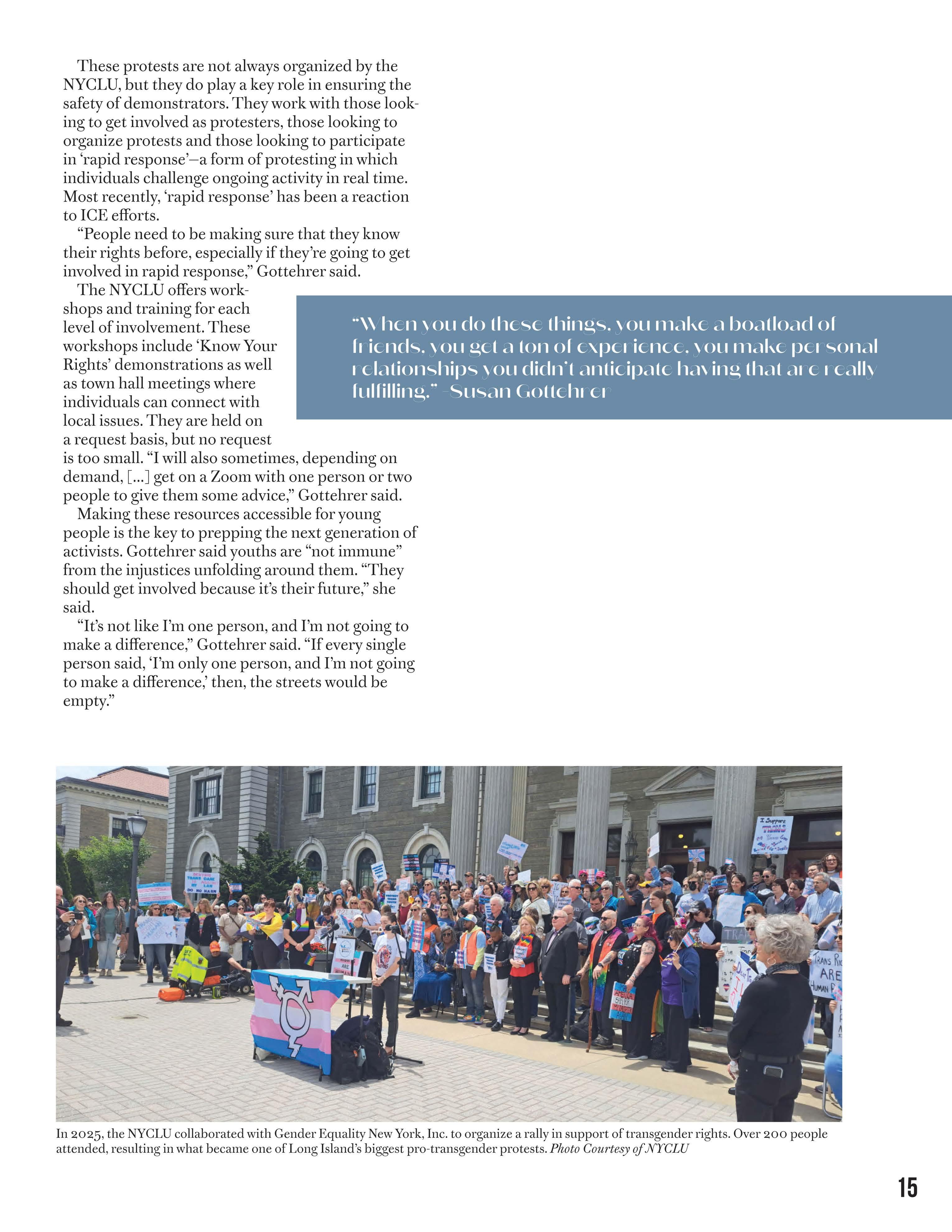
In 2025, the NYCLU collaborated with Gender Equality New York, Inc. to organize a rally in support of transgender rights. Over 200 people attended, resulting in what became one of Long Island's biggest pro-trans gender protests. Photo Courtesy qf NYCLU
Coloring Outside the Splashes of Hope brings art and inspiration to Long Island
By Gi8l1l18 Cost8l1ZO
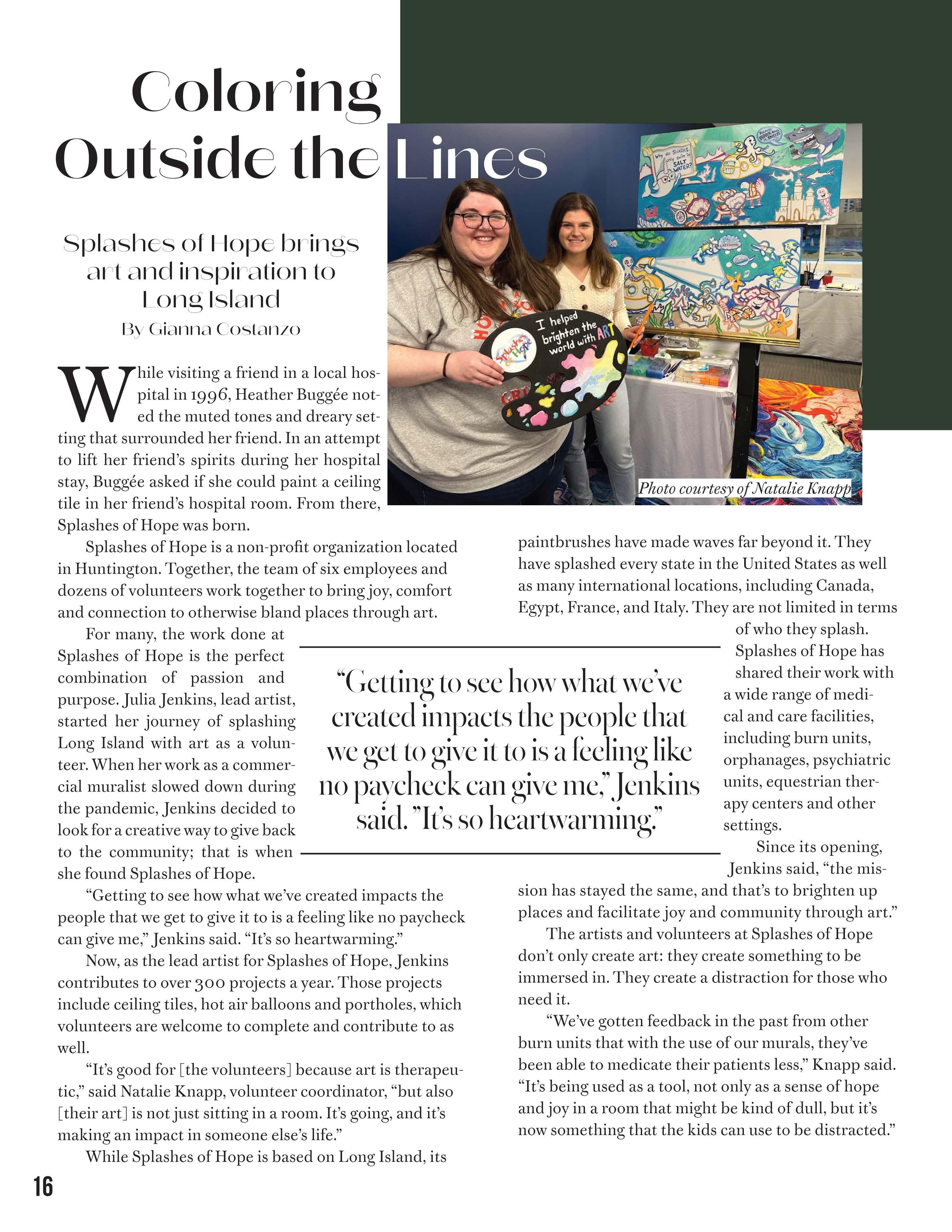
While visiting a friend in a local hospital in 1996, Heather Buggee noted the muted tones and dreary setting that surrounded her friend. In an attempt to lift her friend's spirits during her hospital stay, Buggee asked if she could paint a ceiling tile in her friend's hospital room. From there, Splashes of Hope was born.
Splashes of Hope is a non-profit organization located in Huntington. Together, the team of six employees and dozens of volunteers work together to bring joy, comfort and connection to otherwise bland places through art. of who they splash.
For many, the work done at
Splashes of Hope is the perfect combination of passion and purpose. Julia Jenkins, lead artist, started her journey of splashing Long Island with art as a volunteer. When her work as a commercial muralist slowed down during the pandemic, Jenkins decided to look for a creative way to give back
paintbrushes have made waves far beyond it. They have splashed every state in the United States as well as many international locations, including Canada, Egypt, France, and Italy. They are not limited in terms
"G • l l ' ett1ngto see 10,,,"' 1at"'eve created in1pactsthe people that "'e get to giveit to is a feelinglike no paycheckcan given1e;'Jenkins "d "I ' ts so l1eart"1arn11ng. " sa1 . •
to the community; that is when ----------------------she found Splashes of Hope.
"Getting to see how what we've created impacts the people that we get to give it to is a feeling like no paycheck can give me," Jenkins said. "It's so heartwarming."
Now, as the lead artist for Splashes of Hope,Jenkins contributes to over 300 projects a year. Those projects include ceiling tiles, hot air balloons and portholes, which volunteers are welcome to complete and contribute to as well.
"It's good for [the volunteers] because art is therapeutic," said Natalie Knapp, volunteer coordinator, "but also [their art] is not just sitting in a room. It's going, and it's making an impact in someone else's life."
While Splashes of Hope is based on Long Island, its
Splashes of Hope has shared their work with a wide range of medical and care facilities, including burn units, orphanages, psychiatric units, equestrian therapy centers and other settings.
Since its opening, Jenkins said, "the mission has stayed the same, and that's to brighten up places and facilitate joy and community through art."
The artists and volunteers at Splashes of Hope don't only create art: they create something to be immersed in. They create a distraction for those who need it.
"We've gotten feedback in the past from other burn units that with the use of our murals, they've been able to medicate their patients less," Knapp said. "It's being used as a tool, not only as a sense of hope and joy in a room that might be kind of dull, but it's now something that the kids can use to be distracted."
She Leads with Style
By Gabrielle Yanovitz
In Roslyn lives a boutique thrift shop that's cycled through designer garments, vintage housewares and eccentric accessories since 1962. While neighborhood regulars return each week to forage for a one-of-akind item, many are unaware that their purchase funds the service initiatives of the Junior League of Long Island (JLLI), a nonprofit organization that supports women and children in need while empowering women to take on leadership roles in their community.
Remi Farnan, a Glen Cove native who served as the youngest president of Long Island's chapter two years ago, has expanded the shop's outreach with younger generations, for whom thrifting has become increasingly popular. As one of the last remaining Junior League thrift stores in the country across nearly 300 chapters, Farnan has made a point to emphasize the impacts of the shop when customers stop by.
"It's been cool to be able to catch people's attention to bring them to an organization that goes back into the community," she said. "Thrifting is like an adventure, and here it's an adventure that gives back."
The Roslyn storefront is JLLI's largest fundraiser, contributing to its Community Service Fund that raised $31,000 in 2025. The fund supports monthly projects such as Thanksgiving basket making and birthday deliveries for children experiencing homelessness, and provides grants to organizations across the island like Bethany House, Allied Foundation, Tri-Community and Youth Agency and Sangha Education Center to tackle issues that impact women and children on Long Island most directly.
"The unique part about Long Island is that it's so diverse all over," said President Jess Torracca, who's been an active member of the chapter since 2021. "We're able to support all of the needs based on the different organizations we're touching."
Torraccajoined the Junior League following the footsteps of her mother, who was a member of Long Island's chapter in the 1990s. Wanting to meet new friends in the area and serve Long Island, she found much more-a space for women to collaborate across generations and develop crucial leadership skills to serve their communities.
"We have women in our organization who were on the C-suite of major companies, to stay-at-home-moms," Torracca said. "People are getting experience on things that they wouldn't have had anywhere else."
Farnan expressed a deep gratitude for the organization that's celebrating its 75th anniversary in 2026, noting that beyond the resounding impacts they make on Long Island, what keeps Junior League members driving forward is the personal and professional development they receive through leading.
"The Junior League is women leading a woman's world, and women leading the world," Farnan said. "It gave me public speaking skills, project management skills ... I have a lot of confidence in what I can do as a leader because of the Junior League."
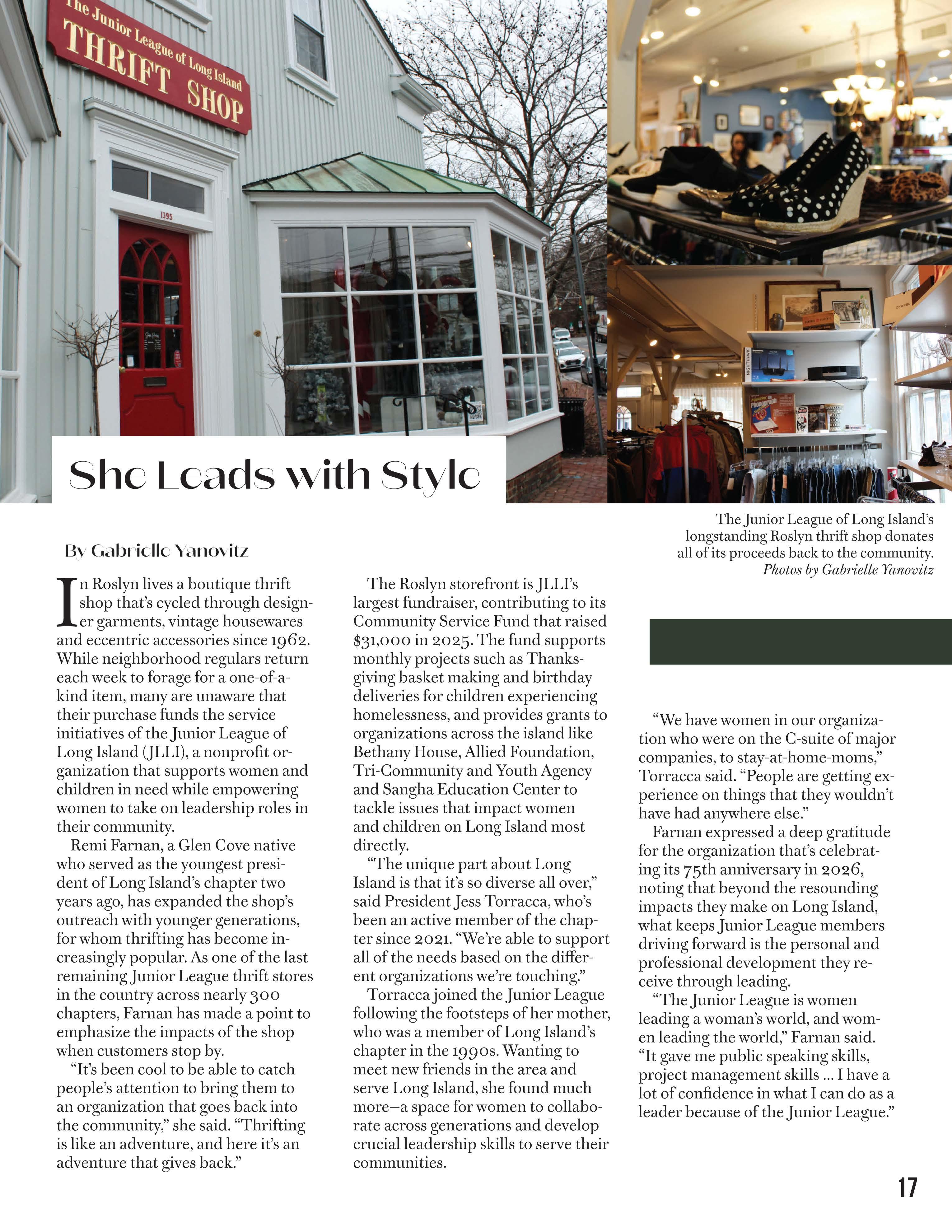
The Junior League of Long Island's longstanding Roslyn thrift shop donates all of its proceeds back to the community.
Photos by Gabrielle Yanovitz
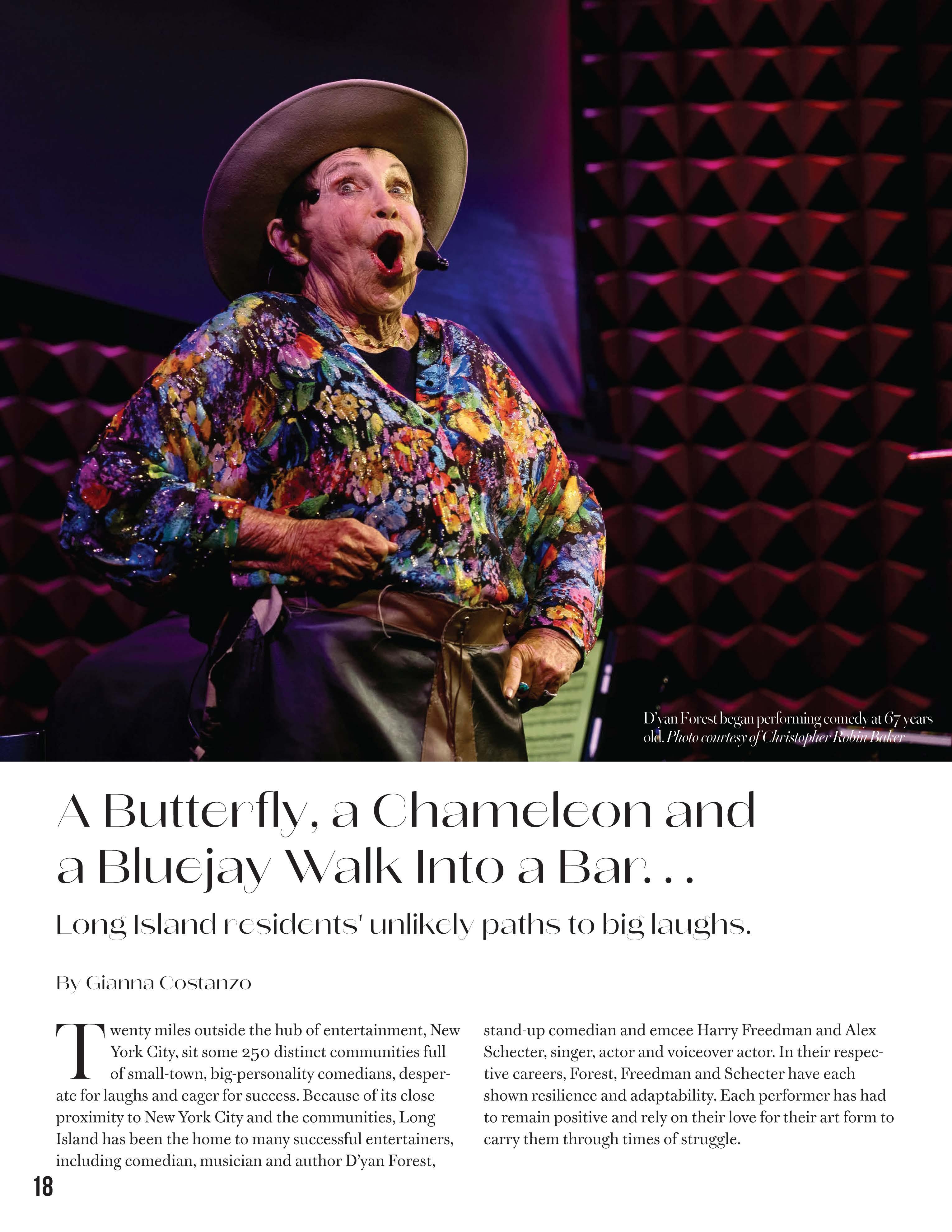
A Butterfly, a Chameleon and a Bluejay Walk Into a Bar . ..
Long Island residents' unlikely paths to big laughs.
By Gianna Costanzo
wenty miles outside the hub of entertainment, New stand-up comedian and emcee Harry Freedman and Alex York City, sit some 250 distinct communities full Schecter, singer, actor and voiceover actor. In their respecof small-town, big-personality comedians, desper-tive careers, Forest, Freedman and Schecter have each ate for laughs and eager for success. Because of its close shown resilience and adaptability. Each performer has had proximity to New York City and the communities, Long to remain positive and rely on their love for their art form to Island has been the home to many successful entertainers, carry them through times of struggle. including comedian, musician and author D'yan Forest,
D'yanForest,the monarch butterfly
At 91 years old, Forest is the oldest working female comedian, as recognized by Guinness World Records. "I'm not your normal comic," Forest said. "There aren't that many old people around. When they see you walking the stage, they don't expect anything. 'What's this old lady doing here?' [they ask.] The best thing that happens is when they're laughing and they realize, 'Oh, this isn't just a little old grandma."'
and then, all of a sudden, [we] musicians were out of work."
Forest noticed a lack of interest in musical entertainment, so she decided, at the age of 67, to pivot into comedy. After a successful comedy show at Caroline's on Broadway comedy club, Forest fell in love.
"I never thought people would laugh at me," Forest said. "It's a thrill. That's why I stick at it: it warms my heart."
Like a monarch butter .--------------------------, fly, Forest has traveled far in her lifetime, defied odds by transforming her life and has displayed longevity in her new career.
After studying drama and music at multiple uni L-------------------------
versities worldwide, most notably the Berk.lee College of Music, Forest, a resident of Southampton for nearly three decades, began her career as a pianist and vocalist. After decades of performing in local and international piano bars and theaters, Forest's life and the world changed following the 9/11 attacks.
"There was silence in New York," Forest said. "Everybody was so saddand down. Nothing was happening,
Harrv Freedman,the chameleon ;
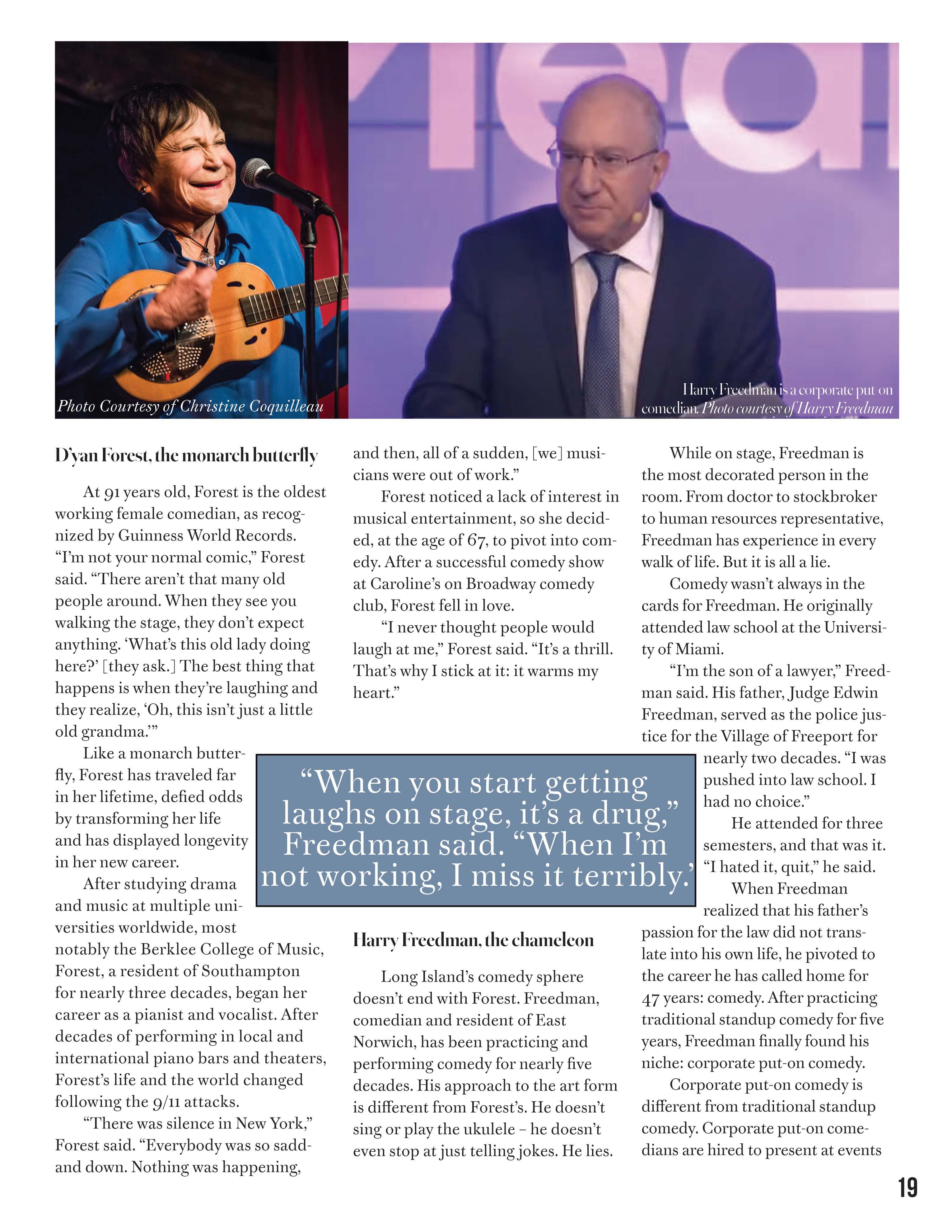
Long Island's comedy sphere doesn't end with Forest. Freedman, comedian and resident of East Norwich, has been practicing and performing comedy for nearly five decades. His approach to the art form is different from Forest's. He doesn't sing or play the ukulele -he doesn't even stop at just telling jokes. He lies.
While on stage, Freedman is the most decorated person in the room. From doctor to stockbroker to human resources representative, Freedman has experience in every walk of life. But it is all a lie.
Comedy wasn't always in the cards for Freedman. He originally attended law school at the University of Miami.
"I'm the son of a lawyer," Freedman said. His father, Judge Edwin Freedman, served as the police justice for the Village of Freeport for nearly two decades. "I was pushed into law school. I had no choice."
He attended for three semesters, and that was it.
"I hated it, quit," he said. When Freedman realized that his father's passion for the law did not translate into his own life, he pivoted to the career he has called home for 4 7 years: comedy. After practicing traditional standup comedy for five years, Freedman finally found his niche: corporate put-on comedy. Corporate put-on comedy is different from traditional standup comedy. Corporate put-on comedians are hired to present at events
and pretend to be experts in the specific businesses that they were hired by.
"It was like a whole world, and I got into that world," Freedman said.
While on stage, Freedman sets a challenge for himself: to trick the audience for as long as possible.
"The corporate show, when I'm doing that, they think I am a new consultant or an industry expert. They don't know I'm a comic," Freedman said. "My goal is to get them laughing, but have them think I'm real for as long as possible and slowly but surely get more outrageous."
For Freedman, that thrill is what keeps him coming back to the stage after 4 7 years of performing. "When you start getting laughs on stage, it's a drug," Freedman said. "When I'm not working, I miss it terribly."
Across Long Island, comedians like Forest and Freedman prove that there is no single path to the stage -only a shared pursuit of laughter and the thrill that comes with it.
Alex Schecter,the bluC;jay
On the flip side, Schecter, who grew up in Great Neck, only got his start there. He now resides in Manhattan and frequents the Broadway, off-Broadway and studio stages.
Similar to a blue jay, Schecter migrated a short distance from his home to a place where he could succeed in his chosen career.
While many of Schecter's friends and colleagues have made a life for themselves split between Long Island and New York City, the Island was more of a stepping stone for Alex.
After discovering his passion for the arts in high school, Schecter decided to further his learning by attending Vanderbilt University. There, Schecter received a bache-
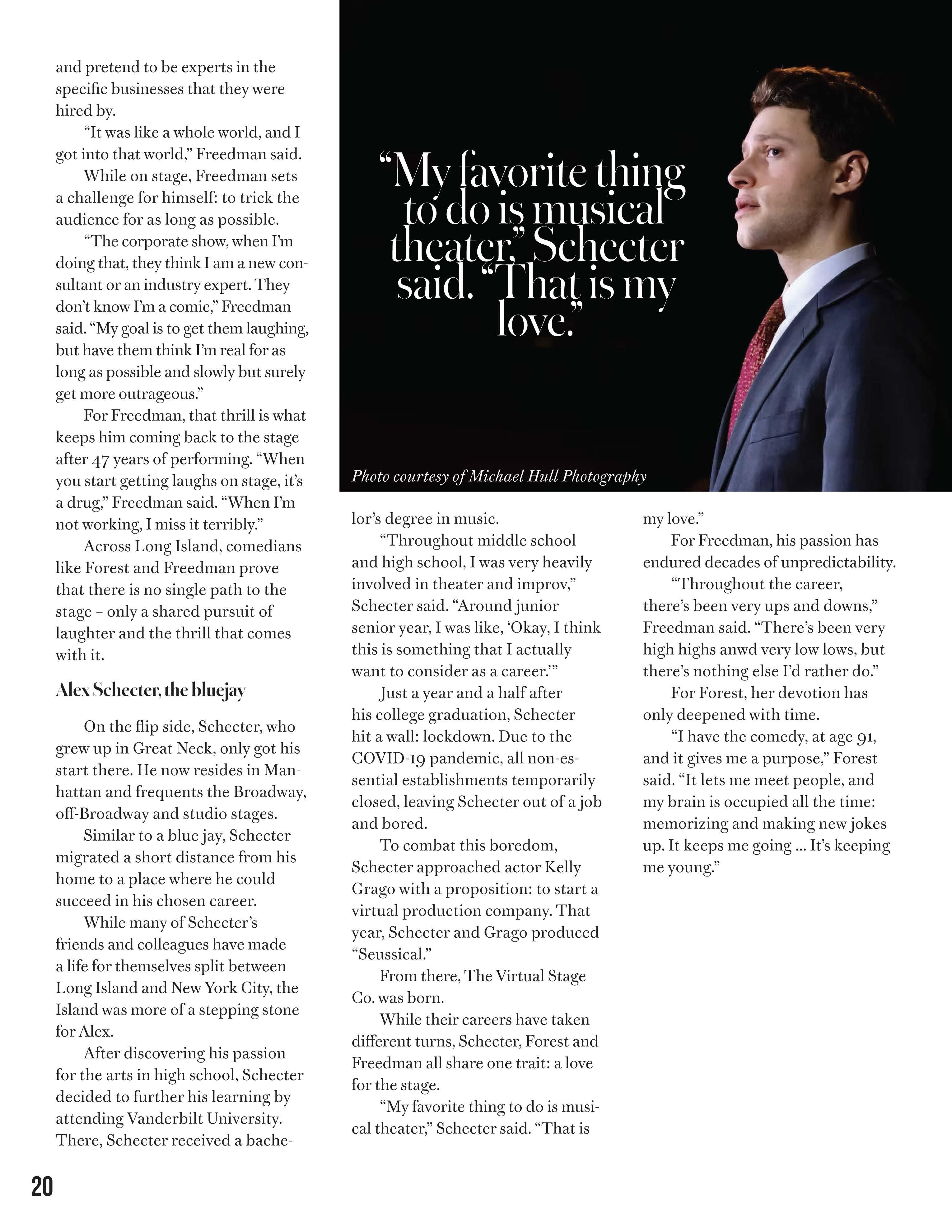
lor's degree in music.
"Throughout middle school and high school, I was very heavily involved in theater and improv," Schecter said. "Around junior senior year, I was like, 'Okay, I think this is something that I actually want to consider as a career."'
Just a year and a half after his college graduation, Schecter hit a wall: lock.down. Due to the COVID-19 pandemic, all non-essential establishments temporarily closed, leaving Schecter out of a job and bored.
To combat this boredom, Schecter approached actor Kelly Grago with a proposition: to start a virtual production company. That year, Schecter and Grago produced "Seussical."
From there, The Virtual Stage Co. was born.
While their careers have taken different turns, Schecter, Forest and Freedman all share one trait: a love for the stage.
"My favorite thing to do is musical theater," Schecter said. "That is
my love."
For Freedman, his passion has endured decades of unpredictability.
"Throughout the career, there's been very ups and downs," Freedman said. "There's been very high highs anwd very low lows, but there's nothing else I'd rather do."
For Forest, her devotion has only deepened with time.
"I have the comedy, at age 91, and it gives me a purpose," Forest said. "It lets me meet people, and my brain is occupied all the time: memorizing and making new jokes up. It keeps me going ... It's keeping me young."
Long Island Cares Battles Hunger, Builds Community
BvKavlaBarnes / /
0n December 12, 2022, outside a Freeport pantry, a man arrived on a bicycle with his dog trotting beside him. Before stepping inside, he removed his coat and placed it on the ground so the dog could stay warm.
Long Island families facing food insecurity are turning in increasing numbers to Long Island Cares, a regional food bank that serves thousands of people each year. Through its network of pantries, outreach programs and community partnerships, the organization works to meet the growing demand for food assistance across the region.
For Kaylin Wasilchuk, corporate philanthropy manager at Long Island Cares, moments like that highlight the reality many Long Islanders face.
"It made me realize how hard it is for some people to get access to food and what they are willing to do to make sure they can eat," Wasilchuk said.
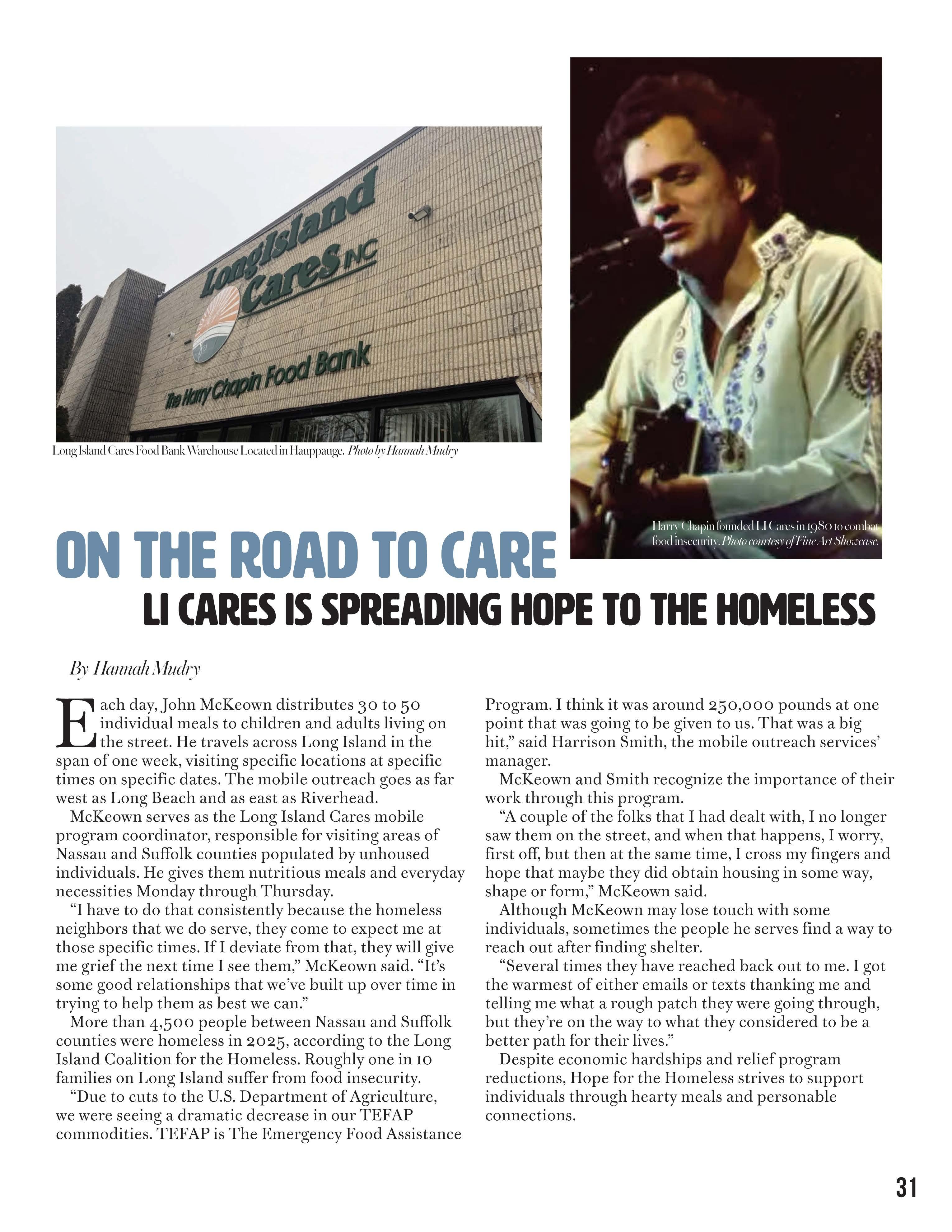
Founded in 1980 by singer-songwriter Harry Chapin, Long Island Cares was created with the vision of a hunger-free Long Island. Today, the organization continues to work toward that goal by providing both immediate food assistance and long-term support services.
"Our mission is to bring together all available resources for the benefit of the hungry and food insecure on Long Island," Wasilchuk said. "To the best of our ability, we want to provide for the
humanitarian needs of our community."
Over the years, the organization has expanded its reach, helping those in a wide range of populations, including seniors, veterans, children and individuals experiencing homelessness. In addition to operating six pantry locations, Long Island Cares supports a network of more than 3 o o partner
c.m clo11<1tcju...,t ',IO <mcl I h<l I p1 m iclc ._,._,j....._ me. 11...,to
agencies, including shelters, soup kitchens and schools.
The pantry locations range from: Hauppauge Headquarters 10 Davids Drive
Bethpage Essential Market 386 N. Wantagh Ave.
Freeport Nassau Service Center 475 N. Brookside Ave.
Lindenhurst South Shore Service Center 161-163 N. Wellwood Ave.
Huntington Station Humanitarian Center 220 Broadway
Valley Stream West Nassau Center 241 Rockaway Ave.
Hampton Bays Hunger Assistance
102 W. Montauk
In the past year alone, the organization has served approximately 196,000 people at its pantry locations, according to Wasilchuk.
"We are more than just food," Wasilchuk said. "We have services for seniors, veterans, pets, the homeless, children and everyone in between."
Long Island Cares relies heavily on community support to sustain its operations. Funding comes from a mix of individual donors, corporations, foundations and fundraising events, all of which contribute to the organization's ability to provide meals and services to others in need. Even small contributions can have a significant impact.
Volunteers also play a critical role in keeping the organization running. With more than 5,000 volunteers in its database, Long Island Cares depends on community members to help sort, organize and distribute food.
"We literally couldn't do what we do without them," Wasilchuk said.
Like many food banks, Long Island Cares has faced major challenges in recent years. During the COVID-19 pandemic and periods of economic instability, the demand for food assistance increased dramatically while resources became strained.
"People who never thought they would see a food pantry line were suddenly on one," Wasilchuk said. "It was a time of crisis for food banks everywhere."
Despite these challenges, staff members say the need for services continues to grow, driven in part by rising food costs and increased demand across Long Island.
\ olunlccrs packingmealsforpeople in need.Photocourle~v(/lfr~vlaBarne~
Racks in lhc warehouse.Photo~vKc~vla Barnes
Rows of meals & lhc volunteerspack ing the meals.Photo~vf{'c~vlaBarnes
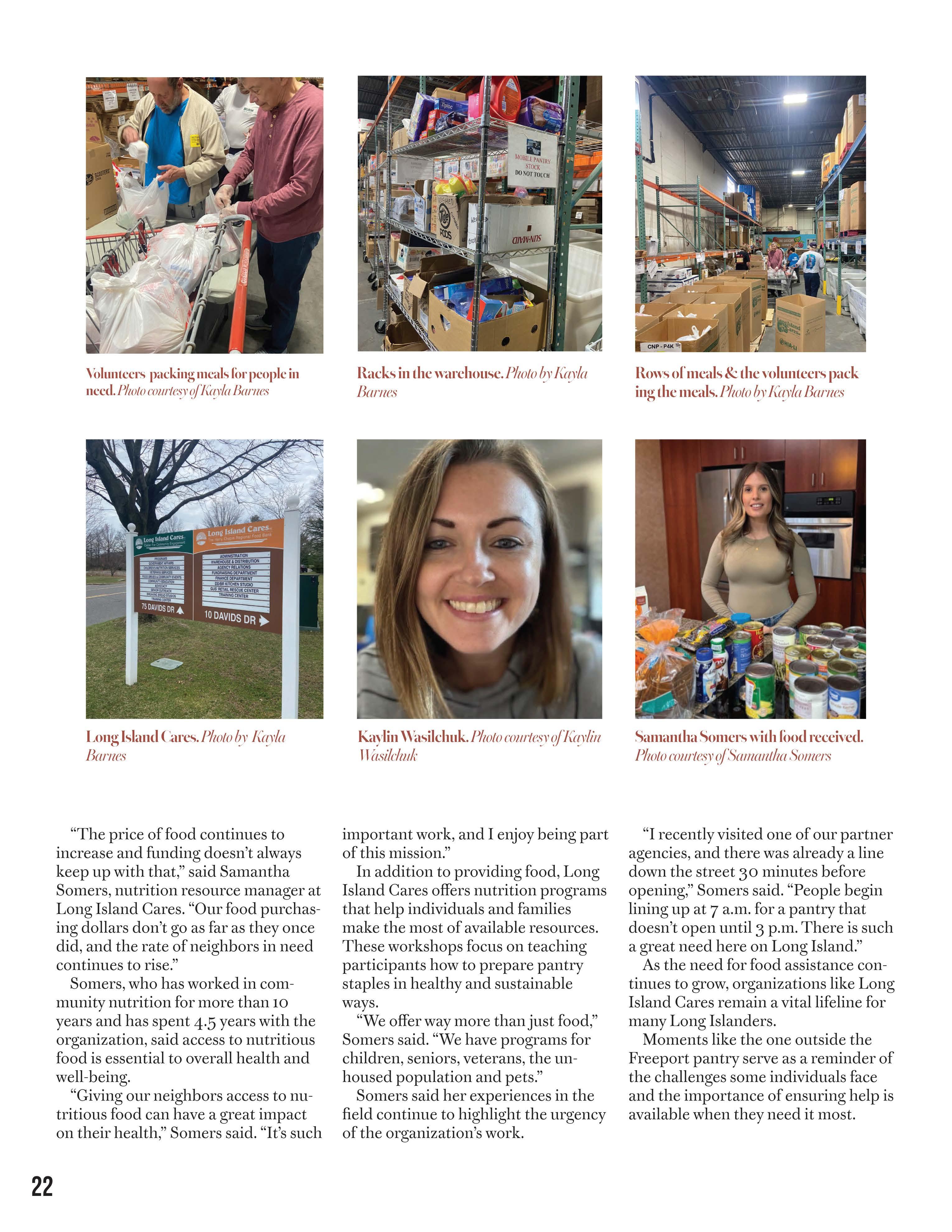
Long Island(:arcs.Photo~,,Kc~vla Barnes
KaylinWasikhuk.Photocourtesyq/Kqyltiz TIctst'/dzuk
SamanthaSomers with food received. Photocourte,~vq/SamanthaSomm;
"The price of food continues to increase and funding doesn't always keep up with that," said Samantha Somers, nutrition resource manager at Long Island Cares. "Our food purchasing dollars don't go as far as they once did, and the rate of neighbors in need continues to rise."
Somers, who has worked in community nutrition for more than 10 years and has spent 4.5 years with the organization, said access to nutritious food is essential to overall health and well-being.
"Giving our neighbors access to nutritious food can have a great impact on their health," Somers said. "It's such
important work, and I enjoy being part of this mission."
In addition to providing food, Long Island Cares offers nutrition programs that help individuals and families make the most of available resources. These workshops focus on teaching participants how to prepare pantry staples in healthy and sustainable ways.
"We offer way more than just food," Somers said. "We have programs for children, seniors, veterans, the unhoused population and pets."
Somers said her experiences in the field continue to highlight the urgency of the organization's work.
"I recently visited one of our partner agencies, and there was already a line down the street 30 minutes before opening," Somers said. "People begin lining up at 7 a.m. for a pantry that doesn't open until 3 p.m. There is such a great need here on Long Island."
As the need for food assistance continues to grow, organizations like Long Island Cares remain a vital lifeline for many Long Islanders.
Moments like the one outside the Freeport pantry serve as a reminder of the challenges some individuals face and the importance of ensuring help is available when they need it most.

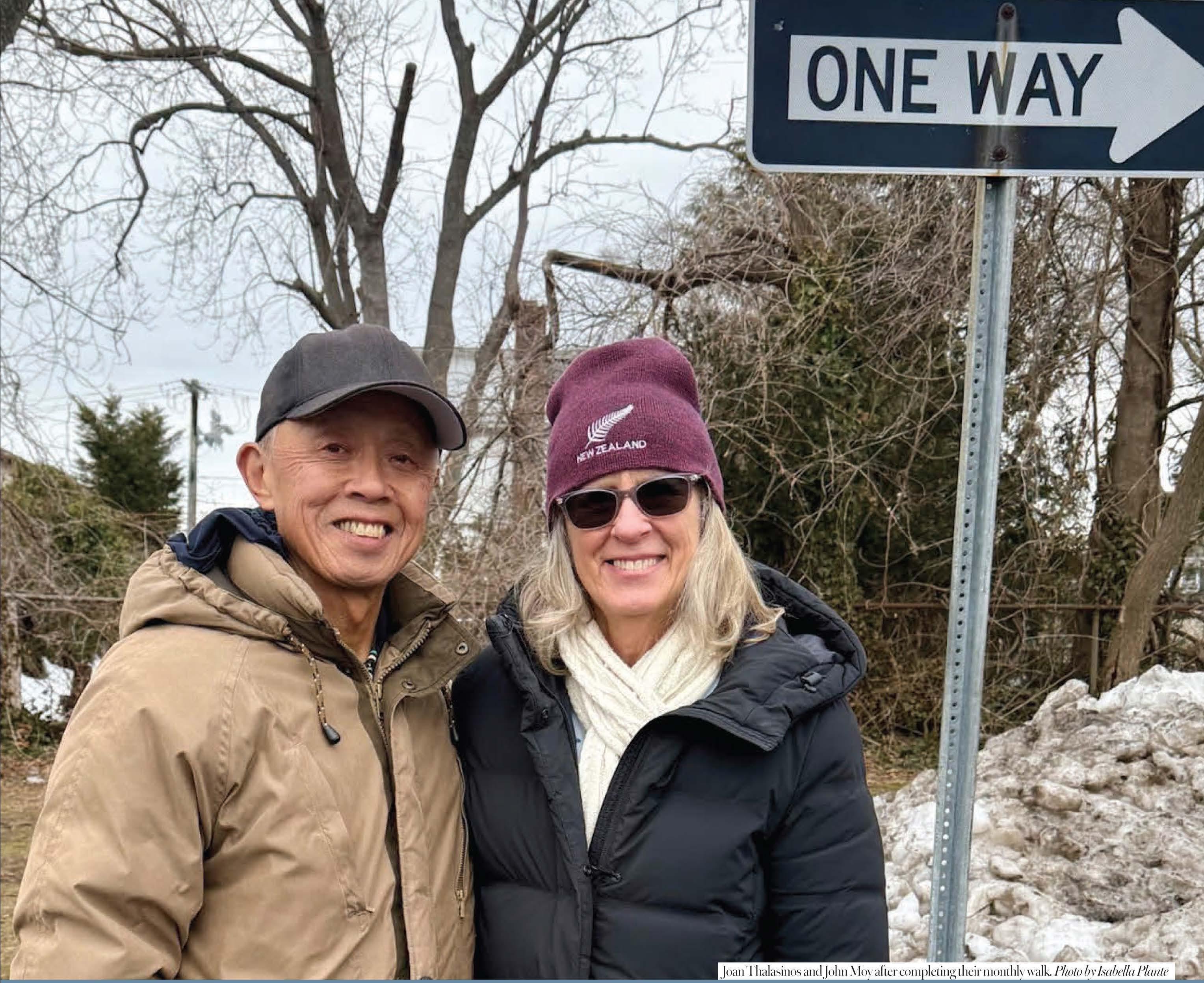
As Joan Thalasinos andjohn Moy close the little over twomile loop around Arthur J. Hendrickson Park, they complete a monthly tradition that not only brings neighbors together but reminds the two of the spark they kindled not so long ago.
With healthcare challenges and social isolation continuing to rise among Long Islanders, and more broadly Americans, initiatives like Walk with a Doc are helping spread hope.
More than just exercise, the program creates space for connection across generations while promoting both physical and mental well-being. Rooted in the principles oflifestyle medicine, the chapter reflects a larger shift across Long Island: neighbors coming together prioritizing their health, and strengthening the social bonds that help communities endure and thrive.
And that is exaclty what happend for Thalasinos and Moy.
In the spirit of health and wellness, the two didn't meet on the trail itself, but in the in-between moments, after their monthly meeting, as people filtered back to their cars. Thalasinos was swapping her sneakers, getting ready to head to a game of pickleball, when a casual conversation turned into something more.
The two were introduced by Moy's neighbors, who after becoming friendly with Thalasinos, encouraged him to come for a walk. They met through the program when Moy joined in June 2025, began dating soon after, and have attended the walks together ever smce.
"I was getting in my car, and we started chatting, and I told him I was changing my sneakers because I was going to go play pickleball," Thalasinos said. "He was like, 'Oh, I would like to play pickleball,' and then the rest is history."
They hadn't even walked together that day
But that's the point.
What started as a simple health initiative has grown into something far beyond steps and miles. It's a space
where strangers become familiar, where small conversations turn into friendships and where wellness extends past physical health into a sense of belonging.
From learning new health topics each month, to meeting neighbors, or having open conversations with physicians, the group offers more than just a walk, it offers connection and companionship because sometimes, all it takes is a five minute conversation in the parking lot to change everything.
More than just a walk
With more than 500 chapters nationwide, and five across Long Island, Walk with a Doc continues to grow, grounded in the belief that "walking truly is the best medicine." At its core, the program encourages physicians to step beyond the confines of their offices and into their communities, forming local groups that meet for monthly walks. It's a simple idea with a lasting impact: creating a space where health and happiness combined with conversation and connection support the well-being of the community.
In Valley Stream, the chapter has been doingjust that since March 2023. What began as a simple monthly walk to prevent a sedentary life has grown into a steady gathering point for residents of all ages, where conversation flows as easily as the miles.
The chapter's dedication extends far beyond its lead physicians. At its heart, there is a core group of around seven members who show up month after month, committed not only to the walk itself, but to the small community they've built in pursuit of self-improvement.
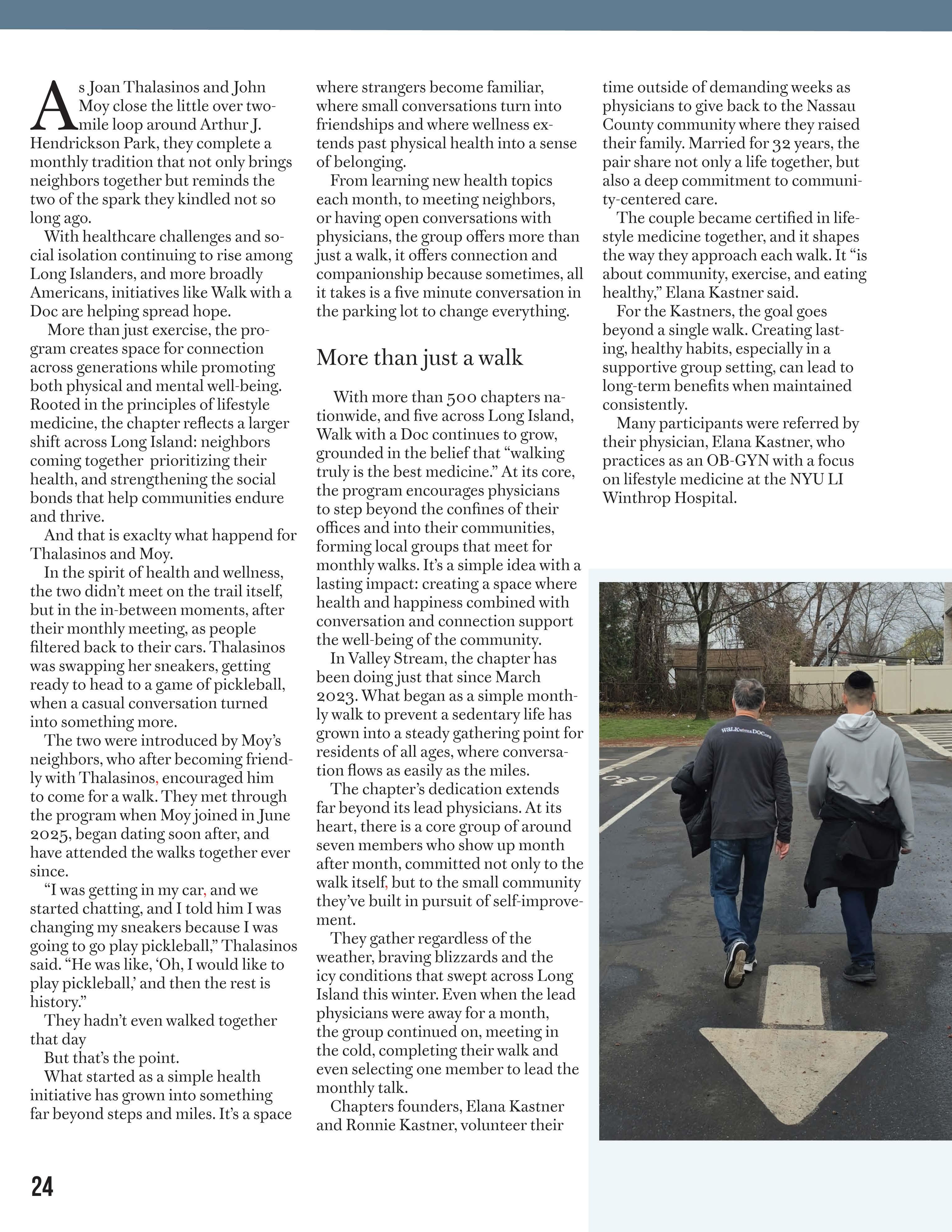
They gather regardless of the weather, braving blizzards and the icy conditions that swept across Long Island this winter. Even when the lead physicians were away for a month, the group continued on, meeting in the cold, completing their walk and even selecting one member to lead the monthly talk.
Chapters founders, Elana Kastner and Ronnie Kastner, volunteer their
time outside of demanding weeks as physicians to give back to the Nass au County community where they raised their family. Married for 32 years, the pair share not only a life together, but also a deep commitment to community-centered care.
The couple became certified in lifestyle medicine together, and it shapes the way they approach each walk. It "is about community, exercise, and eating healthy," Elana Kastner said.
For the Kastners, the goal goes beyond a single walk. Creating lasting, healthy habits, especially in a supportive group setting, can lead to long-term benefits when maintained consistently.
Many participants were referred by their physician, Elana Kastner, who practices as an OB-GYN with a focus on lifestyle medicine at the NYU LI Winthrop Hospital.
"I have seen people with exercise and a good diet reverse diabetes," Elana Kastner said. "People that never thought they were gonna be able to get off blood pressure medication are able to."
Each month, the group highlights a new topic, such as hypertension or heart health, offering simple strategies like reducing sodium intake. The program is also designed to make healthy living feel more achievable. According to Ronnie Kastner, adults should aim for150 minutes of physical activity each week. The group's 75-minute walk helps participants reach half that goal in one session, while also building connections they might not have otherwise made.
But it's in the individual stories where the impact of the group becomes most clear. For many members, these scheduled walks have become more than routine, they've marked turning points in their lives.
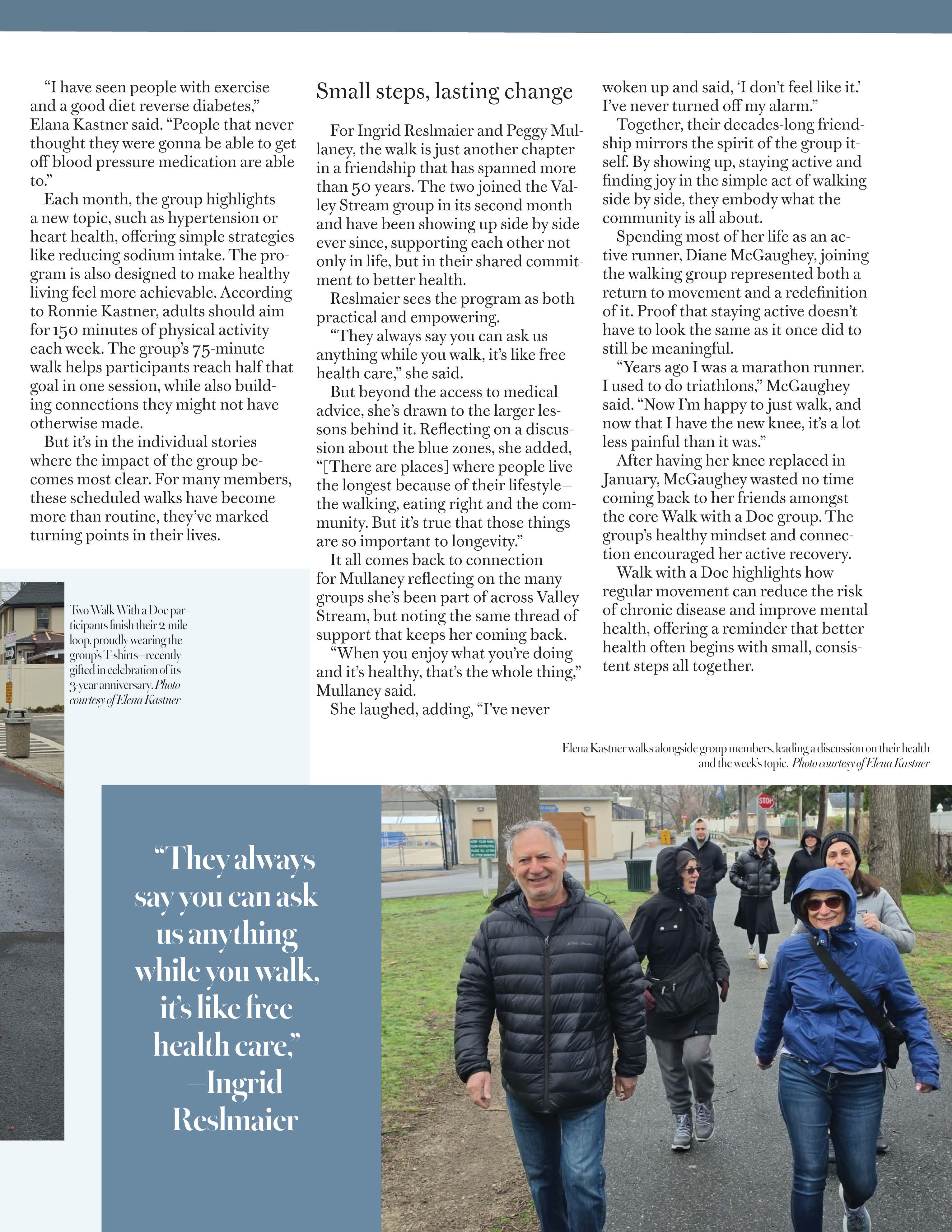
'fao \ \'alk \ \'ith a Doc par ticipantsfinishtheir 2 mile loop.proudIvwcari11gthe group'sTshirts rcccntlv giftedin cclehrationof'its .'3veanumiversarv.Photo courtc.~v!/FlenaKastner
Small steps, lasting change
For Ingrid Reslmaier and Peggy Mullaney, the walk is just another chapter in a friendship that has spanned more than 50 years. The two joined the Valley Stream group in its second month and have been showing up side by side ever since, supporting each other not only in life, but in their shared commitment to better health.
Reslmaier sees the program as both practical and empowering.
"They always say you can ask us anything while you walk, it's like free health care," she said.
But beyond the access to medical advice, she's drawn to the larger lessons behind it. Reflecting on a discussion about the blue zones, she added, "[There are places] where people live the longest because of their lifestylethe walking, eating right and the community. But it's true that those things are so important to longevity."
It all comes back to connection for Mullaney reflecting on the many groups she's been part of across Valley Stream, but noting the same thread of support that keeps her coming back.
"When you enjoy what you're doing and it's healthy, that's the whole thing," Mullaney said.
She laughed, adding, "I've never
woken up and said, 'I don't feel like it.' I've never turned off my alarm.''
Together, their decades-long friendship mirrors the spirit of the group itself By showing up, staying active and finding joy in the simple act of walking side by side, they embody what the community is all about.
Spending most of her life as an active runner, Diane McGaughey, joining the walking group represented both a return to movement and a redefinition of it. Proof that staying active doesn't have to look the same as it once did to still be meaningful.
"Years ago I was a marathon runner. I used to do triathlons," McGaughey said. "Now I'm happy to just walk, and now that I have the new knee, it's a lot less painful than it was.''
After having her knee replaced in January, McGaugheywasted no time coming back to her friends amongst the core Walk with a Doc group. The group's healthy mindset and connection encouraged her active recovery.
Walk with a Doc highlights how regular movement can reduce the risk of chronic disease and improve mental health, offering a reminder that better health often begins with small, consistent steps all together.
Elena Kastnerwalksalong~idegroup members.leadinga discussionon their health and the week'stopic. Photocourte.~v!flc'/e11aKastner
LongIsland's HealthTakesaStep Forward at Eisenhower Park
ByNicholasPiretto
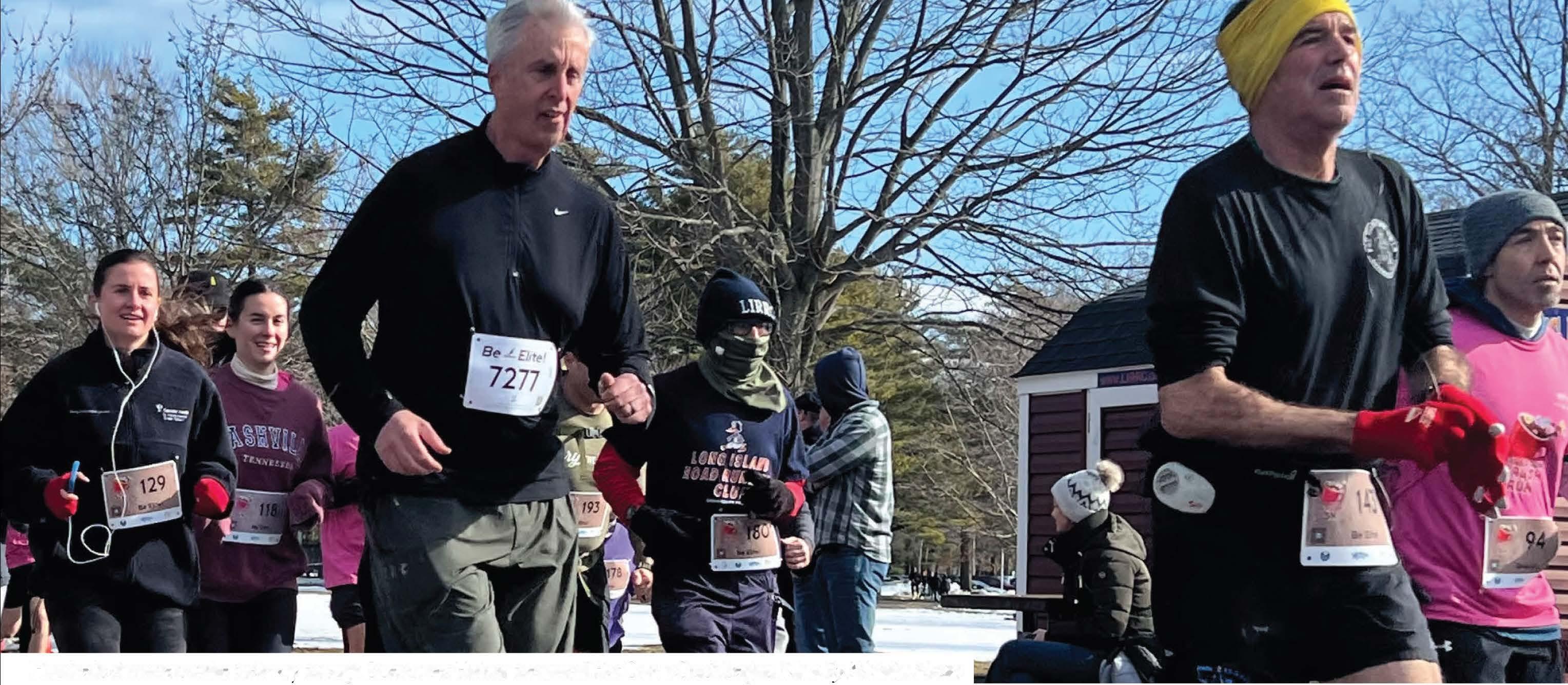
Hundreds of Long Islanders gathered at Eisenhower Park on Feb. 21 notjust to run, but to take part in a growing push toward healthier lifestyles and stronger community connections.
The Hot Cocoa Crush 5K supports EliteFeats' Never Stop Running Foundation, a nonprofit organization that supports athletic events and community fundraisers. They help runners who can not afford running shoes or compete in bigger races.
Jack Shappy of Bohemia was the announcer and base producer. When reflecting on Long Island's state of health, he said, "Running in the past five years has risen in popularity for the group and community setting, as well as motivation for those who are looking to lose weight, maybe get faster or even those who need more motivation in their lives."
Shappy said that despite the rising rate of obesity on Long Island, there has been a shift toward healthier lifestyles.
"What you are seeing today, 250 runners. We had about 125 last year." He said. Long Island is "its own country" in a way, according to Shappy, pointing to its stronger sense of community compared to New York City.
"I don't know the name of the guy that I was kind of competing with at the end there, but he was pushing me. It turned into a Dean Gregory of Commack won the race. He said that resilience means showing up, even on the days you don't want to. He also gave advice to Long Islanders who may be lacking in motivation, saying that they have to remember what they are really working for, not just what they feel like doing on that day.
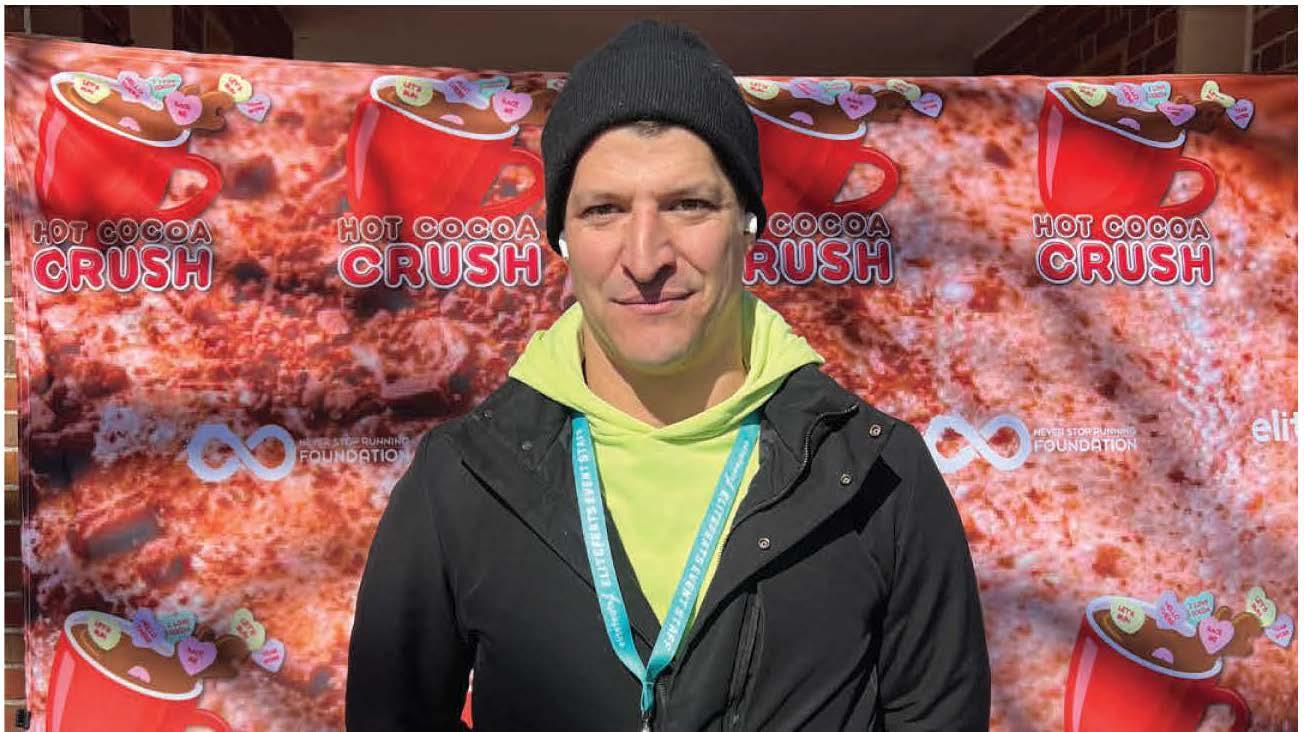

Gregory notes moments like these highlight the importance of showing up and staying committed, even in a group setting.
"I don't know the name of the guy that I was kind of competing with at the end there, but he was pushing me. It turned into a friendly competition, and that's what it's all about," Gregory said.
Events like the Hot Cocoa Crush 5K are a step in the right direction for Long Islanders as they face rising obesity and increased inactivity. Races like these highlight a call to action and a sense of community. For Long Islanders, it was never about winning the race; it was about being able to say that they showed up and took that step forward.
tlirough Eisenhow er Parkasthe annual I lot( :ocoa ( :rushbegins. Photo B\'. JWc/10/as Pireffo
.JackShappvistheam1ou11ccrandh,Lseproducerli>rtheIlotCocoaCrush_3K.Plmtob,:NidmfasPile/lo.
c-ram:t
~\vned African braiding salon has operated in Bay Shore for almost 30 years. Their clientele has been around just as long.
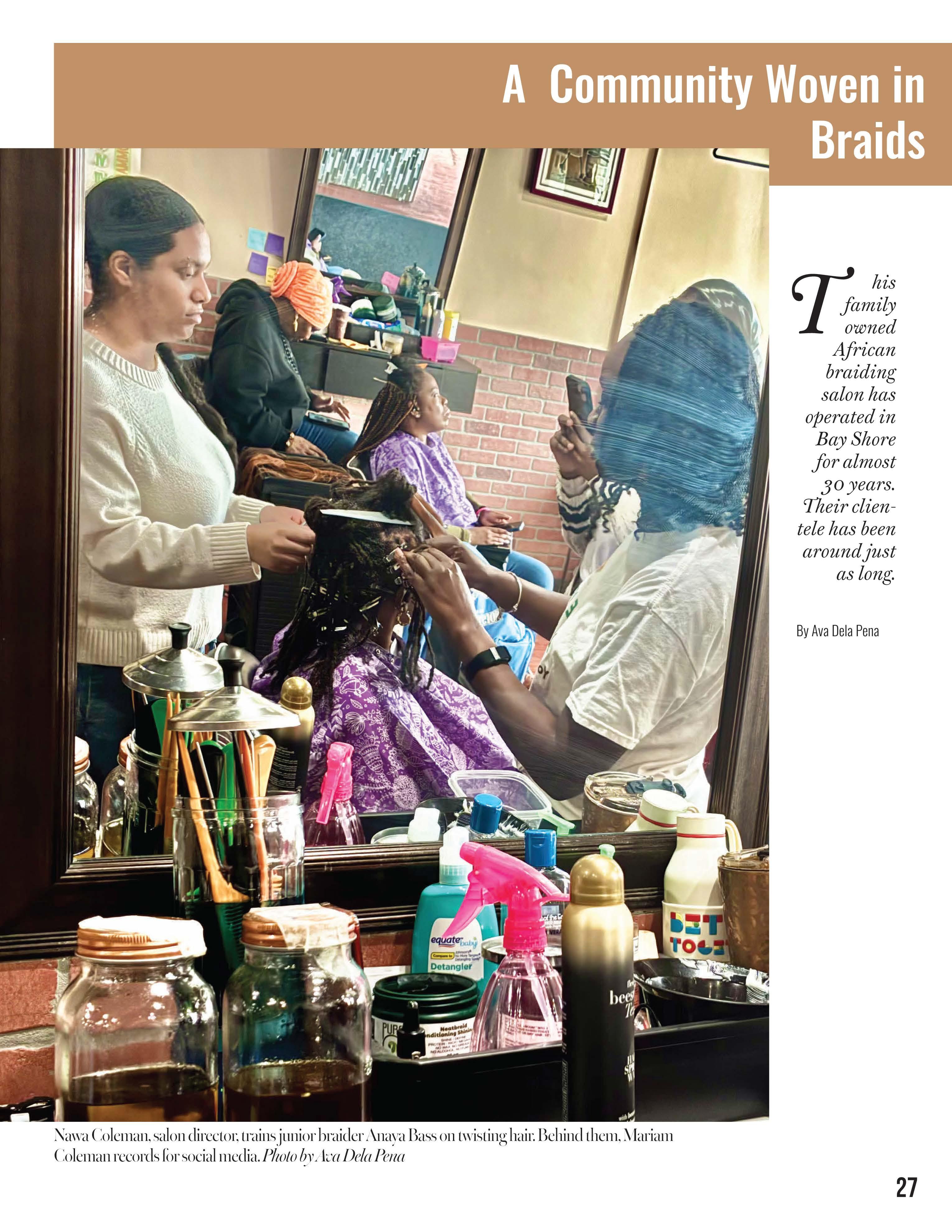
ByAvaDelaPena
When the Kamate family immigrated from the Cote d'Ivoire to the Bronx in 1990, they were determined to run a successful business venture. They had long been entrepreneurial, but when their dream of running a restaurant in Harlem proved cutthroat, they decided to turn their sights to a different opportunity. They saw that while hair braiding salons were saturated in New York City, the small community of African Americans on Long Island were lacking a truly dependable salon in the area.
The Kamate family opened K&D African Hair Braiding as a resource for an underserved population. The salon, tucked away on Main Street in Bayshore, has since stood for nearly 30 years, and loyal customers have returned time and again for just as long. They all had one word to describe the staff of beauticians: family.
"There are people who have been coming to us since the inception," Nawa Coleman said. There are people who came at the IO year mark, and there are people who probably just came six years ago. But it's like once people come in, they want to stay, right?"
Thehustle
The family-owned operation is now run by the Kamate's daughter, salon director Nawa Coleman. She said her parents initially looked to Suffolk County in order to serve the smaller demographic of African Americans. According to the 1990 US census, black.Americans made up less than 6% of the county's racial demographics. "When they need to get these types of services, it's not just as openly available for them. They have to go to the city or Nassau County," she said.
"My parents hustled, hustled, hustled," Nawa Coleman said. But they were not without obstacles: they were threatened with fines from town ordinances who were apprehensive about the promotion of an African hair braiding salon in the area. Nawa Coleman said it took a good five years of effort before they were able to cement their business as a trustworthy establishment and source of community.
"Then people started to know, 'Okay, this is our spot.' Like, 'We finally have a braiding salon-a specifically African braiding salon-that we can call our home.'"
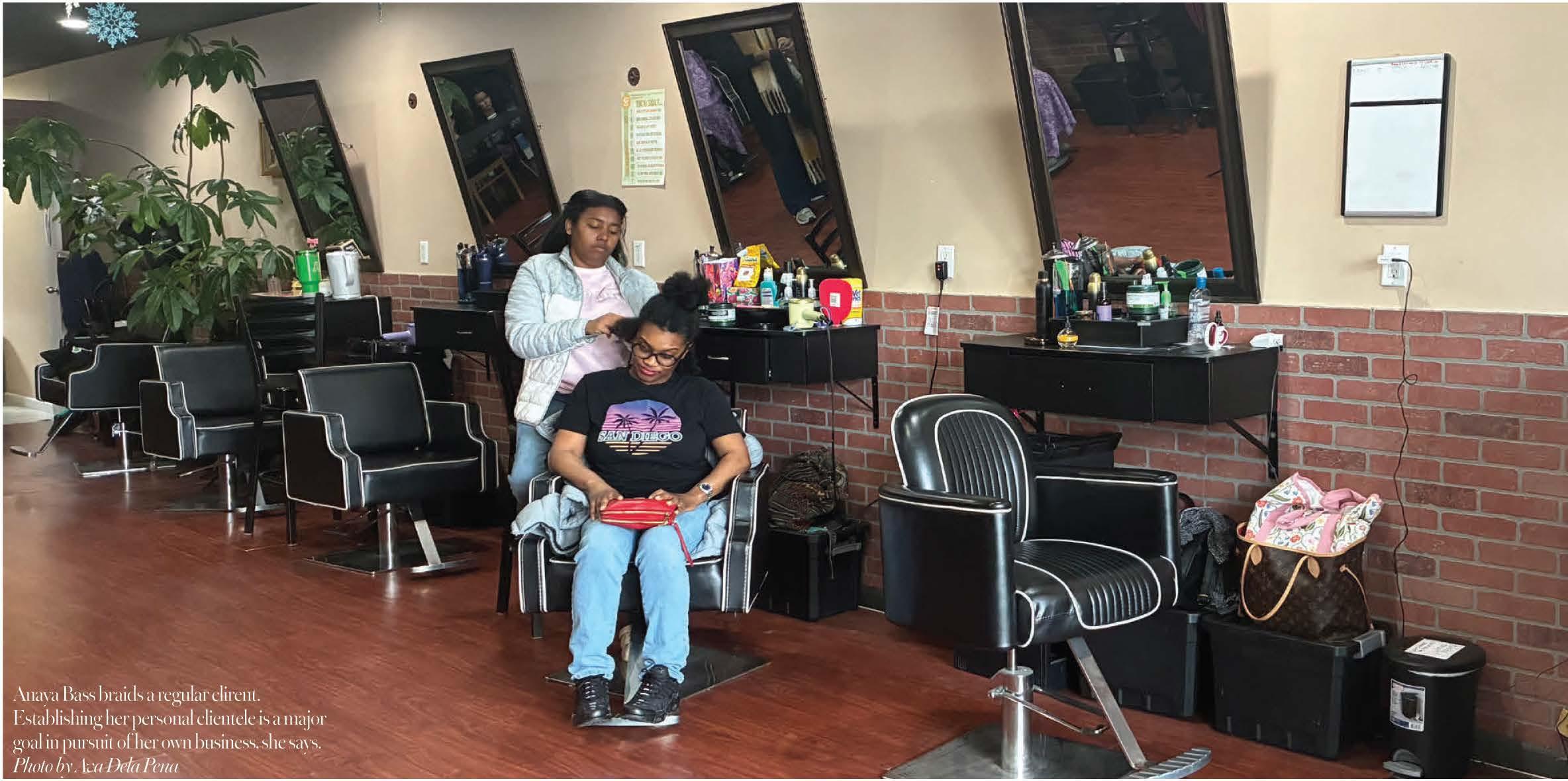
\'awa ( :olcrnandutch braidsAdrianPass more.a regularclient.Forher.the Kamatc familvisconsiderednextof' kin.:'\awa ( :olci.nan'sshirt reads"r\sk me if'voucan touchmvhai1:··Photo~v/ltaDeir;Pena
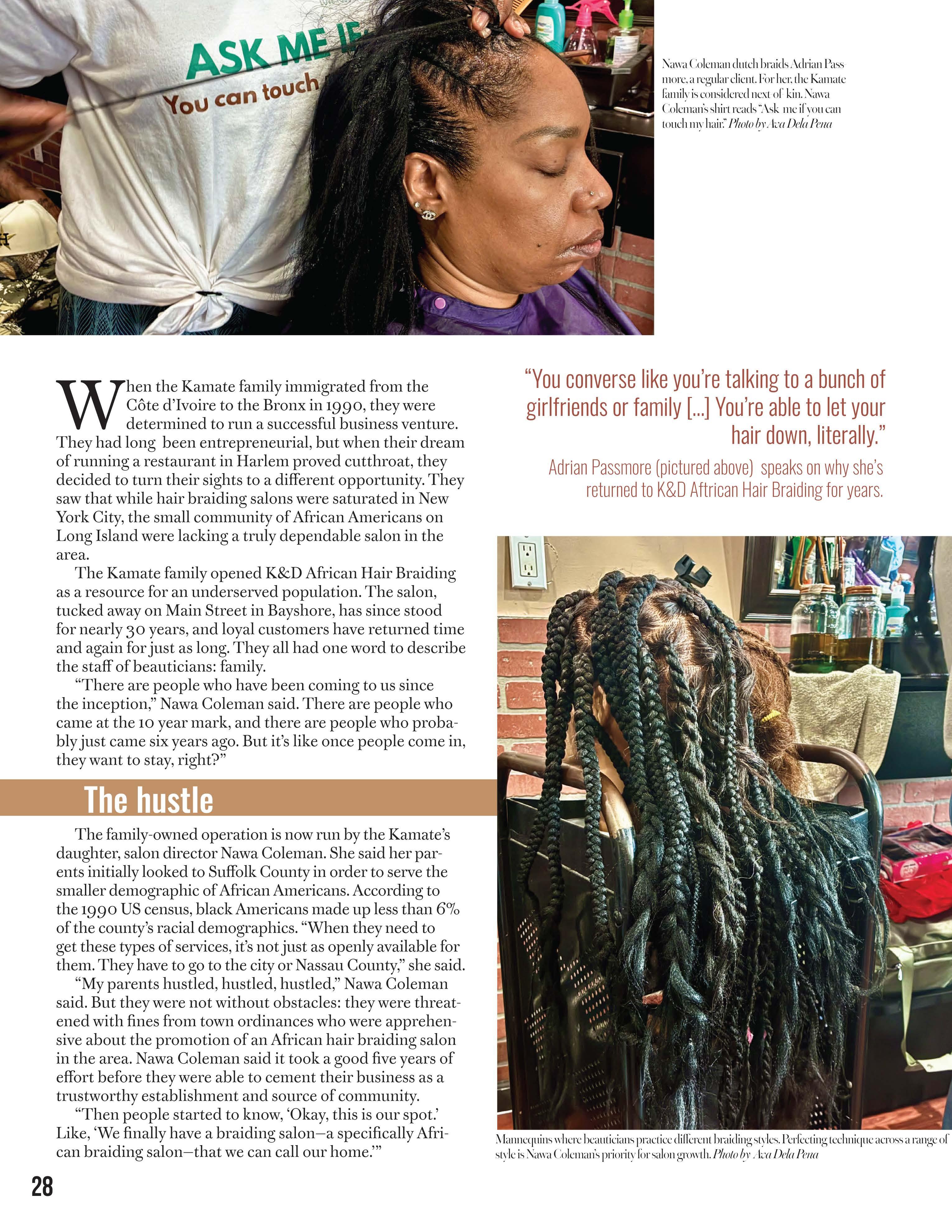
"Youconverseyou're toa bunch of like talking girlfriends [... ] You're toletyour orfamily able hairdown,literally."
AdrianPassmore above) onwhyshe's (pictured speaks returnedtoK&DAftricanHairBraidingforyears.
Wherehairdressingbecomesahome
Hair-braiding is a skill that many people practice independently. Instead of a salon, many beauticians operate out of their home or travel to meet clients at theirs.
But the moment clients enter K&D African Hair Braiding, they're stepping into an establishment filled with friends and family. Mariam Coleman, the youngest of the Kamate siblings, grew up in the salon. Now, she manages social media content, but she'll always be known as the baby. Secretary Norma Wilson initially applied because the salon was a household name in her own family, and has been an establishment they have returned to for years.
The result of a salon run by close family and friends? Conversation is lively, greetings are quick and laughter is frequent.
"As soon as you walk in, everyone speaks. You converse like you're talking to a bunch of girlfriends," said Adrian Passmore, a regular client.
"We are moving more towards an isolated, independent culture all around," Nawa Coleman said. "So, when people come into an established business, especially one that cares about the perception the community has on them, then they know that they'll have that guarantee of, 'okay, I'm going to be taken care 0£"'
Wilsonrefers toherself as the 'Mother Hen' because she enjoys spoiling each client with water, tea, snacks and even
slippers. "That's something I just do for them," she said. "It's not a necessity. I go out of my way and do it for them."
Being taken care of doesn't end

with hospitality. Communication and understanding is at the heart of fostering a community of people who want to return.
"I want them to feel beautiful," Wilson said. "I make sure they're going to come back again. And if there's some issue where they feel they're not going to, I find out why and try to rectify it."
"I feel like, when you find an environment that fits you, especially when it comes to being comfortable, you just want to keep coming back,"
said Brian Fequiere, a K&D regular of over two years. He books with Miss Connie, who always does his twists exactly how he asks. Other places, he said, don't listen to customers' specific requests with the care and attention he experiences at K&D.
Many braiders have been working at the salon since the early days of its opening, when Nawa was still just a little girl. They stick around not only because the team feels like family, but so do the clients. Making people feel beautiful is a special perk to having regular clients. "It is my happiness," said Miss Afi, one braider who has known the Kamate family for decades.
Anaya Bass, a junior braider training under Nawa Coleman, said she grew up there.
"I've been coming here since I was nine years old, and now I'm 19. So it's like a full circle moment," she said.
In order to satisfy each customer to their fullest extent, Coleman is looking to expand the salon's services.
"If we keep everything exactly the same, then we're just kind of closing the opportunities that can happen for candy," she said. "And at the same time, we're not able to serve our community to their fullest. Something that our clients have always asked us, do you do hair wash services? Do you care for textured hair? Do you also do colors, dyes, cuts, trims, that, this?"
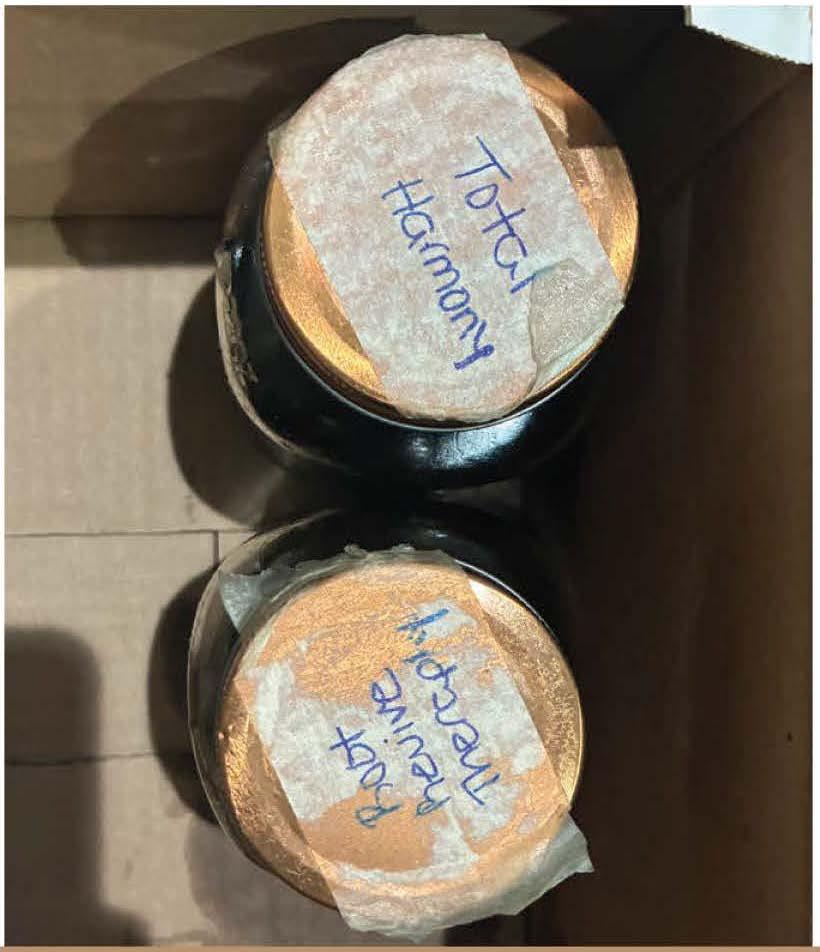
I lairandscalpoilsarcmadeinhouse.Thesalonsells packa�cd,ials li>rcustomers.butbi�batchesarckept 111maS<mjarsforsalonusedmin�senices.Photobl'. Im IMPeua•
Beyondthebraids
Expanding the salon is just one effort from Nawa Coleman's personal initiative, Beynd the Braids. The initiative aims to give back to their community-their first effort allowed them to distribute toiletries, feminine hygiene products and essentials like baby wipes and bottles. This was only made possible through donations from long-time patrons.
The initiative also aims to give beauty professionals the resources they need for success. Nawa Coleman said that beauty professionals are oftentimes "the go-to for every single issue that happens [in a salon], and that is just not a realistic way to continue to live."
Growing up in the salon environment, Nawa Coleman witnessed the cycle of overworking and burnout from her own mother as she strove to get the business off the ground.
Today, she wants every beauty professional she works with to be able to manage their work seamlessly
and efficiently without sacrificing quality. She also wants them to be
"It'sstillanextensionofmyfamily's business, ofmine buta realbigpassion iscoachingother beautyprofessionalsto understand how theirvalue[... ] beyondjustthembehind thechair."
-NawaColeman theBraids'onher'Beyond lniative
and the skill, which is very important, but it's definitely not isolated from the numbers and the data."
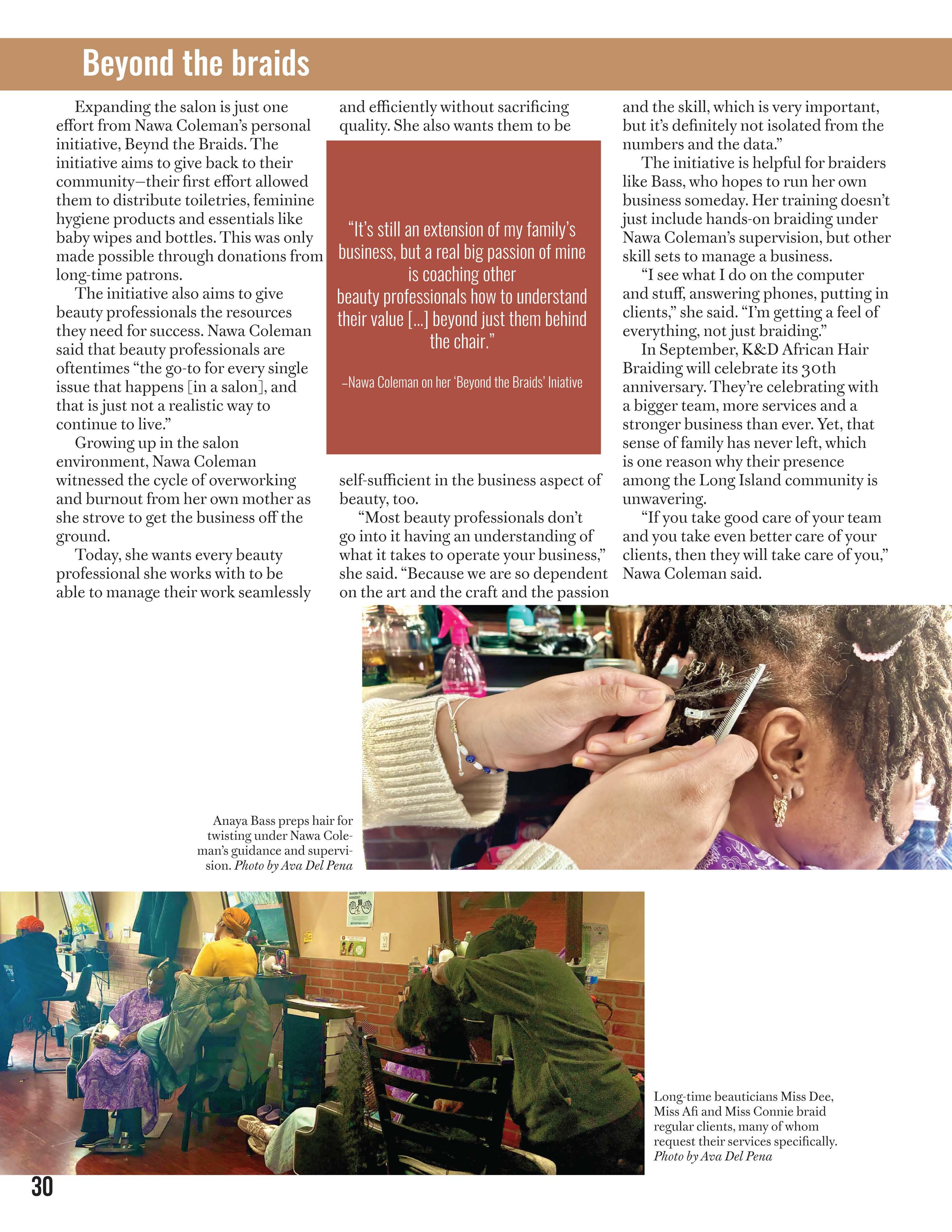
The initiative is helpful for braiders like Bass, who hopes to run her own business someday. Her training doesn't just include hands-on braiding under Nawa Coleman's supervision, but other skill sets to manage a business.
"I see what I do on the computer and stuff, answering phones, putting in clients," she said. "I'm getting a feel of everything, not just braiding."
self-sufficient in the business aspect of beauty, too.
"Most beauty professionals don't go into it having an understanding of what it takes to operate your business," she said. "Because we are so dependent on the art and the craft and the passion
In September, K&D African Hair Braiding will celebrate its 30th anniversary. They're celebrating with a bigger team, more services and a stronger business than ever. Yet, that sense of family has never left, which is one reason why their presence among the Long Island community is unwavering.
"If you take good care of your team and you take even better care of your clients, then they will take care of you," Nawa Coleman said.
Anaya Bass preps hair for twisting under Nawa Coleman's guidance and supervision. Photo by Ava Del Pena
Long-time beauticians Miss Dee, Miss Afi and Miss Connie braid regular clients, many of whom request their services specifically. Photo by Ava Del Pena
I"011gIsland( :arcsFoodBank\\'arehouseI"ocatcdin I lauppaugc.Photof~v I lannahMud1:v
ONTHEROADTOCARE LICARES HOPE HOMELESS ISSPREADING TOTHE
Jt,)Hannah1\1udry
Each day,John McKeown distributes 30 to 50 individual meals to children and adults living on the street. He travels across Long Island in the span of one week, visiting specific locations at specific times on specific dates. The mobile outreach goes as far west as Long Beach and as east as Riverhead.
McKeown serves as the Long Island Cares mobile program coordinator, responsible for visiting areas of Nassau and Suffolk counties populated by unhoused individuals. He gives them nutritious meals and everyday necessities Monday through Thursday.
"I have to do that consistently because the homeless neighbors that we do serve, they come to expect me at those specific times. If I deviate from that, they will give me grief the next time I see them," McKeown said. "It's some good relationships that we've built up over time in trying to help them as best we can."
More than 4,500 people between Nassau and Suffolk counties were homeless in 2025, according to the Long Island Coalition for the Homeless. Roughly one in IO families on Long Island suffer from food insecurity.
"Due to cuts to the U.S. Department of Agriculture, we were seeing a dramatic decrease in our TEF AP commodities. TEFAP is The Emergency Food Assistance
Program. I think it was around 250,000 pounds at one point that was going to be given to us. That was a big hit," said Harrison Smith, the mobile outreach services' manager.
McKeown and Smith recognize the importance of their work through this program.
"A couple of the folks that I had dealt with, I no longer saw them on the street, and when that happens, I worry, first off, but then at the same time, I cross my fingers and hope that maybe they did obtain housing in some way, shape or form," McKeown said.
Although McKeown may lose touch with some individuals, sometimes the people he serves find a way to reach out after finding shelter.
"Several times they have reached back out to me. I got the warmest of either emails or texts thanking me and telling me what a rough patch they were going through, but they're on the way to what they considered to be a better path for their lives."
Despite economic hardships and relief program reductions, Hope for the Homeless strives to support individuals through hearty meals and personable connections.
By Gabrielle Yanovitz
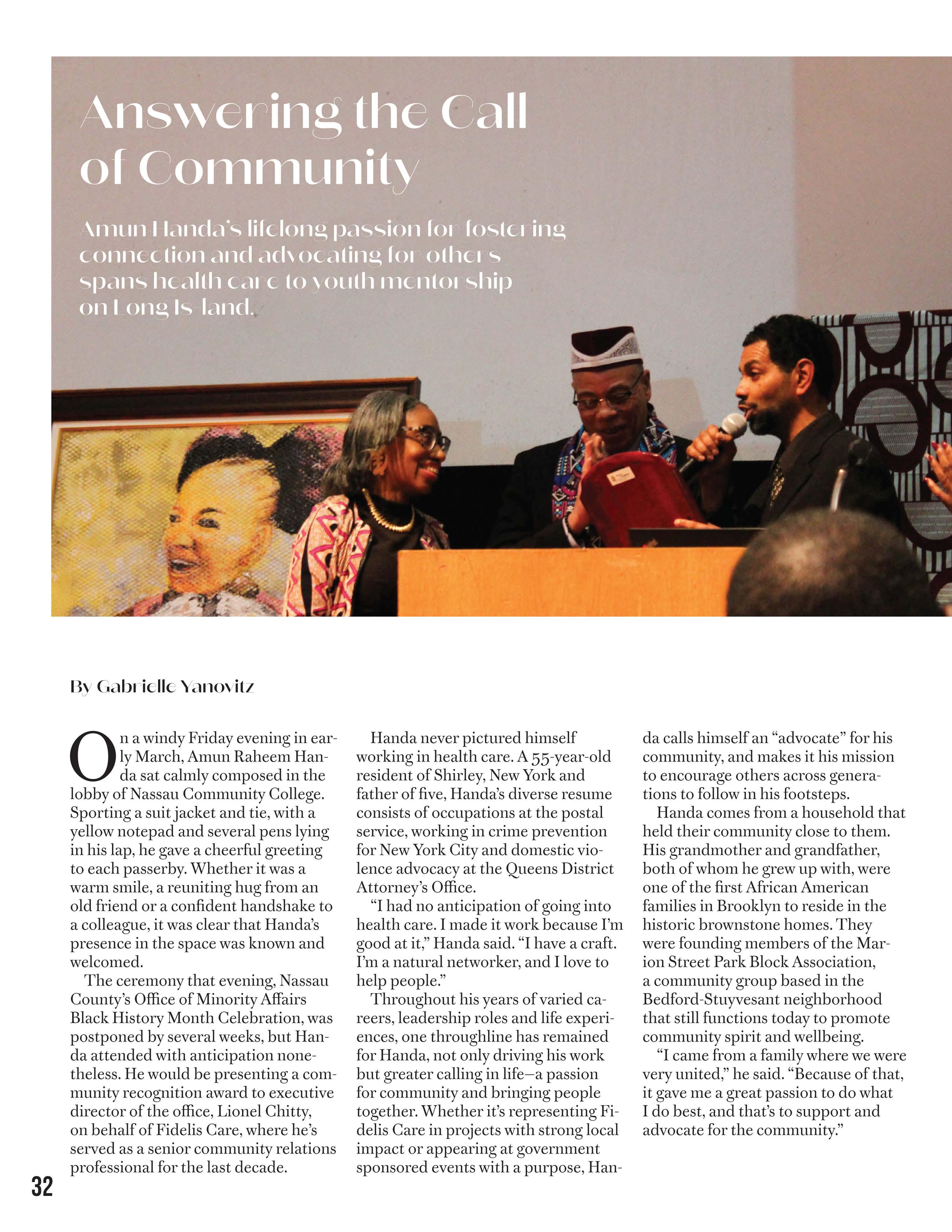
0n a windy Friday evening in early March, Amun Raheem Handa sat calmly composed in the lobby of Nassau Community College. Sporting a suit jacket and tie, with a yellow notepad and several pens lying in his lap, he gave a cheerful greeting to each passerby. Whether it was a warm smile, a reuniting hug from an old friend or a confident handshake to a colleague, it was clear that Randa's presence in the space was known and welcomed.
The ceremony that evening, Nass au County's Office of Minority Affairs Black History Month Celebration, was postponed by several weeks, but Handa attended with anticipation nonetheless. He would be presenting a community recognition award to executive director of the office, Lionel Chitty, on behalf of Fidelis Care, where he's served as a senior community relations professional for the last decade.
Handa never pictured himself working in health care. A 55-year-old resident of Shirley, New York and father of five, Randa's diverse resume consists of occupations at the postal service, working in crime prevention for New York City and domestic violence advocacy at the Queens District Attorney's Office.
"I had no anticipation of going into health care. I made it work because I'm good at it," Handa said. "I have a craft. I'm a natural network.er, and I love to help people."
Throughout his years of varied careers, leadership roles and life experiences, one throughline has remained for Handa, not only driving his work but greater calling in life-a passion for community and bringing people together. Whether it's representing Fidelis Care in projects with strong local impact or appearing at government sponsored events with a purpose, Han-
da calls himself an "advocate" for his community, and makes it his mission to encourage others across generations to follow in his footsteps.
Handa comes from a household that held their community close to them. His grandmother and grandfather, both of whom he grew up with, were one of the first African American families in Brooklyn to reside in the historic brownstone homes. They were founding members of the Marion Street Park Block Association, a community group based in the Bedford-Stuyvesant neighborhood that still functions today to promote community spirit and wellbeing.
"I came from a family where we were very united," he said. "Because of that, it gave me a great passion to do what I do best, and that's to support and advocate for the community."
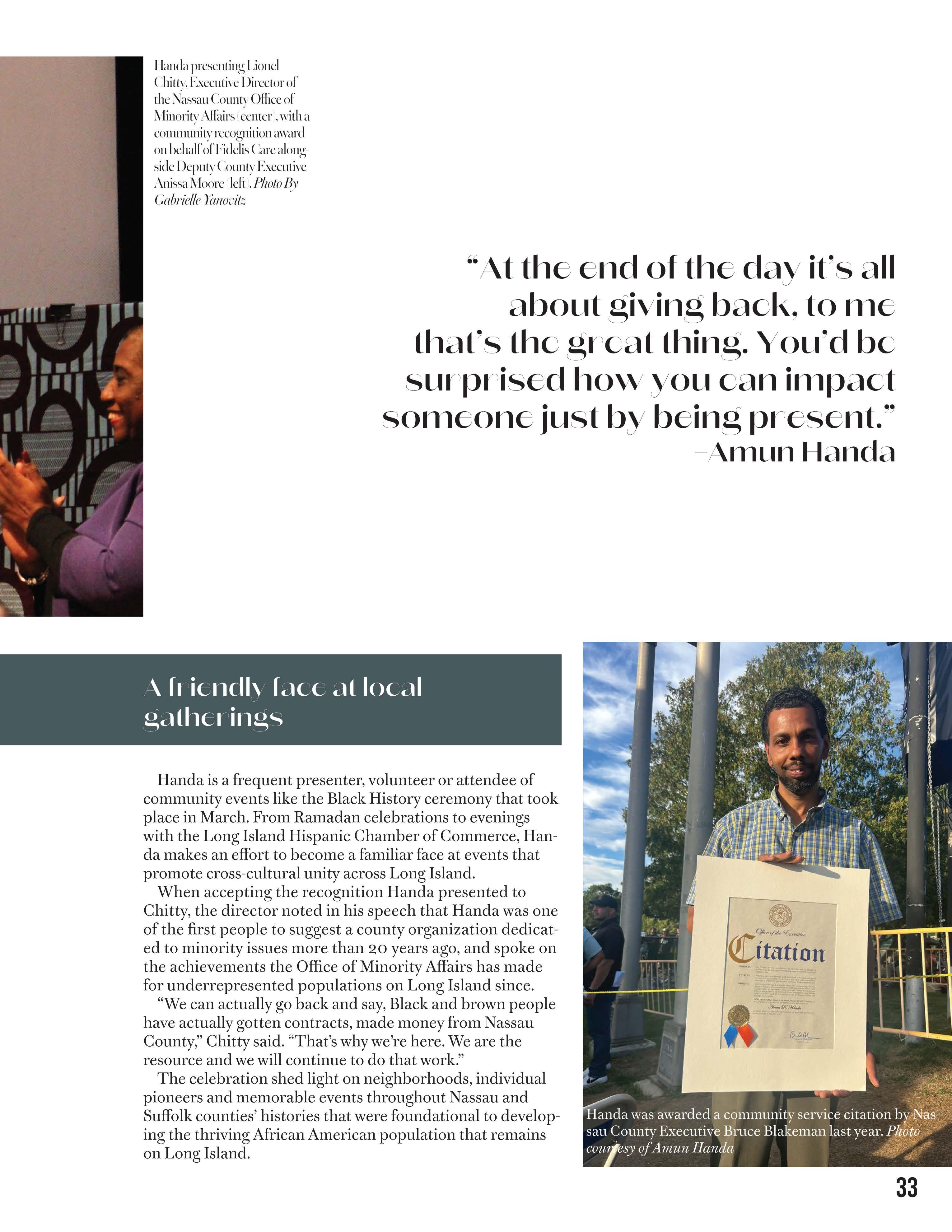
I JandaprcscnlingI ,ioncl ( :hillv,ExecutiveDirectorof' the ~assau ( :ountvOfficeof' .VlinoritvAffairs ~enter , witha co111111u;1ilvrecognitionaward on bchalf'ol'Fidclis ( :arcalong side Dcputv( ounty Excculivc Anissa.\foorc left . PhotoB_y GabrielleYcowciL:
"At the end of the day it's all about giving back, to me that's the great thing. You'd be surprised how you can impact someone just by being present."
-Amun Handa
Banda is a frequent presenter, volunteer or attendee of community events like the Black History ceremony that took place in March. From Ramadan celebrations to evenings with the Long Island Hispanic Chamber of Commerce, Banda makes an effort to become a familiar face at events that promote cross-cultural unity across Long Island.
When accepting the recognition Banda presented to Chitty, the director noted in his speech that Banda was one of the first people to suggest a county organization dedicated to minority issues more than 20 years ago, and spoke on the achievements the Office of Minority Affairs has made for underrepresented populations on Long Island since.
"We can actually go back and say, Black and brown people have actually gotten contracts, made money from Nassau County," Chitty said. "That's why we're here. We are the
resource and we will continue to do that work."
The celebration shed light on neighborhoods, individual pioneers and memorable events throughout Nassau and Suffolk counties' histories that were foundational to developing the thriving African American population that remains on Long Island.
In the moments surrounding the ceremony at Nassau Community College, Randa's connections with the community were evident. Nearly every individual who passed by Banda met him with joy, and emphasized his dedication to helping others.
"You want something to happen, he's the man," said Jolaine Rodriguez, a Supervisor at the Office of Minority Affairs. "You can always count on h Im. • "
Kevell Allie, a Long Island-based entrepreneur who's worked with Banda through the Long Island African American Chamber of Commerce, shared that Banda taught him to "not wait for opportunities" and to "go out there and get it."
"One of the key things I've taken from him is the importance of showing up consistently for the community and leading with intention," Allie said. "He has a strong ability to bring people together and create meaningful opportunities, and that's something I've carried into my own work as I continue building my business."
Banda reacted to the warm interactions with humility and gratitude.
"When you give back to the community, it reciprocates. It shows that you're a stakeholder in the community," he said. "At the end of the day, it's all about giving back. To me, that's the great thing. You'd be surprised how you can impact someone just by being present."
Randa's presence and impact was formally recognized by Nassau County Executive Bruce Blakeman last year when he received a citation from Executive, commending his service to Nassau County residents and his contributions to enriching the lives of African Americans on Long Island.
L pliHing lhc ncxl
gcnc1 8lion
Banda has taken his service beyond his workplace and participation in public events, as he formerly served as president of One Hundred Black Men of Long Island, a mentorship organization for Black youth, and continues to personally mentor students and individuals in his free time. Despite being a father to four daughters and a son, Banda puts great time and effort into the individual relationships he's formed with his mentees.
"I like to invest in the kids, especially teenagers, because they have a lot of things they need to get off their chest," he said. "I want them to feel like they have a big brother on their side."
Banda expressed crucial lessons he conveys to his students that he hopes will motivate them through hardships, and places much of the responsibility on himself to show up as a role model.
"I want the kids to know this is the real world, and preparation is everything," he said. "If I'm going to lead by example, I can't tell these kids to emulate me if I don't set the example. My failure is their failure."
Above all, being a consistent figure of altruism, professionalism and kindness for his community is what keeps Banda afloat, regardless of whether or not people are watching. He described a recent scene at a supermarket in which he intervened between a young man and his mother who were fighting over not having enough money for groceries. After stepping in to dissolve the situation, the altercation ended in hugs and misty eyes.
"That made my day," Banda said. "I know I can't save the world, I'm not Dr. King. But if I can save one person, if I help one person, that's a success story for me."
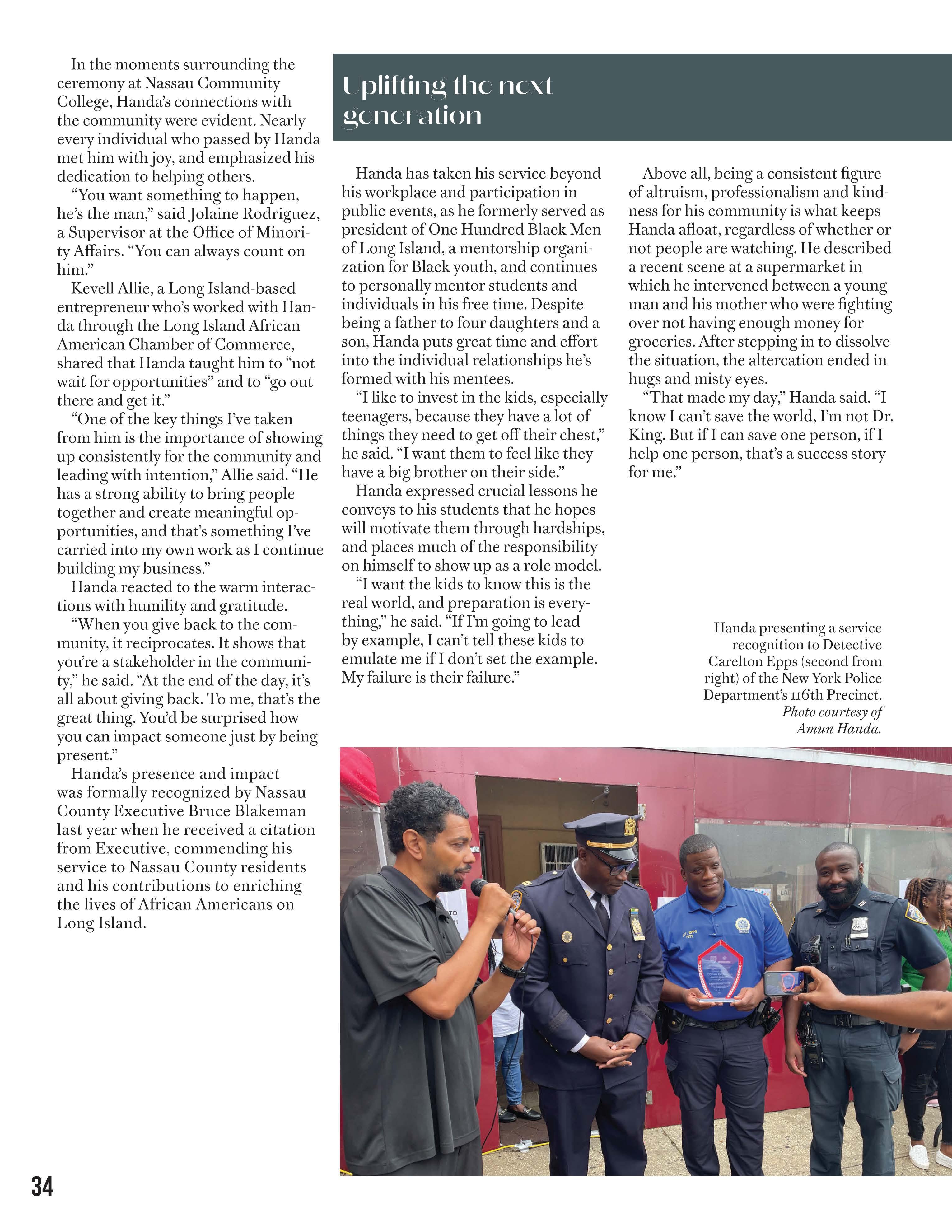
Randa presenting a service recognition to Detective Carelton Epps (second from right) of the New York Police Department's 116th Precinct. Photo courtesyof AmunHanda.
"NoICE,No Fear, IMMIGRANTS are welcome here!"
Bv (:hristina1\rloua
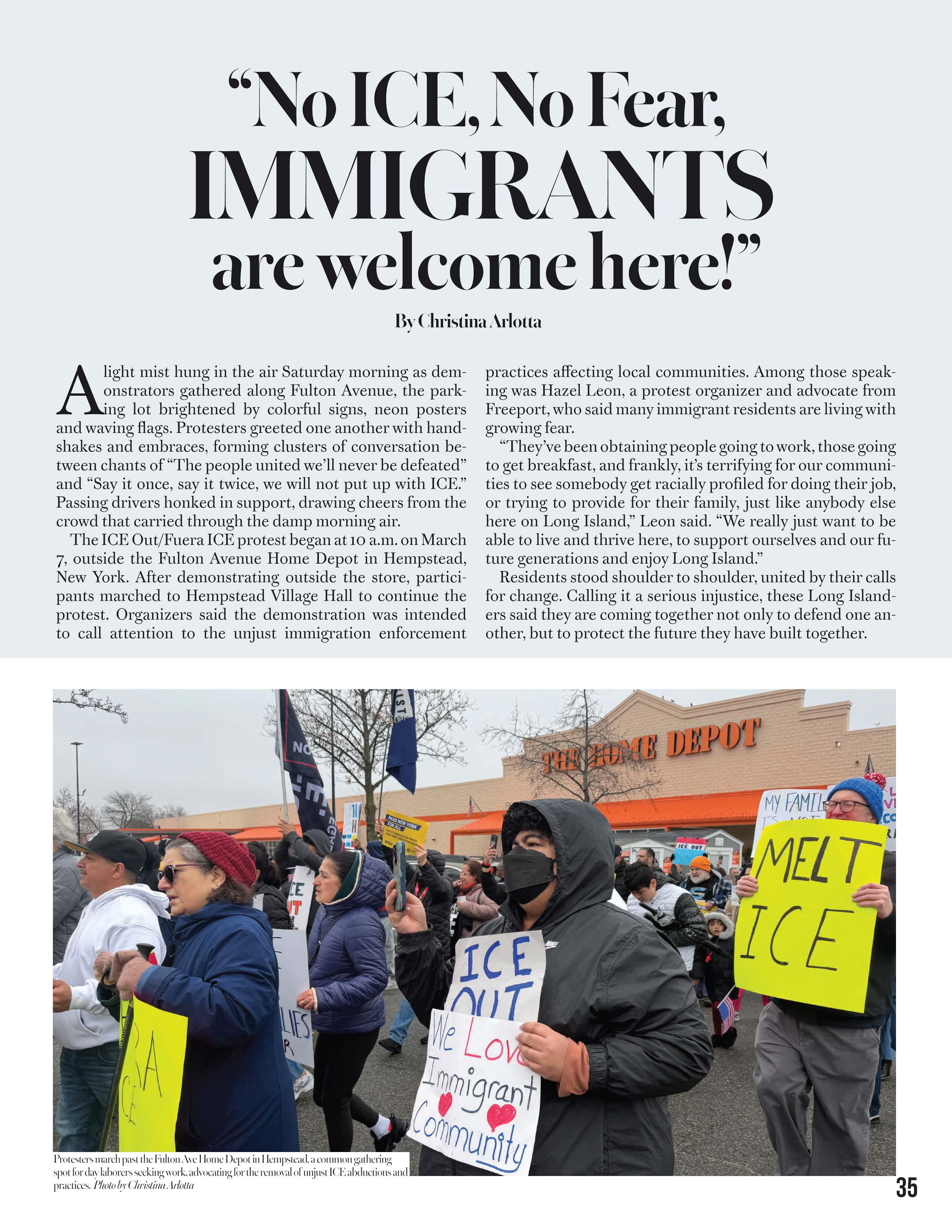
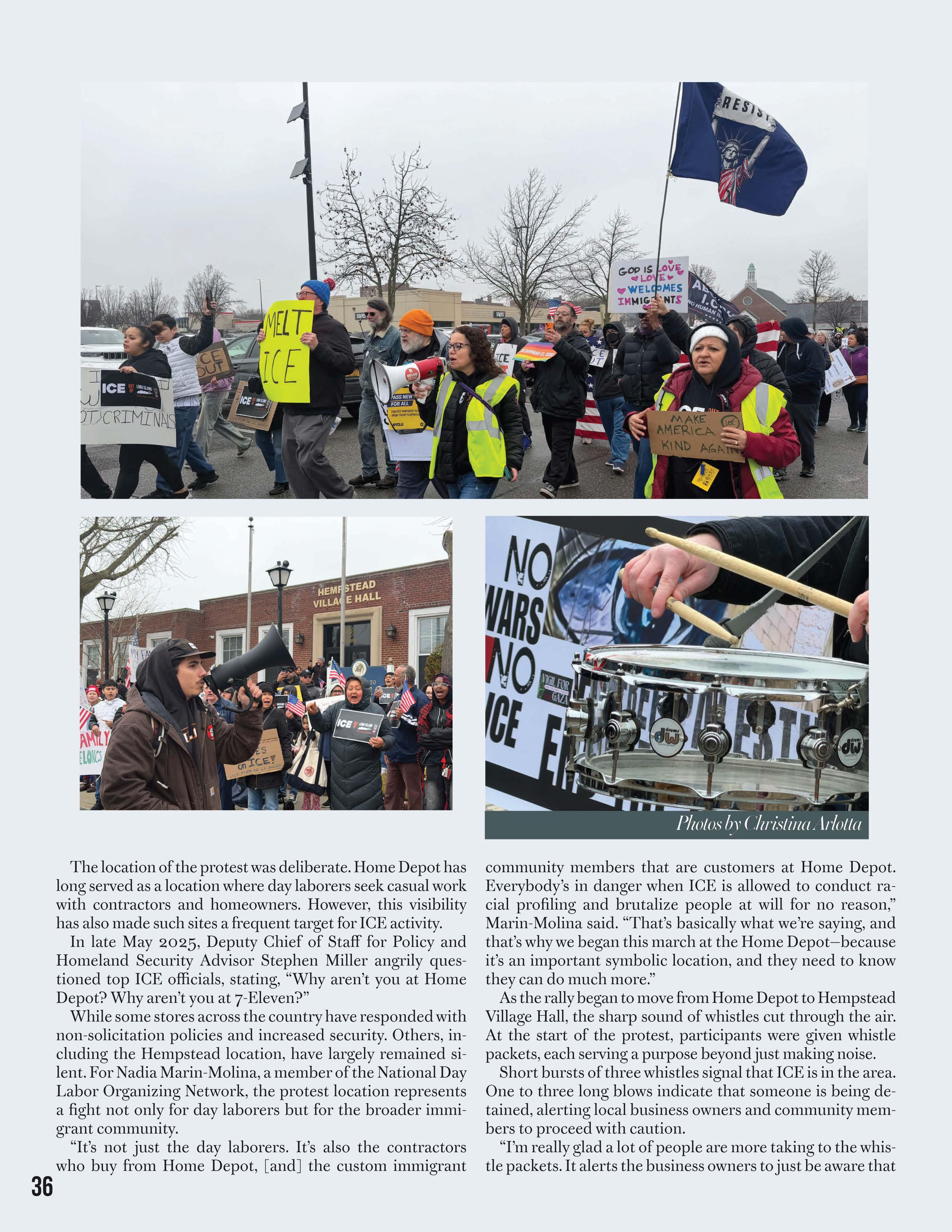
Alight mist hung in the air Saturday morning as demonstrators gathered along Fulton Avenue, the parkng lot brightened by colorful signs, neon posters and waving flags. Protesters greeted one another with handshakes and embraces, forming clusters of conversation between chants of"The people united we'll never be defeated" and "Say it once, say it twice, we will not put up with ICE." Passing drivers honked in support, drawing cheers from the crowd that carried through the damp morning air.
The ICE Out/Fuera ICE protest began at IO a.m. on March 7, outside the Fulton Avenue Home Depot in Hempstead, New York. After demonstrating outside the store, participants marched to Hempstead Village Hall to continue the protest. Organizers said the demonstration was intended to call attention to the unjust immigration enforcement
practices affecting local communities. Among those speaking was Hazel Leon, a protest organizer and advocate from Freeport, who said many immigrant residents are living with growing fear.
"They've been obtaining people going to work, those going to get breakfast, and frankly, it's terrifying for our communities to see somebody get racially profiled for doing their job, or trying to provide for their family, just like anybody else here on Long Island," Leon said. "We really just want to be able to live and thrive here, to support ourselves and our future generations and enjoy Long Island."
Residents stood shoulder to shoulder, united by their calls for change. Calling it a serious injustice, these Long Islanders said they are coming together not only to defend one another, but to protect the future they have built together.
The location of the protest was deliberate. Home Depot has long served as a location where day laborers seek casual work with contractors and homeowners. However, this visibility has also made such sites a frequent target for ICE activity.
In late May 2025, Deputy Chief of Staff for Policy and Homeland Security Advisor Stephen Miller angrily questioned top I CE officials, stating, "Why aren't you at Home Depot? Why aren't you at 7-Eleven?"
While some stores across the country have responded with non-solicitation policies and increased security. Others, including the Hempstead location, have largely remained silent. For Nadia Marin-Molina, a member of the National Day Labor Organizing Network, the protest location represents a fight not only for day laborers but for the broader immigrant community.
"It's not just the day laborers. It's also the contractors who buy from Home Depot, [and] the custom immigrant
community members that are customers at Home Depot. Everybody's in danger when ICE is allowed to conduct racial profiling and brutalize people at will for no reason," Marin-Molina said. "That's basically what we're saying, and that's why we began this march at the Home Depot-because it's an important symbolic location, and they need to know they can do much more."
As the rally began to move from Home Depot to Hempstead Village Hall, the sharp sound of whistles cut through the air. At the start of the protest, participants were given whistle packets, each serving a purpose beyond just making noise.
Short bursts of three whistles signal that ICE is in the area. One to three long blows indicate that someone is being detained, alerting local business owners and community members to proceed with caution.
"I'm really glad a lot of people are more taking to the whistle packets. It alerts the business owners to just be aware that
ICE is trying to scoop people up," Leon said. "It's not left or right right now; it's top versus bottom. Authoritarians thrive on fear, so when we push back, we're closer to winning back our country that we deserve."
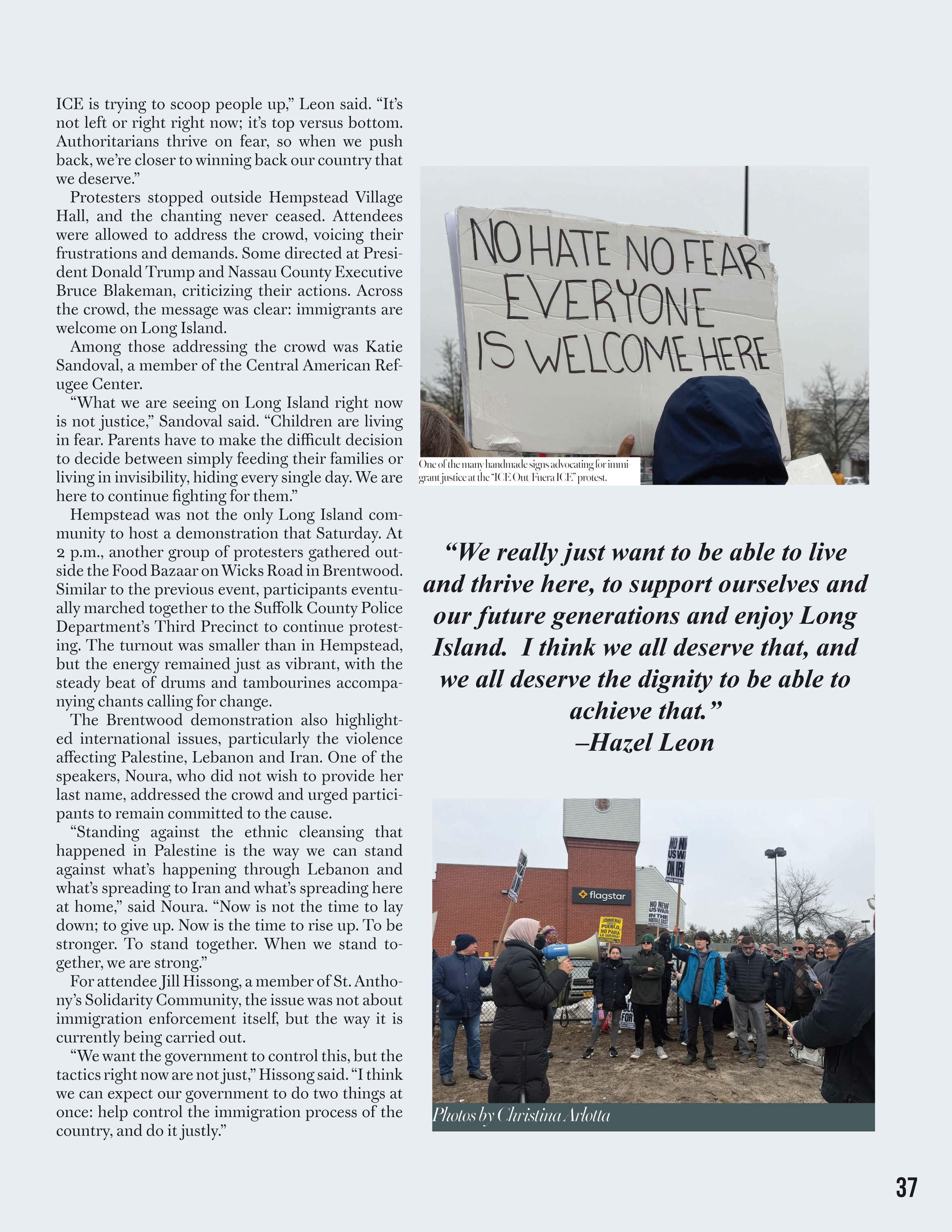
Protesters stopped outside Hempstead Village Hall, and the chanting never ceased. Attendees were allowed to address the crowd, voicing their frustrations and demands. Some directed at President Donald Trump and Nassau County Executive Bruce Blakeman, criticizing their actions. Across the crowd, the message was clear: immigrants are welcome on Long Island.
Among those addressing the crowd was Katie Sandoval, a member of the Central American Refugee Center.
"What we are seeing on Long Island right now is not justice," Sandoval said. "Children are living in fear. Parents have to make the difficult decision to decide between simply feeding their families or living in invisibility, hiding every single day. We are here to continue fighting for them."
Hempstead was not the only Long Island community to host a demonstration that Saturday. At 2 p.m., another group of protesters gathered outside the Food Bazaar on Wicks Road in Brentwood. Similar to the previous event, participants eventually marched together to the Suffolk County Police Department's Third Precinct to continue protesting. The turnout was smaller than in Hempstead, but the energy remained just as vibrant, with the steady beat of drums and tambourines accompanying chants calling for change.
The Brentwood demonstration also highlighted international issues, particularly the violence affecting Palestine, Lebanon and Iran. One of the speakers, Noura, who did not wish to provide her last name, addressed the crowd and urged participants to remain committed to the cause.
"Standing against the ethnic cleansing that happened in Palestine is the way we can stand against what's happening through Lebanon and what's spreading to Iran and what's spreading here at home," said Noura. "Now is not the time to lay down; to give up. Now is the time to rise up. To be stronger. To stand together. When we stand together, we are strong."
For attendee Jill Hissong, a member of St. Anthony's Solidarity Community, the issue was not about immigration enforcement itself, but the way it is currently being carried out.
"We want the government to control this, but the tactics right now are not just," Hissong said. "I think we can expect our government to do two things at once: help control the immigration process of the country, and do it justly."
"We really just want to be able to live and thrive here, to support ourselves and our future generations and enjoy Long Island. I think we all deserve that, and we all deserve the dignity to be able to achieve that. "
-Hazel Leon
One of'the rnanvhandmadesignsadvocatingforirnmi grantjustice at the "I( :EOut Fuera I( :E"protest.
Tenseto Tranquil Yogaas a stress reliever

ByMadelineSisk
With 70% of Long Islanders reporting increased stress from the rising costs of groceries, rent and home expenses, it's important to find healthy alternatives to manage stress levels. Stress can cause a myriad of physical effects, including the release of hormones like cortisol and adrenaline, which narrow your arteries and increase blood pressure.
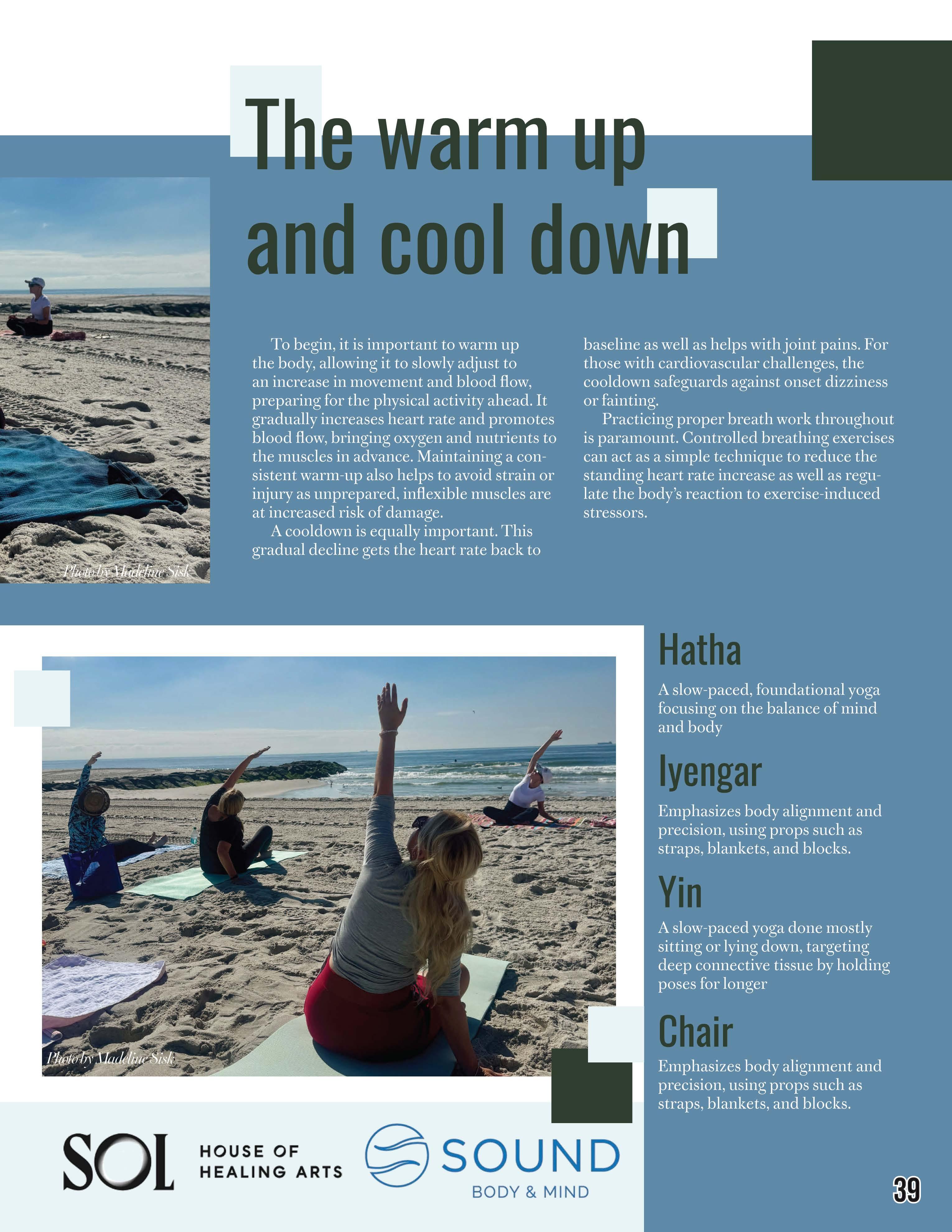
One such solution is exercise, as it releases endorphins and lowers cortisol. While standard aerobic exercise accomplishes this, movement-impaired adults may be limited. Alternatively, yoga focuses on flexibility and balance while supporting circulation
and calming the mind and nervous system. This cultivates the relaxation response, which trains your body to be less reactive under stress by slowing the heart rate and lowering blood pressure. It also tamps down inflammation, reduces arterial stiffness and promotes better circulation. Breathing exercises also increase lung capacity and improve oxygen delivery to the body.
Yoga is more than simply stretching and moving into poses, it weaves together three interconnected threads: physical postures, controlled breathing and meditation.
andcooldo
HOUSE OF HEALING ARTS
Iyengar
Vin
Hatha
BYKAYLABARNES
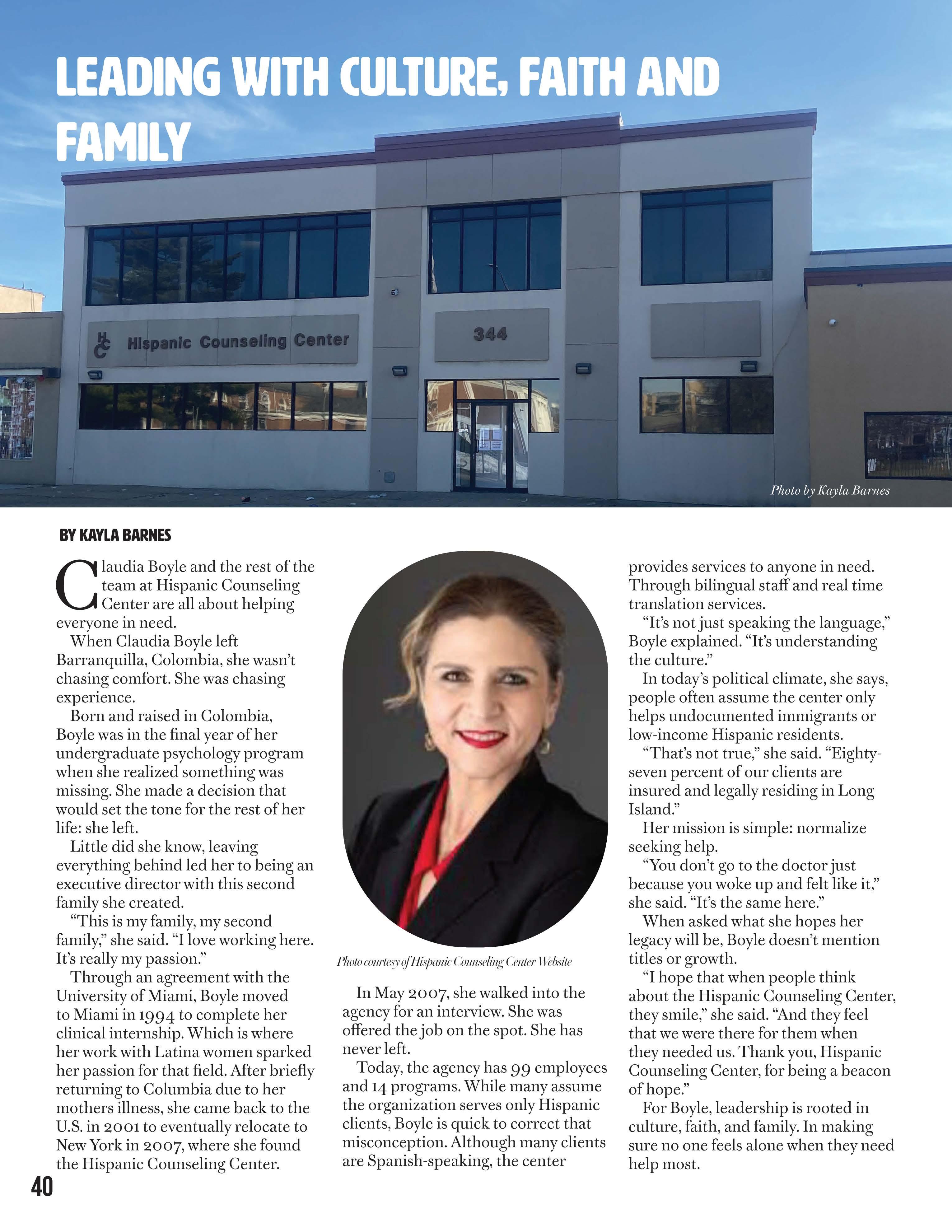
Claudia Boyle and the rest of the team at Hispanic Counseling Center are all about helping everyone in need.
When Claudia Boyle left Barranquilla, Colombia, she wasn't chasing comfort. She was chasing experience.
Born and raised in Colombia, Boyle was in the final year of her undergraduate psychology program when she realized something was missing. She made a decision that would set the tone for the rest of her life: she left.
Little did she know, leaving everything behind led her to being an executive director with this second family she created.
"This is my family, my second family," she said. "I love working here. It's really my passion."
Through an agreement with the University of Miami, Boyle moved to Miami in 1994 to complete her clinical internship. Which is where her work with Latina women sparked her passion for that field. After briefly returning to Columbia due to her mothers illness, she came back to the U.S. in 2001 to eventually relocate to New York in 2007, where she found the Hispanic Counseling Center.
In May 2007, she walked into the agency for an interview. She was offered the job on the spot. She has never left.
Today, the agency has 99 employees and 14 programs. While many assume the organization serves only Hispanic clients, Boyle is quick to correct that misconception. Although many clients are Spanish-speaking, the center
provides services to anyone in need. Through bilingual staff and real time translation services.
"It's not just speaking the language," Boyle explained. "It's understanding the culture."
In today's political climate, she says, people often assume the center only helps undocumented immigrants or low-income Hispanic residents.
"That's not true," she said. "Eightyseven percent of our clients are insured and legally residing in Long Island."
Her mission is simple: normalize seeking help.
"You don't go to the doctor just because you woke up and felt like it," she said. "It's the same here."
When asked what she hopes her legacy will be, Boyle doesn't mention titles or growth.
"I hope that when people think about the Hispanic Counseling Center, they smile," she said. "And they feel that we were there for them when they needed us. Thank you, Hispanic Counseling Center, for being a beacon of hope."
For Boyle, leadership is rooted in culture, faith, and family. In making sure no one feels alone when they need help most.
LONGBEACHTURNSTHETIDEFOR
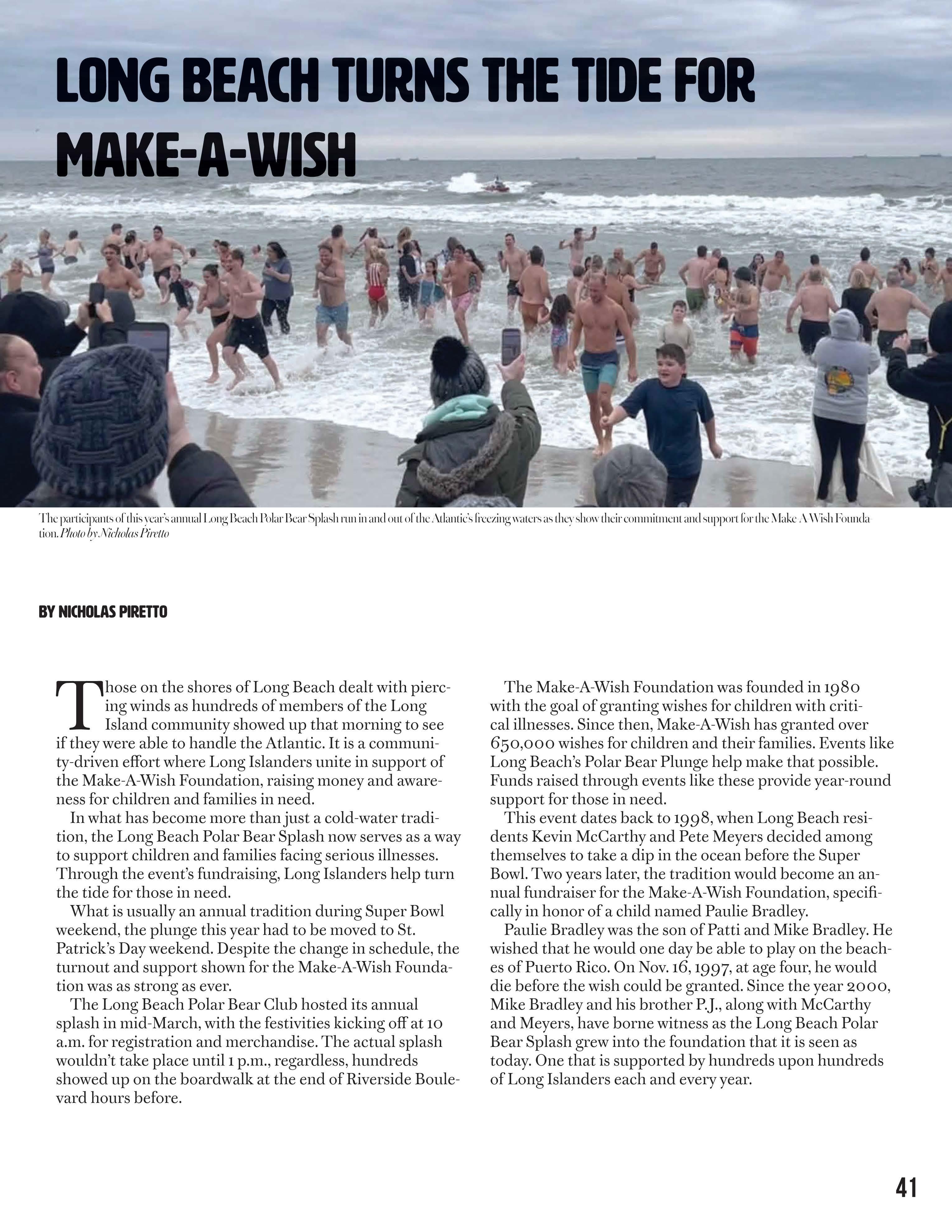
•I'he participantsof'thisvcar'sannualI,ong BeachPolarBearSplashnm in and out of'the Atlantic'sfreezingwatersas thcvshowtheircommitmcllland support forthe ,\fake1\
Fmmda tion.Photol!v.Nid10/asPirc/lo
BYNICHOLASPIRETTO
Those on the shores of Long Beach dealt with piercing winds as hundreds of members of the Long Island community showed up that morning to see if they were able to handle the Atlantic. It is a community-driven effort where Long Islanders unite in support of the Make-A-Wish Foundation, raising money and awareness for children and families in need.
In what has become more than just a cold-water tradition, the Long Beach Polar Bear Splash now serves as a way to support children and families facing serious illnesses. Through the event's fundraising, Long Islanders help turn the tide for those in need.
What is usually an annual tradition during Super Bowl weekend, the plunge this year had to be moved to St. Patrick's Day weekend. Despite the change in schedule, the turnout and support shown for the Make-A-Wish Foundation was as strong as ever.
The Long Beach Polar Bear Club hosted its annual splash in mid-March, with the festivities kicking off at IO a.m. for registration and merchandise. The actual splash wouldn't take place until 1 p.m., regardless, hundreds showed up on the boardwalk at the end of Riverside Boulevard hours before.
The Make-A-Wish Foundation was founded in 1980 with the goal of granting wishes for children with critical illnesses. Since then, Make-A-Wish has granted over 650,000 wishes for children and their families. Events like Long Beach's Polar Bear Plunge help make that possible. Funds raised through events like these provide year-round support for those in need.
This event dates back to 1998, when Long Beach residents Kevin McCarthy and Pete Meyers decided among themselves to take a dip in the ocean before the Super Bowl. Two years later, the tradition would become an annual fundraiser for the Make-A-Wish Foundation, specifically in honor of a child named Paulie Bradley.
Paulie Bradley was the son of Patti and Mike Bradley. He wished that he would one day be able to play on the beaches of Puerto Rico. On Nov. 16, 1997, at age four, he would die before the wish could be granted. Since the year 2000, Mike Bradley and his brother P.J., along with McCarthy and Meyers, have borne witness as the Long Beach Polar Bear Splash grew into the foundation that it is seen as today. One that is supported by hundreds upon hundreds of Long Islanders each and every year.
''It'snotonlygood for thesickchild, it is alsogoodfor thesiblingsandthe
parentstoo. "
-PETEMEYERS, BEAR FOUNDER POLAR CLUB
PaulieBradley,whosememory inspiredthe creationof Long Beach'sPolarBearSplash,is rememberedthrough the annual fimdraiserand the MakeA 'Nish Foundation.P/zoto
courtesy 1?ftlzeBr'Cldfeyfimzi61,
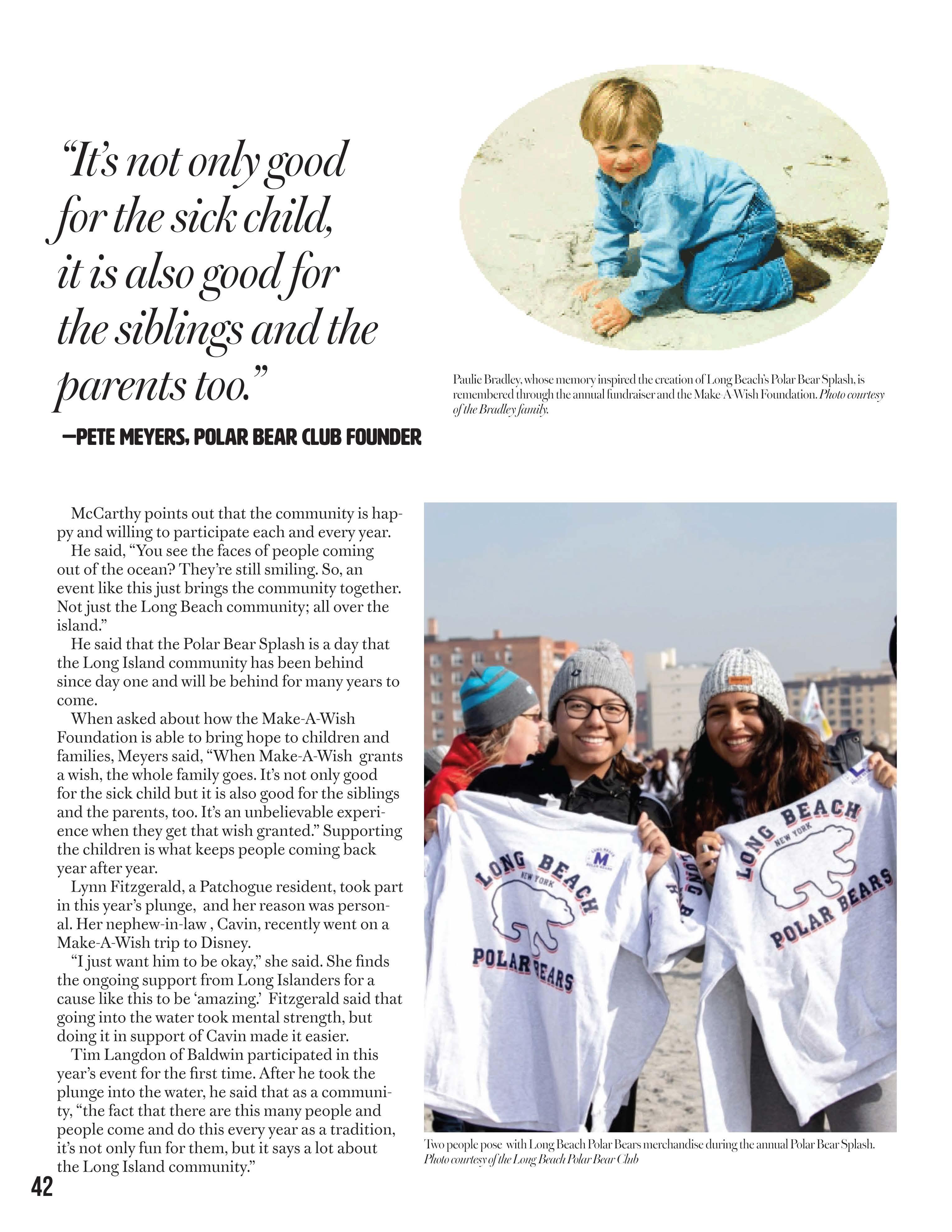
McCarthy points out that the community is happy and willing to participate each and every year. He said, "You see the faces of people coming out of the ocean? They're still smiling. So, an event like this just brings the community together. Not just the Long Beach community; all over the island."
He said that the Polar Bear Splash is a day that the Long Island community has been behind since day one and will be behind for many years to come.
When asked about how the Make-A-Wish Foundation is able to bring hope to children and families, Meyers said, "When Make-A-Wish grants a wish, the whole family goes. It's not only good for the sick child but it is also good for the siblings and the parents, too. It's an unbelievable experience when they get that wish granted." Supporting the children is what keeps people coming back year after year.
Lynn Fitzgerald, a Patchogue resident, took part in this year's plunge, and her reason was personal. Her nephew-in-law, Cavin, recentlywent on a Make-A-Wish trip to Disney.
"I just want him to be okay," she said. She finds the ongoing support from Long Islanders for a cause like this to be 'amazing.' Fitzgerald said that going into the water took mental strength, but doing it in support of Cavin made it easier.
Tim Langdon of Baldwin participated in this year's event for the first time. After he took the plunge into the water, he said that as a community, "the fact that there are this many people and people come and do this every year as a tradition, Twopeople pose with Long BeachPolarBearsmerchandiseduring the annual PolarBearSplash. it's not only fun for them, but it says a lot about Photocourtes_v(/the/,ongBeacftPolarBearOub the Long Island community."
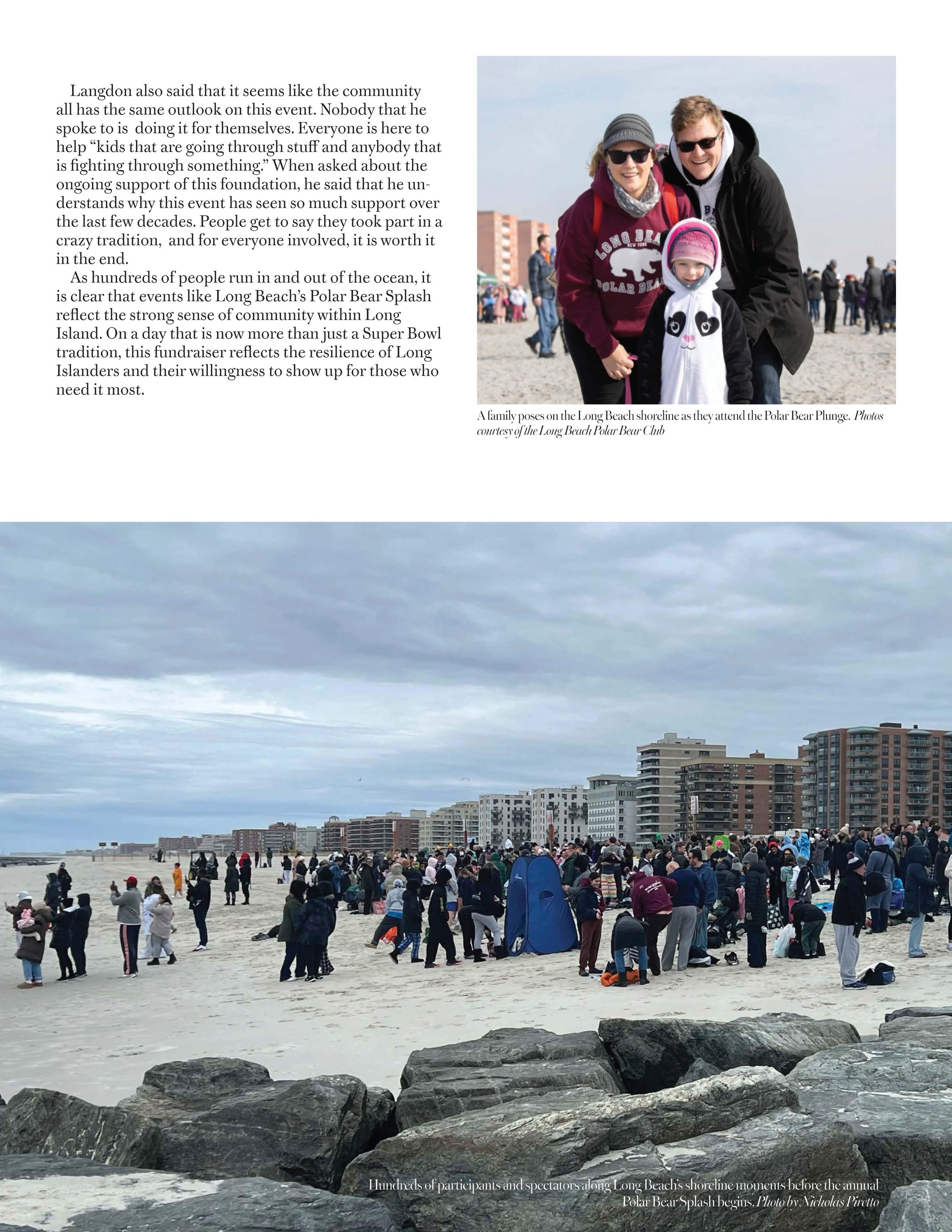
Langdon also said that it seems like the community all has the same outlook on this event. Nobody that he spoke to is doing it for themselves. Everyone is here to help "kids that are going through stuff and anybody that is fighting through something." When asked about the ongoing support of this foundation, he said that he understands why this event has seen so much support over the last few decades. People get to say they took part in a crazy tradition, and for everyone involved, it is worth it in the end.
As hundreds of people run in and out of the ocean, it is clear that events like Long Beach's Polar Bear Splash reflect the strong sense of community within Long Island. On a day that is now more than just a Super Bowl tradition, this fundraiser reflects the resilience of Long Islanders and their willingness to show up for those who need it most.
A familyposes on the I ,ong Beachshorelineas they attend die PolarBear Plunge. Photos cour/es_v(/the/,ongBeachPolarBearCJub

2026
Educators Association Station of the Year-5x NAB Marconi Winner