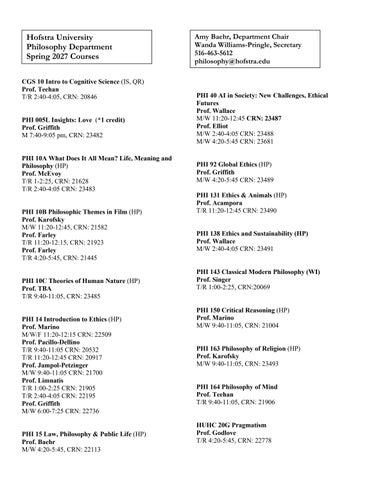
Hofstra University Philosophy Department Spring 2027 Courses CGS 10 Intro to Cognitive Science (IS, QR) Prof. Teehan T/R 2:40-4:05, CRN: 20846 PHI 005L Insights: Love (*1 credit) Prof. Griffith M 7:40-9:05 pm, CRN: 23482 PHI 10A What Does It All Mean? Life, Meaning and Philosophy (HP) Prof. McEvoy T/R 1-2:25, CRN: 21628 T/R 2:40-4:05 CRN: 23483 PHI 10B Philosophic Themes in Film (HP) Prof. Karofsky M/W 11:20-12:45, CRN: 21582 Prof. Farley T/R 11:20-12:15, CRN: 21923 Prof. Farley T/R 4:20-5:45, CRN: 21445 PHI 10C Theories of Human Nature (HP) Prof. TBA T/R 9:40-11:05, CRN: 23485 PHI 14 Introduction to Ethics (HP) Prof. Marino M/W/F 11:20-12:15 CRN: 22509 Prof. Pacillo-Dellino T/R 9:40-11:05 CRN: 20532 T/R 11:20-12:45 CRN: 20917 Prof. Jampol-Petzinger M/W 9:40-11:05 CRN: 21700 Prof. Limnatis T/R 1:00-2:25 CRN: 21905 T/R 2:40-4:05 CRN: 22195 Prof. Griffith M/W 6:00-7:25 CRN: 22736 PHI 15 Law, Philosophy & Public Life (HP) Prof. Baehr M/W 4:20-5:45, CRN: 22113
Amy Baehr, Department Chair Wanda Williams-Pringle, Secretary 516-463-5612 philosophy@hofstra.edu
PHI 40 AI in Society: New Challenges, Ethical Futures Prof. Wallace M/W 11:20-12:45 CRN: 23487 Prof. Elliot M/W 2:40-4:05 CRN: 23488 M/W 4:20-5:45 CRN: 23681 PHI 92 Global Ethics (HP) Prof. Griffith M/W 4:20-5:45 CRN: 23489 PHI 131 Ethics & Animals (HP) Prof. Acampora T/R 11:20-12:45 CRN: 23490 PHI 138 Ethics and Sustainability (HP) Prof. Wallace M/W 2:40-4:05 CRN: 23491 PHI 143 Classical Modern Philosophy (WI) Prof. Singer T/R 1:00-2:25, CRN:20069 PHI 150 Critical Reasoning (HP) Prof. Marino M/W 9:40-11:05, CRN: 21004 PHI 163 Philosophy of Religion (HP) Prof. Karofsky M/W 9:40-11:05, CRN: 23493 PHI 164 Philosophy of Mind Prof. Teehan T/R 9:40-11:05, CRN: 21906 HUHC 20G Pragmatism Prof. Godlove T/R 4:20-5:45, CRN: 22778
CGS 10 Introduction to Cognitive Science (IS, QR) (3 credits) Cognitive science studies the mind and behavior from the points of view of philosophy, psychology, neuroscience, computer science, biology, and other disciplines. This course considers how mind appears on the scene in the course of human evolution, and how to make sense of mind as embedded in the natural world. Topics include the problem of consciousness, the question of non-human animal minds, the role of the body in cognition, and the workings of the moral mind. PHI 005L Insights: Love (1 credit) This course explores love in all its complexity and nuance. We'll use various sources ranging from bell hooks' All About Love to Plato's Symposium, in order to come closer to an understanding of what love is and the different forms love can take. Some of the questions we'll face are: (1) What is the nature of familial love? (2) What is the nature of erotic/romantic love? And (3) what does it mean to love yourself? Since we all express our understanding of love differently, students will have the freedom to pursue which medium best expresses their understanding of love, and thus the final assignment may be in the form of a paper, presentation, art project, song, or video essay. PHI 10A What Does It All Mean? Life, Meaning and Philosophy (HP) (3 credits) What does it all mean? What is the point of life? We’ve all wondered about these questions from time to time. There are a range of answers available. For some people, the meaning of life has to do with God; for others, it is happiness; for others, it is helping others. Some thinkers reject the idea of a “one size fits all” view of meaning, and hold that we must create our own meaning, while still others argue that life has no meaning. Whatever the answer, the question of life’s meaning quickly becomes entangled with other philosophical questions. This course will examine various approaches to the question of the meaning of life, and how this question connects with other important philosophical questions. PHI 10B Philosophic Themes in Film (HP) (3 credits) An introduction to various philosophical issues that arise in contemporary films like Ad Astra, Arrival, Ex Machina, Her, Beautiful Boy, Silence, A Serious Man, Edge of Tomorrow, Inception, and The Matrix. Some of the issues examined include the problem of skepticism, the mind-body problem, personal identity, artificial intelligence, free will and determinism, moral dilemmas, and the meaning of life. PHI 10C Theories of Human Nature (HP) (3 credits) Examination of classical and contemporary theories of human nature. Considers persons as moral beings, as seekers of knowledge, and as social and political animals. Emphasis on the connection between theories of human nature and conceptions of the natural world. PHI 014 Introduction to Ethics (HP) (3 credits) This course focuses on critical reasoning about ethics. It reviews major approaches to ethical values and examines the bases for why some conduct (like killing, deceit, fraud) is wrong, and why some things (like freedom, fairness, compassion) are valuable. The course also examines the relationship between ethics and society, with focus on contemporary issues. For example: ethics in professional or business contexts, health and medical contexts, ethics in personal relationships, and environmental ethics. PHI 15 Law, Philosophy and Public Life (HP) (3 credits) Introduction to political philosophies that animate contemporary politics in the United States, including libertarianism, liberalism, and conservatism. Focus is on how these philosophies play out in disagreements about issues such as climate change, taxation, race and gender, immigration, and the role of religion in public life.
PHI 40 Artificial Intelligence In Society: New Challenges, Ethical Futures Emerging artificial intelligence technologies create new challenges for traditional approaches to human ethics. By exploring how artificial intelligence creates specific problems, students learn to think about possible solutions. They do that by learning traditional ways of thinking about ideas like right action, goodness, personal character, rights and responsibilities, and fairness and justice in the context of artificial intelligence. They observe how these ideas interact with artificial intelligence in specific cases, and they practice logical reasoning about what to do with AI using those concepts. They explore where our society might need new ethical ideas, and they think about how to build a promising future society that includes AI. PHI 92 Global Ethics (HP) (3 credits) Examination of the philosophical and ethical implications of globalization. Classical and contemporary ethical theories will be considered. The course is meant to deepen students' understanding of the phenomenon of globalization, and to strengthen students' ethical insight, intercultural sensitivity, and capacity to address the challenges of today's world with courage and deliberation. No prior coursework in philosophy is required. PHI 131 Ethics and Animals (HP) (3 credits) Inquiry into the ethical significance of non-human animals. Consideration of such issues as whether non-human animals have interests and rights; whether animals' capacity for consciousness or for pain and pleasure is a basis for their having ethical significance; whether animals are due a certain level of care and concern. The course will also examine whether similarity to human beings is necessary for nonhuman animals to have ethical significance. The course may look at cases involving the treatment and portrayal of animals in agriculture and diet, science and education, wild nature and domestic life, and entertainment and fashion. PHI 138 Ethics and Sustainability (HP) (3 credits) This course considers how we should live and how we should value the future. Should we “discount” the future, that is, value it less than the present, or is it of equal or greater value than the present? Do we, as individuals, as societies, have responsibilities to future generations? The course examines the concept of sustainability and the ethical bases for individual, corporate, and social responsibilities to live, consume, and produce sustainably. The course combines philosophical readings with practical and concrete case studies. PHI 143 Classical Modern Philosophy (3 credits) In this course we examine the views of 17th and 18th century philosophers about knowledge and the nature of reality. The topics we will discuss include perception, the limits and the justification of knowledge, substance (is reality purely physical?), cause and effect, free will, personal identity, and the existence of God. We will also pay attention to the efforts these philosophers made to understand and advance science, to deal with turmoil about religious authority and religious beliefs (we’ll develop a working understanding of various ways to be a heretic), and—directly or indirectly—to improve human life.
PHI 150 Critical Reasoning (HP) (3 credits) This course is a study of reasoning and argument as they appear in ordinary usage. The aim of the course is to increase students’ skills in critical thinking: how to recognize unsupported assertions, how to analyze and assess arguments encountered in everyday life, and how to formulate and present cogent arguments of one’s own. PHI 163 Philosophy of Religion (HP) (3 credits) This course explores various debates between theists, atheists, and agnostics, including whether there is adequate proof of God's existence; whether the existence of the universe can be explained if there is no God; whether God's existence is necessary for morality; whether life can have meaning and purpose without God; and whether there can ever be adequate responses to any of these questions. No previous study of philosophy is presupposed or required. PHI 164 Philosophy of Mind (3 credits) Philosophy of mind discusses issues like the mind/body problem, artificial intelligence, the nature of consciousness and intentionality, and mental causation. Some typical questions are: What are minds? Are they the same or different from souls? How could brains possibly think? Can animals, babies or computers think? Can persons change bodies? Could you or I survive the death of our bodies? HUHC 20G Pragmatism This course surveys the history of philosophy in America with a special focus on the development of American pragmatism. Pragmatism is a diverse tradition, united by an interest in embedding theory in practice, the fallibility of our knowledge, and a robust account of human experience. We will begin with the philosophy of Charles Sanders Peirce (1839-1914); we will look at what he accepted and what he rejected from the western philosophical tradition. Then we will take up Peirce’s contemporary and friend, William James (1842-1910), then move on to James’ student John Dewey (1859-1952) and then to W.V.O. Quine (1908-2000) and Richard Rorty (1931-2007). Our guides throughout the course will be the writings of Cheryl Misak and Susan Haack—outstanding contemporary pragmatists in their own right. **This course is open to philosophy majors by permission of instructor. Please contact Professor Godlove: phitfg@hofstra.edu