D O NA LD A ND B A R B A R A AT HO FS TR A / NO RTHW E LL
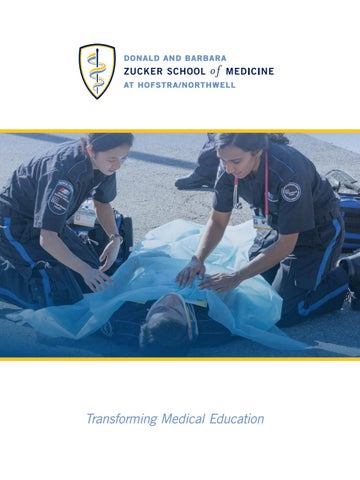
Transforming Medical Education
Leadership
Lawrence G. Smith, MD, MACP Founding Dean
At the very core of the journey into medicine is the desire to help individuals and their families, improve communities, inspire change, and transform lives. We use these values to train leaders in the medical field who will be sought after by patients. And these values represent the driving force behind the innovation, scholarship, and success of the Donald and Barbara Zucker School of Medicine at Hofstra/Northwell. Welcoming our first class of students in 2011, the Zucker School of Medicine launched a unique approach to medical education that challenged the traditional model of training that has existed since the early 20th century. Developed by a multidisciplinary team of clinicians and scientists from over 20 departments at Northwell Health, in collaboration with Hofstra University, our curriculum structure merges class time, independent learning, scientific inquiry, and real-life application beginning day one of a student’s medical education. The goal: to produce doctors who are prepared to meet the demands of the nation’s changing health care environment. Today, the Zucker School of Medicine ranks highly for research, an unprecedented gain in reputation and measure of excellence that is on par with leading institutions nationwide and close to home. In just a short period, we have proven – through the success of our graduates – that our application-based, patient-centered approach to educating the next generation of physicians and scientists benefits our students and the patients they will serve. Our vision for change has inspired a new movement in medical education throughout the country. It is a revolution in learning and health care that will produce the best clinicians, educators, and innovators in medicine for years to come.
About Us Donald and Barbara Zucker School of Medicine at Hofstra/Northwell Established in 2008, the Zucker School of Medicine was founded by two equal partners: Hofstra University and Northwell Health. The Zucker School of Medicine is built upon the strong clinical and graduate medical education programs of Northwell, as well as the robust research and academic programs of both Hofstra University and Northwell’s Feinstein Institute for Medical Research, including a partnership with Cold Spring Harbor Laboratory. The Zucker School of Medicine currently ranks among top medical schools nationwide for research (U.S. News & World Report, Best Graduate Schools, 2019). Our vision for the Zucker School of Medicine was to create an innovative student-centered curriculum that leverages the vast clinical resources of Northwell Health and integrates academic course content with hands-on clinical experiences. It is a new approach to learning that combines the biomedical, biopsychosocial, and clinical medicine needed to prepare tomorrow’s health care professionals – starting on the first day of medical training.
Fast Facts Mission medicine.hofstra.edu
Accreditation The Zucker School of Medicine at Hofstra/Northwell is fully accredited by the Liaison Committee on Medical Education (LCME.org).
Degrees Offered • MD (Doctor of Medicine) • MD/PhD (dual Doctor of Medicine/Doctor of Philosophy, Molecular Basis of Medicine) • MD/MPH (joint Doctor of Medicine/Master of Public Health) • MD/MBA (joint Doctor of Medicine/Master of Business Administration) • PhD in the Molecular Basis of Medicine • Hofstra 4+4 Program: BS-BA/MD (dual Bachelor of Arts or Bachelor of Science/Doctor of Medicine)
Faculty: 3100+ • Academic Departments: 25
Core Values
The Zucker School of Medicine at Hofstra/Northwell, in a culture of community, scholarship, and innovation, is dedicated to inspiring diverse and promising students to lead and transform medicine for the betterment of humanity.
Students (per class): 99 • Annual MD Applicants: Approximately 5,300 • Median Overall GPA: 3.8 • Median MCAT: 516 National Residency Match Zucker School of Medicine graduates have successfully matched into highly competitive residency programs across the country in a wide variety of specialty areas.
Location Nestled in western Long Island, NY, on the North Campus of Hofstra University, the Zucker School of Medicine is just 25 miles from the excitement of Manhattan and is easily accessible by car or the Long Island Rail Road. Long Island is home to a wide range of attractions, from the world-famous Jones Beach to the renowned Hamptons of the East End. Hofstra’s beautiful 244-acre campus is a nationally recognized arboretum that includes lush greenery, flowers, and landscapes to inspire and motivate students.
Our core values shape the experiences and mentoring necessary for the transformation of our students into caring and accomplished physicians who embody, and will be recognized by, these values in their professional lives. 4
t Community t Learning t Scholarship t Patient-centeredness t Diversity t Professionalism t Humanism t Reflection t Innovation t Vision
ADMISSION MD Admission Requirements
Recommended Course Work
All applicants must have earned a bachelor’s degree from an accredited U.S. or Canadian college or university prior to matriculation into the MD program. Applicants must be U.S. citizens or permanent residents. Application materials for the Zucker School of Medicine at Hofstra/Northwell include the following:
The Zucker School of Medicine at Hofstra/Northwell believes the study of medicine is enriched by contact with other intellectual disciplines; therefore, it seeks students with a diverse blend of educational credentials. A liberal arts background in classes such as anthropology, history, literature, philosophy, political science, psychology, religion, and/or sociology, which requires students to read broadly, write extensively, and present oral arguments, is highly recommended.
t A Premedical Committee letter. If your school does not have a Premedical Committee, or a considerable amount of time has passed since graduation, you may submit three individual letters of recommendation – two letters from individual professors (at least one in science) and one letter from a non-academic professional (included with AMCAS application). Applicants may submit more than three letters of recommendation through AMCAS, though we do not guarantee that all letters beyond the minimum requirement will be reviewed by our Office of Admissions. t A completed secondary application, including the $100 application fee. If the applicant is eligible for fee assistance through the Association of American Medical Colleges Fee Assistance Program (AAMC FAP), the secondary application fee will be waived.
While there are no prerequisites in the natural sciences needed to apply, the Zucker School of Medicine strongly recommends successful completion of the following courses: t One year of college biology with lab t Chemistry, to the level of organic or biochemistry t One year of college mathematics, preferably including statistics t One year of college physics t English literature or equivalent, including writing Additional course work in cell biology, embryology, ethics, genetics, and molecular biology is helpful, but not required for admission. Deadlines Early Decision t AMCAS Application Deadline: August 1 t Secondary Application Deadline: August 31* Regular Decision t AMCAS Application Deadline: November 1 t Secondary Application Deadline: December 1* *Applications will not be reviewed until MCAT scores, a Premedical Committee letter or three letters of recommendation, and a completed secondary application have been received.
For more information about admission criteria and other degree programs at the Zucker School of Medicine, please contact the Office of Admissions at medicine.admissions@hofstra.edu or 516-463-7519.
medicine.hofstra.edu
t A completed primary application submitted through the American Medical College Application Service (amcas@aamc.org), including Medical College Admission Test (MCAT) scores (new MCAT exam only) and official transcripts from all postsecondary schools attended.
Medical School Core Curriculum Integrated Academics, Clinical Experiences
First 100 Weeks (Years 1 and 2)
medicine.hofstra.edu
Science and clinical knowledge are interwoven during the First 100 Weeks through case-based sessions called PEARLS (Patient-Centered Explorations in Active Reasoning, Learning, and Synthesis). PEARLS sessions are intentionally designed to ensure that students acquire the skills to solve clinical problems by critically evaluating and applying basic and clinical scientific knowledge to socially contextualized patient care. The First 100 Weeks includes four integrated courses in the first year and three courses in the second year, each of which contains three major components: (1) Mechanisms of Health, Disease, and Intervention, (2) Structure, (3) Patient, Physician, and Society and an Initial Clinical Experience (ICE) clerkship. Mechanisms of Health, Disease, and Intervention t Molecular, cellular and organ physiology, and pathophysiology t Cellular and organ physiology t Pharmacology t Therapeutics Structure t Anatomy t Embryology t Histology t Imaging t Pathology t Physical Diagnosis t Ultrasound Skills Patient, Physician, and Society t Non-biological sciences t Core clinical skills Initial Clinical Experience (ICE) The Initial Clinical Experience, or ICE, allows first- and second-year medical students to complement their classroom learning with direct patient care for one full afternoon each week. ICE is unique in that students develop longitudinal relationships over two years with both preceptors and patients, and through these relationships, learning occurs. ICE disciplines are coordinated temporally with the integrated science curricular content and themes. Each student is paired with five discipline-specific, physician/faculty preceptors in the following core disciplines: t General Medicine (Internal Medicine or Family Medicine) t Obstetrics and Gynecology t Pediatrics t Psychiatry t Surgery
The Zucker School of Medicine at Hofstra/Northwell has established a culture in which learning is valued over teaching, and students are self-directed learners. Our students have honed their ability to independently research questions and can problem solve, work in teams, think critically, and turn their knowledge into action.
PEARLS PEARLS is the foundation of our student-centered curriculum during the initial years of training. The goal of PEARLS is for students to learn the key concepts of biomedical science embedded in real patient cases, while also fostering teamwork, leadership, lifelong learning, and reflection.
Essential principles of PEARLS include: t Challenging students to develop higher cognitive skills of analysis, synthesis, and evaluation (focusing on how or why, rather than what). t Providing a bridge for linking pre-existing knowledge to new knowledge. t Encouraging students to consider cases from multiple perspectives, including science, clinical reasoning, prevention, and population health. t Requiring all individual group members to identify learning objectives and research-related information, and to explain the results of that inquiry during subsequent student-led sessions. PEARLS cases thoroughly integrate all aspects of the curriculum and provide the structural framework for learning sessions throughout each week.
“Early clinical exposure through EMT training and clinic visits allowed me to see patients consistently in my first two years and to think critically about their cases. These were not shadowing experiences, but opportunities to interact with and learn from patients, bringing the time spent in the classroom to life in vivid color.� Dahlia Hassan, MD Class of 2017
medicine.hofstra.edu
Each student is assigned to a PEARLS group of eight or nine peers and one faculty facilitator for the duration of a course. The first session of the week involves dissecting two cases and developing specific learning objectives. During the second and third sessions, students work together to synthesize their understanding of the material.
Medical School Core Curriculum
medicine.hofstra.edu
Integrated Academics, Clinical Experiences
The founders of the Zucker School of Medicine at Hofstra/Northwell sought a significant departure from traditional undergraduate medical education curricula and created a curricular design that includes the following guiding principles: t A fully integrated four-year science and clinical curriculum t An adult learner environment that values independent study and self-directed learning t Built upon experiential and active small group, case-based learning t Focused on conceptual knowledge in action, not memorizing facts t Early meaningful patient interactions with emphasis on both individual and population health t Reflection on the transformation from person to professional
Second 100 Weeks (Years 3 and 4) The advanced clinical experiences remain true to the pedagogy established in the First 100 Weeks, incorporating structured exercises that ensure a continuous intertwining of science and clinical medicine so that students learn to apply science successfully in the context of patient care. Advanced Clinical Experience (Year 3) The Advanced Clinical Experience of the Second 100 Weeks is structured around six core clerkships in both inpatient and ambulatory settings in the following fields: t Neurology t Psychiatry t Obstetrics and Gynecology
t Pediatrics t General Medicine t Surgery
Additionally, students are given two opportunities to personalize their course of study by choosing a two-week specialty. For half of the Advanced Clinical Experience, students participate in a community practice-based ambulatory experience called Continuity Clinic. Preparation for Residency (Year 4) During Preparation for Residency, students are required to complete three acting internships in the fields of: t Family Medicine, Internal Medicine, Pediatrics, or Surgery t Emergency Medicine t Critical Care These acting internships prepare students for residency and the level of responsibility expected during postgraduate training. During Preparation for Residency, students also complete elective experiences, and are given dedicated professional development time to focus on study for USMLE Step 2 and the residency application process.
Guiding Principle: Assessment Drives Learning The overarching goal of the Zucker School of Medicine at Hofstra/Northwell assessment system is to assist students in becoming reflective practitioners of medicine who embrace lifelong learning opportunities and complement their learning with a critical approach to self-assessment and self-improvement.
t Direct observation t Formative feedback t Self-assessment t Peer assessment t Summative assessment During the First 100 Weeks, assessment mirrors the active learning that occurs in class sessions and is aligned with each of the three curricular components – Mechanisms of Health, Disease, and Intervention; Structure; and Patient, Physician, and Society. Grading in the First 100 Weeks is entirely pass/fail, and performance on individual assessments is reported in a manner devoid of numerical scores to minimize competition and promote teamwork. Assessment modalities include: t Short-answer essay exams t Faculty/preceptor narrative feedback t Objective-structured clinical exams (OSCEs) t Lab practicals t Project-based presentations During the Second 100 Weeks, assessment components align with clinical experiences. The grading system in the Second 100 Weeks consists of honors, high pass, pass, and fail. Assessment modalities include: t National Board of Medical Examiners (NBME) subject exams t Short-answer essay exams t OSCEs t Faculty and resident narrative feedback t Clinical presentations t Clinical documentation t Professionalism performance assessments
“The students at the Zucker School of Medicine were so enthusiastic about their school and their curriculum that I instantly knew the culture they had created here was something special that I wanted to be a part of.” Eric Ebert
Class of 2020
medicine.hofstra.edu
The Zucker School of Medicine’s comprehensive, competency-based assessment system includes numerous opportunities for tracking each student’s developmental progress in the educational program through:
MD/PhD Program Overview In addition to receiving their MD degree, students in the MD/PhD program receive their PhD degree in the Molecular Basis of Medicine from the Donald and Barbara Zucker School of Medicine at Hofstra/Northwell. The program trains individuals to pursue scholarly activity in biomedical, translational, and clinical research, with the goal of transforming and improving medical care for the population at large. The unique aspects of this program are the emphasis on both the study of human disease and the application of that study to clinical practice. Students can complete their PhD work in laboratories located within the Feinstein Institute for Medical Research and Cold Spring Harbor Laboratory.
Application and Interview Process
medicine.hofstra.edu
Applicants interested in applying to our MD/PhD program should apply through AMCAS and select MD/PhD as their program type. After applying through AMCAS, applicants are notified via email of the Zucker School of Medicine’s receipt of a verified application. Please visit medicine.hofstra.edu/mdphdrequirement for complete application requirements. Those invited to interview with the Zucker School of Medicine will be given the opportunity to tour the facilities of the Feinstein Institute for Medical Research, meet with researchers in their area of interest, and speak with current MD/PhD students. This is in addition to the MD interview portion of the day, which consists of: 1) Multiple Mini Interview (MMI); 2) presentations from the Office of Admissions and Student Affairs that cover relevant topics and provide an in-depth description of our curriculum, the admissions process, and the roles played by each office; 3) lunch with our current students; and 4) a tour of the Zucker School of Medicine building.
MD/PhD Curriculum and Timeline Medical students in the MD/PhD program complete the First 100 Weeks of the MD curriculum and take the Step 1 licensing exam. They then enter the laboratory to begin the PhD phase of the program. During this phase of training, students in the MD/PhD program have the opportunity to continue to practice and refine their clinical skills. In partnering with Northwell Health, there are many options available, and arrangements can be tailored with regard to the interest/need of the student. Once the dissertation is complete, various re-entry points allow for students to reintegrate into the MD curriculum for the Second 100 Weeks. Year One (MS1) MD V MS1 course work PhD V Critical Readings and Topics in Translational Medicine course Summer between MS1 and MS2 PhD V Lab Rotations V Model Organisms course Year Two (MS2) MD V MS2 course work
Year Three (PhD1) PhD V Qualifying Exam completed V Continued work on PhD project
Year Six (MS3) MD V Advanced Clinical Experience
Year Four (PhD2) PhD V Continued work on PhD project
Year Seven (MS4) MD V Preparation for Residency
Year Five+ (PhD3) PhD V Preparation for defense and transition back to MD curriculum V Students are required to pass their defense before returning to the MD curriculum
The required courses Rational Drug Design and Ethics are taken during the PhD years. Year Five may be longer than 12 months, and a student may re-enter the MD curriculum in June, July, October, or November. This results in a shortened MS4 year in which MD requirements are reduced for MD/PhD students.
Contact Information For more information about the MD/PhD program, please visit medicine.hofstra.edu/mdphd. For specific questions, please contact: t Betty Diamond, MD, Director of MD/PhD and PhD Programs, Donald and Barbara Zucker School of Medicine at Hofstra/Northwell t Email: bdiamond@northwell.edu t Tiffany Jordan, Assistant Director of Dual Degree Programs and Curricular Initiatives, Donald and Barbara Zucker School of Medicine at Hofstra/Northwell t Email: tiffany.m.jordan@hofstra.edu
MD/MPH Program Overview The MD/MPH joint degree program is designed for medical students at the Donald and Barbara Zucker School of Medicine at Hofstra/Northwell who are interested in acquiring public health knowledge and skills. The educational mission of the MD/MPH program is to prepare physicians with an enhanced understanding of the social, behavioral, economic, and political determinants of health, and the skills necessary to apply this knowledge to improve the health of populations through leadership in patient care, research, education, health care policy analysis, and community empowerment.
Eligibility and Cost Zucker School of Medicine students are eligible to apply for admission to the MD/MPH program during their third year (MS3). The goal of the MD/MPH program is to facilitate the attainment of both degrees within a five-year period. Accepted MD/MPH students take a leave of absence from medical school between the third and fourth year to complete the majority of their MPH course work during one year’s time. Tuition and fees for the MPH portion are in addition to the cost of attendance for the Zucker School of Medicine MD program, and are evaluated each year and subject to change.
MD/MPH Curriculum
MPH Plan of Study Summer (after completion of MS3) t MPH 220 Environmental and Occupational Health
Winter t MPH 222 Research Methods for Qualitative Studies
Fall t MPH 200 Introduction to Public Health t MPH 210 Public Health Policies and Systems t MPH 204 Social and Behavioral Determinants of Health t MPH 205 Public Health Program Planning and Evaluation t MPH 221 Research Methods for Quantitative Studies t MPH 229 Public Health Professional Development Seminar t MPH 230 Public Health Internship and Leadership Seminar*
Spring t MPH 202 Epidemiology I t MPH 203 Biostatistics I t MPH 206 Biostatistics and Epidemiology t MPH 223 Global Health Issues t MPH 229 Public Health Professional Development Seminar t MPH 231 Culminating Research Experience*
Application
* These courses can start during the MPH year and continue throughout the program period with or without an additional two months of elective time during the MS4 year.
Interested students in good academic standing must complete a one-page MPH application form by February 15 of their MS3 year.
Contact Information For more information about the MPH program, please visit hofstra.edu/publichealth. For specific questions or to set up an appointment, contact: t Isma H. Chaudhry, MD, MPH, Director, Public Health Graduate Programs, Department of Health Professions, Hofstra University t Email: isma.h.chaudhry@hofstra.edu t Lauren Block, MD, MPH, Associate Professor, Liaison, MD/MPH Program, Donald and Barbara Zucker School of Medicine at Hofstra/Northwell t Email: lblock2@northwell.edu t Tiffany Jordan, Assistant Director of Dual Degree Programs and Curricular Initiatives, Donald and Barbara Zucker School of Medicine at Hofstra/Northwell t Email: tiffany.m.jordan@hofstra.edu
medicine.hofstra.edu
Medical students accepted into the MD/MPH program are granted 6 credits toward the MPH based on the Patient, Physician, and Society component, including the Initial Clinical Experience (ICE) of their First 100 Weeks curriculum, and the Advanced Clinical Experience/Continuity Clinic of the Second 100 Weeks. MD/MPH students are required to complete the remaining 36 credits of public health core courses, including a 3-credit supervised field internship and a 3-credit supervised culminating research experience. Most MD/MPH students use elective time during their fourth year of medical school to complete the field internship and culminating research experience.
MD/MBA Program Overview The MD/MBA joint degree program at the Donald and Barbara Zucker School of Medicine at Hofstra/Northwell is designed for students who are interested in acquiring core business competencies and leadership and decision analysis skills, as well as a strategic perspective of business problems as they relate to the health care environment. The educational mission of the program is to graduate physicians with enhanced leadership and management skills, while preparing them as potential health care leaders.
Eligibility and Cost The MD/MBA program is open to all students enrolled in the Zucker School of Medicine, inclusive of the 4+4 BS-BA/MD program. The suggested timing to enter the MD/MBA program is after completion of year 3 of the MD program. The goal is for students in the MD/MBA program to attain both degrees within a five-year timeframe. Accepted MD/MBA students take a leave of absence from the MD program to complete the majority of their MBA course work in one year.
medicine.hofstra.edu
Tuition and graduate fees for the MBA portion are evaluated each year and are subject to change. This is in addition to the cost of attendance for the Zucker School of Medicine MD program.
MD/MBA Curriculum MD/MBA students are required to complete 41 credits of business, accounting, and health care strategic management courses, including a 3-credit culminating capstone course. Most MD/MBA students use elective time (up to a maximum of two electives) during their fourth year of medical school to complete any outstanding course work. Some courses may be waived if students have applicable previous course work.
MBA Plan of Study Summer I (after completion of MS3) t ACCT 203* Accounting and Financial Reporting t ECO 200* Survey of Economics t MGT 200* Business Ethics and Society, MKT 203 Marketing Analysis and Management, or IT 203 Information Systems for Managers Fall t MGT 200, MKT 203, or IT 203** t BAN 203 Advanced Quantitative Analysis for Managers t MGT 207 Organizational Behavior and Leadership Skills for Strategic Advantage January t HADM Elective
Spring t FIN 203 Managerial Finance t HADM Elective t IB 207 Global Business Decision Making t MBA 350 Integrative Strategic Decision Making Summer II t HADM Elective t HADM Elective HADM electives include: U.S. Health System, Health Policy and Analysis, Health Care Economics, and Health Care Finance * These courses can be waived if a class at a comparable level has been taken within the past five years. ** One of these courses will be taken during Summer I, while the remaining two courses will be completed during Fall.
Application Interested students in good academic standing will need to complete a one-page MBA Application Form by March 1 of the year prior to intended matriculation. Applications will be made available by and submitted to the assistant director of dual degree programs and then routed to the MBA program director.
Contact Information For more information about the MBA program, please visit hofstra.edu/mbainfo. For specific questions or to set up an appointment, contact: t Dr. Kaushik Sengupta, Associate Dean for Graduate Education and Director of the Online MBA Program, Frank G. Zarb School of Business, kaushik.sengupta@hofstra.edu t Tiffany Jordan, Assistant Director of Dual Degree Programs and Curricular Initiatives, Donald and Barbara Zucker School of Medicine at Hofstra/Northwell, tiffany.m.jordan@hofstra.edu
Student Research The Zucker School of Medicine emphasizes the importance of discovery and innovation in the process of learning and in helping patients. Through partnerships with clinical services and laboratories within Northwell Health and externally, our faculty and students are engaged in all forms of collaborative research, in particular, investigations involving the underlying biological process of disease for use in development of new therapies and diagnostics.
All medical students benefit from the extensive resources of the Zucker School of Medicine, which include the Feinstein Institute for Medical Research (the research arm of Northwell Health) and Cold Spring Harbor Laboratory in a collaboration that equips students for the accelerating pace of medical research and scientific discovery in the years ahead. Facilitated by the Zucker School of Medicine Advisory Committee for Student Research and the Office of Student Affairs, students have the opportunity to choose from several different types of research projects that explore a variety of key areas in medicine. These include short-term and longitudinal studies in basic science, clinical research, community health, medical education, medical humanities, and quality improvement.
t At least 70 percent of students engage in research during the summer after their first year of study, and nearly 100 percent do so by graduation. Students engage in research projects, locally and overseas, that cover a wide range of health issues. Many partner with top research investigators from the Feinstein Institute for Medical Research, Cold Spring Harbor Laboratory, and other areas, while others travel abroad to work on public health projects, such as studying health issues of Haitian workers in the Dominican Republic. The Zucker School of Medicine also hosts an annual Scholarship Day to showcase and disseminate new knowledge contributed by medical students of all years of study who participated in summer research activities. Students engaged in investigative studies are guided from start to finish by Zucker School of Medicine faculty mentors.
medicine.hofstra.edu
t Each year, the Zucker School of Medicine admits four MD/PhD students who, over seven to eight years, complete both the MD degree program requirements and the requirements for the PhD in the Molecular Basis of Medicine.
medicine.hofstra.edu
Faculty Renowned Physicians and Educators The faculty of the Zucker School of Medicine at Hofstra/Northwell consists of more than 3,100 nationally and internationally recognized medical educators, clinicians, and scientists who represent a vast number of diverse specialties and wide range of interests. They are leaders in clinical skills education and research, and are engaged in a variety of community service endeavors. Our faculty members are widely published, and many serve on numerous editorial boards and national study sections. We have a burgeoning Alpha Omega Alpha Honor Medical Society chapter with over 300 members and a recently established Academy of Medical Educators that recognizes outstanding medical educators who embrace the academic guiding principles of the Zucker School of Medicine. Additionally, members of our faculty make regular media appearances as experts in the medical field. Department of Science Education Unlike other institutions, the Zucker School of Medicine offers a uniquely distinct Science Education Department, which includes faculty members who are full-time educators and are dedicated entirely to teaching biomedical, biopsychosocial, and clinical sciences. Their open-door policy creates an accessible and collegial environment and reflects professors’ engagement with their students.
“ While the early patient exposure drew me in, it was the students I met on my interview day and during re-visit weekend that convinced me that I made the right choice.” Shadae Beale, MD Class of 2018
Student Life Connect closely with peers, educators, and mentors. About the Student-Run Free Clinic
The Office of Student Affairs, together with various departments, works to ensure a safe, caring, and positive learning environment for every student. From the first day of training through to graduation, the Office of Student Affairs’ direct links to various academic resources provide students with opportunities to connect closely with educators and mentors who can provide a wealth of experience, insight, and guidance.
Run by students with the support of on-site faculty-physicians, the Zucker School of Medicine Free Clinic in Rego Park, New York, offers annual physicals, sick visits, vaccines, blood work, electrocardiograms, and much more for patients in need, including referrals at low or no cost. The service follows in the footsteps of a free clinic initiated in Far Rockaway, Queens, in response to Superstorm Sandy by Doctors of the World in partnership with the Zucker School of Medicine.
Student support services at the Zucker School of Medicine include: t Academic advising – dedicated to helping students with demonstrated or self-identified academic difficulty. t Career advising – focused on transforming trainees from students to professionals, including providing direction during the residency match process and career exploration. t Financial assistance – concentrated on providing advice, planning, and options for responsible fiscal management of a student’s journey through medical school to a career. t Diversity and inclusion – committed to promoting cohesion, understanding, and acceptance of differences in culture, color, and creed within the Zucker School of Medicine community and beyond. Extracurricular Activities For personal growth, well-being, and success, students are encouraged to take part in a wide range of extracurricular activities and student organizations at the Zucker School of Medicine, including more than 50 active clubs, special interest groups, and committees. Students can also create and participate in a variety of community service initiatives. These include educating elementary school children about healthy living habits; fundraising for childhood cancer, women’s heart health, and other causes; mentoring young students interested in science and medicine; and caring for patients in need at the Zucker School of Medicine’s student-run free clinic in Rego Park, New York. Student Honors Many Zucker School of Medicine students graduate with distinction for their commitment to scholarly and humanitarian efforts, including being inducted into various honor societies, and receiving departmental awards and other recognitions of excellence. The Zucker School of Medicine celebrates these milestones during each student’s journey to residency.
medicine.hofstra.edu
Each year the Zucker School of Medicine at Hofstra/Northwell welcomes approximately 100 new students from all regions, socioeconomic backgrounds, and walks of life. The small class size encourages a collaborative, close-knit academic culture and enables students to build genuine relationships with peers, faculty, and staff.
Academic and Clinical Facilities On and Off Campus
The Zucker School of Medicine at Hofstra/Northwell building consists of 113,000 square feet of high-tech learning, laboratory, meeting, and office space. On campus, students have access to all the resources they need to succeed — excellent library services with online and print collections; fitness, recreation, and dining facilities; arts and culture; and extensive wired and wireless internet access, including the only Internet2 connection among private colleges on Long Island.
medicine.hofstra.edu
An ultramodern, environmentally conscious facility, the Zucker School of Medicine at Hofstra/Northwell has evolved into an epicenter for numerous academic, industry, local, and national events. From the 2016 presidential debate at Hofstra to professional conferences and community forums, the Zucker School of Medicine is the pulse of many important gatherings and discussions focused on generating positive energy, innovation, and change. The building’s layout features an open, contemporary, yet inviting space and seamless design that is punctuated by small group rooms, a multipurpose area, large medical education theaters, clinical skills rooms (unique to the Zucker School of Medicine), a health sciences library, and a structure laboratory that offers the latest medical technology. The decor and layout also feature indoor and outdoor dining and lounge retreats to inspire socialization, collaboration, and community. The facility is designed to meet the highest standards for LEED Silver Rating, a benchmark in green building design and sustainability. Structure Laboratory The 7,300-square-foot structure laboratory offers significant capacity, allowing room for more than 125 individuals. The lab features built-in telecommunication technology/computers, large monitors, and state-of-the-art surgical lighting. Medical Education Theaters Two large medical education theaters (large group halls) offer cutting-edge audiovisual systems, secondary confidence monitors for presentations, and an occupant capacity of over 200. The theaters also have a lecture capture system, allowing sessions to be recorded for playback over the network, as well as push-to-talk technology with automatic video capture of speakers in the audience.
Small Group Rooms and Study Areas
Campus Amenities Comfortable and convenient on-campus graduate housing and ample parking are available. When it’s time to dine, the Zucker School of Medicine facility has its own on-site café with a variety of grab-and-go food/drink options and healthy fare. Students can enjoy a meal outdoors surrounded by beautiful green space, or relax in one of many indoor retreats, including an inviting student lounge complete with dining and relaxed-seating areas, work stations, and entertainment. Students can also explore the numerous eateries available on and off the Hofstra University campus. In support of a healthy lifestyle, students are encouraged to take advantage of Hofstra’s on-campus fitness amenities, including: t The Swim Center, featuring an Olympic-size pool and four diving areas t The David S. Mack Fitness Center, including state-of-the-art cardio and strength equipment, circuit training, cycle studio, basketball courts, indoor track, exercise classes, and intramural sports t Biking and jogging trails t Tennis, baseball, and soccer fields for recreational games and practice All of these amenities and more are just steps away from the Zucker School of Medicine building, which features its own outdoor, half-court basketball area.
medicine.hofstra.edu
The Zucker School of Medicine offers 25 small group classrooms throughout the facility intended to enhance discussion and collaboration, and improve learning outcomes. Groups of 8-10 students occupy these rooms during teaching sessions. Each room features interactive whiteboard technology as well as walls with writable and erasable surfaces. Enclosed work stations that accommodate one or two people are also available.
Northwell Health
medicine.hofstra.edu
Northwell Health Operating Statistics t 2 million+ patients treated annually t Over 4.3 million patient encounters and 39,000 births t 287,214 hospital discharges t 635,418 emergency visits t 832,498 home health visits t 195,100 ambulatory surgeries t 105,185 ambulance transports Northwell Health is the nation’s 14th largest health care organization. Zucker School of Medicine at Hofstra/Northwell students train at many hospitals, including Katz Women’s Hospital, Cohen Children’s Medical Center, Zucker Hillside Hospital, and Lenox Hill Hospital in Manhattan. Students also have the opportunity to utilize Northwell Health’s training facilities, including:
Northwell Health is New York state’s largest health care provider and private employer, with 22 hospitals and over 550 outpatient practices. Northwell cares for more than 2 million people annually in the metro New York area and beyond and employs 62,000 employees in more than 100 medical specialties. Northwell Health Caregivers t Nearly 18,500 physicians, including 3,100+ members of Northwell Health Physician Partners t More than 16,000 nurses t More than 4,725 volunteers
t Center for Learning and Innovation t Patient Safety Institute t Bioskills Education Center These training facilities include the latest operative technologies, human simulation/robotic laboratories, and high-tech research space. In addition, during the first nine weeks of the curriculum, students train as certified emergency medical technicians and work shifts on Northwell Health ambulances. In addition to Zucker School of Medicine main campus facilities, students train within and have access
to Northwell’s network of hospitals, community health organizations, and learning and research centers, including: t Feinstein Institute for Medical Research t Cold Spring Harbor Laboratory
Together, these state-of-the-art facilities and our team of distinguished educators are shaping the next leaders in science and medicine.
DONALD AND BARBARA AT H O F S T R A / N O RT H W E L L
500 Hofstra University Hempstead, NY 11549-5000 Phone: 516-463-7516 • Fax: 516-463-5631
medicine.hofstra.edu
medicine.hofstra.edu medicine.admissions@hofstra.edu
80133:12/18
Hofstra University is committed to extending equal opportunity to all qualified individuals without regard to race, color, religion, sex, sexual orientation, gender identity or expression, age, national or ethnic origin, physical or mental disability, marital or veteran status in employment and in the conduct and operation of Hofstra University’s educational programs and activities, including admissions, scholarship and loan programs, and athletic and other school-administered programs. For additional contacts and related policies and resources, see hofstra.edu/eoe. In compliance with the federal Jeanne Clery Disclosure of Campus Security Policy and Campus Crime Statistics Act and other federal law, detailed information on campus security and fire safety, including statistics, is available by accessing the Hofstra website at hofstra.edu/campussafetyreport or by contacting the Advisory Committee on Campus Safety. Crime statistics are also available at the U.S. Department of Education website at ope.ed.gov/security. The Advisory Committee on Campus Safety will provide upon request all campus crime and fire safety statistics as reported to the U.S. Department of Education. For additional information or a paper copy of the report, please call the Department of Public Safety at 516-463-6606.