Newsletter Department of Romance Languages and Literatures December 2019
Student achievements
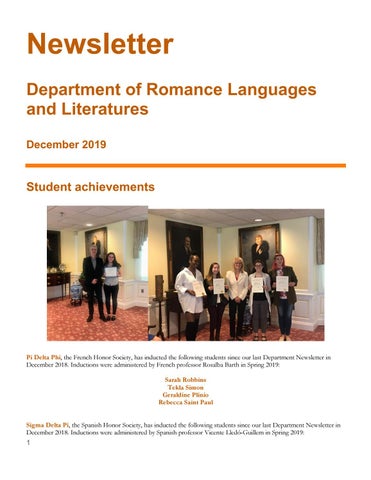
Pi Delta Phi, the French Honor Society, has inducted the following students since our last Department Newsletter in December 2018. Inductions were administered by French professor Rosalba Barth in Spring 2019: Sarah Robbins Tekla Simon Geraldine Plinio Rebecca Saint Paul Sigma Delta Pi, the Spanish Honor Society, has inducted the following students since our last Department Newsletter in December 2018. Inductions were administered by Spanish professor Vicente Lledรณ-Guillem in Spring 2019:
1
Allison Marie Bellesheim Brandon Jurewicz Casey L. Taylor Debbie A. Gรณmez Jacqueline Melgar Jennifer M. Aguinaga Mรณnica Feijoo Sharon Cuellar Madison Yinger Certificates of Language Excellence, from the Northeast Conference on the Teaching of Foreign Languages, were granted to the following recipients in Spring 2019: Geraldine Plinio, Excellence in French Language Giavanna Tims, Excellence in Italian Language Brenden Miller, Excellence in Spanish Language Haley Levine, Excellence in Spanish Language Leia Seereeram, Excellence in Spanish Language Academic Excellence Awards, from the Hofstra College of Liberal Arts and Sciences, were granted in September 2019 to the following students: Ellary Mischel, for Spanish Jenny Maldonado, for LACS December 2019 Undergraduate Research Day, featuring the presentations by two students from the Department of Romance Languages and Literatures and the Latin American and Caribbean Studies Program respectively: Michelle Boo, for LACS Ellary Mischel, for Spanish
2
Janelle-Ashley Marrero, student of Italian, writes: “On Thursday, November 14th, I went with professor Colletti and a small group of other students to The Metropolitan Opera where we attended the performance of La Bohème, an Italian opera about romance, poverty, and ultimately death. The entire experience was amazing! From our seats, we could clearly see the stage, the orchestra pit, and the bright chandeliers when they rose up towards the ceiling before the show started. When I was a kid, I was classically trained as a singer, so I assumed all would be familiar when the performers started singing. I was blown away by the impeccable vocal technique of professional opera singers. When the sopranos hit their high notes and held them, I would gape in awe, me being the alto that I am. The grandiose scene changes, within such a short amount of time, also fascinated me: one minute the characters were in a run-down apartment and suddenly they were amongst seventy other actors in a town square. By the end of the performance, I was completely reminded of the reason I love classical music, and why I pursued it since I was young. I thoroughly enjoyed La Bohème, and if I were given the opportunity to repeat the experience, I would definitely go! Thank you Hofstra and professor Colletti.” Michelle Boo, a LACS student, will present her scholarly work at the December 2019 Undergraduate Research Day, with a paper entitled “The flaws within the effectiveness of Law 70 for Afro-Colombian populations.” Francesca Filiberti, student of Italian, reports: “Last Thursday, I was able to attend the Metropolitan Opera with a group of students and professor Colletti, to see La Bohème. It was my first time attending an opera, and it was truly amazing. The talent exhibited on the stage was spectacular and the show had an incredible production value. Everything was very well put together, from the music, the sets, costumes and more. It was great having the option to read along in English as the performers sang in English or Italian. Overall, it was a really great experience getting to spend the evening at the opera with a group of fellow students and my Italian professor. It was an experience I will not forget, and I look forward to returning to the opera in the near future.” Jenny Maldonado, with majors or minors in Spanish, LACS and Education, interned at the Hofstra Museum last semester, and serves as peer teacher for a LACS course with professor Sampedro this Fall 2019. She was the recipient of the Academic Excellence Award in September 2019 through the LACS program. She reports: “My experience working at the Hofstra University Museum of Art was one I will never forget. It taught me so much in terms of career paths and even contributed to my personal development. I spent about 3 hours per week at the Museum, where I served as their Spanish Education Intern. My responsibilities consisted of translating their “Backpack Program” into Spanish. This program is an opportunity for communities around Hofstra to do a scavenger hunt of some sculptures and sites around the Hofstra campus. Additionally, the Museum would hold Museum visits for 3rd-grade students from nearby schools to come visit the Museum. If there were any students that did not speak English fluently, I would sit by their side and made sure they understood what the Museum Educators were teaching. Working at the Museum was a great experience. It served as a stepping-stone for me and taught me a great deal.” Tiffany Martino, student aide in the Department, writes: “I graduated in May 2018 from Hofstra University with a major in Italian and a minor in English. In Fall 2018, I returned to Hofstra and I am currently working on my Master’s degree in Public Relations, Applied Communication, and Advertising at The Lawrence Herbert School of Communication. Aside from my Public Relations courses, I have been continuing to study one of the subjects I love most, Italian, and will do so until the completion of my Master’s degree in May 2020. In the future, I intend to pursue a career with The Walt Disney Company, as it has been a dream of mine since a young age. I started working in the Department of Romance Languages and Literatures as a student aide in Summer 2016, and eventually became a graduate assistant in September 2018. Since 2016, I have created many long-lasting friendships with not only my fellow student aides but with many of the RLL professors as well. I am beyond thankful for all of the wonderful memories I have shared with the outstanding and admirable faculty of this department.”
3
Claudia Mangiamele, student of Italian, writes: “Going to see La Bohème at the Metropolitan Opera was a very special opportunity which I feel everyone should experience at Hofstra. Getting into the city was super easy. A group of us took the shuttle from right outside the Student Center to the Hempstead train station. We were easily able to buy train tickets through an app on our cell phones. Getting to Penn Station only took about 40 minutes, and once there we transferred to the subway. We took the subway line 1, which brought us to right outside the Met. We went into the building and saw all that people elegantly dressed. On every seat, there is a small screen that displays the songs being sung in English, so that you can follow the Italian plot. The sets on stage were unbelievable, and all the singers in the show had beautiful voices. The show was very enjoyable and entertaining. It was a great experience going to the Met, especially for only $25. Since Hofstra is so close to New York City, students really should take advantage of this opportunity. Hofstra makes it easy to get rides to and from the train station, and Penn Station and the city are easy to navigate through the use of your cell phone. After the show, we hopped back on the subway, and then took the LIRR back to Mineola. The shuttle was waiting for us right outside the train track and it makes stops outside of each dorm building when you are brought back to campus. La Bohème was an amazing experience and every student should go see one opera if they are given a chance.” Ellary Mischel, with majors or minors in Spanish, LACS and Psychology, was the recipient of the Academic Excellence Award this September 2019 through the Spanish program. She will present her scholarly work at the December 2019 Undergraduate Research Day, with a paper entitled “Las dictaduras en América Latina y la pérdida de la inocencia.” She will serve as peer teacher for a Spanish class in Spring 2020 with professor Benita Sampedro. Caroline Peers, student aide in the Department, reports: “My name is Caroline, I am a Neuroscience major, and I am a senior graduating this December. I have worked in RLL for two semesters now, and I have gained connections through the department that I am glad to have. This semester I am taking a course on Italian Food Culture with Dr. Ultsch, and I never would have discovered such an amusing and unique class without working in this department.”
4
Selection of events
Faculty achievements Spanish professor and Department Chair María Anastasio published the essay “Julia de Castro, de la Puríssima: sicalipsisdestape-transfeminismo gaga” in the volume Miradas sobre el cuplé en España: identidades, contextos, artistas y repertorios, which appeared in 2019 at the Instituto Complutense de Ciencias Musicales in Madrid. This essay is part of Dr. Anastasio’s ongoing book project on popular cultural practices in Spain. She also participated in the Tenth Congress of Spanish branch of the International Association for the Study of Popular Music (IASPM) at the University of Oviedo (Spain), where she presented on the recent success of Rosalía, a paper entitled “Cultural Appropriation? Raquel Meller y Rosalía: De los Apaches a las Chonis.” Her paper on Nathy Peluso, another contemporary performer of urban music, entitled “Nathy Peluso en Instagram: voces, imagen y cuerpo,” has been accepted for the XIV Conference of the Latin American branch of IASPM, to take place in Medellín (Colombia) in June 2020. She participated in the 2019 MLA Convention in Chicago, with a paper on 1920s popular music and literature: “Pitiminí, ‘Etoile’ by Margarita Nelken: Cultured Women, Cursi Writers and Low-Brow Pleasures.” Spanish professor Inés Archer organized the Second World Conference on University Researchers, held in New York in August 2019. This conference bought together Latin American academics and researchers in the disciplines of education, economics, health, literature and art, and was simultaneously held at St. John’s University, the United Nations, and the New York Public Library’ Stephen A. Schwarzman Building. The event featured a special reception at the Metropolitan Museum, and a tribute to the one hundredth anniversary of Sigma Delta Pi (1919-2019), the National Collegiate Hispanic Honor Society, and FIDAL, the Foundation for the Integration and Development of Latin America. On August 23, 2019, the Metropolitan Museum acquired a book commemorating the Bicentennial of the Spanish Supreme Court, donated by Professor Archer, who curated the art exhibition associated with the 2012 commemoration at the Supreme Court of Spain. The exhibit featured paintings of 23 artists from countries who were influenced by the Spanish Supreme Court, and the book includes 23 lithographs signed by the artists. On September 27, 2019, professor Archer presented “Mental Health, Humanism, and Spirituality” at the Icahn School of Medicine of Mount Sinai Center for Science and Medicine. In November 2019, she presented a series of readings preceding the 2020 BIENAL AMA+ZÔNIA in Brazil, at Saphira & Ventura Gallery, in collaboration with bi/Coa: Iberoamericana Base / Community of the Americas. In December 2019 she coordinated the programming for Odd Sound: Lecture and reading of contemporary Peruvian Poetry.
5
French professor Rose Barth serves as the faculty adviser for Pi Delta Phi, Hofstra’s Chapter of the National French Honor Society. This past spring, she oversaw the acceptance and induction of five French language students into the society in a ceremony at Hofstra Hall. Spanish professor Warren Bratter’s decade-long interest in the Panamanian singer, song writer and social activist Rubén Blades culminated in a presentation at the September 2019 Hofstra Faculty Research Day: a biographical study of that polymath musician. His article “Puerto Rican Independence,” following the trajectory of Puerto Rico’s politics from Spanish colony to the current post-hurricane Maria situation, has been favorably commented on and read via academia.edu. His article “Point and Counter Point,” comparing and contrasting first generation Middle Eastern politicians in the Americas, has also been favorably commented on and read via academia.edu. In 2019 he served, for the third consecutive summer, as a tutor for Spanish-speaking immigrant children, and translator for their parents, during immigration guardianship proceedings at the Stamford, Connecticut based multi-service immigrant organization Building one Community. He also volunteers as a simultaneous translator for that same multi-service immigrant office, in court and employer cases involving wage recovery for immigrants who have been defrauded. He has completed a piece entitled “Autopista Electrónica,” which seeks to take into account the fundamental ways in which today’s university students process and acquire knowledge, and on how to incorporate these processes into the language-learning classroom, where the Internet is the new blackboard— offering students myriad asynchronous, collaborative, digital, and interactive learning possibilities. His “Letter to the Editor” on the immigration policies enunciated by Acting Director of the United States Citizenship and Immigration Services, Ken Cucinelli, was picked up by the Hearst Agency, and published in the Greenwich Time of Connecticut. He continues to research the history of an independent colony of sixteenth-century escaped slaves, for an article tentatively titled “An African Nation within a Colony: The Precursor of Anti-colonialism in Panama’s Nombre de Dios Palenque.” Professor Bratter’s article on
6
the linguistic identity clues about Christopher Columbus, found in his diaries and letters, “The Mysteries of Christopher Columbus,” was a featured Opinion piece in several Hearst Media Newspapers. Spanish professor Teresa Carandell Sarabia held a presentation at PEIR (Personal Enrichment in Retirement), at Hofstra University, on Catalan culture, folklore and character, her experiences growing up in urban and in rural Catalonia, and her ties to its rural ancestry. Her presentation was so successful thanks to the technical assistance of Art Mattson and Scott E. Sieger, without whom she would not have been able to succeed. Italian professor Simone Castaldi completed two articles and a book chapter. The chapter “Italian Western Comics and the Frontier Myth: from the Fascist Regime to the Berlusconi Era,” will appear in the book Another West: The Globalization of the Comic Book Western (forthcoming at The University of Nebraska Press). It deals with the changing relationship between Italy and the United States as seen through the narratives of Italian Western comics from the Fascist era to the end of the twentieth century. His article “The inexhaustible surface of things: Stefano Tamburini’s comic book work,” published by the journal European Comic Art, is an analysis of the graphic works of designer and cartoonist Stefano Tamburini. It explores Stefano Tamburini’s work in relationship to the “high arts” in the ‘80s, and in connection to the postmodern attention to the “surface” of phenomena, where “surface” implies an epistemological rhizomatic approach. In “Italian Underground, the secret life of Italian Comics 1968-1978,” soon to be published in the Journal of Comic Art, Dr. Castaldi discusses the oftenoverlooked history of DIY comics publishing in Italy between the two waves of student protests in ’68 and ’77. The article traces a map of an almost forgotten, but extremely influential, network of small publishers, and it investigates their engagement with the highly politicized audience of that decade. During this year, Professor Castaldi has also continued his work on the Eisner Award-nominated translation of the 12 graphic novels composing the integral Corto Maltese saga by Hugo Pratt, marking the first time the complete series has been made available in English. The book Early Years came out in the Fall, and The Ballad of the Salty Sea (widely considered the first European graphic novel) will come out in February 2020. Currently, professor Castaldi is working on the translation of the 12th and final volume of the series, Pratt’s MU. Additionally, Professor Castaldi has contributed introductory articles to the Complete Crepax series of books published by Fantagraphics, which collected the entire work of Italian comic artist Guido Crepax. Italian professor Lorenza Colletti recently organized a trip to New York City’s Metropolitan Opera House for Hofstra Italian students and faculty members, to see a production of Giacomo Puccini’s La Bohème. Students enjoyed the cultural experience of seeing an Italian opera, and a wonderful time was had by all. Spanish professor Natalia Chamorro became, in January 2019, a Regional Economic Development Council/New York State Council on the Arts Fellow for Herstory Writers Workshop, a Long Island based organization that brings unheard voices into the public arena, and transforms lived experiences into written memoirs, powerful enough to change hearts, minds and policy. Her memoir essay “Art and Activism” is part of the Hofstra University Library Special Collection digital archive, under the Herstory Writers Workshop exhibit. She has published a review on the book Brave Journeys/Pasos Valientes, which tells the stories of immigrant teenagers arriving in the United States from Latin America, for the organization First Book. She has also published articles and chronicles on Hispanic food and culture in New York in the Latin Lover Magazine. Besides teaching at Hofstra the course Gateway to Communication (SPAN 4), and One-on-One Conversation (SPAN 108), she has collaborated with the Queens Museum in a number of Latinx community-oriented writing and interviewing projects. Spanish professor Álvaro Enrigue presented his latest novel, Now I Surrender and That’s All as part of Hofstra’s Center for “Race” Colloquia Series, on September 25, 2019. Released by the prestigious Barcelona-based publishing house Anagrama, in October 2018, it is currently under contract to appear in English and in several other languages by 2021. During 2018, professor Enrigue attended the Prague International Book Fair at the Czech Republic, The Jaipur International Book Festival in India, and the Medellín and Cartagena de Indias Hay Festivals in Colombia. He was invited to read his work at Brown University, Manhattan College, Universidad de Nuevo León in Mexico, University of Virginia, and the Universities of Trier in Germany and St. Gallen in Switzerland. He was awarded a Residency at the Santa Maddalena Foundation, in Tuscany,
7
Italy, where he spent the months of June and July writing and researching a work in progress. He published reviews on books by Roberto Bolaño, Gabriel García Márquez, Roque Larraquy and Marie Arana at Book Post and The New York Times Review of Books, as much as a pair of essays on contemporary Mexican artists: One of them, about the photographer Pablo López Luz, appeared in Aperture Magazine, and another one, on a recent exhibition of Iñaki Bonillas, came out in the catalog Secrets. Closer to home, and to his heart, professor Enrigue’s novel Sudden Death was honored with a solo display at the “Made in the NYPL” exhibition at the 5th Avenue branch of the New York Public Library; he strongly believes that the Public Library is the foundational stone of New York City, so he spends hours and hours reading, researching and writing there. Simultaneously, his DREAMers Free for All Workshop kept running every Friday –except for the summer months— at the offices of PEN America in Soho for a fourth consecutive year. The workshop has generated such high-quality writing by undocumented young fellows protected from deportation by President Obama’s Deferred Action for Childhood Arrivals Executive Order, that the New York City Mayor’s Office just financed the publication of the DREAM Out Loud anthology.
8
Spanish professor Alfonso García-Osuna edited two volumes of the Iafor Journal of Arts and Humanities this year, published “The Return of the Nation” in Think Magazine (July 2019), and also the piece “Three Pigs and Some Goats” in the Iafor Journal of Arts and Humanities (November 2019). In the month of July, he was “Featured Presenter” at the European Conference on Arts and Humanities in Brighton, England, with a lecture entitled “The demise of homo sapiens: Thought and perception in the kingdom of technology.” In Memory of French professor Liliane Lazar by French professor Sultana Ehrlich: I want to share with you a very happy time I spent with Liliane when we met in Paris a few years ago to have lunch together. During our multiple phone conversations prior to our meeting, it was hard for us to agree on the place where to spend some time, to chat and relax. She suggested Le Café des Deux Magots, located at Saint Germain-des-Près. She said she was hoping to chat with Simone de Beauvoir or Camus. I preferred le quartier Monmartre, and I suggested to eat at Le Moulin de la Galette, in the beautiful quiet gardens and, maybe, who knows, maybe Aristide Bruant or Mattis, or Renoir, would show up and sit with us. But she was insisting on Le Café des Deux Magots and, in the end, I went with her choice. It turned out to be a better choice for me, because from Le Marais, it takes only ten minutes by Metro 4 to get to Saint Germain-des-Près. What a beautiful Parisian summer afternoon we spent together! I will never forget that day and our meeting. In Memory of French professor Liliane Lazar, by French professor Steven Verolla: I have a lasting impression of Liliane; she was an icon of humble and compassionate grace. I remember consulting her during one of my many tumultuous moments of stress. As she listened intently with a little smile, accompanied by an occasional chuckle as if she already knew the answer, she radiated a sense of tranquility as if she had made peace with the world. I will never forget that about her. Spanish professor Vicente Lledó-Guillem published his book monograph La formación de la identidad linguística catalana (siglos XIII-XVII) at the Spanish press Marcial Pons in June 2019. His article, “Defending the language of the peasants in fifteenthcentury Valencia: Jaume Gassull’s La Bramadels Llauradors” has been accepted for publication in the prestigious journal Catalan Review. Moreover, his book chapter “La clasficación de la lengua de Ausías March en la construcción glotopolítica del Imperio Español” will be published in Actas del Tercer Congreso Latinoamericano de Glotopolítica in Berlin, by Peter Lang, in 2020. Professor Lledó-Guillem was invited to give a talk about his book monograph, The Making of Catalan Linguistic Identity in Medieval and Early Modern Times, at Georgetown University in Washington, D.C. in April 2019. He also participated in the 17th Colloquium of the North American Catalan Society in Chicago, in April 2019. During Spring 2019, he created and taught a Spanish Literature in Translation course entitled Magic and Witchcraft in Medieval and Early Modern Spanish (SPLT 050F). He also organized the ceremony of the Spanish Honor Society, Sigma Delta Pi, which recognizes the achievements of several senior students who were about the complete either a major or minor in Spanish. Since September 2018, he has represented the Department of Romance Languages and Literatures at the Faculty Personnel Board (FPB), and in September 2019 he participated in the Hofstra Faculty Research Day. Italian professor Gregory Pell used a sabbatical this past spring to work on a translation project: the complete works of award-winning Italian novelist Angelo Cannavacciuolo into English. He hopes to finish this work by the fall of 2020. In the age of Elena Ferrante and attention to Naples, Cannavacciuolo, is an important figure, who writes eloquently about the under-belly of Neapolitan society, even as he expands his themes and characters to realms that transcend it. Spanish professor Mercedes Mazquiarán de Rodríguez retired from teaching at Hofstra University in May 2018, after a long and fruitful career as a teacher and as a scholar. She was a full-time faculty member of the Department until the year 2000, and then continued as an Adjunct faculty member; she is still active in scholarship. Her main areas of research are Contemporary Spanish Peninsular Literature, with a focus on women writers, and the history and culture of Spain. Her book Barcelona y sus “divinos'? Una mirada intrusa a la gauche divine a casi medio siglo de distancia (Ediciones Bellaterra, 2012) is a study of a bohemian group of intellectuals and artists in the Barcelona of the 1960s, under the Franco dictatorship. Professor Rodríguez’s publications include the edited volume Spanish Women Writers and the Essay: Gender, Politics, and the Self (University of Missouri Press, 1998), where she also contributed with the essay, “Beyond Fiction: Voicing the Personal in Soledad
9
Puértolas’s La vida oculta.” She has published extensively on the works of Spanish female writers Esther Tusquets, María Teresa León, Adelaida García Morales, Paloma Díaz-Mas, and Rosa Chacel, among others. She is currently working on a research project on Spaniards that converted to Islam from the 1970s onwards, after the Franco regime. Spanish professor Luz Marina Ruiz participated in the Second World Conference of University Researchers (WCUR), in August 2019, at St. John’s University, The United Nations and The New York Public Library, with a paper entitled “Del desamor al amor en los Cantos populares de mi tierra en la obra de Candelario Obeso.” Candelario Obeso was a nineteenthcentury Colombian writer and the first poet to write about Colombian Afro descendants and black poetry. This article was subsequently published in the Conference Proceedings.
Spanish professor Benita Sampedro Vizcaya continued to assiduously advise students in the LACS and the Spanish programs, helping them to further develop their research skills. In September 2019, she attended the Academic Excellence Awards ceremony with two of these majors, and this month she prepared two other students to present their research at the December 2019 Undergraduate Research Day. During the last year, she served as Associate Director of Hofstra’s Center for “Race,” Culture and Social Justice, and was responsible for its academic programming. Since 2018, she edited a double special issue of the peer-reviewed and refereed publication Journal of Spanish Cultural Studies, entitled “Entering the Global Hispanophone” (May 2019), and published the article “Transiting Western Sahara” (Journal of Spanish Cultural Studies, May 2019). She also published three book chapters: “Health, Raciality and Modernity in Colonial Equatorial Guinea” (in Post/Colonialism and the Pursuit of Freedom in the Black Atlantic, ed. Jerome Branche, Routledge, 2018), “The Colonial Politics of Meteorology: The West African Expedition of the Urquiola Sisters” (in Unsettling Colonialism: Transoceanic Perspectives on Gender and Race in the Nineteenth-Century Hispanic World, eds. Akiko Tsuchiya and Michelle Murray, SUNY Press, 2019), and “Inscribing Islands: From Cuba to Fernando Poo and Back” (in Transatlantic Studies: Latin America, Iberia, and Africa, eds. Cecilia EnjutoRangel, Sebastiaan Faber, Pedro García-Caro and Robert P. Newcomb, Liverpool University Press, 2019). In terms of public speaking engagements, professor Sampedro was invited to be this year’s Middlebury College Annual Distinguished Lecturer in Gender Studies for the Day of Learning on Global Cultures, on November 1, 2019, with a lecture entitled “Gendering Domestic Service: Houseboys in Spanish Settlers’ Homes in Central West Africa;” she was also the official speaker, on behalf of the Council of Galician Culture, to deliver the inaugural address of the exhibit “The Farewells: Photographs by Alberto Martí,” at Florida Atlantic University’s Schmidt Center Gallery Public Space, on November 4, 2019; and, finally, she gave two invited lectures, one at the University of Valencia in Spain, on July 16, 2019, entitled “Rompiendo barreras y transgrediendo estereotipos: Las que se atrevieron,” and another one at Florida Atlantic University, on November 5, 2019, on “Historias de deportación, travesías atlánticas y presidios africanos en el largo siglo XIX.”
10
Italian professor Lori Ultsch presented a reading of snake imagery in Dante’s Inferno as a vehicle of voicing a rhetorical turning point in the canticle at an international conference in Arizona in early spring 2019. She was later invited to submit a peer-reviewed, article-length version of this conference paper. That essay is currently in press with Brepol publishers, in a volume entitled Reading the Natural World in the Middle Ages and the Renaissance. Dr. Ultsch also has an article on Dacia Maraini’s Isolina, due to be published shortly in a collection of essays on the prize-winning, contemporary author. Dr. Ultsch also organized a speaking engagement at Hofstra University for Dacia Maraini. Ms. Maraini’s talk on early modern women was supported through the HCLAS Dean’s Office as well as RLL, CLL, and HIST, and was well-attended. Students, faculty, and attendees from the greater Long Island community interested in Italian Studies had a wide range of questions during the Q & A after the formal lecture. They queried the author further about medieval female mysticism, Renaissance courtesans, the author’s process of writing, her choice of subject matter and protagonists, the role that travel and her father’s career as an anthropologist played in her intellectual formation, and the sociohistorical realities of the past that Ms. Maraini vividly brings to life in her feminist fiction. Dr. Ultsch also directed Hofstra’s 2019 study abroad program in Florence for the month of June. Her extensive program planning and recruitment focused on highlighting the multi-disciplinary coursework made available to students through the collaboration between Hofstra’s Italian faculty and the international host school Lorenzo de’ Medici. Students pursued coursework in Italian literature, cinema, and language alongside courses in political science, history, and marketing. As part of the program, the group also toured museums, visited monuments, helped each other climb the 463 stairs of Brunelleschi’s dome, and engaged in a variety of group activities that made the program educationally and personally rewarding. Italian professor Rosetta Urgo celebrates her thirty-fifth year of teaching and service at Hofstra University this academic year, and the Department is grateful for her many contributions.
11
French professor Steven Verolla returned to teaching at Hofstra in 2014, after serving as French Course Director, Assistant Professor and mentor to military officers and cadets at West Point. With an eye towards crossing traditional educational boundaries, he promoted and established a myriad of ventures as an online instructor, an editor and as a translator/interpreter of diverse media. During the 2014-15 academic year, he piloted and coordinated an Introductory E-French program for Brazilian students along with preparing Intermediate and Advanced ESL Reading and Composition courses for Indian and Chinese students at the New York Institute of Technology. More recently, over the last three years, the Nassau Community College Language Center hired him to enhance the French and ESL programs for Francophiles and immigrants from various ethnic groups. In the Spring 2018 semester, Adelphi’s Department of Languages, Literatures and Cultures reappointed him to teach Beginning, Intermediate and Advanced French Language and Culture, including French Through the Professions, Advanced French Conversation, and France Today with the use of on-line, open-source, and authentic resources. He interpreted and translated both on site and remotely for various agencies, institutions and organizations as a way to hone the craft and stay abreast of the latest trends in the evolution of language, language pedagogy and advances in technology.
Spanish professor Miguel-Ángel Zapata has recently published a new book of poems Un arbol cruza la ciudad (A tree crosses the city, Lima: Máquina Purísima, 2019), as well as two anthologies of his poetry: Con Dylan Thomas volando por Manhattan (With Dylan Thomas flying through Manhattan. Personal anthology, Buenos Aires Poetry, 2019); and Chopin invitado a casa. Personal Bilingual Anthology (Seville: Ultramarina, 2019). He has also published an anthology of Blanca Varela’s poetry: Degollado resplandor: Poetry of Blanca Varela 1949-2000, with a prologue, selection and notes (Santiago: Editorial Universitaria / Vicente Huidobro Foundation, 2019). This book has been recently presented at the Palacio de Bellas Artes in Mexico City. Professor Zapata has also published several essays, including: “Oscar Hahn: Art and Poetry” (in Altazor, Chile, October 2019); “El mal de amor de Oscar Hahn” (in Buenos Aires Poetry Journal, November 2019); “Carlos Germán Belli and the breakage of habitual language” (in Altazor, Chile, September 2019); “Jose Emilio Pacheco: todo el universo encerrado en un punto de agua” (in Buenos Aires Poetry Journal, May 2019). During 2018, Professor Zapata has offered readings of his poetry and lectures in Madrid, New York, Mexico, Lima, Buenos Aires, and Santiago de Chile. In July 2018 he was invited to conduct a poetry workshop at the Pablo Neruda Foundation La Sebastiana, in Valparaiso, Chile, where he also delivered a lecture on contemporary Peruvian poetry. At Hofstra University, he has organized several poetry readings, and invited a number of guest speakers (from Italy, Chile, Mexico, Spain, and the Dominican Republic) during the last academic year.
12
13
14
Celebrations
December 2019 Newsletter prepared by Lynne Murray, Benita Sampedro Vizcaya, Ă lvaro Enrigue and Gregory Pell _____________________________________________________________________________________
15