Public Health Newsletter
Spring / Summer 2015, Volume 6
The Bridge is a public health newsletter written and produced by Hofstra University students and faculty devoted to bridging the gaps in our health care system and improving the health of our communities.
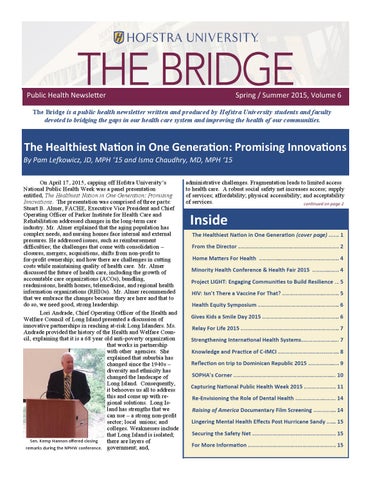
The Healthiest Nation in One Generation: Promising Innovations By Pam Lefkowicz, JD, MPH ‘15 and Isma Chaudhry, MD, MPH ‘15 On April 17, 2015, capping off Hofstra University’s National Public Health Week was a panel presentation entitled, The Healthiest Nation in One Generation: Promising Innovations. The presentation was comprised of three parts: Stuart B. Almer, FACHE, Executive Vice President and Chief Operating Officer of Parker Institute for Health Care and Rehabilitation addressed changes in the long-term care industry. Mr. Almer explained that the aging population has complex needs, and nursing homes face internal and external pressures. He addressed issues, such as reimbursement difficulties; the challenges that come with consolidation – closures, mergers, acquisitions, shifts from non-profit to for-profit ownership; and how there are challenges in cutting costs while maintaining quality of health care. Mr. Almer discussed the future of health care, including the growth of accountable care organizations (ACOs), bundling, readmissions, health homes, telemedicine, and regional health information organizations (RHIOs). Mr. Almer recommended that we embrace the changes because they are here and that to do so, we need good, strong leadership. Lori Andrade, Chief Operating Officer of the Health and Welfare Council of Long Island presented a discussion of innovative partnerships in reaching at-risk Long Islanders. Ms. Andrade provided the history of the Health and Welfare Council, explaining that it is a 68 year old anti-poverty organization that works in partnership with other agencies. She explained that suburbia has changed since the 1940s – diversity and ethnicity has changed the landscape of Long Island. Consequently, it behooves us all to address this and come up with regional solutions. Long Island has strengths that we can use – a strong non-profit sector; local unions; and colleges. Weaknesses include that Long Island is isolated; Sen. Kemp Hannon offered closing there are layers of remarks during the NPHW conference. government; and,
administrative challenges. Fragmentation leads to limited access to health care. A robust social safety net increases access; supply of services; affordability; physical accessibility; and acceptability of services. continued on page 2
Inside The Healthiest Nation in One Generation (cover page) ……. 1 From the Director ……………………………………………………………. 2 Home Matters For Health …………..………………………………….. 4 Minority Health Conference & Health Fair 2015 ………..……. 4 Project LIGHT: Engaging Communities to Build Resilience … 5 HIV: Isn’t There a Vaccine For That? ……………………….……….. 5 Health Equity Symposium ……………………………………………….. 6 Gives Kids a Smile Day 2015 …………………………………………….. 6 Relay For Life 2015 ………………………………………………………….. 7 Strengthening International Health Systems…………………..… 7 Knowledge and Practice of C-IMCI …………………………………... 8 Reflection on trip to Dominican Republic 2015 ……………..…. 9 SOPHA’s Corner …………………………………………………………..… 10 Capturing National Public Health Week 2015 …………………. 11 Re-Envisioning the Role of Dental Health ……………….……… 14 Raising of America Documentary Film Screening …………... 14 Lingering Mental Health Effects Post Hurricane Sandy …... 15 Securing the Safety Net …………………………………………………. 15 For More Information ……………………………………………………. 15
From the Director
Dr. Corinne Kyriacou, PhD, MPH Associate Professor Graduate Director MPH and MSCH Programs Department of Health Professions Hofstra University
It’s been another exciting and action-packed six months for Hofstra’s public and community health graduate programs. This issue of The Bridge reports on a number of important events and milestones, including our annual events: the Interdisciplinary Student Competition, Health Equity Symposium, and National Public Health Week Event Series; our graduating students; our student organization Society of Public Health Advocates (SOPHA); our global health trip and more! One of the highlights of the past semester was our Interdisciplinary Student Film Competition, organized by the MPH program and sponsored by Hofstra’s School of Health Sciences and Human Services, Hofstra’s National Center for Suburban Studies and the Nassau County Department of Health. Seven teams of students (34 in total) from 13 academic programs across campus (undergrad and grad) worked throughout the Spring semester to create and produce short films
on priority minority health issues in Nassau County. Teams competed for best film during our National Public Health Week's Minority Health Conference. Films were judged by both a panel of professional judges representing government, private industry and the community, as well as by the audience, which was made up of over 300 high school and college students as well as faculty, staff and community members. First place was awarded to Team 4: Infectious Diseases, Second Place went to Team 7: Healthy Mother, Babies and Children, and third place went to Team 1: Unintentional Injuries. Standing on the podium and watching the primarily young audience soak in the lessons of the films was one of the most rewarding professional experiences I have ever had.
Winners announced at the 2015 interdisciplinary student film competition at the Minority Health Conference.
I am also very proud of our many service initiatives where public and community health students partner with community-based organizations to assist with data collection, health promotion or
continued on page 3
The Healthiest Nation in One Generation: Promising Innovations Concluding the program and National Public Health Week at Hofstra was the Conversations: Health and Treatments team comprised of Janet Dolgin, JD, PhD, Jack and Freda Dicker Distinguished Professor of Health Care Law, Maurice A. Deane School of Law at Hofstra University; Director, Gitenstein Institute of Health Law and Policy; Steven Walerstein, MD, MACP, Associate Chief Medical Officer and Senior Vice President of Medical Affairs, North Shore-LIJ Health System; Associate Professor of Medicine, Hofstra North Shore-LIJ School of
program planning. In February, MPH students volunteered at the Nassau County Dental Society’s Give Kids a Smile Day where they established a data collection and analysis process to better track outcomes (see Danielle Spitaleri’s article on page 6). In March we held the 2nd Annual Health Equity Symposium where students joined together with practitioners to discuss best practices in reducing health disparities (for more detail, see the article by Jody-Ann Mcleggon, MPH ‘15). In April, Nick Mercado, MPH ’15, led a team of Healthcare Heroes in Hofstra’s 8th Annual Relay for Life event, raising money and awareness for cancer care and prevention (see his article on page 7). In June we partnered with the Nassau County Department of Human Services and North Shore-LIJ Health System to host stakeholders from the aging, veteran and emergency management sectors to discuss ways to securing the safety net for vulnerable populations (see the article by Becky Bajwa, MPH ’15). That same month we hosted the Housing Matters for Health symposium where over 100 providers gathered to set an agenda for addressing social determinants of health (see article by Joseph Singer, MPH ‘16). These are just a few examples of how the MPH has reached out, and how the community has reached in, to collaborate on important public health concerns. Clearly these are win-win opportunities, offering our students invaluable hands-on experience while also providing muchneeded hands-on support for community partners.
Medicine; Maria Carney, MD, Chief, Division of Geriatric and Palliative Medicine, North Shore-LIJ Health System; Assistant Professor, Hofstra North Shore-LIJ School of Medicine; Isma Chaudhry, MD; and Pam Smith (Lefkowicz), JD. The CHAT team described the mission of the project, which is to empower individuals with information about advance directives, allowing for more open communication with their families and clinicians about patient-centered medical
continued from page 1
decision making for themselves and loved ones should they be faced with a serious and/or life threatening situation. CHAT aims to educate and enable individuals on legal tools and provide medical guidance to facilitate communication about treatment options. CHAT is an innovative initiative between Gitenstein Institute, NS-LIJ Health system and the communities. All were encouraged to go home, discuss their wishes about healthcare and treatment with their loved ones, and make a plan for their future care. 2
From the Director Our signature Spring event is the National Public Heath Week Event Series (NPHW), which this year was held April 15-17, 2015. Over 30 MPH and MSCH students participated in either the planning or implementation of our 3-day celebration of public health. We collaborated with many other schools and programs at Hofstra along with like-minded community partners – including Child Care Council of Nassau County, Docs for Tots, Nassau County Department of Health, Nassau County Perinatal Services Network, Nassau University Medical Center, New York State Oral Health Coalition, Pride for Youth, and Hofstra University’s School of Health Sciences and Human Services; the Lawrence Herbert School of Communication, the Law School and the School of Education – to pull off this wide-ranging conference. We were able to invite large numbers from campus and surrounding communities to our events with generous sponsorship from AgeWell New York; the Alzheimer’s Foundation of America; Healthfirst; Henry Schein Inc.; Jzanus Home Care; Parker Jewish Institute for Health Care and Rehabilitation; the Steven and Alexandra Cohen Children’s Medical Center of New York at North Shore-LIJ Health System; the Gitenstein Institute for Health Law and Policy at the Maurice A. Deane School of Law at Hofstra University; the Hofstra Cultural Center; and the National Center for Suburban Studies at Hofstra University. During NPHW, our students and fellow public health professionals engaged the college and surrounding communities in discussions and demonstrations related to: cutting-edge practices in long-term care, end of life care and outreach (see cover article, Healthiest Nation in One Generation by Pam Lefkowicz, MPH ‘15 and Isma Chaudhry, MPH ’15); re-envisioning the role of oral health providers in prevention and control of chronic illness (see article by is Jing Wang, MPH ’16); lingering mental health effects of Hurricane Sandy (see article by Shon Augustine, MPH ’15); minority health (see article by Saeyoan Thiru, MPH ’15); HIV
prevention (see article by Rose Napoleon, MPH ’15); and strengthening international health system capacity and response to disease outbreaks (see article by Ibrahim Sannoh, MPH ’15). This year’s NPHW event series also included an interactive, campus center tabling program organized by SOPHA (see SOPHA’s corner, page 10); a half-day Raise your Voice for Care: Alzheimer’s Foundation of America College Initiative which involved workshops as well as an amazing concert to raise awareness of dementia (see our website for a video of this event); and a screening and discussion of PBS’ new and powerful documentary Raising of A merica: Early Childhood and the Future of our Nation (see article by Kemar Trawers, MPH ‘16). On May 6th we held our Spring 2015 MPH symposium in the Multipurpose Room of the Student Center from 6-9pm. Nine graduating MPH students presented on their culminating research projects, the final requirement for their MPH degree (see picture below). The audience, made up of fellow MPH students, alumni, faculty, research preceptors, family and friends observed the broad range of public health issues our students are concerned about. There were three student panels, organized by theme: Panel 1: Partnering to Expand Reach included Becky Bajwa, Taleen Bolbolian and Danielle Spitaleri. Panel 2: Improving Disease Management included J ulie Krystal, Zichen Liu and Saima Shafique. Panel 3: Advocating for Fairness included Sharisse Carter, Tracy Portelli and Ibrahim Sannoh. The presentations were scholarly, important and engaging. The students demonstrated sophisticated public speaking and communication skills and a deep commitment to finding creative ways to prevent and improve public health problems locally, nationally, and globally. We wish them fulfilling careers and look forward to working with them as colleagues. In June, 3 of our MPH students travelled to the Dominican Republic to assess awareness, use and impact of a
continued from page 3
World Health Organization/UNICEF best practice guideline for managing childhood illnesses. Under the guidance of Dr. Omolara Uwemedimo, our Global Health professor and Director of the Global Health Residency Program at Cohen’s Children’s Medical Center, Afrin Howlader, MPH ’15, Berlinda Olivier, MPH ’15, and Abdul Qadri, MPH ’15 spent three weeks interviewing providers, parents and children in an effort to better understand how to integrate cost-effective strategies for improving quality of care and quality of life. Their experience is described in the articles on page 8 and 9. Things don’t slow down much around here during the summer. SOPHA is busy planning health promotion activities for the upcoming Nassau County Health, Fitness and Sports Expo on July 26, 2015 at Eisenhower Park. Alumni are busy establishing Hofstra’s first Public Health Alumni Association (see website for more details), and the faculty recently hosted the Council on Education for Public Health for a consultation visit in preparation for the submission of our self study report (January 2016) a requirement for program accreditation. Happily, we are also in the midst of welcoming our 4th cohort of MPH students to campus and getting ready for the 2015-2016 academic year. Twenty students served as writers, editors, layout specialists or photographers for this volume of The Bridge. I am grateful for how engaged and involved our students are, and to our student editors who worked tirelessly over the past several months to produce this impressive, interesting and informative collection of public health-in-action stories. Enjoy the read! In health, Corinne Kyriacou
Graduating MPH students, with Drs. Hackett, Kyriacou and Santella, at the May 2015 Symposium.
3
Home Matters for Health By Joseph Singer, MPH’16 On Monday June 8, 2015 The Community Development Corporation of Long Island and The National Center for Suburban Studies hosted “Home Matters for Health on Long Island” at Hofstra University. This initiative brought leaders from various backgrounds to collaborate on new ideas as well as develop partnerships for future action. The Event was sponsored by NeighborWorks® America, United Way of Long Island, and the JPMorgan Chase Foundation, fostering the core principle of housing and healthy outcomes that have been proven to be a direct result. With keynote speaker Stephanie Ettinger de Cuba from Children’s Health Watch we learned how “stable, decent, and affordable housing is like a vaccine” demonstrating severity of poor housing conditions and the health
implications that can arise as a result, both long and short term. A panel of five regional speakers, all from the heath and housing industry provided their own overview of what efforts need to be made in order to make significant outcomes. The panelists included: Art Gianelli (Mt. Sinai St. Luke’s), Martine Hackett (Assistant Professor, Hofstra University), Ted Houghton (Executive Deputy Commissioner, NYS Homes and Community Renewal), L. Von Kuhen ( Seniro VP CDCLI), Henie Lustgarten (Bronx Health and Housing Consortium). There was an interactive discussion between all participants, brainstorming and collaborating with one another, coming up with necessary actions that would be needed to make Healthy Homes
MPH students Joseph Singer and Berlinda Olivier working the twitter feed at the "Home Matters for Health" symposium.
on Long Island an accessible outcome in the near future. Paul Weech, President and CEO at NeighborWorks® gave concluding remarks and issued a “Call to Action” to recognize housing as a key to reducing health disparities.
Minority Health Conference and Health Fair 2015 By Saeyoan Thiru, MPH ‘15
On Thursday April 16, 2015 the MPH Program and Hofstra’s School of Health Sciences and Human Services hosted the second annual minority health conference and health fair. The Conference provided an informative panel presentation from health commissioners and showcased student film competition focusing on the various facets of health disparities. The conference unified various sectors within the health care field to come together to bring awareness to various health disparities in suburbia. The event aims to promote health education and offer free screenings to the general public. The
Minority Conference was a platform that brought together high school students (Queens, Brooklyn, Long Island) and college students, healthcare professionals and general public to discuss and learn about various health issues that we face in our neighborhood. The panel discussion was led by Dr. Lawrence Eisenstein (Health Commissioner of Nassau County), Dr. James L. Tomarken (Health Commissioner of Suffolk County), and Dr. Ada Huang (Deputy Health Commissioner of Westchester County). They shared their experiences and expressed the health concerns that were brewing within the community. Their aim was to educate the public on the disparities that minorities faced and provide solutions to the public to help mitigate these disparities in the communities. The student film competition exhibited seven films each based on a specific health theme (unintentional
injuries, mental health, substance abuse, infectious disease, healthy environment, chronic disease, and healthy mother’s babies and children) focusing on the minority population. The competition allowed students from different disciplines to come together and share their knowledge and create a short trailer that addresses the health issue within the minority communities. Finally, the health fair exposed the community to various health organizations who brought awareness of multiple services readily available and methods to improve their health behaviors. The health fair was also a venue which offered free screening for: dental, oral cancer, speech, hearing, and HIV. This event was truly a day full of health promotion and health education. 4
Project LIGHT: Engaging Communities to Build Resilience By Baktawar Bajwa, MPH’15 Project LIGHT - Leaders In Gathering Hope Together came about as a CDC funded study aimed at creating two clear products: a mental health vulnerability profile and a Hurricane Sandy Cohort database that can be utilized for emergency preparedness and planning in case of future natural disasters. The study aimed to recruit 650 male and female participants age 18 and older. Study methodology included self-surveys On October 28th, 2012 Hurricane administered in Long Island, Queens and Sandy hit the East Coast of the U.S. and as Staten Island. The survey contained a result the greater New York area suffered validated measures of behavioral and tremendous damage. Almost 3 million psychological health, questions regarding people were left without power and more mental health history and an instrument than 370,000 people were evacuated from designed specifically for assessing their homes. Although property damage, exposure to Hurricane Sandy in terms of displacement from place of residence, loss possible consequences of the hurricane. of power were all important concerns, the Participants also completed a section on long lasting psychological devastation of demographic and health information. Sandy is one aspect often overlooked. It is essential to highlight the role of Previous hurricane impacts have accounted community engagement in Project for mental health and have shown higher LIGHT. Community engagement has been rates of depression, anxiety and stress seen as a prime facilitator of partnerships among victims. to implement community resilience. In terms of research, community engagement
helps to serve as a process for inclusive participation by communities affiliated with the issues at hand. Project LIGHT engaged the community from the very beginning, by first forming a partnership between NSLIJ Feinstein Institute of Research and Nassau County Department of Human Services. This initial partnership opened avenues for additional partners that represented outlets to the affected areas and communities, which essentially formed the participant pool. Community engagement for Project LIGHT also serves as an important component for the dissemination of information. Multiple presentations, panel discussions, conferences and other relevant events are being planned in order for effective dissemination among the communities that have helped with the recruitment of participants in addition to stakeholders in the mental health and disaster preparedness community. For results and further information about Project LIGHT, please visit: http:// www.feinsteininstitute.org/projectlight/
HIV: Isn’t There a Vaccine For That? By Rose Ines Napoleon, MPH’16 The first word in HIV is human, which means that we are “humans who need love and support.” Those are the words from HIV positive Robin Lopez, a presenter at the HIV event held during the National Public Health Week moderated by Dr. Anthony Santella and sponsored by Hofstra University's Cultural Center. Robin, along with Justin Toro are two young adults living with HIV. They were able discuss their life living with HIV in our society. While both are comfortable with their circumstances now, getting to this comfort level was a struggle. At first they found it difficult to accept the fact that they are HIV positive. It affected their daily lives and interactions with other individuals. They felt as if everyone was judging them, and they wish they were normal. What is normal? Asked Justin. To me, he said, normal is living with HIV. So
Robin and Justin both had to make adjustments in their respective lives to live as a fully functioning individual with HIV. They both have dedicated their lives to speaking to young adults about the importance of getting tested and having safe sex. Individuals ages 13 to 24 account for an estimated 26% of all new HIV infections diagnosed in the United States, yet only 23% of sexually active high school students have ever been tested for HIV. This can be attributed to the lack of sex education children are receiving. There are misconceptions and myths that teaching children and speaking about sex will eventually lead them to have sex. However, in reality teaching children does not cause them to have more sex, or engage in sexual activities at an earlier
age. Poor quality of sex education in the country leads to higher prevalence of HIV and inconsistent use of protection. While modern advancements have contributed to highly effective treatments, the prevalence is increasing and that is why it is important for every individual to protect themselves and their partners and get tested for HIV.
http://www.youthincharge.org/author/lengvang/page/2/
5
Health Equity Symposium: Bringing Awareness to Health Disparities By Jody-Ann McLeggon, MPH’15 On March 4th, 2015, I watched as students, faculty, staff, guest speakers, sponsors and vendors gingerly walked into the Hofstra USA building. The days leading up to this event included months of collaborative effort. The second Annual Health Equity Symposium (HES) highlights ways in which public health professionals are constantly working to achieve health equity. This symposium, originally conceived by Johanna Andrews, an alumni of the MPH program, exemplifies the uniqueness of Hofstra’s MPH program. Speakers were from several different sectors of the public health workforce. They included Community Outreach Coordinator Tamara Michel from The Queens Public Library, who explained the importance of using the library as a health
hub, Nassau County’s Department of Health, Carolyn McCummings who spoke about her role in bridging health gaps on Long Island, Dr. Jennifer Mieres of North Shore-LIJ who spoke about women’s health and her role as a public health professional, as well as Dr. Kittles, Professor at University of Arizona and Director at the Center for Population Genetics who enlightened us all with his presentation about genetics, race and place and their relation public health issues. As students we are encouraged to actively participate in our journey towards becoming healthcare leaders. This event was entirely student driven; from its conception, planning, outcome and evaluation. Being able to take a leadership role in such an
event that sets Hofstra’s MPH program apart from others is truly rewarding. I encourage all students to take a step forward, be active and seize the opportunity to be a part of one the most extraordinary events right here on campus.
Gives Kids a Smile Day 2015 By Danielle Spitaleri RDH, BS, MPH 15’, CHES 15’ This year during National Children’s Dental Public Health Month in February, the annual free dental public event, Give Kids a Smile (GKAS), ran successfully once again with the new addition of Hofstra University’s MPH volunteers, coordination, and support. Each year, on the first Friday of February, around 1,600 students from seven different Long Island school districts including Baldwin, Freeport, Hempstead, Lawrence, Roosevelt, Uniondale, and Laurelton receive free dental screenings, education, and museum tours. Volunteers include local dentists, hygienists, dental assistants, dental staff members, students, and local community members such as Hofstra’s MPH students and faculty who helped
create an evaluation of the event, a database for tracking screenings outcomes, and dental educational brochures for the children to take home to their families. Students from eleven lower income schools were escorted around the event space, The Cradle of Aviation Museum in Hempstead, Long Island, by their teachers and volunteers, where they received free visual dental screenings from volunteer dentists and hygienists, preventative fluoride varnish treatments which can prevent and reverse cavities, and obtained dental health education in a fun and interactive form such as puppet shows. The children also viewed a kid friendly movie, and received a dental care package filled with an informative educational brochure to take home to their families along with a new toothbrush, toothpaste, and floss. The Nassau County Dental Society (NCDS) created this event thirteen years ago by teaming up with local dental professionals, community volunteers, and now public health professionals, to create GKAS day for schools located in underserved areas of Nassau County. It is sponsored by a New York State Dental Association (NYSDA) grant
along with donations from Henry Schein Inc., McDonalds Corp., JetBlue Airlines Corp., and numerous private donors and businesses. This event was started nationally by the American Dental Association (ADA) in 2003, as a way for dentists across the country to join with others in their community to provide dental services to underserved children. It was an honor for all the volunteer professionals who helped coordinate the event and data tracking this year and with the addition of Hofstra’s wonderful MPH faculty and students, one can only imagine how much more successful the event will become next year. Data analysis conducted after the event revealed that around 30% of the students screened were in need of urgent dental treatment or had active dental diseases in need of treatment. The NCDS is currently in the process of following up with the students’ families to make sure the identified students have dental homes to get the treatment they need and will also be providing a free clinic day at North Shore-LIJ hospital to provide treatment for students without dental homes. 6
Relay For Life 2015 By Nicholas Mercado, MPH ‘15 In May 1985, Dr. Gordy Klatt walked and ran for 24 hours around a track in Tacoma, Washington, ultimately raising $27,000 to help the American Cancer Society fight the nation’s biggest health concern cancer. A year later, 340 supporters joined the overnight event. Since those first steps, the Relay for Life movement has grown into a worldwide phenomenon, raising nearly $5 billion to fight cancer (relayforlife.org). On Saturday April 25th, 2015, Hofstra University celebrated its 8th annual Relay for Life event starting at 5pm and ending at 5am on Sunday April 26th. During this event, students, faculty, and staff gather for a full 12-hour night of fundraising, fun, and relaying for those
who survived their fight with cancer, are currently fighting cancer… or have lost their fight. Student groups come up with creative fundraising ideas for the day of the event. This includes bake sales, blanket sales, games, face paint, spin art, etc. This year, as part of my internship, and more out of my love for Relay for Life, I decided to start my own graduate team. Initially, this team was going to comprise of Master of Public Health (M.P.H.) students, however, as more persons got wind of the event, the Master of Health Administrations (M.H.A.) and Doctor of Medicine (M.D.) programs at Hofstra wanted to join. Before I knew it, this team turned from an M.P.H. team to a full allied health team. Our team was therefore named the Hofstra Healthcare Heroes in order to incorporate all of the health professionals involved in making this team possible.
As the date of the event drew closer, we learned of a campaign that would incorporate public health and fit nicely into the theme of Relay for Life. This skin cancer prevention program was called Slip! Slop! Slap! And Wrap!: 4 easy ways to help protect against UV rays and prevent skin cancer: slip on a t-shirt, slop on some sunscreen, slap on a hat, and wrap around sunglasses. Everyone was on board. We gathered t-shirts, bought sunglasses, hats, and sunscreen to distribute them following a small donation. The night was long and it was cold, but that didn’t stop a good number of the Healthcare Heroes from staying the night. By the end of the night, 58 teams and 714 participants raised over $44,000. This was a successful Relay for Life and I hope the Hofstra Healthcare Heroes will continue to participate in the years following.
Strengthening International Health System Capacity & Response to Disease Outbreaks By Ibrahim Sannoh, MPH’15 The name Guéckédou has in recent years has been associated with some of the most disastrous public health events in history. The confirmation of patient zero in this small Guinean village bordering Sierra Leone and Liberia; where merchants, farmers and day laborers from all three nations travel with little governmental regulation should have painted a portrait of what was to be expected for the 2014 Ebola epidemic. Despite being the current epicenter of Ebola, the number of new cases according to the World Health Organization
https://www.google.ca/url?sa=i&rct=j&q=&esrc=s&source=images&cd=&cad=rja&uact=8&ved=0CAcQjR w&url=http%3A%2F%2Fnews.mongabay.com%2F2014%2F0805-sri-stiles-ebola-zaire-to-guinea.html&ei= NFGTVePCKpKAygSvp72wDw&bvm=bv.96952980,d.aWw&psig=AFQjCNEnKNZKqaD4CPi_Wif6hxlDrmb 9gw&ust=1435803234881631
continues to decrease across the town. However, the recent murders of eight health workers by villagers in the neighboring city of Nzerekore, remains a stark reminder that the misunderstanding of disease transmission, preventive methods and the clash of two very different cultures can pose fatal threats to health workers and the population they aim to help. While these recent days have certainly been dark for Guéckédou, I have seen a different side of this, once commerce driven town famous for its Wednesdays when merchants from Cote d'Ivoire, Sierra Leone, Liberia, Senegal, Mali and Libya gathered to trade. The noise could be unbearable. Like many Sierra Leonean, Ivorian, and Liberian refugees, my family was welcomed into Guéckédou during the outbreak of a civil war. And like many refugees before and after us, the people of Guéckédou embraced us with open arms to no profit of their own. But as I watched events unfold during the recent Ebola outbreak, a sad realization came upon me, that my adopted home will forever remain
a ghost of its former self: A testament to the impact of disease outbreaks on an already deficient health system, characterized by scarce resources, entrenched fragmentation and long-standing political instabilities; rendering them unable to provide both crisis and routine care. As part of a series of talks and events organized for National Public Health Week, Hofstra’s Master of Public Health Program and Cohen’s Children’s Hospital explored strategies for strengthening and sustaining health system capacity across the globe. With a focus on developing nations, the talk aimed to prove that the best defense against disease outbreaks is a strong health system. Speakers of the event included Dr. Koyejo Oyerinde and Dr. Sally E. Findley. Dr. Koyejo Oyerinde is a pediatrician and public health expert in the Department of Population and Family Health at Columbia University. continued on page 9
7
Knowledge and practice of integrated management of childhood illnesses community and family practices (C-IMCI) and association with child nutritional and developmental status in Dominican Republic: a cross-sectional study By Afrin Howlader, MPH’16, Berlinda Olivier, MPH’16 and Abdul M. Qadri, MPH’15 In low and middle-income countries (LMICs) there has been a dramatic reduction in childhood mortality. As children begin living longer, more attention needs to be placed on the quality of their lives. The World Health Organization (WHO) and United Nations Children’s Fund (UNICEF) have developed a strategy to strengthen caregiver and community knowledge and use of specified family practices proven to reduce childhood morbidity and mortality known as community-IMCI (C-IMCI). The importance of the C-IMCI component cannot be overstated, considering that the majority of childhood deaths worldwide occur without any contact with the formal health system. Examples of the key focus areas embedded within C-IMCI include health promotion, illness prevention, illness recognition, home management of
acute child illness, and timely and appropriate care seeking during acute child illness. However, only in the past decade have efforts been made to ensure that C-IMCI is integrated into health system programming. Minimal research has been performed to investigate the actual effect of C-IMCI on child health outcomes. Undernutrition in children under six years of age increases the risk of death, inhibits physical and cognitive development and has lifelong effects on individual health. In Latin America, malnutrition is a heightened concern where 16% of children under the age of 5 years are stunted. The 2008-2012 UNICEF
Additionally, LMICs such as the Dominican Republic, have had difficulty estimating the prevalence of developmental delays, in order to costeffectively allocate resources for evidence-based interventions. report of child nutritional status in The objective of this study is to Dominican Republic has identified 10% determine the current level of stunting, an indicator of chronic knowledge and practices of C-IMCI malnutrition, nationally. However, the key practices, as well as undernutrition broad estimate does not reflect the and developmental delays among malnutrition among the poorest and children aged 6 months - 60 months underserved communities in Dominican who seek care at public health Republic, which are potentially higher. In addition to undernutrition, facilities in La Romana, Dominican Republic. In addition, we aim to delays in childhood identify if any significant and/or development have risen specific relationships between the exponentially and now is a knowledge and practice of C-IMCI major determinant of child and nutritional and developmental morbidity. According to the outcomes exist. Lastly, we will World Health Organization, examine if there is any correlation more than 200 million children in under-developed between the knowledge and practice of C-IMCI and the frequency of reported countries do not experience acute lower respiratory infections and the full range of skills and diarrheal illnesses. Dr. Omolara T. functioning abilities. More specifically, 2011 studies by Uwemedimo, Global Health faculty and Director of Global Health the Economic Residency Program at Cohen Children Commission for Latin Hospital is supervising this work. America and the Caribbean note that approximately 12.4% of the Latin American population struggle with a developmental disability. Moreover, many LMICs are unable to afford expensive developmental assessment tools used in high-income countries to examine the children in need.
8
Reflection on Trip to Dominican Republic 2015 By Afrin Howlader, MPH’16, Berlinda Olivier, MPH’16 and Abdul M. Qadri, MPH’15 Our journey to the Dominican Republic not only allowed us to gain further knowledge of healthcare research but also enhanced our understanding of different cultural and social atmospheres outside of the United States. During our three-week stay we were able to assess 81 patients including our pilot study enrollees. We assessed the nutritional status of children from ages 6 months to 5 years along with their development status by utilizing The Malawi Developmental Assessment Tool. We also surveyed the primary caretakers of these children by conducting the Integrated Management of Childhood Illnesses survey questionnaire. Overall, we were successful with obtaining our target goal of participants, following IRB protocol and procedures, and guiding our participants with understanding and addressing the importance of nutrition, development, and quality of health care. As we dove into our first day, our prior expectations and ideas had to be adjusted due to the challenges faced in our environment. We took on active roles as co-investigators to implement protocols and procedures according to the
Institutional Review Board. A few challenges that were faced included, patient privacy, language barriers, and the day-to-day structure of the study. With our eclectic range of skills the three of us we were able to modify, overcome, and renovate our planned proposal. As we were immersed into a different social arena we experienced several cultural differences that altered our view of how another part of the world lives. A common trend that was witnessed was the young females starting a family earlier on in life. We also noticed that the society had collectivism traits where family and community was valued and emphasized. This changed our perspectives of how an altruistic and simplistic way
of living can be satisfying in ways that has currently been taken for granted in our individualistic society. It is important to realize the life we live isn’t the only life there is. In order to gain a variety of perspectives we must walk past the blinders that tunnel our vision. This experience has given us the opportunity to venture out of our comfort zone and provide us with certain skills to grow and develop into well-rounded scholars.
Strengthening International Health System Capacity & Response to Disease Outbreaks Dr. Koyejo Oyerinde implements the Averting Maternal Death and Disability (AMDD) Program which strategizes on maternal and newborn health worldwide. Dr. Sally E. Findley is a global migration researcher with Columbia University Medical Center of Population and Family Health and Sociomedical Sciences. Her research focuses on migration, vulnerability, and health. Driven from the perspective of promoting healthy communities, both speakers sought to demonstrate the efficiency of multi-intervention ensembles involving health workers, volunteers, national ministries of health and international partnerships to research and implement the most efficient programs with regards to building and maintaining health systems capable for responding to disease outbreak. The key moment of the evening was the story of an American based West African politician whose immediate response
to a motorcycle crash involving a child was to request to his audience to call 911. I have to admit that this story made me laugh quite a bit, and it continued to do so. The crash itself is obviously not the humorous part but the incident speaks to a harsh reality faced by many villagers in the developing world where even the most basic medical needs can take days to resolve. With a health care system functioning mostly on out of pocket payments, political and tribal instabilities and battered by an overwhelming increase of Sierra Leonean and Liberian refugees, the residents of Guéckédou have little hope to cling to. As case after case of the 2014 Ebola outbreak continue to devastate this once commerce mecca which provided and continues to shelter victims of the Liberian and Sierra Leone civil wars, I can’t help but marvel at the blatant failures of all three
continued from page 7
governments and international non-governmental organizations (NGO's) who understood Guéckédou’s strategic location as it relates to the flow of people between Guinea, Sierra Leone and Liberia (the three countries most affected by the current outbreak) and yet failed to take this knowledge into account and immediately provide the proper precautions necessary to gain control of the Ebola outbreak.
http://www.cdc.gov/
9
Society of Public Health Advocates (S.O.P.H.A) Corner We’ve made it to the finish line! The Spring 2015 semester proved to be a very busy and eventful one. Aside from the papers, class presentations, and culminating experiences, the Society of Public Health Advocates stayed busy planning events to round out the semester- most notable National Public Health Week. SOPHA was so lucky to have an a fully engaged membership help the E-board plan The National Public Health Week Tabling Campaign, the Lingering Mental Health Issues from Hurricane Sandy, and The Networking Dinner. The added involvement allowed us to spread ourselves and be more visible on the Hofstra campus. On this page you will see the dedication and fun depicted in photos from SOPHA’s Spring events which include: Give Kids a Smile Day, the Health Equity Symposium, National Public Health week, Relay for Life, Postpartum Screening Day. For more pictures, content and video clips, check out our facebook @ www.facebook.com/SOPHAPRIDE. Here’s to a good semester, and congratulations to all who graduate this May and August! S.O.P.H.A Incoming Executive Board: Rose Napoleon (President) Afrin Howlader (V ice President) Aditya Bissoonauth (Treasurer) Abdul Qadri (Secretary) Ilanna Scheur (Event Manager) Outgoing Executive Board: Pascale Frederique (President) Becky Bakhtawar (V ice President) Shon Augustine (Community Liaison) Taleen Bololian (Event Manager) Thalia Stewart (Promotion Coordinator) Zichen Liu (Treasurer) Berlinda Oliveria (Secretary)
10
Capturing National Public Health Week 2015
Getting informed about the importance of Alzheimer’s Disease.
Dr. Corinne Kyriacou, Dr. Anthony Santella and Dean Bloom with Dr. Nicholas Tucci, NYS Oral Coalition.
Contemporary band Honor By August performs free Concert.
Public getting free dental screening.
High school students from Brooklyn attending the Health Fair.
The public getting educated by various Health organization. 11
Capturing National Public Health Week 2015
National Black Leadership Commission on AIDS, Inc. of Nassau County promoting HIV/AIDS awareness.
Hofstra’s Physician Assistants provide insight on various issues.
NuHealth employees educate the public about health disparities.
Queens high school students attend Health Fair.
North Shore-LIJ nutritionist providing healthy smoothies.
Exercise Science Undergraduates testing public’s fitness levels. 12
Capturing National Public Health Week 2015
Hofstra’ students engaged during national public health week.
Hofstra’s Speech and Hearing Clinic provides free screening.
Dean Bloom with Carina Loscalzo, Director, PA Program and Steve Kess, Vice President, Henry Schein
Student film competition showcased powerful messages.
Exercise Science students teach public to do exercises at home.
MPH students tabling in the student center bringing awareness. 13
Re-Envisioning the Role of Dental Health Providers in Prevention and Control of Chronic Illness By Jing Wang, MPH’16 Many people would say that oral health is important to staying healthy; as it enables one to enjoy different foods, speak and overall enjoy high quality life. Many chronic health problems first present in the mouth and dental health providers can help make earlier diagnoses, which can improve overall quality of care and life. During National Public Health Week on April 17, there was an oral health event called re-envisioning the role of dental providers in prevention and control of chronic illness. There were many dental and public health professionals that were invited including: Steve Kess, Vice President for Global Professional Relations Henry Schein, Inc., Evie Lalla, Professor of Dental Medicine from Columbia
University College of Dental Medicine, Jeff Sender from Broadway Dental, Hicksville, Sharon Struminger, Professor/ Continuing Education Director from Department of Dental Hygiene and Dr. Anthony Santella, Assistant Professor at Hofstra University. Oral health is an understated topic, however it can offer important signs about your overall health. It is true that problems in your mouth can reflect the rest of your body. It is a fact that there are more bacteria in your mouth than there are persons on Earth. As Dr. Lalla mentioned, diabetes is correlated with periodontal disease. This means that people need to pay more attention to prevention. In
addition, certain diseases, such as HIV/AIDS, can lower the body's resistance to infection, making oral health problems more severe. For example, if the germs in one’s mouth settle into the gums, one has a potential to get gum disease. These issues raise our attention to the importance of oral health. Oral health, as the window to our whole body, is more important than one might comprehend. Knowing the facts about how the health of your mouth, teeth and gums can affect your general health is essential. Better integrating dental and clinical care can improve outcomes greatly.
Raising Of America: Documentary Film Screening By Kemar Trowers, MPH ‘16 and Martine Hackett, PhD, MPH, Assistant Professor Hofstra University’s Master of Public Health and the Society of Public Health Advocates (SOPHA) sponsored an inspiring film screening and panel discussion, Raising of America: Early Childhood and The Future of Our Nation during 2015 National Public Health Week . The event offered early childhood supporters, community residents and students a sneak preview of the Premiere Episode of the documentary series from California Newsreel, creators of the acclaimed Unnatural Causes PBS series. An engaging panel discussion moderated by Hofstra’s own Dr. Martine Hackett PhD, MPH, assistant professor of Health Professions, followed the viewing. In keeping with the national campaign to raise awareness of the link between a healthier and more equitable American society, and a strong start for all our children backed by societal investments in early childhood, the film screening and discussion brought together local professionals in early childhood development and health as well as youth advocates from Long Island. The panelists were: Ms. Jan Barbieri, Executive Director Child Care Council of Nassau, Inc.; Mr. Jacob Dixon, CEO of Choice for All; Ms. Dana Friedman, President of the Early Years Institute; and Dr. Dina Lieser, Co-director of Docs for Tots and Director of Community Pediatrics at Nassau University Medical Center.
The panelists highlight the main issues that threaten our children’s chances for best outcomes, and expressed their concerns and suggestions. These concerns included the lack of investment in children aged 0 - 4 years old, the lack of knowledge of available resources fund, the need to collaborate, and the unique challenges of securing governmental approval in Long Island. The panelists suggested solutions to these concerns and barriers. Among these were the call for Universal Childcare for all children, an increase in subsidy dollars and support from the business industry, the election of leaders who share values upheld by community members, an “Early Development Instrument” to assess school readiness, better coordination of efforts for children by community groups and a voice for the Hispanic communities of Westbury. Other suggestions included the promotion of child care as an appropriate setting for education and child rearing, the need for co-operations to make the necessary provisions that guarantees flexible-work schedules to meet the demands of childcare, the need for pay-leave legislature and investment in technical support and assistance.
modeling positive parenting ultimately catering to the social emotional well-being of children. The promise of higher educational achievement among middle school and high school aged children, the maintenance of good health status in the wider population dependent upon the early childhood experiences of our children as much of the foundation for these are laid within the first years of life. It is therefore, vitally important that we as a society make investments in early childhood development to ensure a better future for our nation. For more information on the Raising of America documentary series, the national campaign, how to take action and additional resources visit www.raisingofamerica.org.
The Docs for TOTS program at Nassau University Medical Center was highlighted as an exemplary collaborative program geared towards promoting safe, stable and nurturing relationships and 14
Lingering Mental Health Effects 2.5 Years Post Hurricane Sandy By Shon Augustine, MPH’15 In October 2012, Hurricane Sandy shattered various portions of Long Island, the Mid-Atlantic and Northeastern United States. The impact of this Hurricane was substantial because many lives were lost, homes were destroyed, and communities were devastated of which many are still recovering from substantial financial, medical, and most importantly emotional costs. Hurricane Sandy Recovery, 2.5 years later, has continued to be a monstrous challenge for many responding agencies and disaster survivors recovering. More specifically, mental health has been a
growing problem in this recovery and has accounted for all disaster survivors, regardless of sex and age. The state of mental health, for disaster survivors, vary across Long Island, but collectively share the need for help. At the recent SOPHA-sponsored Sandy Panel at Hofstra University’s National Public Health Week, guest speakers were able to share their past experiences and current mission in this recovery. It was very interesting to hear Dr. Rebecca Schwartz, Lori Zlotoff, and Stephanie Tipping present a great image of the current mental health state in Long
Island Sandy survivors to the panel’s audience. Lori and Stephanie shared stories of the many struggles people are experiencing and gave a great overview of the services available to people who are mentally disrupted from the disaster. Dr. Schwartz presented her research on the mental health status of the survivors, which in turn provided lessons on how our jurisdictions can improve response systems and programs. The audience was appreciative and grateful to hear their mission and keen to learn the role they can play in mental health recovery for Sandy disaster survivors.
Securing the Safety Net By Baktawar Bajwa, MPH’15 On June 11th; folks from the research, community based practice and academic sector gathered for a conference held here at Hofstra University in conjunction with NSLIJ Feinstein Institute of Research, Nassau County Department of Human Services and Hofstra University’s Master of Public Health Program. The conference explored topics about the most vulnerable populations here in Nassau County: the aging population, veterans, and disaster responders and victims with a special presentation about Project LIGHT, a CDC funded study about the psychological health impact of Hurricane Sandy. The goal was to get an organic conversation flowing about meeting the
needs of these vulnerable populations and to direct future interventions and identify shortfalls for the next disaster, whether it be natural or manmade. Medical professionals, non-profits/community based organizations and educational institutions were all invited to attend. The conference was divided into three pieces. The first piece was titled, “The new role of senior centers in the 21st century: addressing isolation and achieving success.” The speaker for this piece was Carol Waldman, executive director for the Glen Cover Senior Community Service Center. The second piece was titled, “Veterans: the challenges of reintegration” and the speakers for this piece were Dr. Joan Beder from
Wurzweiler School of Social Work at Yeshiva University and Nicholas Auletta and Matt Gabriel from Team Red, White and Blue. The last piece was split into two parts. The first part was by Dr. Adam Gonzalez, founding director of the Mind Body Clinical Research Center at SUNY Stony Brook titled, “Disaster responders & mental health.” The second part was by Dr. Rebecca Schwartz from the NSLIJ Department of Occupational Medicine, Epidemiology and Prevention titled, “Post disaster mental health population study: project LIGHT.” Most notable were the synergies among how we approach these distinct populations. The audience was extremely engaged and several interesting collaborations were born.
Student Editorial Committee Abdul Moiz Qadri, MPH ‘16 (Chair); Saeyoan Thiru, MPH ‘15 and Kemar Trowers, MPH ‘16 Bridge Newsletter Layout and Production Saeyoan Thiru, MPH ‘15 Acknowledgement Thank you to everyone who took pictures during the events and allowed The Bridge to feature them! For More Information; To learn more about Hofstra’s MPH and MS in Community Health Programs and to find out about upcoming events and view archived webinars, please visit www.hofstra.edu/publichealth . You can also email Corinne Kyriacou, PhD, MPH, associate professor and director, MPH and MS in Community Health programs, at corinne.m.kyriacou@hofstra.edu. 15