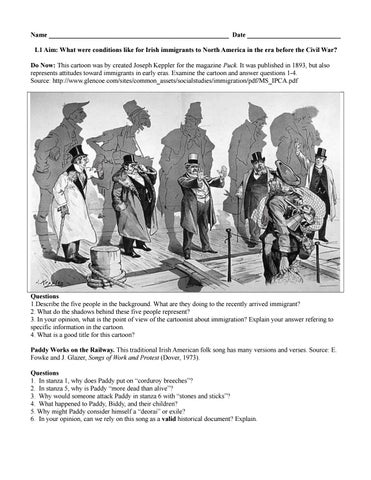
Name ______________________________________________________ Date ____________________________ L1 Aim: What were conditions like for Irish immigrants to North America in the era before the Civil War? Do Now: This cartoon was by created Joseph Keppler for the magazine Puck. It was published in 1893, but also represents attitudes toward immigrants in early eras. Examine the cartoon and answer questions 1-4. Source: http://www.glencoe.com/sites/common_assets/socialstudies/immigration/pdf/MS_IPCA.pdf
Questions 1.Describe the five people in the background. What are they doing to the recently arrived immigrant? 2. What do the shadows behind these five people represent? 3. In your opinion, what is the point of view of the cartoonist about immigration? Explain your answer refering to specific information in the cartoon. 4. What is a good title for this cartoon? Paddy Works on the Railway. This traditional Irish American folk song has many versions and verses. Source: E. Fowke and J. Glazer, Songs of Work and Protest (Dover, 1973). Questions 1. In stanza 1, why does Paddy put on “corduroy breeches”? 2. In stanza 5, why is Paddy “more dead than alive”? 3. Why would someone attack Paddy in stanza 6 with “stones and sticks”? 4. What happened to Paddy, Biddy, and their children? 5. Why might Paddy consider himself a “deorai” or exile? 6. In your opinion, can we rely on this song as a valid historical document? Explain.
Paddy Works on the Railway Word Bank: Corduroy breeches are a type of pants worn by workingmen. Filly-me-oori-oori-ay is a nonsense word that gives the song spirit. In stanza 2, Bad cess is another way of wishing someone bad luck. In stanza 3, elegant means perfect. In stanza 9, when Paddy says he has no stocking or cravat, he means he does not have a wool cap or a scarf. 1. In eighteen hundred and forty one, I put my corduroy breeches on, I put my corduroy breeches on, to work upon the railway. Filly-me-oori-oori-ay, Filly-me-oori-oori-ay, Filly-me-oori-oori-ay, to work upon the railway. 2. In eighteen hundred and forty two, I left the old world for the new, bad cess to the luck that brought me through, to work upon the railway. Filly-me-oori-oori-ay, Filly-me-oori-oori-ay, Filly-me-oori-oori-ay, to work upon the railway. 3. In eighteen hundred and forty three, 'twas then I met sweet Biddy McGee, an elegant wife she's been to me, while working upon the railway. Filly-me-oori-oori-ay, Filly-me-oori-oori-ay, Filly-me-oori-oori-ay, to work upon the railway. 4. In eighteen hundred and forty four, I landed on America's shore, I landed on America's shore, to work upon the railway. Filly-me-oori-oori-ay, Filly-me-oori-oori-ay, Filly-me-oori-oori-ay, to work upon the railway. 5. In eighteen hundred and forty five, I found myself more dead than alive, I found myself more dead than alive, from working on the railway. Filly-me-oori-oori-ay, Filly-me-oori-oori-ay, Filly-me-oori-oori-ay, to work upon the railway. 6. In eighteen hundred and forty six, they pelted me with stones and sticks, and I was in one hell of a fix, from working on the railway. Filly-me-oori-oori-ay, Filly-me-oori-oori-ay, Filly-me-oori-oori-ay, to work upon the railway. 7. In eighteen hundred and forty seven, Sweet Biddy she died and went to heaven, if she left one child, she left eleven, to work upon the railway. Filly-me-oori-oori-ay, Filly-me-oori-oori-ay, Filly-me-oori-oori-ay, to work upon the railway. 8. In eighteen hundred and forty eight, I found myself at heaven's gate, I found myself at heaven's gate, from working on the railway. Filly-me-oori-oori-ay, Filly-me-oori-oori-ay, Filly-me-oori-oori-ay, to work upon the railway. 9. It's “Pat, do this!” and “Pat, do that!” without a stocking or cravat, and nothing but an old straw hat, to work upon the railway. Filly-me-oori-oori-ay, Filly-me-oori-oori-ay, Filly-me-oori-oori-ay, to work upon the railway. Additional Primary Sources your teams wants to consult: 1. ___________________________________________ 2. ___________________________________________ 3. ___________________________________________ 4. ___________________________________________ 5. ___________________________________________ Exit Ticket: What form(s) of documentary evidence do you believe will provide the best evidence about the Irish immigrant experience in the United States? Explain.
Application/Enrichment: Read the excerpt from a newspaper report and answer questions 1-3. Source: Village Voice, August 7, 2001 Margaret Bianculli-Dyber, Farmingville, NY. “My husband works for a large food-distribution warehouse—he's a forklift operator. Traditionally, they make 20-something dollars an hour. My husband makes $12 an hour. Labor is so plentiful for [the company], they say, “I can just replace you and get El Salvadorans for $6 or $7 an hour.” Now this company made $1 billion in profits last year. They have 300 El Salvadorans working there. Because of a plentiful supply of cheap labor, my husband's wages are held down, and I have to work.” Questions 1. Who is Margaret Bianculli-Dyber? 2. What is her attitude toward recent Hispanic immigration to the United States? 3. In your experience, should the United States limit immigration? Explain your view.
Name ______________________________________________________ Date ____________________________ L2 Aim: What were conditions like for Irish immigrants to North America in the era before the Civil War?
Do Now: This cartoon was created by Thomas Nast for Harper’s magazine. It was published in 1867. Examine the cartoon and answer questions 1-4. Source: http://www.victoriana.com/history/irish-political-cartoons.html Questions: 1. What is the caption of this cartoon? 2. What is happening in the cartoon? 3. How are the Irish portrayed in the cartoon? 4. In your opinion, was cartoonist Thomas Nast a nativist (biased against immigrants)? Team Activity: Each student pair will read about the experience of Irish immigrants to the United States in a different locality and answer the accompanying question. Pairs will then help their teams complete the document chart. Be prepared to report on your section to the full class. Exit Ticket: Do you believe it was harder for immigrants to the United States in the era before the Civil War or today? Explain.
Application/Enrichment: Draw a political cartoon showing attitudes towards Irish immigants to the United States in the era before the Civil War.
Document A. Irish Immigrants in New Orleans, Louisiana (1833) Working in pairs read this report by Tyrone Powers, a famous Irish actor who toured the American south in the 1830s. Powers was sympathetic toward Irish immigrants to the United States and felt they were being unfairly treated. Read the article and answer the questions. After reading the report answer questions 1-4. Then help your team complete the document chart. Questions 1. In section A, the author writes: “I only wish that the wise men at home who coolly charge the present condition of Ireland upon the inherent laziness of her population, could be transported to this spot.” In your opinion, whom is he referring to and why does he make this wish? 2. How does the author describe conditions for Irish immigrants who are working on the canal in Louisiana and their families? 3. In section C, the author writes: “Slave labour cannot be substituted to any extent, being much too expensive; a good slave costs at this time two hundred pounds sterling, and to have a thousand such swept off a line of canal in one season, would call for prompt consideration.” In your opinion, why does the author believe this? 4. In your opinion, is the treatment of the Irish in New Orleans related to anti-Irish prejudice and nativism? Explain your views. A) “One of the greatest works now in progress here, is the canal planned to connect Lac Pontchartrain with the city of New Orleans. I only wish that the wise men at home who coolly charge the present condition of Ireland upon the inherent [natural] laziness of her population, could be transported [brought] to this spot. Here they subsist [survive] on the coarsest fare [worst food]; excluded from all the advantages of civilization; often at the mercy of a hard contractor, who wrings his profits from their blood; and all this for a pittance [small amount]that merely enables them to exist, with little power to save, or a hope beyond the continuance of the like exertion [hard work].” B) “Here too were many poor women with their husbands; I contemplated their wasted forms and sickly looks, together with the close swamp whose stagnant air they were doomed to breathe, and fancied them, in some hour of leisure, calling to memory the green valley and the pure river of their distant home.” C) “At such works all over this continent the Irish are the laborers chiefly employed, and the mortality amongst them is enormous. At present they are, where I have seen them working here, worse lodged than the cattle of the field; in fact, the only thought bestowed upon them appears to be, by what expedient the greatest quantity of labor may be extracted from them at the cheapest rate to the contractor. Slave labour cannot be substituted to any extent, being much too expensive; a good slave costs at this time two hundred pounds sterling, and to have a thousand such swept off a line of canal in one season, would call for prompt consideration.” D) “Christian charity and justice should suggest that the laborers ought to be provided with decent quarters, that sufficient medical aid should always be at hand, and above all, that the brutalizing, accursed practice of extorting [forcing] extra labour by the stimulus of corn spirit should be wholly forbidden.”
Document B. Immigrants in New York City. These passages are from the diary of George Templeton Strong, who lived in New York City. They were written between 1838 and 1857. A “Banshee” is a female spirit in Irish folklore whose tearful screaming warns a family that a member will soon die. A ward is a subdivision of an urban area. The “Bloody Sixth Ward” in lower Manhattan in New York City was a poor Irish community also known as Five Points. Read the passages and answer questions 1-4. Then help your team complete the document chart. Questions 1. How does Strong feel about immigrants who are becoming United States citizens? 2. In section B, Strong writes that there was “a grand no-popery riot last night, including a vigorous attack on the Roman Catholic Cathedral.” What does this passage suggest about his feelings toward Irish immigrants? 3. In general, how does Strong describe the Irish in New York City? 4. In your opinion, should Strong be considered a nativist? Cite specific evidence to explain your view. A) “It was enough to turn a man's stomach to see the way they were naturalizing this morning. Wretched, filthy, bestial-looking Italians and Irish, the very scum and dregs of human nature filled the office so completely that I was almost afraid of being poisoned by going in.” B) “We had some hard fighting yesterday in the Bloody Sixth Ward, and a grand no-popery riot last night, including a vigorous attack on the Roman Catholic Cathedral with brick bats and howls . . . Met a KnowNothing procession moving uptown, as I traveled down Broadway to the meeting; a most emphatic demonstration. Solid column, eight or ten abreast, and numbering some two or three thousand, mostly young men marching in quick time. They looked as if they might have designs on St. Patrick's Cathedral, and I think the Irish would have found them ugly customers.” C) “Orders given to commence excavating. Ireland came to the rescue; twenty 'sons of toil' with prehensile paws [animal-like hands] supplied them by nature with evident reference to the handling of the spade and the wielding of the pickaxe and congenital hollows on the shoulder wonderfully adapted to make the carrying of the hod [a tray for carrying bricks or other heavy loads on your back] a luxury instead of a labor.” D) “Yesterday morning I was a spectator of a strange, weird, painful scene. Seeing a crowd on the corner, I stopped and made my way to a front place. The earth had caved in a few minutes before and crushed the breath out of a pair of ill-starred Irish laborers. They had just been dug out, and lay white and stark on the ground. Around them were a few men and fifteen or twenty Irish women, wives, kinfolk or friends. The women were raising a wild, unearthly cry, half shriek and half song, wailing as a score of daylight Banshees. Now and then one of them would throw herself down on one of the corpses, or wipe some trace of defilement from the face of the dead man with her apron, slowly and carefully, and then resume her lament. It was an uncanny sound to hear. Our Irish fellow citizens are almost as remote from us in temperament and constitution as the Chinese.”
Document 3. Irish Immigrants in Philadelphia. Working in pairs read this report on anti-Irish riots in Philadelphia in 1884. After reading the report answer questions 1-4. Then help your team complete the document chart. Questions 1. What were the goals of the political platform described in section A? 2. In your opinion, what would be the impact if these ideas became the law? 3- According to sections B and C, why are these groups worried about Irish Catholic immigrants to the United States? 4. In your opinion, are there examples of anti-Irish prejudice in these accounts of rioting in Philadelphia in 1844? Make a list and explain your views. A) In 1844 anti-immigrant groups in Philadelphia approved a three-plank platform. It called for the extension of the waiting period for naturalization [citizenship] to twenty-one years; the election of none but native-born Americans to public office; and the rejection of foreign interference in the social, political and religious institutions of the country, especially the public schools. B) Anti-immigrant groups circulated a leaflet complaining about new immigrants to the United States. According to the leaflet “The day must come, and, we fear, is not too far distant, when most of our offices will be held by foreigners – men who have no sympathy with the spirit of our institutions, who have done aught to secure the blessings they enjoy, and instead of governing ourselves, we shall be governed by men, many of whom, but a few short years previously, scarcely knew of our existence.” C) There were anti-Irish riots in the streets of Philadelphia. A company of Irish volunteer firefighters fought the rioters and one of the rioters died. An anti-Irish anti-Catholic organization issued this declaration: “The bloody hand of the Pope (leader of the Roman Catholic Church) has stretched forth to our destruction. Now we call on our fellow-citizens, who regard free institutions, whether they be native or adopted, to arm. Our liberties are to be fought for – let us not be slack in our preparation.” D) The next day a fire set by anti-Irish rioters destroyed St. Augustine's Roman Catholic Church and the Governor of Pennsylvania declared military rule. More than 2,000 state troops patrolled the streets of Philadelphia. The commanding officer announced: “Order must be restored, life and property rendered secure. The idle, the vicious, the disorderly must be curbed and taught to understand and respect the supremacy of the law and, if they do not take warning, on their own heads be the consequences.”
Document 4. Irish Immigrants Arrive in New Brunswick, Canada Working in pairs read the edited letter from Bryan Clancy to his mother and brother. He is writing from St. John in New Brunswick, Canada. The letter was sent on November 17, 1847. After reading the letter answer questions1-4. Then help your team complete the document chart. Questions 1. In section A, Bryan Clancy writes he is “uneasy� about his decision to come to North America. Based on the information in the letter, why is he uneasy? 2. What happened to people on board the boat when they arrived in Canada? 3. Why is the government thinking of sending many of the arrivals back to Ireland? 4. Based on this letter, what is life like for Irish immigrants when they arrive in Canada? Dear mother and brother, A) I take the favorable opportunity of writing these few lines to you hoping to find you are all in as good health. We were very uneasy for ever coming to this country for we were in a bad state of health. During the voyage there was a very bad fever aboard. Pebby took the fever on the Ship and was taken to the cabin by the Captain's wife and was there from a week we were on sea till we come to quarantine [a place were new arrivals are kept separate]. Then all the passengers that did not pass the doctor was sent to the Island and she was kept by the Captain's wife on the ship. Pebby was relapsed again and sent to Hospital and remained there nine or ten days but thank be to God she got over all the disorders. B) I was at work at a dollar per day, but the place got very bad and no regard for new passengers nor even a nights lodging could be found. I met with Andy Kerrigan and he took me with him to his house and remained there for a month boarding. Mary took a very bad fever and was despaired of both by priest and doctor. As soon as she got well, Andy took the same disease. I am sorry to relate that poor Biddy Clancy and Catherine McGowan died in Hospital and a great many of our friends. C) I often wished to be at home again bad and all as we were. We often wished we never saw St. John. We are sorry that we cannot send any relief to you. Any new passengers except those that have friends from before are in distress [trouble]. It's very hard to get work here. D) The government is about to send all the passengers that were sent out here home again because they are sure that all of them that did not perish surely will this winter. I am very glad that Catherine did not come to this place for a great deal of our neighbors died here.
Irish Immigrants to North America
Location New Orleans
New York
Philadelphia
St. John, Canada
Source Year
Conditions faced by the Irish
Evidence of Nativism