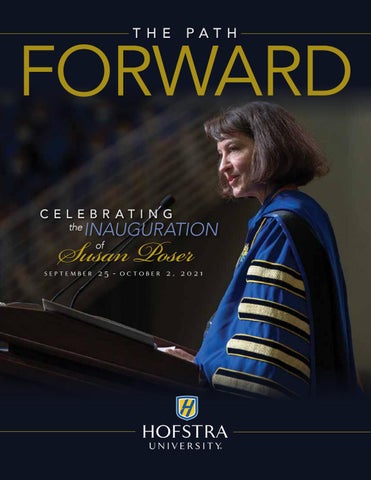
THE
PATH
FORWARD CELEBR ATING
Susan Poser the
INAUGURATION of
september 25 - october 2, 2021
I n a u g u r a t i o n 2 0 21
1
september 27, 2021 Hofstra University hosted a week of events to celebrate the inauguration of Dr. Susan Poser as its ninth president, including symposia, service projects, a prom, a barbecue featuring restaurants from the local community, the annual Alumni Awards dinner and the Fall Fest outdoor music festival and carnival.
Building and Bridging Our Future Together: Hofstra University and Our Communities
Over three days during inauguration week, Hofstra University convened symposia organized by the academic community that highlighted the breadth and depth of Hofstra faculty, staff, students, and alumni across its schools. The sessions covered: • Bridges that the university can forge with the wider community to build a better, more just world. • University research, teaching and practices that address themes of inclusion, engagement, justice, equity and innovation. • Multi-disciplinary collaborations within the university.
KEYNOTE ADDRESS: New York Times Journalist
CHARLES M. BLOW
2
I n a u g u r a t i o n 2 0 21
“
Battling racism is like fighting a hydra. Cut off one head and two more grow back.
”
– Charles M. Blow
I
nauguration week began with a keynote address by Charles M. Blow, New York Times journalist, CNN commentator, and author of the bestselling memoir, Fire Shut Up in my Bones, which was adapted into an opera by Oscar-nominated composer Terence Blanchard. The opera, which premiered the day of his Hofstra address, marked the first time an opera by a Black composer has ever been performed at the New York Metropolitan Opera. In his keynote, Mr. Blow discussed the Black Lives Matter movement and protests, police reform and the nature and limits of allyship. Following his address, Mr. Blow participated in a conversation and audience question-and-answer session moderated by President Susan Poser. Later, he visited the Lawrence Herbert School of Communication and spent time with a group of journalism students.
I n a u g u r a t i o n 2 0 21
3
september 27, 2021
SYMPOSIA: DAY ONE Building an Equity Agenda for Suburbs and Long Island “While the suburbs don’t get as much attention and respect when we are doing scholarly research, they are a foundational part of American geography. We have to engage the suburbs when we are talking about building a more equitable and more humane American society.“ – Craig Dalton, assistant professor of Global Studies and Geography
Educating Law Students to Service and Partner With Marginalized Communities “The (law) clinics have been around since the inception of the law school, more than 50 years ago, and are deeply intwined in its DNA. Today, they are the centerpiece of our education and they make the experience of attending Hofstra Law exciting, deeply challenging and deeply rewarding.“ – Theo S. Liebmann, clinical professor of law and direct of the Youth Advocacy Clinic
4
I n a u g u r a t i o n 2 0 21
september 28, 2021
Innovative Experiential Learning Opportunities in Engineering and Computer Science
“These programs promote creativity in computer science and engineering and exposed our students to develop a passion for populational thinking and problem-solving. During the recent pandemic, we saw the role of digital innovation and how that helped to keep traditions alive.“ – Sina Rabbany, Dean of the Fred DeMatteis School of Engineering and Applied Science
SYMPOSIA: DAY TWO Career Readiness: Professional Training and the Liberal Arts “Everyone seems to agree that we shouldn’t have to choose between the liberal arts and pre-professional education … In this learning economy, we know that the winners will be those who can upskill, who can adapt and transcend traditional academic silos.“ – Colin Koproske, managing director, research and development, EAB
Building Citizenship Through Communication Education: Student Media, Civic Engagement and the Challenge of Covering Diverse Local Communities From the Classroom “It’s not about giving voice to the voiceless, but rather shutting your mouth and giving them the space to speak and share what they want to share.“ – Documentary filmmaker Christine Nochese, Associate Professor of Radio, Television and Film
I n a u g u r a t i o n 2 0 21
5
september 29, 2021
SYMPOSIA: DAY THREE Honoring Hofstra’s Disability Heritage by Thinking Disability Futures
Beyond the Campus: Learning by Engaging and Serving the Surrounding Community
“Universal design for learning aims to apply the theoretical framework of universal design to the classroom, planning with the needs of disabled students in mind, which, in turn, provides benefits for everyone.“
“My work with the Center for Civic Engagement has been a transformative experience. Now I’d like my career to move in the direction of non-profit communications where I can work for causes that are important to me, like affordable housing, sustainability and climate change“.
– Sinjita Bhattacharya ‘23, sociology major (Legal Education Accelerated Program) with a minor in disability studies
Sustainability Innovation “Climate risk conversations are a starting point (but), we need to look forward.“ – Cory Krosinsky ’84, executive director of the Network for Sustainable Financial Markets
6
I n a u g u r a t i o n 2 0 21
– Micaela Erickson ‘ 21, Journalism major
september 30, 2021
SYMPOSIA: DAY FOUR An Ethical Approach To Moral Distress During Covid-19 In New York A Path Forward: Examining and Achieving Health Equity for All “We’re living in a quadruple pandemic, which includes COVID-19, the social and mental health reckoning crisis, and economic crisis so many people in our country are experiencing right now. This illustrates the inconvenient and harsh truth about the impact of these determinants of health and how collectively, they impact and significantly contribute to society’s health inequities...So is it any wonder COVID-19 has not been striking all groups equally? Our economic and social policies have not been benefiting all groups equally.“
“The pandemic was like nothing we’ve ever seen before. Who gets the ventilator and who doesn’t, having to allocate who benefits and who doesn’t was probably the worst thing I’ve had to do in my life.“ – Elyse Isopo, Assistant Professor of Graduate Nursing, Hofstra Northwell School of Nursing and Physician Assistant Studies
– Daniel Dawes, director of the Satcher Health Leadership Institute, Morehouse School of Medicine
I n a u g u r a t i o n 2 0 21
7
Service
september 25-27, 2021
COMMUNITY
Civic involvement and service are integral to a Hofstra education, and we are proud of the thousands of hours our students spend each year volunteering and engaging with our neighbors. During inauguration week, students participated in a food drive for the Interfaith Nutrition Network in Hempstead, cleaned up trash at Jones Beach and tutored elementary school children at St. Martin de Porres Marianist School in Uniondale.
8
I n a u g u r a t i o n 2 0 21
Prom
september 25, 2021
welcome to the
PRIDE
More than 700 students glammed up and danced the night away.
I n a u g u r a t i o n 2 0 21
9
Barbeque
september 28, 2021
I N A U G U R AT I O N
One of the best ways to get to know your neighbors is over a good meal. Our inauguration barbecue brought together students, faculty, staff and the community for a celebration that included music, games and a feast provided by Campus Dining and several local restaurants including: Smok-Haus, Ocho Rios Caribbean Cuisine, Roti Paradise, Punta Cana, Jersey Mikes, Vincent’s Clam Bar and Napolini Express – topped off with treats from Mr. Softee.
10
I n a u g u r a t i o n 2 0 21
Rally
september 30, 2021
ROAR
Students – in groups and as individuals – took the stage at Adams Playhouse to celebrate unity, identity and talent by showcasing through performance the creativity and variety of perspectives on our campus.
I n a u g u r a t i o n 2 0 21
11
september 30, 2021
Awards ALUMNI
The night before inauguration, Hofstra celebrated its annual Alumni Awards Dinner celebrating distinguished alumni who have contributed to the university and their communities. The 2021 honorees included: Alumnus of the Year KATHY MARINELLO ’84 President and CEO, PODS Honorary Alumnus of the Year LEONARD SHAPIRO President, Commander Enterprises Young Alumnus CHRISTIAN FUSCARINO ’12 Executive Director, Garden State Equality Alumni Achievement MICHAEL BLISKO ’00 CEO, Infinity Healthcare Management of IL LLC MARK BRACCO ’92 President, Silent House Productions JACQUELINE A. BURKE ’90, ’93 Chair and Chaykin Distinguished Professor in Accounting, Hofstra University NAN FERRARA ’90 Executive Vice President, Continuous Improvement, Voya Financial, Inc. EVELYN HARRISON ’84 Senior Vice President, Chief Clinical Operations Officer, IVERIC Bio CARLE-MARIE MEMNON, MA, ’98; MBA, ’13; DHA; FACHE Assistant Vice President, Academic Training, HSS Education Institute, Hospital for Special Surgery
12
I n a u g u r a t i o n 2 0 21
october 2, 2021
Fall Fest 2021
Our annual Fall Fest/Parent and Family Weekend was back in 2021, capping off the inauguration week with a carnival, the crowning of our Pride Court and a concert that featured performances by student dance troupes, tribute band Y2K! and headliner T-Pain.
I n a u g u r a t i o n 2 0 21
13
Day
october 1, 2021
I N A U G U R AT I O N
14
I n a u g u r a t i o n 2 0 21
I n a u g u r a t i o n 2 0 21
15
16
I n a u g u r a t i o n 2 0 21
Day
october 1, 2021
I N A U G U R AT I O N
I n a u g u r a t i o n 2 0 21
17
KELLY ELKOWITZ
Hofstra University, Class of 2023
Artist, Painting in honor of the inauguration of President Susan Poser Kelly Elkowitz is a senior fine arts major with a minor in political science at Hofstra University. Her art integrates abstraction with the figure, emphasizing construction and found materials. Her 2021 departmental end-of-year exhibit painting won Hofstra’s Presidential Purchase Award.
Elkowitz provided the following thoughts on the painting: “Overall, the composition is meant to evoke an optimistic and hopeful tone, with the flowers looking up toward the future and the sunlight above. Spring often represents something new and hopeful to come, so I felt flowers in bloom would be perfect to welcome our new president, Dr. Poser.
18
I n a u g u r a t i o n 2 0 21
FORWARD The revelation of this genesis Is akin to the artless innocence Of rain falling over a well worn ground. They formed the foundation; we formed a sound. The sound of morning where mercies are new, And of thanking the past for seeds it grew. We roar as rushing waters ‘round a bend, Changing sediment for sentiment’s mend. We’ll prune, nurture, and edify the soil (So tomorrow’s fruit will prize today’s toil), Show them how to put their hands to the plow, And see success exist beyond the now. Use tools that worked for ye old pioneers And pass them along for the coming years. It takes a village — Nay, generations. Progress requires steadfast veneration. But, blind devotion? No, we must evolve. A problem persists with no resolve to solve. Narrow paths keep us steady and on course, But narrow minds only produce remorse. All we have to lose is the senseless weight Our shoulders bore until almost too late. Thank who you’ll thank for open eyes and grace To not fear change but run to its embrace.
NICOLE WONG Maurice A. Deane School of Law, Class of 2022 Winner, Inauguration Student Poetry Contest Nicole Wong is a third-year student at the Maurice A. Deane School of Law at Hofstra University. She grew up in the New York City foster care system, living with several diverse families. She holds a BA in Political Science from Queens College and a Master of Science in Teaching from Fordham University. She is currently finishing her last year of law school at Hofstra University.
Here and now, welcome opportunity. Overcome the pause of adversity. Flow and carve the needed capacity So we can refine our humanity. Same book, different page. Far from perfect. Risky it may be but move toward it. All the sowed trials will reap a reward. Forward. I n a u g u r a t i o n 2 0 21
19
ALMA MATER – “BLUE AND GOLD”
Performed by Hofstra Inauguration Vocal Ensemble
KHIYA CONNOLLY-SISK ‘22
Student Government Association President
KYLA SURAJBALI ‘23 National Anthem
SEASONS of LOVE
Performed by students from the Department of Drama and Dance
20
I n a u g u r a t i o n 2 0 21
DANIEL E. DAWES, JD
Director of the Satcher Health Leadership Institute at Morehouse School of Medicine
“
Susan Poser knows more than most, cares more than many, has the courage to meet the moment and will persevere until the moment has passed. The pride of Nebraska Law and the University of Illinois Chicago is now the pride of Hofstra University and I for one am, frankly, jealous of you all – because you now get to bask in the warm glow of her light. I’m also immensely excited to see Hofstra shine brighter than ever before.
“
BARBARA J. WILSON, PHD President of the University of Iowa
“
I can say without hesitation you have landed a great one. Everyone that worked with Susan could see she was destined to be a president…Hofstra, you have found a president that will help you attract and build talent who will help you nurture ideas into action and will be a tireless advocate for your institution.
“
HARVEY PERLMAN, JD
Former chancellor of the University of Nebraska and former dean of the University of Nebraska College of Law
“
You have chosen wisely. You have a new president who wants to ‘do’ president not just be one. She will be aggressive in pursuing your collective ambitions, she will seize on opportunities that present themselves, she will advocate on your behalf and she will also push each of you to contribute your best to this enterprise.
“
I n a u g u r a t i o n 2 0 21
21
Speech
INAUGURATION
HELLO HOFSTRA!
I
would like to begin by thanking everyone for the warm welcome I have received over the past two months, from across the university, from alumni and friends, and from the civic and business community of Long Island. I am so happy to be here.
Thank you, Don, for the kind introduction. And thank you for what is now almost a year of guidance and conversation as we went from the presidential search, into an eight-month transition period, and then into the beginning of my presidency. You are a trusted advisor and friend and a most outstanding leader of the Hofstra Board of Trustees.
will always represent for me this day and my life at Hofstra. Nicole Wong, thank you for your poem, Forward, which speaks in an eloquent and moving way about the future, and its link to the past. Thank you, Kyla Surajbali for the beautiful rendition of the National Anthem. I have so much respect for anyone who can get to that high note! Many thanks to our talented student singers and musicians for your participation and for bringing such beautiful music to this day. I also want to thank the Inauguration Committee and scores of staff, administrators, faculty, students, and alumni for working tirelessly for months to make this day special, and to make it work logistically. Let’s give them a hand.
I also want to thank the Presidential Search Committee for engaging in months of interviews last year and for your continuing support, along with the whole Hofstra Board of Trustees for your leadership and your trust in me. I am The idea of the pandemic humbled and honored to follow as a portal or gateway serves President Rabinowitz’s long and successful presidency. as a useful metaphor to frame
“
Thank you, Daniel, Barb, and Harvey, for making the trip to be here today. Daniel – I am bursting with pride over you and all you have accomplished, including the news just this week that you were elected to the National Academy of Medicine - there is nothing that could be more gratifying for a teacher than to have a former student become a dear friend and colleague and reach such heights, and I know that there is more to come.
the challenges that we in higher education have before us. If the pandemic is a portal, how will Hofstra walk through it? What will we take, and what will we leave behind? What world are we ready to fight for? What kind of university and community do we want to imagine on the other side?
Barbara – you are the model of strong and fearless leadership, complemented by warmth and authenticity. You were my rock at the University of Illinois, and I am so full of admiration for all you accomplished there, and I look forward to all you will now accomplish at the University of Iowa as its new president. And Harvey, whom I have known for almost thirty years, your mentorship has shaped my career and my way of thinking in so many ways. And because I worked so closely with you when you were the Chancellor at Nebraska, and because you are a man of great action but few words (as profound as they are), the mentoring that I received occurred mostly through observation of your leadership, your intellect, your integrity, and your trust in those who worked with and for you. I try to model that every day. Thank you, Kelly Elkowitz for the exquisite painting, which
Special thanks to Herman Berliner, the former provost of Hofstra, who initially served as chair of the committee, and Interim Provost Janet Lenaghan, who took over as chair, for your leadership. Thank you to all of the faculty, staff, and administrators who organized and participated in the academic symposia over the past week. It was an extraordinary week and I personally learned so much about the strength of each of the schools at Hofstra.
I want to thank and acknowledge friends and colleagues who traveled to be here, and my family here today – my beloved father, Norman Poser – who is also my dear friend, confidante, and editor - and my stepmother Judy Cohn, and my cousin, Margaret Poser. My mother, Miriam Poser, could not be here in person but is watching online. Hi Mom. I also want to acknowledge my other set of parents, Eugene and Joanne DiMagno, who are watching from Minnesota.
“
My wonderful and accomplished daughters, Eve Poser DiMagno and Sarah Simone Poser DiMagno, each travelled from California to be here. They are the lights of my life, truly my pride and joy. Will you please stand gals? And my husband of 31 years, Steve DiMagno, an organic and medicinal chemist. He is the love of my life, my everything. Steve, will you please stand? Just over 85 years ago, Nassau College – Hofstra Memorial of New York University, opened its doors. Nineteen faculty taught several hundred students in the three-story Dutch Colonial mansion left in trust by Kate and William Hofstra to I n a u g u r a t i o n 2 0 21
23
serve the public good. The relationship with New York University lasted only until the first graduating class was faced with a choice of which institution would issue their diplomas - New York University or Hofstra College, and they chose Hofstra College with its already-formed identity as a small, closely-knit liberal arts college. After nearly closing during World War II, Hofstra began a long period of growth and innovation in education that continues today. In the nineteen sixties, decades before the Americans with Disabilities Act, we pioneered the idea that a campus should be accessible to all. And in the midst of the War on Poverty, Hofstra created the New Opportunities at Hofstra program, known as NOAH, to serve students from economically disadvantaged backgrounds We continued this tradition of innovation in the Eighties, when a small group of faculty created a conference to begin to write the historical record of presidents from FDR forward. Over the past 40 years, hundreds of former Cabinet members, policy makers, journalists, and several presidents have visited the campus as part of that program. Those conferences grew into a Hofstra’s strength in Presidential history, and our hosting of three consecutive US presidential debates.
In the new millennium, we partnered with Northwell Health, the largest private healthcare provider in New York State, to create the first new allopathic school of medicine in New York in nearly 50 years. The inaugural leaders of the Donald and Barbara Zucker School of Medicine created an innovative, experiential program of medical education that is thriving and being studied and imitated by medical schools around the country. This brief tour through the history of Hofstra provides a flavor of the character of this university and the spirit of innovation and caring that continues to this day. Hence our motto, Pride and Purpose. It is so heartening to see all of you here today. The whole Hofstra community is back on campus in what we believe is a very safe manner. This required Herculean efforts by scores of faculty, administrators, and staff, with the expert assistance of our friends at Northwell Health, to ensure universal compliance with our vaccine policy and testing protocols. We are now enjoying each other’s company and the serendipity of everyday life - what one of my colleagues once referred to as the magic of the peripheral – the things on the periphery that just can’t happen on zoom. The chance encounter on the Starbucks line that could lead to a lifelong relationship, a family, and children; glancing by chance at a bulletin board and learning about a student club that is the perfect fit; the impromptu conversation between student and professor after class that could change the course of a student’s career, and life. This is the magic of daily life that we have all grown to appreciate, and now relish as we move about the campus. What a time we are living in, and what a time for higher education. The pleasure of our renewed togetherness is real, but it cannot mask the challenges ahead. Even before COVID, higher education was facing disruption on many fronts - anticipating fewer high school graduates; the fast growth and prevalence of online education; increasing skepticism about the value of a college education; and the fact that students now coming to college are digital natives, that is, they started playing with an iPad as young children, and have always had any fact they could possibly need literally in their back pocket. And then came COVID, which accelerated the change we knew was coming, and transformed it at the same time. How we address these changes over the coming years will determine Hofstra’s future, and the futures of our students. One of the more interesting ways to think about this moment was suggested by the Indian novelist, Arundhati Roy, in an article that she published last year in the Financial Times. This is what she said:
24
I n a u g u r a t i o n 2 0 21
Historically, pandemics have forced humans to break with the past and imagine their world anew. This one is no different. It is a portal, a gateway between one world and the next. We can choose to walk through it, dragging the carcasses of our prejudice and hatred, our avarice, our data banks and dead ideas, our dead rivers and smoky skies behind us. Or, we can walk through lightly, with little luggage, ready to imagine another world. And ready to fight for it. This author metaphorically posits the pandemic as a portal, a gateway, between the past and the present, a time when we must choose what we will leave behind, and what we will take through this portal into the future. Of course, Arundahti Roy was not speaking specifically about higher education, but of India and the world at large, and the transformative effect that pandemics have on civilization.
bright and talented student body, an outstanding, divisionone, athletic program, and a shared sense of community that is palpable on the campus. Our students famously call Hofstra “home,” and articulate a feeling that they are cared for here, nurtured and supported throughout their educational journey. Over the past two months, I have begun to meet with Hofstra alumni individually and in groups. The good feeling, loyalty, and enthusiasm for Hofstra that these alumni express is inspiring. Hofstra is also very connected civically in Hempstead, Long Island, and the State of New York. I have begun to get to know some of the local, county and state officials, and the business and civic leaders. Our ties to our community are deep and longstanding and will continue to provide opportunities to work together to build prosperity on Long Island and throughout the State of New York.
Even though this pandemic sadly is not over yet, we can already see its transformative effects. So many are out of All of these things are part of our DNA at Hofstra, and they work, yet employers cannot must be continually nurtured find employees. Companies to keep them alive. So, we We are embarking upon an initiative at are announcing they will be don’t have much to leave fully remote forever, which is behind as we move through Hofstra that will serve as the foundation for having cascading effects on this portal and beyond the the next decade, and will help us to identify our cities and towns, pandemic, yet there is so much the priorities to which we will direct our energy transportation, and a host of to imagine for our future. other things. Individuals are and our resources. We will start with the changing their work habits, We are embarking upon an questions: How do we define ourselves as a their careers, their lifestyles, initiative at Hofstra that will university now, and what are our ambitions for where they live, and how they serve as the foundation for the think about meaning and next decade, and will help us the future? … We must decide together what purpose in their lives. to identify the priorities to post-pandemic world we want to imagine. This struggle with meaning which we will direct our What do our students need to learn, and purpose surely energy and our resources. We contributed to the broad will start with the questions: and how should they learn it? consensus in 2020, which How do we define ourselves as united people across race, a university now, and what are class, age and geography, to take to the streets and the our ambitions for the future? airwaves to condemn the murder of George Floyd and declare that they would no longer stand for all that it These conversations will soon be getting underway in represented. faculty meetings, among our student leaders, and in our administrative units, by our alumni and our board of The idea of the pandemic as a portal or gateway serves as a trustees. We must decide together what post-pandemic useful metaphor to frame the challenges that we in higher world we want to imagine. What do our students need to education have before us. If the pandemic is a portal, how learn, and how should they learn it? will Hofstra walk through it? What will we take, and what will we leave behind? What world are we ready to fight for? How do we provide them with the tools to thrive in the What kind of university and community do we want to twenty-first century, including the ability to pivot multiple imagine on the other side? times among jobs and even careers? What discoveries are our faculty well-positioned to make, and what knowledge One thing I know is that at Hofstra, we don’t want to walk will they create? How can we strengthen our relationships through this portal too lightly, carrying too little with us, and understand our obligations to our immediate because there is so much good here and it is embedded in community and to the world at large? the history and culture of Hofstra. How do we educate our students to think about the This includes a faculty deeply committed to teaching, a ever-changing technology that if directed well, will support
“
“
I n a u g u r a t i o n 2 0 21
25
our thriving, in a time of climate change and poisonous political discourse? What is our role in addressing the social and racial justice issues that have impacted our country for so long? Like a good law professor, I am full of questions, but not of answers. I know that our university can answer these questions, and meet these challenges. Hofstra is so well positioned to prosper in this environment of change, while remaining true to our history and our values. This conviction is based on the past two months as your president, the past year of studying Hofstra from a distance, and my experience of over twenty-five years in higher education. So, I would like to offer a few thoughts about three areas that I believe are critical to our future.
“You think your pain and your heartbreak are unprecedented in the history of the world, but then you read.” As a classics major who continues to find joy as an amateur musician, but never considered a career that draws specifically on either of these disciplines, I can attest to the value of a liberal arts education, which I make use of in one way or another, every single day. But here’s the issue. This generation of college students is acutely aware of the uncertainty of the world. They were born post-9/11, their families endured the Great Recession and its aftermath, and they are now experiencing first-hand the pandemic, the growing effects of climate change, and a society that continues to wrestle with the consequences of its racist history.
For them, understandably, choosing a liberal arts education might seem to be just another way to subject themselves to more uncertainty, because it is not obvious how that kind of study will lead to a career, or even a job. In current times, many, if not most, students, and their parents, approach We have the ability to be higher education looking for a straight nimble and to take the path from college to career. We must figure out how to articulate clearly and strategic risks that we must demonstrably the lifelong value of a take,” Poser said. “We have liberal arts core and make it relevant to the alumni, community and today’s students, and understandable to their parents. friends to guide and support us.
Hofstra’s official mission and goals statement includes the following: • First, we are dedicated to providing “a firm foundation in the liberal arts and sciences designed to encourage intellectual curiosity,” and • Second, that we are “devoted to recruiting and retaining a highly qualified and diverse academic community of students, faculty, staff and administrators respectful of the contributions and dignity of each of its members,” and • Third, that “Hofstra University’s faculty is committed to excellence in teaching, scholarly research and service and the University emphasizes and supports the creation and synthesis of knowledge as well as its dissemination.”
“
If we have the commitment, the discipline, and the energy, we will prosper as never before.
So first, the firm foundation in the liberal arts. The workforce of today is profoundly influenced by changing technology and the need for new skills. As a university, we are preparing students for the challenge of jobs and careers that have not yet been invented. The liberal arts provide a robust underpinning to deal with our rapidly changing world because they use subjects such as literature, history, and the arts to teach translational skills that apply, directly or indirectly, to any career, and to a satisfying life of other pursuits. Studying the liberal arts prepares one to think critically, write well, and to consider the universality of the human condition. As James Baldwin said, when you are young, [and I quote]
26
I n a u g u r a t i o n 2 0 21
Hofstra is unique, or at least unusual, in that it has sustained its historical liberal arts college tradition for undergraduates, yet added many other programs of study, both undergraduate and graduate. For example, Hofstra is one of only three universities in the New York area that has schools of Law, Medicine, and Engineering, and the other two schools, let’s just say they are big private universities in the City, have enrollments of 51,000 and 31,000. Hofstra’s total student enrollment is about 10,000.
“
So, we are providing a wide array of opportunities in a small and close-knit community. This means we can create an undergraduate program of study that is based in the liberal arts, but includes continual exposure in multiple ways to the range of professional opportunities. We can do this through alumni mentoring, broadening the internship programs already in place, and engaging students in career discussions from early in their college experience.
In this way, we can guide students on well-articulated, individualized pathways to the beginning of their next stage, whether that is a job, or graduate study. Second, diversity and dignity. This year, 46 percent of entering students at Hofstra self-identify as students of color. Hofstra has a history of being welcoming to people of all races, ethnicities, religions, sexual orientations, gender identities, and physical abilities. We are also dedicated to making an inclusive community out of this diversity in the classroom, on the field, and in our offices. We must now redouble these efforts. We are already planning an expansion of the Office of Diversity and Inclusion and other support structures in a way that will further this priority. Moreover, we must strive to increase the number of faculty of color so that all of our students have the opportunity to learn from professors who have shared, lived experiences and with whom they can identify. And I am interested in how we might provide the opportunity for every student at Hofstra to learn about and explore the growing multiculturalism of our society in a productive way and in a safe environment. Our students will be spending their adult lives in a country whose population will not be constituted with a majority race or ethnicity; we will be a nation of multiple minorities. As we are already witnessing in this country, one can choose to consider this a threat, or embrace it with hope and excitement. And that choice, which is made individually and collectively, can be shaped and influenced by education. Third, and finally, scholarly research and the synthesis and transmission of knowledge. Universities have two fundamental purposes – the education of the next generation, and the creation of knowledge.
strengthen to ensure Hofstra’s future, as we move past this pandemic and into the next era. There is no one program or initiative that will ensure success in helping our students see their pathway through college to career, or in achieving equity and inclusion for everyone at Hofstra, or for growing our scholarly and research productivity and in turn, the reputation of the university. This will take dedication and sustained effort from all parts. And yet I am so optimistic that if we come together with pride and purpose, we can do these things. Hofstra is beautifully positioned as a university – small enough to offer every student the opportunity to know their professors, participate in a wide variety of activities, and influence their surroundings, and large enough to offer an array of academic and career opportunities for undergraduate, graduate, and professional students. We have the ability to be nimble and to take the strategic risks that we must take; and we have the alumni, community, and friends to guide and support us. If we have the commitment, the discipline, and the energy, we will prosper as never before. So, in closing, I ask you to take my hand, and consider the words of the late Irish poet John O’Donohue: Though your destination is not yet clear / You can trust the promise of this opening; Unfurl yourself into the grace of beginning / That is at one with your life’s desire. Awaken your spirit to adventure; Hold nothing back, learn to find ease in risk; / Soon you will be home in a new rhythm, For your soul senses the world that awaits you. [For A New Beginning John O’Donohue, 1956-2008] Thank you.
Hofstra in its early years was a liberal arts college, but as I described, it has now grown into a substantial university, offering an array of graduate and professional degrees in many fields. There is excellent research and scholarship going on here, from the engineering labs to the health sciences to our experts in presidential history, and our award-winning faculty in the humanities writing books and serving as public intellectuals. As a university offering masters, doctorates, law degrees, and medical degrees, we must do even more to support, incentivize, and expect all faculty members to be engaged in research and scholarship as a critical element of maintaining the vitality of the teaching mission, enhancing our reputation, and remaining relevant. These are three areas that I believe we must build upon and I n a u g u r a t i o n 2 0 21
27
hofstra H
I
I
S
n September 1935, Nassau College – Hofstra Memorial of New York University opened its doors in a three-story, white-shingled home that still stands on our South Campus, with 19 faculty, 159 day students, and 621 evening students.
Today, Hofstra University is an institution of international reach and reputation with nearly 11,000 students, more than 143,000 alumni, 340 top-ranked undergraduate and graduate program options, and schools of law and medicine. The history of Hofstra is defined by the pioneering spirit of those first professors and students, whose pride 28
I n a u g u r a t i o n 2 0 21
T
O
R
Y
and purpose are the foundation upon which our university continues to grow and thrive. But long before Hofstra was founded, indeed before there was “Long Island,” the Indigenous peoples called this region Sewanhacky, Wamponomon, and Paumanake – sacred territory inhabited by the Carnarsie, Rockaway, Matinecock, Merricks, Massapequa, Nissequoge, Secatoag, Seatauket, Patchoag, Corchaug, Shinnecock, Manhasset, and Montauk. Each tribe had its own territory, whose boundaries were respected by the others, and all inhabitants were united in their
O
F
shared desire for peace.
When we think about the history of Hofstra, the land that surrounds us is part of that history, and we want to protect that legacy and honor the Indigenous peoples who have made untold contributions to our region. Hofstra University owes its name to lumber magnate William Hofstra and his wife, Kate, who purchased 15 acres in Hempstead in 1903. There, they built the family home – now known as Hofstra Hall – amid the estates and farms along Fulton Avenue. The home was dubbed “The Netherlands” in recognition of William Hofstra’s Dutch ancestry.
When William Hofstra died in 1932, he left his estate in his wife’s hands. Kate Hofstra died just over a year later, and she specified that the bulk of the estate and property was to be used for charitable, scientific, or humanitarian purposes, to be named in honor of William. This set the stage for a partnership with New York University and the launch of Nassau College – Hofstra Memorial of New York University, a coeducational commuter college with day and evening classes. The affiliation with NYU didn’t last long. By 1939, Hofstra College had established itself as an independent institution of higher education. From the mid-1940s to late-1960s, enrollment mushroomed and 13 new academic buildings, including the John Cranford Adams Playhouse, named for Hofstra’s president at the time, were constructed. It was during this period that the annual Shakespeare Festival – now in its 71st year and performed on Hofstra’s historically accurate replica of the Bard’s Globe Stage – began.
By 1970, when the School of Law welcomed its first class, Hofstra was a residential campus, with six towers, a student center, and the Unispan pedestrian bridge rising above Hempstead Turnpike. By the 1980s, the University was hosting more than 500 cultural events annually, including art shows, film festivals, seminars, concerts, drama and dance programs, and national and international conferences. During this period, the campus grounds, blanketed with trees and blooming with thousands of tulips every spring, won official recognition as an arboretum from the prestigious American Public Gardens Association. Today, the campus is landscaped with more than 12,000 evergreen and deciduous trees representing more than 600 species and dotted with more than 70 outdoor sculptures that are part of the permanent collection of the Hofstra University Museum of Art. In 1982, Hofstra’s distinction as a
The presidential debates drew thousands of international media to campus, provided extraordinary civic engagement opportunities for students, and solidified Hofstra’s reputation as a university dedicated to the study of the politics and policy of the presidency. In all, seven U.S. presidents have visited Hofstra’s campus: Dwight D. Eisenhower, Gerald Ford, Jimmy Carter, George H.W. Bush, Bill Clinton, Barack Obama, and Donald Trump. As the 20th century ended, the University opened Breslin Hall, a building dedicated to classrooms; established the School of Communication; named the School of Business for alumnus, trustee, and former NASDAQ Chairman and CEO Frank G. Zarb; and welcomed among its commencement speakers, Long Island native Billy Joel. The young commuter school had grown into a global institution that drew students from 52 U.S. states and territories and nearly 100
The young commuter school had grown into a global institution that drew students from 52 U.S. states and territories and nearly 100 countries. The University’s growth continued as divisions were reorganized into schools, groundbreaking programs were created, and historic milestones were reached. Hofstra became one of the first universities to be fully accessible to individuals with physical disabilities – years before a federal law was enacted. And the University’s program to provide highly motivated and diverse students with access to higher education – called NOAH – became a model for a similar New York state program. Hofstra became Long Island’s first private university in 1963. Two years later, the Rev. Dr. Martin Luther King Jr. delivered the commencement address.
center for presidential study began with a conference that brought together government officials, journalists, and historians to examine the presidency of Franklin Delano Roosevelt. The University has since hosted presidential conferences on every president from FDR to George W. Bush. This scholarly tradition led directly to the establishment of the Peter S. Kalikow Center for the Study of the American Presidency and, eventually, to Hofstra becoming the only university in the nation to host three consecutive U.S. presidential debates (2008, 2012, and 2016). Two Hofstra presidential debates rank among the top 10 most watched in television history.
countries. At the dawn of the new millennium, Hofstra was about to embark on the most transformative period in its history. In 2011 and 2015, respectively, Hofstra and Northwell Health launched the Donald and Barbara Zucker School of Medicine at Hofstra/Northwell and the Hofstra Northwell School of Nursing and Physician Assistant Studies – both dedicated to training the next generation of healthcare providers with a new model focused on community-based care. The creation of the School of Health Professions and Human Services, the
I n a u g u r a t i o n 2 0 21
29
Fred DeMatteis School of Engineering and Applied Science, and the Peter S. Kalikow School of Government, Public Policy and International Affairs followed. Meanwhile, the School of Law was named for law alumnus, chair emeritus of the Hofstra Board of Trustees, and former Endo Laboratories executive Maurice A. Deane, and the School of Communication was named for Pantone Matching System inventor, Hofstra alumnus, and trustee emeritus Lawrence Herbert. Modern buildings were constructed for the medical school and the Zarb School of Business, which turned 50 in 2016. The Leo A. Guthart Hall for Innovation and Discovery is a high-tech wonder that includes a behavioral research in business lab, an enhanced business
In August 2021, Hofstra welcomed Dr. Susan Poser as its ninth president and first woman to lead the University, and named Hofstra University Honors College for retiring President Stuart Rabinowitz and his wife, Nancy. Hofstra continues to invest heavily in programs that encourage civic engagement and community service, including The National Center for Suburban Studies at Hofstra University, Center for Civic Engagement, and Center for “Race,” Culture and Social Justice. Our schools continue to innovate across the curriculum with new programs, including the nation’s first Doctorate in Nursing Practice
to industry to provide students with internships, co-ops, and career outcomes. These connections also provide research opportunities such as producing the Marcum-Hofstra CEO Survey and the Long Island Supply Chain Index. Our schools also enjoy national recognition, including the DeMatteis School, which was recently recognized for its commitment to diversity, equity, and inclusion by the American Society for Engineering Education. Hofstra’s commitment to our community is evident in all we do — from programs such as the NSF scholars, which supports making math and science instruction more equitable and inclusive to students from underrepresented communities, to our medical-legal partnership with the Deane School of Law, Northwell Health, and the New York State Bar Association, which provides much-needed legal and medical care to community members across Long Island and New York City, regardless of the ability to pay. In the years to come, Hofstra University will continue in its unwavering commitment to excellence in teaching and research, to public service and civic engagement, to the free expression of ideas in robust but respectful discourse, and to diversity and global understanding.
incubator, and Hofstra’s Institute of Innovation and Entrepreneurship. The interdisciplinary, state-of-the-art Cybersecurity Innovation and Research Center trains students to detect and defend against cybercrime and created partnerships among industry, government, and education to analyze threats and strengthen network security. The University is now building a Science and Innovation Center, expected to be completed in late 2022. This modern building will serve as the new home for our engineering, applied science, and nursing students. 30
I n a u g u r a t i o n 2 0 21
(DNP) that leads to a combined Acute Care Nurse Practitioner and Certified Registered Nurse Anesthetist. We continue to offer award-winning programs such as our student-run radio station, WRHU, which is a three-time Marconi Award winner and a finalist again this year. It also was named the recipient of 2021 World Radio Day Award by the Academy of Radio Arts and Sciences of America. A cornerstone of our curriculum is impactful experiential learning — leveraging our strong connections
Much has changed since those first students and faculty arrived, but Hofstra’s core values are enduring. Eighty-two years ago, when Hofstra separated from New York University, members of the first graduating class were given a choice. They could receive their degrees from NYU, or from Hofstra. They chose Hofstra. Hofstra Pride and Purpose. Then, now, and forever.
I n a u g u r a t i o n 2 0 21
31