
Take a ride through Hofstra’s world of research

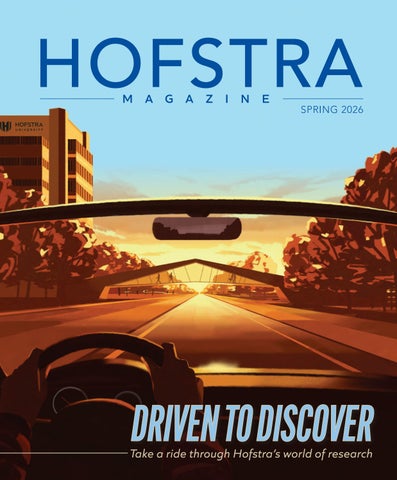
Take a ride through Hofstra’s world of research
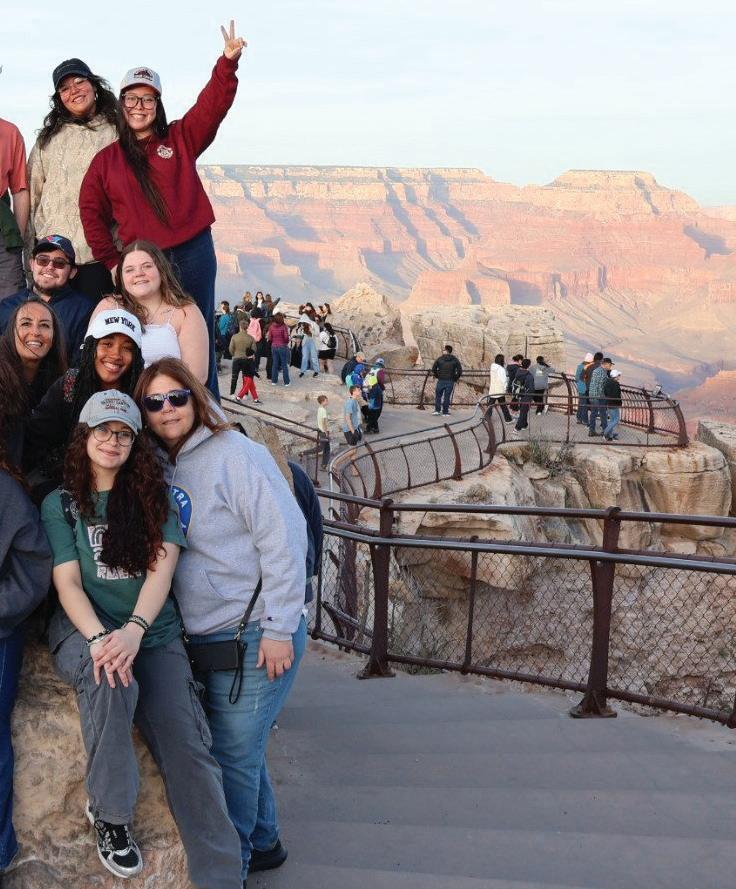
A group of Hofstra students and staff spent their spring break in picturesque Arizona. Led by Anita Ellis (front row, far right), director of the Office of Commuting Student Services and Community Outreach, the Hofstra contingent visited natural wonders like the Grand Canyon, learned about Native American history and culture, and volunteered at local organizations feeding those in need.
PAGE 28
Last fall, the Board of Trustees unanimously approved to extend President Susan Poser’s contract. As she wraps up her first five years, Hofstra’s ninth president reflects on the University’s progress and potential.
PAGE
Is artificial intelligence a friend or a
What are its strengths and shortcomings? Where is the line between asset and liability? With Hofstra’s campus-wide launch of ChatGPT Edu, students and faculty can decide for themselves.
PAGE
The search for knowledge is fundamental to Hofstra’s mission as an institution of higher learning. These are the people and projects powering the University’s research efforts and shaping the future of innovation.
Dear Hofstra University Alumni and Friends,
It is my pleasure to introduce you to the spring 2026 issue of Hofstra Magazine
This edition will give you a sense of the exciting year we have had, grounded in the work of Hofstra students, faculty, staff, and alumni.
Research is playing an increasingly important role at Hofstra. We highlight recent achievements of Hofstra faculty and students and the impact of their work.
This issue explores Hofstra’s expanding attention to artificial intelligence (AI) and how AI is changing teaching, scholarship, and career preparation.
You will learn about Hofstra University’s first Rhodes Scholar; the successes of the athletic programs, including our first appearance at March Madness in over two decades; and the new leaders working to further Hofstra’s mission.
Thank you for your continued support of this wonderful university. I hope you will stay connected, engage with fellow alumni and friends, and share your good news with us at hofstra.edu/alumni
Sincerely,

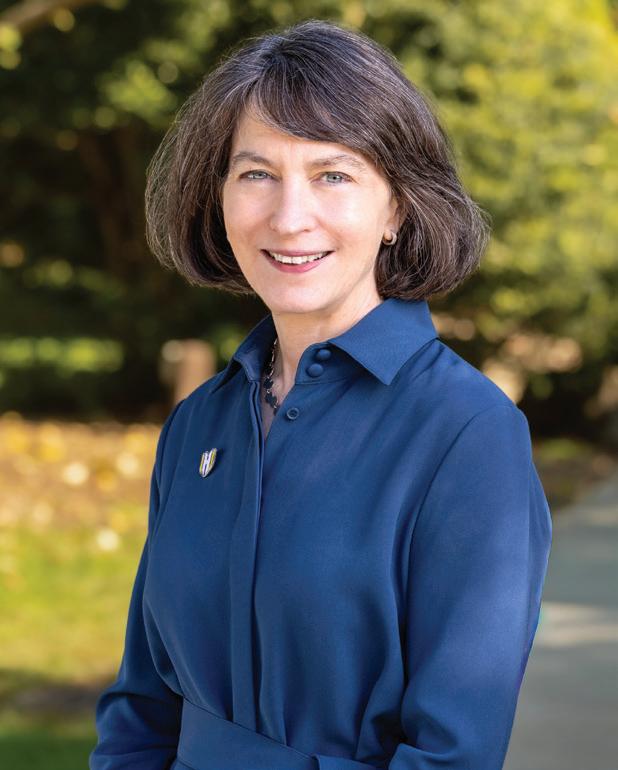
Susan Poser President
President Dr. Susan Poser
Provost and Senior Vice
President for Academic Affairs
Senior Vice President for Development and Alumni Affairs
Laine Norton
Dr. Charles Riordan Vice President for Marketing and Communications
Terry Coniglio
Assistant Vice President for Communication
Michael Wilke
Assistant Vice President for Creative Services
Francis A. Rizzo III
Managing Editor
Andrew Sheldon
Creative Director
Kelvin Fonville
Editorial Director
Linda Merklin
University Photographer Matteo Bracco
Senior Business Manager
Jessica Ramos
Contributing Writers
Lindsey Angioletti
Lois Bentivegna
Justin Chupungco
Claire Curry
Stephanie Flynn
Robert Lerose
Heidi J. Goldenberg
Stephen Gorchov
Ginny Greenberg
Mary Gregory
Andy Kissoon
Amy Reich
Len Skoros
Yolanda Stewart
Contributing Photographers
Rick De Masi
Alexis Friedman
Kumba Jagne
Joe Orovitz
Janette Pellegrini
Dalia Shawareb
Cover
ILLUSTRATION Emiliano Ponzi
DESIGN Kelvin Fonville
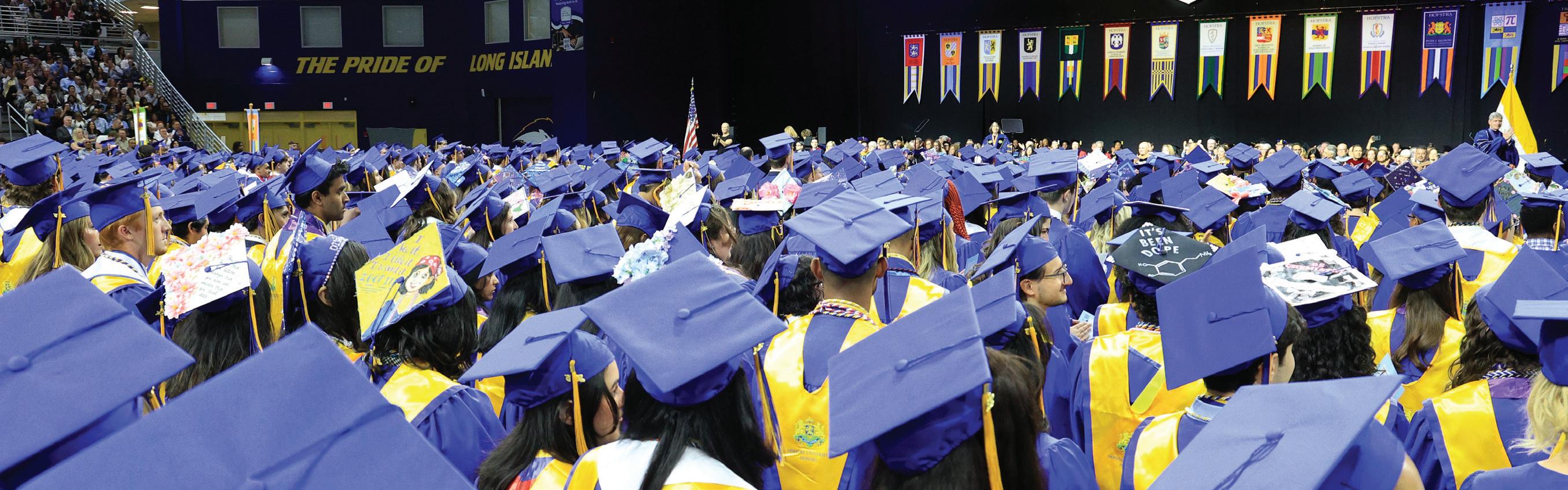
Northwell Health’s new leader delivers address and receives honorary degree at the winter ceremony.
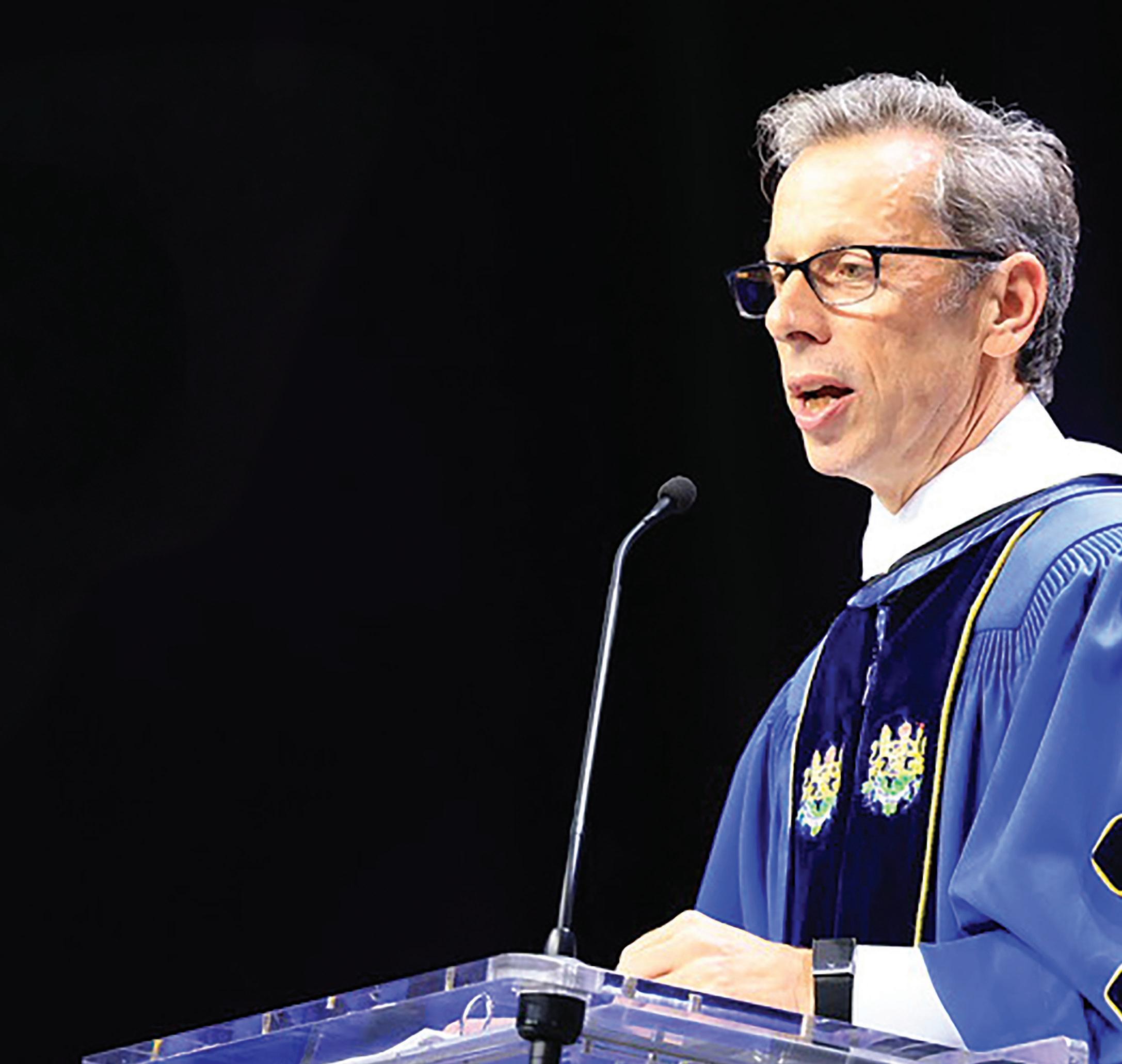
Dr. John D’Angelo, president and CEO of Northwell Health, delivered an inspirational message to graduates and guests at Hofstra University’s 2025 Midyear Commencement in December. Nearly 800 Hofstra undergraduate and graduate students received their degrees at the ceremony.
As Northwell’s top executive, a role he assumed in October, D’Angelo oversees the largest health system in the Northeast, consisting of 28 hospitals, more than 1,000 outpatient locations, and 104,000 employees. He is also a professor of emergency medicine at the Donald and Barbara Zucker School of Medicine at Hofstra/Northwell.
D’Angelo began his career at Northwell more than 25 years ago as an emergency medicine physician at Glen Cove Hospital and progressed through various clinical and administrative leadership roles. He most recently served as executive vice president of the health system’s Central Market.
Citing his own professional journey, D’Angelo told the graduates that putting in the work in their fields will take them great places. “We all have things we are really good at,” he said. “When you find those things, you should lean into them. You should get better at them. You should become an expert in those things. Because that will create opportunities for you and open doors that you couldn’t have imagined at the start of your journey.”
Prior to his remarks at commencement, D’Angelo received a Doctor of Humane Letters, honoris causa
Hofstra gets a new board chair and welcomes the next dean of the School of Education and new senior vice president for development and alumni affairs.
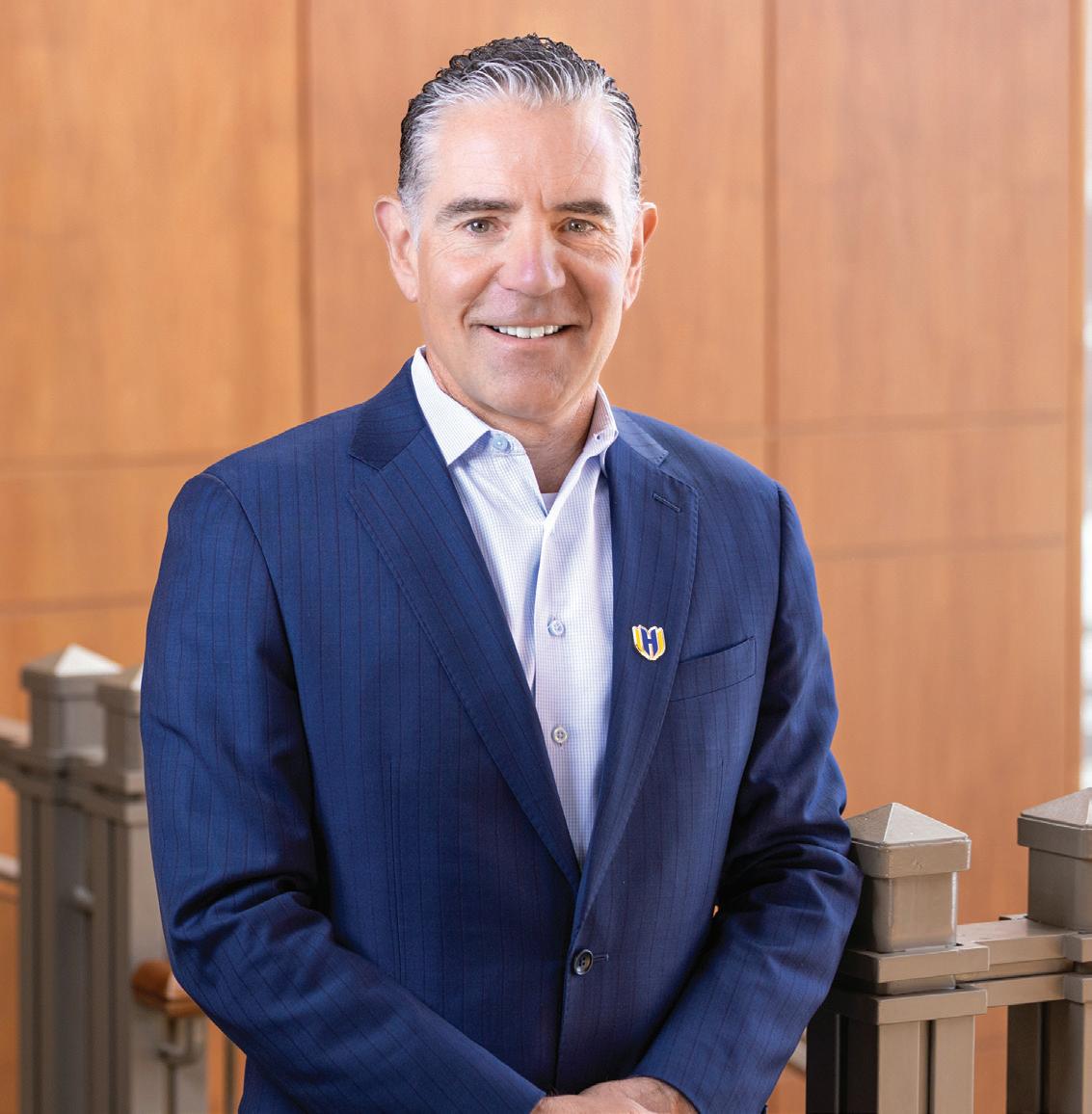
Chair, Hofstra University Board of Trustees
In October, the Hofstra University Board of Trustees elected Hofstra alumnus Michael Roberge, a member of the board since 2014, as its next chair in a unanimous vote. He succeeds Donald Schaeffer, who held the position since 2019.
After earning his MBA from Hofstra’s Frank G. Zarb School of Business in 1992, Roberge embarked on a distinguished, 30-plus year career in finance. The Minnesota native is currently chair of MFS Investment Management in Boston, where he helps set the strategic direction of the firm’s investment of more than $650 billion in assets.
Since joining Hofstra’s board, Roberge has played a pivotal role in shaping Hofstra’s future. He served on the presidential search committee that selected Hofstra President Susan Poser and chairs the Committee on Development and Alumni Affairs.
As board chair, Roberge will work with the University’s senior leadership to continue advancing the Hofstra 100 strategic plan. “We will continue to ensure the strength, continuity, and development of our liberal arts and professional programs,” Roberge said. “The board is very excited about the opportunities ahead — it’s a challenging but energizing time for higher education.”
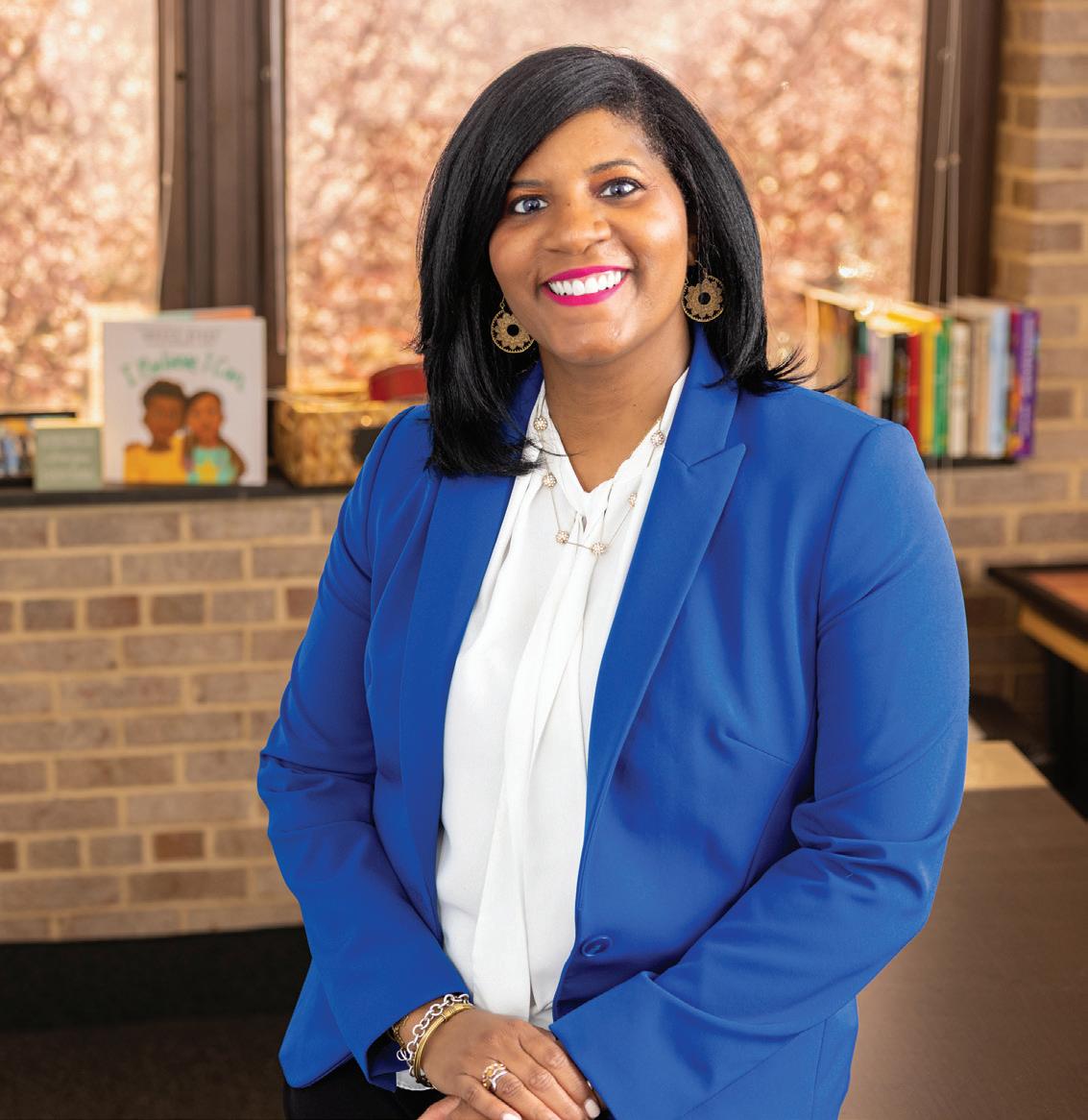
Dean, Hofstra University School of Education
Last fall, Hofstra announced the appointment of Dr. Ayana Allen-Handy as dean of the School of Education. She joined the University on January 1.
Allen-Handy is an accomplished educator and researcher who most recently served as professor of urban education and chair of the Department of Policy, Organization, and Leadership in the School of Education at Drexel University.
Her research focuses on the social foundations and contexts of education, urban teacher education, and youth-led and communityengaged research. She has secured more than $14 million in grant funding from, among other organizations, the National Science Foundation, AmeriCorps, and National Institutes of Health.
“It is an honor to serve as dean during this transformative new era, building on the school’s stellar reputation and strong legacy of producing reflective, knowledgeable teachers and educational leaders who use scholarship to inform their practice,” Allen-Handy said.
The Philadelphia native holds a dual BA in Management & Society and Spanish from the University of North Carolina at Chapel Hill, an MEd from the University of St. Thomas (TX), and a PhD in Curriculum and Instruction from Texas A&M University.
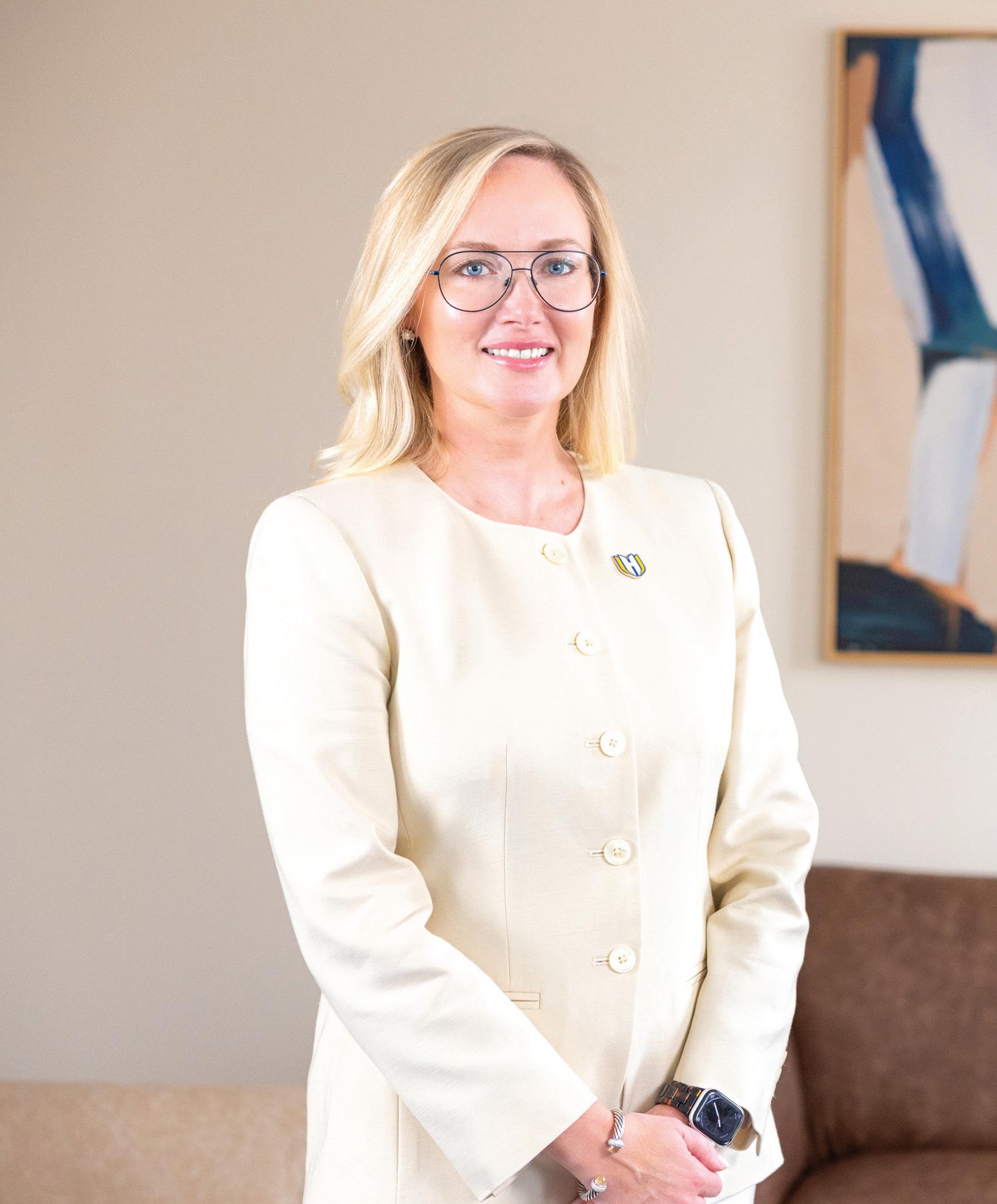
Hofstra’s new head of development and alumni affairs aims to keep Hofstra on the upswing by connecting passion and possibility.
A t a recent alumni event in Washington, D.C., a Hofstra graduate shared with Laine Norton, the University’s senior vice president for development and alumni affairs, that his Hofstra professor drove him all the way to North Carolina, where he would attend graduate school. Norton was not surprised to hear what has become a familiar story. After joining Hofstra in February, Norton met alumni in cities across the country who shared similar anecdotes.
“There is a deeply passionate population of people who are really grateful and committed to the institution,” Norton said. “I’m excited to meet more of our alumni and deepen and enrich those connections.”
In addition to overseeing alumni affairs, Norton manages a team responsible for philanthropy and development, leadership recruitment and engagement, and prospect research and cultivation. A seasoned professional in the field, she brings years of experience to her new post. Norton most recently served as vice president for advancement at Ithaca College. Previously, she was assistant dean for advancement at Syracuse University’s Maxwell School of Citizenship and Public Affairs. Her exceptional contributions to both institutions

helped expand philanthropic giving and achieve million-dollar campaign goals.
“I’ve seen lives transformed through private giving — the students who travel internationally for the first time, study abroad, or stay on to earn more degrees,” Norton said about what lies at the heart of her work. “The level to which private support makes a difference is really incredible.”
Born in Mississippi and raised in Nebraska, Norton holds degrees in journalism and history at the University of Nebraska-Lincoln. She worked as a student intern in her alma mater’s development department and later as a senior director of development for the University of Nebraska Foundation on behalf of the Jeffrey S. Raikes School of Computer Science and Management and the College of Business.
“Higher education has been part of my lifeblood,” Norton said, explaining that she literally grew up in the halls of academia. Her father was a university dean, and her grandfather was president of a midwestern college. “I’m grateful to be able to apply my experiences to my role at Hofstra as we approach the University’s centennial [in 2035] and at a time with both wonderful momentum and opportunity for growth.”
Generous Zarb alumni transform lives for generations of Hofstra students.
Last fall, Hofstra celebrated the dedication of the Ronnie Charney Core Skills Lab at the Frank G. Zarb School of Business, honoring the life and legacy of Ronnie Charney and the enduring connection she shared with her husband, Larry Charney ’69, a proud Hofstra alumnus and steadfast supporter of the University.
Launched in 2023, the Core Skills Lab is a centerpiece of the Zarb School’s experiential learning approach, enabling students to strengthen the communication, presentation, and interpersonal skills essential for professional success. Equipped with state-of-the-art technology, virtual reality tools, and AI-enabled feedback systems, the lab helps students build confidence and leadership presence.
“Larry often reminds us that, in business, success isn’t only about what you know, but how you connect,” said Zarb School Dean Janet Lenaghan. “Ronnie embodied everything the Core Skills Lab represents — a place to grow, be yourself, and build skills that last a lifetime.”
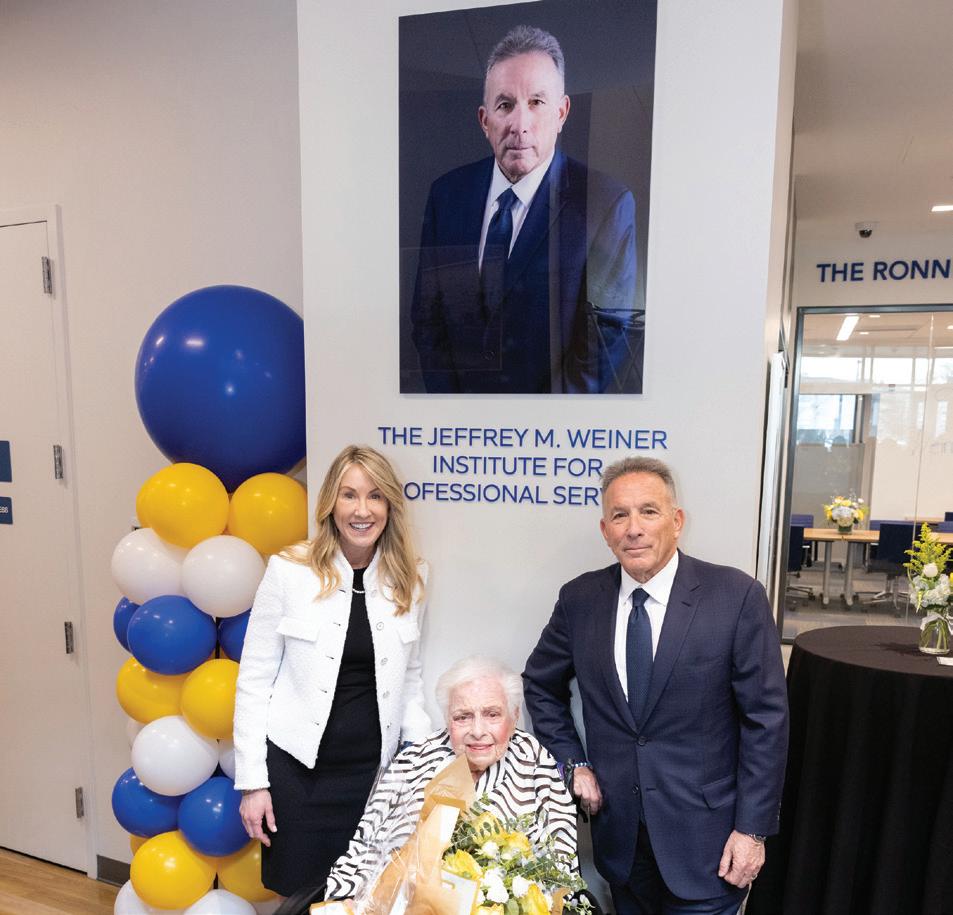
In March, Hofstra established the Jeffrey M. Weiner Institute for Professional Services at the Frank G. Zarb School of Business, funded by a $5 million gift from alumnus Jeffrey Weiner ’79, former chairman and CEO of Marcum LLP. A dedication ceremony was held at the Leo A. Guthart Hall for Innovation and Discovery.
“This extraordinary gift from Jeffrey Weiner will expand opportunities for our students and reinforce Hofstra’s commitment to preparing graduates to lead, innovate, and excel in today’s evolving professional landscape,” Hofstra President Susan Poser said.
The Frank G. Zarb School of Business’ Online MBA program placed fifth in Poets&Quants’ 2026 list of best online MBA programs in the U.S., up four spots from 2025. “This recognition speaks to the quality and momentum of our Online MBA program,” Zarb School Dean Janet Lenaghan said. “Our faculty are deeply engaged, our curriculum is continuously evolving, and our students are achieving meaningful career outcomes.”
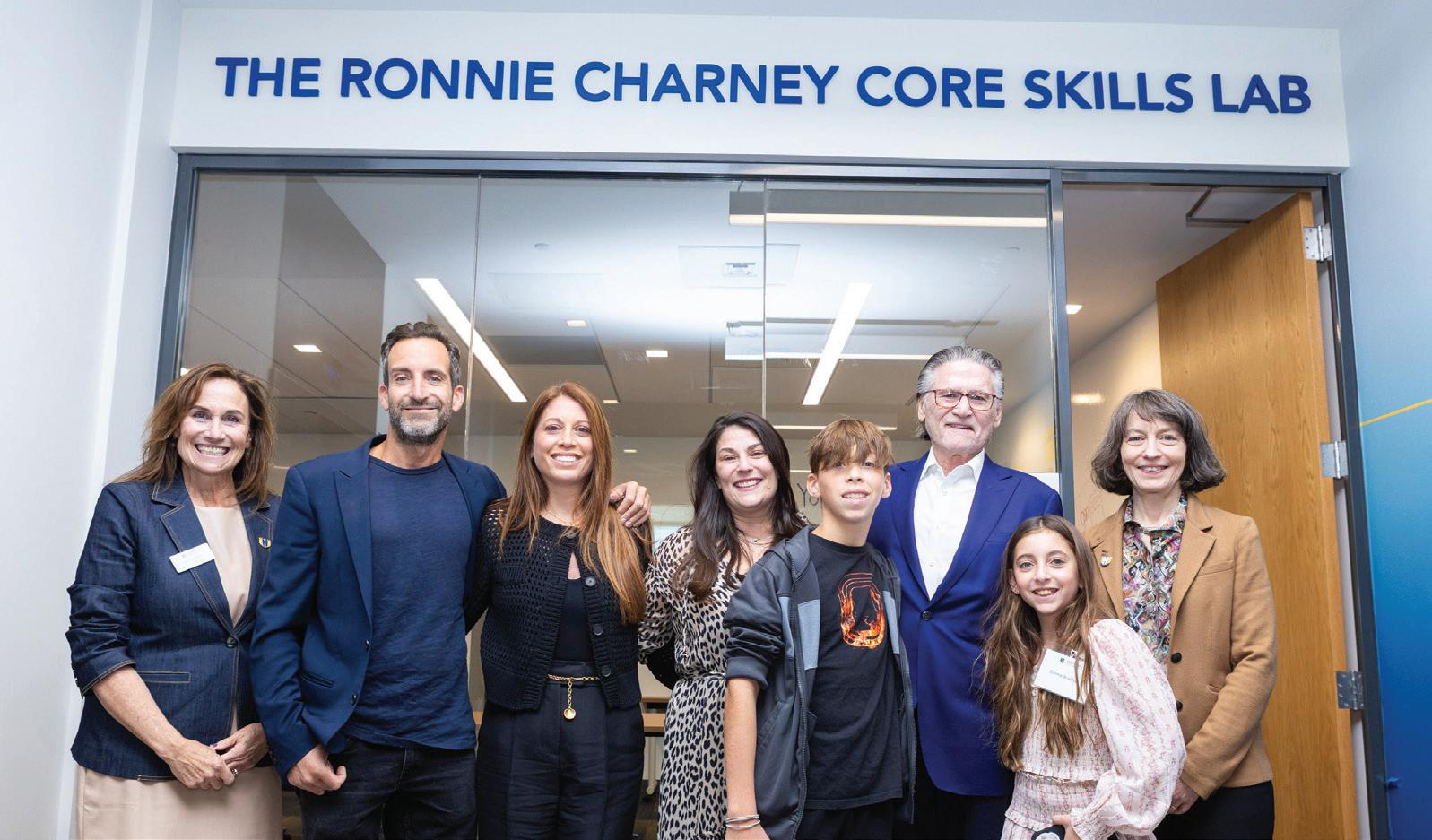
Charney reflected on the couple’s longtime partnership in philanthropy. “Ronnie and I partnered on everything,” he said. “The phrase ‘core skills’ is Ronnie to a T — her love, her
The Institute will serve as a hub for innovation, industry engagement, and academic thought leadership, strengthening career preparation in accounting, finance, marketing, and other professional services fields. By connecting students with employers and professional mentors, the institute will provide students with industry insight to complement their academic foundations. “Academia builds your educational and technical skills,” Weiner said. “You then gain practical experience in the field and continue to build from there.” His gift will help provide students with the practical career insight needed to enter the workforce confidently.
Read more about Jeffrey Weiner's career and his hopes for the Institute for Professional Services on page 22.
balance, her strength. She created a wonderful life for me and everyone she touched. Now every student who walks into this building passes by her name and carries her legacy forward.”
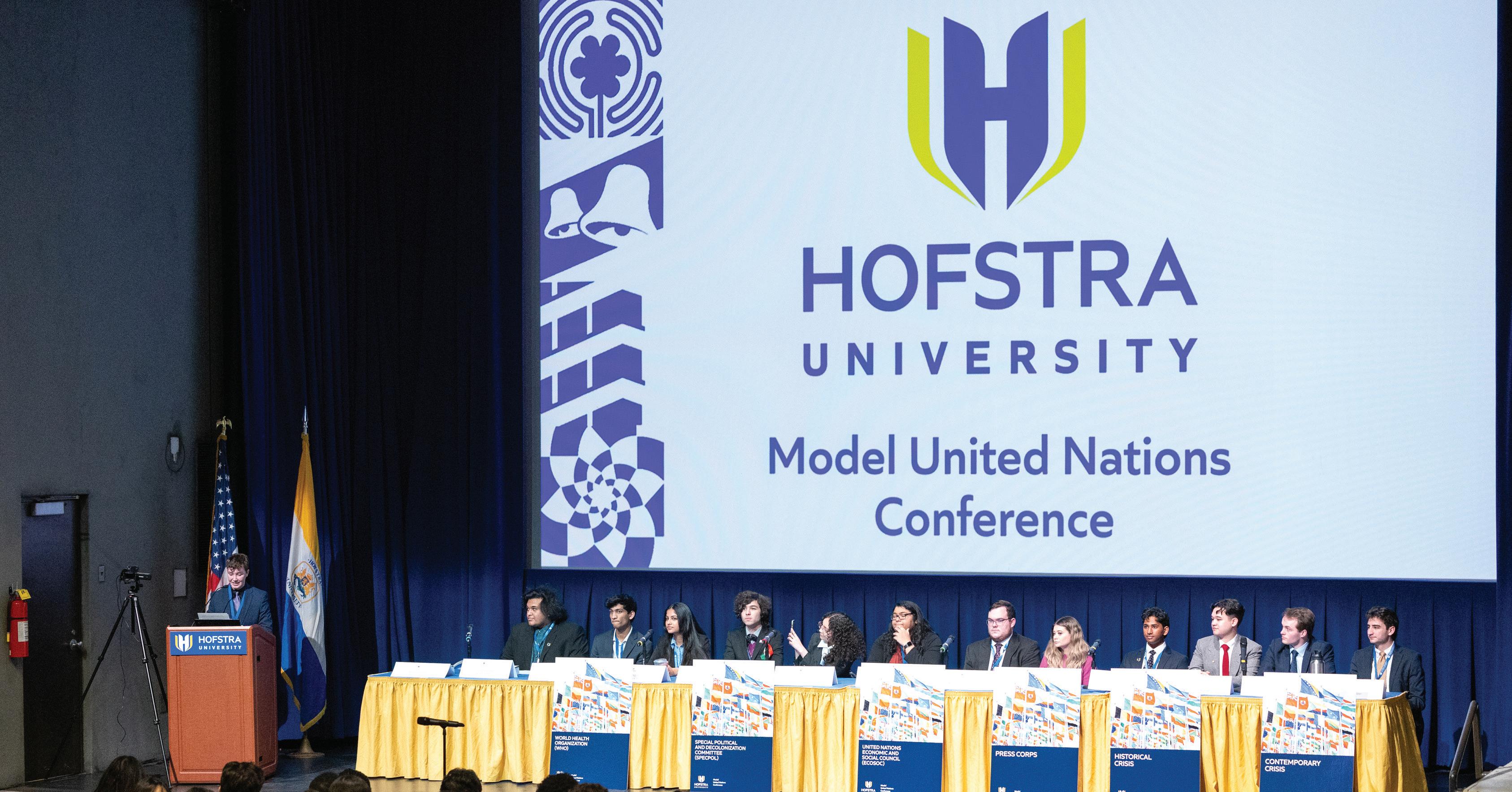
Hofstra’s Model UN Conference places local high school students on the world stage.
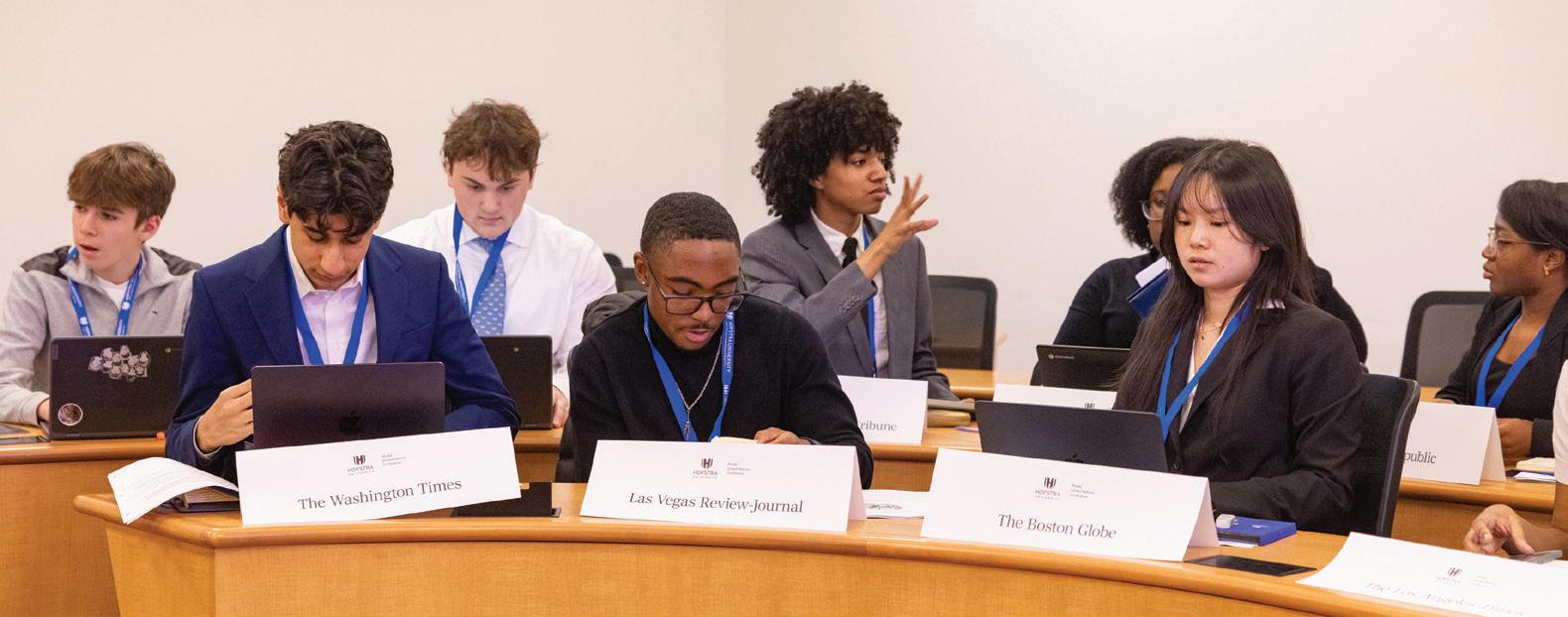
The international housing crisis, the environmental impact of avocado farming in Mexico, the Cold War in Berlin in the 1960s. These are just a few of the wide-ranging topics high school students study and debate at Hofstra’s annual Model United Nations Conference.
Each spring, students across Long Island and New York City convene on campus to compete in a simulation of the UN’s role on the international stage. Organized and hosted by Hofstra’s own Model UN Club, the conference was launched in 2012 as an accessible alternative to costly overnight conferences, said Dr. Rosanna Perotti, a Hofstra political science professor who was involved with the event in its early days.
“This is a way to get young students onto a college campus and get them excited about the possibilities that await them,” Perotti said, adding that the conference brings together students from different economic backgrounds, ethnicities, and religions. “This is the most
rewarding aspect of hosting the Model United Nations. It has allowed us to facilitate conversation among groups that are often segregated geographically and socially.”
This year’s event, themed “Navigating the Changing World Order,” opened on February 27. Over the course of three days, 200 students from a dozen high schools tackled some of world’s most pressing issues, such as journalistic ethics, genetic engineering, and the global housing crisis.
In addition to honing public speaking skills, students delve deeply into historical, contemporary, economic, and world health issues and discuss them from different viewpoints. “It’s a learning conference,” said Raven Bateman ’27, club president and secretary-general of the 2026 Model UN Conference. “I think students who participate in Model UN have a much better understanding and view of the world.”
Chloe Eng, a senior at Manhasset Secondary School, had the opportunity to listen, learn, and report while serving as a New York Times delegate in the conference’s press corps committee last year.
“We argued about press freedom and how the press is treated around the world,” she said. “We also attended other committee sessions and wrote articles about the topics students were debating in real time. I was glad to experience that and to talk and work with student journalists from other high schools and from Hofstra.”
This, ultimately, is why Eng and her fellow students return year after year: The University's conference provides the opportunity to work alongside their most talented peers. “It’s a level up from other competitions,” Eng said. “The strength of the delegates at Hofstra is higher. It is the best place for us to test our skills.”
Throughout the academic year, Hofstra hosted events that brought the greater community together to connect, share, and examine women’s issues.
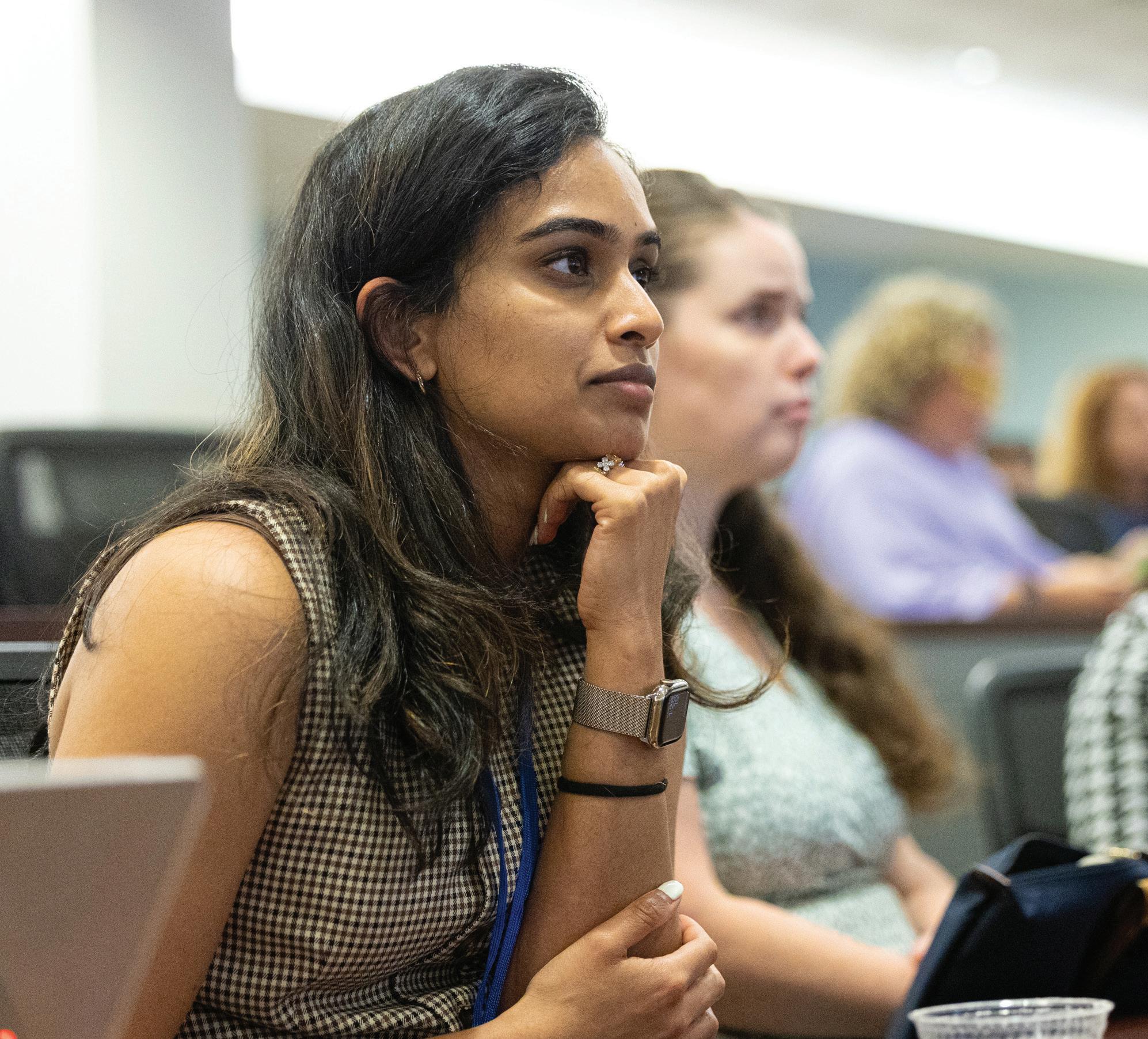
The Donald and Barbara Zucker School of Medicine at Hofstra/ Northwell kicked things off just weeks into the fall semester by hosting the September Women in Medicine Conference (SWIMC). Co-sponsored by the Zucker Women in Medicine and Science (ZWIMS) group, Katz Institute for Women’s Health, Northwell Health Physician Partners, and the Kern National Network for Flourishing in Medicine, the event brought together more than 100 faculty, staff, medical students, clinicians, and other professionals from all walks of life.
“I would not have missed this conference for the world,” said Dr. Jill Rabin, professor of obstetrics and gynecology at the Zucker School of Medicine. “The opportunity to come together, women — and men! — to share our knowledge and experience was truly an amazing and synergistic event.”
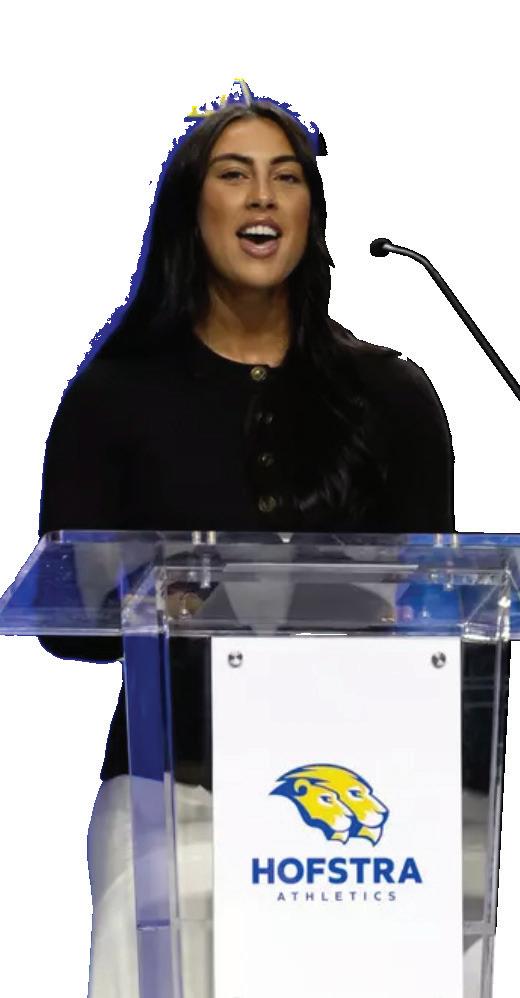
Hofstra Athletics held its own event the very next month. The Women of the Pride Symposium brought together nearly 200 student-athletes, coaches, and administrators to discuss and celebrate women in sports and leadership. The event included panels and breakout sessions exploring the power of being a female student-athlete and life after collegiate athletics.
The inaugural symposium, the brainchild of women’s soccer student-athlete Millie Davies ’26, was made possible through the support of Hofstra President Susan Poser, Hofstra Vice President and Director of Athletics Rick Cole Jr., and Trish Healy, a longtime supporter of Hofstra Athletics and member of the event’s advisory committee. “I wanted to bring all the female athletes, staff, and alumnae back to inspire the room,” Davies said. “Who better to learn from than the women who have been in our shoes? The amazing speakers made me realize how special it is to be a student-athlete and to be present in our journey. We gain so many important skills, like discipline, time management, and teamwork, that we can carry with us long after college.”
Millie Davies ’26
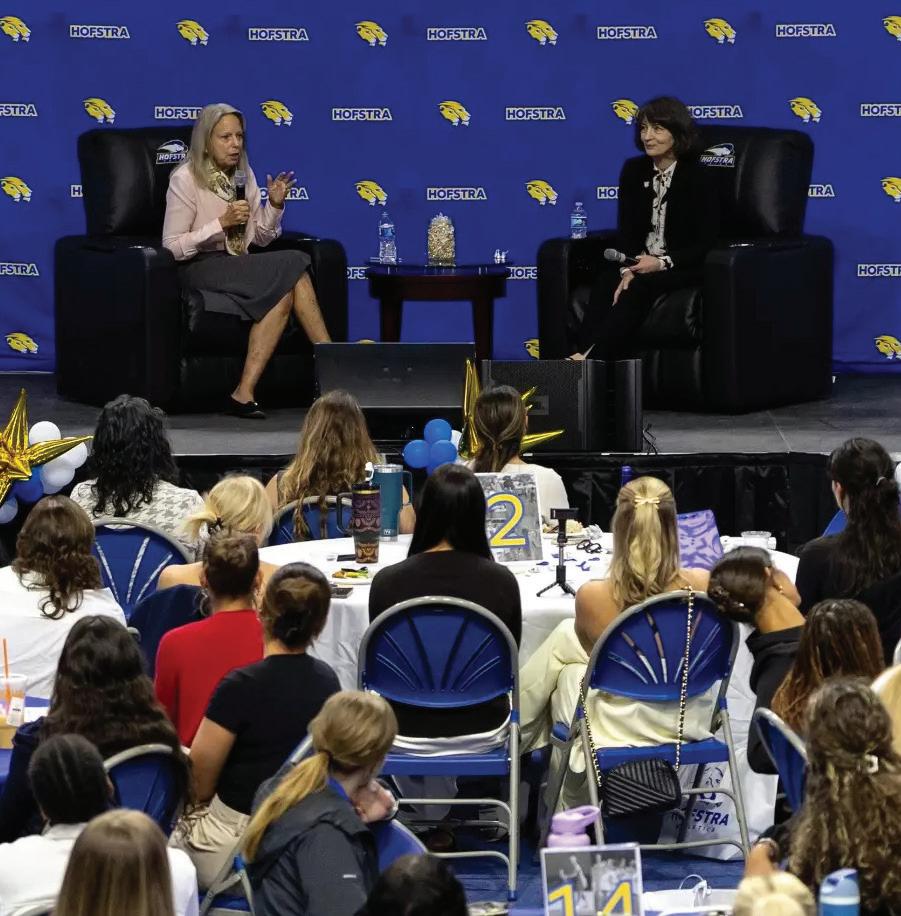
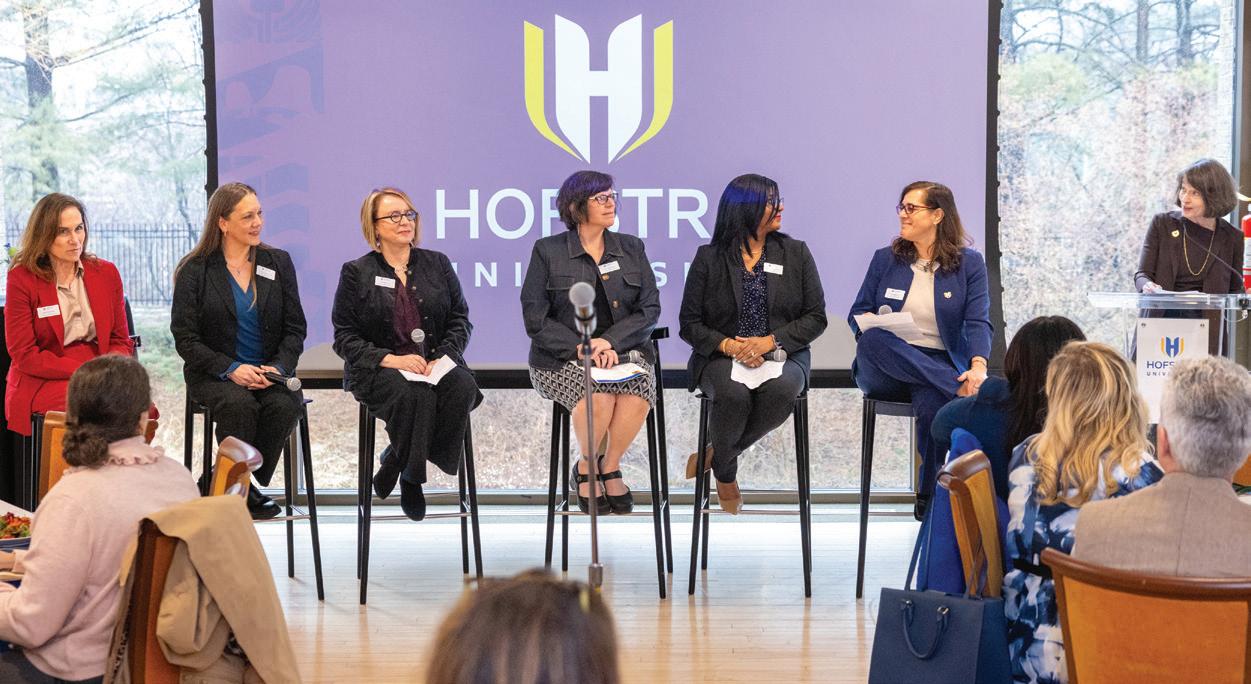
In March, the University held its second annual Women in Leadership Symposium, hosted by the Hofstra University Women in Leadership Advisory Board and open for all to attend. The event brought together professionals, students, faculty, and alumni for a day of connection, mentorship, and candid conversation, designed to empower attendees at every stage of their professional journeys. Discussions, breakout sessions, and panels featured successful Hofstra graduates and University leaders exploring paths to building confidence, promoting career growth, and creating work-life balance.
The event’s keynote address was given by Evy Poumpouras ’99, former U.S. Secret Service agent, NBC News correspondent, and author of Becoming Bulletproof. While in conversation with Dr. Eva Badowska, dean of Hofstra College of Liberal Arts and Sciences, Poumpouras likened inner strength to the Kevlar vest she often had to wear in the field. Kevlar is made up of many layers of fabric that, when tightly woven together, become like armor. “It’s not any one thing you do in life that makes you exceptional,” she said. “Building resilience is about all the layers, all the tiny things and small decisions you make, compounded over time.”

Karine Jean-Pierre encourages civic participation as the way forward.
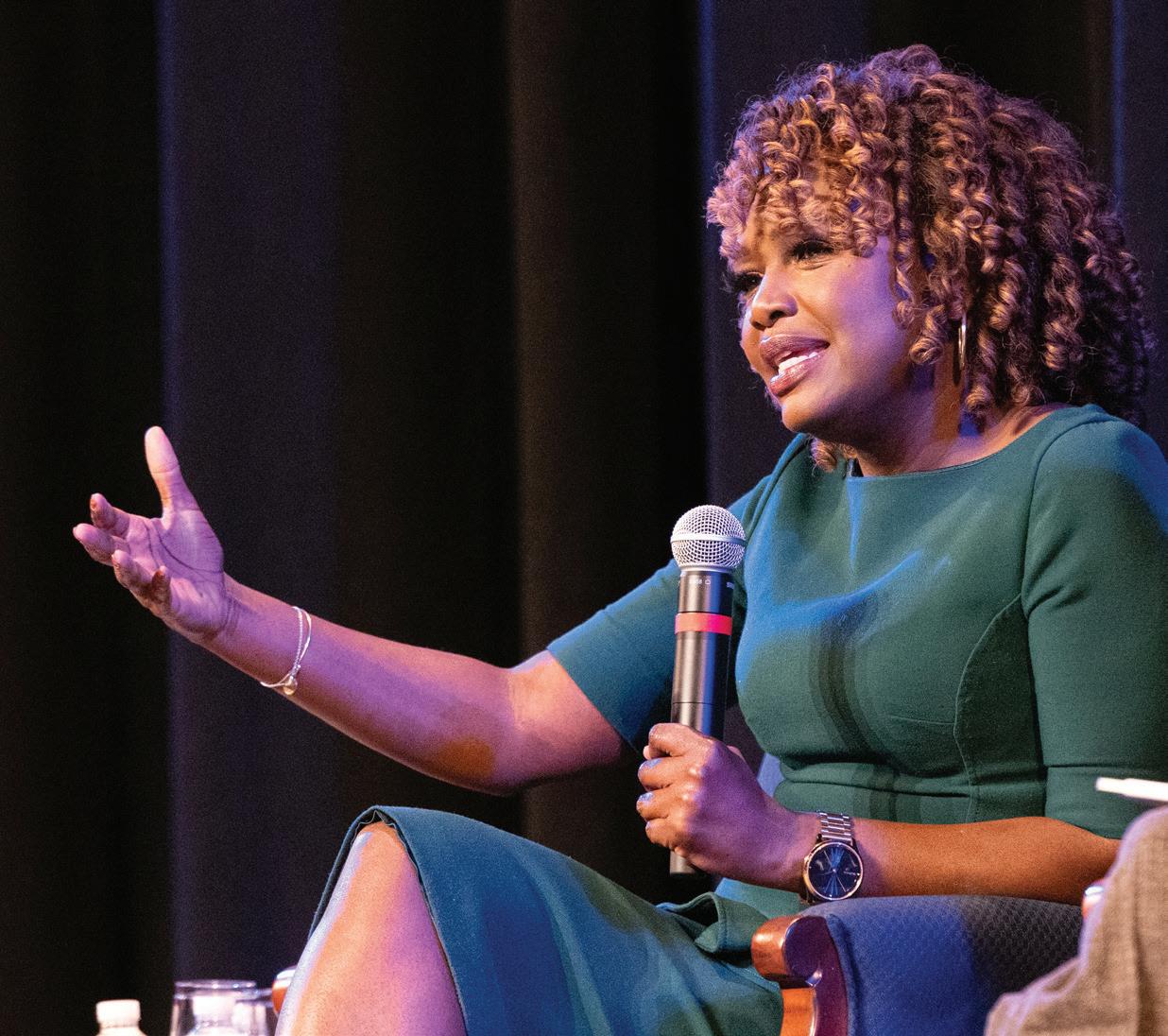
Former White House Press Secretary Karine Jean-Pierre delivered a message of resilience and civic responsibility during her keynote speech at Hofstra University’s Signature Speaker Series in February.
In the standing-room-only theater at the John Cranford Adams Playhouse, Jean-Pierre, White House press secretary for President Obama, drew on personal stories, history, and her experience in the White House to emphasize that hope is not passive. “Democracy is fragile, folks. And it survives only when people participate,” she said. “Participating is an act of hope.”
She acknowledged that many young people feel disenfranchised by the political system. “If you feel frustrated by politics, you’re not wrong,” she said. “But disengagement comes at a cost, because decisions are still being made whether you participate or not.”
Jean-Pierre, who graduated from Kellenberg Memorial High School, just down the road from Hofstra’s campus, went on to encourage students to see civic participation as a form of empowerment. “Voting is not a reward. It’s civic engagement. It’s a responsibility.” While JeanPierre recognized concerns about the current political system, she stressed that change requires involvement, not withdrawal. “You cannot change a system if you refuse to engage with it,” she said. “Reform does not come from opting out. It comes from sustained participation.”
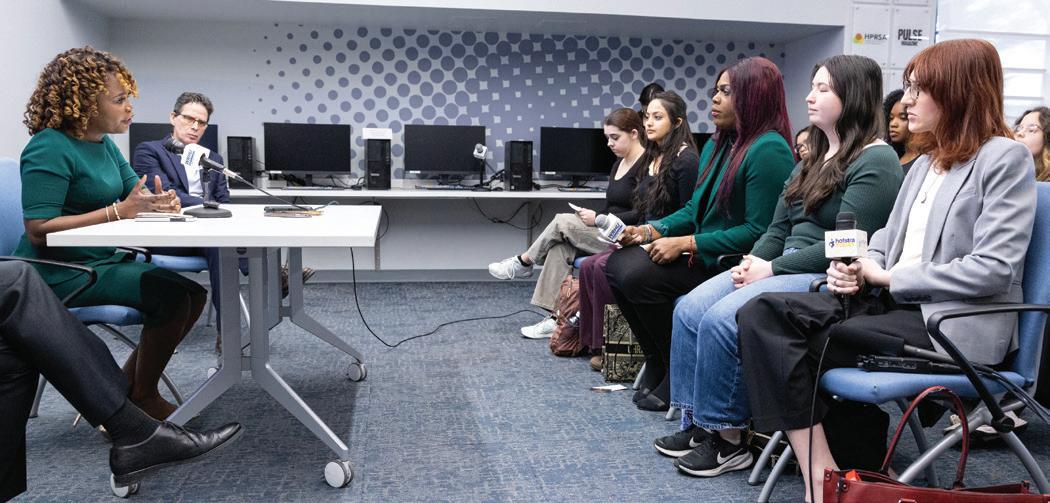
Afterward, Jean-Pierre signed copies of her two books, Moving Forward: A Story of Hope, Hard Work, and the Promise of America and Independent: A Look Inside a Broken White House, Outside the Party Lines. She then held a group discussion with student journalists from The Lawrence Herbert School of Communication before ending her visit with an interview on WRHU-88.7 FM, Radio Hofstra University.
Relive Hofstra’s highlights from a year of community and collaboration.
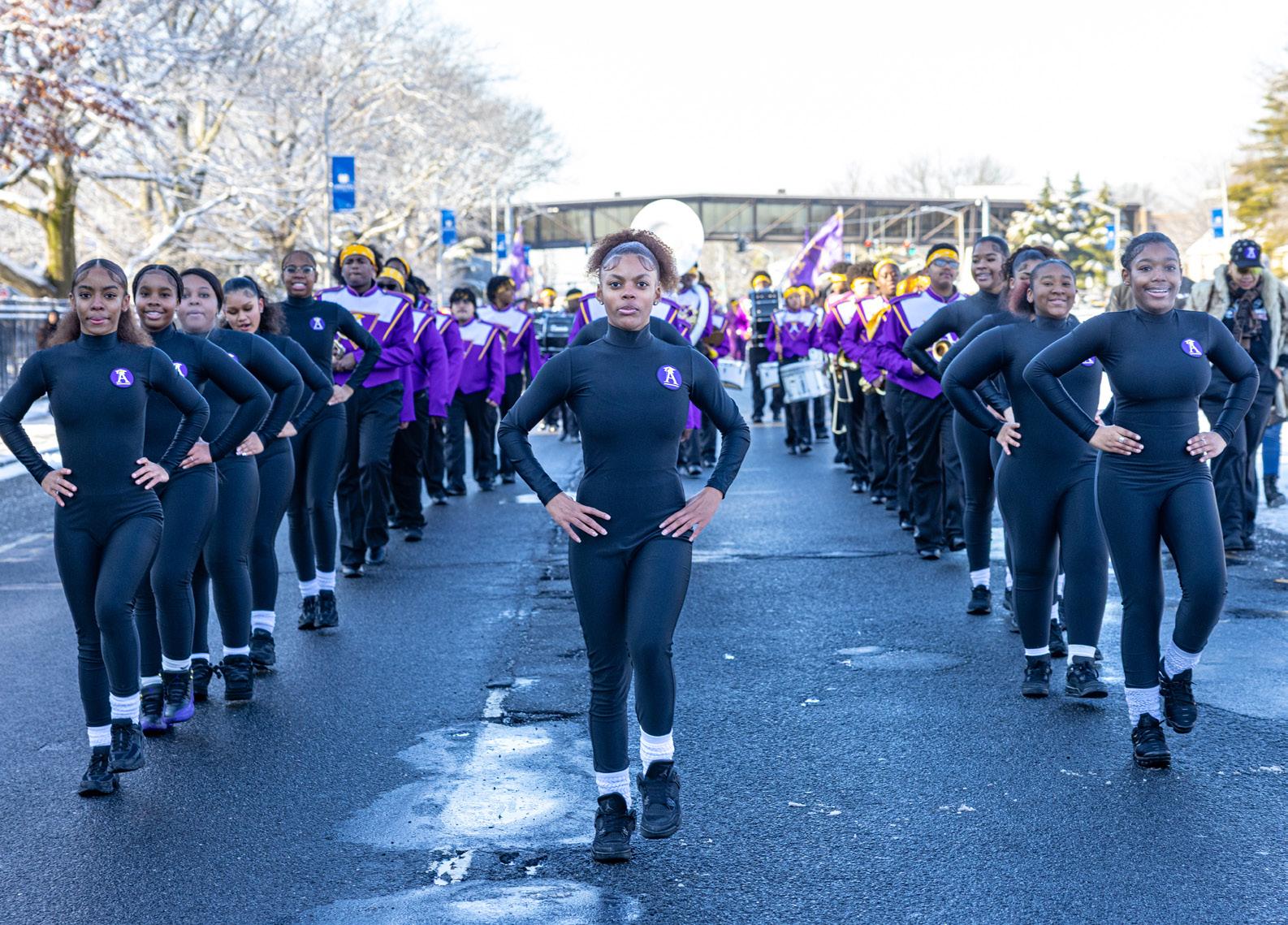
On Monday, January 19, the Hofstra community participated in one of its most cherished annual traditions: the MLK Day March and Celebration. For the fourth consecutive year, the event was co-hosted by the Village of Hempstead and Hofstra University, where Dr. King delivered the commencement speech to the Class of 1965.
Under the theme “Building the Beloved Community: Walking Together Across Generations,” the day commenced with a parade along Hempstead Turnpike. Hofstra alumna Athelene A. Collins ’92 , executive director of the Hofstra Cultural Center, and student Skyler Holmes ’27 , a public relations
and strategic communication major with a minor in Africana studies, served as the parade’s two grand marshals.
The celebration continued at the Sondra and David S. Mack Student Center with a moving program of speakers and performances.
Also addressing the crowd was Village of Hempstead Mayor Waylyn Hobbs Jr. and Hempstead NAACP President Barbara V. Powell, who was the keynote speaker. The event was rounded out with performances by local student groups, including the Hempstead High School Choir and Cheer/Dance Squad, and Academy Charter School dancers.
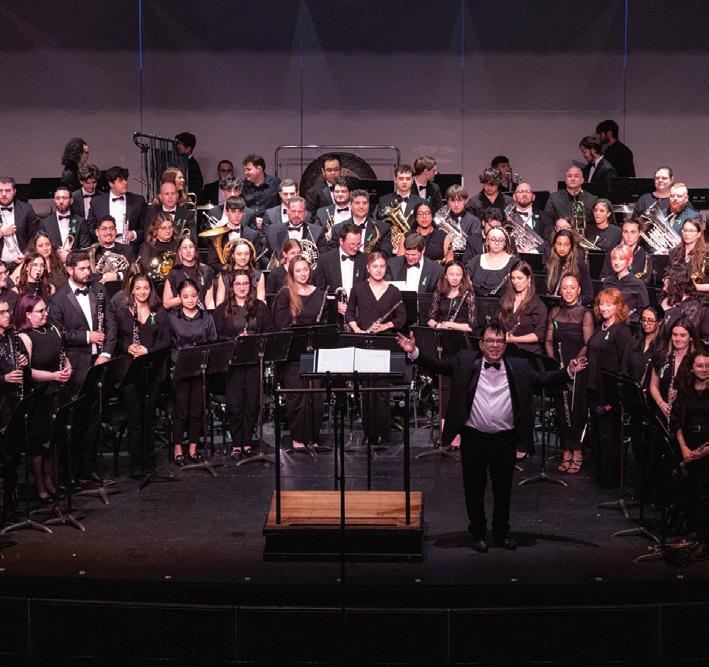
Last summer, 50 Hofstra music alumni joined current students on stage to honor the life of former classmate Gina Pellettiere ’01, ’06. Pellettiere, the longtime band director at Farmingdale High School, was killed in 2023 when the band’s bus tragically crashed in upstate New York.
The free concert featured a performance of “Eternal Trailblazer,” a new musical composition commissioned to celebrate Pellettiere’s life and love of music.
Adjunct Associate Professor of Music
David Soto, a friend and colleague of Pellettiere, served as conductor.

Last fall, more than 600 Hofstra students headed out into the community to participate in the University’s annual Shake-A-Rake program. The volunteers spent the day raking and clearing the yards of senior citizens and disabled residents living near campus.
Shake-A-Rake, which is sponsored by the Office of Commuting Student Services and Community Outreach, began in 2010 and has since grown to become Hofstra’s largest community service initiative.

Gimme Five!
Last fall, Hofstra University’s student-run radio station, WRHU-88.7 FM, was named College Radio Station of the Year at the 2025 National Association of Broadcasters’ (NAB) Marconi Radio Awards. The flagship station of the New York Islanders, Long Island Nets, Long Island Ducks, and Hofstra Pride athletics won the Marconi four previous times: 2014, 2017, 2019, 2022.
“Accepting the fifth Marconi Award on behalf of WRHU was such a surreal moment,” Station Manager Ashley Blum ’26 said. “Representing the station means the world to me, and I’m just filled with so much pride for every single person on our staff. They all work incredibly hard and put so much love, dedication, and creativity into every broadcast and project.”
Located in The Lawrence Herbert School of Communication, WRHU is powered by the
hard work of more than 300 students. The results have been recognized far and wide. WRHU has been honored with numerous regional, state, and national awards from organizations such as the Alliance of Women in Media, College Media Association, Fair Media Council, Journalism Association of New York, New York State Broadcasters Association, and Press Club of Long Island.
In February, WRHU’s professional-inresidence, Doualy Xaykaothao, was named a Faculty Champion by the University of Vermont’s Center for Community News. The accolade recognizes faculty members for their efforts to start or expand universityled reporting programs in their region.
Xaykaothao, who serves as adjunct associate professor of radio, television, film in the Herbert School, is a Peabody Award-winning newscaster and reporter for NPR who joined WRHU in 2023. As professional-in-residence, she mentors students and community volunteers in the art of radio, podcasting, and broadcast journalism.
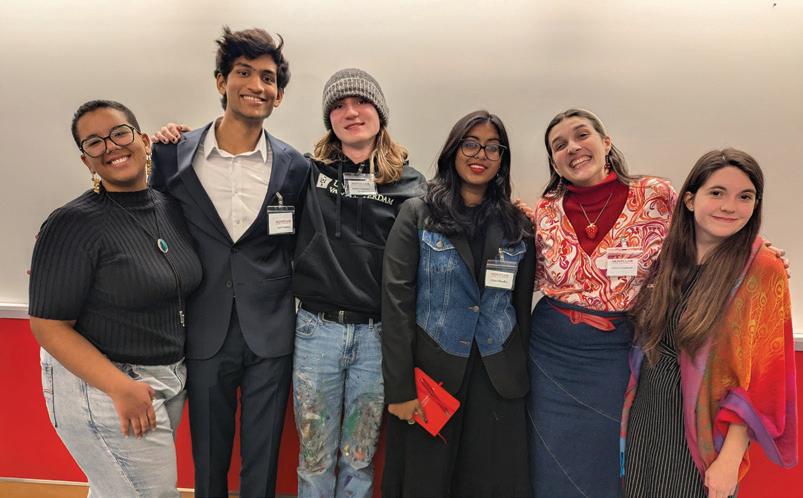
A group of current and former Hofstra students won the 2025 Geography Bowl competition during the Middle States American Association of Geographers Regional Meeting in November. The team of Sophia Camacho ’26, Natalie Correa ’24, Vienna De Lombaerde ’26, Cameron Elwell ’26, Aadi Gadekar ’28, and Dinara Moodley ’26 defeated Rutgers University in the final round to seal the victory.
The very same month, Mu Kappa, Hofstra’s chapter of the international geographical honor society Gamma Theta Upsilon, was recognized with the organization’s Honors Chapter Award. Only eight of the country’s 300-plus active chapters received the recognition, given to schools that demonstrate campus service and a commitment to outstanding student scholarship in geography. Mu Kappa has received the award eight times since its founding in 2012.
In March, Gadekar represented the Middle States at the World GeoBowl held during the American Association of Geographers Annual Meeting in San Francisco. Middle States defeated the Southwest Division in the final to win the competition.
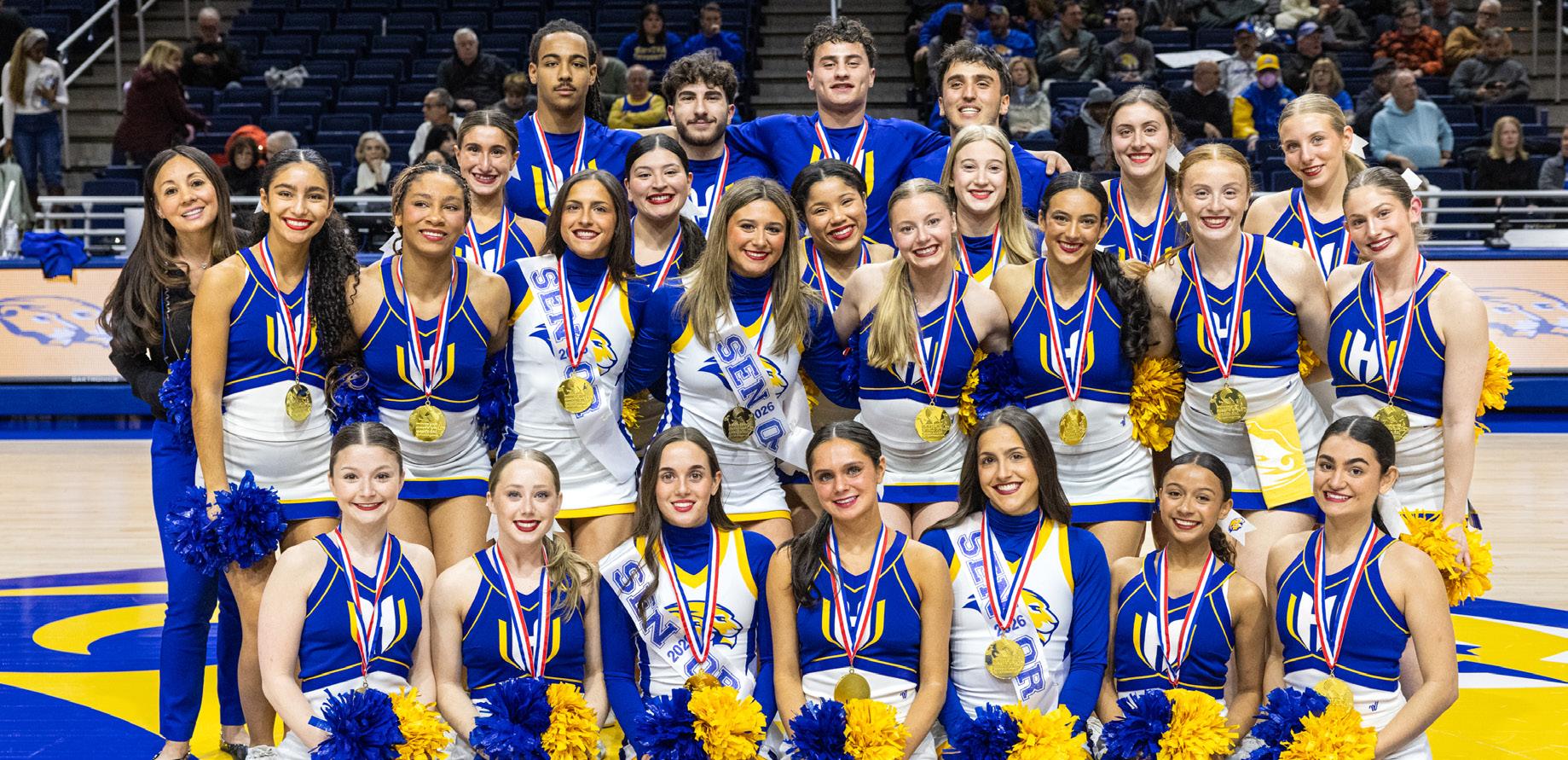
Hofstra’s Cheer team returned to campus for the spring semester with medals draped around their necks. Days earlier, the squad earned first-place honors in the Small Coed Game Day division at the World Cup Championship in Orlando.
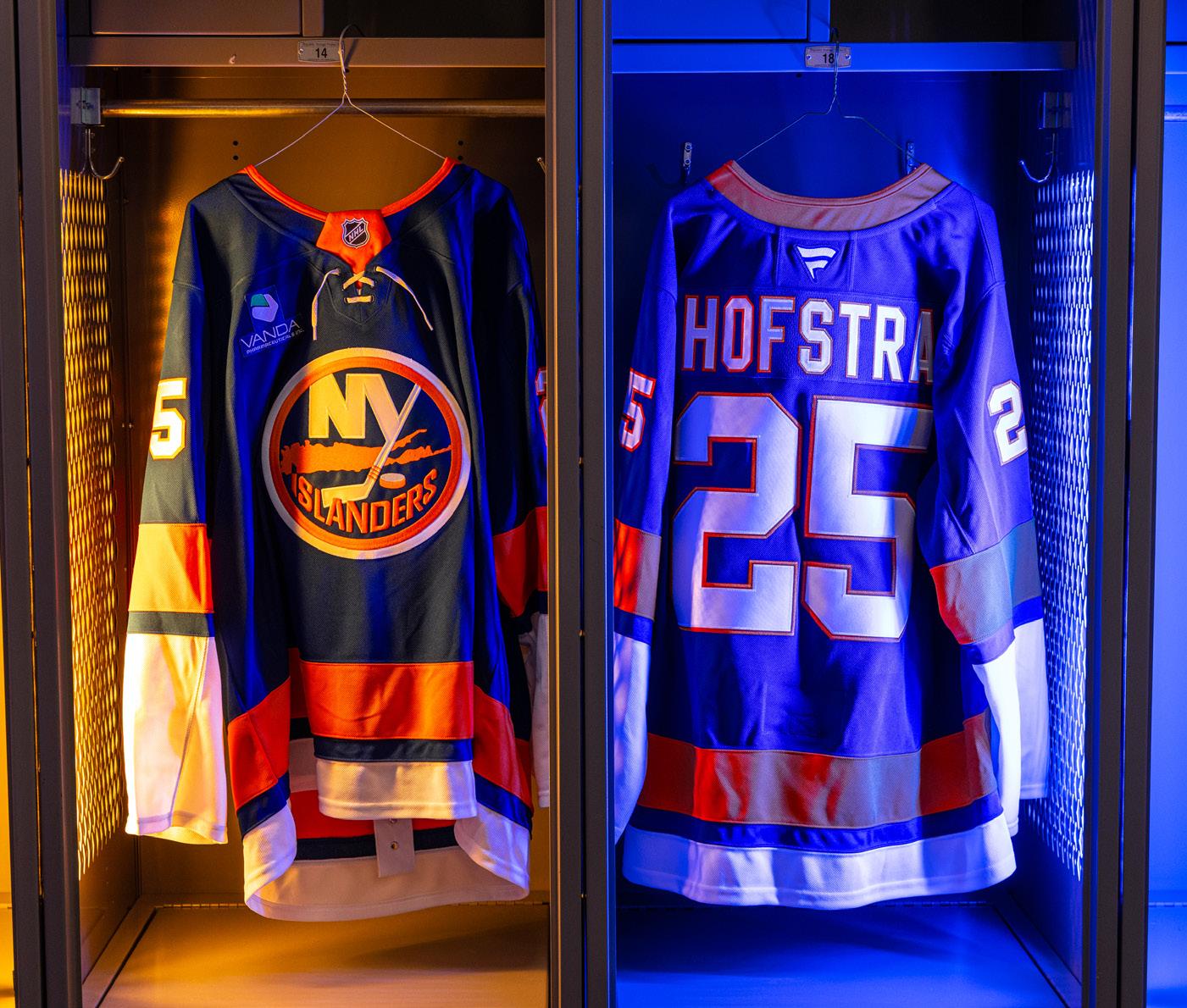
Hofstra joins the New York Islanders and UBS Arena in a partnership that puts students in the center of the action.
Hofstra University has teamed up with the National Hockey League’s New York Islanders and UBS Arena for a new partnership that will give students unmatched access to the fast-paced world of professional sports and entertainment.
The five-year agreement, which makes Hofstra the Official University Partner of the New York Islanders and UBS Arena, allows Hofstra students to gain hands-on experience through internships, experiential learning projects, and industry exposure in sports media, video production, public relations, marketing, and more.
The new agreement builds on Hofstra’s longstanding broadcast partnership with the Islanders. Since 2010, WRHU-FM Radio Hofstra University has been the Islanders flagship station, with game coverage powered by student producers, locker-room reporters, and engineers.
With UBS Arena located just 6 miles from Hofstra’s campus, the collaboration also unites community leaders and drives local pride.
“I am very excited about this partnership and the opportunities it will provide to our students,” Hofstra President Susan Poser said. “Collaborations like this prepare students for success and grow Hofstra’s network on Long Island and beyond.”
The agreement also allows full-time employees of the New York Islanders, UBS Arena, and Oak View Group (the arena’s operating partner) to be eligible for graduate tuition reimbursement to continue their education at Hofstra.
“This partnership is a true win for the Islanders, UBS Arena, and the students of Hofstra University,” said Kelly Cheeseman, president of business operations for the New York Islanders and UBS Arena. “As Long Island’s hockey team in a world-class venue, we’re excited to offer unmatched, hands-on professional experiences, and give students and faculty incredible access to the entertainment and energy of our games, including special student and faculty ticket offers. We look forward to working with Hofstra to develop the next generation of sports and entertainment leaders and to grow our fan base for years to come.”
THE PARTNERSHIP BRINGS EXCLUSIVE CAMPUS LIFE PERKS:
•Dedicated ticket portal offering preferred pricing for Hofstra students, faculty, and staff at select Islanders home games
•Annual guest lectures featuring top executives from the New York Islanders and UBS Arena
•Joint community and campus events, where New York Islanders mascots, Sparky and Nyisles, will join Hofstra’s beloved Kate and Willie to rally school spirit







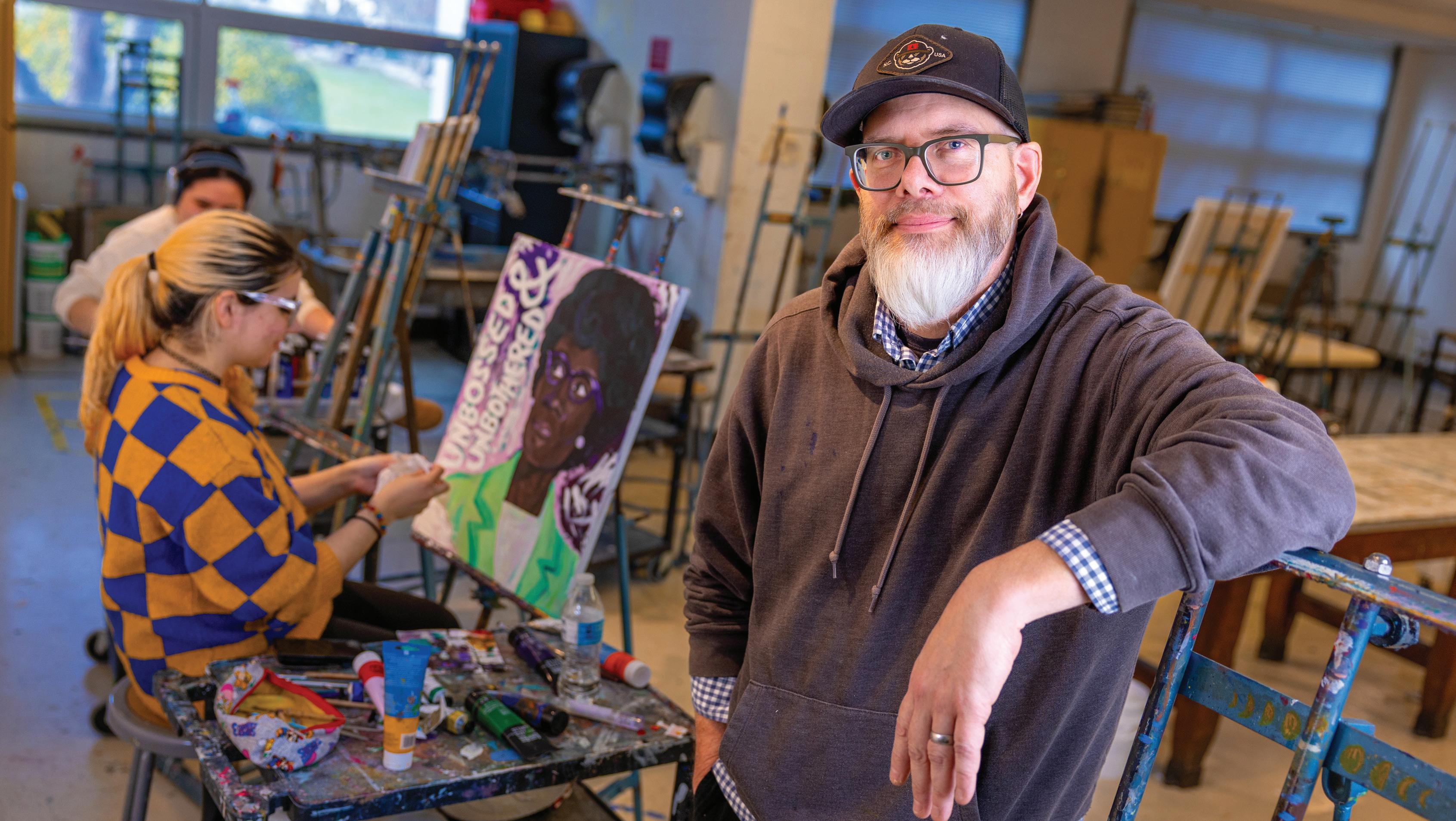
A Hofstra fine arts professor is beautifying campus, one work of art at a time.
Nature, it’s said, abhors a vacuum. So, too, does Jim Lee. Where the world sees emptiness, however, the Hofstra professor of fine arts sees openness — an openness for opportunity.
An accomplished artist himself, Lee knows firsthand the excitement his students feel and the confidence they gain having their work on display, and he understands how art enlivens spaces and fosters connections. Coming from a small town in Michigan with “way more cows than folks,” Lee’s dream to be a professional artist led him to New York, and in 2000, a call came asking him to fill in as a painting teacher at Hofstra.
More than 25 years later, the campus is home, and he is adorning it with art created by his students as part of an innovative initiative called “University as Gallery.”
The concept — turning bare spaces into mini galleries of student works — is simple. The results have been enlivening. The first exhibition last spring, Body Language, generated significant buzz within the Hofstra community. This year, works celebrating the 250th anniversary of the signing of the Declaration of Independence were installed in the Joan and Donald E. Axinn Library and the Sondra and David S. Mack Student Center.
Lee shared his inspiration and plans for the program, as well as the spot on campus he would most like to tackle next.
How did you come up with “University as Gallery”?
There was a call from the University to the faculty to generate ideas and initiatives that would be interesting for the campus. They wanted really groundbreaking things. So, I combined my efforts with [Associate Professor of Engineering] Ted Segal and [Assistant Professor of Engineering] Lynn Albers, and Sasha Giordano, director of the Hofstra University Museum of Art. If I were to do this on my own, I didn’t know if it would be big enough, but when we combined our efforts, the University agreed it was a great idea and something we should do.
Where on campus do you hope to expand the program?
There are spaces all over — I have a list of them. It’s like I created a monster for myself. One of my favorite locations is the Unispan. I think it would be a great place to exhibit work and design a show.
Art is a powerful form of communication that can express ideas or raise questions. What does it do for these young artists to have their work exhibited publicly?
For a student to be able to exhibit their work and put it into a public space, it takes on a different responsibility because now the work has been elevated. Now there’s something being said to an audience.
What have you learned from your students, and what’s one important thing that you hope they learn from you?
I always tell them I’m going to learn way more from them than they’ll ever learn from me. They keep me energized. Talking with them keeps me relevant. It keys me into what’s going on. I think the thing they’re going to learn from me is dedication. I like to say that I take what I do very seriously, but I don’t take myself very seriously, and I hope that they learn that.


Two spring theater productions highlight the best and worst of times.
Hofstra Department of Drama and Dance celebrated Black History Month with a production of Dominique Morisseau’s Detroit ’67, featuring direction by Adjunct Assistant Professor G.D. Kimble
Detroit ’67 is the story of two siblings and their increasingly contentious relationship, set against the backdrop of the 1967 Detroit riots. After premiering off-Broadway in 2013, the work won the 2014 Edward M. Kennedy Prize for Drama Inspired by American History.
“This play captures Black resilience, joy, and struggle in a way that still feels deeply relevant,” cast member Diamond Tucker ’26 said. “Stepping into my role has allowed me to explore strength, vulnerability, and survival within our community. I’m excited for audiences to experience a story that honors our history, while sparking important conversations about where we are now.”
Tucker’s remarks were seconded by co-star Grace Ward ’26. “It’s a story about a specific event within American history that is hauntingly resonant in 2026,” she said. “It is a rare piece of art told from a Black perspective. It’s so important to uplift and support these kinds of stories.”

Hofstra Opera Theater ushered in the spring semester with a reimagining of The Marriage of Figaro, Mozart’s 1786 comic opera about love and fidelity in four acts.
The adaptation, which takes place in modern-day Las Vegas, was the brainchild of Alex Paul Sheerin, adjunct associate professor of music and Opera Theater director. “I wanted to find a context and setting that made the singers feel closer to the material and gave us an opportunity to have extra layers of fun,” said Sheerin, who added that the entertainment capital was the perfect backdrop. “I always want to find a setting that respects the initial hierarchy of the piece itself. The modern-day Las Vegas casino has all the same types of characters of the initial 18th-century story, with a

Sheerin also provided stage direction alongside musical direction from pianist Violetta Zabbi. Hofstra Opera Theater is an opera training program open to all interested students. The ensemble presents an annual performance in January and two scene productions at the conclusion of each semester.
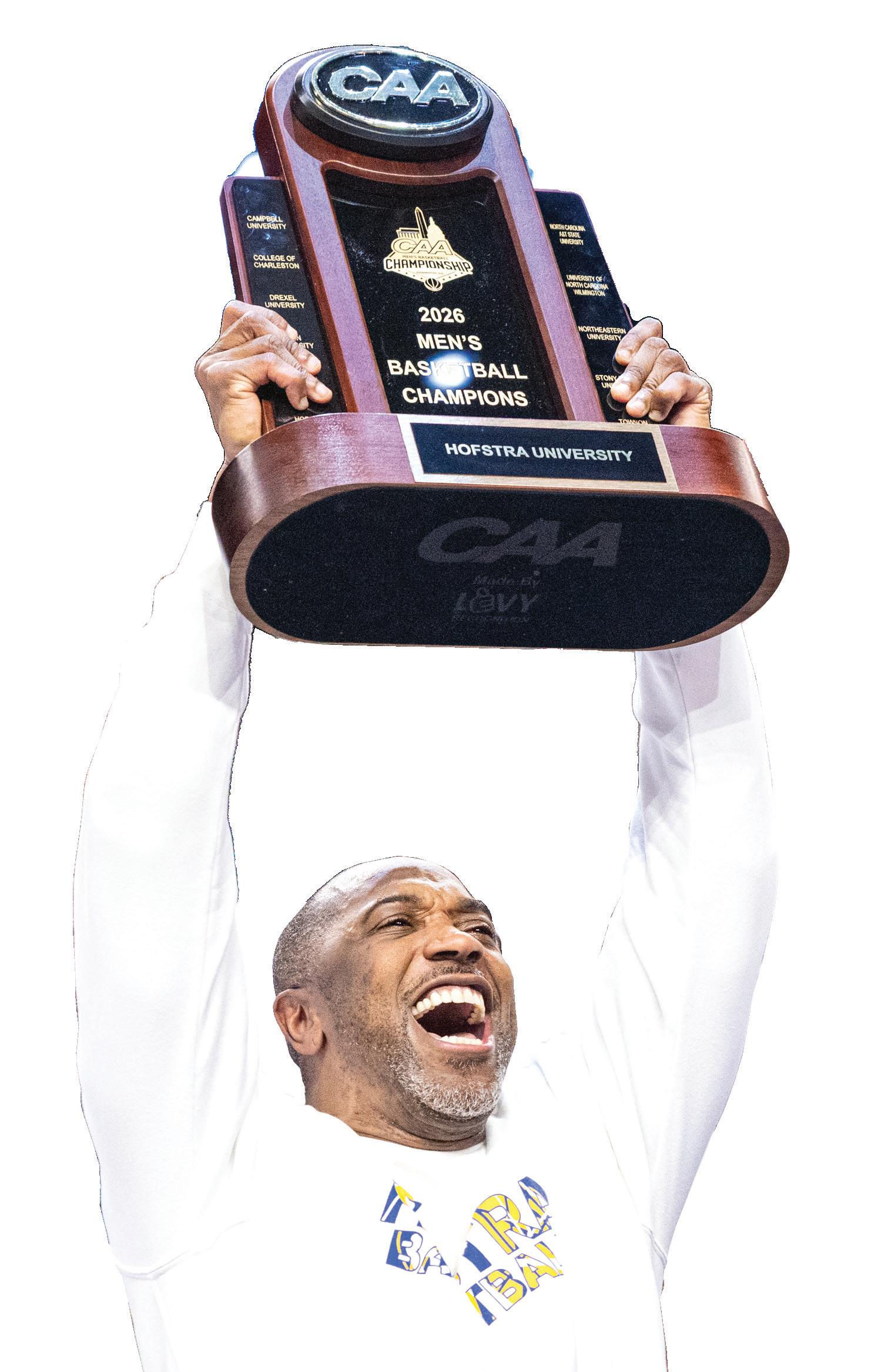
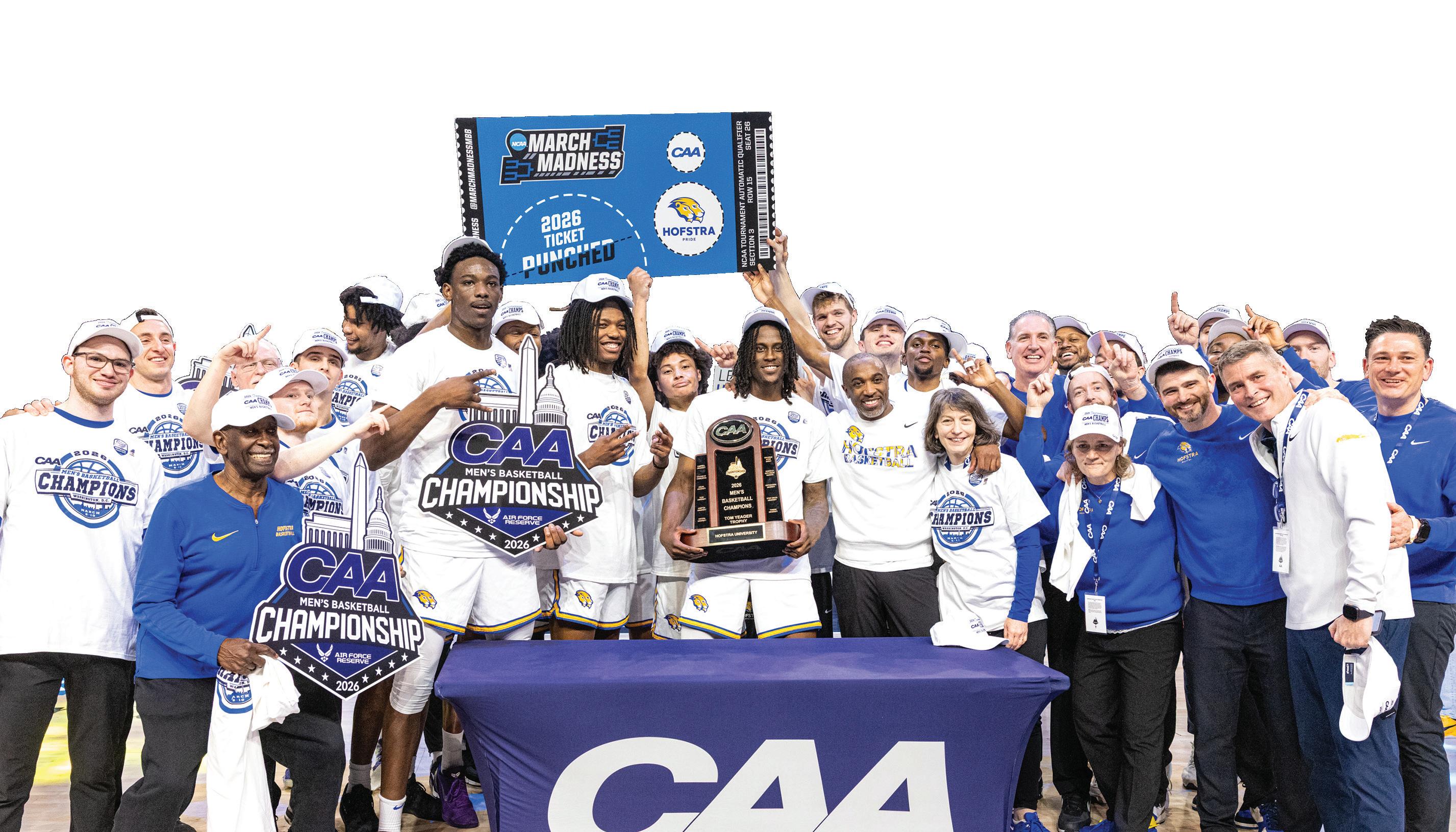
Head Coach Speedy Claxton leads the Hofstra men’s basketball team back to the NCAA tournament for first time since 2001.
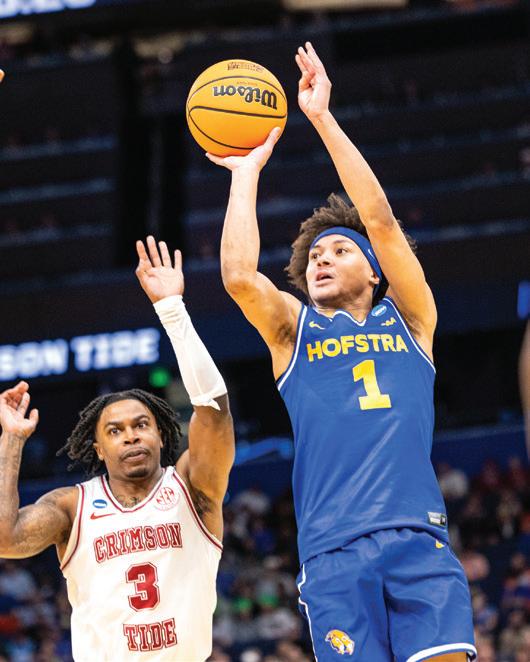
Fifty-six seconds. That’s all that stood between the Hofstra men’s basketball team and a loss to upstate rival Syracuse. The Pride had other plans. Down by one, CAA Player of the Year Cruz Davis ’26 drove to the basket before passing to German Plotnikov ’26 in the corner. The senior from Belarus calmly drilled a three pointer to give the Pride a lead they would not relinquish.
The victory, Hofstra’s first against Syracuse, proved to be a catalyst. The Pride won its next five games, including a 4-0 start in conference play. Hofstra ended the regular season with a 21-10 overall record while going 12-6 in conference play. The latter earned Hofstra the No. 3 seed in the CAA tournament. After cruising past William & Mary in the quarterfinals, the Pride won an overtime contest against Towson thanks to a game-winning three-pointer by Preston Edmead ’29. A 75-69 victory over Monmouth in the finals earned Hofstra its
Hofstra’s backcourt duo is the team’s driving force. Here’s a look at the pair’s accomplishments this season.
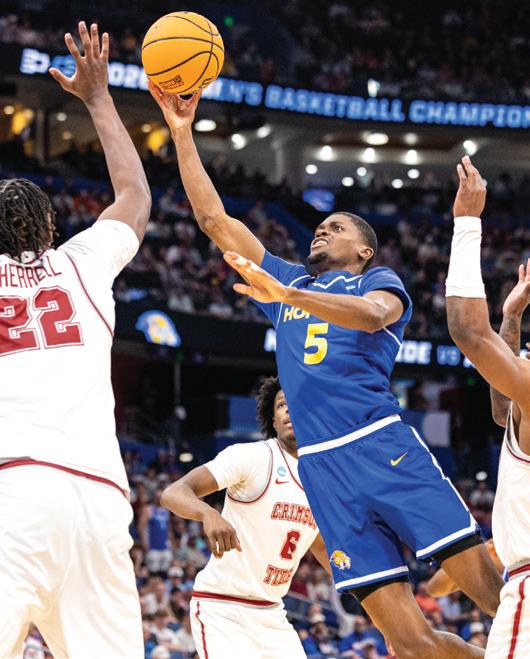
• CAA Player of the Year
• First Team All-CAA selection
• Three-time CAA Player of the Week
• All-CAA Championship Team
•Led CAA in minutes (37.9) and points per game (20.2); ranked 4th and 29th in NCAA, respectively
• CAA Scholar-Athlete of the Year
• Named to CAA Commissioner’s A cademic Honor Roll
• CAA Rookie of the Year
• Second Team All-CAA selection
• CAA All-Rookie Team selection
• CAA Championship Most Outstanding Player
• Seven-time CAA Rookie of the Week (one shy of CAA record)
• Top 10 in CAA in minutes, points, and assists, among other statistical categories
• Named to CAA Commissioner’s A cademic Honor Roll
Women’s basketball delivers an unprecedented postseason performance.
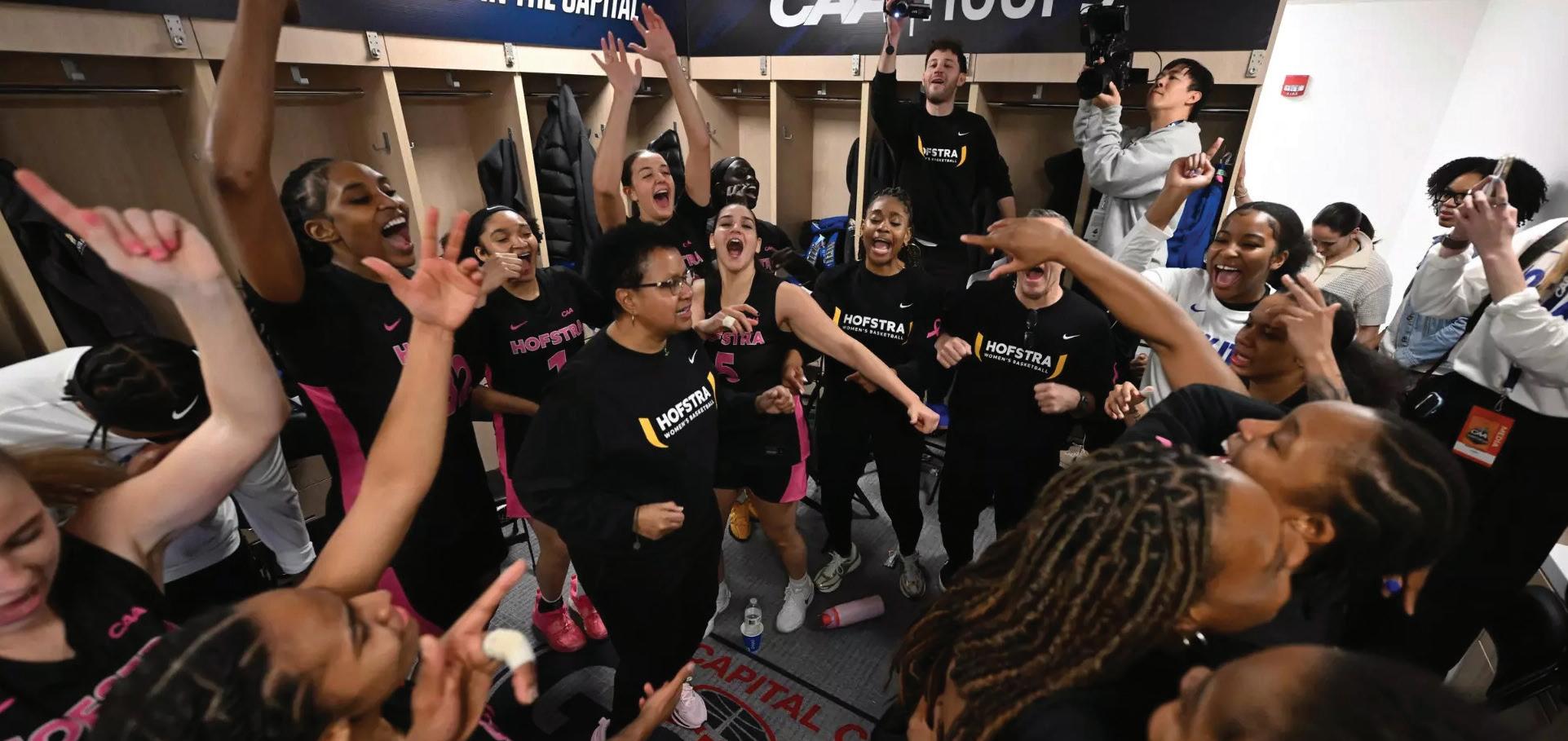
The Hofstra women’s basketball team nearly joined the men’s team in the NCAA tournament, courtesy of a Cinderella run through the CAA tournament. After eking out a one-point victory over Towson, the No. 10 seeded Pride beat second-ranked Campbell in the quarterfinals and third-ranked Drexel in the semis. The dream came to an end against No. 1 Charleston in the finals, but the Pride made history as the lowest seeded team in CAA history to reach the conference tournament finals.

Three international student-athletes paced their teams to ace seasons en route to netting themselves the CAA’s top honor.

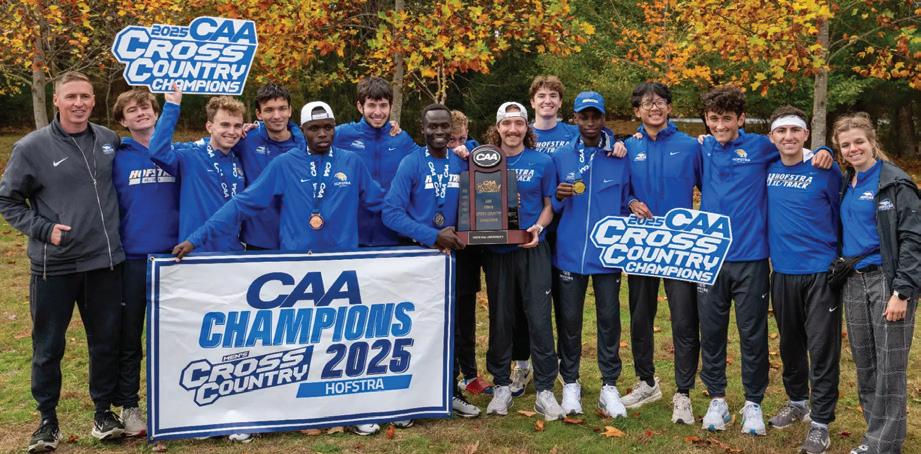
The Hofstra men’s cross country team captured the program’s first-ever CAA title at the conference championship at Ocean County Park in Lakewood, New Jersey.
Five Pride runners finished in the top 21 in a field of more than 100 student-athletes, including four who recorded top 10 finishes. Leading the way were Abraham Longosiwa ’26, who finished second in the 8K race, and freshman phenom Fredrick Kipkosgei ’29, who topped the field with a time of 23:01.60 to earn Hofstra’s first individual CAA title since 2020. Two other runners, Jason Kerber ’28 and Abel Kipkemboi ’29, finished ninth and 11th, respectively, to join Longosiwa and Kipkosgei on the All-CAA team.
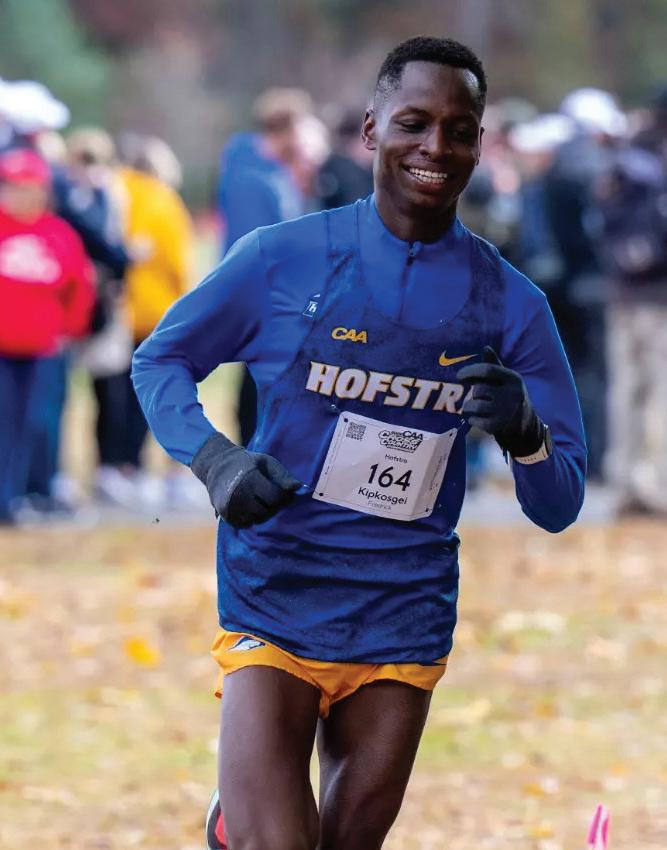
The win sent Hofstra to the NCAA Northeast Region Championship, where it continued its historic season. The Pride finished 10th out of 38 competing schools, its best Region Championship finish. Once again, Kipkosgei stole the show. The Kenya native won the 10K race, outpacing the 100-runner field to secure another individual title and punch his ticket to the NCAA Division I Cross Country Championship. He finished that race 38th out of 261 to earn All-America honors. The accolades did not stop there. Following the season, Kipkosgei was named the Northeast Region Men’s Athlete of the Year by the U.S. Track & Field Cross Country Coaches Association before being selected the 2025 CAA Men’s Cross Country Runner and Rookie of the Year. He is the first student-athlete to earn both awards in the same season since 2015.
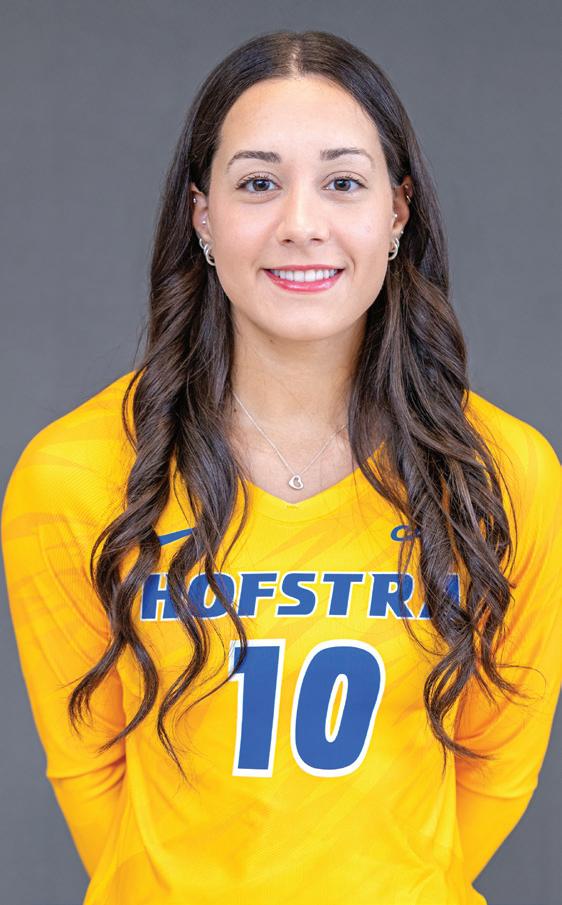
On the volleyball court, the Pride started the season off with nine consecutive victories. It did not take long to top that streak. The team played seven matches in the month of October — and did not lose a single one. It was part of a 10-match winning streak that included eight consecutive sweeps in which the Pride did not drop a set, tying the program record. Hofstra entered the CAA tournament as the top seed. After getting past North Carolina A&T in the semifinals, the Pride lost a five-set match to Campbell in the finals.
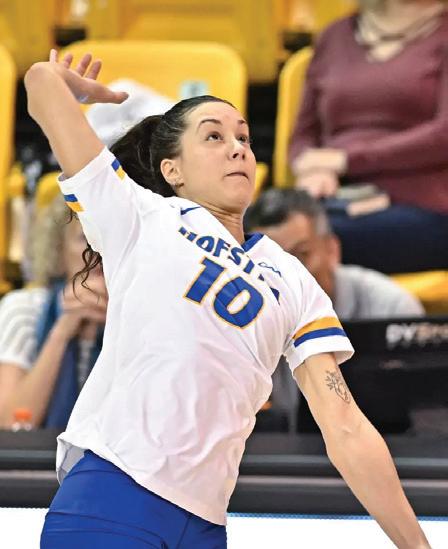
The team’s 22-win season, the most since 2018, earned several Hofstra players year-end recognition. Nina Jioshvili-Ravva was named the CAA Setter of the Year and placed on the All-CAA First Team and CAA All-Rookie Team. Beatriz Braga ’27 and Clara Bal ’26 garnered All-CAA First Team and Second Team accolades, respectively.
No one, however, had a season like outside hitter Izadora Stedile ’26. The senior from Curitiba, Brazil, led the team with 366 kills and ranked second with 319 digs. She also added 37 blocks, 26 assists, and 12 service aces. Stedile’s stellar campaign earned her CAA Player of the Year and All-CAA First Team honors. She was also named an Honorable Mention member of the America Volleyball Coaches Association’s All-American and All-North Region teams. The former honor made her just the third All-American in program history.
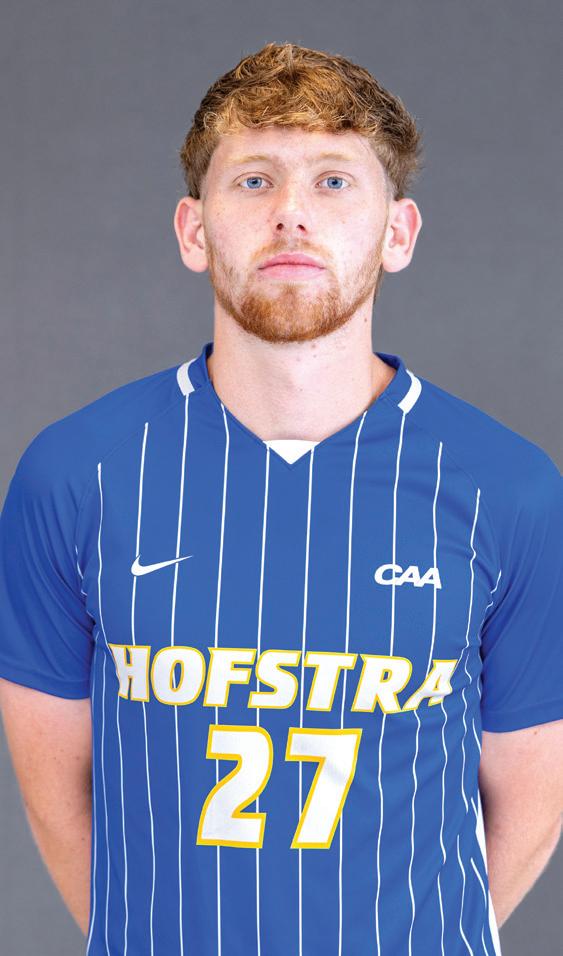
Hofstra’s men’s soccer team entered the CAA tournament as the top seed after a 12-4-0 regular season record. The program’s hopes for a fifth consecutive conference title were dashed with a second-round loss to No. 2 Stony Brook — but still earned a spot in the NCAA tournament.
A 2-0 shutout of Syracuse in the first round of the tournament set up a meeting with the nation’s top-ranked team, undefeated University of Vermont. The Catamounts defeated the Pride in the 2024 tournament on their way to winning the national championship. The rematch saw Vermont score a late goal to tie the game at 2-2 and send it into overtime. Just six minutes later, senior midfielder Laurie Goddard ’26 received a pass in front of goal and one-timed the ball into the back of the net to send Hofstra to the third round for just the second time in program history.
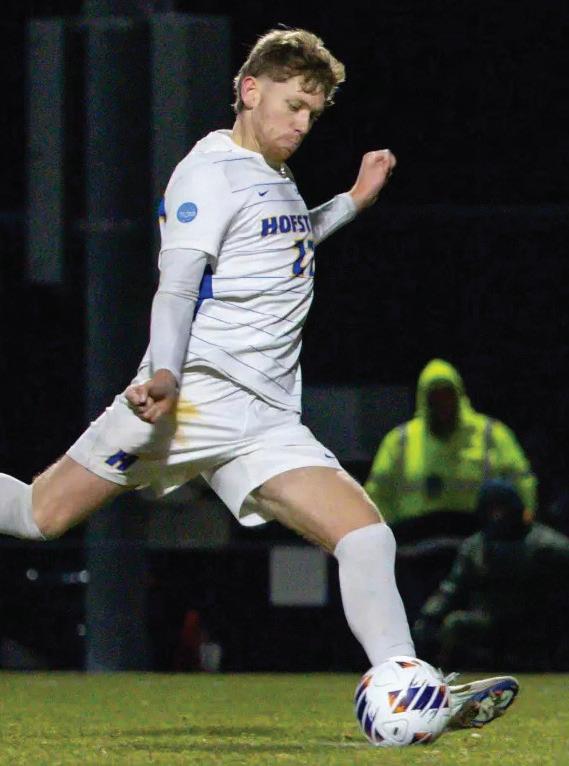
Although the season ended with a penalty-kick loss to Furman the following week, it would not be the last we heard of Goddard. The London native’s 15 goals and 37 points led the Pride and ranked sixth and eighth, respectively, in the country. No Division I player scored more game-winning goals than Goddard’s eight.
The performance earned the senior a host of accolades, including CAA Player and Midfielder of the Year, First Team All-CAA, United Soccer Coaches All-Atlantic Region First Team, Eastern College Athletic Conference Offensive Player of the Year, and First Team All-ECAC. The final honor was the highest: Goddard was named a Second Team All-American, becoming the ninth player in program history to claim the honor.
Ten days before the men’s soccer season kicked off, longtime Head Coach Richard Nuttall announced that 2025 — his 37th year leading the Pride — would be his last. At the close of the season, Nuttall transitioned to a new role as assistant director of athletics for development and alumni affairs/head men’s soccer coach emeritus. Associate Head Coach Stephen Roche, who was named head coach in waiting last season, takes over the program.
“I never imagined having this job for 37 years, and I am thankful for having had the opportunity to make the Hofstra men’s soccer program a force to be reckoned with,” said Nuttall, who was honored in a postgame ceremony following Hofstra’s October 4 Alumni Day game. ”I will entrust that to Stephen, who is more than ready to carry that mantle.”
Nuttall, whose 364 victories make him the program’s winningest coach, led the Pride to unprecedented success. Under the England native’s direction, Hofstra won eight CAA Championships and advanced to nine NCAA Championships. Nuttall earned CAA Coach of the Year honors four times, including in his final season.
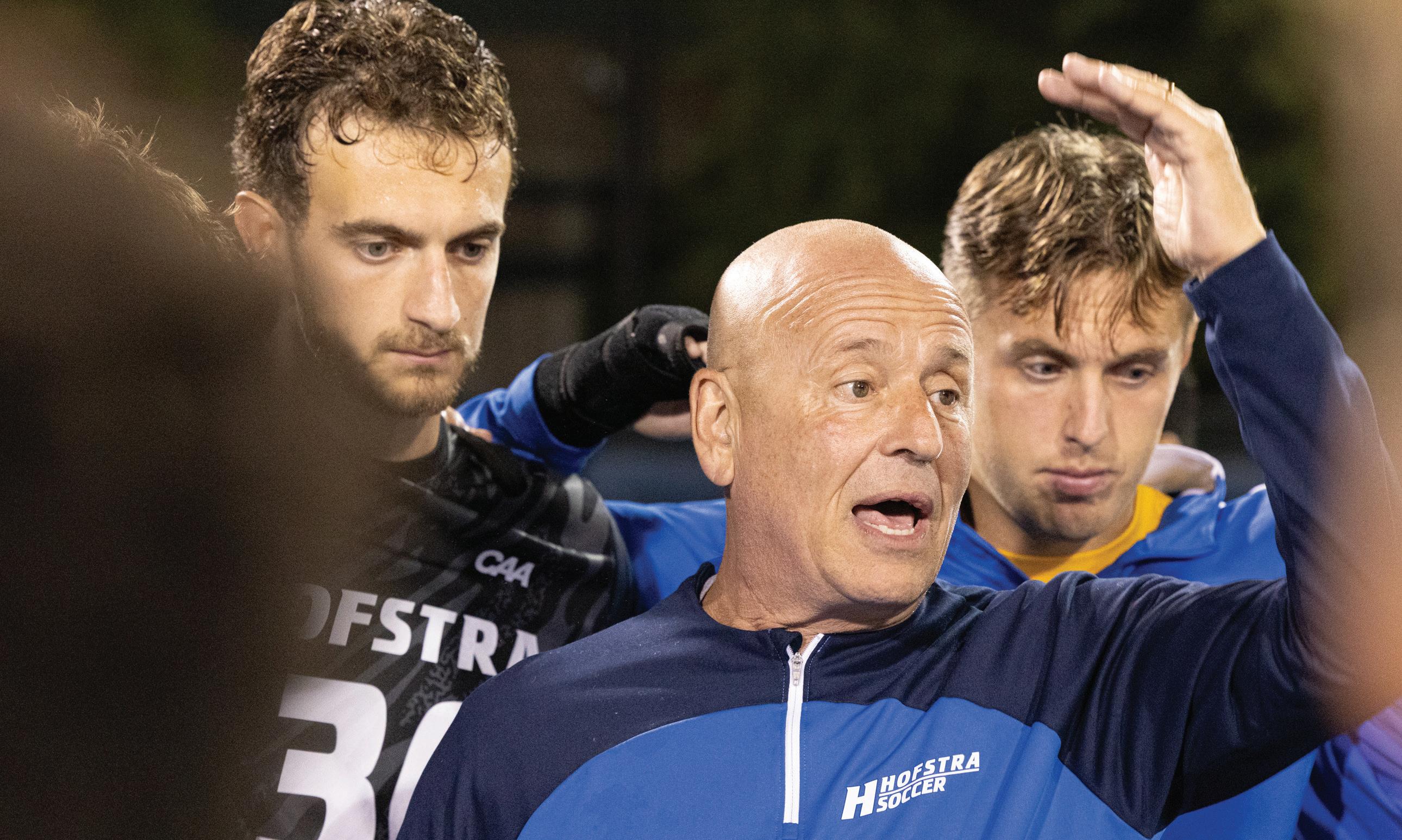
By Stephanie Flynn
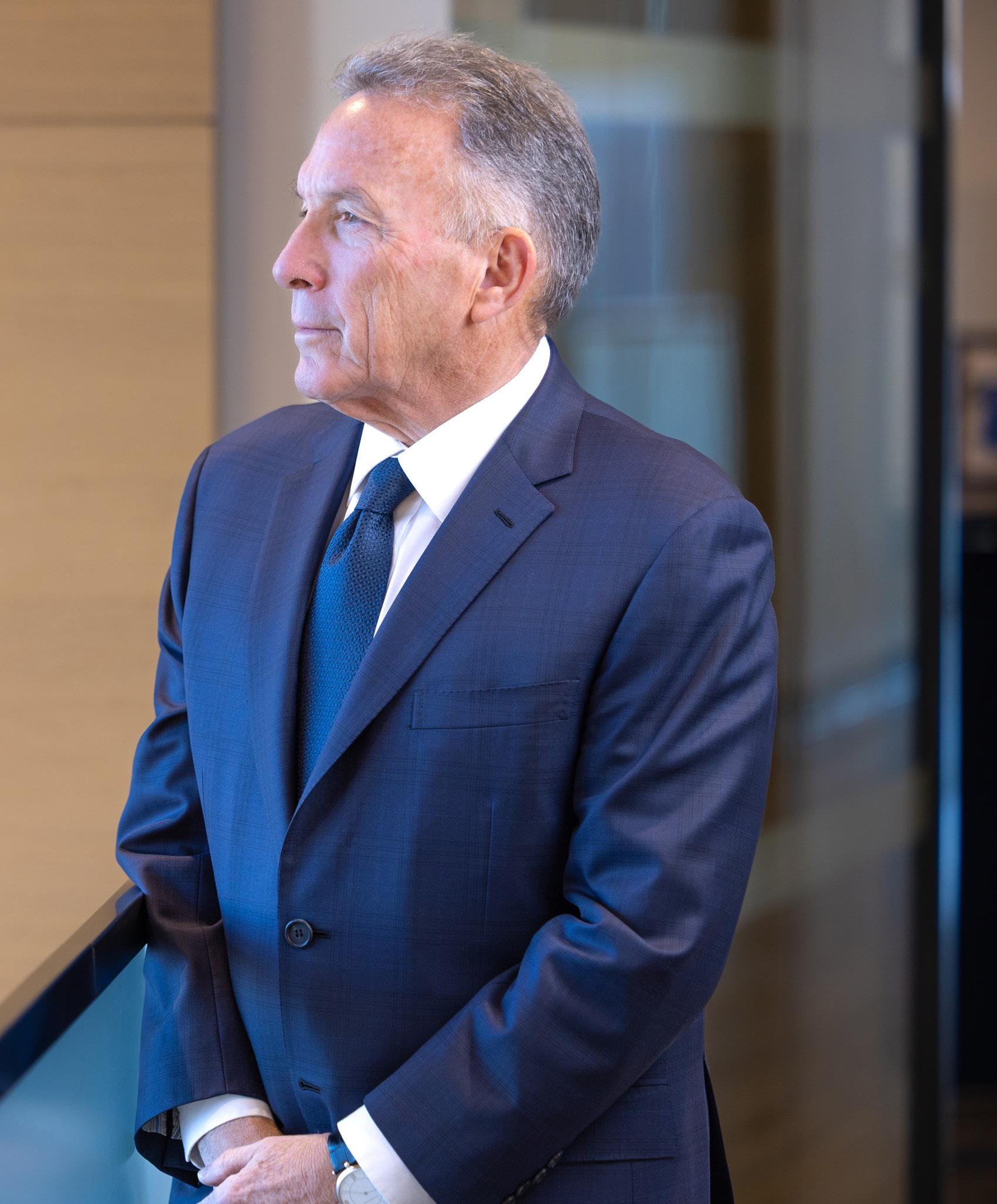
PProfessional services is a rapidly changing industry shaped by evolving technology, rising client expectations, and increasing competition for top talent. In this environment, technical knowledge alone is no longer enough for young graduates looking to enter the field.
With a $5 million gift, Jeffrey M. Weiner ’79 is helping ensure that Hofstra students are fully prepared to meet the demands of this new era. His investment establishes the Jeffrey M. Weiner Institute for Professional Services at the Frank G. Zarb School of Business. The institute is designed to strengthen the connection between classroom learning and professional practice. Through interdisciplinary collaboration, faculty fellowships, student scholarships, applied research initiatives, and an annual conference convening scholars and industry leaders, the institute will position Hofstra as a thought leader in advancing both the study and practice of professional services.
For Weiner, the initiative is as personal as it is strategic. A Long Island native, Weiner transferred to Hofstra and majored in accounting with a practical goal: to graduate prepared to build a career. “Hofstra gave me a great education,” Weiner said. “Without it, I wouldn’t be where I am today.”
After earning his CPA, Weiner made the decision to leave one of the then-Big 8 accounting firms to join a much smaller practice. Over the next several decades, he helped build that firm into Marcum LLP, a nationwide professional services company. Along the way, he witnessed the transformation of accounting firms into multidisciplinary enterprises that delivered advisory, consulting, and strategic services. That experience shaped his understanding of what the industry demands, and what young professionals need to thrive within it.
between what students are learning and what they’ll be doing. If somebody who majors in business wants to come out and get a job, they should have some idea of what that job is before they decide they want it and go for it.”
The institute reflects Weiner’s broader view of professional services. Fields such as marketing, finance, consulting, and accounting are all professions grounded in education, ethical responsibility, and client trust. Elevating these disciplines — and preparing students to approach them with rigor, professionalism, and a service mindset — is central to the institute’s mission. The challenge is helping students understand how theory translates into practice, what professional roles actually entail, how industries are evolving, and what employers expect from day one.
“[The institute will provide] that connection between what students are learning and what they’ll be doing. ”

“Education gives you the foundation, but I think there needs to be a bridge,” Weiner said. “[The institute will provide] that connection
Through faculty research and meaningful engagement with industry leaders, the institute will create a dialogue between scholarship and industry, amplifying Hofstra’s thought leadership in areas that directly inform practice. Faculty across disciplines will collaborate on research addressing emerging trends, workforce dynamics, technological transformation, and client expectations.
At the student level, the institute will help demystify career pathways. By strengthening connections among faculty, alumni, and industry leaders, students will gain clearer insight into what professional roles look like. This deeper understanding will better equip graduates to enter client-facing industries with confidence and clarity.
Looking ahead, Weiner hopes the institute evolves alongside the profession it serves. “I would hope it develops a life of its own,” he said, ”one that continues to adapt, innovate, and remain relevant as professional services change.”
Photo by Matteo Bracco
Melanin Movers creates a dedicated space for students of all colors to dance, discover, and dream.
By Yolanda Stewart
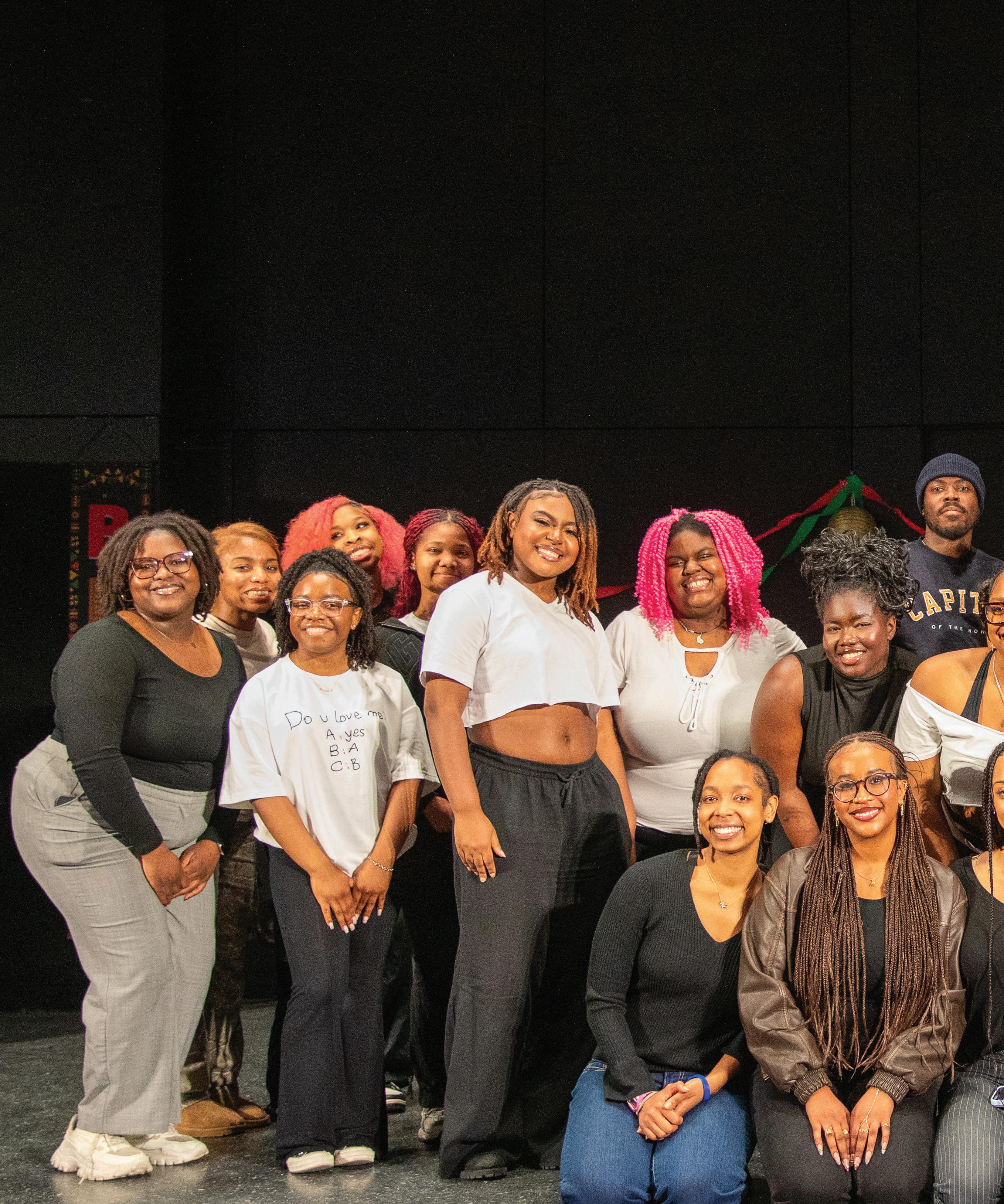
BBlack culture came alive inside The Helene Fortunoff Theater on the final Friday night of February, as student artists filled the space with the sights and sounds of dance, poetry, art, film, and music. The performances were part of “Soul, Sound, and Story,” a showcase and celebration of Black creativity, co-sponsored by the Hofstra Cultural Center and Melanin Movers, Hofstra’s newest student dance troupe.
Melanin Movers emerged just last year, bringing with it an impassioned need for inclusive dance communities. “One thing I really noticed within the Dance Department here at Hofstra is that there weren’t a lot of people of color,” said Melanin Movers President Saskia Guerrier ’26, a double major in dance and speech-language-hearing sciences. “Sometimes when you don’t see someone who looks like you, you won't feel welcomed in that space, so I felt like I had this calling to start a club to put my brothers and sisters on game, on how to be the best dancers they could be in any space they’re in.”
Melanin Movers aims to uplift dancers of color by providing resources and experiences such as panel discussions, mentorship, and field trips to participate in dance classes in New York City. The student group also holds master classes in which guest instructors offer expert-level teaching. The first master class was taught in the fall by model and So You Think You Can Dance contestant Waverly Fredericks. The series
continued this spring, including a class led by choreographer Ian DaSilva in March.
All current members of the troupe’s e-board study dance at Hofstra, which entails significant training in disciplines such as ballet and contemporary. But you can expect more diversity from the Melanin Movers. “The troupe is intentional about spotlighting other dance genres outside of ballet and modern,” Secretary Eshe’y Johnson ’27 said. Melanin Movers performs a range of dance styles, from heels to hip-hip to Afro-fusion, exposing members to different forms of movement.
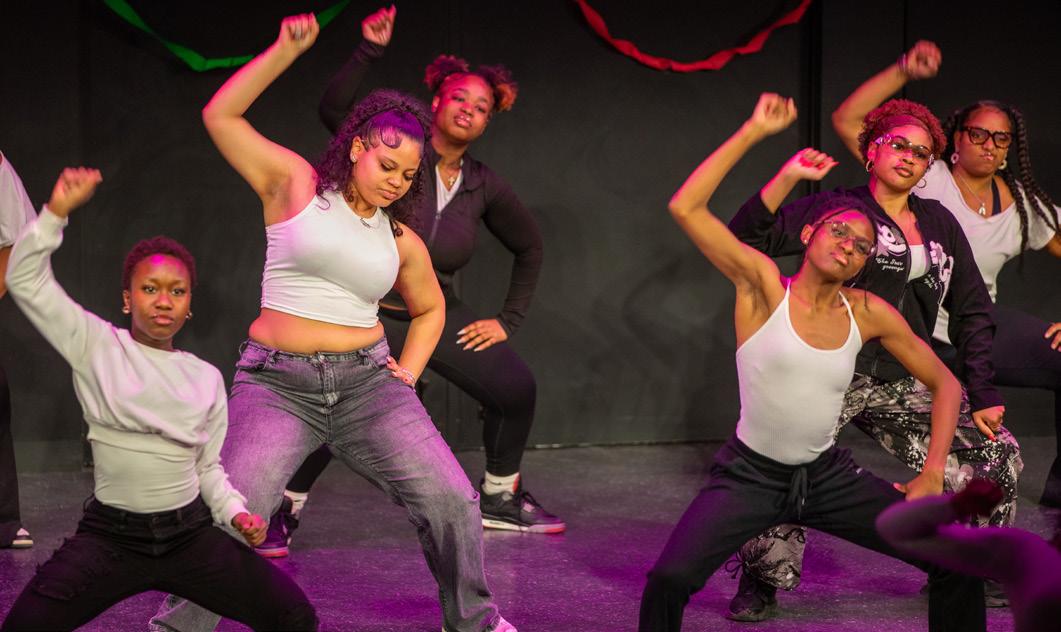
More than just a performance troupe, however, Melanin Movers is “a safe space for people of all backgrounds,” Johnson said. A priority is put on mental health and self-care practices. The collective encourages its members to express their opinions and feelings about school, life, or any other topic that’s on their mind.
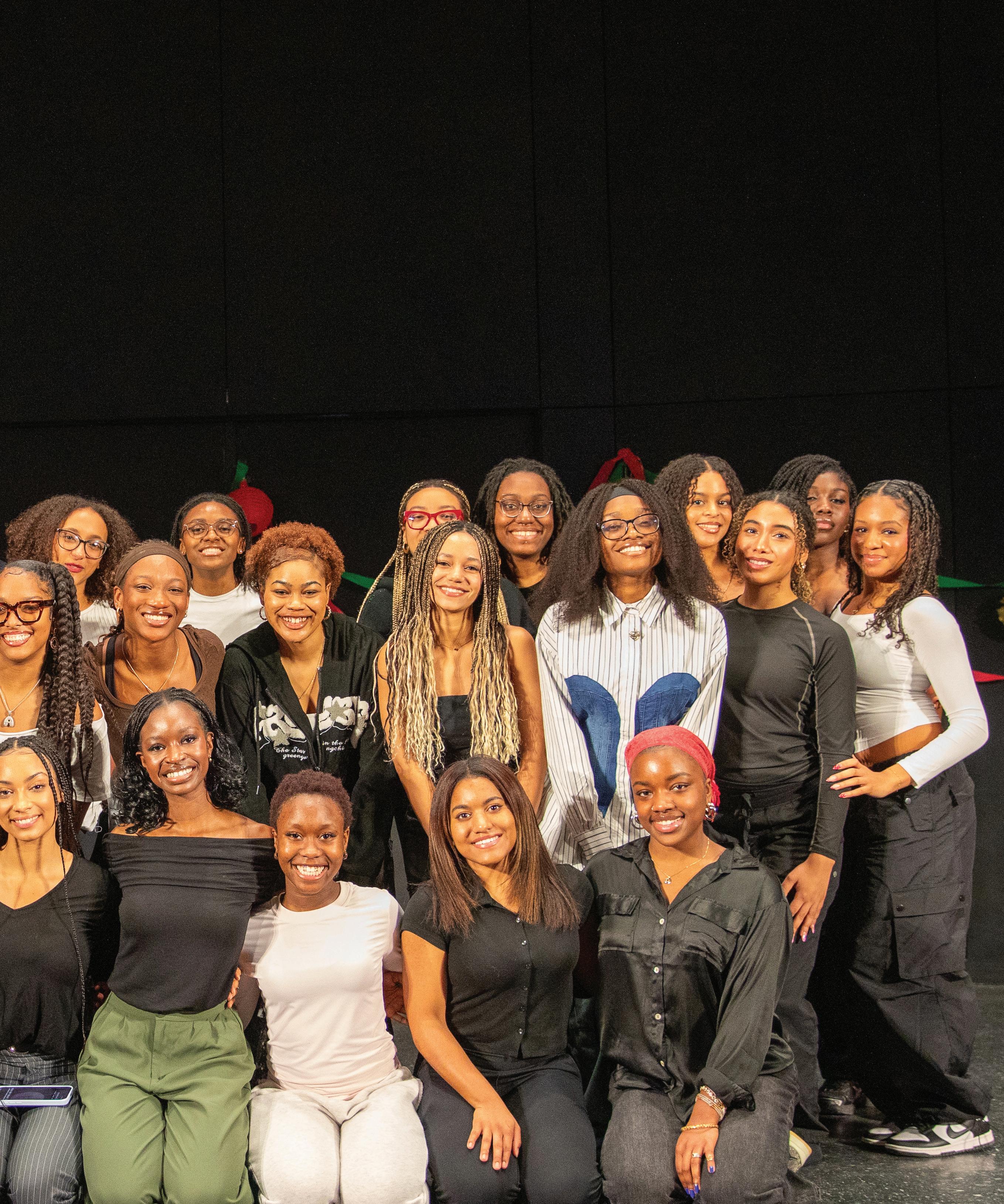
In some ways, Melanin Movers is continuing the legacy of dance started by the Imani Dance Ensemble, a former Hofstra club that introduced the student body to dance styles such as jazz, hiphop, house, and Afro-Caribbean.
Guerrier had connected with former Imani member Jamie Sherman ’07 and received advice from the alumna while establishing Melanin Movers. Now, Guerrier and her peers are carrying the torch to show what it means to explore dance freely without limitations.
While the name Melanin Movers is symbolic of the group’s mostly Black student composition and pride of varied complexions, it is not meant to dissuade other identities from joining. Interested participants don’t need to have dance training backgrounds, either. All that's required is positive energy and the desire to dance. As Guerrier put it, “We’re opening up the floor.”

Hofstra’s Music Business program has found its rhythm under the management of Professor Terry Tompkins.
By Mary Gregory
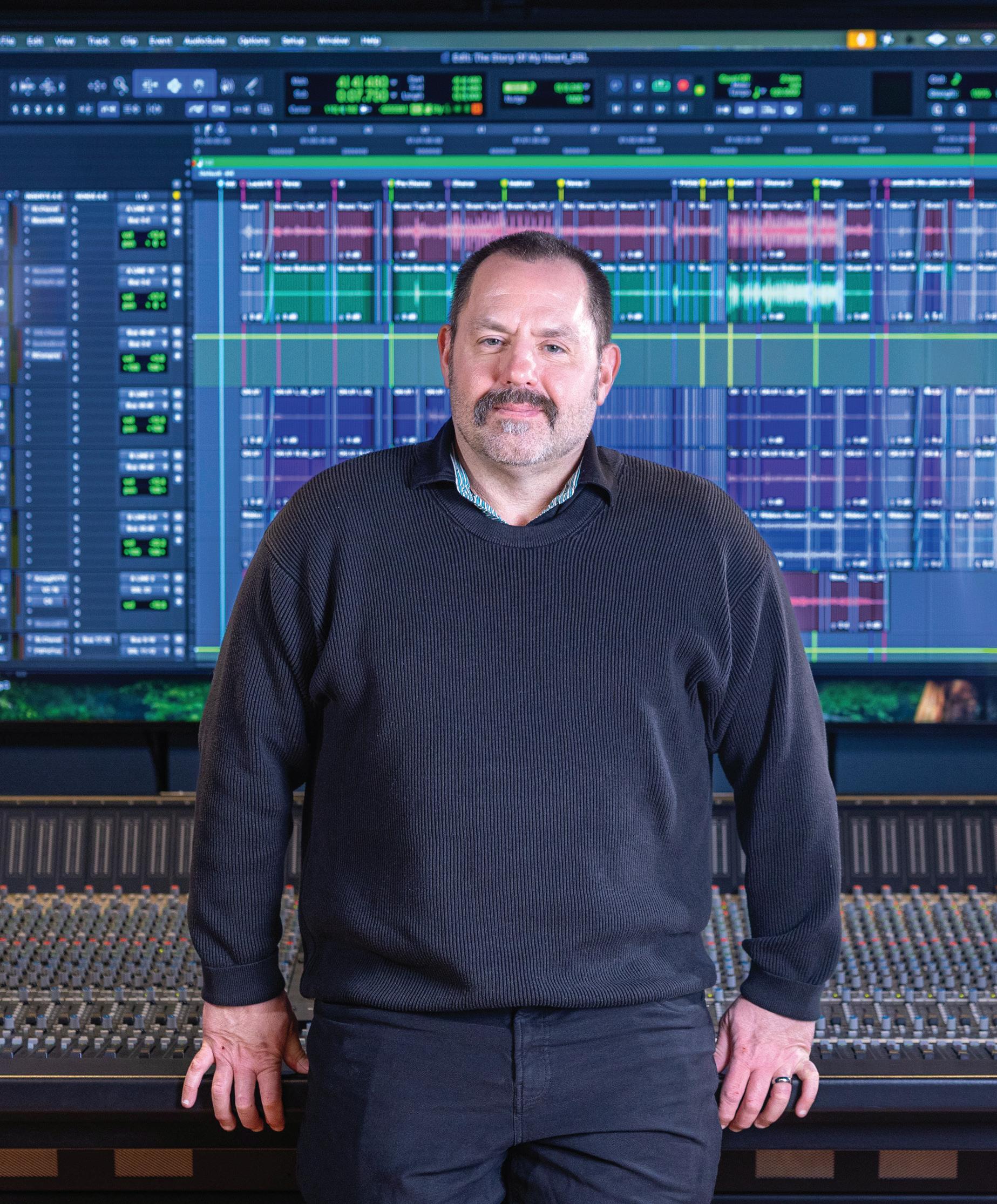
MMusic is the soundtrack of our lives. For Terry Tompkins, assistant professor of music and coordinator of Hofstra’s Music Business program, it’s something more. “It’s not a job,” he said. “It’s a lifestyle.”
Though nowadays the soundtrack to Tompkins’ life has been commandeered by Disney tunes (courtesy of his young daughter), music has been the rhythm of his days since he was a young rocker in a successful band. “But, ultimately,” he said, “I realized that my talents were better served on the other side of things.” Tompkins, who also managed his former band, earned a BA and MBA before going on to manage bigger bands, organize tours and festivals, and secure recording contracts.
In a major coup, while working in A&R for Columbia Records, he signed John Legend, making Tompkins somewhat of a legend himself. “I guess that was my first big break — discovering and helping land a Grammywinning best new artist and multi-platinum release,” Tompkins said.
After years in the industry, and professorship stints at Millersville, Saint Joseph’s, and Drexel Universities, the Philadelphia native came to Hofstra in 2017.
program that has been recognized as one the best in the country seven times by Billboard magazine.
“A lot’s happening, and a lot’s planned to happen, which is exciting,” Tompkins said. “We just secured approval for an accelerated dualdegree program, so music business students with a general business concentration can earn their undergraduate degree and MBA in five years. We have an advanced seminar class where students go through everything on the artist side of things — writing a song, recording it, making a video, releasing the song, marketing the song, and finding an audience for it. Then they go through everything on the business side — forming a business entity, registering the song, copyrights for the song, group partnership agreements, and foreign rights affiliation.”
“The promise I made to myself a long time ago was, ‘I’m going to do something in my life that I love.’”
Since then, the University’s Music Business program has grown dramatically, by nearly every metric. In size, the program’s enrollment has nearly quadrupled, from a few dozen to roughly 170. In degrees, the program now offers two distinct pathways: a BS for performing artists and BA for non-performers. In facilities, a new electronic lab with 16 stations and a state-of-theart recording studio opened last year. The result is a Music Business
In the fall, Tompkins will have his students working with the funk/soul/rock band War, whose hits include “Why Can't We Be Friends?” and “Low Rider.” “This year is the 50th anniversary of their greatest hits compilation, which they are going to reissue,” Tompkins said. “We’re working with management, the record label, and the publishing company.” At the end of the semester, students will propose ways to engage with younger audiences.
Tompkins’ passion for finding unique teaching methods circles back to his own life. “The promise I made to myself a long time ago was, ‘I’m going to do something in my life that I love.’”
He has the same hope for his students — to be inspired, to pursue their dreams, to create a meaningful life. “And underneath all of it is music.”
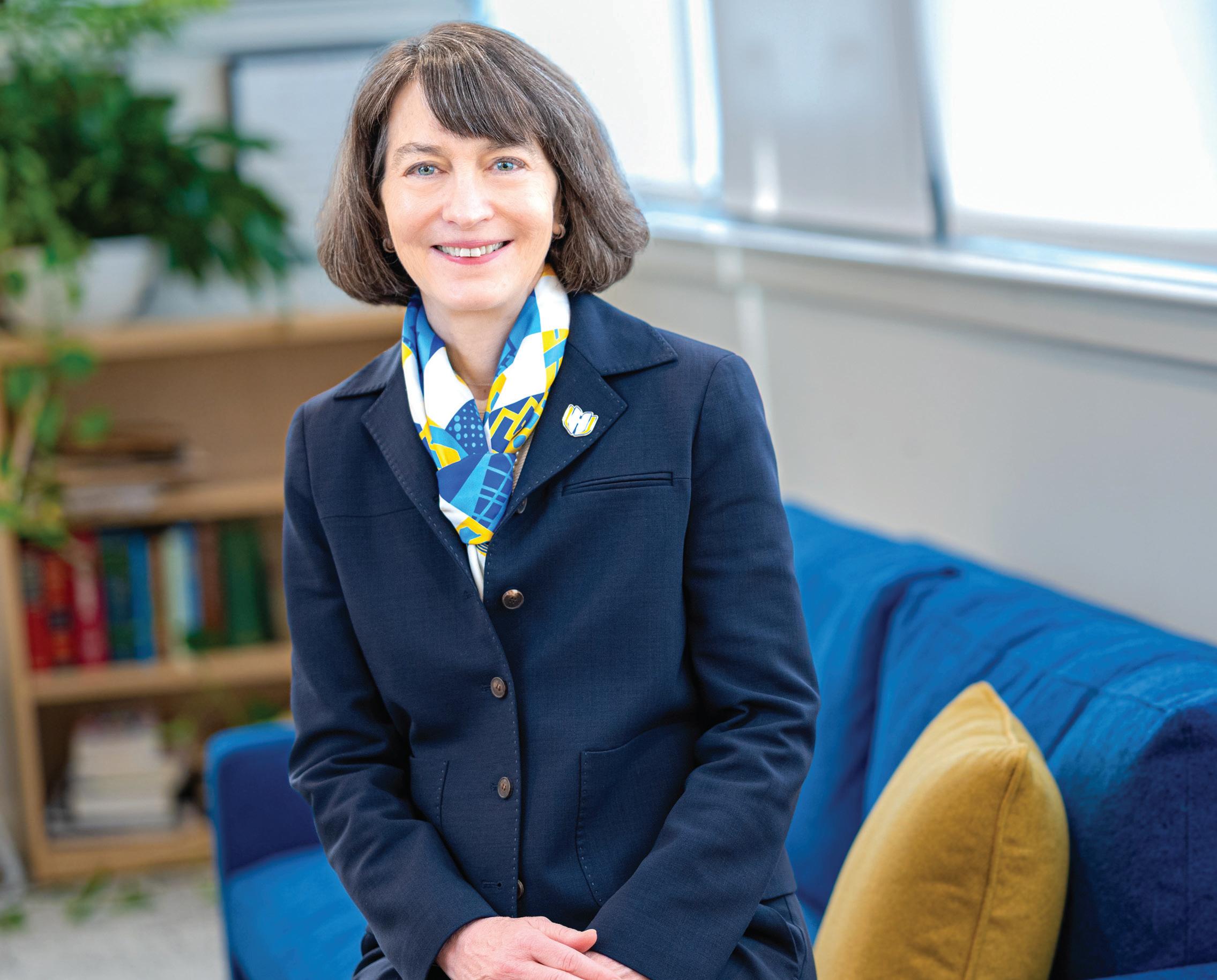
Hofstra’s ninth president looks back at the University’s accomplishments during her first five years and the strategic priorities shaping its future.
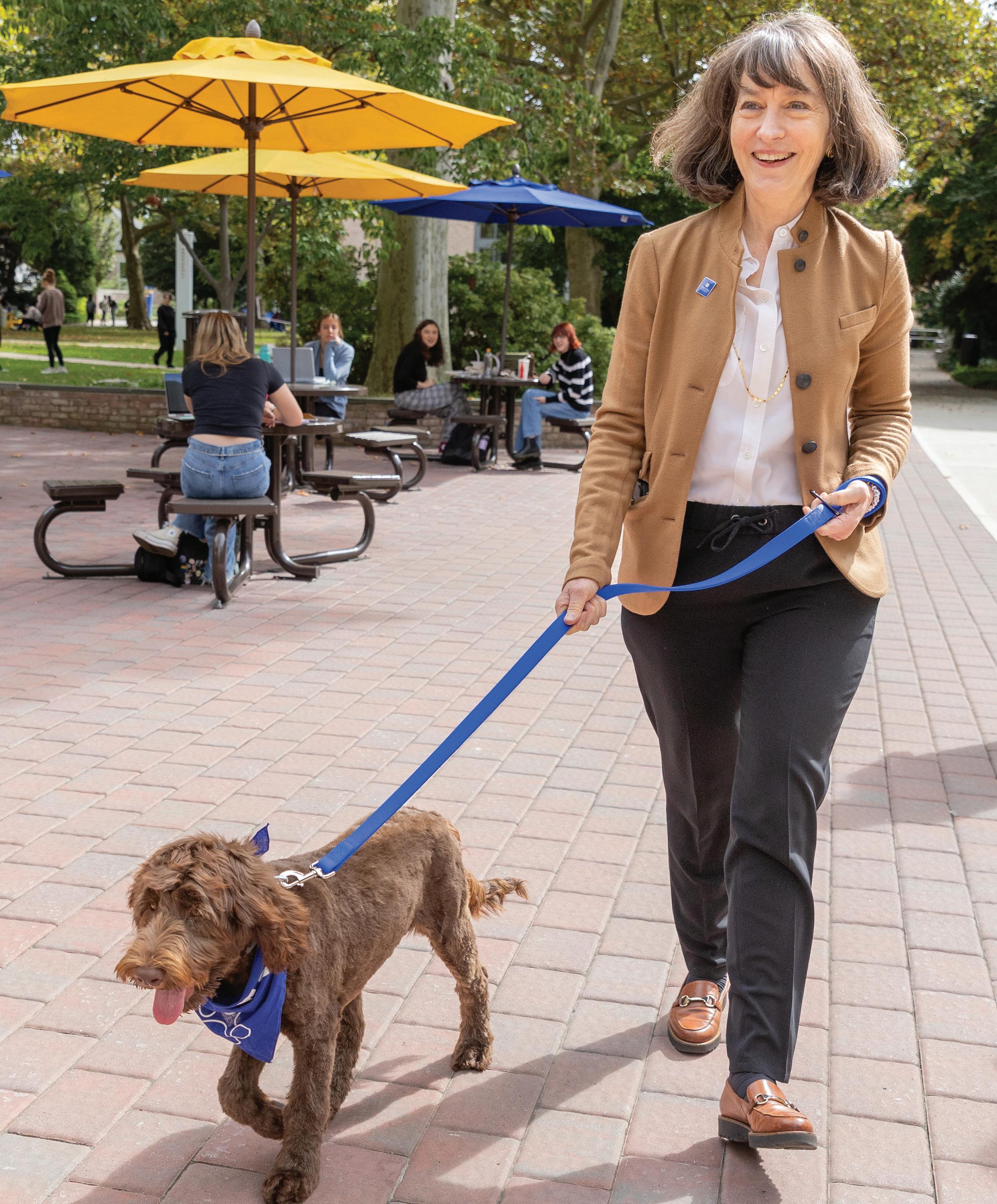
AAt 6 a.m., while the Hofstra campus is just starting to stir, Susan Poser can often be found swimming a mile in the pool at the Hofstra Swim Center, usually after she has already spent time at home responding to the previous day’s emails and preparing for the day.
“I have always been a morning person. I have a lot of energy and clarity of thinking early in the morning,” she says, “but don’t expect me to respond to emails that come in after 9 p.m.”
Since arriving at Hofstra as its ninth president in August 2021, Poser has led the University through a variety of challenges. When she began her presidency, the pandemic was waning but still very much a concern as the academic year began. Soon thereafter, the University learned that a massive casino development might be built in the Nassau Hub, across the street from Hofstra, which eventually did not come to pass. This was followed by the October 7 attacks and the aftermath, which created tensions on campus. And then came the presidential election that resulted in significant changes to federal policy affecting colleges and universities.
Through it all, Hofstra has remained a safe and caring environment, and Poser’s presidency has been defined by a steady focus on building upon Hofstra’s successful history by strengthening its
academic profile, increasing support for students, and positioning the University for the future.
In October 2025, in recognition of the progress made, the Board of Trustees extended President Poser’s contract into 2031.
Donald Schaeffer, who served as Board of Trustees chair from 2019 to 2025, said, “Susan has brought a clarity of purpose to Hofstra that you don’t often see in higher education. During my tenure as chair, I had the opportunity to watch her unite people around a shared vision for the Hofstra 100 strategic plan — the University’s reaffirmed commitment to academic excellence and student success.”
One of Poser’s first initiatives as president was to launch a broadly collaborative strategic planning process that brought together voices from across the Hofstra community. The resulting plan, Hofstra 100 (referencing Hofstra’s centennial in 2035) positions the University to become a model for interdisciplinary education, connect academic work with meaningful community engagement, strengthen student success through individualized support, and enhance institutional effectiveness through improved efficiency and responsiveness.
It seems to be working.

Over the past four years, retention and four-year graduation rates have reached their highest levels in Hofstra’s history. In fall 2025, Hofstra celebrated its first Rhodes Scholar.
In 2025, the University earned the R2 research designation by the Carnegie Classification of Institutions of Higher Education — a major step forward in its research profile. The designation is awarded to institutions based on research spending and the number of doctoral degrees conferred. Since 2021, the University increased its doctoral degree conferrals by 72%, research expenditures by 88%, and sponsored grant expenditures by 122%.
“We are making the right investments,” Poser said. “We have seen the fruits of these investments in the upsurge in retention and graduation rates. The investment in the office that supports student fellowships has increased the number of high-profile awards going to Hofstra students. I knew we had these types of students at Hofstra; we just needed to provide the resources to support them.”
Michael Roberge, chair of the Hofstra Board of Trustees, noted, “Susan is deeply intentional — she is focused on building academic excellence, supporting faculty, and providing students with experiential and engagement opportunities. Under her leadership, investments in education aren’t abstract; they translate directly into stronger outcomes.” Under Poser, the last few years have also brought increased activity and engagement across campus.
In 2021, Poser initiated the annual Hofstra Presidential Symposium, a campus-wide forum that features faculty from every school and college presenting on one important issue. This year’s symposium, taking place September 29-October 1, 2026, will focus on “The Future of Work,” examining how shifting industries and emerging career pathways are reshaping the workplace, and how universities can prepare graduates for a lifetime of adaptation and growth. Previous symposia have explored artificial intelligence, sustainability, education in an election year, and the beauty of academic inquiry.
Hofstra has strengthened access to education for local high school students through a growing number of new programs. The Hofstra-Uniondale Pathway Program (HUPP) offers Uniondale High School students aspiring to become journalists, filmmakers, podcasters, and social media influencers the opportunity to earn college credits toward a degree. The Leadership, Entrepreneurship, and Innovation Program (LEIP) at Hofstra’s Zarb School of Business offers 11th- and 12th-grade students from Hempstead High School an opportunity to enroll in a Zarb first-year course and earn 3 college credits.
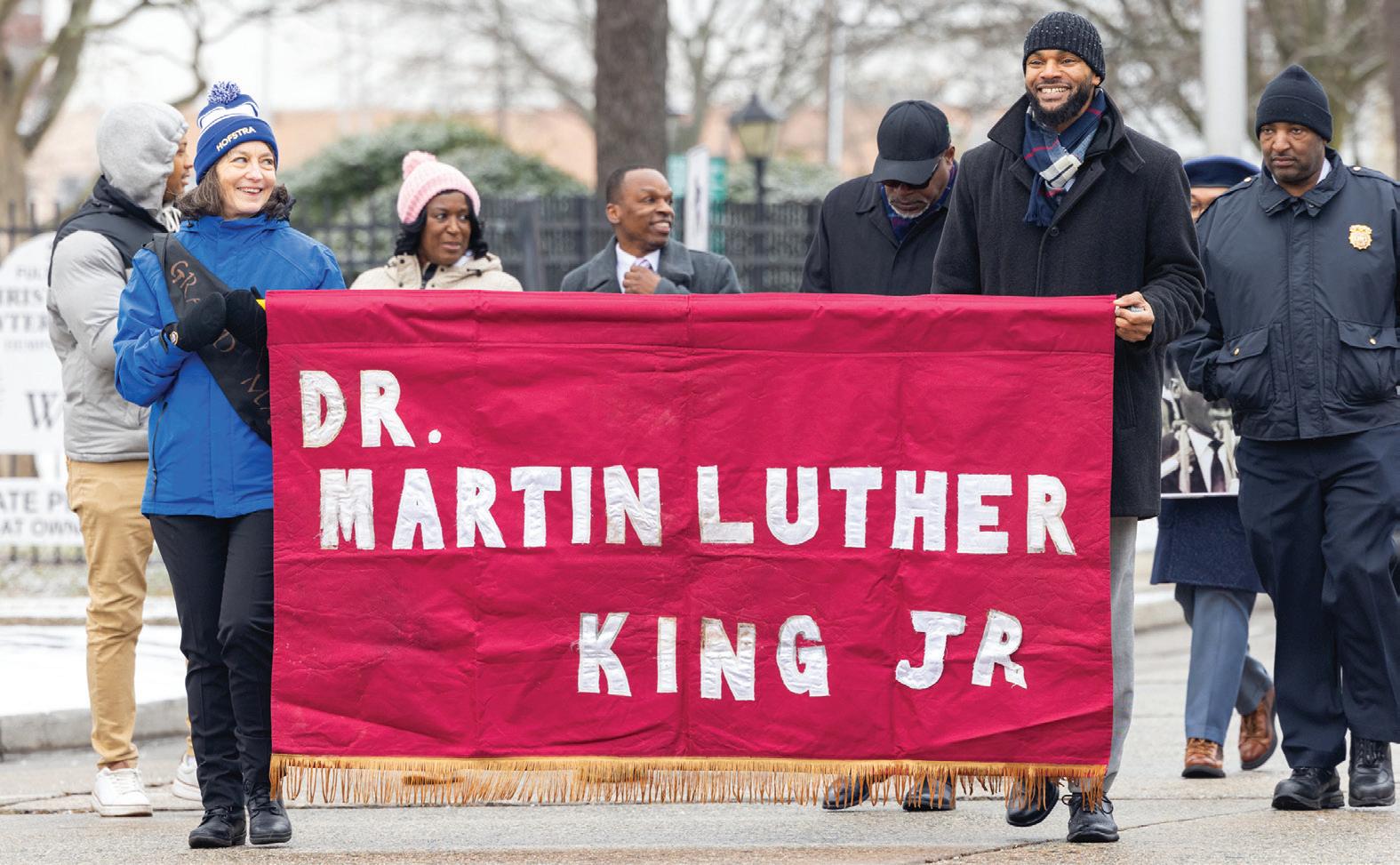
Since January 2023, Hofstra has partnered with the Village of Hempstead on its longstanding MLK Day March and now co-hosts a day of celebration and commemoration on campus. In 2025, Poser served as grand marshal in the parade, an honor bestowed by Hempstead Village Mayor Waylyn Hobbs Jr.
In 2023, Hofstra’s launched a refreshed format for its annual Legislative Breakfast, which has become a key forum connecting University leaders, faculty, and students to local, state, and federal officials.
“It is my privilege to work with President Poser as she advocates for improvements to this fine academic institution, and I look forward to working together to achieve even greater impact for the Long Island region in the years ahead,” said New York Assemblymember Charles Lavine.
Winter Homecoming was revived in 2025, reestablishing it as a signature campus tradition that brings together students, faculty, staff, and alumni. Held in February, the weeklong celebration features a performance from a professional comedian, service opportunities, and a range of student and alumni programing, culminating in men’s and women’s basketball games. The return of Winter Homecoming has strengthened school spirit and connection across the Hofstra community.
Last year, the University launched an annual Women in Leadership Symposium, bringing together accomplished professionals, students, and alumnae to discuss leadership, resilience, and breaking barriers. Athletics introduced the inaugural student-led Women of the Pride, which brought together nearly 200 studentathletes, coaches, and administrators to celebrate women in sports and leadership.
“Dr. Poser deserves tremendous credit for the inclusive culture that exists at Hofstra today,” noted Heather Cohen ’98, president of The Weiss Agency, president of the Hofstra Alumni Organization Executive Board, and a member of The Lawrence Herbert School of Communication Dean’s Advisory Board and Hofstra’s Women in Leadership Advisory Board.
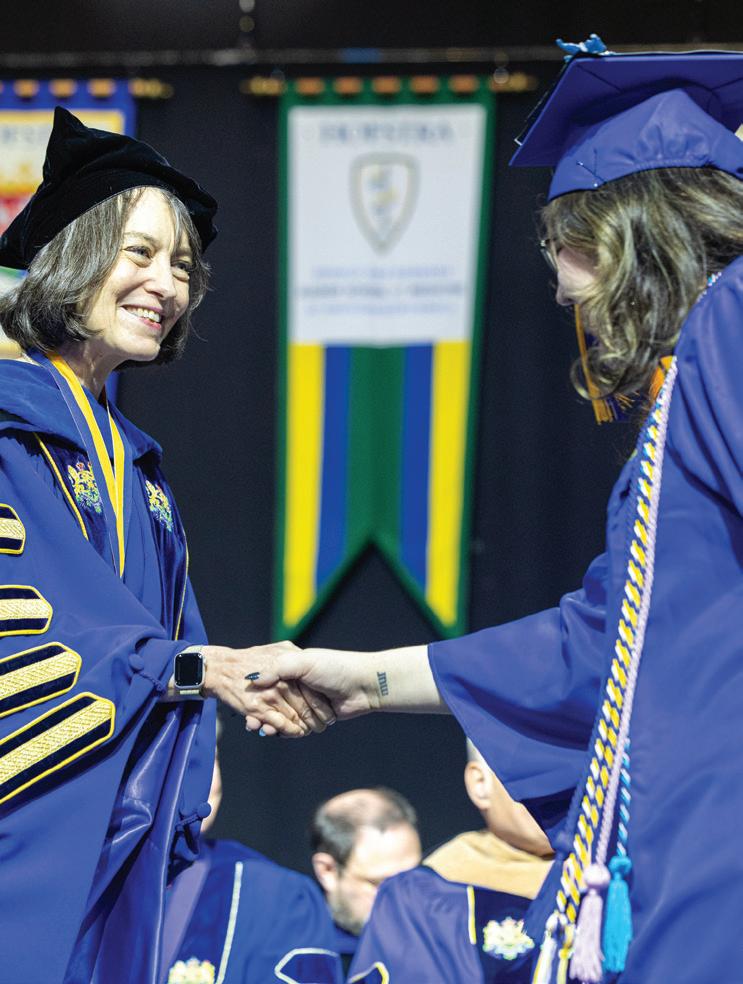
“You can feel it immediately, when you walk on campus,” Cohen said. “Her approachability and genuinely caring personality are evident in how she interacts with every student, faculty member, and our alumni. Dr. Poser has put together a team of superstars who are committed to lifting our University to the next level – and beyond – all because of her transformational leadership.”
Poser has prioritized investing in faculty and academic leadership, supporting the creation of 10 new faculty positions; the hiring of seven deans, including two new deanships in the School of Education and the Library; the establishment of an associate to the president for government and community affairs; the hiring of eight vice presidents and a senior vice provost for research and creative activities; and funding the new Center for Excellence in Learning, Teaching, and Assessment (CELTA).
With the labor market impacts of artificial intelligence, the University is ensuring that all students graduate with a working knowledge of AI – what it is, how it operates, and the ethical and social ramifications of its use. Beginning in the fall semester, a 9-credit Certificate in AI Foundations, Ethics, & Applications will be offered to students in all majors, and CELTA offers related workshops and programs.
Hofstra Athletics has had much to cheer about. Men’s basketball won the 2026 CAA championship and returned to the NCAA March Madness Tournament for the first time since 2001. (Although they won the CAA championship in 2020, March Madness was canceled because of COVID-19.)
Adding to the momentum, men’s cross country won its first-ever CAA championship in 2025. Men’s soccer has won four consecutive CAA championships from 2021 to 2024 and advanced to the NCAA Third Round in 2021, 2023, and 2025, while women’s soccer has captured two conference titles since Poser arrived. The baseball team took home the CAA title in 2022. The softball team matched the feat the following year, winning its first championship in five years and advancing to the NCAA Regionals.
Hofstra student-athletes have also excelled beyond the fields of competition, posting a department-record 3.59 GPA in the spring 2025 semester (surpassing the CAA conference average), and contributing more than 4,400 hours of community service in the 2024-2025 academic year.
This recap only begins to capture the innovative initiatives happening across Hofstra. In 2025, President Poser and
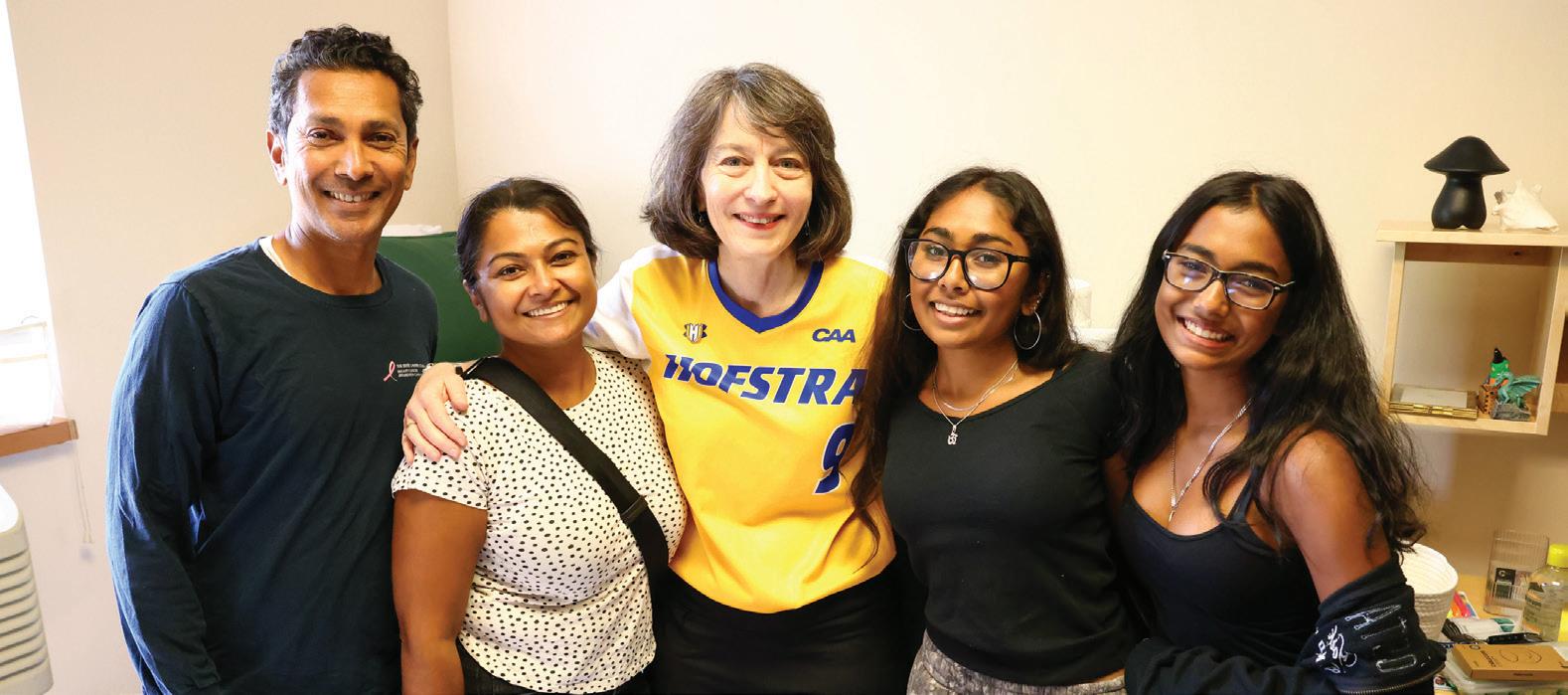
Provost Charlie Riordan launched the award-winning podcast Hofstra Campus Conversations , providing a way for alumni to stay connected and updated on the University’s progress through conversations with Hofstra’s changemakers. The podcast is available on all major podcast platforms.
In addition to Poser’s continued focus on implementing Hofstra 100, the University is undertaking an ambitious project to create a “college town” on the southeast part of campus, where Shuart Stadium currently stands. The University would build a new lacrosse stadium on the north side of campus, take down the stadium, and use the 15 acres in and around where the stadium currently stands to create a mixed-use village that would offer restaurants, retail, entertainment, and spaces for Hofstra students and employees, as well as the surrounding community, to gather.
In September 2025, the Urban Land Institute, a global nonprofit organization
that specializes in guiding development of equitable, sustainable, healthy, and resilient communities, spent five days on campus, touring the site and meeting with internal and external constituencies to make high-level recommendations for the project.
As a result, the planning of this project has begun, with the hope that it will be completed well before Hofstra celebrates its centennial in 2035.
As higher education continues to evolve, Poser remains focused on ensuring that Hofstra can adapt quickly, remain student-centered, and continue to build its academic profile and national reputation.
“I could not be more excited about Hofstra’s future than I am at this moment,” Poser said. “It comes down to the people – the dedication of the senior administrators, the deans, the faculty, and the outstanding, caring staff, all of whom are laser focused on creating the best educational and developmental experience for Hofstra students. The challenges ahead are real, but so is the momentum.”
Hofstra rolls out ChatGPT Edu campus-wide, allowing students, staff, and faculty to safely and securely gain AI proficiency in a rapidly changing world.

By Robert Lerose ’ 81



TThere is no way around it: Becoming AI literate is now a necessary part of a college education.
Since the public release of OpenAI’s ChatGPT in November 2022, generative artificial intelligence (GenAI) has had an immense impact on all aspects of society, including higher education and the workplace. Students now turn to AI to brainstorm ideas, draft outlines, and summarize readings. Teachers use it to prepare course material, conduct scholarly research, and even grade papers. A June 2025 study by education consulting firm Tyton Partners found that 42% of students and 30% of instructors reported using GenAI at least weekly.
To that end, Hofstra’s embrace of AI took a major step forward last fall when it became the first Long Island university, and among the first in the country, to release ChatGPT Edu, a version of the tool designed specifically for higher education. ChatGPT Edu provides the campus community with a safe AI-powered tool with which to experiment, build confidence, and develop the skills that will set them apart in their research endeavors and future careers.
Giving campus-wide access to ChatGPT Edu aligns with Hofstra’s goals of fostering students’ intellectual development and preparing them for careers. But the use and application of GenAI have raised far-reaching questions about the proper place of such a transformative technology and how to integrate it into life, work, and school — concerns Hofstra is taking seriously.
“The right time to start thinking about those questions is when you have access to a liberal arts education and faculty who can start to help you think about the ethics of these types of tools, the capabilities of the tools, and when it’s appropriate to use them or not use them,” said Jesse Webster, Hofstra’s chief information officer.
The process of choosing a suitable AI tool for the University began three years ago. In what he calls a pre-pilot stage, Webster and several colleagues formed a team to try out different AI models, including those made by Anthropic, Google, and OpenAI. After recruiting about a dozen participants from the Hofstra community across the various trials, the team found that ChatGPT Edu best met the University’s needs, and Webster expanded the ChatGPT Edu trial to a full-fledged pilot for the 2024-2025 academic year, ultimately expanding to nearly 300 participants, including Hofstra staff, faculty, and faculty-sponsored students.
“The right time to start thinking about those questions is when you have access to a liberal arts education and faculty who can start to help you think about the ethics of these types of tools...”
In spring 2025, the team held a series of listening sessions to learn what the pilot participants liked, what their concerns were, and areas where the tool did not deliver. Some faculty members questioned the usefulness of
a general-purpose AI tool compared to a subject-matter relevant tool. The team also considered that some members of the Hofstra community who were not involved with the pilot were already using AI tools on their own.
“We wanted to meet those people where they were and have a Hofstra-provided tool … that could bring them into a safer space to be experimenting with AI rather than having everybody pick their own space and [getting their own] ChatGPT account,” Webster said.
One of the University’s main concerns for Hofstra users centered on privacy and the paradigm behind AI chatbots. The public version of ChatGPT and its competitors get “smarter” every time a user enters data or uploads content, helping OpenAI improve the chatbot, but at the expense of the user’s data privacy. The University’s contract with OpenAI ensures that no prompt, data, or content from any Hofstra ChatGPT Edu user is used to train ChatGPT.
The Hofstra community is also able to take advantage of ChatGPT Edu’s intrinsic extra features. Users can access advanced options such as image generation and thinking or reasoning models, for example. Usage limits are much higher on the Edu version as well. The enhanced features, security, and privacy controls make ChatGPT Edu “a better place for someone in the Hofstra community to experiment with AI versus using one of the publicly available tools,” Webster said.


Hofstra rolled out ChatGPT Edu in October 2025. As of this spring, approximately 4,000 students, 500 faculty, and 500 administrators had registered to use it. There is no mandatory campus-wide usage policy; each faculty member decides for themselves how ChatGPT Edu can be used, or not, in their classroom and under what conditions. “We’re taking a pedagogy-first approach,” said Mitch Kase, executive director of the Center for Excellence in Learning, Teaching and Assessment (CELTA). “We’re very respectful of how faculty approach their courses. It’s a question of, ‘How do we support good teaching?’ And then we figure out if and where AI fits.”
Some faculty members were early adopters of ChatGPT Edu, Kase said, while others ranged from cautiously open to openly wary of its impact on learning. To help educators think through their relationship with AI, Kase co-leads a faculty learning community called the AI Faculty Research Group, which tackles critical questions in a thoughtful, open environment. He also collaborated with departments on campus to create an online module open to faculty, staff, and students that provides resources and guidelines to help them build their AI literacy.
Kase is working with the Provost’s Office and Axinn Library to develop a survey instrument to gather feedback from students about their interactions with ChatGPT Edu and the impact of AI on their studies and assignments. He expects more widespread use of AI at Hofstra in the next academic year, particularly with the introduction of a new 9-credit AI certificate in the fall, which will be open to all students. “One of the goals of the center is to provide spaces so that faculty can talk about their teaching and their research and about a tool that’s going to help them innovate and arrive at the appropriateness of AI in their [work].”
As a complement to the work at CELTA, Axinn Library is making AI part of its information literacy course. To that end, the library offers workshops and instruction that educate ChatGPT Edu users on how to make inquiries, work with prompts, find information, and access authoritative information from
library resources that are embedded with AI tools. “I think that generative AI tools within library databases are the next generation of discovery tools for researchers,” said Lorrie McAllister, dean of Axinn Library. “Tools like ChatGPT Edu help us with our work.”
In her own work, McAllister has used ChatGPT Edu to help prepare components of grant proposals, such as creating outlines of the grant request, putting together briefs for the administration, and ensuring that proposals meet the goals and requirements of the grant foundations.
Just as faculty and administrators are experimenting with it, the 4,000 Hofstra students enrolled in ChatGPT Edu are testing the AI tool, figuring out where and how it belongs in their academic life. The reaction so far is mixed.
English major Chloe Voluck-Sviedrys ’29 was first exposed to ChatGPT Edu in a class taught by Professor Warren Frisina, dean of the Stuart and Nancy Rabinowitz Honors College. Her assignment was to have one of her essays edited by the AI tool for clarity and concision, and then comment on the chatbot’s changes. She was pleased that it came up with different choices when she overused particular words but was unhappy when it deleted content that had special meaning to her.
“I think I was talking about a personal experience or emotion, like anger or frustration, and it cut it out to sound more scientific,” Voluck-Sviedrys recalled. “The voice I generated through writing on my own was lost. It was a formal paper, so that could have affected that choice, but it didn’t sound like me.”
“We’re very respectful of how faculty approach their courses. It’s a question of, ‘How do we support good teaching?’ And then we figure out if and where AI fits.”
Meanwhile, Lucas Sampo ’29, a Frei Scholar at the Frank G. Zarb School of Business, was excited about the opportunity to use ChatGPT Edu. “I thought it was cool that [the University is] encouraging students to use AI because it’s definitely an important skill to learn,” he said.
Before coming to Hofstra, Sampo had used AI to help brainstorm ideas for schoolwork or polish emails. Like Voluck-Sviedrys, his class assignment involved ChatGPT Edu editing an essay draft. Because he knew that the chatbot would clean up grammar and sentence structure and condense his work, Sampo could focus just on expressing himself. He has also used ChatGPT Edu to clarify reading material that is confusing. But he makes sure to verify any citations from books that the chatbot generates because, “sometimes it’ll just make up quotes.”
Learning AI’s capabilities and shortcomings now will equip students with the knowledge and skills they will need on day one of their careers. According to a 2025 survey conducted by the career resource platform Resume Genius, “81% of hiring managers now consider AI-related skills a hiring priority, making them among the most sought-after capabilities.” Therefore, investing in AI literacy serves Hofstra’s goal of equipping students with the skills necessary to thrive in their careers.
As the academic year comes to an end, Hofstra remains committed to AI and is open to developing new partnerships and student opportunities. “Our role is to be very thoughtful about how to help our students develop their own critical, ethical views on AI,” Kase said, “and develop those skills that are going to be beneficial to them in the workplace.”
Beginning in fall 2026, Hofstra will offer the AI Foundations, Ethics, & Applications Certificate to provide interested students with an introduction to the fundamentals of artificial intelligence (AI). The 9-credit program, open to all students, consists of three courses: Overview of AI and Computer Science, Artificial Intelligence in Society: New Challenges, Ethical Futures, and an elective drawn from a growing list of AI-related courses.

Upon completion of the program, students will be able to:
• Demonstrate a broad understanding of AI principles and practices.
• Analyze ethical and social questions arising from AI development and deployment.
• Apply AI-related insights to disciplinary contexts in the humanities, social sciences, and natural sciences.
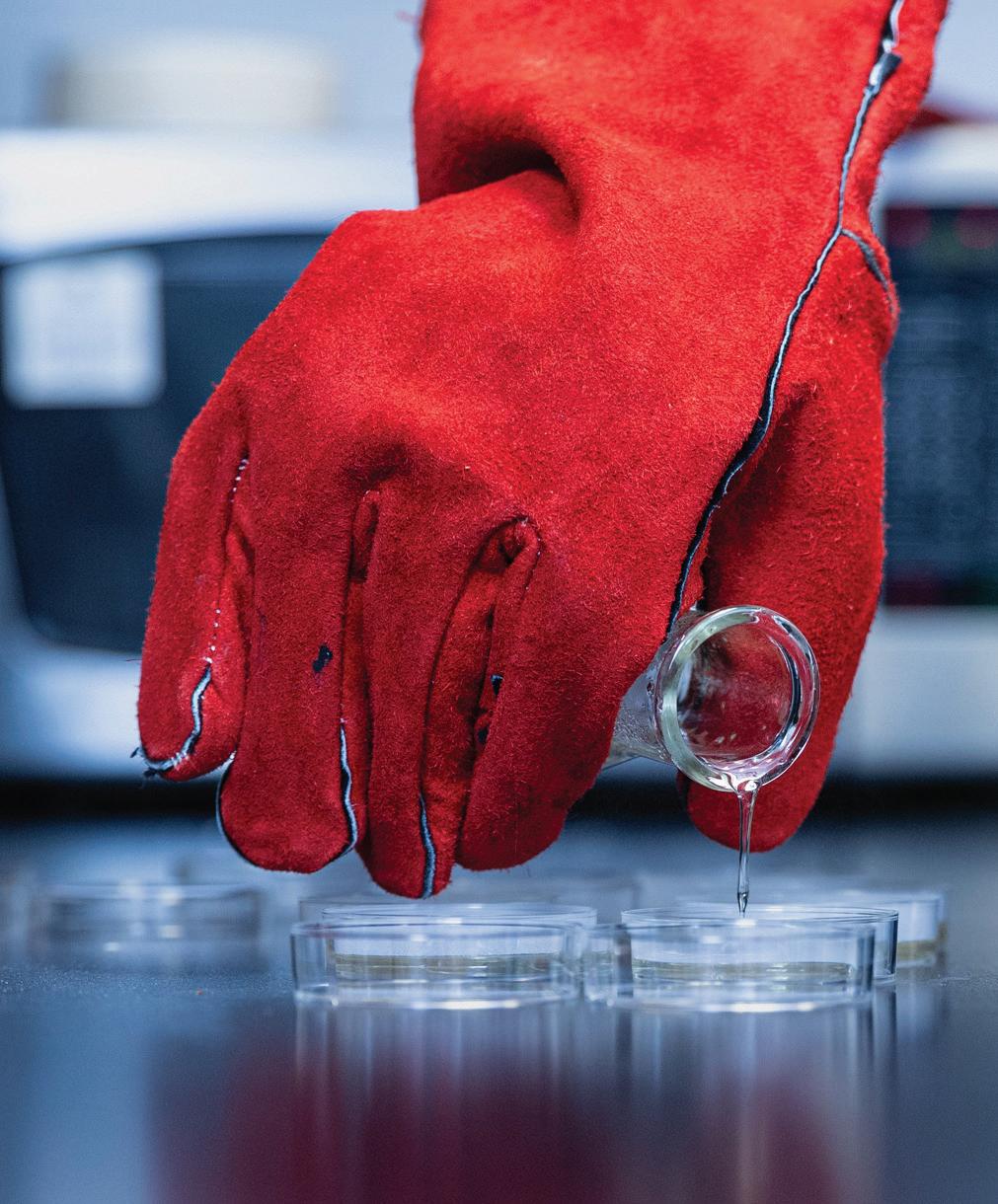

Producing original research is a tenet of Hofstra’s new mission statement. But greater still, the search for knowledge is among the University’s core values:
We pursue excellence through the generation, acquisition, and application of knowledge.
“Generation of new knowledge is fundamental to what universities do,” Hofstra Provost Charlie Riordan said when asked why scholarly research was such a prominent component of Hofstra 100, the 10-year strategic plan guiding the University to its centennial in 2035.
He went on to include the benefits of research for students — “you learn best by doing” — and the University — “research excellence is a way in which universities can really distinguish themselves and build reputations.”
Scholarly research is not done in a silo. It often requires a team of investigators, support staff, and administrators to guide the project from proposal to final report publication and dissemination. Together, the team handles the multifaceted process that includes submitting grant applications, securing funding, and accessing the necessary tools and technology.
As such, no one component of Hofstra’s research would tell the whole story. What follows are just some of the many moving parts of Hofstra’s research ecosystem.


Since 1973, the Carnegie Commission on Higher Education has recognized the top research universities across the country. Last year, Hofstra was included on that list for the first time, receiving the Research 2: High Research Spending and Doctorate Production (R2) University designation.
Of the three Carnegie research designations — R1 (Very High Research Spending and Doctorate Production), R2 (High Research Spending and Doctorate Production), and RCU (Research College and University) — Hofstra reached the R2 level by surpassing $5 million in annual research spending and awarding more than 20 research doctorates annually.
“It’s a measure of impact and productivity,” Riordan said. “It’s also a measure of stature that will help the University attract students, faculty, and additional funding.”
There are roughly 4,000 degreegranting colleges and universities in the United States. Of those, only 326 earned R1 or R2 designations, placing Hofstra’s research work in the top 8% of universities.
From Hofstra’s dedication to research comes several notable recent achievements.
In March, computer science and mathematics double major Linden Faye ’27 became the third Hofstra student to win a Barry Goldwater Scholarship, the preeminent award for undergraduates studying the natural sciences, mathematics, and engineering.
Faye, who minors in physics, was one of 454 students selected from a nationwide pool of nearly 1,500 peers nominated for the award. He follows in the footsteps of Hofstra alumni Joseph Mancuso ’20 and Antonio Collado ’24, who won the award in 2020 and 2023, respectively.
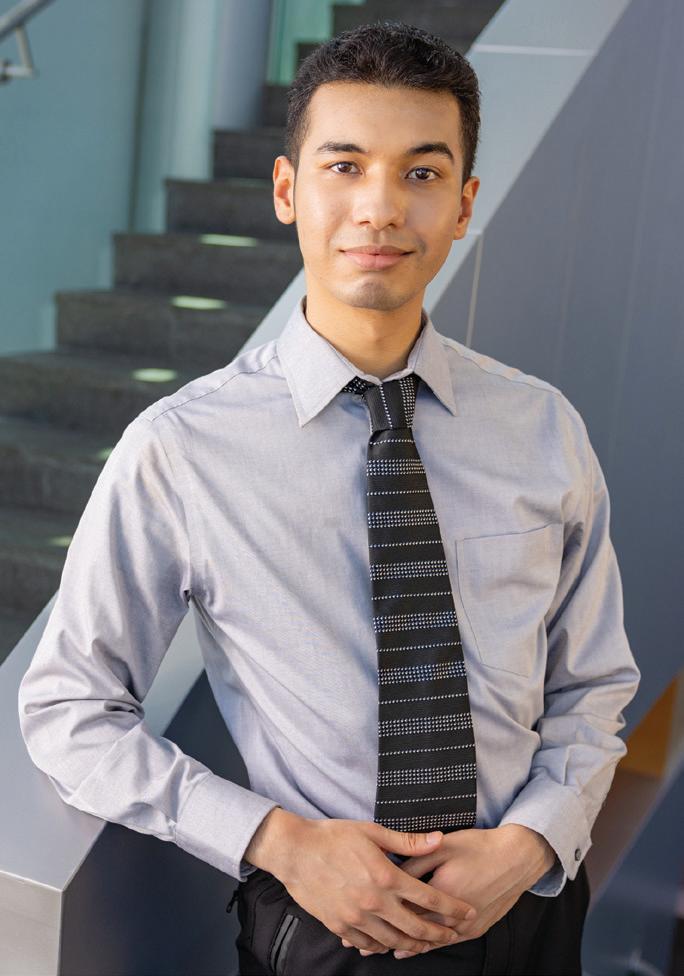
“I am truly honored and thankful to receive this national STEM scholarship,” Faye said. “Winning the Goldwater affirms my abilities and reflects how far I have come and the challenges I have overcome.”
The Goldwater Foundation was established by Congress in 1986 in honor of the eponymous U.S. senator. The scholarship program is designed to identify and financially support college sophomores and juniors looking to pursue careers in STEM fields, which are science, technology, engineering, and mathematics. Over the past 40 years, the foundation has awarded more than 11,000 scholarships.
Faye plans to pursue a PhD in Biomedical Engineering, a field where he can work to advance human health by applying mathematical modeling and machine learning to the investigation and design of biomedical systems in advancing human health.
The Donald and Barbara Zucker School of Medicine at Hofstra/Northwell has once again been recognized among the nation’s top medical schools for research by U.S. News & World Report . The 2026 Best Graduate Schools list places the Zucker School among the top three in New York state and in the top half nationwide, earning a Tier 2 placement for research excellence.
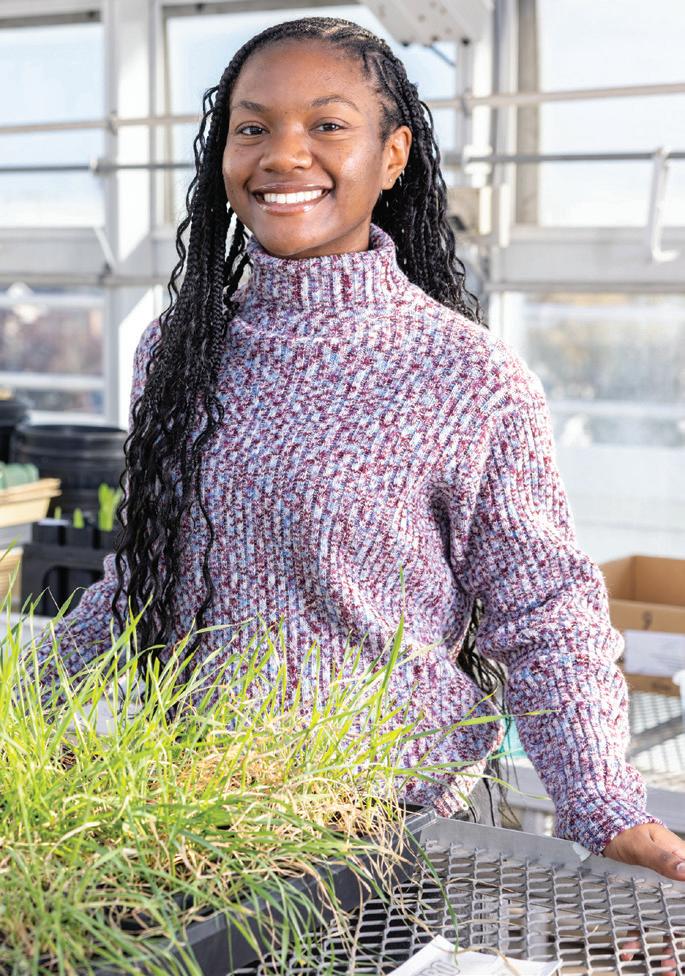
Environmental resources major Arden Thompson ’27 conducted research in an unique environment last summer when she was one of just 14 students nationwide selected to attend the OCEAN Core Academy.
The eight-day program, offered by the International Ocean Discovery Program and hosted by Texas A&M University, gave students hands-on experience examining samples and data recovered from deep ocean floor cores, then analyzing and reporting their findings. “It was challenging but rewarding,” Thompson said. “We had just over a week to conduct the research and present our findings. It pushed me to apply what I’d learned at Hofstra in a professional research setting.”
Thompson’s team focused its work on microfossils, microscopic remnants of ancient life used to interpret past environmental conditions. It’s a topic she began studying at Hofstra under the mentorship of E. Christa Farmer, professor of geology, environment, and sustainability. “We can look at these tiny fossils and see patterns that reveal how Earth’s climate has changed over time,” Thompson explained. “By comparing what existed in the past, we can predict trends for the future.”
Thompson plans to continue in the environmental field, be it in the workforce or graduate school. “The experiences I’ve had at Hofstra are helping me figure out my next steps.”
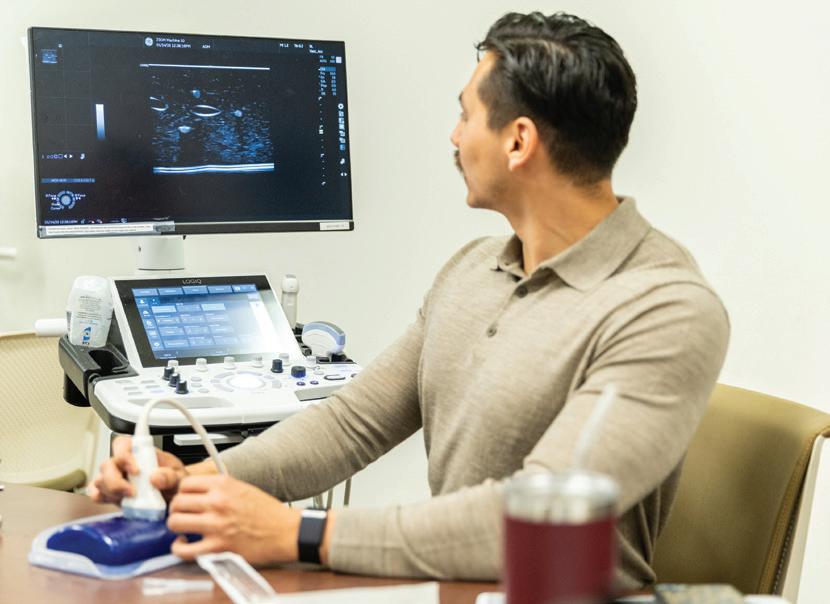
Hofstra is officially recognized as an AgeFriendly University (AFU) by the AgeFriendly University Network, an international association of higher education institutions committed to creating age-inclusive and agefriendly environments for learning, research, and community engagement. Hofstra is one of just four institutions in New York state, and the only on Long Island, to earn the recognition.

The AFU designation recognizes institutions that have ensured equitable access to campus resources for learning at every stage of life. This includes encouraging older adults to participate in research and ensuring that the University’s research agenda is informed by the needs of an aging society.
For Hofstra’s first Rhodes Scholar, life converges under the lens of her microscope.
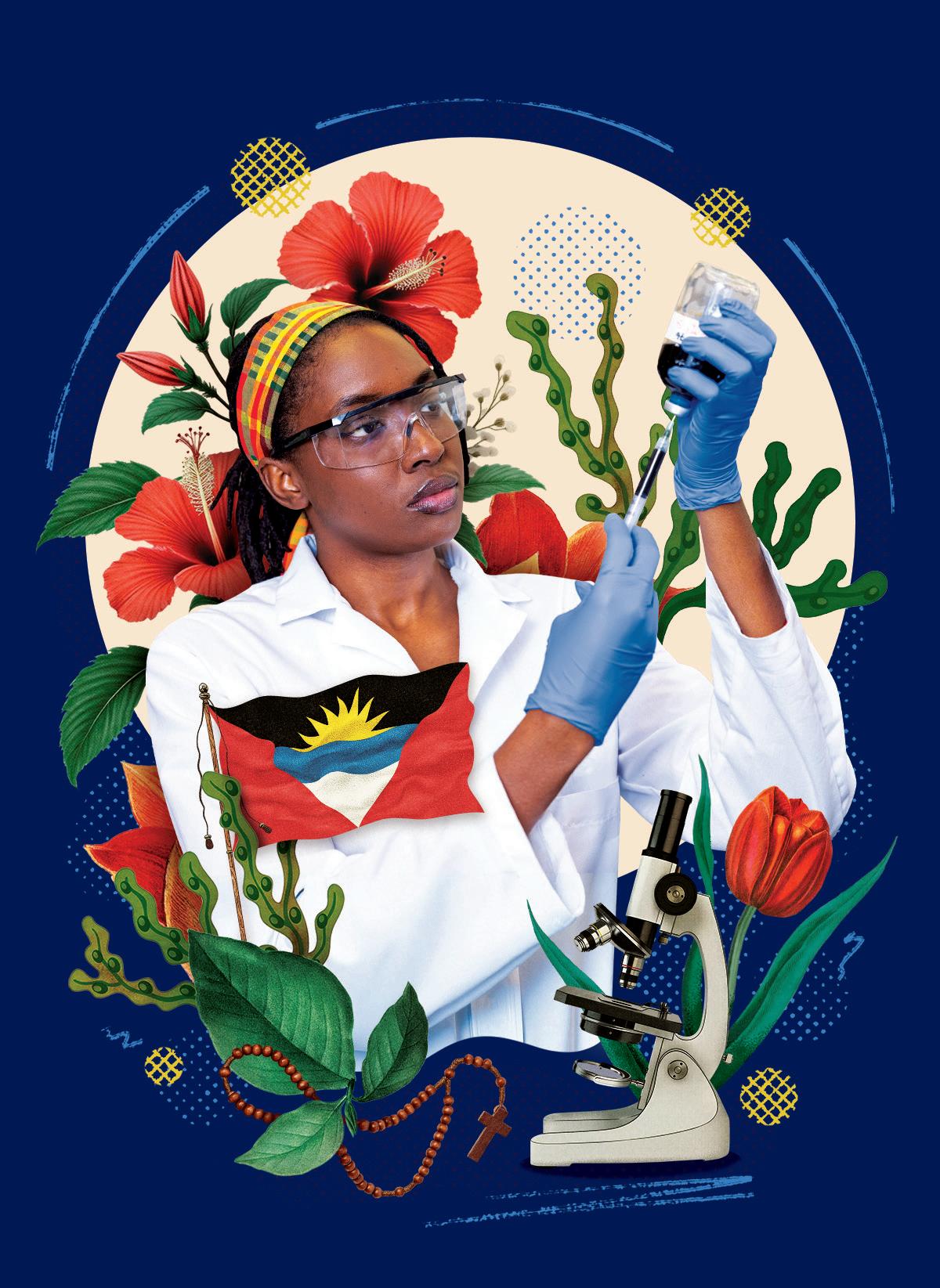
Antigua and Barbuda’s national flag is a tribute to the Caribbean country’s land and liberty. The twin-island’s flag was adopted in 1967 after the former British colony gained self-governance. The design, by artist Sir Reginald Samuel, is equally symbolic and scenic: Framed by two red triangles, the yellow sun rises over blue waters and white sand, jutting into black skies, ushering in a new day. Land and liberty.
But behind the seascape is a greater tribute. The prominent red, blue, and black colors represent, respectively, the dynamism, hopefulness, and African heritage of the country’s people. Land, liberty — and lives.
Samuel’s design was selected through a national contest. Fifty-eight years later, another gifted Antiguan won a different prestigious competition. Dynamic, hopeful, and Black, Resa B. Nelson ’26 is the living embodiment of her motherland’s flag — and Hofstra University’s first Rhodes Scholar.
The Rhodes Scholarship is a fully funded postgraduate award allowing students from around the world to study at Oxford University for two or more years. Nelson will be pursuing an MSc by Research in Medical Sciences at the Radcliffe Department of Medicine at Oxford.
Precocious and curious, Nelson fell in love with science as a child. By age 10, she dreamed of becoming a doctor. This path led the Antiguan to another island — Long Island, 1,700 miles away. “I had a counselor that was helping me look for schools,” Nelson recalled. “She suggested Hofstra because it had a medical school.”
Nelson enrolled at Hofstra in 2022 and wasted no time getting acclimated. “I saw a hibiscus on campus as a freshman. I felt very at home because I have hibiscuses at my house,” Nelson said of spotting the popular Caribbean flower.
A second, more transformative event occurred in her first year: She joined the Izquierdo Lab. This laboratory, run by Dr. Javier Izquierdo, Hofstra professor of biology, is where Nelson would blossom into the researcher she is.
After her first-year lab experience and a summer spent researching, medical school was officially off the table. “I wanted to be a doctor,” Nelson said, “but once I started doing research, I realized I loved the act of discovery, the process of asking questions, and finding answers. … If I’m in a tissue culture room growing and transferring cells, and I’m on the microscope and have my headphones in, that is the perfect day for me.”
Many of those days were spent on her primary research project: solving an ecological issue that threatens her homeland. Antigua has 365 beaches, one for each day of the year, as the locals say. The sandy shores are a major tourist attraction and, as the flag reminds us, a point of pride. But situated between beachgoers and the shoreline is one of the island’s major ecological issues: seaweed.
Sargassum seaweed, which blooms in the tropical Atlantic, washes up on Antigua’s beaches in heaps. The large, brown piles of macroalgae obscuring the turquoise seas are unappealing to the eye, but their attack on the senses is worse. “Because there’s so much, it doesn’t dry the way normal seaweed would dry,” Nelson said. “It rots and smells horrible. It burns your eyes. It’s not very pleasant at all.”
Nelson’s research focused on discovering methods of converting the seaweed into biofuels and other bioproducts. The project was done under the guidance of Izquierdo, who is part teacher, part collaborator. “It’s more of a partnership than a dictatorship.” Nelson said. “You’re not just following orders. You’re learning from each other.”
The Izquierdo Lab provided Nelson with the requisite time, space, resources, and mentorship needed for such work. “Dr. Izquierdo’s lab is the reason I’m pursuing what I’m pursuing,” Nelson declared.
IVBack in Antigua, Nelson played flute in the national Youth Symphony Orchestra. The ensemble’s founder, Karen-Mae Hill, was Antigua and Barbuda’s first Rhodes Scholar. Meeting Hill marked the first time Nelson had ever heard of the prestigious scholarship.
In 2023, the group toured the United Kingdom, playing at famed venues around the country. Following a concert at Oxford’s Christ Church Cathedral, Nelson walked to the university’s All Souls College. Upon entering the school’s famous library, she was greeted by an immense marble statue of Christopher Codrington. Upon his death in 1710, Codrington, a former Fellow of All Souls, endowed the college with funds to build the library — and his invaluable book collection to fill its shelves.
What was most striking to Nelson, however, was another memorial, this one a plaque: “In memory of those who worked in slavery on the Codrington plantations in the West Indies.” Codrington’s wealth was derived from the slave-working plantations he inherited across the Caribbean. “Codrington was emblematic of the institution of slavery in the region that my forefathers endured,” Nelson said. This monument of a library, then, was built on the backs of Nelson’s ancestors. “It would be great to study at this institution because the research is fantastic,” Nelson thought. “And if my fore parents had something to do with the building of the institution, that would also make it great to learn from.”
The college has taken steps in recent years to address this exploitative history. While the statue remains, projected onto it now is a sequence of names of those who were enslaved on Codrington’s plantations.
VNelson recounted her experience at All Souls in her Rhodes Scholarship application. Also included were her extracurriculars — president of biology honor society TriBeta, volunteer at local middle school, and, most notably, secretary of both Hofstra’s InterVarsity Christian Fellowship and Hofstra Gospel Ensemble. “My faith is a really big part of what I do,” Nelson said, adding that she was also a youth leader and choir member at her church in New York. “Servant leadership is something that my dad emphasized when I was younger — how Jesus served people. [My research] is how I am able to serve my community in a way that I love and is meaningful to me.”
Nelson’s devotion to both fact and faith would seem self-contradicting. She disagrees. “I think my faith complements my science,” she said. “Faith without work is dead, right? If you’re not working toward a solution, then what do we do?”
For Nelson, fact and faith combine to create moments of wonder. “I saw a stem cell for the first time last summer. I’m getting emotional thinking about it. Because it’s a beautiful thing to see,” she recalled. “The times I’ve felt most in awe, I was looking into a microscope.”
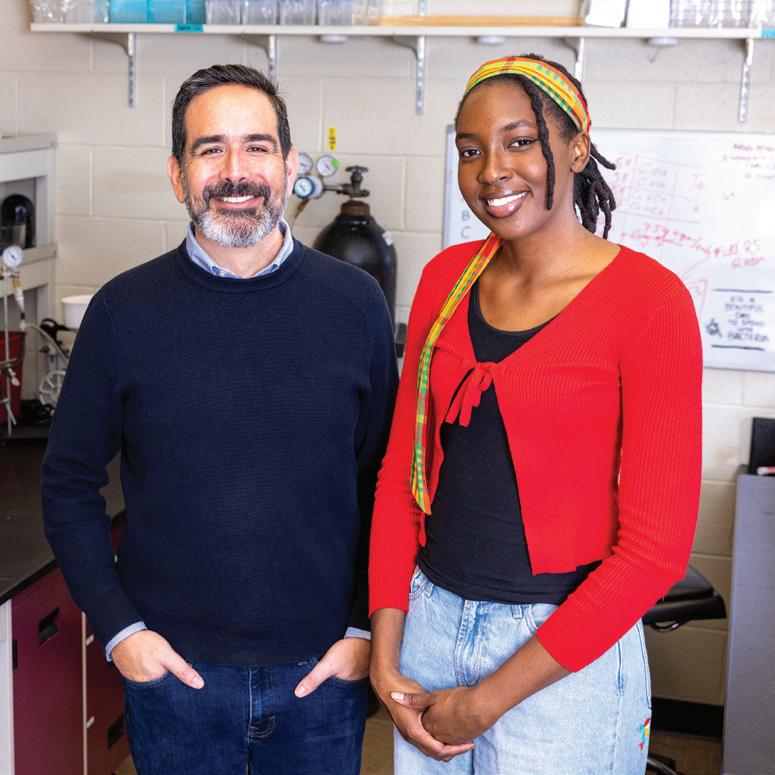
Hofstra appoints a new research leader to drive discovery and imagination.
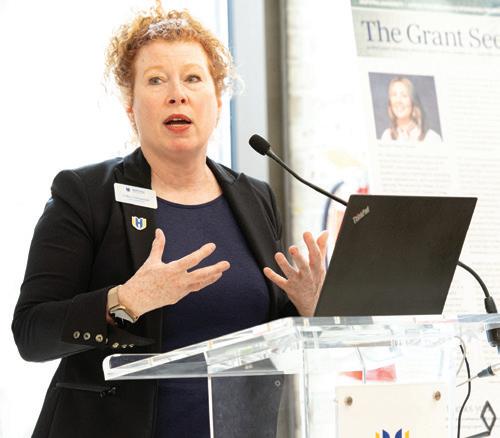
On September 1, Dr. Colleen Fitzgerald began her tenure as Hofstra University’s inaugural senior vice provost for research and creative activities. A nationally recognized linguist and higher education administrator, Fitzgerald brings more than two decades of experience in research leadership, faculty development, and community-engaged scholarship. She previously served as a professor of linguistics, a program director at the National Science Foundation (NSF), and, most recently, vice president for research and creative activity at North Dakota State University.
We spoke with Fitzgerald about her path to Hofstra, her passion for supporting faculty and student discovery, and her goals for the University’s expanding research efforts.
Can you tell us about your professional background and expertise?
My scholarly background is in linguistics, and much of my career has centered on working with Native American and other Indigenous communities to support language documentation and reclamation efforts. I’ve long been passionate about community-based research, servicelearning, and mentoring faculty and students in ways that center equity and impact. During my time at the National Science Foundation, I managed the Documenting Endangered Languages program and participated in a challenge-driven initiative, NSF’s 10 Big Ideas. That experience revealed how deeply I value serving others. For the past decade, my focus has been on supporting faculty success in research and creative work, and I’m excited to bring that same energy to Hofstra.
What do you enjoy most about working in higher education?
There’s something magical about the start of college, that sense of wonder and possibility. As an undergraduate, I experienced that firsthand when I participated in an NSF Research Experiences for Undergraduates program and conducted my first fieldwork abroad. I even secured my first grant as a student. Those formative experiences helped shape me into the researcher and leader I am today. Now, I find it incredibly rewarding to help faculty create those same transformative opportunities for students. Faculty-driven research and creative activity is where discovery leads to impact and sparks innovation. I look forward to supporting original, interdisciplinary work that opens doors for Hofstra students.
What drew you to Hofstra?
I was searching for a university where I could make a meaningful impact, and Hofstra stood out immediately. Its comprehensive programs and strong sense of momentum really excited me. When I visited, I felt the energy — a community proud of what it has achieved and eager to build on that progress. The campus is beautiful, and the people have been so welcoming and supportive. It’s clear that Hofstra is a place where great things are happening.

With the Hofstra 100 strategic plan, a new R2 university designation, and a bold brand launch, this is a defining moment for Hofstra. How do you see your role supporting these efforts?
My position reflects Hofstra’s deep investment in research and creative activity and President Poser’s vision for faculty excellence that strengthens our national reputation.
Research is central to the Hofstra 100 strategic plan. Faculty work not only elevates scholarship but also creates high-impact, personalized learning experiences for students. I hope to foster a thriving, inclusive research enterprise with strong infrastructure and strategic direction. I’m eager to collaborate with faculty and campus leaders to identify Hofstra’s big ideas — areas where our expertise and partnerships can offer innovative, solutions-driven approaches.
Research requires diverse perspectives. Here’s how Hofstra is getting all parties to the table.
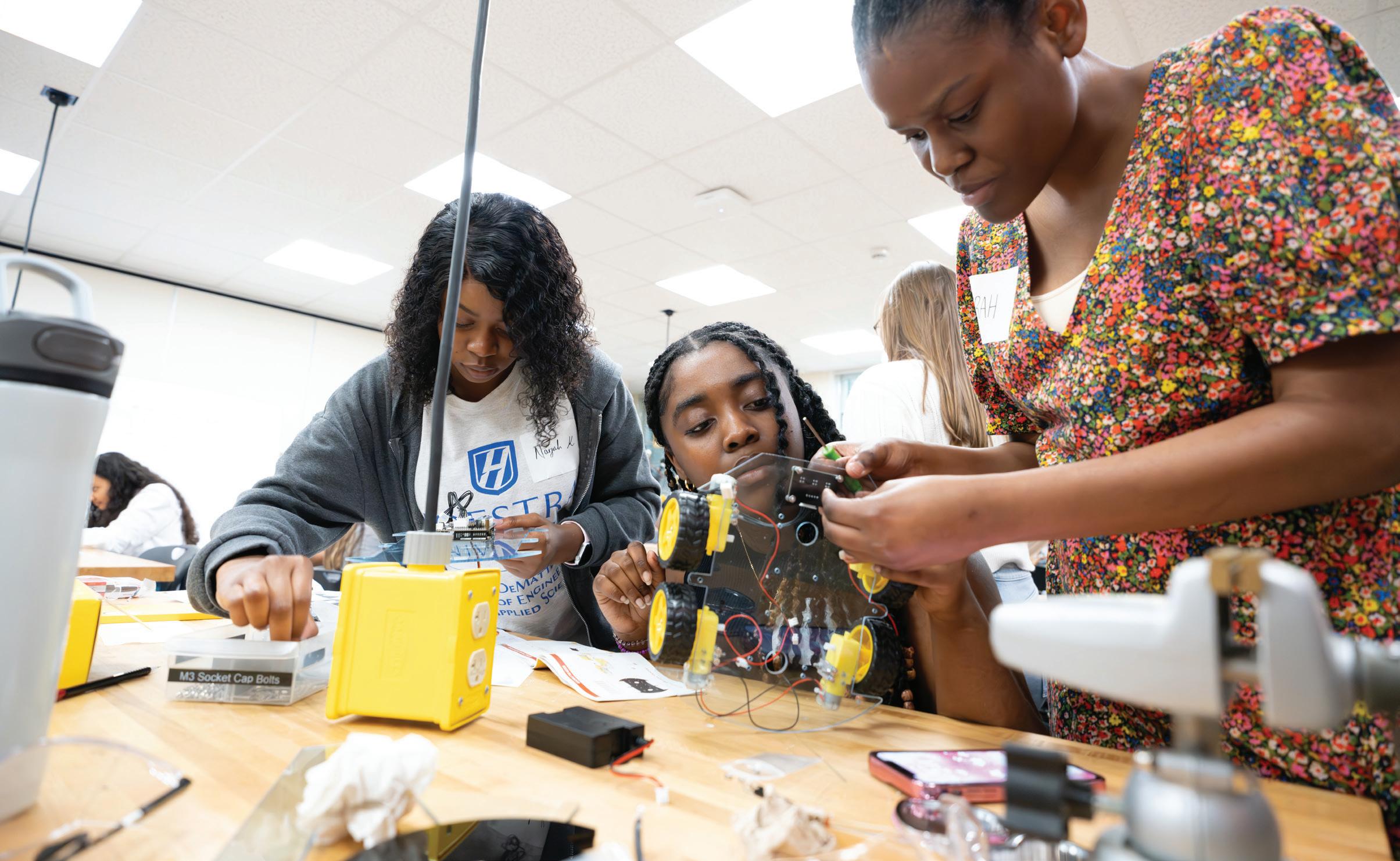
Last year, The National Center for Suburban Studies at Hofstra University released the results of a study done in partnership with the Asian American Institute for Research and Engagement, a local nonprofit working to advance the needs of Asian Americans.
The report, Discriminatory Language Barriers for LI’s Asian Americans, detailed the difficulties local Asian Americans have accessing essential services. While communication challenges for foreign language speakers were expected, it took researchers two years to uncover the scale and scope. Researchers surveyed roughly 400 U.S.- and foreign-born Asian Americans of varying proficiency in English. Nearly 60% of those surveyed, including individuals of Chinese, Indian, Pakistani, Korean, and Afghan descent, reported facing language difficulties. For more than half of them, these difficulties affected access to critical services such as emergency health care and police/fire and legal assistance, as well as difficulty voting.
Based on this data, the research team provided recommendations, including enhanced language services provided by government and healthcare organizations, multilingual voting material, and community education programs.
By identifying problems and developing solutions, research is one of the primary drivers of societal progress. So long, of course, as researchers take a holistic view of society in lieu of a fragmented one. This is often not the case, as large sections of society — based on race, gender, socioeconomic level, age, etc. — are unresearched. Problems go undiscovered, solutions are unrealized, progress stalls, and historically marginalized communities fall further behind.
Here are several Hofstra resources and initiatives aiming to create a more diverse research portfolio.
The center was established at Hofstra University in 2017 to promote scholarship, research, and curriculum development on “race” (in quotation marks to recognize the physical, social, and political constructs) and social justice. The center awards two annual Faculty Summer Research Grants. Previous recipients have presented their research on topics such as healthcare equity and the multiracial student experience.
Faculty Diversity Research and Development Grants are awarded to faculty in any discipline in support of research or curricular innovation regarding diversity and inclusion. LGBTQ+ Research Initiative Grants are awarded to faculty engaged in research or creative work on the experiences of LGBTQ+ people and allies on Hofstra’s campus and/or in the suburbs.
2025-2026 Faculty Diversity Research and Development Grants:
• Disabled Students’ Experiences in Kinesiology-Based Programs in Higher Education in the United States
Fabián Arroyo-Rojas, PhD, Assistant Professor of Specialized Programs in Education, School of Education
• Sounding Anti-Slavery Voices: Black Women on the Speakers’ Platform Lisa Merrill, PhD, Professor of Rhetoric and Performance Studies, Hofstra College of Liberal Arts and Sciences
2025-2026 LGBTQIA+ Research Initiative Grant:
• Colors That Move: How LGBTQ+ Family Acceptance Films from Immigrant Communities Create Radical Empathy
Aashish Kumar, MFA, MS, MA, Professor of Radio, Television, Film, The Lawrence Herbert School of Communication
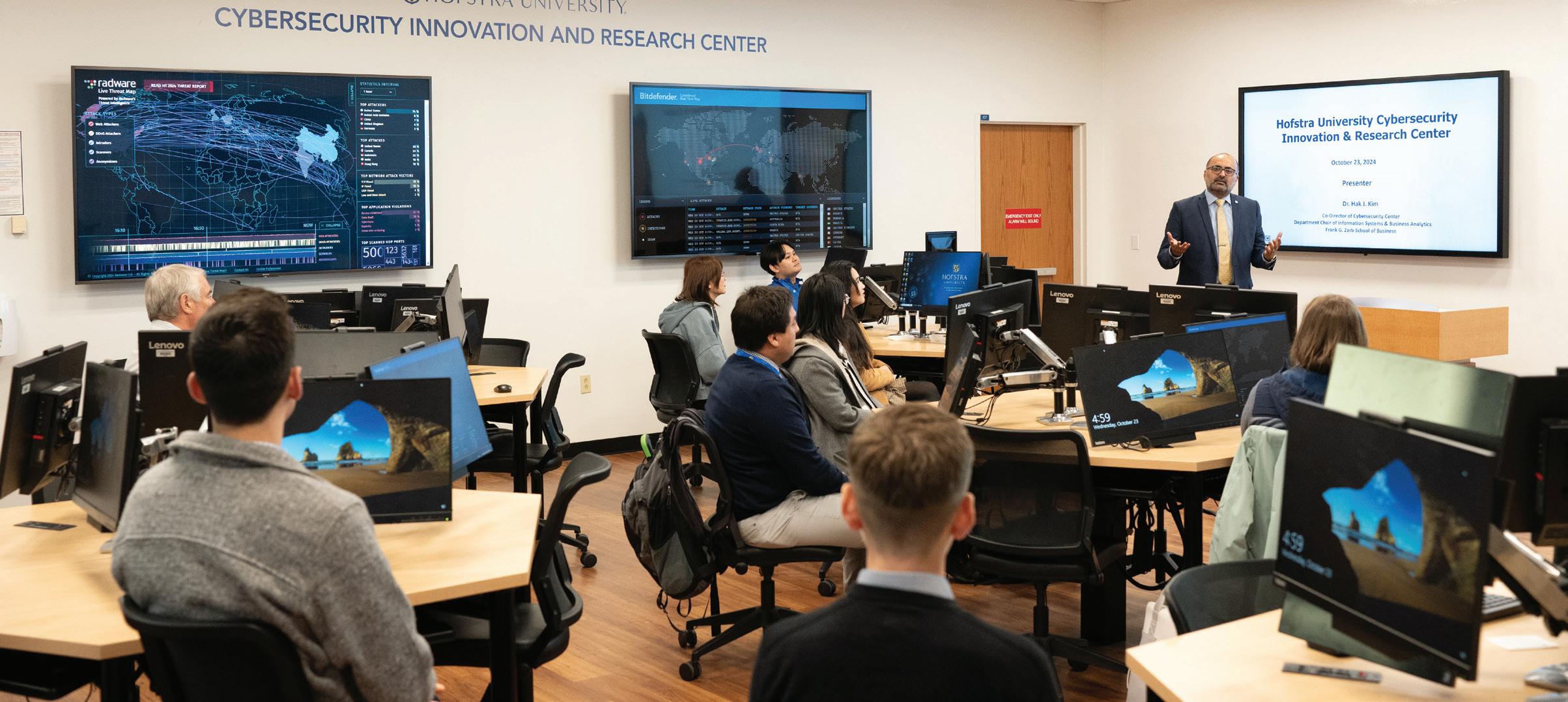
Hofstra’s numerous research centers specialize in fields ranging from politics and presidents to science and suburbia.
Research centers serve as a scholarly nexus on campus, connecting faculty investigators with the collaborators, technology, resources, and funding needed to advance their work.
Here are a few of the centers and institutes where Hofstra researchers drive innovation.
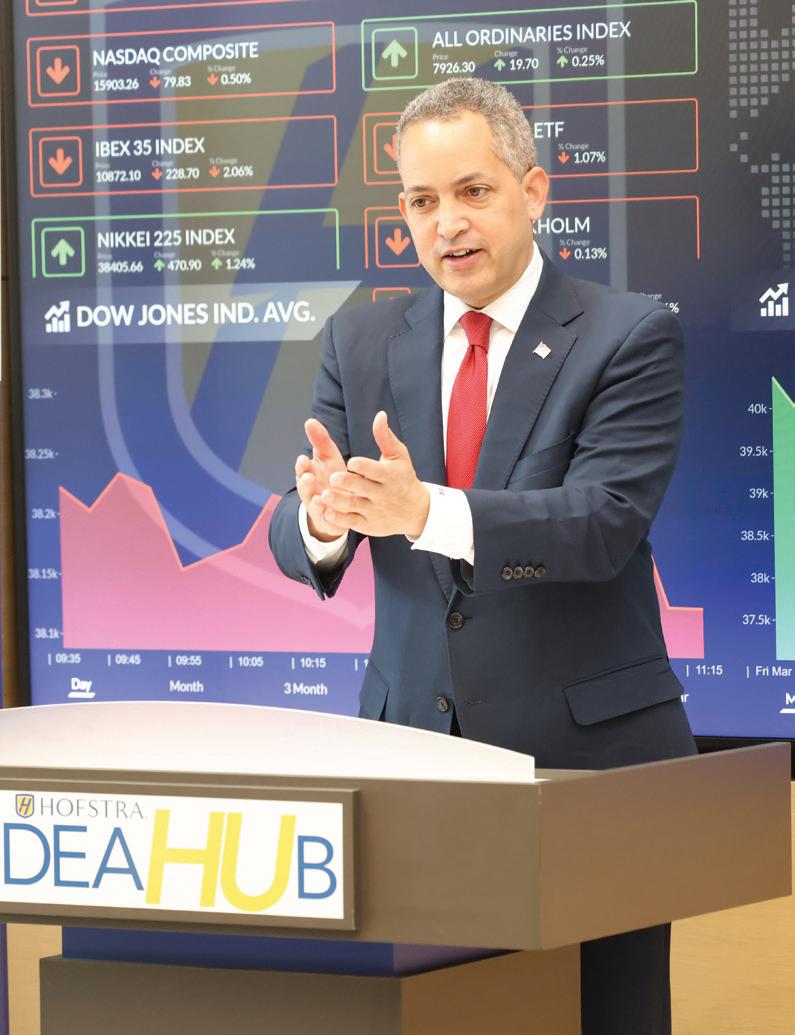
Founded in 2007, The National Center for Suburban Studies at Hofstra University (NCSS) is a nonpartisan research institution dedicated to the study of suburbia’s problems and promise. Believed to be the first institute of its kind, the NCSS works to understand suburbia through rigorous research in the natural and social sciences and humanities.
Under the umbrella of the Fred DeMatteis School of Engineering and Applied Science, the Center for STEM Research supports science, technology, engineering, and mathematics programs in schools, colleges, and universities both in New York state and nationally. Since 1993, the center has won National Science Foundation grants totaling $40 million. This funding aids researchers’ work in studying and developing innovative teaching models that infuse STEM into the curriculum.
A joint project of the Fred DeMatteis School of Engineering and Applied Science and the Frank G. Zarb School of Business, this state-ofthe-art facility uses hyper-realistic simulations to train students to detect and defend against cybercrime. The center also works on cybersecurity research projects in collaboration with industry, government, and academia.
Headquartered in the Leo A. Guthart Hall for Innovation and Discovery’s ideaHUb incubator, The Institute of Innovation and
Entrepreneurship (IIE) is fostering a dynamic community that promotes excellence in learning, teaching, and impactful research, while also supporting the growth and development of new business ventures.Faculty members can apply for Innovation Research Fellowships, which provide up to $50,000 in funding.
Peter S. Kalikow Center for the Study of the American Presidency
Founded in 2006, the Peter S. Kalikow Center for the Study of the American Presidency makes Hofstra one of few institutions in the country with a unique focus on the presidency. Its research efforts include sponsoring a lecture series and publishing numerous books on the presidency. Most notably, the Kalikow Center hosts multiday presidential conferences where scholars, policymakers, journalists, and current and former government officials discuss and evaluate each presidential administration.
Behavorial Research in Business Laboratory Center for Civic Engagement Center for “Race,” Culture and Social Justice Center for the Study of Labor and Democracy
Hofstra Law Institutes and Centers
Hofstra University Bioethics Center
Hofstra University Museum of Art
Institute for Forensic Linguistics, Threat Assessment, and Strategic Analysis at Hofstra University
Institute for Public Humanities and the Arts Long Island Studies Institute
Hofstra’s research and innovation have made positive impacts on communities near and far.
The Research: In partnership with the Town of Hempstead and the Long Island Regional Planning Council (LIRPC), Hofstra conducted a multiyear study measuring the pollutant levels in local waterways. Dr. Steve Raciti, Hofstra associate professor of biology, was the principal investigator of the study that ran from 2019 to 2024.
The Impact: This research proved that Long Island’s water is getting cleaner and confirmed the effectiveness of upgrades to wastewater treatment infrastructure. The results showed that pollutants, notably nitrogen, have significantly decreased. Excess nitrogen, the leading cause of Long Island’s water quality deterioration, causes algal blooms that lead to low oxygen conditions, fish kills, and degraded wetlands and marine habitats. It also contaminates the groundwater, jeopardizing Long Island’s drinking water supply.
The Research: For years, Dr. Jase Bernhardt, Hofstra associate professor of geology, environment, and sustainability, has researched how virtual reality (VR) can aid severe weather warnings and preparation. Using VR headsets, participants experience simulated dangerous weather events, such as hurricanes, flash floods, rip currents, and snow squalls.
The Impact: Last summer, NY State Parks purchased headsets for the public to better understand the dangers of rip currents, which kill about 100 people annually, according to the National Oceanic and Atmosphere Administration. Bernhardt’s work has also been adopted by the Pennsylvania Department of Transportation as a tool for motorists to practice driving through a snow squall. According to Pennsylvania State officials, investments like this have led to 7% fewer winter crashes and a 34% decrease in serious injuries and fatalities in the state.
The Research: In research published last fall, Maurice A. Deane School of Law Professor Jordan Laris Cohen examined job loss during pretrial detention. Cohen found that it was common for people to lose their jobs even during a short detention stay. This sets off a chain of events affecting income, housing, and family life – all despite the presumption of their innocence and the possibility of them ultimately being found not guilty.
The Impact: Cohen has proposed for a reemployment right for those held in pretrial detention. Such a statute would guarantee job reinstatement for any individual released from pretrial detention whose charges are still pending or resulted in any resolution other than conviction. If Cohen’s plan was implemented, it could spare the livelihoods of the 500,000 people detained in U.S. jails at any given moment, waiting for their trial, many of whom will be found not guilty.
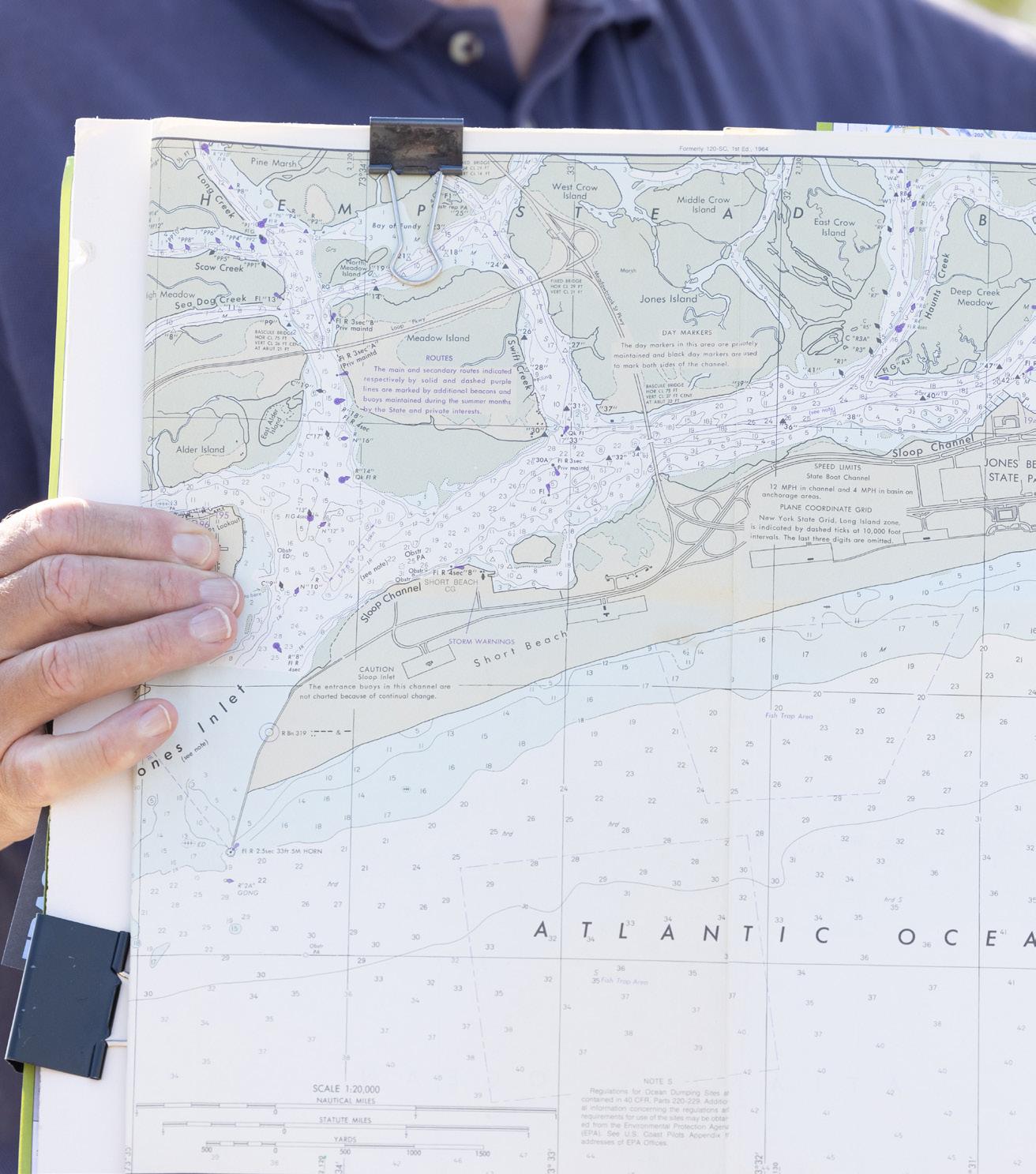
The Research: A research project led by Anthony Gordon, visiting scholar in Hofstra’s Center for STEM Research, aims to transform high school computer science education by integrating microelectronics, practical problem solving, and culturally relevant learning experiences that reflect today’s technological demands. Recently, the center received a nearly $300,000 grant from the National Science Foundation (NSF) to expand

Hofstra alumni joined students, faculty, staff, friends, and family in kicking off the spring semester at Winter Homecoming 2026. The weeklong celebration, held February 3-8, was filled with events, including a performance by comedian Trevor Wallace, that brought together the Hofstra community to celebrate and connect.
Winter Homecoming’s main event was the men’s basketball game against Towson University. Prior to tipoff, a tailgate party was held featuring games, food, music, and giveaways. The celebration continued for the 3,500 spectators who filled the David S. Mack Sports and Exhibition Complex. The Pride dominated its conference rival from start to finish on the way to a 71-49 victory.

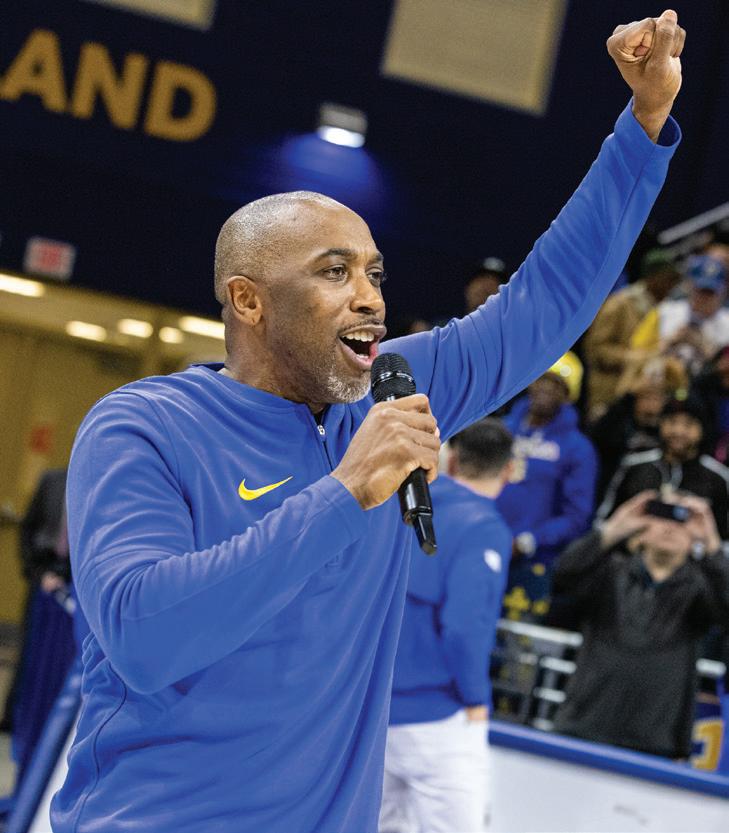
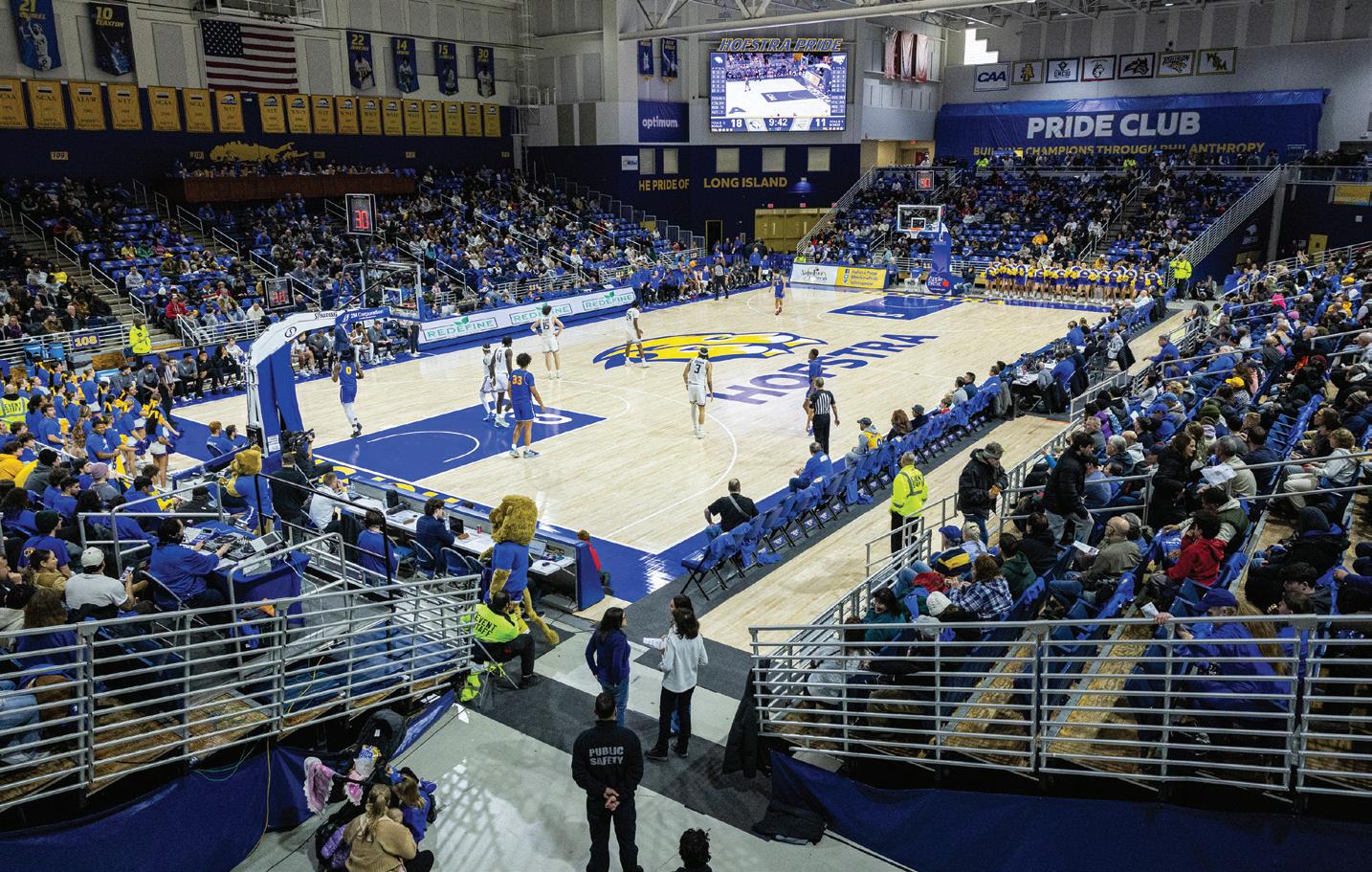
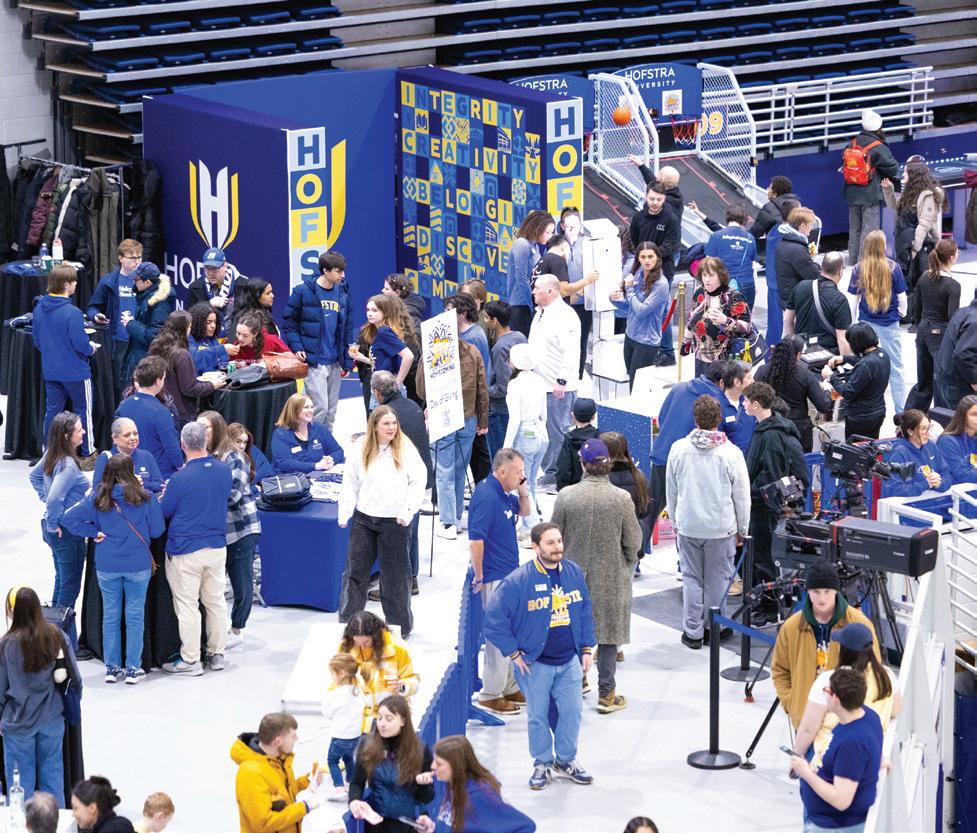
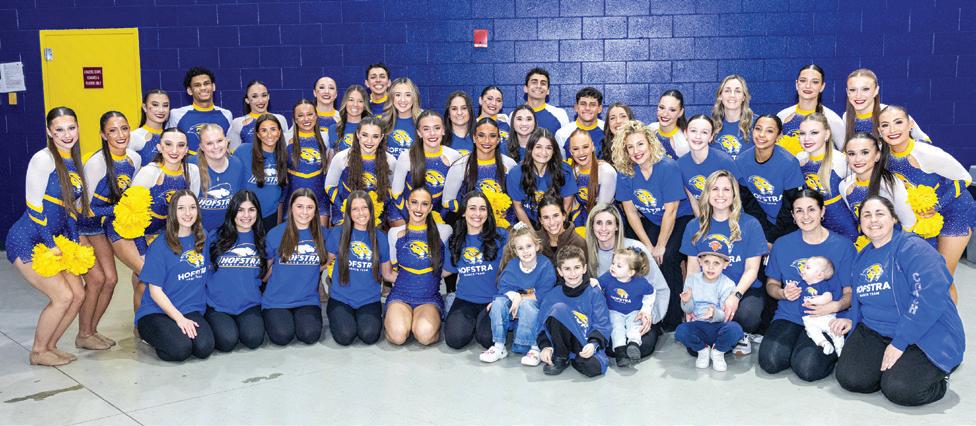

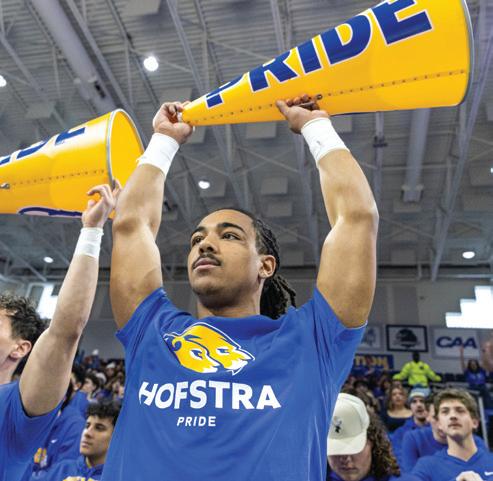
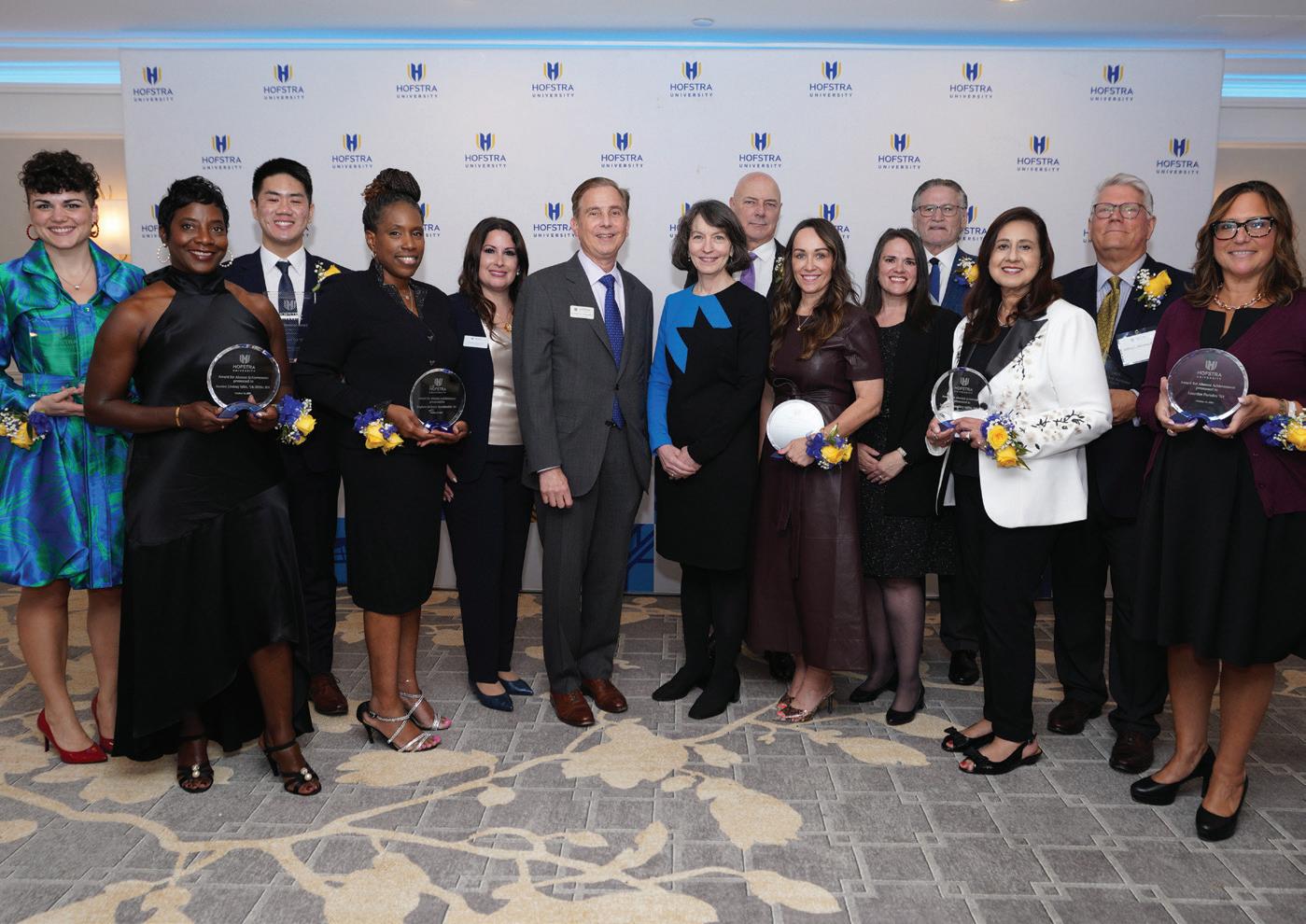
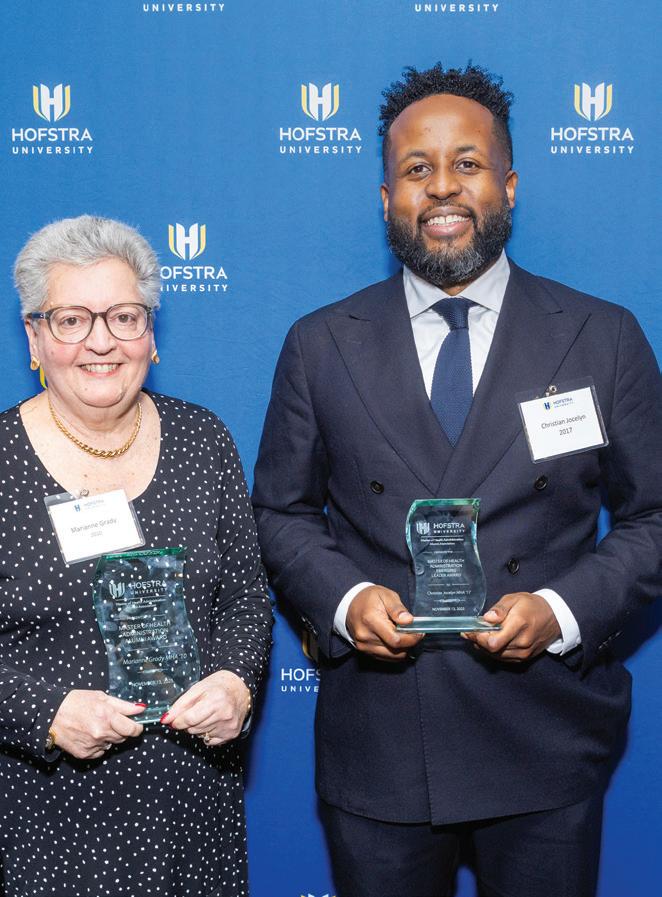
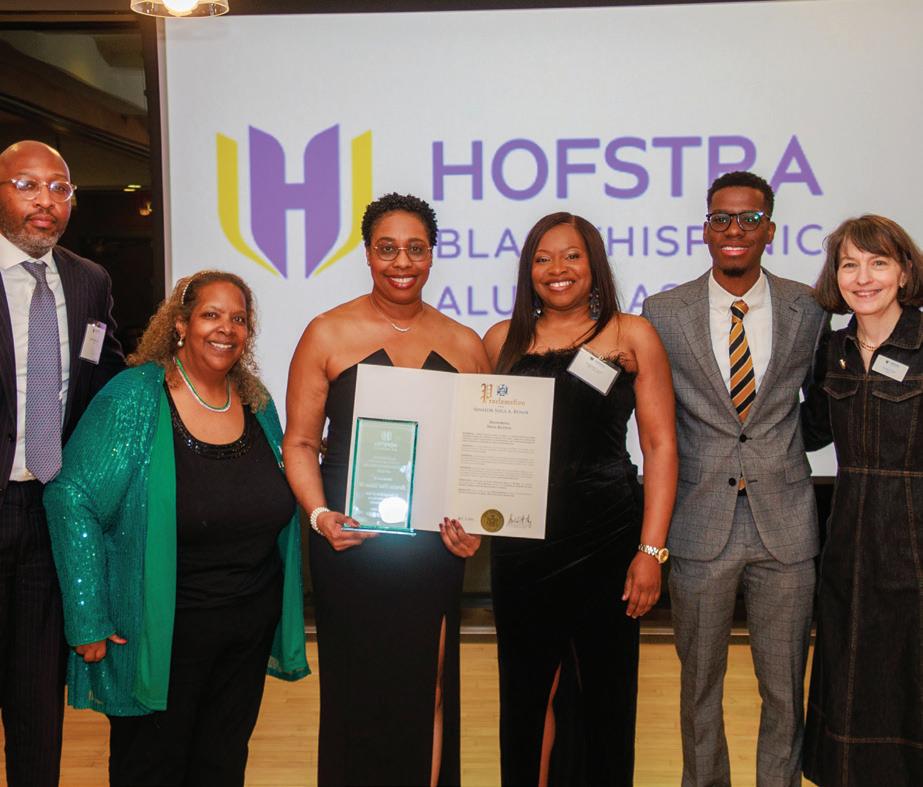
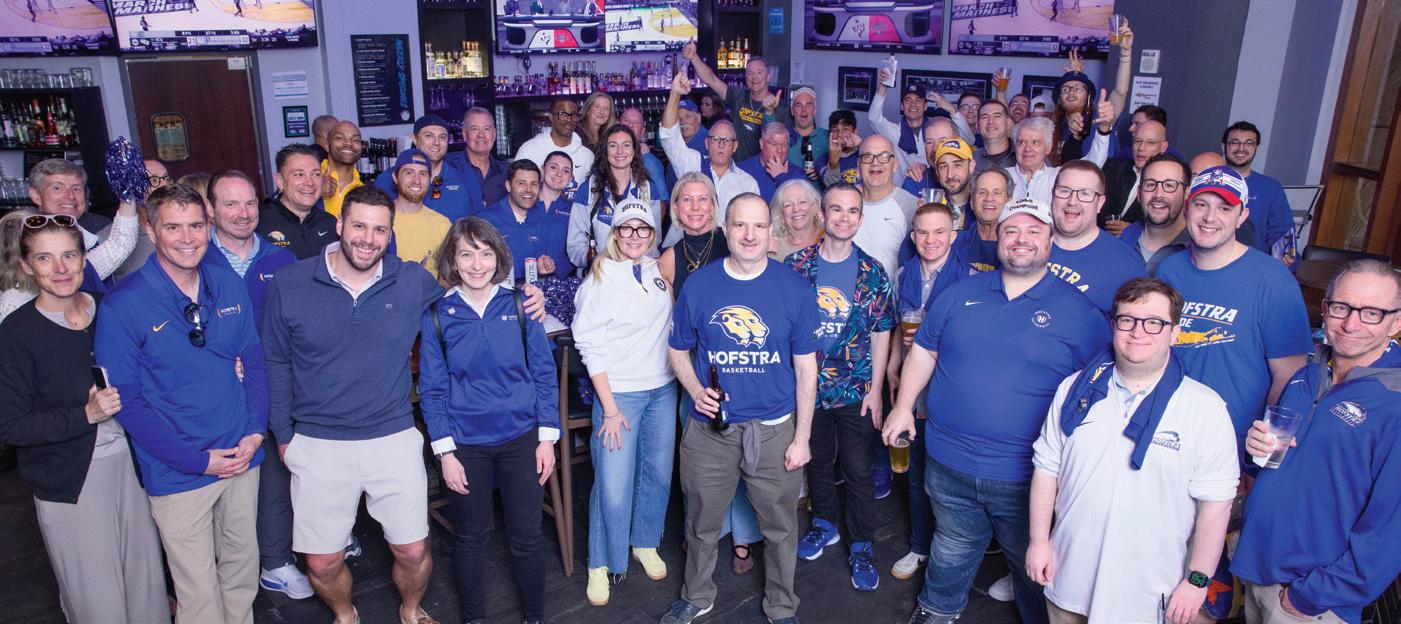
JOIN US AT AN ALUMNI EVENT
50th REUNION OF THE CLASS OF 1976
May 17
HOFSTRA ATHLETICS HALL OF FAME AND GOLF OUTING
June 1
GOLD NYC SUMMER SOCIAL June 11
WOMEN OF THE PRIDE October 7 FALL FEST
October 16-18

1964
MaryAnn (Cacioppo) Giammarco (BA, Spanish) of Bradenton, FL, has been married for nearly 59 years. She is a retired teacher and enjoys time with her four children and 11 grandchildren.
1972
Carl R. Wagreich (BA, Psychology) of Rolling Hills Estates, CA, recently retired after 46 years of practicing podiatry. Over the course of his career, he served as co-director of Operation Footprint in Mexico, Honduras, and El Salvador, and directed three podiatric residency programs. He and his wife have four sons and four grandchildren.
1974
Bill Bleyer (BA, Economics) of Bayville, NY, had his seventh book on Long Island and New York history, The Roosevelts in New York City, published by The History Press.
1975
Mitchell Maiman (BS, Engineering Science) of Medford, NY, is retired.
1977
Wendy J. Swift (MSEd, Education) of Farmington, CT, will have her memoir, A Dream Life, published by Vine Leaves Press in May 2026.
1982
Peter C. Lomtevas, Esq. (BA, Computer Science) of Brooklyn, NY, is a senior attorney for the Dutchess County Department of Community and Family Services in Poughkeepsie, NY.
1983
Bob Madeiros (BE, Engineering Science) of North Bennington, VT, recently launched his own consulting LLC. He relocated from Florida to southern Vermont, where he is enjoying a quieter pace of life away from the sun and hurricanes.
Ivo Nikolic (BS, Industrial Engineering) of Hauppauge, NY, serves as chief operations officer at Total Orthopedics & Sports Medicine. He is responsible for driving operational performance to enhance patient satisfaction and retention in alignment with the organization’s strategic plan. He is Lean Six Sigma Black Belt certified.

(BS, Computer Science) of Hempstead, NY, was honored with a 2025 Alumni Achievement Award in recognition of her professional accomplishments and continued support of Hofstra. She serves on both the DeMatteis School of Engineering and Applied Science Dean’s Advisory Board and Hofstra’s Women in Leadership Advisory Board, and remains an active member of the Hofstra community.
Laura Tringone Labenberg (BA, Speech Arts; MS, Elementary Education, ’89; MS, Foundation of Education ’90; Certificate of Advanced Study in Administration, ’93; Professional Diploma, Administration, ’93) of Hendersonville, TN, was recently promoted to director of the Young Lawyers Division and law student development coordinator for the Tennessee Bar Association in Nashville.
Richard Teed (BS, Computer Science; MBA, Finance, ’94) of Woodbury, NY, is the chief executive officer of LBi Software since 2007; a member of the Hofstra Computer Science Advisory Board since 2018; and a member of the Board of Directors of LISTnet, the Long Island Software and Technology Network.
Rose Mazzei Anasagasti (BS, Computer Science) of Southold, NY, is a senior programmer at CU*NorthWest, a credit union servicing organization. She has worked remotely part time since 1998, programming in RPG across the banking, manufacturing, and distribution industries.
John Fintland (BE, Engineering Science) of Islamorada, FL, is the principal and owner of Advanced Filtration Concepts Inc., based in Los Angeles.
Alex (Reynaldo) Jimenez (BS, Mechanical Engineering) of Las Vegas, NV, is a lead principal consultant at Backbase with 38 years of experience in financial services, specializing in strategy, innovation, and transformation. He previously held leadership roles at EPAM, Extractable, Finalytics.ai, and several major financial institutions.
Joseph Ambrose (MS, Computer Science) of Amityville, NY, retired in 2010 after a successful 30-plus-year career in IT. He now serves as the technology coordinator at his church, supporting various ministries and helping others make the most of available tech tools.
Dr. Donald Johann (MS, Computer Science) of Little Rock, AR, continues to advance research at the intersection of genomics and precision medicine. His recent work exploring whether RNA sequencing can identify clinically significant variants missed by DNA sequencing led to his fifth publication in the Nature Portfolio journals: “Augmenting Precision Medicine via Targeted RNA-Seq Detection of Expressed Mutations” (npj Precision Oncology). He also authored his 12th paper on liquid biopsy science, “Recommended Clinical Context and Patient Context Data Elements for Liquid Biopsy Data Submitted to Data Repositories and Data Commons,” published in Clinical and Translational Science
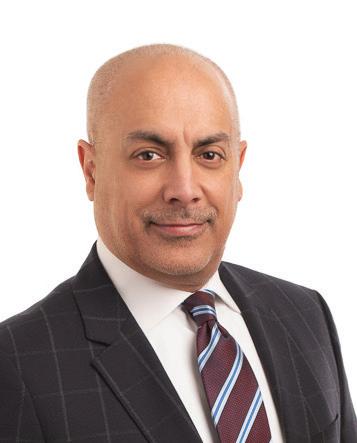
JASPREET S. MAYALL (BBA, Management; JD, ’91) of Dix Hills, NY, has been named co-managing partner at Certilman Balin Adler & Hyman LLP.
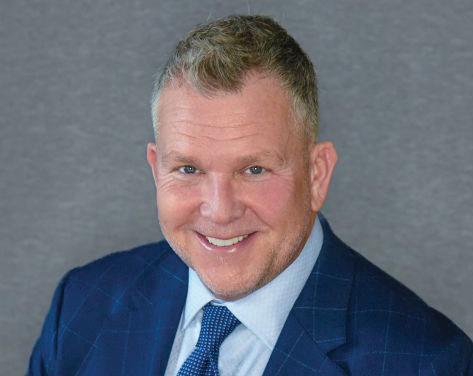
RICHARD S. SHEELEY
(BA, Social Science) of East Hampton, CT, recently joined Halloran Sage as a partner. He brings extensive family law experience to the firm.
Jeffrey Anschlowar (BE, Engineering Science) of New York, NY, founded and built Maspeth Squash, the world’s only outdoor, steel squash court.
Shawn T. Huxel (BE, Engineering Science) of Seaside Park, NJ, is the founder and CEO of Juv-n8, where he is advancing biologic systems for tissue renewal. His career has focused on launching and growing global organizations in medical devices, biomaterials, and regenerative medicine. His experience spans research and development, manufacturing scale-up, intellectual property strategy, regulatory execution, and worldwide commercialization.
Albert M. Isaacs (BA, Communication Arts) of Levittown, NY, will soon release his memoir, Finding Mary Smith. The book tells the true story of how he discovered he had been part of a 1960s gray-market adoption and uncovered the hidden history of his biological family. He shares a story of identity, resilience, and unexpected connections, and credits Hofstra with giving him a strong foundation as a storyteller and communicator.
Vincent Gagliano (BS, Computer Science; MS, Computer Science, ’95) of Centerport, NY, lives with his wife of 26 years, Annie. Both are employed at Dell Technologies, as is their son, Eli, who is based in Nashville, Tennessee. Their daughter, Gabby, is pursuing a graduate degree at Columbia University’s School of Journalism. Go Pride!
Charles R. Hoffman (BS, Computer Science) of Duluth, GA, recently joined Akur8, a French startup focused on advancing insurance pricing through AI and actuarial expertise. As head of software development for reserving, he leads a team building a new actuarial loss-reserving solution designed to help insurers strengthen performance, transparency, and decision-making worldwide.
Fredric Itkin (MA, Computer Science) of Lindenhurst, NY, works in software development as a senior IT developer.
Shari Botwin (BA, Psychology) of Narberth, PA, was recently hired by the Rutgers School of Social Work in New Brunswick to teach two graduatelevel courses focused on working with survivors of abuse and trauma. She will also be featured in an upcoming short documentary on PTSD and trauma-informed medical care. The project, commissioned by a Columbia University team, is part of a series of six short films highlighting individuals with different disabilities.
Manav Bhasin (BS, Electrical Engineering) of Plainview, NY, is vice president and chief information officer at Presidio.
Marie Catheline Jean-Francois (BA, Creative Writing & Literature) of Richmond Hill, NY, selfpublished their debut novel in July 2024 under the pen name Cathelina Duvert. Their novel, The Box, reveals the power of resilience and self-discovery in the face of one woman’s journey through depression, offering a tale of redemption and healing.
Erik J. Leach (BE, Civil Engineering) of Alpharetta, GA, is director of capital programs delivery at the Metropolitan Atlanta Rapid Transit Authority (MARTA), responsible for State of Good Repair and Systems programs.
Danyel Racenet (BE, Engineering Science) of Hastings, FL, recently transitioned to a new role at Medtronic, where she now leads the physiological sensing R&D teams within the company’s monitoring business. She previously worked in the ENT division. Danyel is a long-standing member of the DeMatteis School Dean’s Advisory Board.
Heather Cohen (BA, Audio/Radio) of Melville, NY, is president of The Weiss Agency and will be honored as one of eight recipients of the 2026 Leadership Awards from the Broadcasters Foundation of America.
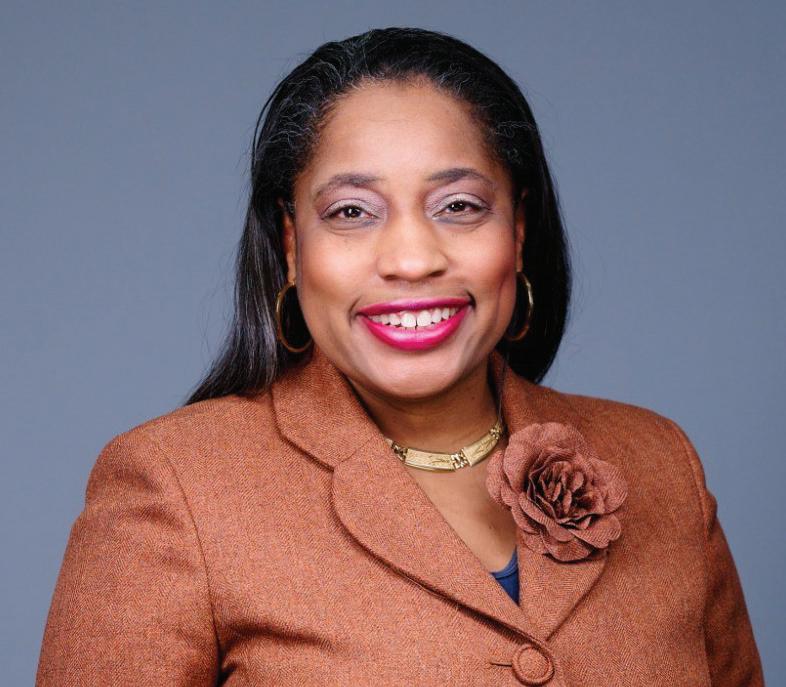
(MA, Health Administration; MBA, Strategic Business Management, ’13) of Brentwood, NY, was appointed assistant vice president of graduate medical education, clinical affairs, and business strategy in the Office of the System Chief Medical Officer at NYC Health + Hospitals. In this role, Memnon provides strategic system-wide leadership to advance operational excellence, strengthen the physician workforce, and support high-quality, patientcentered training.
Jennifer Ann Redmond (BA, Speech-Language Pathology) of Lindenhurst, NY, recently had their fourth book, Too Fast, Too Short: The Life of Diana Barrymore (University Press of Mississippi), published to excellent reviews.
Paul Trapani (MS, Computer Science) of Bay Shore, NY, is co-founder of PassTech Development, a software consulting and development company. He is also president of the Long Island Software Technology Network (LISTnet).
KEVIN MCGUIRE
(BBA, Business Administration) recently published his first novel, Sleeper Code, which became an Amazon No. 1 international bestseller. Additionally, Kevin was selected to be a featured author at the London Book Fair in March 2026.
Elaine E. Liberato Jenkins (BS, Professional Studies) of Concord, NC, moved to Charlotte in 2011 after starting her family on Long Island. She has worked in the field of infant and early childhood mental health since 2004. In 2017, Elaine began teaching in the Child and Family Development and Special Education department at the University of North Carolina at Charlotte’s School of Education. She is also co-founder of an educational consulting company that provides professional development, technical assistance, and family support services to early childhood educators and families. She is a proud mother of three children and two dogs.
Patrick Crea (MSEd, English Education) of Mineola, NY, was appointed assistant principal of Nassau BOCES Joseph M. Barry Career and Technical Education Center in Westbury. Barry Tech is the agency’s state-of-the-art, premier career and technical education (CTE) high school, serving more than 1,100 students from districts throughout Nassau County.
(BA, Print Journalism) of Lake Grove, NY, is vice president of digital technology and communications at Ark Technology Consultants and was elected president of the Society of Professional Journalists, the nation’s largest journalism organization. He and author, journalist, and retired Newsday reporter Bill Bleyer ’74 of Bayville, NY, have been named to the Society of Professional Journalists Foundation board.
Joshua Sankowski (BA, Political Science) of Rochester, NY, was recently promoted to senior housing development collaborator at PathStone Development Corporation. He was also selected to serve on the NeighborWorks America Communications and Marketing Advisory Committee and joined the Jewish Family Services of Rochester Board of Directors.
Chintan Sheth (BS, Mechanical Engineering) of Ronkonkoma, NY, is working as a control account manager in the Cryogenics Department at Brookhaven National Laboratory. The team is wrapping up the final run of the Relativistic Heavy Ion Collider (RHIC), concluding 25 years of operation.
Paul Salmon (BS, Computer Science) of Denver, CO, is working as a data engineer for Todyl, a cybersecurity startup out of Denver.
Dr. Arik D. Adhami (BE, Engineering Science) of Great Neck, NY, opened PureDent Plainview in August 2023, a family-oriented dental practice specializing in implant and cosmetic dentistry, emergency care, and comprehensive treatment. He draws on his engineering background to bring added precision and technical insight to complex procedures, including implants and root canals.
Jonathan Ledesma (BE, Engineering Science) of Franklin Square, NY, is a project manager for a construction company. He is currently involved in three projects located in Manhattan, the Bronx, and Nassau County, including renovation of a campus building at Nassau Community College.
Adam Patrick Seeman (BS, Computer Science; BA, Film Studies & Production) of Conshohocken, PA, joined Ramp as a staff software engineer in August 2025.
Ian Kornfeld (BS, Mechanical Engineering) of Farmingdale, NY, is a recent recipient of the Young Pipeliners International John Tiratsoo Award for Young Achievement, which recognizes significant contributions to the pipeline industry by professionals under the age of 36.
Keith Abbott (BA, Computer Science) of South Huntington, NY, is a professional services supervisor at a managed service provider, where he oversees field technicians across the downstate New York area. The company focuses on supporting small to midsize businesses, with a concentration in the healthcare industry.
Mihir Desai (MS, Computer Science) of Levittown, NY, is an application development manager at Jovia Financial Credit Union.
Kylan Duff (BS, Industrial Engineering) of Rochester, MN, is nearing the end of his third year with Hormel Foods. He was recently promoted to industrial engineering manager at the company’s Planters facility in Fort Smith.
(BA, Public Relations) of Endwell, NY, serves as manager of media, communications, and events at New York Transco. She was recently honored with the company’s 2025 Innovator of the Year Award for leading the development of the Propel NY Energy mobile app, an interactive communications tool that provides timely project updates to communities along the 90mile electric transmission improvement project spanning Long Island, Queens, the Bronx, and Westchester County. The app was co-developed with the New York Power Authority.
(BA, English Literature and Drama; MFA, Creative Writing, ’19) of Fort Salonga, NY, published his first novel, The Path of Redemption. Set in Italy, where he studied abroad during his time at Hofstra, the book draws on the architecture, art, and culture of Florence, the Tuscan countryside, and the landmarks of Rome.
William Pedone (BS, Electrical Engineering) of Ozone Park, NY, works for LiRo-Hill as a senior project engineer and construction manager. He oversees midsize public projects ranging from $10 million to $65 million, including boiler and hot water heater replacements for New York City Housing Authority developments.
(JD) of Staten Island, NY, was elevated to partner at Glenn Agre Bergman and Fuentes LLP, effective January 1, 2026. An attorney with the firm since its founding in 2021, he has built a litigation practice representing hedge funds, investment managers, private equity sponsors, lender groups, and corporate fiduciaries. His work centers on complex disputes involving distressed investments, liability management transactions, corporate governance matters, bankruptcy litigation, and accounting malpractice claims.
Robert Adelson (BE, Bioengineering) of New York, NY, has served since March 2025 as a data scientist and head of research at a startup dedicated to detecting, reporting on, monitoring, and preventing the spread of digital misinformation.
Alexander Hayes (BA, Economics) of Erie, PA, completed his PhD in Political Science at UCLA last year and now works as a senior data scientist at YouGov. He appeared as a contestant on Jeopardy! on September 16, 2025.
Robert Kollmer (BS, Mechanical Engineering) of Levittown, NY, recently transitioned from his role as a consulting engineer designing HVAC systems to a forensics engineer, where he analyzes the root causes of construction defects in mechanical, electrical, plumbing, and fire protection systems in buildings across the country. He also serves as an adjunct instructor of engineering at Hofstra.
Ahsan Sandhu (BE, Civil Engineering) of Bethpage, NY, works as a lead civil engineer in utilities and an adjunct instructor at local colleges.
Michael Lazarus (BA, Computer Science) of Westampton, NJ, recently married fellow 2019 graduate Eri Ahmed. The couple moved into a new home, where they are settling in with their two cats.
(MHA, Health Administration) of Valley Stream, NY, is a healthcare executive, educator, and ordained minister. He currently serves as associate executive director of emergency services at NYC Health + Hospitals/Queens. In this role, he oversees the Emergency Department and leads hospital-wide emergency management efforts. In addition to his hospital leadership, Robinson is president of B. Robinson Consulting LLC, where he advises missiondriven organizations and emerging leaders on strategy, system transformation, and equityfocused leadership. He also serves as president of the Hofstra University Master of Health Administration (MHA) Alumni Association.
Liane Sousa (BA, Journalism) of Bronx, NY, is an account executive at Wave Sports & Entertainment. She works with major cultural voices, including Kylie Kelce’s Not Gonna Lie podcast and Carmelo Anthony’s 7PM in Brooklyn In her role, she develops multiplatform advertising sales packages for leading national brands, using the company’s audio, digital, and broadcast platforms along with its talent roster.
Maggie Ruggiero (BS, Industrial Engineering; MS, Engineering Management, ’23) of Massapequa Park, NY, recently started as a project coordinator at Precision Signs in Amityville, NY, and is getting her CAPM, on her way to her PMP.
Chris Ottusch (BS, Engineering Science; MS, Computer Science, ’23) of Northport, NY, is working at Northrop Grumman in Bethpage on the G/ATOR (Ground/Air Task-Oriented Radar) system. The program has recently drawn media attention for its advanced capabilities and growing role in national defense.
Sami McDonnell (BS, Industrial Engineering) of North Royalton, OH, is an industrial engineering specialist at Ford Motor Company’s Cleveland Engine Plant. She joined Ford in April 2023.
Nicholas Caliendo (BS, Biomechanics) of Oyster Bay, NY, is a design engineer at A Step Ahead Prosthetics, where he designs prosthetic covers and models facial prosthetics for patients.
Anthony Terzulli (BS, Industrial Engineering) of Elmont, NY, completed two years at General Motors in Spring Hill, Tennessee, where he served as a process engineer overseeing equipment installation and machine readiness procurement. He recently joined Vanderlande Industries at the New Terminal One at JFK Airport as a process engineer supporting the automated baggage handling system. Anthony is part of a team focused on continuous improvement and advancing high-performance culture initiatives at airports across the East Coast.
Foijul Islam (BS, Mechanical Engineering) of Dhaka, Bangladesh, returned to Bangladesh and now serves as a director in his family’s water faucet manufacturing business. He is focused on introducing automation to improve operations and developing more water-efficient, high-end products.
Brandon Wolmer (BS, Mechanical Engineering) of West Hartford, CT, is a junior design engineer at NEFCO, a construction supply company that provides engineering design for pipe support systems.
Diana Bayandina (MS, Computer Science) of Brooklyn, NY, was selected as a presenter for the WiCyS 2026 Conference in Washington, D.C., chosen from nearly 1,000 submissions. She will present her research on defending large language models against prompt injection and hallucination risks, highlighting her continued focus on trustworthy AI, cybersecurity research, and engagement with the global tech community.
Ashley García Cervantes (BS, Computer Science) of Hempstead, NY, works as a cybersecurity consultant at Accenture, where she helps clients strengthen security with a focus on data and AI security. She holds CompTIA Security+ certification and has completed ethical hacking training. Ashley also serves as a project manager for one of her workstreams and is a committee member of Accenture’s NY Metro People Advocacy Network in Security.
Alexander Charest (BS, Industrial Engineering) of Baldwinsville, NY, is an engineering associate in the Early Leadership Development Program at Avient Corporation.
Sung Choi (BA, Computer Science) of Levittown, NY, has more than 10 years of active duty service in the U.S. Army and currently serves as a signal officer.
Weijia Deng (MS, Computer Science) of Reston, VA, is a web developer.
Jared Fuller (BA, Computer Science) of Hempstead, NY, is currently seeking opportunities in data analysis or software engineering. He recently completed a company certification, which he added to his resume.
Luis Hernandez (BS, Civil Engineering) of Katy, TX, is working as an engineer for TallGrass Energy.
Robert Karakasians (BS, Mechanical Engineering) of Seaford, NY, works at MGE in New York City, where he designs HVAC systems for high-rise buildings in New York and Florida. His experience includes core and shell developments as well as residential projects. He specializes in advanced climate control solutions, including Variable Refrigerant Flow systems and water-source heat pumps to improve efficiency.
Rebecca Lee Rode (BS, Mechanical Engineering) of Deer Park, NY, is attending Hofstra University’s Fred DeMatteis School of Engineering and Applied Science full-time to earn a master’s in engineering management.
MARRIAGE
2010
Meghan Foley Scavone (BA, Elementary Education & Psychology; MSEd, ’13) of Middletown, CT, married Jonathan Scavone on September 20, 2025.
Doris E. Rouse (BA, ’50)
Louis H. Irwin (BS, ’54)
Geraldine T. Walsh (MSEd, ’55)
Marcia L. Yeates (BA, ’55)
Kenneth R. Willenbruch (BBA, ’56)
Gloria E. Siegel (MSEd, ’58)
Joan Skrobala (BA, ’58)
Lawrence Evers (BA, ’59)
William R. Laky (BA, ’59)
Harold P. Seale (BA, ’59)
Charles W. Hildebrandt (BS, ’60)
Rita S. Risch (MSEd, ’60)
Carolee C. Olsen (BSEd, ’61)
Louis Ragosta (MSEd, ’61)
Charles J. Staropoli (BA, ’62)
Kathleen Strait (BA, ’62)
Barbara Brown (BA, ’63)
William R. Brown (BBA, ’63)
Joseph N. Candelora (BA, ’63)
Gilbert J. Collins (BA, ’63)
Michael Pasetsky (BA, ’63)
Helen Sherman (BSEd, ’63)
John F. Lundie (BS, ’64)
James J. O’Reilly (BS, ’64)
Constantine J. Prokop (MBA, ’64)
Hella Amelkin (BA, ’65)
Donald P. Cummings (BA, ’65)
Kenneth J. Skoglind (MBA, ’65)
Ronald B. Cohen (BA, ’66)
Robert P. Moncsko (BS, ’66)
David M. Posner (BA, ’66)
David R. Tiffany (MA, ’67)
Clare Aitken (BSEd, ’68)
Selma Clark (MSEd, ’68)
Brook K. Dubovick (BA, ’68)
Kenneth S. Held (BBA, ’68)
Elizabeth C. McCarville (MSEd, ’68)
Frances B. O’Connor (MA, ’68)
Valerie Roessner (BA, ’69)
Paula R. Shaer (MSEd, ’69)
Linda C. Wenze (BA, ’69)
Charles E. Rosen (MA, ’70)
Francis E. Woelfel (MSEd, ’70)
Vito M. Martino (MSEd, ’71)
Mark W. Sullivan (BA, ’71)
Karen R. Taber (BSEd, ’71)
Nickey J. Hutcherson (MSEd, ’72)
Bernadette Matthews (BA, ’72)
Brian Hawkins (MSEd, ’73)
Robert A. Schoepflin (MBA, ’73)
Gary H. Wolf (BS, ’75)
Penny M. Novello (BA, ’76)
Bruce S. Patterson (MBA, ’76)
Mary H. Smith (JD, ’77)
Sheldon Schmidt (PhD, ’78)
William Finger (MA, ’79)
Deborah Ellen Friend (MSEd, ’79)
Edward P. Hayden (BA, ’79)
Frederic A. Keating (EdD, ’79)
Alan J. Leo (BS, ’79)
Kevin R. Conroy (BBA, ’80)
Michael H. Greco (BA, ’81)
Marcy Lynn Holmes (BA, ’82)
Donald C. Jones (BA, ’84)
Susan MaryAnn Kenney (BS, ’84)
Patricia Bock (PD, ’85)
Mildred C. McCarthy (MS, ’86)
Daniel K. Sack (BBA, ’88)
Beth S. Block (JD, ’89)
Joel C. Evaristo (BBA ’93)
Britt Connolly (BBA ’94)
David N. Neidhart (BA, ’01)
Nicole Rubert (BA, ’01)
Kemba Miles (JD, ’04)
Marit A. Sadaka (BBA, ’05)
Joshua J. Kellett (BA, ’08)
Arsha Alexander (BA, ’09)
Alexander Filotti (MBA ’09)
Paul Romano (BBA, ’11)
Peter Robert Dwyer (BBA, BA, ’12)
Brandon V. Bonistall (BBA, ’15)
This information is current as of April 1, 2026.
The Hofstra community is deeply saddened by the passing of Wilbur Breslin, trustee emeritus of the Hofstra University Board of Trustees, on April 1, 2026.
Mr. Breslin maintained a long-standing and meaningful relationship with Hofstra University, serving as a member of the Board of Trustees for 16 years before being named trustee emeritus. He and his family made generous and transformative contributions to the University that strengthened Hofstra’s academic mission and impact. In 2013, he was celebrated as an honorary Hofstra alumnus. His son, Kenneth ’86, and grandson, Justin ’21, are both graduates of the Maurice A. Deane School of Law at Hofstra University.
In recognition of his philanthropy and leadership, Hofstra named Wilbur and Dorothy Breslin Hall and established the Wilbur F. Breslin Center for Real Estate Studies.
Mr. Breslin supported a wide range of not-for-profit organizations across Long Island through the Breslin Family Foundation. His legacy of leadership, generosity, and service to Hofstra University and the broader community will endure for generations.
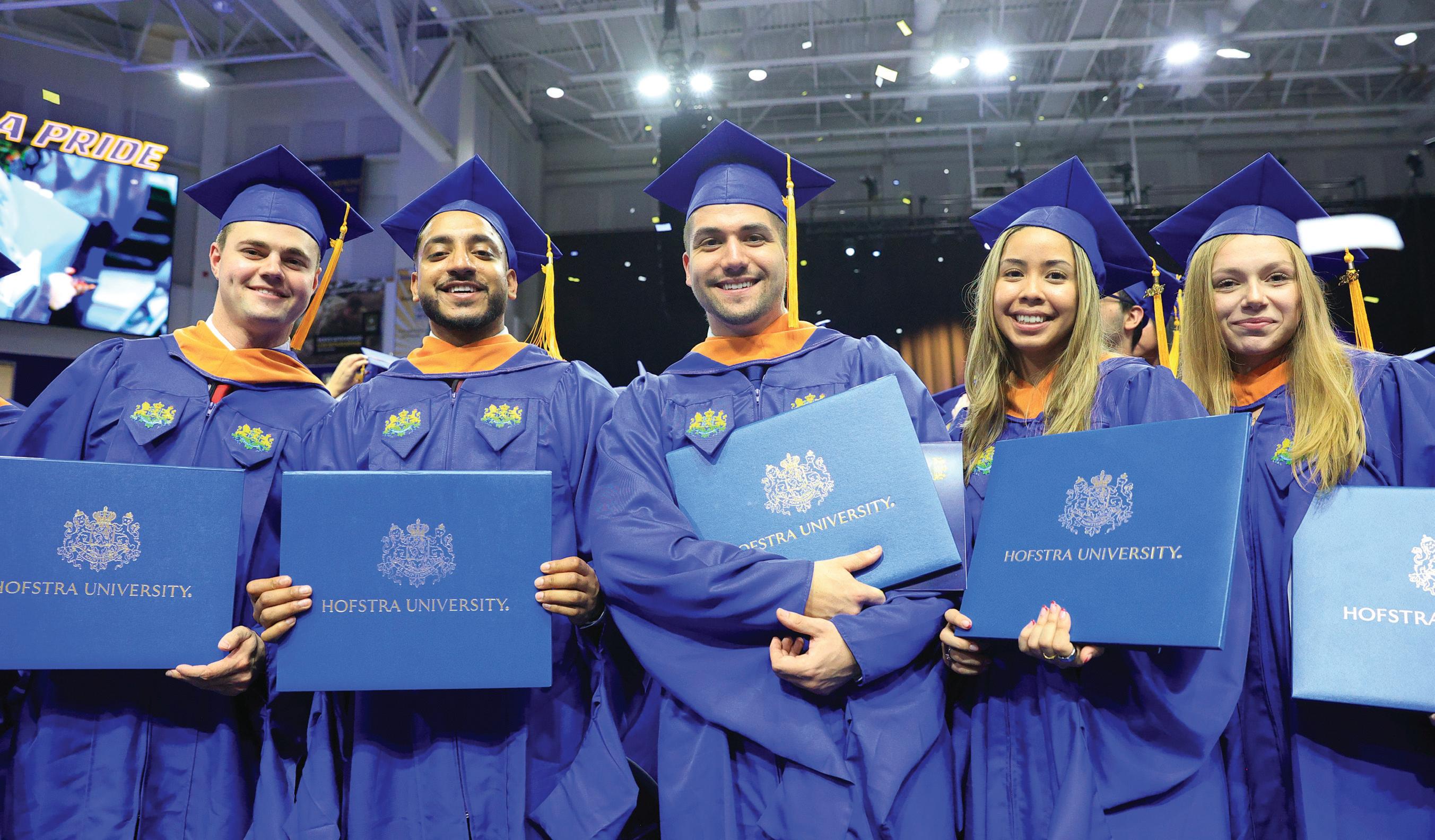
As Hofstra approaches its centennial year in 2035, the University is building for the future — strengthening academic distinction, driving discovery, and empowering the next generation of leaders.
But the future does not happen on its own. Your support will help turn ambition into action and position the University for long-term success.
Give today. Shape tomorrow.
Scan the QR code to make your gift today.
Hempstead, New York 11549
Hempstead, New York 11549
Issue No. 5 | Fall 2025
Issue No. 6 Spring 2026