HOFSTRA M
A
G
A
Z
I
N
E
2014-2015 INSIDE: Medical Milestones | Meet Our New Provost | Urban Explorers
’’
We are increasingly a city-dwelling species, and that means our animal and plant experiences occur in cities – not from traveling to Yosemite or the Amazon or the Outback. Fewer and fewer people are going to see bears in the woods — they’re going to see bears in their backyards.
Urban Explorers ’’
— Dr. Russell Burke
Urban Explorers
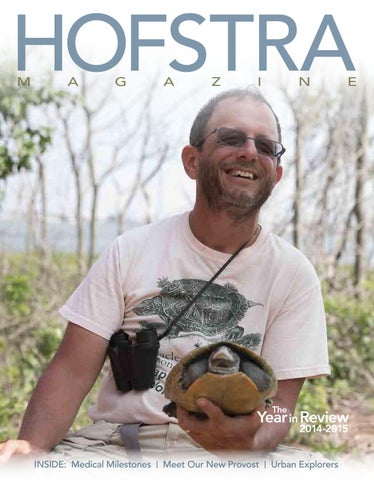
From turtles on the tarmac to coyotes in Central Park, Dr. Russell Burke’s job is to meet the neighbors. That’s because Burke, an urban ecologist and chair of Hofstra’s Biology Department, has devoted his career to studying the habits and habitats of city wildlife, which are increasingly popping up in some very public places. Like Runway 4L at John F. Kennedy Airport, where hundreds of turtles have delayed flights three times in the past six years. Like Lower Manhattan, Riverside Park, even on the roof of a bar in Long Island City — all spots where coyotes were sighted this spring. “This is not what ecologists thought was going to happen 30 years ago,” Burke said. “We thought the cities would be a wasteland for wildlife, and city kids would grow up never having seen an animal other than a pigeon or a squirrel. But more animals and plants have adapted to city life than we expected.” “For people who study human-wildlife interactions,” he said, “cities and suburbia are where the action is.” And Burke is one of the local experts that government agencies, as well as media outlets, call on to make sense of this evolving urban landscape.
The Trouble With Turtles Enter Dr. Burke, who has been researching turtle behavior in the nearby Jamaica Bay Wildlife Refuge with his students for nearly a decade. “We were in the right place. We knew a lot about the terrapins in Jamaica Bay when, all of a sudden, the terrapins in Jamaica Bay became a big problem,” he said. “It went from nothing going on at JFK to something very big.” Two years later, the turtles were back on Runway 4L, only this time there were more than 150. And in 2014 it happened again. By then, Burke and his students were working with the Port Authority and its wildlife biologists to explain the phenomenon and find a permanent solution. It turns out the turtles that clambered onto Runway 4L were not from the same population that Burke and his students were studying, or even those that the Port Authority was already tracking at the airport. The Runway 4L terrapins were smaller and younger than those Burke and Port Authority officials had seen before, suggesting that “something happened to predators of terrapin eggs” — most likely raccoons — that allowed more hatchlings to survive than usual, Burke said. continued on next page
8
Hofstra
2 014 -2 015 I n R e v i e w
Hofstra
2 014 -2 015 I n R e v i e w
9
Urban Explorers Coyote City
’’
And New Yorkers got quite an introduction earlier this year, when a spate of coyote sightings captured the city’s attention.
I thought – that’s just crazy, this is the city. Then, once you get that first introduction to wildlife in the city, you start to notice it everywhere.
’’
— Melissa Zostant, BS, ’14; MS, ’16
Over the past two years, the Port Authority has installed black plastic tubing to create a physical barrier too high for the turtles to climb – and the solution seems to be working, except when the occasional high tide washes some turtles over the tubing. Burke’s collaboration with the Port Authority led one of his graduate students, Melissa Zostant, to focus her thesis on the turtle population at JFK. For the past two summers, she’s been working with the airport’s wildlife biologists as a paid intern.
There have been at least seven coyote sightings in New York City this spring alone – in Riverside Park; in a backyard in Middle Village, Queens; and in Lower Manhattan, where a female coyote led police on a two-hour chase before being caught near an outdoor café. “The coyotes are altogether new – never in the East before,” said Burke, who co-wrote a study released this spring titled “Coyotes Go ‘Bridge and Tunnel’: A Narrow Opportunity to Study the Socio-ecological Impacts of Coyote Range Expansion on Long Island, NY Pre- and Post-Arrival,” about the migration of coyotes into New York City and, eventually, Long Island. “To them it’s just habitat for them to live. There’s food, there’s shelter – everything they need.” The first documented evidence of a coyote in New York City came in 1997, when a dead coyote – apparently hit by a car – was found on the Major Deegan Expressway in the Bronx. A few years later, a coyote was captured in Central Park.
“I never really thought of turtles as a research animal until I started volunteering with Dr. Burke,” said Zostant, who earned a BS in biology at Hofstra in 2014. “I really do love turtles. They’re really charismatic and have their own little personalities.”
“There’s going to be a time when coyote sightings are no longer news,” Burke told the New York Daily News in a story about a coyote captured in Queens. “In Los Angeles and Chicago, there are coyotes, and no one really pays attention.”
The first time Zostant trekked through the swampy, peaceful isolation of the Wildlife Refuge to participate in Hofstra’s terrapin project, the Albany, N.Y., native was stunned to discover a different world so close to the concrete jungle of Gotham.
But on Long Island, where there have been relatively few coyote sightings so far, there’s more at stake than a few tabloid headlines. As the animals’ numbers inevitably grow, there is “a rare and time-sensitive [scientific] opportunity” to research coyotes’ social and ecological impact on a densely populated area, as well as their interaction with people, according to Burke’s study.
“I thought – that’s just crazy, this is the city,” she said. “Then, once you get that first introduction to wildlife in the city, you start to notice it everywhere.”
“We are increasingly a city-dwelling species, and that means our animal and plant experiences come in cities – not from traveling to Yosemite or the Amazon or the Outback,” Burke said. “Fewer and fewer people are going to see bears in the woods — they’re going to see bears in their backyards.”
10
Hofstra
2 014 -2 015 I n R e v i e w
Centers for Invention support the to s re tu n e v w ile providing g two ne h in w h c n n o u ti la a v is o y n in rsit and promote e. Hofstra Unive t n e m p lo e v e d rld experienc o ic w m lo a n re o c le e b ’s a lu region ents to get va w on the d tu s r fo s e fall, will dra ie th it in n g in tu r en o p o p op eurship, science, and medicine to build a n re p e tr n E r lied r fo ary Cente ring and app interdisciplin anies. s, law, enginee
The f busines star tup comp the schools o m, and advise ra g e ro p resources of r to ra le S) launched th unch an acce Science (SEA d lie p p curriculum, la A d ring exper tise ng an l and enginee l of Engineeri ca o ni ho ch Sc te e e d th , vi pro rlier this year a professors Meanwhile, ea which Hofstr in , n o ti a r Innov research centers. d socially Center fo esses and educational an f in o us n b l io ct na io lle g co to re Acting the own jewel in y,” said SEAS cr it a un e m b m to co es er id n promis ffers to the w for Innovatio a University o tr fs “The Center o H es ic llectual serv cal problems conscious inte PhD. ractical techni p y, n an o b rk ab o R w na ity to exposure Dean Si the opportun perience and ve ex ha d rl y o lt -w cu al Fa ar ticipants: h perspec tive udents gain re benefits all p ho bring a fres unity, while st w m ls m na co s io ss es The initiative in fe nts in the e bus h pro ploy consulta interest to th to par tner wit em te le ill ia w ab r ed e m te ar s im en f ie C o am compan e solution. The res that the te sues. In turn, for an in-hous y. “This ensu tr , ig b us to industry is d o in to in ic g e if ar spec ors, en eers projects that nced profess exper tise in a ie h it er w p ex er f b to issues and o em up ym ailable, made Hofstra facult novation. be the best av absence of a ill Center for In w e m th le f b o ro r p to a ec e ir lv d , so PhD assembled to Kevin Craig, y resulting ips in that an ientists,” says sh sc er d tn an ar p rs s ne ines kept low, desig university-bus d cost will be er ea th rh o ve m o o , fr lly dif ferent d software. any. Additiona r Innovation is equipment an e hiring comp s, th b y la b S A ed The Center fo in SE ta a tr e re vested in Hofs roper ty will b es will be rein intellectual p fe d ea rh ve o ised by and monies ra Hofstra
2 014 -2 015 I n R e v i e w
11
Hempstead, New York 11549 Vol. 27 No. 1 • The Year in Review 2014-2015
61058:7/15
Non-Profit Org. U.S. Postage PAID Hofstra University
Urban Explorers See page 8.