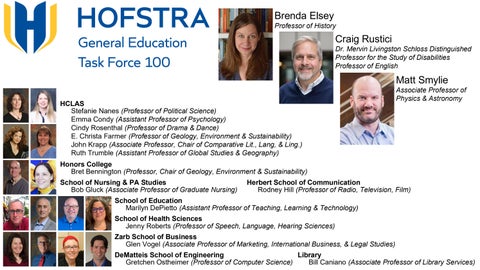
Brenda Elsey Professor of History
Craig Rustici Dr. Mervin Livingston Schloss Distinguished Professor for the Study of Disabilities Professor of English
Matt Smylie HCLAS Stefanie Nanes (Professor of Political Science) Emma Condy (Assistant Professor of Psychology) Cindy Rosenthal (Professor of Drama & Dance) E. Christa Farmer (Professor of Geology, Environment & Sustainability) John Krapp (Associate Professor, Chair of Comparative Lit., Lang, & Ling.) Ruth Trumble (Assistant Professor of Global Studies & Geography)
Associate Professor of Physics & Astronomy
Honors College Bret Bennington (Professor, Chair of Geology, Environment & Sustainability)
School of Nursing & PA Studies Bob Gluck (Associate Professor of Graduate Nursing)
Herbert School of Communication Rodney Hill (Professor of Radio, Television, Film)
School of Education Marilyn DePietto (Assistant Professor of Teaching, Learning & Technology)
School of Health Sciences Jenny Roberts (Professor of Speech, Language, Hearing Sciences) Zarb School of Business Glen Vogel (Associate Professor of Marketing, International Business, & Legal Studies) DeMatteis School of Engineering Library Gretchen Ostheimer (Professor of Computer Science) Bill Caniano (Associate Professor of Library Services)
The General Education Task Force 100 Work is Ongoing
Literacy
Inquiry
Expression
Engagement
Agility
What does our Gen Ed system look like?
-Dated -Complex -Disconnected
?
LT, AA, CP, NS, MA, CS, BH, HP, CC, IS, WI, QR
?
ASTR 011 + HIST 106 + ENG 180 = ?
Literacy
Inquiry
Expression
Engagement
Agility
What do faculty want a Gen Ed system to look like?
-Clear in purpose -Simple in structure -Breadth with connection
University Degree Requirements 6 credits Humanities
8 courses
BA BS BFA BSEd BE BBA 64 programs
43 programs
4 programs
6 credits Natural Science / Mathematics
4 programs
1 program
6 credits Social Science
10 programs
*not counting several dual-degree programs
3 credits WSC 001 , 3 credits WSC 002
Very checklist. Very disconnected. Not intentional. Let's emphasize purpose and impact to students
University Degree Requirements
8 courses
6 credits Humanities 3 credits Creative Innovation , 3 credits Artistic Inquiry 6 credits Natural Science / Mathematics 3 credits Scientific Inquiry , 3 credits Quantitative Inquiry 6 credits Social Science 3 credits Foundational Concepts , 3 credits Social Contexts 3 credits WSC 001 , 3 credits WSC 002
Let's emphasize purpose and impact to students
BA BS BFA BSEd BE BBA 64 programs
43 programs
4 programs
4 programs
1 program
10 programs
*not counting several dual-degree programs
University Degree Requirements
8 courses
3 credits Creative Innovation , 3 credits Artistic Inquiry 3 credits Scientific Inquiry , 3 credits Quantitative Inquiry 3 credits Foundational Concepts , 3 credits Social Contexts
BA BS BFA BSEd BE BBA 64 programs
43 programs
4 programs
4 programs
1 program
10 programs
*not counting several dual-degree programs
3 credits WSC 001 , 3 credits WSC 002 These “categories” replace all tags (LT, AA, CP, NS, MA, CS, BH, HP, CC, IS, WI, QR) used for BAs
Let's emphasize purpose and impact to students
University Degree Requirements
8 courses
3 credits Creative Innovation , 3 credits Artistic Inquiry 3 credits Scientific Inquiry , 3 credits Quantitative Inquiry 3 credits Foundational Concepts , 3 credits Social Contexts At least 1 of these 6 courses will have the Intercultural Competence tag
BA BS BFA BSEd BE BBA 64 programs
43 programs
4 programs
4 programs
1 program
10 programs
*not counting several dual-degree programs
3 credits WSC 001 , 3 credits WSC 002 These “categories” replace all tags (LT, AA, CP, NS, MA, CS, BH, HP, CC, IS, WI, QR) used for BAs
Let ’s incorporate an updated CC
University Degree Requirements
8 courses
3 credits Creative Innovation , 3 credits Artistic Inquiry 3 credits Scientific Inquiry , 3 credits Quantitative Inquiry 3 credits Foundational Concepts , 3 credits Social Contexts At least 1 of these 6 courses will have the Intercultural Competence tag 2 classes are thematically linked*
BA BS BFA BSEd BE BBA 64 programs
43 programs
4 programs
4 programs
1 program
10 programs
*not counting several dual-degree programs
3 credits WSC 001 , 3 credits WSC 002
Let ’s create coherence *may take a few years to roll out/develop
University Degree Requirements
8 courses
3 credits Creative Innovation , 3 credits Artistic Inquiry 3 credits Scientific Inquiry , 3 credits Quantitative Inquiry 3 credits Foundational Concepts , 3 credits Social Contexts At least 1 of these 6 courses will have the Intercultural Competence tag 2 classes are thematically linked* Each class must have a different class prefix (“alpha code”) 3 credits WSC 001 , 3 credits WSC 002
Let ’s enforce intellectual breadth
BA BS BFA BSEd BE BBA 64 programs
43 programs
4 programs
4 programs
1 program
10 programs
*not counting several dual-degree programs
University Degree Requirements
8 courses
3 credits Creative Innovation , 3 credits Artistic Inquiry 3 credits Scientific Inquiry , 3 credits Quantitative Inquiry 3 credits Foundational Concepts , 3 credits Social Contexts At least 1 of these 6 courses will have the Intercultural Competence tag 2 classes are thematically linked* Each class must have a different class prefix (“alpha code”) 3 credits WSC 001 , 3 credits WSC 002
Let ’s make WSC align better with degree paths
BA BS BFA BSEd BE BBA 64 programs
43 programs
4 programs
4 programs
1 program
10 programs
*not counting several dual-degree programs
University Degree Requirements
8 courses
3 credits Creative Innovation , 3 credits Artistic Inquiry 3 credits Scientific Inquiry , 3 credits Quantitative Inquiry 3 credits Foundational Concepts , 3 credits Soci al Contexts At least 1 of these 6 courses will have the Intercultural Competence tag 2 classes are thematically linked* Each class must have a different class prefix (“alpha code”) 3 credits WSC 001 , 3 credits WSC 002 3 credits WSC 090 A-Z “Writing in the Disciplines”
Let ’s make WSC align better with degree paths
BA BS BFA BSEd BE BBA 64 programs
43 programs
4 programs
4 programs
1 program
10 programs
*not counting several dual-degree programs
University Degree Requirements
8 courses
3 credits Creative Innovation , 3 credits Artistic Inquiry 3 credits Scientific Inquiry , 3 credits Quantitative Inquiry 3 credits Foundational Concepts , 3 credits Social Contexts At least 1 of these 6 courses will have the Intercultural Competence tag 2 classes are thematically linked* Each class must have a different class prefix (“alpha code”) 3 credits WSC 001 , 3 credits WSC 090 A-Z “Writing in the Disciplines”
Let ’s make WSC align better with degree paths
BA BS BFA BSEd BE BBA 64 programs
43 programs
4 programs
4 programs
1 program
10 programs
*not counting several dual-degree programs
University Degree Requirements
8 courses
3 credits Creative Innovation , 3 credits Artistic Inquiry 3 credits Scientific Inquiry , 3 credits Quantitative Inquiry 3 credits Foundational Concepts , 3 credits Social Contexts At least 1 of these 6 courses will have the Intercultural Competence tag 2 classes are thematically linked* Each class must have a different class prefix (“alpha code”) 3 credits WSC 001 , 3 credits WSC 090 A-Z “Writing in the Disciplines” 3 credits of degree will satisfy Experiential Learning requirement
Let ’s incorporate experiential learning
BA BS BFA BSEd BE BBA 64 programs
43 programs
4 programs
4 programs
1 program
10 programs
*not counting several dual-degree programs
University Degree Requirements
8 courses
3 credits Creative Innovation , 3 credits Artistic Inquiry 3 credits Scientific Inquiry , 3 credits Quantitative Inquiry 3 credits Foundational Concepts , 3 credits Social Contexts At least 1 of these 6 courses will have the Intercultural Competence tag 2 classes are thematically linked* Each class must have a different class prefix (“alpha code”) 3 credits WSC 001 , 3 credits WSC 090 A-Z “Writing in the Disciplines” 3 credits of degree will satisfy Experiential Learning requirement 3 credit common-curriculum First Year Seminar
BA BS BFA BSEd BE BBA 64 programs
43 programs
4 programs
4 programs
1 program
10 programs
*not counting several dual-degree programs
Let ’s create a common experience, distinct to Hofstra
New Univ. Degree Requirements
9 courses
3 credits Creative Innovation , 3 credits Artistic Inquiry 3 credits Scientific Inquiry , 3 credits Quantitative Inquiry 3 credits Foundational Concepts , 3 credits Social Contexts 3 credits WSC 001 , 3 credits WSC 090 A-Z “Writing in the Disciplines” 3 credit common-curriculum First Year Seminar At least 1 of these 6 courses will have the Intercultural Competence tag 2 classes are thematically linked* Each class must have a different class prefix (“alpha code”) 3 credits of degree will satisfy Experiential Learning requirement
BA BS BFA BSEd BE BBA 64 programs
43 programs
4 programs
4 programs
1 program
10 programs
*not counting several dual-degree programs
New Univ. Degree Requirements
9 courses
3 credits Creative Innovation , 3 credits Artistic Inquiry 3 credits Scientific Inquiry , 3 credits Quantitative Inquiry 3 credits Foundational Concepts , 3 credits Social Contexts 3 credits WSC 001 , 3 credits WSC 090 A-Z “Writing in the Disciplines” are less 3 credit common-curriculum First YearWe Seminar Lots oftag LA than our Competence At least 1 of these 6 courses will have the Intercultural 2 classes are thematically linked* credit to peers still! Each class must have a different class prefix (“alpha code”) use! 3 credits of degree will satisfy Experiential Learning requirement SUNY: 10 courses CUNY: 10 courses Fordham: 12 courses Seton Hall: 13 courses Syracuse: 12 courses Drexel: 10 courses
BA BS BFA BSEd BE BBA 64 programs
43 programs
4 programs
4 programs
1 program
10 programs
*not counting several dual-degree programs
At least 93 credits LA
At least 62 credits LA At least 41 credits LA
Literacy
Inquiry
Expression
Engagement
Agility
School of Humanities, Fine and Performing Arts
Creative Innovation
Creative Innovation courses teach students to produce imaginative works in literary, visual or performing arts or to participate in artistic performances; these courses thus both cultivate creative habits of mind and collaborative problem solving and introduce the history and aesthetic principles of the particular art forms addressed.
Artistic Inquiry
Artistic Inquiry courses teach students to analyze works of literary, visual, or performing arts and the contexts that produce them; these courses thus develop students' capacities to observe, evaluate, discern patterns, think figuratively and infer cultural values from art works.
School of Natural Science and Mathematics
Scientific Inquiry
Scientific Inquiry courses engage students in a rigorous study of the diverse phenomena of the natural world, using hands-on, theoretical, or computational approaches and techniques.
Quantitative Inquiry
Quantitative Inquiry courses expose students to rigorous, collegiate-level mathematical techniques and develop their mathematical reasoning skills.
Kalikow School of Government, Public Policy and International Affairs
Foundational Concepts
Foundational Concepts courses introduce students to enduring debates, reasoning, and theories surrounding truth, justice, power, and ethics that guide participation in civic life.
Social Contexts
Social Contexts courses teach students about the cultures, economies, and histories of societies across time and geographic expanses. This knowledge builds an understanding of contemporary challenges and the possibilities of human innovation.
Literacy
Inquiry
Expression
Engagement
Agility
Writing requirement WSC 001 moves to Spring of first year on most degrees’ 4 -year grids
Rather than WSC 002 , students take WSC 090 A-Z, Writing in the Disciplines Taken 2 nd year or later A writing class more aligned with majors and narrower fields of study Courses will be developed* in consultation with other departments *May take a few years to roll out.
Literacy
Inquiry
Expression
Engagement
Agility
Intercultural Competence (IC) tag To satisfy the Intercultural Competence (IC) tag, a course must either: Study the experiences and perspectives of marginalized communities, including women, LGBTQIA+ people, people with disabilities, and racial, religious, or ethnic minorities
Or: Study the intellectual and cultural traditions of the peoples of Africa, Asia, the Middle East, Latin America, the Caribbean, and/or the indigenous peoples of the Americas and Australia
Literacy
Inquiry
Expression
Engagement
Agility
Experiential Learning tag EXP courses include: Internships, Honors projects, Study Abroad, Independent Study, research for credit, etc. Courses with substantial service learning or project-based learning components can satisfy this as well
EXP designated courses can double count as general education requirements and/or could satisfy major or minor requirements Likely many existing courses will satisfy this tag Codifies something large majority of students are already doing Not restricted to liberal arts & science courses
Literacy
Inquiry
Expression
Engagement
Agility
*This may take a few years to develop and roll out.
Thematic linking
Linked courses have common topics, taught from different disciplinary perspectives
Three thematically linked courses can become NYS-approved certificates that Presidential Studies appear on a transcript HIST 148 The United States: 1945 to Present Modeled after existing interdisciplinary / area studies programs but lots of potential combinations on campus! Multiple combinations of classes could satisfy a certificate
PSC 121 RHET 139
Presidential Leadership and Policy Making Political Communication
Climate Change GEOL 015 Global Climate Change PHI 133 Ethics and the Natural Environment SOC 146 Environmental Justice Italian Culture AH 106 Italian Renaissance Art ANTH 132 Contemporary Italy: An Anthropological View ITLT 030 Italian American Identity
Literacy
Inquiry
Expression
Engagement
Agility
First Year Seminar Large amount of published research shows gains in retention, graduation rates, GPA, wellbeing, and several other metrics Studies show these effects are more pronounced in first-gen students, underprepared students, nontraditional students, and students from historically minoritized groups
ALL of these are on the rise at Hofstra and nationwide
“Professor’s Passion”
“How to College”
Literacy
Inquiry
“Professor’s Passion”
Expression
Engagement
First Year Seminar
Agility “How to College”
Ways to Knowledge at Hofstra How’s and why’s of a university education Exploring education and human nature; the social role of education; science of learning; history, societal, and future role of universities
How to college: Mental Health Services, Title IX, CAE/Tutoring, Writing Center Advising, SAS, Wellness Center
Strengthening of foundational skills Disciplinary knowledge vs general education; “wicked” problems and public policy; technology, ethics, and education
Career Services, Financial Aid
Participation in an intellectual community Construction of communities; Hofstra communities and Long Island communities; the arts as community building
SGA, Commuter Services, Athletics, Cultural activities
Literacy
Inquiry
“Professor’s Passion”
Expression
Engagement
First Year Seminar
Agility “How to College”
Ways to Knowledge at Hofstra 60-70% common content Faculty have free days to discuss aspects of the official topics from their individual/disciplinary perspective
Taught by full-time HCLAS faculty A liberal arts class taught by full-time faculty with a wide range of liberal arts backgrounds.
Meaningful, graded experience Oral and written assignments, activities, and field trips make the course have stakes for the students without being a heavy workload
Cap of 25 means ~40 sections for Fall 2027! Faculty led, faculty developed, from start to finish
BA Degree requirements Creative Innovation 3 courses: (at least one of each) Artistic Inquiry Scientific Inquiry 3 courses: (at least one of each) Quantitative Inquiry Foundational Concepts 3 courses: (at least one of each) Social Contexts
12 -14 courses
At least 2 of these 9 will satisfy the Intercultural Competence (IC) requirement 3 classes are thematically linked* Each class must have a different class prefix (“alpha code”) 3 credits of degree will satisfy Experiential Learning (EXP) requirement 3 credits WSC 001 , 3 credits WSC 090 A-Z “Writing in the Disciplines” 3 credits common-curriculum First Year Seminar Language up to Level 2
Literacy
Inquiry
Universal Degree Requirements
Expression
Engagement
Agility
BA degree requirements
Creative Innovation 2 linked 3 linked 3 courses 2 courses Artistic Inquiry courses courses Scientific Inquiry 3 courses 2 courses Quantitative Inquiry 1 IC 2 IC Foundational Concepts 3 courses 2 courses course courses Social Contexts WSC 001 & WSC 090 A-Z WSC 001 & WSC 090 A-Z Level 2 language requirement No language requirement 3 credits Experiential Learning 3 credits Experiential Learning 3 credits First Year Seminar 3 credits First Year Seminar EXP not restricted to liberal arts & sciences courses Distribution classes must have different course prefixes All students take the same First Year Seminar