HOFSTRA UNIVERSITY
Department of Computer Science
COMPUTING + AI Preparing for the Next 10 Years – and Beyond AI is a subfield of Computer Science. Since the 1950s, from the time of the first computers, researchers in computing have dreamed of and worked toward creating machines that can think and reason like humans. In the last 15 years, advances in computing hardware, the explosion of available data, and breakthroughs in deep neural networks have transformed AI from a research vision into a powerful technology that advances and expands what people can do.
AI is changing computing. That is the opportunity. Today’s AI can write code, analyze data, generate applications, and automate tasks that once required hours of human work. But generating code is not the same as understanding computing. AI is not making computing education less important. It is changing what it means to be well educated in computing. Programming languages and tools will change. What remains valuable is knowing what problem to solve, how to formulate it computationally, how systems and algorithms work, how to evaluate an AI-generated solution, how to recognize when it is wrong, and how to build something better. To use AI effectively – and to improve and advance AI – you need to understand what is happening underneath: algorithms, data, software, computer systems, security, mathematics, and problem solving.
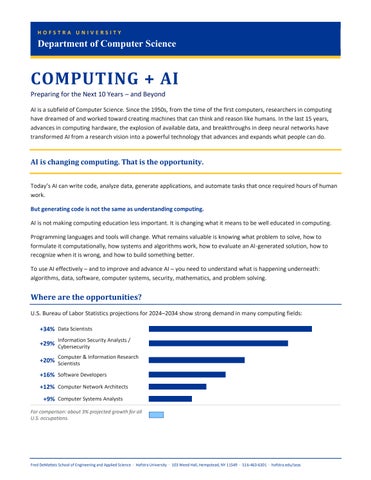
Where are the opportunities? U.S. Bureau of Labor Statistics projections for 2024–2034 show strong demand in many computing fields:
+34% Data Scientists Information Security Analysts /
+29% Cybersecurity
Computer & Information Research
+20% Scientists
+16% Software Developers +12% Computer Network Architects +9% Computer Systems Analysts For comparison: about 3% projected growth for all U.S. occupations.
Fred DeMatteis School of Engineering and Applied Science · Hofstra University · 103 Weed Hall, Hempstead, NY 11549 · 516-463-6301 · hofstra.edu/seas
H O F S T R A U N I V E R S I T Y | Fred DeMatteis School of Engineering and Applied Science
At the same time, employment of traditional computer programmers is projected to decline 6%. Programming is just one of the skills that computing professionals have. According to Forbes (Aug, 19, 2026), a college degree in Computer Science (after Nursing) is the one which value is least effected by AI (It is not easy, it requires special training and skills, critical thinking and problem solving).
Fred DeMatteis School of Engineering and Applied Science · Hofstra University · 103 Weed Hall, Hempstead, NY 11549 · 516-463-6301 · hofstra.edu/seas
H O F S T R A U N I V E R S I T Y | Fred DeMatteis School of Engineering and Applied Science
What does that tell us? The opportunities are increasingly in solving complex problems, developing AI, working with data, designing software and computer systems, securing those systems, and using computing to transform other fields. The current entry-level job market is challenging, including for many recent college graduates. AI is also beginning to automate some tasks traditionally given to entry-level employees. But a high-school student today is not preparing for the job market of 2026. You may enter the professional workforce around 2031 – and have a career that extends to 2070 and beyond. Our goal is not to prepare students to compete with AI at routine tasks. It is to develop graduates with a deep understanding of computing and AI who can: USE AI
→
UNDERSTAND IT
→
EVALUATE IT
→
BUILD WITH IT
→
ADVANCE IT
Don’t just learn today’s tools. Learn the foundations that let you create tomorrow’s.
AI can generate an answer. Can you tell whether it is correct? Can you understand why it failed? Can you make it better? Can you build what comes next?
That is computing.
Explore Computing
Computer Science
Artificial Intelligence
Data Science & Machine Learning
Cybersecurity
Software Engineering
Computer Systems
Hands-on learning, faculty-mentored research, co-op, and professional experience help students turn computing knowledge into the ability to solve real-world problems.
Sources: U.S. Bureau of Labor Statistics, Occupational Outlook Handbook, 2024–2034 projections; Federal Reserve Bank of New York, The Labor Market for Recent College Graduates; National Association of Colleges and Employers (NACE), Job Outlook 2026; World Economic Forum, Future of Jobs Report 2025.
Fred DeMatteis School of Engineering and Applied Science · Hofstra University · 103 Weed Hall, Hempstead, NY 11549 · 516-463-6301 · hofstra.edu/seas