RESEARCH REPORT
Autism Spectrum Disorder in the Workplace by Jenna Wyatt
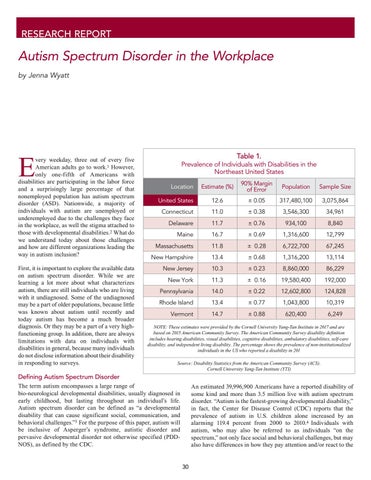
Table 1.
E
very weekday, three out of every five American adults go to work.1 However, only one-fifth of Americans with disabilities are participating in the labor force and a surprisingly large percentage of that nonemployed population has autism spectrum disorder (ASD). Nationwide, a majority of individuals with autism are unemployed or underemployed due to the challenges they face in the workplace, as well the stigma attached to those with developmental disabilities.2 What do we understand today about those challenges and how are different organizations leading the way in autism inclusion? First, it is important to explore the available data on autism spectrum disorder. While we are learning a lot more about what characterizes autism, there are still individuals who are living with it undiagnosed. Some of the undiagnosed may be a part of older populations, because little was known about autism until recently and today autism has become a much broader diagnosis. Or they may be a part of a very highfunctioning group. In addition, there are always limitations with data on individuals with disabilities in general, because many individuals do not disclose information about their disability in responding to surveys.
Prevalence of Individuals with Disabilities in the Northeast United States Estimate (%)
90% Margin of Error
Population
Sample Size
United States
12.6
± 0.05
317,480,100
3,075,864
Connecticut
11.0
± 0.38
3,546,300
34,961
Delaware
11.7
± 0.76
934,100
8,840
Maine
16.7
± 0.69
1,316,600
12,799
Massachusetts
11.8
± 0.28
6,722,700
67,245
New Hampshire
13.4
± 0.68
1,316,200
13,114
New Jersey
10.3
± 0.23
8,860,000
86,229
New York
11.3
± 0.16
19,580,400
192,000
Pennsylvania
14.0
± 0.22
12,602,800
124,828
Rhode Island
13.4
± 0.77
1,043,800
10,319
Vermont
14.7
± 0.88
620,400
6,249
Location
NOTE: These estimates were provided by the Cornell University Yang-Tan Institute in 2017 and are based on 2015 American Community Survey. The American Community Survey disability defnition includes hearing disabilities, visual disabilities, cognitive disabilities, ambulatory disabilities, self-care disability, and independent living disability. The percentage shows the prevalence of non-institutionalized individuals in the US who reported a disability in 201 Source: Disability Statistics from the American Community Survey (ACS). Cornell University Yang-Tan Institute (YTI)
Defning Autism Spectrum Disorder The term autism encompasses a large range of bio-neurological developmental disabilities, usually diagnosed in early childhood, but lasting throughout an individual’s life. Autism spectrum disorder can be defined as “a developmental disability that can cause significant social, communication, and behavioral challenges.”3 For the purpose of this paper, autism will be inclusive of Asperger’s syndrome, autistic disorder and pervasive developmental disorder not otherwise specified (PDDNOS), as defined by the CDC.
An estimated 39,996,900 Americans have a reported disability of some kind and more than 3.5 million live with autism spectrum disorder. “Autism is the fastest-growing developmental disability,” in fact, the Center for Disease Control (CDC) reports that the prevalence of autism in U.S. children alone increased by an alarming 119.4 percent from 2000 to 2010.4 Individuals with autism, who may also be referred to as individuals “on the spectrum,” not only face social and behavioral challenges, but may also have differences in how they pay attention and/or react to the
30
world around them, when compared to their neurotypical peers. Autism, however, is not a one-fits-all diagnosis by any means and while individuals on the spectrum may have similarities, no two individuals are alike. For this reason, it can be challenging to generalize about the Autistic population, so while this paper will describe characteristics that affect many with autism, it is important to note that these challenges and characteristics are not a universal description of all individuals on the spectrum.
a job difficult. Even if they have the expertise in the job area and are incredibly talented, their lack of social skills during an interview, in addition to potential prejudices of a hiring manager, may leave them unemployed. In an interview with Bloomberg Business Week, David McNabb, a college graduate with ASD who was hired by the startup Ultra Testing after a long period of unemployment, speaks to his personal experience about how challenging it can be to find a job when you have ASD:
In some ways, the challenges that affect individuals with autism may hinder or limit their ability to be successful in a typical workplace. In general, they may have trouble relating to others, avoid eye contact, have trouble adapting to routine changes, have a negative reaction to loud noises/bright lights/strong smells, and/ or have trouble building social relationships. Others, while often high functioning, may have challenges with language that is metaphorical and not direct, because they tend to take things very literally. This especially may hinder their ability to build social relationships, because while they may be very interested in people they may be challenged by how to talk to them or relate to them, as well as have challenges understanding boundaries. However, in the workplace specifically, these challenges may affect their ability to work with others and work in disorderly organizations that experience a lot of day-to-day change.
Those meetings with prospective employers “were definitely a large stumbling block”... “I wasn’t on the same page as far as what they were looking for in a person, or maybe the type of person they’d wanted to work with.5 If individuals with autism do become employed, however, they may also face issues working with their managers and peers, especially when managers and peers do not understand them or may be afraid to treat them like any other employee due to their disability. Managers working with all people, not just those with disabilities, should be expected to get to know their employees and how to work with them. While individuals with autism may face different challenges than some other employees, every employee has boundaries that make them uncomfortable or could make them unsuccessful in the work environment. In addition, neurotypical employees may have challenges similar to those issues employees with autism have, such as building social relationships at work or dealing with change.
One of the first challenges, job seekers with autism face is securing a job; the social aspects of autism make interviewing for
Table 2.
Employment status of the civilian population by disability status, not seasonally adjusted [in thousands]
Employment status, sex, and age
Persons with a disability
Persons without a disability
April 2016
April 2017
April 2016
April 2017
Civilian noninstitutional population
29,974
30,612
222,995
223,976
Civilian labor force
6,108
6,166
152,380
153,652
Participation rate
20.4
20.1
68.3
68.6
Employed
5,453
5,509
145,622
147,754
Employment – population ratio
18.2
18.0
65.3
66.0
Unemployed
655
657
6,758
5,898
Unemployment rate
10.7
10.7
4.4
3.8
23,866
24,447
70,615
70,324
TOTAL, 16 years and over
Not in labor force
NOTE: A person with a disability has at least one of the following conditions: is deaf or has serious diffculty hearing; is blind or has serious diffculty seeing even when wearing glasses; has serious diffculty concentrating, remembering, or making decisions because of a physical, mental, or emotional condition; has serious diffculty walking or climbing stairs; has diffculty dressing or bathing; or has diffculty doing errands alone such as visiting a doctor's offce or shopping because of a physical, mental, or emotional condition. Updated population controls are introduced annually with the release of January data Source: Bureau of Labor Statistics: Table A-6, April 2017
31
Center for Special Education Research from 2000 through 2010. NLTS2 is a nationally representative sample of U.S. students who were receiving special education services in December 2000 who are between the ages of 13 and 17 years old. In the analysis by the A.J. Drexel Autism Institute in 2015, they found that young adults with autism have the lowest employment rate across all disabilities.7
Office of Disability Employment Policy Resources Job Accommodation Network (JAN) The Job Accommodation Network (JAN) is a partnership between the U. S. Department of Labor’s Office of Disability Employment Policy (ODEP) and West Virginia University. Their purpose is to develop and influence employment policies and practices in the disability arena. JAN provides many resources especially for employers including a guide to accommodations for different disabilities. www.askjan.org
Over nine out of ten young Americans will work at some point between the ages of 21 and 25, according to a Bureau of Labor Statistics (BLS) study in 2013.8 Since college may not be the right path for disabled students, many students transition from high school directly into the workforce and approximately 50,000 students with ASD leave high school each year. While one of the main purposes of many special education programs is to prepare students for life outside of the school setting, only 58% of young adults with autism work between high school and their 20s, which is the lowest among their peers, including those with other disabilities. However, there was a positive correlation of employment among individuals with ASD and years out of high school. The study explored other factors that may overlap with ASD that are related to employment such as household income, race and ethnicity, conversation ability, and work experience. But it did not give any concrete explanation about why ASD individuals are even less employed than their peers. I, however, believe that the unemployment and underemployment of those with disabilities has much to do with the prejudices and discrimination that still exists in our society, despite government protections.
Employer Assistance and Resource Network (EARN) EARN is a resource that educates both public and private sector employers about disability diversity inclusion and diversity funded by the U. S. Department of Labor’s Office of Disability Employment Policy (ODEP) and the Viscardi Center. EARN supports employers through education and resources online in-person or online training sessions and more. http://www.askearn.org/ Workforce Recruitment Program (WRP) WRP is a resource managed by the U.S. Department of Labor's Office of Disability Employment Policy (ODEP) and the U.S. Department of Defense's Office of Diversity Management & Equal Opportunity (ODMEO). WRP’s purpose is to connect prospective employees who are recent graduates with disabilities to federal and private sector employment opportunities. WRP works with universities around the nation to target and assist these students in finding jobs. www.wrp.gov
Government’s Role The government plays an important role in disability inclusion and policy and there are many government protections for individuals with disabilities as a whole. The largest protection for employees with disabilities in the United States, called the Americans with Disabilities Act (ADA), was enacted in 1990 and later amended in 2008. The ADA not only prohibits the discrimination of individuals with disabilities, but also ensures equal opportunity in employment, state and local government services, public accommodations, commercial facilities, and transportation.9 While all sections of the ADA are important, Title One of the act focuses specifically on the implications of the law in employment. Because Title One of the ADA is a civil rights law regarding employment, it is regulated by the Equal Employment Opportunity Commission (EEOC) and must be enforced in any organization with 15 or more employees.
I. Autism Spectrum Disorder and Labor Force Participation in the U.S. Only 20.4% of Americans with disabilities are participating in the workforce and the unemployment rate among people with disabilities is 10.6%, in comparison to 4.3% for people without disabilities.6 Figure 2 shows employment status in April 2016 and April 2017 in those with disabilities and those without. It is important to note the lack of change in employment status for those with disabilities, while those without disabilities did see some larger changes in the past year as well as difference in unemployment rates and employment-population ratio between those with disabilities and those without.
A disability, according to the ADA, is defined as “a physical or mental impairment that substantially limits one or more major life activities, a record of such an impairment that substantially limits one or more major life activities, a record of an impairment, or being regarded as having such an impairment.”10 It describes a major life activity as any activity that an average person could do with little to no difficulty, such as communicating or reading.11 According to the Job Accommodation Network (JAN), ASD is usually classified as a disability due to the limits those with ASD face in the major life activity classified as brain function.12
In 2015, a study on employment outcomes of young adults on the autism spectrum was done by the A.J. Drexel Autism Institute at Drexel University. They sought to answer the rate of employment for young adults with autism and the job rate in the first years after high school. The data used from their study was from the National Longitudinal Transition Study-2 (NLTS2) conducted by the National
32
colleagues will continue influencing disability policy and help break down the stigma and prejudices surrounding people with disabilities.
Title One of the ADA says that qualified applicants or employees must be provided with a reasonable accommodation if one is necessary to perform the essential job functions. A reasonable accommodation can be any modification or adjustment to either a job or environment that will allow an employee or applicant with a disability to perform the essential functions of their job or participate in an application process. However, an employer is only required to provide a reasonable accommodation if they know that an employee or applicant has a disability that will require them to need a type of accommodation. In addition, an employer is not required to create a new job if an employee cannot meet the essential functions of the job or required to accommodate an employee if it puts an undue hardship on the business.
Local Organizations Fighting Workplace Discrimination and Prejudices Even though government protections have been in place for many years, there are still many issues with disability discrimination in the workplace as well as prejudices. I spoke with Julie Yindra, the Director of Services for Students with Disabilities at Hofstra University, the largest private university on Long Island. She said the biggest challenge for students with disabilities when leaving the university setting is common perceptions of them, especially when it comes to employers. Many employers believe that these job candidates will be challenging to work with and are afraid that they may be more costly with accommodations and days off from work. However, Ms. Yindra says, in spite of these perceptions, many with disabilities go out of their way to defy the stereotype. Born with Spina Bifida, Yindra is also an advocate for those with disabilities and feels judgment from others every day. During her first job in higher education, she never missed a day of work and had perfect attendance for the five years she worked there. She says she felt like she could not take a day off because she wanted to prove employers everywhere wrong, had she taken a day off she felt that she would be perpetuating the idea that others have about those with disabilities.
Similar to the ADA, the Rehabilitation Act prohibits discrimination of those with disabilities in any program or organization that is federally funded in any way, including the government itself, contractors, and subcontractors. Sections 501 and 503 focuses specifically on employment and requires affirmative action and non-discrimination in employment for federal contractors and subcontractors as well as federal agencies. Similar to the ADA, the Rehabilitation Act is also enforced by the EEOC. In order to understand from a government perspective what is next in disability inclusion and and how the government is working to change the prejudices and disadvantages that those with disabilities may face, I spoke with Carol Boyer, a Senior Policy Advisor with the Office of Disability Employment Policy (ODEP) with the Department of Labor (DOL). During our conversation, I tried to learn what was coming down the policy pipeline in the office and what her views on the future are. Unfortunately, she was not able to share much beyond what could already be found on the ODEP website, such as more information from the Job Accommodation Network (JAN) and the Employer Assistance and Resource Network (EARN). Ms. Boyer told me that much in the office has been on hold since the change of administration in January. She said the staff was not sure what to expect and lacked the authority to make any formal decisions with the Trump administration’s delay in swearing in Alexander Acosta, the new U.S. Secretary of Labor. With the Trump White House, many are worried about what will be next for those with disabilities, especially due to the President infamously mocking a disabled reporter back in 2015. Those with disabilities are worried about his stance on issues like health care and education and how it may affect them in the future. The Republican’s American Health Care Act, passed on May 4th, 2017, allows insurers to charge those with pre-existing conditions higher premiums if they have a lapse in coverage.13 Prior to the Affordable Care Act in 2010, those with pre-existing conditions were charged higher premiums by insurers because they typically cost insurers much more money. In a new analysis by the Center for American Progress, a progressive think tank, they estimate a 135% or $5,420 surcharge in standard premiums for a 40-year-old individual with autism.14 However, regardless of what the new administration brings, Carol was hopeful that her and her
Organizations like Hofstra University are actively working to battle challenges that those with disabilities such as autism face. At Hofstra, 650 students have self-identified themselves with Yindra’s office and are actively receiving accommodations. 45 of those students have disclosed that they have autism. Ms. Yindra believes that the number of those with disabilities at Hofstra is much larger, especially for those on the spectrum, but notes that there are many students who decide not to disclose their disability status to the office for various reasons. While Yindra, does worry what happens to her students when they graduate, she is thankful Hofstra provides these students with great resources that many other organizations would be unable to provide. Another higher education institution leading the way in preparing students with disabilities to enter the work force and live independently is the Vocational Independence Program at NYIT in Central Islip, NY. New York Institute of Technology (NYIT) Vocational Independence Program (VIP) NYIT’s VIP program in Westbury, New York is a certified residential postsecondary college transition experience that prepares students with disabilities the ability to take classes and gain work experience all while learning to live and work independently. http://www.nyit.edu/vip
33
Even though the Americans with Disabilities Act was not enacted until 1990, the Vocational Independence Program at NYIT has been in existence and helping those with developmental disabilities since 1987. As a part of my research, I had the opportunity to spend the day on NYIT’s Central Islip campus for their Vocational Independence Program Open House and to immerse myself with prospective students and their families.
practitioner on campus that sees students if they are not feeling well, but also administers and keeps track of their medications A large chunk of the open house at NYIT in Central Islip was participation from current students and one alumnus. Students each shared their stories about VIP, what classes they have taken, where they have worked, etc. One 2013 alumnus, Steven, shared his story of success just four years after graduating from the program. Steven participated in both the I to I program and VIP focusing on work experience. He stated that VIP taught him how to be independent and set him up to be successful at work. When he was a student in the VIP program he worked for the food vendor called Sodexo in various office buildings on Long Island, including Cablevision in Bethpage NY. He still works for Sodexo now, but in New Jersey closer to his parent’s house. In fact, Steven, will soon receive his five–year service plaque from Sodexo for his employment. Steven is currently living at home, but saving money from work to get his own apartment. Even though he lives with his parents, he does pay rent and his cell phone bill. He hopes to live completely independent of his parents soon. Steven is not alone in the success he has had after VIP. During my visit, I met many other students who already have full-time jobs related to their job placements from the VIP program for when they graduate out of the program this summer.
NYIT runs two main programs for students with autism and other developmental disabilities, one called Introduction to Independence (I to I), a summer program for students 16 and older that focuses on a vocational job placement at a local employer as well as learning to live independently. The other program, the Vocational Independence Program (VIP) is a three-year postsecondary certificate program, approved by the Department of Education as a College Transition Program. During the school year, students primarily focus on either college courses at NYIT in Old Westbury and/or gain work experience. The program for many is the alternative to going to college right away or at all, as many students at VIP may not be able to get into college out of high school or may not be able to handle the typical college environment and course load. Some students may participate in the Associate Degree Support Program at VIP. This is a three-year option where students earn an Associate Degree in either Communication Arts or Business Administration in Accounting, however, students in this program must have the academic qualifications to be accepted into NYIT Old Westbury as a regular student and be able to handle the class load. This is not common among the population at VIP, especially as in the college setting, much different from the secondary school setting, all students, regardless of disability status, must complete the same work. For instance, while students at Hofstra or students who take classes at NYIT may get accommodations through their respective school’s disability offices, they still must complete the same work as their peers, and their accommodations likely only provide them with extra time on tests or a note taker for class lectures.
Employment training services place students in various paid and unpaid internships across Long Island that provide students experience in a variety of industries including clerical, retail, food service, hospitality, child recreation, eldercare, and electronic recycling. Their most popular placements include the Marriot Residence Inn, the Hilton Garden Inn, the Holiday Inn, CA Tech (formerly Computer Associates, based in Manhattan and Long Island), NYIT Old Westbury campus, medical facilities such as Stony Brook Medical Center and animal care jobs at grooming businesses, shelters, and animal hospitals. Students are driven to their work locations by NYIT and during their first year, a job coach goes with them to work until it seems that they are able to be at work without the extra support.
The regular VIP program, which is geared towards preparing students for the workforce or to be used as a pre-college experience, is their main focus on campus and was also the main focus of their open house program. The typical student population during the academic year is about 50 to 60 students with a staff ratio of 3:1. Overall, the VIP program focuses on four areas of curriculum through classroom instruction, experiential learning, and one on one coaching. These areas include Executive Functioning, Independent Living, Social and Communications, and either employment or college classes. Every VIP student spends a lot of time being coached and mentored by one of his or her five one-on-one coaches, including a social coach, financial coach, career coach, academic coach, and independent living coach. All students in the program must live on campus as they feel living to learn independently is one of the more important aspects of their program. Each student is provided a single occupancy room and lives on a floor with hallway bathrooms with students all of the same gender. In addition, they have a nurse
The program is truly one of a kind and leading the way in inclusion, especially on Long Island by teaching students how to be independent and teaching local employers what an asset these students can be to the workforce. Organizations that prepare students and teach employers about those with disabilities, especially autism are effectively breaking down disability discrimination and prejudices in the workplace.
Employees with ASD In interviewing Julie Yindra at Hofstra, I asked her about why she felt that employees with disabilities in general and those with autism were such an asset to the workplace. She said that she feels employees with disabilities are a lot more appreciative to have a job, so they work really hard to keep their job and prove themselves to their employer. Reflecting on her own experience she said, “[even though many people complain about paying taxes] ... I like 34
Autism Inclusion in Private Sector Employment The rate of autism has steadily grown over the last twenty years,16 and it is not expected to slow down in the near future. This is an important issue as the growing number of children with autism reach working age. Even over the past few years though, there has been little change to the labor force participation rate for those with disabilities. According to Bloomberg Business Week, “In June 2014, only 19.3 percent of people with disabilities in the U.S. were participating in the labor force, working or seeking work. Of those, 12.9 percent were unemployed, meaning only 16.8 percent of the population with disabilities was employed.”17 These statistics show that not much has changed in recent years, even though more jobs have been created in the United States, but as the mindset towards those with disabilities changes and barriers are broken down, I believe that the unemployment rate of the disabled population will drop quickly.
paying taxes because a lot of people like me are unable to work and feel useless, but I am able to contribute.” When focusing on those with autism specifically, Yindra emphasized that their minds work differently and that allows them to bring a lot to the workplace that a neurotypical individual would not bring. For instance, they possess the ability to solve problems and create ideas beyond that of a neurotypical person. Workers with ASD are highly regarded as reliable, loyal, and hardworking employees. Many employees with ASD, however, are overlooked despite their qualifications, but now many companies are leading the way in autism inclusion in the workplace. Organizations are finally realizing that employees with ASD have a lot to bring to the workplace. In fact, many are recruiting employees specifically with autism because of their desirable skill sets. One industry that has become especially interested in adding those with ASD to their workforce is the technology industry because those with autism are highly skilled, detail orientated, and can be superiorly focused on one thing and often are not bothered by repetitive work because they tend to prefer routine.
Mary Ellen Smith, Microsoft’s corporate vice president of worldwide operations, believes that unemployment for those with disabilities is a huge issue that businesses must begin to address, stating “the unemployment rate is chronic, which is not a reflection of the talent pool, it’s just a reflection of these people not getting through the door.”18 Organizations are stepping up to the plate and standing up for these employees, and I truly believe that advocacy within the business and employment arenas are only going to increase. Companies already leading the way in autism inclusion are German-based programming company SAP, Washington based Microsoft, and Freddie Mac in Virginia all with autism recruitment and retention programs to target talent on the spectrum. While other organizations such as Ultra Testing and Rising Tide Car Wash employ mostly if not all, employees with autism.
Even though employees with ASD may need some accommodations to successfully perform their jobs, as per the ADA, but are assets. As we have spoken about, autism is by no means a one-fits-all diagnosis and therefore different employees may need different accommodations and some may not need any accommodations at all, so all employees would need to be assessed on a case-by-case basis. The Job Accommodation Network (JAN) is a partnership between the U. S. Department of Labor’s Office of Disability Employment Policy (ODEP) and West Virginia University. Their purpose is to develop and influence employment policies and practices in the disability arena. JAN provides many resources especially for employers, including a guide to accommodations for different disabilities. In their guide for ASD, they identify areas that individuals with ASD may be challenged in at work, which include speaking/communicating, atypical movement, time management, maintaining concentration, organization and prioritization, memory, multi-tasking, issues of change, stress management, sensory issues, and social skills.15 Examples of reasonable accommodations that they suggest include, but are not limited to: providing meeting agendas prior to meetings to facilitate greater preparation for social situations, slightly altering interview protocol for potential employees, allowing employees to work from home, and allowing an employee who is easily distracted or works in a loud environment to wear noise-cancelling headphones. Another accommodation idea that may be helpful for all employees, which NYIT provides for their students, is providing a mindfulness room where employees can take a quick break in a quiet and calming space if they become too overwhelmed during the workday. The accommodation ideas for those with ASD are endless and may really make a difference in including the employee with autism in the workplace, with no disturbance at all.
“In spite of autism and because of autism”19 SAP, the German-based programming company with U.S. headquarters in Newtown Square, Pennsylvania is an employer leading the way in autism inclusion at work. SAP employs approximately 85,000 employees worldwide with a large presence of employees with autism through their autism at Work program, which launched in 2013. SAP uses the help of local agencies to recruit individuals for their program, which is active in 9 countries at various office locations. Approximately, 120 employees are currently a part of the program, but the company hopes to recruit 10% of the total employee population by the year 2020. with SAP got involved with disability inclusion because they recognized the high level of unemployment and underemployment for those with autism and wanted to change that. One thing that makes SAP unique is the support system that they create at work for employees with autism. SAP is ahead of the curve because they have realized that one of the best ways to create an inclusive environment is through education and by getting others involved. In addition to teaching managers how to work with and supervise individuals with autism, there are employee volunteers who hold different mentor and coaching roles that assist program participants get acclimated to their new roles, connects employees to resources, as well as helps them socialize at work. 35
Focusing on a Neurodiverse Workplace Ultra Testing, a New York City Technology Start-Up, which does software testing for other companies, is another organization focused on inclusion as well as leveraging the talents that individuals with ASD have. In 2013 two former roommates from MIT formed Ultra Testing. The pair believe that individuals on the autism spectrum are a perfect match for the software testing industry due to their heightened abilities. Different from SAP, Ultra Testing’s employees with autism are integrated in to the regular workforce, where they are actually in the majority, 75% of their employees are on the autism spectrum to be exact. In fact hiring those with autism is a part of their mission, “Our mission is to prove that neurodiversity is a competitive advantage. We aim to do so by bringing excellence to the software testing industry and delivering superior results for our clients.”20
CDC defines disability inclusion best: Disability inclusion means understanding the relationship between the way people function and how they participate in society, and making sure everybody has the same opportunities to participate in every aspect of life to the best of their abilities and desires.22 As we continue to address this important problem, those who really want to be inclusive of others especially will need to bring their employees to include without labeling. This article explored the various challenges that individuals with autism spectrum disorder face in the workplace, and also highlight local New York-based organizations that are making great strides to help these individuals succeed. In addition, some companies in other regions that are leading the way on inclusion and empowerment were spotlighted, such as SAP. They are hiring individuals “in spite of” and “despite” their autism spectrum disorder diagnosis.23 Still, far more is needed since, across the country, individuals with disabilities, especially those with autism, today remain chronically unemployed or underemployed.
Interestingly, I found in my research and conversations with others that many of the advocates for autism in the workplace today have themselves been personally affected by autism or other disabilities in some way, whether through a child, sibling, etc. For instance, a Rising Tide Car Wash was first started because a man wanted his son and others with autism to have jobs. Another example, the Freddie Mac autism Internship program, was started by a business leader who has a daughter on the spectrum. He felt passionate about making sure his daughter could one day work somewhere, despite her disability, and wanted to lead his company to influence others in the business community. Because of this advocacy from parents, I believe that as more children with autism enter working age more companies will have programs and job opportunities for them at work. This may be encouraged by recent studies showing that: “From the business perspective, companies that employ individuals with disabilities are viewed more favorably by the public.”
Jenna Wyatt is a recent Labor Studies graduate of Hofstra University. REGIONAL LABOR REVIEW, vol. 20, no. 1 (Fall 2017). © 2017 Center for the Study of Labor and Democracy, Hofstra University
NOTES 1 U.S. Bureau of Labor Statistics, The Employment Situation (Feb. 2017). 2 McMahon, Brian, et al. “Autism Spectrum Disorders and Intellectual Disabilities: A Comparison Of ADA Title I Workplace Discrimination Allegations.” Journal of Vocational Rehabilitation 36.3 (2012): 159-169. 3 “Facts About ASD.” Centers for Disease Control and Prevention. Centers for Disease Control and Prevention (3/2816). 4 “Facts and Statistics.” Autism Society. Autism Society (8/26/15). 5 Autistic Coders Get Jobs as Microsoft, SAP Woo Software Sleuths” Bloomberg.Business Week (6/02/15). 6 “Office of Disability and Employment Policy.” U.S. Department of Labor (5/03/17). 7 Roux, Anne M., Shattuck, Paul T., Rast, Jessica E., Rava, Julianna A., and Anderson, Kristy A. National autism Indicators Report: Transition into Young Adulthood. Philadelphia, PA: Life Course Outcomes Research Program, A.J. Drexel Autism Institute, Drexel University, 2015. 8 Ibid. 9 “ADA.gov.” 2010 ADA Regulations. ADA.gov, n.d. Web access 4/12/17. 10 Ibid.
More than a Family Business Rising Tide Car Wash in Parkland, FL employs almost exclusively employees on the autism spectrum. Family-owned, the car wash was created with the intention of employing adults with autism such as their son. Owner and CEO of Rising Tide, John D’Eri, attributes the successes of Rising Tide to his amazing staff of 92 associates with disabilities. Rising Tide hopes to not only prepare adults with autism to live more independent lives, but also to bring more awareness about autism at work and show what great assets employees with autism are. In addition to the car wash located in South Florida, John and the D’Eri family are working to raise awareness about autism inclusion and encourage communities to enact ideas that can change the world.21 Conclusion It is important to note that while these programs at work and NYIT’s program have made great strides in the inclusion arena. Inclusion is much more than creating a program called the autism at Work program. While those programs have been important in breaking down barriers, as we progress, it is crucial to look beyond programs that label its incumbents as disabled or Autistic. The 36
11 “Glossary
of ADA Terms.” ADA National Network. N.p., (4/19/17). 12 “Employees with Autism Spectrum Disorder.” Accommodation and Compliance Series (2008): n. pag. Ask JAN. Job Accommodation Network. 13 “Trumpcare and Pre-Existing Conditions.” TrumpCare.com. Web access 5/20/17. 14 Gee, Sam Berger and Emily. "Latest ACA Repeal Plan Would Explode Premiums for People with Pre-Existing Conditions.” Center for American Progress. N.p. (4/20/17). 15 “Employees with Autism Spectrum Disorder.” 16 Autism Fact Sheet.” National Autism Association. 17 Bloomberg Business Week, op. cit. 18 Pasternack, Alex. “Microsoft Wants Autistic Coders. Can It Find Them And Keep Them?” Fast Company. Fast Company,
08 Mar. 2017. Web. 05 May 2017. Autism at Work Overview Video.” SAP. Web access 5/19/17. 20 “ULTRA TESTING.” ULTRA Testing. Web access 5/19/17. 21 “Rising Tide Car Wash – Parkland Car Wash." Rising Tide Car Wash. Web access 5/19/2017. 22 “Disability Inclusion.” Centers for Disease Control and Prevention. Centers for Disease Control and Prevention (3/17/16). 23 “SAP Autism at Work Overview Video.” SAP. Web access 5/19/17. 19 “SAP
Take the fast track to a professional career
Earn both a Hofstra B.A. and an M.B.A. in just fve years – with big savings in time and tuition. Hofstra undergraduates may now enroll in a dual-degree program, combining their studies toward a Labor Studies B.A. degree with work toward a Master of Business Administration. The dual-degree program can be completed in fve years. Qualifed students who major in labor studies and who are admitted to the M.B.A. portion of the dualdegree program may substitute up to 14 semester hours of M.B.A.-level graduate course work for an equal number of hours of undergraduate courses toward the completion of the B.A. degree.
Five-year Dual-degree Program in Labor Studies (B.A.) and Business Administration (M.B.A.) For more information, please contact the Labor Studies Program at laborstudies@hofstra.edu or visit hofstra.edu/laborstudies
WHOFSTRA UNIVERSITY. 37