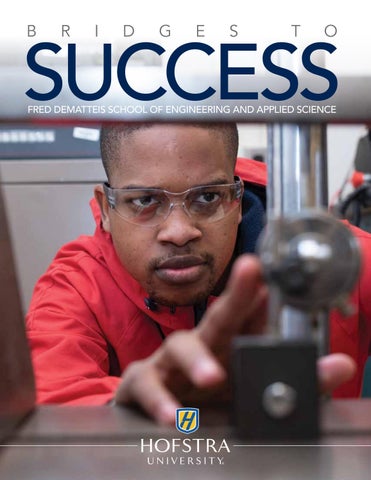
SUCCESS B
R
I
D
G
E
S
T
O
FRED DEMATTEIS SCHOOL OF ENGINEERING AND APPLIED SCIENCE
A Message From Our Dean The essence of a college education stems from the interaction of faculty and students. Knowledge occurs in the classroom, the laboratory, and through extracurricular activities. A predominantly undergraduate-centered school, the Fred DeMatteis School of Engineering and Applied Science focuses on preparing our students for careers that build on having a technical degree, either in engineering or computer science. In this issue, we highlight some of the inspiring ways our professors and students work together, both inside and outside of the classroom. You will learn about the successful collaborations that are forged from these relationships, such as research work, our productive Co-op program, a summer stipend-based program for first-year female students, free winter bridge courses to keep students involved, and our new association with Engineers in Action, an organization that builds infrastructure in rural areas on other continents. I hope you enjoy perusing this brochure. It is my pleasure to be associated with the DeMatteis School of Engineering and Applied Science, and to work alongside our faculty and staff in creating an environment for students that offers large-school opportunities in a small-school setting. Sina Y. Rabbany, PhD Dean, Fred DeMatteis School of Engineering and Applied Science Jean Nerken Distinguished Professor of Engineering Founding Director of the Bioengineering Program
Fred DeMatteis School of Engineering and Applied Science Highlights • Teaching that inspires students both inside and outside the classroom. Classes are conducted by Hofstra faculty, not teaching assistants. • Research opportunities under the supervision of faculty mentors who encourage and guide students to present their work at scientific conferences and/or publish in scholarly journals. • State-of-the-art facilities. A new science and innovation building is set to open in spring 2023, housing classrooms, laboratories, and new technologies and equipment for computer science, bioengineering, and industrial engineering. • On-the-job professional experience through our exclusive Co-op Program, which matches students with full-time, six- to eight-month salaried positions – prior to graduation – at one of approximately 200 participating companies. • Exposure to the liberal arts and sciences. Our students graduate with an education in the social and natural sciences, as well as the humanities, which is an academic and professional asset. • Successful alumni. Over 90% of recent undergraduate degree recipients who responded to a survey (or other reliable source) reported that they were employed or were planning to start graduate school within one year of graduation. • Insightful feedback and support from three advisory boards composed of industry leaders who work with Hofstra faculty and administrators to develop dynamic courses and programs.
engineering.hofstra.edu 3
Program Options Undergraduate Degrees • BA, Computer Science • BA, Engineering Science • BE, Engineering Science • BS, Bioengineering • BS, Civil Engineering • BS, Computer Engineering • BS, Computer Science • BS, Computer Science and Cybersecurity • BS, Computer Science and Mathematics • BS, Electrical Engineering • BS, Electrical Engineering (Computer Option) • BS, Industrial Engineering • BS, Mechanical Engineering • BS, Mechanical Engineering (Aerospace Concentration)
Graduate Degrees • MS, Computer Science • MS, Cybersecurity (Technology) • MS, Data Science • MS, Engineering Management
Dual-Degree Programs • BA/MS, Computer Science • BS/MS, Computer Science • BS-BA/MD: 4+4 Program
4 FRED DEMATTEIS SCHOOL OF ENGINEERING AND APPLIED SCIENCE
Hofstra University successfully remained open during the 2020-2021 academic year, offering both in-person and remote instruction during the COVID-19 pandemic. engineering.hofstra.edu 5
State-of-the-Art Facilities Hofstra provides a wide range of tools that enhance our students’ education. For example, the Cybersecurity Innovation and Research Center was opened in 2019 to support new bachelor’s and master’s programs in this rapidly evolving field. Students have access to equipment in all labs, which are used both for teaching and research.
Laboratories include: • 3D Printer Laboratory
• Advanced Applications Laboratory
• Aerodynamics and Transport Phenomena Laboratory • Big Data Laboratory
• Cell and Tissue Engineering Laboratory
• Civil/Environmental Engineering Laboratory
• Computer Architecture, Embedded Systems, and Mobile Computing Laboratory
• Concrete/Soil Testing Laboratory
• Cybersecurity Innovation and Research Center • Electrical and Signal Processing Laboratory • Gaming and Graphics Laboratory • Linux Laboratory
• Materials Analysis Laboratory • Networking Laboratory
• Research and Innovation Laboratory
• Robotics and Advanced Manufacturing Laboratory • Scanning Electron Microscope Laboratory • Systems Laboratory
• Ultrasound Research Laboratory
6 FRED DEMATTEIS SCHOOL OF ENGINEERING AND APPLIED SCIENCE
WOMEN IN STEM: Christina McMann ‘23
Mechanical engineering major Christina McMann is doing a Co-op at Saab Inc., and getting full-time, paid job experience working on radar systems for U.S. Navy ships. As a young woman pursuing a STEM career, she drew inspiration and support from the DeMatteis School’s W-SPiCE Program (Women’s Summer Program in Computing/Engineering), which provides female engineering and computer science students with mentoring, workshops, and exposure to various high-tech professions. Q: What work are you doing for Saab Inc.? A: I work for the Saab Surveillance Systems. I’m responsible for 3D modeling and designing radar components that will be incorporated into the completed radar assembly. Q: How did being a part of the W-SPiCE program prepare you for this Co-op opportunity? A: The program allowed me to learn different disciplines in engineering and computer science at an accelerated rate, which mimics the structure of a typical work environment. Also, the W-SPiCE program was a major topic of discussion during my interview with Saab. Q: Did it help with your confidence to participate in such a high-level Co-op? A: Going into this new experience would have seemed very scary, but by the time I was ready to apply for the internship, I felt that Hofstra and W-SPiCE prepared me for the opportunity. I believe it gave me the confidence I needed to be successful at a Co-op at Saab. Q: Why do you think it’s important for women to have a program to help them advance in the fields of engineering and applied science? A: Because there are so few women in these roles, it’s hard to see what your future will look like. What W-SPiCE does is bring a whole bunch of women together, with women who have succeeded in industry, so you feel empowered and like you belong in the field. engineering.hofstra.edu 7
SIGN
OF THE TIMES
As an industrial engineer whose work focuses on the field of ergonomics related to visual cognition and interpretation, Dr. Salvador Rojas-Murillo became interested in the process of how people learn American Sign Language.
8 FRED DEMATTEIS SCHOOL OF ENGINEERING AND APPLIED SCIENCE
How do hearing students learn a visual language that doesn’t follow ordinary rules of foreign language translation? “To me, it was a maze,” said Hofstra Assistant Professor Salvadore RojasMurillo, PhD. Dr. Rojas-Murillo joined the DeMatteis School faculty in 2017, and teaches industrial engineering courses related to workspace science, such as logistics, methods, human factors, and computer interactions with people. Humans read text using a concept known as “chunking.” Instead of reading each letter separately, a reader recognizes a group of letters as familiar and reads it as one word or group of words. “One thing I could not understand was how people can do chunking when interpreting sign language,” he added. To understand American Sign Language (ASL), a learner must look at the interpreter’s hands, fingers, the orientation of the hands and fingers, and the movement of the hands and fingers. The front and the back of the hands during finger movements mean different things as well. To find out what happens during the instruction process, Dr. Rojas-Murillo and several of his students used sensitive eye-tracking technology to see where learners were looking during ASL instruction. They recorded 17 common phrases between four and 11 words in length, such as “Did you watch the movie last night?” Then the team hired expert ASL interpreters. During the study, Dr. Rojas-Murillo
watched to see where on the upper body the ASL learners were looking while an interpreter signed. “The higher the level of expertise, the less they were looking at the hands and more at the face,” Dr. Rojas-Murillo said. Now, he is trying to figure out the evolution of beginners who start out observing fingers most of the time, but eventually watch the hands and face. More than 11,000 children are born deaf every year in the U.S., and an additional 35 million Americans have hearing issues, Dr. Rojas-Murillo said. Hearing parents of deaf children must learn sign language as fast as their children so that they can communicate with them. The Hofstra research could lead to modifications on how hearing people, especially those who must communicate with the deaf, are taught ASL. The goal, Dr. Rojas-Murillo said, is to create a virtual tutoring program using eye tracking to speed up the learning process. “It’s pretty ambitious,” he added. Before pursuing his PhD, Dr. Rojas-Murillo advised companies, such as VF Jeanswear and Blinds To Go. During his PhD work at the University of Iowa, he worked as a research engineer for The University of Iowa Hospitals & Clinics, where he performed simulation studies to reduce patient wait times. “Industrial engineering is a bit of math, of physics, a lot of psychology, and a bit of computer science,” Dr. RojasMurillo said. “We are the engineers that look at people.”
engineering.hofstra.edu 9
Building
Bridges A new, innovative program at Hofstra University’s Fred DeMatteis School of Engineering and Applied Science not only connects classroom studies to practical work, but also “bridges” cultures from different countries.
10 FRED DEMATTEIS SCHOOL OF ENGINEERING AND APPLIED SCIENCE
Hofstra students started a chapter of the national Engineers in Action (EIA) Bridge Program last semester, giving them the opportunity to help design and construct a footbridge in a rural community in another part of the world. Assistant Professor Dr. Edward Segal is serving as the chapter’s advisor. The University sent four students last September to the 2021 EIA Bridge Builder Conference in Boulder, Colorado. The three-day event, attended by university teams around the country, focused on building bridges for communities in Bolivia and Eswatini from initial planning and design to fundraising and construction. Hofstra students will travel this summer to work on a project in Bolivia. “Attending the conference has reaffirmed my efforts thus far as well as my general passion for applying my engineering knowledge for international development,” said Esther Zhang ’22, a civil engineering major who helped start the Hofstra EIA chapter. “It was an invaluable
experience that allowed me to connect with students from other chapters and hear about their experiences with past projects.” Students get practical experience communicating with a range of partners to find appropriate solutions to problems, while developing an appreciation for other cultures. “Many of our students are driven to participate in projects like the design and construction of a rural footbridge because of their desire to apply their engineering skills to help other people,” Professor Segal said. “Beyond the technical components of the project, the students will learn more about another culture and begin to better understand the responsibilities they have and the complexities they encounter when working on international projects.”
Photographs courtesy of Engineers in Action.
engineering.hofstra.edu 11
DEMATTEIS BY THE NUMBERS Located
25
miles from Midtown Manhattan
The DeMatteis School is ranked in the
top 16%
in the nation among 239 non-PhD-granting engineering schools (U.S. News & World Report, Best Colleges rankings, 2022).
836 753 total students
undergraduate students 83 graduate students
200+
Co-op partners Over
4,000 alumni
4
21
97%
full-time professors with the highest degrees in their field
student co-authored research papers since 2020
master’s degree programs
12 FRED DEMATTEIS SCHOOL OF ENGINEERING AND APPLIED SCIENCE
8
ABET-accredited undergraduate degree programs
engineering.hofstra.edu 13
BUILDING
FUTURE
THE
14 FRED DEMATTEIS SCHOOL OF ENGINEERING AND APPLIED SCIENCE
The footprint of the Fred DeMatteis School of Engineering and Applied Science is growing. The new Science and Innovation Center, scheduled to be completed in March 2023, will be shared by the DeMatteis School and the Hofstra Northwell School of Nursing and Physician Assistant Studies. This energy-efficient, four-story, 75,000-square-foot facility will be located in the southeast section of the campus, behind the Leo A. Guthart Hall for Innovation and Discovery, which houses the Frank G. Zarb School of Business. A courtyard in front of the new building will provide a gathering space to encourage the exchange of ideas and interdisciplinary learning. Most of our engineering programs will remain in our complex in the southwest corner of campus, while computer science, as well as industrial engineering and bioengineering, will be housed in the new building. The new Science and Innovation Center will boast a large makerspace to facilitate student prototyping and the first-year engineering lab experience. Labs focused on big data, robotics, computer architecture, UNIX systems and graphics, virtual reality, other computer science-related fields, as well as a bioengineering lab, a tissue culture facility, and an industrial engineering manufacturing lab, will also move here. The new Center marks the largest structural addition to Hofstra in 20 years and will accelerate our mission to promote cross-disciplinary collaborations and partnerships with the local community.
engineering.hofstra.edu 15
Undergraduate Research Thrives in DeMatteis School Every summer approximately 30 undergraduate students take advantage of the opportunity to work with DeMatteis faculty members on research projects. More than two-thirds of our full-time faculty participate in the Advanced Summer Program in Research (ASPiRe), which began in 2015. The students receive a competitive stipend to spend 10 weeks immersing themselves in the scientific enterprise. In addition to the reward of exploring a topic well beyond what is possible in a classroom environment, they can earn co-authorship on journal publications and presentations at professional conferences. For students who are considering pursuing advanced research in PhD programs, the experience is invaluable. For those who will seek jobs in high-tech firms, it is equally enriching. In just the past two years, students have co-authored more than 20 published papers. Students’ names are in bold. Adelson, R., Palikuqi, B., Weiss, Z., Checco, A., Schreiner, R., Rafii, S., & Rabbany, S. Y. (2021). Morphological characterization of Etv2 vascular explants using fractal analysis and atomic force microscopy. Microvascular Research, 138:104205. PMID: 34146583.
Fukuda, R., Sarmiento, R., Haddad, D., & Ghorayeb, S. R. (2021). Utilizing Convolutional Neural Networks and Texture Analysis to Diagnose Breast Masses in Ultrasound Images. Proceedings of the American Institute of Ultrasound in Medicine Convention, Orlando, FL.
Albers, L., Currie, E. H., Rooney, D. M., Alma, R., & Shen, T. C. (2020). ASPiRe, a 10-Week Summer One-to-One Mentoring Program and Its Impact on Undergraduate Student Learning and Confidence. Paper presented at the 2020 ASEE Virtual Annual Conference Content Access. Virtual On line, 10.18260/1-2--34170
Haddad, D., Sarmiento, R., Sales, M., & Ghorayeb, S. R. (2020). Quantitative Non-Invasive Ultrasonic Assessment of Breast Mass Heterogeneity for Prediction of Breast Malignancy. Proceedings of the Society of Breast Imaging Symposium, Denver, CO.
Bacci C., Wong W., Barahona V., & Merna, N. (2020). Cardiac and lung endothelial cells in response to fluid shear stress on physiological matrix stiffness and composition. Microcirculation, 28(1):e12659. PMID: 32945052. Chavez, L.M., & Ghorayeb, S. R. (2021). The Application of Photoplethysmography for Estimating Blood Pressure and Heart Rate in Ultraportable Devices. Proceedings of the BMES Annual Meeting, Orlando, FL. Colangelo, P., Segal, O., Speicher, A., & Margala, M. (2020). Automated Hardware and Neural Network Architecture Co-Design of FPGA Accelerators Using Multi-Objective Neural Architecture Search. In 2020 IEEE 10th International Conference on Consumer Electronics. https://doi.org/ICCE-Berlin50680.2020.9352153 Elbing, M., & Shan, J. (2020). The Linux Load Balance: Wasted vCPUs in Clouds. In 2020 IEEE Cloud Summit. https://doi.org/10.IEEECloudSummit48914.2020.00035 Elmougy, Y., Jia, W., Ding, X., & Shan, J. (2021). Diagnosing the Interference on CPU-GPU Synchronization Caused by CPU Sharing in Multi-Tenant GPU Clouds. In 2021 IEEE International Performance, Computing, and Communications Conference, Austin, TX. https://doi.org/10.1109/IPCCC51483.2021/9679439 16 FRED DEMATTEIS SCHOOL OF ENGINEERING AND APPLIED SCIENCE
Kowalski M., Joseph, B., & Ghorayeb, S. R. (2022). Design of a Low-Cost Microwave Wireless Power Receiver for Home Applications. IEEE Wireless Power Week Conference, Bordeaux, France. Kwong, W. C., Arthur, A. W., Lo, F. W., & Yang, G. C. (2022) A Cognitive Radio Ad Hoc Wireless Communication Experimental Testbed Using Off-the-Shelf Modern Software-Defined Radios. Proceedings of the 16th Annual IEEE Long Island Systems, Applications and Technology Conference, Old Westbury, NY; May 6, 2022. Luthra, A., Cavanaugh, J., Renzzo Olcese, H., Hirsch,R. M., & Fu, X. (2020). ZeroAUDIT. Proceedings of the Annual Computer Security Applications Conference (ACSAC), Austin, TX. https://doi.org/10.1145/3427228.3427249 Nation, J. B., Cabot-Miller, J., Segal, O., Lucito, R., & Adaricheva, K. (2021). Combining algorithms to find signatures that predict risk in early-stage stomach cancer. Journal of Computational Biology, 28(10), 985-1006. PMID: 34582702. Petrancosta, J., Chavez, L.M., Lim, C., & Ghorayeb, S.R. (2021). A Novel Method for Quantitative Noninvasive Analysis of Burn Severity Through Ultrasonic Imaging. Proceedings of the American Institute of Ultrasound in Medicine Convention, Orlando, FL.
Powell, M., Joseph, B., & Ghorayeb, S. R. (2022). Novel Design of a Wireless Solar-Powered Mobile Phone Charger. IEEE Wireless Power Week Conference, Bordeaux, France. Rojas-Murillo, S., Pancho, A. B., Cariaso, M. J., Speicher, A., Mato, A., & Segal, O. (2021). Visual learning curves for American sign language (ASL) alphabet. International Journal of Industrial Ergonomics. https://doi.org/10.1016/j.ergon.2020.103027 Romano, D. J., Gomez-Salinero, J. M., Šunić, Z., Checco, A., & Rabbany, S. Y. (2022). Tracking of endothelial cell migration and stiffness measurements reveal the role of cytoskeletal dynamics. International Journal of Molecular Sciences, 23(1):568. PMID: 23010568. Rooney, D. M., Mortimer, P., Tricouros, F. A., & Vaccaro, J. C. (2022). Wake flow measurements behind rotating smooth spheres and baseballs at critical reynolds numbers. Journal of Fluids Engineering, 144(3), 0313031 – 0313038. https://doi.org/10.1115/1.4052326
Rooney, D. M., Vaccaro, J. C., & Smijtink, R. (2020). Cellular Vortex Shedding from Linearly Tapered Finite Cylinders. Proceedings of the ASME 2020 Fluids Engineering Division Summer Meeting, Virtual Conference. https://doi.org/10.1115/FEDSM2020-20043 Schildermans, S., Shan, J., Aerts, K., Jackrel, J., & Ding, X. (2021). Virtualization overhead of multithreading in X86 state-of-the-art & remaining challenges. IEEE Transactions on Parallel and Distributed Systems, 32(10), 2557-2570. https://doi.org/10.1109/TPDS.2021.3064709 Segal, E. M., Elkowitz, L., & Belitsis, N. (2020). A method for rapidly deploying suspended footbridges. Structural Engineering International, 31(3), 357-367, https://doi: 10.1080/10168664.2020.1777617
engineering.hofstra.edu 17
Engineers to Managers:
The Master’s in Engineering Management Experience The DeMatteis School’s graduate program in engineering management began in 2019 with 11 students and has already grown to 50 students – proof that industries are demanding more than technical skills to rise through the ranks. Our program forges a path for working engineers to make the transition to management. Unlike a traditional MBA program, the MS in Engineering Management (MSEM) merges engineering and business management skills, providing working engineers with a more specialized skill set to help them climb into the C-suite.
project management, and process improvement. These skills are critical in crises and are being used by recent graduates currently assisting corporations, healthcare providers, and physicians with vaccine rollouts. Engineering students at Hofstra University also receive valuable, hands-on experience prior to graduation through internships and the engineering management capstone project. For this program, each student is paired with an outside company and tasked with completing a project, demonstrating competency in critical areas of engineering management.
“In the current environment, it is more important than ever to differentiate yourself from the pack,” said Brian Galli, assistant professor of engineering, and director of the Engineering Management program. “An MSEM makes you a more valuable asset whether you are just starting your career or are looking to rise in the ranks.”
Recently, students worked on the construction of new skyscrapers in Manhattan, and the development and implementation of new products in the petroleum industry. They were also involved in improving testing and diagnostics related to COVID-19, as well as addressing strategies for improving supply chain performances amid recent worldwide disruptions.
The MSEM prepares students to use an engineering mindset to solve managerial problems, stated Dr. Galli. Hofstra University offers engineering management courses designed to incorporate a variety of problem-solving skills, such as quantitative decision-making, project planning, quality control,
“The capstone experience really gives our students a chance to put pen to paper and get outside the classroom in order to apply their newly gained knowledge to address real-world managerial problems,” added Dr. Galli.
18 FRED DEMATTEIS SCHOOL OF ENGINEERING AND APPLIED SCIENCE
COMING HOME Aman Luthra ’19, ‘20 Returns to the Classroom
Aman Luthra earned two degrees from the DeMatteis School of Engineering and Applied Science and ended up back where he started … in the classroom. But this time, the software engineer at Goldman Sachs is at the head of the class as an adjunct lecturer teaching mobile application development. After receiving his bachelor’s and master’s degrees in computer science at Hofstra, Luthra joined Goldman Sachs, where he has worked for three years. He began teaching at the DeMatteis School in the fall of 2021. At Hofstra, Luthra focused on machine learning and cybersecurity. His interests led him to a hackathon conference, where he met a Facebook technical program manager. That meeting helped pave the way for the DeMatteis School’s participation in Facebook’s Cybersecurity University program. “They flew a bunch of students out to conferences,” said Luthra. “I went to a few of them in the areas of cybersecurity and software development.” The Facebook Cybersecurity University program helped kick-start the DeMatteis School’s other connections with big tech companies, especially through its Hofstra in Silicon Valley initiative, said Dr. Xiang Fu, professor of computer science. “The program has sponsored several dozen student trips to Black Hat, Def Con, Usenix, and Facebook developer conferences,” added Dr. Fu. “It has also brought internship opportunities.” Luthra loves coming back to Hofstra to teach, and says that he learns as much from the students as they do from him. For Luthra, being around students is another way of staying on top of industry trends. “They will say to me, ‘Hey Professor, have you looked into this new framework?’” said Luthra. “Students are always looking for the next newest thing and no better place to find it but from the next generation of software engineers.”
Esther Zhang ‘22 Civil Engineering
Rahul Ramanthan ‘23 Bioengineering
“The close-knit community at the DeMatteis School is exceptional and has been a crucial part of my journey here at Hofstra University. Professors and students alike have challenged me to go outside of my comfort zone to pursue different opportunities that have collectively helped me to discover my passion for sustainability and international development. During my time at Hofstra, I had the privilege to kickstart Engineers in Action, an organization that aims to provide rural communities with access to essential resources through bridge building. I am confident that my experiences here will help me to launch a successful career building a more sustainable world.”
“As a student in the dual degree 4+4 medical program (BS-MD), I wanted to gain insight into the applications of engineering in medicine. By participating in the ASPiRe program, I had the opportunity to grow my expertise in cell culture work. A research program like this emphasizes curiosity and helps to establish a work ethic founded on perseverance. Being able to collaborate with professors and students encourages constant growth, and will help pave the way as I go into the medical field.” engineering.hofstra.edu 19
RETIRED,
But Not Retiring
B
Professor Emeritus Charles Forsberg Publishes Textbook
ack in the early 1980s, Hofstra’s Department of Engineering was nowhere near as multifaceted as it is today. There was only one accredited degree program, the Bachelor of Engineering in Engineering Science, and about seven or eight faculty had to cover all the courses stretching from electrical circuits to structural analysis to heat transfer. Then the department hired Charles Forsberg, a Columbia PhD who was working at Con Edison. He went on to spend 35 years teaching, helping to solidify the mechanical engineering program, which was accredited a few years after his arrival. Dr. Forsberg taught many lecture and lab courses, primarily in fluid mechanics, heat transfer, programming for engineers, and methods of instrumentation in mechanical engineering. He also created and taught the capstone senior design course in the thermal/fluids area. In the course, students learned the fundamentals of heating, ventilation and air conditioning (HVAC) principles and design, and used software employed by practicing engineers for design of ductwork and determining the energy usages of buildings. The students would visit a facility without an air conditioning system and then design the ductwork for a proposed system, specify the HVAC equipment, and recommend ways for the facility to reduce energy usage and costs. In addition, Dr. Forsberg developed a course in alternative energy systems. Always interested in laboratory development, he obtained several ASHRAE (American Society of Heating, Refrigerating and AirConditioning Engineers) undergraduate program equipment grants, which were used to fabricate new lab experiments or upgrade existing ones. 20 FRED DEMATTEIS SCHOOL OF ENGINEERING AND APPLIED SCIENCE
In 1990, Dr. Forsberg established the Hofstra Energy Analysis and Diagnostic Center. This Center, funded by the U.S. Department of Energy, performed energy surveys of manufacturing facilities. Dr. Manush Raship, an electrical engineering faculty member, and Dr. Forsberg took student teams to the facilities to analyze their energy usage and recommend ways to minimize consumption and costs. Years later, he helped Engineering Department Chair Dr. Richard Puerzer with the preparation of documents for the ABET-reaccreditation visit and served as the Mechanical Engineering Program coordinator for several such visits. He retired to upstate New York, but was still eager to distill his many years of teaching into a book that would help future mechanical engineering students. Dr. Forsberg decided to write a heat transfer textbook, after finding that other texts on the market were not sufficiently practical. For example, many such texts typically use software that is not often available in engineering firms. In 2020, Dr. Forsberg’s Heat Transfer Principles and Applications, was published by Elsevier, using both MATLAB and Excel to solve problems. The book features a comprehensive chapter that includes problems that are purposely ill-defined to mimic real-world conditions. Students have to determine the relevant mode(s) of heat transfer, obtain any needed information, and determine the method of solution. Retirement hasn’t slowed down Dr. Charles Forsberg, teacher of several generations of Hofstra engineering alumni.
From Aspiring Mind to Successful Alum For Justin Eli Cabot Miller ’20, participating in Hofstra University’s Advanced Summer Program in Research (ASPiRe) landed him a job at one of the largest tech companies in the world and a master’s degree in statistics at Yale. The ASPiRe program offers undergraduate engineering and computer science students the opportunity to work individually with faculty mentors on compelling research. Twenty-five students participated in the program last summer. “Studies have shown that students who participate in research have significantly increased chances into getting into top-tier graduate programs across the country,” said Dr. Sina Rabbany, dean of the Fred DeMatteis School of Engineering and Applied Science. For Miller, who graduated from Hofstra with degrees in computer science and math, that meant a summer to devote to his project — a statistical look at genebased outcomes for cancer patients — with Dr. Oren Segal, assistant professor of computer science, and Dr. Kira Adaricheva, professor of mathematics. The program provides students with a competitive stipend, funded by donations, to cover the cost of materials and pay the students so they can focus on their research. “I was working with these professors to predict patient outcomes based on their unique gene expression data,” Miller said. “Because it was funded and over the summer, the ASPiRe program let me achieve more meaningful results.” The statistical analysis on gene outcomes that he began in the ASPiRe program led to Miller presenting his findings during the summer of 2018 at the 4th International Conference on Data Mining in Sydney, Australia. The conference is a peerreviewed forum where researchers worldwide present the results, projects, and industrial experiences that describe significant advances in data mining and applications. Only 13 abstracts were selected. “To be able to present the research from the ASPiRe program at such a prestigious conference was possible because of the high quality of the work done in that program,” Miller said. The opportunity to do such advanced research helps students home in on a career path and gives them an edge when applying for graduate school, he added. For Miller, he landed a job as a software engineer at Google after graduating from Hofstra. After working there for a year, Miller headed off to Yale, where he’ll complete his master’s in May 2022. He’s currently applying to PhD programs at Columbia and New York University.
“Research became a normal part of my school routine, an additional class with its own unique homework and learning objectives,” Miller said. “Even if it wasn’t easy, the research was so worthwhile.”
engineering.hofstra.edu 21
Meet Our Full-Time Engineering Faculty Lynn Albers (PhD, North Carolina State University) Assistant Professor Mechanical Engineering Andy Borum (PhD, University of Illinios at UrbanaChampaign) Assistant Professor Mechanical Engineering M. David Burghardt (PhD, University of Connecticut) Professor Mechanical Engineering Mauro J. Caputi (PhD, Virginia Tech) Director, Freshman Engineering Associate Professor Electrical Engineering Kevin C. Craig (PhD, Columbia University) Director, Center for Innovation Professor Mechanical Engineering Edward Currie (PhD, University of Miami) Associate Professor Electrical Engineering Roche de Guzman (PhD, Wayne State University) Associate Professor Bioengineering
Brian J. Galli (PhD, Old Dominion University) Director, Master of Science in Engineering Management Program Assistant Professor Industrial Engineering Sleiman R. Ghorayeb (PhD, Iowa State University) Professor Electrical Engineering Saryn Goldberg (PhD, Stanford University) Associate Professor Mechanical Engineering Margaret A. Hunter (PhD, Rice University) Assistant Chair Department of Engineering Associate Professor Civil Engineering Wing Kwong (PhD, Princeton University) Professor Electrical Engineering Nicolas Merna (PhD, University of California, Irvine) Assistant Professor Bioengineering Manuel Miranda (PhD, Columbia University) Associate Professor Civil Engineering
Richard J. Puerzer (PhD, University of Pittsburgh) Chair, Department of Engineering Associate Professor Industrial Engineering Sina Y. Rabbany (PhD, University of Pennsylvania) Dean, Fred DeMatteis School of Engineering and Applied Science Professor Bioengineering Salvador Rojas-Murillo (PhD, University of Iowa) Assistant Professor Industrial Engineering David M. Rooney (PhD, North Carolina State University) Associate Dean, Fred DeMatteis School of Engineering and Applied Science Professor Mechanical Engineering Edward Segal (PhD, Princeton University) Assistant Professor Civil Engineering John C. Vaccaro (PhD, Rensselaer Polytechnic Institute) Associate Professor Mechanical Engineering
Meet Our Full-Time Computer Science Faculty
Simona Doboli (PhD, University of Cincinnati) Professor Computer Engineering
Rajesh Kumar (PhD, Syracuse University) Assistant Professor Computer Science
Xiang Fu (PhD, University of California, Santa Barbara) Professor Computer Science
Chuck C. Liang (PhD, University of Pennsylvania) Professor Computer Science
Scott M. Jeffreys (MS, Adelphi University) Graduate Program Director Special Associate Professor Computer Science Gerda L. Kamberova (PhD, University of Pennsylvania) Professor Computer Science
Gretchen Ostheimer (PhD, Rutgers University) Professor Computer Science Krishnan Pillaipakkamnatt (PhD, Vanderbilt University) Chair, Department of Computer Science Professor Computer Science
22 FRED DEMATTEIS SCHOOL OF ENGINEERING AND APPLIED SCIENCE
Oren Segal (PhD, University of Massachusetts Lowell) Assistant Professor Computer Engineering
Jianchen Shan (PhD, New Jersey Institute of Technology) Assistant Professor Computer Science
FRED DEMATTEIS SCHOOL OF ENGINEERING AND APPLIED SCIENCE Dean’s Advisory Board
(degrees earned at Hofstra indicated by year) William Angle Principal CS Technology
Ralph Lambert, BBA, ’84 President and CEO Axis Construction Corporation
Shahriar Rafimayeri, BS, ’88 Chief Information Officer Mimecast
Stefan T. Bodstrom, MBA, ’11 VP of Finance/Treasurer Berlin Family Foundation
William J. Lane, BE, ’98; MD; PhD Assistant Professor Harvard Medical School Director of Clinical Lab Informatics Brigham and Women’s Hospital
John Sartor, PE President and CEO PS&S
John D. Cameron Jr., PE Founder and Managing Partner Cameron Engineering & Associates, LLP Michael P. Delaney, BE, ’85 Chief Aerospace Safety Officer Senior VP The Boeing Company James K. Donaghy, BBA, ’89 Executive Chairman Structure Tone Organization
Scott Nathanson Senior Automation Process Engineer Battery NPI Engineering Apple Inc. James J. Nolan, MBA, ’06 Retired Executive, VP of Research and Innovation Head of Wireless and Networking Lab InterDigital Inc.
Michael Petosa Joseph M. Heaney III, PE VP of Information Technology Owner and Principal American National Standards Institute Walden Environmental Engineering, PLLC Ronald T. Piervincenzi, BE, ’93; PhD Shawn M. Henry, BBA, ’87 CEO President of CrowdStrike Services United States Pharmacopeia CrowdStrike Danyel Racenet ‘97 Robert Ioanna, PE Senior Director, Research and Development Senior Principal ENT/Neuroscience Portfolio Syska Hennessy Group Medtronic
Paul R. Saueracker, MBA, ’78 Retired Chairman and CEO Minerals Technologies Shila Shah-Gavnoudias, PE VP AECOM Anne Shybunko-Moore CEO and Owner GSE Dynamics Inc. Stephanie Siteman Senior Third Party Security Leader Chan Zuckerberg Initiative Casimir S. Skrzypczak, MBA, ’70 Retired Senior VP Cisco Systems Dean Soucy Senior VP of Engineering Clever Devices Chris Wacker, BA, ’76 CEO Laserfiche
HOFSTRA AT A GLANCE
Founded in 1935, Hofstra University is a nationally and internationally recognized institution that has been cited on the Best Colleges lists of U.S. News & World Report, The Princeton Review, Fiske, Washington Monthly, Forbes, LinkedIn, and Payscale. com. Hofstra is also the only university to host three consecutive U.S. presidential debates (2008, 2012, and 2016). Hofstra is in the top 10% of private colleges and universities nationwide for midcareer salary for alumni with only a bachelor’s degree, according to the 2019-2020 PayScale College Salary Report. • Located in Hempstead, Long Island, 25 miles east of NYC • Private, nonsectarian, coeducational • Hofstra is one of only three schools in the New York metropolitan area with colleges of law, medicine, and engineering. • 117 buildings on 244 acres • 29 academic and 33 total accreditations • Member of Phi Beta Kappa • 100% program accessibility for persons with disabilities • Hofstra University has more than 143,000 alumni
• Undergraduate students come from 50 U.S. states and territories, and 73 countries; 38% of fall 2020 first-year students were from outside of New York State. • 35 residence halls housing about 3,500 students • 18 eateries, six theaters, and more than 220 student clubs • The Hofstra libraries contain over 800,000 print volumes and provide 24/7 online access to more than 100,000 full-text journals and 200,000 electronic books. • 21 NCAA Division I athletic teams
engineering.hofstra.edu 23
Nonprofit Org. U.S. Postage PAID Hofstra University
Visit Hofstra We encourage you to visit our campus and discover all that Hofstra has to offer. Go to hofstra.edu/visit for a list of in-person and virtual visit opportunities that are customized to your needs. The UpClose Program invites you to experience a day in the life of a Hofstra student. Your guide for the day will be a current student who is pursuing a degree in your major area of interest. More information is available at hofstra.edu/upclose. If you have any questions, please contact us at campusvisit@hofstra.edu or 516-463-6700. For more information, contact the Fred DeMatteis School of Engineering and Applied Science at DeMatteisSchool@hofstra.edu or 516-463-6028.