Our cells are in constant communication with their environment – sending and receiving signals from other cells both nearby and from other organs. These signals take on multiple forms, and the correct interpretation and response to these signals keep tissues functioning properly and prevent many diseases, such as cancer, vascular inflammation, and infection. In my lab, we use human tissue culture to investigate how pathogens and drug abuse weaken vascular and epidermal tissues and how cancer cells misinterpret signals to upregulate metabolism, proliferation, and migration. Undergraduate and graduate students use advanced laboratory techniques as they help uncover how human cells detect and respond to their environment.
Non-Profit Org. U.S. Postage PAID Hofstra University
FACULTY SPOTLIGHT: MICHAEL DORES
• HOFSTRA BIOLOGY •
ALUMNI NEWSLETTER LETTER FROM THE DEPARTMENT CHAIR DR. PETER DANIEL Professor and Chair Department of Biology Hofstra University
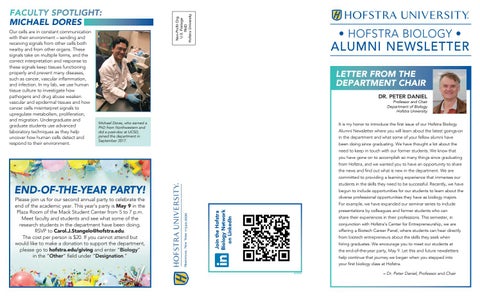
Michael Dores, who earned a PhD from Northwestern and did a post-doc at UCSD, joined the department in September 2017.
It is my honor to introduce the first issue of our Hofstra Biology Alumni Newsletter where you will learn about the latest goings-on in the department and what some of your fellow alumni have been doing since graduating. We have thought a lot about the need to keep in touch with our former students. We know that you have gone on to accomplish so many things since graduating from Hofstra, and we wanted you to have an opportunity to share the news and find out what is new in the department. We are committed to providing a learning experience that immerses our students in the skills they need to be successful. Recently, we have
END-OF-THE-YEAR PARTY!
diverse professional opportunities they have as biology majors. For example, we have expanded our seminar series to include presentations by colleagues and former students who can
Join the Hofstra Biology Network on LinkedIn
Please join us for our second annual party to celebrate the end of the academic year. This year’s party is May 9 in the Plaza Room of the Mack Student Center from 5 to 7 p.m. Meet faculty and students and see what some of the research students in the department have been doing. RSVP to Carol.J.Stangelo@hofstra.edu. The cost per person is $20. If you cannot attend but would like to make a donation to support the department, please go to hofstra.edu/giving and enter “Biology” in the “Other” field under “Designation.”
begun to include opportunities for our students to learn about the
share their experiences in their professions. This semester, in conjunction with Hofstra’s Center for Entrepreneurship, we are offering a Biotech Career Panel, where students can hear directly from biotech entrepreneurs about the skills they seek when hiring graduates. We encourage you to meet our students at the end-of-the-year party, May 9. Let this and future newsletters help continue that journey we began when you stepped into your first biology class at Hofstra. 82247:3/19
82247 Biology Invite Mailer.indd 1
– Dr. Peter Daniel, Professor and Chair
3/8/19 10:43 AM
COURSE SPOTLIGHT: NEUROBIOLOGY LAB If you happened to pass by Room 312 Gittleson Hall on Wednesday afternoon, the first week of the spring semester, you might have thought it had been converted into a gambling casino, but the clicking sounds emanating from the room were not from roulette wheels. Rather, students in our new Neurobiology Lab course (BIO 146L), taught by Drs. Beverly Clendening and Peter Daniel, were listening to the electric organ discharges (EODs) of weakly electric fish picked up by audio monitors. BIO 146L is required for senior neuroscience majors, an interdisciplinary major hosted by the departments of Biology and Psychology. There are eight students in the course this semester, but given the growth we are experiencing in the major, we may be offering two sections of 12 students each by spring 2021. In our first lab session of the semester, students measured the EODs of weakly electric fish by placing positive and negative electrodes at either end of an aquarium containing either a Gnathonemus petersii or G. victoriae. The discharge is amplified and streamed to a PC where it is displayed through
•
•
Evelyn M. Harrison, BA, 1984
Michelle F. Lamendola-Essel, MS, 2011
William Campbell, BA, 1980
Other degrees and certifications: MBA
Other degrees and certifications: DrHSc, MB(ASCP)CM
Other degrees and certifications: DDS
Current position: Chief clinical operations officer, Ophthotech Corporation. Ophthotech is committed to discovering and developing therapeutics and gene therapy solutions to treat ophthalmic diseases, with a focus on orphan and age-related retinal diseases. Memorable classes/professor: Bacteriology; Biology Advisor Dr. Rosalie Stillwell. Unexpected career turns: Starting my career in an academic research setting was a great learning experience. As a new graduate, I faced a challenging opportunity working with the Clinical Trials Unit on an HIV/AIDS study in the mid-1980s. The disease had only been identified by U.S. doctors in 1981, and the experience piqued my interest in clinical research and drug development. So when the opportunity to accept a position at Hoffmann-La Roche presented itself, I could not resist, even though I was still learning about the pharmaceutical industry. Why did you major in biology? I always had a love for science, but my greatest influence came from my mom and aunt who are both nurses. Even as a little girl, I remember their conversations about diseases, treatments, and patient outcomes. They seemed to have such interesting jobs. Even then, I knew that I wanted a career helping people in some way. What skills did you learn at Hofstra that you found useful in your career? Analytical skills, attention to detail, problem solving, time management, and teamwork. Advice for biology majors: In addition to a solid background in the sciences, I’d recommend courses in critical thinking, scientific writing, and speech. Volunteer work: Youth mentor, Harlem Church of Christ; Hofstra Women in Leadership
Check out the expanded profiles at hofstra.edu/biology.
82247 Biology Invite Mailer.indd 2
A LU M N I P R O F I LE S
a chart recorder program. Each discharge produces an electric field around the fish, and disturbances to that field by abiotic or biotic objects are detected by electroreceptors dispersed along the fish’s body. The fish uses this sensory information for navigation, foraging, and communication. For students, this is an easy way to study an ensemble action potential without requiring dissection. Neuroanatomy exercises include anatomy of the mammalian brain through dissection, optic tract tracing in fish, and immunocytochemistry of neurogenesis in the cowbird brain. Students also measure compound action potentials of the frog sciatic nerve, electroretinograms of the compound eye of wild-type and mutant strains of fruit fly, extracellular recordings of motor neuron and stretch receptor action potentials in crayfish, and intracellular recordings of postsynaptic potentials in crayfish muscle cells. In the latter half of the semester, students will design their own experiments using one of these model systems and report the results to their classmates in a research seminar.
Current position: I am the senior project portfolio manager for the head of the Division of Solid Tumor Oncology at Memorial Sloan Kettering Cancer Center in NYC. I oversee a portfolio that includes projects in basic cancer research as well as clinical and translational projects. This position, while it takes me away from the lab bench, is exciting because I get to work in the other areas of the health care industry and assist in activating clinical trials, liaise legal documents, support research operations, and assist in the drafting and submission of grants and manuscripts. Memorable classes/professors: Honestly, I talk about my Hofstra experience so fondly that my colleagues think I’m making up stories. For classes, Animal Migration and Principles of Cell Culture are on the top of my list. I had always focused on molecular biology, so I was not prepared for catching birds and butterflies before sunrise, going to the top of the Empire State Building to gauge bird migrations, or driving up to Cape Cod for a weekend to understand whale migrations. Principles of Cell Culture was my first experience with mammalian cell culture and animal models. The course was very demanding, but by the end I learned not only how to passage cell lines but also how to perform transfections and functional assays — something that I have been able to translate into my career. I could never forget Dr. Maureen Krause. Dr. Krause was my PI and mentor throughout my time at Hofstra and taught me everything I know about working with RNA, which I still leverage in my career! Unexpected career turns: When I started applying for jobs, I was really surprised at the different options that are available for someone with a degree in biology. My first job was at Acupath Laboratories in Plainview, NY, where I had the opportunity to apply all the experience I gained in school to something that affected people’s health. I didn’t think I would end up in health care, but the regulatory aspect of the field is intriguing and it was so exciting to see my work applied to patient care. Why did you major in biology? When I was younger, I knew I would be either a baker or a biologist — I have a love for both. My father convinced me to follow what I’m passionate about, even if it’s the more difficult road, and keep baking as a hobby (thanks dad!).
Memorable classes/professors: Professor McCourt: Embryology – He trained my brain to see in 3D, while viewing 2D images. Professor Stillwell: Bacteriology – WOW! What the human eye can’t see. Professor Wemyss: Physiology – will never forget being assigned a surprise research project at the end of class, as Dr. Wemyss walked hastily out of the lecture hall without answering questions. We were instructed to research and write a paper on the physiologic process of micturition. We were all surprised and delighted, realizing this professor’s sense of humor, upon learning what this process was about. Histology: Sure, all biologists study anatomy, but studying it at a microscopic level makes you realize the body’s divine design. What skills did you learn at Hofstra that you found useful in your career? I mentioned earlier how my training in viewing embryological microscope slides trained my mind to see an organism in 3D, while viewing these 2D slides in succession. This is exactly the concept behind modern-day computerized tomography studies and magnetic resonance imaging studies. CBCT studies of the jaws are now commonly used for diagnosis and treatment planning in the field of dentistry. Understanding these views is almost innate because of my earlier training. Why did you major in biology? I majored in biology because of my childhood curiosity of the human body and anatomy. I used to buy “dissectible” models of the human body, the eye, the heart, and other organs with my savings when I was a kid. I was only mildly interested in baseball card collections. Advice for biology majors: As with any subject, delve in if you’re interested. May your interest become your passion. May your passion give you life. If you are active on any social media sites you’d like to share, please list them here: MalverneDentalCare.com Volunteer work: Attending dentist at North Shore University Hospital’s Department of Special Needs Dentistry. Educate and assist dental residents in the care of individuals with physical and intellectual deficits.
3/8/19 10:43 AM