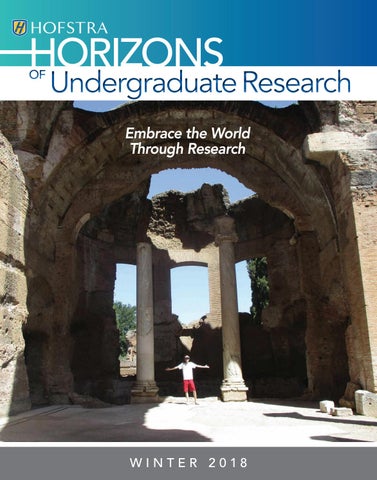
HORIZONS OF
Undergraduate Research Embrace the World Through Research
WINTER 2018
provost’s COLUMN HOFSTRA
Ask almost anyone with a college degree about the most meaningful academic piece of their undergraduate years, and you will certainly hear about an experience – a moment when they were challenged to stretch themselves to apply something learned in a classroom to a realworld situation. Research on the neuroscience of learning, along with decades of work by faculty across the disciplines, shows that experiential learning is a “high-impact practice” that makes a lasting difference in how well students retain and are able to build on their learning. Undergraduate research, which this magazine celebrates, is a leading form of experiential learning, and one that has become widespread at Hofstra University.
HORIZONS
This issue emphasizes the connection between undergraduate research and different forms of experiential learning at Hofstra, whether in a Baroque opera at the Boston Early Music Festival, or in lab work at the Stem Cell Institute at Harvard University, or in the Living Latin program in Rome. The inter-relation of high-impact practices (HIP) at Hofstra will soon be visible on the HIP@HOF webpage, but it is already evident in the interdisciplinary structure of our First-Year Connections program; in the design of our Honors College; in the new Writing Intensive requirement across the curriculum; in our growing emphasis on global engagement through service or study abroad; and in the increased use of the electronic portfolio. In all these scenarios, students learn both content knowledge and techniques (in the lab, on the stage, in the classroom) that support knowledge acquisition. The word technique derives from the ancient Greek techne, meaning a craft or skill. That root is shared by the word technology, which for us indicates a collection of crafts and skills and tools that allows us to do and make other things that extend our abilities to produce knowledge, or widgets, or new widgets that produce new knowledge. The defining technology of our current epoch is digital, and digital technology has transformed both how we learn and to some extent what we learn.
ndergraduate 16 UResearch Day
The next issue of Hofstra Horizons of Undergraduate Research will focus on the role of digital technology in undergraduate research, which will coincide neatly with my participation this year in the Association of Chief Academic Officers’ Digital Fellowship. This focus reflects ongoing discussion on campus of how we use and can and should use digital pedagogy to enhance learning, retention, and graduation rates for all students. I look forward to seeing strong examples of how digital techniques can be brought to bear to enhance the undergraduate research environment at Hofstra University.
Hofstra HORIZONS of Undergraduate Research t WINTER 2018
OF
Undergraduate Research
table of contents
4 What Is Undergraduate Research?
6 Student Profiles onors College 15 HResearch Program 2016 and 2017
18 CAA Undergraduate Research Conference 20 Undergraduate Library Research Award 22 Hofstra Undergraduate Researchers Go the Extra Miles!
24 2016 and 2017
Mentors of the Year
Learning 26 Eatxperiential Hofstra upport Undergraduate 27 SResearch Fund
editor’s NOTE
Neil H. Donahue, PhD Editor Hofstra Horizons of Undergraduate Research Vice Provost for Undergraduate Academic Affairs and Internationalization Professor of German and Comparative Literature
Dr. Neil H. Donahue has taught at Hofstra University since 1988. In addition to seven books, he has published numerous articles and reviews. More information about Dr. Donahue and his curriculum vitae can be found at people.hofstra.edu/Neil_H_Donahue.
Welcome to the fourth issue of Hofstra Horizons of Undergraduate Research! As has been pointed out to me on several occasions, not many universities, if any, have a magazine devoted exclusively to undergraduate research. At Hofstra, I felt we had to have one: Over the years, as I talked to students across the disciplines, I heard what amazing things they were doing in very different fields; I saw the impressive posters of their research on Undergraduate Research Day, and how articulate and poised they were in presenting them; I looked at their photos and heard their stories from professional conferences around the country and even abroad (with full Hofstra funding!); and eventually, I learned what they were doing next – great jobs they’d accepted or graduate or professional schools where they decided to continue their studies. And then, I had to think and ask: How can we not publicize and share their accomplishments? Otherwise, it’s very hard to know what sorts of great things our students are doing in areas other than one’s own home department and college, and so a magazine seemed like a good way to show off our students’ achievements in research, both inside and outside the University, but within our curriculum. Yet such a magazine reflects only a small portion of the undergraduate research that takes place at the University. By definition, research is highly focused, specialized, and in-depth in a very particular area of a discipline, and it’s difficult for an editor-outsider-administrator to know in advance who throughout the University is doing outstanding work, and then get the details. Undergraduate research mainly comes to completion as the semester and the student’s career at Hofstra comes to an end, and then the students leave and go on to great things. The window to secure all the information is small and comes at the busiest time of the year. That’s always the challenge of such a venture: What I’ve collected here as highlights reflects my attempt, less systematic than random, to represent the range at large across the University, and should be seen in relation to prior issues of this magazine, which are easy to flip through online at hofstra.edu/ughorizons. Also, in this issue, I’ve tried with a couple of features to begin to incorporate experiential learning as a form of research when it involves highly specialized content or techniques and/or leads further to highly specialized research. Not all experiential learning aims to do that, but rather has its own purpose in consolidating the student’s general foundational knowledge and theoretical background into specific individual practices. As such, experiential learning is illustrative or shows in particular in the world what was learned in general in the classroom. But experiential learning can also open up a research trajectory by providing necessary skills or isolating a specific problem for further in-depth inquiry and research. Undergraduate research is a highimpact practice in higher education that relates, reinforces, and relies upon other high-impact practices, as defined on the Student Engagement and Learning webpage, hofstra.edu/engagementandlearning. I hope you enjoy this issue, browse past issues, and think of how you can support undergraduate research at Hofstra University! Hofstra HORIZONS of Undergraduate Research t WINTER 2018
WHAT IS UNDERGRADUATE RESEARCH? The University is a place of both teaching and research. Research by faculty informs and enriches the classroom experience and allows students to progress from the fundamentals in a field to its advanced, more specific and nuanced branches of inquiry, and on toward the production of new knowledge. Faculty members instruct students not only in the content of an area but also in its methods of independent inquiry that will lead to new insights and discoveries. Undergraduates engage increasingly in guided research as they move from foundational courses to more advanced courses and more closely defined topics. Advanced students in a major can then engage in independent, supervised research sometimes as juniors, usually as seniors, and possibly for departmental honors, as a way of demonstrating their mastery of both content and methods in the field, and their ability to formulate and pursue their own line of inquiry, which may lead to exciting discoveries and new knowledge. Undergraduate research thus serves as a capstone to a student’s work and development in an undergraduate major and can lead to graduate study or directly into professional life. The term undergraduate research refers to such pursuits in all fields as advanced work in the discipline, whether that work, that research, takes place in the laboratory or the library, in the studio, on stage, or in the field. Each student’s advanced research – after months of hard work, reflection, uncertainty, and frustration, but also happy discovery, enthusiasm, relief, and revision – culminates in the public presentation of the results, in the department, in a public performance (on stage, in an exhibit, or in a recital or concert), at a professional conference, or on Undergraduate Research Day for the Hofstra community in general.
4
The purpose of this magazine is to present an overarching perspective on undergraduate research at Hofstra University across the disciplines and to highlight individual achievements, past and present, along with notable events and awards. The presentation of research, the sharing of knowledge, reflects the commitment to free inquiry and teaching that is central to the mission of the University and that constitutes the lifeblood of the academic enterprise, and we all benefit from and thrill at learning what our hardest-working, most advanced students have accomplished.
Hofstra HORIZONS of Undergraduate Research t WINTER 2018
5
Hofstra HORIZONS of Undergraduate Research t WINTER 2018
Student PROFILES
Rebecca Webber By Jordyn Miller Rebecca Webber ’17, from Manchester, Connecticut, graduated with a double major in comparative literature and linguistics; she earned the Honors College Associate designation, and departmental honors in both majors! Originally a pre-med student with a global studies major, Rebecca decided she loved reading too much not to major in comparative literature, and after taking a Swahili class with Dr. Robert Leonard, she realized her love of language(s) and added linguistics as a second major. For her first honors thesis in comparative literature under the direction of Professor John Krapp, Rebecca analyzed critical interpretations of Lolita (1955) by Vladimir Nabokov; for her second honors thesis in linguistics under Professor Tammy Gales, she looked at government publications and newspapers for their use of language in discussion of HIV and AIDS and how that affects the treatment of both epidemics in Uganda and Swaziland. During the spring semester of her junior year, she studied abroad in Kenya and hopes to return with the Peace Corps.
6
Student PROFILES Jaffar Singh
In 2015 Jaffar received the Dr. Bruce and Doris Lister Endowed Fellowship in Chemistry Research.
When he began his studies at Hofstra in 2013, Jaffar Singh ’17, from Queens, New York, started working with a synthetic organic chemist as a research assistant in Hofstra’s Chemistry Department. His initial research project dealt with synthesizing various compounds known as isoxazoles, which have anti-inflammatory, antifungal, and antiviral properties. In 2015 Jaffar received the Dr. Bruce and Doris Lister Endowed Fellowship in Chemistry Research. Through the fellowship, Jaffar started working with Dr. Richard Denton on synthesizing S-(+/-)-Lycoperdic Acid, which has the possibility to provide help for memory loss and may also play a vital role in disabling certain neurodegenerative disorders such as Alzheimer’s disease and stroke. In his senior year, Jaffar switched research professors and started working as a research assistant with Dr. Shivnath Mazumder, a computational inorganic chemist. For his new project, he investigated the mechanism of water reduction by a copper-containing polypyridine electrocatalyst. Splitting water into hydrogen and
oxygen is one of the most attractive scenarios for solar energy harvesting and sustainable energy production. Hydrogen has the potential to act as a chemical fuel. Therefore, it was urgent to provide an appealing approach toward generating and storing hydrogen in a sustainable manner. H2 can successfully be used as an alternative fuel to avoid emission of greenhouse gases. Jaffar defended his departmental honors thesis in front of a panel of professors and was awarded high honors. Jaffar then applied to various research positions and received an offer to work as a research associate at the MIT’s Koch Institute for Integrative Cancer Research, where he is currently studying the genetic events that contribute to the development of pancreatic cancer. Pancreatic cancer has the lowest survival rate of all cancers. Jaffar is working with various biological techniques such as the CRISPR/Cas9 system, which has revolutionized genome editing by allowing researchers to edit certain genomes both accurately and at a fast pace. Jaffar will pursue an MD-PhD and hopes to use his research experience to help patients with cancer in a clinical setting, while working to prevent and treat cancer in the laboratory.
7
Hofstra HORIZONS of Undergraduate Research t WINTER 2018
Student PROFILES
BIOLOGY GRADUATE AWARDED NATIONAL SCIENCE FOUNDATION FELLOWSHIP Stephen Gaudino
“As a recipient of the National Science Foundation’s Graduate Research Fellowship, he now joins a truly world-class group of scientists, including countless Nobel Prize recipients,” said Dr. Rigel. Stephen Gaudino, who graduated in May 2016 with a degree in biology, was awarded a prestigious 2016 Graduate Research Fellowship from the National Science Foundation (NSF).
8
He was one of 2,000 students chosen from among 17,000 applicants nationwide for the grant, which is awarded to students who show great potential in strengthening what the NSF calls the “the vitality of the U.S. science and engineering enterprise.” With the NSF grant, Stephen received $46,000 toward tuition and living expenses. In August 2017 he completed, with distinction, a Master of Science in integrative biology at Hofstra. “My research interests are in microbiology, and specifically, pathogenic bacteria and methods that could play a role in disease prevention,” said Stephen, of Massapequa, New York. His work in the lab of biology professor and advisor Nathan Rigel, PhD, revolved around the PilR transcriptional regulator. PilR is needed to form Type IV pili, a structure found on the surface of bacterial cells. Pili are important for basic functions such as movement and can aid attachment to human cells during infection.
Hofstra HORIZONS of Undergraduate Research t WINTER 2018
”Stephen has been an integral part of my lab since the day he joined in 2014. As a recipient of the National Science Foundation’s Graduate Research Fellowship, he now joins a truly world-class group of scientists, including countless Nobel Prize recipients,” said Dr. Rigel. “This achievement speaks volumes about Stephen’s potential as a scientist; it also reflects the strength of the research environment that the biology faculty provide to our students.” In addition to a strong personal statement, academic record, and letters of recommendation, Stephen submitted a research proposal in which he outlined a plan to further examine the role of PilR using both genetic and biochemical strategies. He applied for the fellowship with the help of Dr. Rigel and Dr. Neil H. Donahue, vice provost responsible for undergraduate research and fellowships. Stephen was treasurer and historian of Hofstra’s biological honors society, Beta Beta Beta; a member of SMACS (Student Members of the American Chemical Society); and an avid illustrator and painter. He is now fully funded in the PhD program in Molecular Genetics and Microbiology at Stony Brook University.
Student PROFILES
By Jordyn Miller
In looking at the Flint water crisis, Sabrina and Dr. Robinson deciphered implications needed to empower citizens in low-income areas. Sabrina Singh ’17, a senior from Garden City, New York, was a philosophy major with a minor in community health and rhetorical studies. After meeting Dr. Tomeka Robinson early in her college career, Sabrina took a liking to the subject of rhetoric, and was later chosen by Dr. Robinson to assist her in research on environmental racism. In looking at the Flint water crisis, Sabrina and Dr. Robinson deciphered implications needed to empower citizens in low-income areas. Sabrina and Dr. Robinson presented their research at the International Crisis and Risk Communication Conference, March 13-15, 2017, in Orlando, Florida. Along with her research in the Department of Writing Studies and Rhetoric, Sabrina worked with Dr. Chris Eliot and Dr. Ira Singer in the Philosophy Department on her departmental honors thesis, which focused on decision-making capacity in
dementia patients, and how assessments of such capacity can be improved to ensure better health care for these patients. When not in class or doing research, Sabrina was very involved with Hofstra Forensics (the speech and debate team), again with Dr. Robinson. Her interest in rhetoric is both her vocation and avocation, her career plan and her hobby.
Sabrina Singh
After completing her Hofstra degree in three years, Sabrina began the master’s program in communication studies in fall 2017 at the University of Montana with a full scholarship.
Gwen Osterwald By Jordyn Miller Gwen Osterwald ’17, from Allentown, Pennsylvania, was a triple major in Spanish, Chinese, and Chinese studies and a member of Honors College. As a Chinese major, Gwen studied in fall 2016 at East China Normal University in Shanghai. In her sophomore year, she took a Spanish grammar class with Dr. Miguel-Angel Zapata, and she discovered a love for translation. Then, in the summer of 2015, she studied in Granada, Spain, at the University of Granada, and upon returning, then in her junior year, Gwen and Dr. Zapata decided to begin a translation project for her senior honors thesis with the title “The Act of Translation: Spanish-Language Women Poets of Our Generation.” She presented her research on campus at Undergraduate Research Day and in her honors thesis defense. Always up for a challenge, Gwen is an extremely active member of the rock climbing club. In fall 2017 Gwen began Hofstra’s master’s program in forensic linguistics.
9
Hofstra HORIZONS of Undergraduate Research t WINTER 2018
Student PROFILES Hannah Bougleux Gomes
In spring 2017 Hannah conducted research in the Hofstra Psychology Department with Dr. Jin Shin on how anxiety and stress affect the memories of students as well as their performance in class and on tests. Always a presence around Honors College, in the library and the laboratory, Hannah was also vice president of Tri Beta Biological Honors Society, and a member of Phi Delta Epsilon, the pre-medical studies fraternity at Hofstra. She enjoyed peer teaching and tutoring while at Hofstra, as well as tutoring in the science departments. Hannah also shadowed doctors in the Emergency Department at North Shore University Hospital, and frequently volunteered at nursing homes. In any free time that remained, Hannah enjoyed playing volleyball, basketball, and piano.
Hannah Bougleux Gomes ’17, from Belo Horizonte, Brazil, was a pre-medical studies major and psychology minor, and a member of Honors College. She first entered Hofstra on a volleyball scholarship, but began research right away in the Biology Department on how energy resources affect the courtship behavior of fruit flies. After her first year, she dropped volleyball in favor of biological research. In the summer of 2015, Hannah was chosen to work as a researcher at the Harvard Stem Cell Institute working to create HIV-resistant cells. In summer 2016 she returned to Harvard, with Hofstra support, to work on immune tolerance during pregnancy, and treatments to avoid miscarriages and autoimmune diseases.
In September 2016 Hannah gave the Welcoming Address to the incoming Class of 2020 at the Adams Playhouse, where she connected forcefully to that new generation of Hofstra students, with an allusion to something they all were familiar with: “When I think of Hofstra, I think of that scene from the movie Monsters Inc. with the seemingly infinite number of floating doors: Every path, every avenue is right there in front of us, the tools are right here; we can choose any of these doors and step confidently through it. As a senior, today I can say that I’ve picked my door and even though I still don’t know all of what lies behind it, I am sure of the path that I want to take: to help people through medicine and research.” Hannah spent the summer after graduation in her home country working as an instructor in a scientific outreach program for high school students, and then in fall 2017 – while applying to medical schools – she returned to the Harvard Stem Cell Institute to work as a full-time researcher in the laboratory for one year.
10 Anastasia Brodovskaya, from Russia, graduated from Hofstra in spring 2017 with a biochemistry major and neuroscience minor. She was also a member of Honors College. She worked in the biochemistry lab of Dr. Scott Lefurgy on bacterial beta-lactamases, and presented posters at three consecutive American Chemical Society conferences in Denver, San Diego, and San Francisco. She was also an intern in the Harvard Stem Cell Institute Internship Program during the summer after her sophomore year and worked as a neuroscience lab assistant at Brown University after her junior year. Anastasia is a Phi Beta Kappa member, and in fall 2017 she began her graduate work as a fully funded PhD student in the Neuroscience program at the University of Virginia. Hofstra HORIZONS of Undergraduate Research t WINTER 2018
Anastasia Brodovskaya
Student PROFILES By Jordyn Miller Kyle Castoria ’17, from Long Beach, New York, was a double major in physics and mechanical engineering with a minor in math. He also earned departmental high honors in physics and the Graduate with Distinction designation from Honors College, its highest designation. While at Hofstra, Kyle was involved in two research projects in physics: building a scanning tunneling microscope, which can look at the structure of atoms, with Dr. Steve Campolo; and, with Dr. Adam C. Durst, looking at the physics within a semiconductor in great detail. Kyle and Professor Durst presented the project in New Orleans at the American Physical Society meeting in March, and Kyle also presented his research on campus at Undergraduate Research Day. Their findings were published in Physics Review B, a journal of solid state physics (Durst, A.C., Castoria, K.E., and Bhatt, R.N., “Heitler London model for acceptor-acceptor interactions and doped semiconductors,” Phys. Rev. B 96, 155208, Oct. 26, 2017). Kyle played club rugby at Hofstra (until injured) and served as secretary of the Society of Physics Students at Hofstra, and was also a member of Sigma Pi Sigma, the physics honors society. Kyle worked as a physics tutor and a lab aide in the Physics Department. In fall 2017 Kyle entered the PhD program in electrical engineering (with full funding) at Princeton University.
Paul Franco
Kyle Castoria
By Jordyn Miller
Paul Franco ’17, a biology major with a biochemistry minor from Seaford, Long Island, conducted research in his sophomore year, focusing on temperature-dependent sex determination in turtles. Then, with a research fellowship from the department, he also helped professors add a component of research design to the lab curriculum for introductory Cell Biology and Genetics (BIO 011). In summer 2016 Paul was invited to conduct biomedical research at the Harvard Stem Cell Institute, attempting to generate an immune-compatible donor stem cell. He received one of the highest MCAT scores in Hofstra pre-med history.
11
Paul is a member of the pre-medical studies fraternity, Phi Delta Epsilon, and was president of Tri Beta Biological Honors Society. As president, he worked to develop a biology mentor program, sponsored fundraisers for the Children’s Miracle Network, and promoted scientific outreach in the Long Island area. Besides his extracurricular pre-med activities such as shadowing doctors in the Emergency Department at North Shore University Hospital and working as a peer tutor for the Biology Department, Paul enjoys singing, playing basketball, and learning Portuguese in his free time. In summer 2017 Paul participated, along with his fiancée, Hannah Gomes, also Class of ’17, as an instructor in an outreach program in Brazil to motivate young adults to become scientists. In fall 2017 – while applying to medical schools – he returned to the Harvard Stem Cell Institute to work as a full-time researcher in the laboratory for one year. Hofstra HORIZONS of Undergraduate Research t WINTER 2018
Student PROFILES Connor Mayes
Connor Mayes, from Fresno, California, graduated from Hofstra in December 2017 with a triple major in global studies, geography, and German. He completed the Congress-Bundestag Youth Exchange program after high school, which enabled him to spend a full year in Germany at the German Gymnasium (humanistic university-track high school). He continued his study of German at Hofstra, starting on the advanced level. In fall 2017 he completed an honors thesis in each of his majors. His honors thesis in
He combined both of his theses to submit a comprehensive project proposal for a Fulbright scholarship next year in Germany, where he would like to continue his research ... the Department of Global Studies and Geography, supervised by his advisor, Dr. Kari Jensen, with Drs. Zilkia Janer and Mario Ruiz as additional readers, was titled “Ruling the Bloodlands: The Relationship between Space, Resources, and Genocide.” Last year he presented his research in geography on “The Refugee Crisis in Germany” (see photo above), which became the basis for his German honors thesis on literature in Germany from the post-World War II period to
12
Taylor Ninesling
the present (in German) by immigrant authors representing the immigrant experience. He combined both of his theses to submit a comprehensive project proposal for a Fulbright scholarship next year in Germany, where he would like to continue his research to establish “a German model of migrant integration and a methodological model of integrative and human geography” before returning to the United States to work and continue his graduate studies. Connor is also a competitive ballroom dancer.
Taylor Ninesling ’18 is a mathematics major from Massachusetts, who spent the fall semester of 2017 in Budapest, Hungary, learning Hungarian and conducting advanced mathematics research. He won a highly competitive grant for a study abroad semester in the mathematics program at the prestigious Eötvös Loránd University (ELU) in Budapest. Before leaving the United States, Taylor also submitted an application for a 2018-19 Fulbright scholarship to return to Hungary to do further work in the Formal Concept Analysis community at the Renyi Institute of Mathematics. He describes his project as “work on the problem of Belief Revision and Contraction in Direct and Binary-Direct Implicational Bases. The project consists of creating algorithms to solve these problems and proving their correctness. Once completed, I will implement the algorithms and compare their practical time performance against existing algorithms. These can then be applied in the data analysis of many domains, including but not limited to medicine.” In summer 2017 he presented the results of his independent research project under Dr. Kira Adaricheva at Hofstra at the 7th International Conference on Formal Concept Analysis (ICFCA) in Rennes, France. The FCA community is more widespread in Europe than in the United States, and Taylor hopes to widen the community by making connections between the United States and Europe in this area. He will pursue a PhD in the United States.
Hofstra HORIZONS of Undergraduate Research t WINTER 2018
Student PROFILES “When I talk to my friends back home, they didn’t have opportunities like we have had here. Not just the debate, but the events that would happen almost every day ... “ When Carmen Pestano ’17 presented the paper “Crises and Their Impact on the Governance of Immigration” at the European Union Studies Association (EUSA) 15th Biennial Conference last spring in the Canary Islands, she exhibited the poise and expertise of a seasoned scholar on the program. No one would have guessed that she needed a little push from her professor, Dr. Carolyn Dudek, chair of the Political Science Department. But the trip to the conference was also a trip home for Carmen, after having completed her studies at Hofstra as an international student. Four years earlier, she had come to Hofstra by way of the Canary Islands, a beautiful Spanish archipelago off the coast of northwest Africa. She was recruited to play on the tennis team and had declared a political science major before ever setting foot on campus. She was drawn to Hofstra by its proximity to Manhattan and by the fact that the University had, at that time, hosted two presidential debates. “Before coming here, I talked to one of my teammates who told me what the campus was like during the second debate when President Obama was on campus – the excitement, the helicopters flying over campus, and what an amazing experience it was for all the students,” she said. Carmen added a European studies minor to her political science major and found a mentor in Professor Dudek. “I just kept taking classes with her.” Together they began formulating ideas for what would eventually become Carmen’s departmental honors thesis on the
European refugee crisis and its impact on the Canary Islands. Her research focused on how crises can affect migration policy in the European Union. For her research, Carmen received a Firestone Fellowship, a $2,500 award granted by Hofstra College of Liberal Arts and Sciences, and the funds allowed her to travel to the Canary Islands with Professor Dudek during the summer of 2016 to perform research. Once there, Carmen was able – as a Carmen Pestano native speaker and native of Carmen with her thesis advisor, the Canary Islands – to construct Carolyn Dudek, during their trip questions for each interviewee that to the EUSA conference; Carmen were probing and useful for the is dressed in the traditional garb study. Professor Dudek proposed for a festival called the Romeria that they present their findings at of San Benito. the May 2017 conference of the EUSA, the premier scholarly and professional organization focusing poets, writers, even Joe Morton from on the European Union. The EUSA Scandal [TV drama] – that was so awarded Carmen a $500 grant to defray interesting! You get to meet all of them costs associated with the conference. and learn from them.” Then, just days before her return to campus from the Canary Islands, she Carmen distinguished herself at Hofstra recalls: “I found out Hofstra was hosting as a scholar and as an athlete. She was the presidential debate – I was so inducted into Phi Beta Kappa in April, excited!” Thousands of students entered and her 45 career singles victories on a lottery for a ticket to attend the debate the tennis team rank fourth all-time, at the David S. Mack Sports and and her 25 doubles wins with partner Exhibition Complex, and Carmen was Sarah Bowen rank first on the career one of the few hundred to win a seat at doubles wins list. She was a four-time the first face-off between candidates Intercollegiate Tennis Association Donald Trump and Hillary Clinton on Scholar-Athlete. In addition, her thesis September 26. “It was a dream come was chosen for one of the Axinn Library true. I was sitting a few rows back from Undergraduate Research awards (see former President Bill Clinton and saw so page 21). many government officials.” She is pursuing a master’s degree in When asked what she will miss most European affairs at the prestigious about Hofstra, she says, “When I talk to and highly selective Sciences Po, my friends back home, they didn’t have aka Paris Institute of Political Studies. opportunities like we have had here. Not By Ginny Greenberg just the debate, but the events that would and Jordyn Miller happen almost every day – speakers,
13
Hofstra HORIZONS of Undergraduate Research t WINTER 2018
Student PROFILES
Though the literary, linguistic, and historical-archaeological points of interest were the focus of the program, Isaac noted that “meeting Latin enthusiasts and interacting with them was probably the greater part of the learning experience.”
In the summer of 2017, classics major Isaac Hoffman participated in the Paideia Institute’s Living Latin in Rome (LLiR) program – an intensive Latin experience in Rome, Italy. During the five-week program, students read ancient Latin texts, some of which have a close relation to the many monuments and archaeological sites in and around Rome – and they visit those sites. For example, program participants memorized one of Cicero’s Catiline Orations and delivered it in the forum outside the temple where Cicero himself first gave it, and read Pliny’s famous letter describing the eruption of Mount Vesuvius in 79 CE while seated at the summit of the volcano itself!
14
Isaac described it as an opportunity to become closer to Latin in the city of the Latins and a chance to think about the language in an active way, as a living and spoken language. Mornings often began with a site visit, while afternoons were spent in the classroom, improving Latin speaking and writing. Wednesdays and Saturdays were often day trips to sites around Rome, such as Lake Nemi or Sperlonga. The trip also included a weekend in Naples, visiting Pompeii and Mount Vesuvius, and a visit to Florence. Though the literary, linguistic, and historicalarchaeological points of interest were the focus of the program, Isaac noted that “meeting Latin enthusiasts
Hofstra HORIZONS of Undergraduate Research t WINTER 2018
Isaac Hoffman and interacting with them was probably the greater part of the learning experience.” And for Isaac, the program was also a research experience: Isaac heads a new outreach program and internship started by the Classics Department during the last school year, called Aequora. The program was created by the Paideia Institute only a few years ago and has since grown to support after-school programs in multiple states. Aequora aims to improve English literacy in underprivileged communities by teaching Latin and the culture of ancient Rome. The program hopes to expand classical scholarship and study beyond the elite, privileged community, which has been its primary benefactor and audience for many decades, if not centuries. Hofstra’s Aequora program meets at the Hempstead Boys and Girls Club, where Aequora site coordinators and volunteers teach Latin with a fun and engaging curriculum. Both Aequora and the Living Latin in Rome program espouse an active approach to Latin pedagogy, in which the language is taught to be spoken and written as much as to be read and studied. By treating Latin as a living language, students experience a surprisingly high level of engagement and enjoyment with Latin. Because of the novel nature of this approach to an ancient (“dead”) language, an immersive and intensive course like LLiR provided Isaac with new skills to use in the Aequora classroom. Experiencing living Latin pedagogy as a student has informed Isaac’s own pedagogy and inspired new lessons and activities, as well as his own ambitions as a classicist.
Honors COLLEGE
HONORS COLLEGE
RESEARCH PROGRAM
In spring 2017, with a generous donation from Hofstra trustee and Hofstra Law School alumnus Steven C. Witkoff, chairman and CEO of Witkoff, a global real estate development and investment firm, Hofstra University Honors College (HUHC) launched a pilot program to fund HUHC students to work directly with faculty as research assistants. In its first year, the program received 41 applications from a very broad range of disciplines for 12 positions, though ultimately 13 were funded. The areas of research activity included assembling footage from film history; archival work on the history of slavery in Jamaica; establishing a production workflow in online publishing; developing accessibility audits for digital humanities projects; and cataloging illustrations of ceramics and their glazing. In addition, students performed chemical analyses of biodegradability, of municipal wastewater, and of brain tissue; a cross-cultural forensic linguistic analysis of Native American parole board hearings in Montana; and separate analyses of social determinants of public health, of the structural health of buildings and bridges through sensor networks, and of the threats to trust in politics and marketing. In each case, under the guidance of an established researcher/professor, students plunged into the hands-on aspect of very advanced research on primary source materials and analytical techniques. Such research gives them the confidence and skills to pursue their own research and to understand and adopt other techniques and tools of analysis.
15
In April 2017 these selected students presented the results of their activities as research assistants to each other, to the Honors College deans, and to donor Steven Witkoff, who then, again generously, invited them all out to dinner in Manhattan to celebrate their success and share more of their impressions about their experiences. Not all could attend the dinner, but those who did (see photo above, left) look very pleased! As a very successful Hofstra alumnus, Mr. Witkoff could see how his gift helped directly to shape these students’ futures as researchers in their different fields. He renewed the gift for the 2017-2018 year for a new cohort of HUHC student researchers!
Hofstra HORIZONS of Undergraduate Research t WINTER 2018
UNDERGRADUATE RESEARCH DAY 2016
Advanced student research continues throughout the year in all disciplines and, after months of hard work, merits the opportunity for presentation, recognition, and applause!
ach student’s presentation E marks the culmination of intense individual or team research, in the library or in the lab, in the field or studio or on stage, often with moments of anguish, uncertainty, and frustration, but also with happy discovery, satisfaction, enthusiasm, relief and – revision, revision, revision. There’s a reason it’s called a discipline!
16
The presentation of research, the sharing of knowledge, is the life-blood of the academic enterprise, and we all benefit from knowing what our hardest working, most advanced students have accomplished. Hofstra HORIZONS of Undergraduate Research t WINTER 2018
UNDERGRADUATE RESEARCH DAY 2017
The culmination of an undergraduate student’s work in a particular discipline reflects the mastery of both methods and foundational knowledge, and a transition to graduate school or professional life. Undergraduate Research Day makes visible to the University community in general the outstanding work of highly motivated student researchers under the guidance of experienced and engaged faculty members.
From June 1 to 5, 2017, Professor Javier Izquierdo (Biology Department) accompanied a group of four undergraduate students (and one graduate student) from his Hofstra lab to the 2017 Microbe Meeting of the American Society for Microbiology (ASM) in New Orleans, Louisiana, which he considers the “most important meeting in microbiology in the world.” Each of the students presented their own individual project and achieved some notable successes, indeed Hofstra “firsts”: Ashna Joseph’s presentation was upgraded to an ASM Rapid Fire Talk in the main exhibit hall (see photo, second from top, left); Justin Chen’s poster received its own ASM press release to the scientific press covering the event; three students (Ashna Joseph, Justin Chen, and Srilu Garikapati) earned ASM Presenting Student Awards for their posters; and Shari Zaslow’s poster was the first poster from Professor Izquierdo’s lab to bear the National Science Foundation logo. As a result of their excellent presentations, Professor Izquierdo’s students met new contacts and collaborators from Oak Ridge National Labs, the DOE Joint Genome Institute, and the agricultural biotechnology industry.
17
Also, they seem to have had a great time traveling together, and they enjoyed some excellent regional food and good cheer out on the town!
Hofstra HORIZONS of Undergraduate Research t WINTER 2018
18
2016 CAA UNDERGRADUATE RESEARCH CONFERENCE AT WILLIAM & MARY The Colonial Academic Alliance (CAA) is the parallel organization to the Colonial Athletic Association. In 2002 the provosts of the member schools decided that their association should focus not only on athletic competition, but also on student academic achievement. The Colonial Academic Alliance was founded to develop, promote, and facilitate collaborative programs and resource-sharing in order to enhance academic quality and institutional effectiveness among the member institutions: College of Charleston, Drexel University, Elon University, Hofstra University, James Madison University, Northeastern University, Towson University, University of Delaware, University of North Carolina – Wilmington, and William & Mary.
Hofstra HORIZONS of Undergraduate Research t WINTER 2018
CAA Undergraduate Research Conference
Each spring the CAA sponsors an Undergraduate Research Conference that is hosted by a member school. Up to 10 students from each member school present their research either as a poster or as a short lecture; students travel together with faculty or staff to represent their institution. The host school shows off its resources with tours and lectures by outstanding faculty. The conferences generally also offer meetings on diverse topics of interest and use to students, such as sessions on prestigious scholarships (and how to apply), on graduate school, and on environmental best practices. In such ways, CAA member schools learn from one another and share ideas at all levels. Hofstra University has hosted the event twice (in 2005 and 2011) – the second time, in spring 2011, in order to coincide with the University’s yearlong 75th anniversary celebration. In 2016 William & Mary hosted the 14th annual conference on its campus in Williamsburg, Virginia; the conference began with a reception/registration dinner, followed by a ghost tour of Colonial Williamsburg and a reception and dinner at the splendid Muscarelle Museum of Art, surrounded by the stunning exhibit of Ando Hiroshige’s Fifty-Three Stations of the Tokaido, a series of woodblock print images of the most traveled road in pre-modern Japan. The full Saturday of sessions for oral presentations and posters by students was punctuated by two brilliant lectures by W&M faculty. During the luncheon, Hofstra Vice Provost Neil Donahue hosted an information session on prestigious scholarships. Hofstra students were delighted to participate in events at W&M and see the colonial campus and town, and to present their own research with poise and professionalism. Vice Provosts Neil Donahue and Robert Brinkmann drove students to Williamsburg in vans with a lot of good cheer; Provost Simmons shared the ride down but had to hustle back to campus by plane for other business.
19
The 2017 CAA conference was held at Elon University in Elon, North Carolina, but Hofstra withdrew its participation after President Rabinowitz’s decision that Hofstra University should not participate in non-contractual events with University funding while North Carolina’s state law HB2 [House Bill 2] was in effect. That proud and principled decision can be read in full at gohofstra.com/hb2. The Provost’s Office encouraged students to pursue other opportunities for presenting research at conferences (see pages 22 and 23). For images from past conferences, visit hofstra.edu/caaresearch. Hofstra HORIZONS of Undergraduate Research t WINTER 2018
UNDERGRADUATE LIBRARY RESEARCH AWARD ABOUT THE AWARD Established in 1997 by the Hofstra University Library faculty, the Undergraduate Library Research Award (ULRA) recognizes excellence in academic research by a graduating senior. Three awards of $500 each were given for academic papers demonstrating exemplary research authored by seniors scheduled to graduate in May 2017. An award was given for an outstanding paper in each of the three academic disciplines: Humanities, Sciences, and Social Sciences. In addition to the $500 prize, winning papers are published on the ULRA website during the academic year following the granting of the award. The 2017 winners are:
SARAH GERWENS, “Anglicisms –
Nein Danke? Quantitative and Qualitative Analysis of the Occurrence and Usage of English Loanwords in Contemporary German(y),” for Professor Zilkia Janer, GS 100: Global Studies.
20
For Sarah Gerwens’ honors thesis in global studies, she investigated the usage and perception of Anglicism in contemporary Germany. In analyzing existing academic literature, popular publications about the German language, and the arguments of self-proclaimed defenders of German language, she came to the conclusion that German is not being helplessly overwhelmed by English-language influence and, thus, it does not need to be protected or purified. While a student at Hofstra, Sarah was actively involved as a peer teacher in her department and as a global mentor. She was president of Hofstra Model UN, treasurer of Get Global, and a member of Phi Beta Kappa and Honors College, and she also worked as a student assistant in the Philosophy and Religion Department. In summer 2017 Sarah interned for a German politician in the European Parliament before heading to London in September, where she is enrolled in the MSc in Global Europe: Culture and Conflict program at the London School of Economics.
Hofstra HORIZONS of Undergraduate Research t WINTER 2018
ABSTRACT This paper investigates the role of English in Germany in the era of contemporary globalization. As the prevalence of English loanwords and English-language influences has grown over the past decades, so has the opposition to them. Self-proclaimed language protectors, German language organizations, and political parties have attempted to purify and “Germanize” German by eliminating these Anglicisms and strengthening German identity overall. To examine the extent and consequences of English-language influence on German, I reviewed existing academic literature, analyzed the publications of German language protectionists and language organizations, and conducted qualitative and quantitative research by analyzing the usage of Anglicisms in German-speaking print media. Furthermore, I embedded my analysis in the larger historical context of the spread of global English to examine how English proliferation in the era of globalization is different from previous periods and how English purification movements have emerged throughout history. The results of my analysis indicate that German has been significantly influenced by English. Especially the German vocabulary has been expanded and modified, while the deeper structures of the German language have remained largely unaffected. Overall, English-language influences are most noticeable in the realm of consumption, pop culture, and business. However, the German language is neither “dying,” as some of the language protectors fear, nor is it indiscriminately being replaced by monolingual English. Rather, the creative adaptation of English terms and phrases indicates that Germans at large are actively and dynamically utilizing the English language to respond to their local circumstances and the globalized world.
To read this year’s winning papers and for a listing of past winners, visit hofstra.edu/ulra.
RICHARD MYERS, “On the
Dressing of String Solutions,” for Professor Benjamin Burrington, PHYS 100: Physics and Astronomy. Richard Meyers accepted a Department of Energy (DOE) Student Undergraduate Laboratory Internship (SULI), and is working at Oak Ridge National Laboratory in Tennessee. Working with Dr. Roger Kisner in the Electronic and Electrical Systems Research division, he is testing certain properties of electronic noise in sensor systems. He works on theoretical development, experimental design and construction of apparatus, writing programs to process large volumes of data, and interpreting the data, and so is involved in all stages of the process. ABSTRACT The differential systems known as integrable systems represent one of the few classes of partial differential systems for which there is a systematic approach. Interest in these systems first arose from the study of Hamiltonian systems in physics, particularly since few non-integrable systems were found to admit closed form solutions. Since then, integrable systems continue to be a prime subject of study since they appear now in the field theories, which describe modern physical theories, including string theory, which is the source of the AdS5 minimal surface problem presented in this paper. The classical theory of integrable systems is presented to motivate and develop the theory of dressing transformations; I then discuss the application of these transformations to the minimal surface problem.
CARMEN PESTANO,
“Cayuco and Euro Crises: Changing EU Governance of Migration Policy?” for Professor Carolyn Dudek, PSC 100: Political Science. ABSTRACT The cayuco crisis of the Canary Islands and the euro crisis exemplify how crises in European countries affect various levels of government and can shape migration policy. With the creation of a common EU border, scholars question what impact the EU has on member states. The cayuco crisis shows an empowerment rather than a weakening of the Spanish national government. I examine to what extent the EU has helped shape the governance of migration policy using both “soft” governance, non-binding rules, and “hard” governance, binding rules. Using “soft” governance, Spain was able to request assistance from the European Border and Coast Guard Agency (Frontex), to help identify and repatriate migrants. In addition, Spain created Plan Africa, an official development aid plan to expand influence on West African countries, and hence prevent the migrants from leaving the continent, putting an end to the cayuco crisis. However, the euro crisis of 2008 and the EU’s austerity measures have reduced Spain’s capacity to deal with migration. As the financial capabilities of the regional government to address immigration and integration of migrants has decreased, NGOs and other private actors have filled the void of the state, hence shifting the burden of migration policy to both lower levels of government and non-state actors, supporting the assumptions of neoinstitutionalism. [See feature on Carmen Pestano on p. 13.]
21
Hofstra HORIZONS of Undergraduate Research t WINTER 2018
ON THE ROAD AND IN THE AIR!
22
Hofstra HORIZONS of Undergraduate Research t WINTER 2018
Hofstra Undergraduate Researchers
GO THE EXTRA MILES! Hofstra University provides funds to its advanced undergraduate researchers to travel to conferences, individually or in groups, to present their research. Over the last two years, students have been funded to present their research at conferences in San Diego and San Francisco, California (American Chemical Society); Minneapolis, Minnesota (Society for Biomaterials); Los Angeles, California (American Speech-Language-Hearing Association); Orlando, Florida (International Crisis and Risk Communication); Rome, Italy (Living Latin Program); Hawaii (American Society of Mechanical Engineers, Fluids Engineering); Boston, Massachusetts (Eastern Communication Association); New Orleans, Louisiana (American Society for Microbiology); Miami, Florida (European Union Studies Association [EUSA]); Rennes, France (7th International Conference on Formal Concept Analysis); Tampa, Florida (Association of Forensic Science); Portland, Oregon (Ecological Society of America); and Pleasantville, NY (Northeast Writing Centers Association). Last year Hofstra funded through the Provost’s Office over 50 students for travel to conferences for the presentation of research. A group of students also went in 2016 to William & Mary in Williamsburg, Virginia, for the Colonial Academic Alliance conference (see page 18). Such presentations are a wonderful capstone to a student’s research, the opportunity to present outside of one’s own department or university as an emerging professional, and a great catalyst for future research. Research is an adventure,
and all the more so when it includes travel!
23
Hofstra HORIZONS of Undergraduate Research t WINTER 2018
Hofstra Honors Its 2016 Mentor of the Year PAUL FRITZ Paul Fritz, PhD, associate professor of political science in the Peter S. Kalikow School of Government, Public Policy and International Affairs, Hofstra College of Liberal Arts and Sciences, was named the 2016 Mentor of the Year, an annual award that honors outstanding faculty supervision of advanced undergraduate research.
“I also feel extraordinarily lucky to have worked with some of our very best students, who continually amaze me with their intellect and ambition.“ “This is a great honor, of course, but it’s also quite humbling because I know just how many of my colleagues across the University are wonderful mentors that I, in fact, try to emulate,” said Dr. Fritz. “I also feel extraordinarily lucky to have worked with some of our very best students, who continually amaze me with their intellect and ambition. It also makes me reflect on all of the wonderful, generous mentors I’ve had throughout my career, from my undergraduate professors to my graduate school advisors to my colleagues at Hofstra and elsewhere.” Dr. Fritz teaches undergraduate courses on defense policy, American foreign policy, and international politics, and has taught seminars on terrorism and U.N. research. For the past five years, he has also been the faculty advisor for senior political science students who run Hofstra’s Model United Nations Conference, which brings about 200 local high school students to campus for three days to learn about global political relations. In addition, Dr. Fritz supervises students’ honors theses, senior research projects, and internships. “One of the most rewarding things is seeing students get excited with new material and their realization that there are so many issues they can struggle with and eventually, with hard work, explain. And when they realize they can also have a real impact on politics and policy with research, it is doubly rewarding,” he said.
24
“With both advising undergraduate research and being in the classroom, witnessing the intellectual growth of students over the course of a project or class, or maybe even over the course of several years, is what makes my job so much fun and so incredibly rewarding. Moreover, it continually pushes me to advance my own understanding of politics and political science and continue with my research,” he added. Students and faculty who nominated Dr. Fritz all mentioned his devotion and high standards that inspire them to do their best:
“Dr. Fritz’s high expectations regarding quality of research and standards of academic honesty helped me become a better researcher and writer, and his encouragement to consult alternate sources and be more organized in my analysis made me a more critical thinker.” “During his years with us, political science seniors have undertaken more thesis projects with better results than ever before. From his very first year at Hofstra, he has been sought after by the very best students. He has mentored nine of the 32 students who defended (or are defending) honors theses in the department since spring 2008. Two of his thesis students won high honors, and one of them earned the Undergraduate Library Research Award for his thesis on humanitarian intervention.” “Dr. Fritz also assisted me through the difficult graduate school selection process. He provided balanced insight as an insider in the field with my particular career goals in mind. ... As a result, I am on the best possible track for my desired career in international relations.” Dr. Fritz joined Hofstra in 2007 after serving as a postdoctoral research fellow at the Center for International Studies at the University of Southern California. Before that, he taught at The Ohio State University as a graduate teaching associate and lecturer, where he received the Henry R. Spencer Award for Distinguished Teaching in the Department of Political Science in 2002 and the university-wide Graduate Associate Teaching Award for 2002-2003. Dr. Fritz was presented with the Mentor of the Year award at the Celebration of Scholarly Excellence ceremony on Friday, May 13, 2016. By Neena Samuel
The Mentor of the Year award, now in its sixth year, is given to a full-time faculty member who has guided students toward developing original ideas for research in any discipline – from the laboratory or clinic to the library, field, or stage – as they prepare to make the transition from their undergraduate years to graduate studies or professional life. Hofstra HORIZONS of Undergraduate Research t WINTER 2018
Hofstra Honors Its 2017 Mentor of the Year CHRISTOPHER ELIOT Christopher Eliot, PhD, associate professor of philosophy in the Peter S. Kalikow School of Government, Public Policy and International Affairs, Hofstra College of Liberal Arts and Sciences, was named the 2017 Mentor of the Year, an annual award that honors outstanding faculty supervision of advanced undergraduate research.
“The satisfaction of helping them [students] first with small challenges and then later with putting all the pieces together is why I’m in this career.” “This mentoring award reflects how much Hofstra values collaborative relationships between students and faculty working on research projects,” said Dr. Eliot. “We’re teachers and researchers, but we also care about making time to help students explore problems and issues that are important to them. My peers and I prioritize that, and I am grateful to get to work with such engaged and thoughtful students.” Dr. Eliot serves as the advisor for Hofstra’s new interdisciplinary minor in scientific reasoning and data analysis, and has co-taught the Honors College introductory course, Culture & Expression, several times. He also oversees philosophy majors’ research and writing of senior honors theses, in which they explore a philosophical problem in depth. “Students drop by my office to discuss a lot more than just the courses they’re taking,” he said. “They want to talk about how ideas they’re thinking about fit together and how their interests are developing toward work or programs they might pursue when they graduate. Dr. Eliot’s students have gone on to medical and law schools and to a notably diverse range of careers. While a few pursue graduate work in philosophy, most apply the questioning and reasoning skills they develop by studying philosophy to work as varied as writing computer code to starting a business or developing public health policy. Students who nominated Dr. Eliot noted that his encouragement inspired them to do their best: “Dr. Eliot is one of the most dedicated professors I have ever had the honor of working with during my undergraduate career. ... I took his symbolic logic class, and his joy for the subject was evident from day one. ... He informed me about the Firestone Fellowship, and helped me put together an
application. It was my first taste of any type of academic research, and his unwavering support was evident. I always felt welcome in his office, whether to discuss the class assignments or application, because he genuinely enjoys helping students reach their potential.” “He was an amazing sounding board for my ideas, allowing me to truly pursue my interests. I was a bit self-conscious that my work was not ‘philosophical’ enough because I am interested in practical health care application, but he helped to reassure me that philosophy can be successfully [applied across] disciplines. It is this type of interdisciplinary perspective that helps people see the value of their major beyond school.” “He nurtures his students’ abilities, helping them to see their dormant talents.” “Professor Eliot has gone above and beyond his duties as my advisor. He worked with me several months in advance of my initial research semester [and] saved me many times from existential crisis when I realized my thesis was deviating from its original course. When I wrestle with a challenging section of an article, a set of arguments, or an entire philosophical doctrine, he will do his best to empathize and work with me toward finding a solution. This often means exchanging late night ‘Eureka!’ emails or hours-long meetings in his office. Throughout this exhaustive process, he has remained incredibly motivating and supportive.”
25
Dr. Eliot was presented with the Mentor of the Year award at the Celebration of Scholarly Excellence ceremony on Friday, May 19, 2017. By Neena Samuel
“The Mentor of the Year award reaffirms Hofstra’s recognition of advanced undergraduate research and dedicated faculty supervision as part of its commitment to teaching excellence,” said Vice Provost for Undergraduate Academic Affairs and Internationalization Neil H. Donahue. Hofstra HORIZONS of Undergraduate Research t WINTER 2018
EXPERIENTIAL LEARNING AT HOFSTRA Sometimes research takes the form of experiential learning, where the student learns material on site, in action, in person; that same material might otherwise seem abstract and distant. One might say that the learning curve and the distant horizon of the future can merge in experiential learning – in this case, on stage and in costume. Caroline Copeland, adjunct assistant professor of dance, performed in Pergolesi’s comedies La serva padrona (1733) and Livietta e Tracollo (1734) and served as choreographer and dancer in the North American premiere of André Campra’s Le Carnaval de Venise (1699) at the 19th Boston Early Music Festival (BEMF), held June 11-18, 2017. The festival was reviewed glowingly in The New York Times. Professor Copeland shared this prestigious performance opportunity with three of her students – Julian Donahue ’19 and Lindsay Gray ’18, who danced in Le Carnaval, and Gina Ray ’18, who served as an intern and assistant to Professor Copeland and the festival director, Melinda Sullivan. Julian, Lindsay, and Ray participated in the 2017 festival through its Young Artists Program and received funding to spend the month prior to the performance in Boston rehearsing their roles with an international cast. Le Carnaval was the centerpiece production of the festival, performed at Emerson College’s Cutler Majestic Theatre.
Hofstra student Julian Donahue is turned into a stag during Le Carnaval. Photo by Kathy Wittman.
Recognized as the preeminent early music presenter and Baroque opera producer in North America, the BEMF has been credited by The Boston Globe with securing Boston’s reputation as “America’s early music capital.” Founded in 1981, BEMF offers diverse programs and activities, including one Grammy Award-winning and four Grammy Award-nominated opera recordings, an annual concert series, and the biennial weeklong festival and exhibition. The New York Times called Professor Copeland a “welcome omnipresence.” The Wall Street Journal praised Le Carnaval as “fabulously and variously choreographed in period style by Caroline Copeland.” And The Boston Globe also singled out her work: “Now gracious, now spirited, Caroline Copeland’s choreography — gavotte, passepied, rigaudon, bourrée, chaconne, forlana, and much more — underlines the opera’s political theme of reconciliation: Dancing starts where fighting ends.”
26
(L to r) Rachel List, Director of the Dance Program at Hofstra, Lindsay Gray, Caroline Copeland, Julian Donahue, and Gina Ray.
Hofstra HORIZONS of Undergraduate Research t WINTER 2018
See https://news.hofstra.edu/ bostonearlymusic for photos. By Ginny Greenberg
SUPPORT UNDERGRADUATE RESEARCH Make a gift today to the Undergraduate Research Fund! The Undergraduate Research Fund provides Hofstra University undergraduates with the resources to purchase supplies and equipment necessary for their research or performance; or to travel to research or performance sites, such as archives, archaeological digs, or performance venues; or to present research at academic and professional events or conferences. The fund supports students in all disciplines. Undergraduate research translates theoretical knowledge in any field of study into action ... and into new knowledge! Help Hofstra students engage in supervised research and presentation in their field as a step toward later success in graduate or professional school, and their careers. Undergraduate research supports student recruitment, engagement and motivation, learning, retention, advanced achievement, and postgraduate success, as our many alumni can attest! A little support goes a long way in helping students realize their ambitions by pursuing their research and presenting their findings. Your gift will enable current Hofstra students to perform and present at the highest levels in their disciplines, which, in turn, helps the University attract the best and brightest undergraduates. Your gift is fully tax-deductible and will help ensure that Hofstra graduates have the skills and knowledge to rise to the top of their field, and beyond. To make an easy and secure contribution online, please visit hofstra.edu/gur. For questions about giving to the Undergraduate Research Fund, please contact: Dawne M. Alvarado Office for Development, Room 101B Hofstra Hall 101 Hofstra University, Hempstead, NY 11549-1010 Email: Dawne.Alvarado@hofstra.edu • Phone: 516-463-5821
Thank you for your support! Hofstra HORIZONS of Undergraduate Research t WINTER 2018 73487:02/18
Non-Profit Org. U.S. Postage PAID Hofstra University