HOFSTRA UNIVERSIT Y MUSEUM
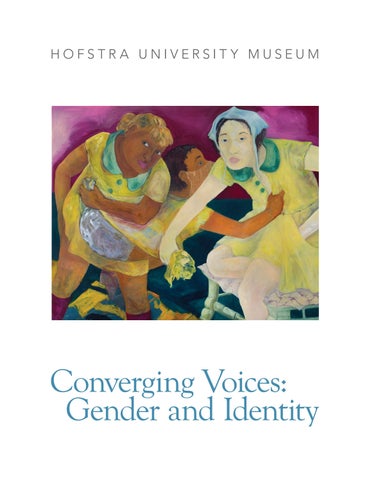
Front cover credit: Philemona Williamson (American, born 1951), Golden Afternoon, 2015, oil on canvas, 48 x 60 in., courtesy of the artist and June Kelly Gallery, New York © 2017 Hofstra University Museum All rights reserved. No part of this publication may be reproduced, stored in a retrieval system or transmitted, in any form or by any means, electronic, mechanical, photocopying, recording or otherwise, without prior permission of the Hofstra University Museum.
HOFSTRA UNIVERSIT Y MUSEUM
May 2-December 15, 2017 | Emily Lowe Gallery
The exhibition is offered in association with the 17th Berkshire Conference on the History of Women, Genders, and Sexualities to be held at Hofstra University June 1-4, 2017. Funding has been provided by the New York State Council on the Arts with the support of Governor Andrew M. Cuomo and the New York State Legislature.
Foreword
4
When I approached Hofstra University about hosting the 17th Berkshire Conference on the History of Women, Genders, and Sexualities, I was especially pleased to receive a warm welcome by the staff of the Hofstra University Museum. Karen T. Albert, deputy director and chief curator, and then Executive Director Beth E. Levinthal (who has since retired) immediately committed themselves to curating a show of women artists that would examine the often controversial topic of gender and identity. In the works exhibited in Converging Voices: Gender and Identity, we see that gender is not one thing, nor a simple construct. The show is breathtaking in its range — representing experiences from across the globe, from Malaysia, Thailand, Afghanistan, and South Africa, to the United States — and we see the varied and complicated ways in which these artists represent the experience of gender. The Berkshire Conference of Women Historians (the Berks) was, like the Guerrilla Girls, created to respond to exclusionary policies. In the first few decades of the 20th century, the leading historical organization, the American Historical Association (AHA), refused to allow women historians to attend its “smokers,” social gatherings of gossipy camaraderie where male historians made the connections required for professional mobility. Underrepresented, underappreciated and underemployed, women historians started the Berks in 1930. A new — and feminist — generation joined in the 1970s. They transformed the organization into one that championed the scholarship of women and women’s history and gender. Beginning in 1973, they organized what would become a triennial conference that has grown from a meeting of a few hundred into the largest international gathering of scholars studying the history of women, gender and sexuality. Our 2017 theme, Difficult Conversations: Thinking and Talking About Women, Genders, and Sexualities Inside and Outside the Academy, confronts a number of challenges scholars in this field face today. The women’s marches that occurred on every continent on January 21, 2017, signaled women’s discontent with our contemporary political moment and the determination of millions to turn back the global attack on women’s rights. It is in this context that we gather at Hofstra to reiterate the importance of studying our history and to discuss how we might utilize knowledge of this history to make people’s lives better. The Berkshire Conference is, then, a celebration of history that reaches across time, geography and peoples, which pairs history with voices from other disciplines, and brings together scholars with artists, teachers of primary and secondary students, performers, activists, and other “just regular folk.” We are honored that the exhibition Converging Voices: Gender and Identity will be on view during our conference, June 1-4, 2017. Every work of art in this exhibition reflects aspects of our scholarship. Ours is a conference about activism like that practiced by the Guerrilla Girls, the political impact of neo-liberalism portrayed by Yee I-Lann, the fluidity of gender and the search for self-identity expressed by Martine Gutierrez and Zanele Muholi, as well as the cultural conflicts represented by Mariam Ghani and Ghada Amer. As Yee I-Lann weaves references to Malaysia’s Gerwani feminist movement, Carrie Mae Weems situates her women in the 1960s counterculture of Angela Davis and Huey Newton. As we historians study art and incorporate it into our representation of history, so do artists study, reflect upon and weave history into their creative work. Together, this exhibition, Converging Voices: Gender and Identity, and the Berkshire Conference’s theme, Difficult Conversations, remind us that the way forward will not be easy. Nonetheless, any redress we seek against political oppression, social and economic inequality, sexism, racism or homophobia must begin with conversations where we build common ground in our shared humanity.
Dr. Susan M. Yohn Professor of History, Hofstra University President, The Berkshire Conference of Women Historians
5
Curator’s Statement
Converging Voices: Gender and Identity Contemporary artists frequently address significant social, political, and environmental concerns in their work, drawing attention to those issues and provoking discussion about them. The artists included in Converging Voices: Gender and Identity delve into issues of ethnic, cultural, gender, and sexual identity. Some of the artists are activists and advocates, using their work to bring public awareness to issues and supporting social change. Others prefer a more personal approach by reflecting on how we see ourselves and how others see us. The voices of these artists come together in this exhibition to encourage engagement in important and difficult conversations about who we are as individuals and as a society. A person’s identity consists of multiple factors such as gender, ethnicity, class and sexuality. The works of art included in the exhibition reveal a wide range of responses to these themes. The artists come from diverse backgrounds, representing various ethnic and cultural traditions, religions and sexual orientations. Autobiographical and personal in nature, the works of art also include symbolic, allegorical and historical references. For example, Yee I-Lann’s photographic collages reveal how traditional cultural mythology in Southeast Asia, which portrays women with long, black hair as evil, persists into this century. Longstanding cultural traditions can also be seen in the work of Mariam Ghani as she investigates the history of Afghanistan, the country of her father. Ghada Amer’s use of unconventional materials and incorporation of text adds a layer of depth and new meaning to her seemingly abstract painting. As activists and advocates for equality beginning in 1985, the Guerilla Girls produced a number of humorous and satirical posters bringing attention to the lack of representation of women and minorities in the art world. The portrait photographs of Zanele Muholi provide a voice for an ignored and abused population of South Africa’s society. Artists such as Martine Gutierrez, Pinaree Sanpitak, Carrie Mae Weems, and Philemona Williamson use the human body and body image to explore aspects of identity, particularly as it relates to gender and sexuality. Gutierrez and Weems present and critique female stereotypes, providing an impetus for discussion about how and why these fixed images have prevailed for decades. Sanpitak’s work is more self-reflective and addresses her feelings about her own body. The turbulent times of adolescence, with its emotional and physical changes, are explored by Williamson. The gender roles, characteristics, and activities that distinguish the sexes are a product of society and vary from culture to culture. Artists examine cultural and personal identity, question the stereotypes and social norms, and challenge the traditional relationship between gender and society. The works by these artists differ greatly even as they address similar issues. There is no way to generalize or categorize their work according to media, national origin or style. The individual voices of this diverse group of artists converge to focus on and speak to issues of gender and identity from their distinctive points of view.
Karen T. Albert Deputy Director and Chief Curator
7
Ghada Amer
(American, born in Egypt, 1963)
Ghada Amer was born in Egypt, grew up in a Muslim household in France, and currently resides in New York City. In her work, she frequently addresses the conflicting cultural ideas of East and West, feminine and masculine, and art and craft. She is best-known for painted and embroidered canvases that explore themes of love, desire, sexuality, and identity. Colored threads are sewn into and through the canvas where they hang loosely, resembling drips and splatters of paint. Embroidery is traditionally considered a women’s craft, but in Amer’s hands the materials are employed in a new and dynamic way. She considers her works on canvas to be paintings and not textile art. Amer’s work has a visual appeal and aesthetic quality that is underlaid with a political message. Upon closer and longer examination, a deeper meaning can be found beneath the surface design. Embedded in the painting White Squares are block-style letters that spell out the phrase “One is not born, but rather becomes a woman.” This is probably the most well-known quote from French feminist author and activist Simone de Beauvoir’s The Second Sex, published in 1949. The book was a detailed analysis of women’s oppression, which became the foundational treatise for mid-20th century feminism. De Beauvoir believed femininity was not based in biology but rather that female roles are shaped by societal and cultural traditions and expectations. The social constructs of teaching women to act and speak in certain ways alter an individual’s identity.
Amer, Ghada. Personal interview. 9 August 2016. Okeke-Agulu, Chika. “Amer, Ghada.” Grove Art Online. Oxford Art Online. Oxford University Press. Web. 27 Mar. 2017. <http://www.oxfordartonline.com/subscriber/article/grove/art/T2220475>.
8
Ghada Amer (American, born in Egypt, 1963) White Squares, 2013 Acrylic, embroidery and gel medium on canvas 50 x 50 in. Courtesy of the artist and Cheim & Read, New York
9
Mariam Ghani (American, born 1978)
Mariam Ghani is an artist who has grown up between cultures — she has a Lebanese mother and an Afghan father. She has stated, “Being in the diaspora, but also going back and forth between countries; being in one country, but identifying emotionally with another; growing up with these wars going on in my parents’ country and never feeling completely detached from that ... I think the place I identify most with is the border.” In her work she explores these issues of national and personal identity. Afghanistan: A Lexicon is a collaborative project with her father in which Ghani provides the images, archival and original, and the text, along with executing the final product. Her father supplied the facts and interpretations, which she renders in her own voice. A lexicon is defined as a vocabulary of a branch of knowledge. Ghani’s Lexicon shows the cyclical history of Afghanistan as the country passes through phases of reform, revolt, collapse and recovery. The entire project contains 71 entries or terms; 12 are included in this exhibition. On each panel, the nation’s foundational figures, places and events are presented, tracing a cyclical history of the country through a series of destructions and rebirths that are rendered as entries in an encyclopedia. The country’s history and struggle for identity are expressed through the stories and remembrances of individuals.
Lagattuta, Madeline. “Artist Mariam Ghani Tackles Afghanistan’s History and Identity.” Departures. 25 February 2015. Robbins, Liz. “Mariam Ghani, A Brooklyn Artist Whose Father Leads Afghanistan.” The New York Times. 20 February 2015.
10
Mariam Ghani (American, born 1978) Afghanistan: A Lexicon, 2015 Pigment prints on BFK Rives paper 8 3/4 x 11 1/4 in. each Courtesy of the artist and RYAN LEE Gallery, New York
11
Guerrilla Girls
(established in the United States, 1985)
The Guerrilla Girls is an activist, feminist artist collective whose mission is to raise consciousness of the inequalities that exist in the art world and to promote gender and racial equality. Since 1985 the members of the group have protested the bias shown by art galleries and museums through an analysis of the types of artists represented in their exhibitions. The impetus for their work was a 1984 exhibition of painting and sculpture at The Museum of Modern Art, New York, where less than 10 percent of the 165 artists represented were women or minorities. With their mission to gather verifiable data on discrimination, they began by counting the number of art gallery and museum solo exhibitions of women and minorities. They published their results as a series of posters that often use humor to illustrate their point. Perhaps their most famous poster announced, “Do women have to be naked to get into the Met. Museum?” In 1989 the group noted the gender of nudes depicted in the paintings and the number of female artists on view at The Metropolitan Museum of Art, New York. The results showed that only 5 percent were female artists, but 85 percent of the nudes were women. Follow-up counts completed in 2005 and 2011 produced only minor advances in the statistics. The Guerrilla Girls formed in New York City but became a national and international presence. Their earliest activity was to hang posters, like the three included in this exhibition, throughout the neighborhoods of the East Village and SoHo. Group members use the names of historical female artists or authors in order to protect themselves from potential repercussions due to their protest. The adoption of a female artist’s name also promotes and educates the public about a lesser-known female artist. The Guerrilla Girls recently celebrated the 30th anniversary of its founding and, despite some gains, the group’s mission for equality in the art world remains necessary in the 21st century.
Gerber, Courtney. “Guerrilla Girls.” Grove Art Online. Oxford Art Online. Oxford University Press. Web. 27 Mar. 2017. <http://www.oxfordartonline.com/subscriber/article/grove/art/T2021709>. Ryzik, Melena. “The Guerrilla Girls, After 3 Decades, Still Rattling Art World Cages.” The New York Times. 5 August 2015.
12
Guerrilla Girls (established in the United States, 1985) The Advantages of Being a Woman Artist, 1988 Poster 17 x 22 in. Hofstra University Museum Collections Museum purchase HU2016.19 © Guerrilla Girls
13
Guerrilla Girls (established in the United States, 1985) Do Women Have to Be Naked to Get Into the Met. Museum?, 2012 Poster 12 x 28 in. Hofstra University Museum Collections Museum purchase HU2016.20 © Guerrilla Girls
14
Guerrilla Girls (established in the United States, 1985) You’re Seeing Less Than Half the Picture, 1989 Poster 17 x 22 in. Hofstra University Museum Collections Museum purchase HU2016.21 © Guerrilla Girls
15
Martine Gutierrez (American, born 1989)
Martine Gutierrez’s works of art delve into issues of gender, sexuality, and self-identity. A gender-fluid artist, someone who does not self-identify as having a fixed gender, Gutierrez sees gender roles as artificial boundaries and observes that gender is only one part of one’s personal identity. Her work examines the arbitrariness of the social structures that define and separate individuals into discrete groups. Emphasizing her androgynous appearance in her photographs and videos, the artist suggests that it is possible for an individual to possess two seemingly contradictory traits at the same time. The photographs Line Up 2, Line Up 3, and Line Up 5 are from a series of self-portraits that feature Gutierrez posing with groups of mannequins that share a similar body type with the artist. The inanimate mannequins are attired as typical female stereotypes such as the blonde bombshell or the school girl. Gutierrez physically alters her appearance and dresses in a similar fashion, including hairstyle and makeup, to become part of the group. The resulting image challenges the viewer’s perception of what is real and what is not, compelling the viewer to look closely and draw their own conclusions.
McDermott, Emily. “Martín Gutierrez.” Interview Magazine. 23 April 2015. Rawley, Lena. “This Artist Thinks Gender Is a Drag.” New York Magazine. 9 February 2017.
16
Martine Gutierrez (American, born 1989) Line Up 2, 2014 Archival digital print 42 x 28 in. Courtesy of the artist and RYAN LEE Gallery, New York
17
Martine Gutierrez (American, born 1989) Line Up 3, 2014 Archival digital print 42 x 28 in. Courtesy of the artist and RYAN LEE Gallery, New York
18
Martine Gutierrez (American, born 1989) Line Up 5, 2014 Archival digital print 42 x 28 in. Courtesy of the artist and RYAN LEE Gallery, New York
19
Yee I-Lann
(Malaysian, born 1971)
Yee I-Lann’s work engages with Southeast Asia’s turbulent history and its mythology, addressing the sociopolitical impact of current politics, neo-colonialism, and globalization. Like the Banana Tree at the Gate is rooted in two motifs that are iconic in her native Malaysia: the abundant banana tree; and the pontianak, a vengeful female spirit with long, black hair. In digital photograph collages, Yee I-Lann combines these legendary tales with mid-20th century feminist movements such as Indonesia’s Gerwani organization. The pontianak is an evil spirit or ghost in Malaysian and Indonesian mythology and is believed to be a woman who died during pregnancy or childbirth. The pontianak is usually depicted as a pale-skinned woman with long, black hair covering her face; red eyes; and a white dress covered in blood stains. The spirits traditionally are thought to reside in banana trees. The Like a Banana Tree at the Gate series consists of three digital photographs that are composed of hundreds of collage elements. Yee I-Lann set up a public mobile studio in the Arts For Grabs market in Kuala Lumpur, Malaysia. The women photographed are playing the role of the pontianak; many are well-known activists and artists. The first panel is titled Ibu or the Beast, which references an essay by Saskia Wieringa on women’s political involvement in Indonesia, and in particular the Gerwani feminist movement. The word Ibu is also an affectionate term for mother in Malaysia or woman in Indonesia. The middle photograph, The Flaming Womb, refers to one of the artist’s favorite books, written by Barbara Andaya, which describes the history of women in pre-colonial Southeast Asia. A Leaf in the Storm, the last panel, also refers to the Gerwani movement and life during Indonesia’s 1965 military coup. It is taken from a biographical account written by Iby Marni about her political beliefs and her involvement with the movement. “The pontianak continues to haunt us in 21st century patriarchal Southeast Asia,” Yee I-Lann explains. “She is the woman standing at the gate like the banana tree in full view. She is potential and power and resource. A banana plant lives only briefly, bearing just one bunch of fruit before it dies. Its root structure, however, grows a new plant immediately — and so the cycle continues, ever present with a memory of the past.”
Rollins, Tyler. “Like the Banana Tree at the Gate.” Gallery brochure. New York: Tyler Rollins Fine Art, 2016. Yee I-Lann. Personal interview. 20 May 2016.
20
Yee I-Lann (Malaysian, born 1971) Ibu or the Beast, 2016 From Like the Banana Tree at the Gate 24 x 80 3/4 in. Giclée print on Hahnemühle PhotoRag paper, edition of 8 + AP Courtesy of the artist and Tyler Rollins Fine Art, New York
Yee I-Lann (Malaysian, born 1971) The Flaming Womb, 2016 From Like the Banana Tree at the Gate 24 x 91 3/4 in. Giclée print on Hahnemühle PhotoRag paper, edition of 8 + AP Courtesy of the artist and Tyler Rollins Fine Art, New York
Yee I-Lann (Malaysian, born 1971) A Leaf in the Storm, 2016 From Like the Banana Tree at the Gate 24 x 62 in. Giclée print on Hahnemühle PhotoRag paper, edition of 8 + AP Courtesy of the artist and Tyler Rollins Fine Art, New York 21
Zanele Muholi (South African, born 1972)
Zanele Muholi’s photographs explore the experience of black lesbian, gay, bisexual, and transgender individuals in South Africa and other African countries. Through her work, she confronts existing discrimination and broadens the visual representation of this group. Muholi began this visual activism in 2006 in response to losing two friends to HIV. Muholi, herself part of the LGBTQ+ community, documents the life struggles of her subjects with great sensitivity and respect. Muholi has stated that the series “... is both highly personal and deeply political to me: an act of searching, resisting, transgressing the boundaries of oppressive racial, sexual, class and gender power structures.” The Faces and Phases series contains more than 250 images. The black and white photographs follow documentary and portrait traditions where the face is the focus of the composition. The subjects, exhibiting individual characteristics (such as scars and tattoos) and style (both hair and clothing), are carefully posed and lit in a studio setting with great attention to contrast. The portraits provide a positive image of individuals who are often abused and violated because of their sexual and gender orientation. With this series of photographs, Muholi gives a voice and presence to a group that has been invisible in general society.
Kart, Susan. “Muholi, Zanele.” Grove Art Online. Oxford Art Online. Oxford University Press. Web. 27 Mar. 2017. <http://www.oxfordartonline.com/subscriber/article/grove/art/T2290034>. Muholi, Zanele. Zanele Muholi: Faces and Phases 2006-2014. Germany: Steidl, 2014.
22
Zanele Muholi (South African, born 1972) Nosizwe Cekiso, Gugulethu, Cape Town, 2008 From the Faces and Phases series Gelatin silver print 30 x 20 in. Courtesy of the artist and Yancey Richardson Gallery, New York © Zanele Muholi, courtesy of Stevenson Cape Town/Johannesburg and Yancey Richardson, New York
Zanele Muholi (South African, born 1972) Tumi Nkopane, KwaThema, Johannesburg, 2013 From the Faces and Phases series Gelatin silver print 30 x 20 in. Courtesy of the artist and Yancey Richardson Gallery, New York © Zanele Muholi, courtesy of Stevenson Cape Town/Johannesburg and Yancey Richardson, New York
23
Zanele Muholi (South African, born 1972) Lesego Thwale, Constitution Hill, Braamfontein, Johannesburg, 2012 From the Faces and Phases series Gelatin silver print 30 x 20 in. Courtesy of the artist and Yancey Richardson Gallery, New York © Zanele Muholi, courtesy of Stevenson Cape Town/Johannesburg and Yancey Richardson, New York
Zanele Muholi (South African, born 1972) Ayanda Mqakayi, Nyanga East, Cape Town, 2011 From the Faces and Phases series Gelatin silver print 30 x 20 in. Courtesy of the artist and Yancey Richardson Gallery, New York © Zanele Muholi, courtesy of Stevenson Cape Town/Johannesburg and Yancey Richardson, New York
24
Zanele Muholi (South African, born 1972) Lebo Leptie Phume, Daveyton, Johannesburg, 2013 From the Faces and Phases series Gelatin silver print 30 x 20 in. Courtesy of the artist and Yancey Richardson Gallery, New York © Zanele Muholi, courtesy of Stevenson Cape Town/Johannesburg and Yancey Richardson, New York
Zanele Muholi (South African, born 1972) Zizima Kom, Embekweni, Paarl, 2011 From the Faces and Phases series Gelatin silver print 30 x 20 in. Courtesy of the artist and Yancey Richardson Gallery, New York © Zanele Muholi, courtesy of Stevenson Cape Town/Johannesburg and Yancey Richardson, New York
25
Pinaree Sanpitak (Thai, born 1961)
Through her paintings, sculpture, textiles and performances, Pinaree Sanpitak explores women’s experiences in Southeast Asia. During the course of her career, the female body has been her primary inspiration, often abstracted to basic forms and taking on a meditative quality. In particular, she has worked with symbolic representations of breasts in various media, using repeated forms that recall bells, offering bowls and Buddhist temple stupas or shrines. She began working with the breast form when her son was born in 1994. Sanpitak uses the breast form as a monument to womanhood, whether it is depicted singular and upright or elongated and inverted. Her body of work does not fit into a set category, but her paintings have a pared-down, minimalist quality that is perhaps derived from her time learning about Buddhism and studying in Japan. Buddhism’s practice of mindfulness or being aware of one’s thoughts and actions may serve as an inspiration for the self-reflective and meditative qualities of her paintings. Brilliant Blue is one of a series of monochromatic paintings of breast and cloud-like formations. The painting conveys a sense of tranquility and weightlessness that is both otherworldly and based in the natural world. Although Sanpitak is an advocate for feminist causes, her work is more introspective and personal in nature.
Krich, John. “Pinaree Sanpitak: A Body of Work.” The Wall Street Journal. 16 January 2014. Rollins, Tyler. “Ma-Lai: Pinaree Sanpitak.” Gallery brochure. New York: Tyler Rollins Fine Art, 2015.
26
Pinaree Sanpitak (Thai, born 1961) Brilliant Blue, 2008 Acrylic on canvas 78 x 98 1/2 in. Courtesy of the artist and Tyler Rollins Fine Art, New York
27
Carrie Mae Weems (American, born 1953)
Through her work, Carrie Mae Weems addresses inequalities based upon ethnicity, gender, and class. Her photography-based narratives examine the lives of under-recognized people, allowing their voices to be heard. Over time her body of work has expanded from photography to video and film presentations with the inclusion of movement and sound. Weems often comments on the influence that publicly accepted stereotypical characteristics (based on ethnicity, societal norms and appearance) have on an individual’s identity. In Afro-Chic, Weems presents a fashion show in opposition to the traditional designer runway show. The models interact with the camera and engage with the audience as they dance and move along the runway to Marvin Gaye’s Sanctified Lady. Weems directs the viewer’s attention to the faces and expressions of the models, which represent a range of body types and ages. Rather than focusing on their clothing, she allows the model’s uniqueness and individuality to show. There is an emphasis on the afro, an often politicized natural hairstyle representing black pride. The afro was a recognized feature worn by 1960s counterculture political activist Angela Davis, whose photograph can be seen in the background of the video. The other black and white photograph is of Black Panther Party co-founder Huey Newton.
Bareman, Karin. “Let’s Get It On – A Look at Carrie Mae Weems’ Afro Chic.” Photoworks. 1 February 2016. Chou, Mary. “Weems, Carrie Mae.” Grove Art Online. Oxford Art Online. Oxford University Press. Web. 27 Mar. 2017. <http://www.oxfordartonline.com/subscriber/article/grove/art/T2022226>.
28
Carrie Mae Weems (American, born 1953) Afro-Chic, 2009-2010 Video, 5:28 minutes, Edition EX of 5 with 2 artist proofs Courtesy of the artist and Jack Shainman Gallery, New York © Carrie Mae Weems
29
Philemona Williamson (American, born 1951)
In her paintings, Philemona Williamson explores the transitional periods between childhood, adolescence, and adulthood. The paintings have an intentional narrative ambiguity where the meaning is not defined but open to the viewer’s interpretation. Thus, there is not a particular place or setting in the paintings, and some of the individual’s features are purposefully blurred or indistinct. The images, drawn from her imagination and her own childhood, often raise more questions than they answer. In her words, “My paintings are of preadolescent girls and boys, children on the cusp of adulthood. The figures struggle to balance their innocence and awkwardness with their newfound sexuality … Who are these children? What are they doing and why? Ethnicity and gender are questioned.” This ambiguity is evident in the painting Golden Afternoon. The girls appear startled in a moment of play, but two of the girls have wary expressions on their faces as if they were caught doing wrong. The subjects are wearing similar dresses, possibly school uniforms, which provides them with equal status. Their bodies and limbs are entwined and the positions of arms and legs are not easily seen. Williamson captures one of life’s most emotional time periods when feelings can quickly move from anxiety to hopefulness and back again.
Daniel, Daria. “Philemona Williamson, Emotive Painter.” Artnet. 3 May 2015. June Kelly Gallery. Artist’s biography. Web. 14 November 2016 <http://junekellygallery.com/williamson/>
30
Philemona Williamson (American, born 1951) Golden Afternoon, 2015 Oil on canvas 48 x 60 in. Courtesy of the artist and June Kelly Gallery, New York
31
Converging Voices: Gender and Identity EXHIBITION CHECKLIST
Ghada Amer (American, born in Egypt, 1963) White Squares, 2013 Acrylic, embroidery and gel medium on canvas 50 x 50 in. Courtesy of the artist and Cheim & Read, New York
Mariam Ghani (American, born 1978) Afghanistan: A Lexicon, 2015 Pigment prints on BFK Rives paper 8 3/4 x 11 1/4 in. each Courtesy of the artist and RYAN LEE Gallery, New York
Guerrilla Girls (established in the United States, 1985) The Advantages of Being a Woman Artist, 1988 Poster 17 x 22 in. Hofstra University Museum Collections, Museum purchase, HU2016.19
Do Women Have to Be Naked to Get Into the Met. Museum? 2012 Poster 12 x 28 in. Hofstra University Museum Collections, Museum purchase, HU2016.20 You’re Seeing Less Than Half the Picture, 1989 Poster 17 x 22 in. Hofstra University Museum Collections, Museum purchase, HU2016.21
Martine Gutierrez (American, born 1989) Line Up 2, 2014 Archival digital print 42 x 28 in. Courtesy of the artist and RYAN LEE Gallery, New York
Line Up 3, 2014 Archival digital print 42 x 28 in. Courtesy of the artist and RYAN LEE Gallery, New York
Line Up 5, 2014 Archival digital print 42 x 28 in. Courtesy of the artist and RYAN LEE Gallery, New York
Yee I-Lann (Malaysian, born 1971) Ibu or the Beast, 2016 From Like the Banana Tree at the Gate 24 x 80 3/4 in. Giclée print on Hahnemühle PhotoRag paper, edition of 8 + AP Courtesy of the artist and Tyler Rollins Fine Art, New York
The Flaming Womb, 2016 From Like the Banana Tree at the Gate 24 x 91 3/4 in. Giclée print on Hahnemühle PhotoRag paper, edition of 8 + AP Courtesy of the artist and Tyler Rollins Fine Art, New York A Leaf in the Storm, 2016 From Like the Banana Tree at the Gate 24 x 62 in. Giclée print on Hahnemühle PhotoRag paper, edition of 8 + AP Courtesy of the artist and Tyler Rollins Fine Art, New York
Zanele Muholi (South African, born 1972) Nosizwe Cekiso, Gugulethu, Cape Town, 2008 From the Faces and Phases series Gelatin silver print 30 x 20 in. Courtesy of the artist and Yancey Richardson Gallery, New York
Tumi Nkopane, KwaThema, Johannesburg, 2013 From the Faces and Phases series Gelatin silver print 30 x 20 in. Courtesy of the artist and Yancey Richardson Gallery, New York
Lesego Thwale, Constitution Hill, Braamfontein, Johannesburg, 2012 From the Faces and Phases series Gelatin silver print 30 x 20 in. Courtesy of the artist and Yancey Richardson Gallery, New York Ayanda Mqakayi, Nyanga East, Cape Town, 2011 From the Faces and Phases series Gelatin silver print 30 x 20 in. Courtesy of the artist and Yancey Richardson Gallery, New York Lebo Leptie Phume, Daveyton, Johannesburg, 2013 From the Faces and Phases series Gelatin silver print 30 x 20 in. Courtesy of the artist and Yancey Richardson Gallery, New York Zizima Kom, Embekweni, Paarl, 2011 From the Faces and Phases series Gelatin silver print 30 x 20 in. Courtesy of the artist and Yancey Richardson Gallery, New York
Pinaree Sanpitak (Thai, born 1961) Brilliant Blue, 2008 Acrylic on canvas 78 x 98 1/2 in. Courtesy of the artist and Tyler Rollins Fine Art, New York
Carrie Mae Weems (American, born 1953) Afro-Chic, 2009-2010 Video, 5:28 minutes, Edition EX of 5 with 2 artist proofs Courtesy of the artist and Jack Shainman Gallery, New York
Philemona Williamson (American, born 1951) Golden Afternoon, 2015 Oil on canvas 48 x 60 in. Courtesy of the artist and June Kelly Gallery, New York
33
HOFSTRA UNIVERSITY STUART RABINOWITZ President Andrew M. Boas and Mark L. Claster Distinguished Professor of Law
GAIL M. SIMMONS Provost and Senior Vice President for Academic Affairs
HOFSTRA UNIVERSITY MUSEUM NANCY RICHNER Director
KAREN T. ALBERT Deputy Director and Chief Curator
ELISA BRUNO Museum Educator
DAVID P. COONAN Museum Educator
ELIZABETH DYSART Museum Educator Director
RENEE B. KUROT School and Youth Program Coordinator
KARLA ODERWALD Senior Assistant to the Director
AMY G. SOLOMON Museum Educator
CHARMISE WOODSIDE-DESIRÉ Communications Director
GRADUATE ASSISTANTSHIP Lauren Cristino
GRADUATE ASSISTANTS Patricia Korbackova Mairead Senk Meghan Urschel
UNDERGRADUATE ASSISTANTS Rachel Davis Jonathan Fidis Alina Gonzalez-Hernandez Shaina Martin Eiryn Scheades Mygan Tran Allison Wolf