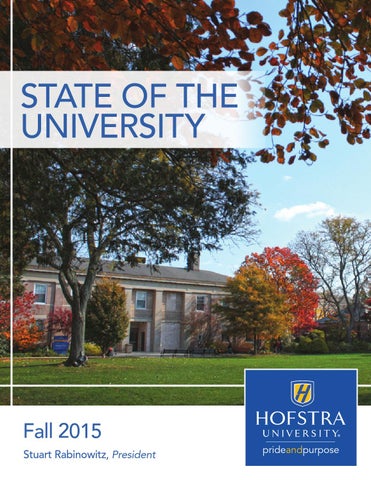
STATE OF THE UNIVERSITY
Fall 2015 Stuart Rabinowitz, President
prideandpurpose
State of the University
Fall 2015
I am pleased to summarize the major accomplishments of the 2014-15 academic year. This past year was a very successful year, with highlights that include the launch of a new school, the Hofstra Northwell School of Graduate Nursing and Physician Assistant Studies, as well as the graduation of the inaugural class of the Hofstra Northwell School of Medicine. The University’s momentum continues with very favorable ratings in an array of publications, and especially high ratings for postgraduate salaries in Payscale.com. Despite our successes, this continues to be a challenging time for Hofstra (and all of private higher education). Families remain highly price sensitive, with many preferring public institutions with very low tuition over private schools, at least for undergraduate education. Private colleges are competing for a reduced pool of highly qualified applicants. Transfers and graduate students pose particular difficulties because of price sensitivity, increased competition, and shifting markets internationally. Despite these challenges, this year’s freshman class, the first in our test-optional admissions strategy, is the most academically accomplished in our history. Set forth below is a brief summary of the past year.
HIGHLIGHTS OF 2014-15 Enrollment The class that entered in fall 2015 was the first class admitted under our new test-optional admissions policy. The University adopted the test-optional policy based on national data, and our own data, indicating that the best predictor of success in college is high school performance (GPA and strength of curriculum) and not standardized tests. Despite the challenges of implementing this new policy and the lack of historical data, the fall 2015 class of 1,651 students is the most academically distinguished in our history. The entering class consists of 372 students eligible for Honors College as opposed to 291 last year, an increase of 81 students (28 percent). The average GPA of the entering class is 3.62 compared to 3.55 last year. Based on the statistical indicators of the freshman class, we would expect enhanced retention and graduation rates for this class. This year’s freshman class is also very diverse, with 37 percent students of color in this year’s entering class. There are 73 international students in the entering class with 23 from China, and the remainder from 28 other countries, including six from the United Kingdom, four each from India and Canada, and three each from Brazil, Italy and Poland. In addition, there are 26 students in our English Language Program who will transition to the undergraduate program in the spring semester or thereafter. We continue to increase our brand and recruitment efforts in areas projected to see growth in high school graduates over the next several years. These more distant markets have once again showed progress, particularly in western and southern states like Texas, California, Arizona, and Florida. We expect these new markets will continue to grow as we increase our presence over the next few years. Transfers were a challenging market this year, with a small decline over last year’s enrollment. Since prospective transfer students cannot be recruited while attending another four-year institution,
1
it is difficult to expand the pool of transfer student applicants. We have developed new articulation agreements with community colleges outside of our direct region and continually evaluate those within our region for enhancements when appropriate. We continue to explore online resources developed to make the transfer process smooth and transparent, offering tools to perform online transfer credit evaluation and articulation to prospective students. In addition, this fall we launched our new virtual tour, allowing prospective students to explore campus on their own, responding to their personal interests rather than needing to follow along a prescribed path. All of our recruitment initiatives are designed to provide students and families with an experience that can be customized and tailored to their unique needs in this ever-changing virtual world. Moving forward, to attract new freshmen as well as transfers, the University continues to market its successful outcomes in terms of internships, placement, and the success of our alumni, and to clearly articulate the distinct strengths of Hofstra’s programs. We also continue to create new dual degree programs, which lessen the time it would take to receive a BA/BS and master’s degree separately, thus reducing the overall cost as well. Our most popular dual degree programs remain those focused on the health professions, specifically our Physician Assistant program and Medical School dual degree options, attracting the most highly qualified candidates to our campus. Many dual degree programs in the Zarb School of Business continue to attract new students as well as play a crucial role in continuing the matriculation of upper-level students to our graduate programs. Fall new graduate enrollment, while exceeding last year’s actual enrollment, was below budget projections. In addition, continuing graduate enrollment was also below budget, due to multiple reasons, including more students graduating earlier than predicted, as well as fewer continuing graduates in the School of Education and the Zarb School. All projections are being carefully reviewed at a granular level based on fall 2015 trends to try to refine and more closely align with future enrollment trends. Moving forward, I have asked our new provost, Gail Simmons, to focus on graduate program review, and to work with the deans to identify new opportunities, and to articulate the strengths of its programs and how they differ from programs offered by competitor schools. In the Zarb School, former Provost Herman Berliner has assumed the position of dean of the Zarb School of Business while a search for the next dean is being conducted, and Dean Berliner is actively engaged in the graduate admissions process and review. A consultant has been retained to do a comprehensive study of the School of Business, analyzing its strengths and weaknesses, opportunities and challenges. The School of Education is also being asked to analyze its enrollment, and to explore new ways in which to enhance the attractiveness of its offerings, including additional online program offerings. Shortfalls in both the undergraduate and graduate areas were managed through expense reductions and savings, resulting in a balanced budget for 2015-16. Moving forward, we are beginning to model aid for the next incoming freshman class to project a discount rate that brings in the desired class (in terms of quantity and quality), at the maximum achievable net tuition revenue. We are keenly aware of the need to provide scholarships and financial aid in a manner that makes us competitive with other institutions, but within the limits of our fiscal constraints. In this regard, fundraising to increase the endowment for scholarships is of particular importance, as is the continued effort to reduce expenses where feasible throughout the University. Increasing graduate enrollment is of particular importance because there are limits and costs to increasing the size of incoming freshman classes, and every effort is being made to enhance graduate programs and to create new programs that have the potential to increase enrollment. 2
Retention The retention rate for the freshman class that entered last year is 80 percent, the same as the previous year, tied for the highest in our history (in 2007, 2010, and 2013). This retention rate is up significantly from the retention rate of 74 percent in 2001, and we continue to enhance our efforts to surpass the current retention rate of 80 percent. Over the past several years, graduation rates have climbed to 50 percent in four years and 60 percent in six years, compared to national averages of 39 percent and 59 percent. This year, again, about half of the cohort that started in fall 2009 graduated in four years and 60 percent in six. Subsequent cohorts, however, are projected to do much better. Tracking the preliminary information on the fall 2010 class, we have a 53 percent four-year graduation rate and are projected to have a 62 percent six-year graduation rate. We anticipate that over time graduation rates will reach our five-year plan goal of 65 percent. Student satisfaction continues to be higher than our benchmark year (spring 2004), with all satisfaction items rated higher. Hofstra is meeting or exceeding student expectations of academic quality, student life and overall value. Our students report they are experiencing personal growth, learning to appreciate diversity, and gaining valuable skills in oral communication, analytical thinking and leadership. Top ratings are given to our academics – including the quality of our programs, instruction, and individualized faculty attention, and academic quality is well rated and correlates to overall satisfaction with their experiences at Hofstra as well as retention. Our students are academically and socially engaged, rate our facilities well, and feel we are preparing them for life beyond our campus.
Fundraising Hofstra experienced another successful year of fundraising in 2014-2015, securing more than $16 million in new cash gifts and payments on pledges. In addition more than $12 million was secured in new recorded pledges and commitments. The University received one of its biggest gifts ever from alumnus Peter S. Kalikow ’65 to establish the Peter S. Kalikow School of Government, Public Policy and International Affairs, combining existing strengths within HCLAS. Additionally, the University continued on its path to increase overall alumni participation and reached 11.8 percent, which is more than double the rate of participation since 2005. Our capital and endowment campaign continues to operate in its early phase, looking to secure major commitments at the highest levels. To date, the campaign has resulted in more than $90 million secured toward student scholarships, capital improvements and faculty support. The University has secured 19 gifts of $1,000,000+ and seven gifts at the $5,000,000+ level.
Academic Enhancements and Initiatives This past July, we welcomed Dr. Gail Simmons as Hofstra University’s provost and senior vice president for academic affairs – the first woman to hold the position. Dr. Simmons was most recently provost and vice president for academic affairs and professor of biology at Manhattanville College. Dr. Simmons’ appointment came after a comprehensive national search that included input from faculty, students, administrators and trustees. Dr. Simmons is a creative and collaborative leader who has successfully worked with faculty, staff and students to find solutions at the academic institutions she has led. 3
As of the end of the 2014-15 academic year, Dr. Herman Berliner stepped down as provost and senior vice president for academic affairs after 25 years in that position, and is now serving as dean of the Frank G. Zarb School of Business. He will after that return to the faculty. In recognition of his dedicated service to the University, Dr. Berliner received a well-deserved honorary degree during the spring Commencement ceremonies. Hofstra has recently joined a major ongoing project of the American Council on Education, the ACE Internationalization Lab. Hofstra’s participation reflects its increasing presence on the international education scene, and will produce a comprehensive strategy to address Hofstra’s desire to provide all its students with a truly global education. In The Lawrence Herbert School of Communication, with funding provided by the generosity of Lawrence Herbert ’51 and with ongoing University support, the school has completed the migration to an all high-definition facility. In partnership with Hitachi Kokusai Electric, the school is now pioneering the use of the company’s 4K capable cameras as part of its broadcast curriculum. The cameras will be housed in the Herbert School’s two production facilities, where they will be used for both curricular and extracurricular programming. In the Hofstra College of Liberal Arts and Sciences, a two-year capital renovation project at Gittleson Hall is underway. The project will create a new collaboratorium consisting of advanced teaching and research facilities to be used by the departments of Biology and Geology, Environment and Sustainability (GES). The John Cranford Adams Playhouse, the major theater on our campus and the centerpiece for many events, including our renowned Shakespeare Festival, is undergoing a major capital renovation project. This project began this past winter with the renovation of the lower lounge area, including the bathrooms, new HVAC, and mechanical improvements, and will finish next summer with an interior renovation and the installation of a new Globe Theatre as a focal point for the study and performance of Shakespeare. In the School of Education, faculty and administration have brought in several major grants, including Assistant Dean Stephen Hernandez, who has a total of $2.5 million from the U.S. Department of Education to prepare teachers to work with students on the autism spectrum, and Associate Professor Roberto Joseph, who has been awarded a grant of almost $1.2 million from the National Science Foundation in support of his project, “iDesign: Developing Technological Fluency Through Culturally-Relevant Game Design.” The School of Education has a 92 percent pass rate on the edTPA exams, well above the state average of 80 percent. Recognizing the importance of the global economy for all of our business majors, the Zarb School of Business is providing an increased number of study abroad/exchange student opportunities. Programs include opportunities in China, France, Germany, Netherlands, and the United Kingdom. Together with an extensive array of internship opportunities, the Zarb School education emphasizes experiential learning to prepare the business leaders of the future. The Zarb Undergraduate Executive Speaker Series continues to attract top executives from leading industries, including Linda Kaplan Thaler, 2015 Advertising Hall of Fame inductee, who discussed several of her award-winning campaigns such as the Aflac duck commercial and Toys “R” Us jingle. The new School of Engineering and Applied Science has seen a three-fold increase in enrollment, and has successfully launched a co-op program for its undergraduates, allowing them to spend six to eight months working full time at a corporation as part of their degree program. New engineering and computer science labs, including a Robotics/Mechatronics lab and a Big Data lab, were created with 4
grant funding to meet the growing needs of our engineering and computer science students. The University has applied for a $25 million state grant, which would be used to help construct a state-of-the-art building to house the School of Engineering and Applied Science. Hofstra recently announced a new Center for Entrepreneurship, to be led by Mark Lesko, former supervisor of the Town of Brookhaven, and head of Accelerate Long Island. Hofstra’s new Center for Entrepreneurship will focus on multi-disciplinary entrepreneurship support and education, leveraging the research and entrepreneurial activities of all of the University’s schools, including business, law, engineering and the health sciences. The center’s goals are to expand entrepreneurship programs; coordinate business plan competitions, including the $100,000 Hofstra CPXi Venture Tech Challenge; launch student fellowships; coordinate entrepreneurial activities; create multi-disciplinary clinics; facilitate the creation of technology-based startup companies; create programs to assist startup companies; and establish a technology transfer function at the University. The Maurice A. Deane School of Law has established a new Center for Intellectual Property Law and has also renamed its highly regarded Institute for the Study of Legal Ethics to the Monroe H. Freedman Institute for the Study of Legal Ethics. In addition, the School of Law has named the Honorable A. Gail Prudenti, former chief administrative judge in New York state, to be executive director of the Center for Children, Families and the Law and special advisor to the dean. She will work to make the Law School’s already well-known clinical programs in children, marriage and family law even stronger. Hofstra continues to lead the way in health care education and has launched the Hofstra Northwell School of Graduate Nursing and Physician Assistant Studies, under the leadership of Dean Kathleen Gallo. The inaugural class of 31 nurse practitioner students arrived this past fall on the heels of state approval for the program, and applications for next fall’s class are already rolling in. We welcomed a record number of physician assistant students as well. Meanwhile the School of Health Professions and Human Services launched an exciting new graduate program in occupational therapy, which enrolled its first class. The MA in Mental Health Counseling program has earned accreditation from the Council for Accreditation of Counseling and Related Educational Programs, receiving the maximum accreditation of eight years. Additionally, Dr. Jamie Mitus was awarded two grants from the U.S. Department of Education – Rehabilitation Service Administration: 1) Long-Term Training Grant for Rehabilitation of Individuals who are Mentally Ill – $150,000, and 2) Long-Term Training Grant in Rehabilitation Counseling – $199,615. The National Center for Suburban Studies at Hofstra University worked with faculty in the Master of Public Health program, with support from a substantial grant from the Dolan Family Foundation to found the Suburban Health Equity Institute, which hosted a regional conference and inaugurated research on the intersection of health and housing. The collaboration also expanded a heralded project on childhood obesity in Roosevelt. NCSS partnered with professors in the Biology Department on separate studies of suburban rats and geese, and formed an alliance with the world-renowned Schomburg Center on Black Culture to create an exhibit on African Americans in suburbia. The Hofstra University Museum offered six original exhibitions to approximately 23,000 visitors. The Museum also served more than 1,000 Hofstra students and faculty in gallery-centered learning sessions as well as more than 2,400 students and their teachers in grades pre-K to 12. In collaboration with the National Center for Suburban Studies at Hofstra University the Museum developed a major study for Suffolk County on the feasibility of locating a STEM-Arts (or STEAM) Center in Wyandanch. 5
School of Medicine The Hofstra Northwell School of Medicine enjoyed a year full of landmark accomplishments. The new building, a 65,000-square-foot addition, was completed in 2015, and with the existing building, creates a state-of-the-art medical school building of over 123,000 square feet. The school received full accreditation by the Liaison Committee on Medical Education in February 2015 and graduated its inaugural class in May 2015. This class of pioneers secured 100 percent residency placements at some of the country’s top institutions during the largest national Residency Match Day ever held. Students matched to top programs at institutions across the country, including Yale-New Haven Hospital, Duke University Medical Center, Tufts Medical Center, NYP Hospital-Columbia & Cornell, Jefferson Medical College/DuPont Children’s Medical Center, Memorial Sloan Kettering, Vanderbilt University Medical Center, Boston University Medical Center, University of Southern California, and Mount Sinai. The Class of 2019, painstakingly selected from a pool of over 6,000 applicants, began its studies in August 2015. One hundred one students comprise the class, of which 48 percent are male, 52 percent are female and 16 percent are from groups underrepresented in medicine. The class has an average MCAT of 33 and average GPA of 3.7.
Increasing Recognition The University received accolades on multiple fronts this year: Hofstra University is in the top 5 percent of colleges and universities nationwide for mid-career salary of graduates with a bachelor’s degree, and in the top 16 percent for return on investment, according to the 2015-16 PayScale College Salary Report and the PayScale College ROI Report. The mid-career salary ranking is an improvement over 2014, when Hofstra ranked in the top 6 percent nationwide. The rankings are based on self-reported mid-career salary data from 1.4 million college graduates. The return on investment rankings are based on a combination of mid-career salary data and an institution’s cost of attendance. These achievements were echoed in the new Brookings Institute rankings of colleges by mid-career earnings and occupational earnings power. The latest PayScale rankings also recognize several of Hofstra’s schools and programs for producing graduates with high earning power, including: • The Frank G. Zarb School of Business was ranked in the top 4 percent of the nation’s Best Schools for Business Majors for graduates with a bachelor’s degree, in the top 5 percent among Best Schools for Business Careers for graduates with a bachelor’s degree, in the top 21 percent among Best Schools for Marketing Careers for graduates with a bachelor’s degree, and in the top 30 percent on mid-career salary for alumni of advanced degree programs. • Hofstra College of Liberal Arts and Sciences was ranked 8th (top 9 percent) for mid-career salary of humanities majors. • The Lawrence Herbert School of Communication was ranked 6th (in the top 5 percent) on mid-career salary for communications majors. • The Maurice A. Deane School of Law was ranked in the top 8 percent on mid-career salary for alumni of advanced degree programs. 6
Hofstra University is among the best 380 colleges and universities in the nation, and is home to the top college radio station in the United States for the second consecutive year, according to The Princeton Review. Just published in The Princeton Review’s 2016 edition of The Best 330 Colleges, the rankings recognized WRHU-88.7 FM Radio Hofstra University as the nation’s No. 1 college station. Also for a second year in a row, Hofstra University is one of the top 50 most entrepreneurial research universities in the nation, according to Forbes magazine’s 2015 rankings. Hofstra ranked 34th, up two spots from 36th on last year’s list. The rankings represent the total number of Hofstra alumni and students on LinkedIn divided by those who say they are founders or business owners. Hofstra was one of just five research universities in New York state to make the list. Hofstra was again ranked by the 2016 U.S. News & World Report’s list of Best Colleges among national universities (schools that offer a full range of undergraduate majors, as well as master’s and doctoral programs, and are committed to research), 58th among Best Engineering Programs (without a doctoral program), and 131st among Best Business Programs (undergraduate). The Frank G. Zarb School of Business is among the Best Business Schools in the nation, based on return on investment, according to Forbes magazine’s 2015 Best Business Schools rankings of full-time MBA programs. Hofstra ranked 58th on the Forbes list, which measured ROI using alumni earnings during the first five years after graduating from a full-time MBA program and comparing that to the cost of attendance, including tuition and foregone salary for two years of study. The online MBA program at the Frank G. Zarb School of Business is ranked 41st among the Top 50 in the nation, according to U.S. News & World Report, ranking higher than any other such program in the New York City metropolitan area, and the part-time MBA is also ranked by U.S. News at 113. The Princeton Review rated the online MBA program 15th in the nation. The rankings rate the Top 25 online MBA programs in the U.S., based on surveys of administrators, students, and graduates of online MBA programs. Hofstra’s online MBA program is the only one in the metropolitan New York area to make the prestigious Princeton Review list. Meanwhile, the School of Education’s online graduate education program, an MSEd in Higher Education Leadership and Policy Studies, ranked 94th, according to the 2015 U.S. News & World Report’s Best Online Programs. The School of Education was also recognized as a Best Education School (graduate) by U.S. News. Our full- and part-time Law School programs were ranked by U.S News & World Report, as were several other graduate programs, including physician assistant, psychology, rehabilitation counseling and speech-language pathology. Among “Great Colleges to Work For” (The Chronicle of Higher Education) from 2009 to 2015, Hofstra was named to the Honor Roll for this list for the second consecutive year. The University’s faculty factored prominently in national news stories and highlighted our expertise in myriad academic disciplines. While the new building, accreditation and first graduating class of the School of Medicine received widespread coverage, faculty members were quoted as experts in Catholicism (Julie Byrne), holiday shopping and the economy (Anne Hamby and Joel Evans), Ebola and the public reaction (Tomeka Robinson), New York state ethics (Eric Lane) and an innovative class about pop culture and the Simpsons, covered in hundreds of papers thanks to the Associated Press (Richard Pioreck). Student-athletes also received accolades in the press, including the baseball 7
team’s adoption of a young boy with leukemia (ABC-7); the lacrosse teams’ education about domestic violence through the One Love Foundation (Katie Couric and Yahoo); a profile about women’s lacrosse player Brittany Altomare (The New York Times); and men’s basketball player Juan’ya Green’s profile in Faces in the Crowd (Sports Illustrated). In addition, hundreds of the University’s faculty and students were recognized for their outstanding work in their academic discipline, in their chosen career field or for community service. Among those stories were: • Dr. Margaret Abraham, sociology professor and special advisor to the provost on diversity initiatives, has been elected president of the International Sociological Association (ISA) for the 2014-2018 term. Founded in 1949 under the auspices of UNESCO, ISA is a nonprofit association for scientific purposes. Its function is to represent sociologists everywhere, regardless of their school of thought, scientific approaches or ideological opinion. ISA’s membership spans 167 countries. • Dr. Mónica Byrne-Jiménez, associate professor and co-director of Hofstra University’s doctoral program in educational and policy leadership, has been appointed president-elect of the University Council for Educational Administration, an international consortium of universities with a mission to improve the preparation of educational leaders through preservice, graduate studies, and professional development programs and to promote the development of research, policy, and professional knowledge. • Professor of English Julia Markus’ book, Lady Byron and Her Daughters (W.W. Norton & Company), described as a startling re-evaluation of Lady Byron’s complex life as single mother and progressive force, received excellent reviews in The New York Times Book Review and the New Yorker. • Jeffrey Morosoff, assistant professor and director of the graduate program in public relations in the Department of Journalism, Media Studies, and Public Relations, received the 2015 Jack Rettaliata Lifetime Achievement Award from the Public Relations Professionals of Long Island. • Chris Sanford, professor of biology, was appointed program director at the National Science Foundation/Division of Biological Infrastructure/Research Resources Cluster. • Alan Singer, professor in the Department of Teacher Education, was awarded New Jersey Council of Social Studies Outstanding Social Studies Service Award, October 2015. • Lisa Merrill, professor of rhetoric, delivered the keynote lecture: “Performing Race in Antebellum Spaces,” at Theatre and Performance Conference, University of Central Lancashire, School of Language, Literature, and International Studies, Preston, United Kingdom, June 19, 2015.
8
• Mary Anne Dumas, senior associate dean for academic affairs and nurse practitioner programs director, has been appointed as a commissioner on the American Nurses Credentialing Center Accreditation Commission. • Michael Salzman, adjunct associate professor of music, began his term as NYSSMA president-elect on January 1 and will serve as NYSSMA president in 2018-19. His book, Kendor Debut Solo Collection for Tuba, was published in January 2016. • Arthur Solari, music director of Hofstra’s Dance program, won a Drama Desk Award for “Outstanding Music in a Play,” recognizing his original score for Tamburlaine the Great, presented by Theater for a New Audience at the Polonsky Shakespeare Center in Brooklyn. This was Solari’s first nomination. • Simon Doubleday, professor and chairperson in the Department of History, has recently been elected president of the American Academy of Research Historians of Medieval Spain. In December 2015 his book, The Wise King: A Christian Prince, Muslim Spain, and the Birth of the Renaissance, was published by Basic Books (New York). • Susan Yohn, professor of history, is currently president of the Berkshire Conference of Women Historians, planning the triennial and international conference, Berkshire Conference on the History of Women, Genders and Sexualities, which will be held at Hofstra in June 2017. This conference is the largest gathering of historians working in this area of history. • Johanna Franklin, assistant professor of mathematics, who received an Association for Women in Mathematics Travel Grant to support attendance at two international conferences, was elected vice chair for four-year colleges of the Mathematical Association of America’s Metro New York section (term started in May 2015). • Professor of Accounting and Taxation Daniel Tinkleman’s book, Introductory Accounting: A Measurement Approach for Managers, was published by Routledge. • The American Accounting Association’s Accounting Information Systems section presented the 2015 Outstanding Dissertation Award to Dr. Rina Hirsch, assistant professor, accounting and taxation, at the 2015 AAA Annual Meeting in Chicago, IL. Her dissertation is titled, Do Social Biases Impede Auditor Reliance on Specialists? Toward a Theory of Social Similarity. • Grant Saff, professor of global studies, served as treasurer, Association of American Geographers, 2013-15 (July). Between 2012 and July 2015, he also served as the regional councilor of the Middle States Association of Geographers and was elected as vice-president of the Middle States Association of American Geographers for 2014-15. • Kristal Zook, professor of journalism, had articles published in Essence, The Nation, The Guardian, Washington Post, Newsday and the Huffington Post in 2015. 9
• Hofstra University Vice President and Director of Athletics Jeffrey A. Hathaway was named an Under Armour Athletic Director of the Year, announced in June 2015 by the National Association of Collegiate Directors of Athletics. • Variety magazine featured two Hofstra students, seniors Nic Christopher and Erica Robinson, among their “110 Students to Watch” in its annual Education Impact Report. Hofstra University was the only college on Long Island to have students featured in this issue. • MFA film student Indrani Kopal’s short film, The Game Changer, was named best student documentary at the 2015 Cannes Film Festival in France, the most prestigious of international film festivals. Already widely acclaimed, her film won the honor at Cannes’ American Pavilion Emerging Filmmaker Showcase, which highlights films from students and young filmmakers. Kopal’s work was among just 22 films chosen to compete from among 500 submissions. The film was also selected to screen at another Cannes session, the Short Film Corner. • Five Hofstra students took second place in the 2015 Adirondack Cup stock picking challenge, a six-month contest sponsored by a boutique mutual fund company co-founded by a Frank G. Zarb School of Business alumnus. Students from 18 colleges and universities across the Northeast participated in the challenge, managing a hypothetical small cap portfolio of stocks valued at $1 million. The goal of the competition, which is in its fourth year, is to provide a setting for students to test investment ideas and portfolio management concepts. • Marissa Espinoza, an economics, political science and psychology triple major who graduated in May, has been awarded a Fulbright Study/Research Grant to conduct research on the economy in Ecuador. Marissa will return home from Ecuador in late May 2016. • Elisa Tang and Brianna Borresen, student journalists at WRHU-88.7 FM Radio Hofstra University, have won national honors for outstanding news programming from the Alliance for Women in Media Foundation. Called the Gracie Award, the prize honors the work of women in television, radio, and online media. Both Tang and Borresen won in the student radio market category, while WRHU community members Fran Spencer and Paula Curci also won in the professional category for outstanding lifestyle/health program. • Claire Weaver, a senior physics and mathematics major from Farmingdale, NY, has been named a recipient of the 2015 Kirsten R. Lorentzen Award from the Society of Physics Students. She was selected from a pool of high-achieving physics students from institutions across the country. • The Hofstra Chronicle was named best college newspaper and student media outlets WRHU-88.7 FM and Long Island Report won a dozen other prizes at the Press Club of Long Island’s annual journalism awards on June 4. Student staffers and community volunteers at WRHU almost swept the professional radio categories, winning six first-place awards for programming in business/economy, arts and entertainment, education, government/politics, health and sports news. Hofstra news site Long Island Report also won first place in the feature story category for its story on homeless veterans. 10
Enhanced Campus Facilities We remain committed to enhancing our campus through important investments in our physical facilities. The University is in the second year of a five-year, $25 million major capital improvement project to fully renovate and enhance our Netherlands and Colonial Square Residential Townhouses. Townhouse improvements include fully renovated common lounges and kitchens, fully renovated suite bathrooms, new suite room furniture and HVAC units, and the addition of improved and more energy-efficient LED lighting throughout the building. This past summer, the five Netherlands South townhouses were fully renovated. Next summer, it is anticipated that the Netherlands project will be fully completed with the renovation of the remaining six townhouses in Netherlands North. This past summer our crews painted the Graduate Residence Hall and townhouses in Colonial Square and Netherlands North. We also began a four-year project to renovate all tower bathrooms, starting with Alliance Hall. Over recent summers, we modernized the elevators in Enterprise, Constitution, and Bill of Rights Halls, and this past summer we modernized the elevator in Alliance Hall. This follows the completion of interior and exterior renovations to Nassau and Suffolk Halls. Following the demolition of Liberty and Republic residence halls, the area was seeded to provide for additional green space for the campus. Additional space was also added to the Continuing Education building to provide for a new Health and Wellness Center. In the coming months, we are also planning classroom renovations for C.V. Starr Hall that will include reconfiguring small seminar rooms and classrooms, painting, upgrading technology, and installing new furniture. At the Mack Student Center, the four west classrooms and the commuter lounge were fully renovated to enhance our meeting spaces for students and conference visitors. The University also completed important space improvements to serve students through the Student Success Collaborative. The Student Access Services Office was relocated from Memorial Hall lower level to the more appropriate Mack Student Center main level, which provides greater overall accessibility. In addition, new staff offices and a multipurpose room for group advising were created in Memorial Hall to allow consolidation for all Center for University Advising staff to be in one single campus location. We continue to build on the significant progress that was made during the past three years on our academic and residential facilities. Enhancing safety is a continuing focus. Working with the town and county, we recently installed a new overhead yield sign with blinking lights over the pedestrian crosswalk on California Avenue, between Weller Hall and Monroe and C.V. Starr Halls. This area has heavy car and pedestrian traffic. We have also completed the installation of additional emergency blue light phones, with a total of 47 locations across both sides of campus. Hofstra continues its efforts to enhance our sustainability initiatives both on campus and within our community. This fall, the University received its first “LEED Certified Building” citation for our construction of the new SOM building. Leadership in Energy and Environmental Design (LEED) is a nationally recognized standard that utilizes a suite of rating systems for the design, construction and operation of high-performance “green” buildings. It is also noteworthy to mention that the University, over the past three years, has increased from 3 percent to 10 percent our total campus power purchases generated from clean renewable off-site energy sources. Hofstra University ranked in the top 10 among 125 colleges and universities that competed in the annual Campus Conservation Nationals, the world’s largest electricity and water reduction program for college students. The top 10 schools, which also included Georgia State University, Concordia College, and Oklahoma State University, had the greatest overall reduction, ranging from 13 to 31 percent, in electricity use.
11
Student Affairs 2014-15 was a year of transition under the new leadership of Vice President Houston Dougharty and Assistant Vice Presidents Jean Peden Christodoulou and Sofia Pertuz, with a renewed focus on student engagement and on student learning and development. One significant initiative in Student Affairs was the creation of a new Student Success Collaborative – reorganizing and combining departments of student affairs that are specifically focused on outreach and support to students. This includes the new Center for Academic Excellence, which was created to provide enhanced tutoring and study skills programming for students, and outreach for academically at-risk students. The Career Center, also part of the Collaborative, saw an increase of 44 percent in counseling appointments and an increase of 35 percent in program attendance during this past year. In partnership with the faculty, the first Faculty-in-Residence program at Hofstra was established. Assistant Professor of Psychology Elisabeth Ploran is living in a Netherlands Residence Hall Complex apartment and works closely with the resident director and student resident assistants to support the living-learning environment in this all first-year student area. Providing our students with proactive and intentional education about important life issues like alcohol and drug abuse and sexual assault prevention has become a major effort throughout the Division of Student Affairs. There are few issues as difficult or as fraught with complexity on a college campus today as the issue of sexual violence, the subject of countless discussions in the media, review by both the state and federal government and new attention by law enforcement. Hofstra has been engaged in a process of continuous enhancement on these issues for many years. In the past year, however, we have redoubled our efforts and provided more resources and protections than even the recently passed New York state legislation requires of us. Hofstra does everything in our power to make our campus safe and secure. The Division of Student Affairs has continued to focus efforts and resources to enhance the education and programming of sexual assault awareness and Title IX issues for the 2015-2016 academic year. While preparing for our students to arrive on campus, all professional and student staff received training from the Title IX coordinator. As a part of the welcoming process, students were required to complete online training that addresses important information about relationship violence and sexual assault, defines the relevant offenses and consent (in reference to sexual activity in New York state), promotes safe and positive options for bystander intervention, and coaches students on how to recognize warning signs of abusive behavior and how to avoid potential attacks. During New Student Orientation, the dean of students and the Title IX coordinator spoke about Hofstra’s community standards and Title IX, educating students on bystander intervention and other issues. In the last few months, following national searches, a student advocacy and prevention awareness director was hired, as well as a full-time Title IX coordinator, who is a lawyer. Collectively their duties include implementing initiatives to prevent sexual violence at Hofstra, responding to reports and complaints of sexual misconduct, and addressing any patterns revealed by such reports and complaints. Both work with the Hofstra community to promote student awareness and have collaborated with many student organizations. Programming included Domestic Violence Awareness Week in October, which featured programs that expose students to resources, self-defense training, and personal narratives. 12
Collaboration with student leaders and organizations was an emphasis this year and resulted in strong relations with the Student Government Association and student representatives to the University Senate. For the first time in several years, elections for these representative posts were quite competitive. Working with SGA and Facilities Management, a new interfaith prayer space was created and student group office spaces in the Mack Student Center were greatly improved. In addition, the vice president and assistant vice presidents host weekly open office hours that are frequented by a wide array of students and student leaders. Community service efforts are vital and growing – incorporating many student clubs, interfaith organizations, fraternities and sororities, and club sports. As an example, this year the annual community service event Shake-A-Rake engaged over 300 students who helped beautify and clean up local homes and parks in Hempstead and Uniondale. Our work with Hofstra parents and families is showing significant growth. Eighty-three percent of surveyed parents (May 2015) indicated that they are satisfied or very satisfied with the communications from our Parent and Family Programs Office. Our increasingly engaged Parent Council raised $7,117 during Fall Festival 2015, supporting the Student Emergency and Family Weekend funds. Focus on student wellness and health continues with a move to a new and significantly upgraded Health and Wellness Center facility, located in University College Hall. This center and Student Counseling Services are also now using a state-of-the-art electronic health records system. In 2015 our counseling staff also initiated our application to begin a national pre-doctoral psychology intern program that will become accredited by the American Psychological Association (APA), an impressive distinction among student counseling centers nationwide. On September 26, our students, parents, families and alumni came together for Fall Festival, which included the popular Taste of Hofstra, the Parade of Floats, and carnival games and activities. The highlights of the weekend were the Vibe Live Concert and Carnival, which included musical acts by Ludacris, Sugar Hill Gang, and the Billy Joel cover band Big Shot; closing fireworks; and the Saturday evening comedy act with Craig Ferguson. Hofstra University has been named to the 2014 President’s Higher Education Community Service Honor Roll for its “exemplary community service programs” — the seventh straight year the University has won federal recognition for civic engagement and volunteerism. Hofstra was cited in the categories of General Community Service, Economic Opportunity and Education.
Athletics During this past year, Hofstra student-athletes continued to excel in the classroom, posting a record 3.24 grade point average for the 2014-15 academic year. Ten Hofstra athletic teams compiled GPAs of 3.30 or higher. The leader in that group was the women’s tennis team with a 3.66 GPA, followed by women’s soccer (3.61), field hockey (3.52), volleyball (3.50), women’s golf (3.50), women’s cross country (3.48), men’s soccer (3.43), men’s tennis (3.39), softball (3.36) and men’s cross country (3.30). Individually, Hofstra student-athletes excelled in the classroom with more than 200 earning a 3.0 GPA or higher in both the fall and spring semesters, and with 26 student-athletes earning a perfect 4.0 GPA in one or both semesters. 13
In May the NCAA announced the Division I Academic Progress Rates (APR) and a school-best 10 Hofstra athletic teams achieved a perfect score. Men’s basketball, men’s golf, men’s tennis, women’s basketball, women’s cross country, field hockey, women’s golf, softball, women’s soccer and women’s tennis were the 10 programs that achieved a perfect 1000 score for the 2013-14 academic year. In addition, the softball and women’s tennis teams were recognized by the NCAA as both posted a multi-year APR in the top 10 percent of their respective sport throughout Division I. The APR, which has been in place for 11 years, provides a real-time look at a team’s academic success each semester by tracking the academic progress of each student-athlete on scholarship. The APR accounts for eligibility, retention and graduation and provides a measure of each team’s academic performance. Hofstra Athletics remained committed to serving the community as during the academic year student-athletes and coaches from all 17 teams took part in more than 41 community service projects and totaled more than 3,300 hours of service. One highlighted project was the Yards for Yeardley campaign. The event was in support of the One Love Foundation, which looks to bring education and awareness to college campuses regarding domestic violence. Students from all 17 teams got together and ran more than 1,000,000 yards in just two days to help promote this outstanding campaign. Other community service projects included visiting local elementary schools for reading days along with sports clinics, the annual Shake-A-Rake event, the ALS Ice Bucket Challenge and the Special Olympics Polar Plunge. On the fields of play, five Pride teams competed in postseason play. Volleyball and softball, under first-year head coaches Emily Mansur and Larissa Anderson, won CAA championships and advanced to the NCAA Tournament. The wrestling team, under first-year mentor Dennis Papadatos, sent two wrestlers to the NCAA Championships, marking the 19th consecutive season that the Pride has sent at least two wrestlers to nationals. The men’s basketball team posted a 20-win season and was selected to play in the College Basketball Invitational, while women’s basketball also won 20 games and earned an invitation to the Women’s National Invitation Tournament. It was also the first time in program history that the women’s basketball program advanced to the finals of the CAA Championship. The 2014-15 season also marked the first time since 2006-07 that both teams won 20 or more games. Hofstra Athletics alumni enjoyed great success in 2014-15 as well. Former Hofstra women’s basketball star Lizanne Murphy ’07 and the Canadian Women’s National Team won the gold medal at the Pan American Games and also qualified for the 2016 Olympic Games with a victory at the FIBA Americas Championship. Men’s lacrosse alumnus Jon Cooper ’89, in his second full season as coach of the Tampa Bay Lightning, took his team to the Stanley Cup Finals this past season. Cooper coached his team to a 50-win season and an Eastern Conference Championship. Men’s Basketball Assistant Coach and all-time Hofstra great Craig “Speedy” Claxton was inducted into the New York City Basketball Hall of Fame in September 2014.
Master Planning With the assistance of consulting firm Sasaki Associates, the University has been engaged in working to develop a comprehensive master plan that will project and plan our space usage over the next 10-15 years. The consultants met with various constituencies last spring, gathered information and reviewed data over the summer, and will further engage the community during the 2015-16 academic year. The master plan will link the University’s mission and strategic agenda with the physical development of the campus, establishing criteria for campus improvements and facilities development in support of the strategic plan, and prioritizing immediate and long-term projects for implementation. 14
Information Technology Enhancements in mobile technology continue with improvements to cellular service for resident students and the availability of HBO Go and (Cine)Max Go for resident student mobile devices. The Portal has been redesigned to make it current and to better support mobile usage, and the Hofstra mobile app has been updated to better support Android devices. The popular Pride Print has been expanded and now supports printing from iOS devices. Knowledge of information technology tools is a critical credential for students to have. In support, the University now offers Microsoft certification for the Office suite of products and operating systems. The certification demonstrates that a student has mastered a level of knowledge and experience with these programs. All-night hackathon and makeathon events were held, enabling students to use their knowledge to gain experience building application software in a very compressed time frame. The never-ending challenge to stay current with technology continues, and 76 technology classrooms were renovated with computers, displays and projectors during this past year. Improvements were made to the University’s infrastructure of networks, servers, and storage devices as well as additional “cloud” services to ensure that information technology is robust and reliable. A major new Enrollment Management System was implemented to support undergraduate admissions. Significant efforts were made to assist administrative departments in the use of technology to support student success, efficiency and compliance. The use of technology in teaching and learning is a constant exploration, and our Faculty Computing Services group held its annual Big Ideas Conference to showcase Hofstra’s successes and explore national trends. The University continues to expand its distance learning offerings, and faculty now have access to online workshops for best practices in teaching distance learning and hybrid courses. Cyber security continues to be a national problem, and the University actively works to provide a secure environment. Additional security software and devices were added to the infrastructure, but perhaps more importantly, an awareness program is in place to encourage each of us to be vigilant in our use of computers. The awareness program also extended to students with our October Security Awareness month that held activities and instruction throughout the month to educate students in the ways of safe computing.
Enhanced Financial Condition The University is again expected to finish the year with positive budget results, providing funding for capital improvements and future operations. As of August 31, 2015, Long-Term Investments, which includes the Endowment and Other Investments made in connection with postretirement benefits, were valued at approximately $448.5 million, a $348 million increase, or 346 percent, since 2002.
The Long Island Region I must also note the substantial time I continue to commit to efforts to improve our region and ultimately inure to the benefit of our University. As co-chair of the Long Island Regional Economic Development Council, I have overseen the prioritization of the many Long Island projects competing for New York state economic development dollars. The Regional Council’s efforts have secured more than $326 million dollars for Long Island, and I have personally interacted with Governor Cuomo and his administration on these issues. I also serve as a member of the five-person Gaming Facility Location Board charged with reviewing and choosing the sites for casinos for the upstate region. Most recently, I became a member of a panel, headed by Trustee 15
Frank Zarb, which reviewed the contracting procedures of Nassau County and made recommendations to the county executive as to best practices. Through my interaction with our elected officials and others, I am confident that Hofstra’s voice will continue to be heard on issues crucial to our success (e.g., the development of the Nassau Hub). In short, I have spent so much time on these activities because I am convinced that the fortunes of Hofstra are inextricably tied to the continued well-being of our immediate area.
Conclusion This remains a very challenging time for private institutions of higher education as the effects of the economic recession continue to linger and families remain price sensitive and debt-averse, and more willing to consider public university options. Affordability continues to be a significant concern for prospective students considering enrollment at a private institution of higher education. Addressing this concern will require increased fundraising for scholarships, and continued efficient management to reduce expenses where possible (and this will require further reducing postretirement healthcare expenses). We are prepared to continue to address these difficult challenges, and we continue to invest in the sciences, technology, and healthcare, which are growth areas that provide expanding career opportunities, while continuing to emphasize the importance of the liberal arts as the core of the university experience. We offer diverse programs, including schools of engineering, business, law and medicine (and are only one of three schools in the metropolitan area to do so). We have a beautiful campus and an enviable location close to New York City, and an excellent, dedicated faculty who are among the best scholars and teachers in their respective fields. We also have a national and international student body with almost 50 percent of the freshman class from outside of New York. This geographic diversity differentiates us from many of our local competitors and will help us as the number of high school graduates in New York and the Northeast continues to decline over this decade. While not minimizing the challenges ahead, we are confident that we will be able to move forward successfully as we increase fundraising, shape enrollment and enhance retention.
16
Nondiscrimination Policy Hofstra University is committed to extending equal opportunity to all qualified individuals without regard to race, color, religion, sex, sexual orientation, gender identity or expression, age, national or ethnic origin, physical or mental disability, marital or veteran status in employment and in the conduct and operation of Hofstra University’s educational programs and activities, including admissions, scholarship and loan programs, and athletic and other school-administered programs. This statement of nondiscrimination is in compliance with Title VI and Title VII of the Civil Rights Act of 1964, Title IX of the Education Amendments of 1972, Section 504 of the Rehabilitation Act of 1973, the Americans with Disabilities Act Amendments Act, the Age Discrimination Act and other applicable federal, state and local laws and regulations relating to nondiscrimination (“Equal Opportunity Laws”). The Equal Rights and Opportunity Officer is the University’s official responsible for coordinating its overall adherence to Equal Opportunity Laws. Questions or concerns regarding any of these laws or other aspects of Hofstra’s Equal Opportunity Statement should be directed to the Equal Rights and Opportunity Officer at EROO@hofstra.edu, 516-463-7310, C/O Office of Legal Affairs and General Counsel, 101 Hofstra University, Hempstead, NY 11549. For additional contacts and related resources, see hofstra.edu/EOE.
Campus Crime Reporting and Fire Safety Statistics In compliance with the federal Jeanne Clery Disclosure of Campus Security Policy and Campus Crime Statistics Act and other federal law, an annual campus safety report which contains detailed information on campus security and fire safety, including statistics, is available by accessing the Hofstra website at hofstra.edu/campussafetyreport or by contacting the Advisory Committee on Campus Safety. Crime statistics are also available at the U.S. Department of Education website at ope.ed.gov/security. The Advisory Committee on Campus Safety will provide upon request all campus crime and fire safety statistics as reported to the United States Department of Education. For additional information or a paper copy of the report, please call the Department of Public Safety at 516-463-6606.
Hofstra University Harassment Policy Hofstra’s prohibition against discrimination is also addressed in Hofstra’s Harassment Policy. The Harassment Policy prohibits harassment--including sexual harassment and sexual violence--based on race, color, religion, sex, sexual orientation, gender identity or expression, age, national or ethnic origin, physical or mental disability, marital or veteran status. Hofstra University is committed to professional and interpersonal respect ensuring that no individuals are subjected to harassment or discriminated against in any way on the basis of any of these protected characteristics. Harassment based on any of these protected characteristics is a form of discrimination prohibited by law and by Hofstra University’s Harassment Policy. The Harassment Policy, which is available online at the link referenced below, contains complaint procedures for resolving complaints of harassment in violation of Hofstra’s Harassment Policy. Harassment policy link: hofstra.edu/harassment
prideandpurpose 65211:1/16