HORIZONS OF
Undergraduate Research
FALL 2015
provost’s COLUMN Dr. Gail Simmons became Hofstra University’s new provost and senior vice president for academic affairs on July 1, 2015. Dr. Simmons, a geneticist, comes to Hofstra from Manhattanville College in Westchester, where she served as chief academic officer, as well as a professor of biology. Prior to her tenure at Manhattanville, Dr. Simmons was dean of the Division of Science and Technology at the College of Staten Island of The City University of New York (CUNY). She also served as founding dean of the School of Science at The College of New Jersey and as associate dean of the Division of Science at The City College of CUNY, where she began her career as a member of the faculty. Undergraduate research transforms the traditional, classroomor laboratory-based teaching and learning process. In the classroom or lab, students often practice research skills by rediscovering knowledge that is already known, in a carefully controlled environment. The experience of undergraduate research allows students to create new knowledge that builds on what has been done in the past, under the mentorship of a faculty member. The student has more freedom to test their own ideas, make mistakes, and eventually present that new knowledge for review by the community. Undergraduate research not only serves as a capstone to a student’s education, allowing the student to claim ownership of their education in their major field, but also inducts the student into the broader community of a discipline that transcends any specific campus. I first became aware of that vital link, in my case to the scientific community of biological research, when I began to do research as an undergraduate at the University of Pittsburgh under the supervision of a mentor, Dr. Fred Gottlieb, who graduated from Hofstra University. My first encounter with Hofstra is bound in the most positive way to my beginnings as a scientist – doing research as an undergraduate. I’m delighted now to be able to support undergraduate research here at Hofstra with a personal sense of the importance of that relation between the student’s independent work and a faculty member’s guiding supervision, both of which enable the student to join a larger professional community. Undergraduate research often differentiates the student from others when applying to graduate or professional school, or most any career position. Admission committees and hiring managers recognize that students who have done undergraduate research have demonstrated the independence, creativity, and maturity of thought and
Hofstra HORIZONS of Undergraduate Research t FALL 2015
HOFSTRA
HORIZONS OF
Undergraduate Research
action that will make them successful. Such research instills both confidence and competence like nothing else. This magazine certainly documents in a broad cross-section what Hofstra undergraduates are capable of accomplishing through their research, whether that means in the lab or on stage, in the library or out in the field. I love to see the various ways students and professors engage in the production of new knowledge in their different fields and different areas, on different topics and in different venues. In research, students and professors begin to work as colleagues in a common enterprise of discovery and definition, which is the essence of what a university does. Supervised research gives an added point of intellectual intensity to the undergraduate education, and I think Hofstra has a great tradition of doing so because of its strong commitment to teaching and the close relation between students and faculty in small classes. It’s great to see the national distinctions that our Hofstra students have earned (from prestigious awards to acceptance into the world-famous Telluride Film Festival), along with funded travel to conferences where they present their work to professors and other professionals. A new section of the magazine, called “Looking Back,” is a wonderful addition that allows a remarkable student like Joe Burg to reflect on precisely those aspects of his experience at Hofstra that have served him well at the next level, in one of the nation’s most prominent PhD programs in physics. This magazine can only present selected highlights, and I do not envy the editor, Dr. Neil Donahue, whose job is to choose from among the full breadth of research that we see on Undergraduate Research Day. Many thanks are due to Dr. Donahue as well for creating and championing undergraduate research as a premier learning experience at Hofstra. Please join me in applauding all our undergraduate researchers, along with their teachers and mentors, for their impressive achievements, and the magazine for presenting some great highlights. I know I speak for the faculty, and for the entire University community, when I say we are very proud!
editor’s NOTE
Welcome to the third issue of Hofstra Horizons of Undergraduate Research! This new magazine, sponsored by the Office of the Provost and the Office for Research and Sponsored Programs, focuses attention directly on the overall landscape at Hofstra of supervised research performance and productivity by our most advanced undergraduate students. As always, the magazine highlights new developments in the support of undergraduate research, along with specific student accomplishments.
It’s an exciting time for undergraduate research at Hofstra!
Neil H. Donahue, PhD Editor Hofstra Horizons of Undergraduate Research Assistant Provost for Undergraduate Research and Fellowships Senior Associate Dean Hofstra University Honors College Professor of German and Comparative Literature
Dr. Neil H. Donahue has taught at Hofstra University since 1988. In addition to six books, he has published numerous articles and reviews. More information about Dr. Donahue and his curriculum vitae can be found at people.hofstra.edu/Neil_H_Donahue.
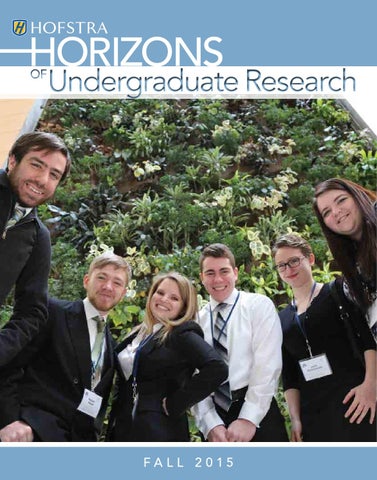
Front cover credit: J Bret Bennington, photographer
This third issue presents the main events during the year for undergraduate research across the curriculum, along with profiles of individual students, departments and their accomplishments, and the resources they use and enjoy at Hofstra. With each issue I try to expand the number of student profiles in order to provide a more and more detailed sense of the tremendous range of fascinating and far-reaching work of our advanced undergraduates, which still, nonetheless, far exceeds what I manage to present here. Last year I highlighted the STEM areas (science, technology, engineering and math) alongside the performing arts in order to underscore by juxtaposition that the performing arts also perform research, albeit differently than in the sciences, while the sciences perform creatively and with imagination, though differently than in the arts. This year I’ve added a feature on Hofstra’s student participation in the world-renowned Telluride Film Festival, which admits applicants into its Student Symposium very selectively, and over the last two years Hofstra has sent three students each year! Each issue also highlights the recipient of the Mentor of the Year Award, which honors an outstanding professor who represents in exemplary fashion that aspect of what faculty members do on a regular basis. This year no profile of a Mentor from Hofstra’s History came together as in the first two issues, though that feature will be back in the future: it’s not always easy to assemble a portrait of our great Hofstra mentors from the past, and all the more exciting when it happens! But then a favorite former student walks in the door to relate his experiences in graduate school! Joe Burg’s reflections might just inaugurate a new feature on graduate students looking back at their training and education at Hofstra. Behind all of these features and phenomena lie the simple facts that our students have great skills, aptitudes and ambitions for research; they receive here at Hofstra outstanding training and guidance in their research, and help in shaping those aptitudes and ambitions; and Hofstra is devoting more and more resources to the faculty and facilities, as well as funding for travel and presentation, to ensure that our students make visible the fruits of their labors, whether as publication, presentation or performance, both at the University and outside the University — regionally, nationally and internationally. Hofstra’s reputation rests on a solid foundation of faculty and student interaction in teaching, which often culminates months or years later with the presentation of student research.
table of contents 4 What Is Undergraduate Research? 5 Across the Disciplines: Student Profiles
20 Undergraduate Research Day 2015 Colonial Academic Alliance 22 Undergraduate Research Conference
24 Hofstra Film Students at Telluride Film Festival in Colorado 26 Looking Back: Alumnus Joe Burg ’13 28 Undergraduate Researchers 30 2015 Mentor of the Year 31 Undergraduate Research Fund Hofstra HORIZONS of Undergraduate Research t FALL 2015
What Is Undergraduate Research? The University is a place of both teaching and research. Research by faculty informs and enriches the classroom experience and allows students to progress from the fundamentals in a field to its advanced, more specific and nuanced branches of inquiry, and on toward the production of new knowledge. Faculty members instruct students not only in the content of an area but also in its methods of independent inquiry that will lead to new insights and discoveries. Undergraduates engage increasingly in guided research as they move from foundational courses to more advanced courses and more closely defined topics. Advanced students in a major can then engage in independent, supervised research sometimes as juniors, usually as seniors, and possibly for departmental honors, as a way of demonstrating their mastery of both content and methods in the field, and their ability to formulate and pursue their own line of inquiry, which may lead to exciting discoveries and new knowledge. Undergraduate research thus serves as a capstone to a student’s work and development in an undergraduate major and can lead to graduate study or directly into professional life. The term undergraduate research refers to such pursuits in all fields as advanced work in the discipline, whether that work, that research, takes place in the laboratory or the library, in the studio, on stage, or in the field. Each student’s advanced research – after months of hard work, reflection, uncertainty and frustration, but also happy discovery, enthusiasm, relief and revision – culminates in the public presentation of the results, either in the department, in a public performance (on stage, in an exhibit or in a recital or concert), at a professional conference or on Undergraduate Research Day for the Hofstra community in general.
4
The purpose of this magazine is to present an overarching perspective on undergraduate research at Hofstra University across the disciplines and to highlight individual achievements, past and present, along with notable events and awards. The presentation of research, the sharing of knowledge, reflects the commitment to free inquiry and teaching that is central to the mission of the University and that constitutes the lifeblood of the academic enterprise, and we all benefit from and thrill at learning what our hardest-working, most advanced students have accomplished.
Hofstra HORIZONS of Undergraduate Research t FALL 2015
Disciplines 5
Hofstra HORIZONS of Undergraduate Research t FALL 2015
Student PROFILES Amanda Lesar Amanda Lesar started at Hofstra in fall 2011 with a dual major in physics and mathematics, and as a member of Honors College. She described her transition to college in a speech at the Honors College admission dinner in spring 2012, providing prospective students with an account of her first-year experiences [excerpted here in the text block]. She elaborates here on her turn to research: “Beginning in May 2013, I interned in the Engineering Department of Frequency Electronics Inc.; although I really enjoyed my experience there, I discovered that I was more interested in the research side of things as opposed to the industry side. I asked Dr. Rohana Garuthara, in Hofstra’s Physics Department, to be my mentor, and I started research in January 2014, the spring semester of my junior year. I wanted to do experimental research in an applied branch of physics, as opposed to theoretical research. I researched the optical characterizations of chemically deposited cadmium selenide nanocrystals, a type of solar cell. I worked with a large temperature range (from 79 kelvins to room temperature), deposited the nanocrystals for varying periods of time (from 24 hours to 120 hours), and used photocurrent measurements, photoluminescence spectroscopy, and the reflectance and transmittance for each sample to examine band gap energies for each sample.
6
“For the summer 2014 I was offered a Howard Hughes Medical Institute Fellowship to continue my research at Hofstra, and then also, very generously, to continue the fellowship for the 2014-2015 academic year. With University support, I was able to travel to San Antonio for the 2015 conference of the American Physical Society to present my research.” In fall 2015, she will begin, with full funding, the PhD program in physics at New York University, where she looks forward to research in biophysics and soft matter physics. As editor, I thought it would be nice to review Amanda’s reflections, from the perspective of her subsequent education, research and success at Hofstra, and look back on her first-year experience at Hofstra and in Honors College. Here is Amanda’s speech from spring 2012 as a first-year student addressing prospective students at the Honors College admission dinner:
Hofstra HORIZONS of Undergraduate Research t FALL 2015
Hello! I’m honored to welcome administrators, faculty members, parents and, most importantly, our potential incoming students here tonight. My name is Amanda Lesar, and I am a freshman physics major and Honors College student here at Hofstra University. I attended high school here on Long Island, and I graduated as valedictorian of my class. Like many of you, I spent way too much time doing extracurriculars like performing groups, yearbook staff, and Model United Nations. Believe me when I say that I know exactly what you guys are going through, because just a year ago, I was in your position, going through the application process. At this point, you’ve finally gotten your acceptance letters and hopefully narrowed down your list of colleges. The fact that you’re sitting here shows that you are on the right track to picking the best university. Many of you have probably already decided to come here, and if you have, I am thrilled to get to welcome you to the Class of 2016. Some of you haven’t made that decision yet. When I sat in those seats last year, I hadn’t made my decision yet either. I stress out over small decisions, so picking my home for the next four years was definitely frightening. I applied to 15 colleges, but my final choice was between Hofstra and The Cooper Union in New York City. A lot of my friends were on Cooper Union’s side. But when I walked around Cooper Union, I couldn’t picture myself there at all. When I was at Hofstra, however, I knew immediately I’d be happy for the next four years. I can’t even express how thrilled I am that I made the decision to come here, choosing the school that I felt was right for me. On one of my first visits to Hofstra, I visited Honors College and met with Dean Donahue. I was a bit intimidated – I was a high school student, one of
Student PROFILES hundreds whom I’m sure he had met with that year. At other colleges I visited, meetings with a dean were hectic and impersonal, because I was usually sandwiched between other meetings they had to attend. Hofstra’s Honors College was different immediately to me, because Dean Donahue didn’t block out 10 minutes for me – he blocked out a morning. At most college visits, I felt that I had to impress and make them want me. At Hofstra, I felt the opposite – instead of a stressful meeting, Dean Donahue wanted to make a personal connection with me, and took the time to get to get to know me. I think that’s one of the amazing things about Hofstra, especially in the Honors College – they get tens of thousands of applications, and yet they still want to personally make sure that you are successful. Here, you are truly not just a number. I had Dean Donahue as a professor in the fall, and I still talk to him often – we have that personal connection where it’s easy to drop by his office if I need anything, and I know he’ll be able to help me out. In Honors College at Hofstra, there’s no isolation from the rest of campus – plenty of my friends aren’t from Honors College. Whether you join the student government, an intramural sport, or an academic society – there is literally always something going on here, but, one of the great things about Honors College is that it feels like a home base. While it’s amazing to have so many opportunities to get involved, it’s also overwhelming, especially in the beginning. Honors College is a truly dependable support system. Literally, you can call Peggy Ann, Rita, Dean Frisina, or Dean Donahue with anything, and they will be able to help you. Anyone, whether they commute, like I do, or live on campus, can easily find their way to the Honors College lounge: It’s a welcoming place – it’s got comfy couches, lots of food, and you can usually find someone to hang out with. Even if you don’t know the person
you meet in the lounge, it’s ridiculously easy to make friends here. I mean, you have the adventure of Culture and Expression together – it’s really a bonding experience. Culture and Expression is one reason we make friends so easily. C&E is one of those cool things unique to Hofstra’s Honors College. It’s a double course that you’ll take in your freshman year, where a humanities and a social science class will get linked in order to jointly examine texts from a bunch of different angles. It’s also in C&E that you’ll find friendships and inside jokes that will last – for the Class of 2015, the “C&E Cat,” made famous from Professor Dardis’ lectures, has its own Twitter account. While C&E is fun, it’s not always easy: Sometimes on a Monday night you need to read the assignment for Tuesday’s lecture and you’ve barely started, but when you show up at that lecture and you see Professor Kozol using a chessboard to mimic the story of “Alice in Wonderland” and wishing you a very happy “unbirthday,” it makes that rush seem worth it. You may not love every text you read in C&E, but I guarantee you’ll find yourself interested in many things you never would’ve thought to look into previously. I say this as a first-year physics major – a subject that doesn’t exactly correspond with what we read in C&E. But then again, C&E is genuinely inclusive of a very wide range of topics. One day you could be debating the great evolution versus religion issue, while the next day you’re examining the music of Mozart’s opera, and the next day you’re analyzing the art associated with William Blake’s poetry. Even a science major like me benefits enormously from the organized debates and the personal relationships with both faculty and fellow students. If there’s one thing that C&E professors love, it’s risk-taking.
For them, it isn’t all about getting an A – it’s about delving into something unique and original, something that you will learn from and remember. Now, I’m guessing you are all a lot like me. You are the kind of student who has the formula and knows how to get an A grade, so all this talk about risk-taking and delving into new things can be a bit daunting. But I’ve learned that you can’t expand your knowledge without taking risks, and C&E has truly rewarded me in that aspect. I was driving to school a couple of days ago, and the road was completely blocked. I started to panic a little bit, because I didn’t have any other way to get to school from that point, and I had class. So I got on the phone with my parents and they gave me some alternate directions. It was really out of the way, and as I was driving, I saw another road that I recognized that seemed like it might be shorter. So I left the route my parents recommended and went for it [followed my own instincts], and I actually ended up making it to class on time. The thing is: everyone is always going to try and give you directions. You can talk to your parents and your friends, and they’ll tell you what they think you should do. They all want to help you get where you’re going. But in the end, the only person in that car is you. The only person who can grab the steering wheel, step on the accelerator, and just drive to where you belong, is you. You can call for directions, but you have to drive alone. Last year I spent a lot of time driving around, listening to everyone tell me what they thought I should do. While it is always helpful to hear what others think, ultimately the choice is yours. I drove myself to the campus of Hofstra University, and I could not be happier. I hope in the fall you take the same road and end up as happy as I am, because this could be the beginning of the best years of your life. Thank you.
7
Hofstra HORIZONS of Undergraduate Research t FALL 2015
Student PROFILES “I definitely want to continue to do research on Spanish and work with Latino communities.”
Anna Pendleton As her departmental honors thesis, Anna Pendleton used lexical analysis to examine the diverse varieties of Spanish in New York City. She looked at which aspects of a speaker’s demographic information most influence their lexicon and dialect, and found that country of origin constitutes a very significant influence, while, surprisingly, other factors such as gender, age, and social class exert very little significant influence. She also looked at the Spanish vocabulary used in New York City, which helps understand and define the characteristics of a new variety of “New York City Spanish.”
8
Anna notes that she has always been interested in the Spanish language, but that she chose this specific research project after having interned with a nonprofit organization called Make the Road New York (MRNY). That organization works with Latino communities all across New York City, addressing issues of power relations and justice for immigrants, in addition to providing many services to the community, such as adult education classes, legal assistance, and help with employment searches. Anna loved working with the members of MRNY and was really interested in the way they all interacted and had built a community, despite their diverse countries of origin, backgrounds and experiences living in New York City. That experience got her interested in studying their language collectively and how it reflects and reacts to those diverse experiences and backgrounds. Anna describes her experience doing research as very much a step-by-step learning experience. Since she had never taken a class in research methods
or in statistics, she had to devise her research plan and analysis completely on her own — but she credits many people with helping her along the way, such as Dr. Jin Shin in Hofstra’s Psychology Department; Katie LyonHart, her boss when she was an intern with MRNY; and her thesis advisor, Professor Vicente Lledo-Guillem. By coincidence, a conference on Spanish in the United States was held in New York City in the spring of 2015 as she completed her research, and she was able to attend the conference and meet many of the same scholars who had inspired her research! She presented her research at Undergraduate Research Day at Hofstra on May 17, 2015. Anna will intern after graduation at a nonprofit that does research with Latino communities in Minneapolis/St. Paul, Minnesota. “I definitely want to continue to do research on Spanish and work with Latino communities. Perhaps I’ll even take my research to other Spanishspeaking countries in Latin America!”
Student PROFILES Erin Reagan
Erin Reagan, from Morgantown, Pennsylvania, graduated in May 2015 with a BS as a double major in biochemistry and physics. She earned departmental honors in physics and departmental high honors in biochemistry. In fall 2015 she will enter University of Pennsylvania’s PhD Program (with full funding) in Cellular and Molecular Biology with a focus on gene therapy and vaccines.
Her research path had begun much earlier and earned accolades even before her senior year. In the summer of 2014,
Erin was selected to participate in the American Chemical Society International Research Experience for Undergraduates (REU) in Glasgow, Scotland, funded by the National Science Foundation (which included housing, travel and living costs in Scotland). There she was able to conduct research on stabilizing light-harvesting complexes from the bacterium Rhodopseudomonas acidophila in dipeptide nanofibers that she had synthesized. That same program also funded the presentation of her research at the American Chemical Society National Meeting in Denver, Colorado, in 2015. At Hofstra, Erin conducted research with Dr. Scott Lefurgy in the Biochemistry Department. She worked on two projects while in his lab. In the first
project, she focused on understanding the thermal properties of different variants of the enzyme octopine dehydrogenase. In her second project, Erin researched antibiotic resistance. She investigated the significance of substrate selectivity of the F293 residue in FOX-4 beta-lactamase through the use of site-directed mutagenesis. In an interview she spoke at length and glowingly about the amount of contact she has had with professors in her area while at Hofstra, inside and outside of the lab, as opposed to the “industry norm” at large research universities — where projects get divided at different stages among undergraduates, graduate students, postdoctoral fellows and professors. At Hofstra she was able to pursue her projects herself, with faculty supervision, through all stages of research, which allowed her to develop the confidence both in performing and in talking about her research that research foundations and graduate schools recognize and reward. In addition to her work within the field of science, Erin has been heavily involved with the social club Hofstra Versus Zombies and served on the executive board of the club for three consecutive years.
Jesse Frye graduated as a biology major who worked with Dr. Beverly Clendening for three years performing research in genetics. His research addressed temperaturedependent sex determination in snapping turtles. Rather than being predetermined, the sex of snapping turtles is based on the temperature at which their eggs are incubated. Jesse’s goal was to discover the specific molecules that respond to these differences in temperature, which could be significantly affected by global climate change. Rising temperatures may alter the ratio of males to females and disturb the population of this species. In addition to his work in biology, Jesse had minors in history and Spanish, and was Jesse also president of the Hofstra University Honors College (HUHC) Service Corps – a community service group on campus that, among other activities, volunteers regularly at a local soup kitchen, at a preschool, and at a hospital. In August 2015 he began his studies in the MD Program at Stony Brook University School of Medicine.
9
Frye
Hofstra HORIZONS of Undergraduate Research t FALL 2015
Student PROFILES
Kat Deiner
Class of 2015
Majors: Art History and Fine Arts
with a concentration in Painting
Hometown: Doylestown, PA
The Yellow of Vincent van Gogh By Kat Deiner Through formally analyzing the structure of these paintings, we see how van Gogh’s reliance on yellow is not incidental, but rather is the heart of his expression. His own relationship with yellow, in accordance with feelings associated with yellow in Western society, forms a dialogue between van Gogh and the viewers through color. In each painting, van Gogh creates a narrative that focuses more on feelings than objects, and meaning rests in his complex color systems and meaningfully placed strokes. While these color systems change in each painting, the main mode of expression, toward the end of his painting career, is consistently yellow. As for Kat’s future plans, she is currently painting and applying to shows in her local area. Afterward, she plans to find work in New York City at a gallery or museum in order to stay involved in the contemporary art scene. In a few years, she plans to go on to graduate school for the MFA in painting. She would love to be both a practicing artist and active professional in the New York City art world.
“My research focusesfocuses on Vincent Gogh and expressive power “My research onvan Vincent vanthe Gogh and the of yellow in his paintings inspired by his arrival in the South of France. expressive power of yellow in his paintings, inspired by Studying abroad at the Marchutz School in Aix-en-Provence, France, his arrival in the South of France. Studying abroad at in the spring of 2014 gave me the opportunity to see the motifs of his in Aix-behind paintings firsthand and encouragedthe me Marchutz to discoverSchool the motivation en-Provence, France, in theart is his masterpieces. Researching such an influential figure in modern spring of much 2014 of gave me the rewarding to me as a painter and has inspired my recent work.”
10
opportunity to see the motifs of his paintings firsthand and encouraged me to discover the motivation behind his masterpieces. Researching such an influential figure in modern art is rewarding to me as a painter and has inspired much of my recent work.”
Hofstra HORIZONS of Undergraduate Research t FALL 2015
Kat’s recent work has been greatly influenced by the paintings of van Gogh; she says, “Both his palettes and physicality of paint resonate in my own work. His understanding of color and interpretation of nature is a constant inspiration.”
Student PROFILES
communicate with others through his writing and to create empathy through the fictional worlds that he created.
Victoria Cocolaras
Victoria Cocolaras just graduated as an English major with a concentration in creative writing and with minors in world literature and music. Her honors thesis, titled “The Warring Worlds of J.D. Salinger,” was written under the supervision of Dr. Scott Harshbarger in the Department of English. The study examines Salinger’s works before, during, and after World War II, when Salinger served as a member of the 4th Counter Intelligence Corps Detachment, the unit with the highest casualty rate of the war. He also participated in D-Day, the ensuing five-month campaign, and the liberation of Dachau. Afterward, Salinger had difficulty integrating himself back into society at home in the United States, as the war had aggravated Salinger’s sense of distance between himself and others.
In her research, Victoria analyzed five of Salinger’s short fiction stories: “Last Day of the Last Furlough,” “A Boy in France,” “A Girl I Knew,” “For Esmé With Love and Squalor,” and “A Perfect Day for Bananafish.” These stories cover the period before, during, and after World War II. At the heart of his fiction lies a clashing of worlds that began early in Salinger’s life (growing up half-Jewish during the 1920s-1930s) and was heightened by his experience in the war (resulting in his further isolation from society). Her research revealed how this clashing of worlds relates to various themes in his works as Salinger struggles to blend together opposites – of time, thoughts, identity, and worlds – in his writing. As background for her research, Victoria read biographies of Salinger, including David Shields and Shane Salerno’s Salinger and Kenneth Slawenski’s J.D. Salinger: A Life, and incorporated current psychological theories of the self. Having spent most of his life in isolation, Salinger reached out to
Though Salinger gained fame and did reach many through his sensationally successful novel The Catcher in the Rye (1951), he spent the latter half of his life in virtual seclusion. The paradox of these clashing worlds is the basis of his works and traces back to the time he spent in military service during the war. His trauma carried over into his writing, as Victoria’s research and analysis of his fiction reflects. The challenges posed to him as a result of the war prompted him to experiment with new ways of expressing that self. Victoria’s research involved studying the nature and effects of posttraumatic stress disorder from current theories and survivors of war. In his recent book, The Evil Hours (2015), David J. Morris, a former Marine infantry officer and reporter in Iraq from 2004 to 2007, gives a firsthand account of his experiences in war and of the research on trauma he did after returning home, which sheds light on what Salinger was also dealing with. In addition, Victoria studied current psychological theories of the self by psychologist Dan McAdams. According to McAdams, the autobiographical self is the part of the self that emerges in early adolescence and is responsible for establishing one’s coherent narrative, something Salinger constantly tried to do, but which his experiences in the war further complicated.
11
Victoria’s research involved studying the nature and effects of posttraumatic stress disorder from current theories and survivors of war. Hofstra HORIZONS of Undergraduate Research t FALL 2015
Student PROFILES dancer, so we speak the same language. “My lighting designer is Max Cerci. He has sat through rehearsals and is always making notes and offering lots of great ideas. He comes up with concepts and questions that I hadn’t even thought to address.”
Alexis “Kate” Robbins The performing arts also require extensive research; sometimes that research conforms to traditional practices in the library or archive, looking back and interpreting (through historical and theoretical scholarship on the arts), but more often, research in the performing arts takes the form, looking forward and imagining, of figuring out how to constitute the performance, achieve the idea, through production in the medium, whether that is theatrical, painterly, sculptural, choreographic, musical or other. That research explores how to put the medium into motion to realize an idea. — NHD For the first time, a Hofstra dance major presented a full hour of her original choreography for the end-of-year Student Rep (April 30-May 5, 2015), a showcase of theatrical work and dance presented by the Department of Drama and Dance.
12
Alexis (aka Kate) Robbins, from Wakefield, Rhode Island, with a dual major in dance and exercise science, was the first dance student to apply for her own senior show within the Student Rep. “Typically MOVOM, featuring selected students and choreography from the Dance Program, puts on a short performance,” Alexis explains. Her concert, titled kamrDANCE, featured a 14-member cast in a seamless production of seven dances, all choreographed by Alexis during her four years at Hofstra. “Two of the pieces are brand-new. The other five have been performed
previously, but I’ve revamped them,” she explains. “Each piece could easily stand on its own, but they flow without break from one to the other.” Alexis says that there is a drastic mood change from dance to dance. When asked how she portrays mood – particularly in tap, which is her specialty – Alexis answers, “I think any style of dance can convey any emotion. Music does a lot to influence the mood. But there is also how you move your body. There is what my feet are doing, but I also use my upper body and face to set the mood.” kamrDANCE featured tap, modern and jazz styles, and the dancers ranged in class year from freshman to senior. “All the students are amazing and have appeared in my works before.” Two of the students, senior Briana Giordano and junior Ginny Mottla, each appeared in three dances. Alexis spoke gratefully about the cast for devoting so much time and energy to the rehearsals and development of kamrDANCE. “We’ve been rehearsing for three hours every Saturday since the start of the semester, and there have been many other times in between.” As the director and producer of the performance, Alexis had to lean on students in theater production to make sure kamrDANCE was a success. “My stage manager, Geena Forristall, a senior BFA in theater production major, is amazing. I requested her and am so lucky to have her on my team. As the stage manager, Geena has to know the show as well as I do. It helps that she’s also a
Hofstra HORIZONS of Undergraduate Research t FALL 2015
kamrDANCE is not the first time Alexis has distinguished herself in the Dance Program. In her sophomore and junior years she was selected by dance faculty to represent Hofstra at the American College Dance Festival Association (ACDFA) Northeast Regional Conference. Both times she was asked to perform in the end-ofconference gala, a great honor for which only 9 or 10 students out of approximately 50 are selected. For the 2013 conference (which incidentally took place at Hofstra) she choreographed and performed a contemporary tap solo titled “Slow Dancing in a Burning Room,” which she performed to the John Mayer song of the same name. Hers was the only tap piece in the program. At the 2014 conference at SUNY Brockport, she choreographed and performed in a modern dance and tap duet titled “A Separate Connection.” That year Alexis was also selected as first alternate to perform at the ACDFA National Conference at The Kennedy Center in Washington, D.C. Juggling her dance classes and rehearsals with her second major in exercise science was particularly challenging but also very rewarding. She also completed an internship at Winthrop Physical Therapy, where she enjoyed working with patients and seeing their progress. After graduation, Alexis wants to move to New York City but is still uncertain about whether her professional goals will center on dance or physical therapy. Right now, she’s planning to compromise. “I’m hoping I can get my choreography out there and audition, while also working as an aide. Eventually there will be graduate school.”
Student PROFILES
Bioengineering Majors Make Their Mark Pierre Llanos, a senior bioengineering student at Hofstra (pictured at right, center, with Nickolas Boroda and Andrew Wong), participated in the 23rd annual CSTEP (Collegiate Science and Technology Entry Program) Statewide Student Conference in spring 2015 and was awarded the Distinguished Research Presentation Award in the poster competition for his work, “Characterization of Biomechanical Properties of Primary Endothelial Cells Exposed to Shear Stress.” He competed against CSTEP juniors, seniors, and graduate students from colleges and universities across New York state. CSTEP provides students with academic enrichment and research experience in science, mathematics and technology content areas. Llanos, who resides in Oceanside, New York, spent last summer at Hofstra with other bioengineering students and Dr. Sina Rabbany, acting dean of the School of Engineering and Applied Science, to examine the role of biomechanical forces on endothelial cells (EC) – the cells that make up the structure of blood vessels. The students were studying EC response to varying microenvironmental conditions, in the hopes of presenting a more complete picture of the cell’s behavior.
Llanos, a mentor and tutor for younger students in Hofstra’s CSTEP program, researched the use of atomic force microscopy (AFM) to characterize these cells under static and dynamic conditions. The use of AFM allows researchers to gather new types of information on cellular characteristics such as 3-D cell images and force maps. Llanos’ research last summer was supported by the Dean’s Fund of the School of Engineering and Applied Science, using a donation made by Mr. Paul Saueracker ’78, CEO (retired), Minerals Technologies.
Nickolas Boroda Nickolas Boroda, a senior bioengineering major, presented research in February at the 59th annual meeting of the Biophysical Society in Baltimore, the largest meeting of biophysicists in the world. “Characterization of Biomechanical Properties of Primary Endothelial Cells Exposed to Shear Stress” is based on research Boroda conducted with fellow Hofstra senior Pierre Llanos and adjunct instructor and research assistant Andrew Wong.
13
Boroda, Llanos and Wong have been studying the response of endothelial cells (EC) to varying microenvironmental conditions, in the hopes of presenting a more complete picture of the cells’ behavior. Endothelial cells make up the structure of blood vessels. Guiding and advising the research was School of Engineering and Applied Science (SEAS) Acting Dean Sina Rabbany. Boroda, Llanos and Wong began their research in the summer of 2014, supported by the Dean’s Fund of SEAS, using a donation made by Mr. Paul Saueracker ’78, CEO (retired), Minerals Technologies. The Biophysical Society was founded in 1958 to encourage development and dissemination of knowledge in biophysics. The society’s members, now over 9,000, work in academia and industry, and at government agencies throughout the world. Hofstra HORIZONS of Undergraduate Research t FALL 2015
Student PROFILES
Marissa Espinoza In her years at Hofstra, Marissa Espinoza developed increasingly as a researcher in her multiple fields, exploring issues in her classes and beyond, with three majors in economics, political science and psychology, along with minors in civic engagement and Spanish, while also a member of Honors College where she earned the Honors College Graduate designation. She accomplished all of this by taking 18-20 credits per semester (15 is typical; full tuition covers 17 credits) and also taking courses in the summer and in January. At risk of understatement, she is not afraid to work hard and, even though her interests range across many areas, she was able to focus through her research on very particular and welldefined topics and relate them to the well-being of individuals or nations.
14
the long-term economic benefits and New York state (and other states’) initiatives to make higher education affordable. Of course, it is highly unusual for anyone to begin to publish before graduation or even while in graduate school, but her combination of research skills and clear prose addressed a topic of vital interest to many on Long Island and nationwide. But Marissa spent most of the summer of 2014 developing a research project for her application for a highly competitive and selective Fulbright scholarship to spend a year, fully funded, in Ecuador: in March she learned that she had received the very prestigious scholarship! She describes her plan for research below: For my Fulbright year, I will be working with an economics professor in Quito, Ecuador, to develop an “index of financialization.” What this means in the most basic terms is an index to measure whether levels of financial growth are real or artificial. Real levels of growth would be economic growth stemming from manufacturing,
Even outside her course work, at the beginning of her senior year (September 2014), she published an article in Long Island Newsday (9/22/2014) titled “Success Lies With Completing a Degree,” where she analyzed economic data on the cost of higher education and increases in student indebtedness in light of
Hofstra HORIZONS of Undergraduate Research t FALL 2015
services, production, etc.; artificial levels of growth would derive from the financial sector: for instance, when trading stocks, the profit earned is not an actual profit, but artificial. Such an index was created for the U.S., so I would like to create a similar one for Ecuador. My affiliation will be with Universidad San Francisco de Quito, a private research university in Quito, where I will work under the supervision of Professor Pedro Romero, an expert in banking and finance, who has published many articles on topics of this nature.
Student PROFILES
In her senior year, Marissa engaged in research for her honors thesis, for which she was then awarded departmental honors: For my honors thesis I did a quantitative and case study analysis of “Quantitative Easing,” which was the U.S. Federal Reserve’s economic recovery/stimulus package after the financial crisis in 2008. I studied the theoretical and historical analysis of QE (quantitative easing) in order to provide what the Federal Reserve used as its framework for QE. Then I did a statistical analysis of QE and the three phases of its rollout from 2007 to 2014. One of the most important goals of QE was to boost economic growth and spending in the U.S. after the financial crisis. This includes business investment spending. So I did a statistical analysis by building a mathematical model to examine whether QE significantly impacted business investment spending. My results showed no significant impact of QE on business investment spending, though my mathematical model may have been too simplistic. After her year of research with the Fulbright scholarship in Ecuador, Marissa would like to take an additional year off before graduate school to do (surprise!) research for either a think tank or a governmental agency, and to decide if she’d like to continue with law school or graduate school for public policy as an avenue into the field of public policy. The research skills and ability to work with other scholars across disciplines that she honed at Hofstra will serve her well for a long time to come.
Douglas Ferraiolo Douglas Ferraiolo graduated from Suffolk County Community College’s Honors Program in 2013 with an associate degree in liberal arts-general studies and began at Hofstra that fall, majoring in environmental resources and minoring in sustainability and fine arts. He graduated in May 2015 with a BS in environmental resources and the Honors Recognition designation from Honors College. In summer 2015 Doug worked as a research assistant with the Hofstra Department of Geology, Environment and Sustainability when he began his research into trace metal and grain size analysis within sediment cores on Long Island. He explains: I chose to focus on four cores found within the Crab Meadow marsh in Northport, New York, which eventually became the research that I presented at the Colonial Academic Alliance Undergraduate Research Conference at Drexel University, as well as at the Long Island Geologists Conference at Stony Brook University and at Undergraduate Research Day at Hofstra University. My research focused on extracting sediment cores from the Crab Meadow marsh via a vibracoring apparatus and splitting them in the lab for further investigation. I split the cores into 1 cm intervals and put them through a sieve system in which they were eventually sent for trace metal analysis at an outside laboratory. I performed the grain size analysis at Hofstra using a sieve system similar to the trace metal analysis and the Ro-Tap machine located in Gittleson Hall. After collecting the data, I made correlations between the percent fines and the trace metals, specifically lead, found throughout the cores in placing the dates of the 1850s-1880s in marking the rise of industrialization and the 1950s in the time of peak leakage when leaded gasoline was being used in large quantities. In doing so, I brought up the point of a new possible era known as the Anthropocene, which is the age of man, which we are currently in today due to the exponential increase of human impact on earth systems. This trend appears in the trace metal concentration of the cores; future study of these core sections will show from the background amounts of these elements when human impact on the surrounding environment began.
15
Doug has accepted a job offer from Roux Associates, an environmental consulting firm based in Islandia, New York, where he plans to gain experience as a staff assistant geologist before beginning graduate study.
Hofstra HORIZONS of Undergraduate Research t FALL 2015
Student PROFILES
Biochemistry Major Awarded ACS Fellowship
Hofstra HORIZONS of Undergraduate Research t FALL 2015
Diego Prado, a senior biochemistry major from Montevideo, Uruguay, was one of three recipients of the William H. Nichols Fellowship from the New York Section of the American Chemical Society (ACS). This is the inaugural year of the fellowships, which awarded students $4,000 for 10 weeks of summer research. Students will receive an additional $1,000 at an awards banquet in 2016.
Student PROFILES
Diego spent the summer of 2015 working with Assistant Professor of Chemistry Scott Lefurgy on research involving enzymes and how they select specific molecules from a mixture of competing chemicals. The research model they used is octopine dehydrogenase, an enzyme found in bay scallops. This enzyme catalyzes a reaction between an amino acid and an alpha-keto acid to produce octopine, one of a class of compounds that is useful in the development of some drugs and specialty chemicals. The goal of Diego’s research is to determine which features of the enzyme are important for recognizing its target molecules, and to change the enzyme’s molecular preference so that it will act efficiently to produce drug precursors. He has been using site-saturation mutagenesis and screening to determine which features can be altered successfully. In 2014 Diego also participated in a fully funded Summer Undergraduate Research Program in the Chemistry Department at Princeton University geared specifically toward students with diverse backgrounds or from underrepresented minorities. Each of six students in the two-month program was assigned to a lab for a short-term project. Diego worked in the lab of Dr. John T. Groves under the supervision of his PhD candidate, Cristin Monroe, on a project investigating the effects of an affinity tag on the activity of a certain protein. Besides the research, the recipients were given opportunities to tour the
town of Princeton and the university as well as visit a local industry that specialized in flavoring and scents for food; the awardees also enjoyed access to seminars and talks with Princeton University faculty about graduate programs and their research practices. At the end of the summer, the students presented their own research in a poster session. Following graduation, Diego plans to pursue a PhD in cell and molecular biology, with an emphasis on cancer research.
The Nichols Fellowship, named for a founding member and former president of the ACS, is designed to support the advancement of New York area college juniors who are interested in chemistry, biochemistry and aligned fields. Recognizing that the New York Local Section area (all boroughs of New York City plus Rockland, Westchester, Nassau and Suffolk Counties, and the area east of the Hackensack River in Hudson and Bergen Counties, New Jersey) houses a broad portfolio of cutting-edge STEM research laboratories, this program strives to provide the authentic research experiences and mentoring needed to prepare the next generation of world-class chemists. This summer opportunity is open to all college juniors (rising seniors) who are majoring in chemistry, biochemistry or chemistry-related fields and who plan to do research during the summer intersession at an institution located within the New York Local Section geographical area.
17
Hofstra HORIZONS of Undergraduate Research t FALL 2015
Student PROFILES
Physics Senior Receives National Award Claire Weaver, a senior physics and mathematics major from Farmingdale, New York, was named a recipient of the 2015 Kirsten R. Lorentzen Award from the Society of Physics Students (SPS). She was selected from a pool of high-achieving students from institutions across the country.
Claire Weaver
The Kirsten R. Lorentzen Award is an Association of Women in Science (AWIS) Educational Foundation program that recognizes female college sophomores and juniors studying physics, including space physics and geophysics, or geoscience. The $2,000 award is given annually to an exceptionally well-rounded student who excels in her studies as well as outdoor activities, service, sports, music or other non-academic pursuits, or who has overcome significant obstacles. The award is administered by SPS and may be used for any aspect of education, including tuition, books, housing or travel.
Claire put her college career on hold briefly to (literally!) join the circus and become a flying trapeze instructor. When she was ready to resume her studies, she enrolled as a physics major at Hofstra, where she became the first female president of the Hofstra chapter of SPS. She calls the study of physics “a pure science ... the Legos of the universe.” She was the 2014-2015 recipient of the James A. Moore Endowed Memorial Award, which is also awarded to students excelling in physics studies and service to the scientific community. Claire presented “Synthesizing New, High-Temperature Superconductors” at the February 2015 national meeting of the American Physical Society in San Antonio, Texas. She presented the results of a research project conducted during a 2014 summer internship with Dr. Meigan Aronson at Brookhaven National Laboratory, involving the fabrication and property identification of metallic crystals in search of high-temperature superconductors.
18
More recently, Claire has been working on an independent study using group theory and symmetry to explore topological insulators. She conducted summer research in the field of nano-photonics and nano-plasmonics, tailoring light-matter interactions using metal-dielectric nanostructures, at the Advanced Science Research Center in Manhattan. Claire plans to continue her studies in graduate school, where she will focus on condensed matter physics. She says, “Not only has my enthusiastic and adventurous nature served me as I transitioned from the circus arts to the sciences, but so has my passion to inspire strength and ability in others. I have enjoyed furthering the development of Hofstra’s physics community as president of SPS, and as I advance through my career I look forward to mentoring the next generation of brilliant minds.”
Hofstra HORIZONS of Undergraduate Research t FALL 2015
Student PROFILES Joseph Pentz, from Neptune, New Jersey, graduated with a BS in television/video. He began immediately after graduation to work as a sales support engineer for Diversified Media Group. For his advanced senior research on the much-discussed concept of “net neutrality,” he was awarded high honors by his department. He recounts his path into research as follows: I chose to begin work researching net neutrality in Dr. [Nancy] Kaplan’s RTVF 134. We were assigned to take one aspect of the television industry and research throughout the semester and present it at the end of the semester. At first I chose the Federal Communications Commission (FCC), but after meeting with Dr. Kaplan, I narrowed it down to network neutrality and the FCC. I chose to focus on network neutrality because it was such a big topic at the time. I dove in headfirst and realized how badly this could affect our infrastructure and the way we use the Internet as a whole. The FCC had not released its decision on net neutrality yet, but it was very fresh in everyone’s mind, though many people did not know what net neutrality really was. When the FCC released its decision, I chose to keep researching the topic of net neutrality because so many things were about to change; at the suggestion of Dr. Nancy Kaplan and Dr. Susan Drucker I submitted my research to the Eastern Communications Association conference in Philadelphia with the title “Deliberation.” They choose only 150 to 200 students to present. My
Joseph Pentz poster was accepted and I went to Philadelphia and presented my research as more and more suits were filed against the FCC for its decision. I found out a few days later that I had won first place for my research. To have my research as an undergraduate accepted for presentation at a professional conference is already an accomplishment, but to be able to say that it won first place is a milestone. My research on net neutrality has kept me aware of how our current infrastructure is changing and how technology will rule our world for years to come. I’m currently employed at Diversified Media Group as a sales support engineer, and I plan to stay in the television industry as an engineer or perhaps one day as a professor so that I can perhaps share my passion for the industry.
19
Hofstra HORIZONS of Undergraduate Research t FALL 2015
Undergraduate Research Day 2015
20
Advanced student research continues throughout the year in all disciplines and, after months of hard work, merits the opportunity for presentation, recognition and applause!
ach student’s presentation E marks the culmination of intense individual or team research, in the library or in the lab, in the field or studio or on stage, often with moments of anguish, uncertainty, and frustration, but also with happy discovery, satisfaction, enthusiasm, relief and – revision, revision, revision. There’s a reason it’s called a discipline!
The presentation of research, the sharing of knowledge, is the life-blood of the academic enterprise, and we all benefit from knowing what our hardest working, most advanced students have accomplished. Hofstra HORIZONS of Undergraduate Research t FALL 2015
Undergraduate Research Day makes visible to the University community in general the outstanding work of highly motivated student researchers under the guidance of experienced and engaged faculty members.
The culmination of an undergraduate student’s work in a particular discipline reflects the mastery of both methods and foundational knowledge, and a transition to graduate school or professional life.
Undergraduate Research Day, May 7, 2015 — by Ginny Greenberg More than 200 people attended this year’s Undergraduate Research Day, where Hofstra seniors from many disciplines shared posters outlining the results of their research projects – more than 65 presentations in total, on topics as diverse as the use of yellow in painting to enzyme mutation testing. Student presenters were joined by their faculty mentors during the popular event, which was held in Axinn Library’s East Library Wing on May 7, 2015. “Many faculty, staff and administrators expressed their awe at the amount and quality of the research. One really just had to come over and enter the room to hear and feel the excitement, the buzz, the intensity of so many advanced, accomplished students talking enthusiastically and knowledgeably about that exact thing that has occupied and preoccupied them for months, if not semesters, if not years,” said Neil H. Donahue, Honors College senior associate dean and assistant provost for undergraduate research and fellowships. “Undergraduate Research Day represents, in its lively density, the core of what a university has accomplished in a given year in educating its most advanced students in their respective disciplines and preparing them for their future.”
21 21
Dean Donahue, who organizes the event each December and May, says he was able to recruit a broader range of posters than ever before. “In the humanities in general, it’s not common practice to present a poster about one’s research, as it is in the natural and social sciences – but it works very well, since the poster is a conversation starter and a means of jumping right into a rich Q&A,” he notes. “This year we had posters from musicians, dancers, creative writers, sociologists, scholars of English literature and Spanish language, geographers and geologists, political science, and cinema studies, along with a full range of biologists, physicists, engineers, chemists and biochemists, and forensic scientists.”
Hofstra HORIZONS of Undergraduate Research t FALL 2015
Colonial Academic Alliance The Colonial Academic Alliance (CAA) is the parallel organization to the Colonial Athletic Association. In 2002 the provosts of the member schools decided that their association should focus not only on athletic competition, but also on student academic achievement. The Colonial Academic Alliance was founded in order to develop, promote and facilitate collaborative programs and resourcesharing to enhance academic quality and institutional effectiveness among the member institutions: College of Charleston, University of Delaware, Drexel University, Elon University, Hofstra University, James Madison University, University of North Carolina – Wilmington, Northeastern University, Towson University, and William & Mary.
Colonial Academic Alliance
Each spring the CAA sponsors an Undergraduate Research Conference that is hosted by a member school. Up to 10 students from each member school present their research either as a poster or as a short lecture; students travel together with faculty or staff to represent their institution. The host school shows its resources with tours and lectures by outstanding faculty. The conferences generally also offer meetings on diverse topics of interest and use to students, such as a session on prestigious scholarships (and how to apply), on graduate school and on environmental best practices. In such ways, CAA member schools learn from one another and share ideas at all levels. In the 2014-15 year, the CAA welcomed a new executive director, Lindsey Interlante, who has experience in strategic planning for institutional effectiveness and student success (along with a background in public administration, MPA ’07, and in geography, MA ’10), and who has begun to bring the discussion and coordination of initiatives among member schools to a new level. Hofstra University has hosted the event twice (in 2005 and 2011) — the second time, in spring 2011, in order to coincide with the University’s yearlong 75th anniversary celebration (which began in September 2010). In 2015 Drexel University hosted the 13th annual conference on its campus in Philadelphia and impressed all in attendance with an opening reception at the Academy of Natural Sciences, the oldest natural history museum in the United States, now affiliated with Drexel, where students and faculty got to hang out with dinosaurs over dinner and then hear an amazing talk by paleontologist Dr. Kenneth Lacovara about his discovery of the Dreadnoughtus – the largest dinosaur known – and both the scientific and practical challenges of locating and then transporting that skeleton. What an adventure! The following day featured a talk by Dr. Frank Lee about his much celebrated transformation of a skyscraper in downtown Philly into the world’s largest video game! Hofstra students were delighted to participate in events there and see the campus and city, and to present their own research (as posters and lecture presentations) with poise and professionalism – and we also had a lot of fun!
23
The group was accompanied by me (NHD, who drove the van) and one of Hofstra’s resident geologists, Dr. J Bret Bennington, who also took amazing photographs that can be viewed here: hofstra.edu/caaresearchphotos. Hofstra HORIZONS of Undergraduate Research t FALL 2015
Hofstra Film Students at Telluride Film Festival (September 4-7, 2015) in the Rocky Mountains of Colorado For the second straight year, Hofstra University (and more precisely, The Lawrence Herbert School of Communication and the Department of Radio, Television, Film) has had three students admitted into the prestigious Telluride Film Festival in Colorado, one of the most famous film festivals in the world. The Student Symposium selects 50 students from around the world, based on application essays, to participate in the festival through a full schedule of film screenings and closed meetings with directors, actors and other industry professionals. As their program indicates: “We are looking for a crosssection of the college and university student population: undergraduate and graduate students; film and non-film majors; and geographical and cultural diversity. The most important qualities we seek are: passion for film, an ability to interact with other students and Symposium guests, and a willingness to follow a highly rigorous program of screenings and discussions. With only 50 slots available, each student’s full commitment to the program is critical.” Through the Student Symposium these students are introduced to the state of the art in the film world at multiple levels, from conception to production to perception and analysis. To have even one student admitted into the, literally, rarefied atmosphere of the Telluride Film Festival (at 9,000 feet elevation in the Rockies!) is already a significant privilege and achievement, but to have three students admitted is extraordinary, and to have that happen two years in a row speaks volumes about the students, faculty and training in film here at Hofstra! In fact, one student, Muhammad Muzammal, was acknowledged by the organizers at the festival as a singular, i.e., unprecedented, instance of a student being invited to attend the festival a second time! David Yurman also attended this year, along with Ethan Magee, who participated in the new Telluride Cinephile program. Both David and Ethan are senior film studies and production majors; Muhammad is a junior industrial engineering major and film studies and production minor. — NHD
24
Remarks by David Yurman It is a singular experience, utterly unique. It’s all at once intimate and overwhelming, small and imposing, elitist and welcoming. ... Telluride felt very much like a trip behind Oz’s curtain. ... The unreality of the whole experience never truly dissipated. My eyes always felt just a tad glazed, like I’d been hypnotized in the Denver International Airport Wednesday morning and I’d wake up there, Tuesday evening, utterly convinced I had driven over 600 miles through the Rockies and attended one of the world’s most exclusive film festivals. It was unfailingly spectacular; during whateverhours on whatever-day, the Student Symposium kids were
Hofstra HORIZONS of Undergraduate Research t FALL 2015
ushered jovially into an intimate little theater and screened a premiere of one of modern-day cinema’s greatest auteurs. And the next day, at whatever-time, that same group of doe-eyed film-junkies sat beneath the pale, whetstone gaze of the screen and watched a flawless restoration of a 50-years-lost silent comedy. And at that moment, sitting in raucous laughter amidst the kaleidoscopic crowd while Laurel and Hardy hurled pies at pedestrians on-screen, I felt the tremendous weight of history brush against me. It was the sort of history that has been made and will be made again, that brings the narrative passions of humanity together beneath
a magnanimous screen, that stains our sight with coruscating colors of story and rhyme, that lovingly and personally reassures every member of the enraptured audience that, at least until the projector flickers off, “you’re all part of the show.” Both the best and worst part of Telluride was meeting all the other Symposium students. Best because I spent a solid five days just learning from peers — whether we were sitting in a Symposium talk or eating lunch, we were learning. About each other’s lives, about our pursuits and our stories and our backgrounds and our ambitions — about which films we watched shamefully under cover of darkness and which ones we obnoxiously raved about to anyone within earshot. At no other time in my life have I ever had the pleasure to share common ground with everyone, in one place and at one time. It was academically illuminating, sure, but it was also life-affirming in this really experiential sort of way. Like a rolling epiphany that stretched across five half-slept nights and four unlit days spent beneath the dim flicker of film projectors. But the inescapable downside to all the stimuli was my realization of how little I knew. And how much I have left to learn. My peers and fellow Symposium attendees were all unbelievably experienced. Some of them had run multiple screenings at their local film archives. Others had organized experimental film showcases, complete with musical performances. Still others had worked on major studio films, volunteered at other major festivals such as Palm Springs and Sundance. And all of them had such a vast repertoire of cinephilic knowledge; this was a crowd of 50 students who subsisted on a diet of one to two films a day, and there were points when I felt like I was running just a bit behind. But I
was able to flex some theoretical muscles of my own; having shot multiple short films on 16mm stock, edited on a flatbed, assisted on the set of an independent feature film and worked in film distribution, I was no stranger to the practical aspects of the art form. It’s the type of experience that tracks along with you — spurs you to write and film and edit so that you, too, can grant people the type of experiences you received under the benign tutelage of the screen. Having finished a feature-length screenplay of my own, and currently working on my first theoretical thesis, I suppose that Telluride could not have come at a better time for me. Just as my foot is grazing the door, a hand shot out and grabbed me, pulled me into that wonderland for just a short time and showed me all the great things I could accomplish. I think, now, I have the tools to do it.
Remarks by Muhammad Muzammal Over the course of the festival’s four-day window, students followed an intensive schedule, viewing four to five films a day and attending intimate discussions with the corresponding creators of the films. In these discussions, students broke down the films analytically and critically, assessing elements such as cinematography, sound design and writing. One of the festival’s highlights for the students included a private screening of Anomalisa, the new animated film from writer/director Charlie Kaufman (of Eternal Sunshine of the Spotless Mind), who, with his Adult Swim co-director Duke Johnson, created a bizarrely entertaining film about a lonely, middle-aged man longing for a human connection. The level of maturity and insightfulness exemplified in Anomalisa was mirrored by the maturity and insightfulness of the students,
who were a kind of film intellectual tribe, with every member bringing something special to the table. Whether it be a medical student from India or an engineering Fulbright scholar, or a graduate film student, every student in Telluride loved and breathed film, with their intense fervor for cinema driving them to sleep for a quarter of the night and watch, discuss and debate films for the rest of their days.
25
The students [at Telluride] saw cinema not just as an art form, but as an arena for truth, where truth is expressed visually. The screening of the 1924 silent French film L’inhumaine, a science fiction spectacle, along with the panel discussions and the intimate Symposium discussions, demonstrated the power of cinema and the [lively exchange of] ideas that make the Telluride Film Festival great. Hofstra HofstraHORIZONS HORIZONSof ofUndergraduate UndergraduateResearch Researchtt FALL FALL2015 2015
Looking BACK
How Undergraduate Research at Hofstra Prepared Me for PhD Research at Stanford By Joe Burg, Class of 2013
Joe Burg visited my office recently on his first trip back to the East Coast and to Hofstra since his graduation in 2013, when he entered the Stanford University Physics PhD program, which is among the most selective in the country, with full funding. You can see a profile of Joe, star pitcher on Hofstra’s baseball team and national Rhodes scholarship finalist, with a 4.0 GPA as a math and physics double major, in the 2013 issue of Hofstra Horizons of Undergraduate Research (visit hofstra.edu/ughorizons). In our conversation, Joe reflected on his work and overall experience thus far at Stanford, and how his undergraduate training and research experience prepared him to do well and advance quickly in one of the best graduate programs in the country in his field (he was accepted to others as well).
— NHD
The general trend for a first-year PhD student is to work under another [more advanced] PhD student or postdoc for a period of time so he/she can then get started on his/her own project as well as have an expert to consult when research issues arise. However, there were no computation/ theory students in my group (including my professor) when I joined, so I faced the challenge of starting a new program requiring skill that I didn’t have yet (programming) with no guidance. But I really wanted to become proficient at programming during my PhD, which was a motivation to take on such a big challenge. In fact, my first task as a PhD student was to configure a cluster of servers so I could run parallel processes for my intensive molecular dynamics simulations. I had the confidence to pursue such an arduous path because of my training and experiences at Hofstra. For almost three years, I worked with Dr. Levine (theoretical physicist) on a theoretical, nonequilibrium quantum physics problem, which eventually led to a publication in Physical Review B. Through my training, I developed an immense appreciation and reverence for the depth and breadth of physics. After working through papers for weeks on end, I would only partially understand an expression or section of the paper.
Hofstra HORIZONS of Undergraduate Research t FALL 2015
Looking BACK Theoretical physics is just difficult; so much background is required to fully understand a concept. However, when I was able to derive expressions or work through Dr. Levine’s research, I increasingly built up my confidence to do research. Thus, taking my physics experiences into an applied field allowed me to hit the ground running: I was able to quickly develop an intuition for a given problem and propose ideas on how to solve it. Furthermore, I began solving research problems in new ways due to my dual background in physics and math. The experience and attention Dr. Levine gave me at Hofstra is equivalent to how a professor treats his/her PhD and postdoctoral students at any major research institution. At most prestigious research institutions, professors are essentially untouchable from an undergraduate’s perspective: if undergraduates want to get some
research experience, they get a summer internship in a lab, where they work for a PhD student and are usually “lab techs.” This is where Hofstra gives an enormous advantage. Working with a published professor as an undergraduate gave me the skills and confidence that other students in my cohort at Stanford did not have (note: they came from MIT [Massachusetts Institute of Technology], Harvard, Columbia, Caltech [California Institute of Technology], Berkeley, Dartmouth, etc.). Even though I took on a research project at Stanford with all the odds against me (no expertise in the field and no mentor), I quickly accelerated to the top of my cohort as the most advanced PhD researcher with several publications in my first year of work. I can directly correlate this success to the fact that I had essentially received three years of PhD training as an undergraduate at Hofstra under Dr. Levine!
The main takeaways from my experience at Hofstra: • Hofstra is an excellent launch-pad school (some of the PhD programs I was accepted into include Stanford, MIT, Caltech, Berkeley, Cornell, Northwestern, UIUC; other classmates of mine at Hofstra have continued onto PhD programs at Harvard, Princeton, Cornell, NYU [MD/PhD], Brandeis, Purdue, to name a few). • The undergraduate research experience at Hofstra is equivalent to graduate-level research at a major research institution. • Hofstra professors will spoil you with outstanding teaching; you will receive a much richer undergraduate education at Hofstra than at a larger institution because you will be taught and mentored by a professor (not a graduate TA), and the class sizes are much smaller.
27
• Hofstra is a special place that instills rigor and confidence in its students. From competing in an NCAA Division I sport [baseball] to double majoring in physics and math, to leading a variety of student groups, to having a team of professors (Dean Donahue, HUHC, and Dr. Bose, PSC) mentor me during my Rhodes scholarship application, to learning to be a researcher under Dr. Levine (PHYS), the expanse of opportunities offered to me at Hofstra was nothing short of exceptional. I am truly grateful and proud to be a Hofstra alumnus.
Hofstra HORIZONS of Undergraduate Research t FALL 2015
Group selfie of chemistry students in Denver for the American Chemical Society conference in March 2015.
Anna Pendleton in Portugal
On the Road and In the Air! Hofstra chemistry students with Professor Sabrina Sobel and conference mascot in Denver.
Sustainability studies and geography double-major Jaclyn Langella getting global at the Association of American Geographers conference in Chicago in April 2015.
28
Allyson Loy, Sherin George and Danielle Velez vanquish an (inanimate) alligator while attending the American Society for Microbiology conference in New Orleans in May 2015.
Charlotte Wood, physics and astronomy student, against the stunning background of the Chilean Andes outside the observatory with the 0.9 meter telescope. She was there in October 2014 with Professor Stephen Lawrence to observe the light echoes of Supernova 1987A. Note her excellent fashion statement!
Hofstra Undergraduate Researchers
Go the Extra Miles! Hofstra University now provides funds to its advanced undergraduate researchers to travel to conferences to present their research or, on some occasions, to conduct their research. Over the last year students have been funded to present their research at conferences in Denver (American Chemical Society), New Orleans (National Shellfish Association), Chicago (two separate groups: Association of American Geographers and National Dance Education Association) and San Antonio (American Physical Society). Other students have been funded for travel to conduct research at Cerro Tololo Inter-American Observatory (CTIO) in La Serena, Chile, as well as to participate in the highly selective Telluride Film Festival (see page 24). A group of students also went to Philadelphia for the Colonial Academic Alliance conference (see page 22). Such presentations are a wonderful capstone to a student’s research, the opportunity to present outside of one’s own department or university, as an emerging professional in the field, and a great catalyst for future research. Research is an adventure, and all the more so when it includes travel!
Biochemistry and physics double major Erin Reagan OK in the U.K.!
Sustainability studies major Jakob Sacket in front of the Bean in downtown Chicago, while at the Association of American Geographers conference in April 2015.
Dancers have good appetites! Hofstra dance students with Professor Anita Feldman at the National Dance Education Organization conference in Chicago in November 2014.
29
Hofstra Honors Its 2015 Mentor of the Year MAY 15, 2015 • By Neena Samuel
James E. Wiley, PhD, professor emeritus of global studies and geography, was named the 2015 Mentor of the Year, the fourth recipient of an annual award that honors outstanding faculty supervision of advanced undergraduate research. He is the second professor from the Department of Global Studies and Geography to receive this honor, following Dr. Kari Jensen, who won the recognition last year. “I am deeply honored to be the recipient of this award,” said Dr. Wiley. “To me, it is the most meaningful award I could have won as it involves the activity that I have found the most rewarding of all during my 24 years at Hofstra.” The Mentor of the Year award is given to a full-time faculty member who has guided students toward developing original ideas for research in any discipline — from the laboratory or clinic to the library, field or stage — which marks the transition of the student into graduate studies or professional life. Dr. Wiley, who retired at the end of the spring 2015 semester, taught courses on world regional geography, population and migration geography, and geographic methodology. In January 2015, shortly after the normalization of U.S.-Cuban relations, he helped lead a group of 15 students on Hofstra’s first study abroad program in Cuba, where they gained a firsthand perspective on the Cuban people and took in historic sites such as the University of Havana and Revolution Square. He plans to continue as co-director of next year’s Hofstra in Cuba trip as well.
30
In addition to teaching, Dr. Wiley supervised students’ honors theses, senior research projects, and internships. “In our department, my colleagues and I place a great deal of emphasis on our individual work in helping students maximize their potential,” he said. “A big part of what I’ve viewed as my role in the mentoring process has been to try to convince students of just how capable they really are. I do this by working with them to expand their ideas of what is possible for them to accomplish. In a department like ours, with its global orientation, that often involves helping students prepare themselves to do foreign research, which is a phenomenal accomplishment for undergraduate students. We’ve had students do field work in the Galápagos, the Dominican Republic, Haiti, Sri Lanka, and Indonesia, among other places, with projects in India and Cambodia on tap this summer. We are very proud of this.” Students and faculty who nominated Dr. Wiley all mentioned his devotion to his students and his ability to inspire: “Professor Wiley is one of the most dedicated, insightful members of the Hofstra family. He helped ignite my love of geography and has been a dependable mentor ever since.”
Hofstra HORIZONS of Undergraduate Research t FALL 2015
“In a semester’s worth of classes, he’s capable of opening up a world that exists outside of the University, the state, the country — one that includes so many other cultures, so many other people and their histories, one that includes, well, the world.” “I owe him my gratitude for encouraging me to go as far as the Dominican Republic to simultaneously investigate my research question firsthand, practice my Spanish in a foreign context, and familiarize myself with my father’s family in that country, to the delight of my parents and myself.” “I am excited to nominate my colleague Dr. James Wiley for the Mentor of the Year award ... I have had the pleasure to serve on several of the honors committees of his students over the years, and I have been impressed by the high level of academic conversation between him and his students, and his always encouraging and listening style of mentorship.” “Dr. Wiley encouraged me to go out and do research in my home country of Haiti ... and to accompany him on the study abroad trip in Cuba, which really was life-changing. Dr. Wiley has been immensely integral to my success here at Hofstra.” Dr. Wiley joined Hofstra in 1991, and over the years added several new courses to the geography curriculum, including specific regional courses on Latin America, South America, the Caribbean, Mexico and Central America, Africa, and Australia and the Pacific. He was also the first director of Hofstra’s Latin American and Caribbean Studies program. A world traveler, he has visited more than 120 countries and uses his photographs and notes to enrich the classroom experience for students. “The annual award reaffirms Hofstra’s recognition of advanced undergraduate research and dedicated faculty supervision as part of its commitment to teaching excellence,” said Neil H. Donahue, assistant provost for undergraduate research and fellowships. Dr. Wiley was presented with the Mentor of the Year award at the Honors Convocation on Sunday, May 17, 2015. In addition to Drs. Wiley and Jensen from Global Studies and Geography, previous winners of the award were Media Studies Professor Mary Ann Allison and Biology Professor Justin DiAngelo.
SUPPORT UNDERGRADUATE RESEARCH Make a gift today to the Undergraduate Research Fund!
The Undergraduate Research Fund will provide Hofstra University
undergraduates with the resources to purchase supplies and equipment necessary for their research or performance; or to travel to research or performance sites, such as archives, archaeological digs, or performance venues; or to present research at academic and professional events or conferences. The fund will support students in all disciplines. Undergraduate research translates theoretical knowledge in any field of study into action ... and into new knowledge! Help Hofstra students engage in supervised research and presentation in their field as a step toward later success in graduate or professional school, and their careers. Undergraduate research supports student recruitment, engagement and motivation, learning, retention, advanced achievement and postgraduate success, as our many alumni can attest! A little support goes a long way in helping students realize their ambitions by pursuing their research and presenting their findings. Your gift will enable current Hofstra students to perform and present at the highest levels in their disciplines, which, in turn, helps the University attract the best and brightest undergraduates. Your gift is fully tax-deductible and will help ensure that Hofstra graduates have the skills and knowledge to rise to the top of their field, and beyond. To make an easy and secure contribution online, please visit hofstra.edu/gur. For questions about giving to the Undergraduate Research Fund, please contact: Dawne M. Alvarado Office for Development, Hofstra Hall, Room 101B 101 Hofstra University, Hempstead, NY 11549-1010 Email: Dawne.Alvarado@hofstra.edu Phone: 516-463-5821
Thank you for your support! 61585:11/15
I’d like to add a special note of thanks to former Provost Herman Berliner for his longstanding support of undergraduate research and of this magazine. Additional thanks to Rita Corbett, Jessica Eads, Ginny Greenberg, Zachary Lane, Sina Rabbany, Neena Samuel, Sabrina Sobel, and of course, Vicki Dwyer, Kelvin Fonville, Linda Merklin, and Denise Sarian (layout and design). — NHD
Non-Profit Org. U.S. Postage PAID Hofstra University