HOFSTRA M
A
G
A
Z
I
N
E
2014-2015 INSIDE: Medical Milestones | Meet Our New Provost | Urban Explorers
Features
Features President Stuart Rabinowitz
Vice President for University Relations and Publisher Melissa Kane Connolly ’89
8
Assistant Vice President for University Relations and Executive Editor Karla Schuster Executive Director of Design and Production Francis A. Rizzo III ’99
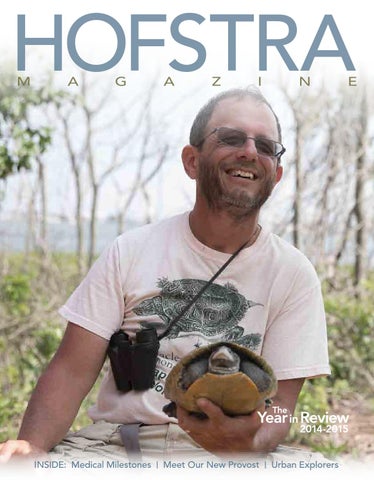
From turtles on the tarmac to coyotes in Central Park, Dr. Russell Burke’s job is to meet the neighbors.
Manager of Editorial Services Linda Merklin University Photographer Zachary Lane Graphic Artist Denise Sarian Contributors Brian Bohl ’08, ’10 Marilou Giammona ‘91 Ginny Greenberg ‘90 Neena Samuel Colin P. Sullivan ‘09, ’15 Contributing Photographers Brian Ballweg ‘77 Steve DiMaio Marty Heitner Kathy Kmonicek Phil Marino Janette Pellegrini ‘98
Facebook “f ” Logo
facebook.com/Hofstra twitter.com/HofstraU linkedin.com/edu/hofstra instagram.com/hofstrau flickr/HofstraUniversity youtube.com/HofstraUniversity
Remembering
Medical Milestones
CMYK / .eps
Home Remedies
featuring alumnus Akshat Jain
Bravo, Dr. Berliner!
Monroe Freedman
Hofstra University’s 12th presidential conference, March 24-26, 2015
Facebook “f ” Logo
featuring alumnus Jose Ortiz
featuring alumni Avin Samtani, Rob Peck and Jonathan Kinas
George W. Bush Conference
CMYK / .eps
Civic Lessons
Swimming With Sharks
14
University Archivist Geri Solomon
22 12 28 30 27 32 34 Fall Festival
Urban Explorers
Creative Director Kelvin Fonville
24
20
18 16
Nursing a Healthy Future
Hofstra Magazine is published once each year by Hofstra University. Our goal is to provide the Hofstra community with exciting and informative news about Hofstra University and its alumni, students, faculty and staff. Hofstra University is committed to extending equal opportunity to all qualified individuals without regard to race, color, religion, sex, sexual orientation, gender identity or expression, age, national or ethnic origin, physical or mental disability, marital or veteran status in employment and in the conduct and operation of Hofstra University’s educational programs and activities, including admissions, scholarship and loan programs, and athletic and other school-administered programs. For more information, visit hofstra.edu/EOE.
Meet Our New Provost
Dr. Gail Simmons
Speech and Debate Sharper Focus
Dutch Treat Day in the Pride
For the latest news about Hofstra, go to news.hofstra.edu
High Five
37
| President’s Letter Hofstra
See page 4.
2 014 -2 015 I n R e v i e w
3
A Letter From President Stuart Rabinowitz
Dear Friends, In the pages of this latest issue of the Hofstra Magazine, you will see how much we accomplished during the 2014-15 academic year, reaching several significant milestones and setting new, even more ambitious goals for the future.
Hofstra University Spring 2015 Commencement
You will read about a year of “firsts” at the Hofstra North Shore-LIJ School of Medicine. Between March and May, the medical school opened a new, 63,000-square-foot addition, participated in its first Match Day (100 percent of all eligible students were matched with residencies) and, finally, celebrated the graduation of its first class. You’ll learn about the expansion of our ground-breaking partnership with North Shore-LIJ Health System to launch a new School of Graduate Nursing and Physician Assistant Studies, which will open in the fall. Also in this issue you will explore the swamps of Jamaica Bay, the runways of JFK and the parks of New York City in a story about the work of Dr. Russell Burke and his students, who study urban wildlife and how people and animals coexist in a crowded metropolis. There are stories that speak to the varied talents of our graduates – from the schoolteacher instilling lessons about the power of civic engagement to the trio of Zarb School alumni whose entrepreneurial flair helped them win fans, and funding, on ABC’s Shark Tank. You will meet our new provost and senior vice president for academic affairs, Dr. Gail Simmons, and celebrate the extraordinary contributions of Dr. Herman Berliner, who retired after serving in that post longer than anyone – 25 years. He will lead the Frank G. Zarb School of Business for the next year as we launch a national search for a new dean.
UPCOMING ALUMNI EVENTS • For information, call 516-463-6636 or email alumni@hofstra.edu.
We also chronicle the latest chapter in the University’s history of presidential conferences, as we welcomed more than 150 scholars, journalists and government officials to examine the lessons and legacy of the administration of George W. Bush. But this magazine is more than just a snapshot of a single year at Hofstra. It is a reflection of the qualities that represent the very best in us, the qualities that embody what it means to be a member of the Pride: determination, community spirit, intellectual curiosity, energy and enthusiasm. We encourage you to visit campus and reconnect with your Pride family because, no matter how many years or miles separate us, Hofstra will always be your home. Sincerely,
Stuart Rabinowitz President, Hofstra University
Annual Alumni Awards Dinner Thursday, September 24, 2015 Garden City Hotel Garden City, New York
Fall Festival 2015 September 25-27, 2015 featuring performances by Big Shot, The Sugarhill Gang, Ludacris and comedian Craig Ferguson
Celebrate the 50th Anniversary of the New Opportunities at Hofstra (NOAH) Program Friday, October 23, 2015 featuring Dr. Bernice A. King Noon – “A Conversation With Dr. Bernice A. King,” John Cranford Adams Playhouse, South Campus. This event is free and open to the public. 6 p.m. – Dinner and Reception, Main Dining Room, Sondra and David S. Mack Student Center, North Campus. Tickets required. All proceeds benefit the NOAH program. For more information, contact the NOAH program at 516-463-6976.
Hofstra
2 014 -2 015 I n R e v i e w
5
2014 Financial Report
Financial Report 2014 Hofstra’s financial strength reflects increased fundraising activities, strong endowment growth, strengthened operating margins, and enhanced control over expenses, particularly relating to health care and post-retirement benefits. Financial resources have increased by 260 percent during the last 10 years, and Hofstra continues to enjoy debt ratings in the A category from both Moody’s and Standard & Poors.
c Components of Revenue 2013-2014
Net Tuition & Fees 65.2%
Sales & Services of Educ. Depts. 0.6% Shared Services 1.4% Other Sources 1.7%
Growth of Endowment in Support of Scholarships
Contributions 5.0% Government Grants & Contracts 2.3% Return – Endowment Available for Spending 3.8% Return – Endowment Other 8.1% Return – Operations 2.0% Auxiliary Enterprises 9.9%
Components of Expenditures 2013-2014 v
ofstra University endowment investments H grew to $412 million by 2014, increasing by 348 percent since 2000. The University’s fundraising goals are aimed at providing enhanced scholarship funding to better compete with institutions with significantly larger endowments.
Instruction 48.6%
Millions of Dollars
450
Academic Support 6.3%
Here’s why: v Alumni support is measured by U.S. News & World Report and has a direct impact on the University’s ranking. Participation is critical. Our goal is to increase alumni participation each year. v Hofstra remains a university largely reliant on tuition. Your support and the growth of our endowment allows Hofstra to undertake new initiatives to maintain its excellent reputation. v Your gift provides for student scholarships, faculty support and program initiatives, and overall operations at Hofstra. v Your investment in Hofstra will allow the University to reach its annual and long-term goals.
We need your help — every gift makes a difference!
The University continues to make the growth of tuition scholarships a top priority. During the past ten years, the University has increased scholarship funding by 160 percent to just over $103 million. The increase in scholarships is reflected in the changing makeup of the student body:
500
Research 0.9% Public Service 2.6%
Hofstra University relies on the generosity and philanthropic support of alumni and friends. This investment in the University is critical to Hofstra’s long-term success.
Tuition Scholarships and Fellowships
Auxiliary Enterprises 11.6%
Student Services 13.2%
412 400 350 300
Other Institutional Support 1.7% Technology & Executive Office 0.9% Telecommunications 3.6% Public Safety 2.5% Legal & Human Resources 1.2% Public Relations 2.5% Insurance 1.2% Development 1.3% Finance & Audit 1.9%
Total Institutional Support 16.8%
250 200 150 100
Fall 2014
Average SAT score* (first-year students)
1061
1151
Average high school GPA (first-time freshmen)
2.80
3.55
Top 10% high school class (first-time freshmen)
12%
28%
Selectivity (acceptance rate as percentage of all applicants)
80%
62%
First-year students from outside NYS
32%
48%
*Critical Reading and Math
50 0
Scholarships 56.6%
Fall 2000
1935
1974
1984
1994
2004
2014
c Endowment Market Value August 31, 2014
Facilities 19.7%
Other 5.2% Centers & Lectures 3.6% Medical School Support* 1.3% Law School Support* 4.6% Endowed Professorships 3.7% Endowed Chairs 5.3%
I was accepted to other BS/MD programs, but couldn’t afford them, and Hofstra enabled me, as a first-generation college student, to pursue my goals and dream without the burden of financial stress. — Britney Nathan
Junior from Uniondale, N.Y., enrolled in the BS/MD program
*Excludes endowments specifically designated for scholarships, chairs and professorships.
6
Hofstra
2 014 -2 015 I n R e v i e w
Hofstra
2 014 -2 015 I n R e v i e w
7
’’
We are increasingly a city-dwelling species, and that means our animal and plant experiences occur in cities – not from traveling to Yosemite or the Amazon or the Outback. Fewer and fewer people are going to see bears in the woods — they’re going to see bears in their backyards.
Urban Explorers ’’
— Dr. Russell Burke
Urban Explorers
From turtles on the tarmac to coyotes in Central Park, Dr. Russell Burke’s job is to meet the neighbors. That’s because Burke, an urban ecologist and chair of Hofstra’s Biology Department, has devoted his career to studying the habits and habitats of city wildlife, which are increasingly popping up in some very public places. Like Runway 4L at John F. Kennedy Airport, where hundreds of turtles have delayed flights three times in the past six years. Like Lower Manhattan, Riverside Park, even on the roof of a bar in Long Island City — all spots where coyotes were sighted this spring. “This is not what ecologists thought was going to happen 30 years ago,” Burke said. “We thought the cities would be a wasteland for wildlife, and city kids would grow up never having seen an animal other than a pigeon or a squirrel. But more animals and plants have adapted to city life than we expected.” “For people who study human-wildlife interactions,” he said, “cities and suburbia are where the action is.” And Burke is one of the local experts that government agencies, as well as media outlets, call on to make sense of this evolving urban landscape.
The Trouble With Turtles Enter Dr. Burke, who has been researching turtle behavior in the nearby Jamaica Bay Wildlife Refuge with his students for nearly a decade. “We were in the right place. We knew a lot about the terrapins in Jamaica Bay when, all of a sudden, the terrapins in Jamaica Bay became a big problem,” he said. “It went from nothing going on at JFK to something very big.” Two years later, the turtles were back on Runway 4L, only this time there were more than 150. And in 2014 it happened again. By then, Burke and his students were working with the Port Authority and its wildlife biologists to explain the phenomenon and find a permanent solution. It turns out the turtles that clambered onto Runway 4L were not from the same population that Burke and his students were studying, or even those that the Port Authority was already tracking at the airport. The Runway 4L terrapins were smaller and younger than those Burke and Port Authority officials had seen before, suggesting that “something happened to predators of terrapin eggs” — most likely raccoons — that allowed more hatchlings to survive than usual, Burke said. continued on next page
8
Hofstra
2 014 -2 015 I n R e v i e w
Hofstra
2 014 -2 015 I n R e v i e w
9
Urban Explorers Coyote City
’’
And New Yorkers got quite an introduction earlier this year, when a spate of coyote sightings captured the city’s attention.
I thought – that’s just crazy, this is the city. Then, once you get that first introduction to wildlife in the city, you start to notice it everywhere.
’’
— Melissa Zostant, BS, ’14; MS, ’16
Over the past two years, the Port Authority has installed black plastic tubing to create a physical barrier too high for the turtles to climb – and the solution seems to be working, except when the occasional high tide washes some turtles over the tubing. Burke’s collaboration with the Port Authority led one of his graduate students, Melissa Zostant, to focus her thesis on the turtle population at JFK. For the past two summers, she’s been working with the airport’s wildlife biologists as a paid intern.
There have been at least seven coyote sightings in New York City this spring alone – in Riverside Park; in a backyard in Middle Village, Queens; and in Lower Manhattan, where a female coyote led police on a two-hour chase before being caught near an outdoor café. “The coyotes are altogether new – never in the East before,” said Burke, who co-wrote a study released this spring titled “Coyotes Go ‘Bridge and Tunnel’: A Narrow Opportunity to Study the Socio-ecological Impacts of Coyote Range Expansion on Long Island, NY Pre- and Post-Arrival,” about the migration of coyotes into New York City and, eventually, Long Island. “To them it’s just habitat for them to live. There’s food, there’s shelter – everything they need.” The first documented evidence of a coyote in New York City came in 1997, when a dead coyote – apparently hit by a car – was found on the Major Deegan Expressway in the Bronx. A few years later, a coyote was captured in Central Park.
“I never really thought of turtles as a research animal until I started volunteering with Dr. Burke,” said Zostant, who earned a BS in biology at Hofstra in 2014. “I really do love turtles. They’re really charismatic and have their own little personalities.”
“There’s going to be a time when coyote sightings are no longer news,” Burke told the New York Daily News in a story about a coyote captured in Queens. “In Los Angeles and Chicago, there are coyotes, and no one really pays attention.”
The first time Zostant trekked through the swampy, peaceful isolation of the Wildlife Refuge to participate in Hofstra’s terrapin project, the Albany, N.Y., native was stunned to discover a different world so close to the concrete jungle of Gotham.
But on Long Island, where there have been relatively few coyote sightings so far, there’s more at stake than a few tabloid headlines. As the animals’ numbers inevitably grow, there is “a rare and time-sensitive [scientific] opportunity” to research coyotes’ social and ecological impact on a densely populated area, as well as their interaction with people, according to Burke’s study.
“I thought – that’s just crazy, this is the city,” she said. “Then, once you get that first introduction to wildlife in the city, you start to notice it everywhere.”
“We are increasingly a city-dwelling species, and that means our animal and plant experiences come in cities – not from traveling to Yosemite or the Amazon or the Outback,” Burke said. “Fewer and fewer people are going to see bears in the woods — they’re going to see bears in their backyards.”
10
Hofstra
2 014 -2 015 I n R e v i e w
Centers for Invention support the to s re tu n e v w ile providing g two ne h in w h c n n o u ti la a v is o y n in rsit and promote e. Hofstra Unive t n e m p lo e v e d rld experienc o ic w m lo a n re o c le e b ’s a lu region ents to get va w on the d tu s r fo s e fall, will dra ie th it in n g in tu r en o p o p op eurship, science, and medicine to build a n re p e tr n E r lied r fo ary Cente ring and app interdisciplin anies. s, law, enginee
The f busines star tup comp the schools o m, and advise ra g e ro p resources of r to ra le S) launched th unch an acce Science (SEA d lie p p curriculum, la A d ring exper tise ng an l and enginee l of Engineeri ca o ni ho ch Sc te e e d th , vi pro rlier this year a professors Meanwhile, ea which Hofstr in , n o ti a r Innov research centers. d socially Center fo esses and educational an f in o us n b l io ct na io lle g co to re Acting the own jewel in y,” said SEAS cr it a un e m b m to co es er id n promis ffers to the w for Innovatio a University o tr fs “The Center o H es ic llectual serv cal problems conscious inte PhD. ractical techni p y, n an o b rk ab o R w na ity to exposure Dean Si the opportun perience and ve ex ha d rl y o lt -w cu al Fa ar ticipants: h perspec tive udents gain re benefits all p ho bring a fres unity, while st w m ls m na co s io ss es The initiative in fe nts in the e bus h pro ploy consulta interest to th to par tner wit em te le ill ia w ab r ed e m te ar s im en f ie C o am compan e solution. The res that the te sues. In turn, for an in-hous y. “This ensu tr , ig b us to industry is d o in to in ic g e if ar spec ors, en eers projects that nced profess exper tise in a ie h it er w p ex er f b to issues and o em up ym ailable, made Hofstra facult novation. be the best av absence of a ill Center for In w e m th le f b o ro r p to a ec e ir lv d , so PhD assembled to Kevin Craig, y resulting ips in that an ientists,” says sh sc er d tn an ar p rs s ne ines kept low, desig university-bus d cost will be er ea th rh o ve m o o , fr lly dif ferent d software. any. Additiona r Innovation is equipment an e hiring comp s, th b y la b S A ed The Center fo in SE ta a tr e re vested in Hofs roper ty will b es will be rein intellectual p fe d ea rh ve o ised by and monies ra Hofstra
2 014 -2 015 I n R e v i e w
11
ALUMNUS PROFILE
There should be something you could put your valuables into so you could lock them up and swim, but there wasn’t — so we invented the AquaVault. — Avin Samtani ’05
12
A friendship forged during their freshman year blossomed into an innovative business venture for Frank G. Zarb School of Business ’05 alumni Avin Samtani, Rob Peck and Jonathan Kinas, who pitched their product on ABC’s Shark Tank earlier this year. They hooked branding expert Daymond John, who agreed to invest $75,000 for a 25 percent stake in their company.
AquaVault’s 120-square-inch cargo hull is roomy enough for wallets, watches, mobile phones, jewelry, keys and other valuables.
Their product, AquaVault, is a portable, personal safe that attaches to beach furniture, bicycles, strollers and basically any outdoor apparatus to safely stow your valuables while you have fun in the sun. Samtani, Peck and Kinas unlocked the idea after they got burned at a high-end resort in South Beach, where they were staying for a wedding they attended in 2012.
The friends and former classmates decided to make lemonade out of lemons. “There should be something you could put your valuables into so you could lock them up and swim, but there wasn’t — so we invented the AquaVault,” Samtani said. “Designs were being drawn on napkins that same day.”
Hofstra
2 014 -2 015 I n R e v i e w
“We hid our stuff under our towels and in our shoes,” Samtani said. “We were only a few feet away, and although we looked over at our chairs multiple times, when we got back to our lounges, our stuff was gone. Worst vacation nightmare comes true!”
Those sketches soon morphed into software renderings. Peck majored in international business, but he has an engineering background. “Rob’s family has been in the construction business for decades, which helped when determining the right materials and design software we should use,” Samtani said. “He was able to navigate through the CAD design software and teach himself. We went through half a dozen prototypes until we were happy with the end result.”
The AquaVault execs were among 45,000 applicants vying for a spot on season six of Shark Tank. They advanced and were able to pitch their product to the panel of “sharks,” or investors. Their segment aired on March 13, 2015. “It was a nerve-racking experience because we didn’t know what to expect,” Samtani said. “We had one shot to go up there in front of a panel of extremely successful businesspeople and convince them to invest in our company. We are very satisfied with the outcome.”
The partners tested the waters for their final prototype at trade shows before diving into Shark Tank. “Our product was a huge hit [at the INPEX invention trade show in Pittsburgh], and it only further confirmed the need to pursue our dream,” Samtani said.
In addition to its success on Shark Tank, AquaVault has also been heralded by Forbes, NBC’s Today, Fox 5, The Miami Herald and Newsday, among many other media outlets.
Buoyed by the bond they formed during their years at Hofstra, Samtani, Peck and Kinas took a leap of faith and left their full-time jobs last year to devote all their attention to AquaVault. Samtani, who was a marketing major, left his residential and commercial lending position at a Manhattan bank; Peck owned a contracting company in upstate New York; and Kinas, who majored in finance, was a financial advisor at Merrill Lynch. They targeted South Florida as a potential hotbed for AquaVault and all moved down there. “Hofstra is a great school and we all have different backgrounds, which helped,” Samtani said. “Going to school together really strengthened that bond of friendship and trust that has kept us together.”
Going forward, new partner Daymond John will be hands-on at AquaVault. The company already has dozens of hotel and corporate partners and aims to be “a staple at every hotel, cruise ship and theme park in the world,” Samtani said. “When you go down to the pool and grab your chair, we want AquaVault to be there with it. People these days want their smartphones with them, and there should be a place to lock up your valuables if you want to take a dip in the pool or walk around the resort. Vacation is all about being worry-free, and our AquaVault helps provide that added peace of mind.” And while Samtani, Peck and Kinas eye the future, they are grateful for their past. “Starting a business is not easy and there are definitely ups and downs, but no matter what, we all find a way to keep our heads up and stay focused on what’s ahead,” Samtani said. “We can also look back and see how much we’ve grown since 2001 when we met, and it’s a great feeling.” Hofstra
2 014 -2 015 I n R e v i e w
13
More than 150 scholars, senior policymakers and journalists spent three days exploring the administration of George W. Bush during Hofstra University’s 12th presidential conference, March 24-26, 2015. The conference on the 43rd president, presented by the Hofstra Cultural Center and the Peter S. Kalikow Center for the Study of the American Presidency in conjunction with the George W. Bush Presidential Library and Museum, was the most comprehensive examination of the Bush presidency since he left office in 2008.
George W. Bush CONFERENCE
Dr. Meena Bose, director of the Kalikow Center and a professor of political science, was the conference director.
14
Hofstra
2 014 -2 015 I n R e v i e w
Dr. Richard Himelfarb, associate professor of political science, was the conference associate director.
The event continued Hofstra’s long and distinguished tradition of hosting conferences on the administrations of every U.S. president since the University’s founding in 1935, from Franklin Delano Roosevelt forward. The University has published articles and commentary from every conference, which have become standard scholarly volumes and early oral histories of each presidency. During the conference, more than 50 scholarly papers from several disciplines, including political science, communication and history, were presented at dozens of panels and forums examining topics such as education, economic policy, homeland security, interrogation policies and White House communication strategies. The George W. Bush conference was the first presidential conference since Hofstra established the Peter S. Kalikow Center for the Study of the American Presidency and the Kalikow Chair in Presidential Studies, and hosted consecutive presidential debates in 2008 and 2012. The University is seeking the honor of hosting a third presidential debate in 2016; the Commission on Presidential Debates is expected to announce its decision on debate hosts later this fall.
HOFSTR A UNIVERSIT Y MUSEUM
The George W. Bush Presidency: Points of Perspective 58635_GWB_MuseumCatalog.indd 1
2/24/15 9:13 AM
Hofstra
2 014 -2 015 I n R e v i e w
15
“This is an extraordinary moment in the history of the Hofstra North Shore-LIJ School of Medicine,” Hofstra University President Stuart Rabinowitz said earlier this year at the grand opening of the school’s new, 63,000-square-foot addition. “We imagined a new kind of partnership and a new model of medical education that would lead to better health care for our region. Today in this beautiful space, we stand quite literally at the crossroads of the old and the new to celebrate the journey of the past seven years and challenge ourselves to aim even higher in the future.” The new addition, which more than doubles the size of the school, features a soaring, sun-filled atrium and state-of-the-art facilities, including a 7,300-square-foot structural anatomy lab.
Medical Milestones The Hofstra North Shore-LIJ School of Medicine celebrated several milestones in 2015, including a new building, full accreditation and the graduation of its first class.
16
Hofstra
2 014 -2 015 I n R e v i e w
On the same day that the new building was unveiled, the medical school announced it had earned full accreditation from the Liaison Committee on Medical Education (LCME), which accredits all medical schools in the United States and Canada. Full accreditation means that the Hofstra North Shore-LIJ School of Medicine and its innovative approach to medical education meet strict national standards for structure, function and performance.
The school’s innovative curriculum combines basic science with clinical experience from the first day of a student’s training, focusing on patient interaction, interdisciplinary teamwork and community service. Among the innovations is training all first-year medical students as emergency medical technicians who complete tours on North Shore-LIJ Health System ambulances. “I think we all realized the potential risks and benefits of being at a new medical school, and some of us were more apprehensive than others,” said Daniel Ohngemach, a member of the charter class who will train for a year in internal medicine before beginning a residency in radiology at the North Shore-LIJ Health System. “But I knew that if I stayed true to myself, I would graduate a well-trained physician.” In May, Ohngemach and 29 other members of the charter class did just that during an emotional commencement ceremony at Hofstra University’s John Cranford Adams Playhouse. AJ Blood, a fellow graduate and past president of student government, agreed. “I looked at the track record of these institutions [North Shore-LIJ and Hofstra University] and the leadership brought in to begin the School of Medicine, and I saw an amazing opportunity,” said Blood, who is heading to Duke University to train in internal medicine. “I knew that far from a risk, I was being offered a chance to get in on the ground floor of the ‘Google’ of medical schools.”
Further burnishing the medical school’s reputation were the results of its first Match Day, during which 100 percent of all eligible students in the first graduating class were matched with residencies, including placements at some of the nation’s most prestigious institutions. The most popular specialty areas were internal Michael J. Dowling, president and CEO medicine and emergency medicine. of the North Shore-LIJ Health System, said the first graduating class blazed a “The competition for residency spots is path that medical schools across the stiff,” said Lawrence G. Smith, MD, nation will follow. MACP, dean of the School of Medicine. “I am pleased to say that our students “Today is the culmination of many hopes placed in some of the most competitive and dreams, struggles and successes – regions in the country.” for our medical students, for their families, for Hofstra University and for Established in 2008, the School of the North Shore-LIJ Health System,” Medicine is the first allopathic medical Dowling said. “This is a memory never school to open in New York state in more to forget. Because of the program you than 40 years. The institution has 2,200 have just come through, you have begun faculty and approximately 280 students, to refashion medical education. We are a roster that is expected to grow to 400 rewriting the rule book.” by 2016.
A PERFECT MATCH
Match Day occurs on the third Friday of March each year at allopathic medical schools in the United States, during which the results of the National Resident Matching Program are announced. The 2015 National Match Day was the largest ever, with 41,334 medical students vying for just 30,212 spots. The Hofstra North Shore-LIJ School of Medicine’s first graduating class had a 100 percent match during its first Match Day, including: t 11 students matched to North Shore-LIJ teaching hospitals t 19 students matched to institutions in the New York metropolitan area t Students were matched to institutions across the United States, including New York, California, Tennessee and Illinois. t Institutions for residency placement included Yale-New Haven Hospital, Duke University Medical Center, Tufts Medical Center, New York-Presbyterian Hospital (Columbia and Cornell), Jefferson Medical College/DuPont Hospital for Children (PA), Memorial Sloan Kettering Cancer Center, Vanderbilt University Medical Center, Boston University Medical Center, University of Southern California, and Mount Sinai Hospital.
Hofstra
2 014 -2 015 I n R e v i e w
17
T
he school, launching in fall 2015, will offer a three-year, part-time program leading to a Master of Science in nursing as a family nurse practitioner or an adult-gerontology acute care nurse practitioner.
In addition to nursing, Hofstra’s two existing programs in physician assistant studies – a dual degree program and a graduate program – will be housed in the new school. The physician assistant studies graduate program is ranked #70 in the nation, according to the 2016 U.S. News & World Report Best Graduate Schools rankings.
NURSING a Healthy Future Hofstra University and North Shore-LIJ Health System are expanding their successful medical school partnership with the new Hofstra North Shore-LIJ School of Graduate Nursing and Physician Assistant Studies.
18
Hofstra
2 014 -2 015 I n R e v i e w
“This is a natural next step in our partnership with North Shore-LIJ Health System,” said Hofstra University President Stuart Rabinowitz. “Meeting the need for accessible, high-quality health care requires well-trained medical professionals of all types. The Hofstra North Shore-LIJ School of Graduate Nursing and Physician Assistant Studies, together with the medical school and our School of Health Professions and Human Services, will help build a comprehensive network of health care options that will serve our region for decades to come.” The Hofstra North Shore-LIJ School of Graduate Nursing and Physician Assistant Studies will continue the innovative, holistic, patient-centered approach pioneered by the medical school, an educational model that focuses on treating people, rather than illnesses, and emphasizes communitybased care.
“
The Hofstra North Shore-LIJ School of Graduate Nursing and Physician Assistant Studies, together with the medical school and our School of Health Professions and Human Services, will help build a comprehensive network of health care options that will serve our region for decades to come.
“
Kathleen Gallo, PhD, MBA, RN, FAAN, senior vice president and chief learning officer at North Shore-LIJ Health System and an associate professor of science education at the Hofstra North Shore-LIJ School of Medicine, has been appointed founding dean of the new school.
care legislation, increased emphasis on preventive care and an aging population, projects the number of jobs in advanced nursing roles, including nurse practitioners, will increase by 31 percent by 2022.
— Hofstra University President Stuart Rabinowitz
“Through this new School of Graduate Nursing and Physician Assistant Studies, we are taking another bold step toward redesigning both medical and nursing education to reflect the rapid changes occurring in the way health care is accessed, delivered and paid for in this country,” said North Shore-LIJ President and CEO Michael J. Dowling. “In keeping with our hands-on approach to education, North Shore-LIJ’s 19 hospitals, more than 400 outpatient facilities, our simulation center and all other resources across the health system will be available as learning laboratories for students in this innovative new school.” The number of nurse practitioners in the United States has nearly doubled over the last decade, from 106,000 in 2004 to 205,000 in 2014, according to the American Academy of Nurse Practitioners. And the Bureau of Labor Statistics, citing the impact of health
Nurse practitioner and physician assistant are ranked among the top 10 best jobs in 2015, according to U.S. News & World Report. “With the Hofstra North Shore-LIJ School of Medicine and this new school, focused on the training of future nurse practitioners and physician assistants, we have a unique opportunity to pursue an interprofessional education curriculum different from any other in the New York area,” said Dr. Gallo. “As our population continues to age and as more people become insured as part of the Affordable Care Act, nurse practitioners and physician assistants will both be key in meeting the growing demand for care.” Dr. Gallo brings to the new school a blend of scholarly, clinical and management experience. At North Shore-LIJ, Dr. Gallo is responsible for leadership development throughout the health system. She has more than 25 years’ experience in emergency nursing, and she previously served as the health system’s director for emergency medicine and vice president for emergency medical services. She also serves on the American Association of Colleges of Nursing Futures Task Force, the American Nurses Foundation Board, and the National Advisory Council on Nurse Education and Practice for the U.S. Department of Health and Human Services. She is a fellow of the American Academy of Nursing and the New York Academy of Medicine, and is a distinguished scholar and fellow of the National Academies of Practice.
Hofstra
2 014 -2 015 I n R e v i e w
19
s e i r o m e M l a v i t s e F l l a F 4 1 20 eadlined the h n ffi ri G y th Weekend. nd Ka ea and Family t n e d Janelle Mona tu S i, n tival – Alum 2014 Fall Fes
5 1 0 2 l a v i t s e F l for Fal y d a e R t e 5-27 G 2 r e b m e t p e y, S a d n u S y a d i r F ig Shot, mances by B for featuring per g, Ludacris and Sugarhill Gan aig Ferguson comedian Cr
n: Craig Ferguso al Tour e D The New
l a v i t s e f l l a f / u ed . a r t s dates. f p u o d h n a to n d io e t n a Stay tu ticket inform 20
for
Hofstra
2 014 -2 015 I n R e v i e w
’’
ALUMNUS PROFILE
It was important to teach the students that an email or a letter goes a long way if you know the right person to contact.
’’
– Jose Ortiz
Who says you can’t fight City Hall? Not the students in Jose Ortiz’s class at the Bushwick Academy of Urban Planning, who turned a class project into a campaign to change the way New York rates the cleanliness of city streets. The project began early in the school year, when Ortiz (MS, ’13), a social studies and economics teacher, connected his 12th graders with Generation Citizen, a national civics education program, and challenged them to think about problems in their Brooklyn neighborhood. After surveying residents, the class quickly zeroed in on the cleanliness of the streets, which they believed was not getting the same attention as it was in other parts of the city. “We found that people were unhappy and feeling discouraged by the state of the neighborhood,” said student Maritza Veron. “Why should some areas be cleaner than ours? They felt no one was paying attention.”
Jose Ortiz, MS, ’13
Civics Lesson
The students had found a cause, but they still needed to build a case. So they researched how the city assesses street cleanliness, and they discovered that the scoring system for determining if a street or sidewalk is clean hasn’t changed since the mid-1970s, and the city uses black and white photos from that era for reference. “We couldn’t believe it,” said student Kimberly Goris. “Technology has advanced so much and to know that the city was using old pictures for something so important was surprising.” They took pictures of littered streets in their neighborhood and filed a Freedom of Information Act request to get the raw scores the city uses to rate cleanliness. In some cases, the streets of Bushwick are rated as clean, or cleaner, than those in more affluent neighborhoods like Greenwich Village and SoHo. In fact, during 2014, for example, there were months – including April 2015, the most recent month available — in which a higher percentage of the streets in the community board that includes Bushwick were considered “acceptably clean” than those in the community board that covers SoHo.
The city’s scoring system ranks streets and sidewalks on a scale of 1 to 3, with 1 being the cleanest. Anything below 1.5 is considered “acceptably clean” by the city. The rankings are used to help the city’s Department of Sanitation determine street-cleaning priorities. (While the city posts online the percentage of “acceptably clean” streets in each community board, it doesn’t post the raw scores for individual neighborhoods). Empowered by their research and encouraged by Ortiz, the class wrote letters and emailed city officials about their concerns. Both City Councilman Antonio Reynoso, who represents Bushwick and chairs the council’s Committee on Sanitation and Solid Waste, and Brooklyn Deputy Borough President Diana Reyna visited the class to hear the students present their case. “It was important to teach the students that an email or a letter goes a long way if you know the right person to contact,” Ortiz said. For Goris, who will be attending SUNY Plattsburgh, the project taught her the power – and responsibility – of advocacy. “Our voices can be heard,” she said, “but we need to speak up.” Veron, who begins her first year at John Jay College of Criminal Justice in the fall, said: “Kids our age can make a difference.” So can teachers like Ortiz. “He’s a role model who cares about students’ work in school and their lives outside the classroom,” she said. Indeed, besides his teaching duties, Ortiz headed the prom committee and ran the school’s yearbook and graduation activities this year. He credits two of his education professors at Hofstra, Dr. Bruce Torff and Dr. Alan Singer, with instilling the belief that teaching is a calling. We become teachers for the children,” Ortiz said, “and for the betterment of society.”
Editor’s note: In the summer of 2015, Jose Ortiz returned to his alma mater, Freeport (NY) High School, as a bilingual social studies teacher.
Hofstra
2 014 -2 015 I n R e v i e w
23
ALUMNUS PROFILE
‘‘
Now that I have my MPH, it gives me the real skill set to create programs in developing countries where I can understand the social culture and barriers. As an oncologist, I would treat 20 to 30 patients a year and make some meaningful changes for them, but as a public health professional, if you create a policy that impacts a whole generation and makes a difference in the quality of life and survival – such as vaccination, immunization, lead screening – I think that this is a greater service to humanity. — Akshat Jain
I
Home Remedies India
Akshat Jain, MD, MPH ’15 returns to to work on public health issues
’’
n the two years it took physician Akshat Jain to earn a Master of Public Health from Hofstra’s School of Health Professions and Human Services, he made three trips to his native India to put theory into practice, working on community-based initiatives aimed at preventing widespread disease, promoting cancer care, and limiting lead exposure. During his last trip, in December 2014, Jain is credited with helping curb an epidemic of dengue fever in Rajasthan, the state in northern India where he grew up. Concerned by an alarming rise in the number of new dengue fever cases, he felt “a desperate urge to create a program that would be of help.”
why there weren’t better ways to help kids like them. It motivated him to eventually pursue medicine as a career – just like his father had, treating patients for free at a charity clinic in the region. “I saw the blessings and goodwill he got from the people he served,” he said.
Jain, 32, mobilized a team of local health experts to educate the public about simple ways to prevent the mosquito-borne virus, which can lead to high fever, dehydration, internal bleeding and, if left untreated, death. The team worked with local and national media outlets to encourage blood drives and remind residents to stay hydrated and wipe away dripping or stagnant water from pipes, pumps, and household cooling systems – rich breeding grounds for mosquitoes. Jain also called on government officials to take steps such as spraying mosquito repellent on susceptible areas and covering wells to reduce infestation.
“When I went back to visit India after my residency, I saw how much more work still needed to be done there,” Jain said. He began a community project to screen children who were at high risk for lead poisoning, which can irreversibly damage brain cells and cause learning disabilities. The experience taught him firsthand the difficulties of both effectively educating the public and garnering the interest of stakeholders who could help support the program – and he realized he needed advanced training if he really wanted to establish programs that would bring about lasting change.
His work against dengue fever was just the latest in a string of charitable projects that Jain has developed to improve the health of communities in India and around the world. Akshat Jain is a third-year pediatric fellow treating childhood cancers at Steven and Alexandra Cohen Children’s Medical Center in New Hyde Park, part of the North Shore-LIJ Health System. He also teaches on the pediatric faculty of the Hofstra North Shore-LIJ School of Medicine. His interest in oncology and hematology – and in public health – stems from his childhood in Rajasthan. “I grew up with a friend in the neighborhood who would always be on the sidelines whenever we played, and I asked my mother why,” he recalls. “She said he had hemophilia, a blood disorder, and if he were to get hit or injured, it could be life-threatening, and his parents would have to sell their house to afford the expensive medicines he would need.” The explanation left the young Jain, who had to limit his own activities because of bronchial asthma, with questions about
During his years as a medical resident in Manhattan between 2008 and 2011, he created his first nonprofit, Prarabdha (meaning “good karma” in Hindi), which collected viable, near-expiry medical supplies from local hospitals and sent them to developing countries in need, such as Haiti after its devastating 2010 earthquake.
“Creating a public health program from scratch is not easy; almost anything can go wrong and lead to disaster,” he said. “There is accountability involved in a program or policy that impacts a wide range of people. It was important that I learned the science of public health.” Already familiar with Hofstra’s campus and reputation, he enrolled in the Master of Public Health (MPH) program, which was launched in 2012. Jain was especially impressed with the MPH program’s emphasis on interdisciplinary learning that drew on experts from all over the University. “We had professors of such diverse specialties in the liberal arts and law, as well as the sciences, that it really opened up a broader horizon of thinking for me.” Janet Dolgin, a distinguished professor of health care law at the Maurice A. Deane School of Law – who also serves as co-director of the Hofstra Bioethics Center and director of the Gitenstein Institute for Health Law and Policy – taught Jain in her public health law course. continued on next page
Hofstra
2 014 -2 015 I n R e v i e w
25
“Akshat added a marvelous voice to the seminar – a compassionate, thoughtful voice informed by clinical expertise,” Professor Dolgin said. “He challenged the law students to consider and re-consider the ground on which legal determinations are shaped. Akshat is smart and deeply committed to health care and population health, and he is very likely to become an important player on the global public health stage.”
‘‘
Akshat recognizes the critical importance of social, behavioral, economic, environmental and political forces and works on all those levels to effect change. His passion for helping those most underserved is evident in everything he does. — Corinne Kyriacou, PhD
’’
Director of the Master of Public Health Program
Jain is now most passionate about his work over the last 18 months helping people with cancer in India, which has been the focus of his graduate thesis. He learned that survival rates for curable cancers were dropping because up to 50 percent of patients from poor families were abandoning cancer treatment, despite free government-sponsored hospital care. Deeply disturbed by the statistics, he began a scientific study to understand why.
Jain and his team worked with political leaders to pass legislation to provide free transportation to families below the poverty line and assigned a social worker to follow through with every patient.
MPH Program Director Corinne Kyriacou, PhD, who is a co-author on Jain’s study, notes that he used his clinical, public health, and research skills in his work in India. “Akshat recognizes the critical importance of social, behavioral, economic, environmental and political forces and works on all those levels to effect change,” she said. “His passion for helping those most underserved is evident in everything he does.” Jain, who is already a consultant on task forces for the American Cancer Society, American Academy of Pediatrics, and Harvard University’s global health programs, hopes to return to India with his wife, Ginee, and infant daughter, Ayana, in another five or six years to work full-time on public health initiatives. Ginee Jain, a dentist and epidemiologist, has often collaborated with her husband on projects and shares his passion. “Now that I have my MPH, it gives me the real skill set to create programs in developing countries where I can understand the social culture and barriers,” said Jain, who is also helping build the MPH’s global health internship program so that more students can work abroad. “As an oncologist, I would treat 20 to 30 patients a year and make some meaningful changes for them, but as a public health professional, if you create a policy that impacts a whole generation and makes a difference in the quality of life and survival – such as vaccination, immunization, lead screening – I think that this is a greater service to humanity.”
Hofstra
2 014 -2 015 I n R e v i e w
Professor Monroe Freedman, who instilled in thousands of students the responsibility of lawyers to zealously represent clients and to stand for social justice, died in February after a legendary 42-year career as a teacher, mentor, advocate and dean.
The results showed that poorer families often couldn’t afford to pay for multiple trips to the hospital or didn’t fully understand the treatment, with some believing they had been cured after just one chemotherapy session.
“In the next six months to a year, we expect to see a great improvement in the health prospects for these patients,” he said. “This is real public health in action.”
26
Maurice A. Deane School of Law
Remembering
Monroe Freedman
Known as the father of modern legal ethics for his successful effort to introduce the field to the mainstream of the legal academy, Professor Freedman received the American Bar Association’s highest award for professionalism. He was recognized for “a lifetime of original and influential scholarship in the field of lawyers’ ethics,” and his peers have called him “the conscience of our profession.” “When I was hired 38 years ago by Monroe, then dean, I asked him, ‘What are your expectations for me?’ He gave me only two directives: Be a great teacher and make a difference. No person has embodied these ideals, both personally and professionally, better than Monroe,” said Hofstra Law Dean Eric Lane. “His impact on the Law School, on the legal community and on his colleagues is indelible.”
Hofstra
2 014 -2 015 I n R e v i e w
27
Meet Our New Provost ...
Dr. Gail Simmons
People’s careers are made up of the pieces of what people can do intellectually and emotionally and how agile their minds are. People who are successful don’t let themselves be defined only by what they studied.
On July 1, 2015, Dr. Gail Simmons became Hofstra University’s new provost and senior vice president for academic affairs. Simmons, a geneticist, comes to Hofstra from Manhattanville College in Westchester, where she served as chief academic officer, as well as a professor of biology. Prior to her tenure at Manhattanville, Simmons was dean of the Division of Science and Technology at the College of Staten Island of The City University of New York (CUNY). She also served as founding dean of the School of Science at The College of New Jersey and as associate dean of the Division of Science at The City College of CUNY, where she began her career as a member of the faculty.
Q: What did you know about Hofstra before you began the process that led to your becoming our new provost? A: I had several points of contact with Hofstra before I learned about this job. I studied biology at the University of Pittsburgh, and I did undergraduate research for two years under a professor, Dr. Fred Gottlieb, who earned a bachelor’s degree here. Then, fast-forward a whole bunch of years: My youngest son was studying ballet at the School of American Ballet in Manhattan and he performed in The Nutcracker with the New York City Ballet, and we heard about a dance company on Long Island that was staging The Nutcracker and was looking for children for the show. So he ended up performing in their show, which was done here at Hofstra. And finally, after President Strauss came to Manhattanville in 2011, a year or two later, one of his sons decided to go to medical school, and he is actually now a medical student here.
“
All of those things put Hofstra on my radar ... when I learned about the job and saw all the amazing things happening here, the strengthening and expanding of the institution, I thought, “Wow, this is a place that’s really on the move.”
Q: What are your chief goals for your first year? A: A lot of it in the first year is getting to know the institution, the people and the culture of the place – learning about the faculty at the core of the institution and what their aspirations are, what their strengths are. One of my goals will be to explore and enhance the internationalization of the campus. President Rabinowitz has already agreed that we should join an internationalization lab run by the American Council on Education. It’s a self-study (20 months) of how we exist as an institution in the international realm, and it will help us come up with a strategic plan for internationalization. In meeting with a variety of people after accepting the position, I heard there were issues around internationalization, particularly in graduate programs, and I think this is a great thing to get involved in early in my tenure. It has a lot of potential to pay big benefits for the University.
28
Hofstra
2 014 -2 015 I n R e v i e w
Q: What do you want the Hofstra community to know about you as you begin your new position? A: I plan to be highly engaged. This job is all about the people. The institution is all about the people – the people who work here, the people who attend, the alumni, and the community members who support us. A big focus of mine is always on the strengths of the people. Q: Name the accomplishment at Manhattanville of which you are most proud. A: The creation of schools within the College. When I started there, Manhattanville had a School of Education and a School of Graduate and Professional Studies (GPS), but all the arts and sciences departments were independent of one another. It was clear that to strengthen the institution, these departments and the programs in GPS needed to be parts of schools and needed to have deans. So we brought in the first external dean for the School of Graduate and Professional Studies, and he worked very, very hard, and we were able to transform it into a School of Business. And we just hired the founding dean of the School of Arts & Sciences. So Manhattanville now has a School of Arts & Sciences, which is really the core of the identity of the institution, alongside a School of Education and a School of Business. Q: You are a scientist by training, and that is clearly where Hofstra has sought to focus its resources in recent years. How do you see the liberal arts in the context of the University’s new emphasis on the natural and health sciences? A: To me there is no conflict between the sciences, the health professions, or engineering and the liberal arts. The liberal arts are about understanding what it means to be human. You can’t understand the motivation for engineering something or for pushing the boundaries of health sciences without understanding the value of people and the human experience, and those understandings come from studying literature, history, philosophy – the liberal arts. Understanding the liberal arts is how people in any career, and in their everyday lives, learn how to communicate and to answer the question, “What is the value of the things I’m working for, supporting, researching or inventing?” It’s a mistake for the larger community, the public, students and their families to think that somehow the liberal arts are less because they don’t click immediately into a career path. People’s careers are made up of the pieces of what people can do intellectually and emotionally and how agile their minds are. People who are successful don’t let themselves be defined only by what they studied.
Q: How did you decide to become a scientist? What led you down that path? And what led you to pursue a career in academia? A: I loved science from the time I was in grade school. What really galvanized me were all my junior high school science
teachers. In the eighth grade, I had Mr. Parker for Introduction to Physical Science. It was all hands-on experimentation. We did labs every week, we analyzed data. It was just enormous, enormous fun. I still have the notebook! Then, in ninth grade, I took Miss Paul’s biology class, and she had us do experiments with fruit flies, and that’s the basis of genetics. It just captured my imagination, and I was hooked on genetics. When I got to college, I was initially pre-med, but then I took a genetics class and was sucked in again. Once I got back into the lab, I said – “I don’t want to go to medical school. I want to go to graduate school and keep doing this.” What got me into administration was teaching a general education biology course at City College. The students I had were amazing; they worked so hard. They were sometimes not prepared for the work, but they really wanted to be in college. It struck me that for many of them, this may be the last science class they take in their lives, and it’s really, really important that they understand it well. I got involved in an effort the dean launched to revamp all general education science, which meant I was collaborating with colleagues in different departments. After that, the dean asked me if I would consider becoming his associate dean. I thought that could be very interesting, so I decided to give it a try.
Q: Where are you from originally? How did your hometown shape your worldview? A: I grew up in the suburb of Monroeville, east of Pittsburgh. Pittsburgh is a great place. What I love about it is that it’s urban, but it’s small and friendly. It’s casual. It’s not a formal place. Q: Do you have a favorite spot on campus yet? A: Not yet. But what I love are the trees. When I realized that Hofstra was an arboretum, I loved that – the trees aren’t just landscaping; they are curated. Q: Favorite book? Movie? TV show? A: I have a real science fiction addiction, so I loved Dune and Stranger in a Strange Land. I also love mysteries, so Patricia Cornwell’s medical examiner mysteries. I also love Elizabeth Peters’ Amelia Peabody Emerson series about a detective-archaeologist who is married to an Egyptologist. My favorite movie is probably Dead Poets Society, and my favorite recent TV show is Numbers – about a mathematician and professor who helps his brother, an FBI agent, solve crimes. Their father is played by Judd Hirsch.
Q: Fun fact? A: Although I have never considered myself any kind of an athlete, a few years ago I bought myself an indoor rowing machine to stay in shape. I discovered an online community of people who did indoor rowing, and it turns out that there are competitions. So in February 2014 I competed in an international competition for indoor rowing. I placed fifth in my age group. Hofstra
2 014 -2 015 I n R e v i e w
29
‘‘
In 2008 the Chemistry and Physics building was named Herman A. Berliner Hall in his honor, thanks to the support of Board of Trustees Chair Alan Bernon ’76, who is a former student of Dr. Berliner’s.
When you’re provost for 25 years ... you really have a chance to make an impact and help shape the faculty.
Bravo Dr. Berliner! ’’
— Dr. Herman A. Berliner
Dr. Herman A. Berliner, Hofstra’s longest serving provost, retired this year after 25 years as the University’s chief academic officer. Dr. Berliner came to Hofstra in 1970 as an economics professor; over his 45 years at the University, he served in a variety of key administrative roles, including dean of the Frank G. Zarb School of Business, dean of the School of Education, associate provost, and associate dean for University Advisement. He holds the Lawrence Herbert Distinguished Professorship.
30
Hofstra
2 014 -2 015 I n R e v i e w
During his tenure as provost, Dr. Berliner was instrumental in the creation of The Lawrence Herbert School of Communication, the School of Engineering and Applied Science, the School of Health Professions and Human Services, Hofstra University Honors College, the Hofstra North Shore-LIJ School of Medicine and, most recently, the Hofstra North Shore-LIJ School of Graduate Nursing and Physician Assistant Studies, which will launch in fall 2015. Dr. Berliner will return to the Frank G. Zarb School of Business as dean for the next year, while the University conducts a nationwide search for a new dean. At commencement this spring, the University recognized Dr. Berliner for his dedication and service to Hofstra with the conferral of an honorary degree. “When you’re provost for 25 years,” Dr. Berliner said, “you really have a chance to make an impact and help shape the faculty. For me, one of the enduring values of Hofstra University is excellence in teaching, and it’s been an honor to be in a position to monitor that for the past 25 years.”
Hofstra
2 014 -2 015 I n R e v i e w
31
SharperFocus New Partnership Brings 4K Technology to The Lawrence Herbert School of Communication In a new partnership with Hitachi Kokusai Electric, Hofstra is now the first university worldwide to use the company’s innovative 4K-technology cameras in its broadcast curriculum at The Lawrence Herbert School of Communication. Beginning this fall, students and faculty in the departments of Radio, Television, Film and Journalism, Media Studies, and Public Relations will learn to use eight new Hitachi SK-UHD4000 broadcast cameras, multi-format studio and field production cameras that allow the gradual transition from high-definition to emerging 4K (or ultra-HD) technology.
Hofstra University’s
Speech and Debate team
ended its inaugural year ranked among the top 30 percent of the nation’s best collegiate debate teams. Many graduates of collegiate debate programs credit the activity with helping them ‘find their voices,’ and they carry these skills into many professional fields
The award-winning team, part of the Department of Rhetoric, earned this standing among the 79 colleges and universities that competed at the Pi Kappa Delta national forensic honor society annual tournament and convention in Athens, Ohio, last March. “The ability to orally communicate effectively and confidently is a skill highly valued by employers who look for what sets a person apart from a sea of other resumes,” said Associate Professor and Director of Forensics Tomeka Robinson, PhD. “We teach students how to stand out and be heard.” Dr. Robinson was also voted president-elect of Pi Kappa Delta, making her the first person of color to be president of a national collegiate speech and debate organization in the United States. The organization is the nation’s oldest collegiate debate organization, with more than 80,000 alumni members.
32
Hofstra
2 014 -2 015 I n R e v i e w
The cameras are the latest development in the Herbert School’s transition to 100-percent high-definition technology, which is expected to be complete by the fall.
Dr. Tomeka Robinson
The Hofstra team is a relaunch of a program that was last active in 2008. In the last year, the team has won more than 30 individual and team prizes at six intercollegiate competitions under the leadership of Dr. Robinson and graduate assistants Sean Allen, Jaysin Spradley and Sierra Ortega, all of whom are awardwinning orators. Participation on the team is open to students of all majors and can help improve communication, critical thinking, and presentation skills. Dr. Robinson notes that many graduates of collegiate debate programs credit the activity with helping them “find their voices,” and they carry these skills into many professional fields, including careers in the media, U.S. Supreme Court, and Congress.
“We have set out to create the best possible HD facility as we rebuild our infrastructure,” said Dean Evan Cornog. “With Hitachi and its 4K expertise, we, as an early adopter, have the benefit of working with a major international innovator that also has a significant local presence near campus. It’s an ideal opportunity to explore how this cutting-edge technology will benefit higher education.” The cameras will be housed in the Herbert School’s two production studios, where they will be used for both curricular and extracurricular programming, including student-produced shows such as Hofstra News Now, Hofstra Today, and sketch comedy show Thursday Nite Live. Both beginner and advanced students in about seven classes will be able to use and learn from the new technology. The Herbert School is already home to a state-of-the-art learning environment that includes an award-winning radio station, converged multimedia newsroom, editing suites, studios, control rooms, and a new sound and color-correction production suite. As a test site, the University will provide Hitachi with valuable insight regarding the technology’s potential uses. With its American headquarters in nearby Woodbury, Hitachi’s representatives will visit campus as guest speakers, interact with students, and see how the cameras are being put to use by the next generation of broadcast professionals.
Hofstra
2 014 -2 015 I n R e v i e w
33
baked one s s o B e k a C m a r nt, motorized g ia o g r a p e n C o L is T th e
confections — honor of Hofstra’s 2015 rk a m e d a tr s in of it a windmill — e k li d e p a h s cake Festival. Dutch Family
Th
DAY IN THE PRIDE In October 2014 Hofstra University launched the first Day in the Pride, to document the everyday and extraordinary things that happen during a single, 24-hour period in the Hofstra community. Thousands of students, staff, faculty, administrators, parents and alumni across the globe participated, sharing moments from their day, whether they were working out at the fitness center, soaking up local culture during a study abroad semester, or taking a selfie in their office – all using the hashtag dayinthepride. The effort culminated in a #dayinthepride video.
Dutch Treat
Hofstra welcomes a wide range of speakers to campus every year. Here’s a sample of some of the distinguished guests who shared their expertise and experience during the 2014-15 year.
Dave Zirin, political sportswriter and editor Lance Ulanoff ’86, Lizz Winstead, at TheNation.com, chief correspondent discussed the intersection co-creator and former and editor-at-large head writer of The of politics and sports. at Mashable – “Big Daily Show, discussed Data and Social Media.” the global response to satire and free speech. 34
Hofstra
2 014 -2 015 I n R e v i e w
Pulitzer Prize-winning journalist Les Payne – “Fifty Years After Selma.”
Pulitzer Prize-winning playwright Quiara Alegría Hudes, who wrote the book for the Tony Award-winning musical In the Heights, performed songs from a new musical.
This year’s Day in the Pride is set for Tuesday, October 27, 2015. Go to hofstra.edu/dayinthepride for details.
75
SHARE YOUR STORY. SHARE YOUR DAY IN THE PRIDE.
AYS TO DE-STRESS W Hofstra 2 014 -2 015 I n R e v i e w Throughout the year, 75 tips on ways to de-stress will
35
Hofstra Athletics
Celebrate Five Pride Athletes Win CAA Player of the Year Awards
In what is sure to be one of the must-attend events of the Pride season, Hofstra University will celebrate the induction of the 1975-1976 and 1999-2000 men’s basketball teams into the Athletics Hall of Fame at a special ceremony this fall.
We can’t wait to see all Pride fans and members of the Hofstra community at this special Hall of Fame celebration.
For more information about the ceremony and luncheon honoring the 1975-1976 and 1999-2000 men’s basketball teams, contact Courtney Crews at courtney.a.crews@hofstra.edu or 516-463-4919.
Brittain Altomare
These two teams, which both advanced to the NCAA Tournament, will become the sixth and seventh teams inducted into the Hall of Fame. The October ceremony continues a celebration that began last spring, when the University inducted eight individuals and two teams into the Hall of Fame, including Linda Brymer ‘78 (women’s basketball, volleyball, softball), Ian “Rocky” Butler ‘02 (football), Robin (Kammerer) Conversano ‘92 (field hockey, women’s lacrosse), Bill Edwards (softball coach), Kevin Huff ‘78 (men’s lacrosse, football), James C. Metzger ‘83 (for extraordinary service to Hofstra Athletics), Eric Schmiesing ‘01 (wrestling), Kathleen (McPike) Taylor ‘01 (women’s lacrosse), the 1968 men’s soccer team and the 1995 volleyball team.
Awards in sports are not always a meritocracy. Fans stuff cyber ballot boxes to help their favorite players earn All-Star bids. Past performance and name recognition can sometimes help an established athlete win accolades over an emerging standout. But for the five Hofstra student-athletes who won the Colonial Athletic Association Player of the Year award in 2014-15, the distinction comes from those who perhaps know and respect their talents most – rival coaches (only head coaches in the conference can vote for the Player of the Year award, and no coach is allowed to select their own player). Kelsie Wills (volleyball), Brittain Altomare (women’s lacrosse), Jonel Boileau (field hockey), Leah Galton (women’s soccer) and Sam Llinares (men’s lacrosse) were chosen as the best player in the league in their respective sports, highlighting an impressive Hofstra Athletics season. “It’s a tribute to the caliber of student-athletes and the Athletic Department as a whole,” Boileau said. “We couldn’t have done it without our teammates, coaches and the administrators who all play major roles in our experiences at Hofstra.” continued on next page
Hofstra
2 014 -2 015 I n R e v i e w
37
Hofstra Athletics
Hofstra Athletics Boileau and Wills also graduated in May following stellar careers. Wills earned a degree in accounting with a minor in finance, though she hopes to continue her volleyball career as a professional in Europe. Wills was part of two CAA championship seasons in 2012 and 2014, capping her career as an American Volleyball Coaches Association (AVCA) All-America selection. That makes her one of just two players in program history to be named an AVCA All-American. Wills was also just the seventh player in school history to earn all-region accolades.
“The success we’ve had across the different sports speaks wonders for the department,” he said. “We have a tremendous staff at Hofstra that makes each athlete’s experience a great one.” Galton, a forward from Harrogate, England, scored a career-high 17 goals and 38 points, and won her second straight CAA Player of the Year award. She is just the fifth player in league history to win the award more than once. She is now aiming to be the first player in the 22-year history of the conference to win the award three times.
Sam Llinares
Five winners are the most Hofstra has had in a single year since joining the CAA. It is also the most in Hofstra Vice President and Director of Athletics Jeffrey A. Hathaway’s tenure. And individual success begot team success, with volleyball’s thrilling five-set win at Charleston locking up the conference championship and an NCAA Tournament berth.
Her record-setting career at Hofstra included three All-CAA selections. She ended her career ranked third in goals (40) and fourth in points (114) in program history and became the first Hofstra player to win the CAA Player of the Year award for her sport.
As Boileau, Willis and Altomare move onto the next chapter, Galton and Llinares both enter their senior campaigns during the 2015-16 academic year. Llinares is the lone Long Island native of the group. In 14 games the attackman recorded career highs of 33 goals and 57 points for the Pride, becoming the first Hofstra student-athlete to post 50 points or more in consecutive seasons since Tom Kessler did it in 2000 and 2001. The 2014 United States Intercollegiate Lacrosse Association (USILA) All-American honorable mention tallied five hat tricks this season, including a career-best six goals against Manhattan. He also surpassed the 100-point plateau in his career in 2015, and now has 73 goals and 69 assists for 142 points, which is tied for 10th on the all-time Hofstra scoring list.
“We have the most amazing Athletic Department at Hofstra, and Jonel and Kelsie earning scholar-athlete awards is even more impressive than the incredible honor of being a CAA Player of the Year,” Altomare said. “The athletic community is so tight-knit. The support is unparalleled.”
“It meant a lot to me to join the Players of the Year,” Llinares said. “We have a passionate athletic community that has done tremendous things in the history of our program, so I’m just happy to be part of it and contribute to it in any way I can.
2 014 -2 015 I n R e v i e w
“It’s a blessing to share the honors with four other great student-athletes,” she said. “It shows just how much Hofstra Athletics has to offer and how strong we are becoming as a department. I just want to get out there and carry on that tradition and make Hofstra and everyone who supports us even more proud.”
“It gives me a great deal of pride to say I was the first Hofstra player to win the award,” Boileau said, “although I have no doubt that there will be many more winners to come from Hofstra Field Hockey.”
Athletic prowess isn’t the only characteristic that defined the quintet. Boileau and Wills were also chosen as CAA scholarathletes in their respective sports. Altomare, a product of Wolfsville, MD, graduated in the spring with a degree in linguistics and childhood education. She accepted a job at the nonprofit Harlem Lacrosse and Leadership program, working to bring lacrosse to inner cities and helping children secure admission to prestigious prep schools and universities.
Hofstra
“I thank all the coaches who voted for me; it’s a huge honor and much appreciated,” Galton said. “It’s a confidence boost, and I work to earn the continued trust of my coaches who always support me and say ‘no one can stop you.’ My teammates always have my back, and I would be no one without them.
Leah Galton
38
Boileau, a forward from Kelowna, British Columbia, graduated with a degree in international business. She will continue her field hockey career as a graduate assistant coach at the University of Massachusetts, where she will pursue a master’s degree in sports management. A three-time National Field Hockey Coaches Association (NFHCA) All-Mid East Region pick, Boileau’s senior year included 16 goals and 38 points.
Jonel Boileau
“Without a doubt I’ve seen a significant increase in the quality of Hofstra Athletics over the past year, and the success this past season can be attributed to the continuous improvement and work done behind the scenes as well as on the court,” said Wills, who capped her storied career as the program’s all-time leader in kills with 1,942. “I think I speak for all the Player of the Year winners in saying we have a fantastic athletic community.”
“All the accolades and statistics I have accomplished without a doubt mean a great deal more now than they did at the moment,” Wills said. “I didn’t have any focus toward achieving particular numbers during the season, so to be able to look back and see I made some history is very satisfying.”
Kelsie Wills
The outside hitter from Matamata, New Zealand, is one of only six players to total at least 1,000 career kills and 1,000 career digs as she picked up 1,226 digs during her four seasons at Hofstra. She is also the first player with three seasons of 500 or more kills.
Hempstead, New York 11549 Vol. 27 No. 1 • The Year in Review 2014-2015
61058:7/15
Non-Profit Org. U.S. Postage PAID Hofstra University
Urban Explorers See page 8.