HOFSTR A UNIVERSIT Y MUSEUM
The George W. Bush Presidency: Points of Perspective
HOFSTR A UNIVERSIT Y MUSEUM
The George W. Bush Presidency: Points of Perspective February 23-April 10, 2015 | David Filderman Gallery
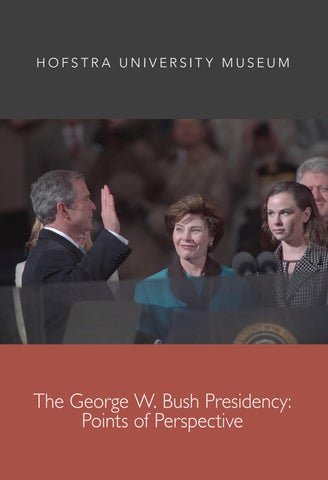
Front cover credit: Wally McNamee, President George W. Bush is sworn in as the 43rd President of the United States during ceremonies in Washington, D.C., January 20, 2001, digital print, courtesy of George W. Bush Presidential Library and Museum © 2015 Hofstra University Museum All rights reserved. No part of this publication may be reproduced, stored in a retrieval system or transmitted, in any form or by any means, electronic, mechanical, photocopying, recording or otherwise, without prior permission of the Hofstra University Museum.
Presented in association with the Hofstra Cultural Center international conference The George W. Bush Presidency (March 24-26, 2015). This exhibition is made possible by funding from the New York State Council on the Arts with the support of Governor Andrew Cuomo and the New York State Legislature. Additional funding for this exhibition and catalog has been provided by Astoria Bank.
Foreword A Focus on the 43rd President of the United States (2001-2009)
Through the years, Hofstra University has built a reputation for its international conferences focused upon the leadership of American presidents in the 20th and 21st centuries. Beginning with an examination of the presidency of Franklin Delano Roosevelt, FDR: The Man, The Myth, The Era – 1882-1945, in 1982, Hofstra has provided scholars, students, and general audiences with unique opportunities to examine the legacy of each of the modern American presidents. The March 24-26, 2015, conference on the George W. Bush presidency is Hofstra’s 12th presidential conference. This associated exhibition has been collaboratively curated by Karen T. Albert, the Hofstra University Museum’s associate director of exhibitions and collections, and Richard Himelfarb, PhD, associate director of the Bush Presidential Conference and Hofstra University associate professor of political science. The exhibition The George W. Bush Presidency: Points of Perspective offers a balanced examination of seven specific “decision points” among scores of others that challenged and personified the presidency of our nation’s 43rd president, George Walker Bush. This is primarily an exhibition of art and ephemera that focuses on the following topics: the 2000 election; 9/11; the War on Terror; Afghanistan and Iraq; Hurricane Katrina; the 2008 economic crisis; Social Security reform; and AIDS and malaria initiatives in Africa. We hope that all visitors will examine the content of this exhibition and draw their own conclusions about the Bush presidency, the administrative decisions that were made during the course of eight years, and their lasting impact upon our nation. The Hofstra University Museum acknowledges and expresses our deep gratitude for the significant contributions of the following artists, funders, individuals, museums, libraries, and organizations: At Hofstra University: Herman A. Berliner, provost and senior vice president for academic affairs; special thanks to Meena Bose, director of the Hofstra conference on the George W. Bush presidency, professor of political science, Peter S. Kalikow Chair in Presidential Studies, and director of Hofstra’s Peter S. Kalikow Center for the Study of
4
the American Presidency; Athelene A. Collins, director of the Hofstra Cultural Center; Melissa Connolly, vice president for university relations; Natalie C. Datlof, director emerita of the Hofstra Cultural Center; Bernard J. Firestone, dean of Hofstra College of Liberal Arts and Sciences; Michael J. O’Connor, curator of special collections; Rosanna Perotti, chair of Hofstra’s Department of Political Science; and Geri E. Solomon, assistant dean and university archivist. We also extend special thanks to the following professionals at the George W. Bush Presidential Library and Museum, Dallas, Texas: Alan C. Lowe, director; Brooke Clement and Shannon Jarrett, supervisory archivists; Shelly DiCiolli, administrative assistant; Heather Nice, education specialist; and for their valuable assistance, Christina M. Oliver, registrar; Amy Polley, curator; and Emily Robison, deputy director. As this exhibition has been greatly enhanced by a number of key contributions from artists, galleries, and individual collectors, we offer our thanks to Steve Breen; Sue Coe; Fay Beilis Duftler, associate director, Galerie St. Etienne; Doug Hilson; Benjamin Lowy; Mike Luckovich; Mike Peters; Stephen V. Russell; and Ann Telnaes. Exhibitions are carefully developed over a period of typically two to three years to assure that the original thesis is well reflected in each work of art and article that is presented to the public. This undertaking requires financial support to ensure that the costs associated with transporting works of art, designing and printing publications, as well as all other elements of an exhibit are fully covered. The Hofstra University Museum is most appreciative of the Hofstra Cultural Center, Astoria Bank, and the New York State Council on the Arts with the support of Governor Andrew Cuomo and the New York State Legislature for their support of this endeavor.
Beth E. Levinthal
Executive Director Hofstra University Museum
5
The George W. Bush Presidency: Points of Perspective George W. Bush’s Decision Points is atypical of presidential memoirs. Instead of presenting an exhaustive account of his life and presidency, Bush focuses on a number of key events and decisions that confronted him. His goal, he explains, is “to give readers perspective on decision making in a complex environment.”1 The George W. Bush Presidency: Points of Perspective exhibit encapsulates this approach. Organized thematically rather than chronologically, the art, artifacts, photographs and documents displayed here reflect a tumultuous period. With the exception of the final section focusing on AIDS and malaria initiatives in Africa, the events chosen elicited major debate, and many continue to do so. While some of the items in the exhibit reflect the perspective of the Bush administration, a number are from critics, while still others (e.g., first responders and workers at Ground Zero) represent no policy agenda. The purpose here is to reflect on key political events that shaped the United States during most of the first decade of the 21st century. The 2000 election was hard fought, extraordinarily close and, most of all, controversial. Bush held a slim lead in the polls over Vice President Al Gore until the weekend before the election when the media reported his 1976 arrest for DUI. A decline in support for Bush left the race neck and neck on Election Day. When the news media called Florida for Gore early in the evening, it appeared the Democrat held a small but potentially decisive lead in the Electoral College. However, as mounting vote returns contradicted initial projections, the networks withdrew Florida from the Gore column and gave the state to Bush. Finally, after 2 a.m. EST, minds changed once again as Florida was deemed undecided with Bush ahead by several hundred votes. What ensued was one of the great election controversies in American history. With Florida holding the Electoral College votes necessary for either candidate to claim victory, lawyers and political operatives from each campaign descended on the state to litigate the results. Disputes stretched on for weeks involving hanging chads, butterfly ballots, recounts, and absentee ballots. Ultimately, Gore v. Bush landed in the United States Supreme Court, which ruled 5-4 that there was no fair way to recount the ballots that would permit Florida to participate in the Electoral College. George W. Bush, whose lead in Florida was a mere 537 votes (over 5.8 million were cast) was declared the winner there. The state’s 25 Electoral College votes provided him with a narrow 271-266 victory. The Supreme Court’s verdict was bitterly contested by many who argued that its five Republican appointees had given Bush Florida on dubious legal grounds. Additionally, Bush’s loss to Gore by just under 544,000 votes (0.5 percent) nationwide led others to question the legitimacy of his victory. Months later, even the verdict that Bush would have won a recount of votes in Florida2 did little to assuage the anger of opponents. 6
As president, George W. Bush planned to focus on domestic policy: tax cuts, education reform, prescription drugs for seniors, and Social Security. In an instant, everything changed. On the morning of September 11, 2001, Al Qaeda terrorists hijacked four American passenger planes. Two hit the North and South Towers of the World Trade Center in New York City, causing each to collapse a short time later. A third crashed into the Pentagon in Washington, D.C., and the fourth in a field in Shanksville, Pennsylvania. Nearly 3,000 people died that day. “We had suffered the most devastating attack since Pearl Harbor,” writes Bush. “An enemy had struck our capital for the first time since the War of 1812. In a single morning, the purpose of my presidency had grown clear: to protect our people and defend our freedom that had come under attack.” Following September 11, Bush offered resolute leadership alternately consoling the nation and vowing to fight a war on terror. On September 14, a visit to Ground Zero in New York provided what was arguably the finest moment of his presidency. Meeting with first responders, Bush climbed atop a mound of metal and began to speak into a bullhorn procured only moments earlier. When workers shouted “We can’t hear you,” Bush responded in a raised voice, “I can hear you. The rest of the world hears you. And the people who knocked these buildings down will hear all of us soon.” The crowd reacted to Bush’s words with a raucous cheer that transformed into a chant of “USA, USA, USA.” On the day Bush visited Ground Zero, Congress passed a resolution granting the president broad powers “to use all necessary force against those nations, organizations, and persons he determines planned, authorized, committed, or aided the terrorist attacks that occurred on September 11, 2001, or harbored such organizations or persons.” In combination with Article II of the Constitution, which entrusts the president with wartime powers as commander in chief, Bush embarked on his mission to protect the nation against a second terrorist attack. In October 2001 Congress, with Bush’s support, passed the PATRIOT Act, a wide-ranging measure authorizing broad government surveillance of suspected terrorists. Two years later, legislation created a new Department of Homeland Security, a massive reorganization of federal government agencies charged with protecting the nation. More controversial were unilateral actions undertaken by the executive branch and conducted in secrecy. These included monitoring al Qaeda communications into and out of the United States without warrants; detaining terrorist suspects at Guantanamo Bay without trial or charges; and employing “enhanced interrogation techniques” to extract 7
intelligence from a number of high-level terrorist suspects. Critics charged that these measures were unconstitutional, unnecessary and ultimately harmful to the nation’s international standing. Their defenders, including President Bush, replied that the threat posed by terrorism post 9/11 was too grave to be combated through traditional law enforcement measures alone. In the aftermath of the attack, Bush reported receiving CIA reports tracking an average of “400 specific threats each month.” One of the scenarios most feared by the government involved the potential for a smallpox attack that could infect two to three million people. In such an environment President Bush unapologetically argued that he erred on the side of public safety: “After the nightmare of September 11, America went seven and a half years without a successful terrorist attack on our soil. If I had to summarize my most meaningful accomplishment as president in one sentence, that would be it.” Within days of the 9/11 attacks, Bush focused his attention on Afghanistan where the Taliban had provided sanctuary to Al Qaeda and Bin Laden. In October 2001 the United States launched Operation Enduring Freedom, a multilateral effort to destroy the terrorist group and their enablers and create a stable democratic government there. Within months, coalition forces liberated the country and drove the Taliban from power. Over the next few years, many aspects of life improved in Afghanistan. Children attended school (including, for the first time, many girls), the economy grew rapidly, refugees returned, and the nation held its first free elections. However, success proved elusive. Taliban loyalists who had fled to Pakistan returned to perpetrate violence on the civilian population. A corrupt Afghanistan government proved unable to provide security for its citizens. Elements in the Pakistani government refused to cooperate with efforts to locate and destroy Al Qaeda. Finally, coalition partners placed heavy restrictions on their forces, burdening further an already undermanned American military. Later, Bush ordered more American troops to Afghanistan in an attempt to stabilize the country. However, as he left office the outcome there remained unclear. What initially appeared to be an easy victory had become a long slog. Compared with Afghanistan, the decision to wage war in Iraq was more controversial. No evidence linked Saddam Hussein to the attacks of September 11. However, the tragedy that day led Bush “to take a fresh look at every threat in the world.” To the administration, Iraq was the most dangerous. Saddam Hussein, a brutal dictator, supported state-sponsored terrorism, was believed to possess Weapons of Mass Destruction (WMD), and had violated numerous U.N. resolutions to disarm. Before September 11, the United States might have been willing to manage Hussein through diplomacy and sanctions. In the aftermath of the tragedy, Bush became increasingly concerned about Saddam transferring his WMD to terrorists. “The lesson of 9/11 was that if we waited for a danger to fully materialize, we would have waited too long,” writes Bush, explaining his decision to confront Iraq. Some questioned Bush’s assumptions, arguing that insufficient evidence existed that Saddam possessed WMD, and even if he did, diplomacy would prove sufficient to deal with the
8
problem. However, these skeptics were outnumbered by those supporting military action against Iraq. While the consensus here was not as strong as it had been on Afghanistan, Bush’s decision to fight in Iraq won significant bipartisan support. In March 2003 President Bush authorized Operation Iraqi Freedom. As in Afghanistan the military campaign enjoyed early success, deposing the regime quickly with few casualties. Unfortunately, here too, initial victory quickly gave way to chaos and instability. With Saddam Hussein removed from power, Baghdad was beset by looting and violence in the weeks following the invasion. Decisions to ban members of Saddam’s Baath Party from serving in government and disband the army added to problems as thousands of newly unemployed and armed men joined the anti-American insurgency. Foreign terrorists affiliated with al Qaeda and later, militant Shia from Iran, entered Iraq, further endangering the security of Iraqis. The task of stabilizing the country again fell to an undermanned American military. Between 2003 and 2006, progress in Iraq — the capture of Saddam Hussein, participation by millions of Iraqis in free elections — was undermined by widespread violence against Iraqi civilians and American soldiers. Additionally, a prisoner abuse scandal at Abu Ghraib, accompanied by the failure to locate any WMD, served to undermine public support for the war and, ultimately, Bush’s presidency. By 2006, events in Iraq had placed Bush and his administration on the political defensive. Increasing public opposition to the Iraq war played a key role in the midterm elections, where Republicans lost majorities in both the House and Senate. Afterwards, Bush would effectively fire his secretary of defense, Donald Rumsfeld, the administration official responsible for the failing military strategy in both Afghanistan and Iraq. During the same period, a bipartisan commission declared the war in Iraq essentially unwinnable and urged a withdrawal from the country. Resisting such pressure, Bush chose to “double down” by sending an additional 20,000 troops to conduct a counterinsurgency in Iraq. Led by General David Petraeus, the U.S. military deployed to the provinces, cleared out insurgent strongholds, and secured the civilian population. The strategy succeeded. In 2007 and 2008, Iraqi and American casualties declined significantly. As Bush left office, it appeared that his goal of creating a stable democracy in Iraq might finally come to fruition. Given the visibility of foreign policy and national security during his presidency, it is surprising that George W. Bush believes Social Security reform was the biggest failure of his two terms.3 Bush had long harbored ambitions of fixing the popular program, dubbed the third rail of American politics. According to Social Security’s trustees, increasing life expectancy, declining birth rates and a formula that set benefits to rise faster than inflation placed the program on a course that was unsustainable. In the absence of reform, Social Security would pay out more in benefits than it collected, starting in 2018. In 2042 the program’s trust fund would be exhausted, leading to benefit cuts of more than 25 percent. 9
To reform the program, Bush proposed two changes: first, permitting younger workers to invest a portion of their payroll taxes in private accounts invested in equities, and second, reducing program expenditures through progressive price indexing, effectively reducing benefits for future retirees, excepting those with low wages. Bush believed he possessed a mandate to reform Social Security because he had discussed the issue in the 2004 campaign. However, given that voters were focused on Iraq and terrorism, it is likely that many paid scant attention to Bush’s plans for the program. Bush’s proposal also proved difficult to explain and was strongly attacked by Democrats as an attempt to destroy Social Security. Congressional Republicans, wary of the politics surrounding efforts to fix the program, provided little support for Bush’s plan. To make his case, Bush embarked on a tour of the country, giving 60 speeches in 60 days. The effort failed; support for Bush’s private accounts was lower at the conclusion of his campaign than at the outset. By the fall of 2005, the plan was dead. Hurricane Katrina in August 2005 ranked as the most expensive national disaster in American history. “In truth,” writes President Bush, “it was not a single disaster but three — a storm that wiped away miles of the Gulf Coast, a flood caused by breaches in the New Orleans levees, and an outbreak of violence in the city.” The crises arising from the event were exacerbated by a government response that was slow, disorganized, and, worst of all, incompetent. In fact a substantial portion of the blame rests with state and local government officials typically charged with managing such emergencies. New Orleans Mayor Ray Nagin did not order a complete evacuation of the city, effectively leaving thousands stranded for days after the hurricane struck. City police abandoned their posts following the disaster, and some even joined the ensuing looting. Finally, Louisiana Governor Kathleen Blanco refused to permit the federal government to deploy active duty troops with law enforcement powers, prolonging the chaos and disorder. All the same, numerous missteps marked President Bush’s handling of the crisis. By his own admission, he waited too long to deploy active duty troops who, even without law enforcement powers, played a key role in stabilizing New Orleans. Perhaps more important were public perceptions that the president was isolated from the crisis and indifferent to the suffering there. Images of Bush looking down on the destruction from Air Force One and his praise for FEMA administrator Michael Brown, who was heavily criticized for heading an incompetent federal response, proved extraordinarily damaging. Bush acknowledges that “... the legacy of fall, 2005 lingered for the rest of my time in office.” In Bush’s final year, 2008, an economic crisis emerged that threatened the U.S. and world economies. A sudden and precipitous decline in housing values threatened the mortgage industry and the solvency of major U.S. banks. Virtually no one was immune from the consequences. Millions of Americans lost their homes while the stock market dropped by one third. Over the next few years, unemployment increased and incomes declined in what proved to be the nation’s worst economic downturn since the Great Depression. 10
President Bush reacted quickly and decisively to the crisis. He pushed for and won bipartisan passage of the Troubled Asset Relief Program (TARP), an $800 billion bailout of overleveraged banks. Bush acknowledges that this intervention in the free market “flew against all my instincts” but insists “it was necessary to pull the country out of the panic.” Most, though certainly not all experts, believe the measure prevented even worse economic disaster. Equally controversial is whether President Bush’s policies are to blame for the origins of the crisis. Whatever the merits of the arguments here, the American public clearly held him responsible for the crisis that occurred on his watch. In contrast to the many controversies surrounding George W. Bush’s presidency, his humanitarian efforts in Africa elicit virtually unanimous praise. In 2003 Bush won congressional passage of a $15 billion initiative to fight HIV/AIDS there. Bush considered the President’s Emergency Plan for AIDS Relief (PEPFAR) to be “a medical version of the Marshall Plan.” By the end of Bush’s second term, over two million Africans had received treatment through the program. Also notable was Bush’s 2007 Malaria Initiative, which distributed insecticide-treated bed nets and delivered medicine to infected and pregnant mothers. The program cut infection rates and protected millions from unnecessary death. After Bush left office, these efforts continued under President Obama, who lauded his predecessor for his efforts. In his post presidency, Bush and his wife, Laura, continue to focus on global health issues in Africa. Since 2012, Pink Ribbon/Red Ribbon, an initiative of the George W. Bush Institute, seeks to eradicate cervical and breast cancer there and in Latin America.4 Since exiting the White House in 2009, President Bush has said little about his presidency beyond his memoirs. Unlike many previous inhabitants who engage in concerted efforts to shape their legacies, Bush appears content to leave matters to history. “It’s too early to say how most of my decisions will turn out,” he writes in the epilogue. “Whatever the verdict on my presidency, I’m comfortable with the fact that I won’t be around to hear it. That’s a decision point only history will reach.” Such is the intent of The George W. Bush Presidency: Points of Perspective. It is our hope that this exhibit will assist visitors in making their own assessments of this consequential administration and its leader.
Richard Himelfarb, PhD Associate Professor of Political Science, Hofstra University Associate Director of the George W. Bush Presidential Conference
All quotes from President Bush’s memoir, Decision Points, Crown, 2010. Dennis Cauchon, “Newspapers’ Recount Shows Bush Prevailed,” USA Today, May 15, 2001. 3 Becky Schlikerman, “Bush Promotes Book in Chicago,” Chicago Tribune, October 21, 2010. 4 Dana Hughes, “George W. Bush’s Legacy in Africa Wins Praise, Even From Foes,” The Note, ABC News, April 26, 2013. 1 2
11
Judge Robert Rosenberg, heading vote recount in Broward County, Florida, 2000 Digital print Courtesy of AP Image/Alan Diaz
12
*All political cartoons are 11 by 17 inches. All photographs are 11 by 14 inches, unless otherwise noted.
Wally McNamee President George W. Bush is sworn in as the 43rd President of the United States during ceremonies in Washington, D.C. January 20, 2001 Digital print Courtesy of George W. Bush Presidential Library and Museum
13
Ann Telnaes The Choice, October 31, 2000
Digital print Courtesy of the artist Ann Telnaes Editorial Cartoon used with the permission of Ann Telnaes and the Cartoonist Group. All rights reserved.
14
Eric Draper Standing atop rubble with retired New York City firefighter Bob Beck, President George W. Bush rallies firefighters and rescue workers at the site of the collapsed World Trade Center in New York City September 14, 2001 Digital print Courtesy of George W. Bush Presidential Library and Museum
15
Doug Hilson Re-Build #3, 2003
Ink and oil on paper 8 1/2 x 11 1/4 in. Courtesy of the artist
16
Eric Draper President George W. Bush meets and thanks a group of U.S. and Coalition troops during a visit to Bagram Air Base in Afghanistan, where President Bush thanked the troops for their service in defense of freedom March 1, 2006 Digital print Courtesy of George W. Bush Presidential Library and Museum
17
Paul Morse Secretary of Defense Donald Rumsfeld hands a note to President George W. Bush during the Working Session of the North Atlantic Council. Istanbul Convention and Exhibition Center. Istanbul, Turkey. The note, from Condoleezza Rice, stated “Iraq is sovereign,” June 28, 2004 Digital print Courtesy of George W. Bush Presidential Library and Museum
18
Sue Coe Abu Ghraib, 2005
Colored woodcut on natural Kitakata paper 15 5/8 x 11 1/4 in. Courtesy of Galerie St. Etienne, New York © 2005, Sue Coe, Courtesy Galerie St. Etienne, New York
19
Luis Cruz Azaceta N.O. HEAD (post Katrina), 2008
Permanent ink and Band-Aid on paper 42 x 30 in. Hofstra University Museum Collections, Gift of Sharon Jacques, HU2012.44 © Luis Cruz Azaceta, George Adams Gallery, New York, 2008
20
Sue Coe Thousands Try and Escape the Superdome, 2006
Graphite on white Strathmore Bristol board 23 x 29 in. Courtesy of Galerie St. Etienne, New York © 2005, Sue Coe, Courtesy Galerie St. Etienne, New York
21
Paul Morse President George W. Bush tours a hurricane ravaged neighborhood in New Orleans, La., from the back of a truck with state and local officials September 12, 2005 Digital print Courtesy of George W. Bush Presidential Library and Museum
22
Chris Greenberg President George W. Bush meets with his economic advisors in the New Executive Office Building in Washington, D.C. “The deficit today is at 1.2 percent of GDP, which is lower than the average of the last 40 years. In other words, we have told the American people that by keeping taxes low we can grow the economy, and by working with Congress to set priorities we can be fiscally responsible and we can head toward balance,” said President Bush in a statement to the press. “And that’s exactly where we’re headed.” October 11, 2007 Digital print Courtesy of George W. Bush Presidential Library and Museum
23
Steve Breen Rex Comes With the House, July 29, 2008
Digital print Courtesy of the artist Steve Breen, San Diego Union-Tribune, Creators News Service, © 2008
24
Mike Peters We’ll be Forever in Your Debt November 5, 2008 Digital print Courtesy of the artist
25
Mike Luckovich His Evolution..., 2008
Digital print Courtesy of the artist
26
Eric Draper Former First Lady Barbara Bush introduces her son President George W. Bush during a discussion on strengthening Social Security at the Lake Nona YMCA Family Center in Orlando, Florida, March 18, 2005 Digital print Courtesy of George W. Bush Presidential Library and Museum
27
Eric Draper Employees work on mosquito netting at A to Z Textile Mills in Arusha, Tanzania, during a visit by President George W. Bush and Mrs. Laura Bush February 18, 2008 Digital print Courtesy of George W. Bush Presidential Library and Museum
28
Joyce N. Boghosian President George W. Bush is joined by Annette Lantos, right, and invited guests in the East Room of the White House, as he signs H.R. 5501, the Tom Lantos and Henry J. Hyde United States Global Leadership Against HIV/AIDS, Tuberculosis and Malaria Reauthorization Act of 2008, July 30, 2008 Digital print Courtesy of George W. Bush Presidential Library and Museum
29
The George W. Bush Presidency: Points of Perspective Exhibition Checklist (chronological within each section)
*All political cartoons are 11 by 17 inches. All photographs are 11 by 14 inches, unless otherwise noted.
The 2000 Election
Republican National Convention Speech, August 3, 2000 Facsimile document Courtesy of George W. Bush Presidential Library and Museum
“Compassionate Conservative for President 2000,” 2000
December 13, 2000 Newspaper Courtesy of George W. Bush Presidential Library and Museum
Map Showing Electoral Votes by State, 2000 Digital reproduction
2000, Pin back button Courtesy of Stephen V. Russell
Wally McNamee President George W. Bush is sworn in as the 43rd President of the United States during ceremonies in Washington, D.C., January 20, 2001 Digital print Courtesy of George W. Bush Presidential Library and Museum
“The Right Choice for America,” 2000
September 11, 2001
Pin back button Courtesy of Stephen V. Russell
“George W. Bush No More Clinton Gore,”
Pin back button Courtesy of Stephen V. Russell
“Vote Republican! Governor George W. Bush of Texas for President 2000,” 2000 Pin back button Courtesy of Stephen V. Russell
Ann Telnaes The Choice, October 31, 2000 Digital print Courtesy of the artist
Voting Booth, Butterfly Ballot and Chads,
November 7, 2000 Courtesy of Department of Political Science, Hofstra College of Liberal Arts and Sciences
“Bush Appears to Defeat Gore,”
The New York Times, November 8, 2000 Newspaper Courtesy of George W. Bush Presidential Library and Museum
Judge Robert Rosenberg, heading vote recount in Broward County, Florida, 2000 Digital print Courtesy of AP Image/Alan Diaz
30
“Bush Prevails,” The New York Times,
Presidential Statement from Oval Office,
Draft 2 (3 pages), September 11, 2001 Facsimile document Courtesy of George W. Bush Presidential Library and Museum
Eric Draper As Dan Bartlett, Deputy Assistant to the President, points to news footage of the World Trade Center President George W. Bush gathers information about the terrorist attack from a classroom at Emma E. Booker Elementary School in Sarasota, Fla. Also pictured from left are: Deborah Loewer, Director of White House Situation Room, and Senior Adviser Karl Rove, September 11, 2001 Digital print Courtesy of George W. Bush Presidential Library and Museum Eric Draper President George W. Bush watches television coverage of the attacks on the World Trade Center, during a briefing in a classroom at Emma E. Booker Elementary School in Sarasota, Florida, September 11, 2001 Digital print Courtesy of George W. Bush Presidential Library and Museum
Eric Draper Standing atop rubble with retired New York City firefighter Bob Beck, President George W. Bush rallies firefighters and rescue workers at the site of the collapsed World Trade Center in New York City, September 14, 2001 Digital print Courtesy of George W. Bush Presidential Library and Museum Eric Draper President George W. Bush throws out the ceremonial first pitch at Yankee Stadium before Game Three of the World Series between the Arizona Diamondbacks and the New York Yankees, October 30, 2001 Digital print Courtesy of George W. Bush Presidential Library and Museum
Mason Hoe
Metal with red paint, wood handle wrapped in black tape 20 1/2 x 6 1/4 in. Courtesy of Hofstra University Libraries Special Collections
Metropolitan Transportation Authority of New York Respirator
Pink and blue plastic 5 x 5 1/2 x 9 in. Courtesy of Hofstra University Libraries Special Collections
Work Boots
Doug Hilson Re-Build #3, 2003 Ink and oil on paper 8 1/2 x 11 1/4 in. Courtesy of the artist The War on Terror: Iraq and Afghanistan
First Lady Laura Bush’s Radio Address, Draft #8 (2 pages), November 17, 2001 Facsimile document Courtesy of George W. Bush Presidential Library and Museum
Susan Sterner Mrs. Laura Bush delivers a radio address from the Prairie Chapel Ranch in Crawford, TX. Mrs. Bush is the first First Lady to deliver an entire Presidential Radio Address, November 17, 2001 Digital print Courtesy of George W. Bush Presidential Library and Museum
Announcement of Military Action in Iraq, Draft #5 (2 pages), March 19, 2003 Facsimile document Courtesy of George W. Bush Presidential Library and Museum
Ann Telnaes The Losing Card, March 19, 2003 Digital print Courtesy of the artist
Black leather, 5 x 12 x 9 in. Courtesy of Hofstra University Libraries Special Collections
Iraqi “Most Wanted” Playing Cards, 2003
Hardhat worn by construction worker Pete Cusumano of Local Ironworkers 361
Operation Iraqi Freedom Military Heroes Playing Cards, 2003
Brown plastic with stickers and goggles with green frame 8 1/2 x 11 1/2 x 6 in. Courtesy of Hofstra University Libraries Special Collections
Doug Hilson Outta Here #2, 2002 Media-pen and colored ink on paper 5 x 8 1/4 in. Courtesy of the artist
Courtesy of George W. Bush Presidential Library and Museum
Courtesy of George W. Bush Presidential Library and Museum
Military Patch: Crawford TX-Baghdad Iraq; Thanksgiving Secret Mission, 2003
Courtesy of George W. Bush Presidential Library and Museum
Military Badge: Operation Iraqi Freedom no date Courtesy of George W. Bush Presidential Library and Museum
31
Sue Coe Fun House (Aren’t We Handsome), 2004 Graphite on white Strathmore Bristol board 8 3/8 x 12 3/8 in. Courtesy of Galerie St. Etienne, New York
Benjamin Lowy Untitled, Kabul, Afghanistan, April 2007 Photograph 9 1/4 x 14 in. Courtesy of the artist
Sue Coe Perles Before Swine, 2004 Graphite on white Strathmore Bristol board 11 x 8 1/2 in. Courtesy of Galerie St. Etienne, New York
Benjamin Lowy Untitled from Iraq Perspectives I, July 2007 Photograph 9 1/4 x 14 in. Courtesy of the artist
Paul Morse Secretary of Defense Donald Rumsfeld hands a note to President George W. Bush during the Working Session of the North Atlantic Council. Istanbul Convention and Exhibition Center. Istanbul, Turkey. The note, from Condoleezza Rice, stated “Iraq is sovereign,” June 28, 2004 Digital print Courtesy of George W. Bush Presidential Library and Museum
Benjamin Lowy Untitled from Iraq Perspectives II, July 2007 Photograph 9 1/4 x 14 in. Courtesy of the artist
Sue Coe Abu Ghraib, 2005 Colored woodcut on natural Kitakata paper 15 5/8 x 11 1/4 in. Courtesy of Galerie St. Etienne, New York
Chris Greenberg President George W. Bush jogs along the White House jogging track with wounded veterans U.S. Army Sgt. Neil Duncan (Ret.), left, and U.S. Army Specialist Max Ramsey, July 25, 2007 Digital print Courtesy of George W. Bush Presidential Library and Museum
Iraqi Ballot, January 30, 2005
Facsimile document Courtesy of George W. Bush Presidential Library and Museum
Eric Draper President George W. Bush meets and thanks a group of U.S. and Coalition troops during a visit to Bagram Air Base in Afghanistan, where President Bush thanked the troops for their service in defense of freedom March 1, 2006 Digital print Courtesy of George W. Bush Presidential Library and Museum Benjamin Lowy Untitled, Kabul, Afghanistan, April 2007 Photograph 9 1/4 x 14 in. Courtesy of the artist
32
Benjamin Lowy Untitled, Arab Jabour, Iraq, July 2007 Photograph 9 1/4 x 14 in. Courtesy of the artist
Eric Draper President George W. Bush greets U.S. Military personnel at Al Asad Airbase, Al Anbar Province, Iraq, September 3, 2007 Digital print Courtesy of George W. Bush Presidential Library and Museum Hurricane Katrina Paul Morse Aerial view of flooding in New Orleans, Louisiana. Flooding caused by Hurricane Katrina in the New Orleans area is visible from Air Force One as President Bush was able to survey the ravages of the storm during his return from Crawford, Texas to Washington D.C., August 31, 2005 Digital print Courtesy of George W. Bush Presidential Library and Museum
Krisanne Johnson Laura Bush leans down to comfort a woman and her young child inside the Cajundome at the University of Louisiana in Lafayette during her visit to the center, one of many created to accommodate victims of Hurricane Katrina, September 2, 2005, digital print Courtesy of George W. Bush Presidential Library and Museum Mike Luckovich Back of the Bus, September 7, 2005 Digital print, courtesy of the artist Ann Telnaes It’s a Pandemic, September 8, 2005 Digital print, courtesy of the artist Paul Morse President George W. Bush tours a hurricane ravaged neighborhood in New Orleans, La., from the back of a truck with state and local officials, September 12, 2005 Digital print Courtesy of George W. Bush Presidential Library and Museum Steve Breen Red Tape, 2005 Digital print, courtesy of the artist Sue Coe Thousands Try and Escape the Superdome, 2006 Graphite on white Strathmore Bristol board 23 x 29 in. Courtesy of Galerie St. Etienne, New York Mike Peters See? Everything’s Cleaned Up..., September 3, 2006 Digital print, courtesy of the artist Luis Cruz Azaceta N.O. HEAD (post Katrina), 2008 Permanent ink and Band-Aid on paper 42 x 30 in. Hofstra University Museum Collections Gift of Sharon Jacques, HU2012.44 2008 Economic Crisis Mike Peters Economy, February 2, 2007 Digital print, courtesy of the artist
Chris Greenberg President George W. Bush meets with his economic advisors in the New Executive Office Building in Washington, D.C. “The deficit today is at 1.2 percent of GDP, which is lower than the average of the last 40 years. In other words, we have told the American people that by keeping taxes low we can grow the economy, and by working with Congress to set priorities we can be fiscally responsible and we can head toward balance,” said President Bush in a statement to the press. “And that’s exactly where we’re headed.” October 11, 2007 Digital print Courtesy of George W. Bush Presidential Library and Museum Mike Luckovich His Evolution..., 2008 Digital print, courtesy of the artist Eric Draper President George W. Bush is joined by U.S. Treasury Secretary Henry Paulson in the Oval Office, where President Bush told reporters he looks forward to working with Congress to get a good piece of legislation to help creditworthy people to stay in their homes, May 19, 2008 Digital print Courtesy of George W. Bush Presidential Library and Museum Steve Breen Rex Comes With the House, July 29, 2008 Digital print, courtesy of the artist
Recommended Telephone Calls with Congressmen regarding the passage of the financial rescue package,
September 29 to October 3, 2008 Facsimile document Courtesy of George W. Bush Presidential Library and Museum
Steve Breen The Crash of ’08, October 1, 2008 Digital print, courtesy of the artist Steve Breen Seven Deadly Sins, October 19, 2008 Digital print, courtesy of the artist
33
Mike Peters We’ll be Forever in Your Debt, November 5, 2008 Digital print, courtesy of the artist Mike Luckovich I Regret the Iceberg Chose Collision, December 3, 2008 Digital print, courtesy of the artist Mike Luckovich Baby New Year Refuses to Come Out…, December 24, 2008 Digital print, courtesy of the artist Privatization of Social Security Ann Telnaes Place Your Bets, December 2, 2004 Digital print, courtesy of the artist Mike Peters There’s a Crisis…, January 15, 2005 Digital print, courtesy of the artist Paul Morse President George W. Bush participates in a conversation on Social Security reform at Auburn University at Montgomery in Montgomery, Alabama, March 10, 2005 Digital print Courtesy of George W. Bush Presidential Library and Museum Eric Draper Former First Lady Barbara Bush introduces her son President George W. Bush during a discussion on strengthening Social Security at the Lake Nona YMCA Family Center in Orlando, Florida, March 18, 2005 Digital print Courtesy of George W. Bush Presidential Library and Museum
“It’s Your Future. Own It.”
Paul Morse President George W. Bush and Mrs. Bush and President and Mrs. Musevni applaud the singing of the Watoto Choir at the TASO Centre in Entebbe, Uganda, July 11, 2003 Digital print Courtesy of George W. Bush Presidential Library and Museum Eric Draper Employees work on mosquito netting at A to Z Textile Mills in Arusha, Tanzania, during a visit by President George W. Bush and Mrs. Laura Bush, February 18, 2008 Digital print Courtesy of George W. Bush Presidential Library and Museum Joyce N. Boghosian President George W. Bush is joined by Annette Lantos, right, and invited guests in the East Room of the White House, as he signs H.R. 5501, the Tom Lantos and Henry J. Hyde United States Global Leadership Against HIV/AIDS, Tuberculosis and Malaria Reauthorization Act of 2008, July 30, 2008 Digital print Courtesy of George W. Bush Presidential Library and Museum
Red Ribbon Pin Worn by George W. Bush During PEPFAR Reauthorization Bill Signing,
July 31, 2008 Courtesy of George W. Bush Presidential Library and Museum
International Medal of Peace, 2008
Courtesy of George W. Bush Presidential Library and Museum
Memorandum for the Record regarding President’s Emergency Plan for AIDS Relief,
Social Security Reform T-shirt, Cotton Courtesy of George W. Bush Presidential Library and Museum
January 14, 2009 Facsimile document Courtesy of George W. Bush Presidential Library and Museum
“Do the Math. Strengthen Social Security. Support President Bush!”
“Mosquitoes Suck” T-shirt
Ceramic mug Courtesy of George W. Bush Presidential Library and Museum 34
AIDS and Malaria Initiatives in Africa
Cotton Courtesy of George W. Bush Presidential Library and Museum
HOFSTRA UNIVERSITY STUART RABINOWITZ
President Andrew M. Boas and Mark L. Claster Distinguished Professor of Law
HERMAN A. BERLINER Provost and Senior Vice President for Academic Affairs Lawrence Herbert Distinguished Professor
HOFSTRA UNIVERSITY MUSEUM BETH E. LEVINTHAL Executive Director KAREN T. ALBERT Associate Director of Exhibitions and Collections CAROLINE S. BIGELOW Senior Assistant to the Executive Director KRISTY L. CARATZOLA Collections Manager TIFFANY M. JORDAN Development and Membership Coordinator NANCY RICHNER Museum Education Director RENEE B. SELTZER Museum Educator MARILYN ZUCKER Museum Educator GRADUATE ASSISTANTSHIP Frantz Lucien Jr. GRADUATE STUDENT ASSISTANTS Joie M. Johnson-Walker Chelsea Laggan Lindsay Ralbovsky UNDERGRADUATE STUDENT ASSISTANTS Baylee Caudill Roberto Hernandez Claire Ramirez-Raftree Julia Szaniawska
ISBN 978-1-4951-4364-9