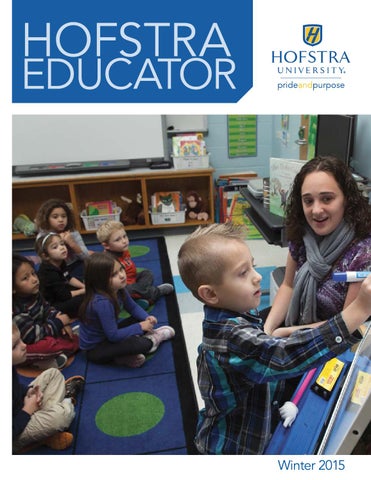
Winter 2015
Table of Contents
4 Studio Helps Children Learn the ABCs of S-T-E-M 6 Hofstra and Farmingdale School District Partner on Pre-K 8 Dancing With the Students 10 News Briefs 12 Seeing the World Through a Different Lens for New Program in Early Childhood Special Education 14 Funding and Applied Behavior Analysis 16 edTPA ~ What It Means and How Did Hofstra Students Fare? 18 Pedagogy for Health Professionals
Message From the Dean 2014 has been as dynamic a year as ever for the School of Education at Hofstra University. As you will see in this rejuvenated edition of the Hofstra Educator, students, faculty and staff have invested much of their time into endeavors that benefit educators throughout the Long Island/metro NY area.
2014 has been as dynamic a year as ever for the School of Education at Hofstra University.
First we review the continued success of an integrated lab space in Hagedorn Hall that was created in response to the push for Science, Technology, Engineering and Math specialists in education. Similarly, highlights of a partnership with an area early childhood center portray the School of Education’s commitment to teachers and learners in this realm – very much the focus of our governor’s recent Universal Pre-K plan. In the pages that follow, you will also learn about new programs in technology, special education, and applied behavior analysis supported by substantial grants obtained by our faculty. It is especially rewarding to see the partnerships and opportunities that arise from these programs for our students, such as the iDesign Maker Space Studio made possible by the National Science Foundation. Other features chronicle new publications, student success in new certification assessments, and more. I hope you enjoy reading this collection of School of Education stories, which are certainly a source of pride for us as well as true indicators of great things to come.
Sean A. Fanelli Dean
MATHEMATICS
ENGINEERING
TECHNOLOGY
SCIENCE
S T E M
Studio Helps Children Learn the
of S-T-E-M s C B A
It is a sunny spring morning at Hagedorn Hall, home of Hofstra University’s School of Education, and fourth graders from nearby California Avenue Elementary School
in Uniondale are taking notes while their classmates run and jump rope. Inside is a flurry of activity as children, their teachers, Hofstra students and their professors all work together to play out a number of different scenarios. These include stations where the children learn the skills of:
q Architects designing a mall. q Cardiologists experimenting with heart rate and pulse before and following physical activity. q Food scientists noting changes in popcorn kernels – before and after the popping. q Linguists coming up with names for pretend dinosaur species, using root words, prefixes and suffixes. q Museum curators classifying a display of natural specimens and determining what it means to be “alive.”
4
T
he children get a chance to try out these jobs, and many others, at Hofstra’s 4-year-old STEM Studio. STEM, an acronym for Science, Technology, Engineering and Mathematics, has long been important to K-12 education. The goal of the visits to Hofstra is to spark children’s interest in these subjects by showing the wide range of applications and connections they have to everyday activity and information, and to each other. Each activity encourages them to measure, analyze, discover, research, talk about and listen to each other’s thinking. The California Avenue School fourth graders visit Hofstra eight times a year. The STEM Studio also hosts visits from elementary schools in Freeport, Roosevelt, Plainedge, Herricks and Hempstead, which keeps the studio very busy. The STEM Studio also receives support from Hofstra’s Office of the Provost and Senior Vice President for Academic Affairs, the School of Education, and IDEAS (The Institute for the Development of Education in the Advanced Sciences.) The Motorola Solutions Foundation has underwritten the class visits to Hofstra. During the 2013-2014 academic year, the STEM Studio received a big boost which came in the form of a $75,000 grant from the American Honda Foundation. This funding supports educator salaries, supplies and transportation costs for bringing in students from Long Island school districts. The award will allow an additional 40 classes and 1,000 students to participate in Hofstra’s unique learning setting.
While the children see their regular visits to Hofstra as fun field trips, each of the tasks in which they engage strengthens intellectual skills that are tested by the New York state assessment program. The STEM Studio serves as a clinical practice site for undergraduate and graduate students of Hofstra’s School of Education.
While the children see their regular visits to Hofstra as fun field trips, each of the tasks in which they engage strengthens intellectual skills that are tested by the New York state assessment program. The STEM Studio serves as a clinical practice site for undergraduate and graduate students of Hofstra’s School of Education. The STEM Studio complements the undergraduate STEM major for elementary education students, while extending the clinical experience of pre-service teachers of all undergraduate education majors. It also enhances research opportunities within the Master of Arts Program in STEM Elementary Education. STEM Studio master teacher and Hofstra doctoral candidate Julia Caliendo is studying the role of the studio approach in teacher preparation. Dr. Jacqueline Grennon Brooks, Hofstra professor and director of the STEM Studio, says, “There is a lot of research that shows us that real learning cannot be measured by one Olympic-style event, such as a state exam. We offer problem-based learning and environments in which children solve STEM-based problems. The byproduct of this work is the children’s success on the state exam. But, most important, we are teaching transferable skills that apply to the many domains of the children’s lives.” She continues, “We like to think of the STEM Studio as an everyday classroom. We want our classrooms to be challenging environments in which learning to read, write, speak and listen, and learning to compute, and learning to be a neighbor and a friend and a peer are all one and the same, and all integrated into the life of the classroom.”
5
Pre-K
Hofstra and Farmingdale School District Partner on
6
Hofstra University’s Early Childhood Education (ECE) Program has taken the mentoring experience a step further by partnering with the local Farmingdale School District and managing the teaching aspects of its Universal Pre-K (UPK) program.
T
his collaboration, entering its ninth year, gives newly certified Hofstra education graduates a chance to complete their first year of teaching with consistent professional support. Working with Ellen Krammer, Farmingdale’s UPK grant coordinator, Hofstra’s ECE Program provides program staff, supervision, and curriculum. Dr. Linda Davey, director of ECE at Hofstra, with the help of her mentoring staff, plans with these new teachers to create a dynamic curriculum, while overseeing the choice of materials, schedule, management and assessment of the children as well as some of the home/school/community connections. During 2013-2014, the program serviced 144 pre-kindergarten children and employed eight certified teachers. Every year graduating ECE students are invited to apply for this one-year mentored position. Each morning and afternoon class is co-taught by two partnered, certified teachers. Additionally, 40 or more current students per year are placed in these classrooms to complete their pre-service clinical requirements in a setting that is crafted to reflect best practice as it has been learned in their teacher education program. Hofstra students not yet graduating are eligible to apply for substitute teacher positions. The curriculum, which follows the New York State Pre-K Foundation to the Common Core, is based on Dr. Doris Fromberg’s “Dynamic Themes” approach to learning, which guides teachers in creating opportunities for children to become independent, caring, and critical thinkers, developing skills leading to academic progress and meaningful citizenship. Dr. Fromberg, professor emeritus in Hofstra’s School of Education, designed the Early Childhood program and directed it for many years until her recent retirement. She serves on the New York State Governor’s Early Childhood Advisory Council as well as editorial boards of professional journals. ECE graduates are observed regularly – at least once every two weeks. Mentoring provided by Hofstra faculty and veterans of the program takes place on site and as part of in-service days and online discussion groups. Each year, two to four of the pre-K teachers are invited back for a second year to aid in the mentoring process of the new teachers. The Hofstra/Farmingdale partnership has proved to be a successful model of collaboration between a school district and a university. Teachers hired for this program interface with both university and district personnel. Since classrooms are housed in the public schools, these new teachers have opportunities to work within the framework of the public school system and to negotiate collaborative relationships while concretizing and expanding their teaching repertoire of skills and reflective abilities within the support of a closely mentored relationship.
7
DANCING WITH THE
St–udents! WHEN DR. SHARON PHILLIPS, ASSISTANT PROFESSOR OF EDUCATION AND A FORMER COMPETITIVE SWING DANCER, WAS ASKED TO TAKE OVER PESP 047 BALLROOM DANCING FOR THE 2013-2014 YEAR, SHE HAD NO IDEA THE CLASS WOULD CHANGE THE LIVES OF MANY OF HER STUDENTS. THE STUDENTS, SOME OF WHOM GREW UP WATCHING DANCING WITH THE STARS, STARTED THE CLASS WITH LITTLE OR NO DANCE TRAINING. HOWEVER, DURING THE SPRING 2014 SEMESTER, DR. PHILLIPS SAYS A FEW OF THESE NOVICES PROGRESSED TO COMPETITION LEVEL AND HAVE FORMED ENDURING FRIENDSHIPS.
8
W
hile the class is offered by the School of Education, it is an elective any student can take, and some register as a means to fulfill credit requirements, like Kevin Afonso ’14, who took the class during his final semester at Hofstra. Dr. Phillips is of the mind that anyone can learn to dance, and everyone in her class does learn, “although they may have different levels of skill.” Dr. Phillips was surprised by the number of young men registering for the classes. She attributes television and movies to popularizing ballroom dancing and helping young people realize the social benefits of knowing how to dance. Since ballroom dancing requires partners, Dr. Phillips says the first several classes are “ice-breakers,” which then progress to dancing in the open position – just holding hands – before dancing in the closed position. “The students constantly rotate partners so they learn how to work on their skills with partners at different levels.” Dr. Phillips recruited Alex Rothstein, a current competitive dancer who was then a senior in the School of Education, to help her coach the students. In addition to the dance steps, Dr. Phillips offers instruction in the history of different styles of dancing and the cultures in which they were born. Rothstein, who is currently in the master’s in sports science program at Hofstra, began dancing competitively during his freshman year and prefers the Latin dances – cha-cha, jive, rumba, samba, and paso doble. Alex’s expertise, says Dr. Phillips, has been a big inspiration to his peers. During one class he spoke about local dance competitions. When a few of the students expressed interest, the class atmosphere started to transform. “It was never the plan for this class to be what it became,” he said. Dr. Phillips said students in her 8 a.m. class were staying through the end of the 9:35 a.m. class, and students in the later class were showing up for the earlier one to squeeze in extra practice time. Even a faculty member with an affinity for dance showed up for the classes to hone his footwork and lend a hand to Dr. Phillips. Students including Afonso, who was an accounting major, drama student Kerry Gaudreau, jazz and commercial music major Zack Smith, and sophomore Daniela Locurto, a speech-pathology major, took the congenial atmosphere outside the classroom, where they made plans to go to dance clubs and set up rehearsals. In March 2014 Hofstra sent its first team of ballroom dancers to the Big Apple Dancesport Challenge. Rothstein competed on the more advanced open-level. Afonso and global studies student Alyssa O’Brien took fifth place in the Newcomer American Swing category. LoCurto, Smith, linguistics student Ria Dela Rosa, and film studies major Desmond Jackson made semifinals in a number of different categories. In April the students competed again in the Gotham City Dancesport Challenge where Afonso and Locurto placed in the Amateur Bronze Jive and the Newcomer Waltz categories. Gaudreau placed in Newcomer Cha-Cha and Swing. Rothstein and his partner, Jen Lippens, placed fifth in Pre-Champ Cha-Cha, Rumba, Samba, Jive and Paso Doble. Dr. Phillips is teaching the Ballroom Dancing class again this year and her hope is that students will continue to bond over the joy of learning to dance.
Photo by Joseph Pasaoa.
9
NEWS BRIEFS Student Loan Forgiveness for Educators U.S. Senator Charles Schumer held a press conference at Hofstra University in fall 2013 to draw attention to a student loan forgiveness and repayment program that could save college graduates tens of thousands of dollars if they take jobs in the public sector, such as education, health care, law enforcement, military service, and not-for-profit organizations. Joining Senator Schumer at the podium were Dr. Sean Fanelli, dean of the School of Education and LTC David Daniel, director of Hofstra’s ROTC program. The Public Service Loan Forgiveness Program (PSLF) has the potential to impact approximately 33 million Americans and one-quarter of New Yorkers in the workforce. Senator Schumer explained the benefits of PSLF: First, qualified employees can reduce their monthly student loan payment to 15 percent of their discretionary income. Second, after 10 years of payments, qualifying student loans will be completely forgiven.
Senator Schumer called on the Department of Education and the Department of Labor to work together to increase awareness of PSLF to ensure that employers in the public sector are notifying new teachers, police officers, firefighters, nurses and not-for-profit employees about the program so they can take advantage of these significant benefits.
Hofstra Signs Articulation Agreement With Institute for Health Professions at Cambria Heights Hofstra University has entered into an articulation agreement with the Institute for Health Professions at Cambria Heights (IHPCH), a career and technical high school in Queens where students can graduate with qualifications to get a job as an emergency medical technician or a nursing assistant. For those students who want to continue their education past high school, faculty members from Hofstra will be working with IHPCH to ensure that the school’s curriculum aligns with Hofstra’s expectations for incoming first-year students. Hofstra faculty will serve on the school’s advisory board, have input on curriculum, and provide professional development opportunities for IHPCH teachers and staff. The articulation agreement utilizes the strengths of several different Hofstra schools, including Hofstra College of Liberal Arts and Sciences, the School of Education, the School of Health Sciences and Human Services, and Hofstra North Shore-LIJ School of Medicine at Hofstra University. 10
Dr. Ronald Bloom, acting dean of Hofstra’s School of Health Sciences and Human Services, said, “Students from IHPCH will have opportunities to attend health fairs and career development events at Hofstra. In addition to working with students, we would like to explore professional development opportunities for the faculty and staff at IHPCH.” The partnership will additionally provide IHPCH students guest speakers and hands-on experiences in the medical profession through field visits and internships. Hofstra students will serve as mentors to the IHPCH students. Dr. Sean Fanelli, dean of Hofstra’s School of Education, said, “By serving as a partner with IHPCH, we are able to advise its teachers and administrators on curriculum design and implementation as well as provide our own future teachers with a host of field experiences as participant-observers and student teachers. We look forward to a rewarding relationship with the faculty and administration at the school in order to benefit its students.”
Professor’s Grant and Teaching Are Focused on Technology in the Classroom
NEWS BRIEFS
Roberto Joseph, PhD, associate professor in the School of Education, has been awarded a grant of almost $1.2 million from the National Science Foundation in support of his project, “iDesign: Developing Technological Fluency Through Culturally-Relevant Game Design.” iDesign Maker Space Lab is a technologically savvy space that encourages everyone, no matter their skills or abilities, to create things through different technological platforms and devices. Dr. Joseph explains, “The purpose of the iDesign project is to develop technological fluency in underrepresented minority youth by supporting them in the creation of interactive computer games that are culturally and socially relevant.” Dr. Joseph’s project is a collaborative effort between Hofstra University and 10 middle schools in New York City and suburban Long Island, all motivated to improve their underserved students’ STEM understanding. The lab will also offer educators a series of workshops on the topics of Smart Board 2014 edition and the different uses, 3D printing and curriculum, Google Chromebooks and apps, how to implement iPads and augmented reality into the classroom, authoring digital stories and game-making curriculum. Appropriately, Dr. Joseph was at the helm of the School of Education’s launch of a Master of Arts in Technology for Learning program in 2013, intended for individuals who aspire to become leaders in educational technology. “Technology is changing how we develop teachers and how we look at the presentation of content and knowledge in the classroom. Being a teacher is no longer just about presenting information. The role of the teacher in the digital age, in my opinion, is as facilitator helping students cypher through all the content that is available to them and helping them to be critical of that information and to evaluate it.” The MA is a hybrid program, meaning that it is a mixture of online and face-to-face classroom learning. The program provides advanced studies in the analysis, design, development, implementation and evaluation of educational technologies. The degree offers 12 to 15 credits of content-pedagogy linkage for those holding initial certification in early childhood, educational technology, and adolescence education contents in English, languages other than English (French, German, Russian, Spanish), mathematics, sciences (biology, chemistry, physics, earth science); and special subjects; fine arts and music. Additionally, each student must complete an electronic portfolio illustrating his or her course work and professional accomplishments. More information is available at hofstra.edu/maTFL, and for more information on the iDesign Maker Space Lab visit Facebook.com/HofstraSOEDMS.
Effective Questioning Strategies in the Classroom Dr. Esther Fusco, associate professor in the School of Education, has written Effective Questioning Strategies in the Classroom: A Step-by-Step Approach to Engaged Thinking and Learning, K-8 (Teachers College Press). Dr. Fusco’s new book provides teachers with a process for implementing a set of strategies known as the Questioning Cycle. This strategy supports teachers in planning and asking questions, assessing students’ responses, and following up those responses with more questions to extend thinking. The book is appropriate for teachers K-8 to create a challenging learning climate and lively class discussion. 11
12
Seeing the World
THROUGH A DIFFERENT LENS A partnership and friendship between Hofstra University Art Education Professor Susan Zwirn and her former student, West Hempstead High School art teacher Evangeline Christodoulou (MSEd ’05), produced an impressive exhibition of photography on the Hofstra campus in the spring of 2014. All the works on display were taken by Christodoulou’s students – 10th, 11th and 12th graders – with many of the pieces inspired by a single “word of the day.” The framed works were spread out over the first floor of Hagedorn Hall, home of the School of Education. Dr. Zwirn sees the exhibit as an important opportunity to demonstrate the impact art education has on young people and the creativity it inspires. Christodoulou said, “I feel that photography helps students learn how to express themselves visually and literally. They learn how to look at things in very different ways. There is also the pure joy they feel when they create something beautiful and interesting.” Christodoulou explained that many times at the start of class, she’ll give her students a word and then send them on “an adventure” to photograph that object – but not in an obvious way. For example, one morning Christodoulou had cupcakes for her students. By the time she gave her class the word of the day, many students had already eaten their subject matter. Still, the students were expected to find a way to feature a cupcake in their photo – and this generated some interesting perspectives. One such example is on display at Hofstra, featuring remnants of pink icing and crumbs left behind on the baking tin. Before becoming a teacher eight years ago, Christodoulou was a graphic designer. “Everything I learned about education I learned from Susan [Zwirn],” she said. Dr. Zwirn invited Christodoulou to present one of her research papers at the annual conference for the National Art Education Association, and she’s continued presenting at trade conferences ever since then, sharing the importance of art education in public schools.
13
n o i t a c u d E School of r o f g n i d n u Receives F n i m a r g o r P New l a i c e p S d o o h d l i h C y l Ear d e i l p p A d n a n o i t a c u d E s i s y l a n A r o i Behav The United States Department of Education has awarded Hofstra University’s School of Education a grant of more than $1.2 million to launch the Hofstra Early Childhood Intervention Specialist Program (HECIS) to train highly qualified teachers who will serve the needs of pre-school age children (birth to 5 years) with disabilities. Up to now, Hofstra has offered an MSEd in Early Childhood Special Education and a separate Advanced Certificate in Applied Behavioral Analysis. The grant program provides funding for eligible candidates in a new Master of Science in Education in Special Education Early Childhood Intervention, which prepares students for certification in both areas in a two-year period. Pursuing the former MSEd and Advanced Certificate programs separately can take up to three years. The co-directors of the grant are School of Education professors Dr. Stephen Hernandez and Dr. Diane Schwartz. Hofstra will receive the grant money over a five-year period. Sixty-five percent of the grant is intended for student scholarships, and remaining funds will be used toward program implementation, materials, technology and compensation for mentors and faculty support. Dr. Hernandez said, “As a result of this grant, dozens of individuals who otherwise would not be able to pursue a graduate degree in special education will be able to acquire the skills necessary to serve the growing population of young children with developmental delays and disabilities.” 14
“
NEWS BRIEFS
With the growing incidence of autism spectrum disorders and other behavioral disabilities in young children, we believe that this dual degree program sets the standard for high-quality teacher preparation in early childhood special education.
”
— Dr. Diane Schwartz
The HECIS program partners Hofstra with the Developmental Disabilities Institute (DDI) and the Genesis/Eden II Agency, which offer services for young children with disabilities in multiple locations in New York City and on Long Island. By working in the programs offered by DDI and the Genesis/Eden II Agency, HECIS students will gain crucial hands-on experience. Dr. Schwartz said, "With the growing incidence of autism spectrum disorders and other behavioral disabilities in young children, we believe that this dual degree program sets the standard for high-quality teacher preparation in early childhood special education." According to Dr. Hernandez, “The U.S. Department of Labor and the Bureau of Labor Statistics have estimated a growth rate of more than 17 percent in the number of special educators between now and 2020. That number is even higher for early childhood special educators – 21 percent.” HECIS is a two-year, six-semester program. Students who receive scholarships through the grant will be required to provide four years of employment service to a high-needs school in the United States. “When students come into our program,” says Dr. Hernandez, “they leave every evening with something they can implement in their classroom the following day. We’re very practical and very results-oriented.” For more information on the grant and on Special Education programs at Hofstra University, contact Dr. Hernandez at 516-463-5759 or Stephen.J.Hernandez@hofstra.edu or Dr. Schwartz at 516-463-5778 or Diane.C.Schwartz@hofstra.edu. 15
edTPA What It Means and How Did Hofstra Students Fare?
16
edTPA
(Teacher Performance Assessment) is a portfolio assessment system that is intended to measure readiness for a teacher preparation candidate to teach. New York state signed on to ensure that new teachers have skills and dispositions necessary to hold their first teaching position. New York state, unlike most others (except Washington state), adopted edTPA as a requirement for initial teacher certification, where students must receive passing scores on edTPA in order to be licensed. As a result, the assessment has become a high-stakes test. During student teaching experiences, students must build an edTPA portfolio that demonstrates the ability to plan effectively and assess instructional results in order to guide future teaching. As part of this portfolio, video clips of the lessons taught must be included as evidence of competence. Scoring of edTPA portfolios is done by educators who are trained to use specific teacher evaluation rubrics. According to the New York State Education Department, educators from all over the state determined passing cut scores for these portfolios.
Are you moving to New York from out of state? New York State Education Department is requiring that certified teachers from other states receive passing scores on edTPA in order to receive NYS teaching certification. A short field placement as well as edTPA portfolio support will be needed by an out-of-state teacher seeking to transfer licensure, in addition to the successful completion of current state teaching seminars and certification exams. Hofstra University’s School of Education can provide the support needed for qualified teaching candidates to work toward this goal. For more information about eligibility requirements and registration, please contact:
Hofstra University is extremely proud of its initial pass rate for the 112 portfolios submitted this year. Ninety-two percent of students received a passing score, surpassing the unofficial statewide average of 84 percent. In addition, more than 50 percent of students who received scores achieved mastery status.
John R. Lewis Associate Dean of External Relations and Field Placement School of Education Phone: 516-463-5389 Email: John.R.Lewis@hofstra.edu
Professor Stephen J. Hernandez serves as edTPA coordinator and Associate Dean John Lewis provides administrative and field placement coordination. Dean Lewis said, “From before the point of edTPA adoption in NYS, Hofstra University’s School of Education worked systematically to make changes in course work to align syllabi with edTPA requirements, to provide extensive professional development for professors, instructors and field supervisors, and to provide as much assistance to students during portfolio development as allowed. This assistance included a full-day edTPA orientation session, two portfolio development days at Hofstra during student teaching, and unlimited access to course professors and field supervisors during the spring semester.”
Monica Conforti Assistant Dean for Recruitment, Public Relations and Retention School of Education Phone: 516-463-5781 Email: Monica.Conforti@hofstra.edu
The School of Education’s Office of Educational Support Services and Office of Field Placement continue to serve as critical resources for students and faculty engaged in initial and professional school-based programs for classroom, pupil services and educational leadership roles.
17
ADVANCED CERTIFICATE PROGRAM Prepares HEALTHCARE PROFESSIONALS TO TEACH IN HEALTH-RELATED FIELDS Hofstra University’s School of Education has launched an Advanced Certificate program that aims to give practicing healthcare professionals the skills, knowledge and vision to become educators who can teach a new generation of healthcare workers. This program, Advanced Certificate in Pedagogy for Health Professionals, is open to all health professionals who hold an undergraduate or post-graduate degree in their field. According to Program Director Alice Fornari, EdD, RD, “Many physicians, nurses, physician assistants, therapists, nutritionists and others in health-related fields realize a desire to teach future professionals at some point during their career. The Advanced Certificate gives them a secondary credential that paves a smooth transition into academia.” This program combines the expertise and resources of Hofstra University’s School of Education, the Hofstra North Shore-LIJ School of Medicine at Hofstra University, and the North Shore-LIJ Heath System to give students a comprehensive learning experience. The growing demand for credentialed health professionals has sparked a growth in pedagogical programs throughout the country and internationally. In fact, this Advanced Certificate program joins more than 100 similar programs at prestigious universities worldwide. Hofstra's advanced degree program supports the standards set forth by the Accreditation Council for Graduate Medical Education (ACGME) and the Liaison Committee on Medical Education (LCME) for the competency of Practice-Based Learning and Improvement (PBLI), focused on teaching others. This 15-credit graduate program’s flexible structure allows full-time professionals to complete the program within one calendar year. In general, students may take two fall courses, two spring courses and one summer practicum. In the fall and spring, one course would be taken online and the other on-site at Hofstra University using an executive scheduling model.
For more information contact Alice Fornari at Alice.Fornari@hofstra.edu or visit hofstra.edu/advcertPHP. 18
EXPLORE The School of Education has a wide array of academic programs for prospective students interested in careers in K-12 schools, community centers and universities. • Early Childhood and Elementary Education • Secondary Education • K-12 Education • Research and Technology • Literacy Studies • Special Education • Educational Leadership and Policy Studies Learn more about bachelor's, master's, advanced certificate and doctoral program offerings today. For more information, please contact: Monica Conforti, Assistant Dean School of Education, Hofstra University Phone: 516-463-5781 • Email: monica.conforti@hofstra.edu hofstra.edu/SOE • facebook.com/HofstraSOE
Non-Profit Org. U.S. Postage PAID Hofstra University
Hempstead, New York 11549 Vol. 1 No. 1 • Hofstra Educator
Learn the
ABCs of S-T-E-M
See page 4.
54269:11/14