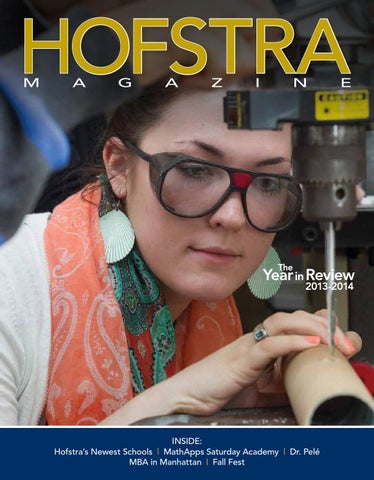
HOFSTRA M
A
G
A
Z
I
N
E
2013-2014
INSIDE: Hofstra’s Newest Schools | MathApps Saturday Academy | Dr. Pelé MBA in Manhattan | Fall Fest
Features President Stuart Rabinowitz
Vice President for University Relations and Publisher Melissa Kane Connolly ’89
812
Assistant Vice President for University Relations and Executive Editor Karla Schuster Executive Director of Design and Production Francis A. Rizzo III ’99
Scientific Method
Hofstra’s newest schools – School of Engineering and Applied Science and School of Health Sciences and Human Services
Creative Director Kelvin Fonville Manager of Editorial Services Linda Merklin University Photographer Zachary Lane Graphic Artist Denise Sarian Contributors Brian Bohl ’08, ’10 Ginny Greenberg ‘90 Neena Samuel Dina Santorelli ’90, ‘09 Colin P. Sullivan ‘09
14
with Samantha Hasher, MA, ’06
Renewing Their Vows
Contributing Photographers Brian Ballweg ‘77 Steve DiMaio Kathy Kmonicek Phil Marino John McKeith Janette Pellegrini ‘98
Hofstra Alums Stage Revival of Tony n’ Tina’s Wedding
University Archivist Geri Solomon Facebook “f ” Logo
The Art of Healing
CMYK / .eps
16
Facebook “f ” Logo
Fall Festival CMYK / .eps
facebook.com/Hofstra twitter.com/HofstraU linkedin.com/edu/hofstra instagram.com/hofstrau flickr/HofstraUniversity youtube.com/HofstraUniversity
Hofstra Magazine is published once each year by Hofstra University. Our goal is to provide the Hofstra community with exciting and informative news about Hofstra University and its alumni, students, faculty and staff. Hofstra University is committed to extending equal opportunity to all qualified individuals without regard to race, color, religion, sex, sexual orientation, gender identity or expression, age, national or ethnic origin, physical or mental disability, marital or veteran status in employment and in the conduct and operation of Hofstra University’s educational programs and activities, including admissions, scholarship and loan programs, and athletic and other school-administered programs. For more information, visit hofstra.edu/EOE.
18
Features continued
21
Game On
Hofstra professors launch game design academy for local middle and high school students
22
Hofstra Gives Back
Hofstra Celebrates “ The Beautiful Game” and the Legendary Pelé
A Winning Legacy
2428
A Few Minutes With …
Julio A. Portalatin, BBA, ’81; LHD, ’13
For the latest news about Hofstra, go to news.hofstra.edu
| President’s Letter Hofstra
See page 4.
2 013 -2 014 I n R e v i e w
3
A Letter From President Stuart Rabinowitz
Dear Friends, As you will see in the pages of this latest edition of the Hofstra Magazine, the 2013-14 academic year was defined by investments we have made in new schools and programs that serve the needs of our students as well as those of the community and the region. You will read about the extraordinary success of our newest schools – the School of Engineering and Applied Science and the School of Health Sciences and Human Services – which are riding a crest of surging enrollment on the way to becoming engines of economic development for decades to come. There are stories about the ways our students, alumni and faculty put their scholarship and skills to work enriching the lives of others. We profile an alumna who uses art therapy to help people with disabilities, and we highlight the charitable work of our student groups, some of which set new records for fundraising this year. And we take you inside an innovative math program, run by two education professors, that teaches local middle and high school students to design computer games. Other features chronicle the excitement of hosting the legendary soccer player Pelé during the largest international symposium on the sport in the United States, and the legacy of softball coach Bill Edwards, who retires as the winningest coach in Hofstra Athletics history. In these pages, you will learn about our new MBA program in Manhattan, and spend a few minutes with alumnus Julio A. Portalatin, who has risen to the top of his field as president and CEO of Mercer and recently joined Hofstra’s Board of Trustees. This has been an exceptional year, one fueled by the support of our alumni, the dedication of our faculty and administrators, and the enthusiasm of our students, whose successful journey is our sacred mission. Faculty, family, alumnus or friend, we are all part of the Hofstra community, and we are all part of the Hofstra story. We encourage you to visit campus, reconnect with your Hofstra family and become more involved with the University that will always be your home. Sincerely,
Stuart Rabinowitz
4
Hofstra
2 013 -2 014 I n R e v i e w
Hofstra University Spring 2014 Commencement
UPCOMING ALUMNI EVENTS • For information, call 516-463-6636 or email alumni@hofstra.edu. Wednesday, June 4, 2014 Hofstra Club of Washington, D.C. Spring Reception Chef Geoff’s Downtown, Washington, D.C. 6 p.m.
Wednesday, June 11, 2014 Long Island Regional Hofstra University Club Showcase Hofstra University Club, North Campus 6:30 p.m.
Sunday, June 8, 2014 Hofstra Alumni Book Club Winter’s Tale by Mark Helprin Libby and Joseph G. Shapiro Alumni House, South Campus 11 a.m.
Thursday, June 19, 2014 G.O.L.D. (Graduates of the Last Decade) Summer Networking Party Midtown 1015, NYC 6 p.m.
Tuesday, June 10, 2014 Hofstra Club of New Jersey/Rockland County Summer Cocktail Reception Oceanaire, Hackensack, NJ 6 p.m.
Tuesday, June 24, 2014 Hofstra Club of Southern Connecticut/Westchester County Summer Cocktail Reception Hudson Grille, White Plains, NY 6 p.m.
Sunday, September 14, 2014 Hofstra Alumni Book Club Orphan Train by Christina Baker Kline Libby and Joseph G. Shapiro Alumni House, South Campus 11 a.m. Thursday, September 18, 2014 Hofstra Alumni Organization Alumni Awards Dinner Garden City Hotel, Garden City, NY 6:30 p.m. Saturday, September 20, 2014 Hofstra Alumni Organization Hofstra Fall Festival/Alumni Day North Campus, Outdoors All Day
Hofstra
2 013 -2 014 I n R e v i e w
5
2013 Financial Report c Components of Revenue 2012-2013
Net Tuition & Fees 67.8%
Sales & Services of Educ. Depts. 0.6% Shared Services 1.5% Other Sources 2.0% Contributions 5.7% Government Grants & Contracts 2.5% Return – Endowment Available for Spending 3.7% Return – Endowment Other 5.0% Return – Operations 1.1% Auxiliary Enterprises 10.1%
Instruction 48.0%
Components of Expenditures 2012-2013 v
Research 0.8% Public Service 3.6% Academic Support 6.3%
Auxiliary Enterprises 11.5%
Student Services 12.7%
Here’s why: v Alumni support is measured by U.S. News & World Report and has a direct impact on the University’s ranking. Participation is critical. Our goal is to increase alumni participation each year. v Hofstra remains a university largely reliant on tuition. Your support and the growth of our endowment allows Hofstra to undertake new initiatives to maintain its excellent reputation. v Your gift provides for student scholarships, faculty support and program initiatives, and overall operations at Hofstra. v Your investment in Hofstra will allow the University to reach its annual and long-term goals. We need your help — every gift makes a difference!
Technology & Telecommunications 4.0% Printing, Mail Room & Public Safety 2.4% Supply Services 0.4% Public Relations 2.3% Legal & Human Resources 1.4% Development 1.4% Finance & Audit 1.9% Insurance 1.1%
Total Institutional Support 17.1%
Components of Endowment Support 2012-2013
c
Hofstra University relies on the generosity and philanthropic support of alumni and friends. This investment in the University is critical to Hofstra’s long-term success.
Other Institutional Support 1.3% Executive Office 0.9%
Funding for Scholarships 85.3% Endowed Scholarships 36.3%
Unrestricted 49.0% (Earmarked for Scholarships)
Business Development Center 1.3% Other 4.3% Endowed Chairs 4.7% Endowed Professorships 4.4%
6
Hofstra
2 013 -2 014 I n R e v i e w
Financial Report 2013 Hofstra’s financial strength reflects increased fundraising activities, strong endowment growth, strengthened operating margins, and enhanced control over expenses, particularly relating to health care and post-retirement benefits. Financial resources have increased by 347 percent during the last 10 years, and Hofstra continues to enjoy debt ratings in the A category from both Moody’s and Standard & Poors.
Millions of Dollars 500 450 400
Endowment Target: $500 million
350 300 250 200
c Endowment Investment Market Value
150
Hofstra University endowment investments grew to $360 million by 2013, increasing by 228 percent in the last 10 years. The University has set its sights on an endowment goal of $500 million to provide enhanced scholarships to better compete with institutions with significantly larger endowments.
100 50 0 1935
1974
1984
1994
2004
2013
Tuition Scholarships and Fellowships v A larger endowment gives Hofstra the edge it needs to attract and retain the most highly qualified students by providing a greater number of scholarships. The University continues to make the growth of tuition scholarships a top priority. During the past nine years, the University has increased scholarship funding by 170 percent to just over $93 million. That increase is reflected in the changing makeup of the student body. The fall 2013 average SAT score (Critical Reading and Math) for first-year students was 1155, up more than 100 points from fall 2000. Our first-time freshman high school GPA rose to 3.51 in fall 2013, compared with just 2.80 in fall 2000. Selectivity — the number of students accepted to Hofstra as a percentage of all those who apply — was 59 percent this year, compared to 80 percent in 2000. The percentage of students in the top 10 percent of their high school classes was 24 percent this year, compared to 12 percent in 2000. The percentage of first-year students from out of New York state was 47 percent, compared to 32 percent in 2000.
Millions of Dollars 100
During the last nine years, the University has increased its scholarship funding by 170 percent. 75
50
25
0 2004
2005
2006
2007
2008
2009
2010
2011
2012
2013
As of August 31,
Hofstra
2 013 -2 014 I n R e v i e w
7
Hofstra’s newest schools –
School of Engineering and Applied Science and School of Health Sciences and Human Services
– off to a strong start.
Scientific Method
8
Hofstra
2 013 -2 014 I n R e v i e w
“ There’s no question that the economy of the 21st century will involve a much-heightened need for health care professionals, and not just physicians. ... And clearly, we will need more engineers and computer scientists. The region needs entrepreneurs with science backgrounds. These [new] schools are a way to raise a flag.” — President Stuart Rabinowitz
“Being in this lab has inspired me ... having access to this equipment really showed me that with enough passion and interest, I can do amazing things that advance the fields of medicine and science.”
Frederick Smith had completed his freshman year as a mechanical engineering major when Hofstra announced it was turning the existing engineering and computer science programs into a School of Engineering and Applied Science. “I was in the library with a friend when I heard,” said Smith, who graduated in May 2014 and is heading to Columbia University for graduate school. “We both looked at each other and said ‘Wow – now when we graduate, our diplomas will say School of Engineering.’ We already had a great program. But in the last few years, I’ve seen more of everything – more equipment and more students and more diversity. It’s exciting to be a part of.”
– Nickolas Boroda ’16, biomedical engineering major.
Since 2011, Hofstra University has launched new schools – the School of Engineering and Applied Science and the School of Health Sciences and Human Services, investing more than $11 million in new equipment, facilities, faculty and programs. Both schools were created from existing programs. The new schools come hard on the heels of the opening of the Hofstra North Shore-LIJ School of Medicine, which will graduate its first class in 2015, and signal a new emphasis on the natural sciences and long-term plans to increase the University’s research footprint. “There’s no question that the economy of the 21st century will involve a muchheightened need for health care professionals, and not just physicians,” said President Stuart Rabinowitz. “And clearly, we will need more engineers and computer scientists. The region needs entrepreneurs with science backgrounds. These [new] schools are a way to raise a flag.”
Hofstra
2 013 -2 014 I n R e v i e w
9
Nearly half of the top 30 fastest-growing careers between now and 2020 are in the health or engineering fields, according to the U.S. Bureau of Labor Statistics. And the number of natural science and engineering bachelor’s degrees granted by U.S. colleges and universities has grown nearly 20 percent in the last five years, according to the National Student Clearinghouse Research Center.
At Hofstra, undergraduate enrollment in engineering and computer science programs has increased 69 percent since 2011, and the number of new freshmen has more than doubled in health sciences and human services.
At Hofstra, undergraduate enrollment in engineering and computer science programs has increased 69 percent since 2011, and the number of new freshmen has more than doubled in health sciences and human services. And when they arrive on campus, these students find programs that encourage them to participate in research, and courses taught by faculty committed to involving their students in meaningful work, inside and outside the classroom. When Corinne Kyriacou, associate professor of health professions, became the first director of Hofstra’s Master of Public Health program, she hoped to enroll students with a pioneering spirit. What she got was a juggernaut. That first class quickly organized a student chapter of the Society of Public Health Advocates (SOPHA), created a biannual newsletter and spearheaded the University’s celebration of National Public Health Week. In just its second year, Hofstra’s 2014 National Public Health Week celebration featured several panels, lectures, film screenings and interactive events, including a community health fair in partnership with the Nassau County Health Department. “Our first MPH cohort – within six months, they were knocking on my door saying ‘we’ve got to do a newsletter, we’ve got to do something for National Public Health Week,’” Kyriacou said. “We started with the idea that maybe we could do one event. They turned it into this incredible campaign. They pushed us, and it’s been incredibly gratifying.” Said Ronald Bloom, acting dean of the School of Health Sciences and Human Services: “There’s an incredible energy in the school, and I think we’ll see that only grow as we continue to add to the programs at HSHS.” Besides the Master of Public Health, the school will launch a minor in nutrition science in the fall.
10
Hofstra
2 013 -2 014 I n R e v i e w
ENROLLMENT GROWTH CHART: (Source: Office of Institutional Research, Hofstra University)
Fall 2011 New Freshmen
Fall 2011 Total Undergraduate
Fall 2012 New Freshmen
Fall 2012 Total Undergraduate
Fall 2013 New Freshmen
Fall 2013 Total Undergraduate
Fall 2014 New Freshmen*
Fall 2014 Total Undergraduate*
School of Engineering and Applied Science
69
307
70
311
141
430
178
520
School of Health Sciences and Human Services
n/a
n/a
45
347
84
379
92
450 *As of May 2014
In the School of Engineering and Applied Science, Hofstra is preparing to open new Big Data and Robotics labs in the fall, on top of the millions already invested in new equipment and facilities, including an atomic force microscope and a 3-D printer. The co-op program, which will provide students with practical experience with industry partners, will launch in spring 2015. What sets the school apart, however, isn’t all the new hardware, but who gets to use it. “Our students have access to every single piece of equipment from the moment they get here,” said Dean Simon Ben-Avi. “That puts you in a position where you can do research with faculty as a freshman, and that is pretty unique.” Take Nickolas Boroda, a sophomore majoring in biomedical engineering who has been conducting research using the atomic force microscope. “Being in this lab has inspired me,” he said, “... and having access to this equipment really showed me that with enough passion and interest in the subject, I can do amazing things that advance the fields of medicine and science.” But not everything at the School of Engineering and Applied Science is high-tech. For the freshmen in Mauro Caputi’s first-year design class, the challenge is to become problem-solvers who know how to communicate and work as a team. The class culminates in a final design project in which students must solve engineering challenges with a $15 budget and simple materials such as foam core, twine and glue. The challenges include building a device that can launch bagels over a six-foot wall or toss a hard-boiled egg across the room without breaking it. Caputi, an associate professor of engineering, runs his class like a game show – The Design is Right – and incorporates jokes, songs and video clips into the lessons. “I think students can be engaged in a variety of ways,” he said. “I like to engage them with comedy, by learning their names, by knowing a little bit about who they are. “This is not only a design class; we treat it as a transition from high school to college,” he said. “And when they finally leave Hofstra, I hope they remember this class and the fun they had and are able to translate some of the lessons into their lives and careers.”
Hofstra
2 013 -2 014 I n R e v i e w
11
Samantha Hasher demonstrates how artists use adaptive equipment used in art therapy at an exhibit of works from participants in local creative arts therapy programs hosted by the School of Health Sciences and Human Services.
The Art of Healing Art therapist Samantha Hasher, MA, ’06 chose to pursue a career that would allow her to
help people with disabilities foster personal development through a creative outlet. Along the way, she has nurtured the next generation of clinicians studying at Hofstra, in much the same way that she was helped as a student.
Hasher, a graduate of Hofstra’s Master of Arts program in creative arts therapy, works at the United Cerebral Palsy Association of Nassau County Inc. (UCPN) in Roosevelt, NY, where she helps 135 adults with cognitive and physical disabilities such as cerebral palsy, Down syndrome, deafness and blindness. The art therapies and techniques that she teaches in a program called Life Options encourage people with disabilities to discover new ways of self-expression that help build self-esteem, independence and healing. “I have learned a lot from working with people with disabilities,” she says. “In particular, that we are more alike than we are different. We are all people with feelings and emotions; we all experience happiness, sadness, fear and disappointment. We all want opportunities to succeed and feel good about ourselves.” She keeps strong connections with Hofstra: In February, she was on campus for an art gallery exhibit sponsored by the School of Health Sciences and Human Services featuring the work of artists from UCPN and another local center. The next month she returned to Hofstra for the annual creative arts therapy conference
12
Hofstra
2 013 -2 014 I n R e v i e w
“ I have learned a lot from working with people with disabilities. ... In particular, that we are more alike than we are different.”
— Samantha
where she led a workshop on how to create programs with the awardwinning Life Options format and reconnected with her mentor and former professor, Margaret CarlockRusso, now the co-director of Hofstra’s arts therapy graduate program. Hasher was introduced to UCPN when she began an internship at its Children’s Learning Center as a graduate student in 2005, an inspiring experience that she says convinced her that she was on the right path. Her supervisor at the time, Laura Buechler, is also an alumna of Hofstra’s graduate program. “Sam demonstrates caring and enthusiasm for the work she accomplishes every day,” says Buechler, who still works in UCPN’s children’s program and collaborates with Hasher on joint projects. “She has been able to bring all of the components of creative arts therapy – from art making to video creations and writing therapy – to the clients she serves. Her wonderful spirit spills into every area that she becomes involved with during the day.” Hasher was hired the following year for UCPN’s Life Options program, and in 2009 began supervising interns from local graduate programs. In the last five years, more than a dozen Hofstra students have interned in the art therapy program in Life Options. “I enjoy providing opportunities for students and helping guide them on their journey in the field,” she says. “It’s very meaningful to me because I was once in their shoes, and it’s especially important for me to work with Hofstra students because it’s my way of giving back.”
Hasher, MA, ’06
One intern, Jamie Coppola ’13, who worked more than 600 hours at UCPN, considers Hasher a mentor and calls her internship there “life changing.” Hasher, in turn, says, “Jamie always went above and beyond. She had a natural ability to connect with people, and made a lasting impact on us.” Coppola makes time to go back and visit with program participants, who still ask about her. Throughout her career, Hasher has not only taught the science and application of her discipline to interns, but she’s also shared her passion for advocacy. Coppola has joined her at rallies where they protested cuts to the state Office for People with Developmental Disabilities. Hasher, who just finished a term as president of the New York Art Therapy Association and now serves on its board as governmental affairs chairperson, has also traveled to Albany to talk to senators and state Assembly members about funding. “It’s important to advocate for those who do not have a voice.” She’s also taught her students the importance of advocating for their own success as well, and often shares with them how she got her job at UCPN. When she first joined the organization, the available position was as a science teacher. She used her art therapy skills to teach science in creative ways – making papier maché planets, digging in the sand for dinosaur bones, and creating a sensory book to study the five senses. In time, she earned her license and board certification as a creative arts therapist, approached her supervisor, and successfully campaigned for a title
Jamie Coppola ’13 working at UCPN internship.
change to art therapist. “I feel so happy that I was able to pave my own way and become the first art therapist at Life Options,” she says. “It took courage to ask for what I wanted.” It’s a story that UCPN intern Ling-Yu Lin ’15, an international student from Taiwan, has taken to heart. “Sam taught me that I should not be afraid of making mistakes.” For Lin, creative arts therapy is a chance to combine her two lifelong passions, psychology and art, both professionally and personally. “I draw a lot when I have pressure, and in my experience, art relieves my stress,” she says. “After studying at Hofstra, I learned that art did not just relieve stress, but it also has a healing power to help people.” She wants to use her degree and her experience at UCPN to open a similar center when she returns to Taiwan next year. Sam Hasher, meanwhile, continues her work at UCPN and plans to eventually open a private practice. She also has plans to be in Taiwan one day for the grand opening of Lin’s center.
Hofstra
2 013 -2 014 I n R e v i e w
13
Renewing Their Vows
HOFSTRA ALUMS STAGE REVIVAL OF TONY N’ TINA’S WEDDING By Dina Santorelli ’90, ’09
Here Comes the Bride. Again. And again. Tony n’ Tina’s Wedding, the smash interactive theater show, has returned to New York City for a 25th anniversary off-Broadway revival. The improv-style comedy, known for its use of warm, exaggerated stereotypes of Italian-Americans, is based on characters created by Hofstra drama alums Mark Nassar (’81) and Nancy Cassaro (’81). The first commercial production of Tony n’ Tina’s Wedding took place in February 1988, and the show would go on to run for 10 years in Greenwich Village before moving to Times Square, where it ran for another decade. There were also productions in cities around the country, including Atlantic City, Chicago, Dallas and Denver, as well as performances in Japan, Australia and many European cities.
The original Tony and Tina – Mark Nassar and Nancy Cassaro, both Class of ’81
14 14
H Hooffssttrraa
22013 013-2 -2014 014 IInn RReevviieew w
The revival brings the party back to Midtown for its two-part event: a traditional wedding ceremony held at Chapel at Jacqueline Kennedy Onassis High School (formerly the location of Performing Arts High School), followed by a reception at Guy’s American Kitchen & Bar on West 44th Street, to which the bridal party escorts family and friends through the heart of Times Square and Shubert Alley.
“
“
Hofstra Ties
The Hofstra ties run deep.
— Joe Corcoran ’82
“The whole idea of the show was really born at Hofstra, with Hofstra students,” said the revival’s producer Joe Corcoran (’82), who produced the commercial production in 1988. He also played one of Tony’s groomsmen in a few of the original performances. “A lot of the creators were from Hofstra.” Indeed, some recognizable names were part of the first weddings of Tony and Tina back in the day, including Elizabeth Dennehy (’82), Judy Sheehan (’82), Moira Wilson (’81), Monica Horan (’84) and Phil Rosenthal (’81), creator of Everybody Loves Raymond. And Hofstra continues to be an important part of the Tony n’ Tina legacy: The current revival features Jon Kayser (’81-’82) as a marketing director, Rob Basso (’94) as an associate producer, and Hillary Needle (’89) as a corporate consultant, among other grads. “When Joe reached out to me to join the Tony n’ Tina team, I was so excited to collaborate with him,” said Needle, who met Corcoran a few years back while she was serving as the event planner for fellow alum Basso’s book launch party for The Everyday Entrepreneur (Wiley, 2011), in which Corcoran was featured. “It’s even more special knowing that so many Hofstra alumni are part of the infrastructure of this iconic show,” Needle said. “The Hofstra ties run deep,” Corcoran said. More than 500 people auditioned for the 25 roles of the current production, including actor Joe Ferraro, son of Hofstra alumnus Joe Ferraro Sr. (’81), who plays the lead role of Tony. A year ago, Ferraro, 25, of Smithtown, N.Y., met Corcoran for a casual lunch with no intentions of discussing the revival, which was in its infancy stage. But the two hit it off. Corcoran later asked Ferraro to perform in regional productions of Tony n’ Tina’s Wedding, and it was during those performances that Ferraro met Tony Lauria, who is directing the Times Square production.
Rob Basso Title: Associate Producer Tony n’ Tina’s Wedding Year graduated: 1994 Major: History Education What he’s doing now: Rob is the president of the Freeport, N.Y.-based Advantage Payroll Services, the region’s largest independently owned payroll services provider. He is also a sought-after speaker, TV personality and published author.
Jon Kayser Title: Marketing Director Tony n’ Tina’s Wedding Years at Hofstra: 1981-1982 Major: Engineering What he’s doing now: Jon is president of InSiteMarketing, a Bedford, N.Y.-based strategic marketing consulting firm that specializes in working with small- to mediumsized companies utilizing “experiential” marketing in traditional advertising and new media to help clients enhance brand equity and expand business relationships.
“My father has always been a huge supporter of anything I do, and without him, I would have never met Joe,” Ferraro said. “The friendships he built at Hofstra 37 years ago are still strong to this day.” The revival of Tony n’ Tina’s Wedding will rely mostly on the successful formula the show was built upon, while taking full advantage of the latest advances in technology, particularly social media, that were not around when the show was conceived. “Social media serves our genre better than any other kind of show,” Corcoran said. “When people come to our show, we’re going ask them to turn their phones on, not off. We’ll encourage them to share their photos and their experiences with their friends before, during and after the show. “Last time, we ran for 20 years,” Corcoran added. “With this revival, I’m hoping we can do the same.”
Hillary Needle Title: Corporate Consultant Tony n’ Tina’s Wedding Year graduated: 1989 Major: Communications/Print Journalism What she’s doing now: Hillary is president of Hillary Needle Events Inc., a Dix Hills, N.Y.-based event planning company that offers a broad range of event planning, marketing and PR services to corporations and not-for-profit organizations. She was recently named one of the Top 50 Most Influential Women in Business by Long Island Business News. Hofstra
2 013 -2 014 I n R e v i e w
15
s e i r o m e M l a v i 2013 Fall aFndeAszizt Ansari headlined the 2013 Fall Festival – Ray Kesha, Sugar t and Family Weekend. en Alumni, Stud
16
Hofstra
2 013 -2 014 I n R e v i e w
2014! , 1 2 9 1 r e b m Septe r’s festivities –
e summer for this yea th y t u d o a h g e u r ro t th e G tival s e lf l a f / u d e . a r r’s events. t a s e f y o is h th t to u o d b e Stay tun r information a fo
Hofstra
2 013 -2 014 I n R e v i e w
17
Game On Hofstra professors launch game design academy for local middle and high school students
18
18
Hofstra
2 013 -2 014 I n R e v i e w
Ideas and questions came like keystrokes, quick and sharp, as the roomful of designers brainstormed concepts for new computer games. How about a game set in a classroom, one designer ventured, where the main character is a student trying to sneak out? Another asked: Would there be obstacles like a teacher or a security guard locking the door? What about other types of traps – like a dead-end path? Or maybe, a third designer suggested, the game should be set up like a scavenger hunt in which the student would have to find different keys to escape the classroom. Roberto Joseph, an associate professor of educational technology, smiled. This was just what he had in mind when he and Blidi Stemn, associate professor of math education, launched Hofstra’s MathApps Saturday Academy, a game design program for local middle and high school students. “You guys are getting concepts just like my college kids here at Hofstra,” he told the group of about 25 students one morning about a month into the program. “No idea is a bad idea,” he said. “The key word is ‘goal.’ What is the goal of the game? That’s a decision that as a designer, you have to make early on.” The goal of the MathApps Saturday Academy, supported by a $30,000 grant from Motorola’s Innovation Generation program, is simple: teach math skills by making them a means to an end, namely building a game that kids want to play. “They’re thinking – ‘I want my ball or my character to move from this point to that point, and how do I do that?’” Joseph said. “Now they’re motivated to learn math to make it happen.” Every Saturday morning, the diverse group of about 50 students in grades 6-9 spend three hours on campus with Joseph, Stemn, and several Hofstra students. They split up into two groups, and spend half their morning on game design, and the other on math skills, solving problems they don’t traditionally encounter in school to build logical reasoning ability.
‘‘
No idea is a bad idea ... The key word is ‘goal.’ What is the goal of the game? That’s a decision that as a designer, you have to make early on.
“This is like an adult class right now,” said Paras Patel, Joseph’s graduate assistant, who is in the second year of Hofstra’s MS program in computer science. “I didn’t think they would get it. I gave them less credit than I should have. But they get it. They all get it.” Franshuas Rodriguez will be among the first to earn a degree from Hofstra’s new Technology for Learning program, which began in fall 2013. She is working with the MathApps Saturday Academy for one of her graduate classes. Two other students in the graduate program, Christopher Dazzo and Susan Byrns, as well as an undergraduate math education major, Ethan Batterman, also help out with the academy.
’’
— Roberto Joseph Hofstra
2 013 -2 014 I n R e v i e w
19
19
‘‘
Technology is just another language ... It’s their language. If you’re going to be an educator, you need to be savvy about this.
’’
— Franshuas Rodriguez
“I’m learning and teaching at the same time,” she said. “I’m not just behind a computer; I’m actually able to implement this in a classroom setting with students.” Rodriguez, a foreign language teacher, envisions using game design to teach principles of grammar to her students at Smithtown Christian School, a parochial high school in Smithtown, N.Y. “Technology is just another language,” she said. “It’s their language. If you’re going to be an educator, you need to be savvy about this.” Nicolette Auld-Griffith, 12, a seventh-grader at Valley Stream South High School, loves solving math riddles and puzzles. “Three hours on a computer?” she said, her eyes widening. “I love this.” The MathApps Saturday Academy even made a morning person out of Caroline Doglia, an eighth-grader at Wisdom Lane Middle School in Levittown, N.Y. “It’s kind of like a whole new world,” she said. “I don’t like waking up early on Saturday mornings, but I don’t mind for this.” After the brainstorming session that morning, Joseph put the students to work with Scratch, a free programming language used to create stories, animation and simple games. He took them through how to use keyboard strokes to create sounds and movement. “Now, just play around with it,” he said. “This is just the beginning.”
20 20
H Hooffssttrraa
22013 013-2 -2014 014 IInn RReevviieew w
Hofstra Gives Back St. Baldrick’s Day Hofstra students, faculty and staff shaved their heads and raised $37,760 – a new record – for children’s cancer research at the sixth annual St. Baldrick’s Day event on March 12, 2014. Among the first to get shaved was Provost and Senior Vice President Herman Berliner, who had agreed to go under the clippers if fundraising hit $25,000. Dr. Berliner was joined by Andrew Fierstein, a first-year health science student fighting bone cancer, and Honors College Senior Associate Dean Neil Donahue, who captained a team on Andrew’s behalf.
Relay For Life Despite rainy skies and chilly temperatures, hundreds of students, staff and community members, including cancer survivors and caregivers, walked for more than 12 hours as part of the annual Relay For Life event in April, raising $83,000 for cancer research – the most among all colleges and universities on Long Island.
Badges of Honor Hofstra University recently launched a program that awards virtual merit badges for student accomplishments, including athletic and academic achievements, community service and leadership. The Merit Program, which began in June 2013, is a new way to highlight student accomplishments such as graduation, being named to the Dean’s List, becoming a member of an honor society or winning an award. When a student is awarded a merit badge, a merit page is automatically created for the student with an image of the badge and a description of the achievement. The student receives an email with the badge and a link to his or her merit page. The badges can be shared on social media channels.
Hofstra has awarded more than 10,000 badges to students since June 2013. Students can customize their merit page with a picture and profile information, and can add other badges to represent their work experience, internships or club memberships. Their merit page also features a “follow” button, so their friends and family can keep track – and share the news – when a badge is awarded.
A student’s personal merit page can be accessed through Hofstra University’s institutional merit page at hofstra.meritpages.com, which lists all achievement badges awarded by Hofstra. Hofstra
2 013 -2 014 I n R e v i e w
21
Hofstra Celebrates
“The Beautiful Game” More than 300 scholars, journalists, and fans from 25 countries convened at Hofstra University in April to examine the economic, political, and social impact of soccer, and celebrate legendary Brazilian and New York Cosmos player Pelé, who was awarded an honorary degree for his humanitarian work and contributions to the sport. The conference, Soccer as the Beautiful Game: Football’s Artistry, Identity and Politics, was the largest international academic symposium about the sport in the United States. Pelé is the honorary president of the New York Cosmos, the team he led to a championship almost 40 years ago. The Cosmos are the reigning 2013 NASL champions and play at Hofstra’s James M. Shuart Stadium. Hofstra recognized Pelé with the conferral of an honorary degree as well as the unveiling of a plaque to commemorate his visit and the conference; the plaque will be permanently installed at the Hofstra Soccer Stadium. The conference included three days of panels, the honorary degree convocation and a youth soccer clinic at Shuart Stadium for more than 300 local children.
22
Hofstra
2 013 -2 014 I n R e v i e w
and the Legendary
PelĂŠ
The conference was presented by the Hofstra Cultural Center in collaboration with more than a dozen academic and sports institutions, including the Cosmos, the Consulates General of South Africa and Brazil in New York, and the United States Soccer Federation. Hofstra history professors Dr. Brenda Elsey and Dr. Stansilao Pugliese were the conference co-directors.
Hofstra
2 013 -2 014 I n R e v i e w
23
A Few Minutes With …
Julio A. Portalatin, BBA, ’81; LHD, ’13 President and Chief Executive Officer, Mercer Julio A. Portalatin became president and CEO of Mercer, a global consulting leader in talent, health, retirement and investments, in January 2012. Before joining Mercer, he was president and CEO of Chartis Growth Economies, a division of American International Group (AIG). During his time at Chartis/AIG, he served in a number of senior positions, including president and CEO of Chartis Emerging Markets; president and CEO of Chartis Europe S.A. and Continental European Region; president of American International Underwriters’ (AIU) Worldwide Accident & Health Division; president of AIU’s Personal Lines Worldwide Division; president and general manager of AIU Seguros Interamericana in Mexico; executive vice president of AIU’s Latin America Division; and vice president–property for Lexington Insurance Company, part of the Commercial Insurance Group (now Chartis US).
In 2000 Mr. Portalatin was elected by the AIG board of directors to the position of vice president and in 2007 to senior vice president. Prior to joining AIG in 1993, Julio Portalatin spent 12 years with Allstate Insurance Company in various executive product underwriting, distribution and marketing positions. He actively supports several nonprofit charitable organizations, including the American Cancer Society, St. Jude Children’s Research Hospital, and Homefront of New Jersey, which seeks to end homelessness. In 2004 he traveled to Thailand after the tsunami to provide much-needed aid to orphaned children. In addition, he has participated in Covenant House’s CEO SleepOut, to help raise awareness and funds for homeless youth. He also supports African women entrepreneurs in Uganda through micro-financing. In May 2013 Mr. Portalatin was awarded an honorary doctorate and served as guest speaker for Hofstra’s graduate commencement. A few months later, he was appointed to Hofstra University’s Board of Trustees. 24
Hofstra
2 013 -2 014 I n R e v i e w
You transferred to Hofstra after getting your associate degree at Suffolk County Community College. Why did you choose Hofstra? Hofstra was one of those schools that offered an opportunity for me to be able to stay close to home and get a great education. The quality of the education was very much a motivator for me. It was also important to stay close to my family – we were going through tough times as a family. Hofstra allowed me to have the balance I needed. I also remember my first day seeing some different lifestyles that I had never seen before. I loved the fact that I grew accustomed to being in an environment like that, which allowed me to be much more diverse in my thinking and to open up my mind about the world as being much larger than the community I grew up in or the state I grew up in. You want college to be something you have not yet experienced. You should be thinking about it academically and socially and as kind of a cosmopolitan environment that allows you to see what you haven’t seen before. And Hofstra was that for me. Were you involved in many campus activities or clubs? I always had a fondness for trying to get involved with activities that did one of three things – expanded my social network, expanded my level of expertise in my interests, or expanded my ability to make a difference. I was a member of the Society for Advancement of Management, and I was a Student Government Association senator and became treasurer. That was an incredible experience – managing a budget of well over $1 million and really being able to understand it, not just the financial aspects but the human aspects. All the clubs and groups came before us to ask for their funding, and there was a lot of passion behind those presentations. I think in many ways these types of things add a lot to your college experience, and I would venture to say that they prepare you as much for the future as the classroom environment does. Can you think of any experience as SGA treasurer that you continue to draw on today, or that helped prepare you for your career, or that influenced your leadership style? It was the Sunday before budget presentation on Tuesday. We all met at my house, with folding chairs and folding tables, and we had all these adding machines all over the place. We basically came together as a team and put that budget together on that day. It was the first time that I can recall I was under such intense deadline pressures up against some very important decisions that had to be made. It’s the first
time I remember having that degree of combination of forces coming together all at once, and ultimately it led to a very disciplined thinking process, and to working together with students and others to get something done. What do you remember about your professors at Zarb? I had professors who were incredibly by the book and theoretical, sometimes out of necessity, and there were others who were very practical and very much current. I kind of liked the balance that I got from that. Collectively, they were all pretty darn good. It was during my time at Zarb that the school was really beginning to gain momentum, and because of that, people there were willing to try new things. I remember conversations about how we could bring a ticker-tape environment simulating the stock exchange in real-time, and of course, now we have that exact type of setting at the school (with the Martin B. Greenberg Trading Room). What makes a good leader? When you think about great leaders that we all can agree on – they have a couple of really important traits. One is that they realize that there’s a moment in time when something or some group or some cause has to be taken to another place. They think about things like they are today and what needs to change to bring it to another place. It’s the capacity to evaluate a situation, to understand where it is today and to take an organization to another place, a better place. You have to operate on the premise that there’s always a better way, always a better place. Then the question is, “How do you bring everyone along a path, along a journey to be able to reach that other place?” You have to define some sort of path to get there, a journey that people can visualize not only in a holistic sense but also where they can answer the Hofstra
2 013 -2 014 I n R e v i e w
25
question, “What part do I play in reaching this new destiny?” It’s very important that that connection happens; otherwise, you look behind you and no one else is there. You have to be very transparent in the way you communicate. If people sense that there’s a hidden agenda, they tend to lose confidence in leadership and tend to become very disenchanted You as a leader can never give up on where you want to take them. They have to see that commitment in you as a leader and that passion in you. You have to be pretty insistent, clear and transparent. And you have to have some degree of passion and inspiration behind it and stay on message. One of the greatest quotes I always try to use when I talk about leadership comes from Mark Twain. He said, “There are two important days in your life, the day you are born and the day you find out why.” A leader has to always be in search of the why.
I would encourage students to go see the world and get experiences that can help you build your personal character, as well as your opportunities for success.
Did you set out to become a CEO? What were your goals when you were at Hofstra? I never decided to be a CEO. What I decided was that I wanted to make a difference, and that’s manifested in many ways, whether it’s in community service – working with homeless youth in New York City or working to promote cancer research – or in business. In business, the more success you achieve, the more difference you have the potential to make. When I was a rising senior, I was sitting at one of the tallest points on Long Island – Bald Hill, it was called – and across from there, there’s this beautiful, big, white building in the middle of a green pasture. I turned to my friends and said, “one day I’m going to work in that building.” They all laughed, of course. I had no idea even what company it was.
“
I graduated in May 1981, and in June 1 applied for a job in that building. It happened to be Allstate. I was one of six people hired. I started supervising people and liked what I was doing. So my goal was to continue to ascend to positions of increasing responsibility. The goal was just to keep advancing, keep
26
Hofstra
2 013 -2 014 I n R e v i e w
putting yourself in positions to make a broader difference in the organization. You’ve traveled extensively for your work. Did you always have an interest in global business? When I was going to high school and starting at community college and going to Hofstra, I was thinking in the moment. I was very focused on my world and how to position myself to make a different in the future. I was rarely thinking about the world bigger than my local place. As time went on, it was apparent that the world was becoming much larger ... it was starting to dawn on me that the experiences I had before had to be expanded. When I started out, I worked in an environment that was predominantly domestic. I found ways to get people at least interested in thinking about globalization. Anytime I touched anything global, it inspired me to do more. Eventually the change in career was the fact that I wanted to go to an organization with an established global footprint so I could really learn what it takes to understand business success in a multicultural international environment. So I spent 20 years at AIG, and I really got exposed to the world. I really got the opportunity to visit and do business in many, many different cultures. I’ve traveled to 70 countries and more than 100 cities. What advice would you offer to a Zarb student today, particularly as it relates to globalization? I truly believe that the same kind of movement I talked about in my life – from local, to a little bit more expansive, touching a little international to becoming truly global – that’s the type of transition students should really be thinking about. With all the types of instruments we have available today, I can as easily text someone in Japan as I can text you in the next office. That opens up an entire world. I would encourage students to go see the world and get experiences that can help you build your personal character, as well as your opportunities for success.
HOFSTRA TAKES MANHATTAN
The Frank G. Zarb School of Business is launching an accelerated MBA program in Manhattan. The new program – for working professionals – begins in the fall and can be completed in less than three years. This marks the first time Hofstra has offered a degree program in New York City. The MBA in Strategic Business Management is a 41-48 credit hybrid program (online and on-site), with on-site classes to be held at Manhattan Eye, Ear & Throat Hospital on East 64th Street, between 2nd and 3rd Avenues. The facility is part of Lenox Hill Hospital, which is a member of the North Shore-LIJ Health System. [North Shore-LIJ partnered with Hofstra to open a new medical school on campus; the school welcomed its inaugural class in August 2011.] The first cohort in Hofstra’s NYC MBA program will be 25 students, with a maximum total enrollment of 100. Fueled by an influx of students from China and India, enrollment in the Zarb School’s graduate programs now stands at about 1,200 students, nearly double what it was four years ago. The New York City program is one of several new initiatives at the Zarb School. In fall 2013 the school created the Dean’s Business Scholars Program to provide experiential learning to high-achieving first-year students throughout their college careers. The charter group of Business Scholars visited the United Nations and Google headquarters, and participated in small group discussions with successful alumni, including the school’s namesake, Frank G. Zarb. Hofstra also launched an on-campus living-learning community for first-year business students called the Zarb House. This community, which hosts weekly potluck dinners with faculty and administrators, has proved so popular that the University is adding a Zarb School themed-housing community for upperclassmen in September 2014. For more information about the new MBA in Manhattan, go to hofstra.edu/mbamanhattan.
Hofstra Athletics
A Winning
Legacy
Before his first game a quarter-century ago – long before he had to fill out his first lineup card or make his first pitching change – Hofstra Softball Coach Bill Edwards had to contend with a broken-down pitching machine. Back then, the equipment inventory consisted of a bucket of balls and small bag of bats. The team had to fight for practice time on a grass multipurpose field with four dirt cutouts that was used by several athletic teams, including the New York Jets. More than 900 wins and 25 years later, Edwards in May announced his retirement, having never logged a losing season. Along the way, Hofstra softball got its own stadium, made 15 NCAA Tournament appearances, and has appeared on ESPN’s family of networks several times. Edwards has won 12 regional Coach of the Year awards. “In the world of collegiate softball, the name Bill Edwards is synonymous with success,” said President Stuart Rabinowitz. “His remarkable tenure at Hofstra was marked by student-athletes’ excellence on the field and in the classroom. He built the Hofstra softball team into a nationally prominent program, and his contributions to the University community are greatly appreciated. As his distinguished career as a coach and a teacher comes to close, I wish him the best on his retirement.” Edwards ends his Hofstra career with a record of 928-419-3 and a winning percentage of .687, making him the winningest coach in the history of Hofstra Athletics. “It’s hard to put into words what Bill Edwards has meant to Hofstra University and our softball team,” said Jeffrey A. Hathaway, vice president and director of athletics. “His tireless work ethic, along with many exceptional assistant coaches and student-athletes, created a winning culture that is the envy of most programs in the nation. The Hofstra Softball program is what it is today because of the outstanding work of Bill Edwards.” Associate Head Coach Larissa Anderson will succeed Edwards. “It’s been a great run and so much fun to work with so many great student-athletes,” Edwards said. “The timing is perfect to turn it over to Larissa, who I respect and admire so much.” Edwards’ collegiate softball coaching career started at Hofstra, though he was instructing young student-athletes long before he arrived on campus. The former physical education teacher in the Commack school district served as a baseball and football coach from freshmen to varsity. Hofstra represented his dream job. 28
Hofstra
2 013 -2 014 I n R e v i e w
Hofstra Athletics
Edwards is the winningest coach in Hofstra Athletics history.
“When I was halfway through my teaching career and coaching high school athletes, I always knew my ideal situation would be a full-time college job because I love to teach and my passion has always been on the athletic field,” Edwards said. “Regardless of whether it was a hockey rink or a baseball diamond or a softball field, I always wanted to work with a special group of student-athletes who would go out every day and put themselves on the line. Being a full-time college coach allowed me to do that. It was living the dream.” Edwards talks freely about the early, early years when both the head coach and assistant Bella Totino were part-time coaches with a full-time dedication to the program. Totino, who played at Adelphi, was instrumental in recruiting in the program’s early years,
which brought four NCAA Tournament appearances between 1993 and 2000. Edwards said he learned much about recruiting and building a program from the likes of Totino and Caryl Drohan, who was the program’s first full-time assistant coach (Edwards was still part-time). Anderson continued that successful tradition after coming to the program following Drohan’s departure, and has spent 13 seasons with the team, including a decade in her current position. “It was the best hire I ever made. She’s so creative and intelligent, and has helped take the program to another level,” he said. “She’ll present things from her generation rather than my generation and has done a great job promoting the program. It’s been a remarkable run.” Hofstra
2 013 -2 014 I n R e v i e w
29
Hofstra Athletics He’s stoic, however, when asked about his own remarkable career. “I thought more about losing and correcting my mistakes,” Edwards said. “I don’t even have a clue as to the numbers and milestones.” Edwards said he was more concerned with the impact his staff could have on his student-athletes, who readily sing their former coach’s praises. Olivia Galati, a two-time All-America selection as a pitcher who is currently playing professionally in the National Pro Fastpitch league, finds herself using Edwards’ words when she is coaching her junior varsity squad in Bay Shore. “I’ve caught myself using his sayings, like ‘Am I speaking Portuguese?’ or referring to opponents as ‘Bazooka State,’” Galati said. “All the memories I have of him, whether on the field or in his office talking about life, have been great. There’s just something special about him that makes you feel like you can do anything.” Galati said she isn’t surprised Edwards avoids talking about his own records. “He’s all about teaching life lessons,” she said. “He’s not about stats and doing things for himself. He’s completely dedicated to his players.”
30
Hofstra
2 013 -2 014 I n R e v i e w
Fifth-year senior Rachael Senatore came back to Hofstra after taking a medical red-shirt last season. The Sparta, N.J., native played centerfield and batted leadoff in Edwards’ 900th career win. “It meant so much, not just for the wins but to do something special for someone who has turned this program into a dominant force in the nation every year,” Senatore said. “You can’t even measure how much he’s helped. He changes your outlook on life. He invested every ounce of his being into every player that comes through. He focuses on life lessons every single day. It’s amazing to see him interact with the young players now that I’m older, because you see what he is trying to pass on.” Senatore earned first-team All-CAA and NFCA First-Team All-Northeast Region honors in 2012, helping Hofstra to its firstever NCAA Super Regional appearance. An injury sidelined her last season, but Senatore said Edwards was still able to impart one of most important lessons of her time with the program. Weather problems, which can be a problem early in the season, had been wreaking havoc with the field. With Senatore unable to practice, Edwards made a point of saying that if an individual wanted something to change, that person needed to go out and get it. The next day, a perfectly manicured field awaited the team, and Senatore assisted in making it happen. “It was really indicative of him as a person,” Senatore said. “When he saw it, he came over to me and said ‘did you learn something today?’ and then walked away. It was one of those special things that was a simple experience, but you step back
Hofstra Athletics and say, ‘wow, he was right, I did learn something.’ That’s how every day is with him.” Anderson has had a unique view for many of Edwards’ milestones. “As much as it’s a credit to Bill, it makes me so proud that I can be there to be a part of it,” Anderson said. “We’re a family. The players refer to us as mom and dad, and we’re all in this together.” “The most impressive thing is that he’s done it in the northeast. We’re still practicing indoors into late March, and we go out and play the toughest schedule we possibly can,” she said. “It’s remarkable that we’ve been able to reach 900 wins in such a short time with some of the limitations that come with where we are located.” Before becoming Edwards’ top assistant, Anderson watched the program with great interest. With her husband, Patrick, an assistant baseball coach at Hofstra at the time, Anderson, a former assistant coach at nearby LIU Post, sat in on workouts and games and watched the team’s clinics. “I knew they were a national program right here in my backyard, and I wanted to learn as much as I could,” Anderson said. She worked with Hofstra Summer Camps the year Drohan left. She stayed in the dorms during that time and paid close attention to Edwards’ lesson plans. When it came time to interview for the open position, Anderson sat in his office and, following a long conversation, was asked one question.
“Here I am, this cocky assistant who was looking to get into Division I,” she said. “After we talked about the game, he asked what I was thinking. I said it was a no-brainer. You either hire me now or I’m going to come back with another team and beat you. He hired me on the spot, which was pretty cool.” The hire has led to plenty of hardware, with 10 conference titles and nine NCAA Tournament appearances. With Anderson calling the pitches in the dugout, Hofstra pitchers have won the last seven Colonial Athletic Association Pitcher of the Year awards and nine of the last 10 with Callie Osborne, Kayleigh Lotti and Galati each earning multiple awards. From the rink, where Edwards served as Iona College’s hockey coach from 1968 to 1979 and earned induction into the school’s Hall of Fame, to the gridiron and baseball diamonds as a high school coach in Commack, to his time at Hofstra, Edwards’ goal has always been the same. “If I have said something inspiring or taught them anything or influenced my players in any way,” he said, “then everything was worth it.”
S BROADCAST E IN L N O E S LIV NS LAUNCHE IO T C U D O R PRIDE P n relations?
ure on foreig at guest lect th r fo r o e, ch r the big gam oduc tions, whi to campus fo it e ak m ’t called Pride Pr s. an ic C et hl at I n io a new service is
ed Div ity has launch uding NCA A ofstra Univers ra events, incl H st – of H m le ct le ob se pr No d seven asts of online broadc of 19 games an ts as dc ctors, oa br produces live ho ac t as dire produced ra students w ber 2013, has st ve of em H ha ec D of ts in en tly n d mos 30 stud hich bega am is compose ors. More than te at t The service, w er as s. op dc em oa ay st pl br sy ast and re ts. The art HD broadc and graphics academic even camera crew, ith state-of-the w s, e or nc ct re rie di pe l l as a great s-on ex technica service, as wel r, getting hand ity fa un so m m ed at co ip a partic t for University on. It is s of our missi , vice presiden rt lly pa no y ide on ar C im sa pr o id Melis y year, and Pr tions fulfills tw ic events ever r students,” sa em ou ho r ad w fo ac ts “Pride Produc ity d en un an e stud hletic arning opport same time, th of cultural, at experiential le ence. At the rs thousands di so broadcasts.” au on a er sp er id m ra w st ca h of to a muc live, multiem on th Relations. “H ng to ki ss or ce w rience ovides ac mmitted valuable expe Produc tions pr program is co uc tions get in ic od et Pr hl e at id ur Pr d ay: “O work with e statistics an rey A. Hathaw dcasts, real-tim Athletics Jeff oa of br or ct ns es ire tio iti D uc od portun ident and udes Pride Pr e exciting op Said Vice Pres twork that incl ts. All of thes ne l en ehensive ta pr em gi m di nc co a ha e g en with a mor to providin nal future ns tio fa di r ad ou e as l id el prov as w program and social media, s.” our athletics en Pride athletic th ith ng w re ct st r ra te in d furthe an es m Hofstra ga d. way to follow wing.
future vie UPridePro archived for uctions at @H e d ar ro s P st e d ca ri P ad ro w You can follo Most of the b
Hofstra
2 013 -2 014 I n R e v i e w
31
Non-Profit Org. U.S. Postage PAID Hofstra University
Hempstead, New York 11549 Vol. 26 No. 1 • The Year in Review 2013-2014
52587:5/14
Scientific Method
See page 8.