INFRASTRUCTURE SOLUTIONS
Issue 16 — 2017
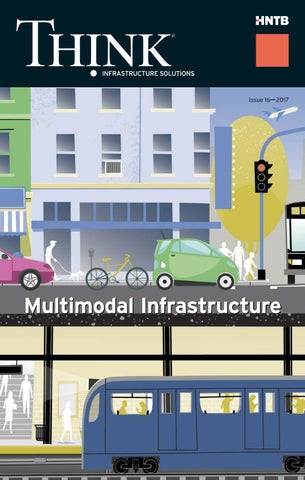
Multimodal Infrastructure
HNTB is an infrastructure solutions firm providing award-winning planning, design, program management and construction management services. HNTB is an equal opportunity employer M/F/V/D.
hntb.com @HNTBCorp facebook.com/HNTBCorp linkedin.com/company/hntb instagram.com/HNTBcorp
Published by the Corporate Communications and Brand Optimization Department of the HNTB Companies, P.O. Box 412197, Kansas City, MO 64141. Patricia Mosher, senior vice president, pmosher@hntb.com Phyllis Schallenberg, editor, pschallenberg@hntb.com
THINK is available to view on both Apple and Android devices through the HNTB App. Access this issue along with other HNTB publications, thought leadership and more. Download from the App Store ® and Google Play.TM Recycled with 10% post-consumer waste. © 2017 HNTB Companies. All rights reserved. Reproduction in whole or in part without written permission is prohibited.
Topics
This edition of THINK highlights the increasing importance of multimodal transportation solutions to create a more efficient and sustainable system that boosts economic growth and improves quality of life for people across the nation.
4 8 12 15
More Modes, Less Fragmentation Facing congestion, rising populations and financial constraints, transportation agencies are collaborating and innovating in new ways. For many, a focus on developing multimodal transportation solutions is helping to address a range of issues while improving service and efficiency within cities, across regions and beyond.
Cradle of Evolution Among a range of multimodal strategies being advanced in California’s Contra Costa County is the acceleration of practical solutions to the critically important first-mile/last-mile challenge. Randy Iwasaki, Executive Director of the Contra Costa Transportation Authority, tells how an aging military installation and a burgeoning office park have become laboratories for innovation, hastening advances in autonomous and connected vehicles while promising more seamless mobility options.
History and Destiny An anticipated population boom in California’s Riverside County is being met with a multifaceted strategy to create infrastructure that can meet burgeoning demand. Anne Mayer, PE, Executive Director for Riverside County Transportation Commission, tells how multimodal thinking and action have helped the county optimize mobility to provide economic benefits.
Getting Down to Business In Florida, a reinvented partnership is advancing innovative solutions to regional challenges, with mobility as a top priority. Rick Homans, President & CEO of the Tampa Bay Partnership, explains why investments in multimodal transportation will be critical to the region competing with others in the nation by retaining and attracting talent, jobs and companies in the years ahead.
THINK ISSUE 16 — 2017
3
MORE MODES, LESS FRAGMENTATION
Technology and regional collaboration will yield solutions for tomorrow’s transportation challenges Transportation agencies nationwide continue to grapple with a host of challenges as they strive to provide constituents with safe, effective and sustainable mobility options. Depending on the city or region, these challenges take the form of aging infrastructure, maintenance backlogs, traffic congestion, environmental concerns and, most universally, financial constraints. Fortunately, 2016 was a year in which transportation funding showed signs of turning the corner after a decade of uncertainty. Funding tied to 2015’s Fixing America’s Surface Transportation (FAST) Act began to flow, with $305 billion supplied by this important five-year bill. Completing the picture, voters in 22 states committed their tax dollars to better transportation, approving ballot measures that will deliver more than $200 billion in new revenue and funding extensions for state and local projects. This uptick in funding, combined with the urgent issues that transportation agencies face, is creating a significant opportunity (and increased pressure) to collaborate and innovate. Transportation leaders increasingly are looking to publicand private-sector partners to develop solutions that benefit from their combined ideas, relationships and financial resources. In similar fashion, they are placing bigger bets on technology — harnessing innovation that addresses today’s problems while also preparing for more effective transportation systems tomorrow.
4
THINK ISSUE 16 — 2017
Multimodal Moves
One common theme is that agencies are increasingly committed to pursuing multimodal transportation solutions — those that offer people an organized and efficiently connected network of mobility options within a city, across a region and beyond. In an ideal environment, an individual could access a multimodal network from virtually any location, choose the most advantageous mode of travel and reach his or her destination safely and efficiently. What’s more, these individuals would be able to reach their destinations by combining biking, walking, driving, taking trains and buses, or accessing any number of on-demand services (such as cabs, ride-hailing and ridesharing). Some cities and counties are moving closer to this ideal, both to deal with traffic and environmental issues and to sustain economic growth by attracting business and high-value workforces. However, in much of the country, there still is a long journey ahead. This is partly because transportation agencies have traditionally been managed and funded as discrete entities with highly focused missions, making regional cooperation a challenge. Also, until very recently, there were few tools available to help diverse agencies stitch together their assets efficiently.
Commonly, the result of these challenges has been a suboptimal user experience. A person who commutes into many metropolitan areas today might experience scenarios like this: • Checks traffic situation on home computer; all clear, so decides to drive in • Uses GPS unit in car and Waze on smartphone to monitor any arising traffic congestion • Pays highway toll using windshieldmounted transponder (and is relieved that credit card is still connected) • Receives accident alert, decides to switch strategies — to leave highway and access commuter rail • Takes nearest exit, navigates to parking lot, which is already full; drives to a farther lot, pays all-day fee with credit card • Jogs one-half mile to train platform; hastily uses credit card to buy round-trip ticket at kiosk • Rides train into the city, disembarking at a station that connects to local bus service • Waits for bus to workplace or, if time is short, hails a cab
Such a scenario illustrates several common issues with navigating our transportation system. First, despite the sophisticated information systems employed within each travel mode, the commuter still must integrate this information on the fly to successfully hopscotch from mode to mode. Second, the commuter must complete three to four different financial transactions, any one of which could hit a glitch that would disrupt the trip. Third, and most critically, one’s blood pressure may rise simply by reading the list of steps above — let alone experiencing a daily gauntlet of uncertainty, gadget-juggling and precarious leaps between modes. We have the opportunity to take our multimodal transportation system to a new level — to make such challenging travel scenarios obsolete for commuters and casual travelers alike. Interconnected transit and transportation systems — combining forces to integrate and deliver information and consolidate payment systems — can provide a more seamless customer experience. Importantly, a multimodal approach also can serve to distribute usage more evenly across the overall transportation system. When given the right information in real time, people will determine for themselves the fastest, most efficient and most comfortable
Innovations Coast-to-Coast Population growth in California is driving rapid innovation in the transportation sector, particularly as it applies to multimodal solutions. The transportation authority in Contra Costa County, for example, is helping to cultivate autonomous and connected vehicles as a means to move people efficiently between modes. The Authority has transformed an old military station into the country’s largest secure testing facility for autonomous and connected vehicle technology, which is being used by a range of private-sector partners. At the same time, the Authority is launching real-world tests of completely autonomous shuttle buses in a large office park, which promises to provide first- and last-mile connections for those using the county’s extensive bus system. About 400 miles south in the same state, Riverside County’s transportation authority is pursuing a multifaceted strategy to expand mobility options for a rapidly rising population. They recently completed a 24-mile extension of the region’s commuter rail service, the first such extension in more than two decades. The Authority also is working to ease one of the nation’s worst commutes through a $1.4 billion project that includes tolled express lanes, giving more commuters the option of paying for more predictable travel times. Finally, the Authority launched an educational program to ease the learning curve for Riverside County residents who could benefit from public transportation but haven’t yet tried it. Meanwhile, on the East Coast, the Tampa Bay region is pursuing multimodal solutions that are tied to that region’s unique geography and political context. They also are undertaking a massive project to improve the region’s highway system, including the addition of 90 miles of tolled express lanes to ease congestion, enhance bus service, and pave the way for autonomous and connected vehicle traffic. Led by an innovative regional partnership, Tampa Bay also is piloting an entirely new transportation option: a high-speed ferry between Tampa and St. Petersburg, which is making highly efficient use of a massive bay that was long viewed as merely an obstruction to regional travel. n THINK ISSUE 16 — 2017
5
THE NEAR-TERM AVAILABILITY OF FEDERAL FUNDING, COMBINED WITH MORE ROBUST AND SUSTAINABLE LOCAL FUNDING IN MANY AREAS, REPRESENTS A UNIQUE OPPORTUNITY TO PLAN AND IMPLEMENT MULTIMODAL SOLUTIONS.
6
THINK ISSUE 16 — 2017
trip from Point A to Point B. Armed with estimated travel times and associated costs for multiple modes of travel, they will be unlikely to choose (and thereby worsen) the day’s most congested routes. In essence, people’s decision-making processes can align more dynamically with the capacity of the transportation system at that moment. Everyone wins.
The Future: Complete Trips
It is important to acknowledge another trend that is accelerating the transition to a multimodal transportation system. This trend is the expansion of “transportation as a service” beyond urban areas to include first suburbs and then, theoretically, to reach virtually every part of the country. Traditionally, it has been easy to divide means of mobility into two groups: “shared/ rented” versus individually “owned.” Among the shared means have been rail systems, buses and other vehicles, airplanes and ferries, taxis and the like. People know that tax dollars, tickets or fees contribute toward the availability and upkeep of these shared assets. In urban areas, where public and commercial transportation options are robust, it has long been common to see people commute and conduct their daily lives using solely these shared assets. By contrast, in the less-populated suburbs and the country, people traditionally have “owned” their means of mobility. They’ve done this out of necessity: even if a bus were to stop nearby, it could not deliver them to the precise locations they’d want to visit in the course of a week. Thus, they were forced to absorb all the expenses of “owning” — loan payments, taxes, maintenance and fuel, and city parking fees — to support a vehicle that, statistically, might be in motion and providing value only about 5 percent of the time. This traditional “share vs. own” paradigm is now slowly evaporating because of ondemand transportation options such as car sharing, ridesharing, bikesharing and ride-hailing apps. Many suburban Americans are exercising these new options to attend to daily needs and reach public transportation, eliminating their need for a car … or at least a second car. Thus, the lines between sharing, renting and owning means of mobility are rapidly blurring. When autonomous vehicles ultimately become ubiquitous, these lines will nearly vanish. Transportation is likely to exist primarily as a service, which people will purchase as they need it, wherever they are, based on their requirements for convenience, speed, comfort and cost.
Public transportation leaders are particularly well-positioned to shape and accelerate this trend toward pay-as-yougo transportation. As it becomes easier to access, transit can become even more essential to mobility than it has been in the past. But, this will require public transportation organizations to expand beyond their traditional roles as system operators to become mobility managers who provide a suite of integrated solutions to the public through partnerships, tighter coordination, savvy use of technology and other skills. The product will thus be “complete trips” rather than merely legs of a journey self-assembled by a traveler, resulting in a superior user experience and greater efficiency across the system.
Looking Forward
The near-term availability of federal funding, combined with more robust and sustainable local funding in many areas, represents a unique opportunity to plan and implement multimodal solutions. Already, many transportation agencies and private-sector companies are coming together to identify opportunities to expand services, integrate modes and seek efficiencies in the bargain. The public’s appetite for broader mobility options is increasing, and the technology needed to integrate those options is advancing rapidly. We will seize this historic opportunity to reshape our transportation system. n
THINK ISSUE 16 — 2017
7
Cradle of Evolution How California’s Contra Costa County is improving mobility and creating jobs through partnerships, constituent engagement and new solutions to the first-mile/last-mile challenge. By Randy Iwasaki
Executive Director, Contra Costa Transportation Authority
In late September 2016, California Governor Jerry Brown began writing the next chapter in transportation history by signing the nation’s first bill allowing for the testing of true selfdriving vehicles — those with no steering wheels, brake pedals or accelerators — on public roads. The bill’s scope is currently limited to our home, Contra Costa County, where we are engaging our community and an array of partners to create practical, multimodal solutions to our transportation challenges. Right now, California — like many other states — is at a unique crossroad in transportation innovation. Although the challenges may be great, we have a unique opportunity to re-envision our system to make it more responsive, safe, efficient, accessible, and environmentally and fiscally sustainable.
WE ARE FORTUNATE THAT THE TAXPAYERS IN OUR COUNTY HAVE BEEN STEADFAST IN FUNDING A HIGH-QUALITY TRANSPORTATION SYSTEM. In recent years, the CCTA has been taking significant steps to seize this opportunity. With a staff of 20 professionals, we are accountable for planning and executing transportation strategies for a county covering roughly 800 square miles, which extends eastward from the San Francisco Bay. Right now, our rapidly growing county has about 1.1 million people, and that population is predicted to grow 29 percent by 2040. 8
THINK ISSUE 16 — 2017
Naturally, it’s a challenge to continue maintaining the infrastructure we have now, while creatively preparing for ever-increasing demands on the system. But, we are fortunate that the taxpayers in our county have been steadfast in funding a high-quality transportation system. In 1988, and again in 2004, they voted to approve a 1/2 -cent sales tax that is directly linked to transportation. There is a tacit understanding that CCTA will invest wisely to deliver the greatest impact for every tax dollar. One of the ways that we do this is through leveraging our local sales tax dollars to obtain other sources of state, federal and regional funding. We strive mightily to hold up the end of the bargain that we’ve made with voters — following a credo of “Promises Made, Promises Kept.”
Pricelessly Old
Part of our charge at CCTA is to look beyond traditional responses to transportation issues — to innovate and be a catalyst for other positive benefits to the community. When I first joined CCTA, Susan Bonilla — who is now a member of the county assembly and sponsor of the vehicle-testing bill Gov. Brown signed — approached me with a question: Was there a way to create smart jobs in our county by making use of a World War II-era military base that would soon be made available to us? So many people from the county commute to San Francisco — why not figure out a way to create high-tech jobs right here? If you have ever been on a military base, you’ll know that some are like small towns enclosed in fences and sometimes beyond maintenance. Some of the buildings and roads on a military base are old, weathered and outdated. Such was the condition of the infrastructure at Concord Naval Weapons Station, which is exactly why I could see its enormous potential as a test bed for connected and autonomous vehicles.
At Caltrans, I oversaw the research program, which taught me the necessity of testing new approaches to infrastructure challenges — to work in the real world of crumbling concrete and faded signs. Thus, to my eye, the former Concord Naval Weapons Station’s antique infrastructure was essentially priceless in the context of testing autonomous vehicles. It provided, for very little money, a series of challenging and imperfect roads and tunnels that would cost millions of dollars to build from scratch. Fast forward to today. The 5,000-acre test site, which we’ve named GoMentum Station, is the largest secure testing facility for autonomous and connected vehicle technology in the United States, with more than 20 miles of paved roadway. Our strategy from the outset was to both advance transportation concepts and create smart jobs. Since then, we have established partnerships with vehicle manufacturers, communications and technology companies, researchers and public agencies, which are testing their innovations and creating jobs. As these talented people do their work, CCTA gains valuable insights that inform our planning and policy decisions.
Bridging the Last Mile
As I mentioned, the newly signed California bill has authorized testing of true autonomous vehicles on public roads. Such clearance has not been essential so far because our tests have taken place within the confines of the secure GoMentum Station. However, in the next phase of CCTA’s program, we will be testing how vehicles will interact with the public and, to some degree, roadway traffic.
More importantly, these vehicles will have a chance to show exactly how they can impact the first-mile/last-mile challenge and fit into our multimodal vision of the future. The real-world testing will take place at Bishop Ranch, a major business park in San Ramon. The business park houses major headquarters and operations for Ford, GE, Chevron and JPMorgan Chase as well as hundreds of other companies. It’s also soon to be home to a large development with residential units, government offices, a hotel, cinema and more. To serve this “city within a city” we offer a range of bus services, including several express buses that connect Bishop Ranch with the Walnut Creek station of the Bay Area Rapid Transit (BART) system. Currently, passengers transfer from BART, catch their bus and enjoy a swift journey to Bishop Ranch — only to be stuck winding their way through the business park with multiple stops at different buildings. This last mile can sometimes take half the time of the entire journey. In an upcoming test, we aim to eliminate this problem using a new concept: autonomous shuttles. We have obtained two such shuttles from a French company called EasyMile, each of which has six seats and room for six additional people to stand. These shuttles, which operate at under 25 mph, are designed to act as a relay partner for our buses completing “the last mile” of commuters’ journeys. Once we test this shuttle concept, we envision a future in which passengers will disembark from buses at a transfer station, step onto an autonomous shuttle, and move THINK ISSUE 16 — 2017
9
WITH AUTONOMOUS VEHICLES, WE ULTIMATELY COULD HOST MORE THAN 3,000 VEHICLES PER LANE, PER HOUR — ABOUT A 50 PERCENT INCREASE IN CAPACITY OVER THE AMOUNT OF VEHICLES WE CAN ACCOMMODATE RIGHT NOW.
10
THINK ISSUE 16 — 2017
along seamlessly to their destinations. Meanwhile, the buses will be free to pick up new passengers, and continue their journey to other transfer stations. It’s easy to imagine how much more efficient and accessible transportation will be when each leg of the multimodal relay is performing optimally: trains travel greater distances at great speeds (potentially high-speed rail); buses use designated lanes on highways for optimal travel times; and shuttles complete the journey.
Transparency and Engagement
For us, innovation isn’t limited to the laboratory (or test range). It’s a group effort that involves many diverse stakeholders. CCTA has been particularly active in reaching out to the community, both to share our vision and to better understand their needs. For example, we recently inverted the dreaded “robo call” concept to positive effect by inviting residents to call us, increasing public participation with thousands of people calling in to join a telephone town hall discussion about transportation. During our outreach efforts, we received more public comments than in the previous 25 years of CCTA-sponsored public meetings. We learned a lot about the challenges people face connecting between transportation modes, fighting traffic and even parking. It was a great, highly productive process. In similar fashion, we have taken the time to engage public officials and interest groups to help ease what can sometimes become polarized debates. We recently began the process of creating an express lane, which had encountered initial resistance until we took stakeholders to a successful system in another county. They saw the concept in action and now, just a short time later, we are on our way to implementing a system that will help manage highway congestion much more efficiently than simply building more lanes.
I travel often to other states to speak to other transportation leaders about our projects and the challenges we’ve faced. Each conversation is unique, but we often discuss autonomous vehicles and how these leaders foresee a dogged sentiment that these high-tech vehicles are bound to “go haywire” and kill people. But, is that really the doomsday scenario we should be talking about? Think about this terrible reality: Last year 38,300 people were killed and 4.4 million injured in vehicle accidents. And, statistically, 90 percent of accidents are the result of driver error. How many deaths could we prevent by adopting autonomous vehicle technology as soon as possible? Additionally, we are all striving to reduce highway congestion and emissions. With autonomous vehicles, we ultimately could host more than 3,000 vehicles per lane, per hour — about a 50 percent increase in capacity over the amount of vehicles we can accommodate right now. How many billions in new lane construction, and how much pollution and commuter time, could we save if we achieved this increased highway capacity through advanced vehicles? How many hours spent in gridlock could now be freed to spend with friends and family? We have amazing opportunities before us. What we need is the ability to seize them through allocating more money to visible products, to recruiting a new talent pool and to engage new partners as we move into a new era of transportation innovation that’s like nothing we’ve witnessed before. n
About the Author Randy Iwasaki serves as Executive Director of the Contra Costa Transportation Authority, where he is responsible for the overall management of the Authority, including its projects, programs, policies and procedures, the board-approved budget and all personnel decisions. Randy has served the Authority since April 2010. Prior to joining the Authority, he served at the California Department of Transportation (Caltrans) for almost 27 years, serving in engineering and management positions, including as the organization’s director. He earned his bachelor’s degree in engineering from California Polytechnic State University, San Luis Obispo, and a master’s in engineering from California State University, Fresno.
THINK ISSUE 16 — 2017
11
History and Destiny Among California’s fastest-growing places, Riverside County is adopting creative strategies for accelerating development of multimodal transportation options. By Anne Mayer, PE
Executive Director, Riverside County Transportation Commission
Riverside County, California, is in a race against time. Today, with a population of about 2.3 million, our county’s transportation infrastructure is already under strain. Yet, by 2035, this population could surpass 3 million, based on projections by the University of California at Riverside, which itself is among the fastest-growing campuses in the state system. This growth translates to a net increase of 30,000 people per year, every year. Thus, Riverside County Transportation Commission, which I lead under the direction of a 34-member board of directors, faces a major challenge: How do we get the right mobility infrastructure in place before more people get here? To give you a sense of our challenge, Riverside County covers roughly the same land area as New Jersey, but shaped in a long, horizontal rectangle that extends eastward from Los Angeles. The county is very diverse demographically and geographically, with urban and suburban areas, wineries and farms, mountains, valleys and deserts. Such diversity, coupled with its rapidly increasing population, makes it critical that our team works closely with other stakeholders to advance holistic transportation solutions that improve mobility as well as the economy and quality of life.
Facilitating Smart Growth
From a transportation perspective, helping to address the county’s escalating housing needs is a top priority. Housing demand outpaces supply, mainly due to the relative affordability of real estate. Market prices are always changing, but a home that costs $325,000 to $400,000 in Riverside might go for $500,000 in neighboring Los Angeles County and even $700,000 in neighboring Orange County. This price difference, combined with the ability to choose one’s
12
THINK ISSUE 16 — 2017
lifestyle — from urban centers of bustling activity, to desert life in the Coachella Valley, to suburban quiet, to equestrian trails — means that our county will continue to have homegrown growth and a greater influx of new people, from millennials to retirees. By extension, RCTC also is focused on supporting job growth by ensuring that transportation is an enabler, not a hindrance, to economic development. Recently, a survey revealed that traffic congestion, the economy, crime prevention and the environment were of citizens’ top concerns. We need to make sure we have a 21st century solution to match current market conditions and meet employee needs. To meet our goals, we know that we cannot simply spend our way out of the congestion problem. We are fortunate to have a part of the steady funding levels we need through 2039, thanks to a 1/2 -cent dedicated sales tax, which voters supported in 1988 and extended in 2002. However, federal and state funding remains unpredictable and might require an increase in our sales tax rate in the future. Funding will remain a critical constraint as we strive to create the right infrastructure we need for the future. As a result, we have to be financially prudent and responsive, and continually fulfill our “Promises Made, Promises Kept” commitment to voters. This means that we need a well-thought-out, multimodal approach to transportation. The status quo will not suffice.
Connecting Modes
The solution is in providing multiple travel choices. Multimodal thinking has permeated our approach to optimizing mobility for many years. One result is the recently completed, 24-mile extension of the Metrolink 91/ Perris Valley Line, an expanded commuter rail service that brings a needed transit alternative to communities along the
congested I-215 corridor. The $248.3 million project, which added four new stations, is the first extension of the region’s Metrolink service since 1994. This new option, which began operations in June 2016, allows more people to access swift public transportation to commute within the county as well as to seamlessly connect outside it, all the way to Los Angeles Union Station or major job centers in Orange County. RCTC launched the extension project in 2002, and it took more than a decade to surmount regulatory and litigation hurdles before construction finally began in 2013. We were very pleased when the new line received a “Hard-Won Victories Award” from the Inland Empire Section of the American Planning Association. The award recognized RCTC’s planning efforts, which were developed and endorsed amidst varying viewpoints. And, of course, we are very proud to offer a safer, more comfortable and more predictable commute to many thousands of people every day. We understand that people’s quality of life improves when they have some certainty about how long it will take to travel from one place to another. It’s stressful to always wonder: Will I get to work on time? or Will I make it to the soccer game? So, to achieve greater travel certainty while generating many other benefits, RCTC has made tolling a key element of our multimodal strategy. Our first tolling effort, which will go into operation in 2017, is part of a large project involving State Route 91 in the Corona area. The $1.4 billion improvement project is adding regular lanes, tolled express lanes, auxiliary lanes and direct express lane
MULTIMODAL THINKING HAS PERMEATED OUR APPROACH TO OPTIMIZING MOBILITY FOR MANY YEARS. connectors, as well as improvements to interchanges, ramps and surface streets along the 91 corridor. This stretch of highway in Riverside County ranks as one of the nation’s worst commutes, with stop-and-go traffic as the norm during rush hours. By including a toll option, we will give individual drivers a chance to pay for more predictable, congestion-free travel, while still providing carpoolers with faster travel. The revenues, of course, will help to fund the highway’s construction, maintenance and operations. From a multimodal perspective, the tolled lanes also allow us to operate CommuterLink Express buses with greater frequency and faster travel times. These buses connect commuters to a range of business parks, shopping malls and regional transit facilities. Yet another priority in improving the overall efficiency of our transportation system is to invest in active transportation improvements that enhance the use of bicycles or that increase pedestrian access. The combination of active transportation investments with public transit can be especially effective in solving the challenge to the “last mile” that connects commuters to their final destinations.
THINK ISSUE 16 — 2017
13
Watch the Gap
It’s important to understand that for multimodal options to work, they must be navigable by as many people as possible. Yet, there is a learning curve. For any one transit mode, you must learn its routes, schedules and fares. Then, if you’re connecting modes, such as taking a bus to a commuter train, it adds another layer of complexity. For those who are disabled or elderly, this process can seem so daunting that they never take the first step — even though public transportation might be a great fit for them.
IT’S IMPORTANT TO UNDERSTAND THAT FOR MULTIMODAL OPTIONS TO WORK, THEY MUST BE NAVIGABLE BY AS MANY PEOPLE AS POSSIBLE. At the Riverside Transit Agency, an agency we fund and Western Riverside County’s primary bus operator, they’re taking steps to bridge this experience gap. The agency, which operates buses and serves the county’s western side, offers a free personalized travel training program to disabled and older individuals, as well as to veterans. Participants get help from a travel trainer who takes the time to understand their needs and to customize a process — including classroom and hands-on training, and even special travel days — to help them learn the steps and experience the benefits of using transit. The program has been very successful. RTA received amazing, very touching letters from people, thanking them for making such a difference in their lives. It’s true that, for people who cannot drive and have always had to rely on friends or family to travel any distance, being able to navigate a local transit route confidently is a game-changer.
Getting (and Staying) Creative
Major investments in transit systems and highways get the most public attention, and we’re very proud of them. But, it’s also very gratifying to see how a small amount of investment can make a huge impact for people. In the far eastern part of our county is a town called Blythe, an agricultural community far removed from most of the county’s other urban centers. Awhile back, we conducted a workshop there to learn about people’s transportation challenges. A major issue that surfaced was that many people were driving for hours one-way to get certain types of health care, such as chemotherapy and dialysis. Veterans had to make the same trip. In many cases, the patients were reliant on others to help them get to these life-affirming appointments. We felt that we needed to help address this, so we collaborated with other groups, including health care professionals, and supported a shuttle service to ease the travel burden for the people of Blythe as they sought to get the care they need. This service was one of only a few to receive a federal grant from a program recognizing the need for connections between transportation and healthcare services. In our many collaborations, we have found that listening to constituents, getting creative, and striving to achieve broader, mutual goals for communities have enabled us to change the everyday lives of the people of Riverside County. Such approaches also will serve us well as we create responsive, multimodal options for the hundreds of thousands of new arrivals we will welcome to our county in the decades ahead. n
About the Author Anne Mayer, PE, is Executive Director for Riverside County Transportation Commission in California. RCTC is the county’s primary transportation planning and funding agency, with an annual budget of $680 million. Before joining RCTC as Deputy Executive Director in 2005, Anne was the District 8 Director for the California Department of Transportation, managing the state highway system in San Bernardino and Riverside counties. She has more than 33 years of experience in the public works field.
14
THINK ISSUE 16 — 2017
Getting Down to Business In Florida, a reinvented partnership is drawing on the skills of diverse leaders to advance regional solutions to regional challenges — with mobility as a top priority. By Rick Homans
President & CEO, Tampa Bay Partnership
Wrapped around a 4,000-square-mile estuary, and encompassing the cities of Tampa, St. Petersburg, Clearwater, Lakeland, Sarasota and Bradenton, the Tampa Bay region has long been recognized for its spectacular beauty and rich culture. The job market is strong, the cost of living is fairly low and the quality of life is excellent. Yet, despite these strengths, Tampa Bay is at a critical crossroads that will determine its future economic vitality. While other metropolitan areas in America’s southeast, such as Charlotte and Atlanta, have invested in transportation infrastructure to sharpen their competitive edge, Tampa Bay has largely stayed in a holding pattern. Our transportation assets, although right now not alarmingly out of sync with our needs, are clearly showing signs of strain. Congestion is increasing right along with population, and if we don’t invest in multimodal transportation soon, we risk falling behind in the coming years when it comes to retaining and attracting talent, jobs and companies. Study after study shows that companies look closely at employee mobility when they decide to locate or stay here. Similarly, college graduates decide whether to come, and then remain, based on the region’s quality of life and opportunities. If they do not see us as a community that provides a wide array of mobility options, they will take their talents elsewhere. Tampa Bay will feel it acutely in the next decade, in terms of employment, wages and economic growth. In my experience, transportation is one of the most important drivers of economic growth in a region. Recently, I had a conversation with a prominent local business leader who said that if we don’t solve Tampa Bay’s transportation problem, we soon may find ourselves growing at a quarter to half of the 2-percent rate we
should expect. That’s a huge “opportunity” cost that we must acknowledge. Why have we not invested more aggressively in transportation? While the Tampa-St. Petersburg-Clearwater MSA is one of the top 20 metro areas in the U.S., we traditionally operate as a collection of individual municipalities and counties versus a single metro area. In other words, we don’t have a lot of experience or success at regional planning, coordination or leadership. What’s more, our community has a history of being reticent to fund transportation infrastructure, as evidenced by a series of failed tax referendums at the ballot box.
IN MY EXPERIENCE, TRANSPORTATION IS ONE OF THE MOST IMPORTANT DRIVERS OF ECONOMIC GROWTH IN A REGION. The Tampa Bay Partnership, for which I am CEO, is striving to fill this regional leadership void in a way that is creative, collaborative and comprehensive. Our role is to unify the region’s most influential business leaders and a diverse group of community stakeholders to address Tampa Bay’s most challenging economic issues. The result: Tampa Bay becomes more competitive, and therefore, more prosperous. Transportation is at the top of our list of priorities.
Putting Mobility in the Fast Lane
Multimodal transportation relies on giving people options to meet their expectations for speed, predictability and price. With this philosophy in mind, the Florida Department of Transportation announced at the
THINK ISSUE 16 — 2017
15
beginning of 2015 that it would undertake a comprehensive $3.3 billion project, called Tampa Bay Express, to increase capacity and reduce congestion on the major highways that run through Tampa Bay. Along with rebuilding bottleneck-plagued interchanges and the 10-mile Howard Frankland Bridge, FDOT proposed the creation of 90 miles of express toll lanes in Tampa Bay. The goal of this effort, as it has been in other metro areas, would be to reduce congestion by giving drivers the choice of paying a toll in return for a more predictable trip time. Drivers could reasonably anticipate speeds of 45 miles per hour, even during rush hour. Even more importantly, the lanes would host public transit vehicles, such as express buses or bus rapid transit, allowing quicker and more reliable service, thus making them even more attractive to commuters. Adding this specialized lane also would create a platform for future innovations, such as autonomous vehicles. As the study proceeded, the critics surfaced. Neighborhood leaders complained of poor communication; transit advocates argued that the state should stop funding highway improvements and focus instead on light rail. At the Tampa Bay Partnership, we understood that critics’ assertions, if left unanswered, would eventually represent reality in the public debate. We were convinced that the region needed a strong
16
THINK ISSUE 16 — 2017
advocate to explain why the largest public works project in the history of the region was critical to quality of life and economic vitality in Tampa Bay. We also agreed that communication and engagement could be improved, and parts of the project could be redesigned to address concerns. Accordingly, we stepped into the role of advocate, building a broad coalition of those with common interests by detailing how the project would contribute to economic growth, attract employers and give people more transportation options. We emphasized how TBX would provide, finally, a way to offer public transit with schedule-certainty, rebuild the connecting bay bridge with structural support to carry rail technology and provide a 44-foot highway median that could be used as a transit envelope. Importantly, we emphasized how reducing congestion and increasing capacity would improve quality of life, by letting parents spend less time in traffic and more time with their families. We conducted informational meetings, made effective use of social media and a website, and quickly responded to criticisms with facts and reason. Due in part to these efforts, and the diligence of members of our coalition, the TBX project continues to move forward, and we are happy to see that FDOT is working to address the legitimate concerns that were raised by neighborhood and community leaders.
Exploring Multimodal Transit Options
During the debate over TBX, we found ourselves in strong agreement with many community leaders who were calling for the development of multimodal transit options that could include light rail, bus rapid transit, ride share and/or autonomous vehicles. That’s why the Partnership applauded FDOT when it allocated $1.5 million for the community, under the stewardship of the Hillsborough Area Regional Transit Authority, to undertake what is now called the Regional Transit Feasibility Plan. This plan, encompassing the three counties of Hillsborough, Pasco and Pinellas, is scheduled to be complete by mid-2018 and it will present, for the first time, a vision for a regional transit system, provide a phased implementation plan, and propose the first phase in the form of an application for project development to the Federal Transit Administration. The Partnership views the planning work as a critical first step and we want to be ready to implement the plan when it is complete. That’s why we are working hard with business, community and political leaders to ensure that we have the right regional structures in place to support a regional transit system. Today, Tampa Bay is one of two of the top 20 metro areas that lacks a unified MPO to provide regional transportation planning. We are supporting efforts to consolidate three county MPOs into a single, regional MPO. Likewise, we currently have separate transit agencies for Hillsborough, Pasco and Pinellas Counties. The Partnership is supporting efforts to create a regional structure for transit operations. The Partnership also is investigating how we might be able to secure the local funding that will be necessary to implement an effective regional transit system. We are studying public-private partnerships, referendums and direct support from local, state and/or federal governments. Finally, we are working closely with the firms that are managing the study, including HNTB, to ensure that they look seriously at all forms of transit, including ride share, autonomous vehicles and even gondolas.
Super-highway of Water
Amidst all the planning, we witnessed in the past few months a genuine transit success story in Tampa Bay. As I noted, a 4,000-square-mile estuary forms the heart of our region. This bay is among our greatest shared economic assets, but we have to
invest a lot in transportation infrastructure to connect our communities. Glance at a map of Tampa Bay and you’ll see the network of highways, causeways and bridges we’ve built over many decades to circumvent or traverse the bay. This strategy has served us well, but in 2015 we decided to review with a fresh eye new options for improving regional mobility. A key insight was that we had long viewed the bay as a barrier, rather than as an opportunity. The bay’s surface had the potential to provide a zero-maintenance, direct-line platform for launching a ferry service between two of our major cities, Tampa and St. Petersburg. Leaders from St. Petersburg, Tampa, Hillsborough County and Pinellas County came together to explore the potential of a high-speed, cross-bay passenger ferry. Rather than attempt to advance a plan for a large-scale operation, they decided to start small: a six-month pilot project involving just one ferry, to give the community enough time to gauge consumer interest and gain real-world experience into how such a service should operate. The pilot project would cost only $1.5 million. This vision came to fruition in early November 2016, as a 149-passenger catamaran ferry made its inaugural trip between the Vinoy Basin in downtown St. Petersburg and the Tampa Convention Center in downtown Tampa. I was proud to be on this historic journey. Since then, ferries have been making the same 50-minute trip every day: during the first month of operations, 7,400 people used the service. The proponents are continually surveying passengers to gain insights into how to refine the service, with the possibility of expanding it if demand and economics affirm its viability. At the Partnership, we support this creative, yet fairly obvious, mobility option and we celebrate the underlying success. It’s a perfect example of the region coming together as one community to create transportation connectivity.
Dynamic Business Drivers
To advance the regional solutions we envision for Tampa Bay, we recognized the need to dramatically change the Partnership’s structure. Last year, we moved away from public funding sources and reinvented ourselves as a privately funded, CEO-driven advocacy organization, thus gaining greater flexibility to engage and activate leaders across the private and public sectors who are instrumental to achieving economic growth in the region.
THINK ISSUE 16 — 2017
17
In October 2016, the “new” Tampa Bay Partnership came into being. Our new structure, involving a by-invitation-only group of leading executives in the region, is unique to Tampa Bay. Our sole governing body is our Council of Governors, which may comprise up to 40 highly influential and regionally minded CEOs. These executives, who will invest at least $50,000 in the Partnership annually, are distinguished by their track record of business leadership, influence and civic engagement. They are committed to making the Partnership’s public policy initiatives a priority. We are gaining additional intellectual and financial support from our Leadership Council, which may comprise up to 40 companies, private non-profits and individuals. These council members, who will invest at least $25,000 in the Partnership annually, are directly engaged in advancing the Partnership’s regional priorities through our public policy working groups. Importantly, the members of these two leadership groups represent a broad crosssection of private institutions including representatives from health care entities and insurers, sports teams, nonprofits, professional services firms, banks, transportation, energy, telecommunications, real estate, consumer products and information technology companies.
I’m confident that we’re on the path to answering that question with a resounding yes. We’re bringing together private, public and non-profit leaders to look at Tampa Bay as one unified market. With a collaborative spirit, this coalition is striving to build out a regional transportation solution that will impact our quality of life in so many ways. We’re also fortunate to have excellent support in Tallahassee and a strong congressional delegation in Washington, D.C., that is paving the way for success. What we have in front of us is a clear window of opportunity. We intend to take advantage of it. n
The Road Forward
Tampa Bay faces a fundamental question as it relates to transportation: Are we prepared to work together to leapfrog our infrastructure so that, rather than just catching up to other regions, we become a model for others to follow? That’s the question we’re seeking to answer through the Regional Transit Feasibility Plan.
About the Author Rick Homans is President & CEO of the Tampa Bay Partnership, whose mission is “to create a unified, competitive and prosperous region.” Before assuming this role in November 2015, Rick served as President & CEO of the Tampa Hillsborough Economic Development Corporation, the lead economic development group for Hillsborough County. A Boston native, he spent 32 years living in New Mexico, where he served in the cabinet of Governor Bill Richardson, first as Secretary of Economic Development and subsequently as Secretary of Taxation and Revenue.
18
THINK ISSUE 16 — 2017
The HNTB Companies Infrastructure Solutions