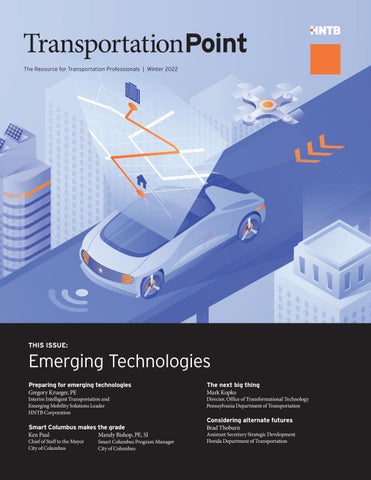
The Resource for Transportation Professionals | Winter 2022
THIS ISSUE:
Emerging Technologies Preparing for emerging technologies Gregory Krueger, PE Interim Intelligent Transportation and Emerging Mobility Solutions Leader HNTB Corporation
Smart Columbus makes the grade Ken Paul Mandy Bishop, PE, SI Chief of Staff to the Mayor City of Columbus
Smart Columbus Program Manager City of Columbus
The next big thing Mark Kopko
Director, Office of Transformational Technology Pennsylvania Department of Transportation
Considering alternate futures Brad Thoburn
Assistant Secretary Strategic Development Florida Department of Transportation
Transportation Point is published by HNTB Corporation. HNTB is an infrastructure solutions firm providing award-winning planning, design, program management and construction management services. Please direct all questions or comments about Transportation Point to corporatecommunications@hntb.com.
Download the HNTB App Discover exclusive Transportation Point content on the HNTB app.
@HNTBCorp
Transportation Point and other HNTB publications and resources are available on the HNTB App. Download the app for free from App Store® and Google Play.™
facebook.com/HNTBCorp linkedin.com/company/hntb instagram.com/HNTBcorp
Preparing for emerging technologies The new realities DOTs face with emerging technologies By Greg Krueger, PE — Interim Intelligent Transportation and Emerging Mobility Solutions Leader, HNTB Corporation | LinkedIn
Departments of transportation are consistently exploring new ways to enhance mobility and create more efficiencies. The challenges remain strong as technologies rapidly change, workforce demands shift and the pace of change continues to accelerate. The good news is DOTs and municipalities are finding proactive ways to ready their policies, programs and infrastructure. This issue of Transportation Point features articles from three leaders in emerging technology adoption: - The City of Columbus, Ohio - The Pennsylvania Department of Transportation - The Florida Department of Transportation From their insights, we can identify the following new realities for DOTs: • The importance of emerging technologies is being elevated within state and local transportation departments. Identifying and incorporating emerging technologies is no longer solely an IT department function. New technologies are being assigned the same level of importance as planning, safety or traffic engineering and operations divisions. For example, FDOT and PennDOT have given emerging technologies prominence on their organizational charts. FDOT has an assistant secretary leading the DOT’s Division of Strategic Development. PennDOT has a director-level position heading up the Office of Transformational Technology. Both agencies’ articles provide frameworks and best practices for elevating the importance of emerging technologies that other transportation departments can draw upon. • The topic of emerging technologies is broader than autonomous vehicles. When we think of the phrase emerging technologies, images of self-driving and connected vehicles come to mind, but the topic covers much, much more. Categories include: - - - - - -
Mining, receiving and interpreting vehicle, driver and roadway data Determining how best to apply insights gained from newfound access to big data Incorporating all modes, such as advanced air mobility and personal delivery devices Building a charging station network and other infrastructure to support electric vehicles Identifying new sources of funding to replace the fuel tax as more people line up at the plug and not the pump Implementing emerging technologies in an equitable way
Each category has potential to enhance mobility, safety and efficiency. • Incorporating emerging technologies requires a strategic plan. The three thought leaders featured in this issue are not only thinking strategically, but have developed and implemented plans to turn visions into reality. Smart Columbus provides a
HNTB | Transportation Point | Winter 2022 3
roadmap for using emerging technology to advance mobility in ways that create greater equity and higher quality of life for residents. FDOT has developed a long-range plan that meets current needs while helping the DOT better prepare to pivot and respond to the disruption and rapid change emerging technologies create. PennDOT’s plan is to make exploring and implementing emerging technologies as seamless and easy as possible for the department. Best practices in developing strategic plans include: - - -
Collecting input from all departments within your organization to ensure buy-in Including actionable items, such as building a data platform to collect and use vehicle data, creating policies for laying fiber-optic lines during construction projects, building a workforce development and retention program or adopting the Federal Highway Administration’s Automated Traffic Signal Performance Measures, part of the Every Day Counts 4 technology initiative Asking for input from a broad group of public and private stakeholders and influencers
• Planning is paramount. The nation’s fleet of vehicles isn’t going to turnover overnight. It will take decades before we see full-scale adoption. That gives agencies time to develop and implement strategic plans but starting now is important. Taking advantage of these best practices Reading the best practices and lessons learned in this issue can be invaluable to agencies no matter where they are on the adoption timeline. Now is the time to take advantage of these and other best practices and move our nation’s transportation system closer to realizing its mission and vision of greater safety, efficiency, mobility and quality of life. ABOUT THE AUTHOR
4
HNTB | Transportation Point | Winter 2022
Smart Columbus makes the grade City reports key successes and what’s next for the mobility technology program By Ken Paul — Chief of Staff, Office of the Mayor, City of Columbus | LinkedIn Mandy Bishop, PE, SI — Smart Columbus Program Manager, City of Columbus | LinkedIn
When Ms. Peg’s car was totaled during the pandemic, she didn’t see a need to replace it right away. Usually, she would visit a food pantry once every two weeks, but without a vehicle, she would have had to depend on others to take her. When a self-driving shuttle expanded service of the food pantry to the Rosewind Community Center, she continued getting food without having a car. Ms. Peg’s story is one of the many successes to come from the Smart Columbus program, a program that applies responsive, innovative and safe emerging technologies to advance mobility in ways that create greater equity and a higher quality of life. The beginning of something big In 2016, Columbus won a $40 million Smart City Challenge award from the U.S. Department of Transportation. Adding $19 million in state and local funds and a $10 million grant from the Paul G. Allen Family Foundation, the city developed and implemented a portfolio of emerging tech-based mobility projects to provide safer, cleaner and more equitable transportation options. Demonstrations aim to solve challenges We believe transportation is the great equalizer. The city’s mission was never to implement technology for technology’s sake but to demonstrate how an intelligent transportation system and equitable access to transportation can create shared prosperity and provide a ladder or a pathway to education, job training and employment. Focused on solving residents’ challenges, the city launched a number of demonstration projects, including: • Automated vehicle deployment on public streets. • A connected vehicle environment that spans four corridors, 85 intersections and more than 1,000 vehicles (and that is interoperable with other regional deployments). This environment generates millions of vehicle and infrastructure messages each day enabling a rich data set to power traffic management analysis. • An open source multimodal transportation planning app that applies emerging technologies like machine learning and blockchain to make trip planning more intelligent for users. • Improvements to a parking management app to show users private and public parking options and to add parking availability analytics customized to Columbus for on-street parking. • Smart mobility hubs that combine multiple modes and are anchored by interactive kiosks that help create first-mile and last-mile connections. • An operating system that is built mainly on open-source software, is cloud agnostic with query and visualization capabilites, and enables users to access and analyze over 2,000 datasets.
HNTB | Transportation Point | Winter 2022 5
The city concentrated its demonstrations in the lower-income, underserved Linden neighborhood. Many of the existing challenges in Linden were exaccerbated during the pandemic. In fact, the pandemic may have helped the city illustrate just how powerful using technology to solve community challenges can be. Following are key successes of the program: • Automated vehicles deliver food. Like many communities across the country, we saw food pantry use soar during the pandemic. Like Ms. Peg, residents didn’t always have a way to get to the food pantry. And everyone was being asked not to pick up neighbors because of social distancing regulations. Social distancing also prevented our automated shuttle from carrying passengers, so we recommissioned it. With a trained operator on board, the shuttle transported prepackaged food through the neighborhood on a predetermined route. The Linden LEAP became the nation’s first daily-operating public self-driving shuttle in a residential area. LEAP transported nearly 130,000 meals and 15,000 masks from St. Stephen’s Community House to neighbors in need during the pandemic. • App helps plan trips. Users downloaded the Pivot multimodal transportation planning app more than 1,000 times during the pandemic to help plan and pay for trips combining bus, ride-hailing, carpool, bikes, scooters, taxis and personal vehicles or bicycles. The app supported 447 trips during the pandemic. Pivot users said transfers between transportation modes were easier, and they were more satisfied with their transportation options, travel time, distance and flexibility. • Connected vehicles create safer intersections. More than 1,000 connected vehicles could “talk” to each other and to 85 dangerous intersections. The technology improved emergency response times, slowed vehicles approaching red lights and slowed participants’ speeds in school zones at high crash intersections across the corridor during the demonstration. • Access to opportunity improves. For travelers originating at the Linden Transit Center, improvements to trip planning through the trip planning app and smart mobility hubs expanded the geographic area accessible to travelers within 30 minutes. This expands opportunities to at least 20,000 additional jobs and 3,000 additional health care services. In addition, the CoGo bike share was the first of its kind in the Linden neighborhood, integrating emerging modes into an opportunity neighborhood, making it accessible to more residents. • Improved mobility for key populations including pregnant individuals using nonemergency medical transportation and travelers with cognitive disabilities. Participants in Smart Columbus’ prenatal trip assistance project received enhanced smart transportation services and took more trips to medical appointments than those who continued to receive standard transportation benefits provided by Medicaid-managed care organizations. A wayfinding application shifted 82 trips from the personal vehicles of caregivers to fixed-route transit and enabled a majority of the participants to travel independently for the first time. • Resident excitement for and the embrace of emerging technology. The trip planning and parking management apps had extremely high app ratings and will serve the new ways in which our residents use and pay for transportation. During the ParkColumbus demonstration, the city noted not only an increase in credit card payment for on-street parking, but also a dramatic increase in payment through the app as opposed to at pay stations.
6
HNTB | Transportation Point | Winter 2022
A space or place for innovation Smart Columbus also brought value as a convener for our community. Leaders came together under the program and created space for innovation that we plan to carry forward. As the Smart Columbus federal award ends, the program begins a new chapter as an agile, collaborative innovation lab, focusing on what is new and next at the intersection of technology and community good. In some cases, Smart Columbus may be the home of that innovation and carry it forward. Other times, we may incubate the idea and hand it off to a partner organization, who will then own it and carry it forward. In addition, we will continue six of the demonstration projects: 1. Pivot trip-planning application 2. Smart mobility hubs 3. Connected vehicle environment 4. Smart Columbus operating system 5. Parking management app 6. Meals and food delivery service We also plan to continue electric vehicle adoption. The Paul G. Allen Foundation grant helped the city to achieve some key priorities related to decarbonization, fleet and consumer EV adoption and expanded charging infrastructure in central Ohio. This grant achieved measurable results
HNTB | Transportation Point | Winter 2022 7
including a nearly 700,000 reduction in GhG (measured in MT CO2), over 300 fleet EVs and 4,000 consumer EVs purchased, and 914 EV charging ports installed. As a result, Columbus is the fastest-growing region in the Midwest for electric vehicle adoption and sales. We see this initiative contributing to Mayor Andrew Ginther’s goal for Columbus to be carbon-neutral by 2050. As for the program’s structure and governance, Smart Columbus is now a standalone 501(c)(3) nonprofit with an executive director, co-chairs and a board of directors. The board comprises most if not all of Smart Columbus’ existing 100 public and private partners. Funding is a 50/50 partnership between the private sector and the public sector. Through Smart Columbus’ evolution, we will continue to innovate to improve our residents’ quality of life with an enduring goal to erase disparities and create opportunities for our residents. ABOUT THE AUTHOR
8
HNTB | Transportation Point | Winter 2022
The next big thing How PennDOT plans to use emerging technologies to address everything from equity and climate justice to work zone safety By Mark Kopko — Director, Office of Transformational Technology, Pennsylvania Department of Transportation | LinkedIn
The Pennsylvania Department of Transportation’s Office of Transformational Technology’s goal is to make the process of exploring and implementing emerging technologies as seamless and easy as possible for our DOT. Ultimately, if we do our job right, the DOT will have integrated select technologies to the point our office can move on to the next big thing. Our office is among only a few in the industry charged with looking holistically at how technology impacts transportation. However, we may see other agencies take a similar approach as automated and connected vehicles, drones and other advances edge closer to becoming realities in our world. The following information about our office’s origins, best practices and goals may be helpful. Why we set up shop PennDOT is a large agency. We oversee highway, rail, freight, air, public transit and vehicle registration and licensing. The Office of Transformational Technology elevates the importance of emerging technologies within the DOT and evaluates them from an enterprise-wide perspective. Our office serves as subject matter experts and integration specialists for emerging technologies. We help determine if and where a technology might fit and how to best plan for its integration. We lead initiatives in automated vehicles, connected vehicles, platooning transit vehicles, smart cities, broadband and personal delivery devices. We support other agencies’ initiatives involving shared mobility, drones, vehicle electrification, hyperloop and mileage-based user fees. Taking an enterprise-wide approach avoids patchwork adoption, siloed expertise and compatibility issues that could arise if each business unit operated independently. Plus, our office relieves others in the DOT of the need to become technology experts in addition to their day-today roles and responsibilities. Determining which technology to pursue Technology is continually evolving. That makes the task of determining which technologies to pursue a challenge. Going “all in” on a specific technology only to learn after significant investment that something newer, faster, less expensive or more universally applicable is taking its place is a major risk. To avoid going down the wrong road, our office implements three mitigation strategies: • Seek input from a variety of stakeholders For decades, auto manufacturers made the vehicles, consumers drove them and states built the roadways. Each entity stayed in its respective lane. Today, connected and automated vehicles, drones and personal delivery devices are blurring the lines and dictating industry and DOT take a more interdependent, collaborative approach.
HNTB | Transportation Point | Winter 2022 9
We chose to incorporate this concept in our process. Instead of researching and deploying technology in a vacuum, the worst thing an agency can do, we partner with sister agencies, private-sector businesses and academia. When we consider their insights and research in our assessments, we make better, more informed choices of where and when to invest taxpayer dollars. One of our best examples of collaboration, and one of our most significant achievements, is PennDOT’s new connected and automated vehicle policies. Our partners helped us update our testing guidance, create policies and procedures for platooning transit vehicles and develop operational constraints and procedures for personal delivery devices. • Invest in relationships We have been surprised at our partners’ willingness to collaborate and share what they know. It indicates their understanding of technologies’ ability to do significant good. However, we’ve also learned there is a limit to the amount of proprietary knowledge the private sector will divulge. The auto industry’s job is to advance technologies with the altruistic goal of improving safety, fuel efficiency or battery life, but they still must make a profit. For competitive reasons, these industry partners are hesitant to show all their cards. We must respect those boundaries and work to earn their trust. • Take a conservative approach We take incremental, foundational steps that will benefit taxpayers regardless of how a technology evolves. For example, PennDOT is developing a strategic plan to install fiber to facilitate infrastructure connectivity with vehicles and potentially support automation. But at the end of the day, we still need to connect maintenance sheds to district offices, ITS equipment in the field to traffic management centers, etc. There are other use cases we have for that fiber. So, we’re identifying use cases now, and we can say, “Okay, we can put this here to meet our current needs, but it also will make this corridor prepared then for the emerging transportation technology.” That puts us in such a better position.
Personal Delivery Devices
We see a future where PDDs shuttle fresh, nutritious produce and goods to residents in urban areas who do not have access to grocery stores or farmer’s markets. But we need the help of our partners to make it happen. Using automated vehicles to increase equity Emerging technologies could help Pennsylvania’s transportation system work for everyone by addressing many of the socioeconomic and geographic inequities we face today. For example, personal delivery devices have the potential to help alleviate the issue of food deserts. PDDs are ground-based, driverless delivery devices manufactured to transport cargo or goods. Pennsylvania state law now allows PDDs to operate in pedestrian areas, on select shoulders or berms of roadways and on select roadways.
10
HNTB | Transportation Point | Winter 2022
We see a future where PDDs shuttle fresh, nutritious produce and goods to residents in urban areas who do not have access to grocery stores or farmer’s markets. But we need the help of our partners to make it happen. Again, we are convening stakeholders to get a sense of how the technology would be used. Our private-industry partners have their business models, and we respect them, but we also want them to be aware of the geographic inequities our citizens face and to realize how their technology could help create greater quality of life for all. Addressing climate justice with vehicle electrification PennDOT welcomes the transition to vehicle electrification, although we realize its implications for DOT operations and funding. But before electrification can be a viable personal, public and commercial alternative, we must have the right resources in the right places. Currently, we are working with a variety of stakeholders to create a strategic plan for deploying EV infrastructure that is safe, reliable and readily accessible. Part of the plan focuses on locating charging stations to facilitate short- and long-distance travel and eliminate motorists’ concerns of being stranded by a dead battery. Using high-definition maps to create safer work zones Every motorist has negotiated a work zone where traffic cones and signs contradict pavement markings. Humans know to follow the channeling devices, but machine visioning may not. The inability of automated vehicles to adjust to a work zone is a big industry concern. That’s why PennDOT applied for and received an $8.4 million federal grant; we want to positively influence work zone safety through improved connectivity, machine visioning and high-definition mapping. Through the department’s oversight, it has become clear that AVs do not perform well in the work zones and routinely require human intervention. In many cases, testers try to avoid work zones altogether.
HNTB | Transportation Point | Winter 2022 11
We intend to develop a consistent approach for AVs to operate safely in work zones. For example, most automated vehicles use high-definition maps as the foundation for operations. But a map is only as good as its accuracy. The second a DOT sets up a work zone, the map is no longer accurate, at least temporarily. We are studying how to share basic work zone information, such as where backups are forming, when the next lane shift or closure will occur and what the configuration will look like. Our goal is to create real-time high-definition maps from which automated vehicles can navigate safely. To demonstrate the viability of a solution, we will perform demonstrations in a variety of work zone configurations with varying scale, complexity and duration. Our systematic approach to verify proposed AV solutions includes: • Running all solutions and approaches through multiple simulations • Conducting demonstrations in a controlled, closed-course environment • Safely integrating successful solutions into limited, small-scale demonstrations With the help of a comprehensive team of subject matter experts, including Carnegie Mellon University and Penn State University, engineering consultants, auto industry partners and various government entities, including the Pennsylvania Turnpike Commission, we hope to create a future where automated vehicles can navigate new or existing work zones at least as well as if not better than humans do. Takeaways Emerging technologies can significantly advance major industry initiatives, such as safety and mobility, while catering to equity and climate justice needs. Identifying and integrating the right technologies requires a dedicated team, executive leadership support, educational institutions and public and private partners who share a collective desire to leave the world better than we found it. ABOUT THE AUTHOR
12
HNTB | Transportation Point | Winter 2022
Considering alternate futures FDOT prepares for the impacts of emerging technologies By Brad Thoburn — Assistant Secretary Strategic Development, Florida Department of Transportation | LinkedIn
Departments of transportation are responsible for anticipating the future of transportation and evaluating the most efficient, effective ways to incorporate emerging technologies into their longrange plans. Meeting the immediate needs of our transportation system while predicting the impacts of today’s advances 10 or 20 years down the road is a complex exercise, requiring creative approaches. The Florida Department of Transportation has always been at the forefront of assessing emerging technologies and their roles in enhancing mobility. To ensure long-range transportation plans effectively serve their communities, transportation planners need to be able to respond to various scenarios. They need to ask the what-if questions, such as: • What if transit agencies purchase fossil-fuel-burning buses with a 12-year useful life, and they face near-term obsolescence due to energy shifts or impacts of shared mobility? • What if drone deliveries and urban air taxis shift traffic volumes and infrastructure demands on urban roadways? • What if an agency is on the front edge of developing real-time passenger information or mobile ticketing, and a third party figures out how to put all those things together faster and cheaper? • What if the tremendous investment in vehicle autonomy leads automakers to achieve level four or five sooner than later? FDOT formally updates Florida’s Transportation Plan every five years, but the department is always exploring what-if questions like these and many other future-looking questions. By continuously updating implementation strategies and evaluating performance, Florida’s Transportation Plan never sits on the shelf! It is a living document, evolving with the transportation ecosystem. Practices, such a scenario planning, enable planners to evaluate the what-ifs and better prepare FDOT to pivot and respond to the disruption and rapid change emerging technologies and other disruptions create. Below are some of the variables the industry should consider in planning for a disruptive future: Political policy shifts Federal funding priorities and policies tend to swing from one extreme to another. What if these swings continue? How can we best plan for a volatile political landscape? Public-private partnerships Technology advances are forcing DOTs to become nimbler and more responsive. Government was not built for speed or flexibility, but the private sector is if it’s to survive. Given the right circumstances, are there opportunities to better leverage public-private partnerships as sources of innovation and transfer the risks a DOT should not otherwise bear?
HNTB | Transportation Point | Winter 2022 13
Governance Cities, counties, states, regional entities and the federal government have separate roles in providing mobility. As technology advances, those lines of responsibility are beginning to blur. Will government agencies need to step back and re-evaluate their place in the mobility ecosystem as we go forward? At the very least, it heightens the need for stronger partnerships. For example, most transit agencies are operated by a county or an independent authority. Most micro-mobility services, such as bike share and scooters, are permitted and regulated by cities. The transit industry talks about integrating these modes as one solution to the first-mile last-mile challenge. But how would that happen? Can existing entities transform or even merge to serve as the mobility integrator? The emergence of air taxis is another area where jurisdictions may overlap. The market for noiseless electric air taxis is expected to mature during this decade and soar to $1.5 trillion globally by 2040, according to Morgan Stanley research. Adding drone deliveries to the mix creates a new level of complexity. Will this change the regulatory relationship between the Federal Aviation Administration, state aviation offices and local land use and zoning? Land-use policies The traditional view of transit-oriented development involves high-density mixed-use development within a quarter mile of a premium transit station, usually rail transit. Should land-use planners look to develop “mobility-oriented design” in the world of shared, micro and urban air mobility?
14
HNTB | Transportation Point | Winter 2022
Big data Big data has the potential to help optimize investments and provide real-time operational value for the public and private sectors. For example, weigh-in-motion technology is already producing valuable data for freight planning and operations. The freight industry might be able to use data to optimize commodity flow, but when a system is as fragmented as trucking, it is difficult to harness big data. As connected and automated vehicles and other technologies emerge that make it easier to understand and evaluate the supply chain and optimize the movement of goods, will we see a consolidation of freight operators? Will consolidation make it easier to leverage big data and maximize the movement of freight? Considering the answers to those questions could help to eliminate bottlenecks and create opportunities for smoother flowing freight. Predictive analytics In a recent study, FDOT and University of South Florida researchers evaluated predictive models that use data, such as weather condition, traffic congestion, time of day and vehicle speed, to predict when and where crashes were likely to occur. In simulation and in real-world conditions, these models predicted crashes accurately up to 60% of the time. What if FDOT Road Rangers and law enforcement coordinated to mitigate high-risk situations? Could crashes be cleared faster or even prevented? What if that information could be used to develop techniques to slow traffic when conditions become conducive to a crash? What if common characteristics of crash-prone areas could inform future roadway design? The time to speculate is now Planning for the future requires asking hypothetical questions. FDOT not only encourages its employees to imagine, our planning requires it. As transportation leaders imagine different futures, they can better mitigate risks and capture the potential of emerging mobility solutions. Envisioning the immense potential for emerging technologies to improve safety and mobility, while optimizing the use of existing infrastructure is exciting. But, as innovations like flying taxis, drones and robo taxis emerge, their planning and policy implications must be contemplated – even though most of the puzzle pieces may be missing. Asking “what if” during this era of rapid technological advancement is healthy, and it’s necessary if DOTs are to be nimbler and more responsive to change. ABOUT THE AUTHOR
HNTB | Transportation Point | Winter 2022 15
The HNTB Companies Infrastructure Solutions hntb.com
© 2021 HNTB Companies. All rights reserved. Reproduction in whole or in part without written permission is prohibited.