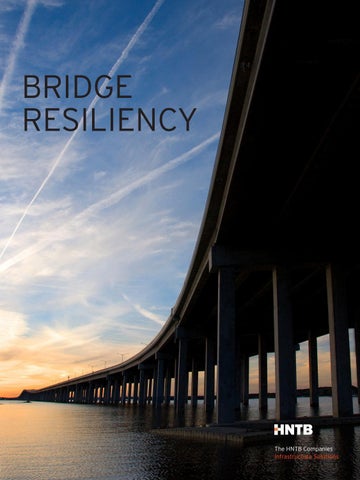
BRIDGE RESILIENCY
The HNTB Companies Infrastructure Solutions
Bridge Resiliency Well-established standards, holistic thinking and industry best practices can help strengthen bridges to better withstand catastrophic events.
HNTB’s approach is backed by:
Bridges are critical to the lifeline of our nation’s economy. That is why ensuring a bridge has minimal impact from weather or disaster events is crucial. HNTB thoughtfully examines how we design and construct bridges with resiliency in mind.
• Developing resilient infrastructure by maximizing use of grant programs.
In addition, HNTB works with our clients to assess risks and ensure bridges across the country are prepared for disasters, changing environmental conditions such as higher-intensity storms and rising water levels, as well as population shifts. We understand that partnerships are key — partnerships with federal, state and local governments to form the holistic approaches needed to harden our bridges.
Walnut Avenue Bridge
• Delivering proven experience in bringing communities and assets operational as quickly as possible in the event of a disaster. • Delivering proven program management strategies, plans and techniques that provide proper managerial and administrative support for executing large recovery efforts.
• Developing and providing outreach support and reporting in a targeted way to educate and inform all stakeholders. • Ensuring recovery efforts through planning, design and construction incorporate resiliency. HNTB’s proven ability to engage, assess and develop practical solutions for bridges of all types and employ the latest technology to communicate and capture data, while building with more resiliency is unmatched.
Full range of services:
• Web-based technology tools and applications
• Damage assessment
• Resident Project Representative rpr services
• Debris removal coordination
• Information technology
• Cost-benefit analyses
• Pre- and post-storm action mitigation plans
• Project prioritization
• Technical assistance and guidance with claims and appeals
• Program administration, monitoring and reporting • Financial and document control • Infrastructure reconstruction design and inspection
• Oversight for grantees, contracted vendors and grant administrators • Staff augmentation • Procurement assistance
• Federal and state agency coordination
• Infrastructure resiliency planning
• Comprehensive public/stakeholder outreach
• Performance management and analytics
St. Louis Bay Bridge
Applying a proven approach HNTB has extensive experience with disaster recovery and resiliency, particularly as it relates to bridges. We provide an integrated approach, encompassing multiple disciplines, to holistically inspect and address damaged infrastructure and prevent future deterioration. Time and again, HNTB has assisted agencies with submitting thorough documentation for smoother project approvals and expedited funding. Through these efforts, HNTB has helped expand disaster response and recovery resources for our clients. Walnut Avenue Bridge The Bay Area Rapid Transit’s Walnut Avenue Bridge is a first for California and the U.S. It straddles the Hayward Fault and is designed by HNTB to survive severe fault displacement from a magnitude 7.25 earthquake. The bridge is one component of a 5.4-mile design-build project with Warm Springs Constructors, extending BART’s rail line from Fremont Station south of Oakland to a new Warm Springs Station. HNTB is the lead designer for the entire project. Because of its location, the bridge is subject to two types of seismic force: constant, extremely slow slippage known as fault creep and dynamic force from an earthquake. BART’s performance requirements called for trains to resume operation over the bridge within a reasonable amount of time, following a design base 500-year earthquake. Missouri’s Safe and Sound Program The program completed the delivery of 802 new or improved bridges in about three and a half years. Packaged as a mega design-build contract, the program enabled designers and engineers to look at the bridges holistically and achieve significant efficiencies and cost savings. The immediate result was that construction on each bridge site moved more swiftly-in fact, the average bridge replacement took 42 days, about half the normal time. From a resilience standpoint, this standardization also set the stage for accelerated recovery in the event of the sudden loss of one or many bridges. HNTB was the designer for this program. St. Louis Bay Bridge After Hurricane Katrina destroyed the St. Louis Bay Bridge in Mississippi, which carries U.S. 90 between Henderson Point and Bay St. Louis, in August 2005, Mississippi Department of Transportation had to move expeditiously to replace the structure. While the 2.1-mile-long bridge was out, motorists had to use a 45-minute detour to travel between the two communities. MDOT proceeded with the state’s first-ever design-build contract, accelerating project completion by hiring the same contractor to oversee project design and construction. The new bridge was built higher, eliminating the need for a draw.
CTDOT’s Walk Bridge Program
Chesapeake Bay Bridge and Tunnel Adding another two-lane tunnel, approximately 5,700 feet, under the Thimble Shoal Channel, to expand the capacity and improve the safety for travelers who use the CBBT. Also, it will protect the economic competitiveness and livability of the region through enhanced resiliency as the CBBT serves as the sole connection between the Delmarva Peninsula and the Hampton Roads area. HNTB’s scope of work for the project includes construction management, procurement, inspection, project controls, claims avoidance, quality assurance and federal compliance. Walk Bridge In an effort to improve the resiliency of infrastructure after Superstorm Sandy, the Connecticut Department of Transportation undertook this program to increase
safety, reliability and ease of travel throughout Norwalk. HNTB is the design consultant and designer of record for the Walk Bridge Program — the CTDOT’s first program to be contracted under the construction manager/general contractor delivery method. This program advances Norwalk’s railroad transportation infrastructure while improving local roads and sidewalks for motorists, pedestrians and cyclists. HNTB’s design services include bridge, mechanical, electrical, track, high tower, catenary, geotechnical, signals and communication, civil, architectural, hydraulics and construction sequencing. HNTB also prepared the environmental documentation and permit applications for the program.
Pensacola Bay Bridge During Hurricane Sally’s landfall in September 2020, the recently opened Pensacola Bay Bridge in Northwest Florida suffered significant damage after a number of construction barges broke free and smashed into the structure. Florida Department of Transportation had to shut down the bridge and conduct extensive repairs. Working through its GEC contract with FDOT District Three, HNTB used video to share the impact the storm had and detail the reconstruction of the piers and rebuilding of the desks for traffic to resume so the public was aware.
The HNTB Companies Infrastructure Solutions hntb.com
2021 HNTB Companies. All rights reserved. © Reproduction in whole or in part without written permission is prohibited.