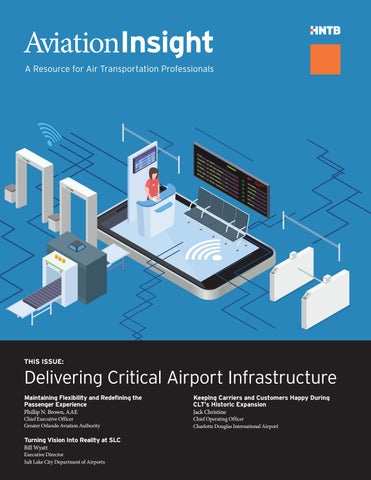
THIS ISSUE:
Delivering Critical Airport Infrastructure Maintaining Flexibility and Redefining the Passenger Experience Phillip N. Brown, AAE Chief Executive Officer Greater Orlando Aviation Authority
Turning Vision Into Reality at SLC Bill Wyatt Executive Director Salt Lake City Department of Airports
Keeping Carriers and Customers Happy During CLT’s Historic Expansion Jack Christine Chief Operating Officer Charlotte Douglas International Airport
Maintaining Flexibility and Redefining the Passenger Experience
Phillip N. Brown, AAE Chief Executive Officer Greater Orlando Aviation Authority
Orlando’s new South Terminal C focuses on flexibility for the future, a unique journey for travelers Prior to the COVID-19 pandemic, Orlando International Airport was one of the fastestgrowing airports in North America with 2019 passenger totals over 51 million, which had been increasing by approximately three million each year for five consecutive years. The heightened demand could be attributed to a strong regional economy, explosive population growth in the Orlando metro area, expansion of the region’s medical, simulation and infrastructure sectors, its continued ranking as a top tourist destination and the exponential growth of air travel across the country. To keep pace with demand, the Greater Orlando Aviation Authority (GOAA) embarked upon a $4.27 billion capital improvement and modernization program, the largest expansion in the airport’s history. Completions to date include modernizing our North Terminal Complex with ticket lobby modifications, expansion of the west security checkpoint along with expanding and modernizing the Federal Inspection Station, replacing the automated people mover systems to airsides 1 and 3 and improving the baggage system. In addition, we have completed and opened a new standalone South Automated People Mover / Intermodal Terminal Facility, and parking garage, where intercity high-speed trains will connect travelers with Miami, West Palm Beach and Fort Lauderdale, a first for a U.S. airport. Planning is already underway for expanding Brightline to a connection from Orlando to Tampa, with a stop at Walt Disney World as well. Our new, world-class South Terminal C is on track for substantial completion in February 2022. Aviation Insight is published by HNTB Corporation. HNTB is an infrastructure solutions firm providing award-winning planning, design, program management and construction management services. Please direct all questions or comments about Aviation Insight to corporatecommunications@hntb.com.
ABOUT THE AUTHOR
Phil Brown was recognized as one of Orlando’s 50 Most Powerful People of 2019 for his leadership of the nation’s 10th busiest airport, which handled more than 51 million annual passengers in 2019 and employs more than 20,000 workers. He manages Orlando International Airport’s $3.8 billion capital improvement plan to enhance the main terminal and construct a new South Terminal. Brown also has been recognized by the Florida Department of Transportation as the Aviation Professional of the Year.
A faster curb-to-gate process
At every touchpoint, South Terminal C will enhance the passenger experience either by expediting it, personalizing it or creating “wow” moments.
Download the HNTB App Discover exclusive Aviation Insight content on the HNTB app.
South Terminal C innovations
@HNTBCorp
Aviation Insight and the other HNTB publications and resources are available on the HNTB App. Download the app for free from App Store® and Google Play.™
facebook.com/HNTBCorp
The U.S.’s first terminal-wide, state-of-the-art RFID baggage handling system
100% automated TSA screening lanes
“Bags first” processing for U.S. Customs and Border Protection and Federal Inspection Station
100% facial recognition and iris scans of international arrivals and departures
Total virtual ramp control by camera
linkedin.com/company/hntb instagram.com/HNTBcorp
HNTB | Aviation Insight | Summer 2021 3
To accomplish our goal of moving passengers from curb to gate more efficiently, we identified the touchpoints for a variety of travelers and the areas and processes that slow them down. For example, business travelers typically don’t need many touchpoints between the curb and their aircraft seat, so we are providing self-check-in kiosks, which allow them to bypass ticket counters and agents.
Identification (RFID) tag, which allows us to continually track each bag’s exact location. Other benefits include:
On the other hand, a family of five who rarely travels may need multiple touchpoints. For them, we have multilingual, multicultural ambassadors, ticketing counters and ample wayfinding signage.
Early arrival bag storage. Departing passengers can check in and drop off their bags at the terminal as early as they wish for a hands-free experience. The space will hold up to 2,000 pieces of luggage.
The Orlando Experience®
Shorter wait times. The system is designed to meet our goal of five-and-a-half minutes in-system time with no bag taking longer than 15 minutes.
No oversized baggage restrictions. The airport also will be the first in North America to accommodate a mixture of standard-sized and oversized baggage in one size of container, meaning golf clubs, strollers and wheelchairs will arrive by baggage carousel along with the passenger’s other luggage.
A design theme conveyed throughout the airport with unique architecture, aesthetics and convenience amenities that capture the essence of what makes central Florida special. Core elements include water, garden and natural light.
Expedited customs processing Biometric facial recognition for international arriving and departing passengers will reduce U.S. Customs and Border Protection processing times from 2 minutes to about 45 seconds, provided no questions or secondary interviews are needed. Centralized screening No matter where passengers go in South Terminal C, they will only have to proceed through one Transportation Security Administration checkpoint. Our automated screening lanes will handle up to 40 minutes of queued passengers without the lines spilling into other terminal areas. When changes in security processes occur, access panels, built into the flooring, will let us quickly and easily reconfigure the checkpoint. Rich use of multimedia The Authority has invested in three large-scale interactive digital electronic media exhibits to help communicate The Orlando Experience® and create wonderful, unexpected vacation memories before passengers leave the terminal. In the landside terminal, both arriving and departing passengers will encounter the “Portal,” the terminal building’s signature electronic media feature. A set of multimedia screens, featuring lifelike LED 8K technology, is mounted on a custom-built helix-like steel frame that spirals up through the terminal’s three floors, making the Portal visible to all. The video screens will capture constantly changing images of Central Florida’s natural beauty, attractions, activities and unique images of the region’s transformative history from agribusiness to space. When travelers experience this imaginative concept, we want them to have a sense that no destination is unreachable.
A new, welcoming layout
Passengers will enjoy Florida’s world-famous sunshine during their South Terminal C experience. A towering glass skylight atrium, known as The Boulevard, extends the length of the new landside terminal to the airside concourse hub, serving as a subtle wayfinder throughout the main passenger corridors. Instead of migrating to the terminal’s lower level to claim their baggage, domestic and international arriving passengers will be reunited with their luggage in the sunny arrival hall on the terminal’s top floor. A new terminal-wide high-speed individual baggage carrier system, selected for its lean, spaceoptimizing vertical configuration, allows for an elevated system and facilitates GOAA’s inverted terminal concept. It marks another first for an entire terminal facility the U.S. The system transports each piece of baggage on an individual tote, equipped with a Radio Frequency
4
HNTB | Aviation Insight | Summer 2021
Palm Court, the grand gathering hub where the airside’s north and west concourses intersect, features a 30-foot-tall, video spectacular called the “Moment Vault.” Three large video walls, viewed from outside or inside the Moment Vault, will show Florida’s beaches, botanical gardens — and perhaps even rocket launches. As passengers watch the videos, cameras will capture their silhouettes and embed their likeness into the iconic Central Florida scenes, creating memorable moments worthy of family selfies. In the north concourse, passengers will walk along “Windows on Orlando,” a 60-foot-long by 28-foot-tall video wall. The three giant, contiguous screens can work together or independently to make passengers feel as if they are swimming with manatees or walking along a beach with ocean waves washing toward their feet. Unique retail experiences Cape Canaveral and our world-famous theme parks will have retail outlets in the new South Terminal C. Disney World and Universal Studios also will have two-story stores, featuring immersive media displays on the outside.
HNTB | Aviation Insight | Summer 2021 5
Multimodal connectivity Traversing from South Terminal C through the Ground Transportation Facility, passengers will find yet another first for a U.S. airport hub: the South Airport Automated People Mover Complex and Intermodal Terminal Facility. This fully integrated transportation facility offers immediate access to rental cars, taxis, private vehicles, buses and shuttles – and in 2022, high-speed rail service from Orlando to Miami in less than 4 hours. Flexibility to accommodate demand To help our passengers leave and arrive on-time, even during peak travel times and as demand for air travel increases further, we built flexibility into every aspect of South Terminal C. Each of our new 15 “swing” gates will accommodate domestic and international flights and multiple aircraft, based on demand. We will have the option in the future to use remote hardstands for boarding and deplaning as well as aircraft remote parking to help increase gate throughput. After passengers deplane, an aircraft will push back to the hardstand to be serviced, cleaned and provisioned while another aircraft pulls up to the same gate and boards or unloads its passengers, enabling more turns per gate. And, our multi-aircraft ramp system (MARS) gates can service a super jumbo or a normal, narrowbody aircraft at the same time without impeding the flow of traffic on the apron. When the terminal is in narrow-body configuration, our 15 Phase 1 gates will be able to hold up to 19 aircraft. Connecting with the person, not just the passenger Designing the terminal of the future is not simply about creating efficiencies and capacity. For us, it’s about creating a personal experience for both the frequent traveler and first-time flyer. Our South Terminal C will make air travel more enjoyable and relaxing, and position Orlando International Airport as a memorable part of every traveler’s journey.
• • • • •
Deploying more maintenance crews Revising some of our maintenance contracts, so we can adapt to crowds and high passenger loads Supplementing GOAA staff with consultants Leveraging our airport ambassadors to help passengers move quickly through the processes Adding security screeners
3. Maintaining the vision We let those charged with executing the program – the architects, engineers, construction managers and operational team focus on the details of each project while we keep our focus on the big picture and the 360-degree vision.
Want to travel through South Terminal C? Experience the passenger journey by watching the video only on the HNTB App.
AUTHOR
Phillip N. Brown, AAE Chief Executive Officer Greater Orlando Aviation Authority
Ensuring successful program implementation To maintain day-to-day operations while modernizing the North Terminal Complex and building a new South Terminal C, the Greater Orlando Aviation Authority has innovatively deployed industrystandard program management practices while adding our own proven systems and procedures. Following are examples of both: 1. Determining budget, then scope Before we begin a project of any size, we determine what we can afford. Orlando International Airport is a heavy leisure airport with sensitive price points. To be mindful of overall airline costs, we maximized a range of funding types – from passenger facility charges, now capped at $4.50, and customer facility fees to Airport Improvement Program funds and bond financing, derived from having one of the best airport credit ratings in the country. We work diligently to maintain a conservative debt portfolio, have sufficient cash on hand and keep our current cost per enplaned passenger at manageable levels. Some of our staff have traveled to major European airports to collect lessons learned on opening large facilities. 2. Staffing up Our operational readiness team is leading the effort to identify the number of employees and skillsets needed to operate both the revamped North Terminal Complex and the new South Terminal C efficiently and effectively. New employees receive on-the-job training, handling passenger loads in the North Terminal Complex. Some will transition to the South Terminal once it opens. Other workforce additions include:
6
HNTB | Aviation Insight | Summer 2021
HNTB | Aviation Insight | Summer 2021 7
Turning Vision Into Reality at SLC
Bill Wyatt Executive Director, Salt Lake City Department of Airports
Six success strategies deliver phase one of the nation’s newest hub airport
In September 2020, during a pandemic, the Salt Lake City Department of Airports opened phase one of a new generation of airport. The new Salt Lake City International Airport, or New SLC, features a beautiful new terminal, a parking garage with double the previous capacity and the initial portions of two new linear concourses. The concourses are currently connected via the mid-concourse tunnel. The tunnel is temporary until the permanent, central passenger tunnel, part of phase two, now underway, is completed. The New SLC is the largest capital construction project in Utah’s history and the nation’s newest hub airport. Ready to accommodate 34 million passengers annually, the new facility replaces an existing terminal and five pier concourses, all built in the 1960s and ‘70s. The successful completion of phase one of the SLCDA’s $4.1 billion Airport Redevelopment Project is directly linked to six strategies that helped turn our vision into a reality: 1. Meet the moment Large, transformative airport programs are like aircraft carriers. They don’t turn on a dime. Therefore, you must position the program to meet moments of opportunity when they arise. We’ve been able to do that by building out portions of the new airport’s infrastructure more than a decade before we needed them. One forward-positioning example happened in 2004. The SLCDA secured a Federal Aviation Administration grant to design and construct the shell of a west utility tunnel between the two concourses. The tunnel would not be needed for 15 years; however, the goal was to build it in advance and avoid disrupting aircraft traffic while the new concourses were constructed. Once the tunnel was constructed, it was immediately closed. We opened it officially in 2018, according to plan. It was an extremely forward-looking piece of planning that kept phase one disruption on the apron/airfield to a minimum.
The New SLC ABOUT THE AUTHOR
Bill Wyatt is the Executive Director of the Salt Lake City Department of Airports. The SLCDA operates Salt Lake City International Airport and two reliever airports, South Valley Regional Airport and Tooele Valley Airport. Previously, Wyatt spent 16 years as the Executive Director of the Port of Portland, where he oversaw four marine terminals, two general aviation airports and Portland International Airport. Contact him at bill.wyatt@slcgov.com.
• A two-level roadway with elevated departures roadway • A parking garage with 3,600 stalls and a camera-based sensor system that uses lights to indicate open spots • 56 electronic vehicle charging stations • The Gateway Building, housing car rental counters and quick-check ticket counters • 16 security screening lanes with automatic return bins for touchless processing • 45 concessions with street pricing • Electronic outlets at each seat and in open-seating areas • 7 miles of luggage conveyor belts to accommodate oversized items • Aircraft gates that employ the SAFEGATE Aircraft Docking System for automated aircraft parking • 24 restrooms with private lactation rooms • A large greeting room to wait for and meet arriving passengers once physical distancing measures are lifted • Large-scale art installations to represent Utah’s natural beauty and provide a sense of place
THERE’S MORE TO THE STORY OF SALT LAKE CITY INTERNATIONAL AIRPORT’S NEW DESIGN.
Listen to Bill Wyatt share more about the thought process on design and how passengers have reacted to phase one by going to the HNTB App.
© Courtesy of Salt Lake City Department of Airports
8
HNTB | Aviation Insight | Summer 2021
HNTB | Aviation Insight | Summer 2021
9
2. Stay on plan The cover page of SLC’s 1996 master plan looks much like what we’re building, which is amazing when you consider the difference between Salt Lake City in 1996 and the airline industry in 1996 and where we are today. Change has been constant. Yet, our program has enjoyed a continuity that has helped us stay true to our vision:
We also created two joint-venture contractor teams: one to focus on Concourse B; and one to deliver the terminal and Concourse A. Each team has a contractor with extensive national and/or international airport experience and a contractor with extensive local experience. The national contractors each came to the project having excellent relationships with Delta Air Lines. The local firms know the trades, the local market and the traditions of this area.
• Delta Air Lines has been a part of the Airport Redevelopment Project from the beginning. SLC is critically important to them as an origin and destination market and a connecting market. Delta’s SLC hub gives the airline a strategic position to realize its vision as an international carrier.
4. Ask disruptive questions The original game plan was to build half of Concourse B, half of Concourse A and all the landside terminal facilities in phase one while keeping two of three old concourses open to maintain needed gate counts and airline capacity requirements. In phase two, we would build the remainder of Concourse A for an additional 22 gates and the central portion of Concourse B for another eight gates.
Delta recently extended its lease at SLC to strengthen the airport’s financial profile. By signing the lease extension, Delta has extended its commitment to SLC by 10 years. SLC is fortunate to have a hub carrier who understands our success is their success. • The Salt Lake City community has experienced consistent growth and is fortunate to have a strong economy. For airports, that’s the secret sauce. A healthy economy drives development, and development creates demand for air travel. • The SLCDA has enjoyed continuity in leadership. My engineering director participated in the 1996 master plan. He assembled the FAA grant request for the mid-concourse tunnel, the key to building the new concourses without significantly disrupting traffic.
When the pandemic hit, and air traffic all but evaporated, SLC went from serving up to 30,000 passengers a day to 1,500 a day. We met with the project management team and the airlines and asked a question that could significantly disrupt our game plan: “Did we need all of those open gates in the existing airport when passenger totals were so low? Or, could we demolish all three concourses at once, skip the 25 gate-changing phases and accelerate the second phase of this project by two years?” It took time to arrive at a conclusion, but the answer was, “Yes, we could do that.” Until the new Concourse A - East and additional Concourse B gates were available, we would operate remote aircraft hardstands. Once the existing airport was demolished, phase two was in control of its destiny.
On Trend A result of airlines and passengers increased use of technology, there is less space at the front of the new terminal than the old terminal. Further, the airport is expandable. More gates could be added to Concourse B and a third, parallel concourse is planned for the future. © Courtesy of Salt Lake City Department of Airports
3. Assemble the right teams The definition of “right” will be different for each airport. We created teams with specific skill sets and knowledge, such as project management, schedule maintenance, national airport expertise and local expertise. The project management team comprises private-sector employees who are experts in delivering large capital improvement programs. Within the project management team is a group responsible for maintaining the project schedule and looking for opportunities to accelerate it. The project team’s expertise in managing large capital programs and SLC’s internal oversight committee has been an effective combination. We (the airport) make the decisions, and they (the PM team) execute them. A program of this scale always will have challenges, but our working relationship with the project management team is strong. Whenever an issue arises, the group convenes to resolve it. If we don’t have the answer when we begin the meeting, we generally have a direction when we conclude it. The collaboration has been terrific.
10
We planned to demolish the three old concourses one at a time over several years as new gates came online – and that presented a challenge. Constructing the new airport on top of the old airport, parts of which were in operation, would have required repeatedly closing one gate and opening another in a complex 25-phase process.
HNTB | Aviation Insight | Summer 2021
We also asked a second disruptive question during that time: “Should we take advantage of the downturn in business and build the central passenger tunnel now rather than wait?” The answer again was “yes” for the same reason we built the utility tunnel years earlier than planned. The central passenger tunnel would connect the main terminal with the Concourse B. The tunnel also is designed to extend to a future Concourse C and has the capacity for a people mover. If we didn’t construct the central passenger tunnel now and air travel returned, we would interrupt the traffic flow between the two parallel runways, making aircraft taxi time incredibly long. As a result, construction for the central tunnel is underway. It will open in 2023. 5. Have mechanisms to manage scope changes In our case, that mechanism was the construction-manager at-risk delivery method, selected by my predecessor. CMAR is most effective when a project has significant scope changes, as ours has. For example, at the last minute, Delta asked to double the Sky Club space from 18,000 square feet to nearly 30,000 square feet. And, deep into the construction phase, we discovered the federal inspection station was too small to support the U.S. Customs and Border Protection’s new operations. We had to increase the size of the terminal’s footprint to accommodate a larger space. Currently, our challenge is determining how we might speed the completion of Concourse B to meet the demand for more space. In each instance, the CMAR has brought more brainpower and ingenuity to the table. Under design-build delivery, the scope can be more challenging to manage because it is not necessarily the owner’s design. The design-builder has designed it, and there is a risk of having the contractor build a facility that differs from the owner’s vision. Under CMAR, the SLCDA completed the airport design, and we hired a contractor to build it to our exact specifications. CMAR is giving the SLCDA what we wanted and planned for, a new, more efficient global airport that will offer an exceptional travel experience.
HNTB | Aviation Insight | Summer 2021 11
6. Push through adversity Two and a half years ago, we circled Sept. 15, 2020, as the opening day for phase one of the Airport Redevelopment Project. Working backward from that date, we considered the scope of work in front of us, the project’s pace and our experience to date. The timeline seemed reasonable and doable. In February 2020, just as the project was in the final stretch with 1,800 to 2,000 tradespeople on-site daily, the pandemic hit. In early March, we convened the general contractors, the project management team and the county health department and instituted effective and immediate health and safety protocols. We mandated mask-wearing inside the building, conducted temperature checks and enforced social distancing with signage and an increased number of safety officers. We kept the workforce safe and earning their salaries. And the project stayed on schedule. We never shut down, nor did we change our opening date.
Keeping Carriers and Customers Happy During CLT’s Historic Expansion
Charlotte Douglas International Airport has seen unprecedented demand for air travel in recent years. Aided by the region’s population growth and American Airlines’ strategic initiative to increase its presence here, our passenger totals rose to all-time high of 50.2 million in 2019, ranking us among the world’s top 10 busiest airports.
Of the six strategies we used to successfully deliver phase one of the Airport Redevelopment Project, pushing through adversity has been pivotal in turning our vision into a reality. Today, Salt Lake City has a stunningly beautiful airport terminal complex that will serve and grow with the region for decades to come.
Like the rest of the industry, our airport felt significant impacts from COVID-19. However, despite traffic dropping 46% in 2020, our partner airlines continued to add Charlotte-based flights as they rebuilt their schedules, with a total of 10 new destinations now available to flyers. As the aviation industry recovers and understanding that demand will continue to grow, we have continued to move forward with Destination CLT to help meet the needs of our customers and airline partners. Launched in 2015, the 10-year program is the most significant expansion in the history of our airport, with an estimated cost between $2.5 - $3.1 billion. Landside projects include an elevated roadway and terminal curb front, expansions to Concourses A, B, C and E, a terminal food court expansion, terminal renovations and lobby expansion.
AUTHOR
Chief Operating Officer Charlotte Douglas International Airport
How Charlotte is delivering a multibillion-dollar capital improvement program with support from all sides
Oddly, the pandemic eased the task of opening a new airport. Unlocking the front door on Day 1 to 30,000 people, including 20,000 connecting passengers, would have been challenging. The pandemic, however, provided an opportunity for a “soft opening.” Low passenger volumes gave us time to work out the kinks and provide proper staff training.
Bill Wyatt Executive Director Salt Lake City Department of Airports
Jack Christine
ABOUT THE AUTHOR
Jack Christine is responsible for airport development, operations and facilities maintenance. During his 23year career at the airport, Christine has been the assistant aviation director of development, planning and development manager, airport planner and associate airport planner. In addition to his position as COO for the airport, Mr. Christine also serves as an adjunct professor at the University of North Carolina at Charlotte, teaching courses in airport development. Contact him at (704) 359-4932 or jlchristine@cltairport.com.
© Courtesy of Charlotte Douglas International Airport
12
HNTB | Aviation Insight | Summer 2021
HNTB | Aviation Insight | Summer 2021 13
Modernizing our airport, while effectively serving passengers is challenging – but not as challenging as it might have been had we not approached it with a spirit of collaboration. Passengers and air carriers would be living through the decade-long renovation with us. We believed inclusivity was the only way to proceed. Since the program’s inception, we have listened, identified and proactively responded to their top concerns: • Carriers enjoy a low cost per enplanement (CPE) at CLT. They wanted us to keep it low. • Ten years is a long time to inconvenience carriers and customers. Schedules needed to be accelerated when and where possible. • Passengers and carriers wanted us to include them in the program by way of involvement, information or both. Below is how we are addressing each of those concerns: CPE: Sustaining a competitive operation As a department of the City of Charlotte, CLT is a public enterprise; however, we are entirely self-sustaining and do not collect tax dollars. You might expect us to have a high cost per enplanement to compensate, but at $2 our CPE is the lowest airline cost per passenger among all large-hub airports in the U.S. We cannot deliver a modernized airport and keep our CPE below $2, but we can remain aggressively competitive. Rather than focus on a specific dollar amount, our approach is to benchmark our airport against other large-hub airports to ensure we continue to be among the lowest-cost facilities in the country. Because of the tremendous infrastructure growth anticipated by many airports, including CLT, over the next 7-10 years, comparing our CPE against the CPE of other key airports will be a better indicator of carrier cost vs. value. Time: Accelerating the schedule After Destination CLT launched, we incrementally added speed and complexity to our workloads. Our in-house staff absorbed the additional projects to a point, but we knew we would reach saturation and need outside resources. To help us identify the areas in which we would need additional support, we developed a resource allocation plan. As a result, we hired project managers, project inspectors and project controls specialists. Their primary responsibility is coordinating the various interrelated, overlapping projects, identifying potential clashes and avoiding overly cumbersome impacts.
For customers, our relationships with the local news media and a constant newsfeed on social media have proven to be valuable communication tools as we work through the development program. As an example, the Concourse B renovation project was challenging because it is our busiest concourse, and the renovations had to be done while we continued to use every gate on the concourse. Seeing us dismantle the ceiling and prepare the floor for terrazzo tile installation was jarring and somewhat disorienting for our customers. We kept them informed and engaged by actively participating in social media, posting explanations and renderings and quickly responding to questions. Our responses were helpful not only to the individual posting a comment, issue or request but to everyone who follows us on that platform. Understanding something new and better was coming helped customers endure the floor-to-ceiling concourse transformation with patience. They have welcomed the completed renovation with excitement and positive feedback. In 2020, we moved forward to also complete successful renovations to Concourses A and C. Throughout that process, we were able to respond to questions from passengers on social media with pictures of the already finished renovations on Concourse B to help them better understand the project and visualize the end product. Our policy not to move forward with any initiatives unless we have a consensus among our carrier partners can threaten an aggressive schedule. Nonetheless, it’s how we choose to do business. To ensure each project provides what the carrier needs to operate efficiently, we invest a tremendous amount of time and effort to understand their expectations and explain what those expectations mean in terms of cost and operational impacts. During the planning phase of each project, we hold regularly scheduled meetings with carrier representatives. We walk through the project, discuss how to manage the operation and transition to the new asset. Soliciting carriers’ ideas and feedback each step of the way builds trust and results in a better product. Once we implement a project, we meet with the carrier representatives regularly, and we invite their representatives to our construction meetings. We don’t always see eye to eye, but our inclusive approach gives us the time and ability to achieve alignment on each project. Carriers appreciate our approach. Several have called it “refreshing and effective.” That’s the outcome we envisioned when we began Destination CLT. Planning and executing a significant improvement and renovation program is taxing on everyone, but if airports give the proper attention to stakeholders’ concerns, they can strengthen and deepen their relationships with carriers and customers. AUTHOR
Jack Christine Chief Operating Officer Charlotte Douglas International Airport
Having additional program management expertise immersed in the program is critical to maintaining: • An aggressive schedule and our pledge to reach completion by 2025 • Communication between the airport and the contractors • Claim-free projects Although outside expertise is an additional expense, the dividends of fewer claims and schedule compliance alone are worth it. We are continuing to track well on schedule and budget for the Destination CLT program. Inclusion: Collaborating and communicating in excess We use the phrase “excessive collaboration and communication” purely in an attempt to describe our team’s all-out effort to engage carriers and customers in a very genuine and meaningful way. Throughout the program, we have proactively communicated with our stakeholders, treating them as partners in the program’s development.
14
HNTB | Aviation Insight | Summer 2021
HNTB | Aviation Insight | Summer 2021 15
The HNTB Companies Infrastructure Solutions hntb.com
© 2021 HNTB Companies. All rights reserved. Reproduction in whole or in part without written permission is prohibited.