I. Background and Overview of Program
The MMSc in Therapeutics Sciences (MMSc TS) is a 64-credit, research-focused degree program. The MMSc TS program will train students to become professional experimentalists in drug discovery and pursue careers in for-profit and nonprofit institutions, such as pharmaceutical and biotech companies, academic labs, and research institutes, or further education in graduate and/or medical schools.
The Program will provide its graduates with the knowledge, skills, and experience needed to excel as laboratory research scientists in biochemistry, molecular and cell biology, and assay development. Our students will learn to put their conceptual knowledge into practice by designing and conducting experiments, acquiring, analyzing, interpreting, and visualizing data, and communicating their scientific findings.
Under the mentorship of a Harvard Medical School faculty member, students will complete an in-depth thesis research project over three semesters, while also developing professional skills needed to perform at a high level. Upon successful completion of the Program, students will be equipped with:
● A strong scientific background in biochemistry, enzymology, protein science, and molecular interactions, especially as they relate to therapeutic sciences
● Deep understanding of experimental design principles, including assay development, validation, and relevant technologies and instrumentation
● Data literacy, tools and strategies to evaluate the quality of datasets, generate testable hypotheses, and perform statistical analyses
● Tools for searching, reading, and discussing scientific literature and extracting relevant information, methods, and protocols for experimental implementation
● Develop data visualization, presentation and communication skills to effectively prepare progress reports, protocols, executive summaries, and manuscripts
● Professional skills, including time, project and people management, teamwork, collaboration, and networking
● Proficiency in rigorous, reproducible, and responsible conduct of research, accurate record-keeping, and the use of electronic laboratory notebooks
● Experience in conducting independent research, including assembling a final thesis and presenting key findings in a public forum
The MMSc TS curriculum is listed in section V below.
II. Degree(s) Offered
The Master of Medical Science in Therapeutic Sciences is a 64-credit full-time program to be completed in person. See Section 2.06 for definitions of full-time.
III. Prerequisites for Admission
Applicants are expected to demonstrate a strong interest in conducting bench-based research in biochemistry, biophysics, chemical biology, molecular and cell biology, assay development, high-throughput screening, and related areas, especially in the context of early drug discovery. In addition, some preference will be given to candidates with prior laboratory research experience.
Applicants must submit the following application materials:
Online application form
Curriculum Vitae
Four short-answer questions to demonstrate the motivation and qualification for the Program.
Undergraduate and graduate transcripts
Two letters of recommendation
GRE test scores are accepted but optional.
Applications open in early September of each year, with a mid-January deadline. The Admissions Review Committee reviews applications in the Spring semester; selected candidates will be interviewed via a video call in February-April, and acceptance notifications will be sent out in April-May.
In addition to the requirements above, a language proficiency test is required for applicants for whom English was not the medium of instruction for their undergraduate or graduate degree. The Program accepts TOEFL iBT, TOEFL Essentials, IELTS Academic, or the Duolingo English Test. To be considered for admission, applicants must meet the following minimum test score requirements:
TOEFL iBT: 103
TOEFL Essentials: 11
IELTS Academic: 7.5
Duolingo English Test: 125
Instructions to submit official test scores:
TOEFL iBT and TOEFL Essentials: Code 3151: Harvard Medical School Graduate Education Master's Programs
IELTS Academic: Contact the test center where you took the IELTS test to request that your scores be sent via E-Delivery to: Account Name: Harvard Medical School Graduate Education Master's Programs Address: Graduate Education Master's Programs 25 Shattuck Street
Boston, MA 02115 United States
Duolingo English Test: Search for ''Harvard Medical School" and select the appropriate program.
Course descriptions
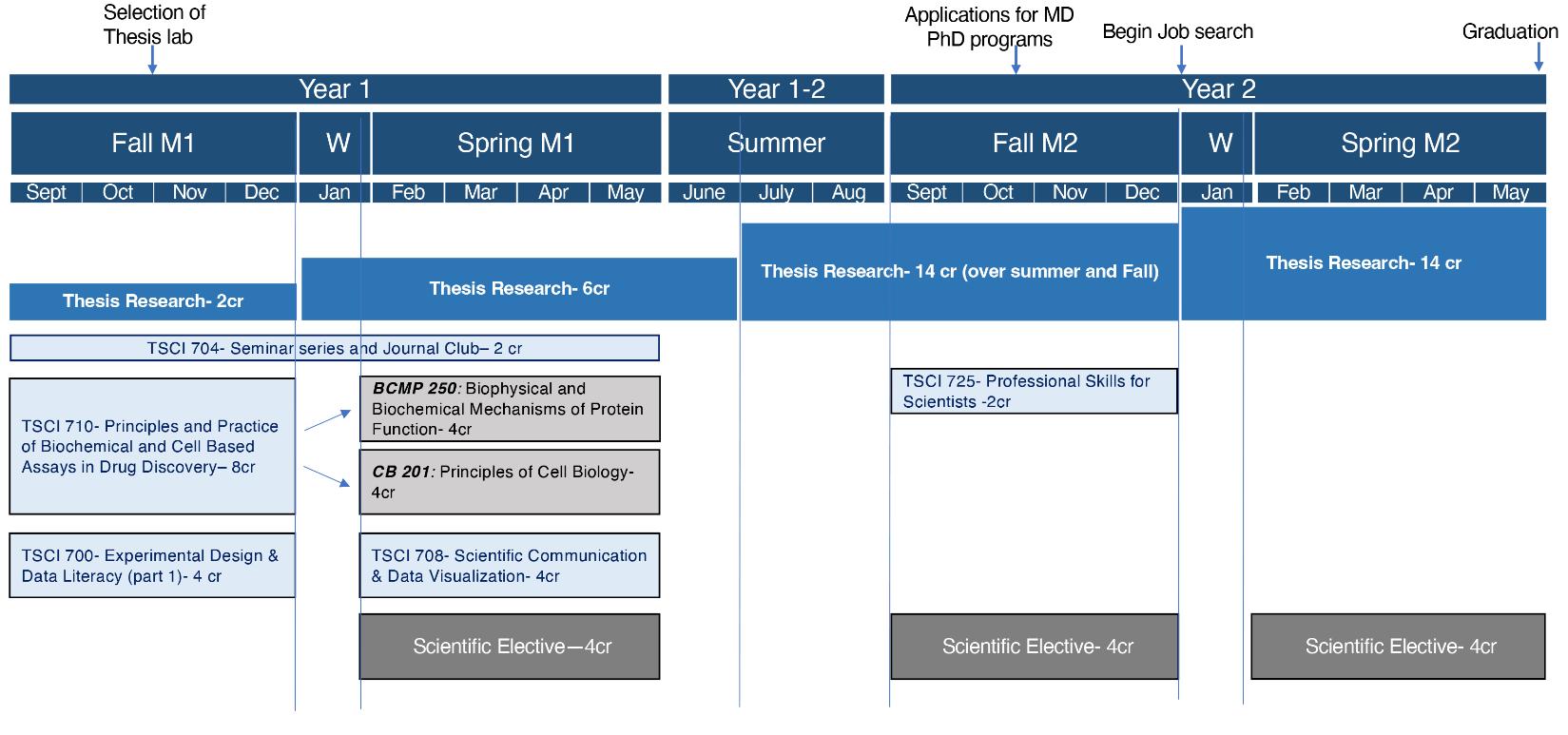
TSCI 710--Principles and Practice of Biochemical and Cell Based Assays in Drug Discovery
Credits: 8.00 CREDITS (Required)
Directors: Mark Namchuk, Kelly Arnett, Jennifer Smith
Grade Criteria: Letter
This course is the program's foundational course, combining lecture and lab-based components. It will equip the students with a fundamental understanding of biochemistry and cell biology, and their application in assay development. To enhance hands-on learning, the course will include laboratory components facilitating the translation of theoretical concepts into laboratory experience. The main topics covered include an introduction to modern drug discovery, an overview of assay technologies, the biochemistry of enzymes, receptors and ion channels, and biochemical and cellbased assay development.
TSCI 700--Experimental Design & Data Literacy
Credits: 4.00 CREDITS (Required)
Directors: David Glass and Ralph Mazitschek
Grade Criteria: Letter
Rigorous and reproducible biomedical research necessitates a strong foundation in understanding, collecting, analyzing, representing, and storing scientific data. This course equips scientists with practical statistical and data literacy skills, emphasizing best practices in Rigor, Reproducibility, and Responsibility (R3), alongside biostatistics and data analysis. The course will place emphasis on practical statistical and data literacy, and provide hands-on learning opportunities by integrating user-friendly, commonly used software, such as
This course would expand on the main themes of Fundamentals in Biochemistry, Cell Biology and Assays Development course and offer more advanced treatment of these themes for MMSc TS students who join a lab that conducts research using cell-based assays and strategies. Thus, this course is a Selective, and each student will be advised on selecting it by their Thesis Advisory Committee, Program leadership and their PIs.
TSCI 708--Scientific Communication and Data Visualization
Credits: 4.00 CREDITS (Required)
Directors: Milka Kostic
Grade Criteria: Letter
This interactive, hands-on course emphasizes the importance of scientific communication and data visualization. In this course students will learn about different formats of science communication, fundamentals of scientific writing, data visualization and figure preparation. Additionally, the course will describe different communication formats used in industry, and cover fundamentals of effective oral communication. Students will use their own thesis research topics and data for their hands-on assignments throughout this course. The course will prepare the students for their Thesis Committee meeting, and the HMS Masters Symposium.
TSCI 725--Professional Skills Development
Credits: 2.00 CREDITS (Required)
Directors: Milka Kostic and Catherine Dubreuil
Grade Criteria: Letter
This course is offered in the second year of training and is designed to equip Master's students with professional development and soft skills essential for post-graduation success. Through interactive sessions, practical exercises, and guest speakers from industry and academia, students will develop a comprehensive skill set crucial for thriving in a competitive work environment. The course will focus on professional skills and EQ, working in a diverse and interdisciplinary team, principles of management (both for projects and people), negotiation and conflict resolution, and networking and job search strategies.
Expectations for students by term or year
Year 1, Term 1:
1. Maintenance of a B average (numeric value of 80%) in coursework
2. Selection of a research laboratory in consultation with program directors
3. Initiation of part-time laboratory research
Year 1, Term 2:
1. Maintenance of B average (numeric value of 80%) in coursework
2. Continuation of laboratory research
3. Review of thesis project with program directors and first Thesis Advisory Committee (TAC) meeting
Summer between Year 1 and Year 2 will be dedicated to full-time mentored research in the thesis lab
Year 2, Term 1:
1. Maintenance of a B average (numeric value of 80%) in coursework
2. Thesis Advisory Committee (TAC) meeting, review of research progress
Year 2, Term 2:
1. Maintenance of a B average (numeric value of 80%) in coursework
2. Thesis Advisory Committee (TAC) meeting, final review of research progress and approval of thesis defense plans
3. Thesis Defense
Students will need to abide by all policies in the HMS Master's Student Handbook, including attendance (See Section 2.02) and academic integrity (See Section 3.09). Students must also abide by all policies at the home school for any courses taken at other schools within Harvard University.
Mentored research
All MMSc TS students are required to complete a mentored, hands-on thesis project. To maximize the time students spend in the lab acquiring the skills, knowledge, and experience needed to be a career experimentalist, students will choose their thesis advisor and establish a project in the Fall semester of Year 1. They are expected to spend 16 – 20 months conducting a laboratory-based thesis project in one of the core therapeutic sciences areas (biochemistry, biophysics, chemical biology, molecular pharmacology, molecular and cell biology). The students will be guided to choose the project based on their interests, expertise, and training goals. The research will be conducted under the mentorship of a Harvard University faculty member. Each semester, a specific set of scaffolded requirements have to be completed, and pre-determined thesis project/lab research milestones have to be met, resulting in a Satisfactory/Unsatisfactory grade.
Under the guidance of the thesis supervisor (i.e., postdoc or staff scientist), the student will develop and implement experimental methods to investigate specific aspects of the research question. This includes selecting appropriate techniques, tools, and protocols, and/or the generation of required reagents. The student is responsible for conducting the experiments, as well as data analysis, documentation and interpretation. There is the expectation of a solid body of work which may or may not represent a part or a whole of a publication. There is no formal expectation of a publication to graduate. The MMSc TS thesis will have three components: (1) an oral presentation of the work, (2) their electronic notebooks, and (3) a written summary document integrating the data from the slides from the oral defense. The document will include an executive summary contextualizing the project with citations, figures with detailed figure legends and detailed methods. The thesis must be submitted at least two weeks before the defense. Defenses will be scheduled from March to April of year two. Upon completion of the oral thesis defense and approval of the thesis, the student is required to upload a pdf of the thesis on the Harvard University database ProQuest, that is managed by Countway Library.
Assessment
Therapeutic Sciences uses letter grades for all its courses. The minimum standard for satisfactory work in the MMSc TS is a B average (numeric value of 80%). A grade of C is offset by a grade of A and a D by two A's; no
account is taken of plus or minus. A grade of F is failing. A course in which a student receives an F can be retaken for credit at a later time, in which case both grades will appear on the student's transcript. The pass/fail grading option is not available for MMSc TS core courses. Please see section 2.03 for more policies on grading and examinations.
Assessment for courses in other programs or schools is determined by those programs and schools.
Length of Time to Degree
MMSc TS students are expected to complete the MMSc degree in two academic years. Students may petition the program director in writing for an extension of time. Additionally, students must formalize any requested enrollment changes through the student information system. (See Section 2.06 for definitions of full and parttime and Section 2.07 for the policy on length of time to degree.)
Requirements for graduation
Overall B average (3.0 GPA) for course work.
Satisfactory progress as assessed by mentor and thesis committee
Successful defense of thesis
A degree will not be granted to a student who is not in good standing or against whom a disciplinary charge is pending. In addition, a student's term bill must be paid in full before they are awarded a diploma.
VI. Advising
The MMSc TS has a robust advising structure. The MMSc TS team is available for student guidance and advising throughout their time in the Program. The Program provides a formal advising plan for each student as follows:
One-on-one meetings will be held every term with the program directors to discuss progress.
One-on-one meetings with the program manager/administrative team will be held at minimum twice/academic year
The thesis advisory committee will meet a total of 3 times in the program to assess progress.
Formal check-ins with the lab PI and thesis supervisor every other month
Peer advising with other students in the program will be held annually
A thesis evaluation committee (different from the thesis advisory committee) will evaluate the thesis defense
VII. Financial Aid
See section 5.08 for financial information