C. Program Outline/Courses
The program is organized as follows:
1. An introductory course entitled “Fundamental Skills for Academic Success” is offered to begin the program in September. The primary objective of this course is to prepare students for work in the Master’s program and set expectations for managing time, academic integrity, and tips for success in the program. This course also begins the process of establishing our community with student-derived shared goals, values and behavioral expectations.
2. In the Fall term, a course in Clinical Operations Management Workflows is offered to prepare students for real world management scenarios related to patient care, quality control, people management, and general operations to introduce core concepts to the cohort.
3. Financial Planning and Management in Healthcare Organizations is offered in the Fall term to provide the fundamentals of healthcare finances including accounting, business planning, revenue cycle management, and budgeting in healthcare organizations. For those students who have significant experience with financial management, an advanced course is offered.
4. Clinical Operations pathway students will be introduced to foundational data analysis with a course in Quantitative Science and Clinical Research in the Fall semester. This course uses a variety of data analysis methods to help students make data-driven decisions.
5. Innovation in the Context of Stakeholder Perspectives is offered in the fall for the Industry pathway students to gain foundational skills in industry leadership
6. Core Executive Leadership Topics for the Executive Leadership pathway is offered in the fall to provide a context for the skillsets that executives need to lead clinical service initiatives.
7. In the January term, students in the clinical operations and executive leadership pathway will take a course in Effective Healthcare Management, which focuses on the management of space and people in healthcare organizations. Students will learn to apply the skills of resource management to the success of clinical operations.
8. Also in the January term, students in the Clinical Operations and Industry Leadership pathways will take a course in Supply Chain Management. They will learn how to use data effectively to analyze supply chain management and navigate and manage resources.
9. Value Based Healthcare and Population Management is offered in the January term for students in the Industry Pathway and the Executive Leadership Pathway.
10. Students will take a course in Leadership and Teamwork in coordination with the SM-HQS and MedEd programs. This course examines different aspects of working with, managing, and leading a team. Students will learn skills and techniques that are needed to manage a talented group of people effectively, pilot successful collaborations within and outside a group, navigate the complexities of the institution, and manage the inevitable conflicts that arise in a high-stakes environment.
11. In the Spring, a course in Healthcare Service Line Planning and Operations is offered. This course provides insight into the role of service line providers in the management of operations and strategic planning. The course will also explore how service lines are developing in systems and in other countries as a preferred model of patientcentered, high quality care.
12. To help students understand the role of technology in healthcare operations, a course in Integrating New Technology into Healthcare Delivery takes place in the Spring. This course provides a context for the importance of implementing new technologies into operations workflows.
13. Creating a Learning Organization in Healthcare Settings is offered in the Spring to give students in the clinical operations pathway the opportunity to understand how education plays a role in medical organizations. An educational mission not only enables members to grow within the organization but also poises the institution to be a leader in adopting new advances within the medical field.
14. To provide more advanced training on the core skills required by clinical operations leaders, Clinical Service Operations Skillsets is taught in the Spring semester to take a deeper dive into concepts covered during the Fall. This course aims to provide students with concrete tools they can apply in multiple operational settings.
15. A course in Industry Leadership Skillsets is introduced in the Spring term for students in the Industry Pathway.
16. C-Suite and Healthcare Executive Leadership is introduced in the Spring for students in the Executive Leadership pathway. It readies learners to assume senior leadership roles in the health care industry by preparing students to understand their personal leadership style, lead teams, think more strategically, and balance innovation with risk – all within the unique regulatory and cultural environment of health care.
17. Over the course of both Fall and Spring semesters, the students will participate in a seminar series. The series will include approximately 10-12 lectures across multiple
disciplines. The lectures will give students insights on how the leaders in the field forged their career paths and how their current role integrates with clinical operations. The seminar series is also an opportunity for the students to ask questions of the panelists and engage in networking opportunities.
18. Across the course of the Fall and Spring semesters is the Capstone project. The experience will be an intensive hands-on experience at the student’s home institution and is targeted to allow students to apply the tools, strategies, and methods from their didactic courses to develop a solution to an evidence-based operational problem seen in healthcare delivery. The student will report on key milestones and will receive feedback from his/her executive sponsor, capstone advisor, CSO Program Directors, and other students.
19. Elective course opportunities at HMS and other Harvard schools may be available with the permission of the Program Directors.
II. Degree Offered
MCSO will be offered by HMS as a 36-credit Master of Sciencedegree, over one academic year for full time students and two academic years for part time students. Students graduating after May 2025 will receive the degree, Master of Science in Clinical Service Operations.
III. Admission
Admitted candidates will be required to have the following: A terminal degree (e.g., MD, DDS, DNP, Pharm-D, , MBA, MPH, MHA, MSW, MBBS, MSN) and experience in operational roles or clinical experience. Candidates should have a minimum of five years professional experience in a clinical or industry setting for these pathways. Ten years of experience in a senior management role is required for the Executive Leadership pathway. Applications will be considered based on a combination of experience and education.
The admissions process will also evaluate academic, clinical, or operational achievements, including professional accomplishments in clinical service operations. The applicant will be expected to discuss his/her career, plans for future directions after completion of the program in a personal statement, and formally indicate a commitment to devote sufficient time to master the program content. There will be a formal admissions committee comprised of the Program Director, Program Co-Director, pathway leaders, andthe program manager. .
In addition to the requirements listed above, a language proficiency test is required for applicants for whom English was not the medium of instruction for their undergraduate or graduate degree. The master’s programs accept TOEFL iBT, TOEFL Essentials, IELTS Academic, or the Duolingo English Test. To be considered for admission, applicants must meet the following minimum test score requirements:
TOEFL iBT: 103
TOEFL iBT (new): 5.0
TOEFL Essentials: 11
IELTS Academic: 7.5
Duolingo English Test: 130
Instructions to submit official test scores:
TOEFL iBT and TOEFL Essentials: Code 3151: Harvard Medical School Graduate Education Master’s Programs
IELTS Academic:
Contact the test center where you took the IELTS test to request that your scores be sent via EDelivery to:
Account Name: Harvard Medical School Graduate Education Master's Programs
Address: Graduate Education Master's Programs 25 Shattuck Street Boston, MA 02115
United States
Duolingo English Test:
Search for “Harvard Medical School” and select the appropriate program.
IV. Course of Study
1. Concentrations offered
a. General Operations Pathway
b. Industry Leadership Pathway
c. Executive Leadership Pathway
2. Curriculum by term
a. The program begins in September 2026 and ends in May of 2027.
3. Full time and Part time options
a. Full time students will complete 36 credits over the course of one academic year, with 15 credits completed in the Fall, 6 credits in January, and 15 credits in Spring.
b. Part time students will complete 8 to 9 credits in the Fall semester, 4 credits in January, and 5 to 6 credits in the Spring of the first year. For the second year, the credit breakdown is 8, 2, 8 to 10 for Fall, January, and Spring.
4. Summary of Changes for AY 2026/2027
There are no proposed changes from the previous academic year.
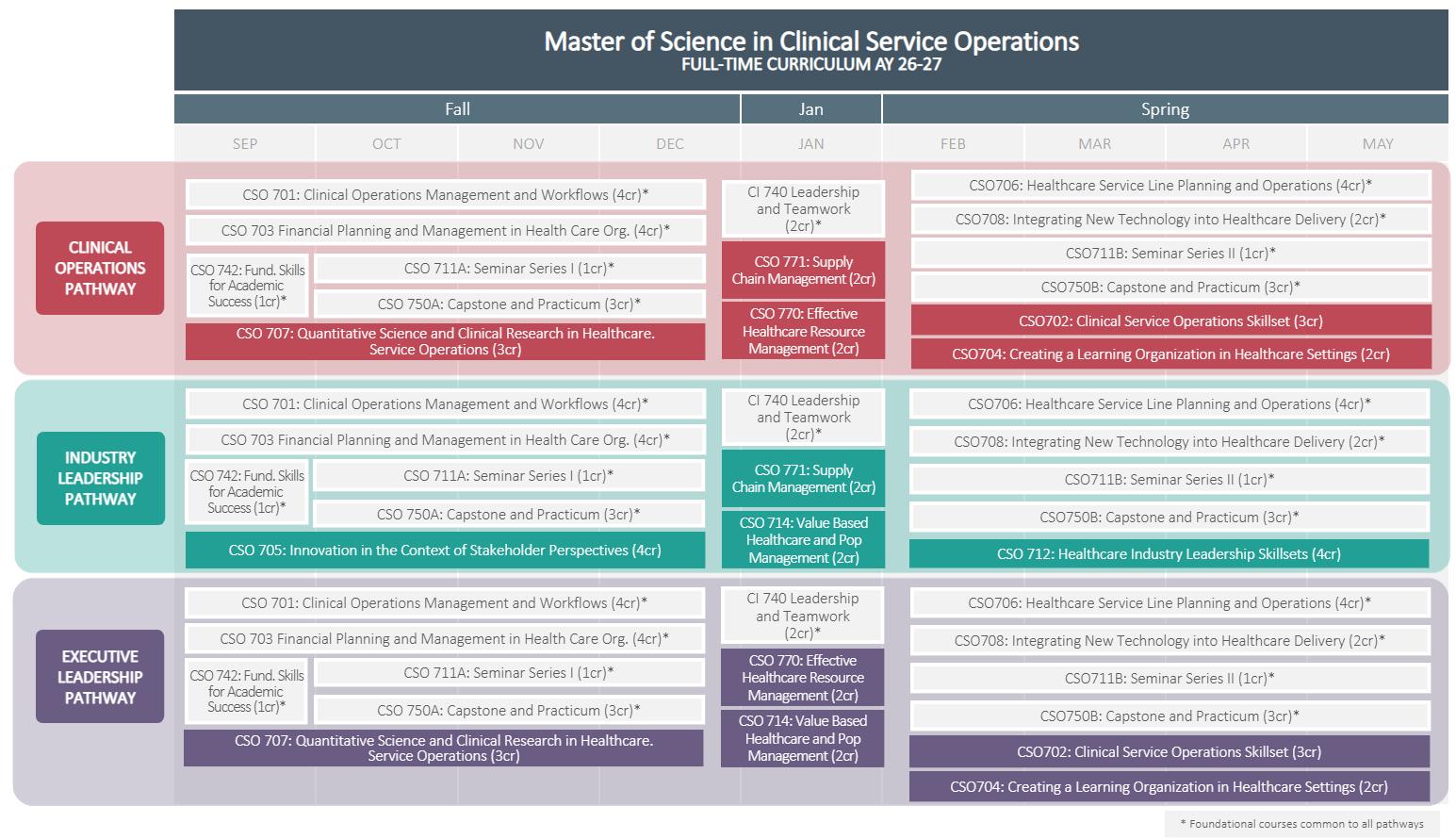
Full time curriculum map
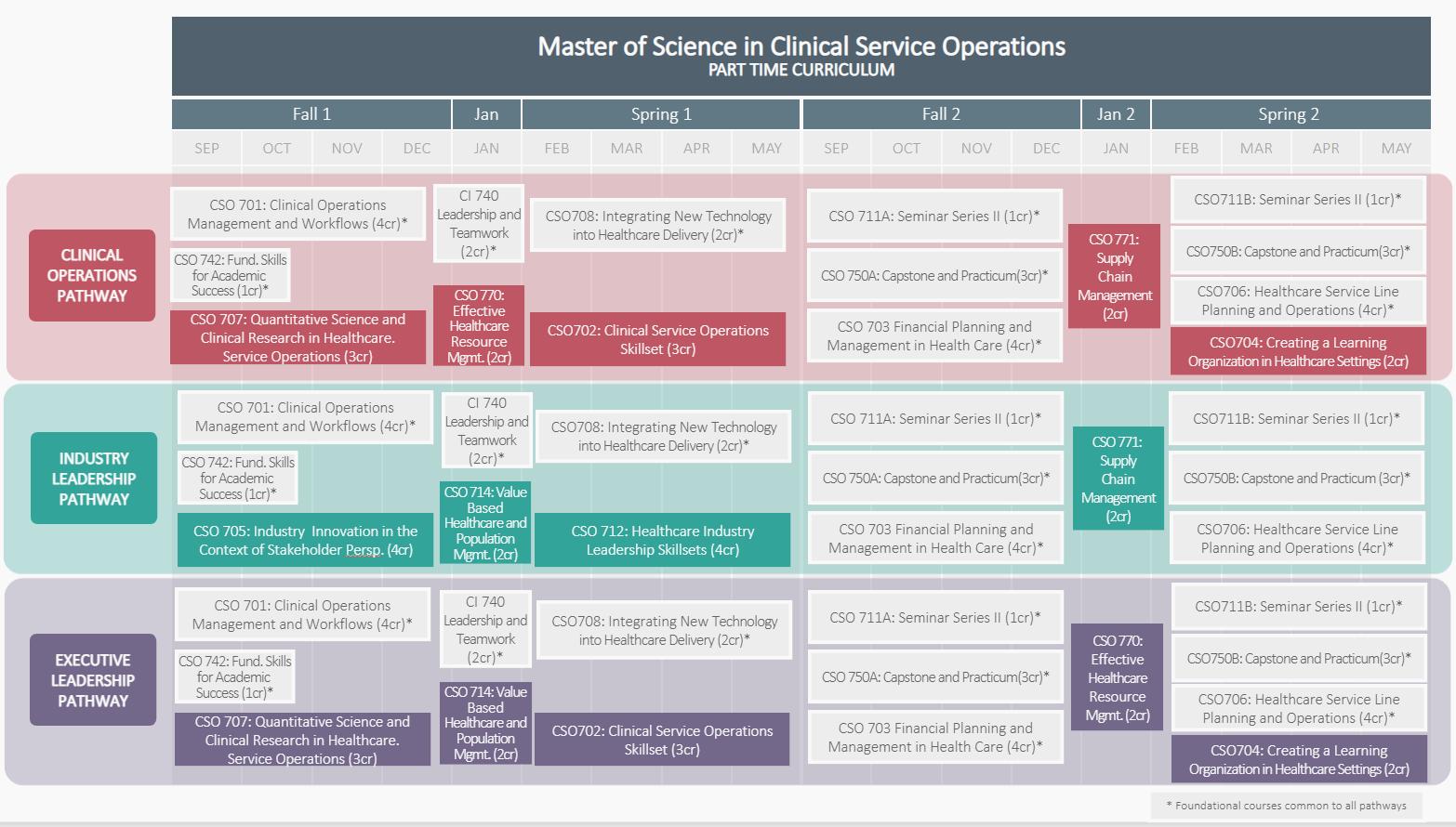
Part time curriculum map
A.
B.
Full Time Course Breakdown
Fall Term (September – December)
CSO742: Fundamental Skills for Academic Success (1)
CSO 701: Clinical Operations Management and Workflows (4)
CSO 703: Financial Planning and Management in Healthcare Organizations (4)
CSO 750A: Capstone and Practicum I (3)
CSO 711A: Seminar Series I: Real World Experience in Managing Healthcare Organizations (1)
(Clinical Ops Pathway) CSO 707: Quantitative Science and Clinical Research in Healthcare Service Operations (3)
(Industry Pathway) CSO 705: Innovation in the Context of Stakeholder Perspectives (4)
January Term
CI 740: Leadership and Teamwork (2)
(Clinical Ops & Executive Pathway) CSO 770: Effective Healthcare Resource Management (2)
(Clinical Ops & Industry Pathway) CSO 771: Supply Chain Management (2)
(Industry & Executive Pathway) CSO 714: Value Based Healthcare and Population Management (2)
Spring Term (February – May)
CSO 706: Healthcare Service Line Planning and Operations (4)
CSO 708: Integrating Technology into Healthcare Delivery (2)
CSO 750B: Capstone and Practicum II (3)
CSO 711B: Seminar Series II: Real World Experiences in Managing Healthcare Organizations (1)
(Clinical Ops Pathway) CSO 704: Creating a Learning Organization in Healthcare Settings (2)
(Clinical Ops Pathway) CSO 702: Clinical Service Operations Skillsets (3)
(Industry Pathway) CSO 712: Healthcare Industry Leadership Skillsets (4)
Part Time Course Breakdown
Year I Courses
Fall 1 Term (September – December)
CSO742: Fundamental Skills for Academic Success (1)
CSO701: Clinical Operations Management and Workflows (4)
(Clinical Ops Pathway) CSO707: Quantitative Science and Clinical Research in Healthcare Service Operations (3)
(Industry Pathway) CSO 705: Industry Innovation in the Context of Stakeholder Perspective (4)
January 1 Term
CI740: Leadership and Teamwork (2)
(Clinical Ops Pathway) CSO 770: Effective Healthcare Resource Management (2)
(Industry & Executive Pathway) CSO 714: Value Based Healthcare Population Management (2)
Spring 1 Term (February – May)
CSO708: Integrating Technology into Healthcare Delivery (2)
(Clinical Ops Pathway) CSO702: Clinical Service Operations Skillsets (3)
(Industry Pathway) CSO 712: Healthcare Industry Leadership Skillsets (4)
(Executive Pathway) CSO 710: C-Suite and Healthcare Executive Leadership Skillsets (4)
Year II Courses
Fall 2 Term (September – December)
CSO750A: Capstone and Practicum I (3)
CSO711A: Seminar Series I: Real World Experience in Managing Healthcare Organizations (1)
CSO703: Financial Planning and Management in Healthcare Organizations (4)
January 2 Term
(Executive Leadership Pathway) CSO770: Effective Healthcare Resource Management (2)
(Clinical Ops & Industry Pathway) CSO771: Supply Chain Management (2)
Spring 2 Term (February – May)
CSO711B: Seminar Series II: Real World Experiences in Managing Healthcare Organizations (1)
CSO750B: Capstone and Practicum II (3)
CSO706: Healthcare Service Line Planning and Operations (4)
(Clinical Ops Pathway) CSO704: Creating a Learning Organization in Healthcare Settings (2)
V. Course Descriptions
CSO 742: Fundamental Skills for Academic Success (1 Credit)
Course director: J. Kevin Tucker, MD, Director, Master of Science in Clinical Service Operations, Associate Physician, Brigham and Women’s Hospital.
This course shares an overview of key skill sets with students to support their experience in graduate school. We will review how having a growth mindset is essential for graduate school and professional life. Students will analyze and discuss key challenges in professionalism (communication, respect, biases, academic honesty, etc.). Building on organizational behavior and coaching principles, this course will also examine key aspects of leadership and teamwork essential skills like perspective taking, contribution to group dynamics, and best practices when working in groups.
The class will discuss project management as a graduate student and relationship building with a key focus on mentor-mentee relationships. Finally, students will evaluate their strengths and weaknesses in regard to professionalism, teamwork, and leadership, and develop a strategy to enhance their academic and professional performance.
Multiple resources will be used in this course, including cases, articles, chapters, and media materials. Learning Goals
By the end of the course, students will be able to:
Describe relevant strategies to improve learning experience and analyze how they may impact their own pathway as a graduate student.
Identify the relevant professional integrity skills that they need to focus on during their master’s program.
Apply essential communication, teamwork, and collaboration skills.
Strengthen skills to succeed in graduate school and leadership
CSO701: Clinical Operations Management and Workflows (4 Credits)
Course director:
Rachel Wasserstrom, MBA, Associate Director, Master of Science in Clinical Service Operations.
The aim of this course is to provide students with the skill to break down key components of clinical healthcare operations management and quality across inpatient, ambulatory, and procedural areas. The course will prepare students for real world management scenarios related to patient care, quality control, and people management and general operations. Students will learn about various aspects of managing healthcare organizations including efficiency, quality and safety, and process improvement. The course will illuminate the importance of patient access and timeliness of care and will cover modern strategies for capacity management and throughput strategies to optimize patient care delivery. Students will learn about the significance of the EMR in today’s healthcare delivery system and will obtain real-world strategies for tracking performance including understanding operational metrics and productivity. The course will also cover the basics of healthcare disaster planning and crisis management. A core component of the program will be a deep dive into performance improvement, operations redesign and change management using case studies and working in teams.
Course components will include live sessions, interactive modules, reading reflections, case studies and online discussion forums.
Key learning objectives will include:
Understand the fundamental roles of clinical operations workflows in a variety of settings including: ambulatory, inpatient, and procedural areas including the operationoperatingroom setting
Appreciate how data drive decisions and the importance of dashboards
Understand principles of capacity management, throughput, and patient flow
Appreciate how provider preference can be effectively managed considering other factors such as cost and efficiency
Understand value of standard procedures and policies and why they are important
Explore performance improvement strategies for high quality, efficient operations
Appreciate how ancillary departments, such as pharmacy, are integrated into healthcare operations
Delve into the role of the clinical operations expert in daily operations and disaster planning.
Learn how the regulatory environment shapes clinical operations, decision making, and patient care delivery
Learn about different healthcare settings and how challenges differ based on setting
CSO703: Financial Planning and Management in Healthcare Organizations (4 Credits) Course Director: Mario DiBenedetto, Executive Director, Finance - Mass General Physicians Organization - Member organization of Mass General Brigham
This course will provide the basics of healthcare finances including accounting, business planning, revenue cycle management, and budgeting. The course will provide clinical operations leaders with a broad overview of healthcare reimbursement, policy, and delivery in the US and abroad. .. Students will learn about strategies that healthcare systems have taken to increase revenue, while reducing costs, including population health management trends. The course will provide the student with insights on how to develop and manage healthcare finances and compile capital and operating budgets. Students will gain understanding of reimbursement and payer mix. The course will illustrate how health reform and regulatory changes can impact healthcare finances. Additionally, the course will prepare students for how to exercise leadership during budget processes or business planning, and how to track and monitor financial performance.
Key learning objectives include:
Discuss key concepts of healthcare finances that are relevant to a clinical operations leader including: budgeting, business planning, and financial forecasting
Describe key financial vocabulary and concepts, including, but not limited to direct and indirect costs, fixed and variable costs, contribution margin analysis, and break-even analysis
Discuss the major aspects of reimbursement, contracts and global payments
Define case mix and length of stay and their impact on revenue
CSO707: Quantitative Science and Clinical Research in Healthcare Service Operations (3 credits)
Course Directors: Inga Lennes, MD, MPH, MBA, President, University
California San Francisco Health and Lara Henshaw-Archer, MBA, PMP, VP, COO Ambulatory Services, University California San Francisco Health A core skill set for clinical operations leaders is understanding and using data to make decisions. This course will provide exposure to the use of quantitative data for analysis, program development, quality monitoring and improvement, and real-world decision-making related to the patient experience and provider performance. The course will also provide the clinical operations leader with valuable insights on clinical research and grants management. Specifically, students will learn how to interpret clinical research data to help guide business planning and program development decision-making. We will explore how grants and clinical research are utilized to enhance clinical programming and the patient experience. The course will provide an overview of grants and research management, as successful integration of clinical and observational research can be extremely impactful.
The course materials will consist of articles, case studies, discussion forums, interactive modules, and live and recorded lectures.
Key learning objectives will include:
Understand how clinical data and research data are used as part of clinical operations
Learn models for clinical research integration into clinical setting, including the role of grants
Develop analytical skills for interpreting data and applying to decision making
CSO 705 Industry Innovation in the Context of Stakeholder Perspectives (4 credits)
Course Director:
Innovative solutions in health care are being introduced at an accelerating pace, including new pharmaceutical therapeutic modalities, digital health solutions or care delivery/financing models. This course will systematically explore the ways that health care innovations have multiple potential audiences or stakeholders across the health care ecosystem, such as patients, providers,
health systems, or payers. Each of these stakeholders has their own concept of that innovation’s value. Program sessions will discuss the potential impact of emerging technologies (such as precision medicine, digital solutions or AI) in the context of these sometimes competing stakeholder perspectives, enabling students to more clearly identify business opportunities and challenges, and shape a strategy to achieve broad, sustainable adoption of innovations. Course components will include reading of preparatory materials, interactive lectures and small group application exercises.
Learning Goals:
Gain empathy for perspectives, pain points and concepts of value for key health care stakeholders
Integrate insights into the forces and enabling technologies shaping the future of health care to frame business opportunities and challenges Apply insights into health care culture and real-world workflows to inform development and adoption of innovations
CSO770: Effective Healthcare Resource Management (2 credits)
Course Director: David McCready, MBA, MHA, President & CEO, Southcoast Health
This course will primarily focus on space, finance, and people management, all of which are critical resources for healthcare operations leaders. This is an essential module that will explore physical space, facilities, financial revenue landscape, and payer impacts, as well as provide an overview of human resources management from hiring staff, developing a workforce, and nurturing providers and staff. Students will learn directly from industry experts who have significant real-world experience in the specialty areas covered in the course. Course components will include live sessions, instructional video, readings, and online discussion forums.
Key learning objectives
By the end of this course, students will be able to:
Describe best practices for strategic human resources management as a core strategy of institutional success.
Identify the signs of caregiver burnout and appreciate the impact that burnout has on the workforce; appreciate strategies, solutions, and resources available to support employee wellbeing.
Summarize and give examples of the operational and financial implications of developing, supporting, and maintaining a major hospital facility.
Appraise and defend the key role of facility support departments in the operations of a hospital.
Enumerate and value the future external and internal risks that challenge an organization’s financial stability and delivery of its mission.
CSO771: Supply Chain Management (2 Credits)
Course Director: Julie Barrios, MS, Executive Director Supply Chain Sourcing and Data Analytics, Mass General Brigham
A major role for any clinical operations leader is supply chain management. Access to supplies is critical to patient care, and leaders need to have a deep understanding of the upstream and downstream processes, as well as the importance of vendor relationships, including the opportunity to co-develop innovations through research or beta testing. Clinical operations leaders also need to respect boundaries with vendors and be mindful of conflict of interest rules. Managing supply cost is a major focus and understanding strategies for reducing costs or better managing inventory are critical. Forecasting and budgeting is a key skill set and ensuring that students understand the core components of supply and equipment contracts is important. There is also significant innovation in tracking and monitoring high-cost supplies and pharmaceuticals. The course will also cover using data and metrics for supply chain management and how to deal with shortages that have become more frequent over the past several years.
Key learning objectives
By the end of this course, students will be able to:
Discuss basic principles of Supply Chain Management
Explain the dimensions of Clinical Operations that are impacted by Supply Chain
Evaluate the successfulness of supply chain optimization methods in various scenarios
Summarize the role of vendors and ethics associated with managing supplies
CI740 Leadership and Teamwork (2 credits)
Katherine Santos, MBA, Chief Strategy Officer, Legacy Lifecare
This course examines different aspects of working with, managing, and leading a team. Lectures will discuss the skills and techniques that are needed to manage a talented group of people effectively, pilot successful collaborations within and outside a group, navigate the complexities of the institution, and manage the inevitable conflicts that arise in a high-stakes environment.
Key learning objectives include:
Describe the theoretical foundations of teamwork, teaming, and adaptive leadership.
Identify key dynamics that contribute to highly functional teams and dysfunctional teams
Discuss leadership problem-solving strategies in quality, education, operations, and research
Infer best leadership practices from real-world leaders in healthcare and education
Analyze the success of conflict-resolution strategies and tactics in different contexts
Practice teamwork and collaborative decision-making
Analyze and propose leadership strategies for solving real-world situations
CSO706: Healthcare Service Line Planning and Operations (4 Credits)
Course Director:
Susan Chapman Moss, MBA, President, Beth
Israel Lahey Hospital
Performance Network ,
and
Cynthia Lewis Kavanagh, Executive Director, Strategy, Planning and Intelligence, Mass General Brigham
The service line trend has evolved over the past 20 years and service lines are currently being used in both community hospitals and academic medical centers to organize care delivery for the patient, improve quality, reduce costs, and drive top line margin and market share. Despite this trend, the organization and governance of healthcare organizations are not always well aligned with the development of service lines, and clinical operations leaders need insight in how to advance change and work towards models of care that best support the patient and organizational goals. Typical service lines may be disease focused like cancer, heart disease, neurosciences, digestive diseases, and behavioral health, or focused on different populations like women’s health, children’s health, or geriatrics, or may be more procedural or location-based including transplant, dialysis, critical care/ICU, perioperative services, or emergency medicine. A key driver for the establishment of service lines is the need for a complex set of clinical services that span ambulatory, procedural, and inpatient settings, as well as require high degrees of multidisciplinary management and integration of clinical research. Physician alignment is necessary in all service line models and there are novel approaches to organizing physicians in service lines. Service lines are often a vehicle for program development and capital investment and can be leveraged for philanthropy and naming gifts. Clinical operations leaders and service line leaders play a critical leadership role in the day-to-day management and strategic planning of these operations. This course will provide context of how service lines fit into the overall framework of a hospital and will cover all aspects of service line leadership and management including governance, financial planning, accounting, quality control, operations, capital planning, business development, and patient centered care. The course will explore how service lines are developing in systems and in other countries as a preferred model of patient-centered, high-quality care.
Course components will include: pre-recorded didactics, live sessions, pre-readings, online discussion forums, group work and a service line planning project that will be tied to the elements of each weeks’ learnings.
Key learning objectives
By the end of the course, students will be able to:
Explain the organization and principles of a service line
Understand planning and finances associated with service lines
Explore models for service line management and physician alignment
Learn how service lines can grow market share and enhance patient satisfaction
CSO708: Integrating New Technology into Healthcare Delivery (2 credits)
Course Director: James Stanford, MBA, Managing Director, Fitzroy Health
Technological advances in healthcare are moving at a rapid pace. Emerging digital health solutions are critical strategic enablers that allow data to be transformed, enterprise wide and
locally, into rich insights that enable improved care outcomes, exceptional patient experience, workflow efficiencies, and greater system cohesion and operational alignment. The convergence of big data, artificial intelligence (AI), cloud computing and the internet of things (IoT) has served as a disruptive force across industries and is now propelling innovation in healthcare. The implementation of these technologies in healthcare is introducing new methods for care delivery and challenging the status quo across the spectrum of hospital operations, from back-end administrative functions to front-line patient care.
This course will explore factors driving the need for innovation in healthcare today, the benefits and risks of adopting new technology, and strategies for securing leadership support. The course will prepare healthcare leaders to evaluate transformative opportunities, conduct due diligence, and make effective decisions that impact clinical and administrative workflows within complex matrix organizations.
The course materials will consist of lecture notes, case studies, and readings.
Key learning objectives include:
At the completion of the course, students will be able to:
Describe real-world application of integrating technology into healthcare delivery, including diligence, selection, and implementation of transformational technologies;
Identify clinical/operational challenges and compelling solutions that align with a provider system’s broader strategy;
Identify the necessary considerations and components of a robust due diligence process;
Determine essential strategies, considerations, and planning components for successful adoption of emerging technologies;
Work in cross-functional teams and understand the interactions between healthcare and industry/ regulatory players; and
Develop tactics and skills needed to influence decision making and orchestrate desired outcomes within complex organizations.
CSO704: Creating a Learning Organization in Healthcare Settings (2 credits):
Course Director: Tony Weiss, M.D., M.B.A., M.Sc., C.P.E., F.A.P.A., Associate Professor of Psychiatry, Beth Israel Deaconess Medical Center
Given the rapid pace of change in healthcare not only must individuals be continuous learners, but also organizations must continually “learn” to adapt, change, and grow. As our healthcare organizations become vehicles for population health management across regional networks, this type of learning is necessary now more than ever before. This is enhanced further with the advent of system wide EMRs, digital and tele-health, access to big data, and personalized medicine approaches. There are some new risks associated with rapid change, and organizations need to learn how to preserve the fundamentals of patient care. Furthermore, patient and family
expectations for providers and teams are shifting, and some care is shifting into the home or virtual setting. This course will explore the facets of creating a learning organization within health care.
Beyond the adaptation and learning that all health care organizations must undergo to stay relevant and competitive in today’s environment, Academic Medical Centers (AMCs) have an additional role in training the next generation of clinicians. The course will also explore the teaching mission in the healthcare setting, including the operational integration of students and post-graduate trainees and financing of graduate medical education.
Course components will include live virtual synchronous sessions, asynchronous videos, readings, and online discussion forums.
Key learning objectives include: By the end of the course, students will be able to:
Develop expertise in the characteristics of a learning organization, how to assess organizations for this classification, and how to strengthen this quality within a healthcare organization.
Understand the rapidly changing role of data and information technology in health care.
Explore the role of artificial intelligence and machine learning in healthcare as tools to enhance organizational learning.
Understand how to properly assess change within an organization, operationalize change management frameworks, and understand the human and technical side of change management.
Analyze a written case study to enhance comprehension of characteristics of a learning organization and steps needed for change management skills.
Explore the role of graduate medical education within U.S. academic medical centers, including how the institution is financed and governed.
Utilize communication and leadership skills required to develop and maintain collaboration in a learning organization in general or in times of crisis.
CSO702: Clinical Service Operations Skillsets (3 Credits):
Course Director: Erika Rosato, DNP, MHA, RN, Director of Ambulatory Oncology Clinical Services, Massachusetts General Hospital and, Elizabeth Aremu, MHA, MPH, Director of Strategy and Innovation, Optum Insight
This course is designed to provide in-depth training on the core competencies required by clinical operations leaders at all organizational levels, from managing a unit or department, to overseeing a service line, to leading an entire hospital or health system. Students will develop essential leadership capabilities including change management, strategic planning, crisis leadership, data-driven decision-making, stakeholder management, and strategic communication.
The course emphasizes practical application through interactive exercises, real-world case studies, and the development of a comprehensive leadership toolkit.
Key focus areas include navigating complex organizational dynamics, managing multidisciplinary teams, leading through crisis and uncertainty, using data and metrics to drive performance, and addressing the evolving regulatory landscape in healthcare. Students will learn to balance strategic vision with operational execution while maintaining ethical leadership practices and relationship-based care principles. Through hands-on application of frameworks and tools, participants will build immediately usable resources they can deploy in their current and future leadership roles.
Key learning objectives
By the end of the course, students will be able to:
Apply core operational leadership competencies including change management, strategic planning, crisis management, project management, and data-driven decision-making
Lead high-performing multi-disciplinary teams through performance management, coaching, and inclusive team building
Navigate organizational complexity using stakeholder management, strategic communication, and coalition-building skills
Drive operational excellence through data analytics, quality improvement, regulatory compliance, and financial management
Build a personal leadership toolkit of practical frameworks and resources for ongoing professional development
Integrate relationship-based care and ethical decision-making into all aspects of operational leadership
CSO 712: Healthcare Industry Leadership Skillsets (4 credits)
Course Director: Harry Orf, PhD, Former Senior VP for Research, Massachusetts General Hospital, Industry Leadership Pathway Director for Master of Science in Clinical Service Operations.
This course will help prepare learners to assume more senior leadership roles in the health care industry. Utilizing real-world examples from industry sectors such as digital health and biopharma, sessions will prepare students to understand their personal leadership style, lead teams, think more strategically, and balance innovation with risk – all within the unique regulatory and cultural environment of health care. In several sessions, students will have the opportunity to hear directly from senior industry leaders as they relate the lessons learned from their leadership challenges.
Course components will include reading of preparatory materials, interactive lectures, case-based learning and small group discussions.
Learning Goals:
By the end of this course, students will be able to:
Understand key principles of self-leadership, team leadership, functional leadership and enterprise leadership
Understand the ecosystem for company creation and leadership in different contexts
Apply frameworks to strengthen their ability to think strategically and foster innovation
Synthesize lessons learned from the experiences of senior industry leaders
CSO711 A&B: Seminar Series: Real World Experience in Managing Health Care Organizations (2 Credits)
Course Director: J. Kevin Tucker, MD, Director, Master of Science in Clinical Service Operations, Associate Physician, Brigham and Women’s Hospital.
The seminar series provides experiential learning through direct interaction in a give-and-take format with a senior healthcare executive. The didactic hour of instruction is followed by an inclass exercise that builds upon the discussion in the first hour.
The lecture series will include approximately 12 lectures by healthcare leaders across multiple disciplines. Industry executives from related fields will also be invited to share their perspectives. These lectures will include background on their career path, key leadership qualities, teambuilding, communication, and other skill sets and will explore their personal and organizational strategies for work-life balance, resiliency, and burnout.
Key learning objectives include:
At the end of the fall and spring courses, students will be able to:
Apply leadership lessons gleaned from examples and discussion of real-world experiences in personal and professional contexts
Incorporate core topics of creating corporate culture, advancing diversity, inclusion, and belonging and managing change into their professional endeavors.
Build their professional network
Apply leadership lessons gleaned from examples and discussion of real-world experiences in personal and professional contexts
Employ strategies to understand and resolve conflict in the context of labor management
CSO750A and CSO750B: Clinical Operations Practicum and Capstone Project (6 Credits
Total Over Fall/Spring Semester):
Course Director:
J. Kevin Tucker, MD, Director, Master of Science in Clinical Service Operations, Associate Physician, Brigham and Women’s Hospital
The capstone experience is a required component of the Master’s program. The experience will be an intensive hands-on experience to be completed at the students’ home hospital or organization to allow students to apply the tools, strategies, and methods from their didactic courses to develop a solution to an evidence-based operational problem seen in healthcare delivery. Students will identify an executive sponsor from their own organization. At the beginning of the capstone (i.e., over the fall term), the executive sponsor and student will identify a topic and specific problem to address or investigate. Ideally, this will be an issue that is germane to both the student and mentor’s work and organization. They will perform evidence-based research into the issue, the impact on care, and best practices if they exist. They will then analyze and describe the current system of care surrounding the problem within the organization, and design an intervention. They will construct an implementation plan along with measures, and a method for assessing and displaying outcomes. Finally, they will share early findings from implementation or will demonstrate a range of solutions or alternatives. All capstones will include a workflow analysis, financial plan, and staffing plan. Examples could include the understanding and updating of budgetary or business planning processes, the creation of system solutions to solve workflow, implementing innovation or new service, performance improvement, supply chain management, human resources management, or clinical research integration.
Over the course of the year, the milestones worksheets will provide a framework for preparing the final paper. The capstone template also provides a clear outline and format for the paper. The oral presentation should be 20-25 minutes in length and shall allow for questions.
At the end of the Capstone Courses, students will be able to:
Describe an operational problem within a healthcare organization or similar setting
Identify key stakeholders to develop an operational improvement plan
Research how other organizations have approached similar operational problems
Develop a process improvement plan
Analyze the financial impact of the improvement plan on the organization
VI. Expectations for students by term or year
Students will be formally evaluated in each course, through participation, online quizzes and homework, team projects, and written work. Attendance is required for all live synchronous sessions.
Students are expected to abide by the policies, including attendance and academic integrity, of each school in which courses are taken.
VII. Assessment
Students receive a final grade for each didactic course they take. This will be a satisfactory/unsatisfactory rating for all courses in the SM-CSO program. Satisfactory is defined as a numeric score of 80 or better. In addition, students are evaluated throughout each course through regular homework assignments, online quizzes, class participation, and team-based projects that are presented orally and in written form.
Length of Time to Degree
Students are expected to complete the SM-CSO degree program in one academic year if enrolled in the full-time option, and in two academic years, if part-time.
Requirements for graduation
Completion of the 36-credit curriculum and a Capstone project are required (in the form of an analytic report, with a successful oral presentation). A degree will not be granted to a student who is not in good standing or against whom a disciplinary charge is pending. In addition, a student’s term bill must be paid in full before they are awarded the degree.
VIII. Advising
Each student will benefit from ongoing advice from their executive sponsor and capstone advisor who will have expertise iin the subject matter of the Capstone. Capstone Advisors will spend at least 10 hours supporting the students and providing input on drafts. The Program Directors will also have office hours and will be accessible to the students.
IX. Financial Aid
Program applicants are encouraged to apply for external grants and fellowships whenever possible.
SM-CSO has limited scholarship resources available through discretionary resources. Application for program scholarship support is made directly to the program director.