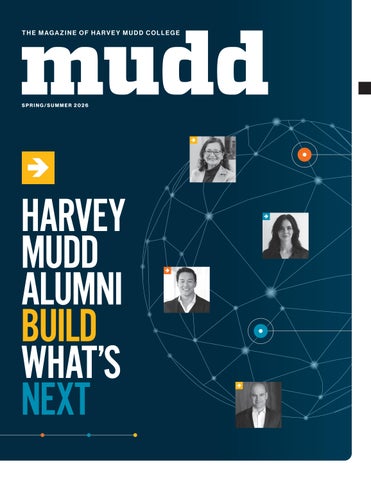
mudd T H E M AG A Z I N E O F H A R V E Y M U D D C O L L E G E
SPRING/SUMMER 2026
Aditi Bonthu
Ria Rajasekar, Marika Ragnartz, Shreya Reddi, Maddie Reeve
Gabriela Gamiz, civic and community engagement director, and Leilani Elkaslasy
Commencement speaker Laurie Leshin
Izze Stolzoff and Shreya Subramanian
Erin Wang with parents, Tony and Thao
Front: Laura Vairus, Ananya Venkatachalam, Bam Sindhurattavej. Back: Thomas Wing, Anshuman Singh
Jessica Liu
Lucas Lemos, Tony Laviada, Luis Lorenzana, Alicia Krasner, Vikram Krishna, Daniel Kotkosky, Omar Jimenez, Mingbei (Tommy) Liu (kneeling)
Download free images from HMC Flickr, bit.ly/gradimages2026 Video of ceremony: bit.ly/3Rensgw
2
CONTENTS
Spring/Summer 2026 Volume 26, No. 2 Mudd Magazine is produced two times per year by the Office of Communications and Marketing. Senior Director of Communications, Senior Editor Stephanie L. Graham, APR Creative Director Robert Vidaure Senior Graphic Designer Joshua Buller
5
Innovation Accelerator Labs are Redefining Progress Through a suite of Innovation Accelerator Labs, the College is transforming how students interact with data, health, artificial intelligence and the Core Curriculum.
19
The Hackathon Advantage Alspencer Omondi ’26 leverages hackathons to validate startup concepts, build products and fuel a winning pipeline of new ventures.
Associate Directors Sarah Barnes, Kristine Delgadillo, Susan Reza Contributing Writers Jen Miller Contributing Photographers Elisa Ferrari, Jeanine Hill, Dominic Indolino, Brian Morri, Nancy Newman, Colin Young-Wolff Vice President for Communications and Marketing/Chief Communications Officer Timothy L. Hussey, APR
Mudd Magazine (SSN 0276-0797) is published by Harvey Mudd College, Office of Communications and Marketing, 301 Platt Boulevard Claremont, CA 91711. Nonprofit Organization Postage Paid at Claremont, CA 91711.
20
39
Insightful, candid reflections from alumni entrepreneurs, who expose the realities of building a business.
Mudders create affordable AI technology to help those with vision impairments.
Mudd Alumni Build What’s Next
Accessible Independence
Departments 4 College News 12 Research 14 Clinic
41
Mudders Power NASA’s Historic Artemis II Mission Alumni describe their work on NASA’s latest mission.
HARVEY MUDD COLLEGE MAGAZINE
34 Mudderings 37 Class Notes
Postmaster: Send address changes to Harvey Mudd College, Advancement Services, 301 Platt Boulevard, Claremont, CA 91711. Copyright © 2026—Harvey Mudd College. All rights reserved. Opinions expressed in the Mudd Magazine are those of the individual authors and subjects and do not necessarily reflect the views of the College administration, faculty or students. No portion of this magazine may be reproduced without the express written consent of the editor. Mudd Magazine staff welcomes your input: communications@hmc.edu or Mudd Magazine, Harvey Mudd College, 301 Platt Boulevard, Claremont, CA 91711
magazine.hmc.edu Follow Harvey Mudd College Instagram – @harvey_mudd Facebook – @harveymuddcollege LinkedIn – harvey-mudd-college Bluesky – @hmc.edu
3
PRESIDENT’S PERSPECTIVE The Start of Something New
Devices of Democracy During the Athenian democracy 2,500 years ago, the Kleroterion served as a sortition device to randomly select citizens for public offices and juries. In 2024, artist Taryn Simon reimagined this ancient tool as a modern sculpture to spark dialogue about contemporary democracy. The Game of Democracy: Art, Engineering Chance, Choice, and Civic Life, a spring semester course that I led with Michael G. and C. Jane Wilson Professor in Arts and the Humanities Ken Fandell, transformed that dialogue into an interdisciplinary learning opportunity. Together, we explored how aesthetics and structural function shape democratic life. Students in the course shared their work as part of an on-campus exhibition that included Simon’s Kleroterion, on loan from the Almine Rech Gallery in Paris. hmc.edu/game-of-democracy
the spring semester always brings a profound sense of pride as we share in the traditions that define Harvey Mudd, from annual research and Clinic presentations to Commencement. This year, that pride is amplified by a powerful sense of momentum. Our community celebrated several major national student awards—including a prestigious Fulbright Scholarship— and honored exceptional staff, faculty, and alumni. This shared excellence shapes the experience for everyone who joins our community, inspiring us to think boldly about how we support future generations. Reflecting our deep commitment to access and opportunity, we have defined The Harvey Mudd Promise—a campaign initiative to eliminate student loans for all students—and the new Impact Scholars Program (more on page 4). By striving to remove financial barriers, we aim to empower our students with the freedom to dream bigger, take risks, and pursue visionary paths without the burden of debt. That spirit of exploration also thrives outside the classroom. Guided by our STEM for a Better World strategic plan, we are actively expanding Harvey Mudd’s entrepreneurial ecosystem. In February, we convened an executive roundtable to discuss how we might best support student innovation and integrate entrepreneurial thinking into our community. Seeded by a $1 million leadership gift, our new Innovation Accelerator Lab for Entrepreneurship is in the planning stages to serve as a programmatic engine for these efforts. We are exploring several exciting
possibilities, including a potential “Venture Clinic”—inspired by our legendary 60-year-old Clinic model—to offer students a dedicated runway to develop student-led startups with robust industry mentorship. The extraordinary scope of Mudder innovation is on full display throughout this issue, which features remarkable alumni entrepreneurs and current students who are turning bold ideas into reality. This impact extends globally and literally out of this world. We celebrate astronaut Stan Love ’87, who served as lead capsule communicator for NASA’s historic Artemis II lunar mission this spring, alongside the many alumni whose brilliant technical contributions helped propel the mission to success (page 41). As we look to the fall, we are pleased to welcome 232 entering students into our community. They arrive at a significant moment for the College as we launch a $250 million comprehensive campaign, the most ambitious fundraising effort in Harvey Mudd’s history. Look out for a new video series this fall sharing the stories of this visionary campaign. Thank you for your continued dedication to empowering the next generation of responsible STEM leaders.
Harriet B. Nembhard President Harvey Mudd College
SPRING/SUMMER 2026
4
COLLEGE NEWS Premier Research Experience A prestigious award from the Arnold and Mabel Beckman Foundation totaling over $150,000 will support six exceptional undergraduate researchers from 2026 through 2029, marking the College’s fifth such award. The Beckman Scholars Program is designed to stimulate and support research activities by talented, full-time undergraduates. The program will provide a distinct 15-month mentored research experience in chemistry, biochemistry, the biological and medical sciences, or interdisciplinary combinations of these fields. Each Beckman Scholar will receive a $26,000 award package ($21,000 stipend for the student and $5,000 for mentor and institutional support). The 15-month commitment includes two full-time summer research terms and academic year research credits. Beyond laboratory work, scholars will participate in leadership and networking activities, scientific communication training and mentorship interactions.
Roadmap for College Affordability To ensure that a Harvey Mudd education remains within reach for students from all financial backgrounds, the College has released its Final Report of the Task Force on College Affordability. The report highlights a comprehensive strategy focused on academic excellence, access and equity.
Key highlights include: •T he Harvey Mudd Promise. A landmark initiative aiming to eliminate student loans for all students. This expansion of current policy—which already meets full need without loans for families earning under $100,000—will be a primary focus of upcoming fundraising efforts. •T he Impact Scholars Program. An umbrella for scholarship opportunities, including the existing President’s Scholars Program as well as the new MORE (Mudd Opportunity for Research Experience) Scholarship Program. • Integrated Research. MORE Scholars will receive annual merit awards and guaranteed funding for summer research, while the endowment will also provide stipends for faculty mentors to sustain the College’s signature hands-on learning environment. By purposefully investing in students and their families, the College aims to open its doors wider to the world's most promising future STEM leaders, empowering graduates with the freedom to choose career paths—from social impact to aerospace—driven by their passions and the impact they want to make. View the online report: bit.ly/AffordHMC.
HARVEY MUDD COLLEGE MAGAZINE
Campaign Launch The board of trustees voted to launch the largest comprehensive fundraising campaign in the College’s 70-year history beginning July 1, with a preliminary goal of raising $250 million over the next seven years. hmc.edu/campaign
COLLEGE NEWS
5
Innovation Accelerator Labs are Redefining Progress through a suite of innovation Accelerator Labs, the College is transforming how students interact with data, health, artificial intelligence and the Core Curriculum, expanding from “what can we build?” to “whom does this serve?” Data as a Tool for Justice
The Data Science and Social Impact Lab concluded its work during spring 2026. At its DIoDS (Driving the Impact of Data Science) Conference in February, guest speaker Nathan Alexander (Howard University) drew upon the legacy of American writer and civil rights icon James Baldwin and challenged the community with a question: “How much data do you want for your progress?” This philosophy anchored the conference, where industry leaders and academics explored how to harness data toward sustainable, equitable action. Joseph Robertson (Mato Ohitika Analytics) shared his work on “Data Sovereignty,” showing students how to ethically bridge indigenous culture with modern data science to identify harms in technological systems. David Uminsky ’03 described how the University of Chicago Data Science Institute—which he leads—is applying the HMC Clinic model to build bridges between data scientists and their communities. The lab’s commitment to “data-to-doing” was further reflected in the spring 2026 Datathon, in which student teams competed to visualize complex trends in global health and nutrition, turning raw numbers into compelling narratives for change. Engineering for Human Health
In the Emerging Health Technologies (EHT) Lab, the focus is on leveraging the interdisciplinary foundation of a Mudd education to address pressing challenges in biomedical research and development. This spring, the lab hosted a series of industry experts from companies like Novartis and Roche, exploring how data science drives drug discovery and how physics shapes sequencing development. The EHT Lab
(Re)Imagining Liberal Arts and STEM Education in the Age of GenAI conference, spring 2026
is also a powerhouse for career longevity, fostering a robust alumni networking hub and placing students in high-impact summer internships at companies led by HMC alumni. The lab seeks to ensure Mudders are ready to lead in the biotech and pharmaceutical sectors.
teaching with AI, about AI or in response to AI. During the spring, the Imaginative Prototyping Lab created a studio space for Mudd students to build AI prototypes and engage in multi-layered analyses of the impacts of their designs. A Foundation for Success
The AI Frontier: Reimagining the Classroom
As generative AI shifts the landscape of higher education, the AI Experimentation Lab is leading a national conversation. In May, the lab hosted the conference “(Re) Imagining Liberal Arts & STEM Education in the Age of GenAI.” The conference featured visionaries like Dylan Baker ’17 (Distributed AI Research Institute), who challenged participants to reframe ethical AI. The goal is to create “AI-aware” teaching models that emphasize how these tools impact society, ensuring that the next generation of builders is as ethically grounded as they are technically proficient. Other presenters at the conference included Mudd faculty sharing their work from microgrants to reimagine their
The Thriving in STEM Lab ensures that the Harvey Mudd Core is a springboard rather than a barrier. Through summer skills previews and cohort-based tutoring, the lab builds the social and academic readiness necessary for students to participate in the rigorous curriculum. The tutoring program finished its third semester, linking 23 students with tutors. The Core Skills Preview is moving to an in-person weekly format this fall for small, selected groups of about 10 students and will include mentoring cohorts (one student and one faculty mentor partnered with each section).
mc.edu/strategic-planning/innovationh accelerator
SPRING/SUMMER 2026
6
COLLEGE NEWS
New Endowed Professorship in AI The College is accelerating its leadership in the digital frontier with the establishment of the Jenna and Paul Segal Endowed Professorship in Artificial Intelligence. Made possible by a grant from the Paul and Jenna Segal Family Foundation, this new professorship is central to the College’s mission to build an integrated, undergraduate-focused AI laboratory. The Segal Professor will act as a “teacher-scholar-builder,” bridging classroom theory with the technical and ethical frontiers of AI development. A key part of the role involves leading Clinic Program teams of juniors and seniors who will tackle AI challenges for industry and nonprofit partners. “Harvey Mudd is uniquely positioned to help undergraduates shape the future of AI,” said Paul Segal. “We hope this professorship helps sustain a culture where ambitious ideas are welcomed, experiments are measured honestly and each generation of students builds on what the previous one shipped.” By engaging with the newly established Innovation Accelerator Laboratory for AI, the professor will guide students in building systems that prioritize robustness, reliability and energy efficiency. “This professorship allows us to cultivate an environment where undergraduates learn the discipline of rigorous evaluation and the technical agency required to build from the ground up,” said President Harriet Nembhard. T o learn more about the national search to fill this position, view the position description at bit.ly/AIProfessorship.
Trustee Update
Trustees honored Vice Chair of the Board Laura Larson P’20, who has served with distinction on the board for many years. Larson was presented with the Sprague Outstanding Volunteer Service Award, which recognizes those who exemplify the highest ideals of service to the College. The award is named in honor of Norman F. Sprague Jr., who joined the board in 1955 and who donated funds to build the Sprague Library and to endow a professorship in the life sciences.
HARVEY MUDD COLLEGE MAGAZINE
Appointments Jim Bean ’77 reelected chair of the board (two-year term) Joe Beda ’97, David Campbell ’85, Dr. Hayden Hatch ’12, Izzy Lee ’16, Shashank Samant and Dr. Valerie Thadhani P’27 elected for three-year terms Howard Deshong III ’89, P’22, P’28, Matthew Ferri, Murray Goldberg, Tyler Mingst P’22, Amyn Rajan P’27, Michael Schubmehl ’02 and Bruce Worster ’64 reelected for three-year terms Scott Fraser ’76, Laurie Girand, Laura Larson P’20, Allan Leinwand and Jessica Skon named emeritus trustees In Memoriam Emeritus trustee Scott Smallwood P’17 died Feb. 26. During his time as vice chair and chair of the Investment Committee (2013–2019), he was instrumental in the management of HMC’s endowment. The Smallwood Family Chair, established by Scott and his wife, Carol Ann, provides research start-up funds and student scholarships. Emeritus trustee William Wiesmann (board member 1999–2010), died March 12. Actively involved with HMC since the early 1990s, Wiesmann oversaw 11 Engineering Clinic projects focusing on novel medical device designs and computational systems, and helped generate government funding opportunities for faculty.
COLLEGE NEWS
7
Celebrating Exceptional Service This spring, the College honored community members for their extraordinary dedication and impact with annual awards. Gracie Alvarez, a building attendant with 33 years of service, received the Mary G. Binder Prize. From her early days as the only woman on the grounds crew across the 5Cs to her current role in Drinkward, Alvarez is beloved for her resilience and “kind soul.” Nominators highlighted her genuine care for students, while mail and custodial services manager Travis Paddock called her “absolutely amazing.” Alvarez, who plans to retire soon, noted, “The students make it worth it.” The prize, established by Professor Emeritus Sam Tanenbaum and his wife, Carol, recognizes support staff who combine exceptional service with a friendly attitude. During Commencement, President Harriet Nembhard presented the Henry T. Mudd Prize to two recipients: Karen Angemi, chief of staff and secretary to the board of trustees, and Bill Alves, Louisa and Robert Miller Professor of the Humanities. Angemi was honored for her “extraordinary and sustained service,” providing vital continuity and mentorship through periods of institutional transition. Alves was recognized for a 25-year legacy of integrating the arts into the HMC experience, notably establishing the College as a global center for microtonal music. Both awards celebrate service that significantly benefits the College’s mission.
President Nembhard with Karen Angemi
Gracie Alvarez
Bill Alves
SPRING/SUMMER 2026
8
COLLEGE NEWS
College Launches Pre-collegiate Immersion Program In July, Harvey Mudd College launched ASPIRE (Advanced STEAM Pre-collegiate Immersion for Research and Exploration), a residential summer program for rising 10th, 11th and 12th graders. The two-week program provided an early glimpse into what it means to study STEM at Harvey Mudd. The 55 participants experienced life on campus and took part in “career treks” to Southern California companies working at the intersection of technology and creativity as well as a field trip to Walt Disney Concert Hall for an educational program highlighting how STEM principles are applied to make music.
Renewable Energy Milestone With the installation of new solar arrays on the Linde Activity Center and two residence halls, Harvey Mudd is nearly doubling its renewable energy capacity to 30%. A cornerstone of the STEM for a Better World strategic plan, the private foundation-funded project aligns campus infrastructure with the College’s climate curriculum while saving an estimated $105,000 annually in energy costs.
HARVEY MUDD COLLEGE MAGAZINE
COLLEGE NEWS
Faculty Updates
Research, Awards, Activities Biology
Research investigating how wood ant transport networks respond to disturbances reveals much about the lives of ants and provides broader insights into how self-organizing networks function in nature and even in human society. Matina Donaldson-Matasci, who was promoted to full professor this spring, and her colleague Sándor Piross, described their research in articles published by the Hungarian Ecological Research Centre and in Proceedings of the Royal Society B.
specimens during the trip and will be conducting DNA sequencing and further research. Chemistry
Advanced undergraduate and first-year graduate students now have a modern pathway into high-level inorganic chemistry via Inorganic Chemistry: An Integrated Approach, a textbook co-authored by Adam Johnson, Ray and Mary Ingwersen Professor of Chemistry and chair of the Department of Chemistry. The book fills a longstanding gap in chemistry education: a single, cohesive resource that goes beyond introductory inorganic texts while remaining accessible and pedagogically grounded. Sarah Kavassalis (chemistry and climate)
was awarded a three-year grant from The Seaver Institute to support research on how emissions from native Southern California vegetation interact with urban air pollution. The research focuses on why—despite decades of progress to improve air quality—ozone pollution remains a persistent health risk to Southern Californians. Kathy Van Heuvelen, a faculty member
Catherine McFadden participated in a
deep-sea expedition on the OceanXplorer near Palau, an island nation in the western Pacific Ocean. Three groups of scientists conducted marine research into megafauna, e-DNA collection and biodiversity. McFadden, Vivian and D. Kenneth Baker Professor in the Life Sciences, was part of a team conducting a “bio blitz,” a large-scale biodiversity census. Using both remotely operated vehicles and a submersible, the group collected as many different organisms as they could, documented their presence there and preserved them appropriately for further study. The researchers focused on documenting organisms associated with corals, which provide the structure and ecosystem for less-studied animals and organisms, including shrimp, sea stars, comb jellies, worms and barnacles. McFadden uncovered several unusual
since 2012 and associate dean of faculty since 2021, begins a three-year term in the new role of senior associate dean of the faculty and strategic initiatives. She oversees academic leadership development, professional development, research infrastructure and partnerships, and seeks to align academic goals with fundraising and marketing efforts. Van Heuvelen is the R. Michael Shanahan Professor of Chemistry. Computer Science Julie Medero, who joined
the faculty in 2014, is the Csilla and Walt Foley Associate Professor of Computer Science and department chair. Lucas Bang was recognized with the
Computing Research Association (CRA) Undergraduate Research Faculty Mentoring Award. He was lauded for
9
providing exceptional mentorship in undergraduate research experiences and guidance on graduate school and researchfocused graduate programs in computing. Over the past seven years, Bang has mentored more than 65 students across a wide range of computing, mathematical and interdisciplinary topics, resulting in 12 student lead-authored papers, 23 student co-authors and multiple student research awards. In September 2025, John V. Sell Professor of Computer Science Jim Boerkoel and CRA scientists lobbied Congress to protect federal research funding following proposed executive budget cuts and layoffs. They emphasized that early stage research fuels economic growth and national security. While 2026 bipartisan legislation prevented drastic 50%+ reductions, a 3% overall cut disproportionately impacted STEM education and climate science. Research by Tim Randolph and Karol Węgrzycki was accepted to the 2026 Symposium on Theory of Computing. “Beating Meet-in-the-Middle for Subset Balancing Problem” considers exact algorithms for subset balancing, a family of related problems that generalizes subset sum, partition and equal subset sum. These are the first algorithms that break the O(|C|n/2)-time “meet-in-the-middle barrier” for these coefficient sets in the worst case. This summer, Erin Talvitie and her student researchers explored “Using Imperfect Predictions to Make Good Decisions,” which studies model-based reinforcement learning in continuous, high-dimensional problems. Talvitie, recently promoted to full professor, is interested in identifying, understanding and, ideally, overcoming computational barriers to progress in the creation of artificial agents that behave flexibly and competently in complex, highdimensional environments. She and her research team approach these questions using tools in machine learning and artificial intelligence, especially in the area of reinforcement learning.
SPRING/SUMMER 2026
10
COLLEGE NEWS
Engineering Nancy Lape, chair of the Department of
Engineering, completed the Executive Leadership in Academic Technology, Engineering, and Science (ELATES) program at Drexel University, an intensive fellowship program that provides training and development for STEM faculty in institutional leadership roles. ELATES prepares fellows to lead change, advance institutional missions and strengthen higher education through a national network of leaders. In June, Fred Leichter left his role as director of the Rick and Susan Sontag Center for Collaborative Creativity (the Hive). As founding director, he shaped programming at the Hive, which pairs a hands-on makerspace with courses in human-centered design, faculty course grants and entrepreneurial impact programs. Leichter will continue teaching the human-centered design classes he introduced at the Hive. Leah Mendelson has begun a three-year
term as faculty director of the makerspace, HMC’s hub for creativity and community building. At the College’s 2026 Leadership Awards, she received the Faculty Impact Award for her mentorship and leadership. A nominator shared, “She cares so much about her students’ learning, and it shows!” Leadership development and coaching expert Werner Zorman taught his last semester at the College this spring. After a sabbatical during the fall, he will retire. Zorman was the first to hold the Walter and Leonore Annenberg Chair in Leadership, an endowed professorship funded jointly by the Annenberg Foundation and Howard Deshong III ’89, P’22, P’28 and Jeannette Deshong, P’22, P’28. Humanities, Social Sciences, and the Arts
member since 2011, she is professor of the history of science, specializing in medical technologies, including x-rays, in the late 19th and early 20th centuries. David Wilson (music) received a prestigious
grant from Taiwan’s National Central Library to research the final chapter of his upcoming interdisciplinary book, Music, Media, and Emotional Pedagogies of Citizenship in Modern Taiwan and China in Taiwan. Wilson’s research centers on Taipei’s annual National Day Projection Mapping Show. This event uses advanced projection technology, original soundtracks and narration to transform the historic presidential office building into a canvas that reflects contemporary Taiwanese identity, culture and citizenship. Anup Gampa (psychology) was granted
tenure and promotion to associate professor. A faculty member since 2020, Gampa’s research focuses on the relationship between an individual’s psychology and social structures— particularly social movements, racism and capitalism. Ambereen Dadabhoy (literature) has
been promoted to full professor. During Alumni Weekend in May, students from Dadabhoy’s Performing Shakespeare course staged a production of Much Ado About Nothing. Mathematics Heather Brooks presented a Mathematical
Connections Seminar about understanding the infinite by studying the finite and vice versa. Brooks, who received tenure and promotion to associate professor last fall, also presented a session on modeling complex biological systems at the American Mathematical Society’s spring Western sectional meeting. This spring, she received an AMS–Simons Research Enhancement Grant for her project “Using Continuum Models to Understand Opinion Dynamics on Networks.”
Vivien Hamilton is
department chair for Humanities, Social Sciences, and the Arts. A faculty
HARVEY MUDD COLLEGE MAGAZINE
Jamie Haddock, Iris and Howard Critchell
Assistant Professor of Mathematics, was granted tenure and promoted to associate
professor. Last fall, Haddock co-authored “Block Gauss-Seidel Methods for T-product Tensor Regression” (accepted to Numerical Algorithms) and “Randomized Kaczmarz Methods for T-product Tensor Linear Systems with Factorized Operators” (accepted to BIT Numerical Mathematics). Jon Jacobsen is associate dean for special
projects, which includes guiding and supporting the Innovation Accelerator Labs program. Other leadership roles during his 24 years at HMC have included chair of the math department, associate dean of academic affairs, and dean of students/VP of student affairs. Benediktsson-Karwa Professor of Mathematics Francis Su gave the J. Sutherland Frame Lecture at the Joint Mathematics Meetings hosted by the American Mathematical Society. Su’s talk, “100 Years of Sperner’s Lemma: Proofs, Generalizations, and Applications,” explains why Sperner’s lemma is a simple combinatorial result that is surprisingly powerful and useful, bringing together ideas in combinatorics, geometry and topology while attracting interest from economists and game theorists. His essay, “A Meditation on Mathematical Joy,” was published by Notre Dame University’s Institute for Social Concerns. Andrés Vindas-Melendez received National
Science Foundation funding to produce the Escuela Costarricense de Combinatoria (Costa Rican School of Combinatorics) conference this summer in San José, Costa Rica. Over the last half-century, algebra, combinatorics and discrete geometry have been transformed by deep interdisciplinary connections and the rise of computational approaches. The conference aims to highlight these interactions, demonstrating that combinatorics is a vital research bridge between fields. Physics Tom Donnelly is director of the Hixon
Center for Climate and the Environment, succeeding Lelia Hawkins who held the role for the last four years. He was the center’s inaugural director but stepped
COLLEGE NEWS
away to serve as vice president for academic affairs and R. Michael Shanahan Dean of the Faculty.
research on dark matter, matterantimatter asymmetry and Higgs boson decays alongside global labs like CERN.
Brian Shuve received a prestigious RCSA
In a study highlighted on QuantumZeitgeist.com, astrophysicist Daniel Tamayo and his colleagues challenged classical models of mean motion resonances—the periodic gravitational interactions between orbiting bodies—by demonstrating that planetary conjunctions can cause
Bridge Award, a grant for stabilizing strong research programs facing federal funding disruptions. One of only 11 nationwide recipients, Shuve is the sole awardee from an undergraduate-only institution. The funding will support Shuve and his students in expanding their collaborative
11
destructive cancellation effects that break the traditionally predictable resonance strength hierarchy. Tamayo was named a 2026 Cottrell Scholar by the Research Corporation for Science Advancement; the accompanying $120,000 grant will allow him to utilize machine learning and opensource numerical tools to study the chaotic early phases and stability of planetary systems, while also funding the creation of open-access astrophysics educational materials for students worldwide.
Welcome, Faculty Colleagues True to the Harvey Mudd mission, each new faculty member brings a passion for problem-solving and a deep commitment to technical innovation. Sara Murphy POM ’18 | Department of Chemistry | Assistant Professor of Chemistry (starts January 2027)
For atmospheric chemist Sara Murphy, the sky is quite literally the limit. Her research zeroes in on the microscopic kinetics and mechanisms of gas-phase organic radical reactions—the fundamental chemical processes driving changes in our air quality and global climate. A Pomona College graduate who majored in chemistry and minored in linguistics, Murphy earned her PhD in environmental science from Caltech before completing postdoctoral work at UCLA at the intersection of atmospheric and physical chemistry. “I especially enjoy thinking about new methods to measure and explore these reactions in understudied and unique environments in the laboratory, and how these results might apply to the real atmosphere,” she says. Students joining her lab will build custom instrumentation designed to measure reactive trace gases both in the laboratory and in the field.
Hae-Seo Kim | Department of Humanities, Social Sciences, and the Arts | Assistant Professor of Science, Technology, and Society
Anthropologist Hae-Seo Kim looks at outer space through a distinctly human lens. Her research spans political and environmental anthropology, space studies and Korean studies, specifically examining how the rapid proliferation of space
industries and infrastructures in South Korea is sparking new forms of political mobilization. Kim works with space activists organizing against the militarization of cosmic orbit and advocating instead for environmental sustainability and peaceful galactic exploration. Beyond politics, Kim studies Korean shamanic and animistic ways of engaging with outer space through fieldwork with local shamans and astrology readers. Kim looks forward to working alongside HSA colleagues who are “dedicated to creating conversations and collaborations between science and humanities.”
Visiting Professor Among the visiting professors for the 2026–2027 academic year is Benson Tsai ’06, clinical professor of engineering and associate Clinic director. Equipped with a master’s degree in chemical engineering from the University of Minnesota and a rich background launching automated startups and building rockets, Tsai is returning to his alma mater to reshape how students view business. His clinical focus treats organizational systems—such as hiring, team dynamics and scaling a company— as intriguing engineering problems. For Tsai, mentoring Mudders and supporting the signature Clinic Program is a full-circle milestone. “What excites me most is the unique brilliance and curiosity of the students here,” he says. “Getting to collaborate with them and mentor their entrepreneurial ambitions is an absolute dream job.”
SPRING/SUMMER 2026
12
RESEARCH
Capstone Roundup
2
From the depths of the ocean to the vastness of the solar system, Harvey Mudd students are pushing the boundaries of what is known. This selection of projects demonstrates some of the research achievements shared during Presentation Days. F ind more research descriptions at hmc.edu/research/ presentation-days/abstracts.
3 1
BIOLOGY
CHEMISTRY
CHEMISTRY
1. Demography and Dispersal of Joshua Trees Student: Callie Dawson ’26 Advisors: Stephen Adolph, Stuart Mudd Professor of Biology
2. Designing a Stereotunable and Chemically Degradable Polymer Student: Tatiana Cardoso ’26 Advisor: Spencer Brucks, assistant professor of chemistry
Relatively little is known about Joshua tree dispersal, creating a knowledge gap that could compromise conservation success amid climate change. Dawson’s study aims to shed light on potential dispersal patterns at the trees’ range edges. The research addressed several questions: Are Joshua trees dispersing in a particular direction (elevationally and/or latitudinally)? Do these trends follow general predictions? What is the dispersal rate, and does the cardinal direction of dispersal differ on slopes versus flat surfaces? What is the demography of Joshua trees at range edges?
Plastic production doubled between 2000 and 2019, leading to significant microplastic accumulation. To address this, scientists are developing degradable plastics by manipulating polymer backbone stereochemistry. While previous research on polydihydrofuran showed limited stereochemical control, this thesis proposes using a high ring-strain oxetane monomer for ring-opening metathesis polymerization (ROMP). This approach aims to create sterically tunable and chemically degradable polymers. Cardoso optimized the photochemical synthesis of the oxetane monomer and investigated various ROMP reaction conditions, including time, temperature and concentration, to evaluate its polymerization viability.
3. Investigating Temperature Dependence of Oxygenated Organic Aerosol in Eastern L.A. County Student: Greyson Karis-Sconyers ’26 Advisor: Lelia Hawkins, professor of chemistry; Hixon Professor of Climate Studies; director, Hixon Center for Climate and the Environment
HARVEY MUDD COLLEGE MAGAZINE
Global air pollution, specifically PM2.5, poses severe health risks to humans, including respiratory mortality and elevated blood pressure. Climate change exacerbates these effects by intensifying heat waves. Organic aerosols, a major component of PM2.5, are highly temperature-sensitive. To analyze temperature’s role in Los Angeles pollution, Karis-Sconyers used mass spectrometry to measure aerosol size and composition. Through source apportionment and factor analysis, researchers distinguished primary and secondary organic aerosols. By correlating 2021 and 2025 data with local meteorology, they determined how temperature influences the formation of this critical pollutant.
RESEARCH
4
13
5
Ivan Dudiak ’26
6
Harvey Mudd Racing members
MATHEMATICS
PHYSICS
SHANAHAN PROJECT
4. Toward Conditions for Consensus of Noisy Bounded-Confidence Models Student: Madeline Reeve ’26 Advisors: Heather Brooks, assistant professor of mathematics; Christopher Miles, University of Utah Department of Mathematics
5. Real-Time Autonomous Drone Navigation in GNSS-Denied Environments Student: Ivan Dudiak ’26 Advisor: Jason Gallicchio, associate professor of physics
6. Harvey Mudd Racing (Formula SAE) Student presenters: Max Conine ’28, Audrey Gruian ’26, Hugo Guckert ’27, Kathy Guo ’28 Advisor: Josh Brake, associate professor of engineering
Real-time navigation is essential for autonomous drone operations in GPS-denied environments. While algorithmic progress is steady, matching GPS reliability in real time remains a challenge. This study evaluates mapping techniques, selecting a robust visual-inertial odometry system for local positioning paired with satellite image matching for global updates. After validating the system on open-source datasets, Dudiak developed an algorithm to enhance stability against environmental interference. He successfully deployed and tested the system on onboard hardware, demonstrating real-time performance and identifying future pathways for increased resilience.
Harvey Mudd Racing (HMR) is HMC’s rookie Formula Society of Automotive Engineers (SAE) team, dedicated to designing, building, testing and racing a prototype Formula-style race car as part of SAE’s international collegiate-level competition. HMR seeks to foster innovation, leadership and technical excellence, as well as provide students with an opportunity to hone real-world skills while contributing to a fast-paced and multidisciplinary project. In 2025–2026, HMR worked to design and begin manufacturing its first competition car in preparation to compete in spring 2027.
Models of opinion dynamics aim to describe the spread of opinions over time in a social network. However, many canonical models are deterministic and thus may fail to capture uncertainty present in social interactions. This work investigates the effect of adding noise into boundedconfidence models, a class of opinion dynamics models where agents are more likely to be influenced by opinions close to their own. In particular, we propose a noisy modification of the Deffuant–Weisbuch model. We prove that in this model all agents eventually adopt the same opinion: This model converges to consensus.
SPRING/SUMMER 2026
14
CLINIC
1
Startups Enlist Students At festivities celebrating this year’s Clinic Program, Albert Dato, professor of engineering and associate Clinic director, remarked that the success of Clinic rests on a powerful combination: talented, purpose-driven students (281 participants); industry sponsors invested in meaningful problemsolving; and a campus ecosystem that brings both together. These selected projects—out of 43 total—reflect that synergy, with many sponsored by startups at the forefront of innovation.
2
3
CurvaFix Clinic team
ENGINEERING
ENGINEERING
COMPUTER SCIENCE/MATHEMATICS
1. Compact Recessed Modular Fan Coil Design for Efficient Hydronic Heating and Cooling Aris Hydronics Liaisons: Robert Benjamin, Nigel Swehla, Matt Tucker Seniors: Andrew Blackett, Samuel Brewer, Bryce Didrickson Juniors: Michael Chan, Ivy McFetridge, Morgan Pulling, Cate Synnott, Nick Dass, Gavin Netherton, Alexis Silva Advisor: Dre Helmns, assistant professor of engineering
2. Biomechanical Testing of a Pelvic Fracture Device CurvaFix Liaisons: Carly Thaler ’95, Eric Whittaker, Kendrick Coburn Seniors: Maya Jenkins, Izze Stolzoff, Sara Wexler, Adne Brako Juniors: Nyah Hamilton, Angel Perez, Kasey Hartman, Katie Latvakoski Advisor: Marissa Sinopoli ’18, assistant professor of engineering
3. Building a Training Arena for Kubernetes Machine Learning Models Applied Computing Research Labs Liaison: David Morrison ’08 Seniors: Cate Lewison, Diya Gangwar, Bob Gao, Omar Jimenez, Rui Zhang Advisor: Erin Talvitie, associate professor of computer science
Aris Hydronics is a Portland-based company developing an all-in-one hydronic system to replace existing gas furnaces, air conditioners and water heaters. The fan coil unit (FCU) of the Aris Hydronics system acts as a single-room air conditioner, providing heated or cooled air to or from the home by transferring energy from or to water. The Aris Hydronics Clinic team was tasked to develop a first-generation recessed FCU that delivers heating and cooling. The unit was created to be modular and fit within standard two-by-four wall framing.
HARVEY MUDD COLLEGE MAGAZINE
Each year in the U.S., approximately 200,000 people sustain a pelvic fracture. Traditional plates and screws used to stabilize these fractures fail in 12–75% of cases due to hardware breaking or loosening. CurvaFix designs and manufactures a flexible implant that conforms to the curvature of the pelvis, providing stable fixation through minimally invasive surgery while potentially reducing the risk of hardware failure. The CurvaFix Clinic team developed a biomechanical test to compare the fixation of the CurvaFix Implant against that of traditional plates and screws across fractures in the pelvis.
Applied Computing Research Labs (ACRL) is a leader in building solutions to optimize and manage distributed systems applications. ACRL’s work centers on Kubernetes, the ubiquitous platform that drives modern cloud infrastructure. However, Kubernetes remains a complicated ecosystem to debug. Using SimKube, ACRL’s Kubernetes simulator, the Clinic team designed a training arena where reinforcement learning agents learn to handle resource constraints and system errors. This training arena would make SimKube the only complete platform for training RL agents on Kubernetes simulations.
CLINIC
4
15
5
6
Cell Harvesting/Transfection Process
ENGINEERING
ENGINEERING
ENGINEERING
4. Regenerative Loads for Testing High-power Electronics Exolambda Liaisons: Will Ferenc ’13, Caitlyn Ossa ’24 Seniors: Slader Spoor, Covadonga Diaz Ruiz, Lucas Lemos, Kanoa Parker, Isabella Hottenrott, Joseph Abdelmalek Junior: Broderick Bownds Advisor: Matthew Spencer, associate professor of engineering
5. Product Development for Plant-based Alternative Protein Offbeast Liaisons: Perry Ellis ’11, Brayden Hedrick ’24 Seniors: Noona Maguire, Alex Robertson, Tali Smith Juniors: Allison Barker, Micah Borg, Tracy Han, Emmy Lo Advisor: Steve Trank, visiting assistant professor of engineering
6. Automated Bioreactor Cell Seeding and Harvesting Tool XDemics Liaisons: Colin Cook, Gabriel Zwillinger ’24, Nicholas Scianmarello Seniors: Joshua Heinstein, Andrew Williams, Leilani Elkaslasy, Erin Wang, Emma Angel Juniors: Jonathan Tabb, Tiffany Nguyen, Alexa Rosenberg Advisor: Angie Lee ’05, visiting assistant professor of engineering
Electronic loads are critical to testing modern electronic parts and systems. Traditional electronic loads are resistors, which dissipate power as heat. The Clinic team is developing a regenerative load that can replace a resistor and recycle energy back to a power source. In addition to saving energy, this can reduce cooling needs and facility costs. Exolambda designs, builds and tests avionics and instrumentation for the aerospace industry.
Offbeast is a woman-owned startup based in Baltimore and New York that is creating a vegan alternative to whole cut steaks. The Clinic team has been tasked to improve the current steak bites and expand their product line beyond its current focus of vegan steak replacements to plant-based chicken wings.
XDemics is revolutionizing the way cells are grown with their high-density cell respiration bioreactors, enabling linear growth scaling from small lab experiments to mass production. To further improve this process, the XDemics Clinic team designed, prototyped and tested a system to fully automate cell seeding, growth and harvesting. This integration will significantly reduce clean-room technician time and minimize contamination risks, resulting in safer, more efficient biological experimentation.
SPRING/SUMMER 2026
16
COLLEGE NEWS
National Stage, Global Impact The Thomas J. Watson Foundation Fellowship, a yearlong exploration outside of the United States Leilani Elkaslasy
(engineering; emphasis in environmental analysis) will pursue a project titled “Designing Inclusion.” Traveling to Argentina, Brazil, Kenya, Egypt and Thailand, and guided by the question, “What does it mean to be disabled, and how can small adaptations help people thrive?” she will work with communities and organizations serving people with disabilities to explore how adaptive design can foster inclusion and improve quality of life. She will then co-create assistive technologies tailored to local needs. Miski Nopo (mathematics
and physics) will explore the relationship between mountain regions and the people who inhabit them. Her project, “Mountain Communities,” will take her to China, Bhutan, Japan, Morocco and New Zealand, where she will examine how cultural, spiritual and environmental perspectives shape human connections to mountainous landscapes. Nopo’s project is inspired by her upbringing in Peru and her connection to the Andean cosmovision, in which mountains—known as Apus—are regarded as living spiritual beings that protect and guide surrounding communities.
Barry Goldwater Scholarship, the most prestigious national award for undergraduate researchers in STEM Johnson Ho (chemistry
and biology) conducted green chemistry research with Donald A. Strauss Professor of Chemistry David Vosburg. Since his first year, Ho has been researching the use of mild peptide-coupling reagents to form carbon-carbon bonds and synthesizing probes for protein assays. He has also been developing a green, one-pot method for synthesizing triazolodiazepines, a class of pharmaceutically relevant compounds. Cole Plepel (math and CS)
conducted research across numerical linear algebra, combinatorics and quantum information. He studied randomized algorithms for tensor decomposition with Iris and Howard Critchell Assistant Professor of Mathematics Jamie Haddock, focusing on how approximate solutions to large linear systems affect the performance of the alternating least-squares algorithm. Plepel later joined Harvey Mudd mathematics professor Andrés Vindas Meléndez’s research group, collaborating on work examining symmetries of symmetric edge polytopes. Plepel also worked with physics professor Jason Gallicchio on quantum position verification, evaluating cryptographic vulnerabilities and practical implementation challenges of protocols
that use quantum mechanics and relativity to verify location. Elio Thadhani (physics)
conducted research spanning astrophysics and quantum information. He improved a computational tool used to predict the long-term stability of exoplanet systems, and he is first author on a paper published in Research Notes of the AAS. Thadhani later conducted quantum information research, developing a protocol for efficient quantum communication under constrained resources. He contributed to research on quantum position verification and is working on developing and experimentally implementing adaptive entanglement witnessing protocols. Fulbright U.S. Student Program, the nation’s flagship international educational exchange initiative Ananya Venkatachalam
(physics and math; linguistics concentration) was awarded a Fulbright U.S. Student Program grant to conduct research at Heidelberg University in Germany on liquid-liquid phase separation, the spontaneous condensing of a solution into distinct, coexisting liquid droplets. Understanding this behavior is critical for advancing research in areas such as biological systems and materials science.
Meaningful Climate Solutions Lucas Sullivan ’27 and Zaara Bhatia ’27 earned second place at the 11th annual Climate and Energy Hackathon, hosted by the MIT Energy and Climate Club. The three-day competition brought together students from MIT, Harvard, Stanford and other leading institutions to develop innovative solutions to global climate and energy challenges. Sullivan and Bhatia were part of a four-person team that tackled a challenge from Array Technologies: creating a tool to weigh tradeoffs between steel cost and carbon footprint across global supply chains and consider purchasing methods. Their solution incorporated climate-adjusted pricing for carbon dioxide, sulfur dioxide and freshwater use for large steel mills within top steel-producing countries, along with modeling for various steel and steel derivatives purchasing strategies.
HARVEY MUDD COLLEGE MAGAZINE
COLLEGE NEWS
17
Future STEM Experts Meet the Mudders from the Class of 2026 who, along with five other recent graduates, received fellowships through the National Science Foundation Graduate Research Fellowship Program. Lev Gruber (physics and astronomy) and Ananya Venkatachalam (chemistry) earned honorable mentions.
Engineering major Marika Ragnartz joins the PhD program in mechanical engineering at Northwestern University, doing research on soft robotics and controls for rehabilitation robotics.
Computer science and mathematics major Mithra Karamchedu begins a PhD in theoretical computer science at Columbia University, where he hopes to specialize in combinatorial algorithms and complexity theory.
Mathematics major Madeline Reeve will pursue a PhD in mathematics at the University of Utah, where she plans to conduct research in applied mathematics and/or mathematical biology.
Sharpen Your Pencils Try your hand at a question from the 2025 William Lowell Putnam Mathematical Competition, a notoriously difficult six-hour exam that tests speed and depth of mathematical reasoning. Harvey Mudd’s team ranked 11th in the nation, based on the scores of its top three finishers. • Top 100–Alan Kappler ’27 • Top 200–Alan Lu ’29, Adam Tang ’26 • Top 500–Silas Brock ’28, Aidan Deshong ’28, Spencer Lewis ’28, Kai Mawhinney ’27, Luke Wang ’27 PROBLEM B3: Suppose S is a nonempty set of positive integers with the property that if n is in S, then every positive divisor of 2025n –15n is in S. Must S contain all positive integers? Find the answer at magazine.hmc.edu
Lilian Zhu, a mathematics major with emphasis in environmental analysis and data science, is pursuing a PhD in physical oceanography at MIT-WHOI, studying coral reef hydrodynamics and using machine learning to optimize the performance of autonomous underwater vehicles.
Polk Memorial Music Award Chengyi Tang ’27 (CS and physics) was named the winner of the Rudolph Polk Memorial Award in Music, and Lucy Wen-Xin Will ’28 (engineering) received an honorable mention. Both pianists study under the tutelage of Hao Huang, holder of the Bessie and Cecil Frankel Endowed Chair in Music at Scripps College. Huang praised the duo as “talented, devoted young pianists who have attained a really high level of musical as well as technical expertise as performers.” Tang, who received a $1,200 prize intended for further musical study, won the Claremont Concert Orchestra Concerto Competition and performed Liszt’s Piano Concerto No. 1 with the orchestra in May. His interests in music and science converge in the Music Information Retrieval Lab, where Tang works with TJ Tsai, associate professor of engineering, on signal processing algorithms and machine learning models involving music. Will, an engineering major with an interest in the aerospace industry, impressed the judges with a program that showcased a wide range of musical time periods and techniques. Her audition included Mozart’s Sonata No. 8 in A Minor, Chopin’s Scherzo No. 2, Liebermann’s Nocturne Op. 38 No. 4 and the fourth movement of Prokofiev’s Sonata No. 2.
SPRING/SUMMER 2026
18
COLLEGE NEWS
Honors for AI Research Harvey Mudd students are leading conversations on the future of artificial intelligence, earning top honors for research that spans classroom learning and global engineering. At the 57th Association for Computing Machinery Technical Symposium on Computer Science Education, Yuan Garcia ’27 (team leader), Florence Lin ’27, Jenny Ngo ’27, Aidan Deshong ’28 and Edward Donson ’26 secured second place for their study on AI’s impact on introductory computing. By analyzing over 1,000 student projects from 2018 to 2024, the team explored how large language models alter learning outcomes. Their ongoing work aims to build tools that assist
faculty in the iterative process of curriculum design in an AI-integrated world. Engineering student Soon Young Kwon ’29 earned two American Society of Mechanical Engineers (ASME) awards this spring. Kwon received the Best Technical Execution / Innovation award at the E4C AI Pilot Hackathon for Frontier, a 25-step agentic workflow that uses four distinct AI models to cross-reference datasets from the United Nations, World Health Organization, World Bank and the Engineering for Change Solutions Library. Judges praised his “trust but verify” approach, which prioritizes human oversight and source-tagged data. Kwon also took first place at the ASME E-Fest
Whistle While You “Cold Cake” Entrepreneurs Kevin Xia ’28 and Daniel Zhu ’29, alongside James Gómez CMC ’27, earned first place and a $5,000 prize at the spring SageTank pitch competition where 5C teams pitch their startups to a panel of VC partners and investors in front of a live audience. Their startup, Whistle, is an agentic software platform that streamlines the complex process of National Collegiate Athletic Association (NCAA) compliance. The trio, all teammates on the CMS men’s soccer team, developed Whistle to provide athletic departments with precise answers to regulatory questions quickly. “The impact is twofold,” says Xia. “It helps the compliance officer find answers faster [within 30 seconds] and with extreme precision so NCAA compliance infractions don’t occur.” The team’s journey from the soccer field to the boardroom was fueled by HMC’s Enterprise and Entrepreneurs course taught by Josh Jones ’98 and Benson Tsai ’06 and the Entrepreneurship Studio, directed by computer science professor Zach Dodds. Xia also attended the Claremont Accelerator program, a 5C student-run accelerator that helps student founders scale their ventures by providing capital, mentorship and staffing. Their journey even included some “cold caking”—literally wooing prospective customers with cake. With their SageTank winnings, the founders worked full-time this summer to scale Whistle. “Building something of your own and growing it with your best friends—that feeling is indescribable,” says Xia.
HARVEY MUDD COLLEGE MAGAZINE
for a high-precision modular joint system, a project that evolved from his first-year engineering coursework. Kwon credited his E4 team members Ever Diaz-Ramos ’27, James Cassidy ’27 and Thiven Anderson’27 for their work on the original course project, which his award-winning poster builds on. Kwon plans to apply his $2,800 prize toward independent research in piezoelectric actuators.
CHEERING SECTION
HMC Athletes in CMS Sports Tennis powerhouse Advik Mareedu ’26 (CS and math) repeated as the NCAA singles national champion and was named the Academic All-America Team Member of the Year for the second consecutive season. In women’s tennis, Rebecca Kong ’28 captured the national championship in women’s doubles while earning third-team Academic All-America honors. West Region Track Athlete of the Year Elle Marsyla ’26 (mathematical and computational biology) claimed the national crown in the 10,000 meters and secured national runner-up in the 5,000 meters. On the diamond, second-team All-American Bryce Didrickson ’26 (engineering) broke the school record for most hits in a single season. Both Marsyla and Didrickson earned Academic All-America honors.
COLLEGE NEWS
19
MY MUDD LIFE
The Hackathon Advantage Written by Kristine Delgadillo
like many entrepreneurs, alspencer Omondi ’26 uses hackathons to build and validate startup ideas and develop products. It’s turned out to be a winning strategy for gaining visibility, earning kudos and building a pipeline of new ventures. Omondi, a computer science major, sees hackathons as a condensed version of the startup process. “I’ve always wanted to get into startups,” he says. “Hackathons felt like the fastest way to build, test ideas and meet people who want to create things.” Since his first year at Harvey Mudd, he’s competed in eight hackathons, winning top awards at six, for work that focuses on “agentic” artificial intelligence: tools that can take a user’s intent and execute complex tasks independently. He says the biggest, yet most rewarding, challenge of a hackathon is narrowing ideas into a focused, workable solution quickly. Omondi placed sixth out of 80 teams at a Jan. 24 Full Stack Hackathon hosted by Y Combinator, where he helped develop an automated web-testing agent that navigates websites like a user to identify bugs before launch. At a Jan. 31 systems hackathon, he won first place for building a tool that allows AI coding agents to pull accurate, real-time data from websites, addressing common issues with outdated responses. He and Ethan Sandoval ’26 earned the Founder’s Award at the Feb. 7 Better Hack event for an AI agent, PreMan, that automates backend testing by integrating with platforms such as GitHub and Jira to identify and fix coding issues with minimal human input. Omondi and Sandoval secured paying customers for PreMan, and it is generating revenue. They are pursuing funding and plan to move to San Francisco to pursue the startup full-time.
Omondi’s approach to startups has been shaped by repetition and observation. “Watching how experienced builders approach problems and present ideas has been incredibly valuable,” he says. Also influential has been his coursework: entrepreneurship courses with Josh Jones ’98 and Benson Tsai ’06 as well as a human-centered engineering design course with Fletcher Jones Professor of Engineering Design Gordon Krauss. Omondi also participated twice in HMC’s Summer Entrepreneurship Studio program, where he developed early stage startup concepts. “I learned how to identify the customer, get feedback and iterate quickly,” he says. Omondi and Sandoval expanded hackathon opportunities on campus by organizing OpenTest Hackathon, an event that strengthened participation and created opportunities for students to apply technical skills in a collaborative setting. Omondi plans to continue competing
“ It’s clear that AI will continue to play an increasingly central role in shaping industries, and I want to be part of building that future.”
in hackathons and learning from experts like Y Combinator CEO Garry Tan and founder/CEO of Google DeepMind Demis Hassabis, whom he heard speak at a recent fireside chat. “It’s clear that AI will continue to play an increasingly central role in shaping industries, and I want to be part of building that future,” Omondi says. “I want to contribute to and help accelerate the adoption of intelligent agents.”
SPRING/SUMMER 2026
20
MUDD ALUMNI BUILD WHAT’S NEXT
Compiled by Sarah Barnes and Stephanie L. Graham
HARVEY MUDD COLLEGE MAGAZINE
21
INNOVATION has always been woven into the fabric of Harvey
Mudd College, where a rigorous STEM foundation is paired with an understanding of global impact. In this issue, we celebrate that spirit by turning the spotlight onto our entrepreneurial alumni network. We reached out to more than 60 Mudd entrepreneurs, asking them to expose the realities of building a business. The following stories are drawn from the insightful, candid reflections shared by alumni entrepreneurs who responded to our call.* Shaped by Harvey Mudd’s distinct values and collaborative culture, these alumni span a range of industries and career stages. From established leaders to emerging founders, this cohort demonstrates the incredible breadth of the College’s entrepreneurial ecosystem. Learn what inspired these creators, the challenges they solve, the obstacles they’ve overcome and their practical advice. To give you a deeper look at HMC innovation, we’ve also highlighted organizations, programs, courses and resources that help drive this entrepreneurial engine. We extend our deepest thanks to participating alumni for allowing us to showcase their journeys and world-changing results.
* Full responses from these and more alumni entrepreneurs can be found online at magazine.hmc.edu
SPRING/SUMMER 2026
22
AJAY SHAH ’06 (ENGINEERING/LEGAL STUDIES) Cytovale
Describe your current venture or entrepreneurial work. Cytovale is focused on helping the 30 million Americans each year who enter U.S. emergency departments (ED) with signs and symptoms of infection to rapidly detect those are experiencing the medical emergency that is sepsis. Sepsis—the body’s dysregulated response to infection—is the No. 1 killer in U.S. hospitals and takes more lives than breast cancer, prostate cancer and opioid overdoses combined. Our rapid diagnostic directly interrogates over 50,000 white blood cells in under 10 minutes, and enables clinicians to identify sepsis in the ED, before it becomes a runaway train. Cytovale was recently FDA cleared, and we’ve now tested almost 100,000 patients and have demonstrated meaningful hospital length-of-stay and mortality benefits.
What inspired you to pursue this path, and what challenge or opportunity were you hoping to address? I chose this path because I’m passionate about solving tough problems that have a real impact. I believe that using technology in care delivery is critical to making a meaningful impact on healthcare and ensuring more equitable care for all—both at 3 a.m. in a rural hospital, and at 3 p.m. in a world-class medical center.
What has been one of the biggest obstacles or lessons you’ve encountered along the way? One of the toughest challenges we faced while developing IntelliSep was reconciling the broad array of stakeholders in the sepsis space—from different clinical societies’ positions to patient advocacy groups—to shifting definitions of the syndrome. In the end, we came back to staying centered on the first principles of the biology and then on staying laser-focused on iterating the technology to actually meet the true needs of frontline clinicians and patients.
The Cytovale System rapidly analyzes thousands of cells, detecting subtle physical changes that can signal disease.
that our technology meets the highest standards for safety and effectiveness. Launching our first pilot was a defining moment— seeing IntelliSep work in a real-world clinical setting, watching it help physicians make faster, more confident decisions and ultimately proving that our vision could translate into measurable impact for patients and healthcare teams. None of it would have been possible without the dedication and innovation of our team, who continue to push boundaries every day.
“I chose this path because I’m passionate about solving tough problems that have a real impact.”
What outcomes, milestones, or accomplishments are you most proud of?
What advice would you offer to current students or recent graduates interested in entrepreneurship or innovation? Be curious, stay open
I’m incredibly proud of what we’ve achieved at Cytovale. Getting there required relentless scientific rigor—validating our first-tomarket technology through extensive clinical studies, ensuring it performed consistently across diverse patient populations, and proving it could deliver outcomes that truly matter: earlier interventions, better decisions and lives saved. Navigating the FDA approval process was another critical milestone, demonstrating
and don’t be afraid to take risks. It’s not about having all the answers right away; it’s about learning, adapting and staying committed to solving real problems. I’ve always enjoyed—and learned a lot from— engaging in conversations with people who are true masters of their craft. I’ve found that these discussions are inspirational and help me hone my own thinking about how other disciplines solve their problems!
HARVEY MUDD COLLEGE MAGAZINE
23
ENTREPRENEURIAL EVOLUTION
A new era of HMC entrepreneurship courses
HENRY KAPTEYN ’83 (PHYSICS) KMLabs
Describe your current venture or entrepreneurial work. My company, KMLabs is a spin-off of my university research. I am CTO and founder for KMLabs, and a physics professor at JILA, CU Boulder. Our spinoff company produces advanced laser systems, primarily for research and development. Specifically, these lasers produce very short, very intense light pulses, and we can take these light pulses and coherently convert them to much shorter wavelengths, essentially creating a tabletop-scale X-ray laser. Most recently, we have been developing a laser that can can be used to implement a new generation of nuclear-referenced optical clock with potentially unprecedented precision.
What has been one of the biggest obstacles or lessons you’ve encountered along the way? As a scientist, I want to “boldly go where no one has gone before.” But this means that we are doing things that are new enough that, as an entrepreneur, you are too far ahead of applications. A market for a completely new technology takes time to develop.
What outcomes, milestones, or accomplishments are you most proud of? KMLabs is a small company, but we have a worldwide market and have supplied laser systems to the U.S., Europe and Asia. These lasers are being used for a wide variety of R&D applications, everything from semiconductors to neurobiology, which leverages the impact of my research. Also, as a professor, I am very proud of the nearly 100 PhDs who have trained in the group that my wife, Margaret Murnane, and I run. They are doing all sorts of things in academe and in industry. We are proud of the learning atmosphere that we have created.
What advice would you offer to current students or recent graduates interested in entrepreneurship or innovation? Have broad interests and be creative, but grounded, in what is possible. I heard it best described as have a “T”- shaped profile of expertise: broad interests, but also a demonstrated ability to go in-depth into a topic to solve a hard problem.
“Have broad interests and be creative, but grounded, in what is possible.”
When economics professor Gary Evans retired in 2020, he left behind a 27-year legacy: the Enterprise and Entrepreneurs seminar. Founded by Evans in 1993, the course proved that engineering prowess was only half the equation; Mudders also needed the commercial acumen to bring their ideas to life. Benson Tsai ’06 and Josh Jones ’98, former students of Evans, are keeping that vision alive. “We decided that together, we could do it,” Tsai says. For the last two years, the duo has brought real-world experience to the classroom. Jones is a serial tech entrepreneur who co-founded the web-hosting giant DreamHost as a student in 1996, later established venture fund Kill Capital, and has built dozens of companies, ranging from regional airlines to advanced urban transit gondola systems. Tsai is a former SpaceX engineer who left rocketry to found Stellar Pizza, an automated food-tech company. Under their guidance, the two-semester seminar has evolved into a startup simulator. In the fall, student teams use the Lean LaunchPad methodology to map out business models and build minimum viable products (MVPs). Students launch their MVPs to gather customer feedback and pivot based on data, culminating in a pitch event to venture capitalists. For students continuing their startups, the spring seminar shifts into an operational incubator. “The goal of the first semester is to decide whether entrepreneurship is for them,” Tsai says. “The second semester is where we have the students actually operate, build their company and try to make money.” Tsai joined the engineering department July 1 as visiting clinical professor and associate Clinic director and will continue teaching the seminar.
OTHER SPECIALIZED COURSES • I ntellectual Property Law for Scientists and Engineers: Fundamentals of patents, trademarks, and copyrights, and how IP adds value to startups. •M anagement of Technical Enterprise: An overview of management practices in technical fields. •N ew Product Development: Theory and practice of product development, considering design, management, and manufacturing. • Introduction to Engineering Design and Manufacturing: Student teams solve design problems posed by not-for-profit clients. •V enture Clinic: A proposed Clinic Program addition that would allow students to dedicate rigorous academic time to student-led startups.
SPRING/SUMMER 2026
24
RAYMOND FONG ’03 (ENGINEERING)
Deviate Labs | Up Paint | Immersive Audio Album
Describe your current venture or entrepreneurial work. I’m founder of Deviate Labs, a growth marketing agency that works with companies from bootstrapped startups to billion-dollar enterprises. What makes us different: we cross-pollinate tactics across industries, taking what works for a scrappy direct-to-consumer (DTC) brand and deploying it inside a Fortune 500, and vice versa. Our framework, the ASP™ Sales Flywheel, is the backbone of everything we do. I developed it and published it in Growth Hacking: Silicon Valley’s Best Kept Secret.
What inspired you to pursue this path, and what challenge or opportunity were you hoping to address? My first jobs out of school were in defense contracting. It was good work, but I dabbled in internet marketing and was intrigued. That led me down the path of marketing education and consulting, and somewhere in there I noticed technically superior products losing in the market while inferior ones won, purely on the strength of distribution and positioning. That bothered me. I wanted to apply the same systematic, data-driven thinking I used as an engineer to the question of growth. That’s what Deviate Labs is built on.
What has been one of the biggest obstacles or lessons you’ve encountered along the way? Being good at the work isn’t the same as being good at running a business. Early on, we were excellent at growth marketing for clients and had almost no system for growing ourselves. We eventually applied our own frameworks internally, and that’s when things clicked. If you’re not willing to be a customer of your own thinking, you probably don't believe in it as much as you should.
What outcomes, milestones, or accomplishments are you most proud of? Three companies built from zero, across three completely different categories. Deviate Labs grew to $1 million in annual recurring revenue. Up Paint, a sustainable DTC brand I co-founded that upcycles waste paint into premium interior paint, was named one of TIME magazine’s Best Innovations of 2022 and landed on shelves at Michaels and Ace Hardware. And Immersive Audio Album, a niche media platform I co-founded for the audiophile community, generated $100,000 in e-commerce revenue with zero ad spend, purely through organic community building. Different industries, same playbook: find the system, build it right, let it compound.
HARVEY MUDD COLLEGE MAGAZINE
Who or what has inspired or influenced you most in your entrepreneurial journey? HMC gave me something more valuable than specific knowledge: a way of reasoning through problems I’d never seen before. Break it down. Identify the components. Figure out how they interact. Beyond Mudd, the entrepreneurs I’ve learned the most from are the ones who built repeatable systems rather than just grinding harder. Scale requires architecture.
25
JENNIFER HOLMGREN ’81 (CHEMISTRY) Lanzatech
Describe your current venture or entrepreneurial work. I lead a company focused on carbon recycling. We use biology—specifically microbes—to capture waste carbon from industrial emissions and convert it into fuels, chemicals, materials and everyday consumer products. The idea is simple: carbon itself is not the enemy; the problem is how we use it. We are working to create a circular carbon economy where waste carbon becomes a resource instead of pollution. Over the years, we’ve expanded from steel mill emissions into municipal solid waste, refinery gases and sustainable aviation fuel through our spinout, LanzaJet.
What inspired you to pursue this path, and what challenge or opportunity were you hoping to address? I’ve always been drawn to problems that people said could not be solved. When I first encountered LanzaTech’s technology, many people thought turning industrial waste gases into useful products was impossible. That was exactly what interested me. I came from a background in renewable fuels and catalysis, but what excited me here was the opportunity to fundamentally rethink carbon. Instead of viewing emissions only as something to bury or avoid, we asked: What if we could reuse carbon again and again? Climate change is an enormous challenge, but it is also an opportunity to redesign industrial systems in smarter, more sustainable ways.
willing to challenge conventional thinking. And, honestly, many of the young people entering climate and technology fields today inspire me tremendously—they bring urgency, creativity and optimism that we desperately need.
What advice would you offer to current students or recent graduates interested in entrepreneurship or innovation? First, do not wait for permission to tackle hard problems. The world’s biggest challenges need people who are willing to think differently. Second, remember that innovation is rarely a solo effort. Listen carefully, collaborate broadly, and build diverse teams. Finally, don’t be discouraged if people initially say your idea is unrealistic. If everyone already agrees something is possible, it probably is not transformational. The future belongs to people who are willing to persist through uncertainty and create what does not yet exist.
“I’ve always been drawn to problems that people said could not be solved.”
What outcomes, milestones, or accomplishments are you most proud of? I’m incredibly proud that we moved carbon recycling from a scientific concept to commercial reality. Seeing our first commercial plants operating, watching aircraft fly on fuel made from recycled carbon, and creating products like clothing fabrics and packaging from emissions were major milestones. I’m also proud that LanzaTech became one of the first carbon capture and utilization companies to go public, helping validate the sector globally. But beyond the business milestones, what matters most to me is proving that climate technologies can create both environmental and economic value at scale.
Who or what has inspired or influenced you most in your entrepreneurial journey? My parents had a profound influence on me. They believed deeply in education and resilience, and they taught me that you should not let other people define what is possible for you. I’ve also been inspired by scientists, engineers and entrepreneurs who were
With joint venture partner Shougang Group, a leading Chinese iron and steel producer, Lanzatech built the world’s first commercial facility converting industrial emissions to sustainable ethanol.
SPRING/SUMMER 2026
26
GEORGIA WITCHEL ’23 (COMPUTER SCIENCE) Mantis Biotech
Describe your current venture or entrepreneurial work. I’m the CEO of Mantis Biotech, where I lead a team of scientists and engineers building the foundational infrastructure for human digital twins. Our platform integrates data from sources like biometric sensors, medical records, video and audio to create highly accurate digital models of people. These digital twins can be used to test medical devices, improve athletic performance and evaluate equipment in a virtual environment before those interventions happen in the real world.
What inspired you to pursue this path, and what challenge or opportunity were you hoping to address? I’ve always been drawn to taking unconventional paths. Before college, I competed internationally as an ice climber. After graduating from Harvey Mudd with a computer science degree, I worked as an engineer at a sports technology startup before earning a master’s degree in applied bioengineering at the University of Washington. While there, I personally really wanted to utilize digital twins in my medical programming projects, but the technology wasn’t sophisticated enough to accurately represent living humans. The infrastructure simply didn’t exist. That challenge became the opportunity that led to Mantis Biotech. I became personally driven to make sure this happens.
What has been one of the biggest obstacles or lessons you've encountered along the way? Ironically, one of the toughest challenges I’ve faced wasn’t building a company—it was earning my degree at Harvey Mudd. Having started a company and raised venture capital, I still say that nothing has been as difficult as the Mudd Common Core. The experience taught me discipline, resilience and how to think across scientific fields. Another lesson has been trusting myself to take risks instead of following the expected path. Whether it was applying to Harvey Mudd without a traditional high school diploma, backcountry skiing through Patagonia after graduation or starting my own company instead of joining a large tech firm, I’ve learned that the greatest feeling of fulfillment often comes from doing what others aren’t willing to do.
What outcomes, milestones or accomplishments are you most proud of? One of our biggest milestones was launching Mantis Biotech publicly after raising $7.3 million in funding with support from
HARVEY MUDD COLLEGE MAGAZINE
Y Combinator. I’m also proud that our technology is already being applied in areas ranging from medical device development to elite athletic performance, including work with the USA Ice Climbing Team. Personally, I’m proud that I’ve been able to combine my interests in science and creativity. During my time at Harvey Mudd I painted every day, and I’ve since exhibited my artwork in galleries and been published internationally. Both science and art have shaped the way I approach innovation.
Who or what has inspired or influenced you most in your entrepreneurial journey? Harvey Mudd had an enormous influence on the way I think. The Common Core gave me the scientific vocabulary to communicate across disciplines, which has been essential in building a biotech company. It also showed me the value of balancing technical rigor with creativity. My experiences as a competitive ice climber also continue to influence me. Ice climbing taught me to stay calm in uncertain situations, embrace calculated risks and keep moving forward even when the path isn’t obvious—qualities that have proven just as valuable in entrepreneurship.
What advice would you offer to current students or recent graduates interested in entrepreneurship or innovation? Don’t feel like you have to follow the same path as everyone else. Some of the best opportunities come from pursuing ideas that others overlook or taking calculated risks that push you outside your comfort zone. Also, embrace learning across disciplines. The broad education I received at Harvey Mudd has been invaluable because building a company means communicating with engineers, scientists, investors and customers. Finally, don’t underestimate the importance of creativity. Whether it’s art, athletics or another passion, the experiences that make you think differently can become your greatest competitive advantage.
27
“The hardest lesson has been staying honest with myself about the gap between what I want my science to be and what the data supports.” DEVON STORK ’15 (CHEMISTRY AND BIOLOGY) Pioneer Labs
Describe your current venture or entrepreneurial work. I co-founded Pioneer Labs, a nonprofit research organization engineering microbes for extreme environments, with a focus on bringing biology to space. Our core platform is a large-scale, functional-genomics system that measures how tens of thousands of bacterial genes function in many conditions at once. It provides the kind of genotype-to-phenotype data you need to develop organisms for environments that Earth biology never evolved to handle.
What inspired you to pursue this path, and what challenge or opportunity were you hoping to address? First, biology is the most sophisticated technology we know of. It can self-replicate and build atomically precise structures at room temperature, powered by sugar or light. Biology is programmable nanotechnology, and we can code in its language. Pioneer Labs is the best way I can close the gap between potential and reality. Second, this kind of work expands what we know and improves how we live. The same tools that let us engineer a microbe to produce a material on Mars also describe how genotype maps to phenotype. Pioneer Labs is built on the bet that aiming biology at hard, distant problems like off-world manufacturing forces the kind of foundational understanding that ultimately enables circular biomanufacturing on Earth.
What outcomes, milestones, or accomplishments are you most proud of? I’m proud of the work that produces real science with tangible artifacts. Two recent manuscripts exemplify this. First is BioBloom, where we made a barcoded whole-genome scanning mutagenesis library for E. coli, that anybody can order off AddGene for their own experiments. Second is our Defined Mars Media paper, which describes an exact chemical mix to simulate Mars regolith and can be ordered from Space Resources Technology. Both are finished results that will push science forward across microbial genetics and astrobiology. I’m most excited about some upcoming results around functional genomics. We’ve finally worked out all of the technical kinks in large-scale phenotype-genotype data collection, and the first good-quality results from that just arrived. They’re the payoff for a long stretch of method-building, and I’m looking forward to finding out what a new kind of data can tell us!
Who or what has inspired or influenced you most in your entrepreneurial journey? My peers. I co-founded Pioneer Labs with friends from grad school, and I’m still surrounded by people I met at Mudd and afterward who work at the cutting edge of their own fields across many different disciplines. My friends have influenced me by example to be ambitious and excited about what I do.
What has been one of the biggest obstacles or lessons you’ve encountered along the way? The hardest lesson has been staying honest with myself about the gap between what I want my science to be and what the data supports. I’ve learned that the caveats are usually the most important part of the story, and learning to focus on the inconvenient details has been an important lesson.
SPRING/SUMMER 2026
28
BRYCE BAILEY ’25 (COMPUTER SCIENCE AND MATHEMATICS)
Nyce Days
Describe your current venture or entrepreneurial work. My current venture is Nyce Days, a community marketing, events, merchandising and media platform focused on building culture and belonging through live experiences. I started building Nyce Days while I was a student at Harvey Mudd, and it has since grown into a broader creative platform in the Washington, D.C., metropolitan area (District of Columbia, Maryland, Virginia), connecting artists, DJs, students, creatives and local communities through events, content, merchandise and storytelling. Nyce Days also powers the Chocolate City Classic, a DC-based hackathon and technology initiative designed to bring more visibility, opportunity and energy to the computer science and startup community in the DC area. I believe DC already has the talent, institutions, culture and foundation to become a major East Coast tech hub alongside cities like San Francisco and New York. What is missing is a spark, and through Nyce Days, I want Chocolate City Classic to help be that spark by raising money, creating opportunities and giving local builders a platform.
What inspired you to pursue this path, and what challenge or opportunity were you hoping to address? When I was a sophomore at Harvey Mudd, my band, Aphelion (me and two other Mudd students), opened for Cochise at Nochella, a Pomona event on Walker Beach. People were moshing, the energy was high and at the end of the set, someone stage-dived and was caught by the crowd. But there was almost no documentation of it. Events can be powerful in the moment, but media, merchandise and storytelling allow them to become part of something larger. Nyce Days was born from that understanding: the opportunity to create spaces where people feel connected, represented and excited to be part of a community, while also giving those moments a life beyond the event itself.
What has been one of the biggest obstacles or lessons you’ve encountered along the way? One of the biggest lessons I have learned is the danger of overextension. As a founder, it is easy to become responsible for too many parts of the operation at once, from strategy and planning to execution, logistics, marketing, partnerships and day-of problem solving. I learned that even if you are capable of doing many things, that does not mean the business is best served by you doing all of them. Entrepreneurship requires more than effort. It requires focus, systems and the ability to build
HARVEY MUDD COLLEGE MAGAZINE
teams that expand what you are capable of delivering. When you try to do too much at once, you risk diluting the value you provide to your audience and community.
What outcomes, milestones or accomplishments are you most proud of? One outcome I am most proud of was coming back to campus during Alumni Weekend and seeing people wearing Nyce Days merchandise. The event I had organized through Nyce Days, the Dean Chris Classic, had taken on a life of its own. It started from individual events and ideas, but it had become something people could recognize, participate in and carry forward.
Who or what has inspired or influenced you most in your entrepreneurial journey? My dad, a tech founder and business owner, has been one of the biggest influences on my entrepreneurial journey. Watching him build, adapt and continue creating businesses gave me a model for what entrepreneurship could look like. He was also part of the reason I chose to study computer science at Harvey Mudd. Seeing how powerful technology can be, and how much leverage it gives people who know how to build, shaped the way I thought about my future. I have also always been inspired by the freedom to create without strict boundaries. Whether through music, events, art, media or technology, I have always wanted to put ideas into the world and see how people respond to them. Entrepreneurship gives me a way to combine all of those interests into something real.
What advice would you offer to current students or recent graduates interested in entrepreneurship or innovation? Do it, and keep doing it. There is never going to be a perfect time to start. Figure out what you can do today, even if it is small, and start there. The people who start and keep going will always be closer than the people who only talk about starting.
“Figure out what you can do today, even if it is small, and start there. ”
29
INSIDE HMC INQ HMC INQ is a venture fund dedicated to supporting, cultivating and financing startups led by Mudders. Sponsored and backed by HMCEN—an informal social network connecting students, alumni and faculty involved in startups—HMC INQ provides the capital, mentorship and connections needed to scale. Founded on the belief that Mudder brilliance is a natural fit for business leadership, HMC INQ acts as a generalist ecosystem, backing strong ideas across any category. The fund works with Mudder-led startups through two strategic avenues:
Early Stage Launchpad. For founders navigating the fragile pre-seed and seed phases, HMC INQ steps in early to help build a business foundation. • The Investment: Acting as a lead investor, the fund provides early checks averaging $50,000 to $100,000. • The Ecosystem: Beyond capital, founders receive monthly strategic mentoring calls, access to operational resources at discounted startup rates, and critical introductions to the broader venture capital community.
Harvey’s Angels. Once a company establishes productmarket fit and begins generating revenue, HMC INQ transitions them to a broader network. • The Mechanism: Through Harvey’s Angels, Mudd alumni and friends invest alongside an established lead investor, typically deploying checks between $250,000 and $500,000 via a streamlined SPV (special purpose vehicle) structure. • Amplified Impact: To significantly expand the capital and global support network available to the founders, these investments are executed in partnership with Gaingels, a global investment firm focused on investing in companies with diverse and underrepresented leadership as well as progressive social values.
Josh Jones ’98
A LEGACY OF COLLABORATIVE LEADERSHIP The roots of HMC INQ trace back to a shared vision between tech entrepreneur Josh Jones ’98 (DreamHost co-founder) and the late Professor Gary Evans, who championed economics and entrepreneurial leadership at the College for nearly four decades. Kash Gokli, the now-retired inaugural director of HMC’s entrepreneurship initiatives and longtime Clinic director and engineering professor, served as an HMC INQ advisor for 12 years. Modeled after the structured incubator format of Y Combinator, HMC INQ is built around the ethos of Mudders helping Mudders. Today, Jones steers the fund alongside partner Scott Nocas, who has 25 years of cross-industry venture experience. HMC INQ has helped deploy over $50M since 2017. This model builds upon a broader tradition of Mudder-led market successes, including GitHub ($7.5B exit to Microsoft), InstaMed ($600M exit to JP Morgan) and LaunchDarkly (raised $330M). HMC INQ is actively nurturing the next generation of success stories, embedding strategic mentorship into companies like Groundlight (AI and computer vision–Leo Dirac ’95, Avi Geiger ’99), KAV (custom-fit bike helmet– Whitman Kwok ’97) and Juva (migraine app–Philip Cheung ’96).
SPRING/SUMMER 2026
30
ALBERTO RUIZ ’14 (PHYSICS) Quel Imaging
Describe your current venture or entrepreneurial work. As co-founder and CTO, I lead the development of optical services and tools that help accelerate the clinical translation of optical imaging technologies. Our company builds on technology that originated from my doctoral research at the Center for Imaging Medicine at Dartmouth Engineering. We have the opportunity to work with leading researchers, industry partners, surgeons and clinicians in the biomedical optics space, putting us at a unique intersection between innovation, product development and real-world clinical use.
What inspired you to pursue this path, and what challenge or opportunity were you hoping to address? As an Innovation PhD Fellow at Dartmouth College, entrepreneurship was a significant part of how I approached my doctoral training. We saw a gap in the market for validated tools that could accelerate the development and clinical translation of biomedical optics technologies. In particular, there was a need for low-volume, high-mix manufacturing methods for optical targets that could support the fragmented nature of biomedical optics applications and clinical indications. Ultimately, we wanted to help promising optical technologies reach the clinic faster while improving the validation and verification processes that support better patient outcomes.
What has been one of the biggest obstacles or lessons you’ve encountered along the way? One lesson I learned early on is that much of the entrepreneurship education available to scientists and engineers focuses on venture-backed startups. As a result, there can be a significant gap between traditional entrepreneurship training and the practical realities of scaling a business through organic, customer-driven revenue rather than venture-backed capital.
What outcomes, milestones, or accomplishments are you most proud of? One milestone I am especially proud of is that by the time I finished my PhD, we had secured more than $2.5 million in NIH funding to commercialize our technology. I am also proud of the dedication my co-founder Dr. Ethan LaRochelle and I have brought to building a mission-driven company with a culture that encourages work-life balance. Building an exceptional eight-person team that delivers world-class expertise and products is high on the list of accomplishments.
Who or what has inspired or influenced you most in your entrepreneurial journey? My advisor, Professor Brian W. Pogue, had a major influence on my entrepreneurial journey, as did Professor Fossum, director of the innovation program and inventor of the CMOS imaging sensor. Earlier in my academic career, professors Greg Lyzenga and Sotorri Lombardi, my thesis advisors at Harvey Mudd, played a significant role in cultivating my curiosity and love for science and engineering. My father operated his own engineering company, which exposed me early to the idea that it was possible to pursue unique opportunities and create your own path. Later, working in industry and seeing an overemphasis on “shareholder value” reinforced my desire to build organizations at the intersection of innovation, engineering and science that focus on creating positive change in the world rather than maximizing financial returns.
“Seeing an overemphasis on ‘shareholder value’ reinforced my desire to build organizations at the intersection of innovation, engineering and science that focus on creating positive change in the world rather than maximizing financial returns.”
HARVEY MUDD COLLEGE MAGAZINE
CLASS NOTES
31
THE 5C INNOVATION ECOSYSTEM
JASON CHRISTIANSEN ’08 (ENGINEERING) Freeflow
Describe your current venture or entrepreneurial work. Freeflow helps property and casualty insurance carriers audit their claims with AI, catching leakage, improving adjuster accuracy and surfacing quality issues that manual reviews miss.
What inspired you to pursue this path, and what challenge or opportunity were you hoping to address? We previously built and sold Young Alfred, a platform that helped homeowners understand and buy home insurance digitally, acquired by Credible Insurance. Round 1 taught us that going direct-to-consumer in insurance is a brutal customer acquistion cost problem. Round 2, we’re going where the leverage actually is: the carriers themselves. AI is creating a real opportunity to help incumbents operate more efficiently, reduce claims leakage and combat fraud. Improving claim outcomes will make insurance more affordable for all. The adjuster workforce is also aging out fast, and new hires need better tools to calibrate and ramp.
What has been one of the biggest obstacles or lessons you’ve encountered along the way? Distribution is the hardest problem in insurance, not product. You can build something genuinely better, but if you grow too fast or too broad, you get adversely selected and contaminate your book. Insurtech 1.0 tried to disintermediate incumbents who have centuries of pricing knowledge, distribution moats and massive existing books. The lesson: don’t fight that. Help them. The leverage in this industry is working with carriers, not around them.
What outcomes, milestones, or accomplishments are you most proud of? With Young Alfred, we built tech that didn’t exist in the industry, integrating robotic process automation into 50+ carrier portals and creating application programming interfaces where none existed, so our insurance customers could go fully digital from quote to policy binding. It was a hard problem, but we believed solving it would help the customer win.
Who or what has inspired or influenced you most in your entrepreneurial journey? Growing up in Colorado skiing, hiking and building things. I’ve always been someone who needs a hard problem to chase. Entrepreneurship scratches that itch better than anything else. I also have a passion for learning and playing new games—and it’s probably the hardest game there is.
HMC’s rigorous technical foundation and its location within the consortium, gives student innovators a true advantage. There’s a high demand for entrepreneurial learning across the campuses, and HMC partners on several initiatives with the other Claremont Colleges. By blending HMC’s engineering and scientific expertise with the marketing and economics strengths of its peer institutions, 5C innovators have access to a powerful startup ecosystem. Claremont alumni collectively rank fifth in the U.S. for total venture capital raised and No. 1 for venture funding per founder. Here are key cross-campus resources driving this entrepreneurial success: • The Hive (The Rick and Susan Sontag Center for Collaborative Creativity): Located at Pomona College, this hub focuses on human-centered design thinking. Mudders frequently take leading roles here, applying their technical skills to interdisciplinary teams. •R andall Lewis Center for Innovation and Entrepreneurship (RLCIE): Based at Claremont McKenna College, the RLCIE offers 5C-wide workshops, speaker series, venture coaching and networking events. In a reciprocal ecosystem, HMC students utilize RLCIE’s business plan resources, while students from the other four colleges gain access to HMC’s machine shop and makerspace. • StoryHouse Ventures: This private venture fund founded by CMC alumni actively invests in, mentors and connects early stage startups led by recent graduates across the 5Cs. • Cross-Registration Flexibility: Students can take courses across the consortium at no extra cost. This academic cross-pollination was visible in HMC’s Enterprise and Entrepreneurs class: While hosted by Harvey Mudd, the spring 2026 roster included students from four undergraduate colleges and Claremont Graduate University. Within this ecosystem, Mudders often serve as the essential technical engine—writing code, developing prototypes and solving engineering bottlenecks while partnering with 5C peers on market research and fundraising strategy. From early stage hires at multibillion-dollar companies like Honey and Flipkart to engineering leadership at Cruise Automation, HMC’s DNA is foundational to the consortium’s global entrepreneurial footprint.
SPRING/SUMMER 2026
32
ANDREW LEES ’75 (CHEMISTRY)
“My biggest inspiration was my parents, who set the example of dedication to knowledge, not money, and to help others.”
Fina Biosolutions
Describe your current venture or entrepreneurial work. Early in my career, I developed chemistry for linking proteins and sugar polymers, which is the basis of so-called “conjugate vaccines.” These vaccines, which include ones for S. pneumoniae, are among the most complex and expensive of routine childhood vaccines. The chemistry was initially licensed to GSK but is now off patent. It is now generally acknowledged as the most efficient and easiest method for synthesizing conjugate vaccines and is widely used. I started my company, Fina Biosolutions, to help emerging market companies learn the technology. FinaBio’s mission is to make vaccines more affordable by making conjugate vaccine reagents and technologies more affordable. Billions of vaccine doses that use the chemistry I developed have been administered, saving tens of thousands of lives. In addition to contract work, we develop methods, train scientists, and help to implement conjugate vaccine technology. Our principal work is in India, China, Bangladesh and Korea. More recently, we turned our attention to the protein component and developed a new way to produce one of the commonly used proteins in conjugate vaccines. As part of FinaBio’s philosophy, I set the price as low as I could, rather than as high as I could get away with charging. FinaBio has an outstanding worldwide reputation as leaders in the field of conjugate vaccines. As royalties are slow to develop and contract work is uneven, we also manufacture carbohydrate-based polymers used in medical diagnostics to provide a more regular source of income. We apply our expertise in protein-polysaccharide conjugation to manufacture these polymers. Another reason for starting FinaBio was because I recognized that I made a great collaborator but a lousy employee. Having my own company gave me the freedom to collaborate rather than just do what my supervisor wanted. It also gave me the opportunity to make my own mistakes instead of depending on others. As a business owner, I have more headaches than I did as an employee, but they are my own headaches, not ones bestowed by management.
What has been one of the biggest obstacles or lessons you’ve encountered along the way? FinaBio was entirely owned by me until recently, when we acquired a passive investor. This has allowed us to focus on the long term and on building a business rather than making money now. This gives us a lot of freedom to be innovative, but the
HARVEY MUDD COLLEGE MAGAZINE
challenge is that we never have enough money for our ambitions. Current challenges include (1) Our management needs to keep up with our needs as we grow and (2) Developing a succession plan.
What outcomes, milestones, or accomplishments are you most proud of? I am most proud of the conjugation chemistry I developed. I have been working to simplify and improve it for more than 30 years. I have watched it go from a small test tube to being part of the lead product at the largest vaccine manufacturer in the world. And I have the satisfaction of knowing that my work made a difference.
Who or what has inspired or influenced you most in your entrepreneurial journey? My biggest inspiration was my parents, who set the example of dedication to knowledge, not money, and to help others. My parents were both scientists who inspired me to become one.
33
ESHIP STUDIO: BUILDING VENTURES AND PEOPLE A co-curricular element of Harvey Mudd College’s entrepreneurial curriculum is the Summer Entrepreneurship Studio program, informally known as Eship Studio. Built for aspiring student entrepreneurs as well as the entreprecurious, Eship Studio offers a hands-on opportunity to practice venture building, from purpose to pitch. During the 10-week, full-time summer program, students define a purpose, refine solutions, conduct business development research, build prototypes and pitch their ideas to diverse audiences. Zach Dodds, Leonhard-Johnson-Rae Professor of Computer Science and Entrepreneurship Studio director, has led the program since it began in 2016 as Summer Startup. He sees the program as a complement to Harvey Mudd’s other entrepreneurship offerings (the Enterprise and Entrepreneurs seminar, other courses and incubator opportunities) and as a way for students to develop important skills, whether they become entrepreneurs or not. “We have had many alums share that the experience of building a venture in Eship Studio were crucial segments of their subsequent paths,” he says. Typical Eship Studio projects range from software and apps to wearable tech and medical devices. One recent project is PreMan, which helps companies make their software accessible to AI agents. Alspencer Omondi ’26 participated in Eship Studio during his sophomore and junior years, launching multiple ventures that grew in ambition and scale (read more about him on page 19). Dodds notes that Omondi’s story is typical, as founders often develop and outgrow many ideas before landing on one that finds broad traction. “One of the most valuable features of Eship Studio is that every participant emerges with a set of stories that only they can tell,” says Dodds. “No one else has their mix of failed initial ideas, expanded perspectives, successful prototypes and lessons learned.” Eship Studio is the product of a vast support network. George Drysdale ’76 has helped make it possible since
Zach Dodds, center, with students
its first iteration in 2016. Steve Hinch ’73 made an Eship Studio spot possible for the summer of 2026 and has provided feedback and advice to the teams. Attorneys Amir Adibi ’07 and Cameron Hajialiakbar have been generous in providing accessible onramps to essential startup legal considerations. Additionally, Enterprise and Entrepreneurs professors Josh Jones ’98 and Benson Tsai ’06 have helped springboard students who decide to make the startup leap. Dodds says, “In 2027, HMC is deepening its commitment to entrepreneurship’s role in STEM education, and Eship Studio will continue to evolve to match Mudd’s vision. As it does, it will continue to serve as an engine for personal growth first and for startup-development as a means to that end.”
SPRING/SUMMER 2026
34
MUDDERINGS Meet the 2026 Outstanding Alumni The Harvey Mudd mission is defined by innovation and a commitment to societal impact. Outstanding Alumni Award recipients embody this goal, translating a rigorous technical education into leadership that solves global challenges. Here’s a look at the visionary work of this year’s honorees.
Darin Grant ’96 (computer science) Senior vice president of global technology, Netflix Animation Studios
A visionary leader, he’s made industry-shaping contributions to the science and technology of computer animation and visual effects. Grant has consistently bridged the gap between artistry and engineering, including groundbreaking work on Fight Club to leading production technology for Kung Fu Panda and The Lego Movie 2. He empowers creators across the globe via open-source collaboration and leadership within the Academy of Motion Picture Arts and Sciences.
Scott Owen ’65 (chemistry) Professor emeritus, Georgia State University
Recognized for his scholarship, innovation, leadership and service in science, technology and education. A pioneer in computer graphics, Owen transitioned from a career in physical chemistry to become a founding member of Georgia State University’s Department of Computer Science. He’s influenced how computer science is taught and practiced worldwide as a global leader within ACM SIGGRAPH, where he served as president and founder of the SIGGRAPH Educators Program.
Suzanne Hawley ’81 (physics) Professor emerita, University of Washington
Erik Ring ’96 (engineering) LEED Fellow, director of engineering, LPA Design Studios
Recognized for outstanding contributions to astrophysics as a researcher, educator and leader.
Recognized for global contributions and a commitment to improving the human experience through sustainable design.
A leading authority on stellar flares and low-mass stars, Hawley’s 25-year tenure at University of Washington is defined by prolific research and dedicated mentorship. She helped pioneer remote observatory operations as longtime director of the ARC 3.5-m telescope at Apache Point Observatory. Her work facilitated data for hundreds of academic publications.
Ring is the engineer-of-record for over 100 LEED projects. His work on net-zero buildings and carbon reduction models has set a new standard for the built environment, proving that technical brilliance and environmental stewardship go hand-in-hand.
Ajay Mukesh Shah ’06 (engineering) Co-founder, CytoVale Robert Hulse ’96/97 (engineering) Partner, Fenwick & West; educator, UC Law San Francisco
Lauded for significant contributions in science and technology as an intellectual property lawyer. Hulse has shaped the IP portfolios of influential tech giants, including Facebook, Apple and Google. He has protected the innovations that define modern digital life while serving his alma mater as a dedicated trustee.
HARVEY MUDD COLLEGE MAGAZINE
Recognized for outstanding technical contributions to society through the development of rapid clinical diagnostics. Shah developed the first FDA-cleared cellular host response diagnostic for sepsis (IntelliSep) as co-founder of a medical diagnostics company. Emergency departments can quickly and accurately treat the world’s leading cause of hospital deaths thanks to Shah.
MUDDERINGS
35
Honorary Alumnae The alumni association honored the daughters of Harvey Mudd’s Founding President Joe Platt and First Lady Jean Platt: Beth Garrow and Ann Walker. They remain connected to the College and support scholarships named after their parents and grandparents (Mildred P. and Clements H. Ferguson). The youngest daughter of Joe and Jean, Garrow grew up on campus during the College’s foundational years. A veteran leader in the nonprofit and development sector, she continues her parents’ legacy through her support scholarships and by including the College in her and her husband Tom’s estate plan. Walker is a professor emerita in genetic and genomic medicine at UC Irvine who spent her career at the forefront of genetic counseling and prenatal diagnosis. Beyond her distinguished medical career and leadership in national genetic societies—she’s founding president of American Board of Genetic Counseling—Walker remains connected to HMC through her support of endowed scholarships and care of her family’s archives.
Grace Credo ’96, Beth Garrow, David Sonner ’80, P’18, Ann Walker
Order of the Wart The Order of the Wart recognizes those who have made significant contributions to the alumni of Harvey Mudd College. Arrran McNabb ’06 (engineering), director of alumni and family engagement, manages signature events, including Family Orientation, Family Weekend and Alumni Weekend and class reunions, and is the liaison to AABOG.
Alumni Weekend 2027 Reunion celebrations will be held for class years ending in 7 and 2, but all alumni are welcome to join in any part of the weekend. We look forward to seeing many of you on campus April 30–May 2, 2026.
Kathy French ’97, Arran McNabb ’06
SPRING/SUMMER 2026
36
MUDDERINGS
Spotlight Awardee Karen Hsin ’06 In 2024, Karen Hsin (writing under the pen name Karrie [Shirou] Shao) released Pacific Drive, a supernatural driving game on PC, PlayStation 5 and Xbox described as “Stephen King’s X-Files in a station wagon.” She was the game’s writer and narrative designer, creating the game’s main story and writing a script that explored themes about the price of pursuing science and technology at all costs, living with public and private failure and the legacy of what we leave behind as both people and scientists. The game has sold more than 1.5 million copies and was nominated for a BAFTA and a Nebula Award, one of the most prestigious
science fiction writing awards. She was named a BAFTA Breakthrough talent and previously worked on League of Legends as one of the first women to write and produce at Riot Games.
Your Nominations Welcome Hsin received AABOG’s Spotlight Award for embodying Harvey Mudd’s themes of innovation, leadership and impact through her work. Who do you think should be in the spotlight? Nominate someone at bit.ly/HMCSpotlightAward.
A Bridge Too Fun Whether it was families teaming up for HMC’s annual construction challenge or exploring a Clinic project and math research, the spirit of collaboration was on full display at Family Weekend. This year’s highlights included a look at the future of AI at Mudd and the College’s commitment to creating inclusive environments where every student can excel. Mark your calendar for Family Weekend, Feb. 5–6, 2027.
HARVEY MUDD COLLEGE MAGAZINE
37
CLASS NOTES 1961
John Murray (math) has been retired since
2001. He married Margi Riles SCR ’69 in 2002 and spent subsequent years traveling, playing golf and enjoying the good life in Corona del Mar.
1967
After 40-plus years in aerospace and communications, Steve Quilici (physics) has retired to give back through management of local government and charitable 501(c)(3) organizations. “In my little town of Ojai, California, I have served on the Building Appeals Board and Planning Commission; I was elected to the board of the Ojai Valley Sanitary District in 2018 and, in fall 2024, I was elected city clerk of Ojai. My charitable activities have mostly served America’s military veterans: officer and board director positions with the Air Force Association, the National Defense Industrial Association, the Armed Forces Communications and Electronics Association and the Space Systems Command Heritage Foundation.”
1970
Marquis Who’s Who honoree Mahesh Kotecha (engineering and physics) has built a more than 50-year career advancing global capital markets, with a focus on expanding access to finance in emerging economies. As president of Structured Credit International Corp. since 1999, he has advised governments, financial institutions and corporations worldwide on credit ratings and risk management, helping shape best practices in structured finance. Mahesh has played a pivotal role in the global expansion of credit rating systems at Standard & Poor’s and pioneered innovations in structured finance, including early work on collateralized debt obligations. A former HMC trustee, he also helped establish one of the first financial guarantee companies for emerging markets in Singapore and has supported greater transparency and capital flows to developing economies.
1972
The Santa Barbara, California, publication Noozhawk featured an article about Fred Brander (chemistry), a pioneering winemaker who helped shape the wine industry in Santa Barbara County over five decades. After growing up with a love of chemistry and cooking—passions that led him to study at Harvey Mudd and later UC Davis—he returned to his family’s land in Los Olivos in the mid-1970s to establish Brander Vineyard. His 1977 Sauvignon Blanc won a gold medal at the L.A. County Fair, a first for the county, and he continued experimenting with varietals like Cabernet Sauvignon even under challenging climates. Fred’s work helped formalize the Los Olivos District AVA and established him as a leader known for blending rigorous science, craftsmanship and deep respect for terroir.
1973
Gene Nelson (IPS) reports: “The American
Nuclear Society awarded me a presidential citation at their 2022 annual meeting in Anaheim, California, in recognition of my tenacious advocacy for Diablo Canyon extended operations. In 2022, the California legislature and governor passed SB 846 which preserved the option of keeping Diablo Canyon running at least until 2030. In 2025, Rebecca Tuhus-Dubrow published a book focused on Diablo Canyon: Atomic Dreams: The New Nuclear Evangelists and the Fight for the Future of Energy. I am featured in a chapter. The fight to extend Diablo Canyon operations to 2045 is underway. The U.S. Nuclear Regulatory Commission Diablo Canyon license renewal application to 2045 will be issued shortly.”
1975
Linda (Jaderberg) St-Cyr (math) writes,
“After retiring from rocket engines and turbomachinery, I’ve been working with my local bird organization, the Northwestern Nevada Bird Alliance … We have set up bird walks for the blind (we listen for and identify various species of birds), promoted bus routes to good
birding locales set up info tables at pride parades, arranged bus trips to park locations for school children to have walks with loaned binoculars and visited schools to teach the children fascinating things about birds and play bird-themed games.” Some 300+ taxidermy mounts go to schools, tabling events and local museums. Linda is pleased that EDIB activities are attracting young people to committee and board positions.
1982
Douglas Arent (chemistry)
has worked in research on energy and sustainability for more than 30 years, publishing extensively on topics within clean energy, renewable energy, power systems, natural gas and the intersection of science and public policy. In October 2025, he spoke to The Innovator (bit.ly/arent-Innovator) about the need for systemic innovation in the energy sector.
1988
Mark Orzech (physics) retired in
September 2025 after 28 years working as a civilian oceanographer for the U.S. Navy (first in Monterey, California, and then in Stennis Space Center, Mississippi). He’s planning to “slow travel” around the world with his wife, Nanette, over the next few years.
1989
Doug Gilman (chemistry) has been living
in Charlotte (SC suburbs) since 2021. He’s about five years into career No. 2, currently fundraising for Charlotte Center for Legal Advocacy. “On occasion I miss chemistry and students, but not research universities. Indu is still working in the chemical industry, and kids are busy in graduate school.”
1995
Liz Orwin (engineering), who serves
as dean of the School of Engineering and Computer Science at University of the Pacific, was named a 2026
SPRING/SUMMER 2026
38
CLASS NOTES
Susan B. Anthony Award winner by the San Joaquin County Commission on the Status of Women. From an interdisciplinary first-year design and innovation course featuring real-world community projects, to joining the Kern Engineering Entrepreneurial Network to foster entrepreneurial mindsets, Liz has overseen the launch of initiatives that put students at the center of education. She is president and member of the Lodi branch of the American Association of University Women. She is a former HMC faculty member and engineering department chair (2001–2021).
1996
Matt Newman (engineering) was inducted
into the Ted Ducey Hall of Fame in January 2026. He was the first Stag to qualify for the NCAA Division III Cross Country Championships all four seasons, earning individual qualifications three times. Matt capped his cross-country career by earning All-America honors as a senior, when he ran a 24:52 at nationals, the fastest five-mile run ever recorded by a Stag. Matt was All-SCIAC all four years, earning first-team honors as a junior and senior, when he placed third and second in the league championships, respectively. During track and field season, Matt earned a SCIAC title in the 5000 meters as a junior and then earned a Top 10 finish (ninth) at the NCAA Championships as a senior, when he broke the old CMS record by 11 seconds. His efforts helped the Stags to four SCIAC Track and Field Championships in his four years, while adding a SCIAC cross country title in 1993.
1997
Colorado School of Mines, majoring in metallurgical and materials engineering.
2000
recognized by the American Chemical Society’s Division of Energy and Fuels for his pioneering work advancing clean energy technologies. The ACS cited his trailblazing use of high-throughput experimental and computational chemistry to accelerate the discovery of polymer architectures for energy materials. Brett is a staff scientist at Lawrence Berkeley National Laboratory, where his research focuses on understanding how the structure of nanostructured materials influences their performance in applications, such as batteries.
Brenda Shreckengost (IPS–mathematical
systems engineering) was awarded the NASA Exceptional Public Achievement medal for team leadership, technical guidance and delivery of the mechanical and thermal subsystem for the Roman Coronagraph Instrument, which will support exoplanet imaging on the Nancy Grace Roman Space Telescope. The Coronagraph was delivered from the Jet Propulsion Laboratory to the Goddard Space Flight Center and has since been integrated into Roman with launch scheduled for September 2026.
2004
Beth (engineering and CS) and Jon Leonard ’93 (math) are pleased that
both of their children are now in college. Peter is a junior at Rose-Hulman, double majoring in optical engineering and nano engineering, and Athena is a first-year at
HARVEY MUDD COLLEGE MAGAZINE
Brett Helms (chemistry) was
JenaValve Technology Inc., developer and manufacturer of the Trilogy Transcatheter Heart Valve System, appointed Tonya Porter (engineering) as vice president of regulatory affairs. She brings more than 20 years of clinical, regulatory and quality experience in medical devices, with deep expertise in regulatory strategy.
2006
Octavi Semonin (physics) made a
significant career change, leaving a long history in clean energy to pursue his true passion, brewing kombucha. “My company, Dirty Stinky Hippy Kombucha, is now the third most popular alternative drink in the central Toronto Farmer’s Market circuit.”
2007
Karl Janich (engineering),
shown with his kids, has had a few jobs since graduating from Mudd and is now a neurosurgeon in Indiana.
2012
Edward Wang (engineering) holds the
Jacobs Faculty Chair in Entrepreneurship and is an associate professor (design; electrical and computer engineering) at UC San Diego. In the Digital Health Technology Lab, Edward explores practical solutions to address real-world medical needs drawn from collaborations with clinicians and world health organizations but solved using new and creative insights that leverage state-of-the-art applied machine learning, embedded systems and mobile sensors. An NAI Senior Member, NIH Trailblazer, Norman Design Laureate and Google Research Scholar, Edward is co-founder/CEO of Billion Labs, makers of smartphone sensors for health monitoring.
2013
Kacyn Fujii (engineering)
and Rachel Chang were married in a small beach ceremony at Waimanalo, Hawaii, this month. The ceremony was officiated by Judge Judith E. Levy, the first openly lesbian federal judge in Michigan and Kacyn’s former boss. Kacyn’s and Rachel’s immediate families and a handful of friends, including Anne Cloudwood (Clark), were in attendance. Anne, who ran Harvey Mudd’s Baking Club when she was a student and is now a professional baker, made their wedding cake.
CLASS NOTES
39
ALUM PROFILE
Accessible Independence Mudders create affordable AI technology to help those with vision impairments Written by Stephanie L. Graham Photo by Dominic Indolino
The idea for an AI-powered wearable device for the blind and visually impaired resulted from being in the right place at the right time. The right place was Harvey Mudd College, where Ket Hollingsworth ’25 (CS/math) arrived in 2021 with an interest in robotics and embedded systems. He got involved in the MuddSub Club and helped build underwater vehicles for international RoboSub competitions. He also met his suitemate Dominick Quaye ’25, an engineer who was building things, like a drone that delivers gas masks through windows during apartment fires, an attachable automatic braking system for cars and a makeshift plasma reactor. The right time was 2023 when a multi-modal language learning model became available for the first time via an application program interface. Hollingsworth pitched an idea to Quaye: An app built for the blind, designed to provide qualitative descriptions that were never before possible. Quaye asked, “Why would we build on top of a visual interface for those who struggle to see? Why not build a wearable with tactile buttons?” The current cost for wearables is expensive—many thousands of dollars. “We knew we could do it for cheaper, and the market already existed. From then, the idea was born! I was inspired and excited to see what we could build,” says Hollingsworth. Quaye and Hollingworth spent the next two months working on a prototype for a product that could potentially help some of the 340 million people worldwide who are blind or who have a moderate to severe vision impairment. “Rates of moderate to severe vision impairment are rising,” says Hollingsworth, “and vision loss often carries a real economic burden for the people it affects.” With one click, the ExploraVist wearable describes a user’s surroundings: reading the text off a menu, helping organize a pantry or simply capturing and sharing moments. It clips onto any standard pair of glasses and can be hung around the neck with a lanyard, attached to a belt or slipped into a pocket.
Ket Hollingsworth ’25 (center) and the ExploraVist team
Armed with the mission of building affordable AI wearable technology for people who are blind and low vision, Quaye and Hollingsworth attended pitch competitions, including Pomona Ventures’ SageTank (placing second in 2024 and first in 2025) and the Claremont Accelerator’s Demo Day. They took the Entrepreneurship class at Mudd and were sponsored by The Rick and Susan Sontag Center for Collaborative Creativity (The Hive) to conduct the ExploraVist Clinic, which allowed them to perform extensive user testing to ensure that the product aligned with human-centered design principles. The Clinic, advised by engineering professor TJ Tsai and liaised by Asha Srikantiah, also led to their first investor. “All of these opportunities and resources combined provided me the confidence and motivation to continue moving forward with the project,” says Hollingsworth. Early on, the ExploraVist team performed testing at Inland Empire Lighthouse for the Blind, a nonprofit that offers programs, classes and activities to enrich and train visually impaired people. Hollingsworth says that the testers loved the wearable. “Hearing people express how much this could help them, and hearing them talk about future use cases, it was motivating.” The ExploraVist team—mostly Mudders—are navigating many entrepreneurial decisions, including funding, growth and technology platforms. This spring, ExploraVist was one of the exhibitors at the CSUN Assistive Technology Conference, which features assistive technological advances, products and services and is the largest of its kind in the world. “We were able to provide live demos of our app-plus-wearable combo, secured key contacts in the space and grew our waitlist from a few dozen to over 100,” Hollingsworth says. They plan to start shipping the wearable in mid-September. “What keeps me committed to ExploraVist is the impact behind it,” says Hollingsworth. “We want to put genuinely capable technology in the hands of people worldwide living with moderate-to-severe visual impairment, at a price that makes independence accessible.” SPRING/SUMMER 2026
40
2015
In Memoriam
in Boulder, Colorado, on Aug. 11, 2025.
Marcus Bryan ’65 (math) died Jan. 14, 2026. While at Harvey Mudd, he
Wendy Brooks (CS) started at Workday
2022
Emily Fok (chemistry), a PhD candidate at UC Berkeley, and Sydney Neibert ’24
(chemistry), a PhD candidate at University of Michigan-Ann Arbor, are among the 2026 American Chemical Society Future Pharma Innovators, a program that recognizes individuals interested in the pharmaceutical industry as a career path. The program provides an industry mentor and a $1,500 stipend for travel to the Fall ACS Meeting to present their research and network with other program members and industrial chemists.
2025
Hannah Dearman-So (engineering)
received a Women in HVACR and Carrier scholarship, which aims to empower women seeking a future in the skilled trades of heating, ventilation, air conditioning and refrigeration. Since graduation, Dearman-So has launched her career as a mechanical engineer specializing in HVACR and plumbing design.
discovered a passion for flying, thanks to mentors Iris and Howard Critchell, and obtained his private pilot license. After a brief stint in corporate engineering, he pursued a career as an airline pilot with TWA and later American Airlines, retiring as a senior captain after a 30-plus-year career. He enjoyed traveling, sailing and spending time on the water during his retirement. Marcus is survived by his wife, Joanne; sons Sean and Timothy; and two grandchildren. Founding Class member Douglas Hunter ’61 (math) died June 27. Doug attended UCLA, earning an M.A. in 1965 and a PhD in 1969, both in political science, with concentrations in international relations theory and national security policy. After serving as a mathematician for the U.S. Navy, he joined the Government Department at Florida State University as an assistant professor from 1969 to 1974. He then spent more than four decades as an analyst and professor with the Department of Defense, retiring in 2017. Founding Class member William Jenisch Jr. ’61 (engineering) died May 7 at age 86. A resident of Chandler, Arizona, he earned his M.S. in management science from West Coast university and worked for 24 years at Aerojet Ordnance Company on many military contracts. He left to work at L.J. Engineering, where he was a senior engineer then engineering manager before retiring in 2004. William was married for more than 45 years to Delores and had a daughter, son and two grandchildren. Michael Krein ’81 (physics) died peacefully from
Have you changed jobs? Retired? Celebrated a milestone? In addition to updates you submit, we compile information from a variety of sources: campus event notices, newspaper and magazine articles, press releases and Google alerts. Please submit updates at bit.ly/HMCClassNotes.
HARVEY MUDD COLLEGE MAGAZINE
a myocardial infarction Sept. 2, 2024. In addition to being a loving uncle to two nieces, he is remembered for his sense of humor, deep laugh, warm and supportive nature, love of animals and creativity. He composed classical music and wrote and illustrated a fantasy novel. He worked as a software engineer in California before settling in Las Vegas.
Mark Mrohs ’74 (physics) died Jan. 29, 2025. A summer job during his junior
year at Spectrolab, making high-efficiency solar cells for spacecraft, launched his lifelong career in solar. He went on to work for Spectrolab, ARCO Solar, Siemens Solar, Astropower, GE Solar, Sunpower, Echo Solar and SunEdison. He also worked with Interplay Learning, where he developed 3D and VR simulation training for solar technicians. Mark received the 2024 Claudia Hansen Wentworth Award for Code Development, Innovation and Training from the American Solar Energy Society.
41 NASA/Joel Kowsky
CLASS NOTES
ALUM PROFILE
Mudders Power NASA’s Historic Artemis II Mission space, designed Orion’s switches, hand controllers, pushbuttons and electronic displays, and developed Orion’s flight rules and operational techniques. I was a test subject for the design of the new orange launch-and-entry suit. I’ve spoken extensively in public about the Artemis program. Serving as Capcom was the cherry on top of a very large sundae.
NASA/Robert Markowitz
NASA’s Artemis II mission around the Moon was the culmination of years of work by thousands of people, including several Harvey Mudd alumni. Corinne Cho ’10 was a design engineer at Airborne Systems when she developed the metal-textile interface connecting Orion space capsule's drogue and main parachute suspension lines to the capsule. Max Maleno ’20 designed and built key components of the Orion capsule’s environmental control, life support and crew systems at Lockheed Martin Space. Veteran astronaut Stan Love ’87, who has been involved in the project for almost 20 years, served as the lead capsule communicator (Capcom) for the mission. Love (pictured, right) describes his experience.
How did you prepare for the mission? Practice, practice, practice. I came into the Artemis Capcom role with over a decade of experience as a Shuttle and ISS Capcom. I began attending Artemis I simulations in 2020. That mission flew without a crew, so a Capcom wasn’t technically needed. (I like to joke that Artemis I was the only mission I supported in which I made no bad calls!) Each simulation, and the 2022 flight that followed them, was an opportunity to learn the spacecraft systems and the roles of the other flight controllers. I participated in real sims with the assigned Artemis II crew, and when the mission finally flew, I had over 100 Artemis Capcom shifts under my belt.
Besides the Capcom role, how else were you involved in the project? I’ve been deeply involved with Orion since its inception nearly 20 years ago. I served on the teams that: selected Lockheed to build the spacecraft, devised its trajectories around the Earth and Moon, designed and built the SLS rocket that carried Orion into
Given your experience as an astronaut, was it hard to be on the ground instead of in space? Nope. Serving as Capcom is 80% of the fun of flying in space and 0% of the risk.
What is something about this experience that you’d like people to know? Capcom is all about correct, concise, timely communication based on a deep understanding of the crew’s situation, needs and personalities. My B.S. in physics from HMC has no relationship to the work, but the fundamental value of a Harvey Mudd education—learning how to examine a tough problem, then gaining new skills to solve it—served me well. All Mudders should realize the capability they’ve forged and use it with confidence.
SPRING/SUMMER 2026
42
REUNION CLASS PHOTOS
Alumni Weekend 2026
1961 Dave Howell, Walt Naumann, Jerry Van Hecke, Gael F. Squibb,
1966 Front: Steve Lundberg, Don Chamberlin, Gary Seeger.
1971 Front: John Renbarger, Jim Johnson, Tom Dodge, Bob Busch,
1976 Front: Peggy Anschutz, Mike Heckrotte, Nancy Smith, Jan Zentler,
John Murray, Maury White.
Peter Brumbaugh. Back: Harvey Kaslow, Robert O. Hettel, Ludd Trozpek, Chris Powell.
Back: Stuart Rupp, Tad Daughters, Jim Dewar, Dennis Rich.
Bruce Weber, John Talcott. Back: Jerome Jackson, Dan Oliver, Blane Eisenberg, Paul Baker, John Carter, Scott Fraser.
1981 Front: Diane Berger, Mary Abe, Dave Abe, Suzanne Hawley, Lynn Kistler, Patrick Myers, Michael Bruno, Jim Au. Back: Shun Cheung, Ron Jackson, Erik Sowa, Bob Bergstedt, Bill Ervin.
HARVEY MUDD COLLEGE MAGAZINE
43
1986 Front: Michele Gibson, Patti Wong, Nancy Young, Mark Byrnes, Luciana Lino. Row 2: Alvin Wong, Kate Freeman, Brian Zill, Mike Hamilton,
Robert Navarro, Scott Gorsuch, John Xavier, Craig Chapman, Karl Kaufmann, Ximemna Avila (photo). Row 3: Tim Holdener, Wayne Datwyler, Steve Woo, Crystal Leonard, Robin Burke.
1991 Front: Eileen Giese, Rob Carillo, Mischelle Mische, Jana Allen. Back: Ben Giese, Geoff Howell, Clark Allen, Erich Hilkemeyer, Tushar Nandwana.
1996 Front: Darryl Yong, Beth Miles, Jay Rosenberger, Alice Lee-Dutra, Dana Fowers, Grace Credo, Elecia White, Cat Snyder, Karen Shell, Ami McElroy,
Rachele Bouchand, Valerie Barron, Grant Kushida, Megan Peach Korsunsky, Jason Brown. Row 2: Ray Montemayor, Phil Cheung, Mike McAlpin, Jacob Garcia, Chris White, Ingo Muschenetz, Daniel Snyder, Paul Lin, Chris Alef, Kal Shobaki, Dave Lee, Hans Purkey, Kal Wong, Erik Ring. Row 3: Nate Tuck, Keith Pitts, Neil Laughlin, Bob Hulse, Steve Bordelon, Geoff Trotter, Lawrence Bruhmuller, Jorge Jeffery, Aaron Thompson, James Tsai.
SPRING/SUMMER 2026
44
REUNION CLASS PHOTOS
Alumni Weekend 2026
2001 Front: Jay Trautman, Chris Moreno, Jeffrey Wong, Gillian Allen, Angie Luengen, Elizabeth Johansen, Ronalee Mann, Jimmy Corno.
Row 2: Tim Buchheim, James Brooks, Ben Feinstein, Zeke Burgess, Brooke Basinger, Neville Khambatta, Ian Weiner, Jillian Wallis. Row 3: Myya Perez, Blaine Hackman, John Benediktsson, Matt Clark, Charlie Garrod, Martin Hoecker-Martinez, Ross Luengen, Bryan Tysinger, Paul SanGiorgio, Josh Switkes.
2006 Front: Susanna Ricco, Sarah Taliaferro, Selene Tan, Dana Seaton, Annie Tan, Teresa Pineda, Laura Angell, Megan Yarnall, Eph Lanford, Karen Hsin.
Row 2: Samuel Feldman, George Malikov, Nathanael Yoder, Kevin Lloyd, Paul Dossa, Michael Bigelow, Alice Rusmevichientong, Elaine Hart, William Gannett, Alexander Himmel, Tiffany Himmel, Alan Davidson, Sara Hummel Landsborough. Row 3: Tavi Semonin, Dustin Brekke, Justin Kauwale, Tyler Jank, Tristan Sharp, Benson Tsai, Stephanie Majkut, Stephanie Levin, Arran McNabb, Amanda Rainer, Ajay Shah, Robert Panish, Steve Edwards. Row 4: William Shipley, Erik Shimshock, David Coyne, Mac Mason, Joseph Majkut, Sheldon Logan, Dan Halperin, Jim Castelaz, Topper Kain.
HARVEY MUDD COLLEGE MAGAZINE
45
2011 Front: Chris Ferguson, Andrey Shur, Austin Anderson, Aggie Szymanska, Daniel Fielder, Andrea Levy, Yael Mayer, Michael Leece, Maddy Ong.
Row 2: David Turner, Hufsa Ahmad, Cate Maddalena, Christine Lee, Kirsten McAfee, Audrey Lawrence, Laura Rowe, Allison Wynn, Brendan Folie, Julia Diaz. Row 3: David Rolfe, Katie Ewing, Sam Ihlenfeldt, Matt Phillips, Neal Pisenti, Cullen McMahon, Kate Honda, Jacob Scott. Row 4: Daniel Ihlenfeldt, Rob Carrington, Sam Keene, Eric Konzelmann, Russell Melick, Marquis Wong, Jessica Blevins, Brendan Smith, Tugboat Ehrlich, Chauncey Willburn-Bautista.
2016 Front: Jennifer Brennan, Aleina Wachtel, Victor Shang, Aaron Rosen, Wai Sing Wong, Sarah Trisorus, Jozefa McKiernan, Izzy Lee, Yuwei He, Mai Ho,
Maggie Liu, Yoonji Lee, Fabiha Hannan. Row 2: Miranda Thompson, Anne Christy, Joyce Yang, Kathryn Aplin, Da Eun Shim, Jeanette Liu, Sarah Paek, Julie Chang, Jazmin Ortiz, Marina Haukness, Anna Sophie Blee-Goldman, Josephine Chen, Thendral Govindaraj, Alison Kingman. Row 3: Akhil Bagaria, Eddie Gonzales, Caroline Nielsen, Emily Stansbury, Allie Barry, Benjamin Chasnov, Mo Zhao, Casey Chu, Heather Young, Maddi Steele, Samantha Echevarria, Angela Chin, Paige Garratt, Alexander Alves, Laura Zhang, Ashka Shah. Row 4: Christina Zeeb, Reyna Hulett, Kelly Robertson, Richard Piersall, Apoorva Sharma, Daniel Lee, James Saindon, Ashuka Xue, Maggie Rabasca, Austin Fikes, Robin Bendiak, Suzy Kim, Jim Wu, Alejandro Mendoza, Vincent Fiorentini, Kunal Menda, Phillip Diffley, Eric Caldwell, Paul Jolly, Sherman Lam, Kevin McSwiggen, Siddarth Srinivasan, Andrew Fishberg, Ben Johnson, Cheng Wai Koo.
2021 Front: Emily Petroni, Fiona Plunkett, Martin Gonzalez, Daphne Poon, Anisha Tandon, Erika MacDonald, Shriya Nadgauda, Shivam Malpani, Martha
Gao. Row 2: Jacob Donenfeld, Erik Meike, Adam Grobman, Chai Karamchedu, Katie Partington, Trevor Nogues, Yury Namgung, Andrea Zavala, Julia Vendemiatti. Row 3: Mason Acevedo, Kalani Duran, Monica Yao, Max Kunz, Santi Santichaivekin, Chris Thompson, Varun Singh, Macallan Penberthy, Megan Dymerski, Abtin Molavi, Aaron Trujillo, Jacob Fischer. Row 4: Guilherme Vieira Da Motta Missaka, Howard Deshong, Kaveh Pezeshki, Ethan Falicov, Kahiwa Hoe, Nick Shepherd, Akshay Trikha, Dom Aiu Taber, Kevin Proudfoot, Brandon Theodorou, Ben Hinthorne.
SPRING/SUMMER 2026
301 Platt Boulevard Claremont, CA 91711 hmc.edu/magazine
YOUR CHOICE Don’t want to receive the print version anymore? Just write to communications@hmc.edu, and we’ll add you to our email-only list.
Entrepreneur Energy Innovation was in full swing at the HMC INQ Spring Entrepreneurial Network Summit this spring. The Claremont Colleges community, including President Harriet Nembhard, hosts Josh Jones ’98 and StoryHouse Ventures, alumni, students, faculty and staff gathered in Santa Monica for an afternoon of high-impact networking and insight-sharing. Guests heard the latest from HMC INQ and StoryHouse Ventures, enjoyed pitches from student entrepreneurs (read more about them in this issue) and connected with VCs and angels. It was a fantastic day of networking and celebrating the power of the Harvey Mudd entrepreneurial network. HARVEY MUDD COLLEGE MAGAZINE
Nonprofit Org. U.S. Postage PAID Claremont, CA Permit No. 35