FEATURE:
WISHING ALL OUR READERS A VERY LOCAL WALK:
It’s an optimistic time of year with the longer days and lighter nights finally arriving. We try to produce an optimistic magazine every month of the year, and feedback I’ve had during 17 years of publishing is that reading The Dell Directory is always a positive and relaxing experience. So I hope this edition is no exception to that.
The local walk takes us up into a favourite spot in the Pentlands, where, speaking of optimism, William was lucky enough to spot a little egret at Harlaw reservoir. Bonaly resident Professor Roland Paxton has contributed a feature on the canal aqueducts, sharing his engineering history knowledge, in time for the Linlithgow Union Canal centre opening for the season this month. Most of us pass under the Slateford Aqueduct frequently; or you can take a canal cruise from Linlithgow to the largest and highest one, the Avon Aqueduct. The back cover announces the Crowdfunder by Colinton Village Enterprise, in aid of The Shed at Spylaw. Everyone is invited to the launch on 22nd April, see page 42 for details.
The What’s On section is full-to-bursting with things on locally, there is something for everyone, from model railways, local history, nature walks and of course Easter holiday fun. If you are involved in community groups or events that you would like help publicising in future issues, please drop me a line.
I hope you enjoy The Dell Directory this month! All enquiries, E:
07854 492638
This is our go-to walk for an hour of fresh air and nature - and I’m sure is for many. It has become very familiar territory indeed. Yet, such is nature’s endless capacity to surprise and delight, that we can still be amazed even on a home patch that we know so well.
Setting off from the recently expanded Harlaw Car Park, we follow the lane between wood and field round past the old visitor centre. Another nice way to start this walk, especially when the rapeseed fields are in bloom, is to go through the gate and between the fields, both options bringing you to the eastern end of Harlaw reservoir within about ten minutes.
The breeze rustles the tops of Scots Pine which border the water to our right. A late clump of snowdrops nestles at the base of the drystone wall on our left, white blooms nodding
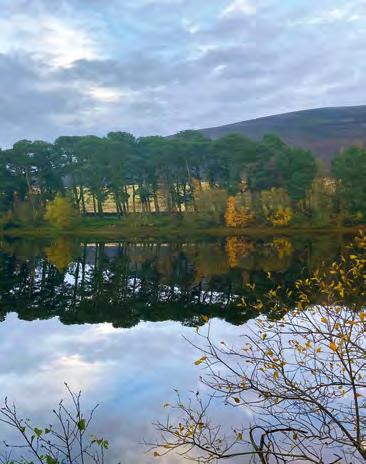
demurely. We cross the little bridge at the reservoir’s eastern end and, shortly afterwards, peel off to the left, heading over the rise towards Black Springs. I can still recall the first time I came this way – back then the pines that line either side of the track stood merely head height. Now, they tower above us and play host to many small birds, including the tiny goldcrest that announces its presence, singing cheerfully in rapid, high triplets, yet proves much harder to spot by eye. Also beloved by birds is the thicket of gorse we pass as we descend to the waters of Threipmuir. I recall a few summers ago when we braved the thorns to pick the sunyellow gorse bloom petals, making gorse tea at home later that day. Drinking that tea was like ingesting a breath of hillside air, transporting me immediately back to the gentle summer warmth of those moments on the hill and others like them.
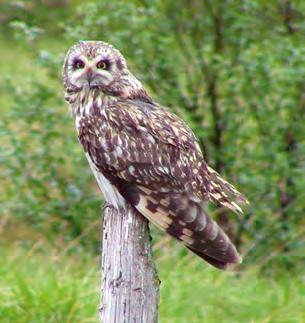
Today, however, the last of winter’s bite lingers in the air as we turn westward to walk alongside Threipmuir Reservoir. Goldeneye and goosander bob upon the water. Another bird flies high across the reservoir. Its unusual shape - long rounded wings and blunt head - piques my interest. On reaching the far side it begins patrolling the lower flank of Black Hill and realisation dawns - it’s a short-eared owl. We watch as it pounces upon something in the undergrowth and is lost from view. Just then, a second owl appears over the field on the near side, where four crows have taken to the air in alarm. This second owl also flaps over to the far side of the reservoir, only to be rebuked by the first, which reappears, launching itself
aggressively upwards from the ground emitting a harsh, hissing call.
Owl number two retreats back across the reservoir where we watch it patrol the field for a while. Soon, however, it ventures over the Black Springs marsh, at the reservoir’s very easternmost extent. Suddenly, we notice a second, slightly smaller, bird in the air next to it – a kestrel. Showing behaviour I’ve never seen before, the two engage in an acrobatic aerial tussle for a minute or two before the owl retreats once more, drifting back over the field. Clearly, we are amidst prized hunting territories worth fighting for.
A kilometre farther on, we reach the weir and ford separating the two reservoirs. We cross the small footbridge and follow the wide track alongside Harlaw’s pine-lined northwest shore. On reaching the end of this wooded stretch we are delighted by another unexpected sight. We double-take at a pure white bird stepping along the shoreline in the shallows. This is no seagull, but in fact a little egret - a member of the heron family, smaller and rarer than the more familiar grey heron. Their foraging tactics differ from those of their larger cousin, who remains stock still waiting for prey to appear before spearing it with a lightning-fast strike of its dagger-like bill. The egret on the other hand is constantly on the move, stepping through the shallow water on long black legs, using its large yellow feet to disturb small creatures which it can devour as it goes. Little egrets only began to appear in the UK in the late eighties and nineties, expanding
their range northwest from continental Europe, first to the south of England, and now Scotland; this is the first time I’ve been lucky enough to see one in Lothian.
GET THE ROUTE ON OS MAPS!
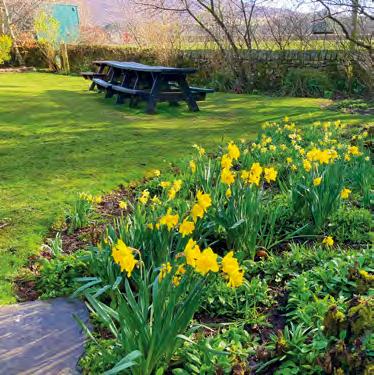
As we round the end of Harlaw to return our starting point we reflect on our good fortune – two wildlife firsts in one day! We are not quite finished yet though – a stroll through the wildlife garden by the old visitor centre is always an enjoyable conclusion to this walk. We admire the spring bulbs and watch the blue tits and coal tits flitting excitedly around the bird feeders in between squirrel raids, then we gaze down into the wildlife pond scanning for frogs. It’s worth being patient here – once you have got your eye in you may be surprised how many you can spot, just their rounded head and bulbous eyes breaking the surface. You may even notice a palmate newt shimmying through the submerged pondweed. Today, we are a little early to see those amphibious friends, but the marsh marigold just coming into flower by the water’s edge tells me it won’t be long…
WALK TIME: Approx. 1hr 20min on well-surfaced paths..
This article was contributed by William Weir. William is a scientist and amateur writer/ photographer who lives locally. In his spare time he enjoys exploring the trails and wild spaces of West Lothian and the Pentland Hills.
Stiffness and inflexibility in muscles and joints affect most of us at different times. We take a look at the likely causes, and the good news is that you can often loosen up and become more mobile.
MUSCLE STIFFNESS
TOO MUCH EXERCISE - This is something many of us are familiar with – overexert yourself and you’ll feel it afterwards. The treatment? A warm bath, NSAIDs (nonsteroidal antiinflammatory drugs), such as ibuprofen, and rest will offer immediate relief. In the long term, stretching and a proper warm-up usually help to keep this kind of stiffness at bay.
TOO LITTLE EXERCISE - Conversely, a sedentary lifestyle can lead to stiffness and inflexibility. Sitting in one position for prolonged periods can make you feel creaky when you get up. Over time, your muscles will weaken – and may even become shorter and tighter - if you don’t move enough. Build frequent movement into your daily routine, including doing a
few stretches several times a day, and consider an activity such as Pilates, which focuses on improving flexibility.
DEHYDRATION - You might be surprised to learn that not drinking enough fluids can lead to aching muscles. Monitor your fluid intake especially as you get older, since your natural sense of thirst tends to decline with age. It can also help to include water-rich foods in your diet, such as cucumbers, watermelon, and tomatoes.
DIET - A diet rich in calcium and magnesium will boost muscle health too. Think bananas, avocados, nuts, dairy products, dark leafy greens, fatty fish and fortified cereals.
SOME MEDICATIONS - A minority of people suffer muscle aches as a side effect of certain prescription drugs. These include statins for high cholesterol, beta-blockers used to treat high blood pressure, isotretinoin for acne, bisphosphonates for osteoporosis and corticosteroids, which are prescribed for conditions like asthma, arthritis and autoimmune diseases. If you think your meds are causing ongoing stiffness and pain, see your GP, who might be able to change you to another drug.
JOINT STIFFNESS
OSTEOARTHRITIS - By far the most common cause of stiff, inflexible joints after the age of 45 is osteoarthritis, when the cartilage which cushions your joints breaks down. Previous injuries, being overweight and family history can all play a part. Regular exercise actually helps rather than aggravates arthritis and might minimise your risk of developing it in the first place. Physio, acupuncture and massage can also bring relief.
Lose weight if necessary and prioritise posture. Strengthening your abdominal and back muscles will help with this. Choose comfortable, supportive shoes.
RHEUMATOID ARTHRITIS
- This is much rarer. It’s a painful autoimmune condition characterised by flare-ups. Unlike with osteoarthritis, morning stiffness doesn’t go away when you start moving. Medication can help reduce inflammation and delay joint damage.
This health column was contributed by Susannah Hickling
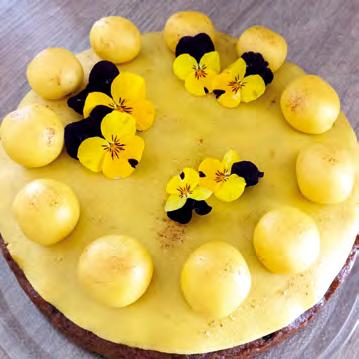
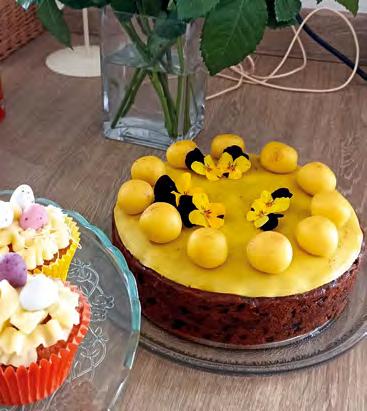
A simnel cake is a traditional Easter fruit cake, characterised by a layer of marzipan in the middle and toasted marzipan balls on top.
In Christian tradition, the marzipan balls represent the apostles. There are usually 11 –Judas is not included. Since we are in Scotland, a Dundee cake is perfect for the occasion and similar to the light fruit cake usually used for simnel. (As a short-cut but to still have the fun of decorating the cake and making the marzipan balls with children, you could buy a round Dundee cake to decorate). The recipe below includes orange zest and marmalade as a nod to the Dundee cake tradition, and the option of soaking the dried fruit in whisky.
Ingredients:
• 480g dried mixed fruit, including currants, raisins, sultanas
• 100g candied citrus peel (or a mix of citrus peel and glace cherries) [optionally, soak the fruit and peel in whisky for 2 hours beforehand]
• grated zest of 1 orange
• 170g self raising flour
• 170g unsalted butter, softened at room temperature • 4 tbsp milk
• 170g light muscovado sugar • 3 eggs
• 100g ground almonds • 1tsp mixed spice
• 3 tablespoons marmalade (or apricot jam)
Decoration:
• 500g packet of marzipan • marmalade
Method:
1. Preheat the oven to 170oC (150oC fan). Line and grease a loose-based 20cm cake tin with baking paper.
2. Beat the butter and sugar together until light and fluffy.
3. Mix the flour, almonds and spices together in a separate bowl.
4. Add the orange zest, 1 egg and 1tbsp of the flour mixture to the butter/sugar, beat well to combine. Do the same for the other two eggs, then stir in the rest of the flour mixture.
5. Add the dried fruit/peel, marmalade, and just enough milk to make a soft, spreadable mixture.
6. Spoon half the mixture into the prepared tin and level the top.
7. Divide the marzipan into thirds. Roll out one third and cut into a disk slightly smaller than the diameter of the tin, and place on top of the mixture in the tin. Add the rest of the cake mixture, level off the top and make a slight indent in the middle.
8. Bake for 30mins, then lower the oven temperature to 140oC/130oC fan and cook for a further 1.5 to 2 hours, until a skewer comes out clean. Towards the end, if necessary cover with foil if the top is getting too cooked.
9. Remove and allow to cool in the tin for 10mins then turn out onto a wire rack to cool completely.
10. Roll half of the remaining marzipan into a disk the same diameter of the cake. Spread a thin layer of marmalade on top of the cake and place the marzipan circle on top.
11. Divide the rest of the marzipan into 11 and make little balls. Arrange on the top of the cake, sticking them on with a little jam.
12. Preheat grill then place the cake under it very briefly, until the marzipan on top of the balls starts to burnish.
Cornish pasties and clotted cream are treats to look forward to when visiting Cornwall. Added to that list is something still delightfully under the radar: Cornish wine. Production is small, and with strong local demand, very little makes its way north to Scotland. Curious to discover Cornish wine, I travelled ten hours by train to visit Camel Valley Vineyard. Nestled in a sun-trapped valley near the River Camel, the vineyard benefits from a unique microclimate that feels almost continental. Long daylight hours and gentle ripening conditions allow grapes to develop bright acidity and delicate aromatics, exactly the right combination for award-winning sparkling wine!
Founded by Bob and Annie Lindo in 1989, Camel Valley has quietly become one of England’s most respected producers. Their sparkling wines, made in the traditional method,
have won international awards and even been served at royal occasions. Alongside these elegant sparklers, they produce fresh, fruitdriven still wines and vibrant rosés that reflect the purity of the landscape.
What’s striking is the pride locals take in their produce! It’s no wonder very little makes its way north! Open any menu across Cornwall and you’ll find Cornish wines listed alongside regional gins and tonics, each celebrating a strong sense of place. Restaurants champion nearby vineyards, creating a true “drink local” culture.
For visitors, it’s a delicious discovery. For those of us further north, it’s a reminder that some of Britain’s most exciting wines are being crafted quietly, just a train journey away.
The monthly wine tasting column is contributed by Joanne Frette. Joanne lives in Juniper Green with her husband and three children. For wine recommendations, reviews and details of future tasting events, please go to swirlsipsocialise.com
The concept of people longing to go on pilgrimages in April is famously introduced in the opening of Geoffrey Chaucer’s 14thcentury book, The Canterbury Tales. He wrote that a group of pilgrims from all walks of life gathered in Southwark to travel to the shrine of St Thomas Becket in Canterbury Cathedral, telling stories as they went. Now, over 600 years later, pilgrimages are once more in vogue.
Today’s pilgrims are heading off on walks in the UK and abroad that offer a chance to reflect, refresh, and challenge themselves physically. Numbers making their way along the ancient Camino to the tomb of St James the Apostle at Santiago de Compostela have rocketed; around 530,000 are thought to have completed it in 2025.
The Scottish Pilgrim Routes Forum and the British Pilgrimage Trust websites are invaluable sources of information on these wonderful ancient off-road routes in the UK. Alongside journeys that take in religious monuments and traditional shrines, there is advice on nonreligious paths and historical landmarks, as well as pagan sites. Both organisations do invaluable work in helping to keep these peaceful trails accessible, maintained and in most cases waymarked.
Closest home to us here, the Forth to Farne Way is a fully waymarked coastal trail between the Firth of Forth and Lindisfarne (off the Northumberland coast) which has been walked by pilgrims over many centuries. The Fife Pilgrim Way starts at either North Qeensferry or Culross and ends at St Andrews, also linking the shrine of St Margaret of Scotland at Dunfermline and St Serf at Culross Abbey. Being relatively close to home, these can be tackled in sections to give a focus and target to weekend walks.
The heyday of the pilgrimage was between the early eleventh and early fifteenth centuries. The aim was to seek repentance or pray for healing. It was also an opportunity to get away from the hard grind of everyday life. The wealthy would go to Jerusalem, Rome or Santiago, but there were plenty of destinations back home accessible to all. Here in Scotland, St Andrews and Iona were the most significant destination. While some people embarked on gruelling
journeys by foot or horseback, staying in monasteries or hospices, their route marked by wayside crosses and chapels, others undertook a short trip to a local shrine. Pilgrimages became big business, from feeding the hordes to selling souvenirs.
All that came to an end with Henry VIII and the split from the Catholic Church. The great monasteries and shrines that drew pilgrims were destroyed.
In today’s stressful world, we once again value the concept of travelling mindfully to a destination. The appeal of rambling through glorious countryside and connecting with our religious, natural or cultural heritage has grown. These are wellness walks for the modern age. Bereavement pilgrimages, walks with dogs and one-day micro-pilgrimages are being added to the ever-lengthening list.
“People are discovering the enrichment that comes from following the ancient paths and in so doing, discovering new things about themselves. There’s nothing quite like the combination of purposeful route walking, closeness to nature and spiritual engagement to quicken the spirit.” The Very Reverend Dr Martin Fair Chair, Scottish Pilgrim Routes Forum.
FOR MORE INFORMATION, VISIT:
Scottish Pilgrim Routes Forum: sprf.org.uk
British Pilgrimage Trust: britishpilgrimage.org
Textural Contrasts
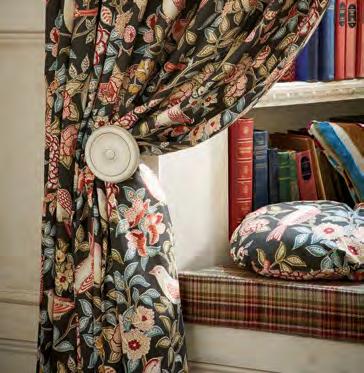
Textural contrasts bring a room to life and help a home feel both welcoming and calm in a fast-paced world. Introduce materials that invite touch and bring comfort and variety to your home.
In 2026, interiors are moving towards greater sensory richness, blending the natural, the hand-crafted and the gently worn with the sleek precision of finely finished, contemporary materials.
USE NEUTRALS AND NATURALS: When you choose natural materials in gorgeous, neutral tones (think driftwood lamp bases, wicker chairs or sheepskin throws), a soft, sophisticated palette will come together easily.
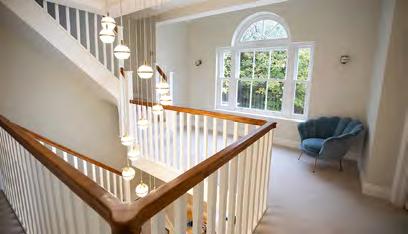
CREATE A TEXTURAL FOUNDATION: Floors, walls, upholstery and window treatments form the base layers of a scheme. Create a calm, coherent backdrop – the ‘quiet’ textures of a room – with features such as a polished timber floor, linen curtains and softly upholstered seating. Walls can be covered in a chalky matt paint, wood panelling, ceramic tiles or a subtly textured wallpaper.
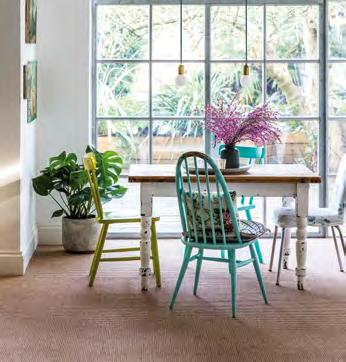
ABOVE: Made from 100% polypropylene, this carpet has the visual texture of sisal and can even be fitted outdoors. Anywhere Rope carpet in Natural, from Alternative Flooring
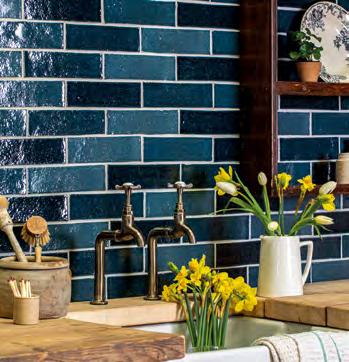
BELOW: Crafted using traditional techniques, each tile is unique, with pooled glazing that gives a motion of colours across its surface. Argyll Skinny Metro tiles, from Marlborough Tiles
LOOK DOWN: The large surface area of a floor sets the scene for everything else. Carpet brings instant softness, while natural fibres such as sisal, coir and jute add a subtle irregularity and character. For added comfort, a deep-pile wool rug offers plush warmth.
CHOOSE UPHOLSTERY FOR COMFORT: Simple, woven seating fabrics have a relaxed feel, while velvet, chenille and leather introduce richer tactile qualities. Layering cushions in complementary finishes – perhaps embroidery against plain weave, or velvet edged with satin – adds depth and interest.
BRING CONTRASTING MATERIALS TO LIFE: Carefully place floor and table lamps, uplighters or angled spotlights to highlight grain, weave and other delicate surface variations, and to reveal the subtle beauty of materials.
INTRODUCE ACCESSORIES: Simply layer in differing materials, such as woven baskets, faceted glassware, pom-pom-trimmed cushions or waffle throws, to add personality, informality and indulgence.
The Interiors column was contributed by Katherine Sorrell
APRIL SUDOKUS (HARD*) (EASY)
APRIL CROSSWORD
ACROSS:
7. Buff up (6), 8. Equality (6), 9. Throw (4), 10. Used by trains (8), 11. Tangled (7), 13. Dizzy (5), 15. Frighten (5), 17. Laughed (7), 20. Fuel (8), 21. Applaud (4), 22. Light wind (6), 23. Hug (6).
DOWN:
1. Pillar (6), 2. Cash register (4), 3. Agitated (7), 4. Ruin (5), 5. Fighting (8), 6. Remained (6), 12. Revenue (8), 14. Without sound (7), 16. Seats (6), 18. Authorise (6), 19. Repaired (5), 21. Surrender (4).
* We have added an extra sudoku puzzle this month due to popular demand! Let us know what you think
^^^ Hard sudoku solution on page 45
Easy sudoku solution on page 45
^^^ Crossword solution in the MAY edition
THE LAZY GARDENER’S DIARY:
As befits a lazy gardener, I’m on holiday and not doing any actual gardening, but always imagining new possibilities.
This year I’ve done much more planning than usual having bought a year’s subscription to the GrowVeg.co.uk digital Garden Planner.
I decided to see if their live chat box invitation to “ask us a question - we typically reply in under 3 minutes” would work at 1am. It did, so I continued asking questions until my entire garden was mapped out with six veg beds virtually full. So now, in anticipation of the spring equinox, it’s almost time to “plant baby plant”, or rather “sow baby sow”, using my second-hand fridge propagation chamber. However, it’s easy to imagine too many seedlings, too many trays and too little time. That’s probably necessary for food self-sufficiency, but ‘annuals’ aren’t what permaculture and the lazy gardener are primarily interested in. To quote Morag Gamble, an Australian permaculture educator: “What if the most radical thing you could do right now is Go Gently?” Now, that sounds like perfect advice for lazy gardeners! So, I’m going to spend more time planning perennial planting schemes between the 30 fruit trees in Campbell Park to create a ‘food forest’. By bringing together the individual tree carers and community groups who’ve adopted the orchard trees, we’ll share the planning and planting in Year 1 whilst reaping the benefits for years to come. That’s not just easier for us, it’s also better for the generations that follow.
Suggestions for perennial vegetables:
• Asparagus • Everlasting Onions
• Taunton Dean Kale.
This column is contributed by Shona Harrower. Shona lives in Colinton and is passionate about low maintenance food production. She is Chair of the Friends of Campbell Park (FCP)
www.goodgardendesign.co.uk
ISince the publication of my March column so many readers have told me, “I have big feet too! I know how hard it is to find shoes that fit.”
sn’t it interesting that we wish one another a “happy new year” long after singing Auld Lang Syne – for weeks after boxing up the Christmas decorations and returning them to the loft.
The barista at Costa commented. A local man with a very large dog suggested I place my foot next to his dog’s – to see which was bigger! And at Sainsbury’s a friendly soul approached me when I was paying for my shopping, declaring that she too had big feet (although a quick glance told me hers were smaller than my own). In fact, I think the “Wedding Shoes Issue” has resulted in more comments than any of the articles I’ve written in the past year!
Regardless of what’s going on in our world and various concerns about issues in our own country, we hope that 2025 will be a good year. It would be wonderful to see peace achieved in at least one area where war is currently raging. And, on a personal level, we also hope to see growth and progress in our own life and in the lives of those we know and love, occasions to celebrate, good health and maybe even some fun surprises in the next 12 months.
Now I’m not sure I want to be known as the writer with the big feet, so I decided on a complete change of focus this month … but then I stumbled onto a description of the various foot shapes.
I’m focusing on the “new” in “Happy New Year”. I’ve not exactly made any new year’s resolutions. This tradition seems to be becoming less popular - social media posts regularly tell us that we don’t need to strive to improve, we are “enough” as we are, we shouldn’t load ourselves up with goals and then feel guilty when we can’t achieve them. Although I agree that it’s good to
be realistic, I love the promise that a new year holds, the “clean slate” potential!
If you live in Balerno, you too may have been delighted to see snow falling early morning on New Year’s Day. I stood at our glass patio door and watched as sleet turned to big white snowflakes that quickly covered our garden and bedecked the trees. It was a wonderful illustration of the “it’s all fresh and new” theme.
One day, sitting in my lounge with a barefooted daughter, I became fascinated with the sharp slope from her big toe to her little toe. I knew that my own foot shape was quite different, and wondered why. I am her mum, after all.
A google search revealed she has Egyptian feet, and that this foot shape is the most common. There was a helpful chart for me to study, complete with drawings of 10 different foot shapes. So I quickly peeled off my left sock to see if I could match my foot to the chart. There was no steep slope, and I noticed my second toe was a bit longer than my big toe. A gentle slope occurred after that. Following careful analysis, I determined I have Greek feet. This delighted me because it’s an uncommon type (affecting only 2030% of people) and “is often considered an aesthetic ideal in art”. Apparently, the Statue of Liberty has Greek toes! So now I hope people will stop saying, “I’ve read you have big feet” and will instead say, “How wonderful it must be to have feet that are aesthetically ideal!” I have beautiful feet, not big feet!
Signing up for a Pilates class was a new thing for me at the beginning of 2024. And it has been a positive change. I may not be as proficient as many in the class, I struggle to do some of the stretches because of a knee issue, and I sometimes have a hard time resisting dancing to the background music when I should be listening to the instructor. But I know the exercise is doing me good. I’m not sure what new thing(s) I will do/ encounter this year, but I will keep my eyes and ears open for them.
When my eldest daughter was in primary school, she decided to try something new. I heard about it from another mum, who had been at the school to watch her daughter do Highland dancing in an assembly. “I didn’t know your girl did it too,” she said. So I explained that she didn’t, although she was in a ballet class. “That’s strange,” said my friend. “At the assembly the children who took Highland dance lessons were invited to go to the centre of the floor and perform. I thought your daughter did rather well.”
Coming out of my reverie, I thought I might as well have a look at my right foot while I was at it. Uh oh. It looked a little different from my left foot. In fact, I wasn’t at all sure if the second toe was longer than the big toe. Could it be a different shape altogether? I consulted the chart. It looked a bit like a Roman foot (this would explain why I studied Latin for four years in high school).
If I have one Greek foot and one Roman foot, what are the implications of this anomaly? Could it be the reason I struggle to find shoes that fit?
Later I asked my child why she had done this. “Oh,” she said. “I thought the teacher said, “Will all children who would like to do Highland dancing please come forward now? So I went.”
Do something new this new year.
I know that some people can’t abide any talk about feet. When the subject comes up, they say, “Eww”. So I promise there will be no more foot-related confessions or revelations next time.
real LIFE is contributed by Suzanne Green. Suzanne, a freelance writer/editor, lives in Balerno and writes regularly for Konect. She is married to Andy and they have two adult daughters.
real LIFE is contributed by Suzanne Green. Suzanne, a freelance writer/editor. She is married to Andy and they have two adult daughters. 38
SUZANNE GREEN
As a sequel to Helen-Jane’s “Canal Builders” article in September’s issue, readers might enjoy a leisurely canal boat cruise on a Linlithgow Union Canal Society boat to the 204-year-old Avon Aqueduct, or a visit to the Slateford and Almond Aqueducts. All three are of the same construction.
On a recent visit to the Avon Aqueduct, passengers were introduced to the book, Civil Engineering Heritage* which features the Aqueduct, with details of the iron trough in which we were afloat! Also shown was
by
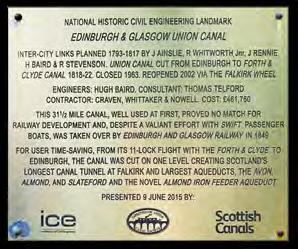
ABOVE: Plaque at the Linlithgow Canal Centre
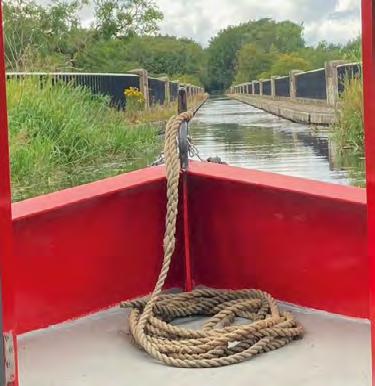
Moored in Avon Aqueduct
Photo
A. Paxton
a rare ticket for the Glasgow to Edinburgh Night Passage, dating from around 1830. At that date, the Glasgow to Edinburgh journey took twelve hours and cost one shilling. Three hours of this travel time was taken with an eleven-lock flight near Falkirk, navigating the 110ft level difference between the two canals. The world-famous Falkirk Wheel boatlift opened in 2002, replaced the eleven locks and now takes only fifteen minutes! The Wheel is designated an International Historic Landmark.
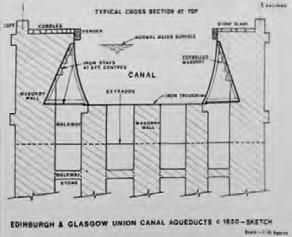
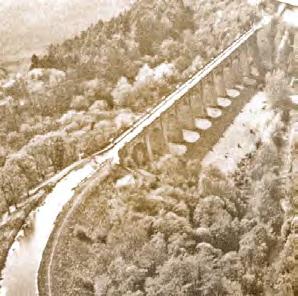
The Avon Aqueduct is the longest and the highest of the three, at 250m long and 26m above the River Avon. The innovative cast iron boat troughs are 4m wide and 2m deep. They were designed in 1817 by the engineer Hugh Baird and erected in 1819-21 by Craven, Whitaker & Nowell. The ironwork was made at Anderson’s Foundry, Leith Walk, Edinburgh.
The design was influenced by Telford’s Pontcysyllte Aqueduct (1805) but differed in having curved-sides, being wider and simply supported on hollow masonry spandrels with strong external walls and two tow paths. This concept enabled the Union Canal to be made without locks on the 242ft countour above sea level. In terms of travel time this was convenient for the service between Falkirk and Edinburgh, about 30 miles. The illustration shows the 16mm thick cast iron troughs with side ‘A’ frames, as inspected by myself during maintenance c.1974. A salvaged screw-bolt is now curated at ICE Scotland Museum. (icemuseum-scotland.hw.ac.uk/item/1994-003/)
ABOVE: Canal ticket circa.1830
Avon Aqueduct (photo from Civil Engineering Heritage Scotland)
LEFT: Union Canal Aqueducts Trough (illus. from Civil Engineering Heritage Scotland)
Unfortunately the Canal was not commercially successful, despite a valiant effort to compete with the rapidly expanding railways of the 1830s and 40s. The Edinburgh & Glasgow Railway ran to Haymarket by 1842, and seven years later acquired the Union Canal Company.
The Linlithgow Canal Society opens for the season on 4th April 2026 with a timetable of cruises including Linlithgow to the Avon Aqueduct and Linlithgow to the Falkirk Wheel. Cruises start at Linlithgow Canal Basin, where a plaque at the door to the Society’s Tea Room and Museum celebrates the Canal as a
National Historic Civil Engineering Landmark. The Linlithgow Union Canal Society is to be congratulated for its dedicated and valuable service to the promotion of canal heritage. For cruise bookings and information please visit www.lucs.org.uk
* Paxton, R. and Shipway, J. Civil Engineering Heritage Scotland, Lowlands 2007 (Available new and used from Amazon).
This article was contributed by Professor Roland Paxton of the Institute of the Sustainable Built Environment, Heriot-Watt University. Roland is an engineering historian and Bonaly resident.
Photo by A. Paxton
RIGHT:
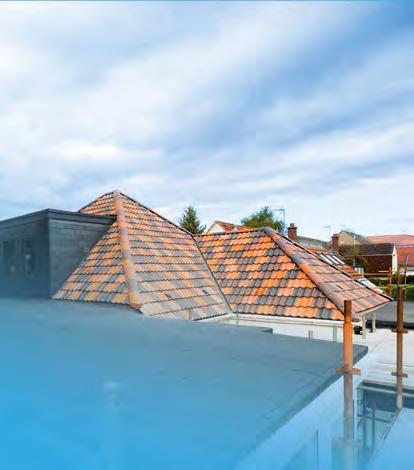
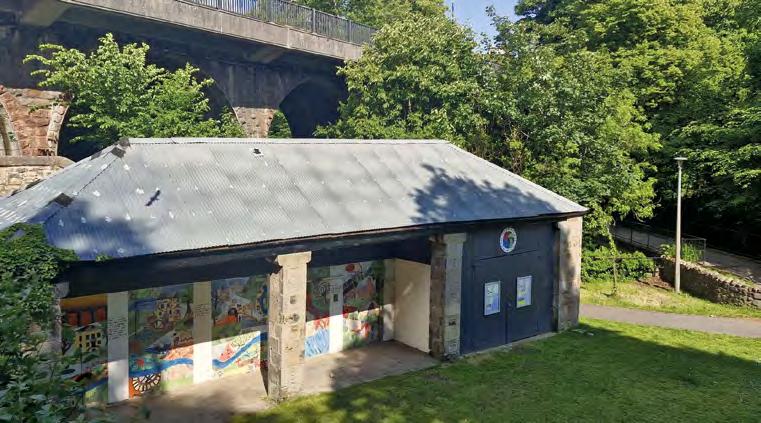
The Shed in Spylaw Park is now visibly taking shape as work continues to transform it into the Colinton Village Hub.
With close to 75% of the funding already secured, construction is underway with Rollo Developments Ltd, and it has been exciting to follow the progress through regular updates on Instagram, Facebook and TikTok.
Seeing the foundations laid and the historic stone pillars restored to their rightful place has been hugely encouraging. Step by step, the vision for a welcoming community hub is becoming a reality.
The project has also benefited from remarkable support from local volunteers and supporters since 2019. From repairs and fundraising events to baking, raffles and community activities such as Art in the Park, the help and enthusiasm of the community have been invaluable.
To share the latest progress, a public meeting will be held on 22nd April at 7.00pm in Dreghorn Loan Hall, where architect David Moore and builder Sean Rollo will give an update on the work so far and the plans for the finished hub.
Most importantly, we are launching our first neighbourhood fundraising initiative: a Community Crowdfunder. Join the final push and help us celebrate “raising the roof” of the Colinton Village Hub.
TO CONTRIBUTE NOW:
• Please scan the QR code (below) or
• Visit cventerprise.org/donate to donate via bank transfer
This article was contributed by Colinton Village Enterprise SCIO
SATURDAY 11TH – SUNDAY 12TH APRIL
Lothians Model Railway ExhibitionThe Lothians Model Railway exhibition returns to Heriot-Watt University. The familyfriendly show features 17 working layouts, including the debut of a detailed Kinleith Paper Mill model. Enjoy a Thomas layout, shunting puzzle, traders and refreshments. Open 10.00am - 4.30pm. ADULTS £6, CHILDREN FREE WITH PAYING ADULT. FREE PARKING AND EASY TRANSPORT ACCESS.
EASTER HOLIDAY ACTIVITIES AT WATER OF LEITH VISITOR CENTRE
All suitable for 5 to 10 year olds, £7 per child, accompanying adult free of charge. Wear wellies if you have them. 1:30-3:30pm. Booking via www.waterofleith.org.uk/events 24 Lanark Road, Edinburgh, EH14 1TQ
• TUE 7TH APRIL: River Dipping - Fun afternoon in the river discovering what lives below the surface.
• THU 9TH APRIL: Forage and Scavenge - Learn how woodlands can provide both a fun day out and a delicious snack. Wild garlic pesto? Snail pie? A fun outdoor adventure where kids learn what to and what not to eat.
• TUE 14TH APRIL: Spring Fling - Fun afternoon in the Dells as we look for signs of spring and the animals who live here.
• THU 16TH APRIL: Sandie’s Saunter - Take on Sandie’s special orienteering challenge though the woods with activities as you go. A fun outdoor adventure where kids follow clues to find activities and hidden spots
Meet in Edinburgh Pentlands Parish Church Hall, Lanark Road from 10.00am - 12noon. NEW MEMBERS WELCOME. Further details from Club Secretary Leslie Hannaford on 0131 453 3012 or lesliehannaford@blueyonder.co.uk
WED 1ST APRIL - “The Mystery of the Stone of Destiny” an illustrated talk by David Maule
WED 15TH APRIL - “The History of Granton Harbour,” an illustrated talk by Colin Chess
WED 2ND MAY - “Edinburgh’s Hidden Sights - for Tourists,”. an illustrated talk by Karen McCormack
SATURDAY 11TH APRIL
Farmers Market - Main Street, Balerno, 9.00am to 1.00pm
SUNDAY 12TH APRIL
Spring Slateford Saunter - Join Kat of Water of Leith Conservation Trust for a mix of nature and local history, revealing more about Slateford and the Dells. Water of Leith Visitor Centre, 24 Lanark Rd, Edinburgh, EH14 1TQ. £7, MEMBERS FREE. Booking and info at: www.waterofleith.org.uk/whats-on/
MON 20TH APRIL TO MON 8TH JUNE
Singing in the Summer SessionsWith Colinton & Merchiston Choir. Eight fun sessions at St Cuthbert’s Episcopal Church, Westgarth Avenue, Colinton, EH13 0BB. 7.20pm till 9.00pm. We will learn and sing a wide variety of classical, popular and folk songs. No previous experience of choral singing is required and you do not have to be able to read music. There will be a break for tea, coffee and biscuits. The cost is £47 for the 8 sessions and includes music hire Further details on how to book will be in local publicity, on our website: colintonchoir.org and our Facebook page.
WEDNESDAY 22ND APRIL
Public Meeting by Colinton Village Enterprise - Hear about our progress and plans for Colinton Village Hub - 7.00pm, Dreghorn Loan Hall, Colinton.
WANT TO INCLUDE YOUR EVENT HERE? COMMUNITY AND NOT-FOR-PROFIT LISTINGS ARE FREE OF CHARGE.
EMAIL EDITOR@KONECT.SCOT BY 15TH OF THE MONTH FOR FOLLOWING MONTH’S ISSUE.
SPORTS, HOBBIES, LEARNING, SUPPORT GROUPS & MORE...
GLENLOCKHART PROBUS
CLUB - For ex-business men and women. We meet to hear talks, mostly by outside speakers, on a wide range of subjects. The venue is Mortonhall Garden Centre, at 10.30am. on the last Thursday in the month, January to November. Occasionally there are additional outings. Contact: E. glenlockhartprobus@outlook.com
ORIAM WALKING FOOTBALL
CLUB - We run a local Walking Football Club, established in 2015, for women aged 40+ and men aged 50+. Our sessions, which are very much mixed ability, take place at Oriam Sports Centre, Heriot-Watt University, EH14 4AS, on a Mon and Fri 12.30-1.30pm, and Wed at 12.00-1.00pm and 8.30-9.30pm We’d love to see new teammates coming along. Sessions are priced at £4.62 but we do have monthly membership schemes available. Please contact Alan Davies on 07568 723303. Email: alan_davis@live.co.uk
OXGANGS WRITE AWAY!
WRITERS' GROUP - Whether you are a beginner or not, wouldbe novelist, journal-writer or poet, come along and share, learn, be inspired or simply listen. We meet at Oxgangs Library every 2nd Wednesday of each month at 6.00pm - free tea/coffee and biscuits too! For more information, contact Robert Carroll Robert. Carroll@edinburgh.gov.uk or katiemoon7754@gmail.com
REDHALL WALKING GROUP -
A gentle walking group exploring areas such as the Union Canal, Colinton Dell and the Water of Leith. Improve your health and wellbeing and meet new people. Meet at Redhall Walled Garden entrance on main road at 97 Lanark Road. Mondays 10.00am - 11.30am Fun, friendly and free.
Contact: emily@elgt.org.uk or 07943 530806
Facebook @GreenspaceTrust
ST CUTHBERT'S PLAYGROUP
- 10.00am - 11.30am - Every Monday during school term time. £2 per family. Toys, snacks and a fun songs! St Cuthbert's Church Hall, Westgarth Avenue, Colinton. Contact Rev Nicki McNelly for more information: stcuthbertsrector@gmail.com
FORGET ME NOTES - The Forget Me Notes Project is a charity that uses music to build community and combat isolation in a variety of settings On the first and third Monday of each month - 2.00pm - 4.00pm in St Cuthbert's Church Hall, Westgarth Avenue, Colinton. Join us when you can, for an hour of music and memories, followed by refreshments. All welcome. Please contact Rev Nicki for more information: stcuthbertsrector@gmail.com (www.forgetmenotes.org.uk)
COLINTON FRIENDLY BRIDGE CLUB - Colinton Cottage Homes’ Hall every Monday from 2.00pm to 5.00pm. Please contact Ken McLeod on 0131 466 0888 for more information.
TEA AND TOTS - Stay and play for ages 0-5 with their parent/ carer - all are welcome! Toys, crafts, refreshments, song-time and more. Every Thursday during school term time, 10am-11.30am at Redeemer Church, 64 Bridge Road, Colinton, EH13 OLQ. FREE E:admin@redeemeredinburgh.org T: 0131 441 7327
ST CUTHBERT’S BADMINTON
CLUB - The Club was formed about 1946 and meets in the Church Hall in Westgarth Avenue, Colinton on Monday evenings at 8.00pm between September and Easter. It is noncompetitive. For details, call Julia Roberts on 07904 813145
PENTLAND BRIDGE CLUBCome and play duplicate bridge in a friendly atmosphere. We meet in St Margaret's Court, Juniper Green on Thursdays at 6.45pm. Table money £4. Less experienced players made very welcome. For further information see www.bridgewebs.com/ pentland or email mthkjb@gmail.com
COLINTON LITERARY SOCIETY - Meetings start with coffee, tea and wine at 7.30pm and are held at Dreghorn Hall, 22 Dreghorn Loan, EH13 0DE. Full programme details are at edinburghpentlands.church/ church-life/church-andcommunity-groups/colintonliterary-society/
COFFEE, CAKE AND COMPANY - Drop in for a free coffee between 10.30am and 12pm on Mondays at Redeemer Church Edinburgh, 64 Bridge Road EH13 0LT. We are mostly retired people, but all ages are welcome! More details at redeemeredinburgh.org/ccc
THIS WOMAN RUNS - We are a small group of local women who support and empower each other to be healthier and happier. We meet Wednesday’s at 7.30pm at the bottom of Thorburn Road, or Sunday’s at 8.00am in Spylaw Park for a quick warm up, 30-minute run at the pace of chat/your pace, and then a gentle cool down. We’d love to see you there! All free, run by friendly local volunteers www.thismumruns.co.uk/joina-local-run
WAVERLEY SPEAKERS
CLUB - Meets in Morningside Parish Church, fortnightly on Tuesdays at 7.15pm. Our aim is to improve members’ public speaking skills in a supportive atmosphere.
Each evening has three prepared speeches of eight minutes, evaluated constructively by another member. Eight impromptu short speeches follow, also evaluated. New members will be made most welcome. Contact Douglas.Lothian@ lenlothian.com
LOCAL FLORAL ART
CLUB - Sit back and enjoy relaxing evenings watching a floral demonstration with lively & interesting chat. You might even win one of the arrangements. We meet at The Braidhills Hotel from 7pm to 8.45pm on the 1st Monday of the month from September. In October and only for October we are at Marchmont St Giles Church .Trial first visit in Sept or Oct only £5! Wine/tea/ coffee available in the hotel. Contact: Joyce Rutherford 0131 443 2536 or joyce. rutherford@btinternet.com
COLINTON SCOTTISH COUNTRY DANCE CLUBCome and join us on alternate Thursday evenings from September to March for an evening of fun dancing to live music. We meet in St Cuthbert's Church Hall Colinton from 7.45pm to 9.15pm. Dances are called but as this is not a teaching class some knowledge of Scottish Country Dance steps and figures is beneficial. For further details phone 07751186359 or 07483814988
THE SWING CAFÉ - Tues to Sat 10.00am-2.00pm. Please come for breakfast (10.00am12.00noon), lunch (12noon -2.00pm) or some delicious home baking (available all day). We welcome groups and if you would like to book
a table, please contact 07514 689258. There are glutenfree, vegetarian, vegan and dairy-free options. Under 12s are invited to enjoy a children's menu. Sit in or take away. We look forward to welcoming you.
COLINTON LOCAL HISTORY SOCIETY - Want to know about local history? W: www.colintonhistory.org E:enquiries@colintonhistory.org
COLINTON GARDEN CLUB - Club members share their love of gardening, gardens and nature, and work together to preserve and add value to our quality of life here in south-west Edinburgh. Monthly members’ meetings on a Monday, in the upper Hall, Dreghorn Loan and start at 8.00pm. We are a friendly and thriving club and new members are very welcome, plus outings and events. The annual subscription is £10.00. per household. For more information see: W: colintongardens.org.uk E: membership@ colintongardens.org.uk
LUNCHCLUB - Every Wednesday 1pm – 3pm, 3 courses £4. Spaces are limited, first come first served. Oxgangs Neighbourhood Centre, 71 Firhill Drive, EH13 9EU. Please visit: oxgangsneighbourhoodcentre.org.uk
PARENT AND TODDLER GROUP - Tuesdays, am session and pm session for two age groups (all under 5s). Oxgangs Neighbourhood Centre, 71 Firhill Drive, EH13 9EU. T: 0131 466 0678
E:oxgangs neighbourhoodcentre @gmail.com
TO INCLUDE YOUR CLUB OR CLASS, PLEASE EMAIL DETAILS, UP TO 75 WORDS, TO EDITOR@KONECT.SCOT
SOLUTION TO MARCH CROSSWORD
ACROSS: 7. Switch, 8. Aboard, 9. Used, 10. External, 11. Annoyed, 13. Pyres, 15. Litre, 17. Beneath, 20. Watching, 21. Tale, 23. School, 24. Needed. DOWN: 1. Ewes, 2. Studio, 3. Thieves, 4. Faith, 5. Hourly, 6. Broadest, 12. Nuisance, 14. Merging, 16. Reckon, 18. Esteem, 19. Silly, 22. Leek.
SOLUTION TO SUDOKU PUZZLES ON P32
NOT-FOR-PROFIT GROUPS ARE FREE. THERE IS A SMALL CHARGE FOR BUSINESSES. SEE KONECT.SCOT FOR FURTHER INFORMATION. (EASY) (HARD)