MISSING: When East Village Artists Came to Main Street
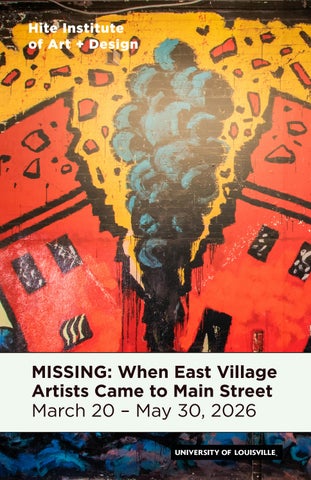
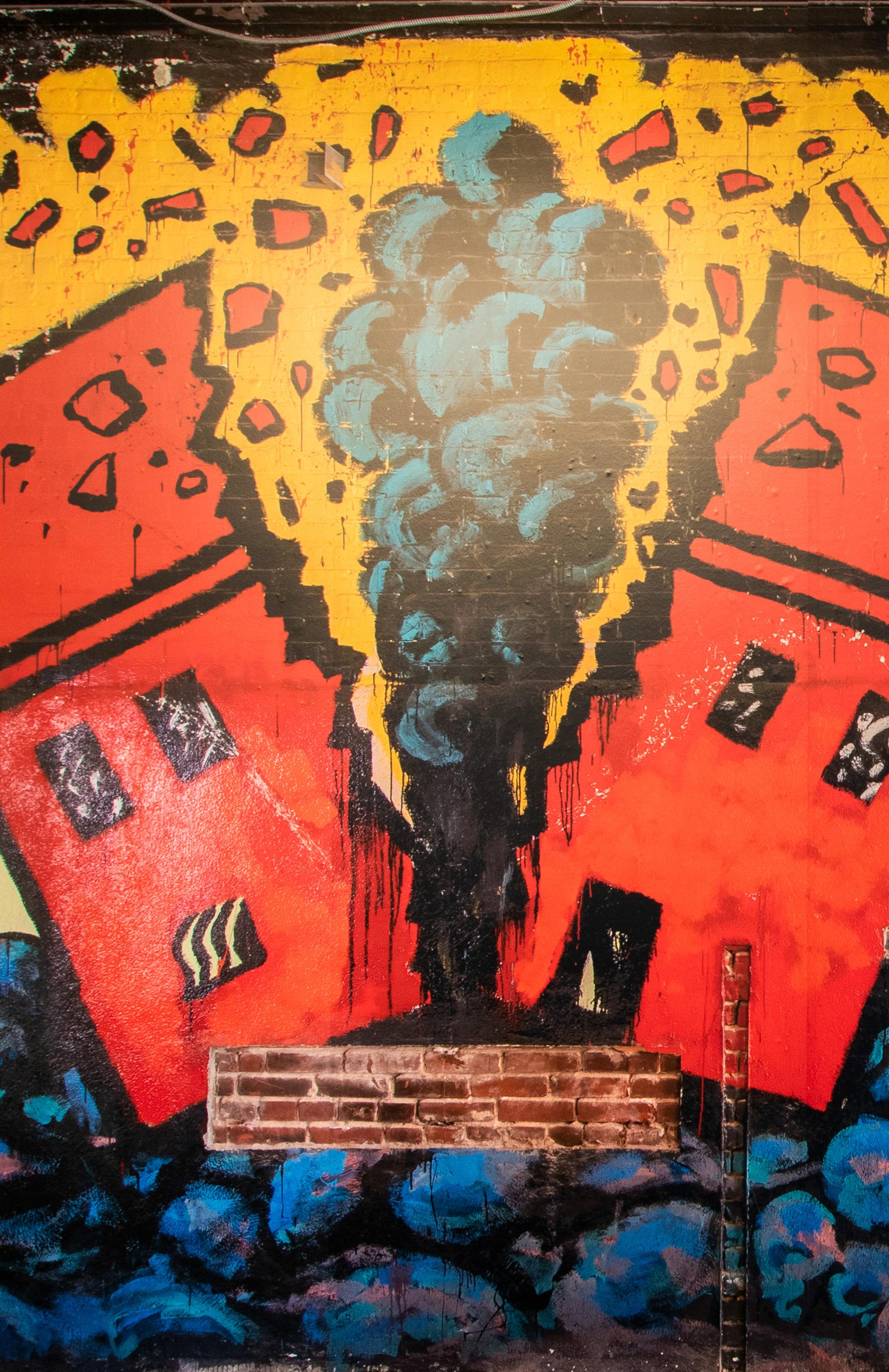
Cover Image: Reproduction of David Wojnarowicz mural in the 1985 Missing Children Show (detail) now on view at the Cressman Center for Visual Arts. Original Mural Image courtesy PPOW Gallery and Mindy Best. Original Photo by Mindy Best. Installation Image by Diane Deaton Street.
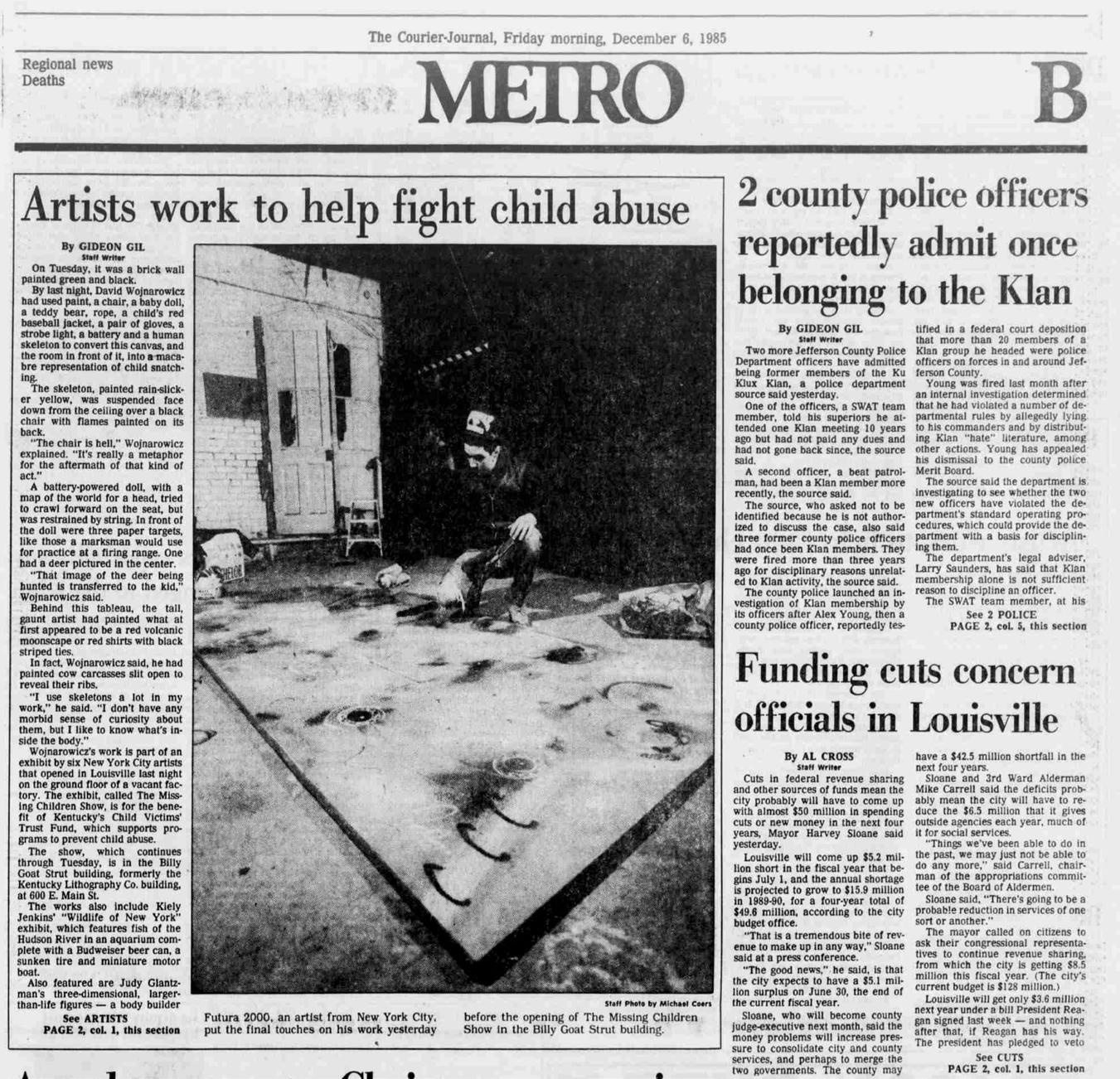
Above: “December 6, 1985 (Page 15 of 55).” The Courier-Journal (1923-), 06 Dec. 1985, p. 15. ProQuest. Web. 2 Apr. 2026 .Image courtesy the University of Louisville Photo Archives.
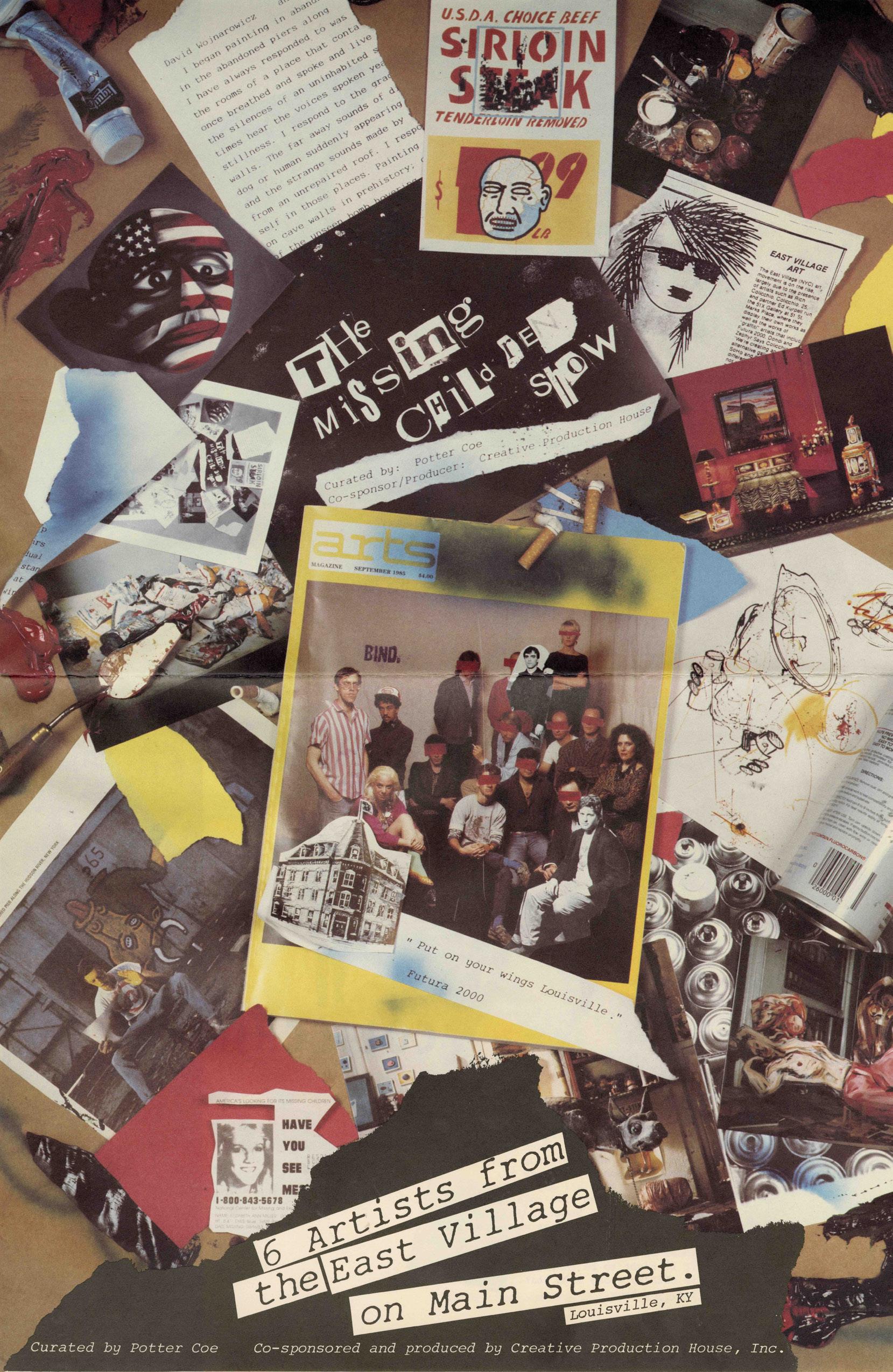
Back cover: 1985 The Missing Children’s Show exhibition catalog cover.
MISSING: When East Village
Artists Came to Main Street
March 20 – May 30, 2026
Cressman Center for Visual Arts
100 E Main St
Louisville, KY
Gallery Hours
Fridays + Saturdays: 11am-4pm
MISSING: When East Village Artists Came to Main Street returns to December 1985 when five New York artists traveled to Louisville to stage an unlikely show in a vacant building at 600 East Main Street. Mounted as a fundraiser for Kentucky’s Child Victims’ Trust Fund, the 1985 Missing Children Show featured new work by David Wojnarowicz, Judy Glantzman, Rich Colicchio, Kiely Jenkins, and Futura 2000. Dubbed “the new irascibles,” this group of artists defined New York’s new East Village avant-garde scene with a mix of graffiti, painterly expressionism, social commentary, and impassioned advocacy. MISSING brings these artists back to Louisville’s Main Street for an exhibition of 1980s art alongside photographs and ephemera from the historic Missing Children Show.
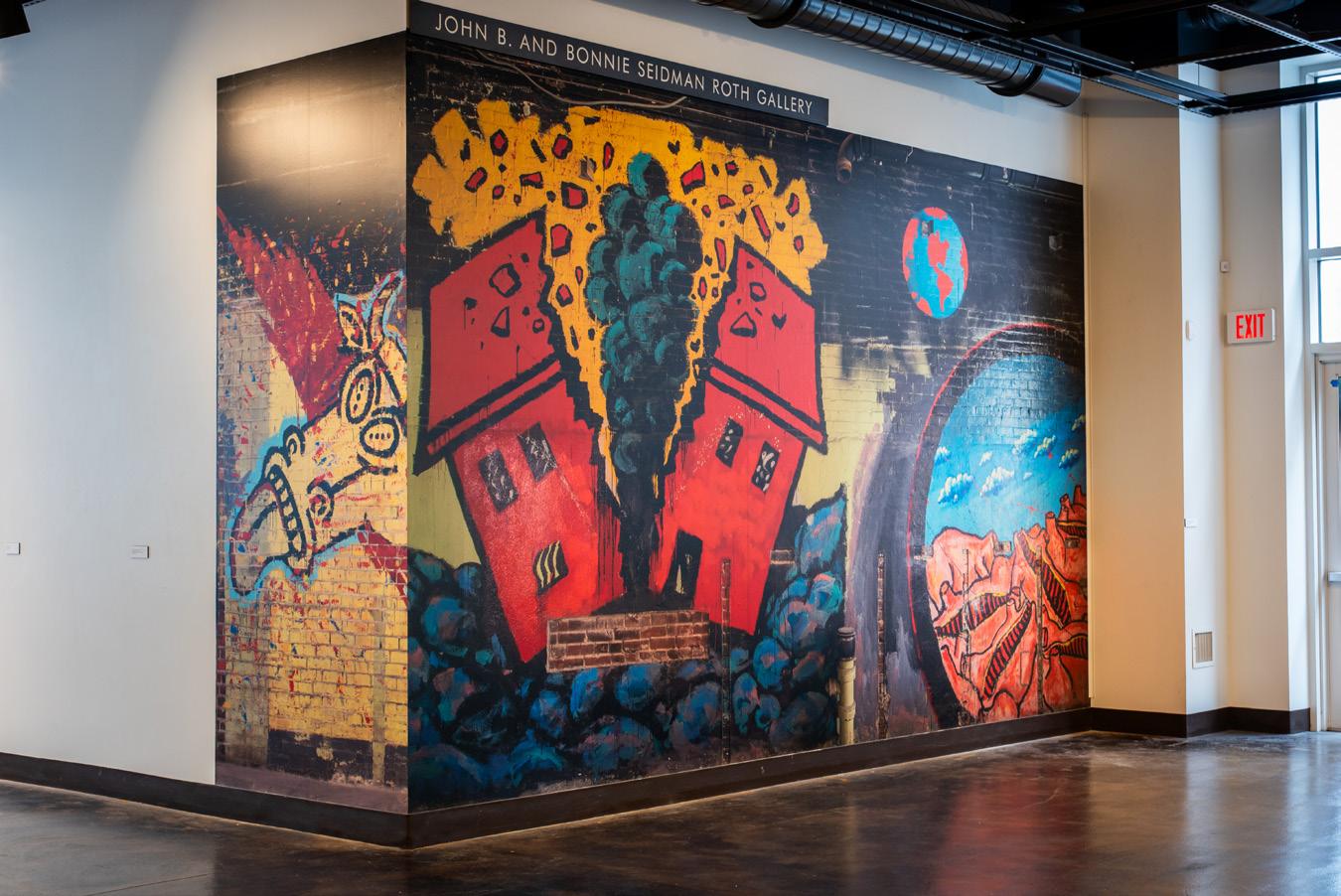
A central feature of MISSING is a reproduction of a mural by David Wojnarowicz, which loomed large in the makeshift exhibition space in 1985. It depicts an exploding house, animal carcasses, a globe, and a gagging cow—images that would become icons in the artist’s visual vocabulary. In 2022, the mural was discovered preserved behind drywall. Today, it is the only known surviving mural by Wojnarowicz, who died of AIDS in 1992 “due to government neglect.” The mural should be a point of pride for our city. But in August of 2025 the building’s current owner covered the mural again with drywall painted black evoking the sadly familiar violence of censorship and erasure that continues to haunt Wojnarowicz’s work long after his death.
At the Cressman Center, a large-scale photo reproduction will stand in for the now-absent mural. The reproduction is accompanied by additional work by Wojanarowicz, capturing his evolving stylistics in this transitional decade.
Judy Glantzman’s uncanny, tender portraits and Rich Colicchio’s disembodied heads demonstrate the playful, often pointedly political return to figuration at this moment. Futura 2000’s abstract graffiti locates this work within the downtown street aesthetic of the Lower East Side, while Kiely Jenkins’ odd sculptural forms affirm this street vernacular and rephrase it for the gallery wall. Altogether, these exuberate East Village peers compose an important and underappreciated moment of 1980s artmaking, just before the wider acknowledgment of the AIDS Crisis and the artistic turn to explicit activism.
MISSING: When East Village Artists Came to Main Street restores a nearly forgotten moment in the history of American art while celebrating Louisville’s unlikely role in this downtown scene. Importantly, the show aims to bring attention to the historic mural hidden away in our city.
Reproduction of David Wojnarowicz mural in the 1985 Missing Children Show now on view at the Cressman Center for Visual Arts. Original Mural Image courtesy PPOW Gallery and Mindy Best. Original Photo by Mindy Best. Installation Image by Diane Deaton Street.
Featured Artists
Rich Colicchio
Colicchio studied painting at the School of Visual Arts in New York City, graduating in 1980. One year later, he founded gallery 51X in a storefront at 51 St. Marks Place in the East Village. 51X was one of the earliest galleries to take hold downtown, prefiguring by just a few years the downtown gallery boom of the mid-eighties. In addition to showing Colicchio’s own work, 51X hosted exhibitions of work by CRASH, Futura 2000, Zephyr, and other artists now associated with the East Village graffiti scene. Indeed, 51X, along with Fun Gallery and Gracie Mansion Gallery, served as early points of contact and collaboration for the loose affiliation of artists that would compose this historic East Village scene.
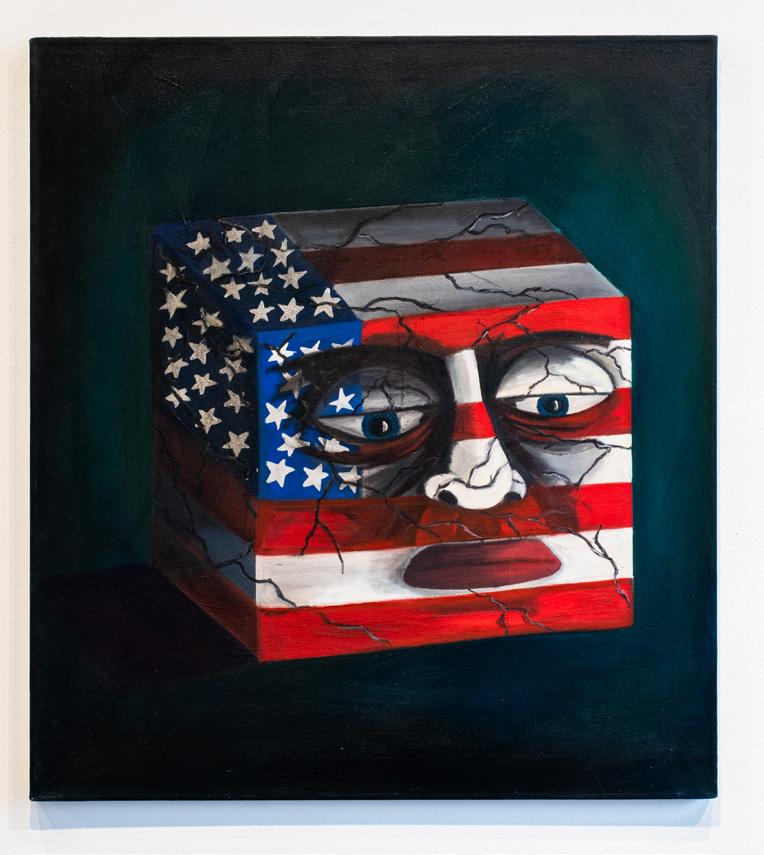
Colicchio’s own work often features cartoonish, oversized heads in tightly circumscribed, almost claustrophobic spaces. The American flag is prominent in the work in this show, although Collicchio’s art also included consumer goods and creaturely human-animal hybrids. Combined, his art suggests an uneasy relationship between graffiti’s “liberatory” self-expression (with its reliance on brand-like tags) and the self-expression championed by the late 20th century patriotism and marketing.
Rich Colicchio, Self-Portrait, 1986, oil on canvas, 36” x 40”. From the Collection of Chris Oliver. Photograph by Diane Deaton Street
Futura 2000
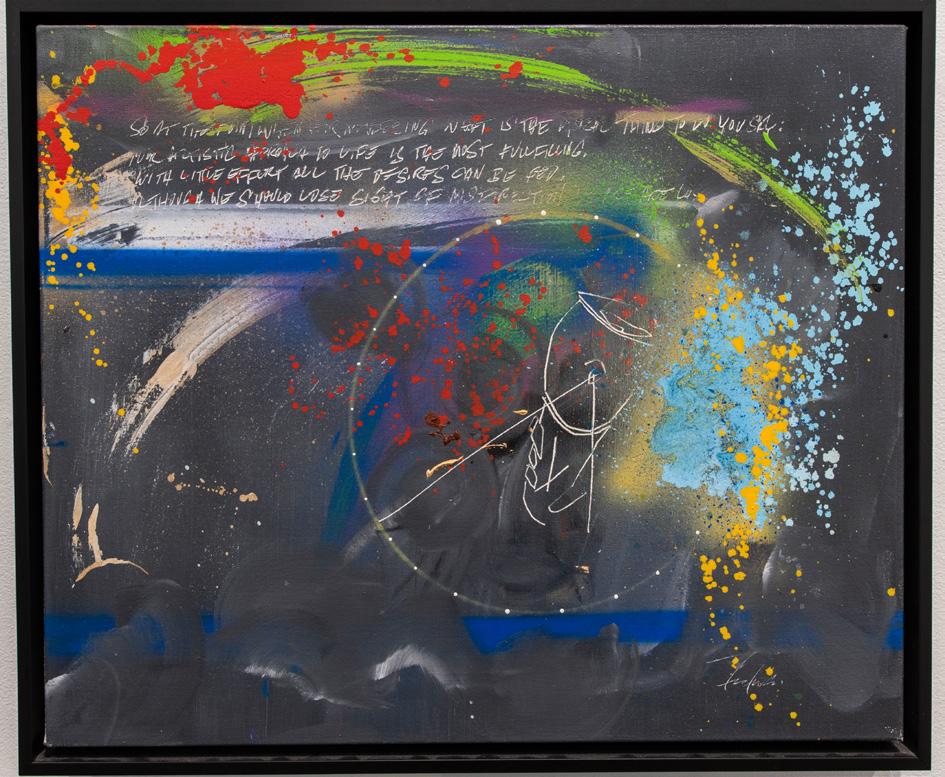
Leonard Hilton McGurr, known today as Futura, worked under the tag “Futura 2000” in the eighties. Unlike most of his street art peers, Futura’s work was almost exclusively abstract, characterized by ethereal backgrounds and brightly colored gestural lines and misty splatters. Such work not only departed from the cartoonish tagger culture of the East Village graffiti scene, but also rejected the return to expressive figuration enacted by the NeoExpressionist painters with whom early graffiti artists were so often critically entangled.
Nevertheless, Futura 2000’s work came directly out of street culture—he was not formally trained—and his paintings were produced with the spray cans and airbrushes of downtown street art. Like modernist abstraction of the turn of the 19th century, Futura’s abstraction emerged in part from his relationship to music: he was an accomplished rapper and musician, with vocals featured on the 1982 The Clash song “Overpowered by Funk.” Futura also produced print material for the Clash’s albums and toured with the band in 1982, performing onstage by tagging the backdrops to their sets. Today, Futura is best known as a graphic designer and illustrator, partnering with street-adjacent brands across the globe.
Futura, Poetry Imitates Art, 1989, Aerosol on canvas, 20” x 24”, From the collection of Alan Bortman. Photograph by Diane Deaton Street.
Judy Glantzman
Glantzman graduated from the Rhode Island School of Design in 1978. In the early eighties she began exhibiting in the East Village, at Civilian Warfare and Gracie Mansion. “I was lucky to be in the right place at the right time,” Glantzman would later reflect. “At Pier 34, you could take a wall and paint anything you wanted. So for a little bit of time, a few years in the mid-1980s in the East Village, it was a very democratic, open situation, and you were able to do things. There was no commerce. That particular group of people had a rawness to them and a feeling of ‘Let’s do this thing,’ which matched my own temperament.”
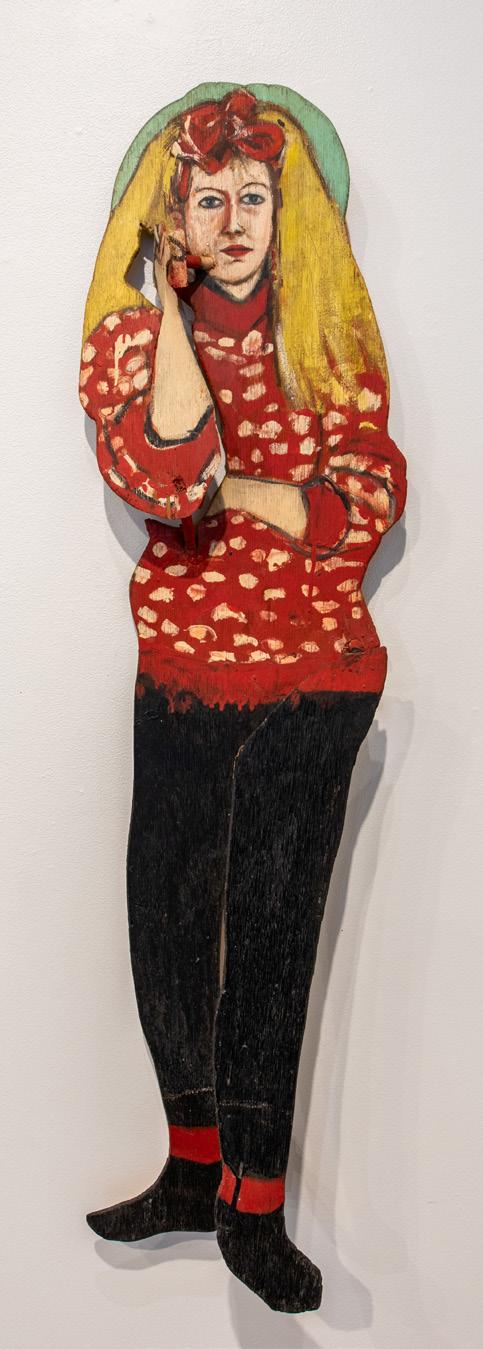
Glantzman’s painted portraits of East Village friends, artists, dealers, and critics exude the raw spirit of this communal ethos. At the same time, they attest to its fragile fleetingness. Composed of urban salvage—shaped pieces of plywood held together with wooden dowels—the figures invite playful engagement while they also seem on the verge of splintering and falling apart. Glantzman paints from the thick of it, channeling impulses and drives without inhibition to create a dense art of abundance filled with psychically charged portraits and symbols. Her most recent solo exhibition at P.P.O.W. in 2026, Playing with Dolls, speaks to her ongoing vision for painting that reflects both the exuberance and darkness of a world teetering on the edge.
Kiely Jenkins
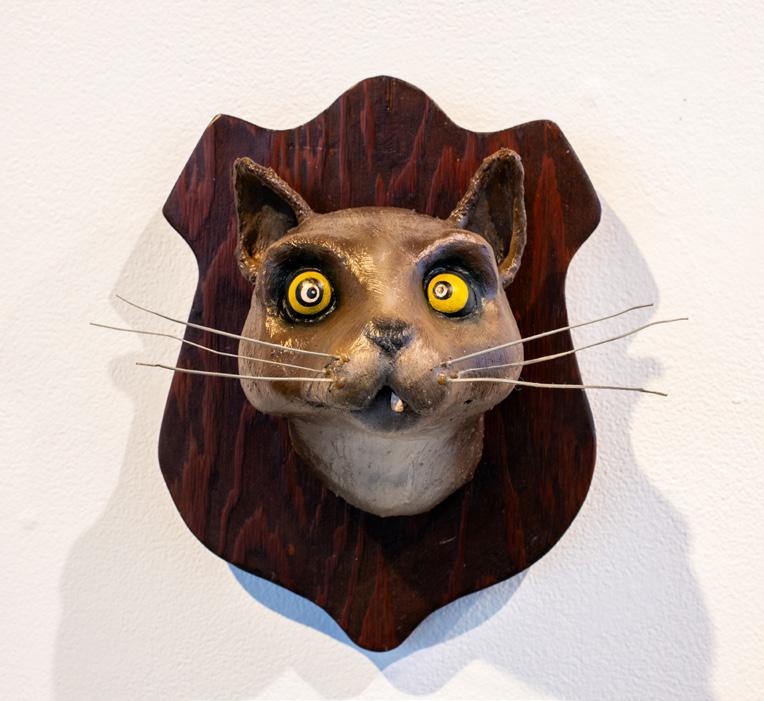
Jenkins was one of the first downtown artists to bridge two-dimensional street art typical of the East Village scene with three-dimensional, sculptural gallery work. He did so via the humorous, cartoon aesthetic of early 1980s tagger culture—a graffiti vernacular in which surprise and laughter served as unexpected backstops to the illegal and often dangerous production of street art. Jenkins’ work is humorous. His objects include cartoonish and brightly-colored fish and other animals, domestic furniture, and grungy New York street scenes and their denizens. These objects often form tableaus or dioramas—that is, the art itself sometimes takes the form of a diorama, or, just as often, the gallery is transformed, via his art, into a cartoonish, diorama-esque space.
His gesture, in every case, is parodic, although it is not necessarily political. Jenkins points to Ed Roth and his Rat Fink anti-Mickey Mouse aesthetic as an influence. The point is not opposition but rather juxtaposition: his art revels in the fact that the bubblegum pop cultural aesthetic of the early 1980s, with its bright colors, big fashion, and glamourous parties, was built on, and often recruited from, decidedly unglamorous downtown street life, with its precarious social stability, drug use, and increasingly dangerous sexual promiscuity.
Image left: Judy Glantzman, Lisa McDonald, 1985, enamel on wood, 50” x 15” x 5.5”; right: Kiely Jenkins, Cat Head, 1984, mixed medium, 12” x 12” x 7”. Photographs by Diane Deaton Street.
David Wojnarowicz
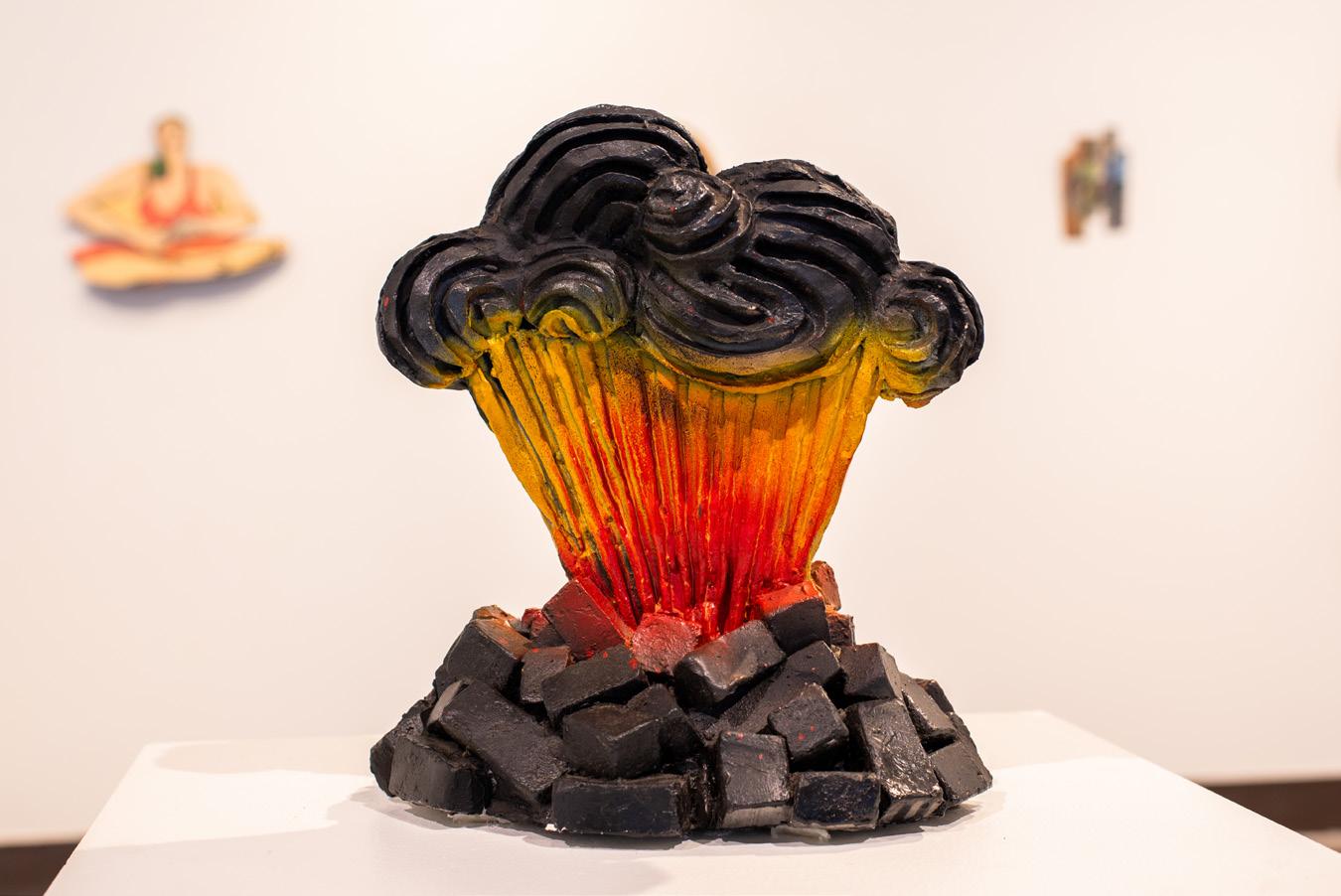
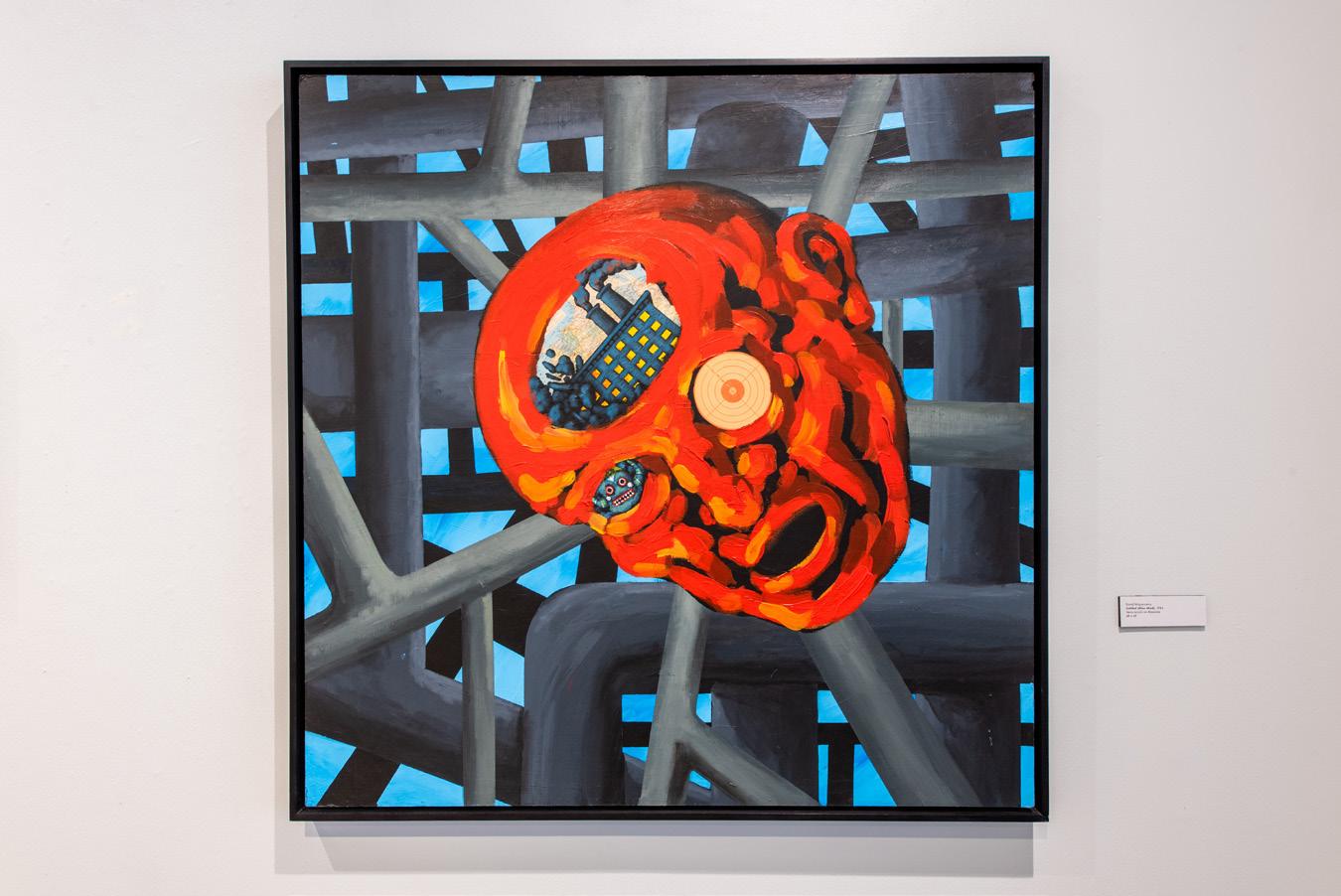
Born in New Jersey in 1954, Wojnarowicz had a notoriously difficult and abusive childhood. He died of AIDS in 1992 “due to government neglect,” leaving behind an expansive body of work encompassing music, filmmaking, photography, painting, poetry, prose, performance, and activism. In the early eighties, Wojnarowicz scavenged the urban landscape, repurposing found objects and working in abandoned buildings, especially Pier 34 off the Hudson River—a liminal site at the edge of the city where both queer cruising and artmaking became possible. Often using stencils, he developed visual vocabulary of signature icons that speak to violence, vulnerability, and the fracturing of the American Dream: a burning house, explosion, shooting target, falling man, gagging cow, animal carcasses, and dive-bombing plane, among others.
“To make the private into something public is an action that has terrific repercussions in the preinvented world,” Wojnarowicz declares in his 1992 book Close to the Knives: A Memoir of Disintegration. “Each public disclosure of a fragment of private reality serves as a dismantling tool against the illusion of ONE-TRIBE NATION.”
Railing against the cruelty and conformism of the “preinvented world,” Wojnarowicz sought to infiltrate it, cracking open spaces for alternative worlds. Through his wide-ranging art practice, and later in his impassioned AIDS activism, Wojnarowicz championed the outcasts, downtrodden, neglected, and abused. His work here on behalf of Kentucky’s Child Victim’s Trust Fund attests to the enduringness of that commitment.
MISSING: When East Village Artists Came to Main Street is made possible with generous support from the John Burton Harter Foundation and The David Wojnarowicz Foundation. Co-Curated by Hite faculty Jennifer Sichel and Chris Reitz
Above: David Wojnarowicz, Untitled (Alien Mind), 1984, Verso acrylic on masonite left: David Wojnarowicz, Untitled (Explosion), 1990, plaster and acrylic paint 12” x 7” x 10. Images for Diane Deaton Street.