VOLUME
66 ISSUE No. 02
Historically Speaking
WINTER 2026
A NEWSLETTER OF HISTORIC COLUMBIA
From the
EXECUTIVE DIRECTOR
F
or over six decades, Historic Columbia’s (HC) mission has inspired camaraderie and connection through our shared history. That work has endured because people choose to care—people who believe that the past has something vital to teach the future and that the landmarks we inherit deserve to stand for the next generation. This is only realized by the broad support of our community, making our work, at its heart, a collective act of generosity. As HC’s stewardship of Columbia’s five historic house museums has continued to evolve, the investment of our foundational donors provides support for sustainable progress and success. The Darnall W. and Susan F. Boyd Foundation has afforded Historic Columbia the opportunity to innovatively curate outdoor spaces at the Hampton-Preston Mansion and the Boyd Foundation Horticultural Center.
President Rodrick Shiver
2nd Vice President Ty Patterson Treasurer Alex Guzman Secretary Lauren Elliott
Historic Columbia preserves places and shares complex stories from the past that connect us in the present and inspire our future.
Suzanne Brooks Executive Director
This commitment is felt most profoundly through the act of planned giving, ensuring the future impact of our community’s steadfast organizations is supported through personal estate plans. Historic Columbia is humbled by those who have entrusted us with this legacy. Mobilizing Historic Columbia’s resources through community partnerships has raised voices from our past, many for the first time. Since 2024, HC has worked alongside the Mill District Alliance, making the mills’ history accessible through digital, place-based content that will debut this spring. This aspect of HC’s work is largely possible through grants—local, state, and national—making resources necessary for the complex and technical work of chronicling the past and its remaining structures. The very buildings this tour and many of HC’s walking tours bring to life survive through acts of preservation that strengthen entire neighborhoods, expand educational programs, and create long‑term impact. 2026 marks a milestone for Historic Columbia and Richland County as we celebrate 50 Forward, the 50th Annual Preservation Awards. Alongside property owners, creative firms, and contractors, preservation’s corporate partners help us think boldly and act to scale. The growing corporate support through membership and annual sponsorship at Historic Columbia sends a powerful message of community pride and identity, one worthy of engagement and investment. This year we invite you to explore the many areas of Historic Columbia’s mission and where your passion for community history aligns with our work. Your membership and gifts of support are transformational. Thank you for believing in the power of place, and for ensuring that our shared story continues.
HISTORIC COLUMBIA | NEWSLETTER
WINTER 2026 Volume 66 | Issue 02
1st Vice President Carroll Heyward
Filling the rooms of each museum, a selection of the carefully collected objects represents generations of Columbia and South Carolina history. Late last year as we announced the rolling initiative Adopt-an-Artifact, individual donors brought life to HC’s Collections Fund, proving that people believe in the value of safeguarding our shared heritage, and many of our most meaningful projects have been fueled by the same individual generosity.
2
Historically Speaking
In This Issue 3 50 Forward: Celebrate 50 Years of Historic Columbia’s Preservation Awards 4 Cotton Mills in Cotton Fields 6 Stewardship in Action 7 In Memoriam: Susan F. Boyd Upcoming Events 8 Collections Spotlight On the cover
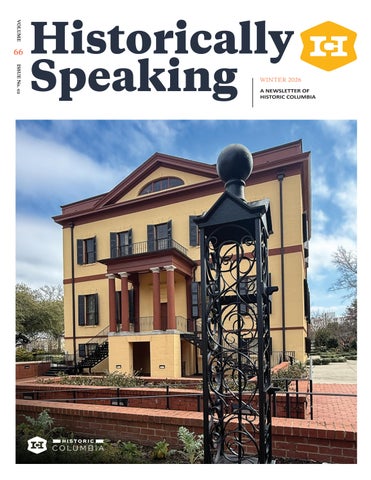
Pillars of the past: New garden column installation at the Gardens of the Hampton-Preston Mansion, funded by the Darnall W. and Susan F. Boyd Foundation. Read more in the article about Susan Boyd on page 7 of this issue. Image courtesy Historic Columbia archive
You are Invited!
GALA May 14, 2026 | 5:30 p.m. The Laundry at BullStreet
J
oin Historic Columbia for 50 Forward Preservation Awards as we celebrate 50 years of honoring preservation excellence in Columbia and Richland County. This milestone event will be held at Columbia’s newest event space and a 2025 Preservation Award winner, The Laundry at BullStreet. Learn more and purchase tickets here:
historiccolumbia.org/events
2025 Preservation Leadership Award winner Fred Delk (second from left), pictured with Historic Columbia’s Director of Preservation John Sherrer, Executive Director Suzanne Brooks, and Preservation Committee Chair Julie Tuttle at the 2025 Preservation Awards, May 2025. Image courtesy Anna Garrison Photography
50 Forward Preservation Awards will be held at The Laundry at BullStreet, a 2025 Historic Columbia Preservation Award winner. Image courtesy The Laundry at BullStreet
Since 1976, Historic Columbia has recognized 276 recipients whose dedication has preserved and enhanced the rich historical, architectural, and cultural heritage of Columbia and Richland County. The evening will begin with an awards ceremony at 4:30 p.m., followed by a gala celebration at 5:30 p.m. featuring cocktails, curated bites, live music, and the very best in historic preservation. Please note the awards ceremony is reserved for recipients and sponsors. Gala tickets are now on sale at historiccolumbia.org. We hope to see all our supporters at this milestone celebration! Join us as we honor the people and projects shaping our city’s future, while raising a glass to the visionaries who brought us here! See you May 14.
Historic Columbia has celebrated excellence in historic preservation since 1976. The 2024 ceremony honoring Preservation Award winners was held at The Pool at 701 Whaley, May 2024. Image courtesy Historic Columbia archive HISTORIC COLUMBIA | NEWSLETTER
3
COTTON MILLS IN COTTON FIELDS Historic Columbia and the Mill District Alliance debut new tour
“In the extreme southwestern suburbs of the city there is now to be seen something that perhaps no eye has ever witnessed before—a big cotton mill going up in the center of a cotton field with laborers picking the cotton from the bolls.” -The State, October 5, 1895 By KATHARINE ALLEN Director of Education & Interpretation
T
he construction of “Whaley’s Mills”—the Richland, Granby, Olympia, and Capital City mills designed and owned by W. B. Smith Whaley—transformed Columbia within the span of a decade. The mills and their infrastructure, including the Columbia Electric Streetcar and Railroad Company, extended the city to the south and east, creating a self-sustaining hub of industrial and social work that supported several thousand residents who were new to urban living. These workers and their families, who were white and often farmers and sharecroppers from rural counties, moved into mill-owned duplexes or tenement houses and began performing
Image courtesy Postcards of the Midlands Collection, Richland Library. Columbia, SC
industrial wage work for the first time. Whaley promised an idyllic life with “neat & tidy cottages.” However, employees faced dangerous workplace conditions during their twelve- and thirteen-hour shifts before returning to a rented, overcrowded home with unclean water, substandard food, and often, communicable diseases. The discord between owners’ capitalist desires and the lived experiences of workers was ever-present, yet so too was the possibility for upward economic mobility in the first half of the twentieth century. In 2024, Historic Columbia partnered with the Mill District Alliance to create digital content that explores these dynamics and more. Funded by the Richland County Conservation Commission, the tour and associated signage examine well-documented buildings while highlighting unknown events. Here are four takeaways:
1. The iconic 701 Whaley building will turn 125 this year.
Clothing and boxed merchandise as they awaited placement before the grand opening of the Mills Avenue Store. Printed in Modern Cotton Mill Engineering (1903); Advertisement, “Opening of the Mills Avenue Store,” The State, November 13, 1901. 4
HISTORIC COLUMBIA | NEWSLETTER
Although listed in the National Register of Historic Places as the circa-1903 “Pacific Community Association Building,” this landmark property opened as the Mills Avenue Store on November 13, 1901. In 1909, the eastern storefront became the mills’ Y.M.C.A., and between 1919 and 1923, the entire building underwent a complete transformation, with two major additions, that cost owner Pacific Mills an estimated $250,000.
2. A marvel of engineering was a mechanism of oppression.
Additional
Investigative journalist Marie Van Vorst, who “went undercover” as a mill worker in 1902, took offense to Olympia Mill’s 140-foot clock tower, which “glared in upon us, giant hands going round, seeming to threaten the hour of dawn and frightening sleep.” Meanwhile, in Modern Cotton Mill Engineering (1903), Whaley touted the same sophisticated timing system because it ensured every employee could always either see the four, eightfoot-tall, illuminated dials or hear the five-thousandpound bell that dictated the rhythm of their days.
Olympia Cotton Mills looms over the adjacent Granby Mills village, 1909. Image courtesy Library of Congress
RESEARCH PROJECTS This fiscal year, Historic Columbia will complete Phase II of the Cotton Mill District project as well as the following:
3. Economic mobility required an education— which the mill provided. In addition to the Olympia School, founded in 1901, the village also funded Granby School on Zigzag (Tryon) Street, and the Night School, which initially operated in the community store building at 701 Whaley Street. Although many first-generation mill workers were illiterate, subsequent generations would graduate from high school and college. The Player family lived on the same block as the Granby School when it opened in 1904. Although all six children, including ten-year-old Henry, worked at the mill to support their widowed mother, they all learned to read and write by 1910. Image courtesy South Caroliniana Library, University of South Carolina, Columbia
History of the United Way of the Midlands In partnership with the United Way of the Midlands, Historic Columbia is documenting 100 years of the United Way (formerly the Community Chest). Here, project interviewee and former board chair Rev. Jesse Washington and former board chair Charlotte Berry visit with local school children in 1995. This project is funded by Colonial Life. Image courtesy United Way of the Midlands archive
Charlie Lambert (born 1892), photographed in January 1909, told photographer Lewis Hine he began working at Granby Cotton Mills at age seven, though the 1900 city directory lists him in school while his father and half-siblings worked there. Like many children at the time, he likely did both. Image courtesy National Child Labor Committee Collection, Library of Congress, Prints and Photographs Division
4. The mills employed white children and Black men in dangerous roles. Although the workforce was overwhelmingly white, a few Black men found employment, working as firemen who managed the steam levels in the Olympia Mills’ boiler room through the firing of coal. Whaley’s successor Lewis W. Parker was also an advocate for child labor, noting that “when labor is as scarce as it is, I hardly feel justified in prohibiting children from being in the mill, for I know if I do I will lose some help that we do not want to lose.” Between 1904 and 1907, Parker settled lawsuits involving the negligent onsite deaths of Shelton Johnson, a Black man, and Howell Hall, a nine-year-old employee.
History of the Y.W.C.A. of Columbia
Children working in the great spinning room of Olympia Cotton Mills, 1903. Image courtesy Russell Maxey Photograph Collection, Richland Library, Columbia, SC
Learn more about this project and take the online tour today:
historiccolumbia.org/mill-district
This project is in partnership with the Mill District Alliance with grant funding from the Richland County Conservation Commission:
In partnership with the Palmetto Center for Women, Historic Columbia has documented the origins and evolution of the Y.W.C.A. of Columbia and the Phyllis Wheatley branch. The South Carolina Department of Archives and History has approved two historical markers, to be installed in fiscal year 2026-2027. Here, attendees of Camp Marion, which operated from 1932 to 1940, perform the morning flag raising. Image courtesy South Caroliniana Library, University of South Carolina, Columbia
5
Stewardship IN ACTION
MID-YEAR MILESTONES IN COLLECTIONS & ARCHIVES
DIGITIZING OUR PAST
I
n Historic Columbia’s strategic efforts to best curate its ever-growing institutional archives, staff processed four boxes (six linear feet) of programs, events, and building photographs. In the process, a partnership with Margaret Dunlap of Richland Library’s Walker Local and Family History Center to digitize images granted public access to long-stored material from HC’s 1992 “Community History Day.” HC staff hope that longtime members might recognize these photographs and encourage the donation of the originals to HC or another archive.
Scan to browse the collection:
Among the 185 newly digitized photographs, this circa-1910 image of 922-924 Gervais Street offers a new perspective on an extant Vista landmark building. Image courtesy Patricia Bearden
CONSERVING OUR COLLECTION
T
his fall, HC launched the Adopt-an-Artifact program. Supporters can “adopt” an object in need of professional conservation or donate to HC’s Collections Fund to support the daily and long-term care of its 4,000+ objects. In 2025, our generous donors raised more than $10,000, including significant gifts from:
1
Collections Sustaining Supporters The Family of Sarah Barnwell Gregorie Sturm
Artifacts Adopted 1. William Harrison Scarborough (1812–1871), Crossing the French Broad, 1839 Adopted by the collective donors who gave on Giving Tuesday and the generous support of the family of Sarah Barnwell Gregorie Sturm 2. William Harrison Scarborough (1812–1871), Portrait of Margaret Ann Boyd DuBose, ca. 1940 Adopted by the collective donors who gave on Giving Tuesday and the generous support of the family of Sarah Barnwell Gregorie Sturm
2
Collections Patron
Richard Hampton Jenrette Foundation
Collections Benefactor Joseph Bruce Bettyann Walters
3
Learn more and make a gift:
Newer history is important, too! HC staff photographed 1300-1304 Main Street in 2000. Four years later, developers leveled the late 19th-century building to establish a parklet. Image courtesy Historic Columbia archive
3. Hiram Powers (1805–1873), Bust of Sarah Buchanan Campbell Preston, ca. 1858–1860 Adopted by Joseph Bruce
DOCUMENTING OUR LANDSCAPE
I
n December, HC successfully migrated more than 3,000 plant records and images to Hortis, a GIS-enabled tool for “managing botanical collections” that allows the documentation of seasonal plant observations in real time. This database will be accessible to the public in early 2027.
6
Curator of Living Collections Rebecca Townsend fully mapped the beds of the HamptonPreston Mansion and documented HC’s camellias in January.
HISTORIC COLUMBIA | NEWSLETTER
t
IN MEMORIAM Susan F. Boyd
January 14, 1933 November 8, 2025
Upcoming
EVENTS
March 31 and May 5
Concert in the Gardens
5:00 — 7:00 p.m. | Hampton-Preston Gardens
Susan F. Boyd (left) at the grand opening of the Boyd Foundation Horticultural Center on the grounds of the Hampton-Preston Mansion and Gardens on March 11, 2022. Image courtesy Historic Columbia archive
H
istoric Columbia mourns the loss of Susan Fair Boyd. A visionary, rooted in Columbia’s past with a commitment to ensuring a better future for the capital city, Susan had an unprecedented belief in Historic Columbia’s Cultural Landscape Masterplan. Realizing the potential of the Hampton-Preston Mansion and Gardens was made possible largely by the generous support of the Darnall W. and Susan F. Boyd Foundation and Susan’s personal investment. Susan’s commitment to conservation and beautification across HC sites can be seen in the gardens of the Robert Mills House, in the 2006 restoration of the HamptonPreston Mansion front entrance, and in ongoing seasonal Welcome Bed plantings. The creation of a sunken garden patio that sits in the the footprint of the mansion’s mid-19th century addition, removed in 1969, and the hardscaping, landscaping, electrical, irrigation, and garden structures, improvements spanning eight years making the grounds of Hampton-Preston accessible. A project very important to a Susan was the completion of the 4,000-square-foot historically inspired glasshouse that now sits on the northwest corner of the Hampton-Preston site. In April 2022, the structure was named the Boyd
Foundation Horticultural Center in honor of the unprecedented support. Susan—a descendant of one of Columbia’s founding families on whose land the city was established— honored her roots to South Carolina across cultural and natural resources and in 2024 received the Preservation Service Award at the South Carolina Historic Preservation Awards. From creating places of respite and peace to holding space for innovation and engagement, Susan’s impact across the Midlands cannot be understated and will continue to nurture the community she loved. Historic Columbia will continue to celebrate the life of a dear friend and champion of our great city. We extend our deepest condolences to Susan’s family and friends.
On the cover t
Most recently, the Boyd Foundation funded the restoration of garden columns featured on the cover of this issue. On your next visit to the Gardens of the Hampton-Preston Mansion, look for the newly installed wrought and cast iron columns by the sunken patio, crafted ca. 1870–1885 and gifted by Corey Bedenbaugh, whose grandfather salvaged them from demolition on the BullStreet campus. Though their exact original location is unknown, the columns will now continue their story just blocks from their former home, thanks to the generosity of the Boyd Foundation.
Performers from the South Carolina Philharmonic will join Historic Columbia to present a beautiful concert of light classics in the garden. Please plan to arrive any time after 5 p.m. The concert will begin at 6 p.m. and last an hour. Bring your own blanket or chairs, and pack a picnic if you’d like. Please note tickets are required, and space is limited if there is inclement weather.
April 9 | HC Members Only April 10-11
Spring Plant Sale Hours vary | Hampton-Preston Gardens
Celebrate spring at our Plant Sale! Browse heirloom flowers, shrubs, vegetables, and perennials, all grown in Historic Columbia’s gardens. Our horticulture experts will be on-site with tips and recommendations. Don’t miss this opportunity to refresh your garden and connect with fellow green thumbs. PLUS: HC Members get early access to all plant offerings in the exclusive Online Presale starting March 24.
June 7
Palladium Tour: Life on Main St. Downtown Columbia
Join us in the heart of Columbia as Palladium Tour invites guests to experience the people, places, and bold reinventions of Main Street. Anchored by the newly renovated AIA South Carolina Center for Architecture as our hub, the tour will open doors to an exciting mix of urban living: private residences, short-term rentals, and dynamic commercial spaces throughout the vibrant 1500 block. Blending history, design, and downtown energy, this year’s event offers a fresh, city-centric twist on one of Palladium’s beloved events.
Learn more and register: historiccolumbia.org/events
t
HISTORIC COLUMBIA | NEWSLETTER
7
1601 Richland Street
|
Columbia, SC 29201
|
www.historiccolumbia.org
NONPROFIT ORG USPOSTAGE PAID COLUMBIA, SC PERMIT #1000
Collections SPOTLIGHT Commissioned by their son Governor John Taylor (1770–1832), these portraits depict Colonel Thomas Taylor (1743–1833) and Ann Wyche Taylor (1749–1834) in their seventies or early eighties. Married in 1767, Thomas and Ann were both born to prominent Virginia families. Following their marriage, the Taylors forced enslaved laborers to build The Plains, a plantation that sprawled outward from the present-day intersection of Barnwell and Richland streets. By 1833, they enslaved over 200 women, men, and children in the Midlands. As an advocate for American independence, Thomas joined the Second Provincial Congress of South Carolina in 1775 and fought in the Revolutionary War while Ann raised their twelve children. In 1786, Thomas Taylor sold a portion of his sprawling plantation to the state for the creation of the capital city, earning him the title: “patriarch of Columbia.” In need of conservation since their acquisition in 2008, these portraits will be added to HC’s Adopt-an-Artifact program, an initiative that offers a tangible opportunity to support the objects in our care. Learn more and make a gift today:
historiccolumbia.org/adopt-an-artifact
Attributed to James DeVeaux Portrait of Colonel Thomas Taylor & Portrait of Ann Wyche Taylor, ca. 1830 Historic Columbia collection HCF 2008.14.1 & HCF 2008.14.2