VOLUME
67 ISSUE No. 01
Historically Speaking FALL 2026
A NEWSLETTER OF HISTORIC COLUMBIA
From the
PRESIDENT
A
s I reflect on my three and a half years as President of Historic Columbia’s (HC) Board of Trustees, I am filled with gratitude for the people, partnerships, and shared commitment that have helped move our organization forward. It has been a privilege to serve during a period of meaningful growth and change, and I am especially proud of what we have accomplished together as we prepare to write the next chapter.
Throughout my presidency, HC continued to strengthen its role as a leader in preservation, interpretation, and community engagement. We celebrated national recognition with the National Trust for Historic Preservation’s Trustees’ Award for Organizational Excellence in 2024, expanded Rodrick Shiver our interpretation of complex history through projects President such as the Heat & Hardship: Hidden Labor of Enslaved Historic Columbia Cooks exhibit, and marked an extraordinary milestone Board of Trustees with the 50th Annual Preservation Awards in May. These accomplishments reflect an organization committed not only to preserving Columbia’s past, but to demonstrating why that history matters today. This past fiscal year was particularly important in preparing for our future. Rather than moving directly from one strategic plan to another, we developed a FY26 Strategic Bridge Plan to give ourselves time to assess our operations, strengthen our foundation, and make thoughtful decisions about what comes next. That work produced meaningful progress, including improvements to our Welcome Center, a comprehensive assessment of Seibels House, investments in new visitor and donor management systems, and planning for the longterm transformation of the Robert Mills campus. Some of these efforts are already visible to visitors, while others represent essential behind-the-scenes investments that will strengthen HC for years to come. Perhaps most importantly, this bridge year allowed us to approach our next strategic plan with greater intention. In this issue, I am delighted that we can now share the FY27–FY29 Strategic Plan, based upon eight priorities that will guide our efforts to strengthen the organization, expand our reach, and ensure that HC remains a vital community resource. As my time as president comes to a close, I am pleased to pass the baton to Carroll Heyward. Having watched Carroll’s involvement grow from Palladium leadership to service on the Board of Trustees, I know he brings a deep commitment to HC’s mission and an understanding of the important role our supporters play in its success. I look forward to seeing the organization continue to grow under his leadership. To my fellow trustees, our dedicated staff, volunteers, donors, members, and community partners, thank you for your trust, generosity, and unwavering support. All we have accomplished during my presidency has been the result of our collective efforts. I leave this role with tremendous pride in how far HC has come and even greater excitement for all that lies ahead. Warm regards,
2
HISTORIC COLUMBIA | NEWSLETTER
Historically Speaking FALL 2026 Volume 67 | Issue 01 President Rodrick Shiver 1st Vice President Carroll Heyward 2nd Vice President Ty Patterson Treasurer Alex Guzman Secretary Lauren Elliott
Historic Columbia preserves places and shares complex stories from the past that connect us in the present and inspire our future.
In This Issue 4 6 7 8 10 11 12 13 14 16
Organizational Highlights Upcoming Events FY26 Event Sponsors Preservation in Practice What’s Next? Meet the Presidents Annual Fund Spotlight The Garden Gang Garden Donor Spotlight Collections Spotlight
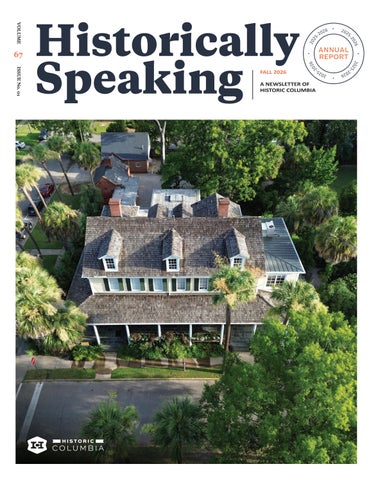
On the cover Aerial photo of the Seibels House at the corner of Richland and Pickens streets, June 2026. This issue contains findings from the Seibels House and Garden Historic Structure Report conducted by Meadors, Inc. Image courtesy Mark DeBacker
Board of Trustees 2025-26 Board of Trustees Rodrick Shiver, President Carroll Heyward, 1st Vice President Ty Patterson, 2nd Vice President Alex Guzman, Treasurer Lauren Elliott, Secretary Ex-Officio Members Gretchen Cooper, Richland County Liaison Sam Johnson, Columbia City Council Liaison Ari Robbins, Palladium Chair
At-Large Members Debbie Parker Douglas Mary Elam Lura Folline Christy Jeter Cory Manning Andrew Rogerson Todd Shaw Gwen Thurmond Julie Tuttle
HC Advisory Council Jim Byrum David Bornemann Ann Cameron Patrick Cleary Beryl Dakers Jessica I. Elfenbein Monya Havekost Kathy Hogan
Ann Holtschlag Michelle Hurley-Johnson Olivia Hyatt Gloria S. James Brian Johnston Jamie Keller Richard Linden Andrew R. Lucas Betsy McDonald
Todd Miller Stuart Moore Jeff Payne C.D. Rhodes Henry Roe Cleve Walker J. Calhoun Watson Aaron West Toni Wilson
Jake Armstrong, Horticulture Assistant Heather Bacon-Rogers, Visitor Experience Manager
Historic Columbia’s Statement of Activities for the year ending on June 30, 2026.
Beth Johnson, Education Assistant
Total Operating Income...................... 2,566,830
Chris Mathis, Horticulture Manager
Operating Expenses Program Expenses............................... 2,012,449 General Supporting................................. 412,810 Fund-Raising Expenses.......................... 157,735
Adam Miller, Group Tour Coordinator
Emily Brown, Director of Marketing & Communications
Sarah Neill, Collections Assistant Carmen Sangster, Education Manager John Sherrer, Director of Preservation
Autumn Chandler, Collections Manager
Autumn Thoele, Rentals Coordinator
Katherine Crawford, Development Coordinator
Rebecca Townsend, Curator of Living Collections
Brooke Flory, Program & Communications Coordinator
David Turner, Director of Advancement
Debbie Giles, Business Manager
2025-26 Financial Statement*
Kevin Jennings, Director of Buildings
Joe Glenn, Facilities Assistant
Suzanne Brooks, Executive Director
Nathan Brown, Office Manager & Executive Assistant
Ari Robbins, President Russell Cox, President-elect Chandler Garnett, Secretary Kyle Alston Bellinger Boylston Brandon Buchanan Janie Campbell Michael Caraballo Eric Meadows Matthew Morrison BJ Phillips Christy Steiger Nell Warthen Alexandra Woodlief Cory Wyckoff Carman Young Andrew Rogerson, Past President, ex-officio
Operating Income City of Columbia................................... 901,285 Richland County.................................... 697,500 Individual/Corporate Donations....... 477,802 Grants..................................................... 60,847 Assets Released from Restriction........... 15,000 Rentals.................................................... 163,253 Tours/Public Programs........................... 73,319 Other........................................................ 177,824
Staff Katharine Allen, Director of Education & Interpretation
Palladium Board of Directors 2025-26
Total Operating Expenses.................... 2,582,994 Net Operating....................................... (16,164) Non-Operating..................................... 970 Change in Net Assets.............................. (15,195) Net Assets, beginning of year.......... 3,247,575 Net Assets, end of year...................... 3,184,195 * Pending audited financials
Rebecca Woodruff, Curator of History
FALL 2026
3
Fiscal Year in Review
ORGANIZATIONAL HIGHLIGHTS CELEBRATING PRESERVATION. EXPANDING POSSIBILITIES.
From statewide recognition and celebrating preservation champions to opening new doors to our city’s history, this year’s milestones reflect the impact of Historic Columbia’s work.
Historic Columbia Receives Inaugural Organizational Excellence Award
H
istoric Columbia is proud to have received the 2026 Organizational Excellence Award as part of the South Carolina Historic Preservation Awards. Presented by Preservation South Carolina, the South Carolina Department of Archives and History, and the Office of the Governor, the annual awards recognize exceptional accomplishments in preserving, rehabilitating, and interpreting South Carolina’s architectural and cultural heritage. The Organizational Excellence Award honors a nonprofit organization whose collective body of work demonstrates sustained achievement in historic preservation. For Historic Columbia, the recognition reflects a story that began in November 1961, when a group of preservationists came together to save the Robert Mills House. Nearly 65 years later, that grassroots effort has grown into a multifaceted preservation and public history organization serving Columbia and Richland County. Today, Historic Columbia stewards six historic sites and 14 acres of gardens while advancing preservation throughout the community. Through
research, advocacy, preservation easements, educational programs, heritage tourism, community partnerships, and resources such as the Building Richland County database, the organization works to protect historic places and connect people with the stories that shaped them. “This award belongs to the many people who have shaped and sustained Historic Columbia over nearly 65 years,” said Executive Director Suzanne Brooks. “It reflects the commitment of generations of staff members, board members, volunteers, donors, partners, and community advocates who believe that preserving historic places and sharing their complete stories strengthens our community.” Historic Columbia accepted the award on July 30 at the South Carolina State House. We are grateful to the organizations and selection committee responsible for this recognition and, most importantly, to the community that has supported Historic Columbia since our founding. The award celebrates what we have accomplished together while encouraging continued stewardship of the places, stories, and cultural resources that make Columbia and Richland County distinctive.
Historic Columbia’s senior leadership team gathered at the South Carolina State House to accept the inaugural Organizational Excellence Award, recognizing nearly 65 years of sustained preservation, interpretation, advocacy, and community partnership across Columbia and Richland County together. Images courtesy Historic Columbia archive
4
HISTORIC COLUMBIA | NEWSLETTER
Over 200 community leaders and historic preservation advocates gathered to celebrate the 50th anniversary of Historic Columbia’s preservation awards at the 50 Forward gala and awards ceremony. Images courtesy Dennis Davis Photography
A Legacy of Preservation
H
istoric Columbia celebrated 50 years of its Preservation Awards with 50 Forward, a special awards ceremony and gala held May 14, 2026, at The Laundry at BullStreet. The milestone event brought together preservation advocates, community leaders, and supporters to honor the people and projects safeguarding our region’s historic places. Attendees were greeted to a Google Maps-based representation of the awards Historic Columbia has issued over the past five decades thanks to the painstaking efforts of preservation intern Jeb Bartlett. Scan or click to view the 2026 Preservation Award winners, as well as the full photo gallery from the event.
historiccolumbia.org/preservation-awards
Seibels House Kitchen Dependency Opens to the Public
B
ehind the historic Seibels House stands a remarkable survivor of Columbia’s past. Built around 1830, the Kitchen Dependency is one of the city’s last remaining structures of its kind, offering a rare glimpse into the lives and labor of the enslaved Africans and African Americans who helped sustain wealthy white households. Thanks to generous funding from the Richland County Conservation Commission, Historic Columbia has transformed this previously inaccessible building into a free, self-guided exhibit. Thoughtful preservation work, new interpretive panels, and improved visitor access invite guests to explore the building’s history and discover the stories its walls and floors have preserved.
Inside, visitors can examine archaeological features uncovered during excavations in 2003 and 2005 and learn how the building’s two rooms served as a kitchen and laundry. The exhibit explores the demanding and often dangerous work performed here, from preparing meals over open fires to washing and mending clothing. Historic documents, archaeological discoveries, and other evidence also illuminate the experiences of Black domestic workers before and after emancipation. Come discover this important chapter of Columbia’s history. The Kitchen Dependency exhibit is free and open to the public Monday– Friday, 10:00 a.m.–4:00 p.m., at Seibels House, 1601 Richland Street.
Exterior and interior views of the newly interpreted Seibels House Kitchen Dependency, where preservation improvements and interpretive panels offer visitors a closer look at the lives and labor of enslaved African Americans. Images courtesy Historic Columbia archive
FALL 2026
5
Upcoming EVENTS
OCT. 15, 16, 17:
OCT. 22:
5:30 - 7:00 p.m. | Downtown Columbia
5:30 - 7:00 p.m. | 919 Gervais Street
MONUMENTAL UNDERTAKINGS
Explore downtown graveyards with Director of Preservation John Sherrer and discover how cabinetmakers, blacksmiths, stonemasons, and funeral businesses shaped 19th-century burial traditions. This 90-minute walking tour examines the craftsmanship, commerce, and memorial customs behind Columbia’s historic monuments and the legacies they represent.
NOV. 12:
COMMUNITY SCANNING DAY | COTTON MILL DISTRICT 11:00 a.m. - 2:00 p.m. | 701 Whaley
Help document the history of Olympia, Granby, and surrounding neighborhoods by bringing photographs, ephemera, or small objects to be digitally scanned. Richland Library and Historic Columbia staff will preserve and share contributions in the online Midlands Memories collection.
BEHIND THE SCENES TOUR: SEABOARD VISTA Go behind the scenes with developer Avant Holdings at Seaboard Vista, where historic buildings are being reimagined for dining, culture, creativity, and residential life. Attendees will tour the buildings once occupied by Murray Drug Company, National Biscuit Company, and Richland County’s dispensary. They will also meet the project team and enjoy light refreshments.
NOV. 12 — JAN. 3:
HOLIDAY HOUSE TOURS Buy tickets online or at the Welcome Center at Robert Mills
The Robert Mills House and the HamptonPreston Mansion are decorated for the season! Enjoy a holiday tour and learn how families celebrated in the 19th and early 20th centuries. Tours offered every Wednesday-Sunday from Nov. 12 — Jan. 3. NEW this year! Tours will be offered the evenings of December 4, 11, and 18 at 6:00 p.m. and 7:00 p.m.
Learn more and get tickets:
historiccolumbia.org/events 6
HISTORIC COLUMBIA | NEWSLETTER
OCT. 26:
TRUNK OR TREAT
5:30 - 7:00 p.m. | Robert Mills House
Grab your costume and join HC for a safe, fun, and FREE Halloween experience. Community members and local organizations throughout Columbia will meet on the grounds of the Robert Mills House to pass out candy to trickor-treaters! Awards and prizes will be offered for the best costume. The presenting sponsor of this event is Legacy Traditional Schools.
DEC 15:
HOLIDAY CONCERT IN THE GARDENS 5:00 - 7:00 p.m. | Boyd Foundation Horticultural Center Greenhouse
Celebrate the season with holiday favorites performed by South Carolina Philharmonic musicians in the Boyd Foundation Horticultural Center greenhouse. Arrive after 5:00 p.m. for the hourlong concert beginning at 6:00 p.m. Chairs are provided, and guests may bring food and beverages to enjoy during the performance.
Thank You to our 2025-26 EVENT SPONSORS Historic Columbia is grateful to the generous sponsors who made our FY26 events possible. Your support brought people together through history, culture, preservation, gardens, education, and community celebration. These programs are stronger because of your partnership.
Absolute Total Care - Healthy Connections* Richland Co. Councilwoman Gretchen D. Cooper** Grace Outdoor Advertising The Big DM 101FM Hot 103.9 Prisma Health SC Arts Commission WACH Fox 57 City of Columbia C&S Tours The Comet MUSC Health Columbia S.C. Chapter of the Links, Inc. Columbia SC63: Our Story Matters USC Center for Civil Rights History and Research Post and Courier Columbia
Mashburn Construction* Styx Co. GBX Group Richard Hampton Jenrette Foundation Goings Law Firm Architrave, LLC Quackenbush Architects + Planners Garvin Design Group The Southern Way
Something Borrowed SouthState Bank AARP South Carolina Central Carolina Community Foundation African American Philanthropy Committee Atkins Law Firm Bailey Law Firm, LLC Cambria Carolina Panorama DreamKey Partners First Palmetto Bank Jabber & Issac, PA Lourie Life & Health Publix Super Markets Charities Selling Soda City Southern First Bank Palmer Memorial Chapel EFinancial Advisors BJ and Edna Langley - McDonald’s The Stanley Law Group Optus Bank Marc Brown Law Firm Johnson, Toal & Battiste PA Healthy Blue HealthPlan of SC Lutheran Services Carolina Main Street District
Rogers Lewis Group Bill Schmidt Stantec LS3P 1x1 Design Tax Credit Marketplace Babcock Apartments Clachan Properties GMK Associates, Inc. Trinity Partners Real Estate McCrory Construction Seed Architecture Studio 2LR First Citizens – Brennan Building Cason Development Group First Reliance Bank Boudreaux Breakthrough Beverage *Presenting Sponsor | **Stage Sponsor
Breakthrough Beverage Garvin Design Group AIA Columbia Law Offices of Brian Caskey Rogers Lewis Group The Art of Real Estate ExtraMile The Shiver Group First Community Financial Consultants Columbia Craft/Peak Drift Brewing Main Street District AIA South Carolina Denice Deganhart Design Synovus Saluda Architecture Thompson Turner Construction
Rogers Lewis Group Garvin Design Group Law Offices of Bryan Caskey Rikard and Protopapas Prisma Health Specialty Woodworks Top Tier Technology Solutions
Learn more about Corporate Support today!
historiccolumbia.org/corporate-support
HPG and Company* FALL 2026
7
Preservation IN PRACTICE
By JOHN SHERRER Director of Preservation
S
Dating to the early 1890s, the earliest known photograph of the Seibels House depicts the building without many of its later additions, including dormers, brick veneer, and an elevated slate-floored piazza. Image courtesy Historic Columbia archive
ome longtime Historic Columbia members may recall the Seibels House gracing the cover of Historically Speaking more than twenty years ago, just like it is in this issue. In that winter 2003 edition, I eagerly shared news of pending archaeological excavations and capital repairs at the capital city’s oldest extant property. A generation of improvements followed. Each of the site’s three historic buildings benefited from “bricks and mortar” capital repairs. Once newly planted gardens now reflect decades of growing seasons. Today visitors to the property access information about the former estate’s physical evolution and the people who once called it home—both white and Black— through wayside signage and through a freshly debuted exhibit in the ca.-1830 kitchen house that showcases the lives of enslaved and post-bellum domestic workers. Although each year since that article was written involved these and other noteworthy preservation and educational accomplishments, Historic Columbia staff knew they needed more information to better interpret the property’s past and to determine what future preservation would involve.
8
HISTORIC COLUMBIA | NEWSLETTER
Unprecedented Findings to Inform Future Preservation Work at Seibels House
That tool came in the form of a historic structure report, or HSR, rendered by Meadors, Inc., a Charleston-based historic preservation firm specializing in research, preservation, and restoration. Over four months, Meadors, Inc. conducted extensive physical inspections of the main house and support buildings, including paint and mortar analyses; reviewed Historic Columbia’s site archives; and pursued additional research leads. The work yielded an unprecedented body of information. At 376 pages, the HSR packs quite a punch. Meadors, Inc.’s tome has already empowered Historic Columbia to better tell the property’s past. Equally important, the HSR is empowering staff in their planning for future stewardship of this architecturally and culturally complex historic site. Armed with in-depth assessments of structural, mechanical, electrical, and plumbing systems, Historic Columbia personnel now have the foundation on which to map out phased systematic approaches to capital repairs. While many factors will influence the speed and extent to which this work can be accomplished— including establishing strong partnerships and identifying various sources of funding—Historic Columbia has positioned itself to steward the site in a manner that serves as a model of historic preservation advocacy in action.
The completed Seibels House and Garden Historic Structure Report (HSR), prepared by Meadors, Inc. in March 2026, brings together 376 pages of architectural investigation, archival research, scientific analysis, and preservation recommendations. The report documents how the property evolved over more than two centuries and provides Historic Columbia with a detailed roadmap for interpreting the site more fully while planning for its long-term care. Image courtesy Meadors, Inc.
The HSR features compelling representations of how the Seibels House changed between the 1880s and the late 1910s as its owners embraced modern technologies and adopted popular aesthetics. Using physical evidence and archival research, Meadors, Inc. developed this hypothetical reconstruction of the Seibels House ca. 1800. Removing nearly two centuries of later additions and alterations reveals a modestly framed residence organized around a central hall. Image courtesy Meadors, Inc.
Preservationists Kalen McKnabb and Betty Prime culled extensive mortar and paint samples from the building to determine how the property was modified through later construction episodes. Microscopic analysis of samples taken from the Seibels House revealed layer upon layer of changing paint schemes. The original exterior siding was tan, followed over time by shades of pink-brown, orangeyellow, yellow, cream and white. One paint sample contained a dark layer researchers believe may be soot associated with Columbia’s burning in 1865—physical evidence of a major event in the city’s history preserved within the building itself. Images courtesy Meadors, Inc.
Researchers compared Sanborn maps, building permits, and physical evidence to untangle generations of alterations at the Seibels House. Their work revealed that some features long attributed to J. Carroll Johnson’s 1919–20 remodeling actually originated during earlier improvements to the property. In 1919, the Seibels family secured a permit to build a $5,000 addition to its house. At that time, a prospective homeowner could buy a brand-new bungalow for that amount. Left image courtesy The State Newspaper, Columbia, SC. Right image courtesy South Caroliniana Library, University of South Carolina, Columbia
Archival research expanded the story of those who lived and worked at Seibels House. The 1900 U.S. Census records the Seibels family alongside Webster Mobley, an African American laborer who later served as their chauffeur. New research also deepens understanding of the property’s evolution from private residence to later uses as PicCriCorn antique store and Hudson’s restaurant. Image courtesy National Archives and Records Administration FALL 2026
9
What’s NEXT?
Shaped by community input and grounded in a shared vision, Historic Columbia’s new strategic plan charts a course for the next three years
W
hat will Columbia look like in five, fifteen, even twenty-five years from now? How can Historic Columbia deepen its impact, broaden its engagement, and ensure the stories, places, and collections entrusted to its care remain relevant and accessible for future generations? These questions shaped Historic Columbia’s strategic planning process and informed the development of the FY27-FY29 Strategic Plan. The plan reflects input from staff, board members, stakeholders, and community participants who shared their experiences and perspectives throughout a pivotal year of
data collection and evaluation. Recognizing that effective planning requires both vision and preparation, Historic Columbia established a Strategic Bridge Plan for FY26. Its findings helped identify organizational strengths, emerging opportunities, and areas where Historic Columbia can continue to adapt in response to the needs and interests of the community it serves. The transitional period allowed the organization to begin strengthening key systems, building organizational capacity, and laying the groundwork for the priorities that now guide the next phase of its work. The FY27-FY29 Strategic Plan is organized around eight priorities that advance Historic Columbia’s mission while
positioning the organization for long-term sustainability. Together, these priorities strengthen financial and organizational resilience, reinforce preservation leadership, enhance visitor and educational experiences, expand intentional community engagement opportunities, and guide the stewardship of historic properties, gardens, and collections. The integration of these efforts is what makes Historic Columbia a uniquely qualified partner in our community, and in our state. Stewardship supports preservation. Research informs interpretation. Community engagement strengthens relevance and accessibility. And organizational and financial sustainability provides the foundation necessary to deliver
STRATEGIC PRIORITIES FY27-FY29 Organizational Vitality
Visitor Experience & Access
Financial Sustainability
Gardens & Living Collection Stewardship
Preservation Leadership
Museum & Object Collection Stewardship
Robert Mills Campus
Community History & County Engagement
Strengthen Historic Columbia’s internal systems, staffing structure, governance, and operational capacity so the organization can function effectively, support staff, and sustain strategic growth. Expand and stabilize Historic Columbia’s financial resources through diversified revenue, stronger donor engagement, multi-year funding relationships, earned revenue, and long-term investment strategies. Bolster Historic Columbia’s role as a trusted local leader and resource for historic preservation that protects Columbia and Richland County's built environment through effective advocacy, education, and community partnerships. Advance the long-term vision for the Robert Mills campus as a more accessible, flexible, and publicly engaged destination through reinterpretation, new facilities, landscape improvements, and expanded community use. See page 14 for more information.
10
HISTORIC COLUMBIA | NEWSLETTER
Improve access to Historic Columbia’s sites, resources, and visitor information while creating meaningful experiences that increase visitation, engagement, and ease of participation.
Advance Historic Columbia’s gardens and horticultural resources as cultural destinations, community assets, and centers of expertise in native plants and living collections.
Strengthen stewardship of Historic Columbia’s historic sites, collections, and interpretive resources through thoughtful planning, responsible collections care, and expanded opportunities for public interpretation.
Expand Historic Columbia’s role as a countywide resource for public history, communitybased research, education, and meaningful engagement with local stories. Conceptual renderings illustrate Historic Columbia’s long-term vision for the Robert Mills campus, including the carriage house rehabilitated into the Robin Waites Community Engagement Center, a new pavilion, and the reinterpretation of the Robert Mills House. Images courtesy Quackenbush Architects + Planners
Meet the
PRESIDENTS
these high-quality programs, experiences, and services. Over the next three years, some outcomes will be visible through the improvements to the Robert Mills campus, new interpretive experiences, and expanded opportunities for community connection. Others will occur behind the scenes through investments in collections care, staff development, and operational effectiveness. Collectively, these efforts represent Historic Columbia’s commitment to thoughtful stewardship, organizational excellence, and a stronger connection between Columbia’s past, present, and future.
New presidents Carroll Heyward and Russell Cox bring experience, enthusiasm and a shared commitment to Historic Columbia’s future
Carroll Heyward, Board President
F
Russell Cox, Palladium President
or Carroll Heyward and Russell Cox, stepping into new leadership roles at Historic Columbia (HC) represents more than a change in title. Both have spent years building connections to the organization and its mission, and both now have an opportunity to help shape what comes next. Their paths also show how involvement with HC can deepen over time, growing from initial interest into lasting service and leadership. Heyward, HC’s new President of the Board of Trustees, first became involved through Palladium, HC’s dynamic group of diverse individuals who support its mission through educational, social, and fundraising initiatives. Over time, that connection grew into deeper service to the organization, eventually leading him to the Board of Trustees and now to its highest volunteer leadership role. His progression from Palladium to Board President offers a compelling example of how HC can cultivate supporters who become increasingly invested in its future. Heyward assumes the presidency as Historic Columbia begins a new strategic plan and looks toward continued investment in its historic sites and landscapes, expanded research and interpretation, and new opportunities to connect people with Columbia’s history. Having experienced HC from multiple levels of volunteer leadership,
he brings a valuable perspective as the Board helps guide those ambitions. As Heyward moves into leadership of the Board of Trustees, Cox is taking the helm of Palladium. Cox’s connection to HC began before he moved to Columbia. Already interested in public history, he was familiar with the organization through its digital presence, and getting to know the people behind HC only deepened his commitment. Preservation advocacy has become especially meaningful to Cox. As Columbia continues to grow and change, he sees preservation and adaptive reuse as essential to maintaining the city’s distinctive character. He points to places such as the Babcock Building and Palmetto Compress Warehouse as reminders that historic places survive because people choose to advocate for them and imagine new futures for them. That perspective also shapes Cox’s vision for Palladium. While social opportunities remain an important part of the group, he sees its impact extending much further. By creating enjoyable, accessible ways for new audiences to engage with HC, Palladium can help build relationships that grow into deeper involvement with the organization. In that sense, Heyward’s own path illustrates the opportunity Cox now sees before Palladium. Today’s event attendee or new member may eventually become a donor, advocate, volunteer or leader. Together, Historic Columbia’s two new presidents represent different points along that continuum, one demonstrating where sustained involvement can lead and the other helping create the connections that may inspire the organization’s next generation of supporters.
FALL 2026
11
F Y 2 7- F Y 2 9 A N N U A L F U N D
Reimagining a
LANDMARK DESTINATION
Support the Robert Mills Landscape Revitalization
F
or more than two centuries, the Robert Mills House and its surrounding landscape have occupied a distinctive place in downtown Columbia. Today, Historic Columbia (HC) is looking ahead to a new chapter for these grounds, one that honors their history while creating a more welcoming, sustainable and engaging public landscape for generations to come. Over the next three years, HC will undertake a comprehensive revitalization of the Robert Mills landscape. At the heart of that vision is a new arboretum featuring more than 100 trees native to North America. Located on the lawns surrounding the central ellipse, the arboretum will increase downtown tree canopy while creating a living museum where visitors can explore the connections among history, horticulture and the natural environment. The vision extends beyond planting trees. Future improvements will create a landscape that is easier and more enjoyable to experience through accessible pathways, improved lighting and seating, new interpretive opportunities and enhancements to aging landscape infrastructure. Together, these investments will help transform the Robert Mills grounds into a historic downtown park: a place where visitors can learn, gather, relax and experience nature in the heart of Columbia. For Curator of Living Collections Rebecca Townsend, the vision is informed by what HC already sees happening elsewhere on its campus.
These aerial views of the Robert Mills House and Gardens show how much of the property remains an unshaded lawn. The broad lawns surrounding the central ellipse offer limited tree canopy and shade. The planned Robert Mills Arboretum will add more than 100 native trees, creating a greener, more comfortable landscape. Drone images courtesy Mark DeBacker
12
HISTORIC COLUMBIA | NEWSLETTER
“What I witness, and what visitors tell me daily, is very simple. Visitors and staff spend time at Hampton-Preston not just because it’s beautiful, but because it is designed to be comfortable. The dense canopy provides shade, meandering concrete pathways make the garden enjoyable and inclusive, and benches provide places for rest and reflection. At Robert Mills, we are lacking those key garden features that invite visitors to linger or explore the different garden rooms. With this strategic plan and our members’ support, our goal is to encourage people to visit this garden and stay awhile.”
“
Rebecca Townsend Curator of Living Collections
That goal begins with this year’s Annual Fund. We are asking you to help us raise $50,000 to begin the transformation of the Robert Mills landscape. Your Annual Fund gift will support year one priorities including:
n A Comprehensive Landscape Plan
HC has invited local firms to develop a plan that honors the history of the Robert Mills landscape while preparing the grounds to better serve visitors and the community.
n Trees for the Arboretum at Robert Mills The north lawn, surrounding the central ellipse, will host a living collection of more than 100 North American native trees. This unique arboretum will increase the downtown tree canopy, preserve and promote regional biodiversity, and help visitors discover the plants that have shaped our southern heritage. The larger vision calls for improved pathways, interpretation, seating, lighting, and associated infrastructure that will make the collection accessible and enjoyable.
A THREE-YEAR VISION
Along with the establishment of an arboretum and supporting infrastructure, Historic Columbia plans to make improvements across the property. In years two and three of the revitalization, we can look forward to the following projects:
n Founders Garden
Last comprehensively revitalized in 2004, a refresh of the Founders Garden will complement planned enhancements to the Robert Mills campus. Examples of envisioned improvements include accessible walkways, additional plantings, landscape lighting, and garden features.
n A Welcoming Downtown Gateway
Historic Columbia plans to introduce a pedestrian entrance to the property along Taylor Street, helping to connect the Robert Mills grounds with the downtown corridor and creating a stronger sense of arrival. Over the next three years, the goal is to make the Robert Mills landscape even more beautiful, accessible, educational, and welcoming to the community.
Horticulture Manager Chris Mathis pictured with the Magnolia macrophylla tree on the Robert Mills campus. Image courtesy Historic Columbia archive
Tree
SPOTLIGHT One tree already demonstrates what the Robert Mills Arboretum can become. HC’s Big Leaf Magnolia (Magnolia macrophylla), planted in 1971 from a seedling sourced from Alwehav plantation in lower Richland County, is now a state champion tree. As native populations of the species decline, Historic Columbia is helping conserve it by sharing seedlings with other institutions and the public. Today, the tree’s location far from primary pathways makes its story difficult to interpret. The arboretum and its supporting infrastructure will encourage visitation for learning, relaxation, and reflection on its trees’ unique historical and ecological significance.
MAKE YOUR GIFT TODAY!
This year, we invite you, our friends and supporters, to help launch the first year of a three-year landscape revitalization at the Robert Mills House and Gardens. Your gift to the 2026–27 Annual Fund will support the development of a new landscape plan and the purchase of trees for the future Robert Mills Arboretum, a living collection of more than 100 southeastern and North American native trees. Together, these improvements will increase downtown tree canopy, support biodiversity, and create a more welcoming place for visitors to explore, learn, and stay awhile. Gifts of all sizes make a difference. Thank you for helping us grow a historic downtown park for generations to come.
Learn more and make your gift today:
historiccolumbia.org/annualfund
FALL 2026
13
Gratitude for THE GARDEN GANG
E
very Tuesday morning, a dedicated group of volunteers arrives at Historic Columbia ready to get their hands dirty. For two hours each week, they weed, prune, plant, mulch, rake and take on whatever task the season requires. Their work may happen quietly, often before many visitors arrive, but its impact can be seen throughout Historic Columbia’s 14 acres of historic gardens. Known affectionately as the “Garden Gang,” these volunteers work alongside Historic Columbia’s horticulture team to care for landscapes that are an important part of the organization’s historic sites. From maintaining garden beds to preparing plants for HC’s biannual plant sales, their work helps ensure the grounds remain welcoming, beautiful, and reflective of the stories Historic Columbia preserves and shares. While two hours on a Tuesday morning may not sound like much, week after week those hours add up. During FY26 alone, 12 garden volunteers
contributed nearly 1,000 hours of service, supporting landscapes across the Robert Mills Historic District and Historic Columbia’s other properties. Several members have volunteered for years, developing a deep familiarity with the gardens and providing valuable continuity as landscapes grow and evolve. New faces are always welcome. For new volunteer Rich Byer, who began volunteering this year, the weekly routine has become about more than gardening. “I’ve been welcomed into something bigger than I expected,” Byer said. That sense of community is part of what keeps the group returning. Tuesday mornings are filled with work, but also conversation, shared knowledge and the satisfaction of seeing the results unfold throughout the year. Volunteers bring a range of experience and interests. Some arrive with years of gardening knowledge, while others learn alongside Historic Columbia staff and fellow volunteers. Together, they have planted, propagated, weeded, watered,
Meet the
GARDEN GANG Historic Columbia gratefully recognizes the garden volunteers who shared their time and talents with us during FY26: Marilee Birchfield (2025) Rich Byer (2026) Beverly Caskey (2026) Walker Covin (2012) Caroline Gibbes (2015) Angela Gorman (2025) Charles Gorman (2025) Joyce Laval (2021) Catherine Maker (2016) John Maker (2016) Susan Martin (2026) Margaret Woodrum (2015)
14
HISTORIC COLUMBIA | NEWSLETTER
Two hours every week. An impact felt across 14 acres.
divided, and transplanted countless plants while tackling larger seasonal projects. Their work supports more than the appearance of the gardens. Historic landscapes are living resources that require constant care. Plants grow and decline. Weather takes its toll. Research brings new discoveries about how spaces were historically used and planted, and visitor needs change. Volunteers provide critical support that allows Historic Columbia’s horticulture team to accomplish more across the organization’s properties. For visitors, the result may simply look like a thriving garden. Behind every carefully maintained bed, newly installed plant or freshly tended path, however, are hours of work from people who have chosen to give their time to Historic Columbia. The Garden Gang represents volunteer service at its best: consistent, hands-on and deeply connected to place. Week after week, two hours at a time, they are helping Historic Columbia’s gardens thrive.
Why They Dig In WALKER COVIN
Volunteer since 2012
“
“I find myself continuing to work in the garden at Historic Columbia because of the friendships that I have made, watching the transitions of each garden, and working with the knowledgeable horticultural staff. The gardens are magical places to volunteer; there is something new to see every season. The staff and volunteers have been a delight to be with, and I am proud to be a part of the organization.”
Garden Donor
SPOTLIGHT
MARILEE BIRCHFIELD Volunteer since 2025
“
“I love being outdoors and contributing to the beauty of HC’s grounds. We mostly weed, but we also learn about plants and the properties. It’s enjoyable spending time with HC staff and other volunteers, especially during breaks. It’s a low-key opportunity I look forward to every week, moving among the sites and supporting Historic Columbia in a different way. Sometimes we even get to take home vegetables, flowers, or plants. Last summer, I picked historic peach varieties and made jam to share with everyone. I feel valued by HC through small things like a name tag and t-shirt, and larger things like volunteer field trips to botanical gardens across the state.”
RICH BYER
Volunteer since 2026
“
“I first came here as a way to contribute to my downtown neighborhood. I’ve since learned a lot from the staff, gotten to know the other volunteers, and have been welcomed into something bigger than I expected. Now, as I drive past these properties, I find myself thinking more about the time shared in these gardens than I do the results of our labors. That’s what keeps me coming back.”
CATHERINE MAKER Volunteer since 2016
“
Join the
GARDEN GANG
“It’s always a pleasure to wake up on a Tuesday morning and ‘go to work.’ As a volunteer, I enjoy sharing time and stories with fellow gardeners and working under the stewardship of a dedicated, knowledgeable, and welcoming staff. It’s rewarding to be part of the maintenance and transformation of these beautiful gardens and grounds and to enjoy them as we work. The most impactful change over the past 10 years has been the development of the HamptonPreston Mansion gardens and the Boyd Foundation Horticultural Center greenhouse.”
Interested in spending Tuesday mornings in Historic Columbia’s gardens? Our garden volunteers meet each Tuesday from 9:00 – 11:00 a.m. to work alongside our horticulture team and help care forour historic landscapes. To learn more about volunteering, contact Rebecca Townsend, Curator of Living Collections, at rtownsend@historiccolumbia. org, or visit historiccolumbia.org/volunteer.
Historic Columbia is grateful to Tom Bruce, owner and operator of Carolina Daylilies, for generously funding “The Hub,” Historic Columbia’s new Horticultural Utility Barn in the HamptonPreston nursery, in memory of his late wife, Linda Bruce. As a plantsman himself, Tom understood that supporting a garden means investing not only in what visitors see, but also in the behind-the-scenes work that makes those landscapes possible. The Hub will serve as an outdoor workspace for Historic Columbia’s horticulture team, providing space to sow seeds, pot plants, store fertilizer and soil, and collect rainwater for use in the nursery. The project also reflects thoughtful reuse through a partnership with Conway Salvage. The Hub is clad in historically appropriate cypress salvaged from an early 19th-century Horry County school, giving new life to historic material while supporting the future of Historic Columbia’s gardens. We are deeply grateful to Tom for a gift that strengthens the daily work of caring for our living collections.
Above (L-R): Tom Bruce with Historic Columbia staff: Director of Buildings Kevin Jennings, Curator of Living Collections Rebecca Townsend, Horticulture Manager Chris Mathis, Horticulture Assistant Jake Armstrong, and Executive Director Suzanne Brooks. Image courtesy Historic Columbia archive
FALL 2026
15
1601 Richland Street
|
Columbia, SC 29201
|
www.historiccolumbia.org
Collections SPOTLIGHT
On loan to Historic Columbia since 1967, this coffee cup and saucer was officially donated by the lender’s family in June. Depicting a pagoda on the right, a weeping willow and a boat on the left, and two birds taking flight along the top, the saucer and matching cup bear the hallmarks of the Blue Willow pattern. Inspired by blue and white Chinese export ware and embodying white society’s fascination with Asia, this popular pattern was created in England around 1780. Later mass produced by manufacturers around the world, the pattern became synonymous with the “Blue Plate Special” as American restaurants began offering affordable meals on imitation dinnerware during World War I. Likely passing through her family for decades, this nineteenth-century iteration was owned by Caroline Guignard (1869–1958) and labeled with the name of a family plantation, “Still Hopes.” A member of the Guignard Brick Works family, Guignard grew up in Aiken before moving to her family’s Georgian Revival mansion at Still Hopes shortly after its completion in 1910. There, she created a studio on the third floor and pursued a career as an artist. Unlike the scene depicted on this coffee set, Guignard’s landscapes were inspired by her surroundings and known for their vibrant colors and impressionistic qualities.
Likely Staffordshire Pottery Coffee Cup & Saucer, c. 1850 Historic Columbia collection HCF 2026.2.1 & HCF 2026.2.2
NONPROFIT ORG USPOSTAGE PAID COLUMBIA, SC PERMIT #1000