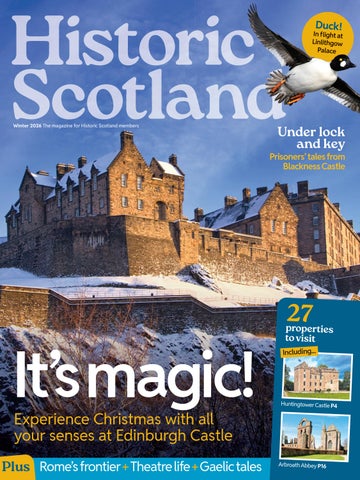
Cover Historic Scotland WInter 2026
VERSION
Duck!
In flight at Linlithgow Palace
REPRO OP SUBS
Winter 2026 The magazine for Historic Scotland members
Under lock and key
ART
Prisoners’ tales from Blackness Castle
PRODUCTION CLIENT
historicenvironment.scot/member HISTORICENVIRONMENT.SCOT/MEMBER
It’s magic! Experience Christmas with all your senses at Edinburgh Castle
Plus Rome’s frontier + Theatre life + Gaelic tales 00 HS cover Final F.indd 1
BLACK YELLOW MAGENTA CYAN
2 7 properties
to visit
Including...
Huntingtower Castle P4
Arbroath Abbey P16
23/10/2026 17:38
91SCOOCT26904.pgs 23.10.2026 17:53
Welcome VERSION
HISTORIC SCOTLAND ALBA AOSMHOR
IQ
REPRO OP
HISTORIC ENVIRONMENT SCOTLAND Longmore House, Salisbury Place, Edinburgh EH9 1SH 0131 668 8600 hes.scot Membership enquiries 0131 668 8999 members@hes.scot Editorial enquiries members@hes.scot
SUBS
Head of Membership & CRM Claire Bowie Membership Marketing Manager Julia Haase-Wilson Editor Indira Mann indira.mann@ thinkpublishing.co.uk
ART
Assistant Editor Jonathan McIntosh Design Matthew Ball Managing Editor Andrew Littlefield
PRODUCTION
Advertising Sales Melissa Mackay melissa.mackay@ thinkpublishing.co.uk 020 3771 7195 Head of Consumer Client Division, Think John Innes john.innes@thinkpublishing.co.uk Think 65 Riding House Street London, W1W 7EH 020 3771 7200
CLIENT
Photography All images provided by Historic Environment Scotland unless otherwise stated. For access to images of Scotland and our properties, call 0131 668 8647/8785 or email images@hes.scot Historic Scotland is published quarterly and printed on Galerie Brite Bulk, which is from well-managed FSC®-certified forests and from other controlled sources. The views expressed in the magazine do not necessarily reflect those of Historic Environment Scotland. All information is correct at the time of going to press. © Historic Environment Scotland. All rights reserved. Reproduction in part or in whole is prohibited without prior agreement of the Membership and CRM Manager of Historic Environment Scotland. Historic Environment Scotland (HES) is a Non Departmental Public Body established by the Historic Environment Scotland Act 2014. HES has assumed the property, rights, liabilities and obligations of Historic Scotland and RCAHMS. Visit hes.scot/about-us Scottish Charity No. SC045925.
Welcome to
Historic Scotland
We hope you’ve had a wonderful year enjoying Scotland’s historic places and creating lasting memories. But the fun doesn’t stop as winter descends. This issue, we’ve plenty of inspiration for winter adventures – including a round-up of seasonal highlights for members and the second part of our series inspired by our collectable History Hunt cards. We also have plenty for you to enjoy on days when you’d rather stay indoors, from Gaelic storytelling to exploring our archives online. We’d love for you to take part in our 2026 Magazine Survey, telling us about the things you like and don’t like in Historic Scotland and ways we can make your members’ magazine even better. Scan the QR code here or head to hes.scot/membersurvey to take part. You could win a £100 John Lewis voucher. The survey closes on 30 November.
Claire Bowie Head of Membership & CRM
Christmas and a’ that Revel in the magic of winter with us. Whether you’re getting into the festive spirit at Edinburgh Castle and Trinity House, celebrating the life and works of Robert Burns at Stirling Castle or enjoying invigorating walks and wildlife spotting with our Ranger Service, we’ll keep you busy this season. We also have a packed calendar of exhibitions, talks and tours. Turn to page 52 to find out more.
Contributors
Matt Havercroft is a journalist and editor specialising in history, travel and the natural world. Page 18
Carine Freeman Rommes is a Steward at Blackness Castle and researches its history in her spare time. Page 30
Hannah Brown is an Interpretation Officer for HES, helping to bring our sites to life for visitors. Page 36
- , CARBON BALANCED PAPER www.carbonbalancedpaper.com CBP016930
IJ FSC
responsible forestry
Indigo Dunphy-Smith is a heritage practitioner and writer specialising in Scotland’s LGBTQ+ history.
wwwraco,g
FSC® C017177
Page 42
MIX Paper I Supporting
historicenvironment.scot 1
BLACK YELLOW MAGENTA CYAN
91SCOOCT26100.pgs 23.10.2026 17:09
VERSION
Inside this issue November 2026 – March 2027
REPRO OP
30
SUBS
Experience the darker side of Blackness Castle
ART PRODUCTION CLIENT
26
Applaud Stanley Baxter and other Scottish perfomers
2 Historic Scotland
BLACK YELLOW MAGENTA CYAN
18
Take a Northern Wander around Duff House
Contents
Regulars 1 Welcome 4 Big picture Treachery at Huntingtower Castle 6 The script Make the most of your membership this winter 16 Spotlight On Arbroath Abbey 48 Shop A seasonal selection of Christmas gifts and treats for everyone 52 Events Great family days out and more 56 Time trip Scotland’s hydroelectric history
12
A look ahead
Tune in to some Gaelic folklore
Two spring events to enjoy in 2027
Women of Maritime Leith
09
Features 18 Northern wanderer On the trail of new and rare History Hunt cards 26 At the theatre Keeping the magic alive on stage 30 The prisoners of Blackness Incarceration on the Firth of Forth 36 The final frontier Meet a bowman from Bar Hill Fort 42 Life through a lens A remarkable queer partnership preserved for posterity
Share a dream day with Still Game’s Jane McGarry
Trinity House ● 8 March 2027, 7pm-8.15pm. Celebrate International Women’s Day on this twilight tour of Trinity House. Suitable for ages 16 and over, you’ll hear powerful stories of wartime heroes, suffragettes and workers who shaped Leith’s history. Booking is essential. Online booking is now available at hes.scot/ womens-history
Your next historic adventure starts here
Maeshowe Chambered Cairn P21
Art Deco Days Duff House P24
Get the Abroath Abbey habit
Arbroath Abbey P16
Accessible version
Your Historic Scotland magazine is also available as an accessible PDF. You can find it at hes.scot/members-magazine or get in touch with our Membership Team to request a copy.
Stirling Castle P9 Blackness Castle P30
John Sinclair House ● 22 March 2027, 2pm-3.30pm. Using items from our Archives, Jackie Sangster, Learning Manager, will take you on a journey exploring Art Deco’s impact on art and architecture in the Scotland of the 1930s. Find out more at hes.scot/art-deco
historicenvironment.scot 3
91SCOOCT26101.pgs 26.10.2026 12:54
Big picture VERSION REPRO OP
Plan your trip to Huntingtower Castle at hes.scot/ huntingtower-castle
Huntingtower Castle SUBS ART PRODUCTION CLIENT
4 Historic Scotland
BLACK YELLOW MAGENTA CYAN
SHUTTERSTOCK
D
A Perthshire country mansion with a treacherous past
ark deeds lurk in the history of this imposing castle, built in the 15th century for the Ruthven family. The Ruthvens’ role in plotting against James VI – including kidnapping the young king – ultimately led to their downfall, and the castle passed to the Murrays.
The Place of Ruthven was renamed Huntingtower and major alterations, including linking the two original towers, created a country mansion befitting the future dukes of Atholl. The gap that once existed between Huntingtower’s towers earned the name ‘Maiden’s Leap’ after a romantic legend
featuring Dorothea Ruthven. Not to be denied her tryst with John Wemyss, she is said to have leapt the 9ft gap, later eloping with her lover. Today, the castle and its surroundings are a peaceful haven for wildlife, including 200 pipistrelle bats that hibernate here over winter.
historicenvironment.scot 5
91SCOOCT26102.pgs 26.10.2026 12:54
Big Picture - HTower Castle
Huntingtower Castle
VERSION
The script
REPRO OP SUBS PRODUCTION
Spotlighting winter’s unmissable events, activities and updates
CLIENT
Members’ Exclusive Event
2
1
Experience Christmas magic at Edinburgh Castle
There’s an array of seasonal activities to enjoy at Edinburgh Castle this Christmas. Santa Claus has swapped his North Pole Workshop for the castle’s Grand Hall, where he’ll be walking around to say “ho, ho, ho”. Our festive afternoon teas are an experience not to be missed. And on the Esplanade there will
6 Historic Scotland
BLACK YELLOW MAGENTA CYAN
be other wintertime treats, including some tasty street food. Look for the Christmas carriage in Crown Square, admire the festive decorations adorning Governor’s Square and go on a Christmas tree hunt throughout the castle. Plan your day out at edinburghcastle.scot/festive
Explore Blackness Castle’s prison past
Join the Behind Bars at Blackness Castle tour to discover a darker side to this 15th-century fortress on the shore of the Firth of Forth. From wealthy inmates’ lodgings to those confined to the grim pit prison, learn
Details on page 54
about the lives and crimes of the castle’s prisoners and hear impressive stories of daring escapes. Tours run on Sat 16 January 2027 at 10am, 11.30am and 1.30pm. hes.scot/member-events
SHUTTERSTOCK
ART
Make the most of your membership
Membership, 1
4
Discover more about Roman Scotland
3
Kickstart a new year of history hunting
Begin 2027 on a good footing by collecting a new and rare History Hunt card. Our First Footing card takes inspiration from Hogmanay traditions and features illustrations by Scotlandbased artist, Kasia Kozakiewicz. It’s available at selected sites in January. Find out more at hes.scot/history-hunt
Roman Scotland: Life on the Edge of Empire, an exhibition at the National Museum of Scotland, showcases new research and previously unseen archaeological discoveries. Running from 14 November to 18 April 2027, exhibits reveal how the Roman Empire’s invasion shaped communities across Scotland, from the Antonine Wall to the north-east. “This exhibition examines how everyday people were affected by Roman invasion,” says curator, Fraser Hunter. “Don’t miss two spectacular altars
dedicated to the gods Mithras and Sol unearthed at Inveresk Roman Fort. On display for the first time, they provide fascinating insight into the era’s religious customs.”
Historic Scotland members get 20% off tickets. Use code HES20 to book at nms.ac.uk/RomanScotland. Offer available 14 November to 31 December. T&Cs apply.
T&Cs: Visit Roman Scotland: Life on the Edge of Empire between 14/11/26 and 31/12/26 and get 20% off tickets. Use code ‘HES20’ when booking tickets at nms.ac.uk/RomanScotland. Tickets must be pre-booked. Offer valid for the maximum number of people included in your membership and up to a maximum of 6 tickets per basket. Membership card must be shown on arrival. Online bookings only. One code per transaction. Offer not valid on Universal Credit tickets. Offer cannot be used in conjunction with any other promotion, discount or offer, including the 15% family discount. Opening dates and times subject to change.
All in one place Our Members’ Portal is launching soon. For now, find your member benefits and digital copies of your Members’ Guide and magazine at hes.scot/ ~:=:::'.!:?::·;:(~ member. If you haven’t heard from us about this, email members@hes. scot to add your email address to your record.
NATIONAL MUSEUMS SCOTLAND
~i{i!i:;l!l:~
5
Join an Archives talk about William Adam and Scottish country estate architecture
Don’t miss this free talk by Library and Search Room Manager, Frederick Alexander-Reid, on the history of Vitruvius Scoticus. This fascinating text features 17th and 18th-century Scottish country estates and plans by the renowned architect William Adam.
You’ll have the chance to view a first edition copy as well as original material from our Archives. The talk is at 2pm-3.30pm at John Sinclair House on 25 January 2027. Booking is essential. hes.scot/vitruvius-scoticus
We want to hear from you Take part in our 2026 Members survey and you could win a £100 John Lewis voucher. The survey closes on Monday 30 November 2026. hes.scot/membersurvey for details.
historicenvironment.scot 7
91SCOOCT26129.pgs 26.10.2026 12:54
0JLL£~
CHUK
I
..L
n
VERSION
.. Discover Walter Scott
REPRO OP
Triple take
Three ways to learn about a literary legend
Read our blogs
•
Whytock and Reid's proposed designs for furnishings and furniture in Cullen Auld Kirk
Listen to the Historic Scotland Podcast
ART
Hear how Smailholm Tower’s landscape and ballads of the Borders fired Scott’s imagination in episode 5 of Season 2. ▶ hes.scot/memberspodcast
Whytock and Reid furniture designs The Archives Team shares a collection in the best possible taste PRODUCTION CLIENT
Formed in 1876, Edinburgh company Whytock and Reid specialised in designing and making furniture. They received the Royal Warrant from Queen Victoria in 1838 and went on to create pieces for the Palace of Holyroodhouse and the Royal Yacht Britannia. Archive gem
The firm worked with Scottish architect Sir Robert Lorimer to produce Arts and Crafts-style furniture for country houses. It also designed for banks, churches and private clients before closing in 2004. Our archives feature an extensive collection of the practice’s drawings,
documents and photographs, providing insight into the changing fashions of the 19thand 20th-century wealthy classes.
Visit Smailholm Tower Walk in the footsteps of the iconic literary figure on a trip to this 15th-century stronghold. ▶ hes.scot/ smailholm-tower
See these and other gems at our Search Room and Library. Make a date at hes.scot/visit-archives
Caesar Stirling Head How the classical world helped shape a Renaissance king The political and military successes of the Romans’ most celebrated leaders proved powerful models of ambition, authority and achievement for James V. In the 1530s, James commissioned a series of carved oak portraits depicting royalty, nobles and famous figures from the classical world to adorn his inner chamber’s ceiling. Today, these portraits are known as the Stirling Heads. Six of the 38 surviving heads Epic object
You can see this carving on display at Stirling Castle
8 Historic Scotland
BLACK YELLOW MAGENTA CYAN
are of Roman political figures, including this portrait of Julius Caesar. The Stirling Heads were James’s attempt to rank himself among the rulers he revered, while demonstrating his knowledge of the classical world – a quality regarded as essential to wise and virtuous rulers. Learn how artist Jane Ferrier ensured the survival of the Stirling Heads at hes.scot/epic-objects
RECORDS OF WHYTOCK AND REID, EDINBURGH
SUBS
Uncover different chapters of Scott’s life through posts penned by our experts. ▶ hes.scot/walter-scott
Jane McCarry
The actor, presenter and STV Radio host shares how Stirling Castle inspired her love of storytelling
M
y Aunt Agnes was obsessed with Robert Burns and Scottish history, and she took us on loads of day trips around the country in her red Lada car when I was growing up in the 1970s and 1980s. Stirling Castle was Agnes’s favourite because of its connections to famous Scottish figures like William Wallace, Bonnie Prince Charlie, Mary Queen of Scots and Robert I (the Bruce). Fittingly for someone born on Halloween, she particularly loved telling us about Stirling Castle’s grisly past.
Stirling Castle has some incredible stories, from Mote Hill’s Beheading Stone to a spot in the Douglas Gardens where, according to tradition, the body of William, 8th Earl of Douglas was thrown. James II’s enemy had been stabbed 26 times. The ‘Tragedy of the Green Lady’ was Aunt Agnes’s favourite. A superstitious maid was convinced a fire threatened Mary Queen of Scots’ life on 13 September 1561. She vowed to guard her all night but accidentally set the queen’s bed curtains alight. Mary survived but sadly the maid didn’t. Her ghost supposedly still haunts the castle’s halls.
Voices of the past Aunt Agnes always put on voices for the characters she told us about, which brought Stirling Castle’s history alive. And given my family’s connection to the stronghold, her storytelling ability is something I’ve always held close. My grandpa – my mum and Aunt Agnes’s dad – served in the Argyll and Sutherland Highlanders, as did his brothers and father. We visited the Argyll Sutherland Highlanders Museum at Stirling Castle shortly after it opened. Agnes was so proud, telling us how the infantry
My dream day Stirling Castle
became immortalised as the Thin Red Line after facing the Russian cavalry at the Battle of Balaclava in October 1854. In fact, she started singing God Save the Queen after spotting a portrait of Queen Elizabeth. Nobody else joined in. My mum and I were mortified, and teenage me swore I would never go out with Agnes again. But I’m so glad to have had those days with my aunt because they’ll stay with me forever. When I had my boys, I told them Aunt Agnes’s stories whenever we visited Stirling Castle – although I could never do them in the unique way she did! I have all my own teeth for a start… But whether it’s performing in pantomime or as Still Game’s Isa, Aunt Agnes inspired my own love of storytelling. This includes the Burns Suppers I’ve hosted at Stirling Castle’s Great Hall. Whenever I’m speaking at these events, I feel my Aunt Agnes – my family’s own bard – by my side. And it’s comforting knowing Historic Environment Scotland is keeping Stirling Castle’s treasure trove of stories alive. See Jane in Greenock’s Beacon Arts Centre’s pantomime, Cinderella, from 5 to 31 December. To book visit beaconartscentre.co.uk/event/ cinderella
Book tickets to Stirling Castle’s Burns an’ a’ that celebration on Sunday 24 January 2027.
JAMIE SIMPSON, STV RADIO
See page 52
Whether it’s performing in pantomime or as Still Game’s Isa, Aunt Agnes inspired my love of storytelling
Jane’s must-do
I love going on a guided tour whenever I visit Stirling Castle. The guides are always funny, bring the property to life and take you behind the scenes to reveal historical facts that you maybe wouldn’t otherwise discover.
historicenvironment.scot 9
91SCOOCT26130.pgs 23.10.2026 17:16
Script, 1
The script
Gardening
The script VERSION
The garden gate with Gardener Stella Jardine
SUBS ART
Discover how a coastal planting scheme is helping to reinvigorate Inchcolm Abbey’s historic garden
PRODUCTION
S
CLIENT
urrounded by dramatic coastal scenery, seals and seabirds, Inchcolm Abbey provides a unique setting for horticultural conservation. Within its garden, the Aberdour Castle gardening team has recently completed an exciting border redesign. We began by clearing overgrown shrubs from the rock borders and removing self-seeded trees from a neighbouring border.
Border design
When designing any border, it’s important to choose the right plants for the right place. We consider soil type, aspect, moisture levels, exposure and long-term maintenance. This can minimise plant losses and improve the conditions for plants to become established. We developed the planting plan last winter, selecting plants that would thrive in Inchcolm’s dry, sandy soil and salt-laden air. My aim was to create a naturalistic coastal planting scheme using a matrix-style approach. The base matrix layer offers structure and repetition, with examples of ground cover perennials including sea campion (Silene uniflora), myrtle spurge (Euphorbia myrsinites) and Mexican fleabane (Erigeron karvinskianus), and ornamental grasses such as white angel’s fishing rod (Dierama pulcherrimum var. album) and blue oat grass (Helictotrichon sempervirens). Drifts of cupid’s dart (Catananche caerulea), angel wings (Senecio candicans), false dittany (Pseudodictamnus mediterraneus),
On the boat to Inchcolm Island with plants for the redesigned border (right)
When designing any border, it’s important to choose the right plants for the right place white gaura (Oenothera lindheimeri) and African lily (Agapanthus) inject seasonal colour, texture and pollinator value. Sea holly (Eryngium eburneum) and red-hot poker (Kniphofia caulescens) create architectural focal points. Existing garden features have been kept, such as a mature climbing rose with new wall supports added to preserve horticultural history. We’ve introduced New Zealand holly (Olearia macrodonta) and California lily (Ceanothus ‘Edinburgh’) to provide nectar-rich flowers for bees, hoverflies and butterflies.
Island challenges
We did the planting this April, transporting all the plants, mulch and tools using the small staff boat. Another challenge was handwatering the new planting from the island’s only freshwater source. Routine maintenance was paused while gulls nested, but weeding and mulching in July let the plants Don’t miss breathe and the hermit’s cell in the improved soil walled garden, where King moisture. Alexander I is said to have sheltered in 1123. His stay inspired him to establish the Augustinian monastery that survives today.
Wintertime tasks
Follow these tips from the team to winterproof your garden
Mulch
Mulch your borders to enrich the soil, improve moisture retention and suppress weeds.
Prune climbers
Cut back climbing rose laterals to two-tofour buds, remove damaged wood and tie in healthy stems.
Support insects
Leave grasses and architectural plants standing in order to provide shelter for beneficial insects.
STELLA JARDINE
REPRO OP
Creating an island garden
10 Historic Scotland
BLACK YELLOW MAGENTA CYAN
91SCOOCT26131.pgs 23.10.2026 17:21
HALLMARK ROOFING
ROOFING
& LEAD
LTD
SPECIALISTS
Hallmark Roofing Edinburgh Ltd specialises in the repair, renewal and conservation of traditional slate and lead roofs on historic and listed buildings across Scotland.
Our work respects original building fabric and follows best-practice conservation guidance to ensure longevity, authenticity and architectural integrity. We work closely with homeowners, estate managers, architects and conservation bodies to deliver workmanship of the highest standard.
OUR SERVICES 9 Conservation-grade lead roofing 9 Traditional slate roofing 9 Listed building roof repairs 9 Lead welding & detailing 9 Roof surveys & reporting 9 Sympathetic renewal & restoration
OUR CLIENTS
*
~
Private Heritage Owners
..
Conservation Professionals
.a.
Estate Managers
Architects
ACCREDITATIONS 71NFRC
LEADING ROOFING EXCELLENCE
TRUSTMARK GovernmentE nd0 r•ed Quality
.;
HiiHUIE
Edinburgh Trusted Trader
The script VERSION
Winter warmers
Fancy your own bò? Create some magic with your own Highland cow from our new gift range. Turn to page 50.
Blackhouse book shortlisted
REPRO OP
Our guidebook for Arnol Blackhouse/ Taigh-dubh Àrnoil, was shortlisted for the Gaelic Literature Awards 2026’s Donald Meek Award for Best Nonfiction Book. Written in Gaelic and English, the book explores the story of Arnol and its community and culture. Buy a copy at stor.scot
Snuggle in a favourite armchair and tune into four tales from Gaelic folklore with Magaidh Smith Our latest Gaelic video series, Sgeulachdan an Tac an Teine (Tales by the Fireside), sees storyteller Magaidh Smith narrate four traditional tales rooted in the Isle of Lewis. Tune in to meet several distinctive characters, including members of feuding clans, a fairy cow, a bodach (old man) with changing fortunes and the Ciuthach (a broch- or cave-dwelling giant) along the way. The story of the Bò Bhreac Chalanais (The White Cow of Calanais) is perfect listening Gaelic folklore
SUBS ART PRODUCTION
for this time of year. Set during winter’s depths, this tale tells how a bò-mhara (sea-cow or fairy cow) rescues a village, and is a lovely reminder to be
grateful for what we have in life. Told in Gaelic with English subtitles, this series provides an ideal opportunity to explore Gaelic culture while coorying in by the
fireside with a wintertime strùpag (cuppa)!
“They’re a form of fortified residence popular between the mid-14th and 17th centuries,” says Senior Cultural Resources Advisor, Stefan North-Sagrott. “Rectilinear in plan, often with one or more additional wings, they were built as inherently tall structures that provided everything you would have needed over several storeys. Orchardton Tower, which is round in plan, is an interesting exception.
“Historic Scotland has almost 50 tower houses in various forms across Scotland.” This considerate donation will help us conserve and protect our tower houses as we grow our understanding of Scotland’s history.
Enjoy these enchanting traditional stories at hes.scot/gaelic-tales
CLIENT
Tower houses How a legacy donation inspired us to reassess our understanding of these impressive structures
Tower houses under our care include Threave Castle (pictured), Lochleven Castle, Smailholm Tower and Orchardton Tower
12 Historic Scotland
BLACK YELLOW MAGENTA CYAN
Historic Scotland remembers Alisoun Cecilia Grant, who left us a thoughtful gift in her Will. She instructed that it be used in the “upkeep of the fabric and immediate surroundings of tower houses in Scotland”. Alisoun’s request sparked animated discussion across our teams – with the most debated question being: “What exactly is a tower house?”
To find out about leaving us a gift in your Will, email legacies@hes.scot
SHUTTERSTOCK/ILLUSTRATION BY BRIAN LEE
A beginner’s guide to
Script
A day in the life of a Stone Conservator Elina Rodriguez Millan explains how she is conserving our sites and collections for the future
What does a Stone Conservator do? For the past five years I’ve been part of our Stone Conservation team, where I help conserve historic decorative and sculptured stonework across our 336 properties. Tasks include filling cracks with repair mortar to prevent water penetrating, freezing and further damaging stone; cleaning graffiti; and reinstating stone fragments with structural support to keep their original context while ensuring visitors’ safety. What’s an average day? I travel across Scotland documenting the condition of stone at our sites to see if
Teller of tales Matt Steege on how he brings drama to days out at Craigmillar Castle
I moved to Scotland from Racine, Wisconsin, in 2020 for a Master’s degree in Medieval Studies at the University of St Andrews. I became a Visitor Connector volunteer at Craigmillar Castle this May. I lead tours around the castle, answer visitors’ questions and ensure people are enjoying their trips. From tales of witchcraft and warfare to details on its decline and
ii
What’s your favourite part of your job? I’m originally from Spain, so this role has helped me discover more about Scotland’s built heritage. From relocating the Kilmartin Crosses to treating some of Elgin Cathedral’s medieval stone collection, it’s a privilege working closely with fascinating objects while learning how conservators have protected them. Find out more about the work of our skilled Collections and Applied Conservation teams at hes.scot/stone-conservator
Above and right: Stone Conservator Elina Rodriguez Millan at work
Volunteer voices
treatment is needed. I also carry out conservation work to safeguard them long-term. When not in the field, I do research and conservation work on collection objects at our Edinburgh-based conservation studio. We keep detailed accounts of the conservation methods we use to inform best practice.
recovery, I love sharing Craigmillar Castle’s stories. As a long-time actor, bringing these tales to life using my performance skills and academic background is amazing, because seeing Craigmillar Castle through visitors’ eyes feels like experiencing it for the first time. By sharing my knowledge, I help keep the castle’s story alive while providing people with unforgettable experiences.
Visitor Connector volunteer Matt Steege
Discover volunteering opportunities at hes.scot/volunteer
historicenvironment.scot 13
91SCOOCT26132.pgs 26.10.2026 12:33
All Sight Is Light
Don't Let Poor Light Steal Your Focus
Every moment of sight begins with light. It shapes every
Poor light quietly works againstyou. It makes
colour, every face and every detail you experience. When
your eyes work harder, drains concentration and
the quality of light improves, so does the way you see, feel
turns simple tasks into tiring ones. Before you
and engage with the world around you.
blame your eyes, make sure your lighting isn't the real problem.
See EveryDetail Better light revealswhat you've been missing.Colours appear richer, contrast becomes clearer and everyday tasks demand less effort. Your eyes stay comfortable for longer, leaving you free to focus on living instead of straining to see.
*Trustpilot
feefoe~
l'll'll'll'll'l
****"
''
Superb,takes away eyestrain. I feel I have new eyes.Thankyou. Mrs Halbery I Harrow
■ 0800°085"'1088 l!I • seriousreaders.com/A421
Prices correct at time of print.
NAture Column
The script VERSION
The wild side
With Ranger Gordon Smith REPRO OP SUBS
Golden wonder
Keep an eye out for these striking seasonal birds
O
ART
ne of the most enjoyable aspects of my role is observing how our sites change with the seasons. As autumn becomes winter, more water flows into Linlithgow Loch, A licence to thrill replenishing the site after a dry summer. at sites in Scotland As with many wetland habitats, Linlithgow Loch peaks during these refers to their distinctive domed head colder months and becomes the perfect shape. Both sexes boast a bold yellow winter home for many waterfowl. or golden eye but otherwise look very A personal favourite and a seasonal different. Males are primarily white with highlight is the goldeneye duck’s arrival. green heads while females are greyish More than 20,000 of these striking with chocolate brown heads. ducks migrate to our shores during winter to escape harsher conditions. The spy who loved them Linlithgow Loch welcomes several Male birds have a spectacular courtship goldeneyes each year, joining the display, which can often be seen during site’s resident swans, ducks, geese winter. One particularly remarkable and other birds. behaviour is the ‘head throw’, Goldeneye ducks can be which sees the male fully found throughout Scotland Fast fact Goldeneyes’ extend his neck backwards during winter, including wings produce a to face the sky before at several of our sites. characteristic rapidly snapping the Lochleven Castle’s whistling sound head forwards. impressive surrounding when they’re Upon hearing the word waters make it a great site for in flight. goldeneye, I suspect many seeing them, with over 500 people probably think of the visiting each winter. Smaller bodies 1995 Pierce Brosnan film rather than a of water, such as Castle Semple migratory duck. Yet there’s a strong Collegiate Church’s neighbouring lochs, connection between the avian world host these birds in fewer numbers. and James Bond. Goldeneyes feed on aquatic Ian Fleming wrote his famous spy invertebrates, crustaceans and even novels at his Jamaican home named small fish. Their diving prowess can Goldeneye. A keen bird watcher, make spotting them in the water a Fleming owned a guidebook authored challenge, but when you do catch by an American ornithologist called sight of them they’re unmistakable. James Bond – the perfect name for The species’ scientific name, Fleming’s secret agent, 007. Bucephala – meaning bull-headed –
PRODUCTION SHUTTERSTOCK
CLIENT
Upon hearing the word goldeneye, I suspect many people probably think of the 1995 Pierce Brosnan film rather than a migratory duck
Winter wildlife
Doune Castle
The nearby River Teith and Ardoch Burn are ideal spots to see otters busying about their days.
Dumbarton Castle
The estuary mudflats surrounding the castle are rich feeding grounds for waders such as the redshank.
Caerlaverock Castle
An impressive sight, thousands of barnacle geese spend winter feeding and roosting along the nearby Solway Coast.
historicenvironment.scot 15
BLACK YELLOW MAGENTA CYAN
91SCOOCT26133.pgs 23.10.2026 17:24
Spotlight VERSION
A wealthy and powerful religious centre in medieval Scotland
1
Choir and presbytery
REPRO OP
Separated by a screen, the eastern part of the church held the high altar and was reserved for the abbot, his monks and high-status visitors.
SUBS
1
Arbroath Abbey
3 2
PRODUCTION
“I
CLIENT
t is in truth not for glory, nor riches, nor honours that we are fighting, but for freedom”. These lines feature in the Declaration of Arbroath, a letter sent from Arbroath Abbey in 1320 urging the Pope to recognise Robert I (the Bruce) as Scotland’s king. At the time, the nation was locked in the Wars of Independence with England. The abbey was once one of medieval Scotland’s wealthiest and most powerful religious centres. Its founder, King William I, dedicated it to the martyred archbishop St Thomas Becket and invited Tironensian monks from Kelso Abbey to live and worship here. Built from local red sandstone, the abbey was designed to be seen for
miles around. Its soaring western gable, flanked by tall towers, give a sense of how imposing it once was. The large circular window was once glazed with decorative stained glass, and there are traces of the carved masonry that decorated the buildings. In 1350, English raiders left the abbey ‘in ruins and repairable with difficulty’. When it was hit by lightning in 1379, a fire caused damage that took 16 years to repair. After the 1560 Reformation, some of the monks became Protestant ministers but the abbey’s heyday was over. In recent years, our High Level Masonry Inspectors have surveyed the abbey’s stonework, prior to conservation by the local masonry team.
2
Tomb of William I
The founder of Arbroath Abbey was afforded a most prestigious burial spot, in front of the high altar. A modern slab now marks the spot.
3
South transept
One half of the ‘crossbar’ of the cross-shaped church, this transept once contained side chapels. A hidden staircase still leads to the abbey’s upper levels.
Timeline 1178
William I founds Arbroath Abbey, dedicating it to the murdered archbishop St Thomas Becket. He invites monks from Kelso Abbey to form a community and worship here.
The nave in medieval times
16 Historic Scotland
BLACK YELLOW MAGENTA CYAN
1320
Abbot Bernard oversees completion of the Declaration of Arbroath (above), a letter to Pope John XXII urging him to recognise Scotland as an independent nation and Robert Bruce as king.
C.1440
Margaret Stewart, Countess of Angus endows an altar to St Catherine in the south transept. She had granted lands to the monastery for the celebration of Mass every day for her family.
1524
David Beaton becomes the second of three members of the Beaton family to serve as Abbot of Arbroath. He later becomes cardinal, then Archbishop of St Andrews. In 1546, he is assassinated by Protestants.
SHUTTERSTOCK
ART
This iconic ruin in Angus is famous as the birthplace of the Declaration of Arbroath
Spotlight
4
Abbot’s House
Arbroath Abbey
This was the abbot’s secluded space, more comfortable than the monks’ dormitory, where he could entertain high-status guests as part of his more political role.
History unfolds in the visitor centre
4
7 5
5
6
The west front
7
and nave
The western entrance was used for special occasions, with regular access from a door on the north side of the nave. The towers on each side once soared even higher, and the ‘Round O’ window held stained glass.
1560
The Scottish Parliament adopts Protestantism and Scotland’s abbeys are disbanded. There are 22 monks remaining at the Abbey, and some became ministers in the new Protestant church.
6
Gatehouse range This was the main route into the abbey precinct for centuries. It was marked by an impressive gateway with a large room above.
1628
A contemporary account describes the dreadful state of the abbey, with “… the defaced & staggering steeples, the battered wals, broken doune pillars & the floore al ouergrowne with grasse …”
1809
Lighthouse engineer Robert Stevenson (below) visits Arbroath during work on his Bell Rock lighthouse. He is invited to restore the abbey’s ‘Round O’ window, and repairs begin.
The abbey was quarried for stone and timber during the 1580s
Guesthouse
This building may have provided a single suite for a high-status guest or accommodation for the abbey’s visitors, including pilgrims and relatives of the monks.
1951
Arbroath Abbey’s connection with the 1320 Declaration makes it a symbol of Scottish nationhood. After the Stone of Destiny is removed from Westminster Abbey, it is left at the abbey.
historicenvironment.scot 17
91SCOOCT26134.pgs 23.10.2026 17:29
Northern Wanderer Explorer VERSION REPRO OP SUBS
Our friends in the north
In the second part of our series inspired by our History Hunt cards, we explore burial sites, atmospheric ruins and awe-inspiring fortresses Words: Matt Havercroft ART PRODUCTION
Blackhouse, Arnol
CLIENT
Stornoway
EN
\SEWOM
18 Historic Scotland
BLACK YELLOW MAGENTA CYAN
Northern Wanderer, 1
Skara Brae Maeshowe Chambered Cairn
Kirkwall
The preserved prehistoric Social Settlement at Skara Brae
Thurso
A
John oí Groats
Elgin Cathedral Cromarty
Inverness
Fort George
KATIE LOGAN
Wick
re you ready to embark on a time-travelling adventure across the Highlands and Islands? Our Northern Wanderer card will take you from the Isle of Lewis and Orkney to the Moray Firth and Aberdeenshire, visiting a selection of seven spectacular sites that chronicle Scottish history. From the Neolithic village of Skara Brae and the medieval ruins of Elgin Cathedral to the grand Georgian façade and gardens of Duff House, you’ll discover how local people lived, worked and worshipped across the ages. The Northern Wanderer sites are part of the History Hunt collection, with limitededition cards available for Historic Scotland members to collect. All our sites are split into seven themes, with different cards available to pick up at each. The seven categories are: Formidable Fortress, Sacred Site, Halls of History, Tall Tower, Icons of Industry, Social Settlement and Spellbound Stones. Your challenge – should you choose to accept it – is to collect all seven cards to be crowned the ultimate History Hunter and earn a badge. Each year, we also release a limited number of rare cards, including a dedicated ‘Northern Wanderer’ card, which is available to collect at any of the sites included in this feature. The question is: which one will you visit first this winter?
Duff House Huntly Castle
Peterhead
historicenvironment.scot 19
91SCOOCT26103.pgs 26.10.2026 12:39
Northern Wanderer VERSION
Blackhouse, no. 42 Arnol, Brager, Isle of Lewis
REPRO OP SUBS ART
Blackhouse, Arnol
CLIENT
Stepping into the gloom of no. 42 Arnol Blackhouse, you might be forgiven for thinking its former owners have just stepped outside, with a kettle hanging from the rafters over a smouldering peat fire and a small table set for lunch. First built in 1875 by local crofters, David and Christine Macleod, this blackhouse was latterly home to two sisters from the same family who lived here until the 1960s. This single-storey dwelling, with its thick, dry-stone walls, flagstone floors and a thatched roof, was typical of those found across the Western Isles. Similar in appearance to Viking longhouses, these homes provided shelter for both people and their animals, with a porch leading to the living quarters in one half and a byre with stalls for the family’s cattle in the other. At the heart of no. 42 Arnol is the living area, where an open peat fire continues to burn day and night, the smoke
20 Historic Scotland
BLACK YELLOW MAGENTA CYAN
slowly rising and filtering through the thatched roof above, leaving the rafters coated with thick soot. “Once you’ve seen a blackhouse, you’ll start spotting ruins of others across Lewis,” says steward Mary Greer. “They’re special because they give you a glimpse into what it was like being a crofter back then. The fact that they lived with their animals and had an open fire with no chimney are the things most visitors notice.” Today, no. 42 Arnol looks just as it did while occupied, with much of the interior furniture original to when the house was lived in. The living room has a low bench along one wall and a sideboard lined with crockery on the other. Other household objects, including milk churns and a spinning wheel, are evidence of nearly 80 years of occupation by the same family. Just beyond the living room is a bedroom, with two curtained box beds. An adjoining barn to the rear is where the crofters stored corn, potatoes, tools and feed for the livestock, along with fleeces to be sold from the annual woolclipping. The peat stack just
The interior of the Social Settlement
outside ensured fuel was easy to access even in the worst weather. After the First World War, local people began building modern houses using grants from the British Government. The newer homes, with their lime-rendered walls, became known as ‘white houses’, with the term ‘blackhouse’ applied to the older houses. In 1960, a survey found nine inhabited blackhouses in Arnol, including no. 42, which was bought by the state to be preserved. In 1996, the bungalow near no. 42, along with the blackhouse and white house at no. 39, were also purchased. The bungalow is now a visitor centre, with the rest opened to share the story of these traditional island homes.
With its dry-stone walls, flagstone floors and thatched roof, the blackhouse is typical of those found across the Western Isles
DONALD MACLEOD
PRODUCTION
History Hunt cards: Social Settlement, Northern Wanderer and First Footing (available during January 2027). Practical points: Visitor centre, shop, accessible toilets, bicycle rack and car parking.
Northern Wanderer, 2
Skara Brae
A violent storm in 1850 uncovered Skara Brae buried beneath the sand
History Hunt cards: Social Settlement, Northern Wanderer and First Footing (available during January 2027). Practical points: Visitor centre, shop, accessible toilets, bicycle rack and car parking. The prehistoric village of Skara Brae, on Orkney Mainland’s windswept western coast, provides an evocative insight into the lives of a community of farmers, hunters and fishermen who set up home on the shores of the Bay of Skaill over 5,000 years ago. This Neolithic settlement, which is older than the Egyptian pyramids and Stonehenge, was first discovered in 1850, when a violent storm receded to reveal a cluster of stone structures buried
beneath the sand. Further excavation uncovered more details of the lives of their former owners, with stone beds, hearths, cupboards and drains all perfectly preserved. Begin your journey at the visitor centre, where displays and artefacts shine a light on life in the settlement. A reconstructed house offers a glimpse of what the original interiors would have looked like, before you follow a boardwalk out to explore the real thing.
A home for Orkney’s Northern Wanderers
Get your Spellbound Stones card at Maeshowe
The ancient tomb hidden below the grassy mound
Maeshowe Chambered Cairn
ROB MCDOUGALL
History Hunt cards: Spellbound Stones, Northern Wanderer and First Footing (available during January 2027). Practical points: Visitor centre, shop, picnic area, accessible toilets, bicycle rack and car parking. Guided tours only. Just a Neolithic stone’s throw from Skara Brae is Maeshowe, one of Europe’s finest chambered cairns. Built around 2800 BC, this ancient tomb, hidden below a grassy mound and encircled by a ditch, was aligned so that, during the Winter Solstice, the setting sun shines down its gently sloping passage, illuminating the
central chamber. It’s a breathtaking moment that continues to connect today’s visitors to the ancient rituals of its creators. Access to Maeshowe is by guided tour only, starting at the visitor centre in Stenness. A short ride on a shuttle bus takes you to the cairn. The tour brings the cairn to life, highlighting the architectural skill required to build its 10-metre-long passage and stone walls and the Viking graffiti carved
into them over 3,000 years later. These runic inscriptions are the largest collection to survive outside Scandinavia and a reminder that Orkney was under Norwegian rule until 1469. Visitors should book ahead, and can also find out about other Neolithic sites to visit in this unique landscape. These include the Stones of Stenness and Ring of Brodgar, which, like Skara Brae, are also part of the wider Heart of Neolithic Orkney UNESCO World Heritage Site. historicenvironment.scot 21
91SCOOCT26104.pgs 26.10.2026 12:39
Northern Wanderer
REPRO OP
History Hunt cards: Halls of History, Northern Wanderer and Wise Women. Practical points: Visitor centre, shop, picnic area, bicycle rack and car parking.
SUBS ART PRODUCTION
Huntly Castle began as a motte-andbailey, built in the 12th century to guard a strategically important crossing where the rivers Bogie and Deveron meet, before evolving into the seat of the mighty Gordon clan – one of medieval and Renaissance Scotland’s most powerful families. Over the centuries, the castle was significantly remodelled several times, with each residence built on a grander scale than the last. Work on the final palace started in the early 1600s but was abruptly halted by the civil wars in the mid-1600s and the execution of the 2nd Marquis. What survives today is a richly decorated ruin that reveals the Gordon family’s rise to
CLIENT
The Sacred Site of Elgin Cathedral
Explore Huntly Castle’s Halls of History
power and the turbulent events of this period of Scottish history. Visitors approach the castle ruins via a tree-lined avenue, which provides a first view of its ornate exterior. Within the castle, information panels help to reveal the layers of construction. Among the 1st Marquis and Marchioness’s embellishments, which are still visible today, are a grand heraldic frontispiece over the main door, doubleheight oriel windows and an
Elgin Cathedral History Hunt cards: Sacred Site, Northern Wanderer and First Footing (available during January 2027). Practical points: Visitor centre, shop and accessible toilets. Guided or audio tours available. Founded in 1224 and known as the ‘Lantern of the North’, Elgin Cathedral was once one of Scotland’s most magnificent medieval churches – its soaring architecture reflecting the wealth and influence of the bishops of Moray. Fire, conflict and the Reformation eventually brought its decline, resulting in the elegant ruin that exists today. Among the remaining sections are the cathedral’s ornate 13th-century west front – Elgin’s great processional entrance flanked by two tall towers – and the octagonal chapter house, with its vaulted
22 Historic Scotland
BLACK YELLOW MAGENTA CYAN
inscription on the roofline, proclaiming the Gordons’ ownership of the castle. Inside the palace, the two principal apartments – each consisting of a hall, outer or great chamber and inner or bed chamber – offer glimpses of aristocratic life. Downstairs, the basement and kitchens hint at working life for the household staff. Take a climb to the upper floors to enjoy views over Huntly and the rivers the castle was first built to defend.
ceiling. Built after a fire in 1270, this was where the clergy met to conduct their daily business. If you don’t manage to make it on one of the guided tours of the site, there are information panels dotted around the ruins that help to bring the cathedral’s stories to life. Inside the towers of the west front is a display of the finely carved stone unearthed during the conservation of the cathedral. Among these are carvings of enigmatic faces, flowing leaves and fearsome beasts, showcasing the skills and imagination of the masons employed to shape the cathedral’s interiors. It’s also possible to climb the towers, with a platform at the top of the north-west tower, offering expansive views over the town of Elgin and the wider Moray landscape. Before leaving, take the time to explore the graveyard, where you can find an ancient Pictish cross slab dating to the 800s, and Scotland’s tallest gravestone, created for the Anderson family and standing at 5m high.
GARY MURISON
VERSION
Huntly Castle
Northern Wanderer, 3
Fort George History Hunt cards: Formidable Fortress, Northern Wanderer and First Footing (available during January 2027). Practical points: Visitor centre, shop, café, accessible toilets, bicycle rack and car parking. Guided or audio tours available. The first thing you notice about Fort George is the sheer size and scale of this 18th-century military outpost, built on the banks of the Moray Firth east of Inverness. It was commissioned by George II’s government to control the Highlands following the Battle of Culloden in 1746. Designed by military engineer Lieutenant-General William Skinner in the trace italienne style, the fort was built by the illustrious Adam family of architects. Its main defence was a kilometre-long rampart, equipped with over 70 guns, with angled bastions and thick, low-lying ramparts. The fort’s geometric shape also allowed defenders to cover all possible angles of attack.
The fort cost over £200,000 to build; an enormous sum equivalent to many millions today that exceeded Scotland’s entire annual Gross National Product. It took a workforce of over 1,000 tradespeople and many soldiers 21 years to complete. But by 1769, the Jacobite threat had faded. The fort remained in service as a recruiting base and training ground for new Highland regiments used to expand and control the British Empire. Today, it serves as the home of a battalion of the Royal Regiment of Scotland. “Fort George’s history is linked to an iconic moment in time in Scotland,” says property manager John Gibbons. “But its story goes far beyond its walls, thanks to the regiments that were stationed here and their role in shaping politics right around the world.” During school holidays, costumed reenactors perform as soldiers and answer visitors’ questions about barracks life. For Paul Lang, a living history actor with Gael History, it’s
“Some of the most fantastic scenery in Scotland”
the continuation of a long family connection to the fort. “My father, my brother and my uncle all served here, and I spent a chunk of my childhood here as well,” Paul says. Today, the fort is best explored on one of the daily tours. The Highlanders’ Museum tells the story of Highland soldiers from 1792 to the present day. And the fort’s chapel hosts festive carol services over Christmas. “Take a walk around the ramparts, and you’ll see some of the most fantastic scenery in Scotland,” adds John. “This stretch of the Moray Firth is one of the best places in Scotland to spot dolphins.”
SHUTTERSTOCK
“My father, my brother and my uncle all served here, and I spent a chunk of my childhood here as well”
Fort George – a Formidable Fortress historicenvironment.scot 23
91SCOOCT26105.pgs 26.10.2026 12:41
Northern Wanderer, 4
Northern Wanderer VERSION
Duff House, Banff, Aberdeenshire
REPRO OP SUBS ART CLIENT
History Hunt cards: Halls of History, Northern Wanderer and First Footing (available during January 2027). Practical points: Shop, bicycle rack and car parking. Duff House in Banff is one of Scotland’s finest Georgian mansions – a grand Baroque residence designed by William Adam in the 1730s for William Duff, who was later Earl Fife. However, Duff’s grand plans proved to be his undoing, with work on the house stopped in 1741 due to a bitter dispute with his architect over money. This led to a five-year court case, ruled in favour of Adam, who died before he could recoup his debt. Duff was so disappointed by the court’s decision that he never spent a night at the property, deciding instead to leave it to his heirs to complete work on the grounds and
One of the well-appointed Halls of History on view in this grand Georgian mansion
interiors. After the Duff family gave up the house in 1906, it was adapted for use as a hotel. During the Second World War, it became a prisoner-of-war camp, before eventually being taken into state care in the 1950s.
Duff’s grand plans proved to be his undoing, with work on the house stopped in 1741 due to a bitter dispute with his architect
Today, the restored house provides an elegant setting for art collections from National Galleries Scotland, with special exhibitions throughout the year. As you explore the house you’ll find many rooms restored and furnished as they may have looked when generations of the Duff family lived here from 1763 to 1906. Outside, walking trails lead through woodland and along the River Deveron, offering tranquil views back toward the house’s grand façade.
GARY MURISON
PRODUCTION
Duff House
24 Historic Scotland
BLACK YELLOW MAGENTA CYAN
91SCOOCT26106.pgs 26.10.2026 12:40
Leavea gift that standsthe test of time. Findout how at hes.scot/legacies Historic EnvironmentScotland,Longmore House,Salisbury Place,Edinburgh EH91SH legacies@hes.scotI+44 (0)131668 8600 Historic Environment Scotland is a charity registered in Scotland, Charity No. SC045925
HISTORIC I ARAINNEACHD ENVIRONMENT EACHDRAIDHEIL SCOTLAND ALBA
VERSION REPRO OP SUBS ART PRODUCTION CLIENT
A trip to the theatre Take a seat as we raise the curtain on how our grants have supported two theatres at the heart of their communities – Glasgow’s Citizens Theatre and Edinburgh’s King’s Theatre Words: Jonathan McIntosh 26 Historic Scotland
BLACK YELLOW MAGENTA CYAN
W
A Gorbals landmark (right)
hether it’s the emotive power of much-loved shows and daring new drama, the allure of star performers or the pithy one-liners of panto dames, Scottish theatre is special. Not only because it captures the nation’s unique sense of humour, culture and points of view, but because of the magic that its buildings create too. It’s little wonder, then, that theatre won the hearts of Scotland’s cities throughout the 19th and 20th centuries, resulting in the construction of such venues as Edinburgh’s King’s Theatre and Glasgow’s Citizens Theatre. Both cultural icons have received grants from us for redevelopment projects, ensuring their legacies live on.
The Citizens Theatre welcomed 83,692 people to 377 performances within its first year of reopening from 23 August 2025. Of the 5,368 people signed up to its membership scheme, 1,231 are local residents who are Gorbals Pass holders.
Jewel in the crown (opposite page) The Citz’s 650-seat Main Theatre has new wheelchair positions at Circle level and upgraded Upper Circle seating. A revamped lower stage rake and new fly tower facilitate a greater range of shows.
Saving the Citz
The stage is set (below) Built in 1878 as Her Majesty’s Theatre, the Citizens, seen here in 1974, originally presented variety theatre before becoming home to the Citizens’ Company in 1945.
A view into the past (below)
MARK LIDDELL/NEWSQUEST MEDIA GROUP/ALEX BRADY
New viewing windows throughout the Citizens Theatre let visitors see its historic stage machinery and working Victorian paint frame – a massive structure dating back to 1894 that continues to be used to create large-scale backdrops.
The Category A-listed Citizens Theatre was awarded £1,241,039 from our Historic Environment Repair Grant – a predecessor to the current Historic Environment Grant Fund, which supports projects that benefit Scotland’s historic environment. “Our building was no longer fit for purpose,” says the Citizens Theatre’s Marketing Director, Alison MacKinnon. “We wanted the theatre to be accessible to everyone while retaining its unique Victorian features.” The revamp saw the Citizens, affectionately known as the Citz, close its doors in June 2018 and reopen on 23 August last year. “Our funding supported the historic fabric repair elements of the project,” explains HES Grants Manager Frazer
historicenvironment.scot 27
91SCOOCT26107.pgs 26.10.2026 12:41
Picture History - At The Theatre, 1
Picture history
VERSION REPRO OP SUBS
A gala celebration (above) ART
Performers take to the stage during the official opening night of the King’s Theatre on 31 July 2026, the culmination of the multi-million pound restoration project.
PRODUCTION
Community engagement (above) Our funding has supported various King’s Theatre projects, including Hope in a Bottle and Everyone’s Theatre – Telling the Story, above, which put the stories of its community members centre stage.
One item that takes pride of place in The People’s Archive is a time capsule discovered by theatre historian and photographer Mike Hume in 2024. This glass bottle contained a scroll, dated 1906, with 16 signatures of people who brought the theatre to life – inspiring an exploration of the legacies behind the names.
Oh no it isn’t! (above) Rikki Fulton stars as the dame in the 1960 production at the King’s of A Love for Christmas. Dames are a pantomime staple.
Ugly sisters (above) Alec Finlay and Stanley Baxter star in the 1956 production of Cinderella.
You will go to the ball (right) Since first opening its doors in December 1906 with the pantomime Cinderella, the King’s has enjoyed close-knit community connections. 28 Historic Scotland
BLACK YELLOW MAGENTA CYAN
Boiling over (left) Allan Stewart as Mrs Potty in Beauty and the Beast at the King’s.
MIHAELA BODLOVIC/BRIAN HARTLEY/THE SCOTSMAN PUBLICATIONS/DOUGLAS ROBERTSON/CAPITAL THEATRES
CLIENT
Message in a bottle (above)
Picture History - At The Theatre, 2
Find more images
THE SCOTSMAN PUBLICATIONS/UNIVERSITY OF GLASGOW
Search for many more archive treats at trove.scot
Musical magic The 1958 production at the King’s of West Side Story, the timeless classic
Legendary Sean Connery in the 1959
of theatre and cinema, conceived by Jerome Robbins with music by Leonard Bernstein.
production of The Seashell at the King’s.
Gibson. “This included structural repairs to external walls, dealing with significant water penetration and areas of rot infestation, and conservation work to the Victorian auditorium.” The project also delivered a new Studio Theatre, community outreach and rehearsal spaces, improved backstage facilities and artist accommodation, as well as exhibition areas spotlighting the Citz’s heritage. “This redevelopment has preserved a nationally significant cultural asset while making it more accessible, visible and relevant to contemporary audiences,” says Alison. “Many visitors have spoken about returning to a building that’s been part of their lives for decades. Others have said it’s inspired them to discover the theatre’s history for the first time. “This isn’t just the transformation of a historical building; it’s a celebration of a theatre that’s been central to Glasgow’s cultural life for generations.”
A stage for life Edinburgh’s King’s Theatre was also awarded £92,180 towards a four-year redevelopment via the Historic Environment Grants Fund in April 2024. Reopening this August, the Category A-listed building managed by Capital Theatres now has enhanced access and technical features, a new stage,
It’s a celebration of a theatre that’s been central to Glasgow’s cultural life for generations a creative engagement studio and redesigned public and exhibition spaces. “For many Edinburgh residents, the King’s Theatre is their first taste of live theatre, with pantomime shaping their early experiences,” reflects Capital Theatres’ Communications Manager, Emma Goodacre. “This love for the King’s – also known as the People’s Theatre – often becomes generational, with audiences returning with children and grandchildren to share in the magic of theatre.” Fittingly, the King’s Theatre has used our grant funding to capture and preserve its community’s histories. “With support from HES funding, the King’s Theatre worked with pupils from Tollcross
Primary and Boroughmuir High Schools to develop a heritage schools workshop programme,” says HES Grants Manager Berwyn Murray. “The King’s has also created a permanent exhibition exploring its history, and hosts a programme of heritage tours, talks and displays delivered by staff, volunteers and interns trained by our cataloguers, archivists and interpretation designers.” These skills have helped inform projects such as The People’s Archive, which celebrates the cultural legacy of the King’s Theatre. “This archive provides access to programmes, photographs and oral histories about Edinburgh’s only surviving Edwardian theatre,” adds Emma. “The Citizens and King’s Theatre revamps highlight the variety of heritage projects our grants can support,” says Berwyn. “Not only can our funding enhance these theatres as cultural focal points for their communities, it can help foster a sense of belonging and identity for the people who use and love them.”
~ /A ~
Cover star Programme for the King’s long-running Five-Past Eight show.
FM"~•·;xsr EIGHT
Discover more about funding at hes.scot/our-grants
P IC O f,; IC .\ ll ,1 1,;
historicenvironment.scot 29
91SCOOCT26108.pgs 26.10.2026 12:42
Penal history VERSION REPRO OP
The prisoners of Blackness Castle
SUBS
Step inside this Firth of Forth stronghold to hear dark tales of its prison role – from its very first inmate to its last Words: Carine Freeman Rommes
ART PRODUCTION CLIENT
30 Historic Scotland
BLACK YELLOW MAGENTA CYAN
EILIDH GREIG
for themselves the horrible conditions in which their religious heroes – Presbyterians and Covenanters – had once been imprisoned. And for a small donation, the guards happily obliged. As a royal castle, Blackness was much in demand as a place to safely contain those of a higher rank who had offended the monarch or committed violent crimes, or those of any rank who had
disagreed with official religious views. It was not considered a tolerable prison. Dark and humid, it often caused its inmates to become sick. A prisoner’s quarters, of course, depended on how much they could pay and who they were. As we delve into the stories of some of the prisoners who were held here, let’s begin with the man who was the key to it all.
Blackness Castle Cycle to the castle on NCR 76
historicenvironment.scot 31
91SCOOCT26109.pgs 23.10.2026 17:37
The prisoners of Blackness, 1
A
round 200 years ago, the first tourists of sorts to Blackness Castle were not drawn by its impressively intact walls and buildings, or its picturesque location on the shores of the Forth. They knew nothing of its relevance to popular fiction (Outlander, anyone?). They were here for one thing alone: they wanted to see
Penal history VERSION
The catalyst
George Crichton, Lord High Admiral of Scotland
SUBS ART PRODUCTION CLIENT
Castle built in the 1440s, he probably imagined it as a pleasant place to raise his family. Located on the shores of the Forth, the castle controlled access up and down the firth. It also served as a harbour for the Royal Burgh of Linlithgow, with its constant demand for luxury goods bound for the royal palace. Crichton would have expected that his new castle would be called upon to house the odd prisoner – all fortified structures were obliged to do so from time to time. What he didn’t expect was that he would be among its first inmates. After George changed his will, leaving all his lands to James II, his infuriated son James imprisoned his father to force a change of mind. Luckily for George, James II turned up at Blackness Castle with an army and, after some negotiations, he was freed. His son received part of his inheritance while Blackness Castle officially became a royal castle – and a state prison.
The notorious one James Hamilton of Bothwellhaugh
•
From its inauspicious start as a
1569 state prison, Blackness Castle
quickly began to see its fair share of the rich and mighty. People found themselves under lock and key for such crimes as destroying property, theft, impeding officials in their work, religious disputes and helping – or even just talking to – wanted rebels. But occasionally it wasn’t the crime of a prisoner that was worth noting as much as what would happen afterwards. In 1569, James Hamilton of Bothwellhaugh was arrested for his unwavering support of Mary Queen of Scots even after her forced abdication.
32 Historic Scotland
BLACK YELLOW MAGENTA CYAN
The main tower and, inset, an iron loop added when it became a prison
He was held at Blackness Castle and his estates were forfeited. According to popular legend the justice clerk at the time, Sir John Bellenden, had his eye on Hamilton’s estate of Woodhouselee and may well have judged him more harshly in order to possess it. The estate in his grasp, Bellenden is then said to have thrown Hamilton’s wife and James newborn child out in Hamilton the middle of a freezing prepares to night. Whether this make history happened or not, Hamilton harboured a lingering resentment for the man who had facilitated his imprisonment: Regent Moray.
Once freed from Blackness, Hamilton set about making history. On 23 January 1570, he hid in his uncle’s house in Linlithgow and waited for his nemesis to ride past. At which point, he shot him dead. It was the first time a head of state had been assassinated using a gun. Hamilton managed to flee and escape to France, never to return to Scotland. One wonders how the trajectory of Scotland’s history might have been different had he stayed locked up at Blackness Castle for longer.
HULTON GETTY
REPRO OP
•
When George Crichton had
1440 the first iteration of Blackness
Gilbert Kennedy, 4th Earl of Cassillis
•
The prisoners of Blackness, 2
The prisoner that never was
Barbara Cunningham and daughter Jean being taken to prison
In the absence of a police
1573 force, it could be quite
challenging to persuade people to peacefully hand themselves in for imprisonment, especially when they kept their own private army and all law enforcers had was a sternly worded letter of warding. One such example was Gilbert Kennedy, also known as the ‘King of Carrick’. A powerful man with a private army at his disposal, every time Kennedy was called upon to ward himself at Blackness Castle, he simply ignored the summons. Between September 1573 and May 1574 he was charged no less than three times for varying crimes. Each time he refused to hand himself in at Blackness Castle despite the threat of being declared a rebel. Kennedy was untouchable. In the words of the Scottish scholar Robert Pitcairn, who compiled Criminal Trials in Scotland (1829), he continued to be “a very greedy man”, amassing land that wasn’t his. When negotiations to obtain Glenluce Abbey stalled because the abbot died, Kennedy had a monk forge the signatures. He then arranged the monk’s murder and, to be on the safe side, also had his assassin killed. When Kennedy desired the land of Crossraguel Abbey, he seized Commendator Allan Stewart and suspended him over a fire to force him to sign it over. Luckily, Stewart was saved by his brother-in-law, but he never walked again. Inevitably, Kennedy was never locked up at Blackness Castle.
NATIONAL LIBRARY OF SCOTLAND
Another star turn In September, Blackness Castle returned to our screens as Fort William Prison in series 2 of Outlander: Blood of my Blood. This hugely popular time travel series is the prequel to Outlander, in which the castle first provided the Fort William setting.
The women who were warded Janet Gordon of Earlston
•
While men made up the
1679 majority of Blackness Castle’s
inmates, there were also some women. And one particular female prisoner even entered voluntarily. Alexander Gordon of Earlston was a Covenanter who had participated in the Battle of Bothwell Bridge on 22 June 1679, which ended in a decisive government victory. He managed to escape, dressed as a woman, and remained a fugitive until his capture four years later. His original death sentence was commuted to imprisonment, first on the Bass Rock, then in Edinburgh Castle and finally at Blackness Castle, where he would remain until 1689. However, Alexander was not alone. His wife Janet decided to stay with him for the entirety of his term. She even had several children during that time. One can only speculate what it must have been like giving birth and raising children in a prison that is consistently described as gloomy, dreary, cold and damp. During her stay, Lady Janet wrote several covenants, which were
published after her death. She didn’t provide much of a description of prison life because, for her, imprisonment allowed her to emulate the suffering of Christ. In December 1687, for example, she wrote: “Lord, thou knowest my former engagements, which passed betwixt my soul and thee (to my soul’s great comfort) in the sweet castle of Blackness …” Other women prisoners were less enthusiastic about their stay. In May 1683, Barbara Cunningham, Lady Caldwell, was accused of having hosted a minister in her home. Eager to deal with any Presbyterians, the Privy Council ordered that both Lady Caldwell and her eldest daughter Jean should be imprisoned immediately at Blackness Castle. They were kept in close confinement and rarely allowed to take supervised walks along the castle wall. After six months, Jean began to get sick – as did a great many of Blackness Castle’s long-term prisoners – and her mother petitioned for her release, which was eventually granted. Lady Caldwell herself remained imprisoned at Blackness Castle for more than three years, and was not allowed to even briefly visit her younger daughter, Anne, who lay dying.
Janet decided to stay with her husband for the entirety of his term. She even had several children during that time. historicenvironment.scot 33
91SCOOCT26110.pgs 26.10.2026 12:44
The prisoners of Blackness, 3
Penal history VERSION
The end of an era Jacobite prisoners and after
SUBS ART PRODUCTION CLIENT
With the Union of the Crowns, the monarch was no longer in Scotland and the royal palaces and castles were rarely used. The last prisoners to be held at Blackness – Jacobites of the 1745 uprising – didn’t stay long before they were moved on for their final judgment. That year, 11 Jacobites were briefly kept at Blackness. Among them was James Ancrum, a salt overseer from Linlithgowshire, who was caught trying to steal two dragoon horses for the Jacobite soldiers. He was sentenced to be transported to the British colonies but died in prison in Liverpool. Patrick Lawson, a miller from Angus, claimed that he wasn’t really a Jacobite. He said soldiers had seized and tied arms to him, forcing him to fight for the Jacobite cause. Having deserted at Carlisle, Lawson was arrested on his way home but was eventually freed. The final Jacobite prisoner at Blackness Castle that we know of by name was Dougal McLachlan, a 59-year old farmer from Argyllshire. When caught, he was found leading a fellow Jacobite, who was blind.
Image showing Cardinal Beaton’s privileged imprisonment
For this chivalrous act he was sentenced to transportation. It seems that the Jacobite prisoners were the last people to be incarcerated at Blackness Castle. The building was then used to house a small garrison until the 1870s, when it was given a new lease of life. Transformed into an ammunitions depot, the crumbling towers and walls were repaired and the outer barracks added. The next prisoners Blackness Castle would see would be fictional: Jamie and Claire from Outlander, Elizabeth de Burgh from Outlaw King and more recently, characters from Blood of my Blood. Their stories continue to attract visitors from all over the world to this day.
The last prisoners to be held at Blackness didn’t stay long before they were moved on for their final judgment The north tower is sometimes known as the ‘stem’ of the castle
Luxury lodgings Cardinal David Beaton is arguably the most famous of Blackness Castle’s prisoners. The Chancellor of Scotland and Archbishop of St Andrews, he was firmly on the side of Mary of Guise and the FrancoScottish alliance, which put him at odds with Regent Arran. In 1542, Beaton was first imprisoned at what was then Dalkeith Castle, and then at Blackness. He stands out as an example of how agreeable warding could be if you had enough money. Beaton brought a servant with him and continued working – when he wasn’t riding out – in his wellappointed lodgings as if nothing had happened. During his incarceration, he ordered all religious services, including the sacraments, to be suspended. Within a short time, he managed to arrange his return to St Andrews Castle. But on 29 May 1546, he was murdered by a group of Scottish Protestant lairds and noblemen, and his mutilated body hung from the castle windows. Maybe he should have stayed at Blackness after all.
More prison tales Want to know more about what life was like for prisoners held in Blackness Castle? Join Carine Freeman Rommes on an exclusive members’ only tour on Saturday 16 January. More details on page 54.
EILIDH GREIG
REPRO OP
•
By the 18th century, Blackness
1745 Castle had started to decline.
34 Historic Scotland
BLACK YELLOW MAGENTA CYAN
91SCOOCT26111.pgs 23.10.2026 17:38
----framesavers.c m We put new lenses in your own glasses
OWN FRAME N&WLENSES Why buy ne~ frames Ylhen you only ne neYI lenses?
VERSION
Antonine Wall A Roman feat that stretched east to west REPRO OP SUBS
Bar Hill Fort
ART PRODUCTION CLIENT
The final frontier What would life have been like for a Roman soldier stationed in Scotland during the 2nd century? Travel back in time to meet Ebutius, a bowman at Bar Hill Fort on the Antonine Wall. Words: Hannah Brown, Interpretation Officer
36 Historic Scotland
BLACK YELLOW MAGENTA CYAN
E
ver wondered what it would be like to experience daily life in the past? That’s what we, the Interpretation Team, spend our days exploring so that we can bring history to life for our visitors. This issue, we take you back to the year AD 152 to meet Ebutius, an auxiliary soldier on the Antonine Wall, the north-western frontier of the Roman Empire.
Call me Ebutius I am a soldier of the mighty Roman army, one of 500 archers brought to Britain from the distant city of Hama, in the land you now call Syria. We Hamii are renowned for our skill with bow and arrow – we’re the only cohort of archers here in Roman Britain. After some years on Hadrian’s Wall, we were transferred here to the Antonine Wall. Our job is to hold the frontier against the surrounding Caledonian tribes. We have not been here long, and I doubt we’ll be here much longer. Our foothold in this northern landscape feels precarious. My home now is Bar Hill, the highest of the 16 forts on the wall. It’s an ideal defensive position, allowing us archers a clear line of sight across acres of lush, green landscape. Our fort is roughly mid-way along the wall and sometimes I get sent east to Rough Castle Fort when they are in need of archers. Bar Hill Fort is unusual. It’s not on the wall itself, but set back, connected by the via militaris (the military way) running between the fort and the wall.
Overseas player
PHOENIX PHOTOGRAPHY SCOTLAND
A reenactor dressed as one of the Hamian Archers brought to Britain from the city of Hama in Syria
historicenvironment.scot 37
91SCOOCT26112.pgs 26.10.2026 12:45
Time Machine, 1
Time travel
Time travel VERSION REPRO OP
It’s as comfortable as anywhere in this landscape could be. We have all the same facilities as the other forts – a bath house, barrack blocks, a granary and a principia (headquarters). The fort is thriving and noisy, and each soldier has daily duties to fulfil. Let me tell you a little about my life.
Roman remains Ruins of the headquarters, known as the principia, in the ancient Roman fort at Bar Hill
SUBS ART PRODUCTION CLIENT
In this bitter winter, I wake to frost and a cold north wind. The sun is weak in Caledonia and offers little warmth. I was on watch duty for part of the night and have only had four hours’ sleep. I share the barracks with my contubernium, a group of eight men. We have been through so much together and now share a daily routine of sleeping, cooking and working. They have become like my family. My preparations for the day are thorough and methodical. I pull on a long woollen tunic, socks and chain mail – you always have to be prepared. A woollen cloak helps keep the cold out, although I shudder at the damp that clings to it after a drizzly night on watch. In this harsh climate, we’ve been issued leather boots in place of the
usual sandals. The boots are stiff, but essential for keeping our feet warm and dry. My next job is making sure my weapons are clean, rust-free and ready for whatever the day might bring. There are many days when nothing happens on the wall, but we have to stay alert. I aways check my bow carefully, testing its springiness, ensuring its layers of
wood, animal sinew and horn aren’t showing signs of wear.
Drill down I make my way out of the fug of the barracks and into the bright, icy day. Each morning starts with a roll call where we assemble to be counted, inspected and assigned duties by the centurion, who commands about 100 men.
Lost and found An example of the cleaning tool known as a strigil, used in Roman bath houses to scrape oil and dirt from the body
A remarkably preserved leather shoe and metal shoe nails, found during excavations of Bearsden Bath House
An iron arrowhead found at Bar Hill Fort, now part of the Hunterian Museum’s collections in Glasgow 38 Historic Scotland 38 Historic Scotland
BLACK YELLOW MAGENTA CYAN
The way it was Remnants of the Antonine Frontier, such as the ditch (pictured) and Military Way are still clearly visible at Bar Hill today
SHUTTERSTOCK/ALAMY/ARROWHEAD © THE HUNTERIAN, UNIVERSITY OF GLASGOW
Preparations for the day
Time Machine, 2
Today, my first assignment is training. Drill practice is a part of our routine every day. We need to have the repeated movements and spoken commands committed to memory so we can automatically perform them under pressure on the battlefield. As I take my place in formation with my fellow soldiers, I notice the smell of wet wool. It seems like many of us endured the drizzle last night. The centurion shouts “Ite Intente!” (Proceed with purpose) and we march to attention, each holding his sword and shield. Our confidence grows as we repeat these routines. After years in the army, they have become instinct. After drill, I begin archery practice. My cohort are all highly skilled bowmen, and the bow is like an extension of our body. Hama has a rich tradition of archery; we grew up training with bows and arrows as boys. I still practise every day. In a battle we each must be able to rain more than 15 arrows a minute over our enemies. I stand before the practice target and pull an arrow from the quiver on my back. We make the best arrows, and when I release the string it flies true.
close watch watch A close I move onto my second assignment of the day. Guard duty. One of our ,, ' is essential jobs to watch the surrounding landscape – scanning to check for smoke, disturbance, unexpected visitors. The wall is a high turf rampart with a wide, deep ditch in front. It’s topped with a timber fence called a palisade. The imposing wall isn’t just for protection, it’s to show the a symbol n locals the might and strength of Rome. \I watching is exhausting Constant It’s tedious and often uneventful. work. Itís At least I’m on duty during the day today. It’s bitterly cold, but that is nothing compared to the dark nights I regularly have to endure. The hilltop location of the fort provides an incredible sightline, but
it’s very exposed and often itís battered by a cruel wind and horizontal rain. I stare out across the valley, wondering if the trees on the other side contain a danger that will reveal itself today. The area around the fort has been cleared to allow a better view of the landscape. The felled trees are used in building work – like the palisade that protects us – or for fuel to keep us warm. A group of soldiers is heading out with messages to take to a fort beyond the wall. The northern gate is opened and they ride out on their horses, ready for conflict if they encounter hostile forces. I’ve got my bow ready, just in case. After eight dull and gruelling hours scanning the hills and woods, it’s time to rest. An opportunity to wash, relax and cook.
The imposing wall isn’t just for protection, it’s a symbol to show the locals the might and strength of Rome Past impressions Depictions of part of the Antonine Wall being built and (inset above) a warrior from a Caledonian tribe
Walk the wall The Antonine Wall is a UNESCO World Heritage Site. We care for Bar Hill Fort and eight other sites along its length, including Rough Castle and Bearsden Bath House. All sites are open year-round and are free to access. Find out how to visit at hes.scot/romans historicenvironment.scot 39
91SCOOCT26113.pgs 23.10.2026 17:39
Time Machine, 3
Time travel VERSION
New light on Roman Scotland
REPRO OP
A brand-new exhibition at the National Museum of Scotland features a wealth of objects, stories and previously unseen archaeological discoveries that bring to life the military communities of the Roman Empire on their northern frontier. Roman Scotland: Life on the Edge of Empire runs from Saturday 14 November 2026 to Sunday 18 April 2027. Historic Scotland members get a 20% discount on ticket prices when visiting between 14 November and 31 December. Turn to page 6 for more details and to find full terms and conditions.
SUBS
The steamie
PRODUCTION
Bath time
CLIENT
It’s hard to relax when you spend most of your life waiting and watching, but I decide to unwind in the bath house. I need to soak off the long day. The bath house is also the social hub of our fort. As I step inside, the warmth washes over me. I spend a few moments in the frigidarium, the cold room, before moving into the wonderful dry heat of the laconicum. The cold and damp start to leave my bones and I feel myself wind down. I take care of cleaning with oil and a strigil (scraper), then settle down for a game of latrunculi. My game pieces aren’t fancy – just broken bits of pottery – but they do the job. As my opponent and I play, we gossip about the comings and goings in the fort and the victus, the civilian settlement that’s grown up on the southern side of the fort.
When you visit Bar Hill Fort, let your imagination follow Ebutius and his cohort of bowmen
out on a dangerous patrol north of the fort. I climb into my bunk in the smoky and crowded barrack room. Someone is snoring but I need to block the noises out. It’s time to get some sleep in preparation for another day on the Antonine Wall.
Relaxed and clean, I leave the bathhouse. Tonight I’m assigned to cook for my contubernium. I have supplies of grain from the granary to make porridge – a meal we eat most days – with vegetables, cheese and bacon. Each soldier receives a decent amount of rations, which we supplement with more exciting supplies from the victus. When we have time, we go hunting with our bow and arrows. It’s good practice and a treat to have some fresh meat. Tomorrow may bring different challenges. I might be repairing the wall, assigned to paperwork duty or heading
Back to the future
A soldier far from home The Roman army is known for its legionary soldiers. These citizens were rewarded for their discipline and dedication to the Empire with good social status, regular pay and a pension after 25 years of service. But the army also included auxiliary troops – non-citizen soldiers from around the Empire, who either joined voluntarily
or were forced to join when their homelands were conquered. Some 480 Hamian Archers were stationed at Bar Hill Fort, 3,000 miles from home. Before the Antonine Wall was eventually abandoned in AD 162, these soldiers likely moved back to Hadrian’s Wall in what became northern England.
Today all that remains above ground of Bar Hill Fort are markings of the buildings. But when you visit, let your imagination follow Ebutius and his cohort of bowmen going about their structured daily activities. Look to the horizon and contemplate what it would have been like to stare into the mist and rain, wondering if today you’ll need to grab your bow and spring into action, ready to fight for the Roman Empire.
Take a bow
This cast from Trajan’s Column in Rome depicts Hamian Archers in action
ALAMY
ART
Artist’s cutaway view of the Bearsden Bath House, based on archaeological evidence
40 Historic Scotland
BLACK YELLOW MAGENTA CYAN
91SCOOCT26114.pgs 23.10.2026 17:39
REPRO OP
Membership is a gift that creates lasting memories
SUBS ART PRODUCTION CLIENT
Why choose a Historic Scotland gift membership? l Free admission to all of our historic sites l Free entry to daytime events l 20% discount in our shops l 10% discount in our cafés l A quarterly members’ magazine full of inspiration and insights l Reduced-price entry to hundreds of other UK heritage attractions l Support the care and protection of Scotland’s historic places *TERMS AND CONDITIONS APPLY
With a Historic Scotland gift membership, your loved ones can make memories that last a lifetime with entry to our historic sites for a whole year. Buy this Christmas and enjoy 20% off your gift memberships.* Buy online at hes.scot/gift and use the code GIFTMEMBER at checkout or call us on 0131 668 8999 historicenvironment.scot 41
BLACK YELLOW MAGENTA CYAN
91SCOOCT26115.pgs 23.10.2026 17:44
Member advert
VERSION
Share Scotland’s history this Christmas
From the archives VERSION REPRO OP SUBS ART PRODUCTION CLIENT
M.E.M. Donaldson (M.E.M.D.) outside the house at Sanna, Ardnamurchan, Argyll, c.1939. Probably taken by Isabel Bonus.
‘Caledonia stern and wild’
A remarkable archive shines a light on the love story of two highly creative women against the backdrop of Scotland’s wild places
42 Historic Scotland
BLACK YELLOW MAGENTA CYAN
Islands in the early 20th century. Through photography and storytelling, they produced an extraordinary record of some of the nation’s most remote landscapes, archaeology and communities. Their surviving creative archive is an opportunity to explore their contribution to Scotland’s heritage – including sites cared for by us –
through a different lens. We revisit their archive and see it as a catalogue of their shared life, as partners. As a queer woman who specialises in LGBTQ+ heritage in Scotland, I find that Donaldson and Bonus’s archive provides a lens through which to understand how relationships between women were built in the past.
BOTH PAGES, SCOTTISH LIFE ARCHIVE
S
ifting through the photographs of M.E.M. Donaldson (or M.E.M.D. as she preferred) and the well-trodden places she captured transports you back in time. Donaldson and her life partner Isabel Bonus were fiercely creative collaborators who travelled throughout Scotland’s Western Highlands and
Words: Indigo Dunphy-Smith
Life Through a lens, 2
The love boat The couple’s fifteen-footlong open boat, named Isabel Bonus. Bonus is seated at the stern, sailing the boat with two men into Fingal’s Cave. M.E.M.D. was said to have jumped ashore with her large mahogany camera and tripod and scrambled up the rocks to capture the moment. historicenvironment.scot 43
91SCOOCT26116.pgs 23.10.2026 18:07
From the archives VERSION REPRO OP SUBS
Because they were rarely described openly in the language we would recognise today, archival references to partnerships like theirs were often euphemised and, therefore, overlooked. However, what is lacking in their personal correspondence is made up for in the published and unpublished manuscripts inspired by their travels and 11,000 photographs that survive. A handful of these images are available on trove.scot – our online portal to the past – and we can use them to deepen the story of Donaldson and Bonus, particularly where words are scarce.
A story of two people, together ART
Working at the crossroads of social history and art, I am often drawn to the relationship between an artist and their subject. It is especially relevant for this archive as the person behind the camera is just as important as the person in front
of it. Many images of Donaldson were taken by Bonus, but descriptions of the intimacy captured between them in these shared moments have until now been overlooked. As the one generally taking Donaldson’s photograph, Bonus was the more elusive of the two. This, combined with the fact that she died relatively young, is perhaps why she has tended to be positioned as the ‘wife’ or domestic companion of Donaldson, who was the more visible and masculine partner. This is a familiar pattern in the histories of women who loved women, such as diarist Anne Lister and writer Gertrude Stein, where the creative, intellectual or financial contributions of their partners Anne Walker and Alice B. Toklas were overshadowed by the more publicly recognisable figures. As with Lister and Stein, Donaldson wore a more masculine style of clothing
and kept her hair short. Her clothes were made to her own specifications as the material had to resist Highland weather, and the cut of her skirt allowed her to climb over coastal rocky outcrops. The love that the couple had for the wild Highlands and remote Islands lasted as long as their relationship. They chose to build their home at Ardnamurchan, which translates from the Gaelic Àird nam Murchan as ‘headland of the seals’. The house included a built-in darkroom and workshop for processing their photographs, Donaldson having studied chemistry and optics to give her greater control over the developing process. By the time Bonus took the photograph of Donaldson outside their home at Sanna in Ardnamurchan (see page 42), the couple had been settled into their life at one of the most westerly points of the British mainland for more than 10 years.
PRODUCTION
44 Historic Scotland
BLACK YELLOW MAGENTA CYAN
SCOTTISH LIFE ARCHIVE
CLIENT
M.E.M.D. (left) and Bonus discovering a shed, possibly in Kilninian and Kilmore parish, Argyll, c.1910
Life Through a lens, 3
\
\ ·.
M.E.M.D. is carefully unloading her photographic equipment from the back of the car. Is it Bonus taking the picture?
They captured many of the places now cared for by us, creating a record of landscapes and monuments that remain familiar to visitors today
SCOTTISH LIFE ARCHIVE
Imagining their world Over a decade later, Donaldson wrote her memoir while living in Edinburgh in the 1950s. In the final lines of the unpublished manuscript, she described the moment that she and Bonus embarked on their new life in the Highlands. Curiously, Donaldson refers to herself as “Dart” and to Bonus as “Althea”. The use of pseudonyms gives the memoir a mixture of intimacy and reticence, allowing Donaldson to write about the relationship while maintaining the discretion that shaped much of their public lives. In the text Donaldson notes that she had “a warlike nature entirely opposed to the Victorian conventions governing my child- and girlhood”, offering us a hint of how she understood herself in the context of the expectations placed upon women of her generation.
In her account of “Althea”, this unconventionality is paired with a very intimate description of their relationship. Donaldson writes of “the mutual attraction of two opposites” who, despite their differences, “attained to a oneness”. She describes their 30 years together like a marriage, in which they “lived together ideally, in sickness and in health”, and remembers Althea’s “never-failing exclusive love” as one of her defining qualities. The memoir abruptly ends with Dart and Althea setting off into “Caledonia stern and wild” in their new motor car.
Amateur ethnographers? To imagine Donaldson and Bonus’s life beyond the unpublished manuscript’s final scene, we can rely on their surviving photographic archive. It is clear they were mesmerised by the Scottish
Highlands and Islands. They captured many of the places now cared for by us, creating a record of landscapes and monuments that remain familiar to visitors today. But through their lens, the early 20th-century black-and-white images they produced of places such as Inchmahome Priory, Doune Castle and Glasgow Cathedral take on a distinctly different tone – they are darker, quieter and a little moody. Donaldson and Bonus approached the Highlands and Islands as researchers, but also with creativity, gathering stories and observations alongside their photographs. The remote island of Eileach an Naoimh even provided the inspiration for an illustration by Bonus in Donaldson’s book of fiction, The Isles of Flame: A Romance of the Inner Hebrides in the Days of Columba (1913). historicenvironment.scot 45
91SCOOCT26117.pgs 23.10.2026 17:56
Life Through a lens, 4
From the archives VERSION
•
2
1
4
REPRO OP SUBS
3
PRODUCTION CLIENT
Their shared interest in the region was also expressed through Wanderings in the Western Highlands and Islands (1923), a travel narrative, again illustrated by Bonus, that brought together regional history, archaeology, ecclesiology and their own observations of the people and places they encountered. Writing about Iona Abbey and St Martin’s Cross, Donaldson dismissed visitors who “follow, like a flock of sheep, in the wake of the custodier, or pore over a guide book”, and insisted that “Iona has a natural charm which few suspect”. She wanted to experience the landscape on her own terms, drawing on local customs and folklore to see beyond the officially presented version of a place. That still feels relevant to how we encounter Iona today. Visitors approach the abbey through a landscape shaped by centuries of pilgrimage, and everyone walks away with their own relationship to the space.
A glass half full
As with others who travelled through the Highlands in the past, Donaldson and Bonus had their share of inconveniences. In Wanderings in the Western Highlands and Islands, Donaldson recalled spending “several hours” waiting in “drenching rain” for the public motor to depart. But rather than seeking shelter, she decided to “beguile the time by visiting Inverlochy Castle”. By crossing a field and approaching the castle through a gate “on the left”, she turned what might otherwise have been a mundane interruption to a journey into a small act of discovery. Donaldson was interested in more than the historical facts. She wrote that “there is quite [a] romance to the present ruins”, describing how, when viewed from the banks of the River Lochy, they made “a fine old-world picture”, particularly when “stray mists curl about the mountains in the background”. Her words, which frame
M.E.M.D. wanted to experience the landscape on her own terms, drawing on local customs and folklore to see beyond the officially presented version
the castle through its setting and atmosphere, are almost photographic. Donaldson and Bonus were creative partners. Covert moments of intimacy dotted throughout their texts, and the shared experience of taking and posing for photographs, are subtle ways in which their relationship emerges. The sites they captured on film, many of which are now cared for by us, and the images that you’ll find on trove.scot, take you back to well-trodden places and invite you to see them through a new lens. Their photographs and writings record how two women experienced those places together, and how some of Scotland’s oldest buildings and wildest landscapes became part of a life they built – together – as partners.
Putting you in the frame You’ll find more images from M.E.M. Donaldson’s collection, which is held by Inverness Museum and Art Gallery, on trove.scot. We also hold other remarkable collections of photography, including historic graveyards by Betty Willsher, industrial images by Professor John R. Hume and many more. l Explore Scotland’s past at trove.scot
M.E.M. DONALDSON, COLLECTION OF INVERNESS MUSEUM & ART GALLERY/NATIONAL LIBRARY OF SCOTLAND
ART
Made strange by Donaldson and Bonus 1. Iona Abbey and St Martin’s Cross 2. Blackadder Aisle, Glasgow Cathedral 3. Doune Castle 4. One of Bonus’s illustrations from Donaldson’s work of fiction The Isles of Flame: A Romance of the Inner Hebrides in the Days of Columba (1913)
46 Historic Scotland
BLACK YELLOW MAGENTA CYAN
91SCOOCT26118.pgs 23.10.2026 17:55
Gtech r.\ Cleaning up messes before they take over
Platinum Duo The ultimate cordless cleaning duo.
Free Car Accessory Kit worth £50
The AirRAM Platinum and Multi Platinum work together to tackle every corner of your home. From carpets and hard floors to stairs, upholstery and the car, this cordless duo makes everyday cleaning quicker and easier.
• Up to 90 minutescombinedruntime*.
The award-winning AirRAM Platinum glides effortlessly from carpets to hard floors, while the lightweight Multi Platinum is always ready for the places an upright can't reach. Together they give you powerful, cordless cleaning wherever it's needed.
• Crevicetool, extensiontube and dustingbrushincluded.
Powered with our Forward Inertia Drive, the AirRAM Platinum moves effortlessly around your home, while the anti hair-wrap brush bar uses a built-in comb to ensure hair and other debris ends up in the bin - instead of being tangled on the brush bar.
• Scentedcartridgesand strengthenedaluminiumparts.
• PatentedAirLOCTechnology. • Low-profilehandle reacheseasilybeneath furniture.
• FREECar CleaningKitworth £50. • Full-widthLEDheadlightsilluminatehidden dust. • Anti-hairwrap brushbar.
• Easy-emptybinsfor quick,hygienicdisposal.
RATEDEXCELLENT4.9/s
*****
Order now at www.gtech.co.uk or scan the QR code Use code HC27 to SAVE£270. Includes Car Accessory Kit worth £50. Now only £399.98 was £669.98 if you order before December 1st. Includes tFREENext Day delivery.
"The AirRAMPlatinum and Multi Platinum are designed to work together, giving you powerful cordless cleaning throughout your home. Together they make everyday cleaning quicker, easier and more versatile than ever."
Nick Grey Inventor & Founder
Gtechr.\ LOVEDbyourcustomers Over lOOkverified 5 STAR Reviews
11!111!111!111!111!111!111!11
IJ I.JI IIJ IJ IJ
tDelivery is free to all UK addresses.All other orders for sparesand accessoriesonly, will incur a £3.99 delivery charge. Next Day Delivery UK mainland only (excludes highlands).Visit Gtech.co.uk for full T&Cs.
VERSION
We’ve got Christmas sorted
REPRO OP
From Highland cows to cocktails, from bags to baubles, our great new range of seasonal gifts has got something for everyone
SUBS ART PRODUCTION
1 CLIENT
Fancy a christmas cocktail… Onair is our bespoke whisky liqueur, carefully developed by Buck & Birch with input from the Edinburgh Castle team. As inspired by the oldest crown jewels in the United Kingdom, the Honours of Scotland, this exclusive Scotch Whisky Liqueur is named after the Gaelic word for ‘honour’. Onair’s sweet and zesty profile (18% ABV) embraces notes of rosehip, raspberry and woodruff. For at-home cocktails it can be mixed with ginger ale, sparkling wine or just simply enjoyed on the rocks. Under our Made in Scotland ranges, Onair is produced in Haddington. Right from sourcing the raw ingredients to the recyclable packaging, this liqueur is intentionally sustainable at each production point. 48 Historic Scotland
BLACK YELLOW MAGENTA CYAN
…or a warming winter cuppa?
2
3
4
Why not match a box of our shortbread with a cup of Christmas Tea from Brodie’s? Presented in a beautiful ornate tin, this loose-leaf mix combines cinnamon, hibiscus and rosehip with warming sweet notes. These Crown Jewels Shortbread Boxes are supplied by The Kindness Bakery, who have been in the business since 1947. Up in Turriff, Aberdeenshire, their team uses a recipe which dates back three generations. They proudly note that these biscuits contain no artificial flavours or preservatives. 1. Onair 5cl bottle £7, 20cl bottle £15 and 50cl bottle £29 2. Edinburgh Castle Crown Jewels Shortbread Box £8.50 3. Brodie’s Christmas Tea Caddy £13.50 4. Crown Breakfast Cup and Saucer £27 Available to purchase at our shops at multiple sites and online at stor.scot
Show your tree some Christmas love Looking for a bit of glitz and glamour to brighten up your Christmas tree this year? Maybe one of these jolly decorations will do the trick! St. Nicolas, a UK-based design company, has created a set of gorgeous tree decorations - ranging from £7 to £22 - including star and crown decorations, this sparkly gold Champagne ‘glass’ and white-and-gold tree decoration. Launched in 1988, the company is a proud member of the British Association for Fair Trade Shops and Suppliers. Felt So Good, with sustainability at their core, has designed some cute,
felted decorations that are a fun addition for any home. Santa and the Christmas puds have been handcrafted from wool sourced responsibly from New Zealand. Champagne Crown Decoration (right) £15 Tree Decoration (below) £12
Exclusive new bauble This Christmas, our limitededition ceramic bauble will bring added sparkle to your tree. This delicate decoration is crafted from fine bone china to bring a high-quality finish. A silhouette of Edinburgh Castle with the year ‘2026’ printed in gold brings yet more elegance. With more than 50 years of experience, the McLaggan + Co team have screenprinted and kiln-fired these beautiful baubles for a pristine effect. If you are looking to remember a visit to Edinburgh Castle or simply dress your home for the festive season, then this decoration is one for your Christmas wishlist.
Felt So Good
Assorted decorations £11.50-£12.50
All these decorations are available to buy at our Edinburgh Castle Portcullis Gift Shop and online at stor.scot
Spend & save
Members receive a 20% discount by
Limited Edition 2026 Edinburgh Bauble £25
Shop online: view the collection at stor.scot
using the cannot code HES1118 the checkout Members’ discount be applied at to alcohol or sale items Members’ discount cannot be applied to alcohol historicenvironment.scot 49
91SCOOCT26124.pgs 23.10.2026 17:56
Retail, 1
Shop
Shop VERSION
Gift a snowy scene of Edinburgh Castle
1
REPRO OP
This festive season, we are introducing yet another bespoke range from the talented Neon Magpie. Illustrator Megan Hicklin has embraced the dramatic beauty of Edinburgh Castle as seen from the Esplanade. This snowy scene can be bought as a candle, tote bag, mug, magnet or heart decoration. Whether you are looking for your very own wintertime memento or to send a reminder of the city to a loved one, this magical range works perfectly as gifts for loved ones or yourself.
2
SUBS ART
1. Edinburgh Christmas Mug £14 2. Edinburgh Christmas Heart Decoration £7 3. Edinburgh Christmas Tote Bag £14.50 4. Edinburgh Christmas Pillar Candle £13 5. Edinburgh Christmas Magnet £4
3
PRODUCTION
Available to buy at our Edinburgh Castle Portcullis Gift Shop and online at stor.scot
5 4
1
CLIENT
6
A Scottish Icon: the Highland Cow Proudly wearing a jaunty tam, this Highland Cow is the star of one of our brand-new ranges. Sporting a classic tartan, the cow’s portrait can be purchased on an array of merchandise. Whether it’s a tote bag or a special souvenir magnet, the range of matching products are certain to appeal to fans of Scotland’s cutest - and hairiest - icon. From her studio over in Lanarkshire, Lana Mathieson is the talented artist behind this design. 50 Historic Scotland
BLACK YELLOW MAGENTA CYAN
3
1. Highland Cow Cotton Bag £14.50 2. Highland Cow Magnet £3.50 3. Highland Cow Decoration £6.50 4. Highland Cow Coaster Set £9 5. Highland Cow Mug £9.50 6. Highland Cow Tea Towel £11 Available to buy at our shops at multiple locations and online at stor.scot
4 5
2
Season’s readings Six terrific titles to light up your winter
For festive inspiration The Little Book of Christmas and Hogmanay BY ANNA MARSHALL
From Celtic druids and Viking Yule to The Broons, first footings and the Loony Dook, this title spotlights the brilliant and bizarre aspects of Christmas and New Year in Scotland. ● £9.99
For little historians
For creative crafters Build & Decorate – Christmas Tree BY MADALINA ANDRONIC
With a slot-together 3D tree and 24 baubles you can colour in, this set lets you design your own unique Christmas tree. It makes for an ideal decoration for your home or a unique gift for someone special. ● £14.99
For new perspectives Where are the Women? A Guide to an Imagined Scotland BY SARA SHERIDAN
This alternative guide to Scotland’s history shifts the focus to the underrepresented achievements of the nation’s women throughout the ages. Accompanied by Jenny Proudfoot’s illustrations, Sara Sheridan encourages us to imagine a Scotland where women are rightly remembered in statues, streets and buildings. ● £10.99
For art aficionados
l*
Art Deco Scotland BY BRUCE PETER
In this ARuD~CO beautifully illustrated SC01l'[LAlNHD paperback, Bruce Peter, Professor of Design History at Glasgow School of Art, spotlights Scotland’s Art Deco architecture and design. The book includes such iconic structures as the Portobello Lido, Glasgow’s Tower of Empire and the Clyde-built Queen Mary. ● £25
Awesome Scottish Castles Packed with puzzles, more than 100 stickers and Moreno Chiacchiera’s colourful illustrations, this activity book will see young historians dress up with Mary Queen of Scots at Stirling Castle, spot siege sights at Caerlaverock Castle and discover unicorns, dragons and other magical creatures. ● £6.99
For Christmas lovers The Tale of the Nutcracker BY ALEXANDRE DUMAS
This beloved fairy tale is here presented in a stunning hardcover edition. It tells the story of a young girl named Maria, who, after being gifted a magical nutcracker doll on Christmas Eve, finds herself in a fantasy world ruled over by the evil Mouse King. ● £14.99
Don’t forget All books available at stor.scot – where members get a 20% discount
historicenvironment.scot 51
91SCOOCT26125.pgs 23.10.2026 17:57
Retail, 2
Book nook
VERSION
What’s on November 2026 – March 2027
REPRO OP SUBS ART PRODUCTION CLIENT
Christmas is coming Make the festive season a memorable one with these sparkling events Christmas at the Castle Edinburgh Castle Marvel at spectacular Christmas decorations, soak up the magical atmosphere and enjoy festive food in one of Scotland’s most iconic settings. ● Wed 18 Nov-Thu 31 Dec.
Christmas Afternoon Tea Edinburgh Castle Make this Christmas extra special with afternoon tea in The Tearooms at Edinburgh 52 Historic Scotland
BLACK YELLOW MAGENTA CYAN
Castle and enjoy a dining experience fit for royalty. ● Selected dates between Tue 1 Dec-Sun 3 Jan 2027, 11am, 3pm.
Victorian Christmas Edinburgh Castle Encounter living history performers enacting a Victorian Christmas at Edinburgh Castle. Santa will also be here to say hello. Sat 5-Sun 6 Dec, Sat 12Sun 13 Dec, during site opening hours. Booking is recommended.
Christmas Shopping Fair Stirling Castle Unfortunately, this year’s fair at Stirling Castle has been cancelled.
Christmas Afternoon Tea Stirling Castle Join us in Stirling Castle’s Great Hall for a delicious festive afternoon tea – and add some festive fizz. ● Sat 5 Dec, Sun 6 Dec, Sat 12 Dec, Sun 13 Dec, 1pm-2.30pm.
Enjoy a special Christmas Afternoon Tea
Events, 1
Burns an’ a’ that Stirling Castle Step into the world of Scotland’s national bard at Stirling Castle for Burns an’ a’ that – a lively celebration inspired by Robert Burns’ famous 1787 visit. Throughout the day, the castle comes alive with colourful characters from Burns’s life and times. Meet Poosie Nansie and her cronies, enjoy lively songs and music, and hear the bard himself bring ‘Tam o’ Shanter’ to life. Discover the stories behind his work, from friendships and love letters to revolutionary ideas and traditions. ● Sun 24 Jan 2027, 11.30am-3.30pm.
Traditional Christmas
ILLUSTRATION BY MEGAN MCCORMICK
on Tea
Sing the song of the bard
Trinity House Step back in time as we celebrate Christmas at Trinity House! Take part in festive activities suitable for all ages, including drop-in crafts and the chance to handle real and replica objects. Dive into Leith’s famous maritime history and explore this elegant Georgian house, including its outstanding collection of nautical treasures. ● Fri 11 Dec, 12pm-4pm.
Don’t snooze on Scrooge
A Christmas Carol Stirling Castle In this classic tale set on Christmas Eve night, miserly businessman Ebenezer Scrooge embarks on a journey to his past, present and future. This timeless tale
by Charles Dickens is brought to Stirling Castle’s Great Hall in a joyful adaptation by Operation Moonlight. The Mon 21 Dec performance will have BSL interpretation. ● Fri 18 Dec-Mon 21 Dec, 7pm-9pm.
Join us to celebrate Scotland’s national poet
To see our full events programme and book your space, visit hes.scot/events historicenvironment.scot 53
91SCOOCT26126.pgs 26.10.2026 12:49
What’s on E
s
Q
u
s s
E
C
0
L
0
u
R
F
0
R
B
A
A
R
VERSION
•' Discover Blackness Castle’s dark past
•'
., REPRO OP
•'
·'
.,
.,
""
SUBS ART
Members’ Exclusive Events Behind Bars at Blackness Castle
CLIENT
Don’t forget... Members’ Exclusive Events have limited capacity and must be booked in advance at hes.scot/ member-events. 54 Historic Scotland
BLACK YELLOW MAGENTA CYAN
A 1930s bar design from our Archives
Exhibitions, tours and talks Drawn from the Archives Aberdour Castle This exhibition highlights some of the wonderful drawings held within our archives and the role they play in preserving the past. ● Sat 28 Nov-Mon 5 Apr 2027, during site opening hours.
Blue Monday at Sea: Storms, Shipwrecks and Twilight Tales Trinity House Explore the scientific discoveries in our collection that have helped shape our understanding of the climate. Hear stories of weather folklore and learn about those who have inspired shipping forecasts. ● Mon 18 Jan 2027, 7pm-8pm.
Vitruvius Scoticus: A Publication History John Sinclair House Frederick Alexander-Reid, Library and Search Room Manager at the HES Archives,
will recount the publication history of Vitruvius Scoticus, a book containing designs by the renowned 18th-century architect William Adam. ● Mon 25 Jan 2027, 2pm-3.30pm.
17th-century interiors, rich textiles and rare painted decoration that bring to life the wealth and ambitions of Scotland’s nobility. ● Every Tues & Fri, 2.30pm4pm until Sat 31 Jan 2027.
Historic Bricks and Tiles
Marking Time
Engine Shed Recent research shows brick and other clay products have contributed significantly to our historic built environment, and not just stone. Three morning talks will explore how fired earth products such as bricks and tiles can be repaired and conserved. ● Wed 10 Feb 2027, 9.30am-1.30pm.
Unlocking Noble Stirling Argyll’s Lodging Take a private guided tour to explore the house, discover its remarkable evolution and learn about the turbulent lives of its former inhabitants. Encounter recreated
Blackness Castle Explore the history of mark-making in Scotland, beginning with some of the oldest markings found in the country and up to the present day. ● Until Sun 7 Mar 2027, during site opening hours.
Women of Maritime Leith Trinity House Celebrate International Women’s Day on this twilight tour of Trinity House. Suitable for ages 16 and over, you’ll hear powerful stories of wartime heroes, suffragettes and workers who shaped Leith’s history. Booking is essential. ● Mon 8 Mar, 7pm-8.15pm
PAPERS OF JEAN PAYTON REID, ARCHITECT, EDINBURGH
PRODUCTION
Discover the history of Blackness as a ruthless prison. Learn who was imprisoned here, why they were held, and what life was like behind the castle walls. From wealthy prisoners who could afford comfortable lodgings to those locked up in the grim pit prison, uncover the stark realities of confinement at Blackness over the years. We’ll also delve into the experiences of female prisoners and share stories of escapes, mischief and other shenanigans. The tour will involve navigating uneven terrain, inclines and stairs. We encourage attendees to wear suitable footwear and dress for the weather. ● Sat 16 Jan 2027, 10am-11am, 11.30am-12.30pm, 1.30pm-2.30pm.
..
Events, 2
Get outdoors Ranger Walks
Orkney Rangers
Get out and about this winter with our Ranger service. Join walks and activities for all ages and abilities over the festive season, from Trees in Winter and Wetland Wander at both Holyrood Park and Linlithgow Palace, to a jolly Christmas Amble.
Explore the Orkney landscape and discover 5,000 years of history. Orkney Ranger Service will guide you on their walks this winter at Ring of Brodgar and the Stones of Stenness and the nearby Barnhouse Settlement. Free, no booking required.
Full details at
Go for a Christmas Amble or a Wetland Wander
hes.scot/ranger-service
A look ahead
Spring Art Week
Six Nations Afternoon Tea
Edinburgh Castle Enjoy the annual rugby championship with our Six Nations-themed afternoon tea package at The Tearooms at Edinburgh Castle. The package also includes entry to the castle and its attractions. ● Selected dates Fri 5 FebSun 14 Mar 2027, 11am, 3pm.
Galentine’s Film Screening Stirling Castle This year the Great Hall will be transported back to the Regency period with a showing of recent film
adaptation Sense and Sensibility (2026). Before the movie kicks off, take your time to explore the palace and speak to our living history experts. ● Sat 13 Feb 2027, doors 6pm, film starts 7.15pm.
The Women that Made the Castle Edinburgh Castle This tour celebrates women and their contribution to our
nation. Edinburgh Castle has a long, storied history, full of vivacious characters, and yet many of the women have been sidelined throughout the years. Without the contribution of these women, Edinburgh Castle would not be what it is today, and the current women of the castle are here to tell you their stories. ● Sat 6 Mar-Mon 8 Mar 2027, various times.
Caerlaverock Castle To mark the 750th anniversary of Caerlaverock Castle’s construction, we’re hosting Caer750, a year-long programme of events inspired by history, culture and nature. The first event will include local artists and organisations (still to be confirmed), all promoting artistic documentation and visual interpretation of the castle. Visitors will have the opportunity to add their own painting or drawing to a large canvas, which will be put on display at the castle. ● Mon 15-Sun 21 Mar 2027, 11am-3pm.
historicenvironment.scot 55
91SCOOCT26127.pgs 26.10.2026 12:50
Time Trip
Time trip
REPRO OP
A buzz through some powerful archival holdings
SUBS
M
ART PRODUCTION CLIENT
ore than a century ago, Scotland began creating one of the most enduring systems of electricity production: hydroelectric. It was in 1895 that the Foyers plant near Loch Ness was built to power an aluminium smelter. This sparked further schemes at Kinlochleven and Lochaber. From 1943, the North of Scotland Hydroelectric Board began to deliver larger systems such as the Tummel Scheme, featuring dams and underground piping to supply electricity to the Highlands. Meanwhile, the Falls of Clyde Scheme in Lanarkshire brought affordable power to the Central Belt, with its Bonnington and Stonebyres stations still operating today. By 1965, Scotland had 54 power stations and 78 dams, generating over 1,000MW. Today, it holds 85% of the UK’s hydroelectric capacity. So, when you boil a kettle, think of Scotland’s water and the power it supplies.
Find more images from Scotland’s engineering past at trove.scot
ESSING rf FALLS DE I
1928 (above left): Cover for a brochure about the Falls of Clyde Hydroelectric Scheme 1936 (above right): The two alternators inside Bonnington Power Station
1929: Two conduits large enough to hold a standing man near Ben Nevis, part of the Lochaber hydroelectric scheme
1935 (left): Part of a hydroelectric scheme during construction in Scotland. Hydroelectrification enabled people to benefit from the country’s large water supply, providing electric power to scattered local populations and encouraging industry into an area.
1960: The hydroelectric dam at Kinloch Rannoch, Perth and Kinross, built as part of the Tummel scheme and still in use
HULTON GETTY/NATIONAL MUSEUMS SCOTLAND
VERSION
Scotland’s hydroelectric history
56 Historic Scotland
BLACK YELLOW MAGENTA CYAN
91SCOOCT26128.pgs 26.10.2026 12:51
••• :i.
I I
■
J'
11 ■■
,·
NorttrLink