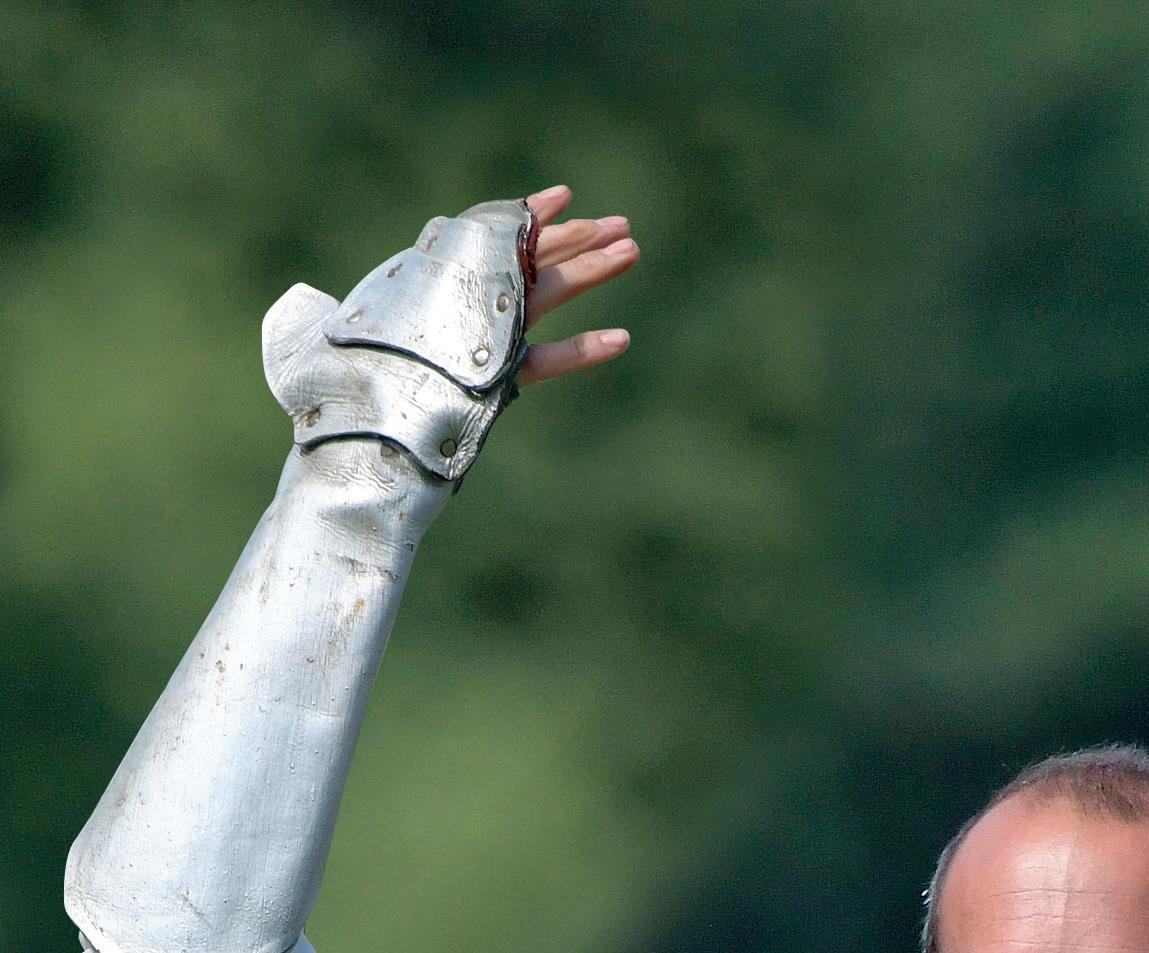






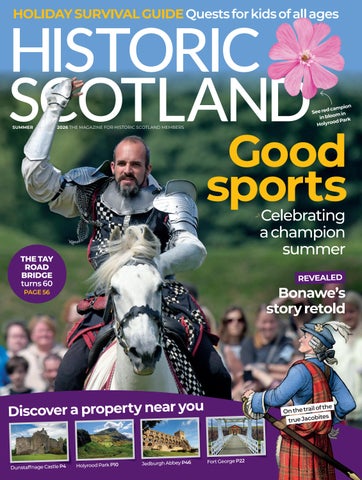
Where would you most like to visit this summer? How about a trip to Caerlaverock Castle to enjoy the colour and excitement of Spectacular Jousting, or some breathtaking sea views from Tantallon Castle’s battlements? Perhaps Edzell Castle’s rose beds in bloom are on your wishlist. Or maybe you need ideas for the children’s summer holidays. Look no further than your latest issue of Historic Scotland. TurntoourHolidaySurvivalGuide(page20)forfive wonderfulquestsatourheritagesites,frommakingmusicat DouneCastletogiantsnakesandladdersatMelroseAbbey.
This summer is packed with sport and, in celebration, we feature the story of an iconic football ground, plus our pick of car-free trips from Glasgow to some heritage hotspots, if you’re in town for the Commonwealth Games (page 24).
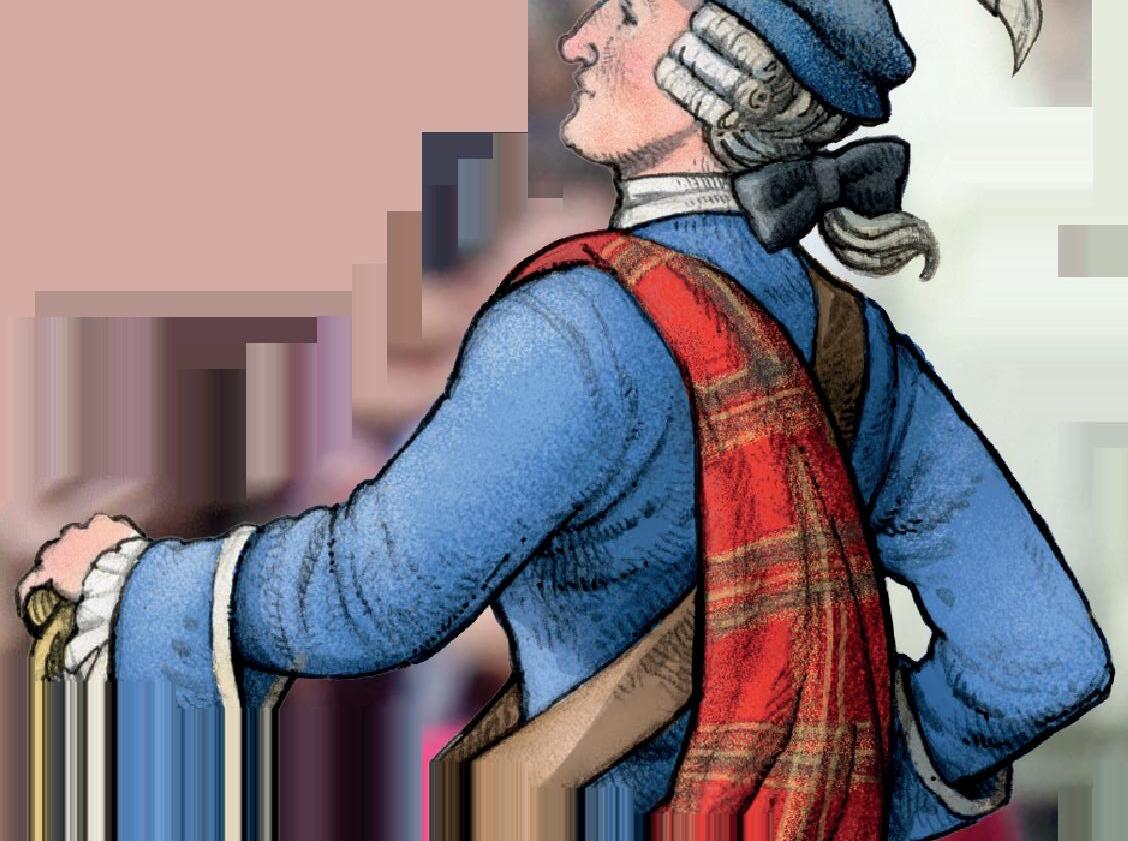
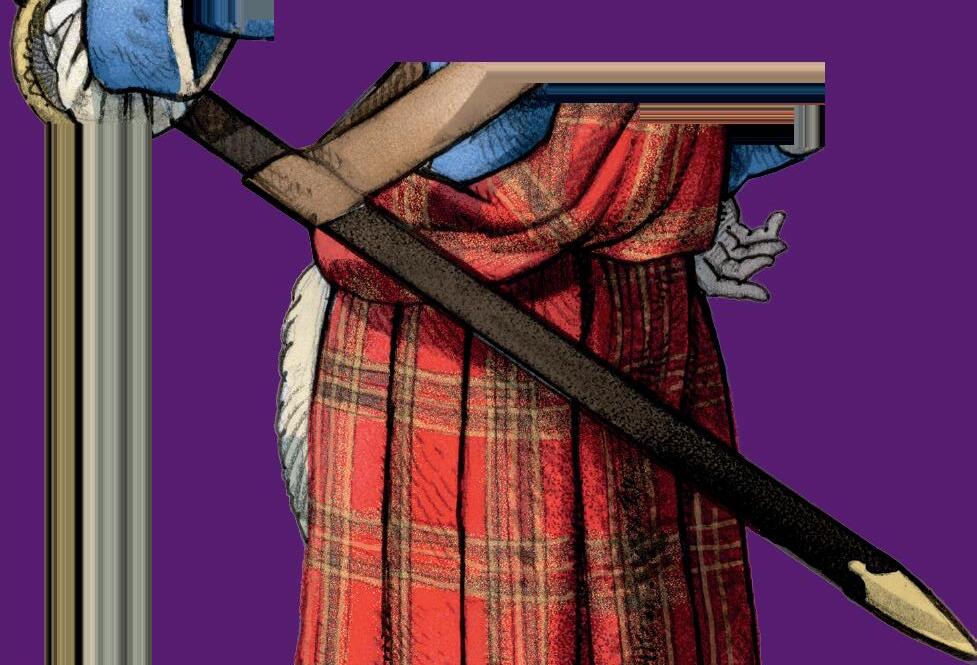
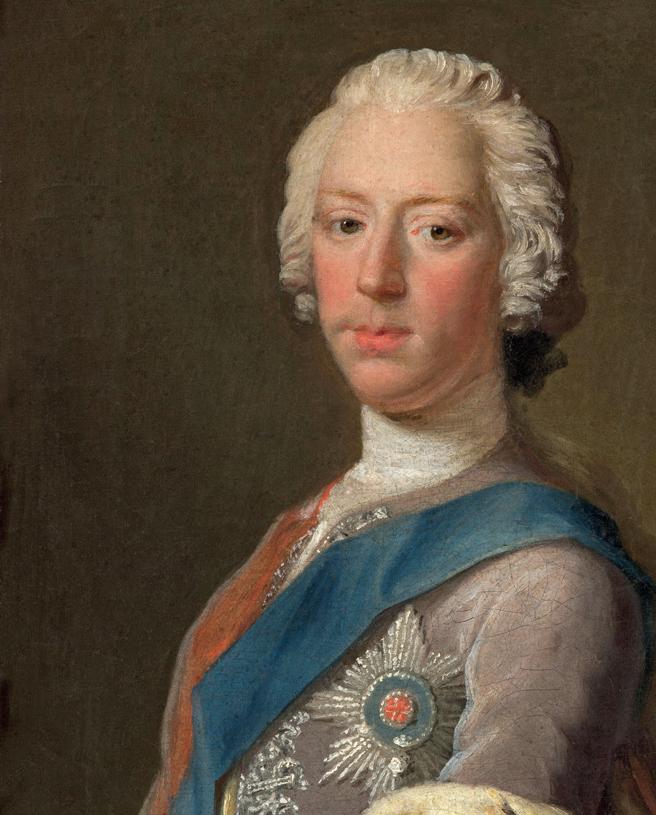
We also reveal some true stories behind the Jacobite cause (page 30), and ask three experts why we still find this period of Scotland’s history so captivating.
Asanewexhibitiondrawingonoralhistoryopensat BonaweHistoricIronFurnace(page36),meetanartistwho wasinspiredbyavisittoacommunitythatwasonceatthe cuttingedgeoftheScottishHighlands’IndustrialRevolution. And if you’re thinking of tying the knot at one of our wonderful properties, you’re in good company as we head back in time to seven historic betrothals (page 44).
Summer is here and we can’t wait to welcome you.
CLAIREBOWIE Head of Membership & CRM

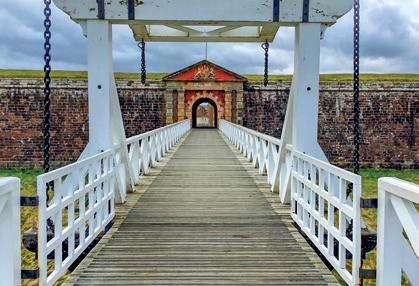
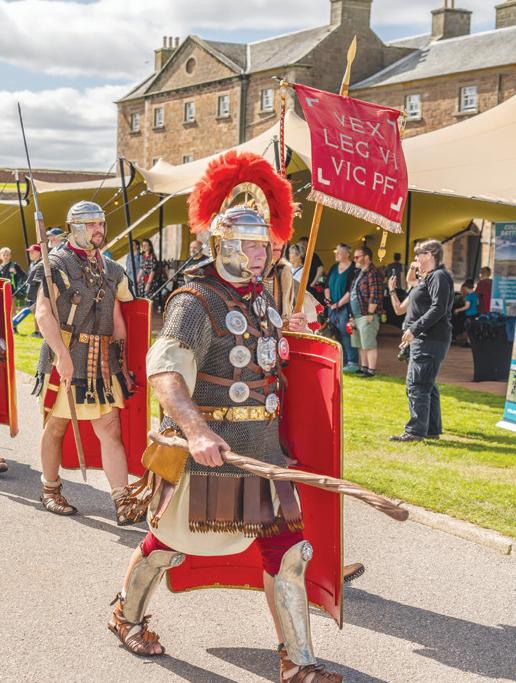
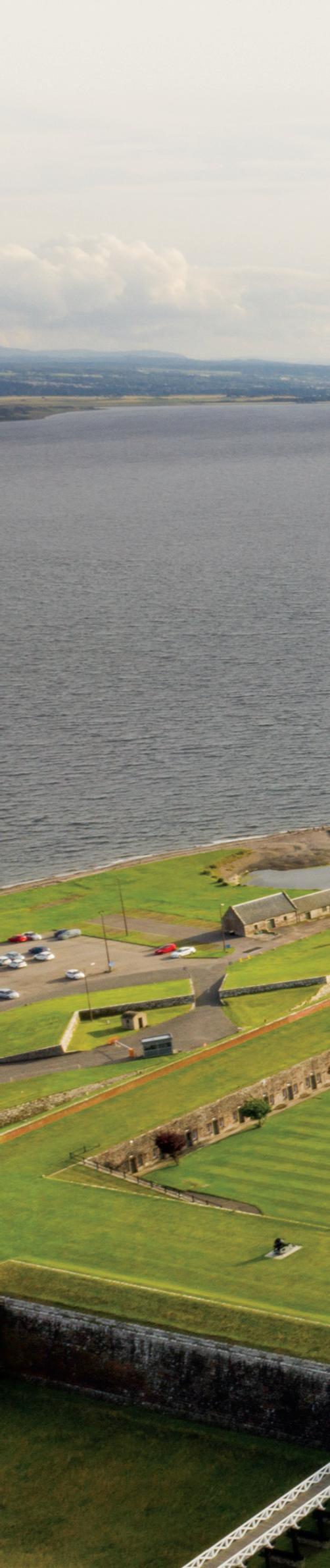
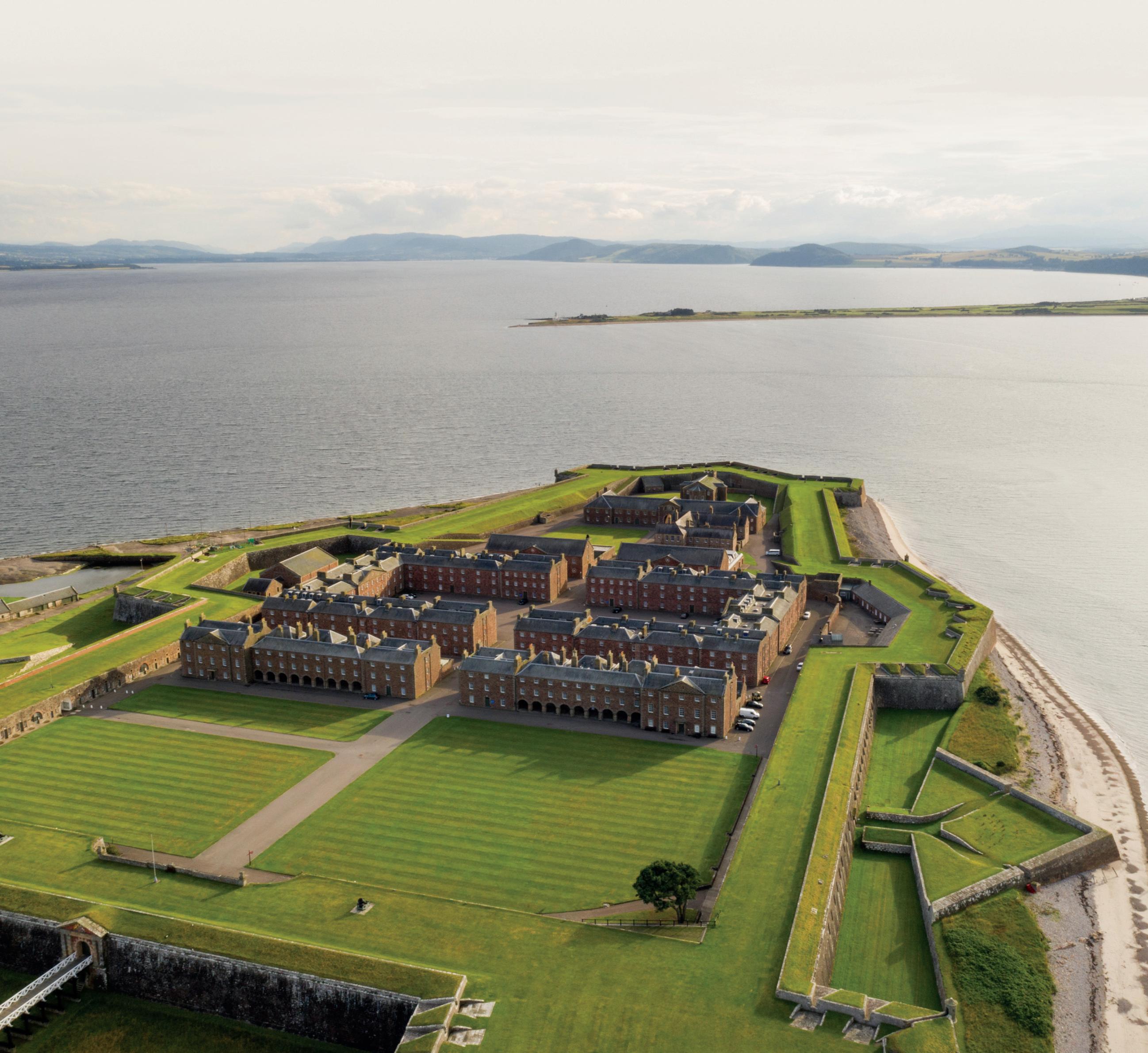
A living timeline covering 2,000 years? It must be our biggest re-enactment event, Celebration of the Centuries, held every year at Fort George. This impressive fortress, with extensive grounds and views across the Moray Firth, is the perfect setting for living history camps, special events and, new for 2026, a tribute show to the horses of the First World War. Don’t miss it!
Find out more on page 52

and

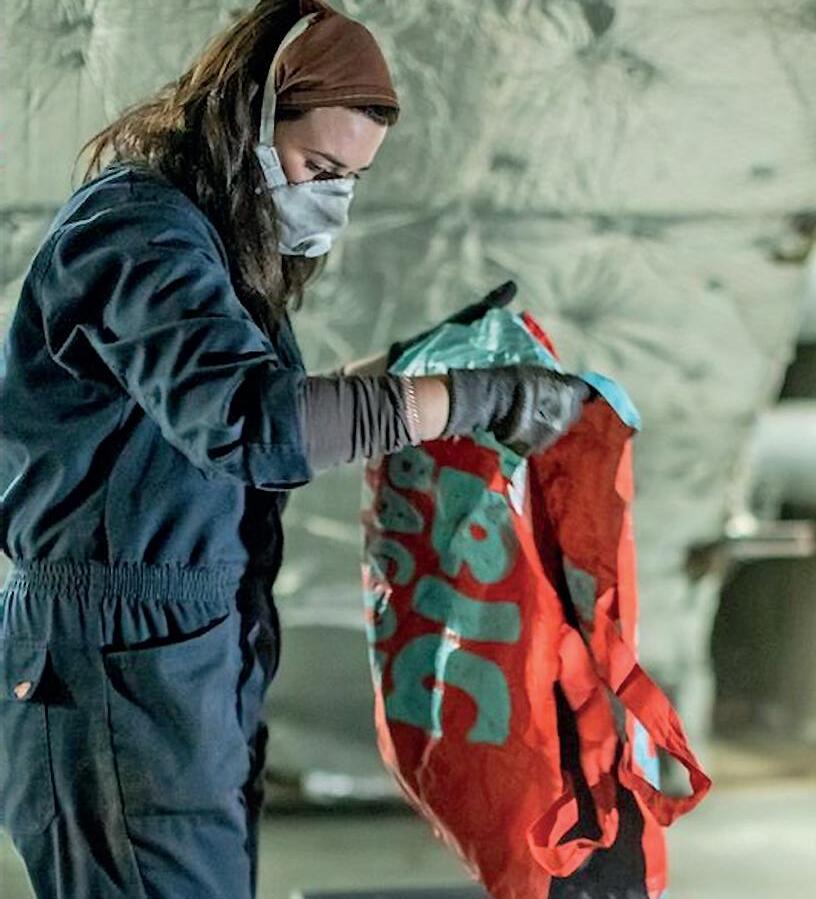
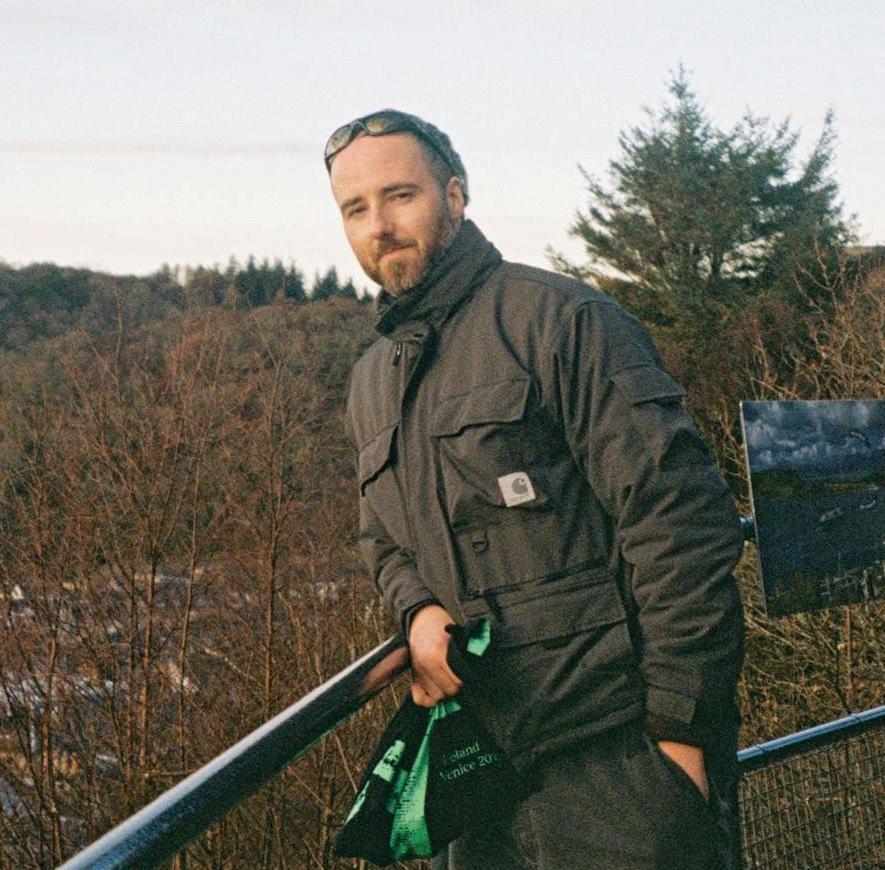
forHES,recently workingonBonawe
HISTORIC ENVIRONMENT
SCOTLAND
Longmore House, Salisbury Place, Edinburgh EH9 1SH 0131 668 8600
hes.scot
Membership enquiries 0131 668 8999
members@hes.scot
Editorial enquiries
members@hes.scot
Head of Membership & CRM
Claire Bowie
Membership Marketing Manager
Julia Haase-Wilson
Editor Indira Mann
indira.mann@ thinkpublishing.co.uk
Assistant Editor Jonathan McIntosh
Design
Matthew Ball
Managing Editor Andrew Littlefield
Advertising Sales
Melissa Mackay
melissa.mackay@ thinkpublishing.co.uk
020 3771 7195
Executive Director, Think John Innes
john.innes@thinkpublishing.co.uk
Think 65 Riding House Street
London, W1W 7EH 020 3771 7200
Photography
All images provided by Historic Environment Scotland unless otherwise stated. For access to images of Scotland and our properties, call 0131 668 8647/8785 or email images@hes.scot
Historic Scotland is published quarterly and printed on Galerie Brite Bulk, which is from wellmanaged FSC®-certified forests and from other controlled sources.
The views expressed in the magazine do not necessarily reflect those of Historic Environment Scotland. All information is correct at the time of going to press.
© Historic Environment Scotland. All rights reserved. Reproduction in part or in whole is prohibited without prior agreement of the Membership and CRM Manager of Historic Environment Scotland.
Historic Environment Scotland (HES) is a Non Departmental Public Body established by the Historic Environment Scotland Act 2014. HES has assumed the property, rights, liabilities and obligations of Historic Scotland and RCAHMS.
Visit hes.scot/about-us Scottish Charity No. SC045925.

A
18
Discover the remarkable
15

30
Beyond the myths of the Jacobite cause

44
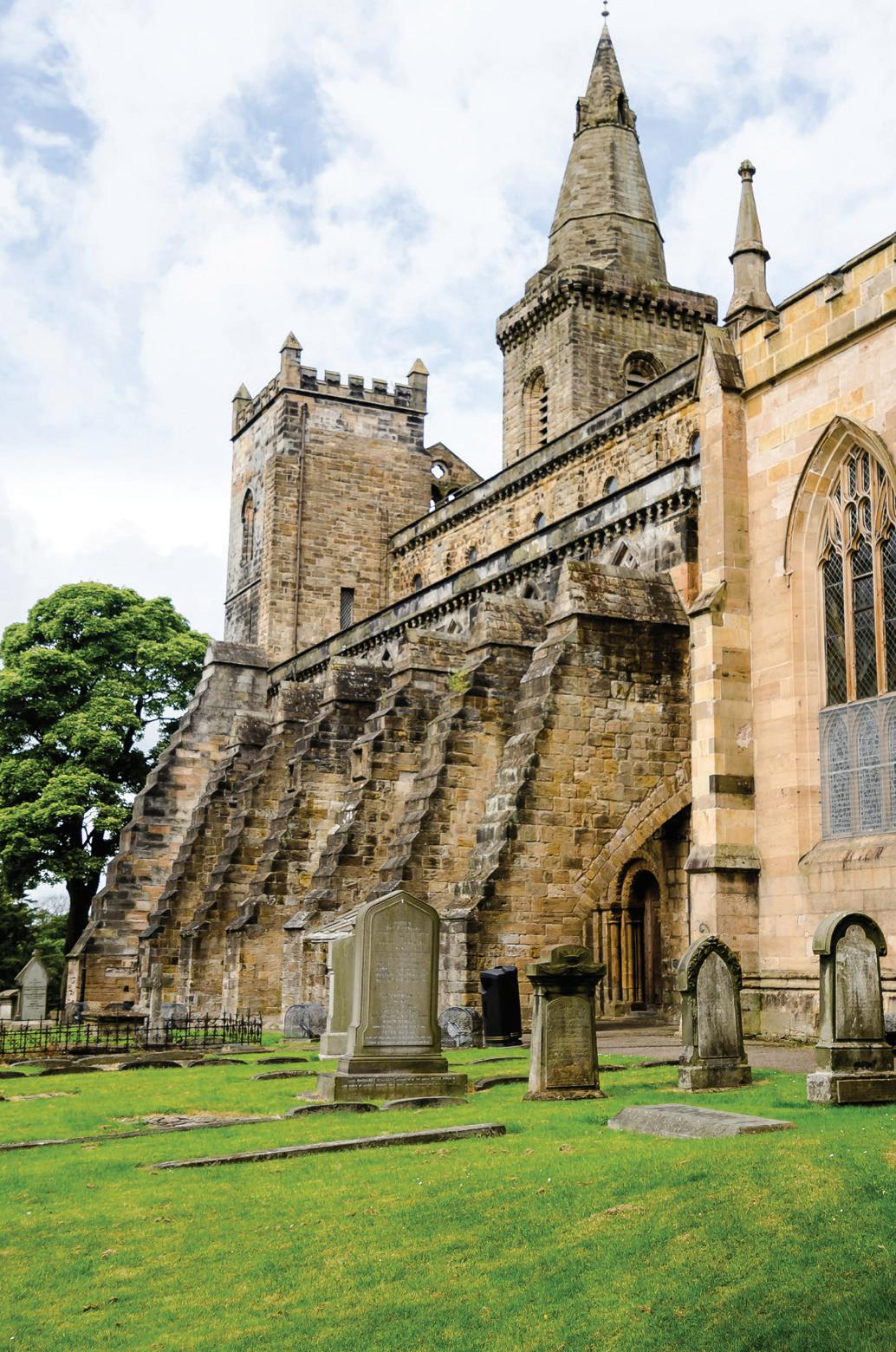
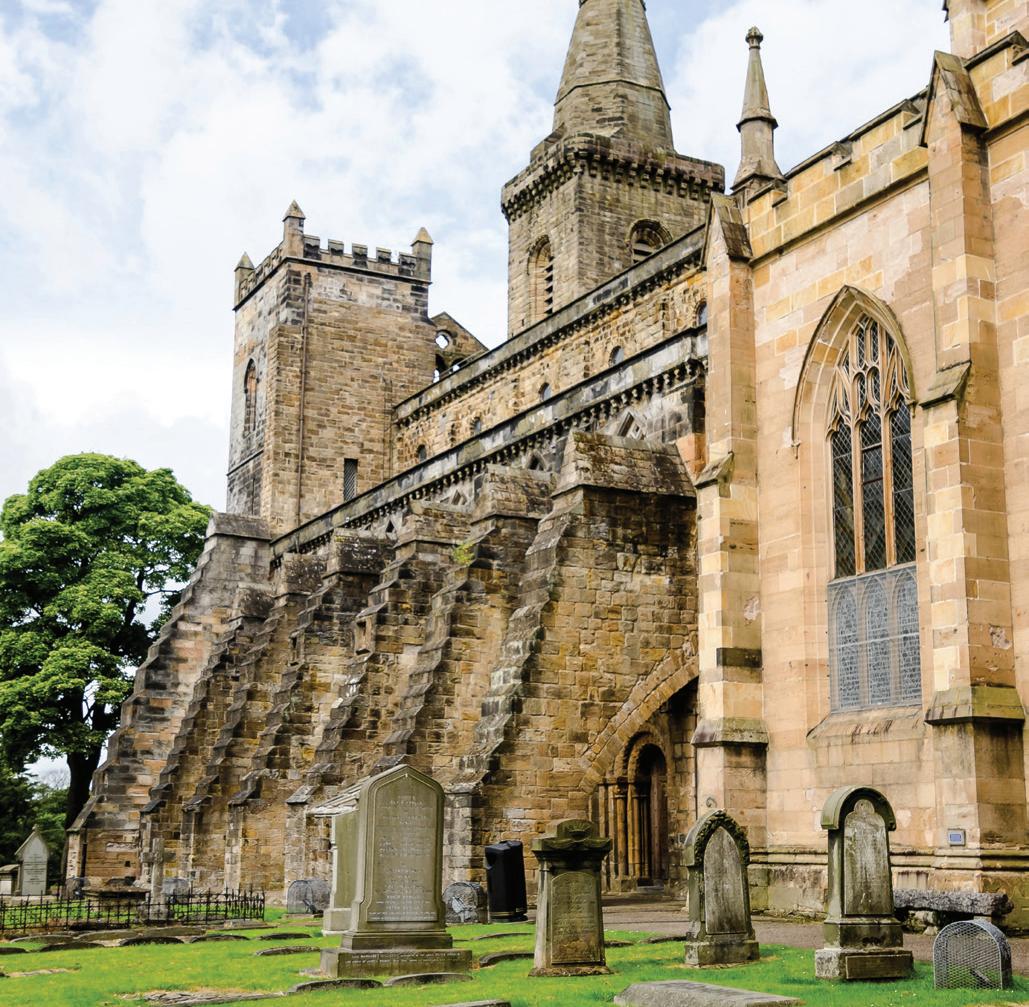
Dunfermline Abbey, where Malcolm III and Saint Margaret made their wedding vows
6 THE SCRIPT
Your guide to experiences at our properties this summer
18 SPOTLIGHT
Bishop’s and Earl’s Palaces
48 SHOP
52 EVENTS
Great days out for all
56 TIME TRIP
20 HOLIDAY SURVIVAL GUIDE
Five fabulous quests for kids
24 CITY OF SPORT
The history of Hampden and Glasgow’s sporting heritage
30 THE JACOBITES
The real people of the Risings
36 LAND OF FOREST AND FIRE
A reimagining of the stories of Bonawe Iron Furnace
44 LOVE & MARRIAGE
Wedding vows at seven sites
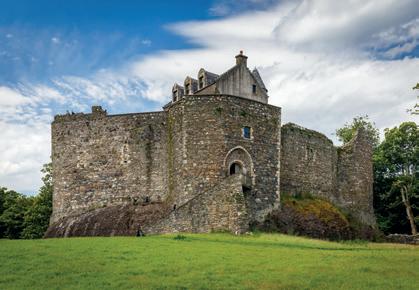
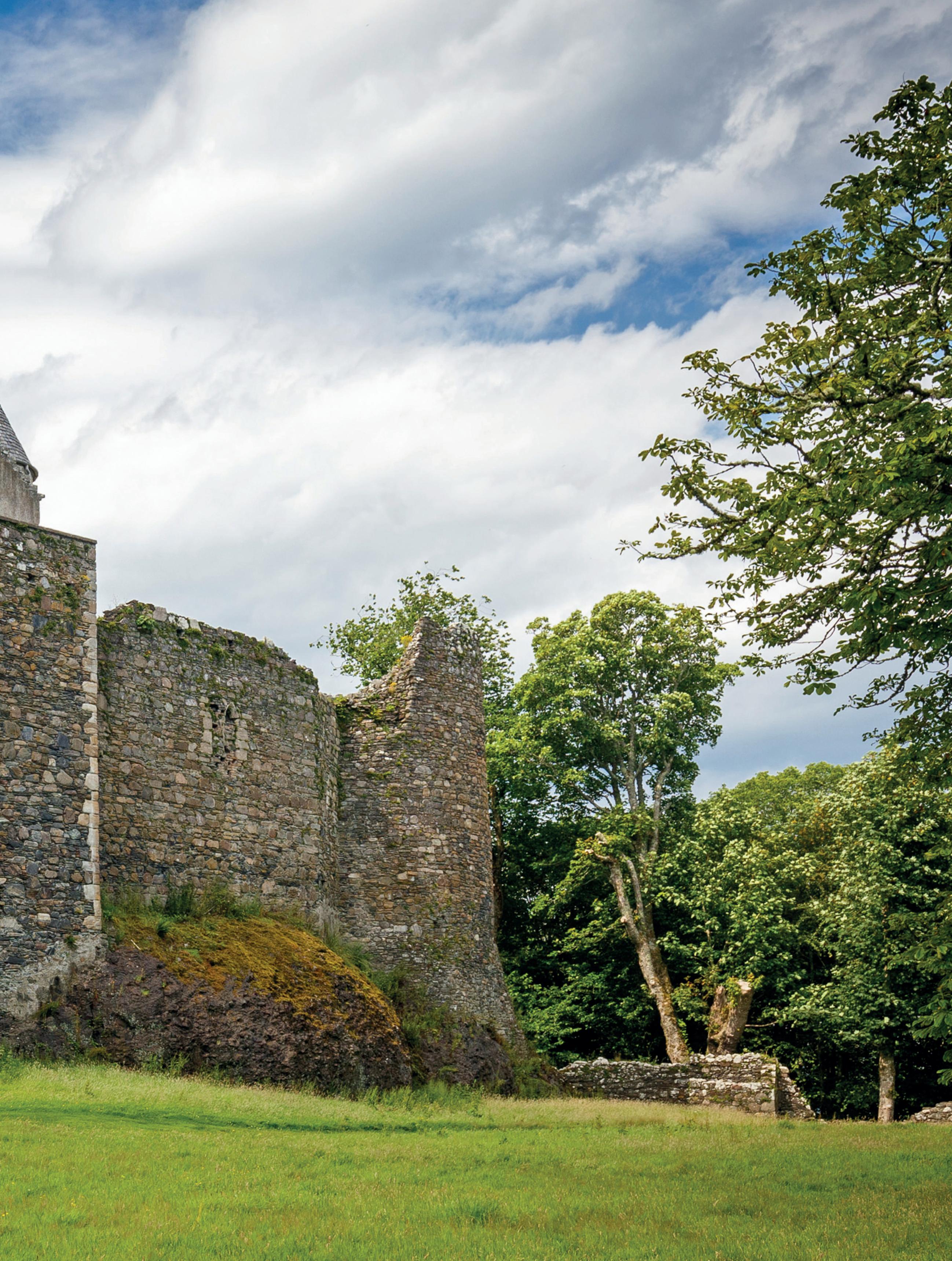
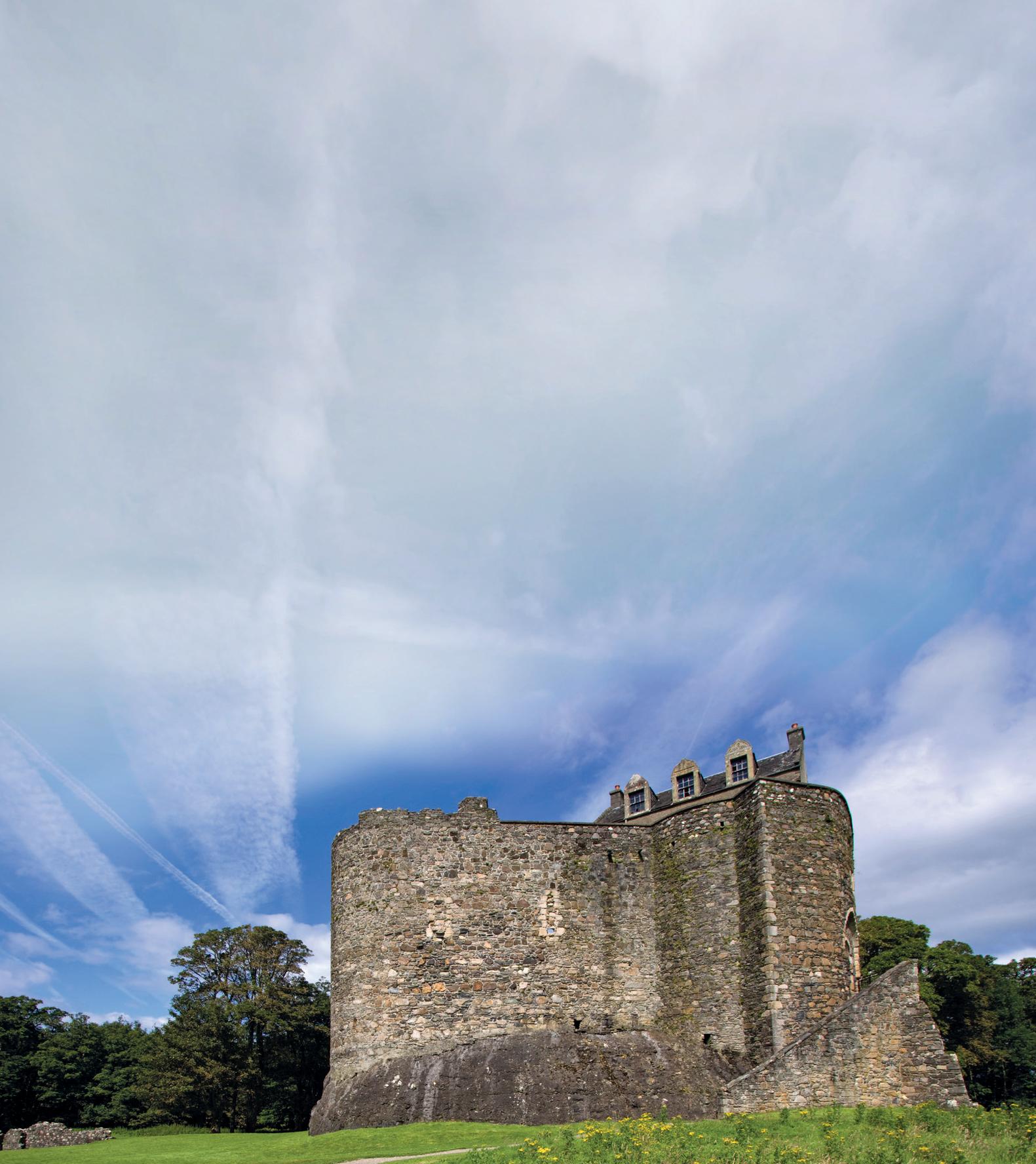
The famous figures and conflicts central to this mighty stronghold’s 800-year history offer glimpses into Scotland’s medieval past


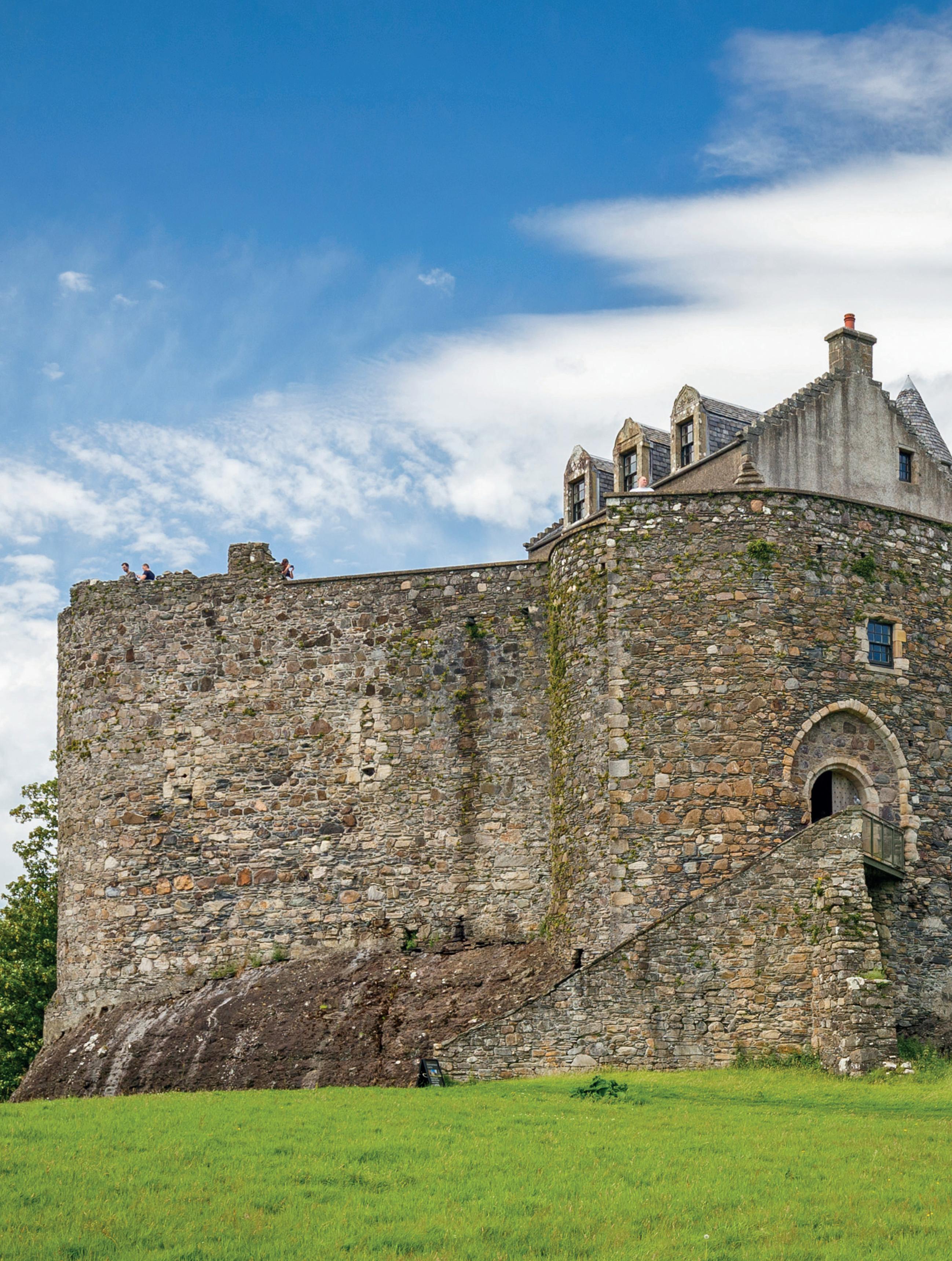
Back in the 1220s, work began on Dunstaffnage Castle, creating a stronghold overlooking the Firth of Lorn for Duncan MacDougall – the son of Dubhgall, Lord of Lorn, and grandson of King of the Isles, Somerled.
The fortress saw the struggle between Scotland and Norway for control of the Hebrides throughout its construction and early years. Official control passed to the king of Scots in 1266. The castle’s architecture, including a massive curtain wall and defensive arrow slits, reflects this battle-ready period.
MacDougalls at the Pass of Brander. Dunstaffnage Castle remained in royal hands until it came under the ownership of the Campbell earls of Argyll in the 1460s.
The castle’s subsequent story is interlinked with the Campbells and the Crown’s attempts to control the population until the last Jacobite Rising of 1745–6.
Flora MacDonald is one of the castle’s most famous guests. After meeting Bonnie Prince Charlie in South Uist – who was running from the Redcoats after his defeat at Culloden in April 1746 – she disguised him as her serving girl, Betty Burke, and they fled to Skye.

MUST-DO
Wander to Dunstaffnage Chapel. The remains of this 13th-century holy place suggest it was highly decorated in its heyday.
Visit the Ocean Explorer Centre nearby to discover more about the abundant wildlife of the Firth of Lorn.
There were also skirmishes here during the Wars of Independence between Scotland and England (1296–1357). In 1308, Robert I besieged it after defeating the
Flora was arrested and detained at Dunstaffnage before being taken to the Tower of London. She was released in 1747.
To travel here sustainably by train, bus, bike and foot, visit goodjourney.org.uk/ dunstaffnage-castle
The West Tower is currently closed.
A 200m upward gravel track leads from the car park to the visitor centre, and the castle is located a further 25m from there.
Assistance dogs have full access. Other dogs are allowed at the castle but not in roofed areas.

Plan your next day out at Dunstaffnage Castle at historyawaits.scot
DUNSTAFFNAGE CASTLE
Our spotlight on top events, activities and updates to enjoy this summer
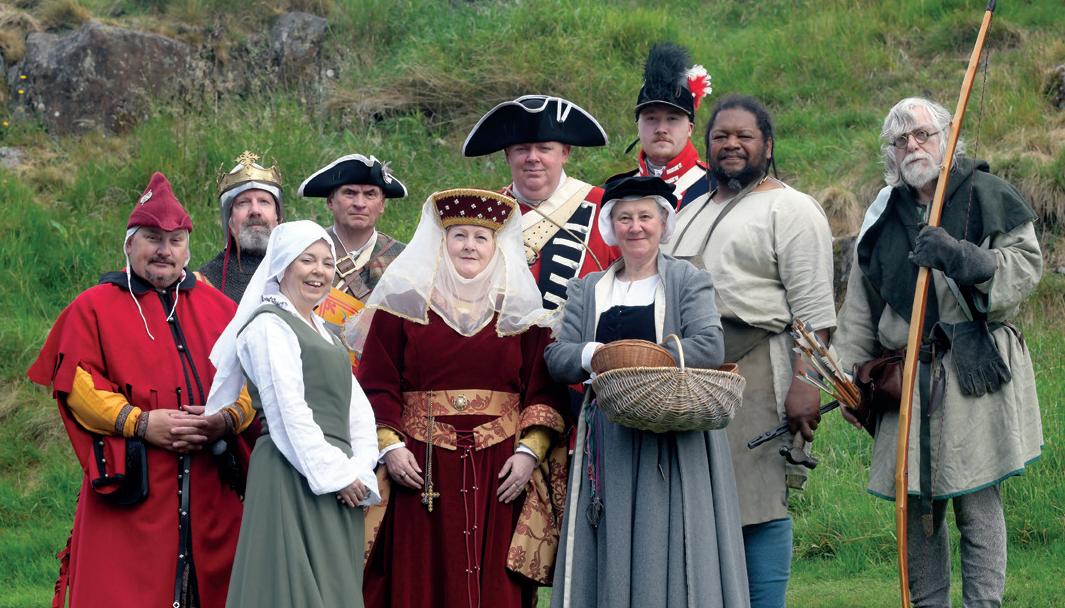
Our Living History programme returns for 2026 to bring Scotland’s colourful past vividly to life.
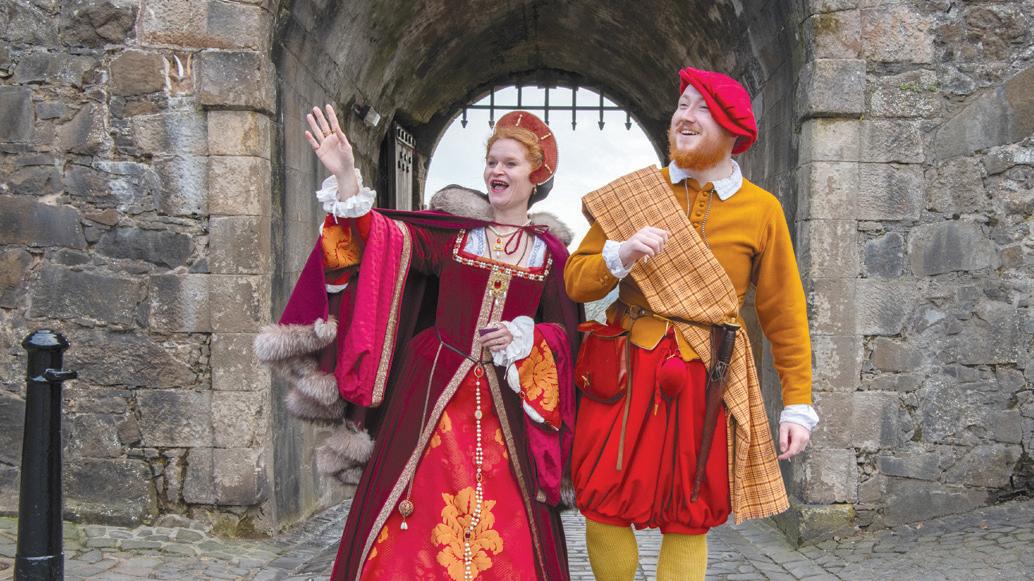
Between 27 June and 16 August at selected sites –Edinburgh Castle, Fort George, Urquhart Castle, Linlithgow Palace, St Andrews Castle and Melrose Abbey – you’ll encounter characters from knights and musicians to skilled craftspeople and comedic courtiers. They will be spotlighting the remarkable stories that are key to the sites we care for.
Find out more at hes.scot/livinghistory
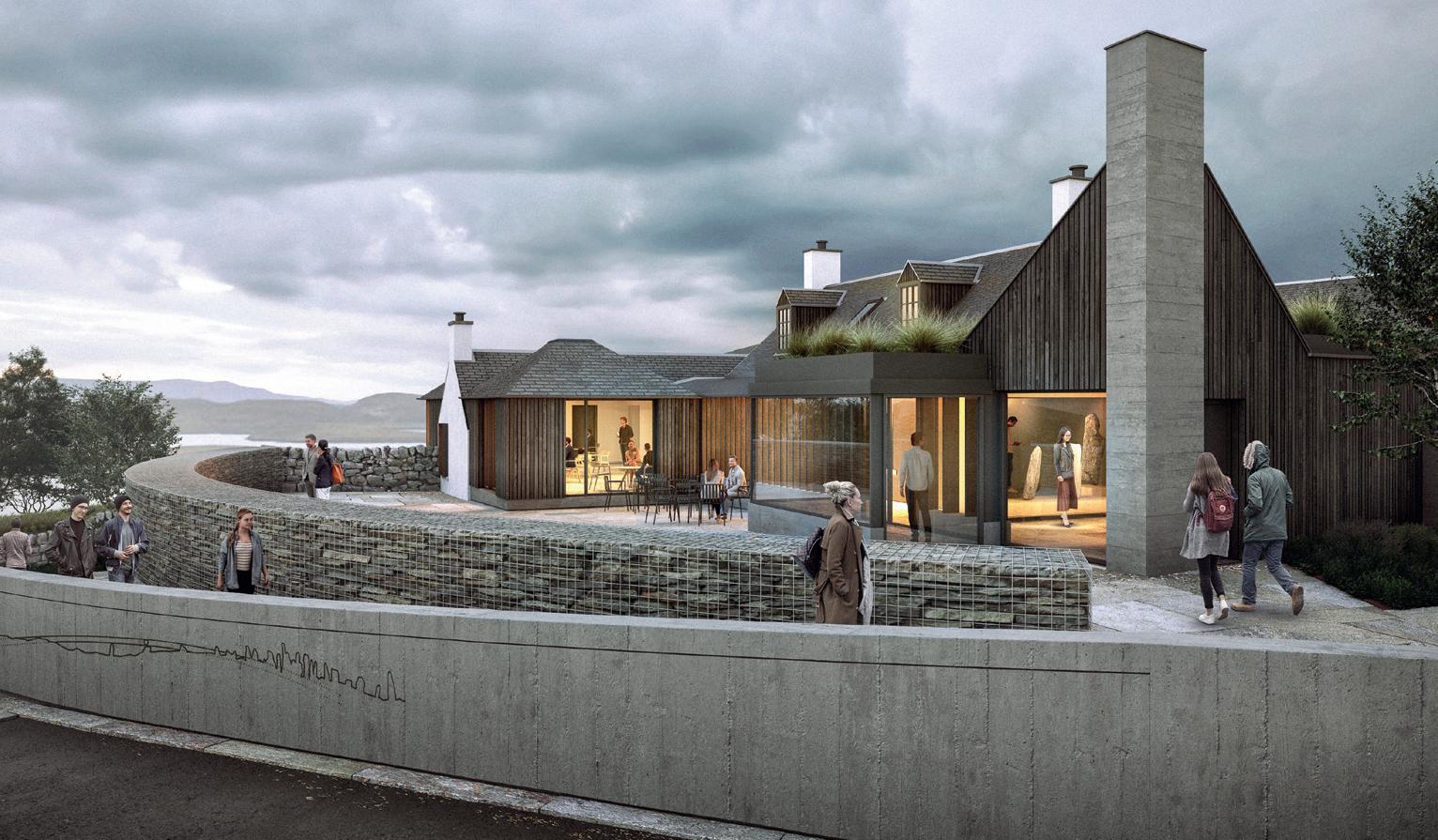
Calanais Standing Stones’ new visitor centre officially opens in July. With an expanded café and shop, enhanced accessibility and a brand-new exhibition, you’ll want to add this beguiling site to your summer must-see list!
Before or after visiting the standing stones themselves, explore their origins and influence on Hebridean archaeology, tradition, folklore, community and culture over millennia.
Learn more at calanais.org
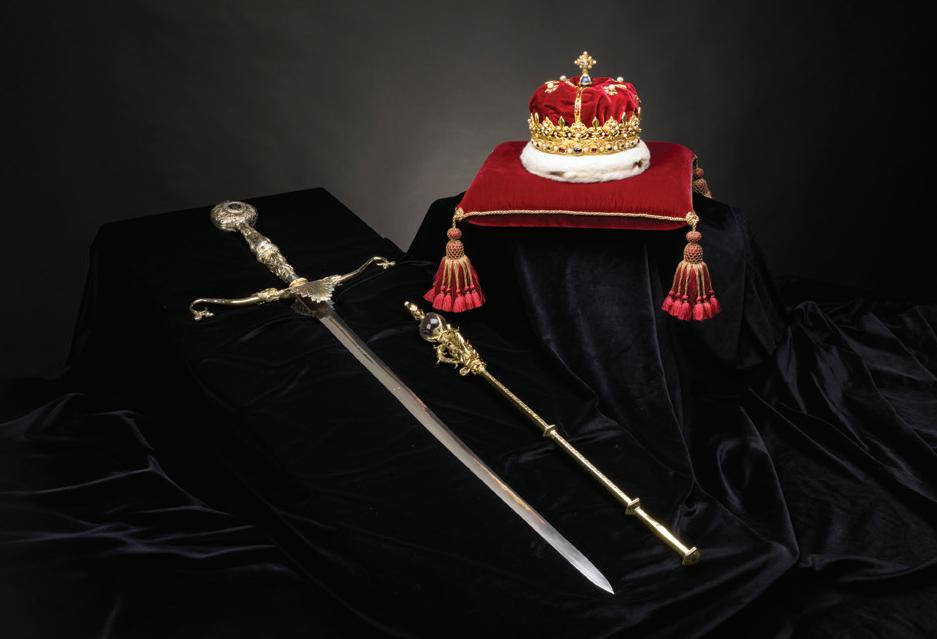
Edinburgh Castle’s Crown Room – which since 1617 has housed the Crown, Sword and Sceptre, making up the Honours of Scotland – has entered an exciting next chapter with its refurbishment.
Witness ways our craftspeople have restored the vault’s Victorian design elements and discover how a state-of-the-art display keeps these treasures secure while helping them shine at their best.
Get a copy of the castle’s guidebook, in our shops or at stor.scot, with your members’ 20% discount
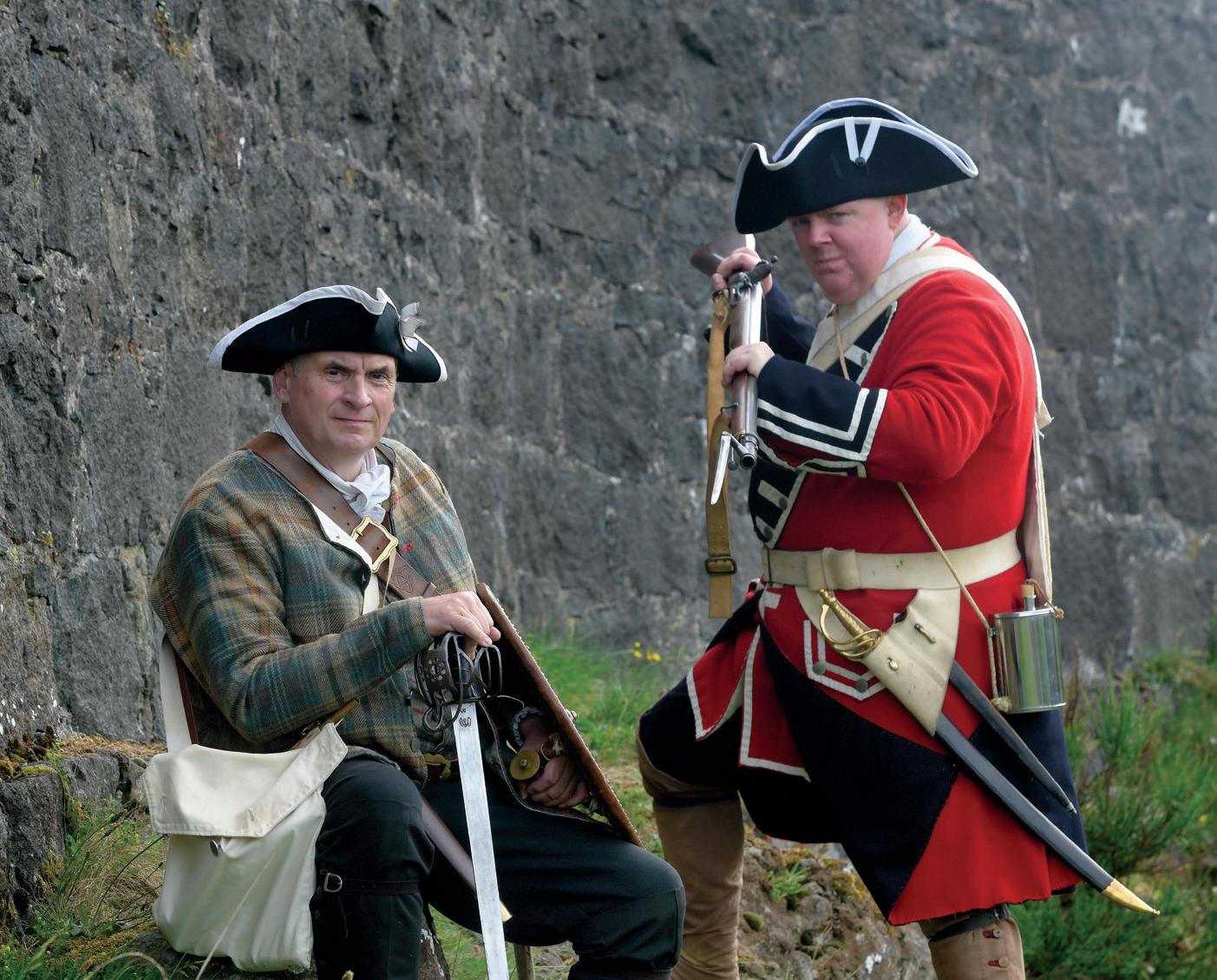
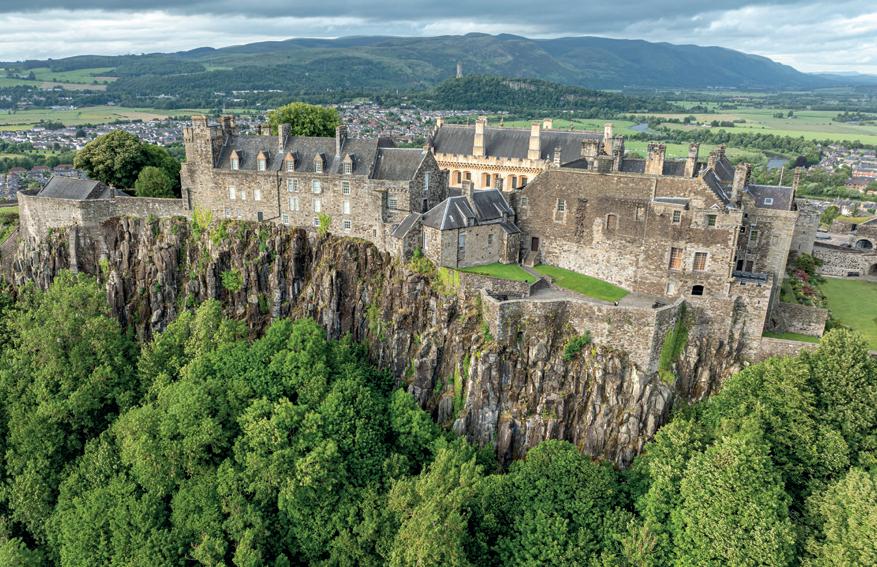
Join a special tour marking the 280th anniversary of a key event during the Jacobite Risings. Learn about Stirling Castle’s role in this turbulent chapter of Scotland’s story.
As you explore the castle’s formidable defences, you’ll delve into the politics and military strategies which shaped the 1715 and 1745 Risings that sought to restore the Stuart monarchy.
Tours at 10.30am and 2.30pm on Tues 16 and Sat 20 June. Book at hes.scot/member-events
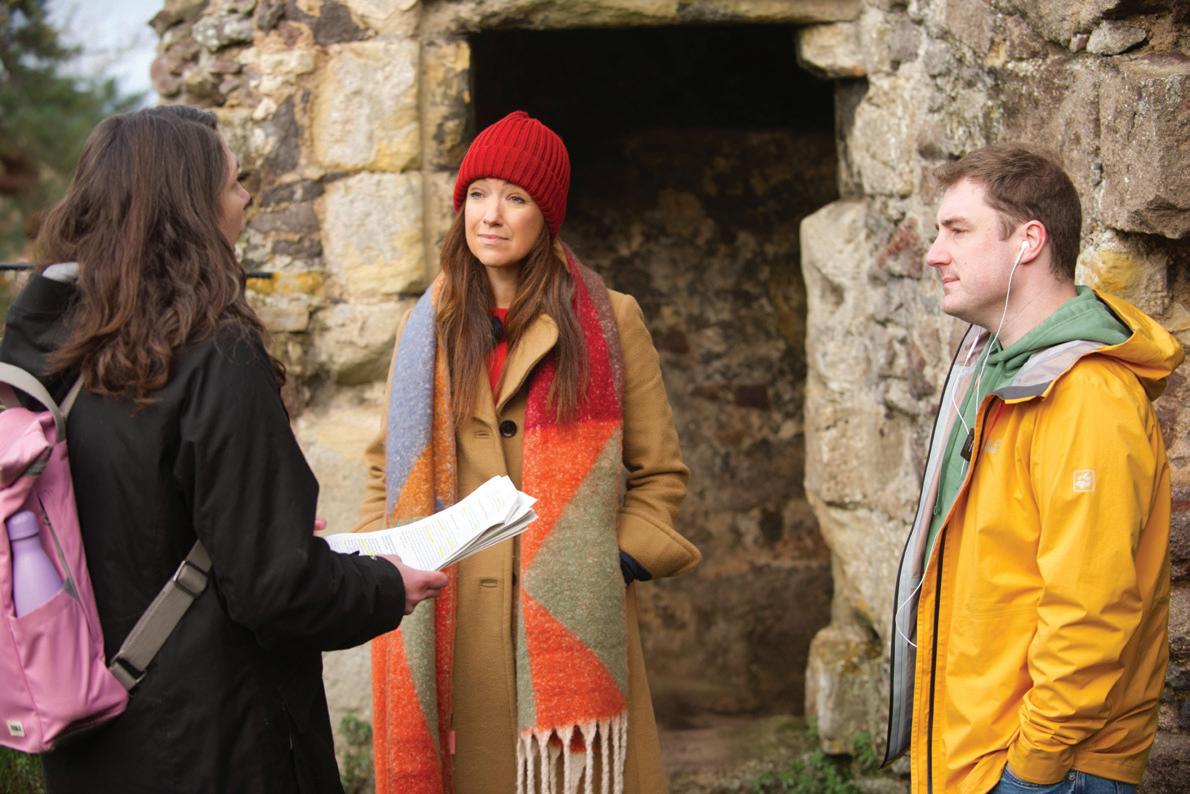
Season 2 of the Historic Scotland Podcast is packed with episodes to keep you entertained as the warmer weather rolls in.
Listen in as host Sarah MacGillivray dives into some rarely told tales, including how Kinneil House helped to kickstart the Industrial Revolution, the inside scoop on Arnol Blackhouse’s Gaelic community and culture, and why Calanais Standing Stones are a part of our Empire story.
Listen at hes.scot/members-podcast
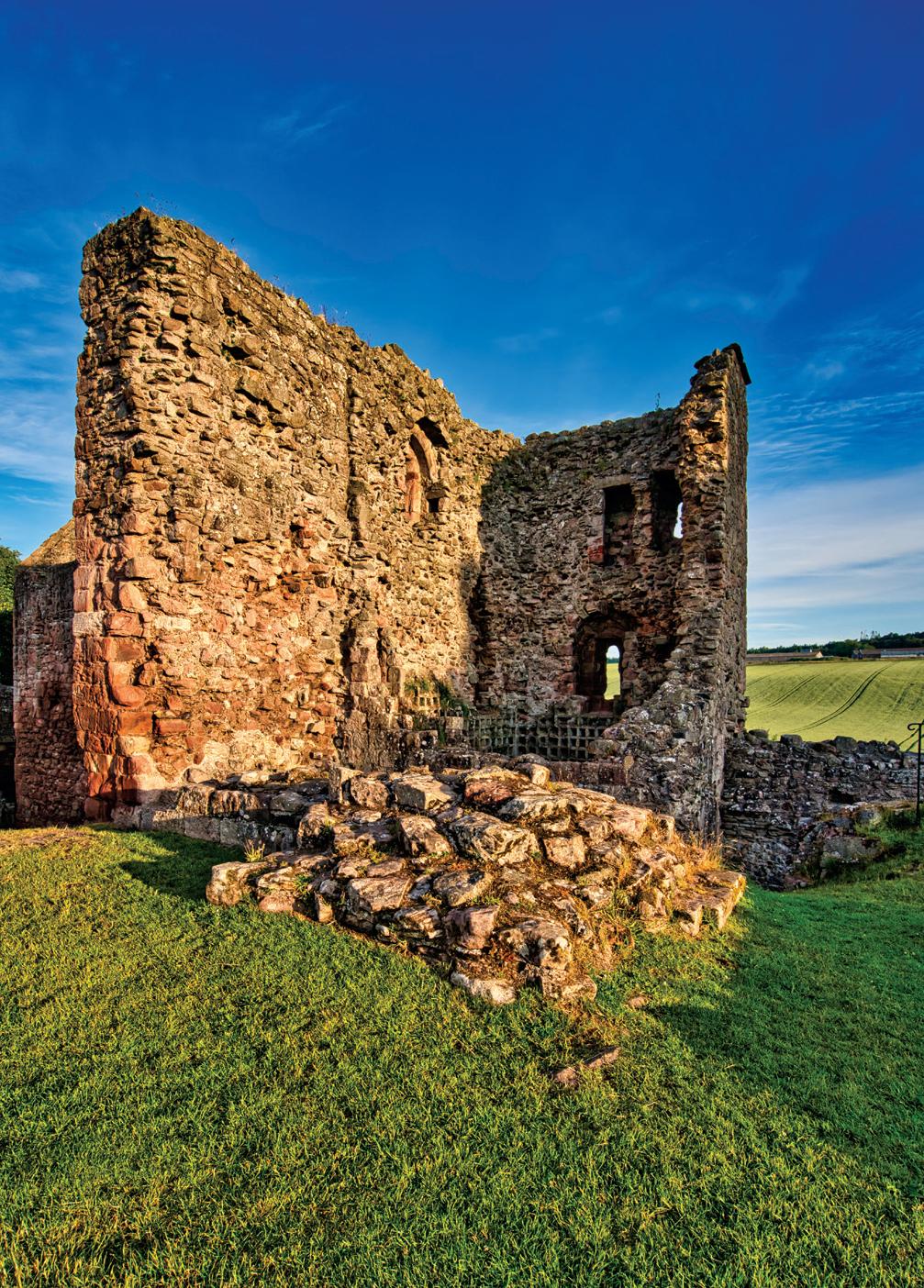
Summer’s brighter and warmer days are ideal for taking your time to explore our sites across Scotland – including those that have recently re-opened following high-level conservation work.
From the 14th-century Castle of Old Wick in Caithness and Hailes Castle in the River Tyne valley to Scotland’s first Cistercian monastery, Melrose Abbey, in the Borders, there are plenty of adventures waiting for you. Check for visit and access details at historyawaits.scot

Our new Members’ Portal is launching this year. In the meantime, find your member benefits and digital copies of your Members’ Guide and Historic Scotland magazine at hes.scot/member. If you haven’t heard from us about this change, email members@hes.scot to add your email address to your record.
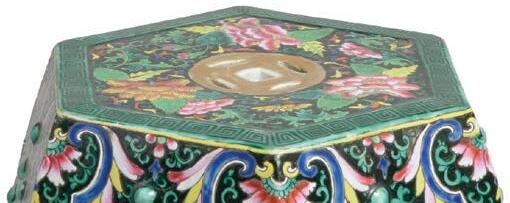


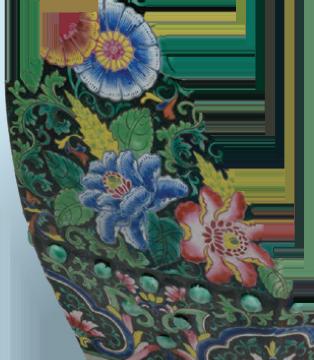
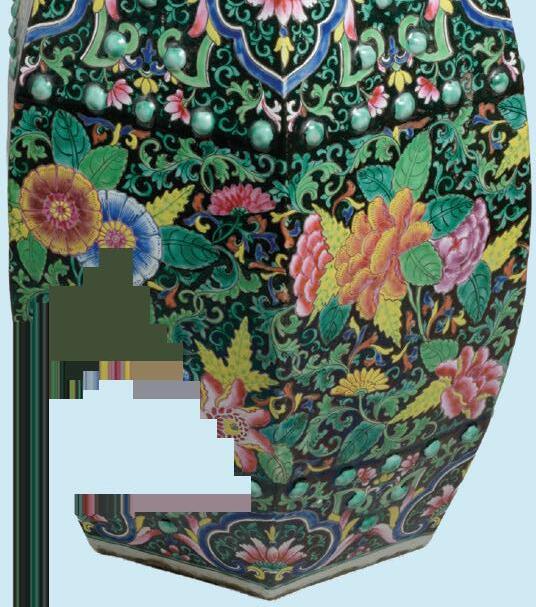
This 18th-century decorative chair has been displayed at Duff House since the 1990s
Looking for inspiration for your own garden furniture? This 18th-century Chinese Canton porcelain garden seat on display at Duff House is a real summertime special.
Painted with flower heads and foliage against a black background, the hexagonal perch is part of a pair. Its famille verte and famille noire design – French for ‘green family’ and ‘black family’ – is crafted in a Chinese decorative style, with opaque overglaze colours.
It’s a rare example of this particular design, which didn’t prove as fashionable as other styles of the 1700s.
The seat is part of the Dunimarle Collection – a group of fine and decorative art brought together by the Erskine of Torrie family during the late 18th and 19th centuries, and originally housed at Dunimarle Castle.
Much of the eclectic Dunimarle Collection chinaware that you’ll see at Duff House was assembled by Magdalene Erskine (1787-1872), reflecting her unique tastes.
Joanna Todd, Volunteer Development Officer,
celebrates our volunteering programme’s first decade
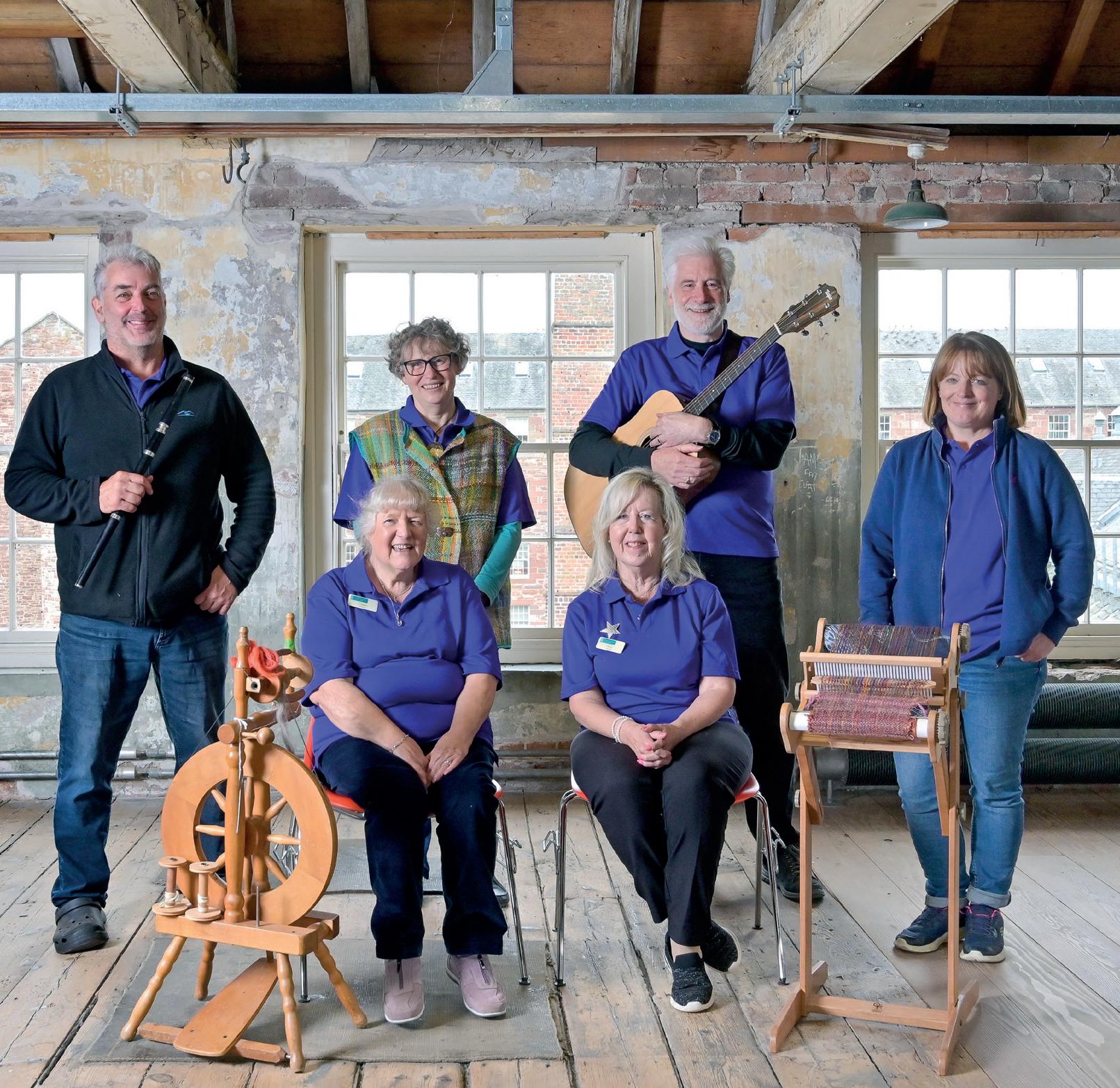
2026 marks a major milestone with the 10th anniversary of our volunteering programme. This initiative started small but has since grown into a vibrant community of more than 200 registered volunteers.
From Visitor Connectors, Volunteer Musicians and Volunteer Gardeners to Digital Connectors supporting the National Collection of Aerial Photography (NCAP) and our Ranger Service, our volunteering opportunities are as diverse as the people whose passion and skills
Getting to grips with gorse in Holyrood Park
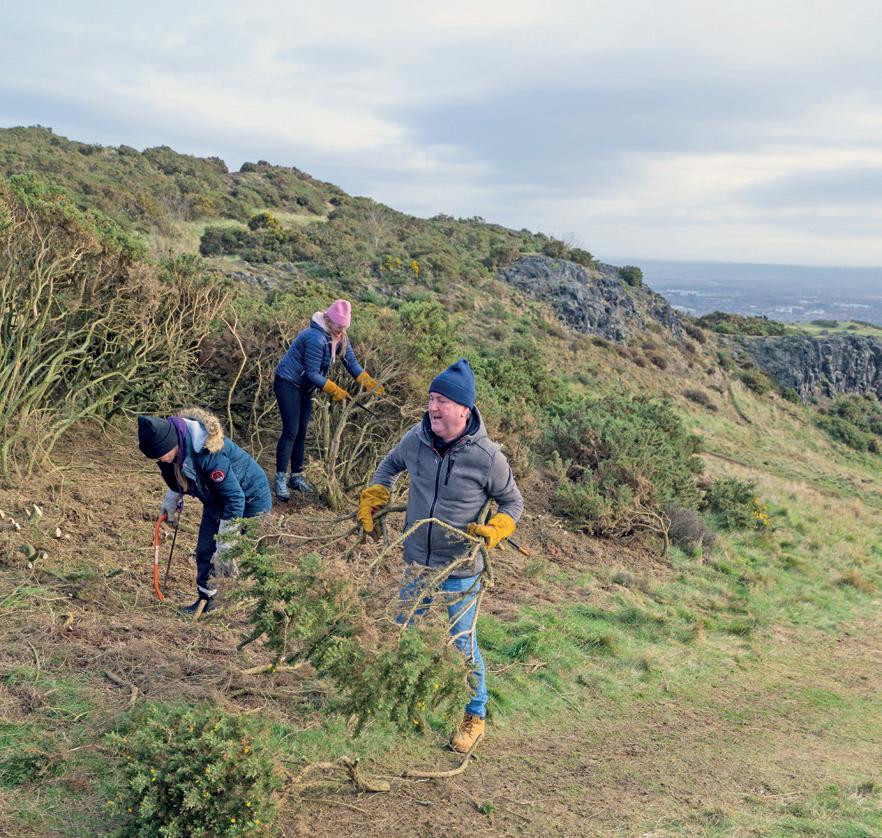
help bring Scotland’s history to life. There are also digital options as well as face-to-face opportunities to take part. And we’ll continue developing new possibilities so even more people can experience the benefits of volunteering.
•
Discover volunteering opportunities at hes.scot/volunteer

following extensive discussion between the team and our landscape and heritage managers and in consultation with the National Trust for Scotland.

We’ve rejuvenated Edzell Castle’s pleasure garden rose beds in time for a blooming great summer
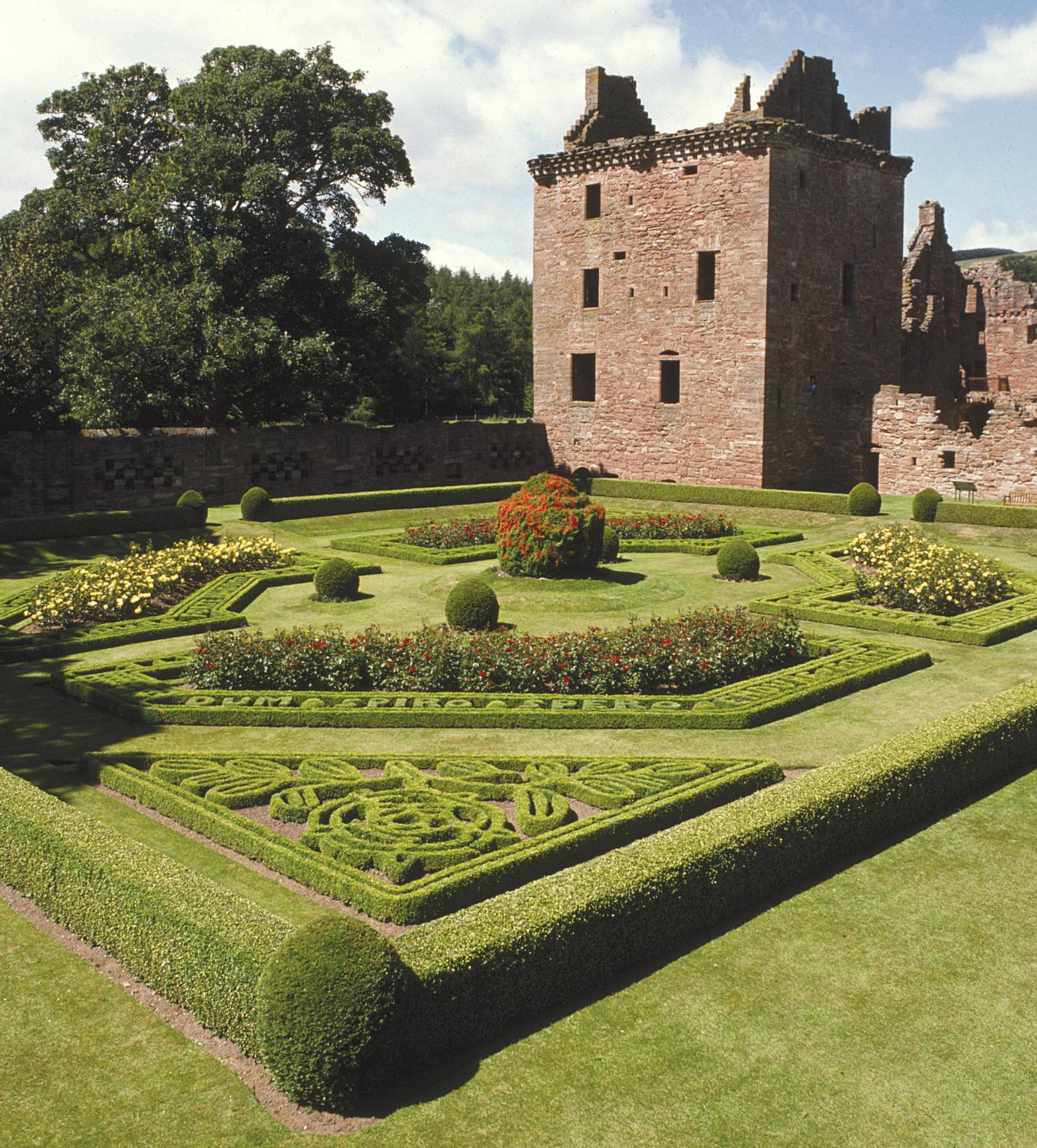
Edzell Castle is known for its intricate and symbol-laden walled garden. It was designed in 1604 by Sir David Lindsay, son of the 9th Earl of Crawford, to celebrate the newly unified crowns of Scotland and England under James VI and I. Today, it remains a living testament to the ambition, artistry and intellectual currents of the early 17th century.
Roses have long been part of this garden’s narrative. While no exact record
of their 17th-century planting survives, bringing the garden’s parterres to life with roses each summer has been a castle tradition since it was replanted in the 1930s.
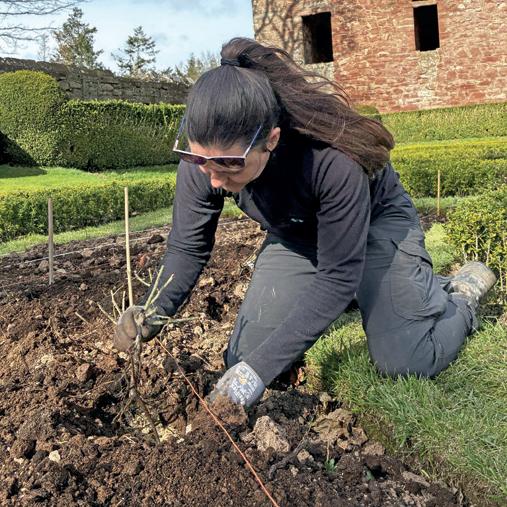
More recently, Edzell Castle’s gardener Shaun Morris and the Garden Team have been busy replacing roses planted 50 years ago with modern cultivars, ahead of the summer season. China Town and Ruby Wedding floribunda roses were selected for this new planting scheme
Other garden highlights to explore at Edzell Castle and Garden in Angus
Spot house martins and swallows, kestrels, red kites, stoats, pine martins, red squirrels, butterflies, and many other species that make Edzell home.
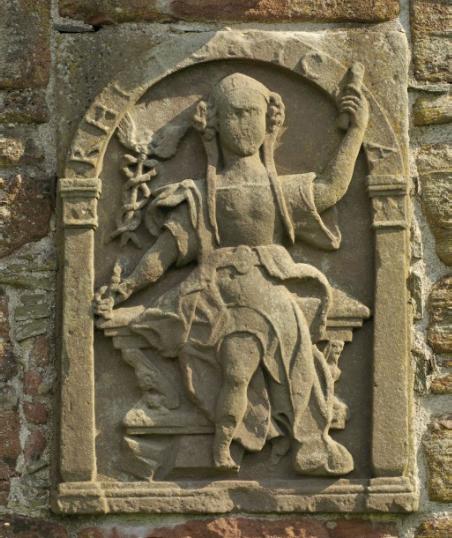
Don’t miss the walled garden’s fine carved depictions of the Seven Cardinal Virtues, Seven Liberal Arts and the Seven Planetary Deities.
Blooming abundantly in summer, disease resistant and resilient to the Scottish climate, these roses are well-suited to a heritage environment where long-term reliability, visual impact and reduced maintenance are all essential. Their colours maintain the site’s established palette of reds and yellows too, continuing the walled garden’s traditional aesthetic.
We source these roses from the nearby Kincardine-based nursery, Fergusons Roses – aligning with our wider commitment to sustainable, regionally based horticultural practice.
Summer is unquestionably the finest season to experience Edzell Castle’s celebrated gardens. As well as the rose beds bursting with beautiful hues, yellow Tagetes and blue and white lobelia cascading over the walls, the air buzzes with life as bees and hoverflies drift from one fragrant flower to the next.
The fantastic flora and fauna that call this walled garden home weave together the aesthetic principles and spirit of Lindsay’s original vision: a garden that blends together scholarship, symbolism and spectacle. The remarkable roses on show here are an indispensable part of this arresting alchemy.
We’re excited about beginning work soon on a new herbaceous botanical timeline border and a revamped picnic area. Watch this space for news.
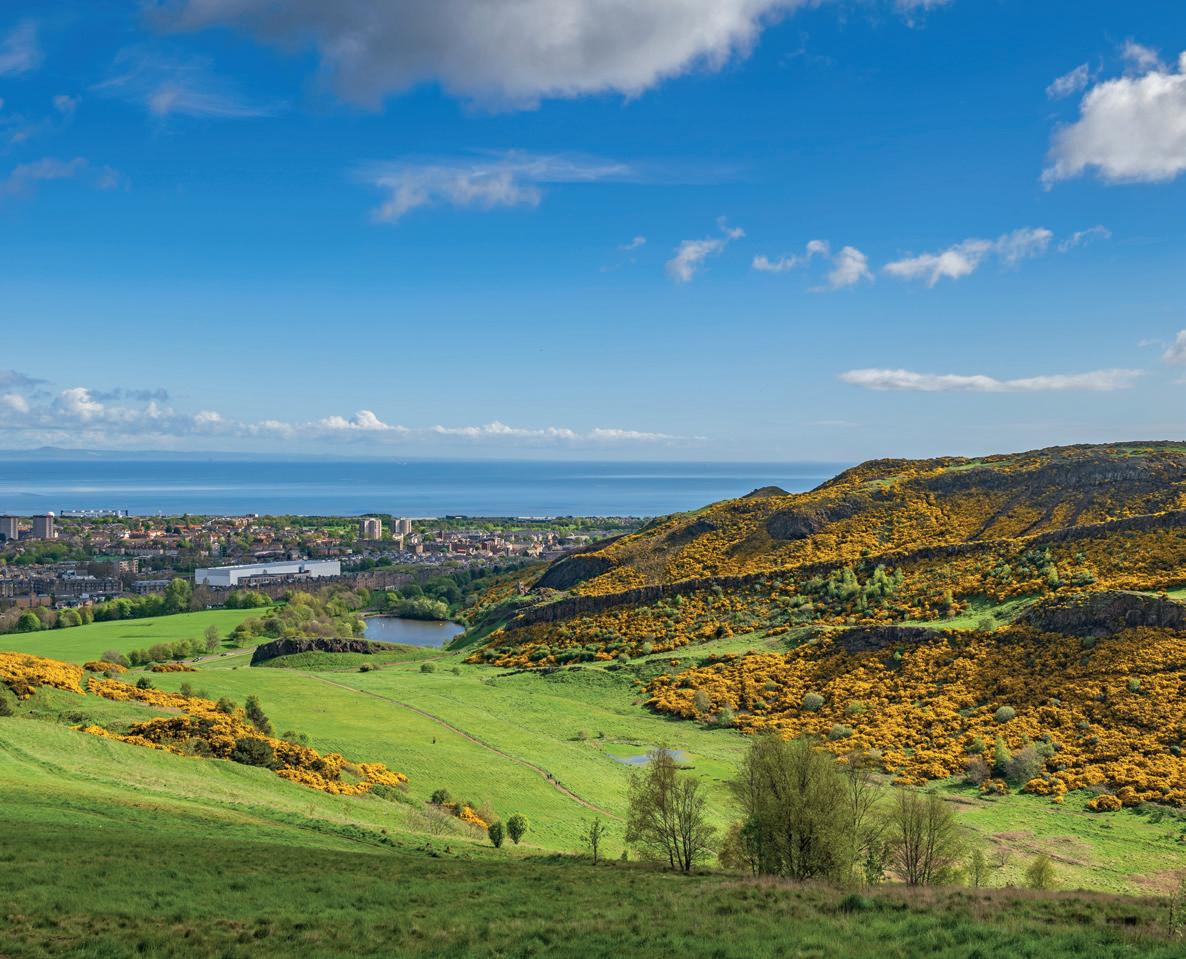
JoinusonawalkthroughEdinburgh’spopulargreenspaceasCatrionaMorrison,GaelicLanguage PolicyManager,identifiestheGaelicwordsandphrasesforsummertimefloraandfauna
AM MÌOS BUIDHE –THE YELLOW MONTH
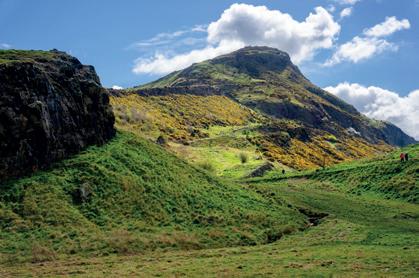
July is known as the yellow month in Gaelic, likely referring to the particular light, flowers and a ripening harvest. The name is relevant to this time of year at Holyrood Park when several yellow plants on its grassy slopes are in bloom, including an abundance of conasg (gorse) and barramhìslein (bird’s-foot trefoil).
CAIRT-LÀIR –TORMENTIL
Translating to ‘ground-bark’, cairt-làir is one of 17 Gaelic names for this pretty plant with tannin-rich roots that have been used to tan leather and strengthen rope fishing nets for centuries. Tormentil was also relied upon for medical purposes in Gaelic communities, as a cure for toothache, cold sores and digestive ailments.
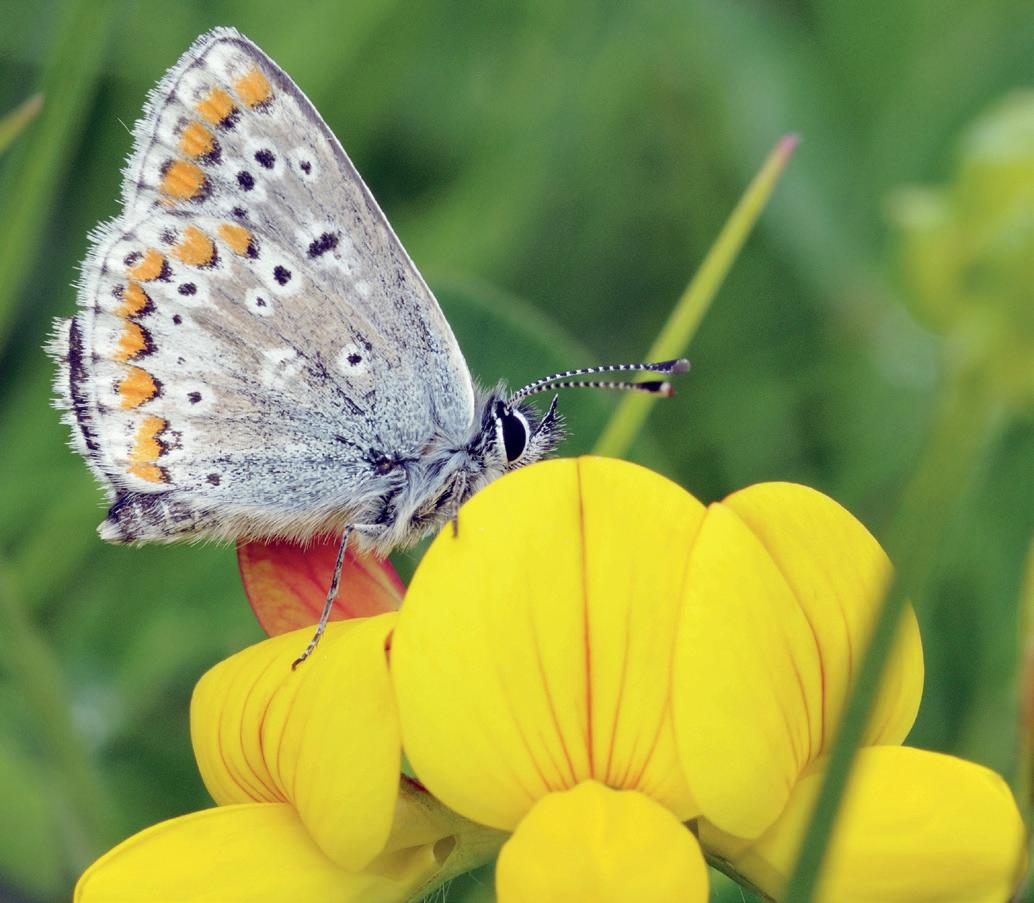

This perennial plant’s yellow flowers were used for red dye and tea. The Gaelic translates as ‘the rennet plant’ as it was once used to curdle milk. Another word
MEMBERS’ EXCLUSIVE EVENT MOREEVENTS ONPAGE55
for it, lus Chù Chulainn –meaning ‘Cù Chulainn’s plant’ – hints at tales of this tea’s ability to calm a historic Gaelic warrior of the same name. Leabaidh ban-sìth, or ‘bed of a female fairy’, is another of its nicknames.
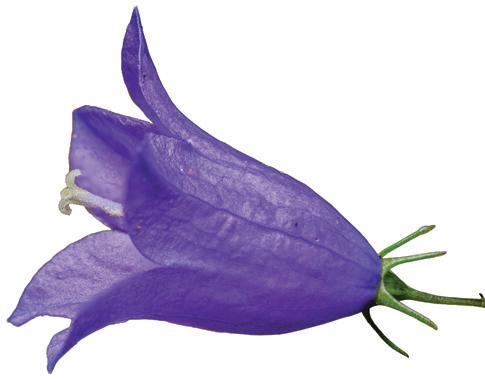
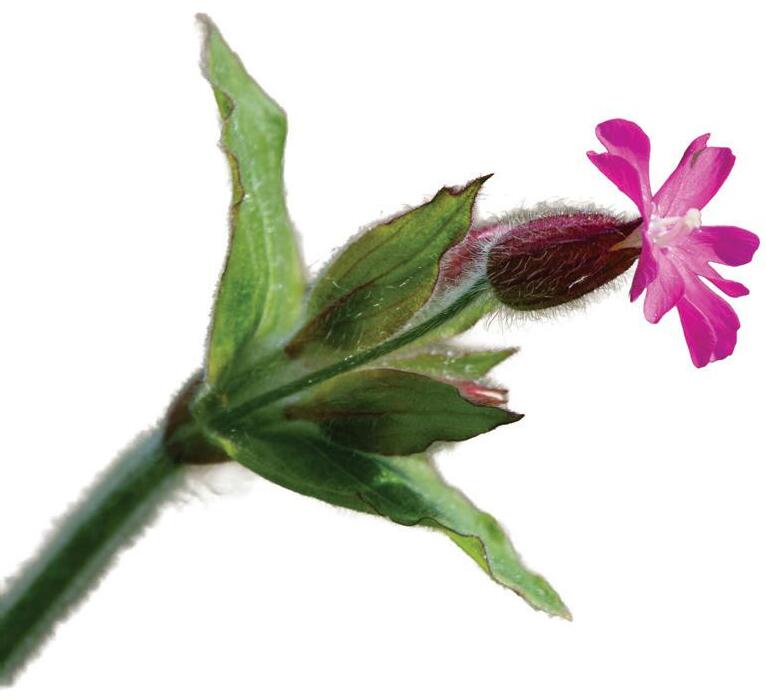
The Gaelic word for these insects, which are deeply linked to summer, means ‘God’s spark’ or ‘flash’. You’ll see butterflies fluttering between red campion flowers – cìrean-coilich (‘cockerel’s comb’) – and the harebell – currac na cuthaige (‘cuckoo’s cap’). Also keep an eye out for northern brown argus fluttering around ròs na grèine, meaning yellow rockrose or literally ‘rose of the sun’.
Viewthefloraandfaunaofthisroyalpark throughScotland’sancientlanguage
This June, join us on a guided walk through Holyrood Park with Gaelic teacher and singer Bria Mason. She’ll be sharing sgeulachdan (Gaelic stories) and identifying the park’s flora and fauna, while providing their Gaelic names and associated folklore. Bria’s tours will be in English so no prior Gaelic knowledge is needed. The tour route is a moderate graded walk, mostly on paths. There will be some rough tracks, uneven and boggy terrain and steep sections, so wear suitable footwear.
Tue 23 and Thu 25 June, between 2pm and 3.30pm. Book your place at hes.scot/member-events

ARCHIVEHIGHLIGHTS
ArchivistJoeWaterfieldspotlightsdesignsbyanacclaimedScottishpartnership
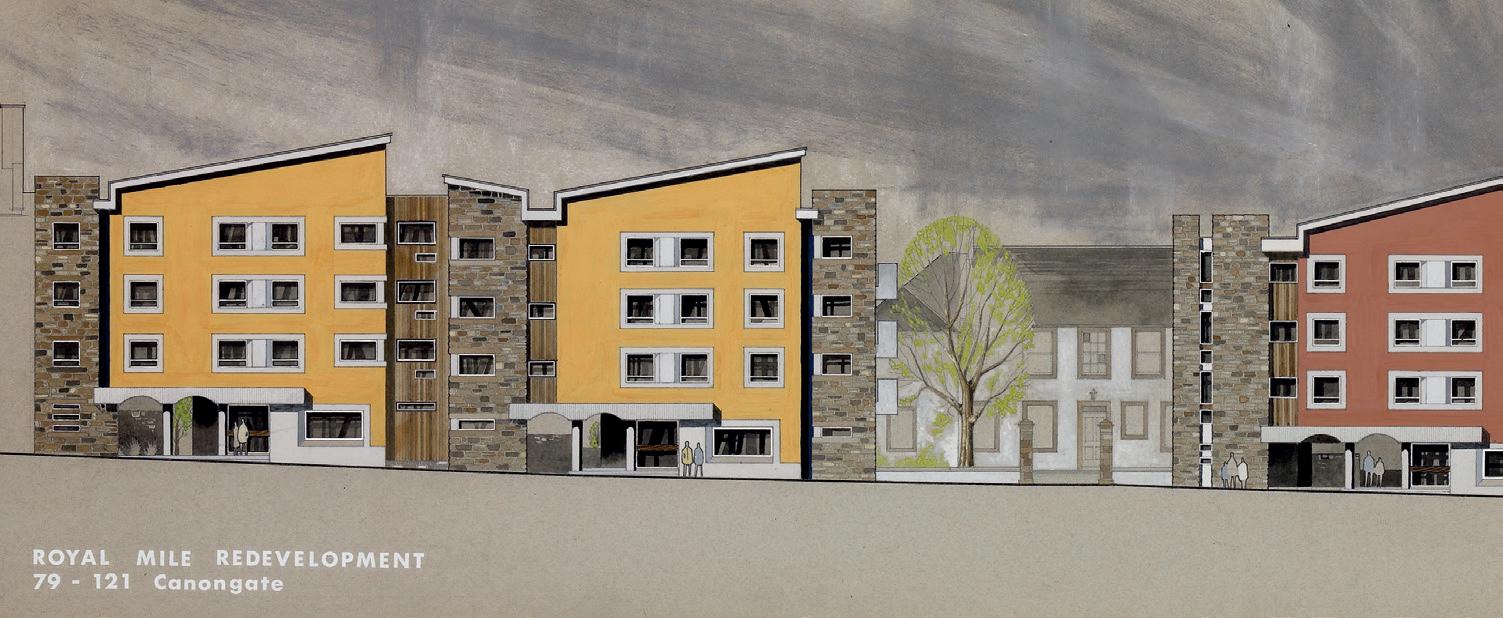
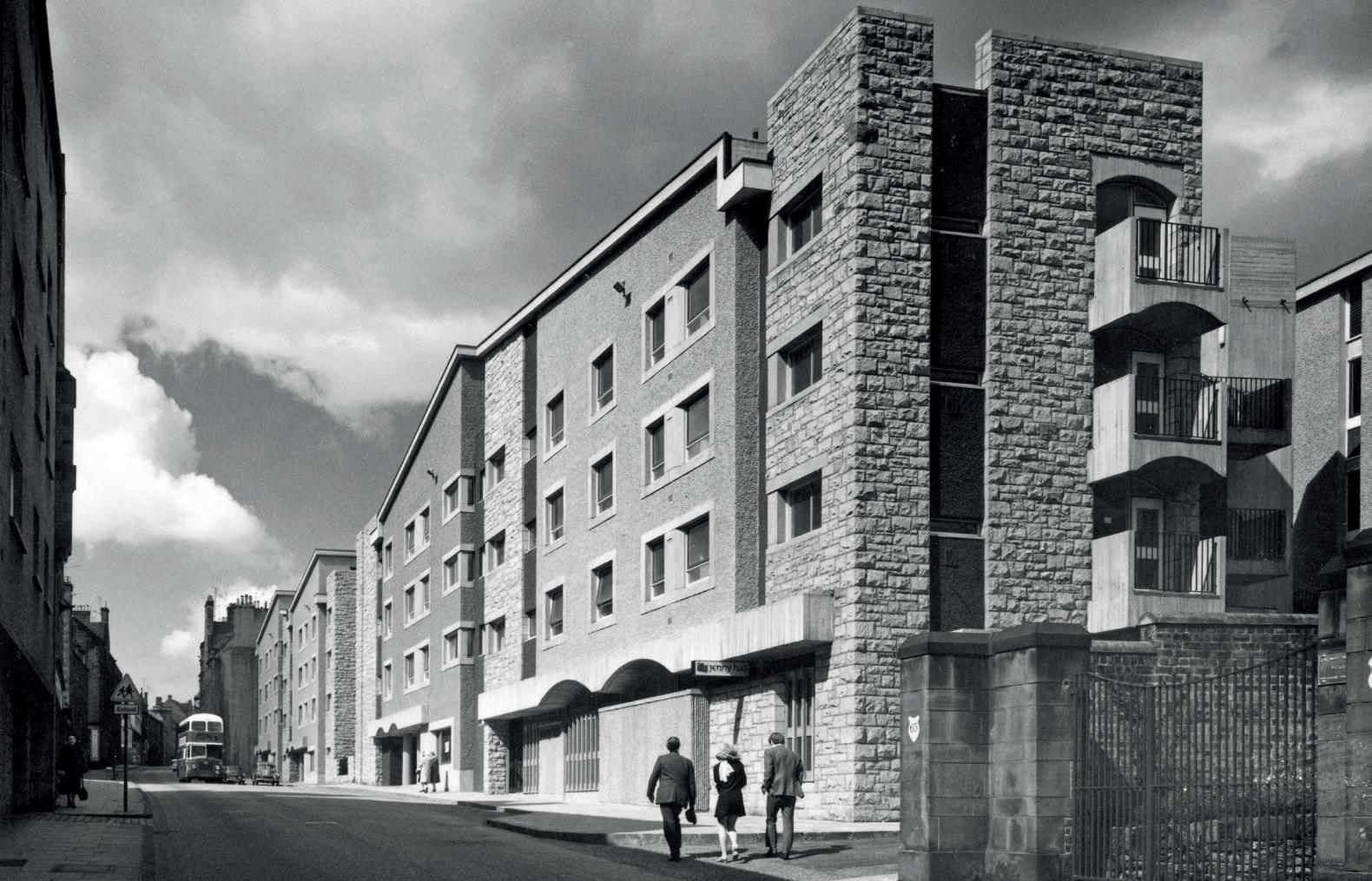
Sir Basil Spence was a renowned Scottish modernist architect whose famous designs include Glasgow Airport, Rome’s British Embassy and Coventry Cathedral. This drawing and photograph of the Canongate Housing Development were created by his practice, which he ran in partnership with architects John Hardie Glover and Peter Ferguson.
Edinburgh’s Canongate was run-down by the mid-20th century.
Consequently, Spence’s firm was contracted to replace the 18th and 19th-century tenements with more habitable housing.
His practice took pride in this work. Spence wrote in 1959 that the housing could be “a wonderful opportunity to get vitality into the Royal Mile” – although he was mindful that the new buildings needed to exist harmoniously with the Old Town’s heritage.
In a 1968 letter, a colleague of Spence’s wrote that the firm wanted
ARCHIVES TEAM TALK
Bookyourplace forourfreetalk,Housing forthePeople:Howthe TenementBuiltUrban Scotland,on28September byemailing archives@hes.scot
to avoid designs which overly mimicked historical buildings, as they wouldn’t stand up when compared to “so much in this city of genuine historical value”.
Work on the Canongate Housing Development was completed in 1969. Today, its historic interest is underlined by its Category B-listed status.
•Some drawings of 19th-century tenements will be on temporary display at John Sinclair House until 31 October, or online at trove.scot
Creativetreasuresto discoveratoursites
FORTGEORGE
From 1 August, Drawn from the Archives celebrates the wonderful drawings held in our collections. Discover how illustrations help us to imagine and connect with the world.
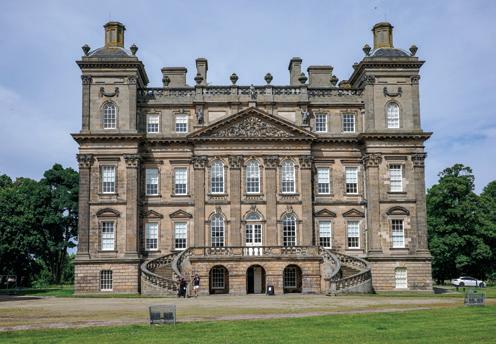
DUFFHOUSE
See Stanley Spencer’s 1950 work Christ Delivered to the People at this William Adam designed mansion until 27 September. Loaned from the National Galleries of Scotland, the painting depicts a moment from the crucifixion of Jesus.
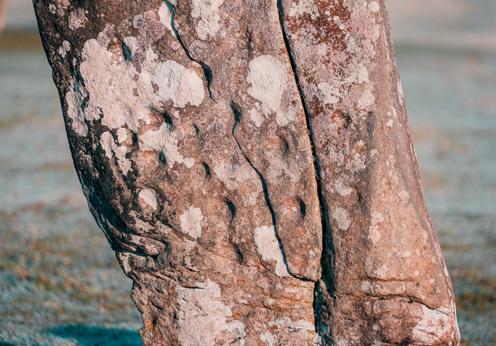
The Late Neolithic rock art found on several outcrops within the glen – including multiple ring marks and spirals – give us an intriguing glimpse into our prehistoric past.
•
Discover more days out at historyawaits.scot
Double Olympic silver curling medallist Bruce Mouat reflects on the happy memories he’s shared with loved ones at Tantallon Castle
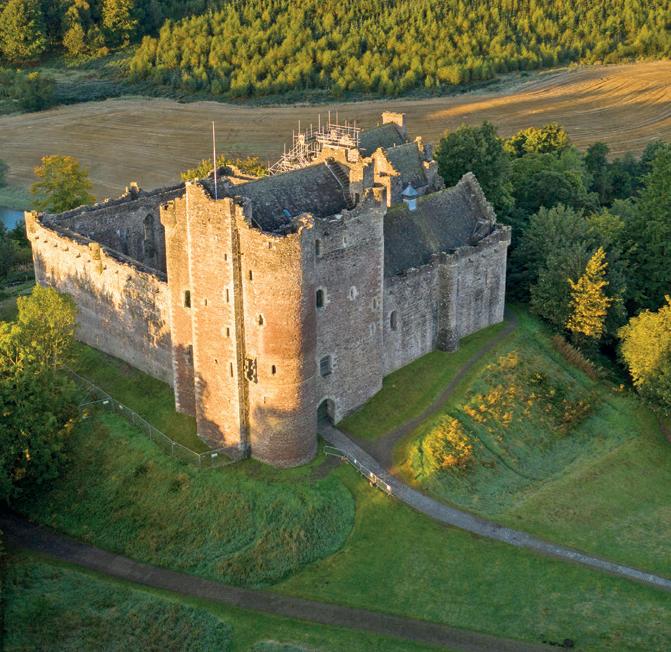
Having grown up in Duddingston, Edinburgh, East Lothian has long been one of my favourite places to explore. We used to take our family dog, Abby, for walks along its picturesque beaches and cliffs near North Berwick, so Tantallon Castle has always been on my periphery. I have a special memory of my partner and I visiting Tantallon Castle on an exceptionally sunny day, which made the orange-red hues of its mighty sandstone curtain wall contrast with the turquoise Firth of Forth behind. It left such a lasting impression on us both. We’ve also been known to recreate the hilarious clip-clop scene from Monty Python and the Holy Grail – which was filmed at Doune Castle –here too!
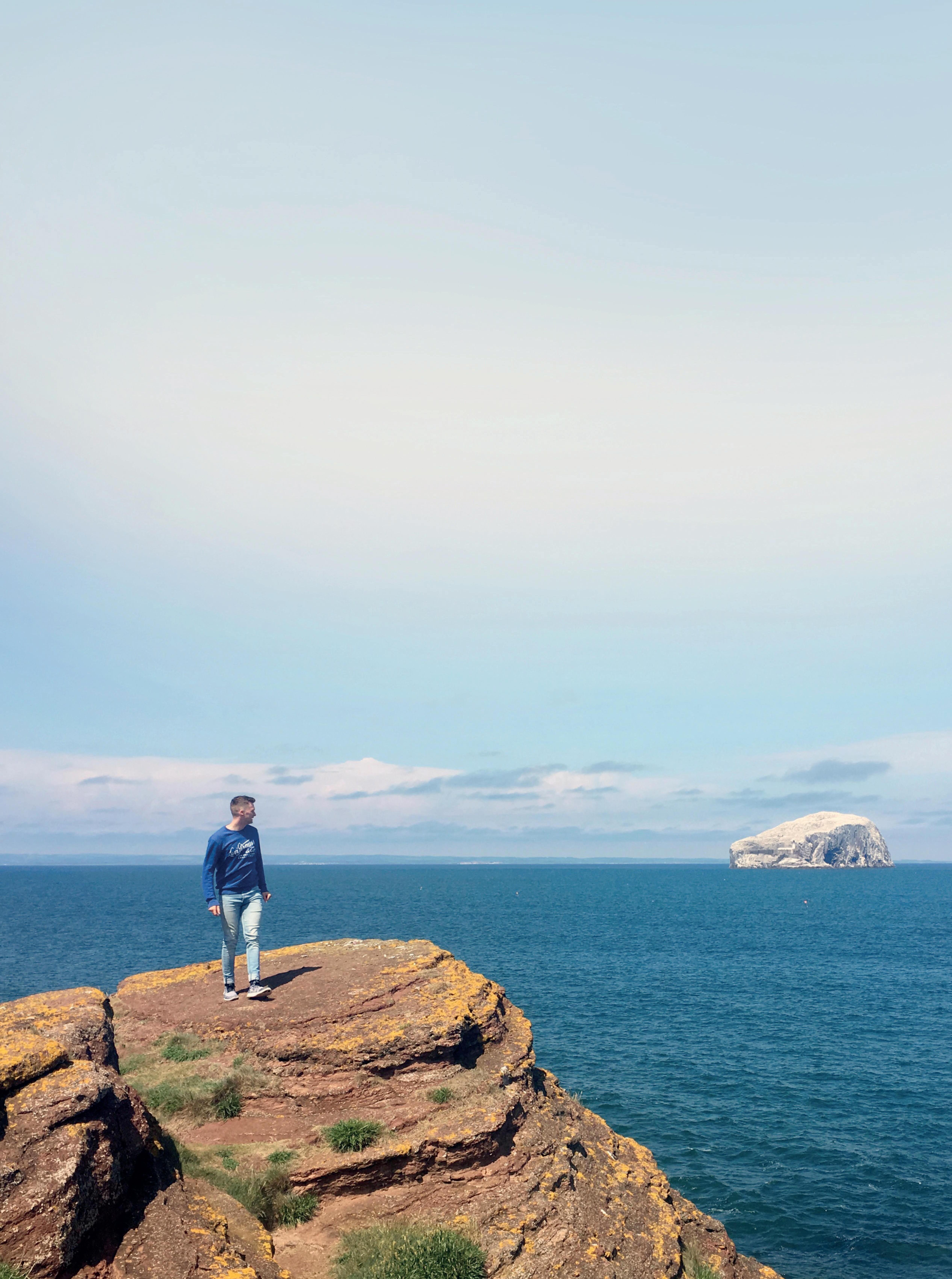
Built in the mid-1300s, Tantallon Castle is a striking place to visit all year round, but it truly comes alive in summer. Climbing Tantallon’s towers rewards you with spectacular views of the North Sea and Bass Rock. This
island has the world’s largest colony of northern gannets, and has over 150,000 occupied nests in summer, so you’ll see lots of these seabirds swooping through the air. And if you’re lucky, you might spot seals splashing in the Firth of Forth too.
I’d also recommend wandering to Seacliff Beach below Tantallon Castle. It’s a prime spot to tuck into a picnic.
I’m an outdoorsy person, so finding somewhere tranquil like Tantallon Castle where I can explore, watch wildlife and learn about Scotland’s history is the perfect fit. It’s great to imagine what life would’ve been like here in its heyday when visiting.
I come from a sport that also has a lot of history behind it. Native to Scotland and one of the world’s oldest team sports, curling dates to 1511 and was originally played on frozen lochs. While curling’s story is ancient, Tantallon Castle’s story stretches back centuries further. That’s why it’s important to learn about the heritage behind places like this and how
they’ve shaped us today. Tantallon Castle is somewhere I’ve spent amazing times with my family and partner. The stories and memories so intrinsic to it must be safeguarded for future generations to enjoy – which makes Historic Environment Scotland’s work to protect it even more vital.
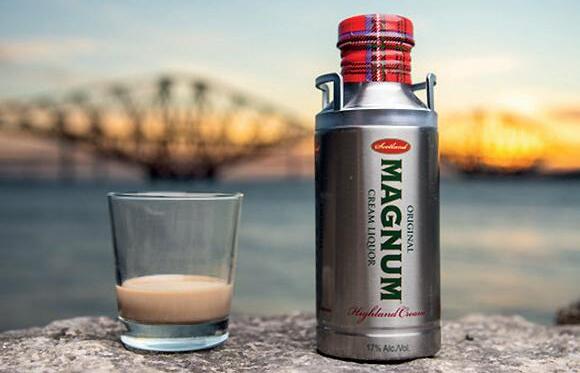
Magnum is the proud sponsor of Team Mouat, Olympic Silver curling medallists in 2022 and 2026. Find out about our exclusive Edinburgh Castle miniature gift pack on page 49.
Tantallon Castle is a striking place to visit all year round, but it truly comes alive in summer

Why pay twice as much for boots of this quality, when these superb Rambler Boots (for men and women) are under £45. All the advantages of a 'performance' boot for half the price. Bird watchers, dog walkers and serious outdoor types have been trusting Hoggs of Fife boots for over 138 years. So put your feet in Scotland's finest, order today.

• Fully waterproof and breathable
• Lightweight unisex boot for all ages
• Hydry™ lining wicks away moisture
• Comfortable padded ankle support
• Real suede/fabric uppers
• Quick release D-ring fastening
• Shock absorbing sure-grip sole
• Replaceable cushioned insole aids air circulation
Unisex sizes: 4, 5, 6, 7, 8, 9, 10, 11, 12
Colours: Fern Green, French Navy
with Ranger Gordon Smith
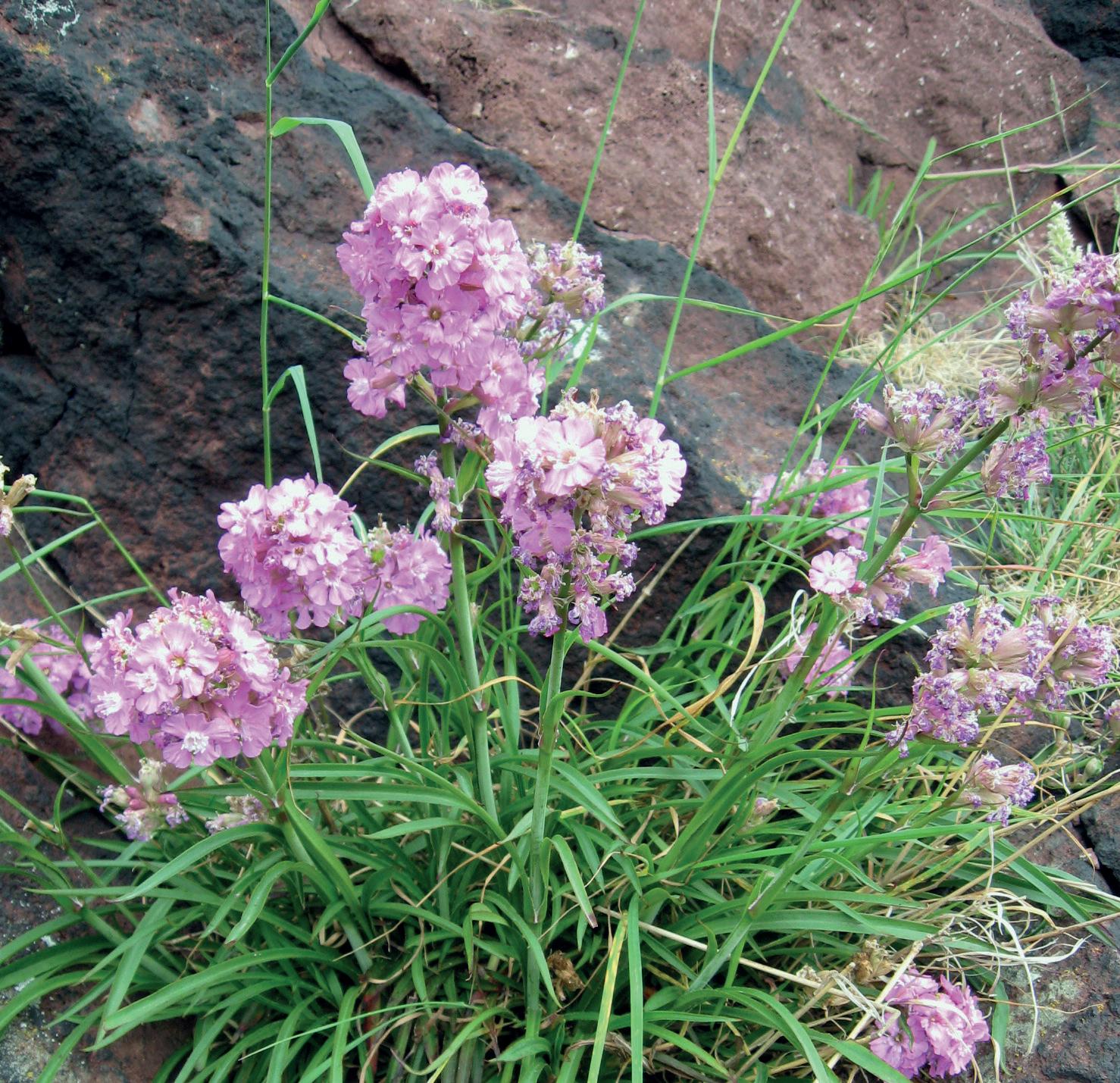
Maintaining a centuries-long connection between Viscaria vulgarisand Holyrood Park
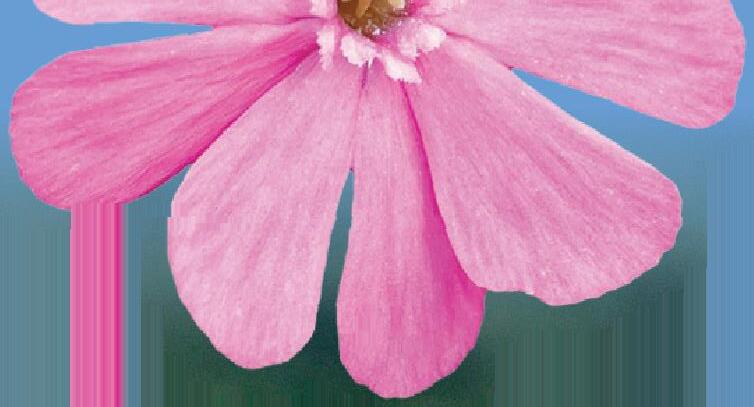
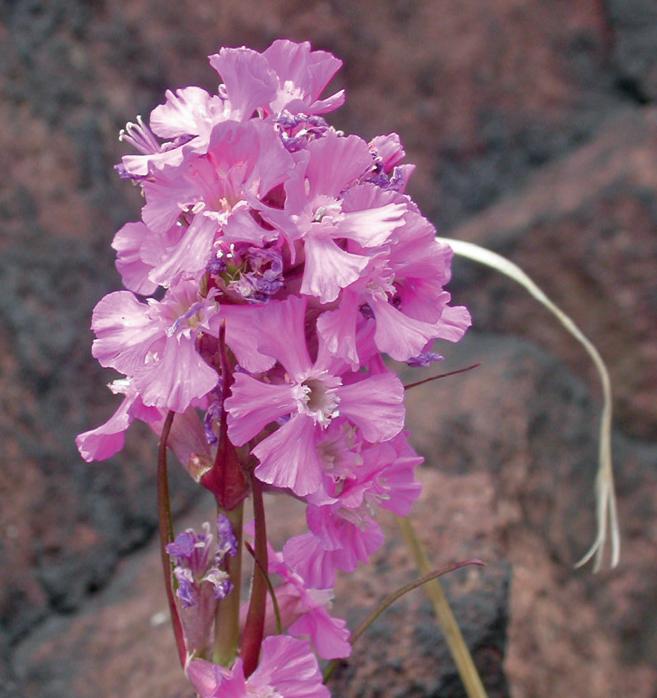
Despite appearing barren and inhospitable, the rocky outcrops that define Holyrood Park’s volcanic landscape are the perfect habitat for one of Scotland’s rarest plants: sticky catchfly (Viscaria vulgaris).
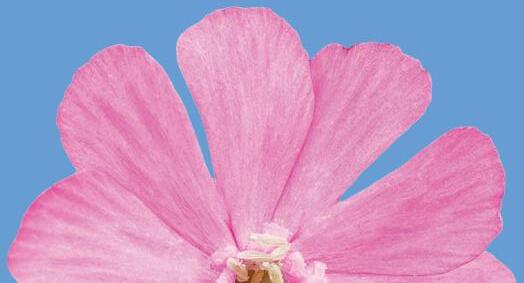
This plant – which has only 18 populations in Britain – thrives among the park’s inaccessible ledges and thin soils. In fact, this pink perennial has been connected to this city landmark for hundreds of years, having been discovered and scientifically recorded here in the 17th century. Today, it stands as Midlothian’s county flower.
The sticky catchfly population has declined rapidly over the years due to quarrying, botanical collections, fires and rock management. As recently as 1993, there were only four individual plants left, and sticky catchfly was at
risk of disappearing from Holyrood Park.
Consequently, Holyrood Park managers and the Royal Botanic Garden Edinburgh joined forces on a pioneering translocation project to collect seeds and reintroduce cultivated plants to suitable locations. They began a second project in 2014 to establish further new populations.
The sticky catchfly gets its name from its upper stem nodes, which make a tacky substance to stop insects stealingnectar.
This work has been an amazing success story, with 200 sticky catchfly
Threesiteswithfantasticsummertimefloraandfauna
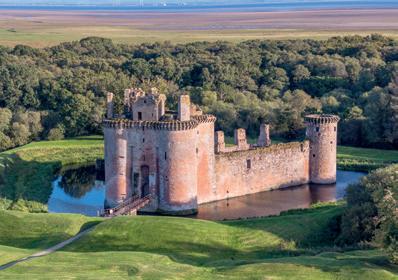
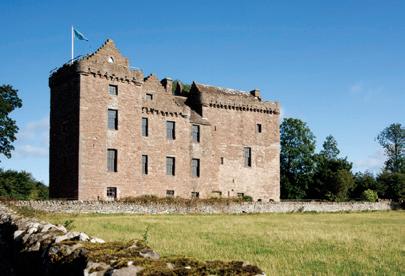
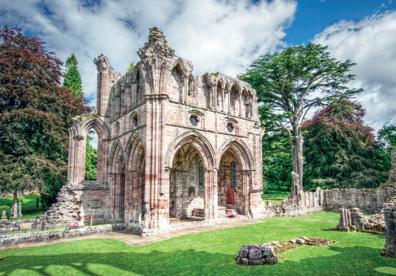
Thenorthernmost populationoftherare natterjacktoadcanbe heardcroakinginthe groundsofthis medievalstronghold.
This15th-century buildingishometo pipistrelle,long-eared andNatterer’sbats, barnowls,roedeer andhedgehogs.
ABBEY Witnesswildflowers–includingyellowrattle, yarrowandorchids–infullbloomatthis Premonstratensian monasteryfoundedin around1150.
plants spread throughout Holyrood Park today. Visit between May and July and you might see its beautiful pink petals in full bloom.
Sticky catchfly remains one of our conservation priorities. In summer, the Ranger Service undertakes a careful programme of monitoring, supported by our dedicated team of volunteers.
All season we survey the populations, recording details such as plant and flower numbers and seed counts. This enables us to accurately assess the situation and respond to any threats.
As summer ends and sticky catchfly goes to seed, our efforts turn to enhancing the plant’s surrounding habitat. Given its small size, sticky catchfly is at risk from encroachment by larger species, such as gorse. Shading and competition can also be an issue, so we remove any areas of problematic vegetation.
Holyrood Park may now have significant plant numbers, but there’s still plenty to be done to protect this special plant. Since last year, we’ve assisted the City of Edinburgh Council’s Rare Plants Project to establish new populations of sticky catchfly and other rare plants across the capital.
Honouring the Battle of Linlithgow Bridge’s quincentenary
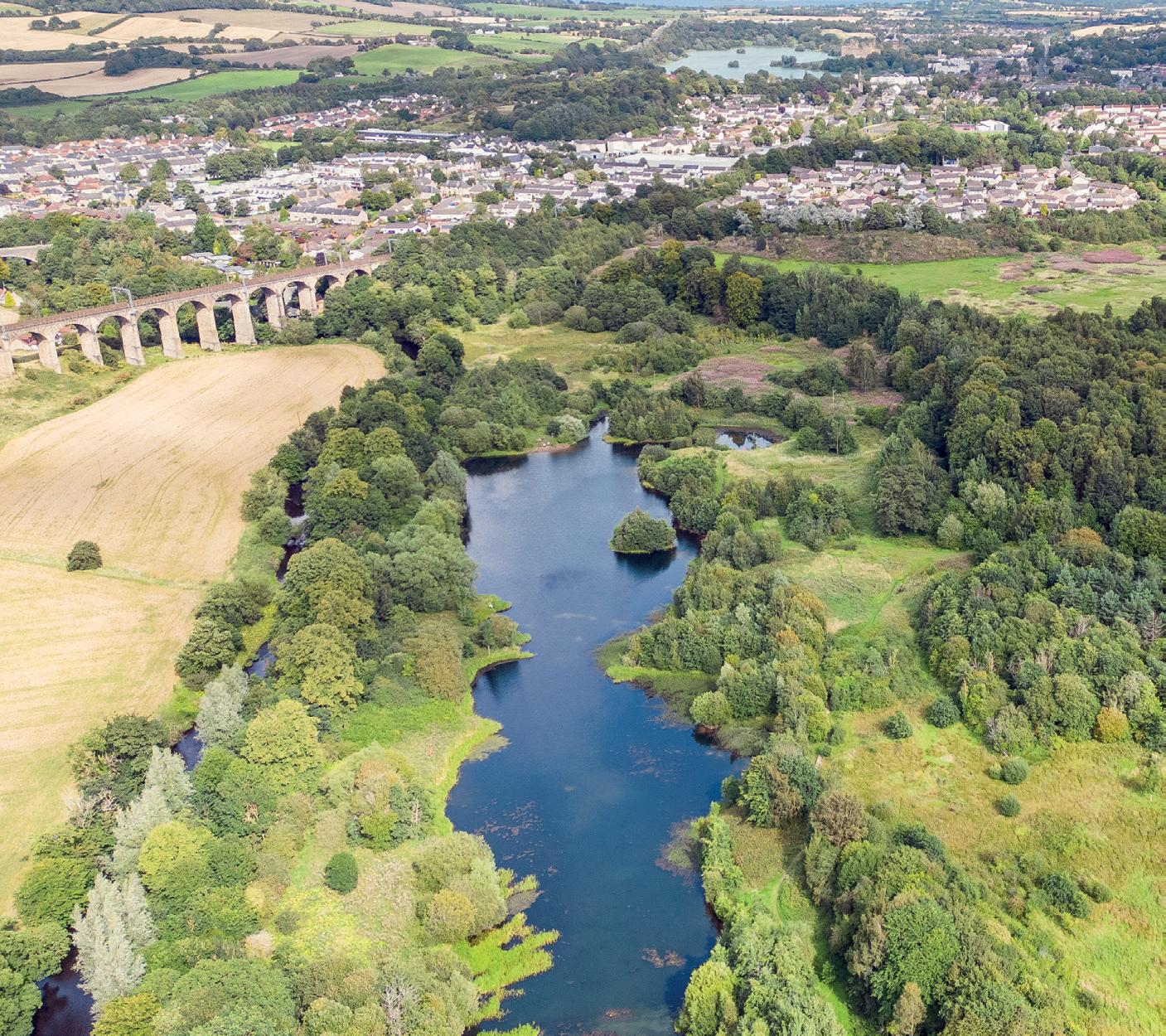
Community groups in Linlithgow, with support from West Lothian Council and us, have created the Battle 500 programme to mark the 500th anniversary of the Battle of Linlithgow Bridge, fought in the town on 4 September 1526.
The battle saw the Earl of Lennox lead an army to Linlithgow to liberate the young King James V from the proEnglish Douglases. Lennox was defeated by the Earl of Arran and taken captive before being killed by James Hamilton of Finnart. Many of our properties –including Linlithgow Palace, Kinneil House, Blackness Castle and Dunfermline Abbey – were bound up in the politics that motivated this conflict.
Battle 500 showcases how the battle shaped the Stewart line of succession
as well as the royal burgh of Linlithgow. An eclectic programme of events includes walking tours, an interactive exhibition and special performances at Linlithgow Palace and St Michael’s Parish Church –culminating in a battle re-enactment at the site during the first weekend of September.


Formoreinformation,visit battle500.org.uk
Why is Scotland’s history important to you?
I have Scottish heritage, so I travel to Scotland from Canada as often as I can. My late father fell in love with Stirling Castle, which I visited shortly before he passed.
Which of the sites we care for have you visited?
On my most recent trip I visited Huntingtower Castle, Glasgow Cathedral, Kilmartin Glen and more. I also joined your ‘Secret Stirling’ guided tour. Seeing the staff’s joy in sharing insights on the castle’s unseen locations was amazing.
How does Scotland’s heritage shape your work?
Last year I completed an MLitt in Scottish Heritage at the University of Aberdeen,
and this has influenced my art therapy practice. Visiting heritage sites promotes the wellbeing benefits of forming a deeper connection between place and self.
Why are you leaving us a legacy?
Heritage sites are key to understanding our past and enhancing our wellbeing. I want future generations to experience these benefits. Contributing to the care of the sites Historic Environment Scotland looks after via a legacy gift ensures people can enjoy them for years to come.
Legacygivinghelpsusto protectScotland’sheritage forfuturegenerations.Find outmoreaboutleavinga giftinyourwillbyemailing legacies@hes.scot

Hallmark Roofing Edinburgh Ltd specialises in the repair, renewal and conservation of traditional slate and lead roofs on historic and listed buildings across Scotland.
Our work respects original building fabric and follows best-practice conservation guidance to ensure longevity, authenticity and architectural integrity.
We work closely with homeowners, estate managers, architects and conservation bodies to deliver workmanship of the highest standard.
Discover the ruins of Kirkwall’s oldest surviving domestic building alongside a Renaissance jewel
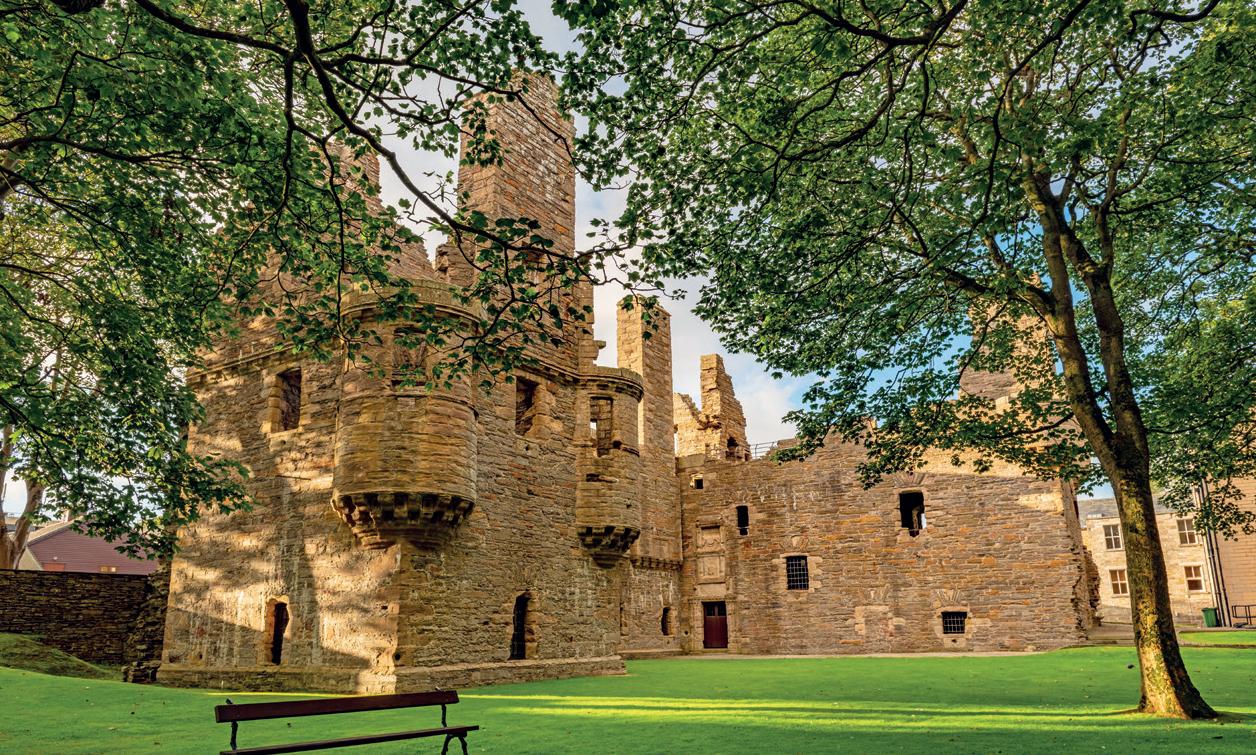
The story of these remarkable ruins in the heart of Kirkwall, Orkney, began with the building of the Bishop’s Palace in the mid-1100s, probably around the same time as St Magnus Cathedral. Kirkwall was then becoming the new capital of the Norse earldom of the Northern Isles.
Earl Magnus had jointly ruled Orkney with his cousin Earl Haakon until his murder following a dispute. A cult of Magnus emerged, which Bishop William – who oversaw the palace’s construction –aligned with after, it is said, being miraculously cured of blindness.
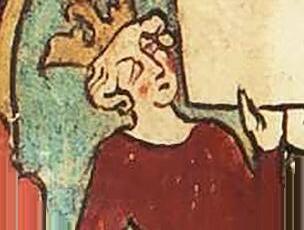
A century later, the palace was witness to the death of King Haakon IV of Norway, after the near defeat of his fleet in the Firth of Clyde. The Saga of Haakon Haakonsson
The Bishop’s Palace is built for Bishop William, when he moved Orkney’s first cathedral in Birsay to Kirkwall.
describes how, in a palace chamber, “at midnight Almighty God called King Haakon out of his mortal life”.
In the 1550s – with Orkney now part of Scotland – the palace was enlarged and enhanced, including the addition of a formidable round tower for Bishop Reid, who had been a trusted ally of James V.
After the Reformation in 1560, the bishop’s power waned. By 1594, Patrick Stewart, 2nd Earl of Orkney, had taken over the palace. Known for living beyond his means, the notorious ‘Black Patie’ added the Earl’s Palace, creating a Renaissance jewel that left him ‘drownit in debt’.
After another period as a bishop’s residence in the 17th century, the palace eventually fell out of use and into ruin.

1263
King Haakon IV of Norway and his fleet come to Kirkwall on their way home from a near defeat at the Battle of Largs. The king dies in a palace chamber weeks later.
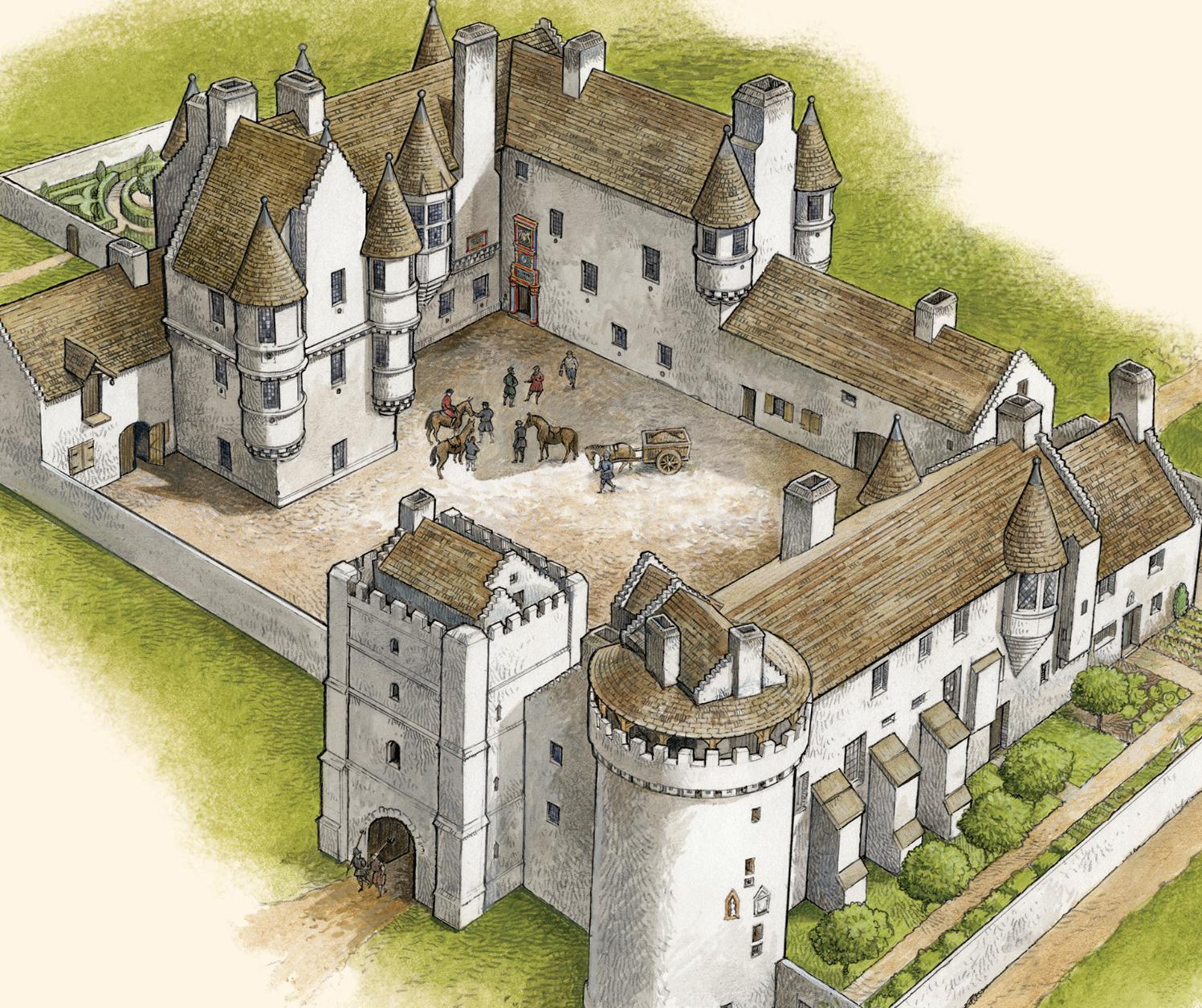
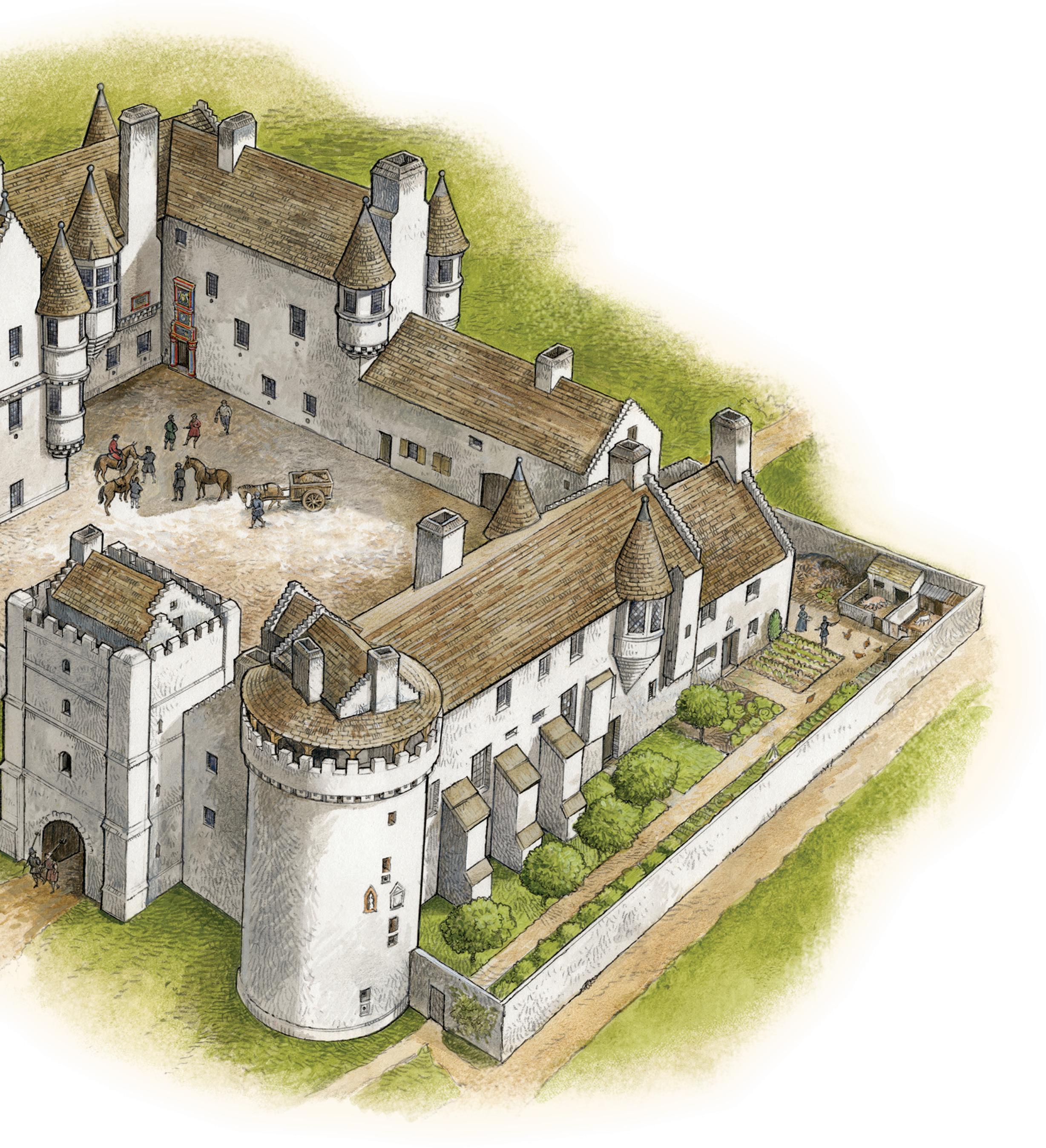
The Bishop’s and Earl’s Palaces as they may have looked on completion around 1607
AND EARL’S PALACES
4 THE EARL’S PALACE
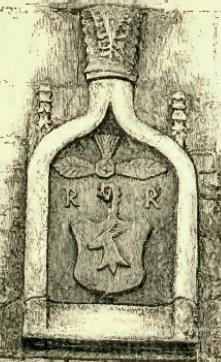
The elaborate entrance bore carved stone panels with the arms of Earl Patrick and the royal arms of Scotland.
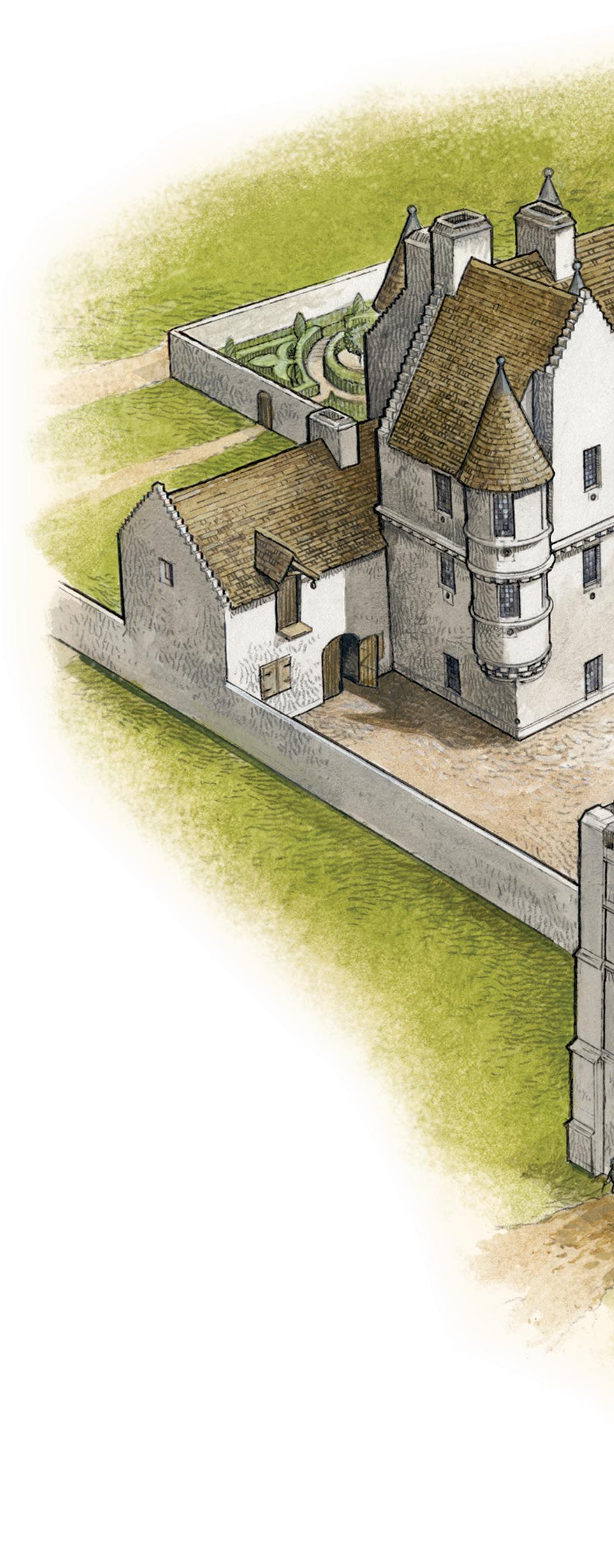
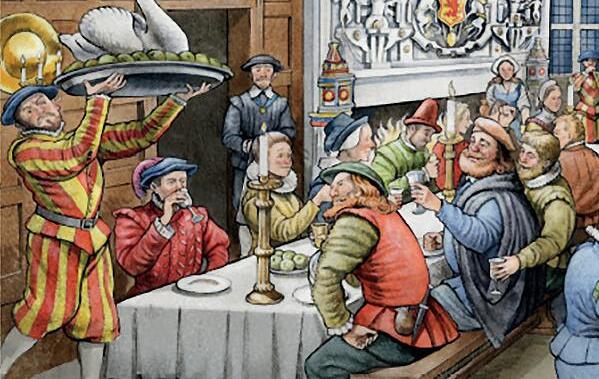
5 THE GREAT HALL
With five cellars on the ground floor, Patrick’s state room, designed for banquets and other public business, was kept well provisioned.
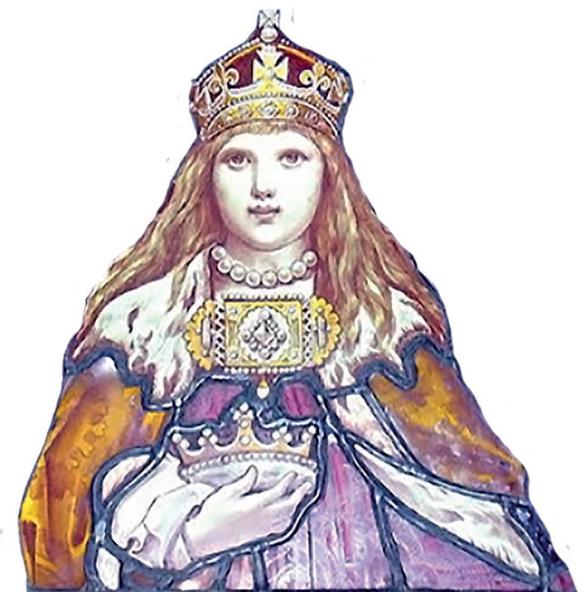
Margaret, the Maid of Norway, dies on her way to Scotland. Her body is thought to have been brought to the Bishop’s Palace.
Robert Reid is appointed Bishop of Orkney and oversees extensive remodelling of the palace. The new round tower, with formidable defences, becomes known as ‘the Moosie [mouse] Toor’.
1 BISHOP’S PALACE
The grand, twostorey residence for the bishop of St Magnus Cathedral later became part of Patrick Stewart’s Renaissance palace.
1593
Patrick, 2nd Earl of Orkney, oversees the new Earl’s Palace and remodelling of the Bishop’s Palace, creating a luxurious Renaissance dwelling. He racks up debt before it is completed in 1607.

2 BISHOP REID’S TOWER
This private apartment of Bishop Reid, with four storeys and defensive features, was added during a remodelling of the palace in the 1550s.
3 COURTYARD
This was the heart of the palace complex, with constant comings and goings, all observed by the steward from his first-floor room.
6 GUEST CHAMBERS
These upper rooms had ensuite facilities and access to turrets that afforded good views of the cathedral and town.
1650
After Patrick’s execution in 1615, the palace falls into decay, but is briefly occupied by John Graham, marquis of Montrose –leader of Royalist forces against Scotland’s Covenanting armies.
7 EARL’S PRIVATE CHAMBERS
Used by the earl and privileged guests, this suite of rooms included a private dining room and a bedchamber.
1689
The Earl’s Palace had once again become a bishop’s residence, but it is now abandoned following the abolition of the episcopacy.








































Ready for an adventure like no other?
We’ve five fabulous quests to keep kids of all ages entertained and ensure everyone has a grand day out.




WORDS: BARBARA HENDERSON































Irecall it vividly – the school holidays stretched before us like a six-week-long obstacle course. With three youngsters to entertain and a limited budget, we considered our options.
Dumfries and Galloway fitted the bill, I suggested, sneakily withholding the fact that I needed to visit the region to research my Burns-themed smuggling book. To my delight, the rest of the family agreed.
However, the week turned out to be a drizzle-fest of Old Testament proportions – day after day of mainly staying put in the small self-catering cottage that we had rented. On the Friday, with my research complete, we decided to venture out anyway.
“What’s a little rain? Let’s do something! There is a castle not far from here.” Little did I know that I was about to fall in love at first sight.
As soon as we entered Caerlaverock Castle, I was smitten. The drawbridge, the moat! The triangular shape of the ruin, so different from any other castle I knew. Needless to say, the children adored it – they were knights from the moment they thrashed across the wooden drawbridge. What child doesn’t love a quest?
Youngsters to entertain over the summer? Fear not, help is at hand!
“What’s a little rain? Let’s do something! There is a castle not far from here”

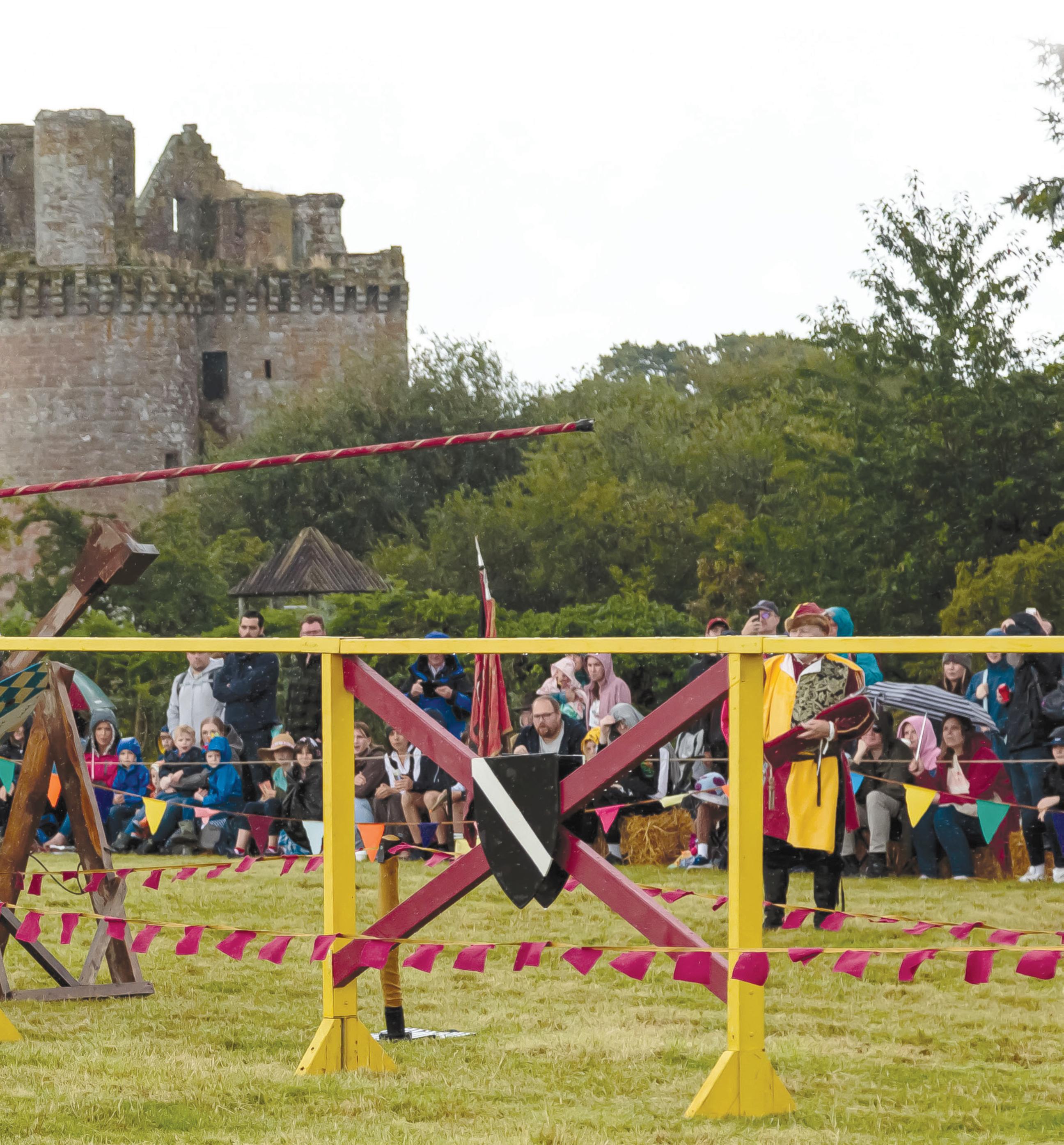

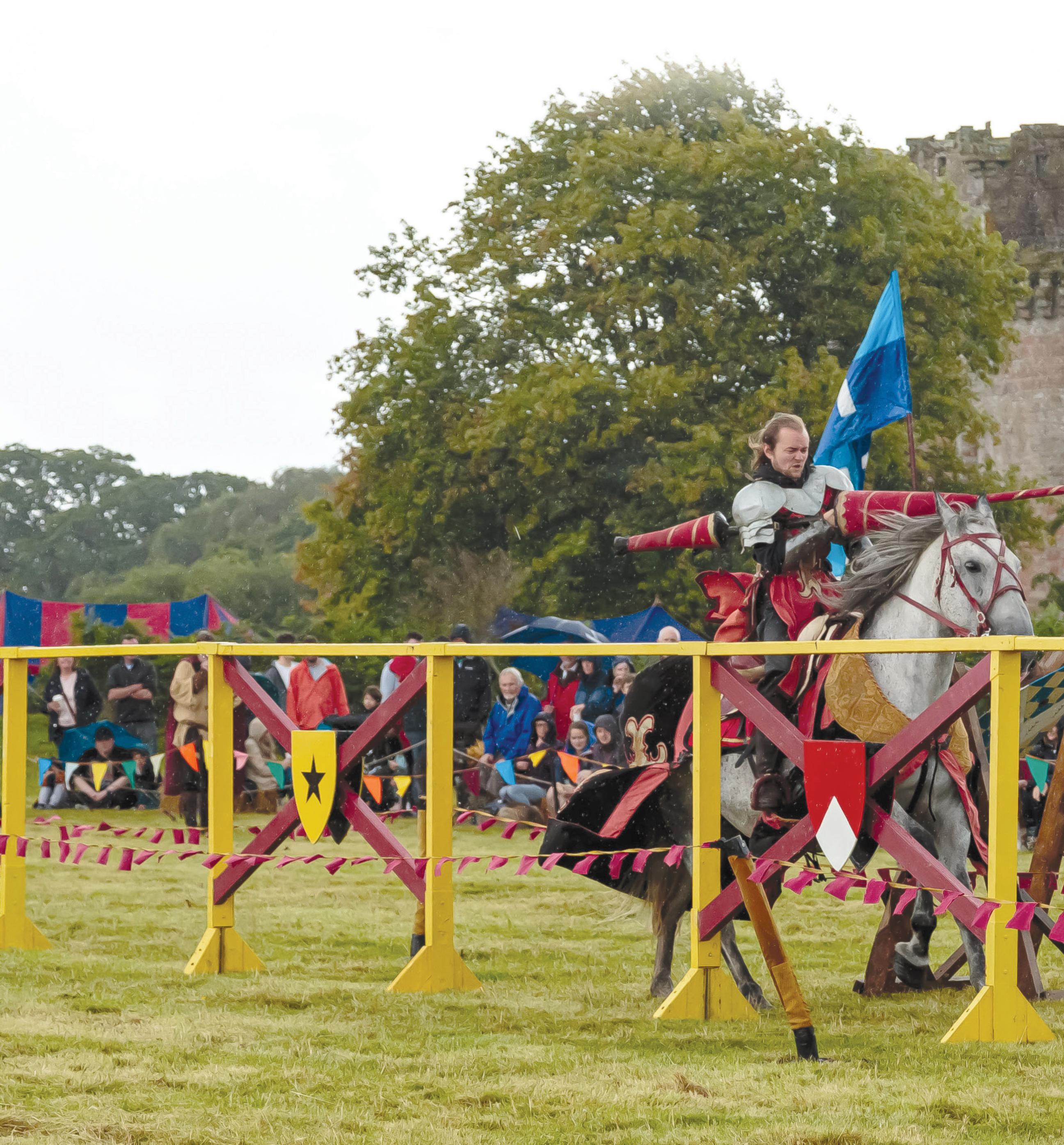
Caelaverock Castle is joust the ticket for a day of thrills and spills
Stories don’t come more dramatic than the medieval poem detailing the days when Edward I, the Hammer of the Scots himself, led an army across the border and laid siege to Caerlaverock in the year 1300. Can you spot the roughly hewn stone balls hurled at the castle walls by terrifying trebuchets during the many sieges here?
1Apart from its compelling past, Caerlaverock offers costumes to try on, art activities and a lovely trail through woodland. You may even see roe deer.
In the 1300 siege, there
were only 60 men to defend the castle against the might of Edward’s army, 87 knights and 8,000 foot soldiers strong.
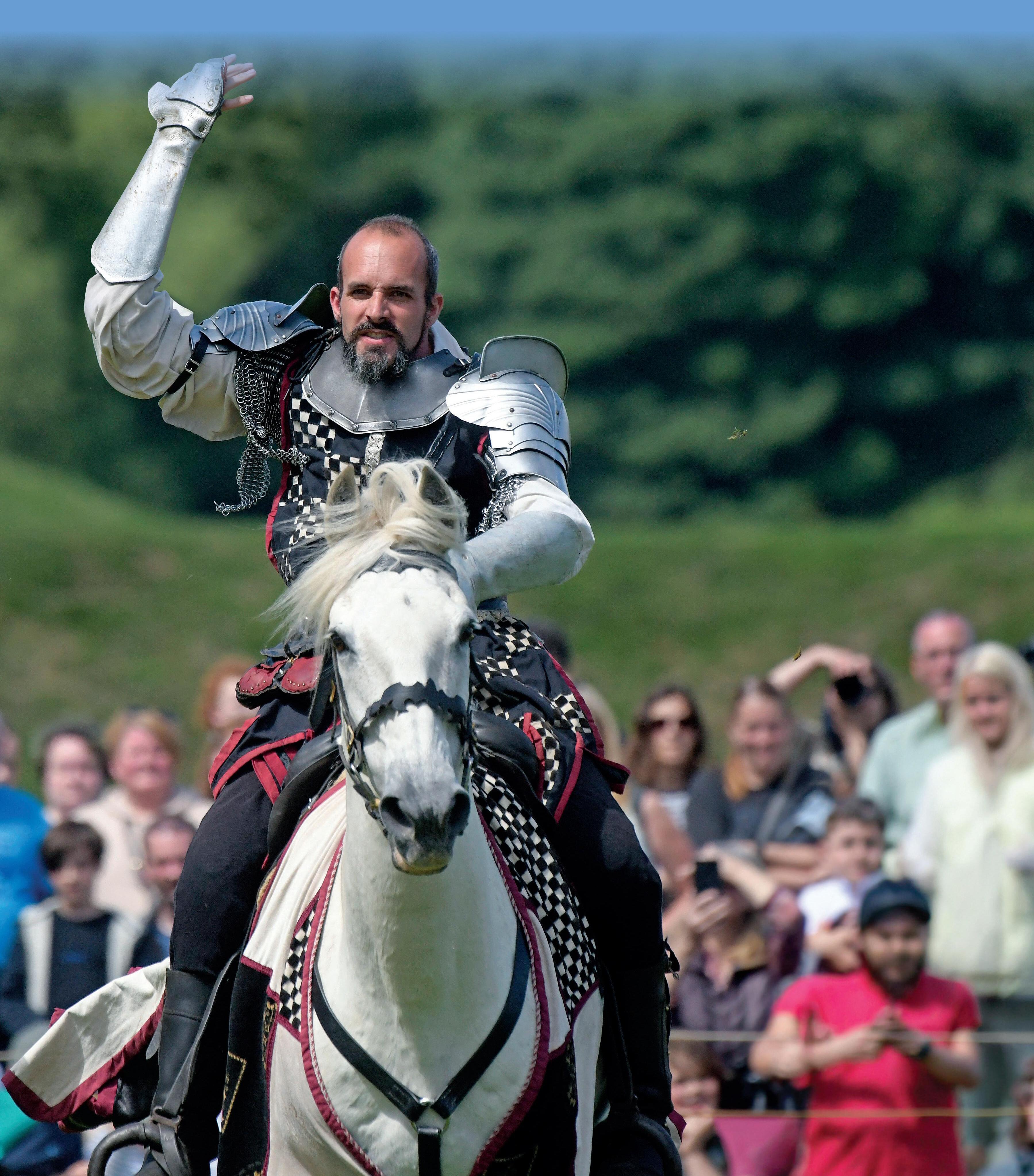
Caerlaverock hosts the medieval-style Spectacular Jousting event on Saturday 25 and Sunday 26 July.
For details visit hes.scot/ spectacular-jousting
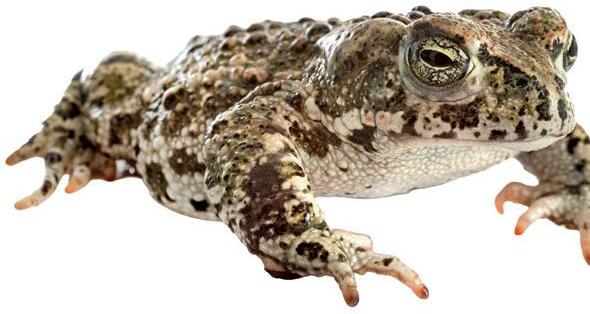
Why not combine a trip to the castle with a visit to the adjacent Caerlaverock Nature Reserve, Scotland’s most important breeding site for the rare natterjack toad.

Come rain or shine, Fort George always entertains
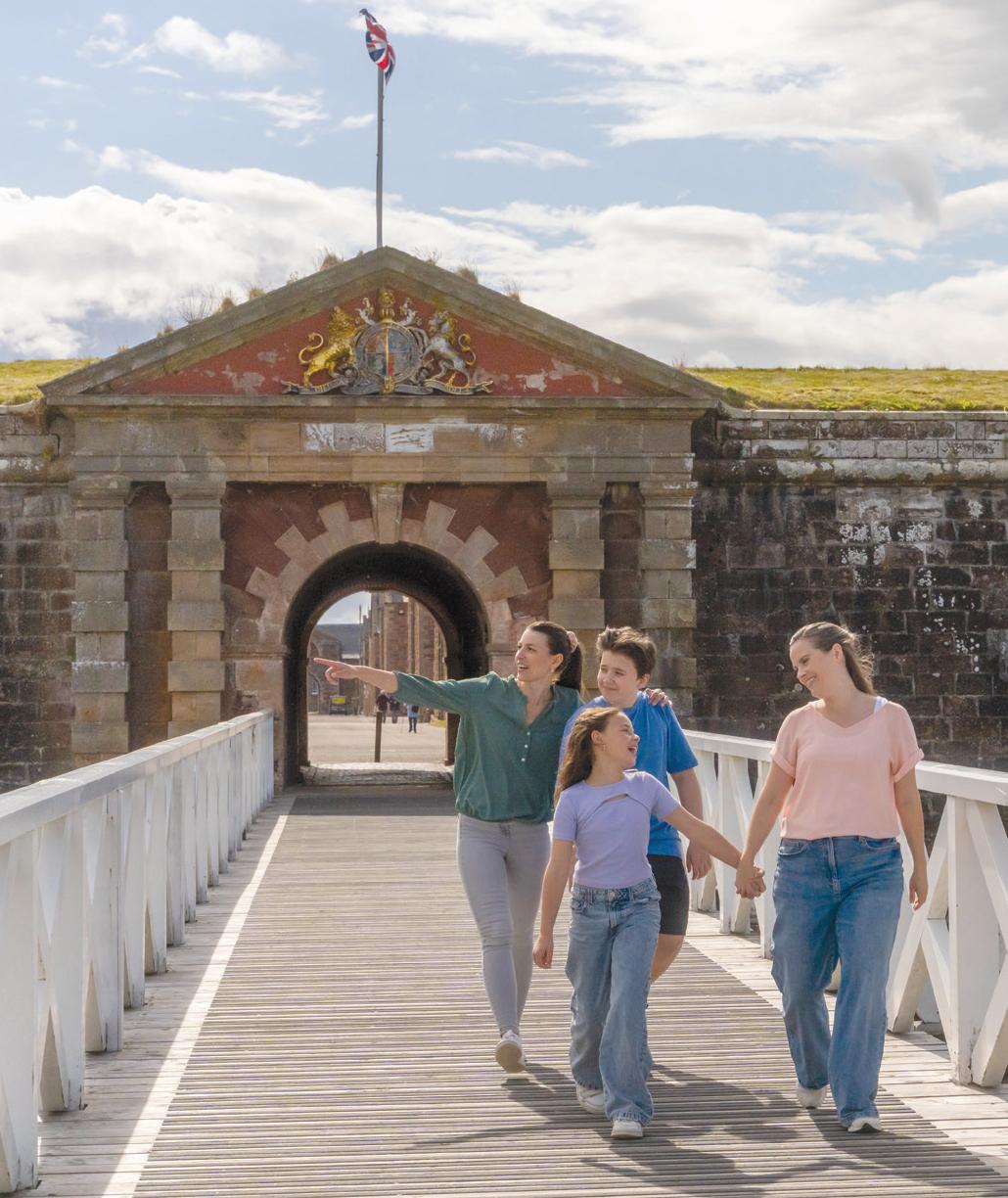
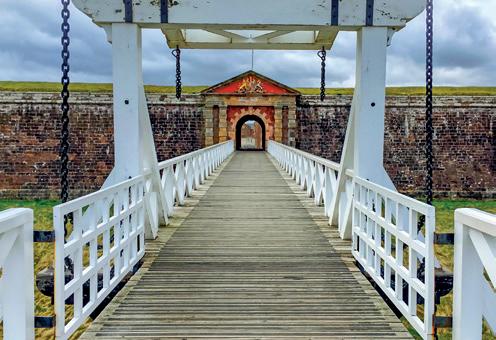
2Host to the popular annual Celebration of the Centuries event (8 and 9 August), Fort George in the Highlands has a lot to interest would-be warriors.
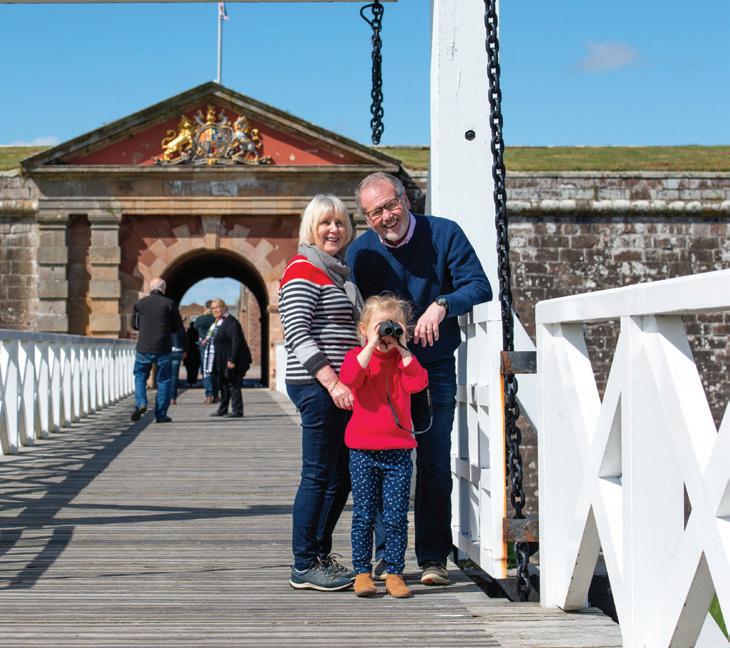
The military-themed Explorer Backpacks on offer contain binoculars because dolphins are often spotted from Fort George’s dramatic ramparts. Your best bet is to be there a couple of hours before high tide and keep your eyes peeled for unusual splashes in the narrowest part of the Moray Firth.
Fort George is an accessible site, and particularly suitable for family groups of different ages and abilities. If the weather turns, there are plenty of indoor and sheltered areas to explore too. Try your hand at the art table, for example!
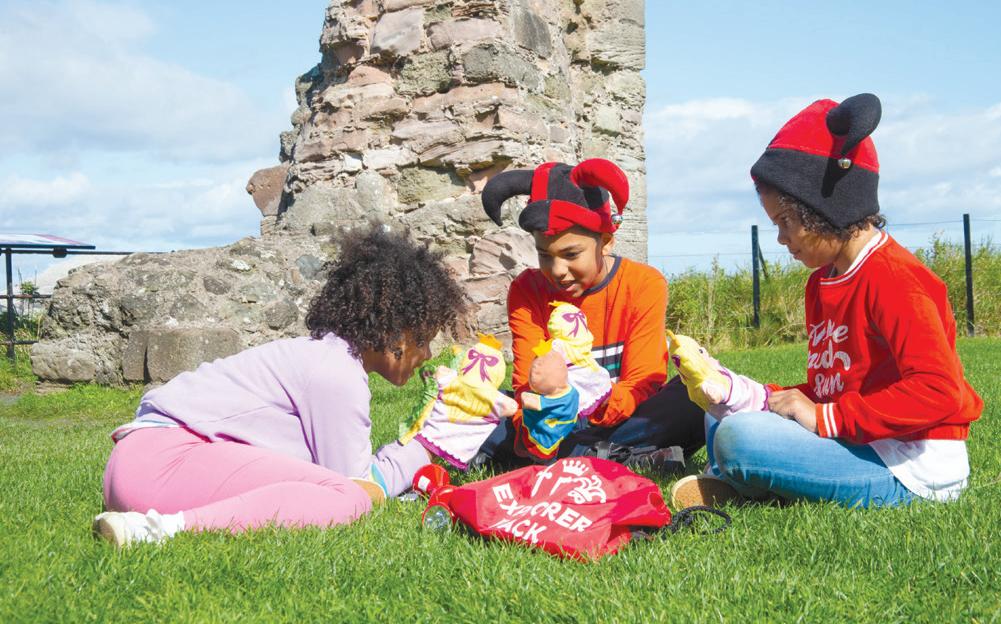
Explorer Backpacks enhance any visit
Did You Know
Begun in 1747 and completed in 1769, the fort originally had two drawbridges along its length – one at each end.
Top Tip
Follow in the footsteps of the Highland soldier –from just after the Battle of Culloden right up to the present day – at The Highlanders’ Museum, on site at Fort George.
For more on Celebration of the Centuries visit hes.scot/celebration

I am not the only one to fall in love with Melrose Abbey. Scotland’s iconic hero Robert I (the Bruce) loved it so much that he chose it as the final resting place for his heart.
Great news for novices: Melrose Abbey is just one of the many Historic Scotland sites where bespoke Explorer Backpacks are available. The abbey-themed backpacks contain goodies designed to enhance the visit for young history-lovers: at Melrose, items include kaleidoscopes, to echo the beautiful stained glass windows, and handbells (sorry, parents).
Did You Know
It may be summer now but spare a thought for the poor monks in winter. Off to the north walk of the cloister was the warming house, the only place where monks were permitted to heat themselves up for short periods each day.
Top Tip
Young visitors can also dress up as monks and really get a feel for the abbey habit. Alternatively, there are gorgeous grounds to enjoy around the impressive gothic ruin. A game of giant snakes and ladders, anyone?
Kids will love spotting the sculpture of Melrose Abbey’s bagpipe-playing pig. Yes, you read that right!
Get a glimpse of the Gothic at Melrose Abbey
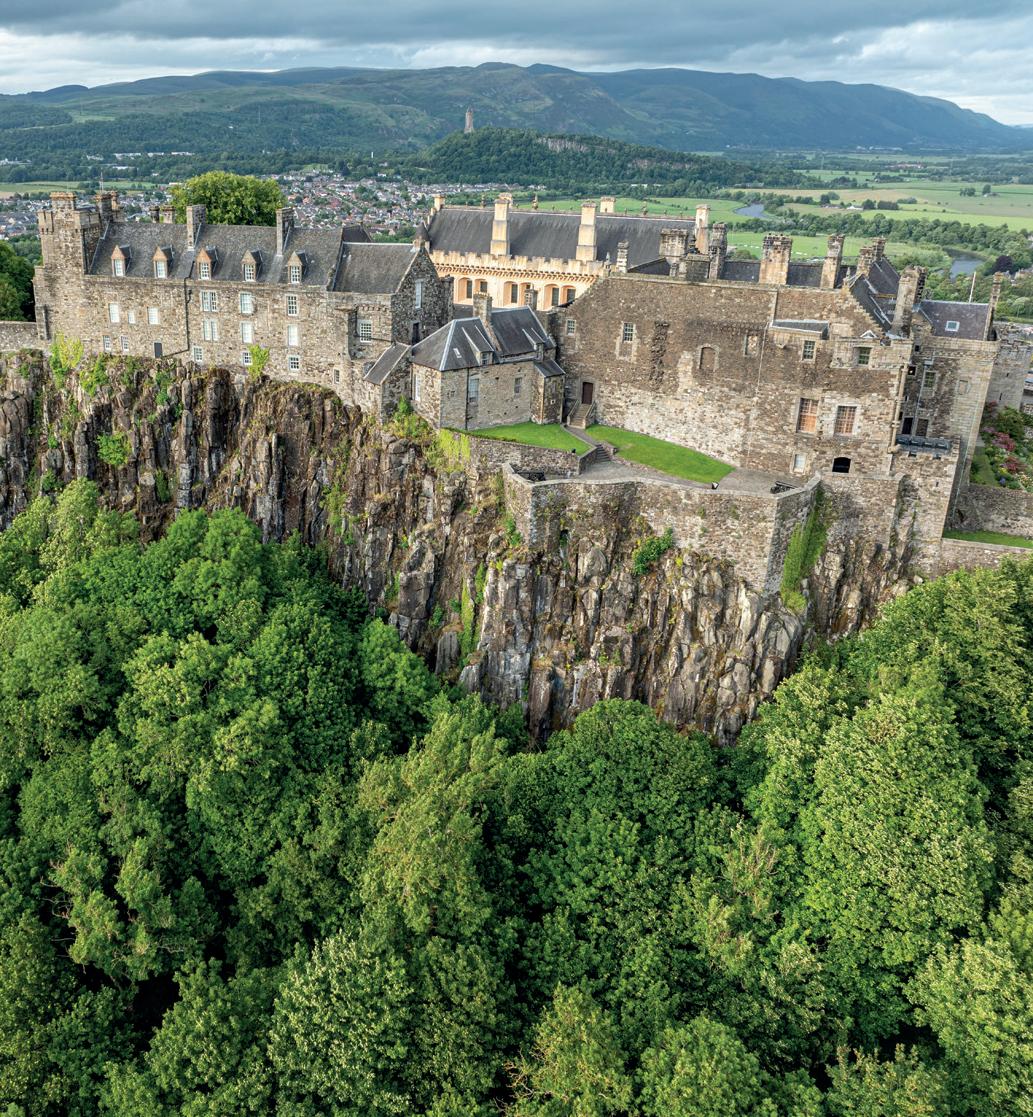
The strategically important Stirling Castle
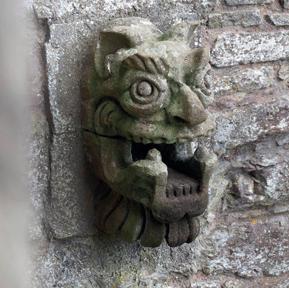
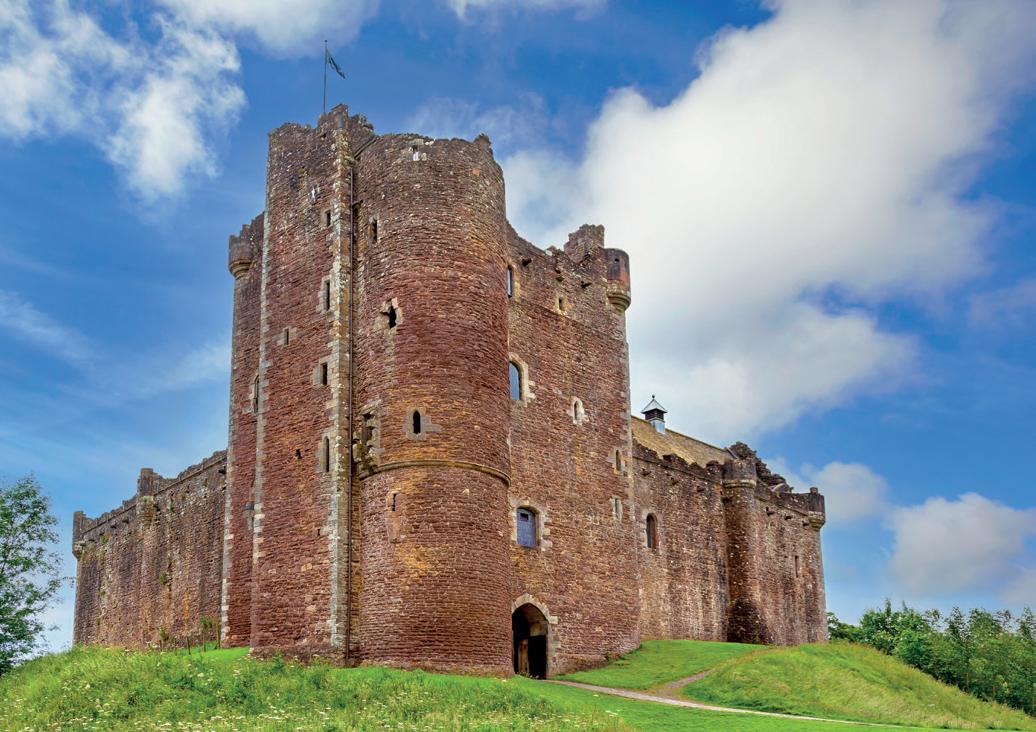
The freely available Explorer Backpacks at Doune Castle contain musical instruments that will equip young visitors to perform just like the minstrels of old. Children will also love the gargoyles lining the courtyard wall –why not indulge in a spot of acting and take photos mimicking the grotesque expressions?
also announced that food was about to be served, in the days before everyone had access to timepieces.
Do not miss the summer nature trail through the woods where the Ardoch Burn flows into the River Teith, boasting wildflowers such as red campion, yellow rattle and meadowsweet.
Did You Know
From the minstrels’ gallery, musicians entertained guests during their meals. Their music
We welcome donations for using the car park at Doune Castle. Please be aware that there is limited visitor parking here.
0Everyone loves unicorns! After all, they’re Scotland’s national animal, widely featured in Scottish heraldry. It turns out that members of Renaissance royalty were particularly keen – head to Stirling Castle and see for yourself. James V was known to possess two sets of unicorn tapestries, which sadly don’t survive, but recreations, completed in 2014, hang in the castle’s Queen’s Lodgings. Stirling has so much to offer young visitors: interactive vaults with multi-sensory stimuli like music and textiles, as well as living history reenactors and children’s quizzes in English, Scots and Gaelic.
Did You Know
Whoever controlled Stirling Castle could dominate travel and communication between east and west, and between the Highlands and the Lowlands.
In the King’s Inner Hall, look up at the famous ceiling featuring the Stirling Heads. Which one is your ace face?
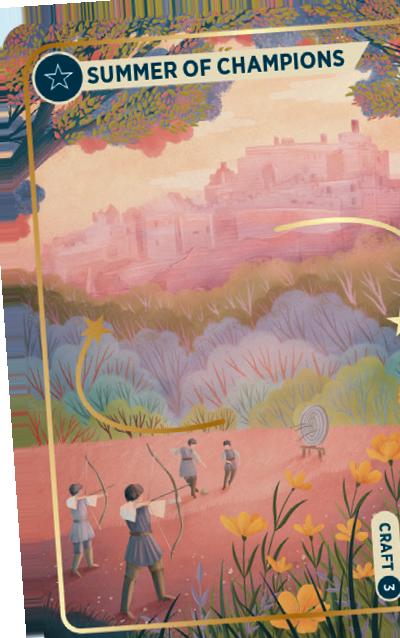
As the Commonwealth Games head to Glasgow and the Tartan Army prepares for the FIFA World Cup, we’re celebrating with a new ‘Summer of Champions’ History Hunt rare card. Collect yours during June and July at selected sites. Find out where at hes.scot/history-hunt


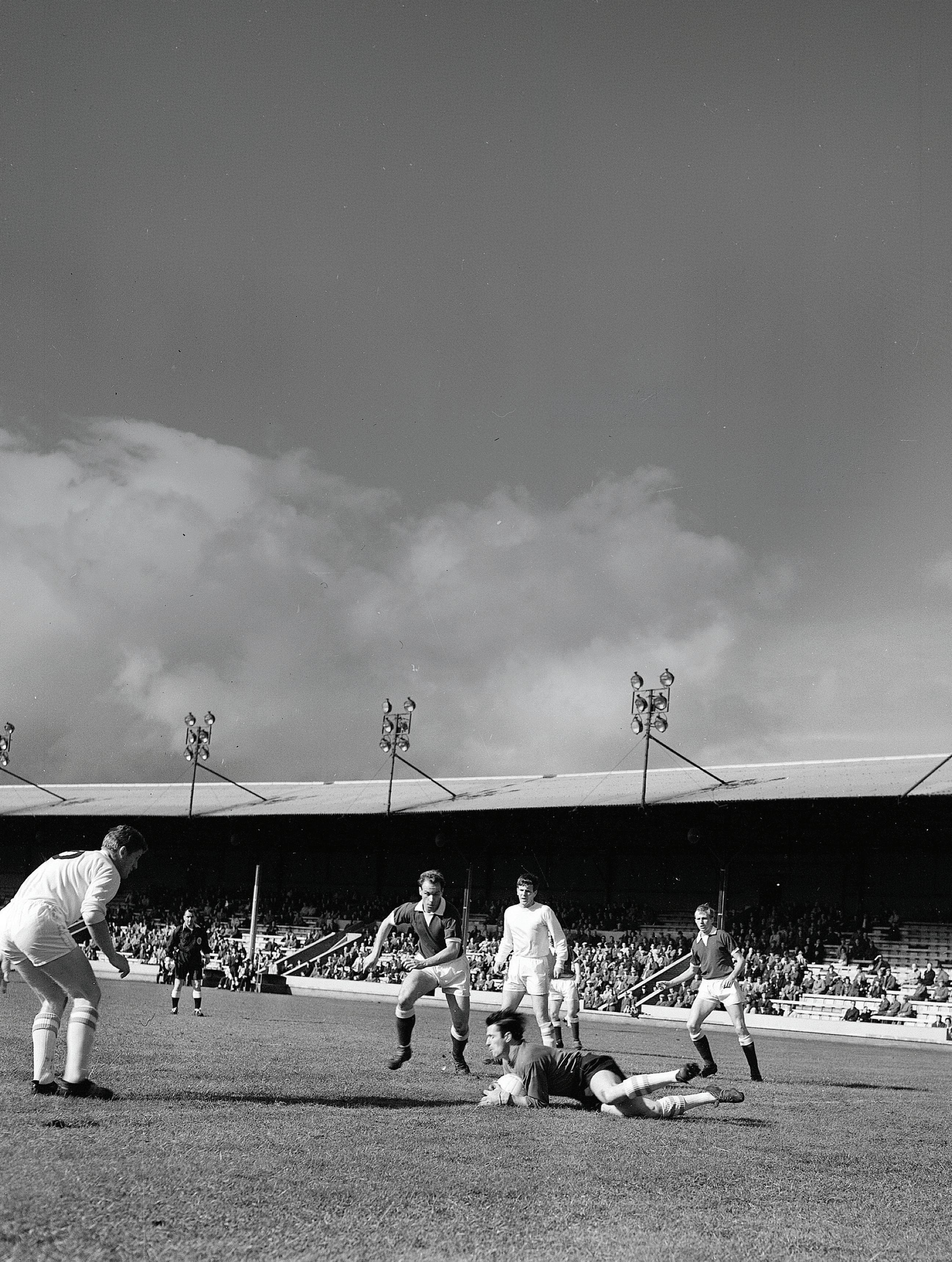
With Glasgow preparing to host the Commonwealth Games and Scotland’s men’s football team poised for the FIFA World Cup 2026, we investigate an iconic football ground and delve into the city’s rich sporting heritage
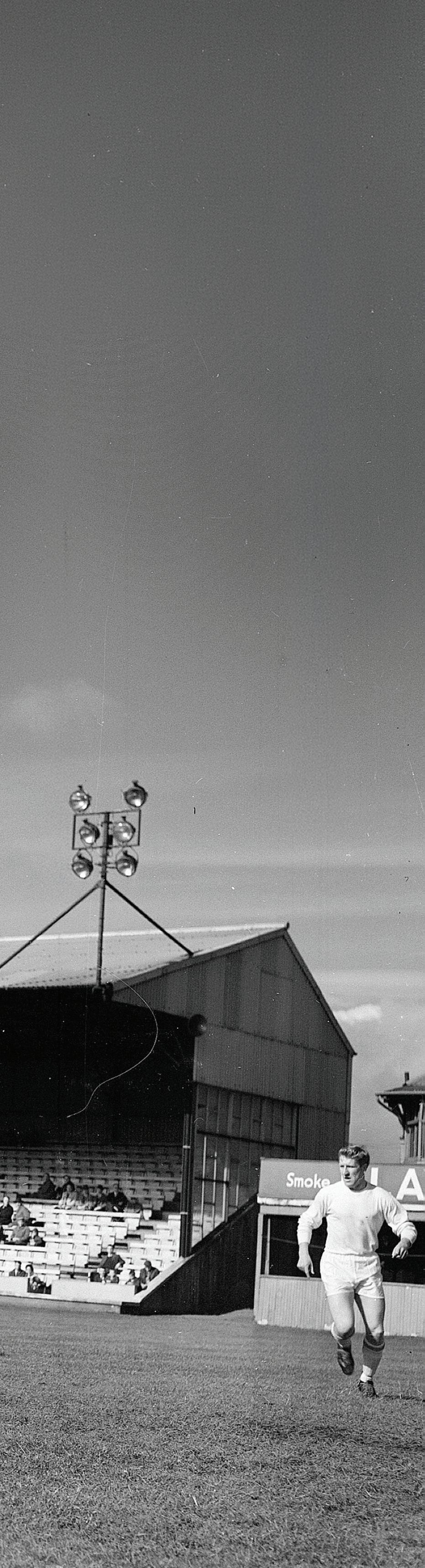
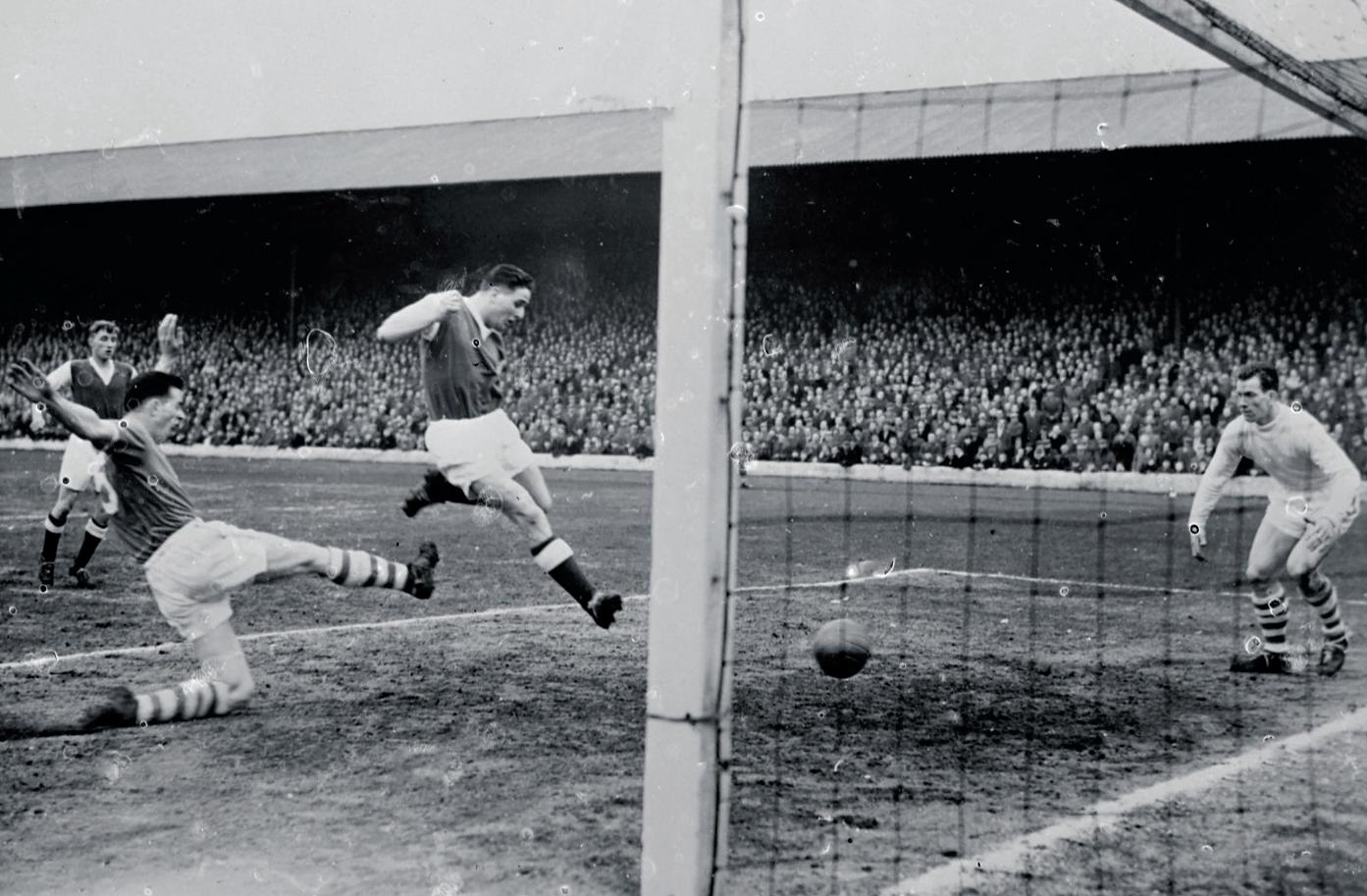
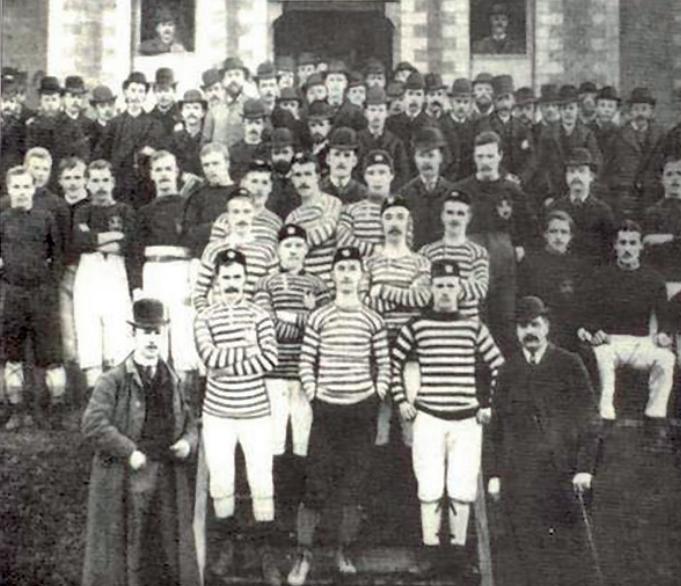
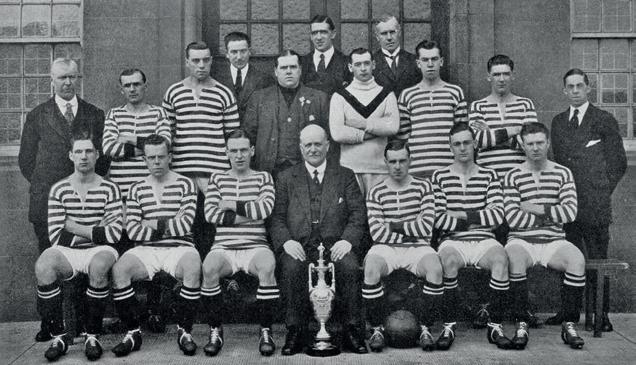
The story of Hampden Park football ground and its pavilion began, unseasonally, on a cold winter’s day over 150 years ago. On 21 January 1873, Queen’s Park Football Club began a search for a suitable site on which to build a new football ground in Glasgow. Only a month later, the club were pivotal in the establishment of the Scottish Football Association and, to this day, they remain the oldest football club in the country.
A site for the ground, the first incarnation of Hampden, was identified in the Southside of the city. It was to be Queen’s Park’s new home and would also host international football matches in front of thousands of spectators. The
ground, now known as First Hampden, was the first purpose-built football ground in Scotland and one of the first in the world. The playing pitch was levelled and sectioned off with rope, the boundary of the ground marked by high wooden fences and pay gates installed at one end.
This simple infrastructure was crucial in forming the blueprint for modern football stadia of today –quality levelled playing surfaces, a pitch separated from spectators, an enclosed ground to limit viewing from outside and gates to sell tickets and generate revenue for the club.
The football ground continued to develop with the construction of a
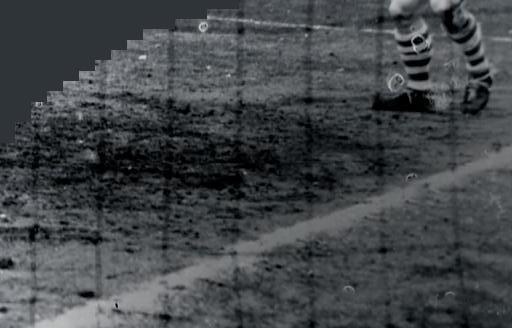
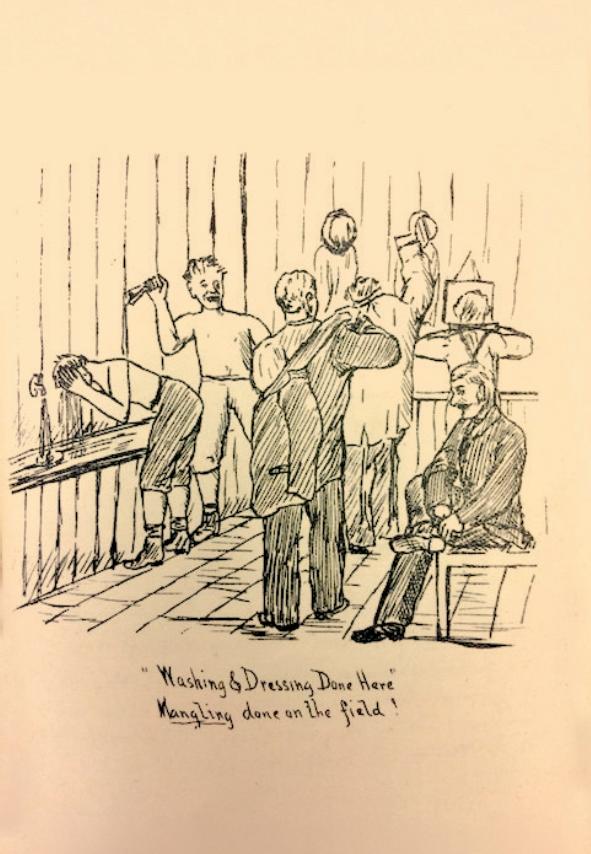
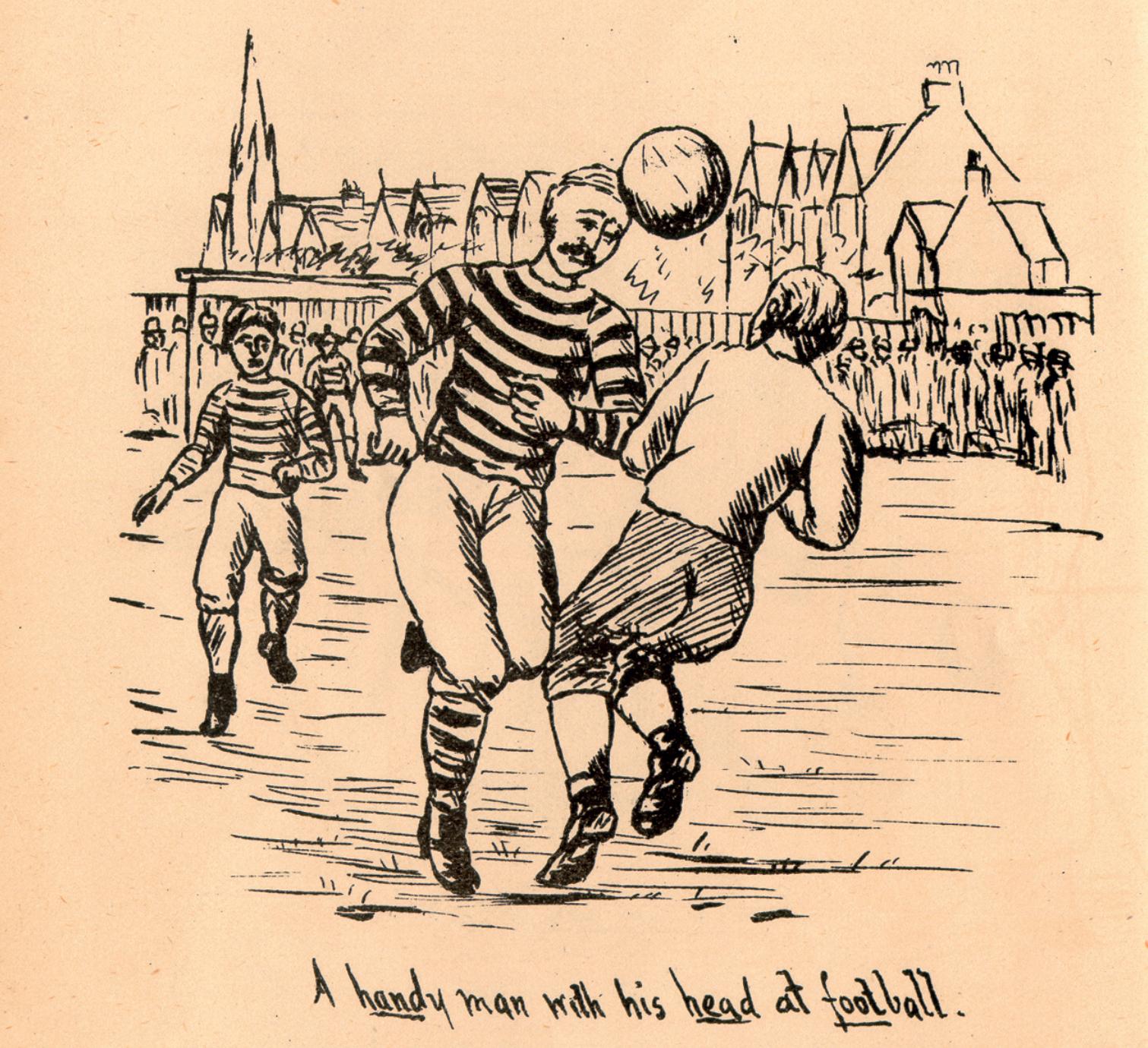
Sketches from Free Kicks at Football pamphlet, 1882: the above sketch is the only known image of the pavilion’s interior
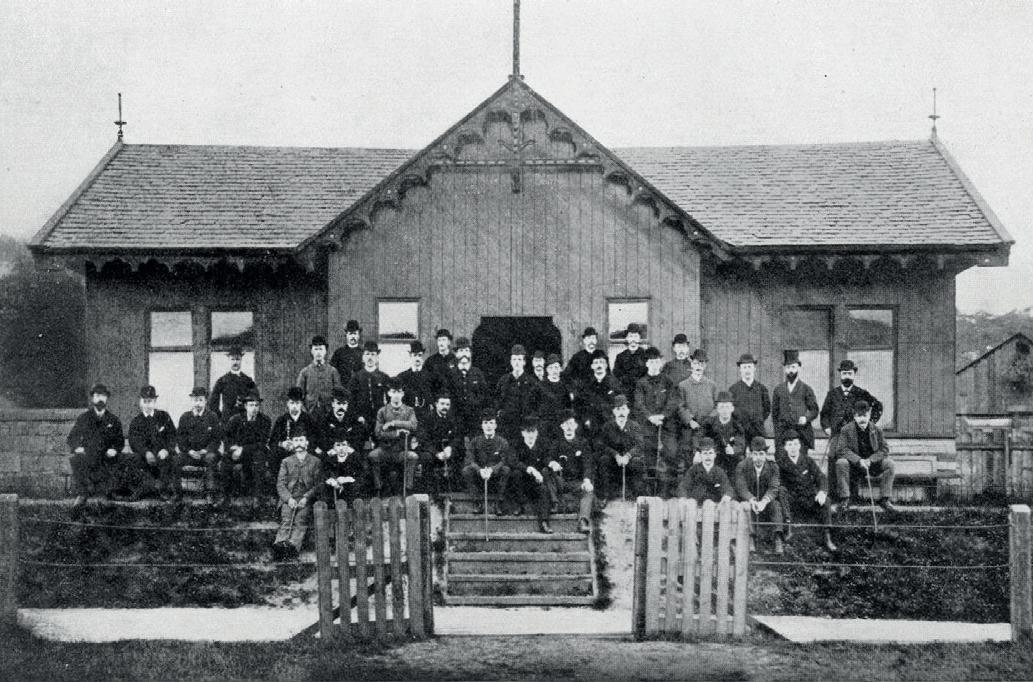
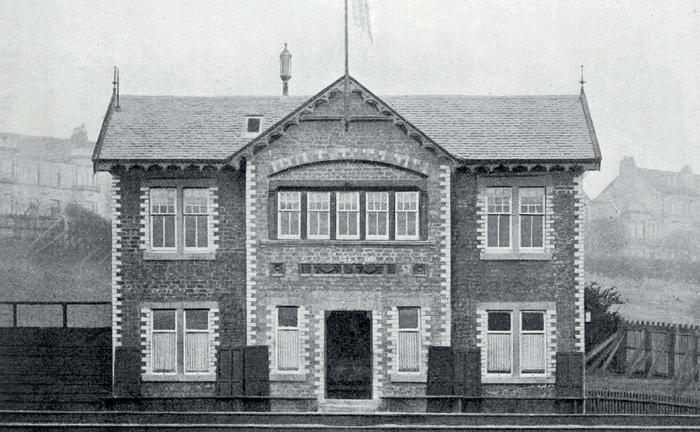
grandstand in 1876. This may have had covered seating, benches or a terrace, offering improved viewing with some protection from the weather. The jewel in the crown arrived in February 1878, when the club purchased a fine pavilion from the Caledonian Cricket Club and reconstructed it at First Hampden.
The opening ceremony for the pavilion is captured in an historic photograph, showing the brick and wooden building, while a sketch from 1882 shows it in use during a match. However, Queen’s Park’s stay at this
25 October 1873
Inaugural match at First Hampden; Queen’s Park beat Dumbreck 7-0.
1878
ground was to be short-lived, as the Cathcart District Railway planned an expansion and purchased the football ground for the new rail line in 1883.
Queen’s Park FC simply moved across the road to what we now know as Second Hampden in Cathkin Park. The pavilion was dismantled, leaving foundations and demolition debris as the only surviving traces of First Hampden that are currently known through archaeological excavation.
The pavilion was rebuilt in the same form, reusing many elements, but it was completely faced in brick. Within a few years the building was transformed,
First Hampden pavilion opening ceremony takes place.
2 March 1878
Scotland beats England 7-2 at the first international match hosted at First Hampden.
1883
Cathcart District Railway purchases ground for the route of a new rail line.
with an upper floor added and a new gymnasium space within.
By 1903, Queen’s Park FC were seeking a new, larger stadium and Second Hampden was sold to Third Lanark FC. There was a disagreement over the value of the pavilion, and it was ultimately broken down into small lots and auctioned off. Third Lanark built a new football ground at the site and changed the layout, forming New Cathkin Park.
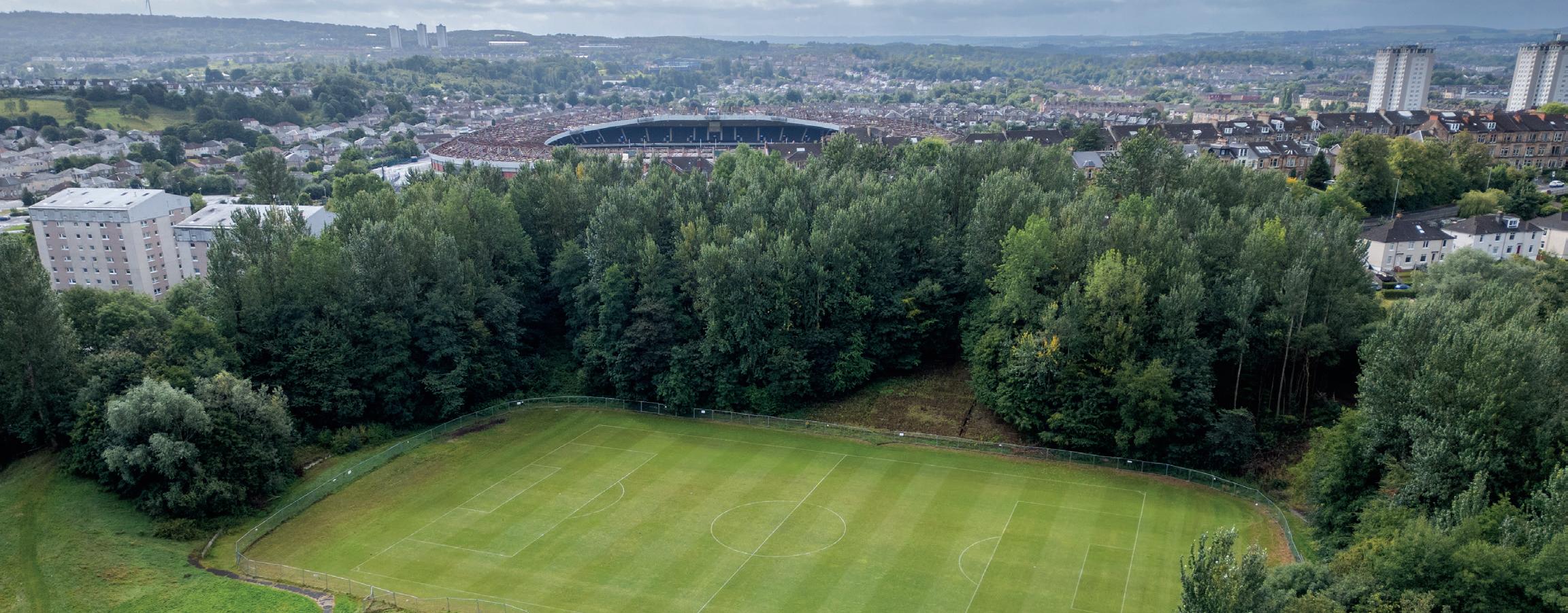
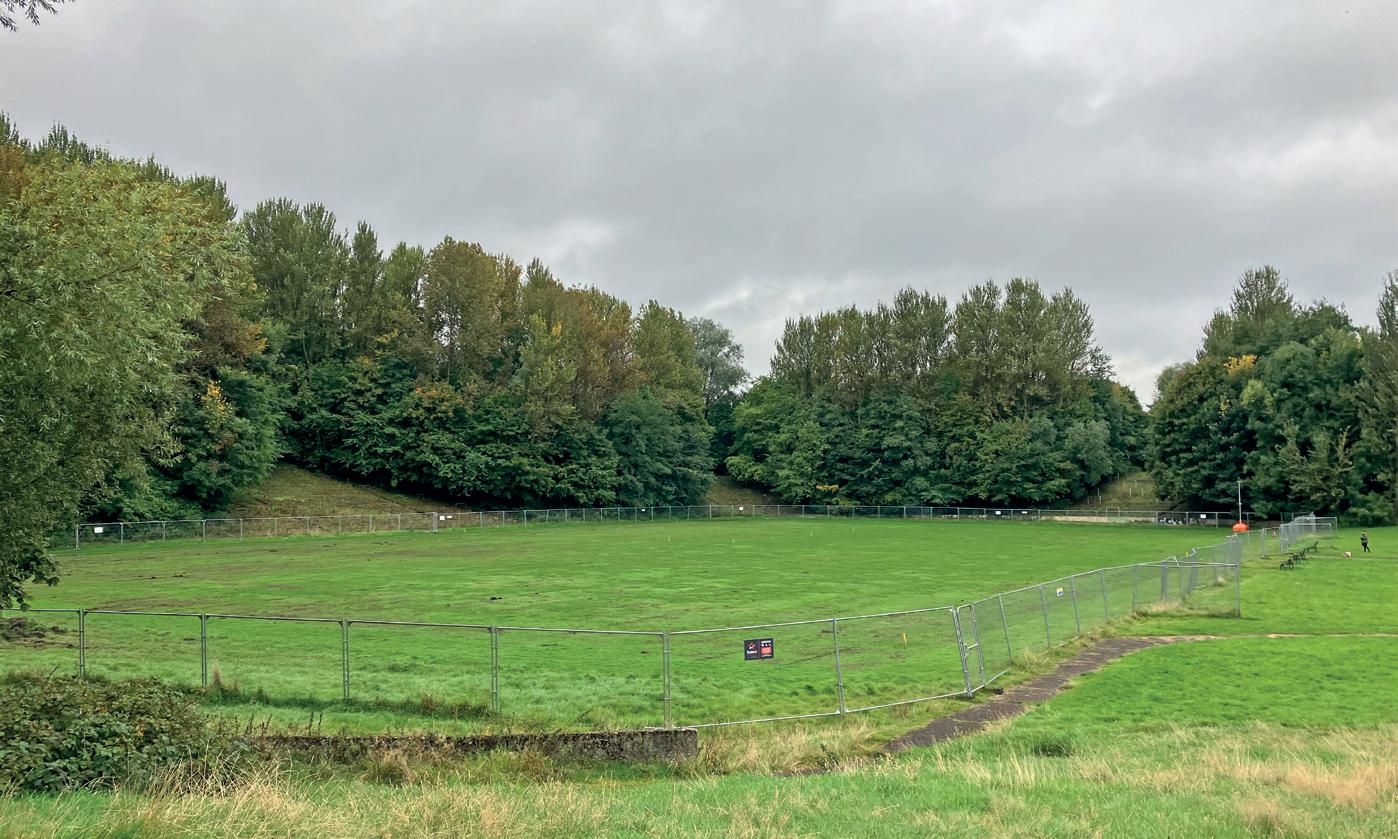
A major redevelopment in the mid20th century saw the construction of concrete terraces and a substantial grandstand at Cathkin Park. Third
18 October 1884
After Queen’s Park’s move to Second Hampden, their first match is a scoreless draw against Dumbarton.
We designated Cathkin Park as a scheduled monument in September 2025
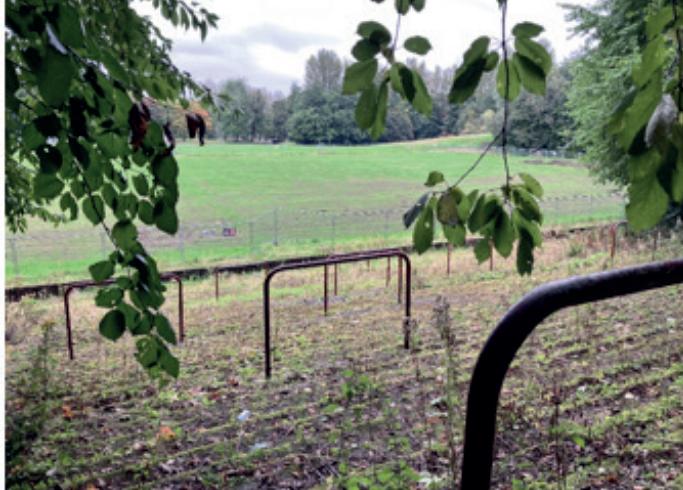
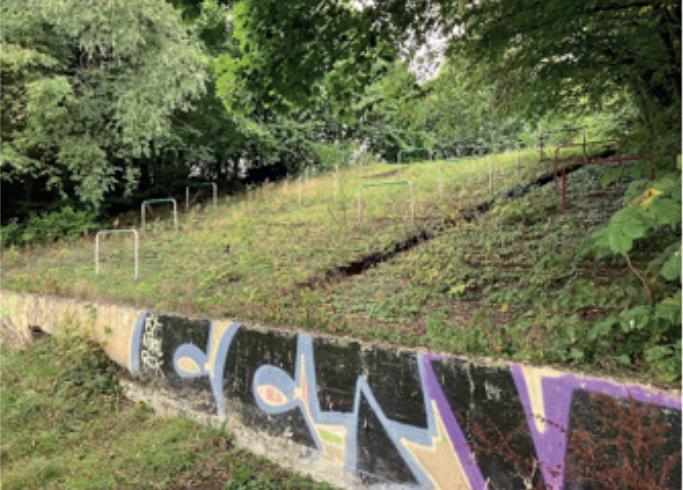
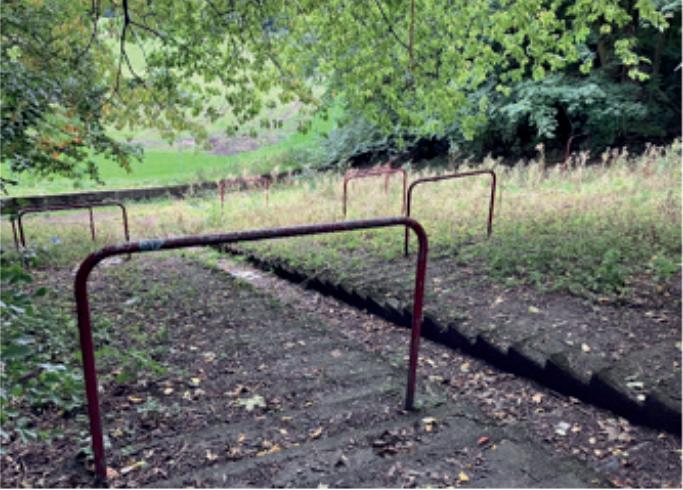
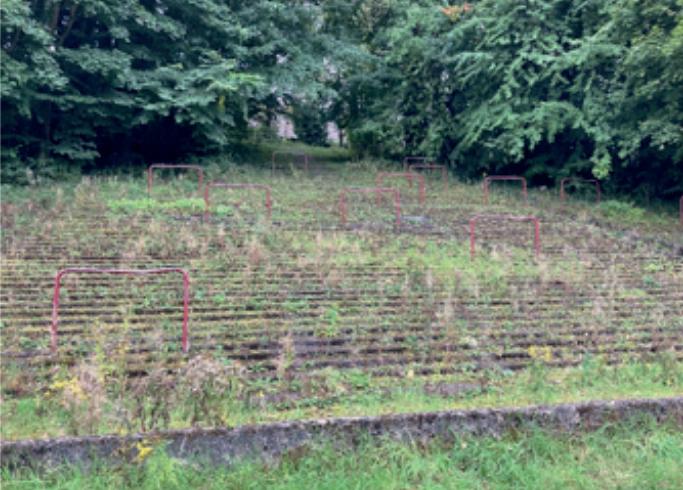
Lanark played at the ground until a financial crisis in 1967 saw the sad end of this famous club. The site is now a public park, but the concrete terraces survive on three sides while the remains of the grandstand are buried below the grass.
Let’s retrace the pavilion’s movement to where it began at First Hampden. Today, the site of the football ground is occupied by Hampden Bowling Club, modern roads, a tenement, railway lines and a park called Kingsley Gardens. This small public park is home to the buried remains of the historic pavilion.
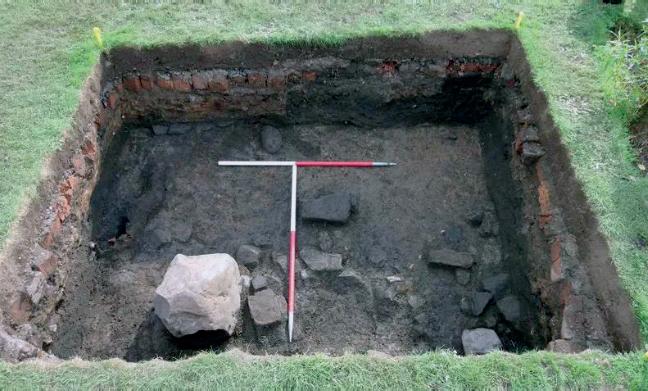
Archaeological investigations in 2021 confirmed the foundations survive along with finds left behind by spectators, such as china shards, clay pipes and glass bottle fragments. Even some wire was found, probably from the post-andwire fence surrounding the pavilion that is seen in the old photograph.
As a rare surviving mid-20th century football venue, Cathkin Park was designated a scheduled monument (SM13799) in September 2025, recognising its role in the development of early football grounds. We recently also scheduled the remains of the First
The Second Hampden pavilion is built using many of the elements of the First Hampden structure.
The Second Hampden pavilion is extended to provide an upstairs and gymnasium.
1903
Queen’s Park move to Third Hampden (site of the current national stadium). Third Lanark redevelop Second Hampden and rename it New Cathkin Park.
The remains of the Cathkin Park grandstand are now overgrown with grass
2021
Archaeological investigations take place on the site of the First Hampden pavilion.
2025
Cathkin Park is designated as a scheduled monument.
2026
Remains of the First Hampden pavilion are scheduled.
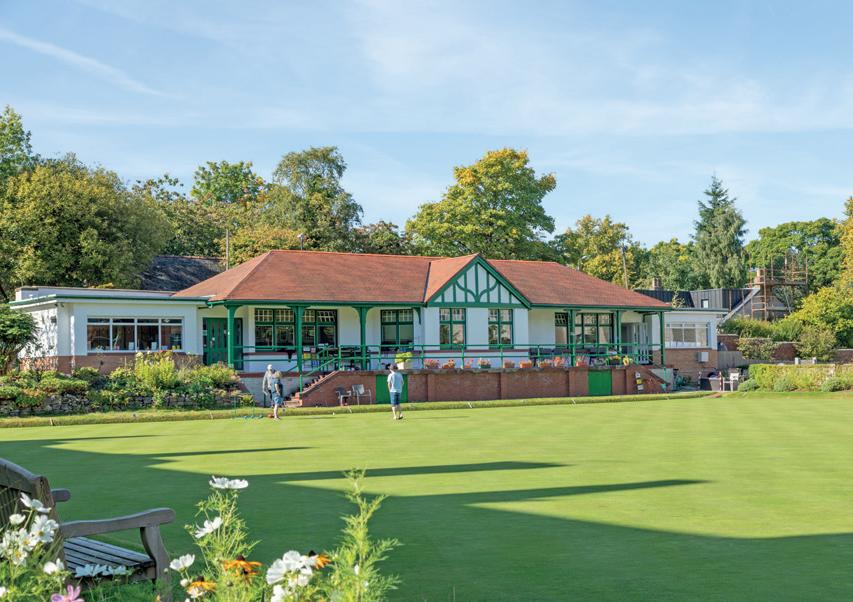
Hampden pavilion at Kingsley Gardens (SM13816) as a tangible surviving element of the first purpose-built football ground in Scotland, and the first in the line of Hampden’s football grounds. Also worth shouting from the stands: First Hampden literally laid the foundations for modern football stadia that we see across the globe today.
Apart from New Cathkin Park and Hampden, Glasgow is home to a wealth of historic venues for a wide variety of sporting activities. The architectural and historic interest of
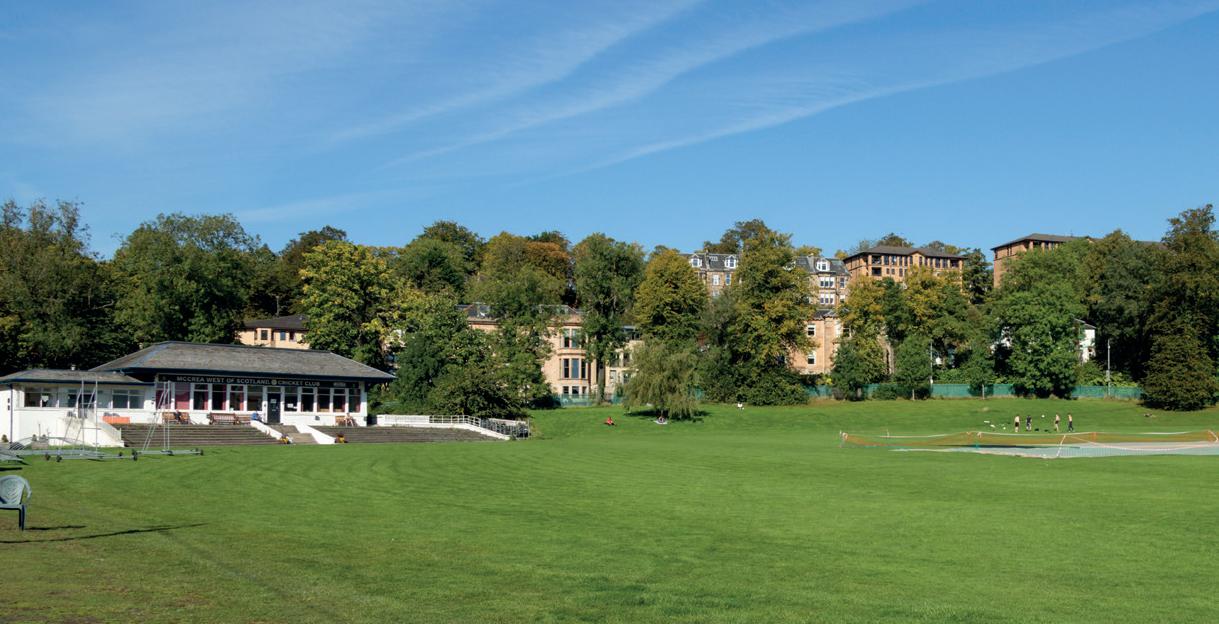
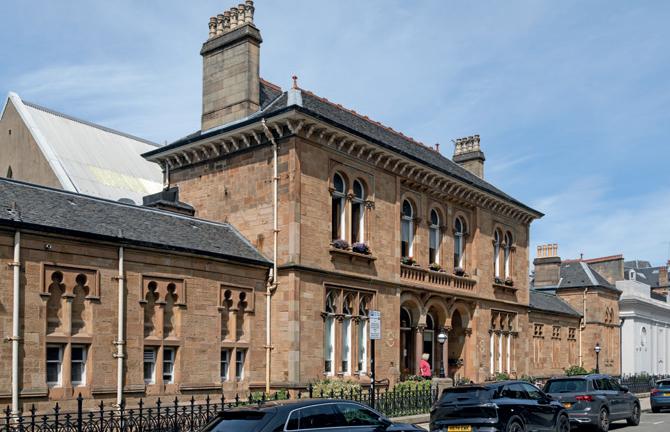
many of the associated buildings are also protected and celebrated by statutory listing or by inclusion within the city’s 22 conservation areas. Pavilions and clubhouses for a variety of sports form the majority of listed sporting buildings in Glasgow.
Although Glasgow Green and the River Clyde were for centuries the city’s sporting hubs for athletics, shinty, golf, cricket, football, swimming, skating and curling, few of its historic sporting structures survive.
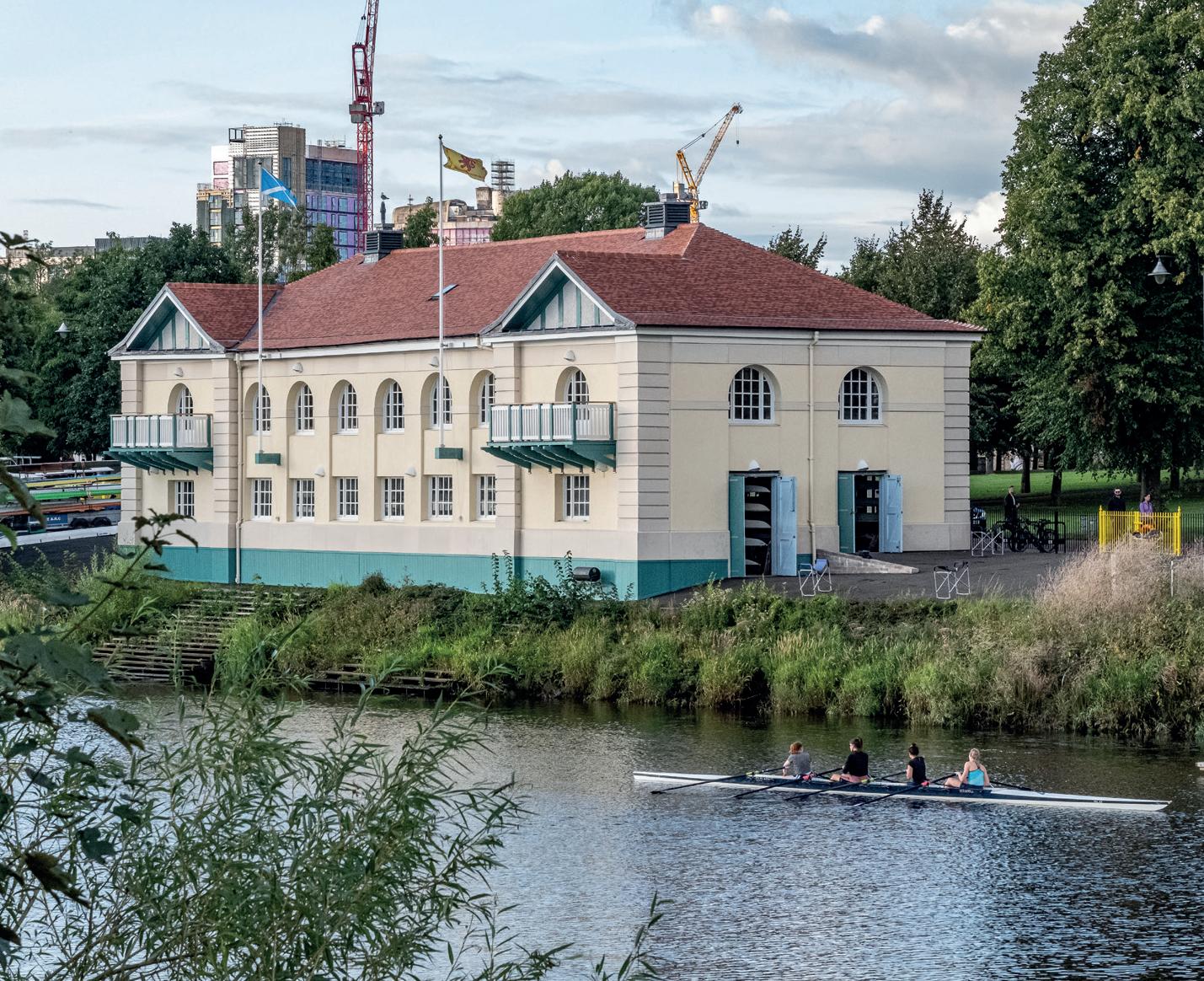
One notable exception is the rare West Boathouse (Category B) of the Clydesdale Amateur Rowing Club
We legally recognise and protect Scotland’s most significant heritage sites, including those with sporting stories. Find out about listed buildings, scheduled monuments and other designations that protect our historic environment at hes.scot/listings
(ARC) and the Clyde ARC, purposebuilt for the two clubs in 1905 to designs by A. B. McDonald of the Office of Public Works.
With grant funding from Historic Environment Scotland, the Heritage Lottery Fund and others, Glasgow Building Preservation Trust delivered the restoration of the building in 2023, including updating facilities and improving accessibility.
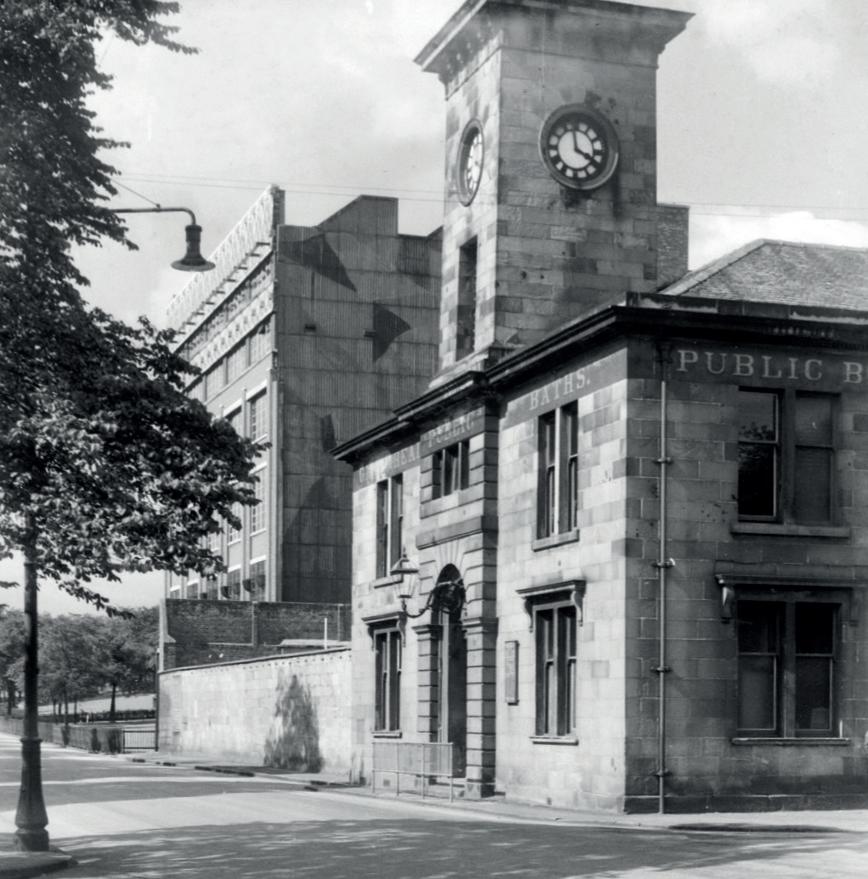
As pollution and water traffic increased in the 19th century, rising numbers of public and private baths were founded to provide safer swimming environments than the
BY ANGELA GIANCOLA, RESPONSIBLE TOURISM COORDINATOR
We share five of our sites that you can reach from Scotland’s biggest city by train, bike or on foot – and discover their historic connections to sporting activities.
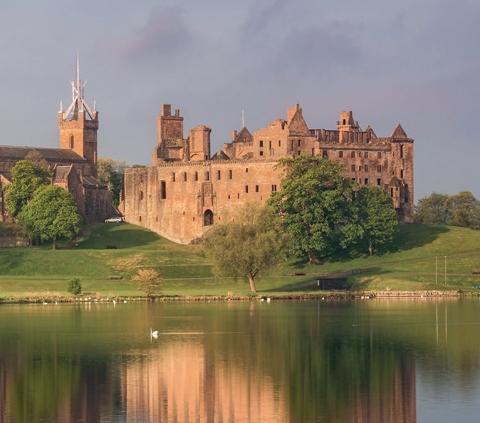
Linlithgow Palace was a popular spot with James IV and James VI for archery. Our modern-day tournament, Spectacular Jousting, will be on 27 and 28 June this year. Take the train from Glasgow Queen Street to Linlithgow (28 minutes), or cycle National Cycle Route 754 to enjoy views of the Forth & Clyde Canal en route (3 hours).
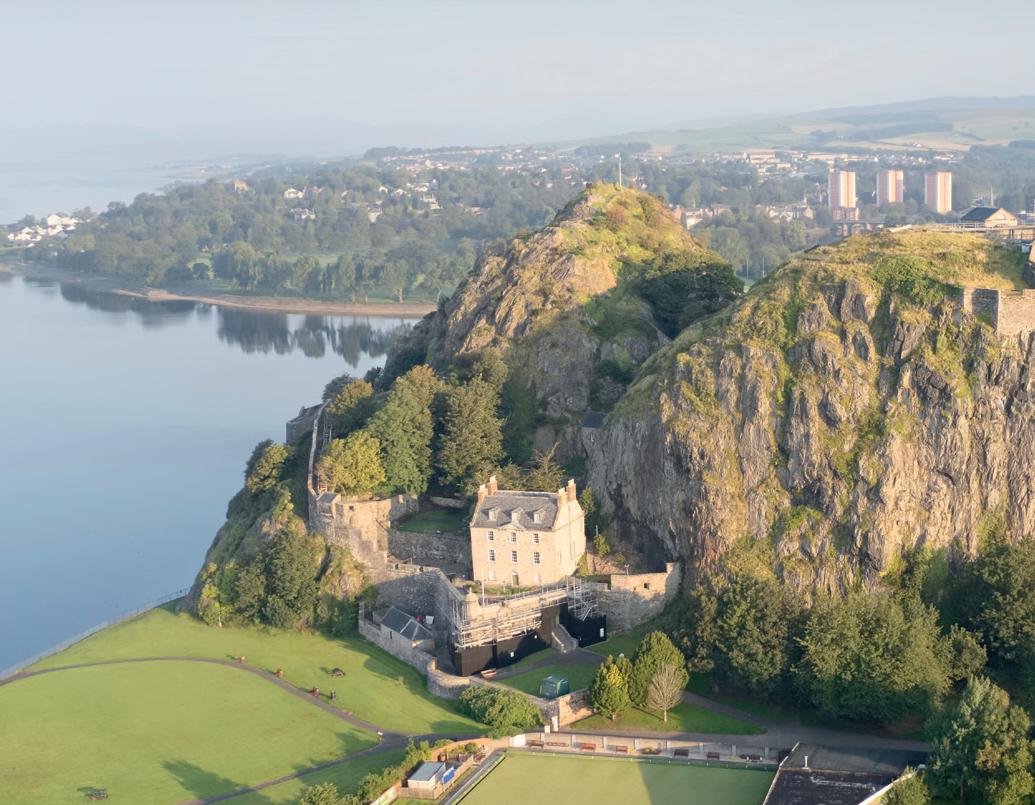
Don’t miss Visiting Vikings on 20 and 21 June, when you’ll hear how Dumbarton Castle was besieged by the Vikings in AD 870. Glima, a form of wrestling, is the only sport still practised from the Viking age to this day. Catch a train to Dumbarton from Glasgow Queen Street (40 minutes) or follow National Cycle Route 7 (1 hour 30 minutes).
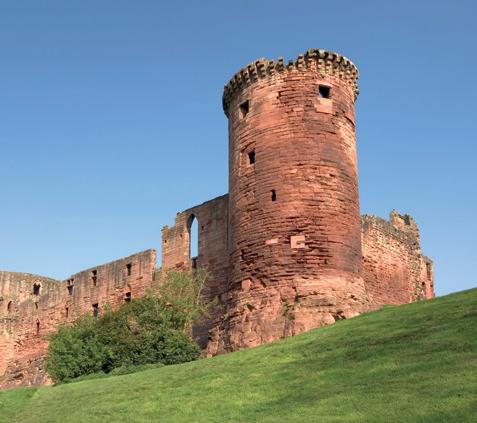
Bothwell Castle has hosted cricket matches on its grounds since 1884. From Glasgow Central station take the train and alight at Uddingston station (12 minutes). From there, either walk along the Main Street (28 minutes) or cycle along the traffic-free National Cycle Route 75 (10 minutes).
city’s rivers. Opened in 1871, the Arlington Baths Club (Category A) in the Woodlands area is the UK’s, and possibly the world’s, oldest private swimming club. The Western Baths (Category A) at Hillhead opened in 1876.
Publicly funded indoor pools, or ‘ponds’, followed from 1878 with the opening of Glasgow Corporation’s Greenhead Baths & Swimming Pool on the edge of Glasgow Green. The city’s oldest surviving public pool is North Woodside Baths and Wash-house (Category C), designed by the City Architect John Carrick and built in
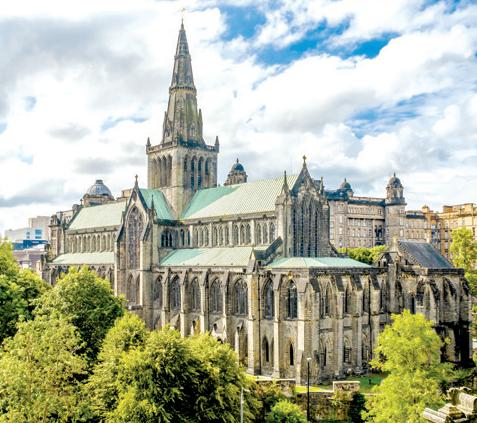
Glasgow Cathedral is near to Glasgow Green, where football was played for centuries. Join one of our Commonwealth Games themed tours, which start at the cathedral, and discover stories of sporting triumph and national celebration. Walk from the city centre or catch a city bus to the Cathedral Square bus stop.
Braid Square between 1880 and 1882. It included separate pools for men and women, private baths and 67 wash-house stalls.
The end of the Little Ice Age in the 1820s saw a shift away from the city’s natural rivers and ponds to shallow artificial outdoor curling rinks. John Cairnie, a surgeon and alumnus of the University of Glasgow, wrote an Essay on Curling and Artificial Pond Making in 1833 and invented a shallow sunken bed that was flooded to enable faster freezing.
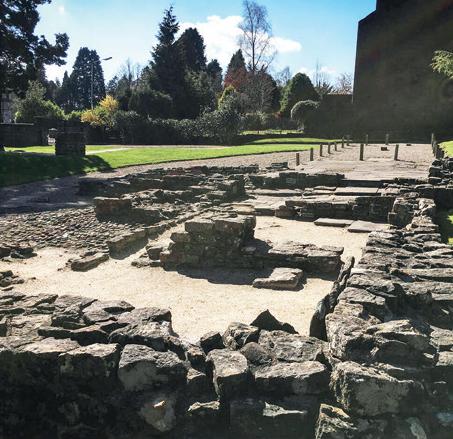
Bearsden Bath House is one of the bestpreserved Roman stone structures along the 37-mile long Antonine Wall. For the 6,000-7,000 Roman soldiers stationed on the wall, bathing was a welcome relief after a hard day of training. Catch a train from Glasgow Queen Street to Hillfoot station (20 minutes). You can follow sections of the wall along the Antonine Wall Trail. More details at antoninewall.org
To find National Cycle Network routes, go to walkwheelcycletrust. org.uk
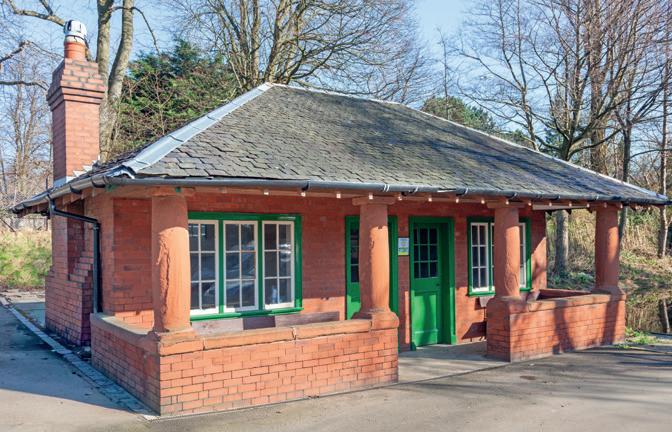
By the end of the 19th century, there were some 80 curling ponds in Glasgow. Indoor freezing technology at the beginning of the 20th century put an end to many of these less reliable outdoor facilities, but Partick Curling Club still hosts a rare Cairnie-style pond, with an Arts & Crafts-style pavilion (Category C) alongside it.
Nick Haynes’s book, Scotland’s Sporting Buildings, explores our legacy of stadia, grandstands, clubhouses, pavilions, huts and swimming pools and is available at stor.scot
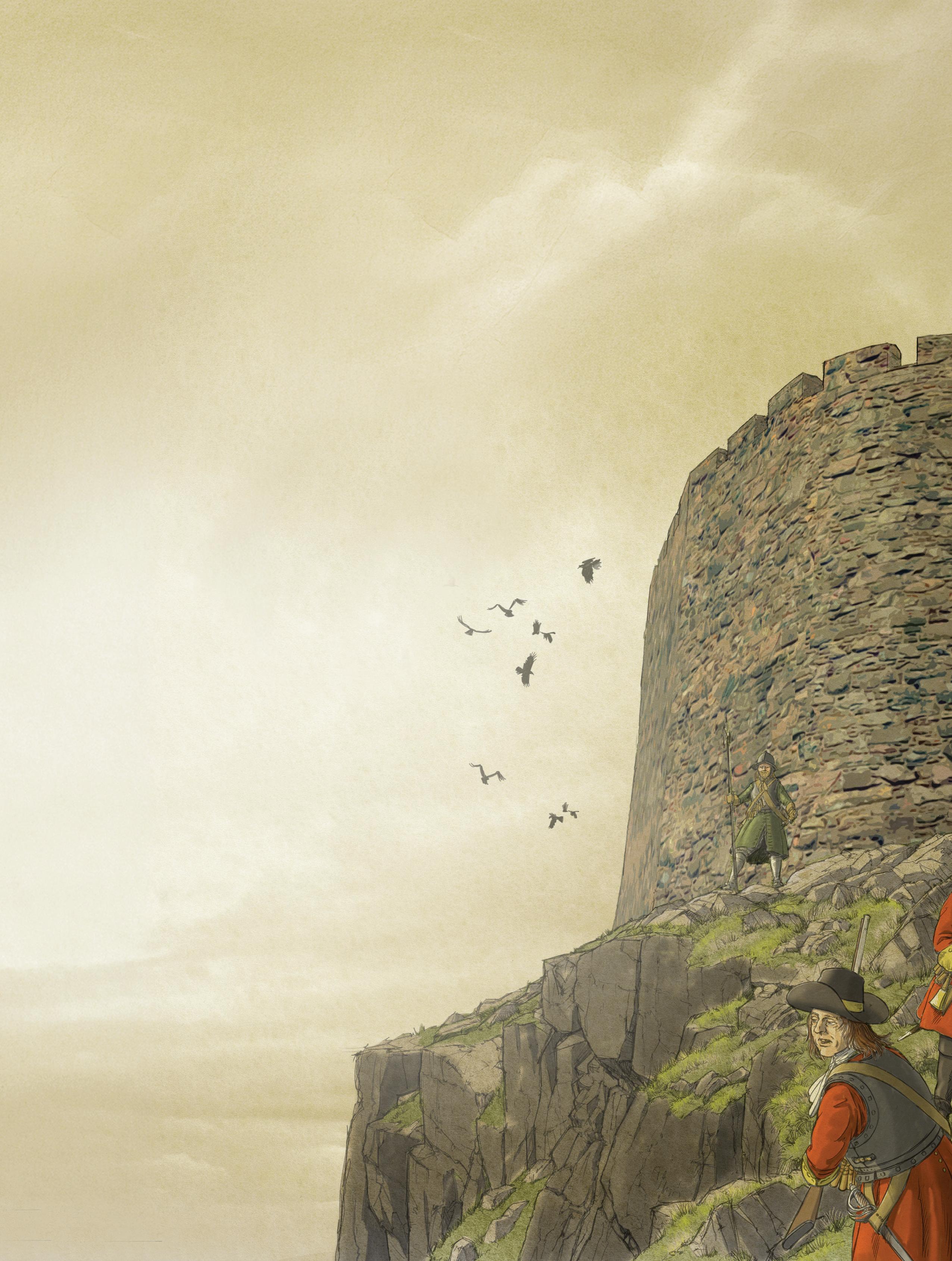
Nearly three centuries on, the true story of the Jacobite cause is often lost to myth and romanticism. We go in search of the real Jacobites, with some help from the experts.
‘Tis Sixty Years Since’ was the subtitle of Walter Scott’s Jacobite novel Waverley (1814), about Edward Waverley, a soldier in the British army who is sent to Scotland in 1745 and switches sides. It is now 280 years since the Battle of Culloden, and yet the subject is as popular, and romanticised, as when Scott recognised its potential for fiction.
The rout of the Jacobite army at Culloden on 16 April 1746 ended decades of serious political unrest, during which supporters of the exiled Stuarts attempted to overthrow the House of Hanover. The failure of the ’45 Rising, led by the ‘Young Pretender’ Prince Charles Edward Stuart on behalf of his father James VIII and III, snuffed out all hopes of a Stuart restoration.
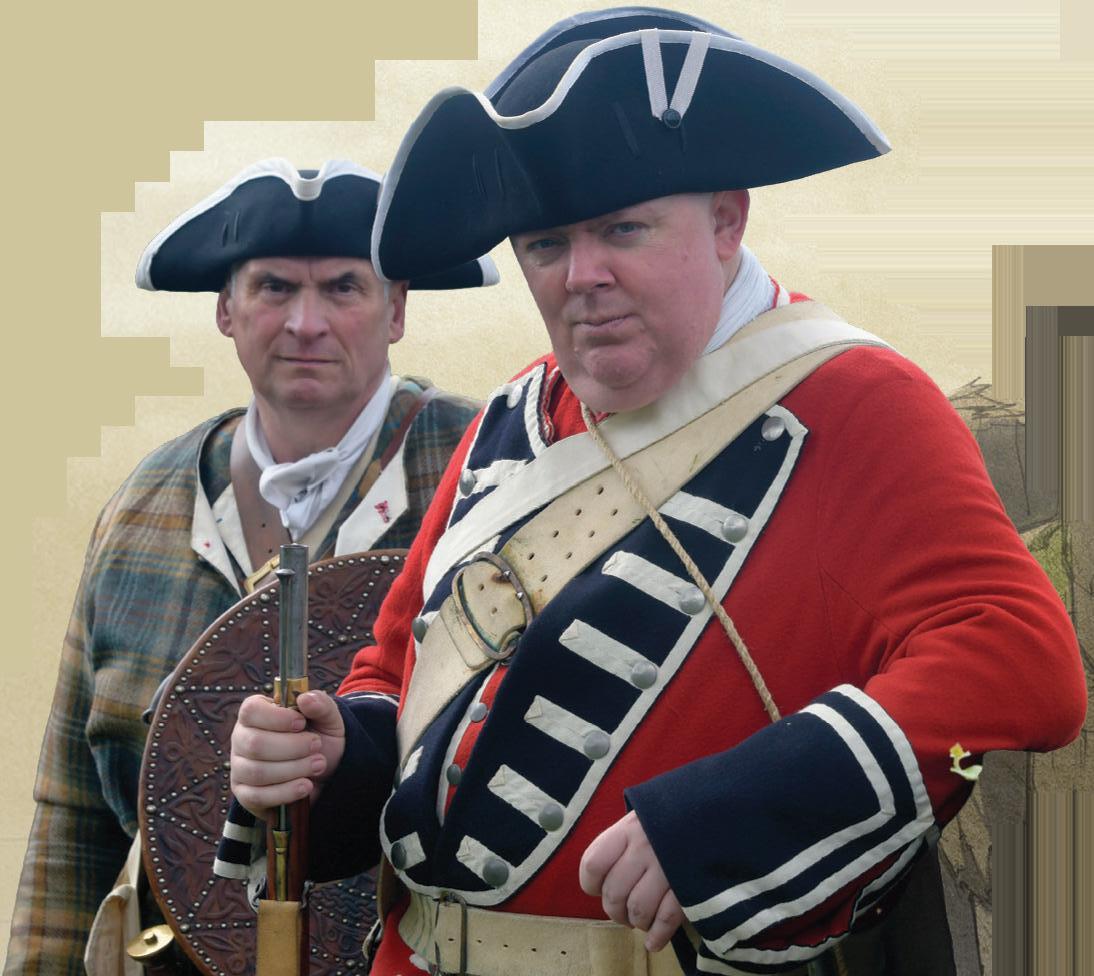
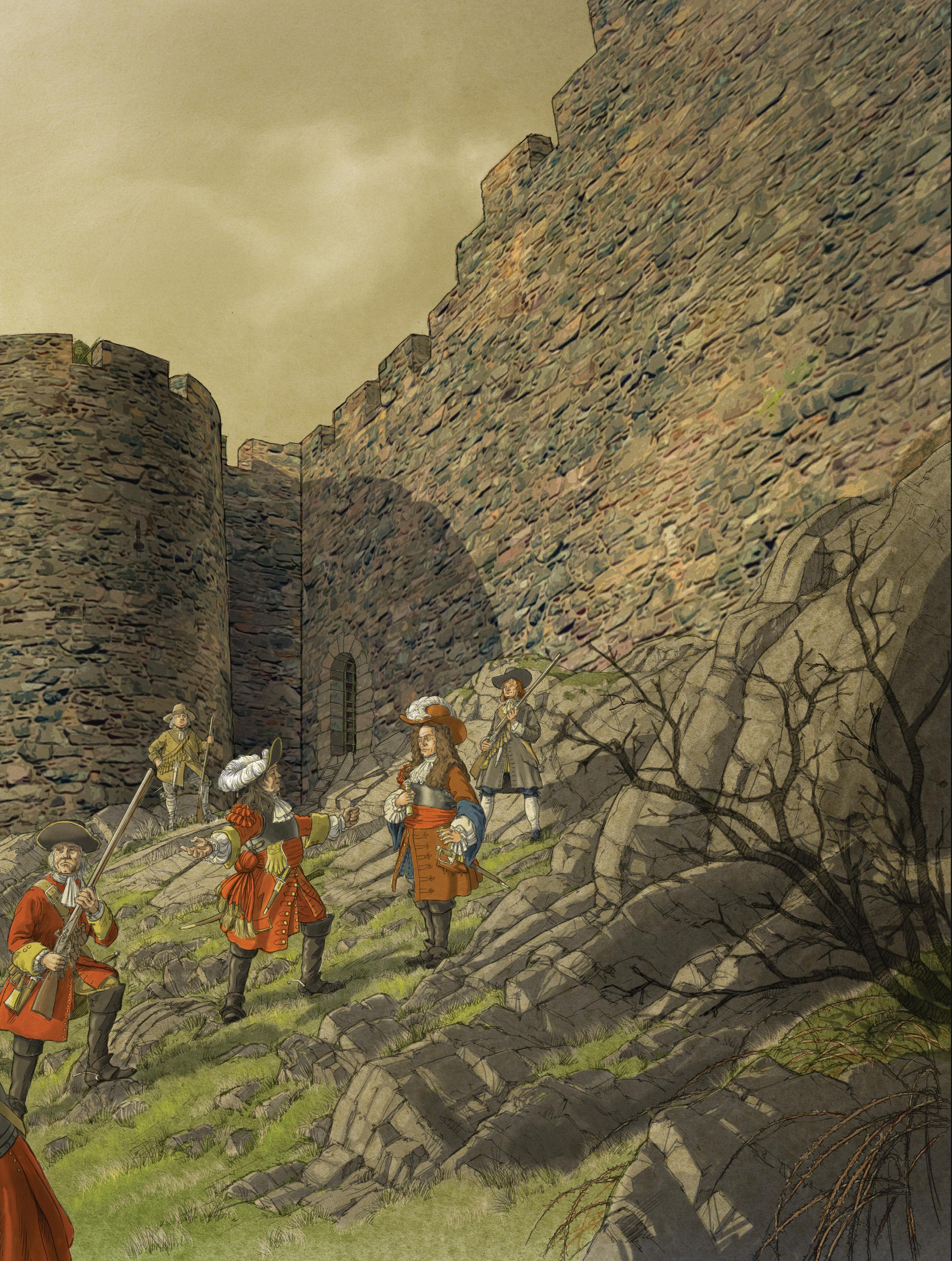
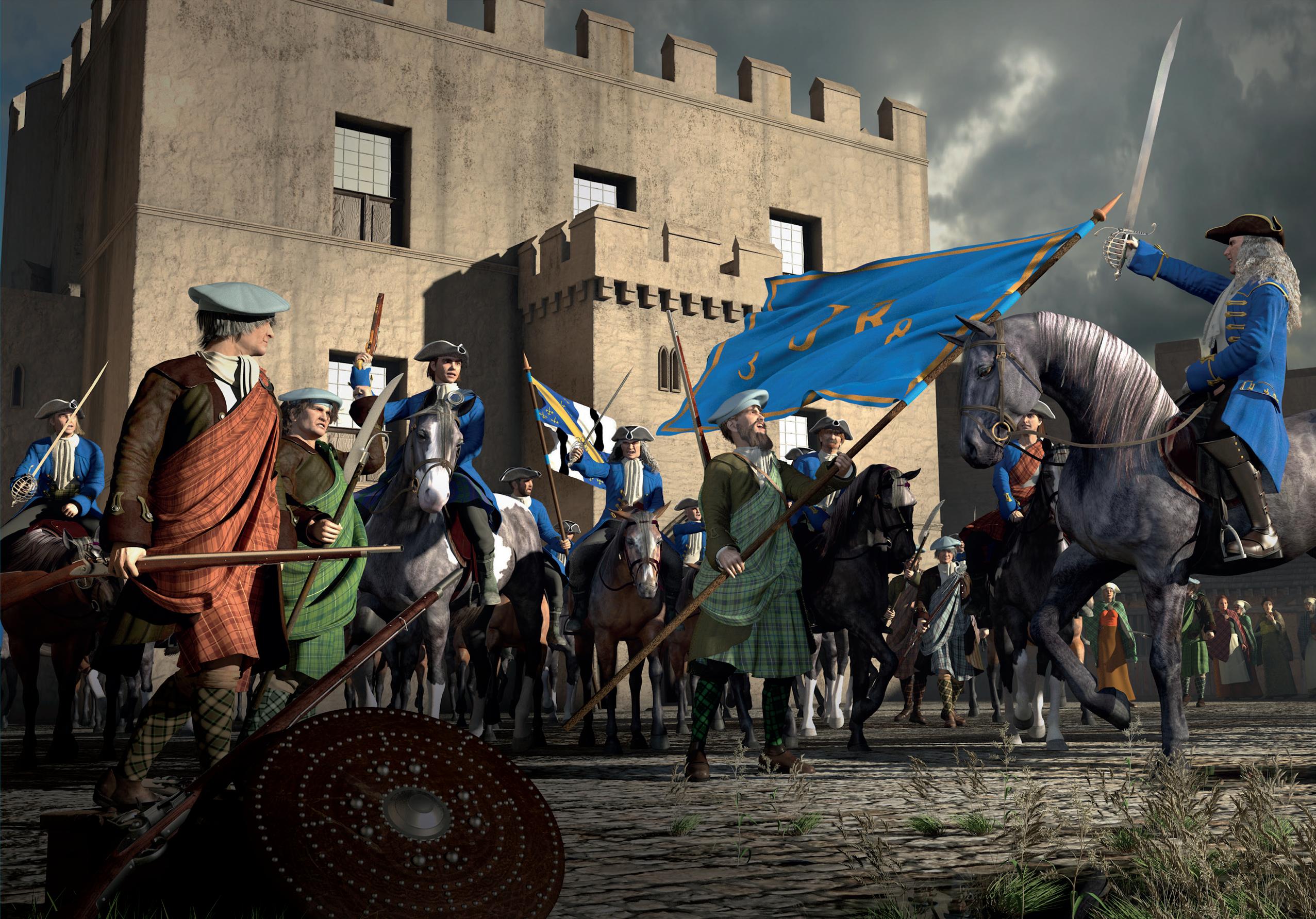
Yet this was not always a doomed cause. From the first Rising in 1689, shortly after William of Orange usurped his uncle and father-in-law James VII and II, the Jacobites were a force to be reckoned with. Between this date and 1746, when Prince Charles fled back to Europe, the country witnessed a series of momentous Risings, many of them involving our properties.
In 1689 Edinburgh Castle, under the Duke of Gordon, held out against government troops for three months, despite running low on powder, food and water. Gordon did everything possible to avoid harming the town and its people, but eventually was obliged to surrender.
In 1745, after Bonnie Prince Charlie’s army had taken Edinburgh, the castle, now held by George II’s troops, again came under siege. This time its soldiers turned their guns on the city, including the house of the poet Allan Ramsay, a Jacobite sympathiser, which was destroyed. During the siege, the prince insisted that the Royal Bank of Scotland convert £857 in promissory banknotes into gold. Chief cashier John Campbell
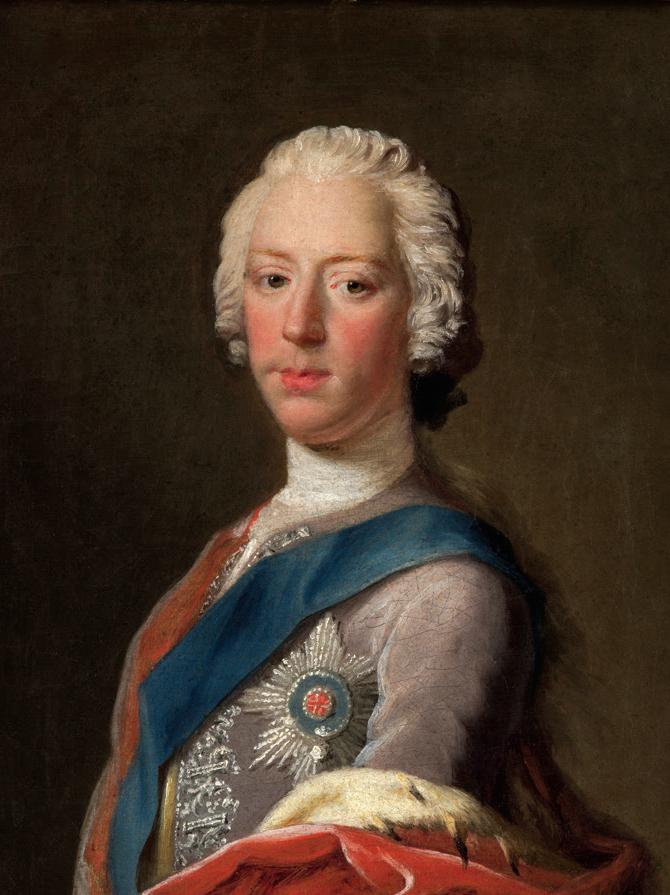
With Prince Charles’s arrival in Scotland in 1745, hopes of a Stuart restoration were high
was given the unenviable task of retrieving the money from the castle.
The nature of the 1689 Rising was rather different from those after the Union of Parliaments in 1707. What had begun as an issue of legitimate monarchy was complicated by the desire to also end the Union. In 1715, the Earl of Mar mustered Jacobite forces at Kildrummy Castle in Aberdeenshire, going on to rally more troops at nearby Corgarff Castle before raising the Jacobite standard at Braemar.
Despite the size of his army, Mar’s campaign petered out after the inconclusive Battle of Sheriffmuir, and James VIII and III, who had landed at Peterhead, was obliged to return to France.
Ringleaders condemned to death after 1715 included the Earl of Nithsdale, owner of Caerlaverock Castle, who was imprisoned in the Tower of London.
The day before his execution his wife Winifred, Countess of Nithsdale, visited him. She took with her a friend who
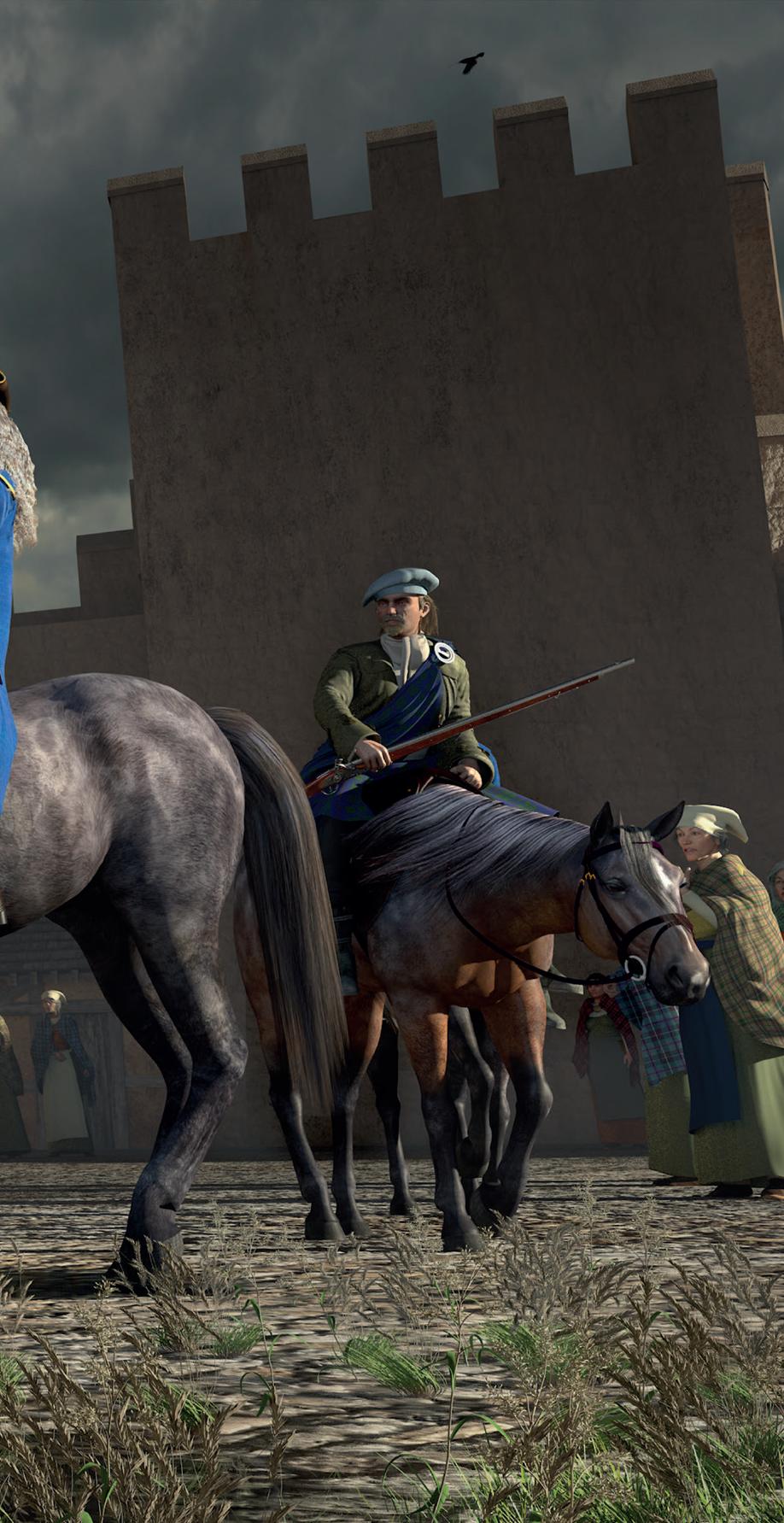
was heavily pregnant (and tall), who hid her face in a handkerchief as if she were sobbing. Dressing the earl in her friend’s clothes, Winifred made him leave while she stayed in his cell, talking loudly as if he was still there. Once he had escaped, she swiftly followed. Years later, when Bonnie Prince Charlie evaded his pursuers dressed as Flora MacDonald’s galumphing maid Betty Burke, he would have remembered the precedent that Nithsdale had set.
With Prince Charles’s arrival in Scotland in 1745, hopes of a Stuart restoration were high. Such was the terror in England that there was a run on the banks and George II prepared to evacuate his family. After the Jacobite triumph at the Battle of Prestonpans, and their capture of Carlisle, they marched on London. But lack of support forced them to turn back at Derby. At the ensuing Battle of Falkirk Muir, Charles’s men won a decisive victory but did not capitalise on this success.
Many of the soldiers captured at Falkirk were imprisoned at Doune Castle under heavy Jacobite guard.
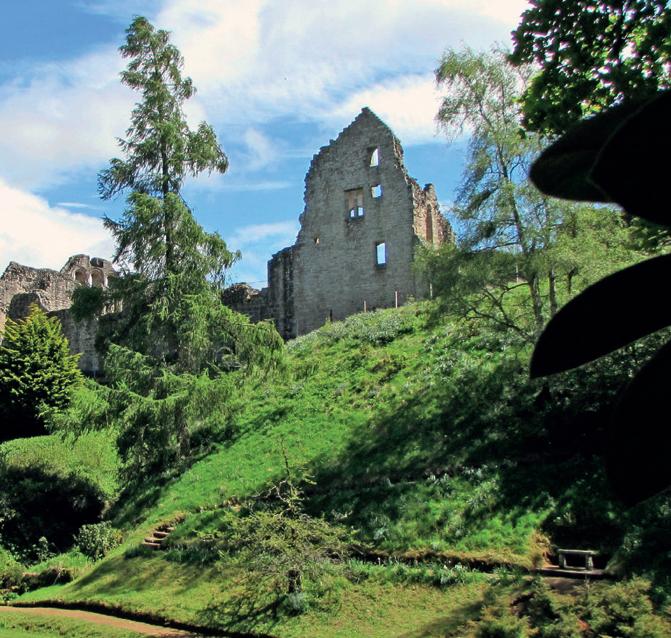
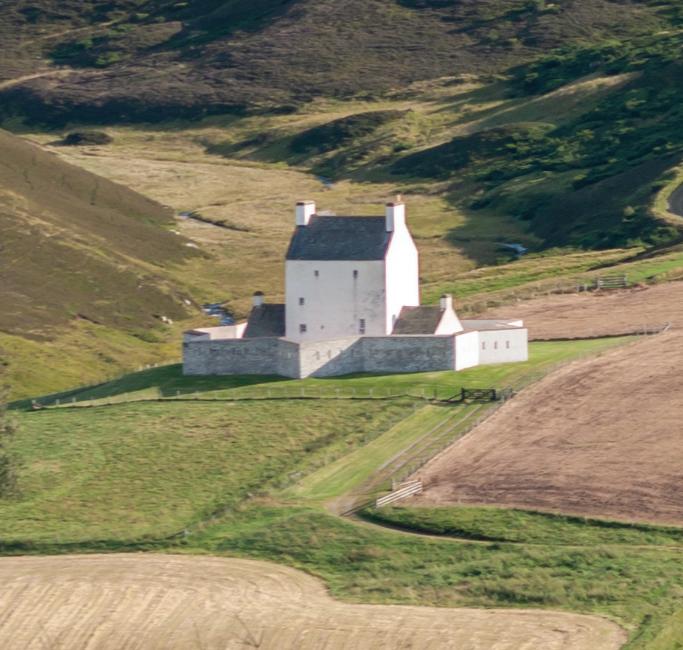
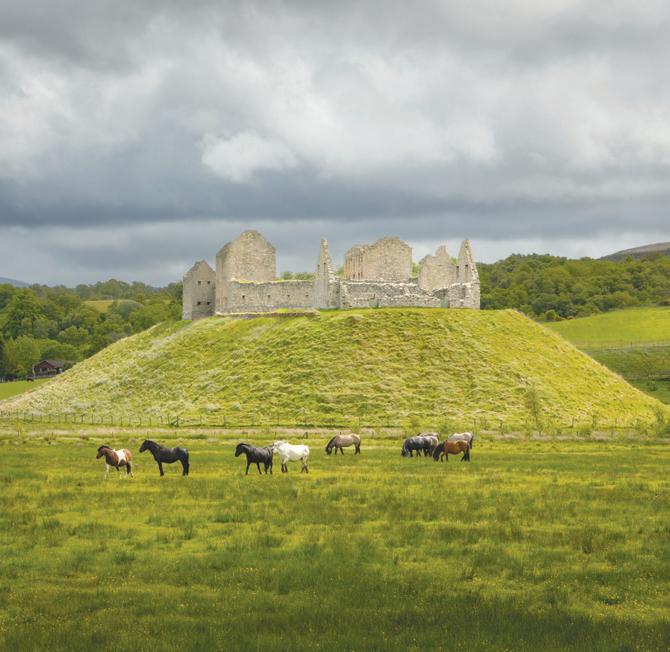
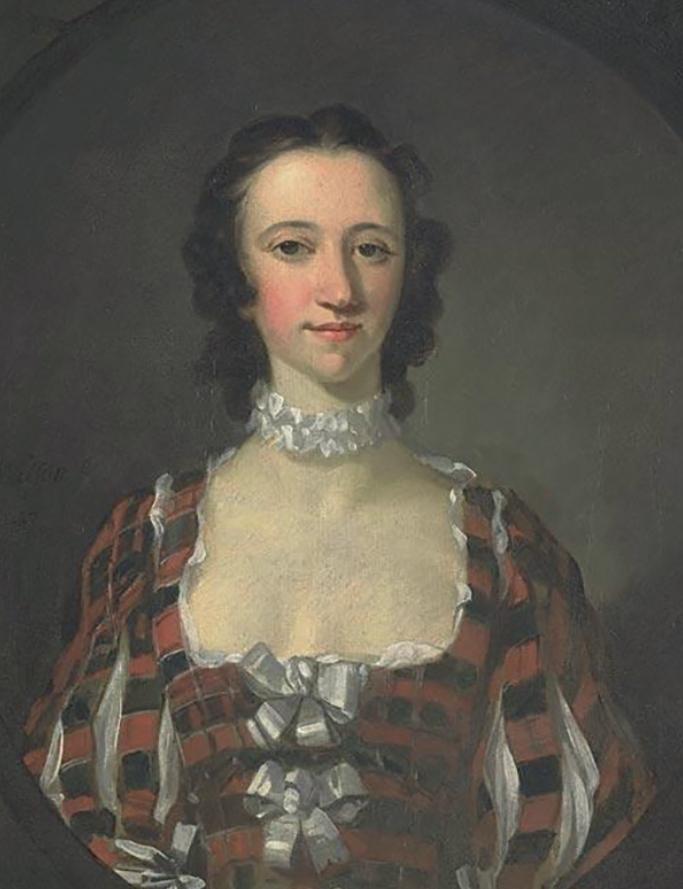
The role of Flora MacDonald in helping Charles escape after Culloden has made her a national hero
Among them was the dramatist John Home. He and a small band of fellow prisoners (including the Rev. John Witherspoon, who later signed the American Declaration of Independence) ripped up blankets to make a rope. In the dead of night, they tied this to the 70-foot-high battlements and took it in turns to clamber down. When the rope broke, leaving a 20-30 foot drop, one volunteer’s friends cushioned his fall. Remaking the rope, another man followed, but lost his grip. Home recalled: “having no body to break his fall [he] was so grievously hurt, bruised and maimed, that he never recovered”.
Myths about the Jacobites began to circulate after Culloden, and many have currency to this day. Some believe the Jacobites were mostly from the Highlands, even though it was a national and international cause. As the historian Murray Pittock explains in The Myth of the Jacobite Clans, misconceptions flourished as pro-Hanoverian, propagandist historians represented the
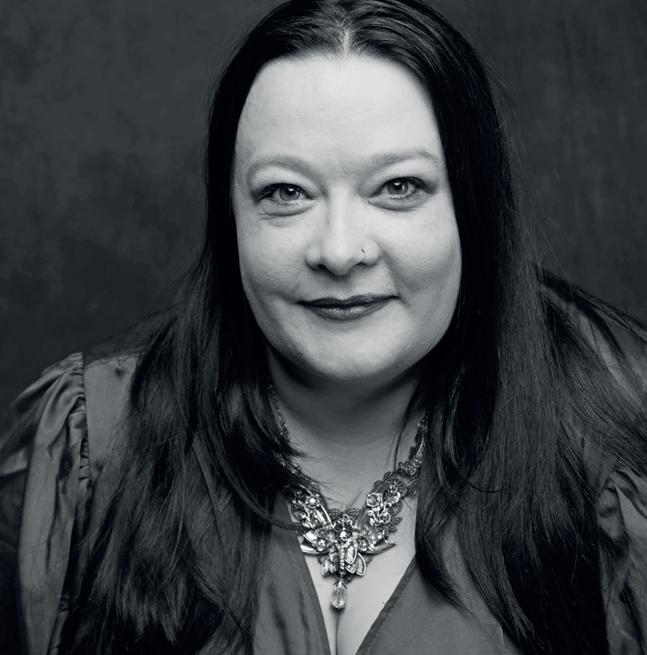
SHONA KINSELLA
Author
of
Outlander and the Real Jacobites
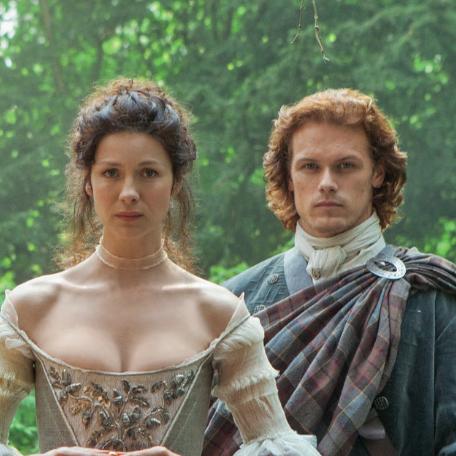
The Jacobite cause captures our imaginations because we really love stories about underdogs. Several other elements lend themselves to romanticism: the handsome young prince fighting to restore his father to his rightful throne; Charles’s charisma and determination; the fact that a huge percentage of the Jacobite forces were made up of civilians who were called to arms by their lairds, but managed to face down trained soldiers who outnumbered them; and the difficulties of those left behind to keep life running.
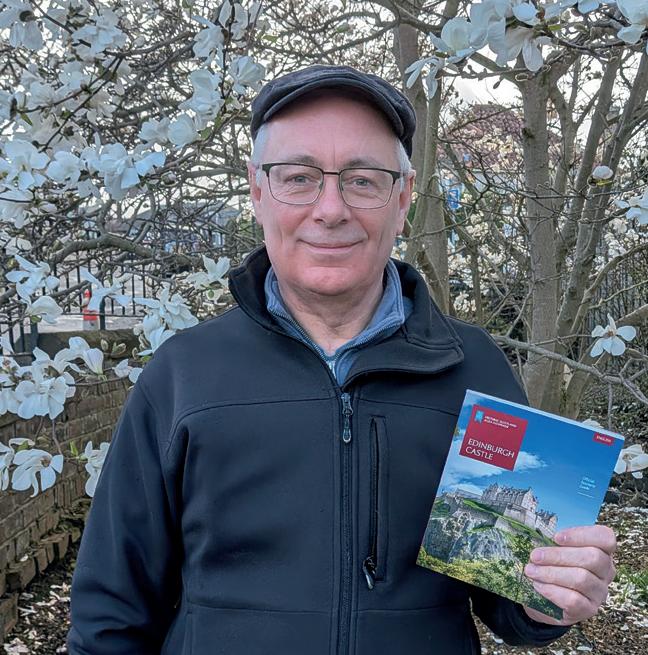
ANDREW BURNET Interpretation Manager, HES
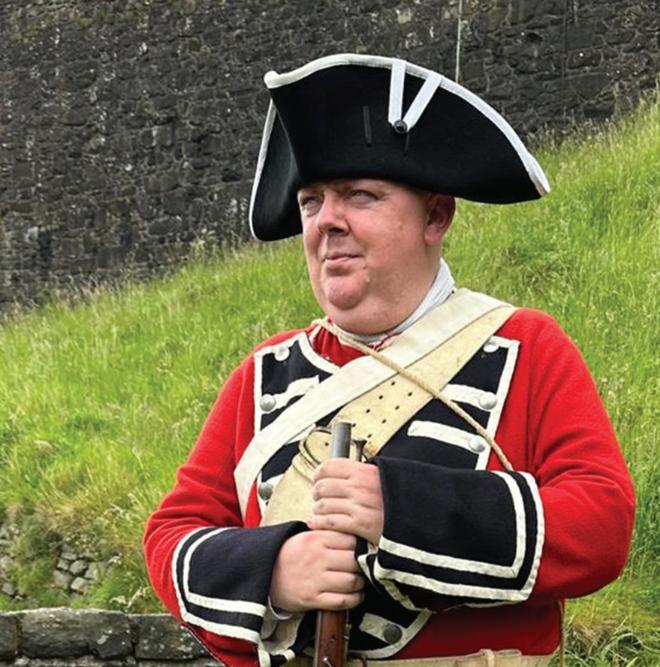
The Jacobite story still brings out strong feelings, and the Redcoats have often been portrayed as the villains of the piece. The atrocities committed after Culloden gave rise to a long-standing view of them as the agents of an oppressive, Londonbased foe, imposing an iron fist on the Highland way of life. Such a view has been amplified by the way that Redcoats have been portrayed in numerous fictional accounts.
PAUL LANG
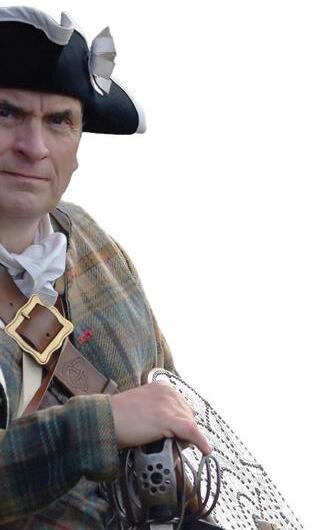
Living history performer
My dad took me to Culloden Battlefield for the first time when I was seven. I was instantly captivated. From that point on, we visited as regularly as possible. My dad worked at Fort George at the time, so he took me to work with him as often as he could, as well as taking me to see other sites linked with the Risings.
The hardest aspect of the 1745 Rising for modern audiences is probably the deprivation. We know that, by the time of Culloden, the Jacobite forces were practically starving.
There was also the fear of the punishments meted not only to those who fought, but also to anyone who might even have been considered a Jacobite sympathiser. Many were executed without trial, or evidence, and faced torture and mistreatment for information.
People sometimes think this is a story of Scots versus English, but there were Scots and English fighting on both sides, as well as interventions coming from Continental Europe.
There was an element of Protestant versus Catholic. The Catholic Stuarts had been supplanted by the Protestant branch of their family. The Jacobites wanted to reverse that. But there were not many Catholics in Scotland or England at that time, so political and clan allegiances were a bigger factor.

By the age of 14, I was working at the battlefield. Then when I turned 16 I began working as a battlefield guide at Culloden and as a living history performer at sites such as Edinburgh Castle and Fort George. To get into the part, I research the subject and character as thoroughly as possible. I want to understand the motivations behind someone’s decisions, their background and their circumstances.
In 1745, one of my ancestors joined the Young Prince’s cause, fighting at the battles of Falkirk and Culloden. After the defeat, he fled to France, where he joined the French army. Within two years, however, he had returned to Scotland, joined the British army, and helped with the building of Fort George near Inverness.
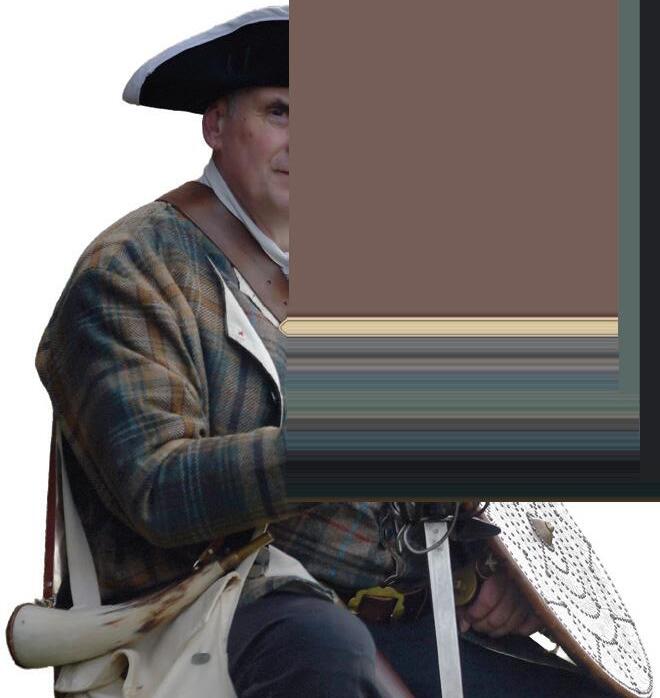
’45 as “backward, marginal and doomed”. They contrasted this with the progressive, modern age of Enlightenment. In this telling, Pittock writes, “the charisma of the Highlander depended on his defeat”. Yet there was nothing inevitable about Jacobite failure.
One commander at Culloden in particular stood out. This was John Roy Stuart, a professional soldier who, with his regiment and that of Clan Fraser, charged the Hanoverian frontline and almost broke it. One of Cumberland’s men remarked: “If all the Highlanders had fought as well as the officer with the red hair and the little hand, the issue might very well have been different”.
The role of Flora MacDonald – no Jacobite supporter – in helping Prince Charles escape after Culloden has made her a national hero. On her arrest, she
was held for a few days at Dunstaffnage Castle, before being put aboard a royal naval ship in Edinburgh. Her captors there described her as “the pretty young rebel”. After a year in the Tower of London, she was pardoned in 1747.
Want to find out more about the people and places linked to the Stuart cause?
Plan your visits at historyawaits.scot
The reprisals that followed Culloden were sickening. As Shona Kinsella writes in Outlander and the Real Jacobites, when considering who might be the model for Diana Gabaldon’s fictional character Black Jack Randall, she mentions that there were a few notorious Redcoats. Their crimes included gang rape, countless killings, drownings and the burning of women and children alive in their homes. To prevent further Risings, the government
passed punitive acts intended to destroy Highland culture, among them outlawing chieftains’ ancient right to hold their own courts. The use of tartan in Highland dress was also outlawed for men and boys, though women and soldiers could still wear it.
The crackdown led to the building of Fort George, near Inverness, along with other military stations across the Highlands. One of Europe’s finest military forts, Fort George’s construction employed 1,000 men. Along with the battlefield site of Culloden, it stands as a stark and sobering reminder of the threat the Jacobites posed to the House of Hanover, and the sad fate of the Highlands after they were crushed.
To prevent further Risings, the government passed punitive acts intended to destroy Highland culture



Alasdair Campbell explores the history and legacy of Bonawe
Historic Iron Furnace in conversation with artist Kirsten Millar

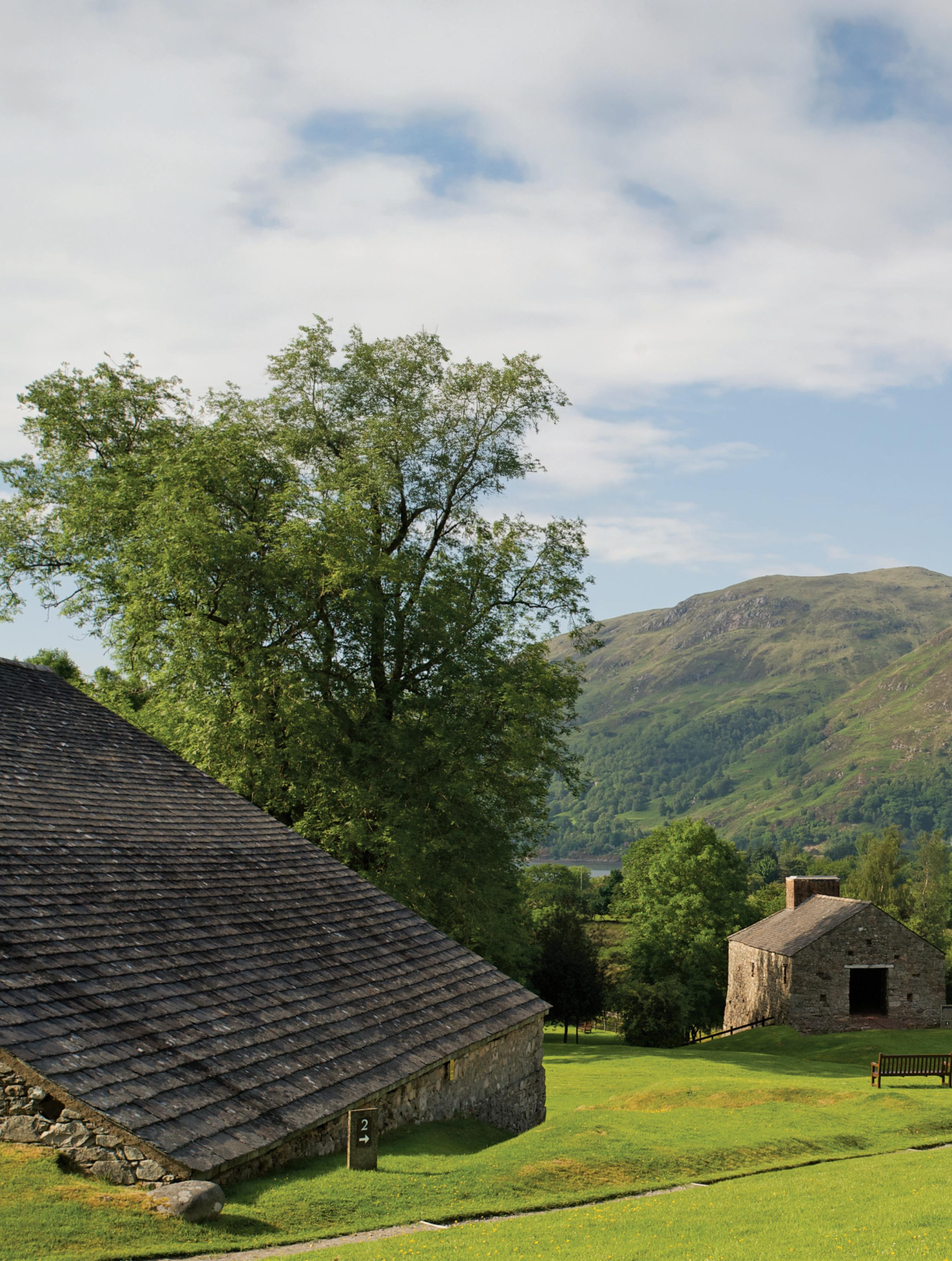


Arecent project to refresh interpretation at Bonawe Historic Iron Furnace (Fùirneis Iarainn Bhun Abha in Gaelic) in Argyll brought our Interpretation Officer Alasdair Campbell into contact with west coast-based artist Kirsten Millar. She had been inspired by the furnace and the history of the area to produce an evocative series of artworks, some of which are now on display. Here, she describes to Alasdair how she drew inspiration from this remarkable survival from the time of the Industrial Revolution.
Alasdair: Kirsten, you have been interested in Bonawe Furnace for a number of years now. When did you first visit and what made you go?
Kirsten: I had always caught glimpses of the furnace from the train window when travelling from Glasgow to Oban. I took the opportunity to
visit one day in 2022 when I was in the area, hiking up Ben Cruachan. I was interested to learn that the furnace dated to an earlier period than the other infrastructural and industrial projects in the area, such as the railway and hydroelectric schemes.
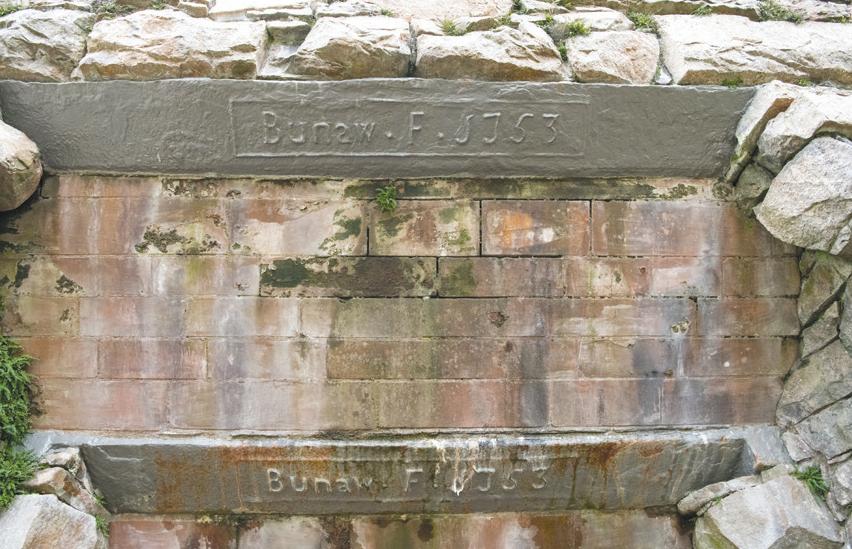
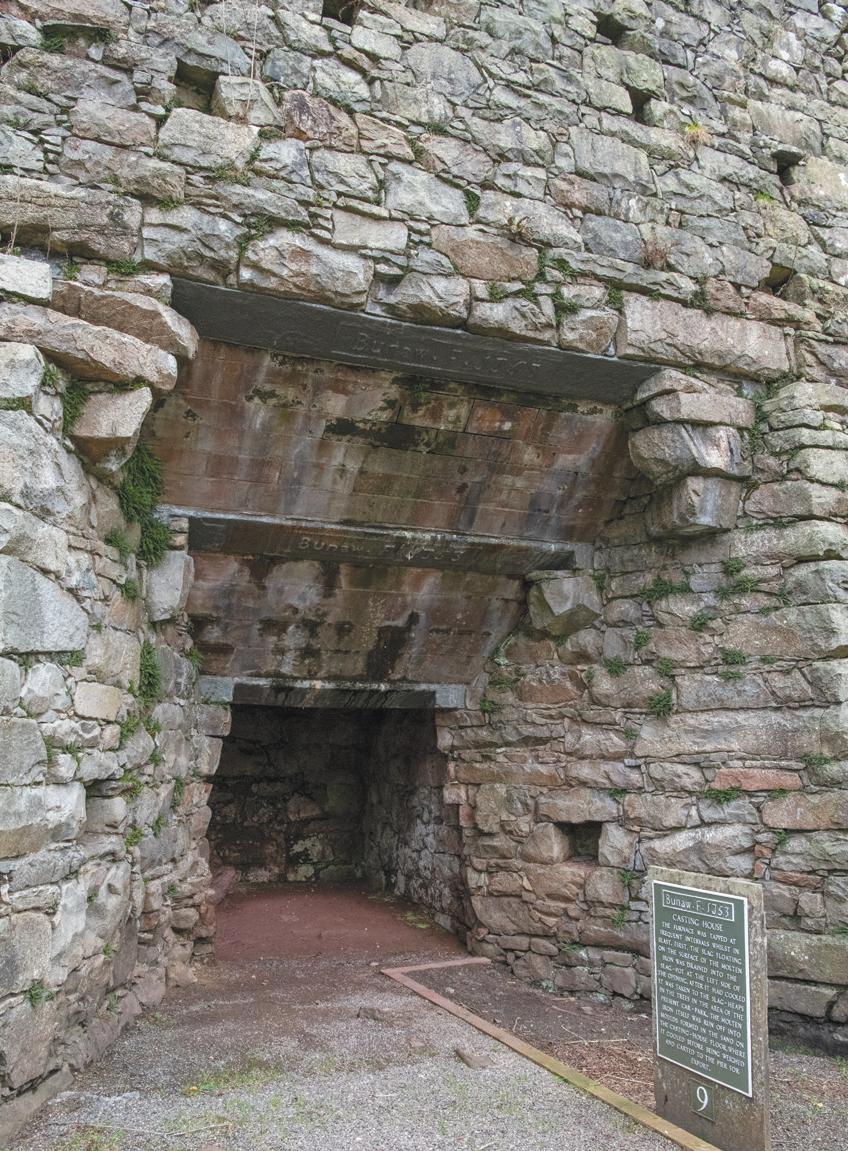
Alasdair: Cruachan Power Station opened in 1965, while Bonawe opened in 1753, during the early years of the Industrial Revolution in Britain, and ran for 120 years. It is one of the earliest and best-preserved examples of industrialisation in the Highlands. Set up by an English company, its business model relied on using wood from the forests of Argyll and water from the River Awe to produce raw iron (Bonawe comes from the Gaelic Bun Abha meaning ‘mouth of the River Awe’). What have you learned about this industrial past?
Kirsten: That contrast between past and present at Bonawe fascinates me. The local population
VISIT BONAWE
Open daily from 9.30am to 5pm (last entry at 4pm), trains and buses run to Taynuilt from Dalmally and Tyndrum. Trains also run from Crianlarich. It’s then a 15-minute walk.





Today, it almost has a pastoral quality, juxtaposed against how the site would have functioned
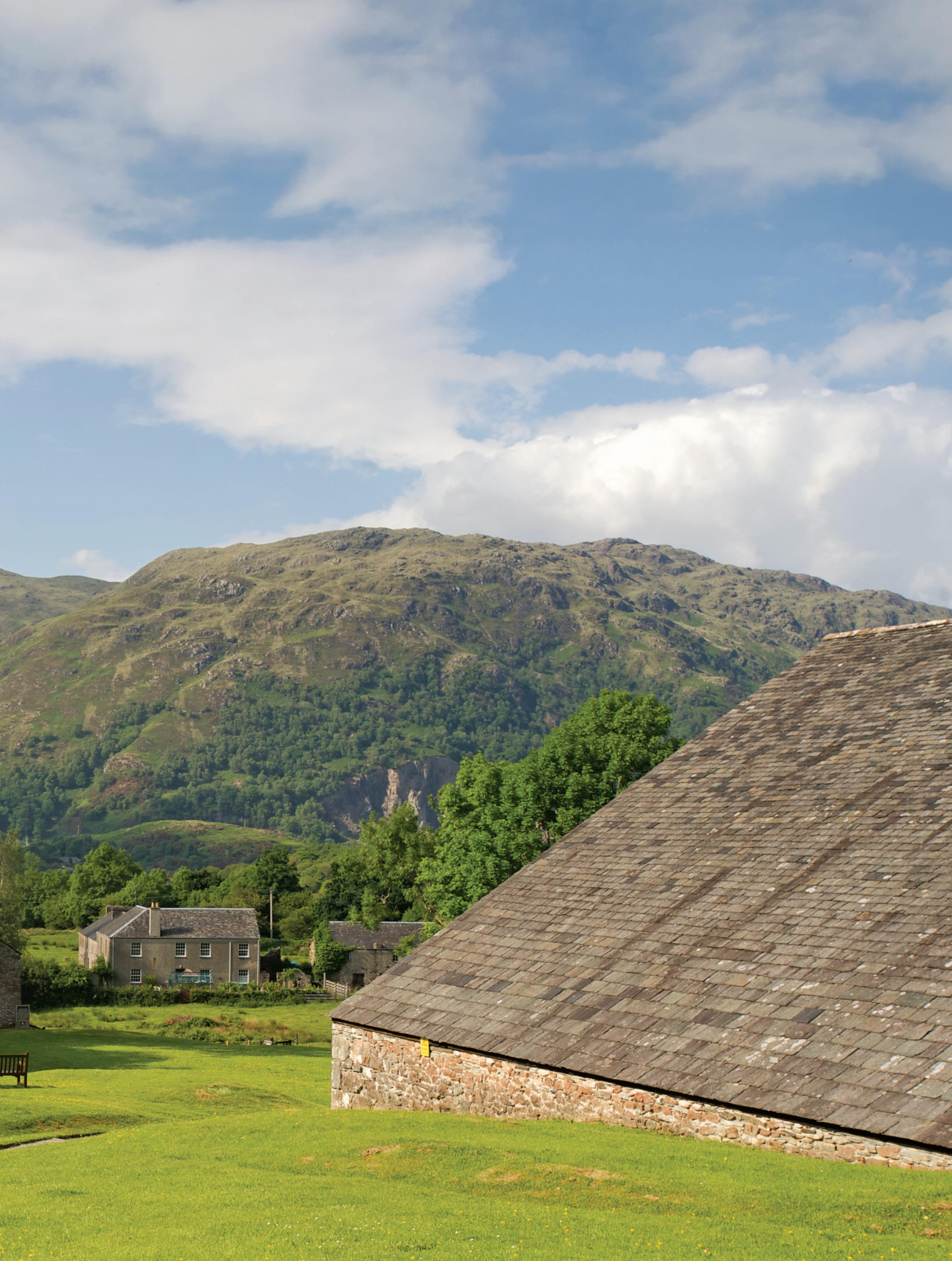
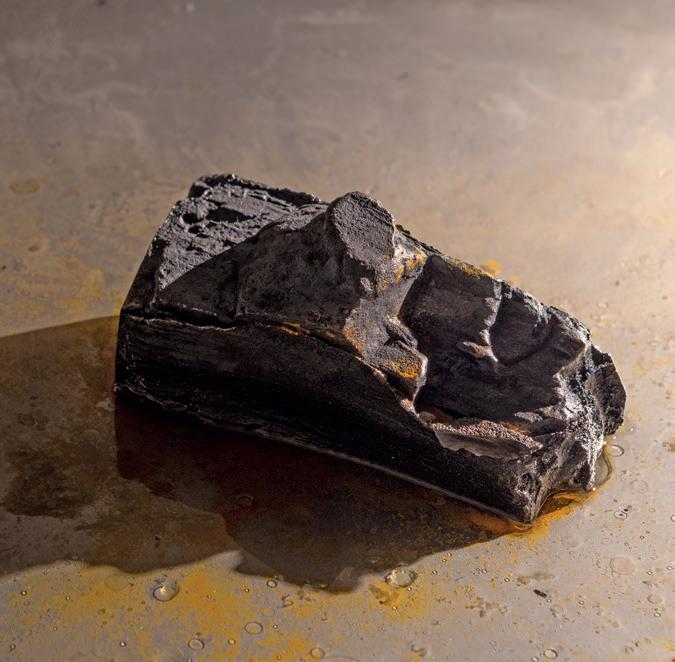
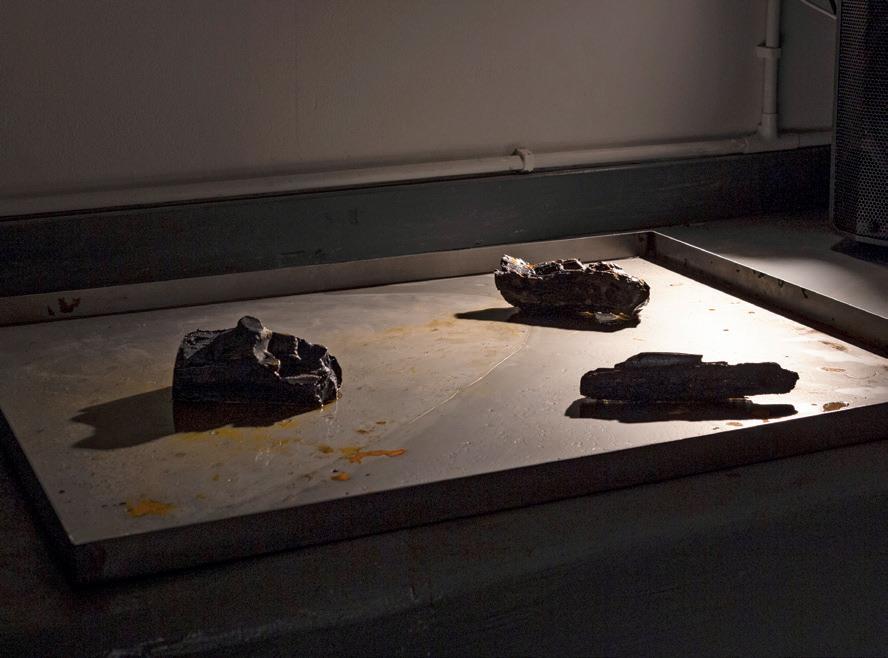
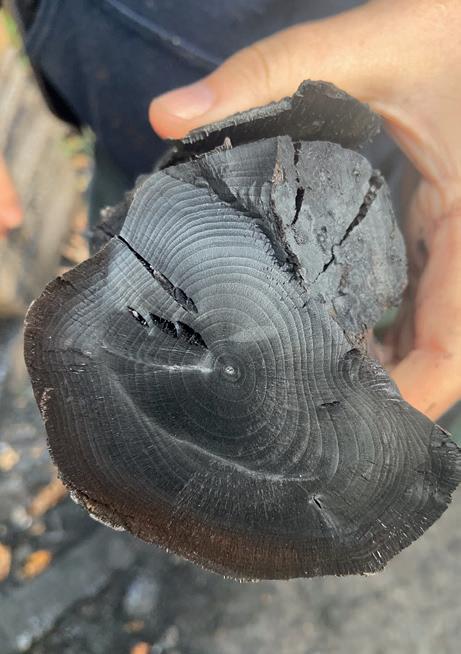
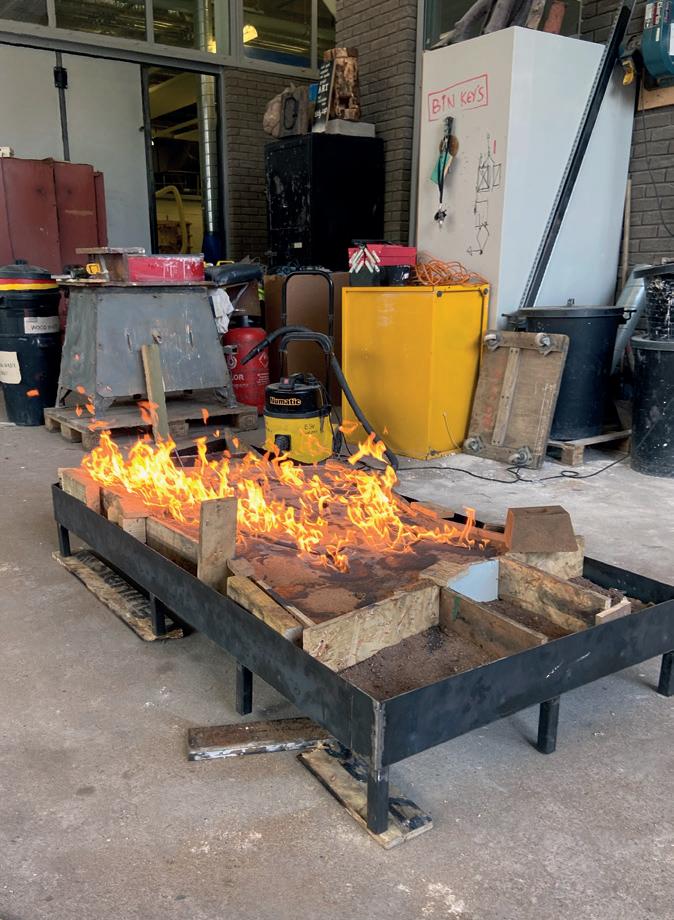
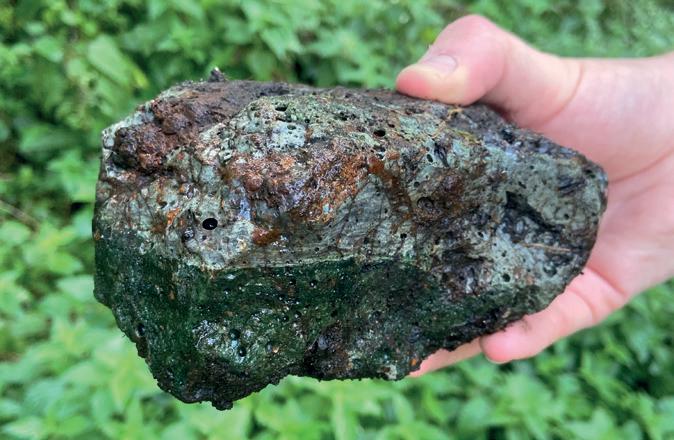
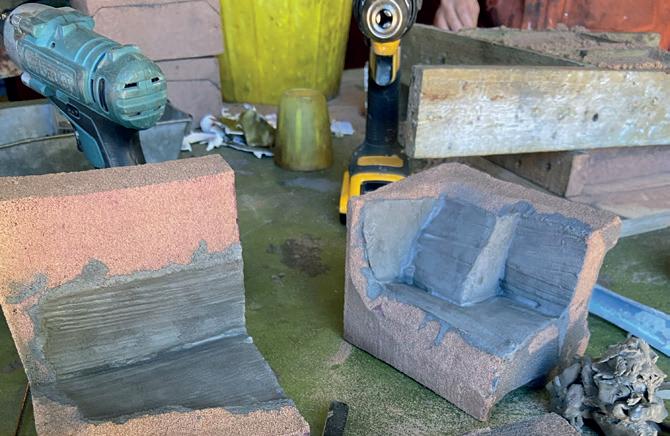
TogetclosertotheBonaweworkers’experiences,
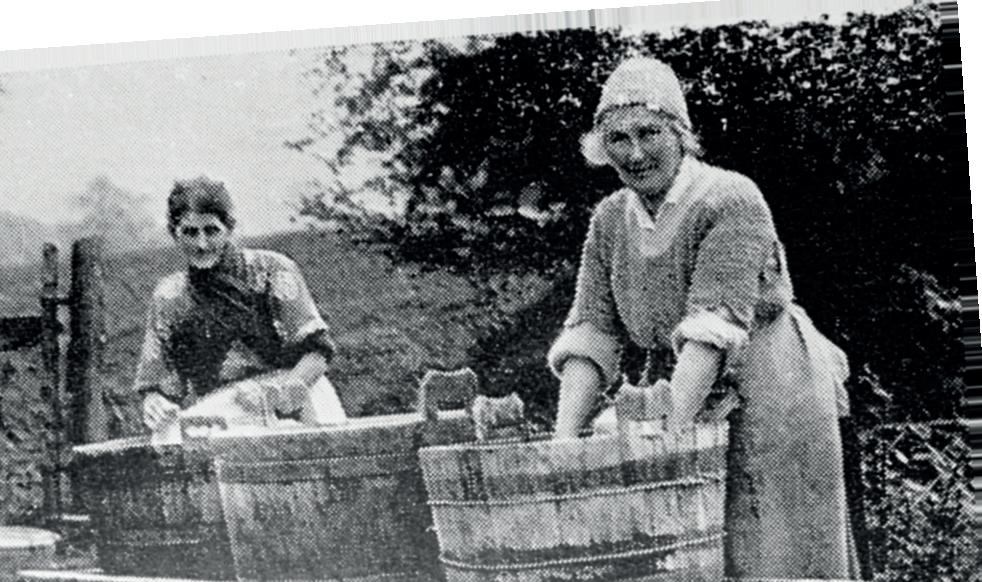
provided the bulk of the company’s workforce and a kind of isolated industrial community gradually formed around the furnace. At its peak, it employed more than 600 people and produced up to 700 tonnes of iron a year in a roaring blast furnace with fires burning 24/7.
Today, it almost has a pastoral quality, juxtaposed against how the site would have functioned. This contrast between past and present is highlighted by this quote from John MacFarlane, who said:
“When the furnace started up, the local people used to say it was like hell on Earth, because at night, for the first time in living memory, the sky was red with light pollution from the furnace fires.”
Alasdair: This kind of industrialisation in the Highlands relied on the exploitation of natural resources and would likely have come as a shock to local people. In larger cities such as Glasgow, industrialisation meant a focus on manufacturing products like textiles or shipbuilding. After your initial visit, you contacted local people, including John. How did this come about?
Kirsten: In 2022, I hosted a community tea and coffee event in Taynuilt, near Bonawe Iron Furnace. I was lucky enough to meet John, alongside other locals with fantastic stories of the site. John sadly passed away in 2023; he was the last fluent native speaker of Lorn Gaelic around Loch Etive, the historic
Gaelic dialect of the area, which would have been spoken by many of the workers at the furnace. I gained an understanding of how important the site was to local people. The village that sprang up around the furnace also has deep roots in the area’s Gaelic culture.
Alasdair: We thought it was important to use Argyll Gaelic dialect in some of the exhibition. We’re delighted to be able to include some of John’s stories, and even prophecies from a fàidh, a Gaelic seer. Bonawe emerges against the backdrop of the Highland Clearances, where Gaels were being evicted from their homes and offered mostly temporary alternative employment with harsh working conditions. The furnace was
Bonawe is one of the earliest and best-preserved examples of industrialisation in the Highlands
'' I cannot believe the difference my HD Light has made. I can now read books and newspapers again.
Mrs Nicholas I Tyne&Wear

• Up to TWELVETIMES more light on your page than a traditional 60Wbulb
• Words are crisp and clear
• Recommended by over 500 opticians
• Designed and made in Britain
• Available as a Floor or Table Light
Serious Readers is a British company totally dedicated to the purity of light. Whilst other lights rely on looks for their appeal rather than light output, our primary focus is on performance. A Serious Light offers incredible clarity and brightness, in fact our lights are used by surgeons, forensic scientists and fine art restorers - basically anyone who needs to see clearly and accurately.
Small text is a test for both light and eye and with a Serious Light this is where you'll really notice the difference. Everything looks sharper, clearer and easier to read. Fine detail is more defined and colour has a new vibrancy and richness.
Love the difference it makes, or we will collect it and refund you in full. 99 in every 100 people who try one, love it and keep it. You have nothing to lose.
Inset, two women doing laundry at Bonawe Iron Furnace around 1920
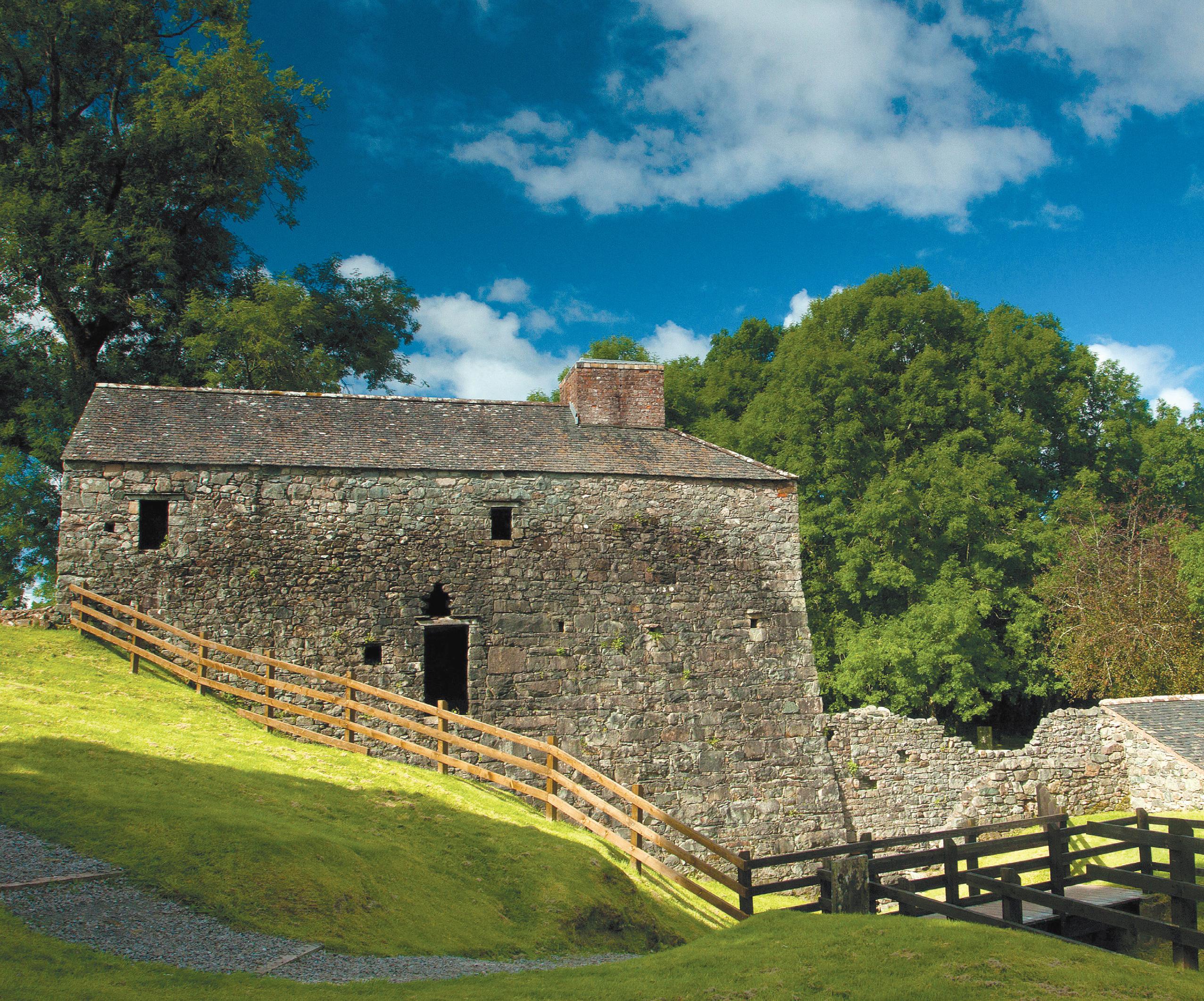


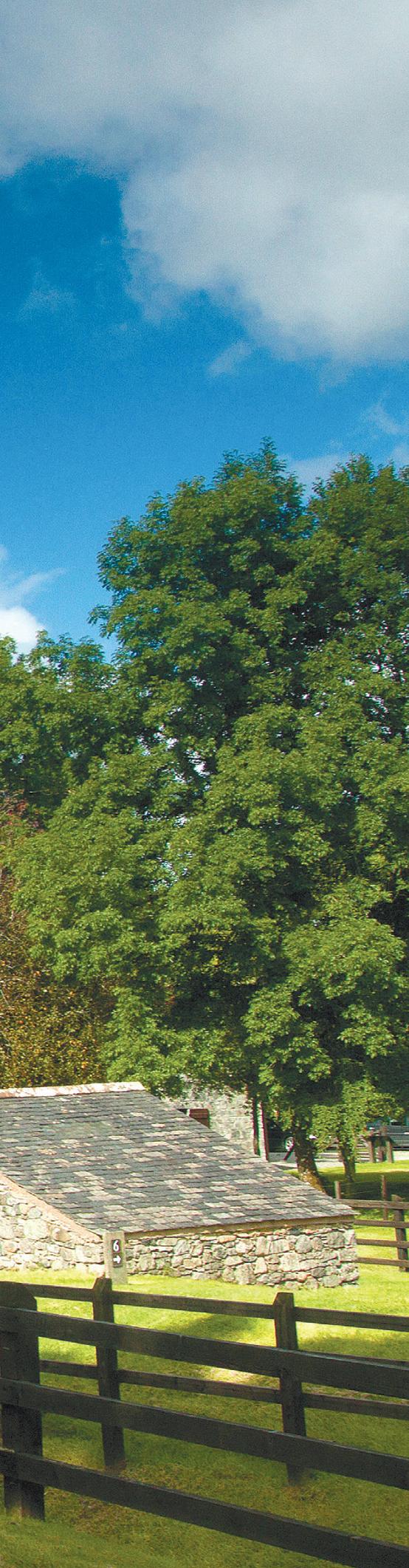
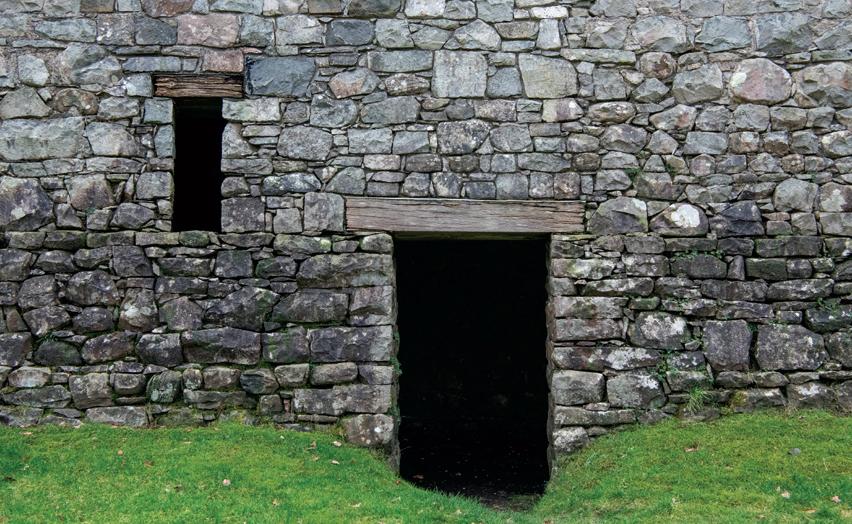
Our new exhibition at Bonawe Historic Iron Furnace brings together oral history accounts and contemporary artworks to tell the story of Britain’s best preserved charcoal blast furnace, the first significant industrial project in the Highlands.
Harnessing the power of the River

Awe and wood from the forests of Argyll, the furnace had a profound and lasting impact on its landscape and population.
Learn about the local Gaelic population, who provided most of the workforce, and the harsh working conditions they endured against the backdrop of the Highland Clearances. See objects with their own stories to tell – such as the tinted
furnace glasses of an unknown worker, and a cannonball, like those supplied to Admiral Nelson during the Napoleonic Wars. Find out more about Gaelic folklore and the predictions of a Highland seer, who foresaw the coming of the furnace –translated into Argyll Gaelic, the local dialect of this ancient region.
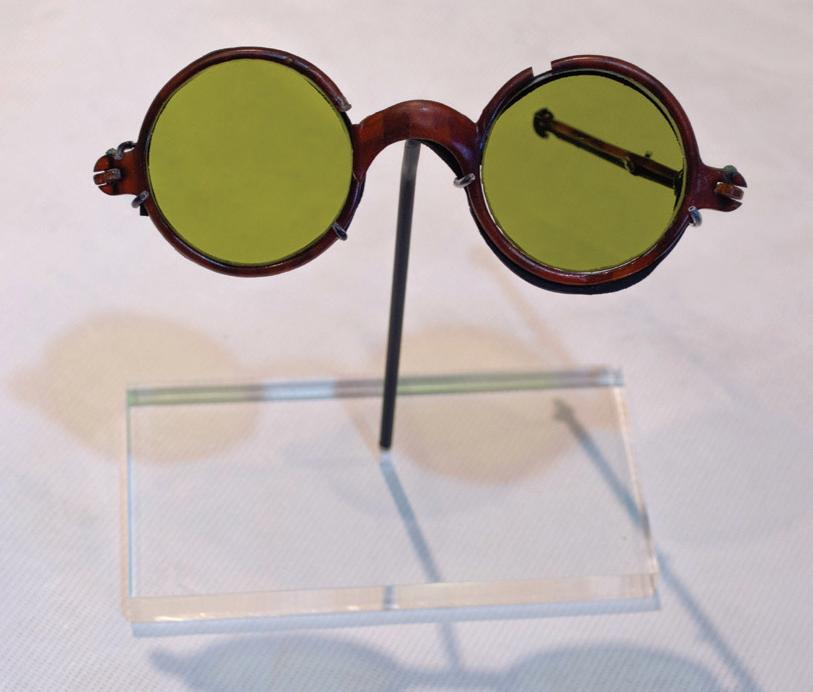
Furnace worker’s tinted spectacles
run by an English company and there was an influx of English workers and their families to Argyll. This sparked tensions as the Englishmen received higher wages than their local counterparts. What else did you find out about relations between the workers and the management?
Kirsten: I discovered material on the company and letters from the English managers reporting on profits and productivity. The archives mention workers in legal disputes with Englishmen or fined for dragging timbers along the road to Bonawe, but there is little information on life in the self-contained furnace community.
Alasdair: Sadly, that is something that we often find with written records: it is
often those in power whose experiences are written down and recorded, while the experience of the workers is absent.
That’s why John’s accounts, passed down through generations of oral history tradition, are so important. Was it this absence of source material on the workers’ experience that opened up new creative possibilities? Did this inspire you to create your artworks that include sculptures, photography and sound?
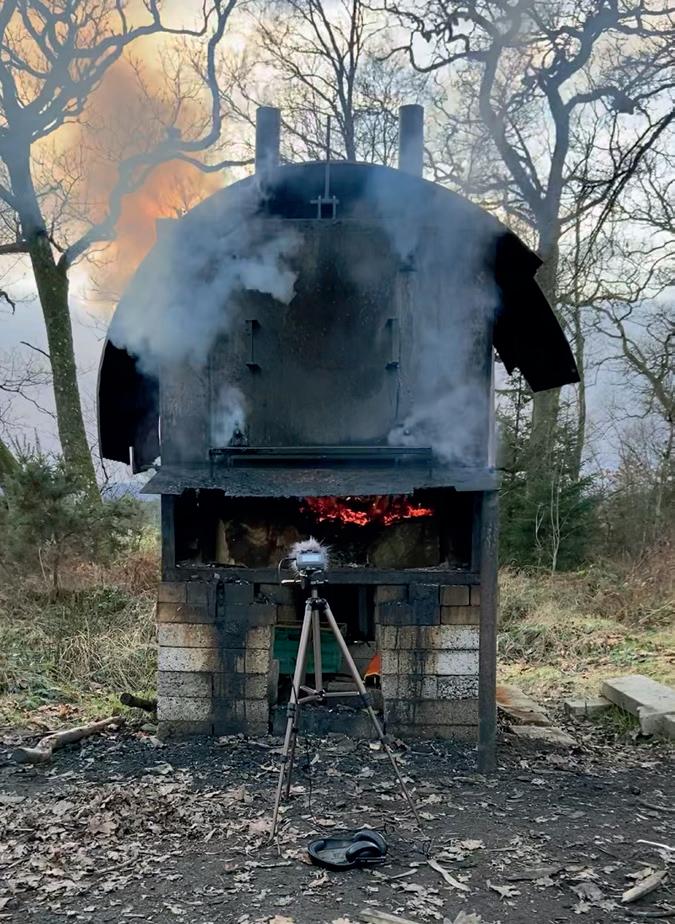
Kirsten: I wanted to understand the labour involved and the sensory experiences of the workers while they transformed wood into charcoal, and ore into iron. Through working with iron myself and learning to make charcoal, I engaged with the smelting process to get closer to the experiences of the workers. Producing the iron casts required
significant work: approximately one day for charcoal-making and four to five days for casting, including mould-making, pouring and finishing the objects.
Alasdair: It’s amazing that you took the time to learn techniques that would have been used by the workers here 200 years ago. Visitors will be able to listen to your sound work in the exhibition. Can you tell us a bit about that?
Kirsten: Sound is a powerful experience and shapes how we engage with our environment. Bonawe today has a bucolic soundscape. The historical soundscape, however, would have been roaring with activity: the blast of the furnace; woodlands filled with workers and charcoal burns producing fuel to feed

the fire. In this work, I sought to recover past sounds and evoke the sensory experience of the workers. I used layered sound recordings of a charcoal burn at Green Aspirations Scotland and an iron pour at Edinburgh Sculpture Workshop, developed and edited with the support of Listen Gallery.
Alasdair: You have also been trying to understand the legacies of Bonawe on the landscape and environment. Carbon emissions from burning charcoal were obviously detrimental but weren’t some aspects sustainable?
Kirsten: I’m interested in the ways historical narratives can shape our interactions with the environment today. I spent time studying the landscape and walking around Bonawe. Through visits to Glen Nant, tours of the furnace with HES staff and excursions to local forests with The Ardchattan Centre, I explored the surrounding woodlands to observe coppicing platforms and trees that once supplied the furnace. The coppicing method –cutting only the tree branches on rotation – meant that, despite the huge quantities of wood required, the forests were left in a better state than when the furnace started.
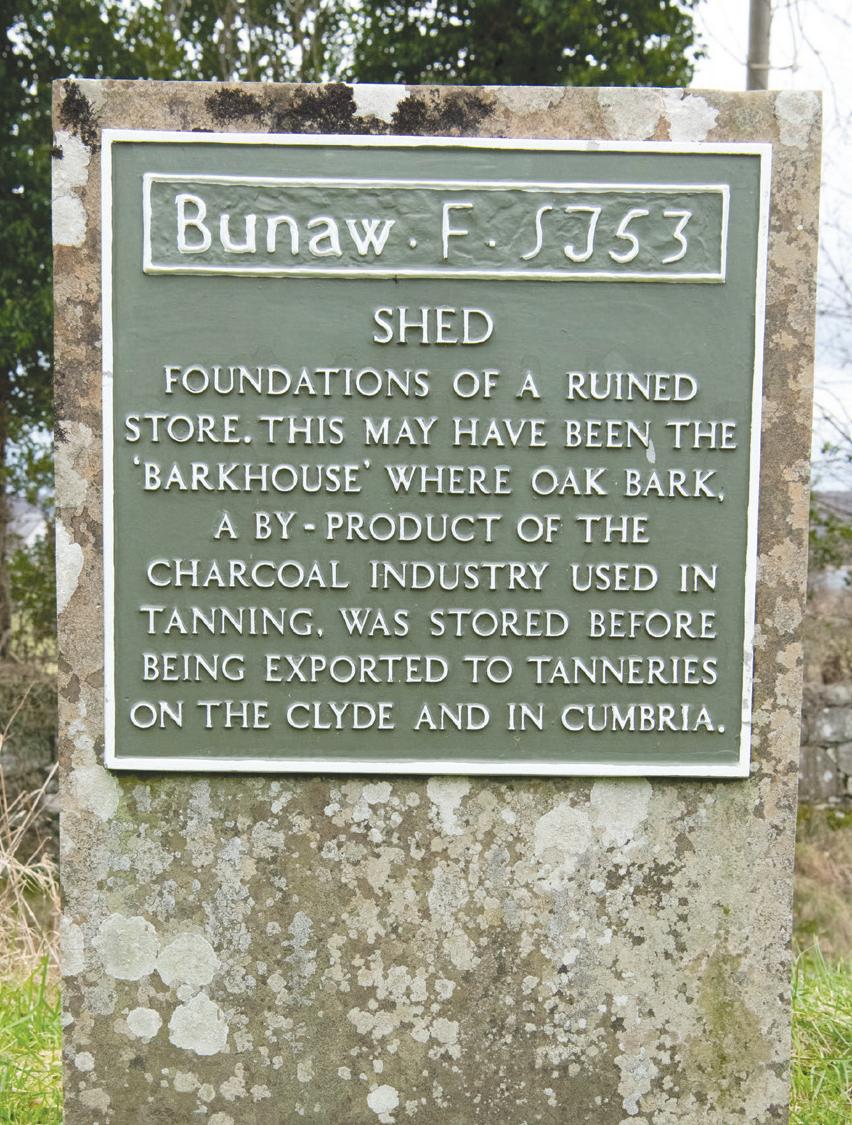
Alasdair: The company was also quite innovative in recycling the by-products of the smelting process. The glassy iron slag was sold to a glassmakers in Edinburgh. The peeled bark went to leather tanneries on the Clyde and in
Cumbria. However, advances in the iron industry put Bonawe out of business. After 120 years of intense industrial activity, rural tranquillity returned. The owners abandoned the site, and tourism became the main industry. Today, people describe wind farms and hydroelectric schemes, and even proposed spaceports, as the ‘re-industrialisation of the Highlands’. For example, the Inverawe power station draws water from the River Awe downstream from where a lade was created to power the furnace bellows.
Kirsten: At Bonawe, for example, historical practices such as coppicing, charcoal-making and bark-peeling remind us that the landscapes were once managed in more cyclical and resource-conscious ways. Engaging with this place has encouraged me to reconsider what we define as productive, and to think more critically about the legacies these industrial projects leave behind; on the landscape and on the communities who live there. These considerations are all relevant for industrial projects today. The story of the furnace – its arrival, success and decline – also reflects how land use, sense of place and communities are constantly shifting.
l Kirsten’s art installation FÙIRNEIS was funded by Creative Scotland and supported by HES and Culture, Heritage and Arts Assembly, Argyll and Isles (CHARTS).
Sound is a powerful experience and shapes how we engage with our environment
Visiting Bonawe Furnace? Plan your visits to other sites in the area at hes.scot/visit
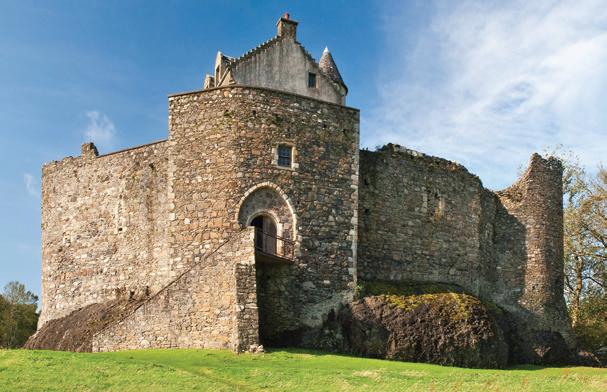
This mighty stronghold of the MacDougalls holds an enviable position above the Firth of Lorn. The name derives from Old Norse and the Gaelic Dùn Staidhinis, meaning ‘Fort of Staidhinis’.
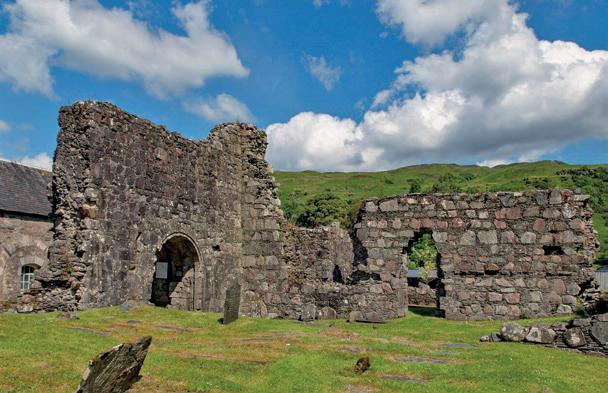
Along the northern shore of Loch Etive you’ll find the tranquil ruins of a priory, once a significant place for the Valliscaulian order of monks and later Clan Campbell. The Gaelic name Àird Chatain means ‘Height of Catan’.
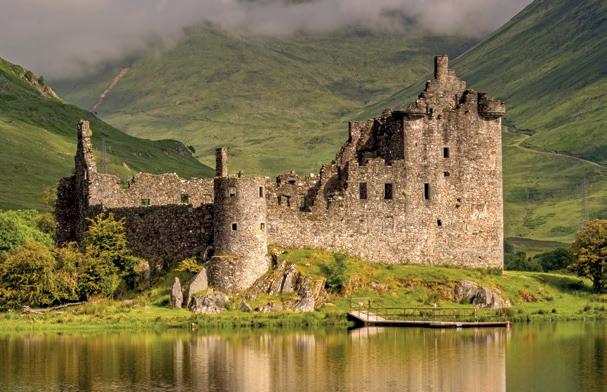
This picturesque castle on Loch Awe was once the powerbase of the Campbells of Glenorchy, and a government outpost during the Jacobite Risings. Its name comes from the Gaelic Caol Chùirn meaning ‘narrows at (the) cairn’.



Free
Free
Discounted
Jonathan McIntosh spotlights seven of our sites where famous couples from history, and more recently, have tied the knot
From matches made in heaven to politically motivated nuptials, our properties have witnessed some momentous matrimonies through the centuries. Here, we highlight some of our sites where famous figures have exchanged vows and rings – for better or worse.
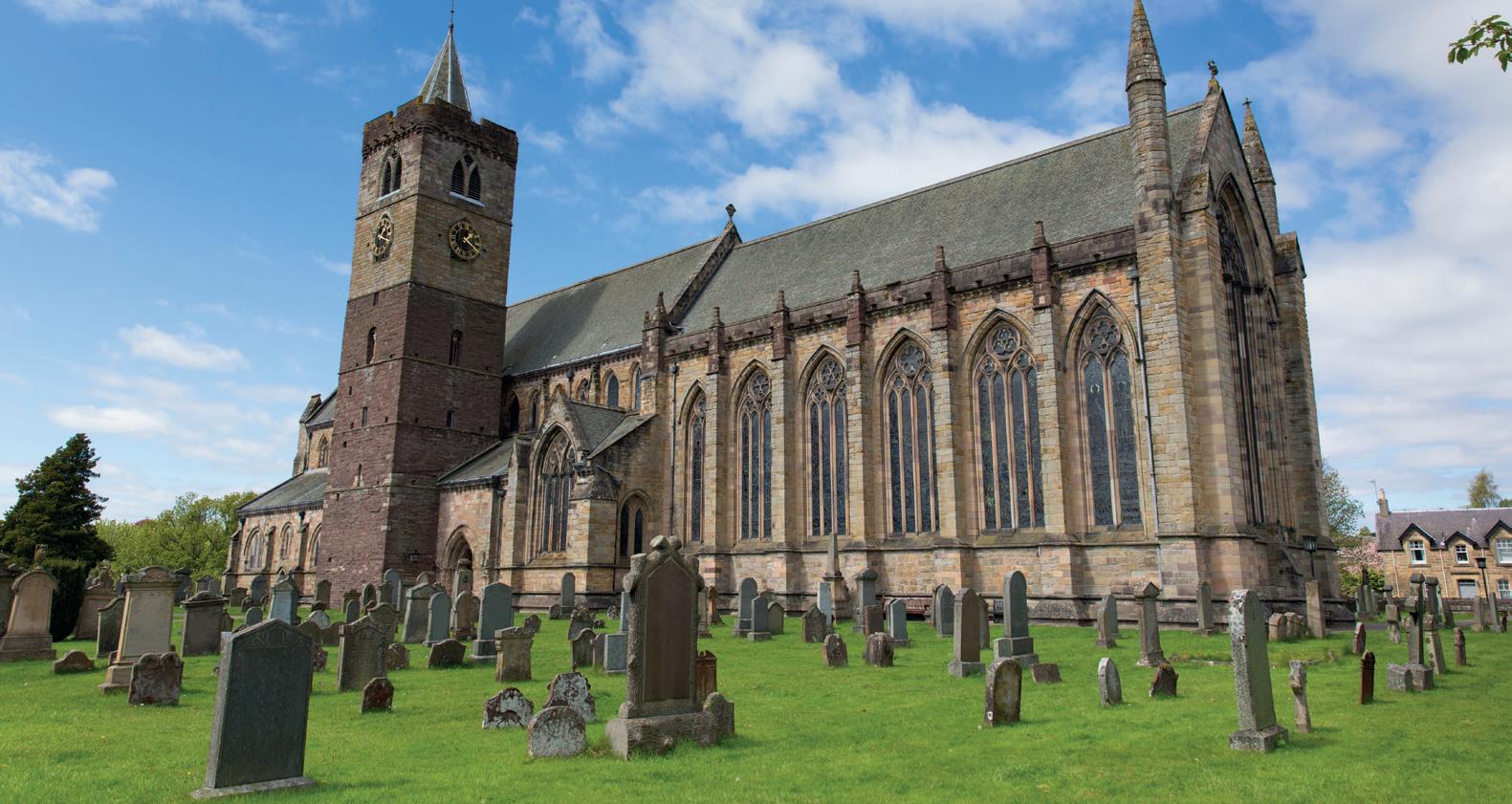
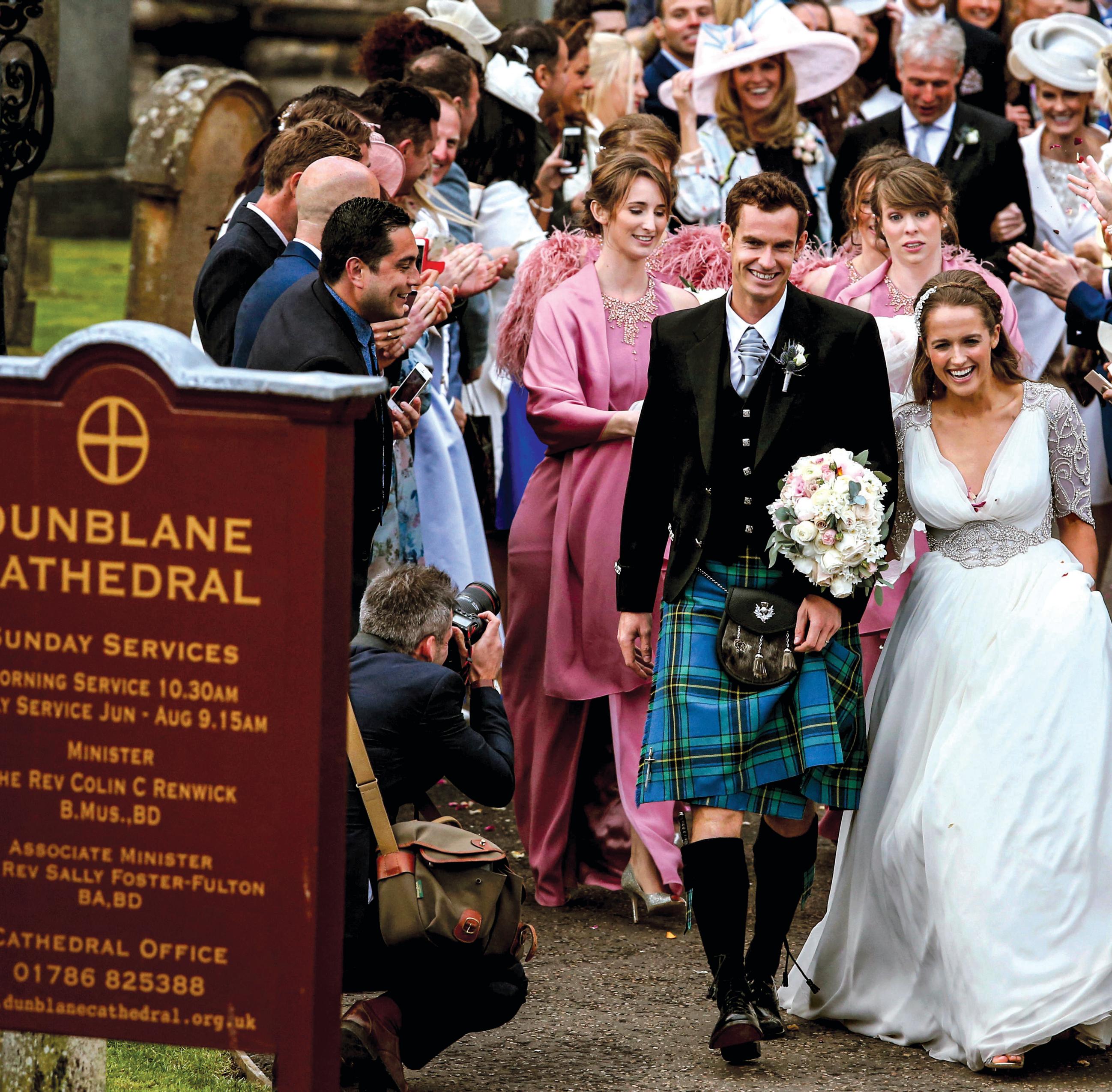
THE VENUE: DUNBLANE CATHEDRAL THE BIG DAY: 11 APRIL 2015
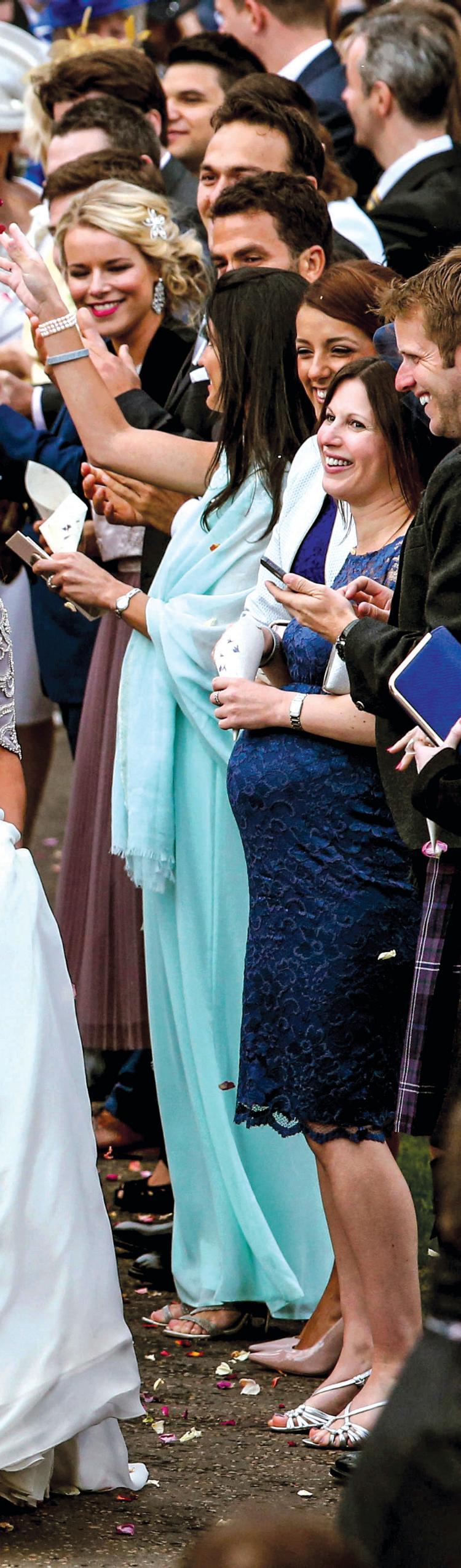
Tennis ace Andy Murray served up modern-day romance by marrying his perfect match, Kim Sears, at this handsome cathedral, which stands on a site that has been used for religious purposes since at least the 9th century.
A white wedding car brought Andy’s future wife to the back of the cathedral, away from crowds of well-wishers and an eager media. They exchanged vows inside before heading to a reception for family and close friends.
The name Dunblane, which means Fort of Blane, comes from the monks of Saint Blane who fled the Isle of Bute in the 7th century, carrying their saint’s holy relics, to escape Viking raids.

THE VENUE: DUNFERMLINE ABBEY
THE BIG DAY: CIRCA 1070
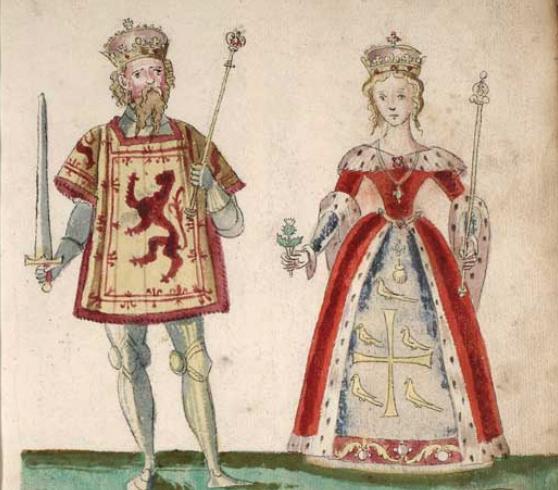
Queen Margaret of Scotland was so taken by the place where she and Malcolm III got married that she invited Benedictine monks from Canterbury to form a small priory here. The couple’s son David I elevated it to abbey status in 1128. Margaret and Malcolm’s marriage cemented Dunfermline’s place as a regal hub. The abbey itself became a final resting place for many Scottish kings and queens.
THE VENUE: JEDBURGH ABBEY
THE BIG DAY: 14 OCTOBER 1285
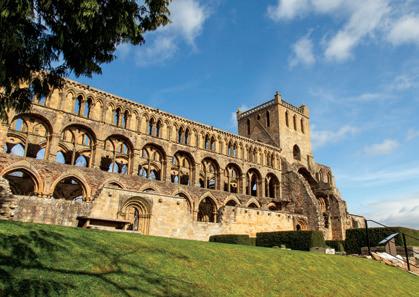
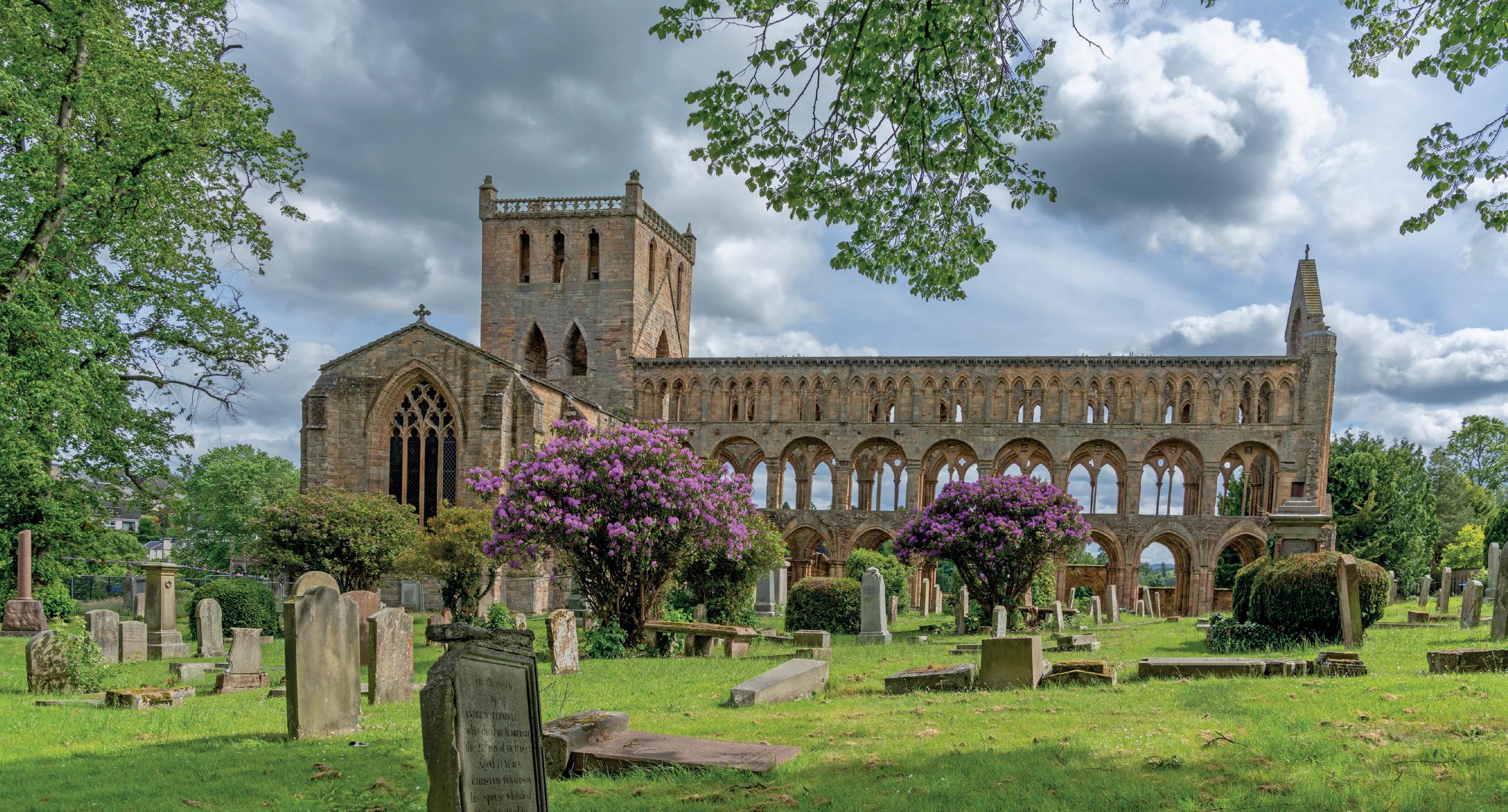
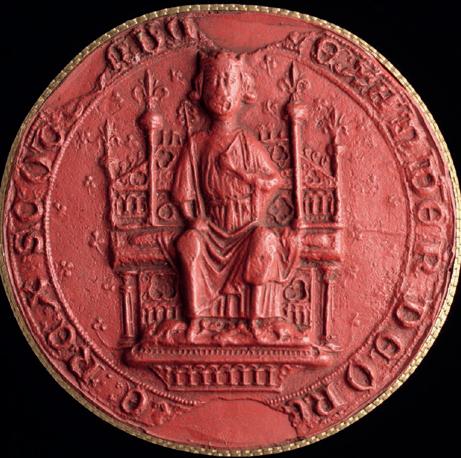
King of Scots Alexander III and Yolande de Dreux, who hailed from one of France’s most influential families, were married at this Augustinian abbey, founded by David I in around 1138.
Scottish chronicler Walter Bower (c.1385-1449) – who wrote the Scotichronicon –later recorded a chilling occurrence. It was said that an apparition appeared at the wedding, and the music stopped.
Having lost his first wife, Margaret of England, in 1275, as well as their three children, Alexander needed an heir. This new exchange of vows represented a hopeful new chapter in his reign, but the couple’s happiness was short-lived.
In March 1286, the king left an Edinburgh Castle banquet to visit a pregnant Yolande in Kinghorn, Fife. In stormy weather, Alexander’s horse lost its footing and threw him to his death. Yolande miscarried months later. The wedding apparition was later seen as an omen for these tragic events.
The cruel twist of fate signalled the beginning of a succession crisis.
THE VENUE: DUNSTAFFNAGE CASTLE
THE BIG DAY: 20 DECEMBER 1463
The drama and deception central to this wedding could be from the script of Game of Thrones. John Stewart of Lorn, also known as Lipper (leper) John, was marrying the daughter of the MacLaren lord of Ardveich. Her name is absent from the historical record, but she was the mother of John’s son, Dougall,
and it was crucial that he was legitimised as the rightful heir.
A vengeful relative, Alan MacCoul, believed his family, the MacDougalls –ancestral owners of Dunstaffnage and the Lorn title – had been unfairly dispossessed of their assets. Fuelled by revenge, MacCoul and his men ambushed the Stewart wedding party procession as it made its way from the castle to the nearby Dunstaffnage Chapel.
Stewart was mortally wounded but, as recorded in the family history, The Stewarts of Appin, John “ground through the marriage ceremony in order to secure the lordship for his son”. MacCoul, meanwhile, breached the castle walls.
Dougall escaped to Stalker Castle with his mother, but five years later he wreaked his revenge when he killed MacCoul at the Battle of Stalc.

THE VENUE:
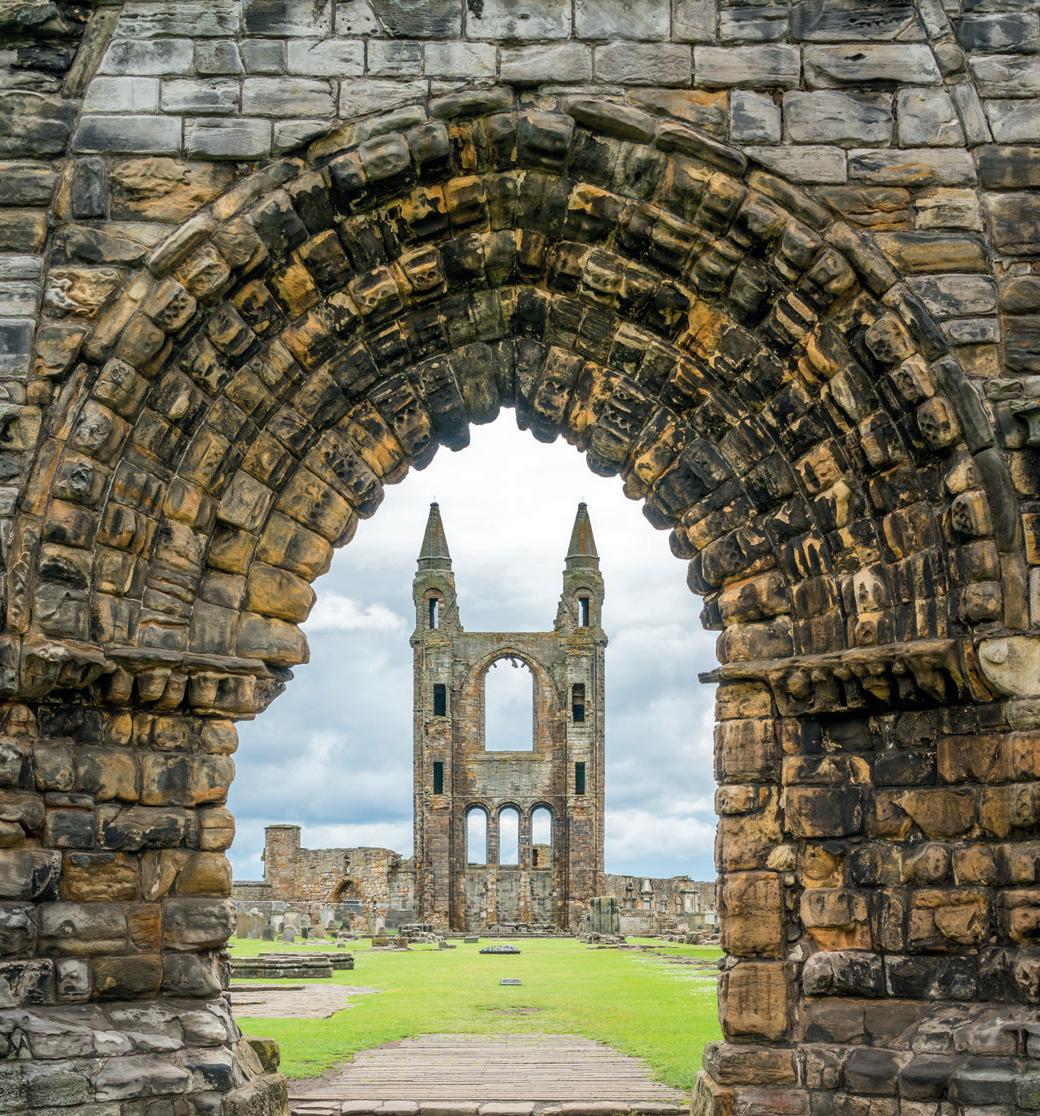
ST ANDREWS CATHEDRAL
THE BIG DAY: 17 JUNE 1538
The marriage of an heirless James V and Mary of Guise was, of course, a means of preserving his lineage but also intended to protect the Auld Alliance between Scotland and France.
The couple were married at the Château de Châteaudun on 9 May 1538 – with around 2,000 Scottish nobility sailing to France to take part. James was absent, with Lord Maxwell acting as his proxy.
The following month they tied the knot in person. Mary arrived at Crail in Fife in mid-June and they married at St Andrews Cathedral on 17 June 1538, with celebrations lasting 40 days.
Mary’s first husband, Louis, the Duke of Longueville, had died from fever in June 1537. James V’s first wife, Madeleine de Valois, had died from tuberculosis that same year.
James and Mary had two sons, who didn’t survive, so it fell to their third child, who was born on 8 December 1542, to continue the Stewart dynasty. That child was Mary Queen of Scots.
DID YOU KNOW?
Doune Castle starred as ‘Swamp Castle’ in the famous Monty Python and the Holy Grail scene where Sir Lancelot attacks a wedding party to save who he thinks is a captive princess.
Find out how you can tie the knot at our heritage sites
Searching for the perfect setting for your wedding? You can hire many of the places we care for as a venue. Whether you fancy walking down the aisle in the world-famous Edinburgh Castle, tying the knot amidst Stirling Castle’s lavish buildings and stunning gardens, eloping to island landmarks such as Inchcolm Abbey or starting married life in Duff House’s romantic environs, these legendary settings offer centuries of history for your most unforgettable moments.
Wedding beaux at Stirling Castle
From hosting the marriage ceremony to planning your reception, our wedding team can make your fairytale wedding dreams come true.
Start the next chapter of your life together in a place that has had a starring role in Scotland’s story. And the icing on the cake? You’ll be helping us to conserve these sites for future generations.
To start planning your special day, visit hes.scot/weddings or email us at venuehire@hes.scot

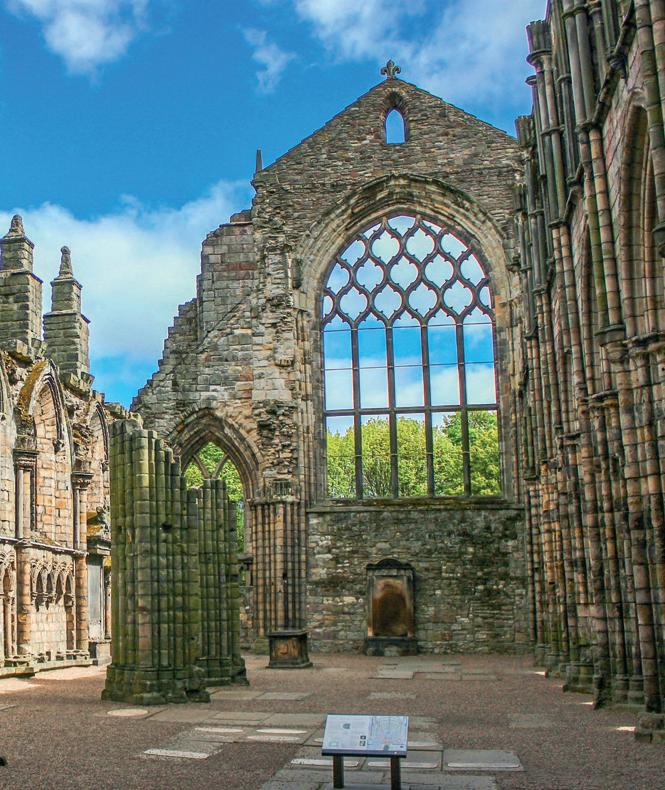
THE VENUE: HOLYROOD ABBEY THE BIG DAY: 8 AUGUST 1503
The 1502 Treaty of Perpetual Peace led to an arranged marriage between Princess Margaret Tudor, the daughter of Henry VII of England, and James IV of Scotland. They had married by proxy on 15 January 1503 at Richmond Palace outside London, with Patrick Hepburn taking James’s place. The formal union took place at Holyrood Abbey later that year. The wedding was James’s opportunity to flaunt his power and largesse. The couple wore matching white gowns decorated with golden flowers and trimmed with crimson velvet. James gifted Margaret her royal sceptre and an intricately illustrated Book of Hours containing portraits of the royal couple.
Of their six children, only one survived infancy –James V, King of Scots, who inherited his title in 1513, after James IV was killed at the Battle of Flodden.
5cl

Onair, our new Edinburgh Castle Whisky Liqueur, was inspired by the Honours of Scotland – the oldest crown jewels in Britain – with a name that translates to ‘honour’ in Gaelic.
Infused with rosehips, raspberries and sweet woodruff, Onair’s ingredients are hand-foraged, distilled and bottled locally to Edinburgh Castle.
Staff from our gift shops were involved in developing the flavour from start to finish, helping to create this extra-special tipple.
To accompany your drink, we also offer a great range of bar and drinkware accessories, including bottle pourers, measures, glassware and more.
Available in all Edinburgh Castle gift shops and online at stor.scot
1. Bottle pourer £20
2. Edinburgh Castle measure £7
3. Goblet £35
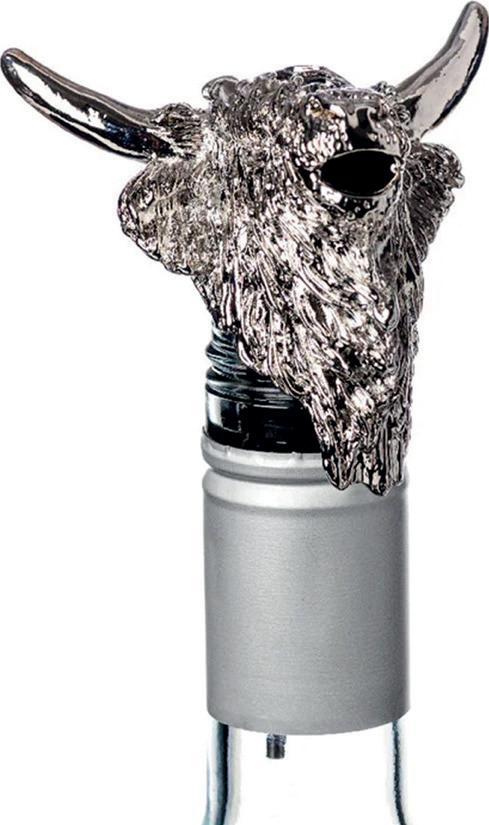
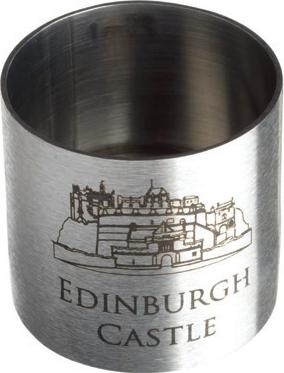

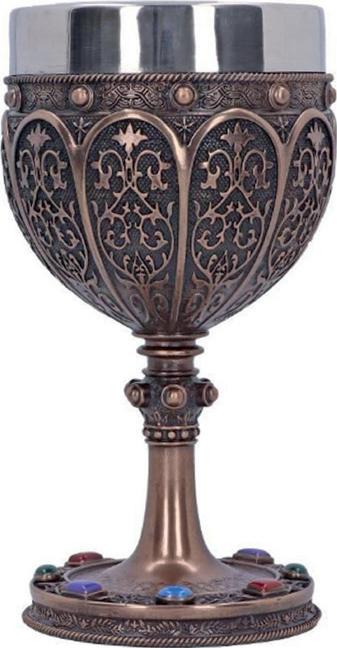
These four cocktail recipes have been created to enhance the taste of Onair wherever you choose to enjoy it

Onair on the Rocks
50ml Onair, poured over ice. Perfect as an after dinner digestif.

Onair and Ginger
25ml Onair, 100ml ginger ale. Served in a tall glass over ice.

Onair Royale
20ml Onair topped with sparkling wine and a raspberry garnish.
Magnum Cream Liqueur is an award-winning fusion of Speyside single malt scotch whisky and cream, crafted and bottled in Edinburgh. It comes in a quick chill, stainless steel, recyclable and reusable flask. You can also enjoy a dram with friends with our exclusive Edinburgh Castle miniature gift pack of three 5cl bottles. Best served chilled to enjoy the gentle notes of caramel and toffee.
1. Magnum Cream Liqueur Gift Set £24
Magnum Cream Liqueur 5cl £8
Magnum Cream Liqueur 70cl £29


Onair Old Fashioned
25ml Onair, 50ml whisky and a dash of orange bitters.


Magnum is the proud sponsor of Team Mouat, Olympic Silver curling medallists in 2022 and 2026
Guideyourlittle explorersontheirfirst foraysintohistory

LetourLittleExplorerstitles,beautifully illustratedbyLouiseForshaw,inspireyour weeones’bigsummeradventures

Scotland Then and Now
Fold-out pages let you see what key locations in Scotland’s history look like today and centuries ago. Turn each page to meet prehistoric villagers at Orkney’s Skara Brae, command Urquhart Castle with Robert I (the Bruce), return to Shetland’s Jarlshof settlement after a Viking raid and be a guest of James V at Stirling Castle.
£10.99

Learn about Scotland’s amazing story through its exciting castles. Move different elements on the pages to pull up a portcullis, lower a drawbridge and set off fireworks. You can also search for Nessie hiding at Urquhart Castle, join Mary Queen of Scots at a feast and escape from Edinburgh Castle’s dreadful dungeons.
£10.99

Skara Brae
Discover what Neolithic life was like at this prehistoric village in Orkney with this engaging book full of historically detailed illustrations. Catch fish for dinner, cook over an open fire and raise a standing stone. Become an archaeologist and unearth the village thousands of years after it was buried by sand. £9.99
Threeenthrallingcompilations forlazyholidays
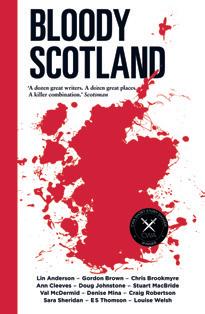
Various authors
This anthology sees 12 of Scotland’s best crime writers –including Denise Mina and Chris
Brookmyre – uncover sinister connections between our nation’s people and places. There’s everything from a murder in an Iron Age broch to a psychological thriller set around Edinburgh Castle’s tourist throngs.
£8.99
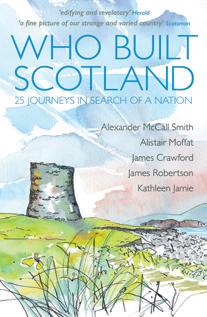
BUILT SCOTLAND
Various authors
Kathleen Jamie, Alexander McCall Smith, Alistair Moffat, James Robertson and James Crawford pick 25 buildings to tell Scotland’s story.
Don’t forget your members’ 20% discount
Encompassing islands, glens and cities, these authors investigate the social, political and cultural narratives central to our nation.
£10.99

who will be remembered here
Various authors
From theatres and hillsides to amusement arcades and libraries, 14 authors, including Johnny McKnight and Louise Welsh, explore the built and natural environments that define their queer history. Pick up a copy to celebrate Pride Month in June.
£16.99
All books available at stor.scot

Those summer knights return to joust again at Linlithgow Palace
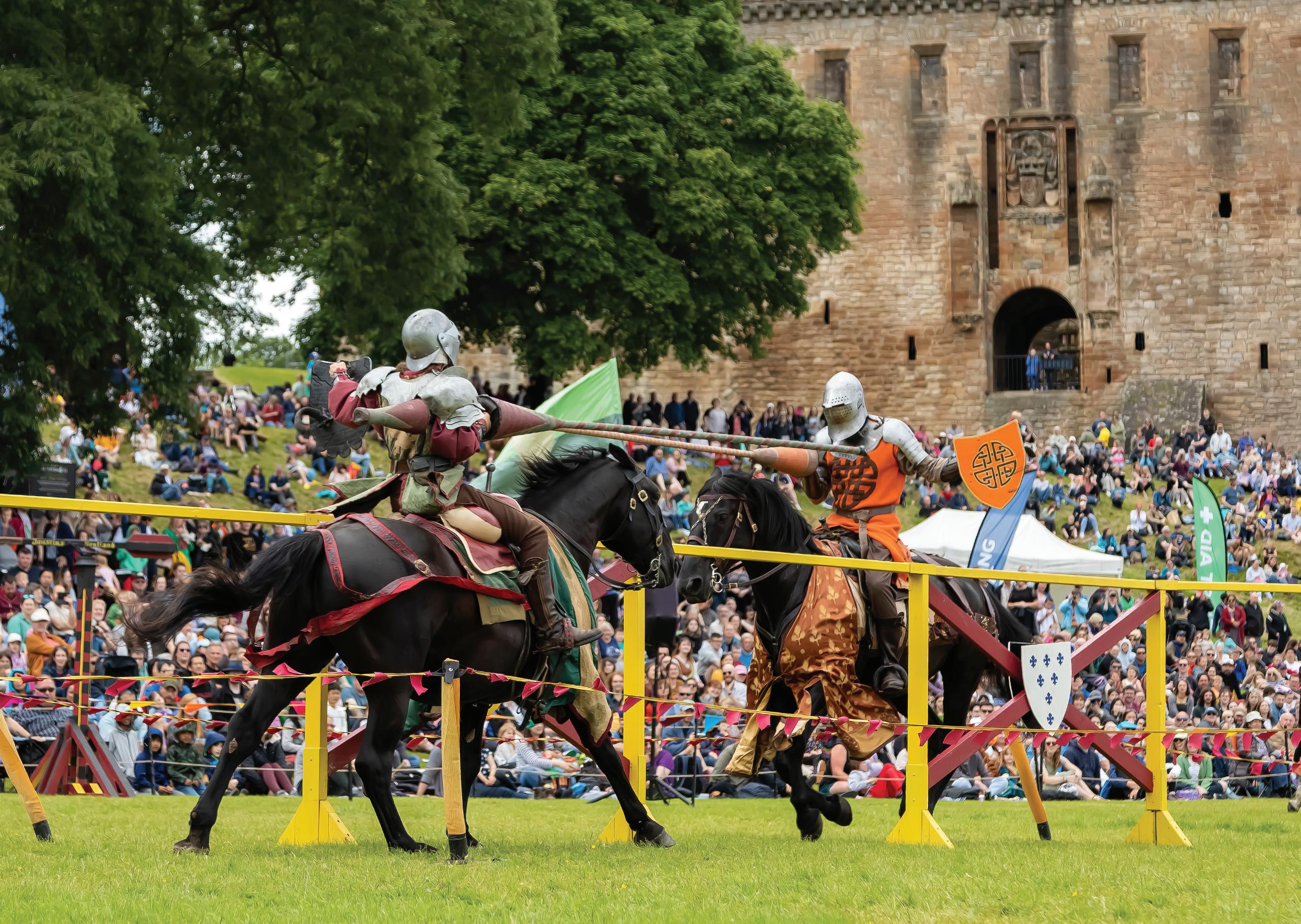
Spectacular Jousting
LINLITHGOW PALACE
CAERLAVEROCK CASTLE
Experience exhilarating horsemanship and impressive skills as the brave and courageous knights battle it out. Hear the thundering of hooves and the clash of lances as our four champions take to the arena. Wander through the colourful living history camp to experience life in medieval times and be entertained by court jesters.
l Linlithgow Palace, Sat 27 & Sun 28 Jun, 11.30am-4.30pm
l Caerlaverock Castle, Sat 25 & Sun 26 Jul, 11am-4pm
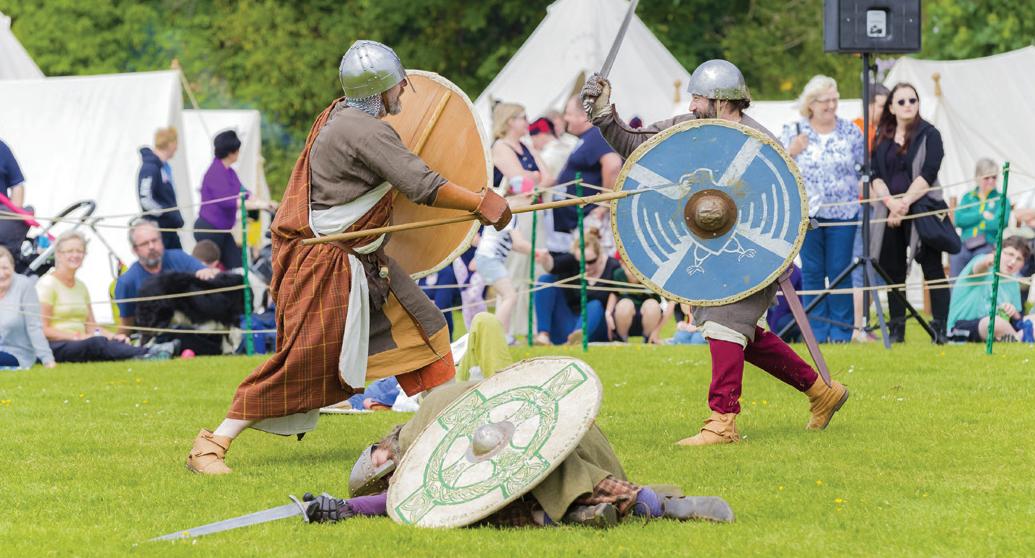
The Viking visitors get a warm welcome
DUMBARTON CASTLE
Come along to the castle and meet some Viking warriors. Discover what life was like for these seafaring Norsemen and why they were at Dumbarton.
l Sat 20 & Sun 21 Jun, 12pm-4pm
VARIOUS SITES
Six sites will be visited by characters from Scotland’s past. From courtly nobles to skilled artisans, hear their stories and the history of each place.
l Sat 27 Jun-Sun 16 Aug, during site opening hours
Medieval Weekends
ELGIN CATHEDRAL
Join medieval pilgrims to discover how they prepared for a long, hard journey to visit their favourite saints. Visit tradespeople at their stalls in our medieval encampment and see arena performances. Meet strolling characters who will describe what life is like in medieval Elgin, where everyone answers to the Bishop of Moray.
l Sat 18 & Sun 19 Jul, 12pm-4pm
MELROSE ABBEY
Join Sir James Douglas and his followers as they get ready to set out on crusade – carrying with
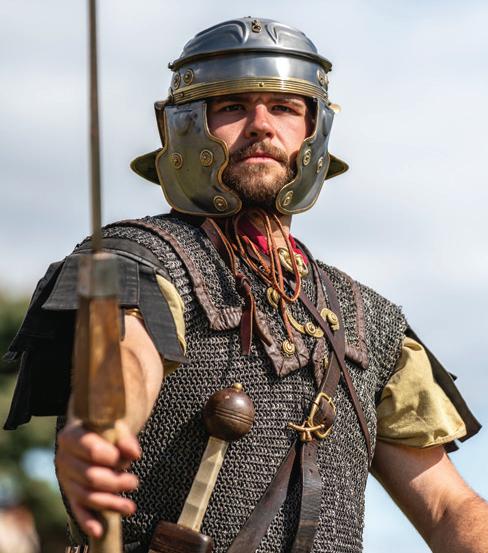
Meet a Roman at the fort
them the heart of Robert I (the Bruce). Meet crusaders and pilgrims, who will tell you how they are preparing for this difficult journey.
l Sat 15 & Sun 16 Aug, 12pm-4pm
FORT GEORGE
Fort George is once again set to host this living history extravaganza. Re-enactors will bring the mighty fortress to life with a living timeline depicting over 2,000 years of Scottish history. This year we’re staging a tribute to the horses of the First World War with a show by our equestrian display team, Les Amis.
l Sat 8-Sun 9 Aug, 11am-5pm
TRINITY HOUSE
Join us at Trinity House for relaxed tours designed for children and families.
Discover the animals that sailors would meet on their travels, take part in our activity trail and handle objects used at sea that are now kept in the Trinity House vaults.
l Various dates in August, 11am-12pm, 1pm-2pm
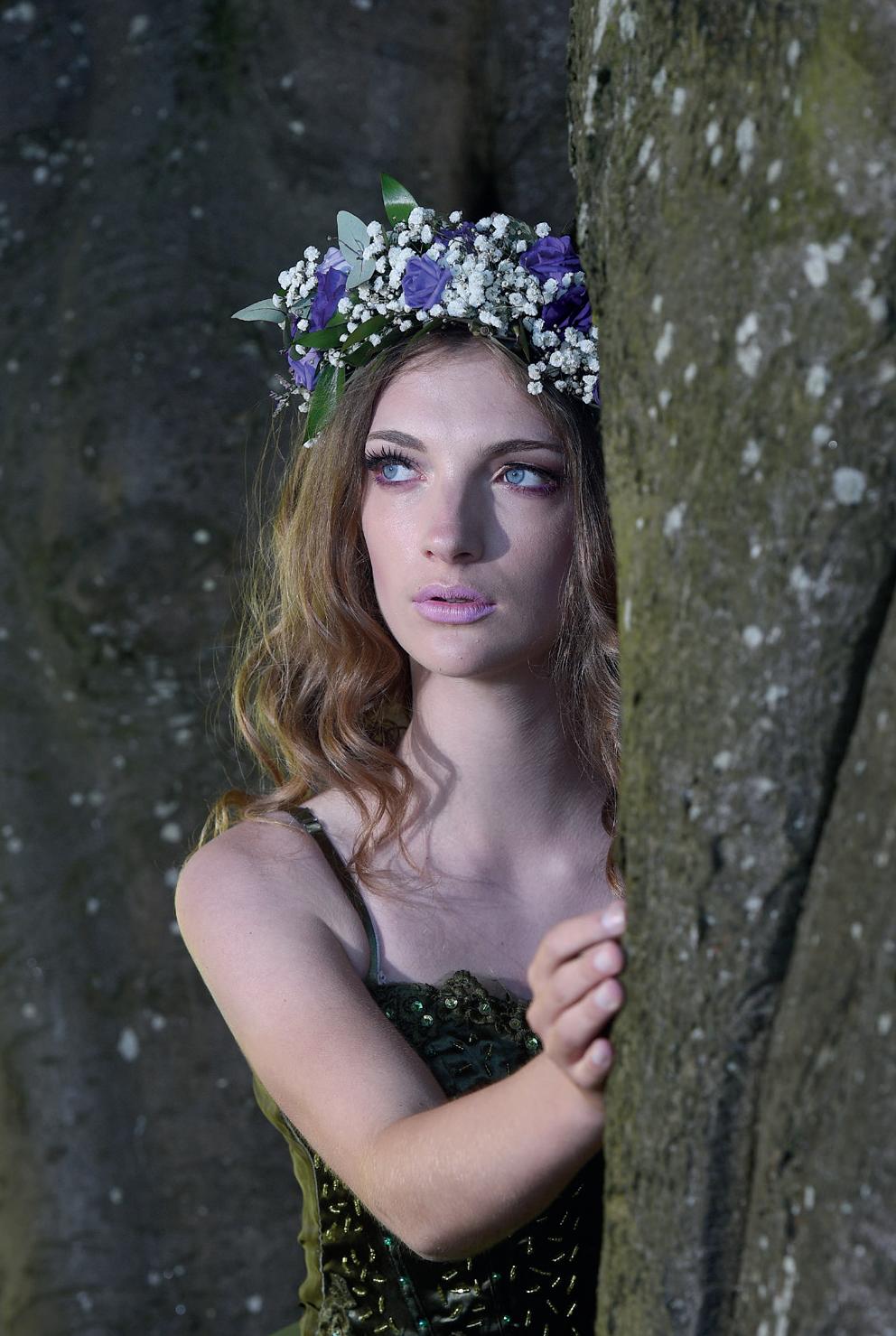
Take your seat for some open-air Shakespeare
The Three Musketeers
EDINBURGH CASTLE
ELGIN CATHEDRAL Young D’Artagnan is desperate to join Athos, Porthos and Aramis as an elite Musketeer of the King’s Guard. Set against the panorama of a 17th-century France at war, this production by Illyria is a whirlwind of excitement, broad comedy and ingenious storytelling. Alexandre Dumas’ classic has the lot! This is an outdoor event, so visitors should bring their own seating or picnic blankets. Booking is essential.
l Edinburgh Castle Fri 19 & Sat 20 Jun, 6.45pm for a 7.30pm start
l Elgin Cathedral Thurs 27 Aug, 6.45pm for a 7.30pm start
King Arthur and the Holy Fail
EDINBURGH CASTLE
The Three Inch Fools present an epic tale of Arthurian adventure and medieval mayhem. When Camelot is rocked to its core by a tragic incident, Arthur embarks on the journey of a lifetime. Destiny awaits, chivalry calls and the quest to end all quests begins.
This is an outdoor event, taking place on a paved area at the top of a cobbled hill. Visitors are advised to bring their own seating.
l Tues 7 & Wed 8 Jul, 6.45pm for a 7.30pm start
DUFF HOUSE
STIRLING CASTLE
Experience love, laughter and a little bit of lunacy when you enter a world where fairies meddle and lovers quarrel. Magic runs wild in this breathtaking open-air performance of William Shakespeare’s beloved comedy. This is an outdoor event, visitors should bring their own seating (rubber-footed) or picnic blankets. Booking is essential.
l Duff House, Thu 9 Jul, 6.15pm for a 7.00pm start l Stirling Castle, Fri 10 Jul, 6.45pm for a 7.30pm start
Summer Classics with the Scottish Chamber Orchestra
STIRLING CASTLE
Discover a musical programme alive with colour, character and charm as the Scottish Chamber Orchestra performs under the direction of co-leader Bogdan Božović. The evening begins with the rustic beauty of three Nordic tunes arranged by the Danish String Quartet, and closes with Haydn’s majestic Symphony No. 104 ‘London’.
l Thurs 6 Aug, doors at 7:15pm for an 8pm start
Get a new view on Archaeology and Empire at Stirling Castle
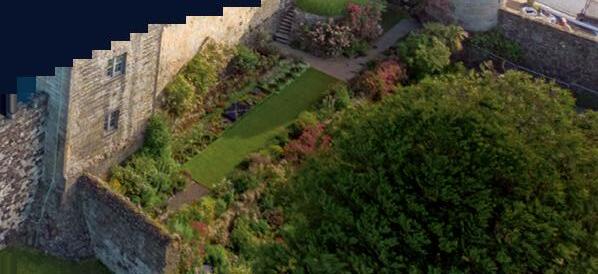
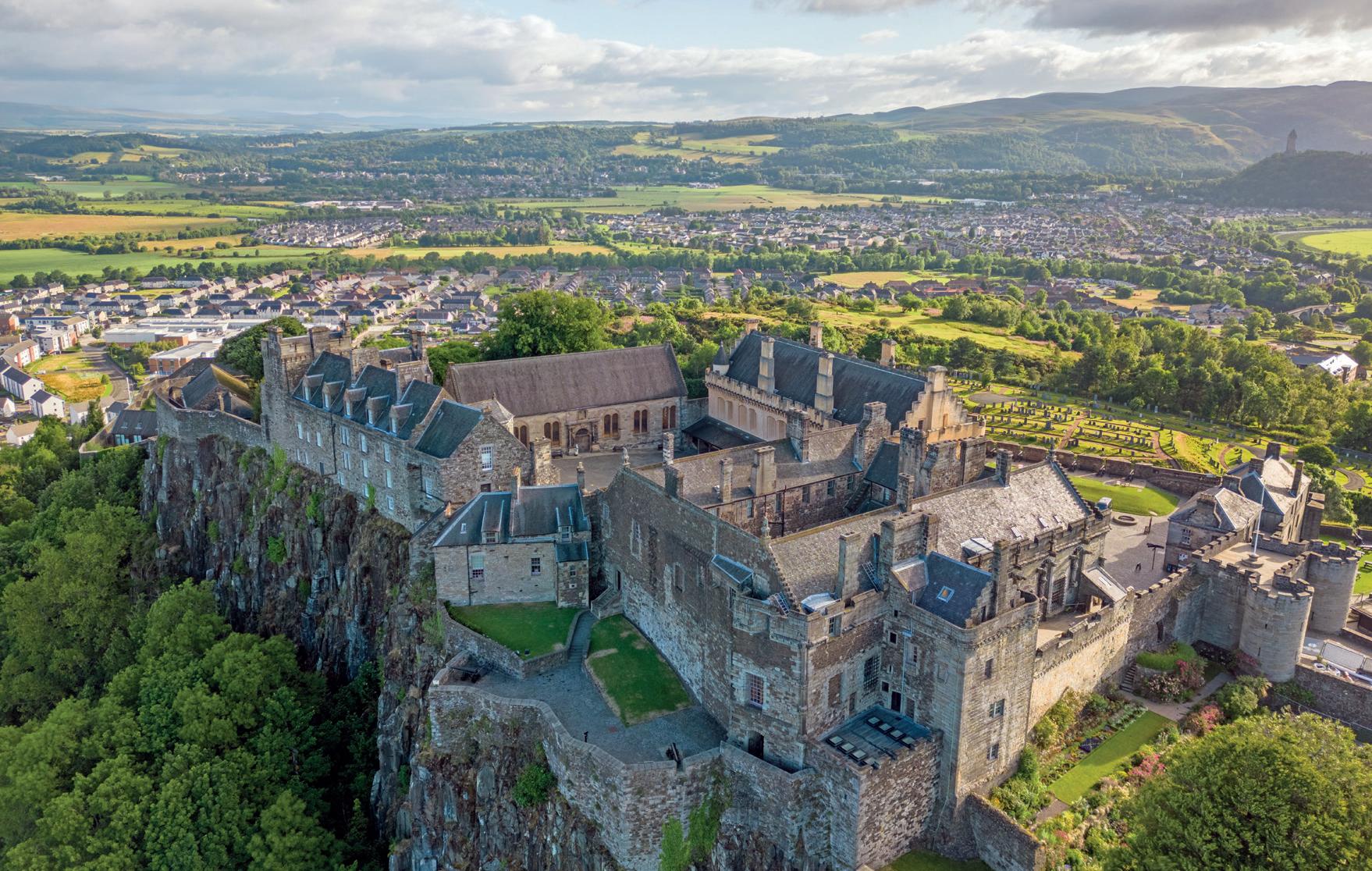
A Castle for the King
HUNTLY CASTLE
The Gordons of Huntly fought for hundreds of years for the Stuart monarchs. Visit these spectacular ruins and hear the Gordon family’s story. Meet some of the royalist defenders of the castle in 1647 and see their weaponry.
l Sat 20 & Sun 21 Jun, 12pm-4pm
In the Land, of the People
FORT GEORGE
Using images drawn from our archives, this exhibition looks at how folklore is an intrinsic part of life in Scotland. Taking us through the landscape, monuments and communities of Scotland, we explore how folklore is an ever-evolving force that continues to shape the world we live in.
l Wed 1-Wed 29 Jul, during site opening hours
Marking Time
STANLEY MILLS
Journey from the present day to some of the oldest
markings to be found in Scotland. Featuring images from across Scotland’s historic environment, this exhibition will help you to explore the range of markings, the clear and hidden messages and the intentions of the writers, from Stranraer to Scalloway and St Abbs to Stornoway.
l Thu 2 Jul-Sun 27 Sep, during site opening hours
Sea Shanty Workshop
TRINITY HOUSE
Leith’s seafarers travelled all across the world on long voyages, where they entertained themselves with crafts, games and music. Join traditional Scots singer Joss Cameron and learn about the history of sea shanties before having a go at singing your own seafaring songs. Includes a tour of Trinity House.
Suitable for ages 12+.
l Sat 18 Jul, 10am-12pm
STIRLING CASTLE
Curated by Dr Cat Dunn, this exhibition explores
Castle, where he will be hosting members of the Scottish court. Find out what life was like in the late 16th century and how important the role of regent was during the minority of King James VI.
l Sat 15 & Sun 16 Aug, 12pm-4pm
ST ANDREWS CASTLE
how the historic landscapes of the Highlands, Dumfries and Galloway, the Western Isles and Orkney have connections to Scotland’s imperial ambitions and the forced displacement of peoples. Combining archival material, writing and newly commissioned artwork, the exhibition uses diverse lenses to provide space for dialogue, reflection and re-imagining.
l Until Mon 20 Jul, during site opening hours
ABERDOUR CASTLE
James Douglas 4th Earl of Morton invites you to join him at his home, Aberdour
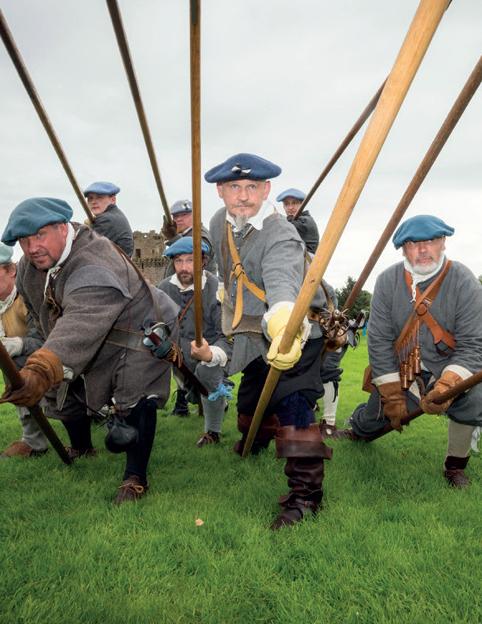
It is the mid-17th-century and Scotland is being ripped apart by religious unrest and a series of wars. Come to this historic castle and meet some of the Covenanting soldiers to find out what they were wanting, and how the echoes from 100 years earlier in St Andrews continued to resonate. You can even inspect the soldiers’ uniforms, flags and weapons.
l Sat 5 & Sun 6 Sep, 12pm-4pm
KINNEIL HOUSE
The Antonine Guard will set up camp in the grounds of Kinneil Estate and engage with visitors on weaponry, armour and fighting techniques. Enjoy a self-guided walk through Kinneil House, including the Renaissance kitchen, 16th-century painted rooms and the Antonine Wall exhibition. And the Friends of Kinneil will provide craft activities for all ages.
l Sat 26 Sep, 10am-4pm Covenanters make a stand
Mark the 280th anniversary of an event that played a part in the Jacobite Risings with this special members’ exclusive tour. Join our expert guide as you explore the Grand Battery and the castle’s formidable defences, discovering how Stirling Castle faced its final siege. Along the way, you will delve into the events of both the 1715 and 1746 Risings, gaining insight into the people, politics and military strategy that shaped these defining moments.
l Tues 16 and Sat 20 Jun, 10.30am and 2.30pm
Explore Gaelic connections to Holyrood Park on an exclusive tour for members
DON’T FORGET... Members’ Exclusive Events have limited capacity and must be booked online in advance. Head to hes.scot/memberevents to book.
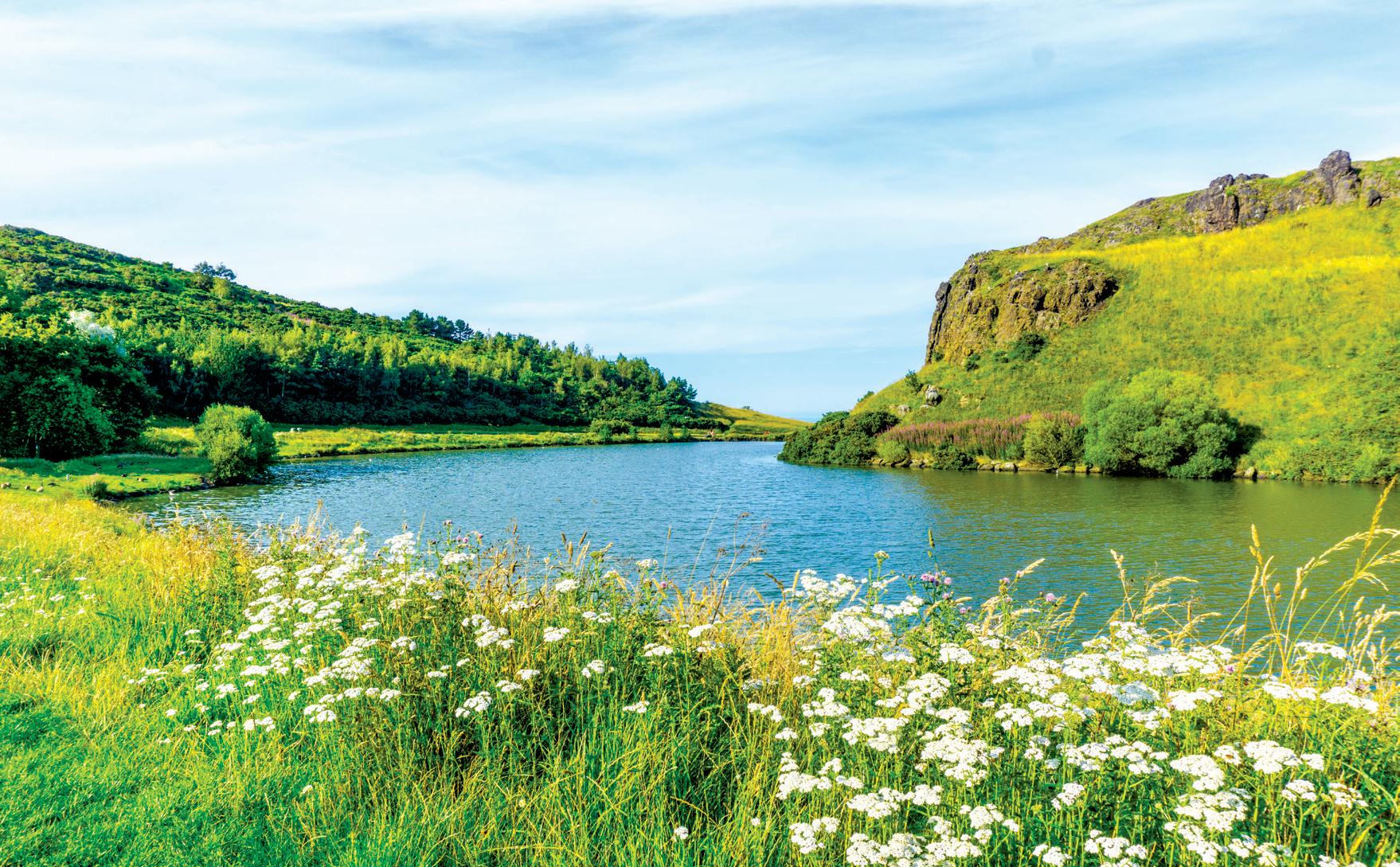
Come along on this guided walk, exclusively for members, to discover Holyrood Park through a Gaelic lens. Gaelic expert Bria Mason will share the Gaelic terms for the park’s flora, as well as some sgeulachdan (Gaelic stories) along the way. The walk will be delivered in
English – no prior Gaelic knowledge is required! This event includes a moderate grade walk. The route will mostly be on paths but may contain rough tracks, uneven and boggy terrain and steep inclines and declines.
l Tues 23 and Thurs 25 Jun, 2pm-3.30pm
Summer is the perfect time to get out and about, so join our Ranger-led walks and activities and explore Scotland’s amazing natural world. From seashore activities to wildlife and geology walks, we’ve events for all ages and abilities.
l For some activities, pre-booking is advised
Enjoy an exclusive tour of Holyrood Abbey and the palace garden (does not include entry to the Palace of Holyroodhouse). Expert guides from the Royal Collections Trust will share with you their knowledge. Book your tickets at www.rct.uk/hes-tour
l Sun 13 Sept 11am and 3pm £5
Explore Orkney’s ancient landscape and discover five millennia of history and prehistory with the Orkney Rangers Service. Join them on their free walks at the Ring of Brodgar, the Stones of Stenness and Barnhouse Village.
l No booking required for Orkney Rangers Service walks
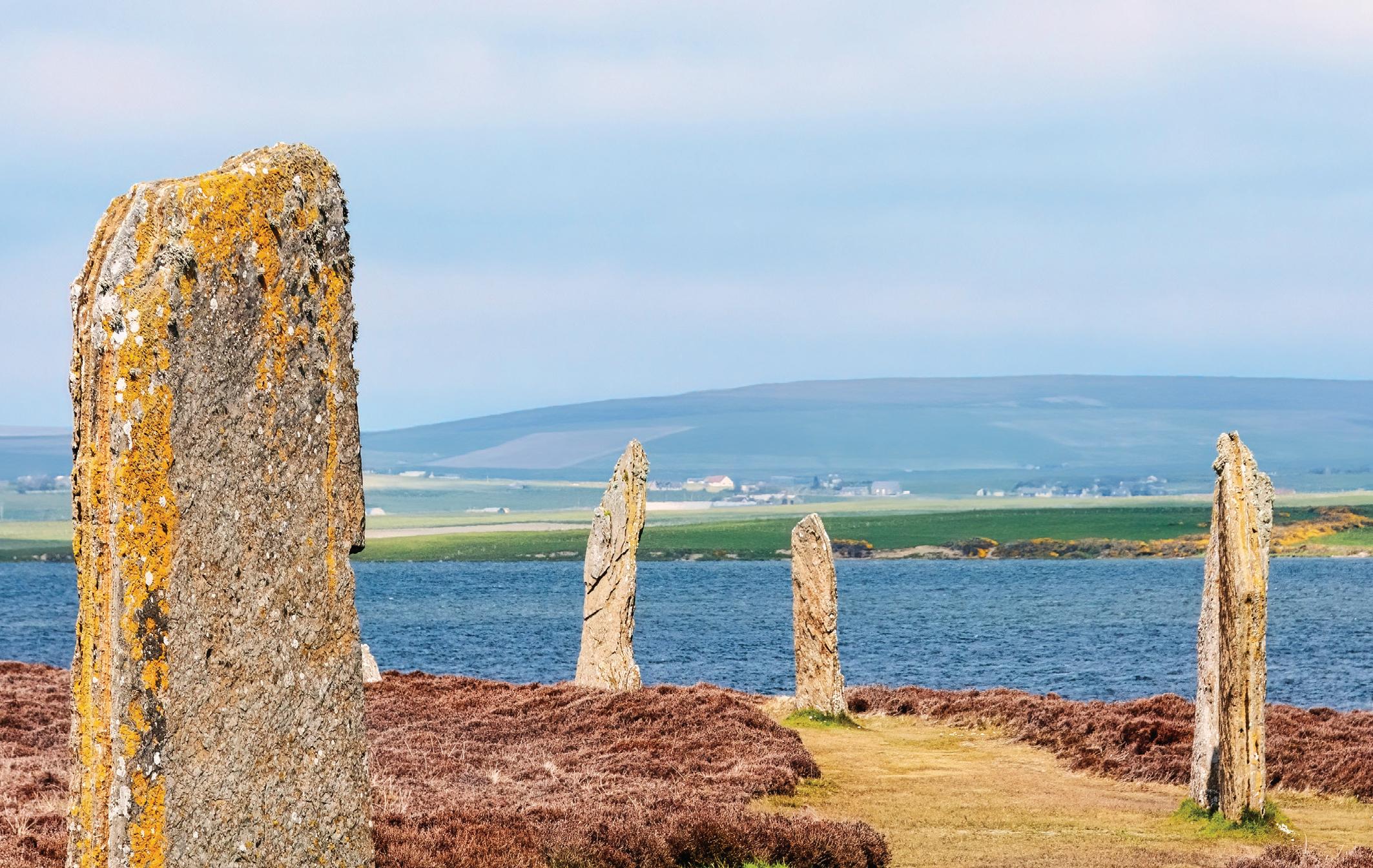

TFind many more images from Scotland’s motoring past at trove.scot
Studioscollection
Above: TayRoadBridge onthenightofits opening,Thursday 18August1966
WORDS: EDWARD CAWOOD, ARCHIVAL PHOTOGRAPHY TRAINEE
his year marks the diamond jubilee of the Tay Road Bridge, Dundee, which turns 60 on 18 August 2026. Built to replace the Tay Ferry, the 1.4-mile bridge was constructed between 1963 and 1966 using over 140,000 tonnes of concrete and 12,000 tonnes of steel, at a cost of around £5 million.
When opened by HRH the Queen Mother in 1966, the Tay Road Bridge was the UK’s longest road bridge over a river. To mark this milestone, more than 600 glass plate photographs of the bridge being built have been digitised.
These images in our Archives form part of a larger collection of photographs from D. Wilson Laing Studios, Blairgowrie, who were commissioned to document construction projects such as the Tay Road Bridge.
The official opening certainly attracted attention, with keen motorists queueing from 2pm the day before to be among the first to drive across the Tay from Dundee to Fife, and vice versa.
The petrol companies Shell and BP even produced an ode to the Tay
Road Bridge in the style of the Dundee poet William McGonagall, who had written a notoriously bad poem about the tragic Tay Rail Bridge disaster of 1879:
So let us raise a cheer on this wonderful day, When we can wave our hats without any dismay, Shouting Huzzahs and professing loyalty to our Gracious Queen, At the opening of our beautiful Bridge, not very far from the Magdalen Green.