






Your favourite Scottish porridge oats and oatmeal now available in recyclable paper bags 9rown, milled and packed in 8colland

Your favourite Scottish porridge oats and oatmeal now available in recyclable paper bags 9rown, milled and packed in 8colland
What’syourspecialplaceinspringtime?If youfindittrickytochoose,we’reheretohelp. Turntopage20,wherewehavefreshwaysto experiencenewplacesandfamiliarfavourites.Andon page6,therearemoreideasforgettingthemostfrom beingamemberofHistoricScotland.
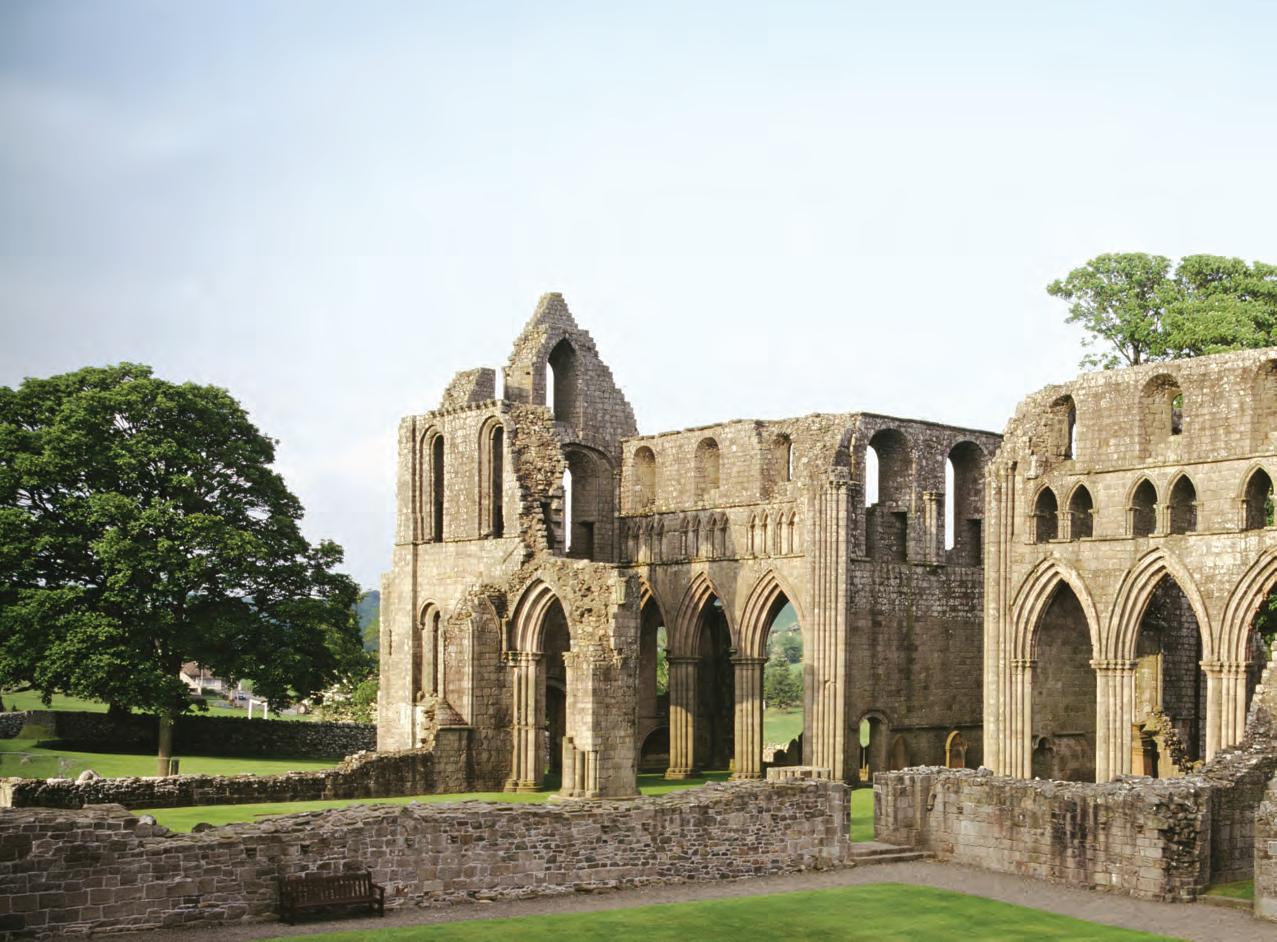
Forfurtherinspiration,turntopage26fortheresultsof our2025members’photographycompetition.Alsointhis issue,enjoyauniquetourofDundrennanAbbeywitha 12th-centurymastermason(page36).Andonpage42,our CraftFellowsprovideamoremodernperspectiveontwo verydifferentsitesandrevealsomelesser-knownfacts.
Ifyou’venevervisitedthegemthatisTrinityHousein LeithinEdinburghgetatasteroftheintriguingobjectsin itsmaritimecollectionsandthestoriescomingtolightasa resultofnewresearch(page30).
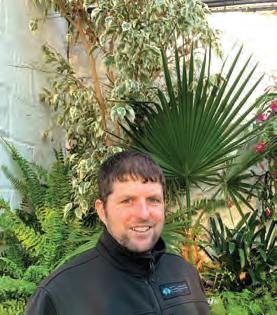
We’reexcitedtolaunchournewgardeningcolumn, onpage8.HeadGardenerStuartLerettedescribeshow heandhisteamhavetransformedanareaintheshadow ofEdinburghCastleintoavibrantgreenspace.Elsewhere, we’veinterviewswithCoinneachMacLeod,akathe HebrideanBaker,whoshareshisdreamdayontheisland ofHarris(page13),andauthorBarbaraHenderson,whose historicalnovelsdrawonScotland’srichheritage(page50).
Withourround-upofthisseason’sunmissableevents, you’reallsetforspring.
CLAIREBOWIE Head of Membership & CRM


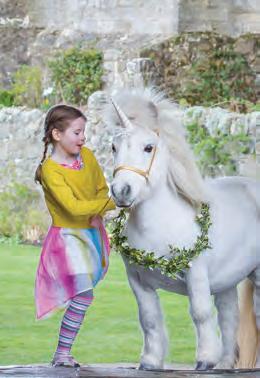
Ifyoulovealittle magicinyour springtimetrips, headtoStirling CastlethisAprilfor ourpopularUnicorn andFriendsevent. Explorethebeautiful QueenAnneGardens andheartalesof Scotland’smythical beasts.Remember, allourdaytime eventsarefree formembers.
Find out more on page 52



HISTORIC ENVIRONMENT
SCOTLAND
hes.scot
Membership enquiries 0131 668 8999
members@hes.scot
Editorial enquiries members@hes.scot
Head of Membership & CRM
Claire Bowie

Longmore House, Salisbury Place, Edinburgh EH9 1SH 0131 668 8600
Julia Haase-Wilson
Editor Indira Mann
indira.mann@ thinkpublishing.co.uk
Assistant Editor
Jonathan McIntosh
Design
Matthew Ball
Managing Editor
Andrew Littlefield
Advertising Sales
Melissa Mackay
melissa.mackay@ thinkpublishing.co.uk
020 3771 7195
Executive Director, Think John Innes
Think 65 Riding House Street
London, W1W 7EH 020 3771 7200
Photography
Membership Marketing Manager
john.innes@thinkpublishing.co.uk

All images provided by Historic Environment Scotland unless otherwise stated. For access to images of Scotland and our properties, call 0131 668 8647/8785 or email images@hes.scot
Historic Scotland is published quarterly and printed on Galerie Brite Bulk, which is from wellmanaged FSC®-certified forests and from other controlled sources.
The views expressed in the magazine do not necessarily reflect those of Historic Environment Scotland. All information is correct at the time of going to press.
© Historic Environment Scotland. All rights reserved. Reproduction in part or in whole is prohibited without prior agreement of the Membership and CRM Manager of Historic Environment Scotland.
Historic Environment Scotland (HES) is a Non Departmental Public Body established by the Historic Environment Scotland Act 2014. HES has assumed the property, rights, liabilities and obligations of Historic Scotland and RCAHMS.
Visit hes.scot/about-us Scottish Charity No. SC045925.


Great days out for all 56 TIME TRIP 15
30
Discover Trinity House’s maritime objects
REGULARS
6 THE SCRIPT
Your guide to experiences at our properties this spring 18 SPOTLIGHT
Aberdour Castle 48 SHOP
52 EVENTS
FEATURES
20 SPRINGTIME ADVENTURES
Six ways to go exploring 26 PHOTOGRAPHY COMPETITION
Members’ top shots 30 STORIES OF THE SEA
Dive into Trinity House 36 MEDIEVAL MAKEOVER
Head back in time with a master mason
42 A MAKER’S PERSPECTIVE
Our Craft Fellows and Trainees
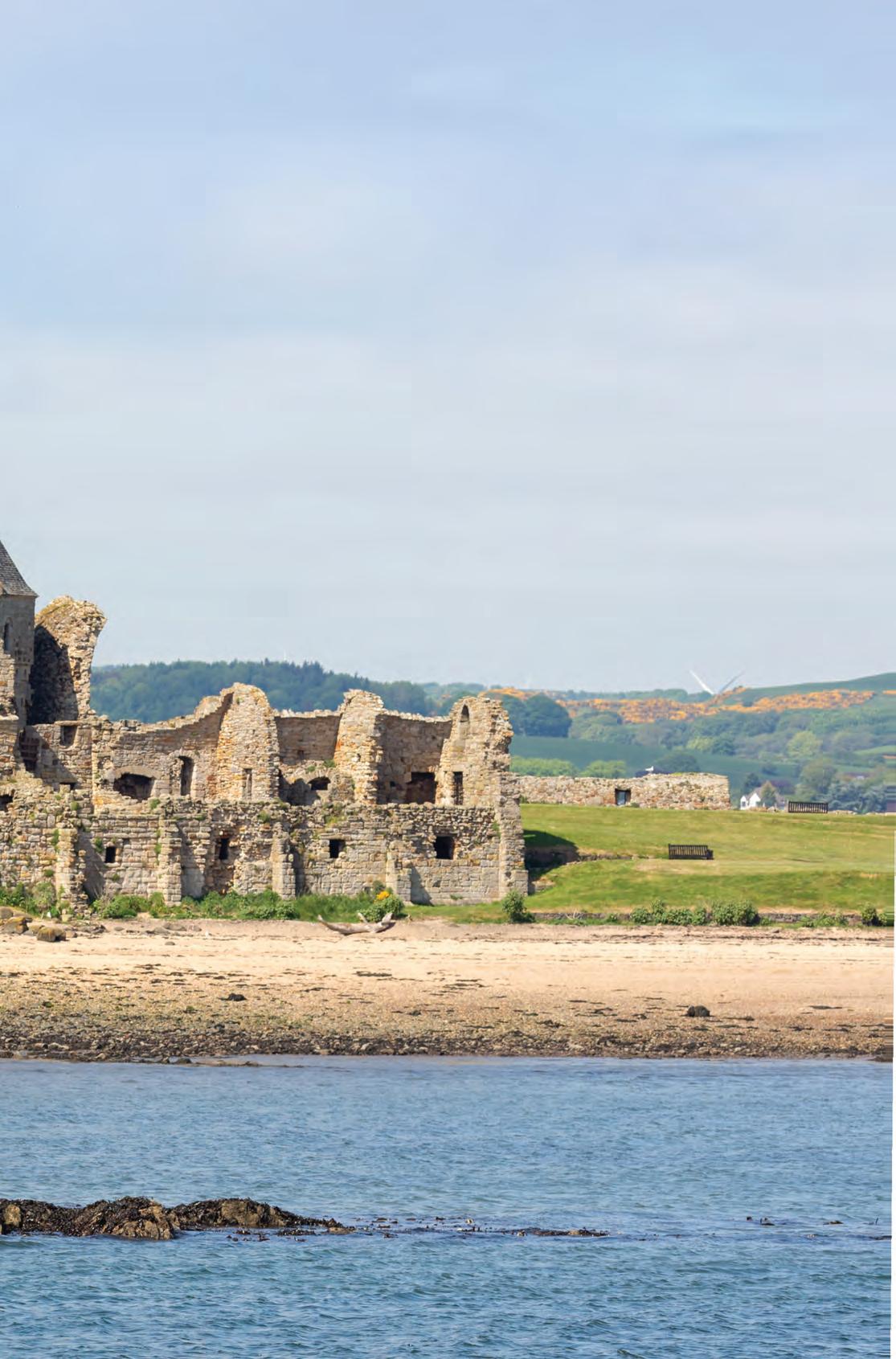
When Inchcolm Abbey re-opens for the summer season on 1 April, follow in the footsteps of those who once travelled to this medieval monastic complex in the Firth of Forth
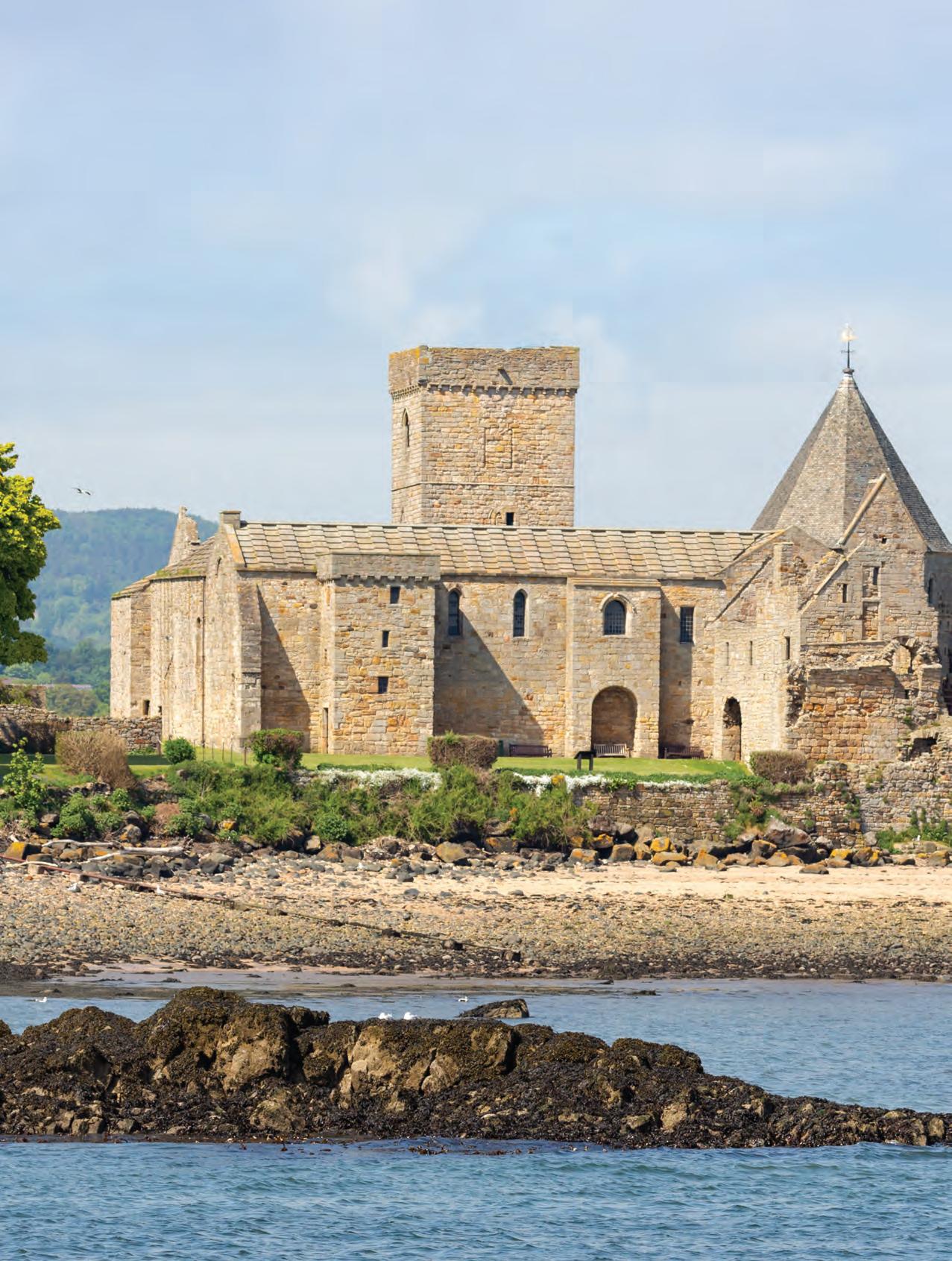

In 1123, Alexander I tried crossing the Firth of Forth in stormy weather but was forced to land at Inchcolm Island. It’s said a hermit provided shelter to his party for three days.
Following his arrival in Fife, Alexander vowed to build a monastery here, having established one at Scone in 1120. When Alexander died in 1124, his successor, David I, brought his brother’s vision to life by inviting Augustinian canons here.
Inchcolm’s name suggests it was a place of Christian significance for centuries before this. In Gaelic, innis means ‘island’ and Colm is likely a shortening of Columba, the saint whose relics were held at Dunkeld, the cathedral at the centre of the bishopric, which included Inchcolm.
The abbey’s inhabitants enjoyed almost a century of peace until Edward I’s 1296 invasion of Scotland, kickstarting the First War of
Independence. In 1547, English troops occupied Inchcolm, considered a strategic base, during the wars of the 1540s, initiated by Henry VIII’s attempt to force a marriage contract between his son Edward and the infant Mary Queen of Scots. His garrison eventually withdrew in March 1548.
Following the Reformation, the canons of Inchcolm were allowed to remain as long as they gave up their old forms of worship.
By the time of the Napoleonic Wars, Inchcolm Island housed a hospital serving a Russian fleet in the Forth. A gun battery installed in 1795 to defend against French invasion was dismantled after 1815’s Battle of Waterloo.
Most of the military structures you can see today on the island date to the First and Second World Wars, when it formed part of fortifications protecting naval assets on the Forth.


Check out Inchcolm Abbey bell tower’s stone screens; beautiful examples of medieval church fixtures.
Don’t miss the rare medieval fresco, a wall painting dating from the 13th century.
Two ferries sail from Hawes Pier, South Queensferry to Inchcolm Island. Tickets must be bought in advance for either Maid of the Forth –maidoftheforth.co.uk –or Forth Boat Tours –forthtours.com.
The pier has 20 stone steps and some areas of the abbey and island have staircases. There are also steep pathways leading to outdoor areas of the site.
Assistance dogs have full access to the site. Other dogs are allowed at the abbey but not in roofed areas.




Our spotlight on events, activities and updates not to be missed this spring
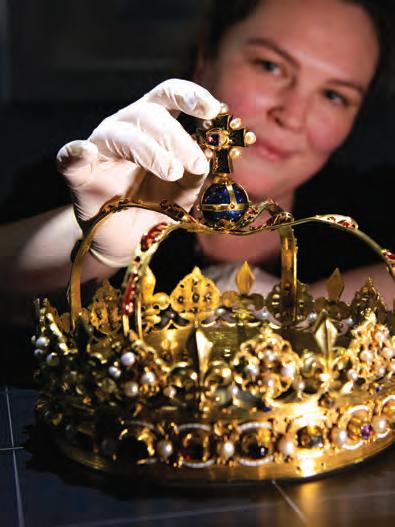
The Honours of Scotland will be placed in a new purpose-built case in Edinburgh Castle when the Crown Room reopens later this spring.
During recent renovation, an envelope containing two letters was found hidden in the Crown Room walls. Written in 1848 and 1993, they discuss the room’s previous refurbishments. Don’t miss the start of an exciting new chapter for Scotland’s Crown Jewels.
Plan your next day out at historyawaits.scot
MEMBERS’ EXCLUSIVE EVENT
MORE EVENTS ON PAGE 54
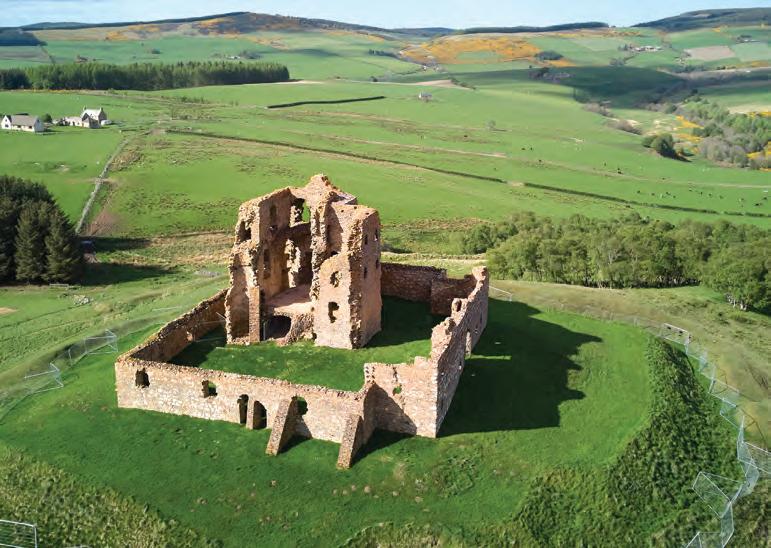
Enjoy an exclusive experience at Auchindoun Castle, in Moray, a 15th-century hilltop stronghold steeped in drama and intrigue, on our members’ only guided tour. You’ll explore these lonely ruins and surrounding earthworks while hearing tales of Thomas Cochrane, Sir Adam Gordon and the feud that left the castle derelict by 1725. This tour promises history, atmosphere and a walk well worth the effort. Sturdy footwear advised.
Tours at 11am and 2.30pm on 28 May. Book at hes.scot/member-events
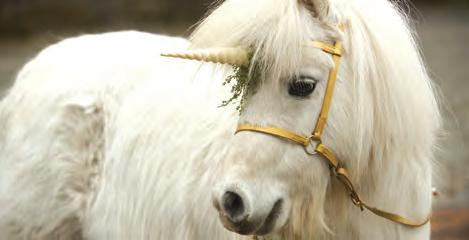
From 3 to 6 April at 29 sites, we’ll be handing out vegan chocolate rabbits during our lamb-themed Easter Trails. Remember to collect your ‘Sprightly Spring’ rare History Hunt card too, new for 2026. Plus, add some magic to spring with Stirling Castle’s Unicorn & Friends event on 11-12 April. Meet Scotland’s national animal and join a treasure hunt.
For more events, turn to page 52
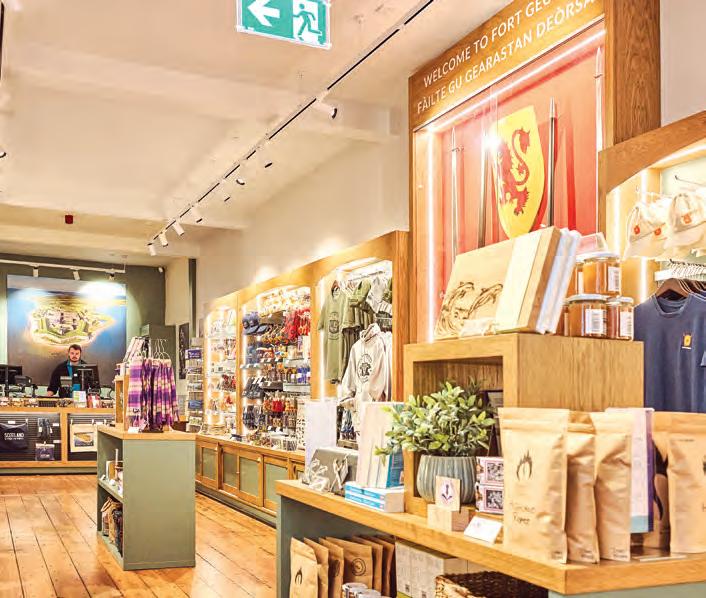
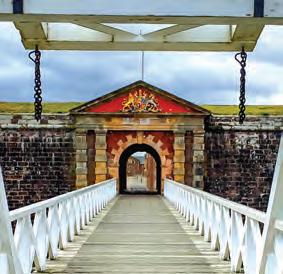
Showcasing locally made products and crafts, Fort George’s retail space has had a spruce up. It’s yet another reason to add this 18th-century military base, designed by the Adam family of architects, to your list of springtime must-sees. And don’t forget to use your 20% members’ discount, valid in all our shops.
Turn to page 48 for an exclusive range of Fort George products
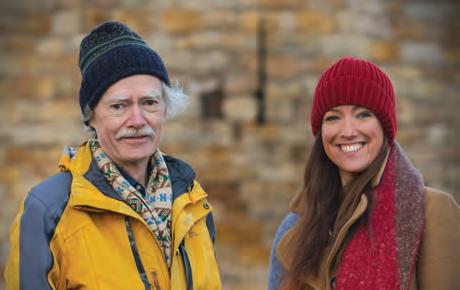

Join host Sarah MacGillivray for the second series of the Historic Scotland Podcast, with early access and exclusive content for Historic Scotland members.
We’ll be visiting Smailholm Tower to discover how Scottish folklore fired Sir Walter Scott’s imagination, and Caerlaverock Castle to reveal a medieval global trade network.
Sarah will also examine how history and legend coexist at Urquhart Castle, and so much more. Catch series two at home or on the move to find out more about Scotland’s impressive past.
Listen at hes.scot/members-podcast


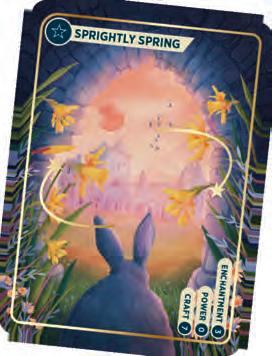
This spring, we’re launching four of our six new rare History Hunt cards for members to collect, featuring colourful illustrations by Scotlandbased artist, Kasia Kozakiewicz. Bag these limited editions by visiting sites up north, in the Borders and in Dumfries and Galloway. And our new ‘Wise Women’ card honours some inspirational women who have made their mark on Scottish history. Watch this space for the release of further rare cards.


Our new Members’ Portal is launching this year. In the meantime, find your member benefits and digital copies of your Members’ Guide and Historic Scotland magazine at hes.sot/member. If you haven’t heard from us about this change, email members@hes.scot to add your email address to your record.
Extending the lifespan of your Members’ Guide helps us to protect Scotland’s heritage and environment, which is why we are not sending out a new guide this year. We are asking members to keep hold of your current copy, which remains valid until any further updates are needed.
Discover more at hes.scot/history-hunt
Don’t have a current Members’ Guide? Email us at members@hes.scot


We’ve freshly planted an eye-catching garden in the shadow of Edinburgh Castle
Keen for some new greenery to feast your eyes on this springtime? Look no further than our freshly planted garden at Castle Wynd Steps.
Situated just below Edinburgh Castle, this historic flight of stairs connects the Grassmarket with Castlehill, near the Esplanade. Once looked after by a local resident, it was recently discovered that we own a piece of this garden after it fell into disrepair.
We’ve been working hard to restore its splendour while providing pedestrians with an eye-catching route to and from the castle area.
Our garden refurbishment was based on a drought tolerant, naturalistic and low-maintenance design, which brings year-round interest and flourishes – with a nod to Scotland’s natural landscapes.

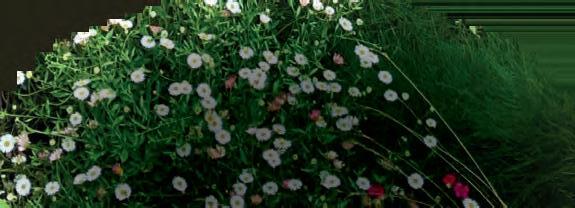

The garden’s planting design is reflective of this, with Santa Barbara daisies (erigeron karvinskianus) and aubretias cascading down the walled sections to represent streams and waterfalls, respectively.
We’ve injected plenty of colourful plants to attract the attention of passersby too. Purple, pink and white hues from heathers, aubretias and aquilegias (shown inset), which bloom in early spring, are mixed with
1. Place a 50/50 mix of compost and gravel in a clean pot.
2. Take cuttings of new shoots from the base of emerging herbaceous perennials (March-October), from below a node.
3. Make a hole in the compost and insert the cuttings – five per pot –so they’re not touching (see image).
4. Water well before covering the cuttings with a plastic bag to conserve moisture.
5. Place the pot on a warm windowsill that’s not in direct
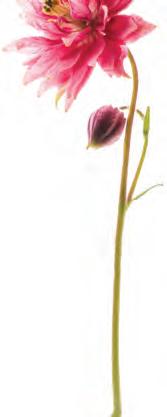
Stuart’s tips on how to propagate your own plants at home
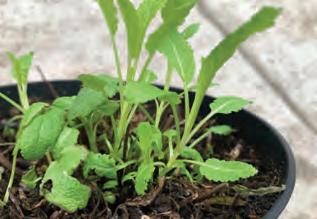
sunlight and wait for roots to appear from the base of the pot within a couple of weeks before transplanting.


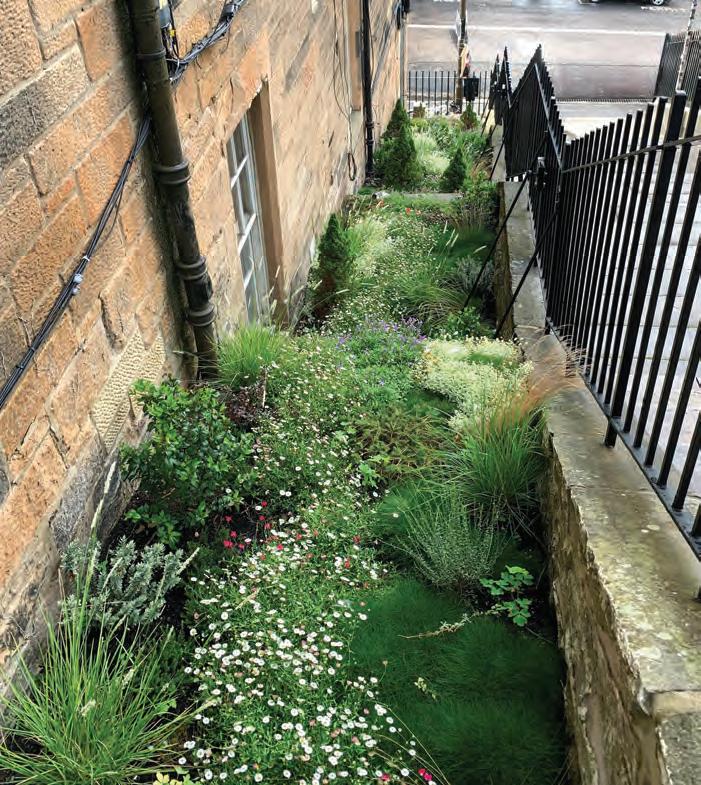
ornamental spiky, evergreen fescue grasses such as festuca gautieri. In mid to late season, look out for erigerons, sedum and dianthus.
A variety of slow-growing dwarf conifers, including albertiana ‘Conica’, have also been used to add structure –a characteristic that’s needed in a small garden such as this.
Plants used were grown in the glasshouses at the Palace of Holyroodhouse, and cuttings were provided by the team that maintains Edinburgh Castle’s gardens. Incorporating such a wide variety of flora ensures pollinators have plenty to forage through all season.
The planting design we’ve chosen means the garden will need minimal maintenance in the future. Plus, we dressed the site with three tonnes of compost derived from seaweed prior to planting to add much needed nutrition to the soil and aid its water retention in the summer months.
Excitingly, this is the first phase of garden renovations planned at Edinburgh Castle. Our team is now turning its attention to the Scottish National War Memorial’s garden. The lessons learned from bringing this garden back to life will be so useful in helping to shape it. Watch this space!
Our Archives feature in the latest series of A House Through Time
In autumn 2025 our Archives Team at John Sinclair House had a visit from Professor David Olusoga OBE.
The writer, historian and broadcaster was there to film for the sixth season of the BBC documentary programme A House Through Time In each episode, David explores the history of a dwelling and its inhabitants. In series six he focuses on a house in Edinburgh’s Calton Hill area. We were delighted to welcome David and the Twenty Twenty Television crew, giving them access to historic photographs and architectural drawings detailing the development of a fascinating area of Edinburgh. Fancy carrying out your own research? Find out how to book a visit to our Archives at trove.scot
A House Through Time will air on BBC Two and BBC iPlayer this year

We’ve launched a new project to protect the cannons in our care
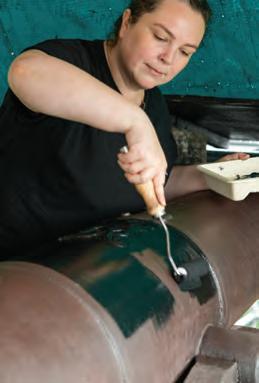
Conservation trials at Stirling Castle and Dumbarton Castle will help us to better care for the 150 plus cannons across our properties, many of which are on loan from the Royal Armouries.
Based on current research and expertise at our sites, the trials will address the effects that weather, pollution and
visitor numbers can have on the condition of these big guns.
The trials so far have involved testing the cannons for the impact of salts and corrosion, preparing surfaces for painting, and applying a modern paint system. Two new types of tompion – plugs placed in barrels to protect cannons’

The top guns of Stirling Castle*
and celebrate World Bee Day on 20 May
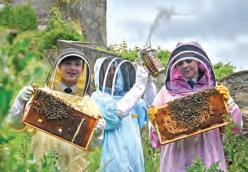
This royal residence houses two hives belonging to Stirling High School’s Bee Project. Pupils maintain them as part of their mission to help bees and improve our environment.
internal ironwork – are being compared too.
The aim of this work is to establish a conservation programme to ensure our cannons continue standing guard at our sites for the next century.

Caring for the Mons Meg cannon at hes.scot/monsmeg or scan the QR code here.
Hear how we’re conserving cannons in the first episode of the Historic Scotland Podcast at hes.scot/ memberspodcast
Look for the bee boles (garden wall recesses) at this grand Grampian residence, used before the development of hives to provide shelter for the skeps (straw baskets) where bees lived and worked.
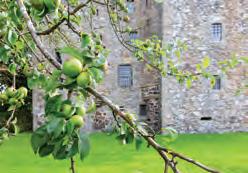
One of Scotland’s bestpreserved 16th-century tower houses, Elcho Castle’s traditional orchards are well renowned. Late April to early May is a great time to see bees getting busy as apples, pears and other fruit begin to blossom.
Discover more days out at historyawaits.scot
ArchivistJoeWaterfield onwhatmakestheadverts inthisEdwardiancatalogue socompelling
Scotland’s Industrial Souvenir catalogue was produced to celebrate the country’s industries at the dawn of the 20th century. As with the British Empire Exhibitions running during this time, the publication showcased Scotland both as a country and as a manufacturing powerhouse.
The first volume, published in 1904, was so successful that a second followed in 1905. Over 6,000 copies were sent worldwide, finding their way to British Empire consulates, ocean liners and more. Scottish companies bought advertising space in the Souvenir, with their products lavishly presented in full colour and gold ink throughout its pages.
Advertisers included Andrew Melrose & Company – their marketing centred around being tea purveyors
Creaturesnefariousand sharp-clawedoncecalled thisstrongholdhome
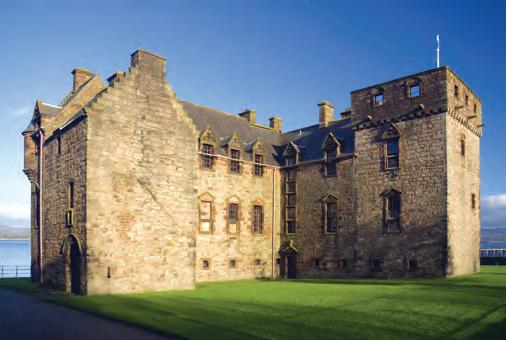
This Renaissance style Castle was built by Sir George Maxwell in 1478 and, at one time, housed the murderous Sir Patrick Maxwell. The Maxwells sold the castle in 1694,
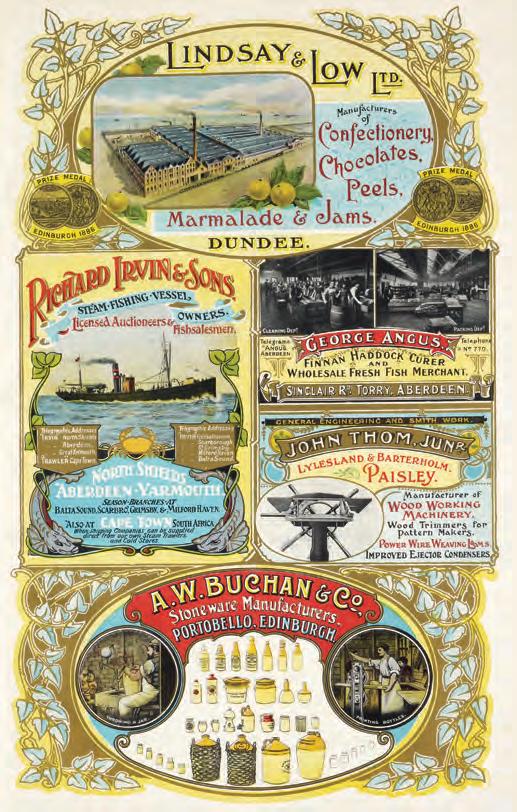
to Queen Victoria during her entire reign – and Moir, Wilson & Co Ltd, whose slogan declared their herrings in tomato sauce “a dainty bite, fit for a king”.
The Souvenir depicted factories and other industrial buildings, spotlighting production methods and people at work. These pages showed
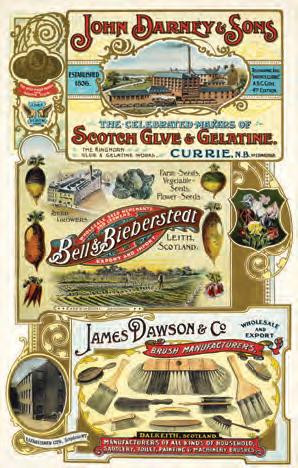
the stages involved in catching, preparing and packing fish for sale and creating stoneware bottles and jars.
The catalogue also ran articles on tourism and leisure, with tips on how the wealthy classes could travel across Scotland in style by rail and steamboat.
View records of the factories, shops and locations referenced in Scotland’s Industrial Souvenir at trove.scot
ushering in a new era of even beastlier occupants.
The space was let out to local tradespeople. One such occupant was John Orr, a ropemaker with a sideline in trading wild animals – big cats and bears in particular – which he bought from ships docking in Port Glasgow.
Orr is thought to have kept animals in Newark Castle’s cellars. Talk about an unusual rental claws!
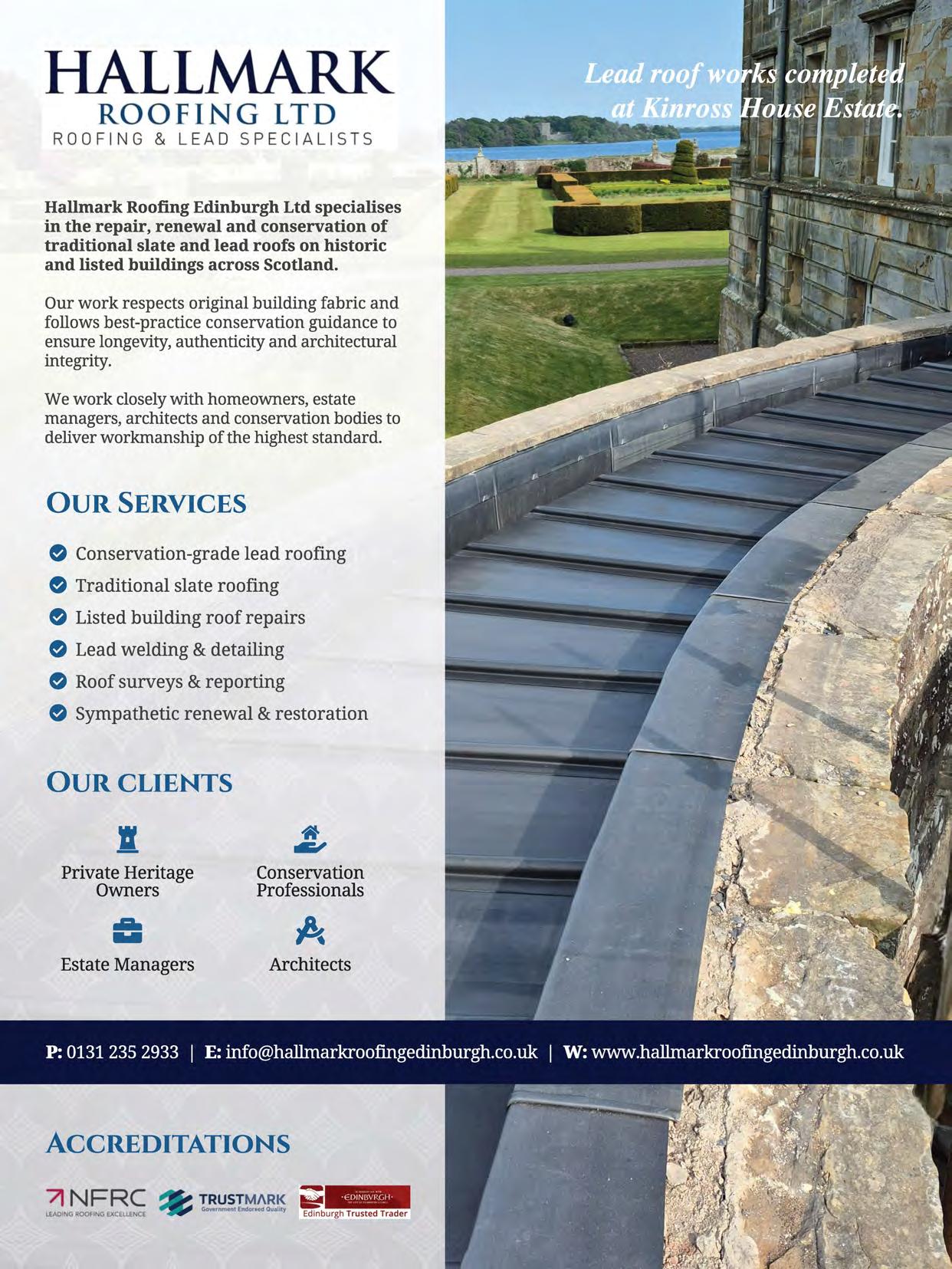
Hallmark Roofing Edinburgh Ltd specialises in the repair, renewal and conservation of traditional slate and lead roofs on historic and listed buildings across Scotland.
Our work respects original building fabric and follows best-practice conservation guidance to ensure longevity, authenticity and architectural integrity.
We work closely with homeowners, estate managers, architects and conservation bodies to deliver workmanship of the highest standard.
S Conservation-grade lead roofing
S Traditional slate roofing
S Listed building roof repairs
S Lead welding & detailing
S Roof surveys & reporting
S Sympathetic renewal & restoration
Seen here with one of the panels in Glasgow Cathedral, Talia Blatt came to Scotland on a Harvard Scholarship

Artist Talia Blatt tells us about her involvement in creating Glasgow Cathedral’s stained-glass panels marking the city’s 850th anniversary
Created during 2024 and 2025, the five Glasgow 850 panels tell stories inspired by the Hebrew Bible’s books: Genesis, Exodus, Leviticus, Numbers and Deuteronomy. Imagery in these books overlapped with Glasgow’s history. I wanted to balance my creative vision with the cathedral and city’s history, and the congregation’s beliefs.
Gaining a theological and historical grounding
During the design planning I got feedback from Glasgow Cathedral’s Reverend Mark Johnstone, the Society of Friends of Glasgow Cathedral and from HES. I also consulted with Professor Garrick Allen from the University of Glasgow, and read the Old and New Testament. I wanted the panels’ biblical text translations to evolve with its historical timeline, so I researched excerpts from the Hebrew, Greek, Latin and King James bibles.
As an American, I had to immerse myself in Glasgow’s secular and cultural history.
I read Alasdair Gray and James Kelman; listened to Billy Connolly and Belle and Sebastian; visited the Mitchell Library and Hunterian and Kelvingrove museums;
scoured the British Newspaper Archive and worked with archivist, Craig Bryce, to access 16th and 17th century materials. I also asked Glasgow’s people why they love the city.
While working as a cathedral tour guide, I studied its Munich, Second World War and 21st-century stained glass windows intensely.
Bringing the panels to
I wanted the panels to be a historical tapestry weaving Glasgow’s past and present. I worked with amazing artists at the Glasgow Glass Studio –Steven Graham, Geraldine McSporran, Tim Kirman and Brian Waugh – at every stage. Together we painted, etched, placed, leaded, soldered and polished the panels.
Easter eggs
The panels are littered with Glaswegian cultural details and inside jokes. The first panel references the line from Scottish folk song, Black is the Colour, “I go down to the Clyde to mourn and weep.” The fifth panel pays this off with the Book of Revelation line, “I will bring an end to mourning and weeping.”
The fifth panel includes the Deuteronomy line, “So choose life!” – a wink to Trainspotting – and the recipe for chicken tikka masala. Irn-Bru also features in the fourth panel. Treat viewing these panels like a scavenger hunt!
Plan a visit to Glasgow Cathedral to see the panels in all their glory at hes.scot/glasgow-cathedral
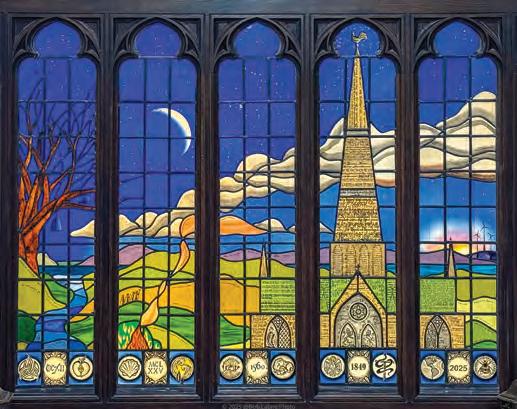
Fellow Glasgow Glass Studio artist Steven Graham collaborated with Talia on this Glasgow 850 panel
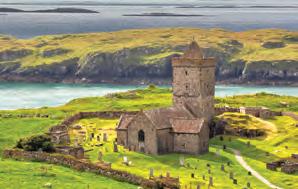
TV presenter and best-selling cookbook writer, Coinneach MacLeod, reveals why St Clement’s Church in the Western Isles holds a piece of his heart
As a proud islander and a MacLeod by name, I feel a deep kinship with St Clement’s Church. After all, it was built in the early 1500s for Alasdair Crotach MacLeod –the 8th Chief of the MacLeods of Harris – to be his clan’s final resting place. Knowing my ancestors laid these stones gives me goosebumps.
St Clement’s is dubbed the Western Isles’ grandest medieval building. Yet for all its prominence, it feels surprisingly intimate and welcoming. From the carved tombs of ancient chiefs to it weathered gravestones, its history speaks to me.
Tales of Scotland’s islands, filled with mystical beasts, shipwrecks and marauding Vikings, fired my imagination from an early age. And they inevitably found their way into my kitchen. My Aunt Bellag inspired my baking journey. She’s 97 now and still bakes every day! Her famous clootie dumpling recipe – or duff, as it’s known in Gaelic – sparked the idea for the Hebridean Baker.
I’ve always said that, like a gripping story, a good recipe is meant to be shared. That’s why my cookbooks blend traditional bakes with the Scottish islands’ myths and legends.
The stonework of Alasdair Crotach MacLeod’s tomb is so detailed that I could easily spend a whole afternoon looking at it. The knight’s effigy is impressive on its own, but the castle, galley, foliage and figures etched into the arch together tell an incredible story.
I might be baking a cake, but I’m also stirring in Gaelic folklore or a memory of island life.
St Clement’s Church is modest in size compared to some mainland churches, but it carries real weight in Scotland’s story. It stands at the edge of Europe where Celtic Christianity took root. The Lords of the Isles and clan chiefs also expressed their power, faith and identity through buildings like it. The past never feels far away.
Spring is a wonderful time to visit. The days stretch longer, primroses bloom and Arctic terns, golden eagles and hen harriers can be spotted as the island wakes from winter.
I always look at the church tower’s sculpted panels first when visiting. The bishop on the west side is possibly St Clement, the east face features two fishermen in a small boat (potentially Saint Peter and Saint Andrew) and the north side has a bull’s head. The south face houses a surprise: a carving of a female nude!
As soon as you step inside the church you’re reminded that Scotland’s heritage isn’t just castles, palaces and battlefields. It’s also places like this: built by islanders, shaped by Gaelic culture and rooted in community. Without proper care, properties such as St Clement’s Church could easily be lost to weather or time. By protecting it, Historic Environment Scotland isn’t just looking after an old building, they’re preserving the stories, craftsmanship, spirit and meaning held in its stones to ensure they’re never forgotten.
St Clement’s Church is modest in size compared to some mainland churches, but it carries real weight in Scotland’s story

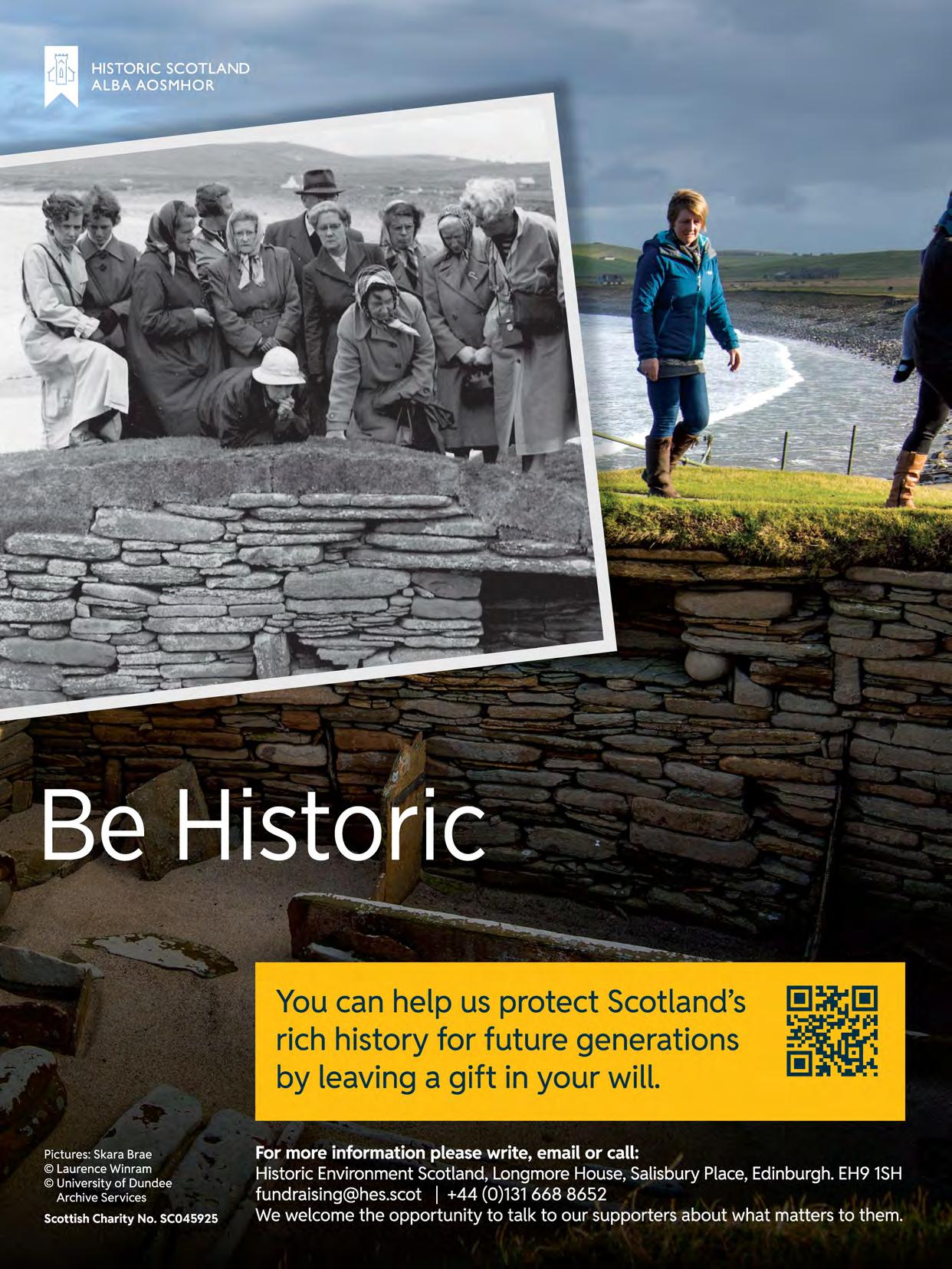
You can help us protect Scotland's rich history for future generations by leaving a gift in your will.
with Ranger Gordon Smith
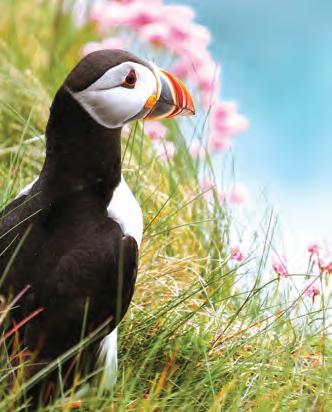
These ‘clowns of the sea’ always raise a smile
With more than 900 islands and an incredible coastline, Scotland is internationally important for seabirds – over five million of them return to breeding colonies across the country in spring. That includes around 80% of the UK’s one-million-strong puffin population.
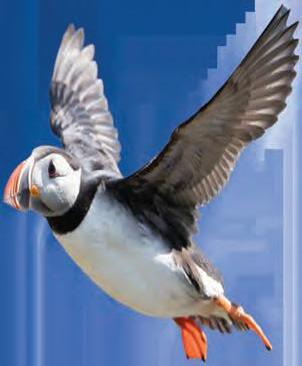
Colourful and charismatic, the Atlantic puffin is instantly recognisable. With a large multicoloured bill, its ‘sea parrot’ and ‘clown of the sea’ nicknames are very fitting. Their scientific name, Fratercula arctica, means ‘little brother of the north’ in Latin – possibly referring to their black and white plumage resembling a friar’s robes. Males and females are identical, although males are often slightly bigger.
Puffin breeding season lasts from April to early August

Despite their clumsy and comical appearance on land, puffins are excellent swimmers. They’re incredibly agile underwater and can dive to depths of up to 60 metres. Their favourite prey is small fish such as sand eels. Serrations in the bill allow puffins to catch and hold many small fish at one time. The average successful catch is 10 fish, but some adults have been recorded carrying up to 80 fish at once!
Puffins flap their wings up to 400 times a minute, helping them reach speeds of around 55mph in the air.
Threegreatsitestospotcharacterfulcreaturesthisseason
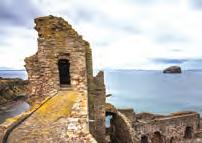
TANTALLONCASTLE
Gannetsarefoundon BassRock,whichis visiblefromTantallon Castle.Fromthecastle youcanwatchthebirds huntingandflying overthewater.
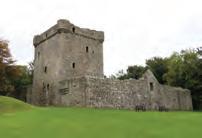
CASTLE
You’lloftenspotgrebes onyourboatjourney toLochlevenCastle, MaryQueenofScots’ formerprison,andin thelochsurrounding theisland.
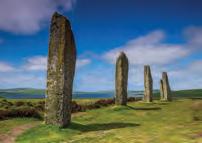
RINGOFBRODGAR
Keepyoureyespeeled fortheraregreat yellowbumblebee hiddenamongthe wildflowersofthis enigmaticNeolithic stonecircle.
All this food attracts the attention of larger predators, such as gulls and skuas, who will attempt to rob the adult puffins of their catch.
Puffins’ hunter-gatherer skills are perfect for keeping their hungry chicks, known as pufflings, well fed. Pufflings are born in underground burrows carefully dug by their mum and dad – although parents have been known to evict rabbits from their burrows for their offspring.
With a dark face and small dark beak, pufflings barely resemble their parents. Their beak and feet gain their bright orange hue as they age. After about 40 days, pufflings are ready to leave the burrow. They head to the open sea and don’t return to land for two years!
Puffins can be spotted at several of our sites. The journey to Inchcolm Abbey involves a boat trip across the Firth of Forth. As the boat approaches the island, look out for rafts of seabirds – puffins among them – feeding and resting on the open water.
In Orkney lies the Brough of Birsay. Once home to Picts and Vikings, this uninhabited tidal island, accessible only at low tide, is now a haven for seabirds, including puffins.
Joanna Todd, Volunteer Development Officer, reveals how our volunteer musicians are hitting all the right notes
Volunteer musicians bring our sites to life. While at first this was an opportunity available only at Duff House – a position held by pianist, Alan, who recently moved on –in 2025, musicians gave freely of their time and musical skills at Fort George, Huntingtower Castle, Stanley Mills and Craigmillar Castle.
Andrew first played at Huntingtower Castle in 2024, performing music inspired by the site. A joint opportunity eventually opened up between there and Stanley Mills, with Andrew joining fellow volunteers, George and Munro.
The Perth-based trio’s first performance took place at Stanley Mills in September 2025, with Andrew and Munro playing guitar and flute, respectively.
Scottish smallpipes player, Scott, became Craigmillar Castle’s
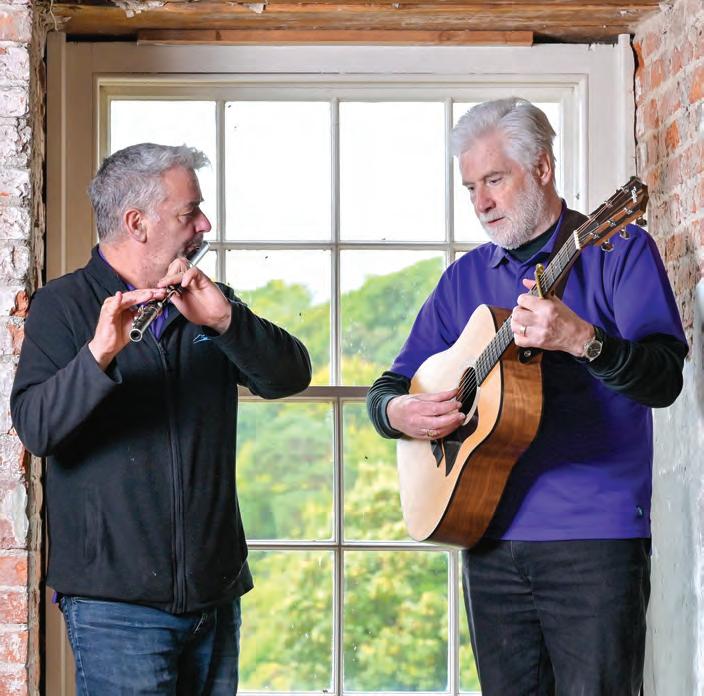
volunteer musician in June 2025. Scott describes bellows-blown bagpipes as having a quieter sound that’s well-suited to spaces like the hall of this former haven of Mary Queen of Scots, and he enjoys playing traditional tunes that strike a chord with visitors.
To mark the clocks changing for spring, we examine three objects once used to keep track of the minutes
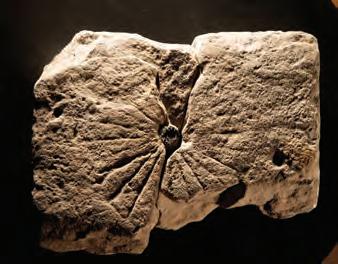
Thismedievalstonesundialonce formedpartofInchcolmAbbey’s south-facingwall.Theremainsofan ironrod(calledagnomon)canstillbe seeninitscentre,fromwhichcarved linesradiate.Thegnomonwouldhave castashadowacrosstheselinesas thesunmovedacrossthesky.
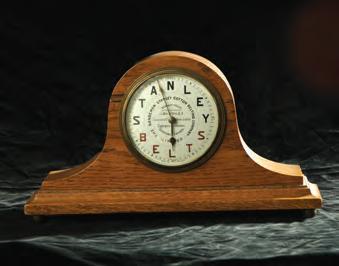
Inthe1800s,StanleyMillsbegan manufacturingcottonbelting. Thisclock–believedtobefrom the1920s–waspartofasales campaigntopromotebelting products.Thisclockandsimilarones werealsopresentedtoemployees asretirementandweddinggifts.
Keepanearoutforvolunteer musiciansplayingatStanleyMillson 9and10MaytomarkNationalMills Weekend.Formoreinformation,visit hes.scot/whats-on
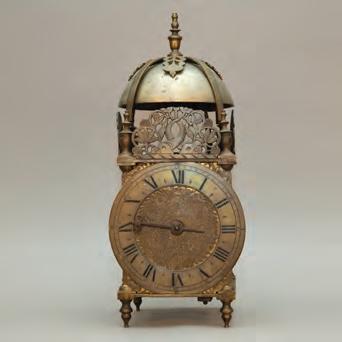
DiscoveredatStirlingCastle,this1600s lanternclockisoneofthefirsttypes ofmechanicaltimepieceusedinhighstatushomes.Thetopdomehada bellunderneath,whichsoundedthe hoursoftheday.Atthebottomthere wouldhavebeendrivingweights andapendulumhangingdown.
•
Spendhoursexploringour collectionsattrove.scot
9781899874637 hardback £65.00 July 2025
1024 pages 1,200+ b&w & 121 col illus 260x190mm
A brand new, greatly expanded, fully revised and excellently received edition of this renowned work: the 'Bible of Scottish Castles' and 'a proud and worthy successor to MacGibbon and Ross'.
• Excellent sales and fabulous reception for the book
• 64 pages of full colour (121 photos) and 1,200+ black-and-white drawings, etchings and photos
• Comprehensive alphabetical guide to castles, towers, historic houses, stately homes and lands
• Daunting fortresses to piles of stones to mere mentions on ancient maps
• Architecture, history, ownership, stories, ghosts
• 5,843 entries, 1,700 more than the fifth edition
• Greatly expanded histories and family ownership
• Clan index with more than 1,200 names
• Accompanying website with interactive map, huge library of illustrations, full index, and more
• Written, printed and published in Scotland
• Postage and packing FREE in the UK
Aberdour Castle viewed from the apple orchard
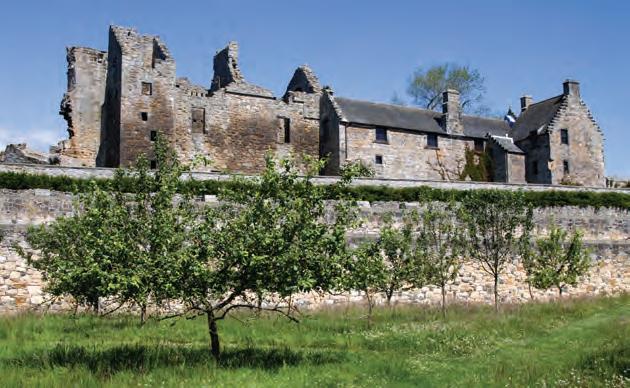
Explore the castle and stroll through the pleasure grounds of this Fife stronghold that became the height of luxury
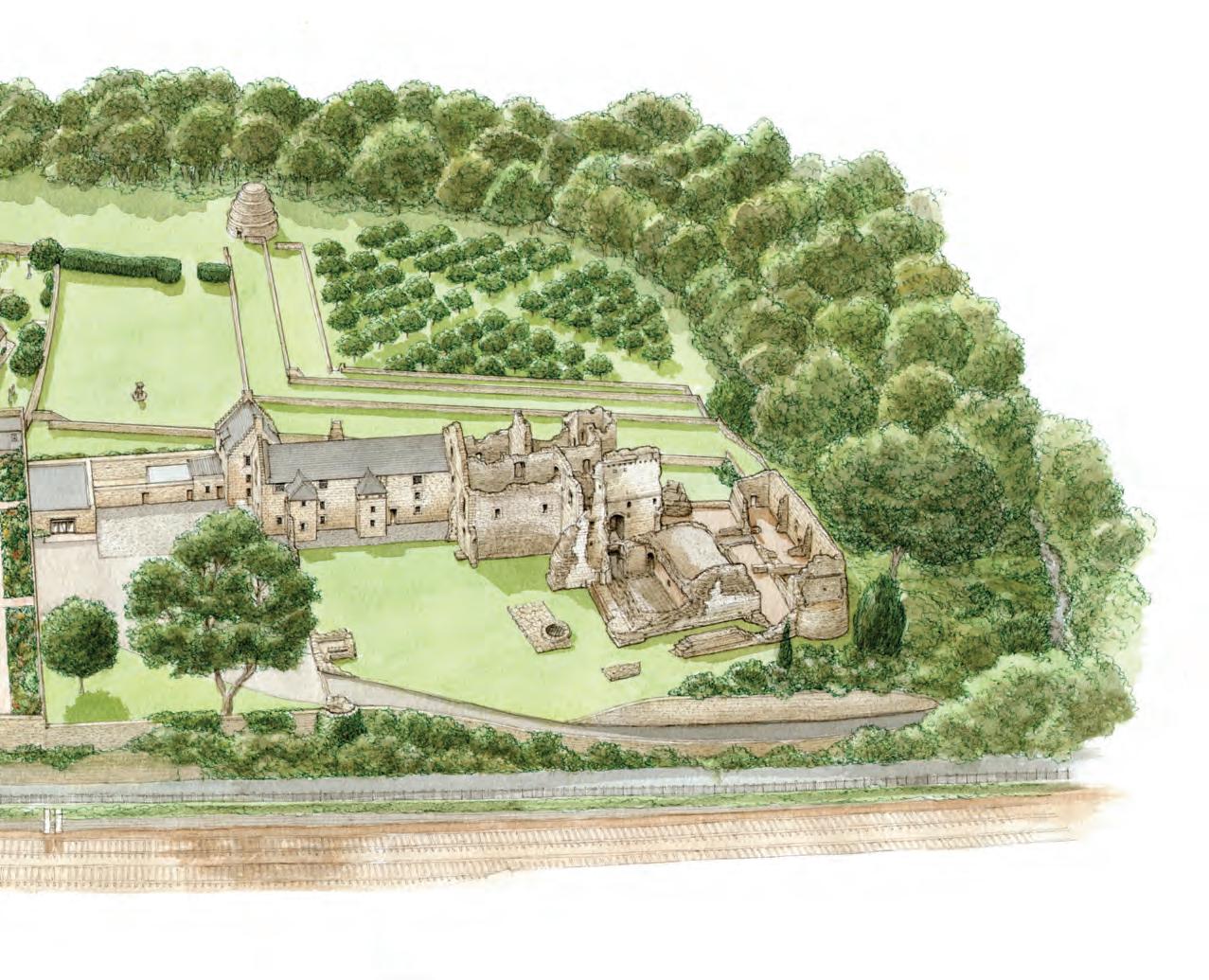
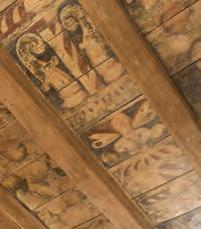
There is much to discover at Aberdour Castle, one of Scotland’s oldest stone castles – from its meandering architecture and rare painted ceiling to its gardens, apple orchard and unusual dovecot. All just a short walk from the beach.
When Alan de Mortimer acquired the barony of Aberdour in the early 12th century, he required a place of strength. At that time, the area was ruled jointly by the lords of Aberdour and the canons of Inchcolm Abbey (which you can see from Aberdour Harbour). By 1325, the lands of Aberdour had been granted to Thomas Randolph, Earl of Moray, by his uncle Robert I (the Bruce). In 1342 one of Moray’s sons granted Easter Aberdour to Sir William Douglas, a soldier of mixed fortunes.
Alan de Mortimer acquires the barony of Aberdour and probably oversees the building of the original keep, kirk and mill.
ABERDOUR CASTLE
The original hall house was converted into a tower house during the later 1300s and adapted by the generations of Douglases who came after.
Perhaps the castle’s most notorious resident was James Douglas, 4th Earl of Morton, later executed for allegedly participating in the murder of James VI and I’s father, Lord Darnley. In the 1640s, William Douglas, the 8th Earl, oversaw the last major changes at Aberdour Castle, including the east range, walled garden and a bowling green. Inventories of the time describe the castle’s sumptuous furnishings. Gardener Charles Lidell created the fruit orchard for the Douglas family in the 1690s. Today, it is home to heritage apple trees and bees.
Substantially rebuilt in the 1500s, probably by the 4th earl, this range provided two floors of apartments and a ground-floor kitchen.
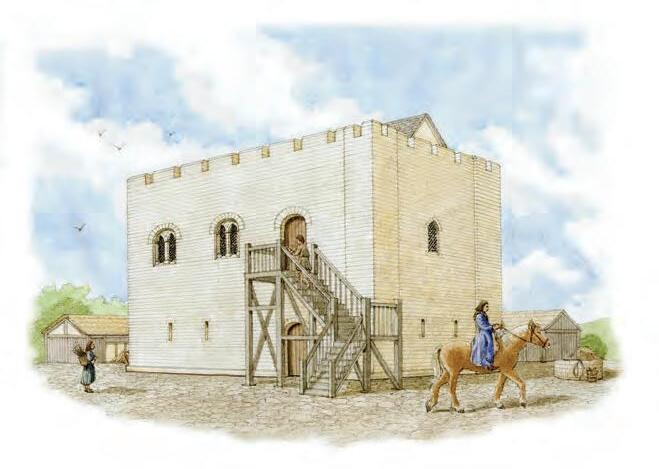
Robert I (the Bruce) grants the lands of Aberdour to his nephew Thomas Randolph, Earl of Moray. In 1343, Easter Aberdour passes to Sir William Douglas, known as ‘the Flower of Chivalry’ for his bravery in battle.
Discover the remains of a brewhouse, bakehouse and other buildings serving the castle’s occupants.
David II confirms that Sir William Douglas had, shortly before his death in 1353, granted his lands to his nephew James –the earliest known historical record of ‘Aberdour Castle’.
1 OUTER COURTYARD
Look for clues to the castle’s different building phases from this open space, where the 1600s gateway once stood.
2 HALL HOUSE/ TOWER HOUSE
Explore the earliest part of the castle, a two-storey hall house from the 1100s, later heightened to form a tower house.
5 EAST RANGE
This last major addition, dating from the 1600s, created a long picture gallery above stables, with private chambers sporting a painted ceiling.
6 TERRACED GARDEN
This set of terraces –extensively rebuilt in modern times –leads you to the orchard, which dates from at least 1690.
1459
Princess Joan Stewart, daughter of James I, marries James Douglas, who becomes the 1st Earl of Morton. The hereditary title of Lord Aberdour is conferred on their eldest son.
1563
James Douglas, 4th Earl of Morton, becomes Lord Chancellor of Scotland under Mary Queen of Scots. His right to the barony of Aberdour is confirmed. Morton later serves as regent to Mary’s son, James VI and I.
7 DOVECOT
Added in the later 1500s, the beehive-shaped structure housed pigeons to supply the castle with eggs and meat.
1606
Sir William Douglas inherits the earldom and creates a grand country residence at Aberdour, with the finest furnishings and tapestries.
8 WALLED GARDEN
Take a seat to admire the herbaceous borders in this garden, originally created to complement the new east range.
9 ST FILLAN’S CHURCH
Built for the de Mortimer family around 1140, this is one of the oldest surviving churches in Scotland. It is not our property but visits are welcomed.
1715
A fire breaks out while government troops are stationed in the castle. The Douglas family moves out in the 1720s to Aberdour House.
WHERE
Spring has arrived and with it come brighter days, better weather (we hope) and loads of ways to explore and enjoy the sites we care for. From seeing where the wild things are along Doune Castle’s trails and learning about Linlithgow Palace’s tales in the Scots language to making a wish at Glasgow Cathedral’s long-forgotten well, we’ve rounded up some fantastic trips to give you a head start.
SIX WAYS TO MAKE THIS SEASON’S DAYS OUT WITH US EXTRA SPECIAL
We’ve
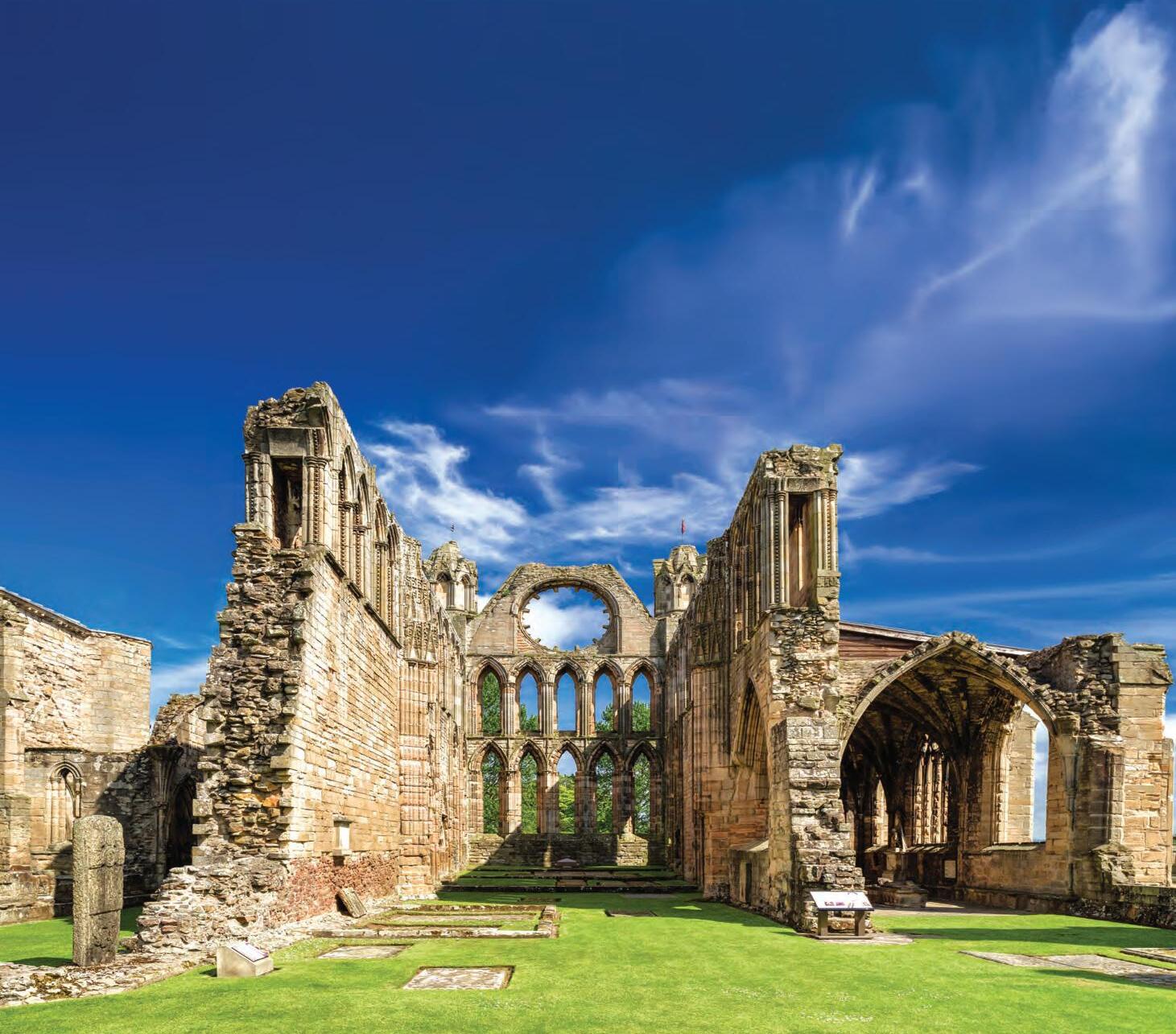
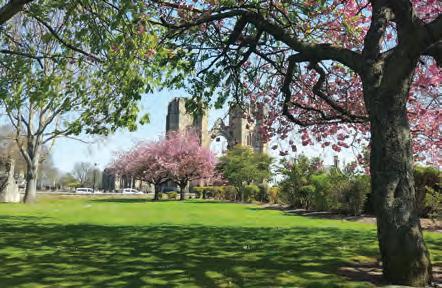
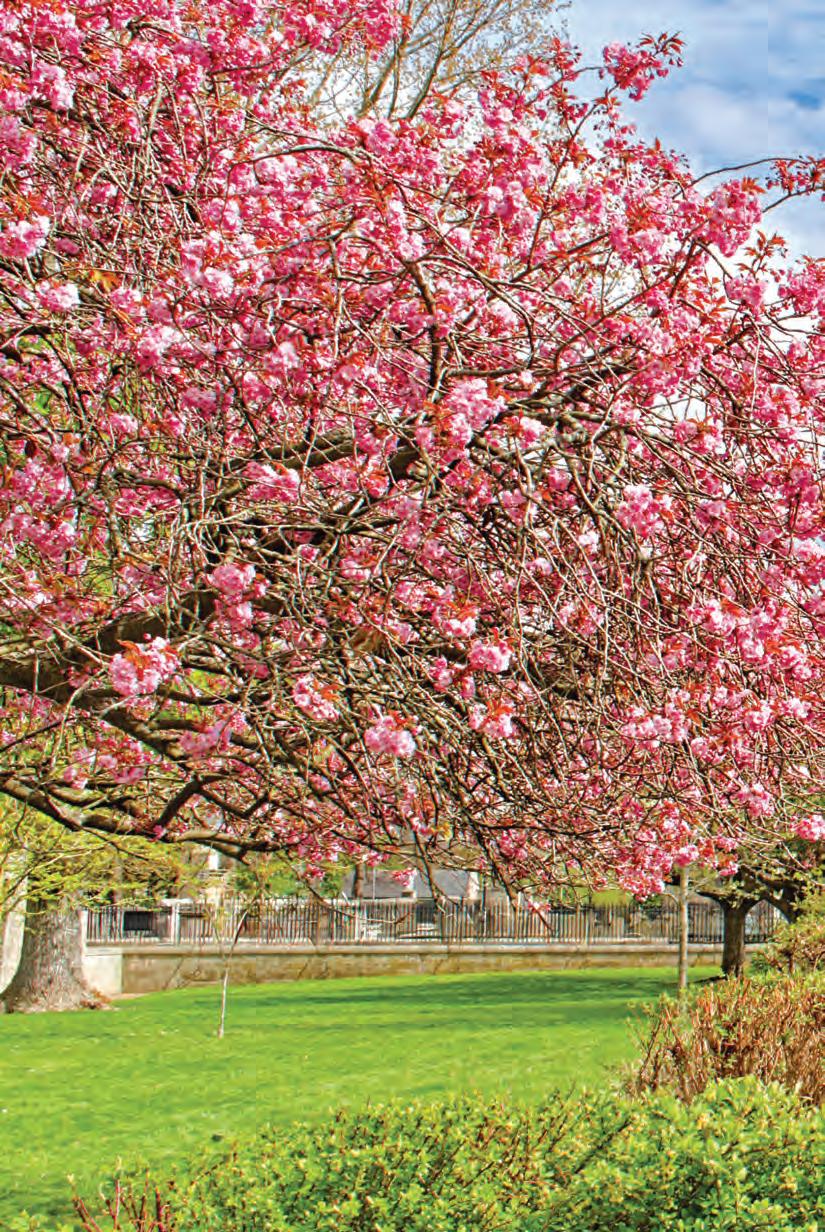
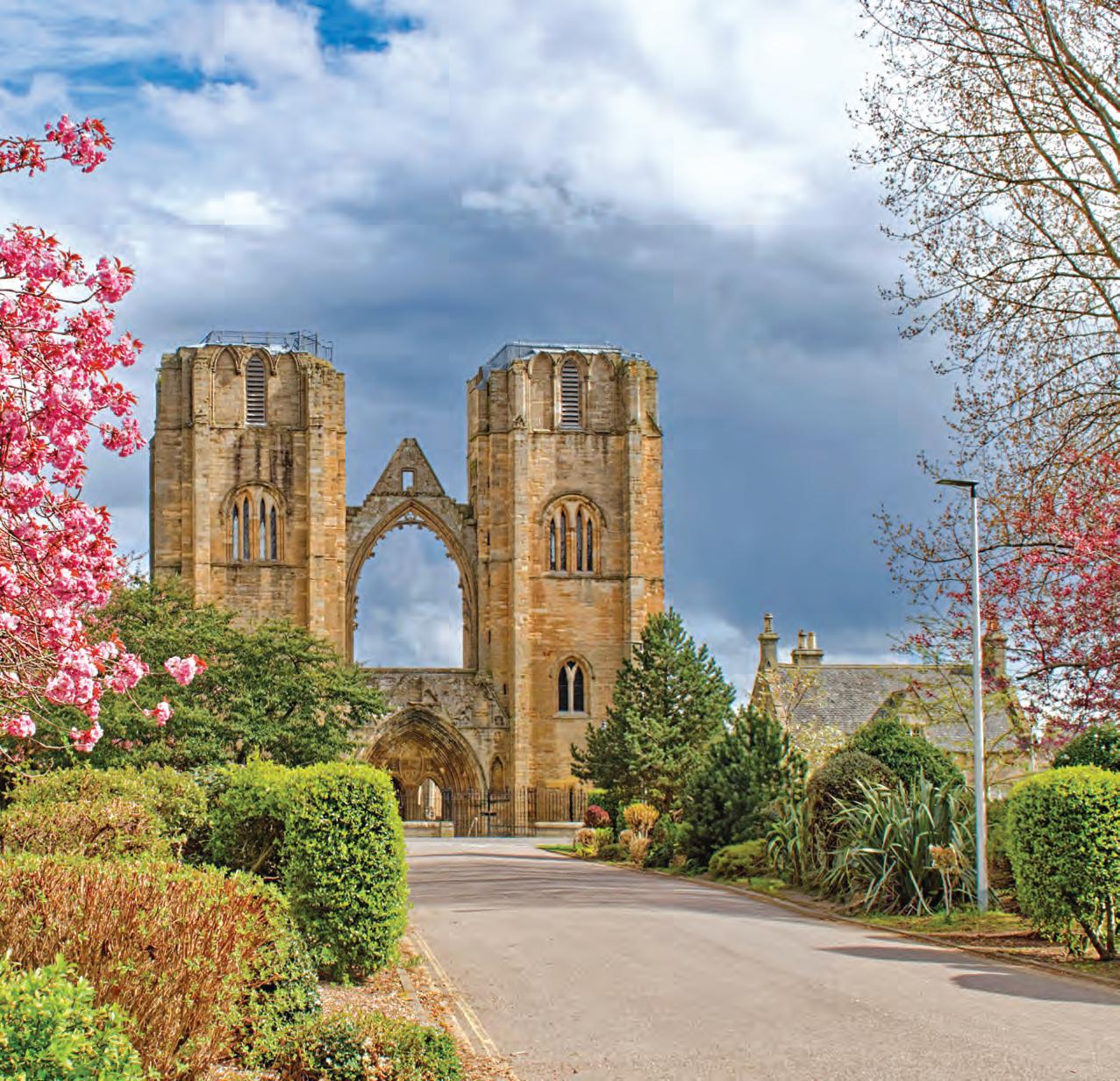
1One of the cheeriest signs of spring’s arrival is the snow-white and candyfloss-coloured hues of cherry blossom trees in bloom. The dramatic display at Elgin Cathedral is no exception.
Cherry trees flower from late March to early May throughout the UK. Thanks to Elgin’s uniquely mild microclimate, however, blossoming season reliably peaks here in late April and early May.
Elgin boasts several cherry blossom tree hotspots. Behind the 13th-century cathedral, the large tree at Johnston’s of Elgin weaving mill is impressive. Cooper Park’s wall of wellestablished cherry trees also beautifully
frames the front of this former place of worship – providing plenty of photo opportunities. Representing life’s beauty and fragility, cherry blossoms have deep cultural significance in Japan. Many gather to enjoy the tradition of hanami, which means ‘flower viewing’. After visiting the cathedral, experience hanami for yourself by spending time admiring Elgin’s splendid sakura (cherry blossoms).
SEND US YOUR SNAPS
Share your images of Elgin Cathedral’s beautiful blossoms by tagging our social media channels.



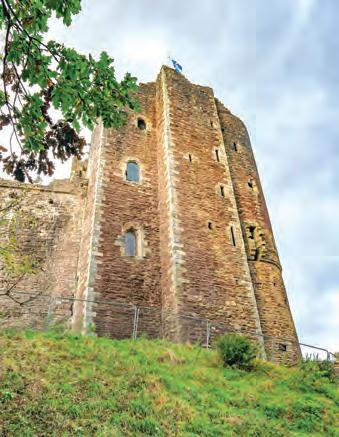
2Outlander, Game of Thrones and Monty Python fans will recognise Doune Castle for its respective starring roles as Castle Leoch, Winterfell and Castle Anthrax or Camelot. The grounds of this former seat of Robert Stewart, the 1st Duke of Albany, are equally as captivating.
Start by wandering the nature trail that snakes around the castle. This leads to a prime spot for seeing timorous beasties that call Doune home, including red squirrels, swallows and firecrests. Follow the path down through the broadleaf woodlands and you’ll find a wildflower meadow that’s often filled with butterflies.
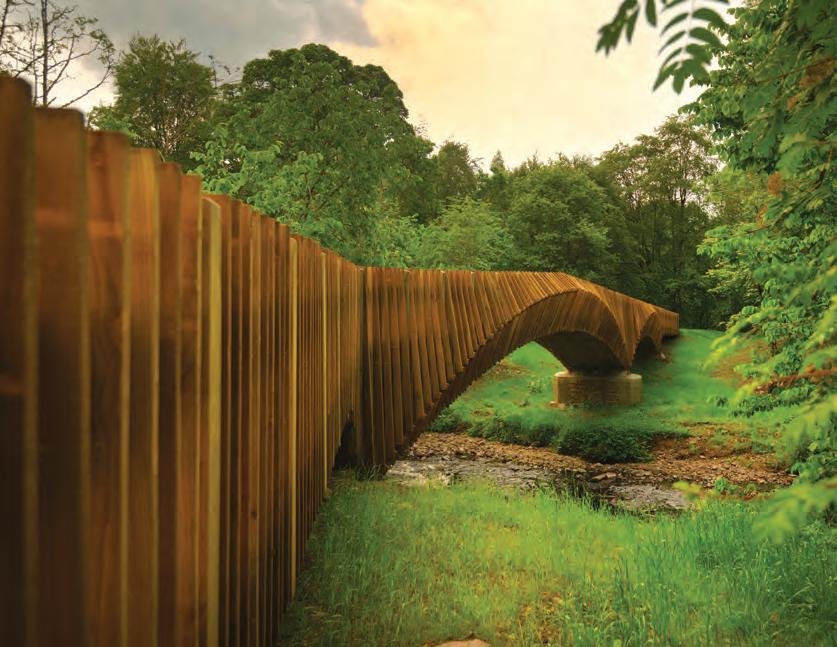
As you make your way along the handsome footbridge – located past the historic icehouse hidden in the hill to the left of the castle – stop and enjoy a breather while listening to the Ardoch Burn bubbling beneath as it flows to the River Teith. Look out for kingfishers upstream and otters splashing around.
This footbridge connects the castle’s environs to other local landmarks, including Doune Ponds, the Mill of Doune and Doune Village.
Collect our Spring Wildlife Trail sheet at the castle and tick off flora and fauna you see along the trails.
An ancient well –overlooked for centuries in Glasgow Cathedral’s crypt – has been transformed into an arresting new installation. Thanks to the Aproxima arts collective, artist Joanna Kessel, University of Glasgow archaeologist Professor Stephen Driscoll and Clyde Archaeology’s David Sneddon, a forgotten chapter of the cathedral’s story has been brought into the light to mark the city of Glasgow’s 850th anniversary. Titled ‘The Well’, this installation is made from over 1,000 shimmering hand-blown Venetian gold-leaf-lined glass tiles that reflect water, light and the cathedral’s stainedglass hues. The well itself is believed to be linked to
PLAN ALL YOUR SPRINGTIME ADVENTURES
Discover more days out at
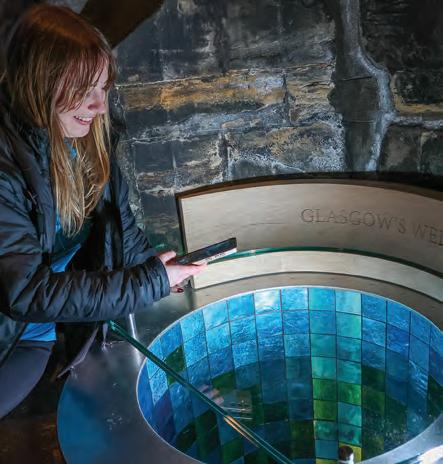
where St Kentigern –aka Glasgow’s patron saint, St Mungo –carried out baptisms in Molendinar Burn. As time passed, this well spring formed part of the wider area of St Kentigern’s shrine in Glasgow Cathedral. Blending archaeology and
‘The
contemporary art, the new piece highlights the city and cathedral’s medieval origins, environmental history and pilgrimage traditions.
ALL’S WELL
Plan your visit to Glasgow Cathedral at hes.scot/ glasgow-cathedral
When Linlithgow Palace was in use in the 1400s and 1500s, Scots was the language of choice for the royal court, and in the Lowlands. As well as being spoken by the monarch and ordinary folk alike, it was also the official written language of the state and its records.
The palace audio guide lets you hear the history of this royal
Stewart residence in Scots. The English version also contains snippets of our native language, meaning everyone can experience the linguistic heritage of Mary Queen of Scots’ birthplace.
Pop your earphones in and you’ll be accompanied by various characters while exploring the palace.
From James VI’s daughter, Princess
Elizabeth, to the plumber who maintained the now iconic fountain, the audio guide features stories of famous and lesser-known people who once lived and worked here.
You’ll receive a download link when booking your members’ ticket at historyawaits.scot

the history
5Why not start spring by immersing yourself in all that Holyrood Park has to offer?
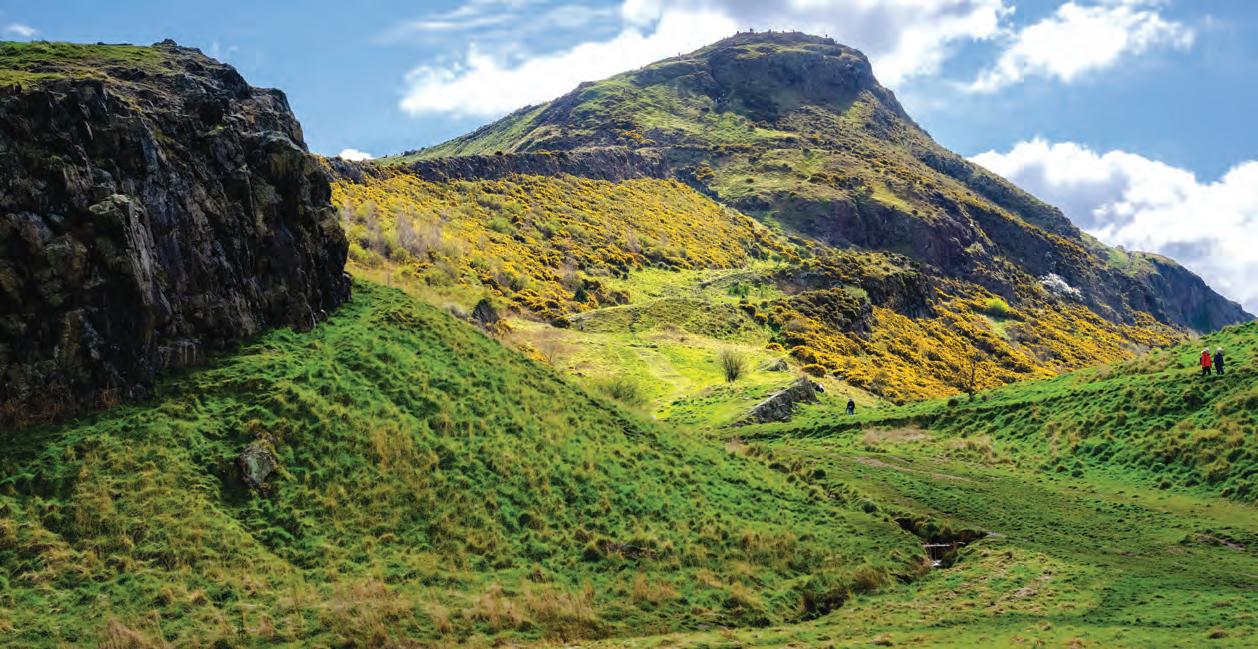
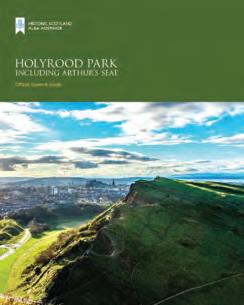
Our Holyrood Park Official Souvenir Guide is a great way to identify the park’s many features, from the geology that formed it to the objects humans have left behind.
Look out for new interpretation panels too, each highlighting a fascinating story. Discover the park’s royal connections, St Margaret Loch’s status as a wildlife haven and intriguing items unearthed at Duddingston Loch.
Series two of the Historic Scotland Podcast sees host Sarah MacGillivray visit Holyrood to investigate how we conduct archaeology in a park that sits in one of the world’s busiest cities.
This April you can also join us for a Members’ Exclusive Tour with archaeologist Graeme Cavers. Find out more on page 54.
A new season is a great time to try something different, such as a deep dive into Holyrood Park
Whether you’re interested in trekking with our Rangers, joining one of our British Sign Language tours or are keen to delve into the park’s layered past, there’s something at Holyrood for everyone.
GRAB A COPY
Get the latest edition of the Holyrood Park Official Souvenir Guide at stor.scot. Don’t forget your 20% members’ discount (see page 49).
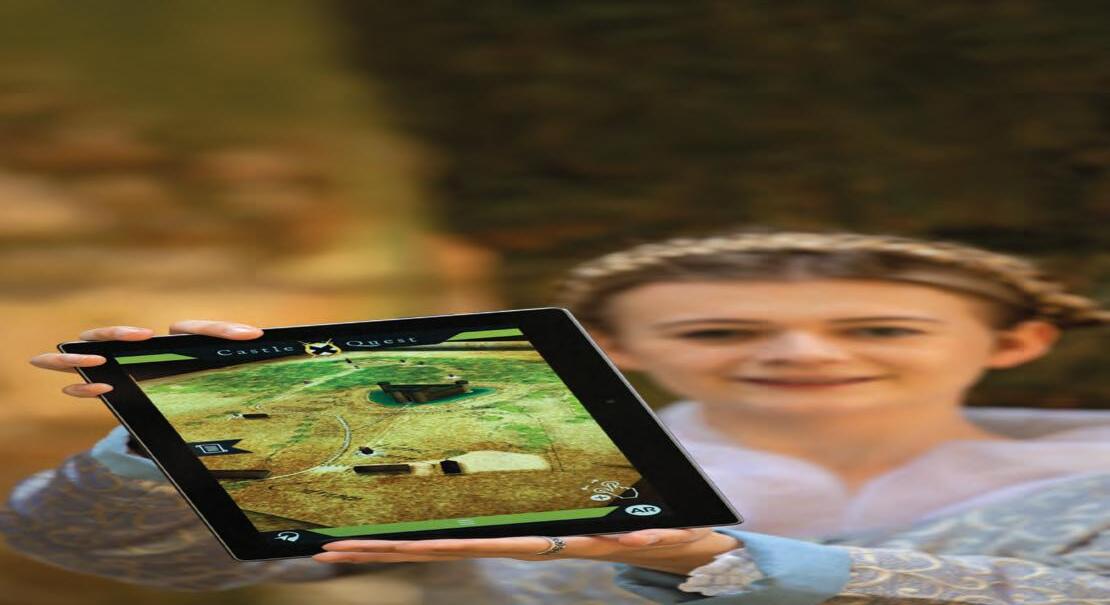
6Whether you fancy learning about a site’s hidden history in-person or from the comfort of your own home, our suite of four free apps puts the power of discovery at your fingertips. Use this cool quartet to help elevate your experience of the sites we protect, as well as other places of interest.
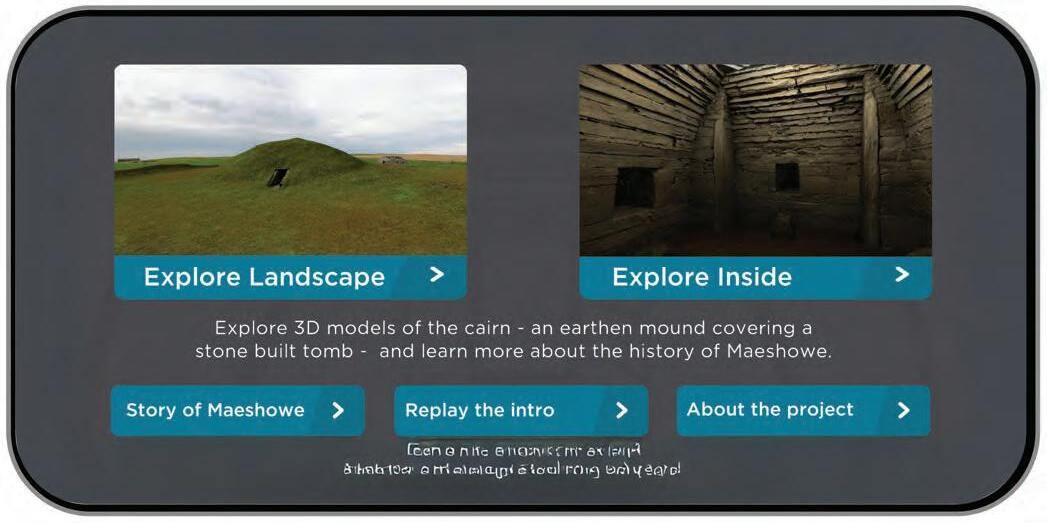

GetitonAndroid,iOSorathes.scot/app
Maeshowe Chambered Cairn is one of north-west Europe’s finest surviving Neolithic monuments. Featuring 3D models, 360° views of the tomb’s interior and exterior, and images of Norse graffiti, this app will equip you with a deeper appreciation for this remarkable feat of engineering, built more than 5,000 years ago.
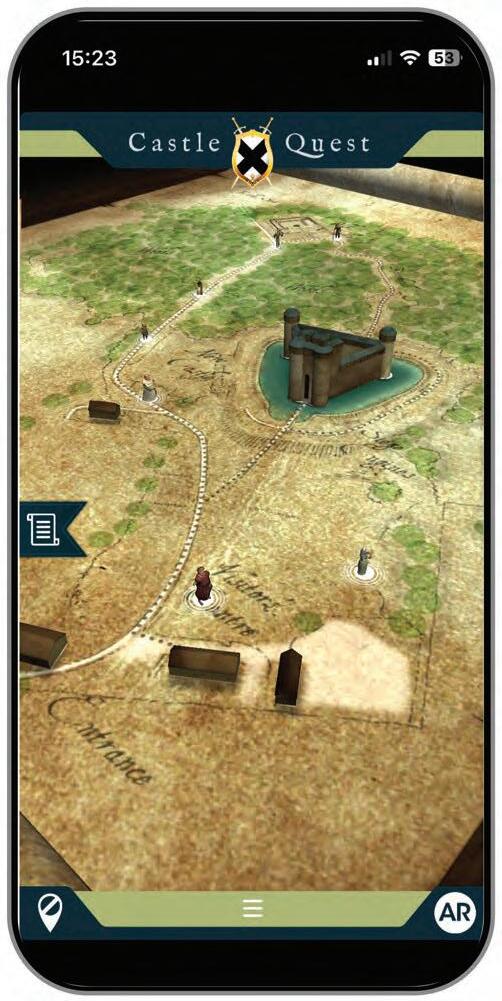

Get it on Android, iOS or at hes.scot/app
This augmented reality game will take you back to Caerlaverock Castle in 1312. Hear stories from 11 people who call this stronghold home as they prepare for Sir Eustace de Maxwell’s return. Collect flag pieces from all characters to complete the challenge.
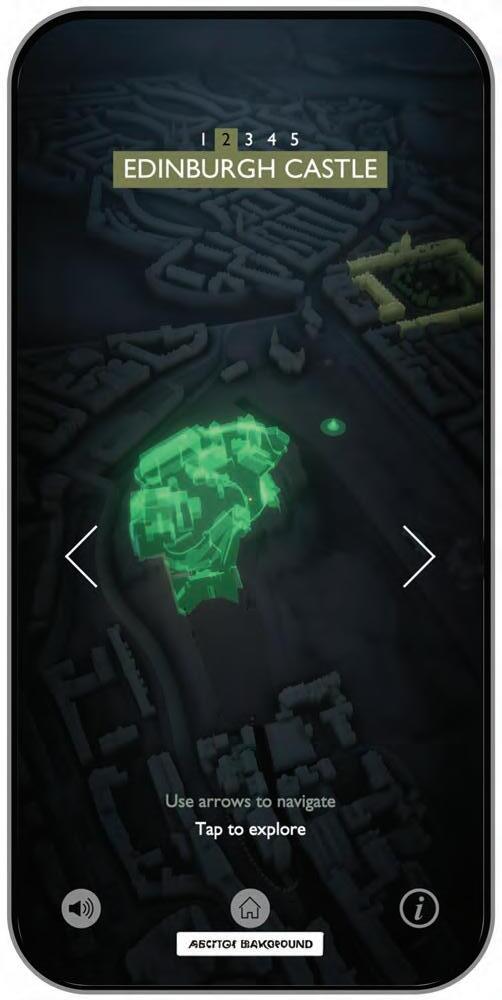

Get it on Android, iOS or at hes.scot/app
Using 3D models of five Edinburgh landmarks, including Edinburgh Castle and the Scott Monument, this app delves into the impact of climate change on heritage sites. It also looks at how we’re using science and technology to understand and adapt to the climate crisis.
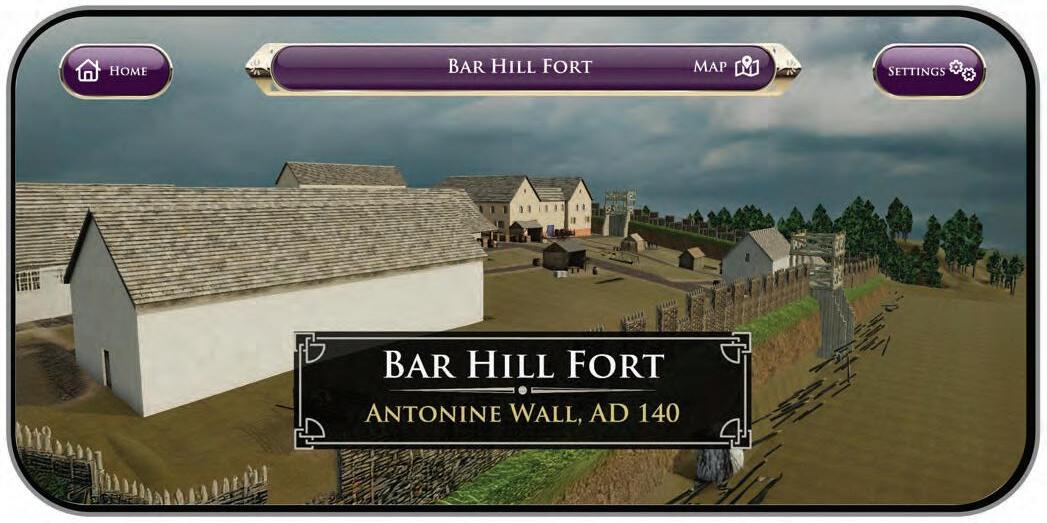

Get it on Android, iOS or at hes.scot/app
Play as either as a Roman archer, Julius, or a servant girl, Verecunda, as you explore Bar Hill Fort, one of several Roman forts built along Scotland’s Antonine Wall nearly two centuries ago. Using 3D models of archaeological artefacts excavated here, collect coins as you help the characters to complete tasks.

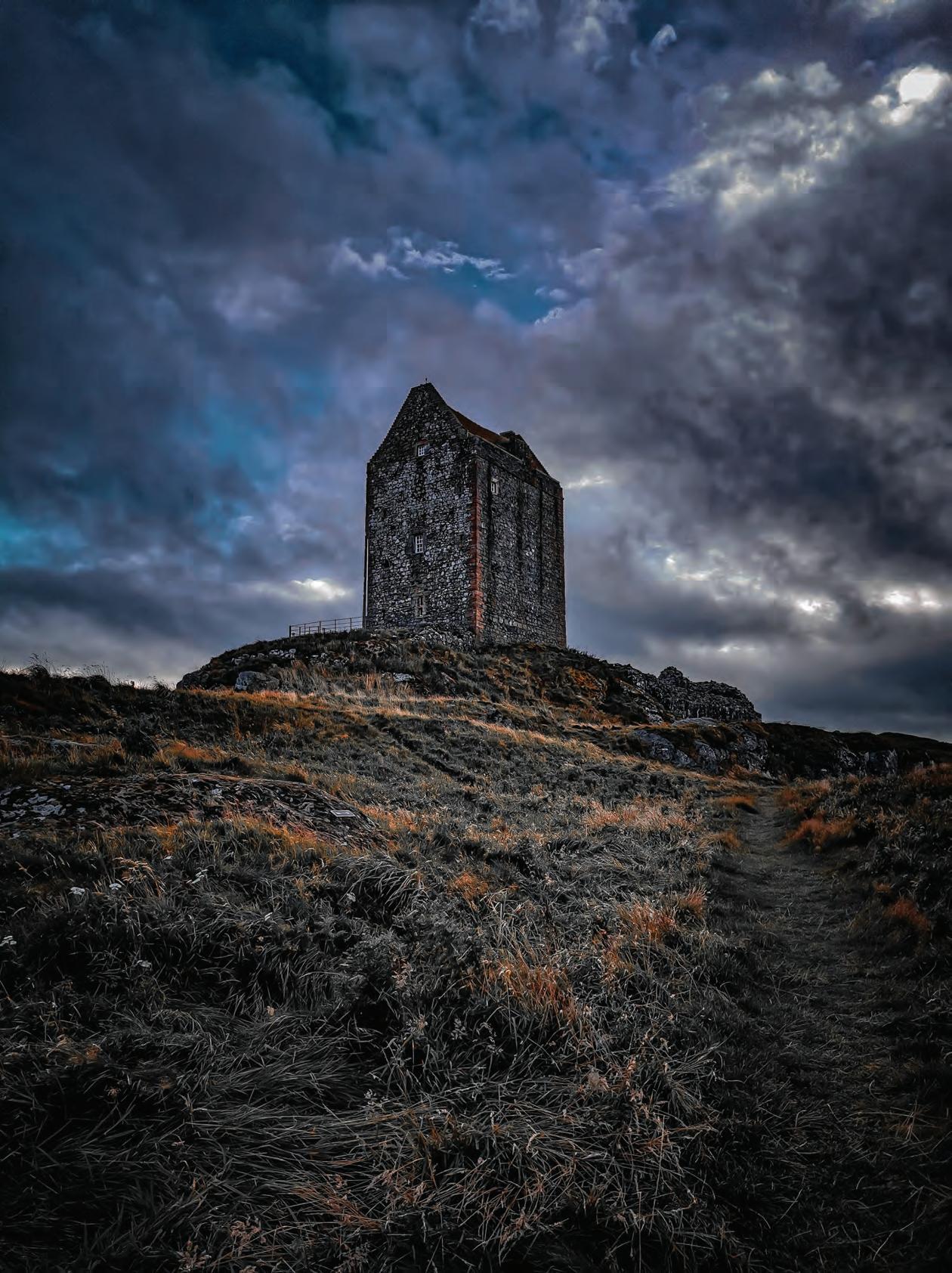
We asked you to send us your best images from great days out at our historic sites – and you nailed it. We reveal the finalists in our 2025 members’ photography competition.
We love to see your images of days out at your favourite properties –soaking up the history, zooming in on the architecture, meeting characters from the past and being thrilled by exciting events.
Our 2025 members’ photography competition set you the theme of ‘epic days out’ and, once again, our judging panel had a tough time choosing the winning shots.
Congratulations to winner Kamil Szczurowski, whose atmospheric image of Smailholm Tower (shown left) had us spellbound. Kamil wins a trip to Edinburgh Castle with our Photo Unit, a £250 Amazon voucher, a free year of Historic Scotland membership and a copy of Art Deco Scotland: Design and Architecture in the Jazz Age
Our two runners up each win afternoon tea for two at Edinburgh Castle, a copy of A History of Scotland’s Landscapes and some delicious Urquhart Castle shortbread. Our judges also selected a set of images that were highly commended for their creative approach.
We hope our featured photographers have inspired you to get out there and get snapping!
WINNER
SMAILHOLM TOWER
Kamil Szczurowski
My visit to Smailholm Tower was primarily to capture its stark, imposing silhouette against the dramatic Scottish Borders landscape. The rectangular structure, steeped in local history and folklore, provided inspiration to Sir Walter Scott, and I aimed to convey the site’s eerie yet timeless atmosphere. I had heard and seen
thunder a few miles from the castle, so my main challenge was to wait for the perfect moment when the passing clouds cast a deep shadow over the tower. This image reminds me of the rich, rugged beauty of the region. I am pleased with how the final image conveys the isolated and stoic nature of this historic landmark.
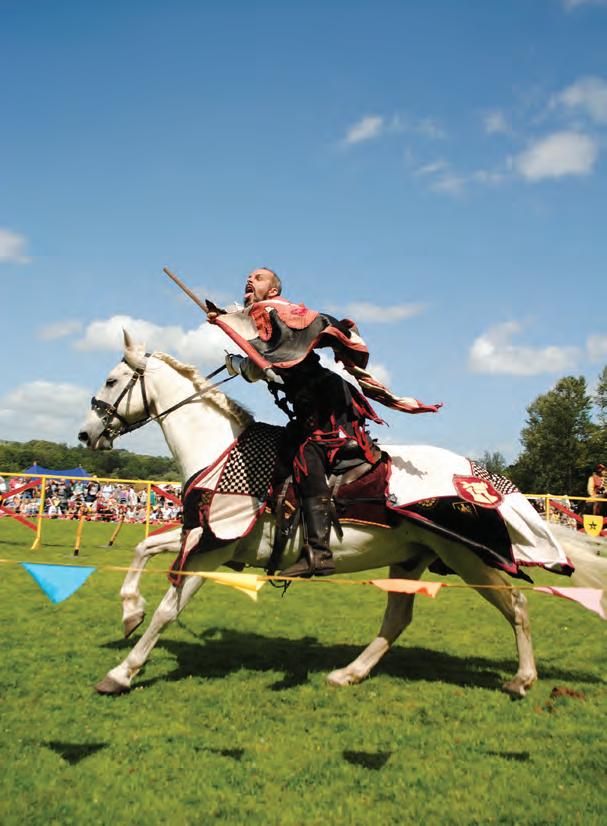
RUNNER UP
Amy Collier
This Spectacular Jousting event was so high energy and action packed. We sat so the beautiful blue sky provided a clear background and just took loads of photos. A lot ended up blurry (the knights and horses were constantly on the move!) but I got lucky with this fantastic photo of Sir Checkmate, which really summed up the day. He was in the middle of jeering with the crowd (who doesn’t love the bad guy?), so it’s a great reminder of an epic day out with my sons. They absolutely loved cheering (and booing!) on the knights.
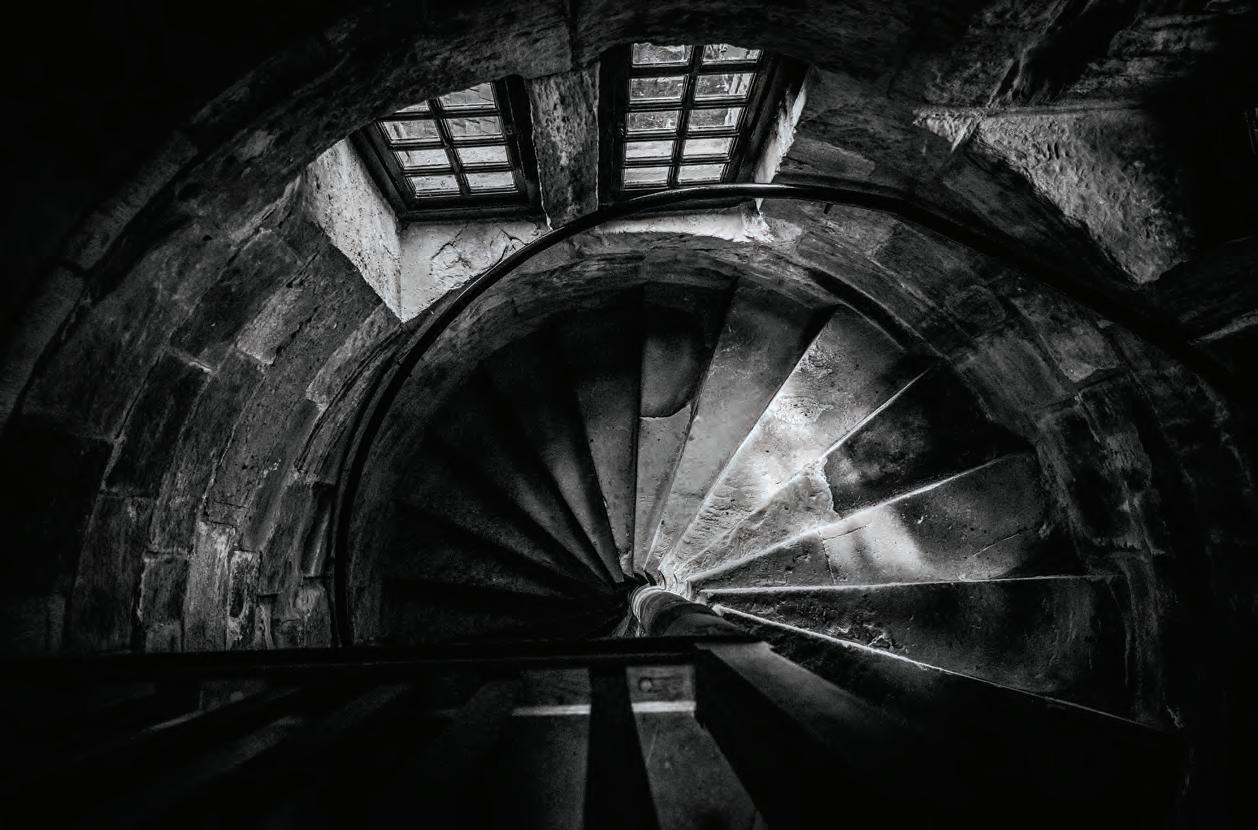
Bob
Smart
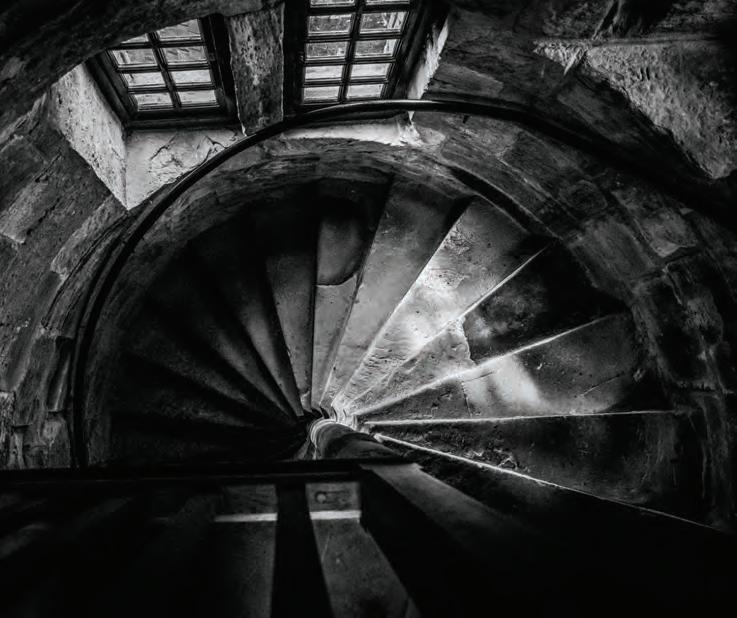
Although I had been to Dollar Glen several times photographing waterfalls etc, I had never seen the inside of Castle Campbell, so I went to rectify that. As I looked down the stairs from above, the staircase was a photograph begging to be taken. I noticed the way the light was flooding through the window, highlighting parts of the staircase, giving a nice contrast which I thought would look great in black-andwhite. I used the widest lens I had with me (Fujifilm 16mm) to capture this shot. Castle Campbell was really impressive, almost matched by the informative guide, who gave me a rundown of the castle’s history upon entering.
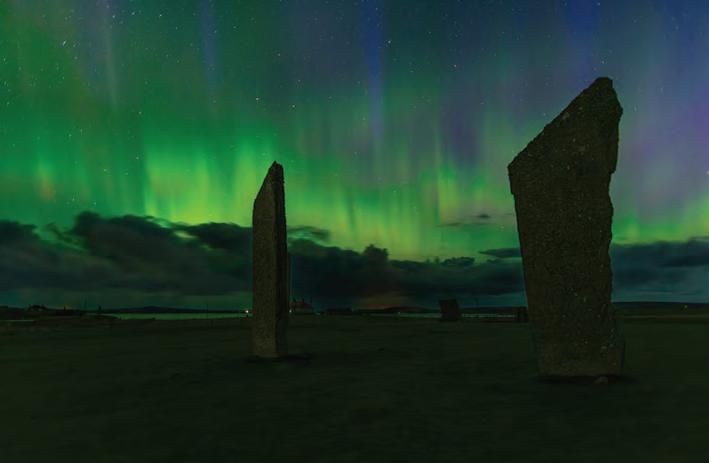
COMMENDED STONES OF STENNESS
Andrew Briggs
We had visited during the day time and were very interested in the history of the stones. That same night the Aurora Borealis came out and I decided to go back to the standing stones, where I got this photo.
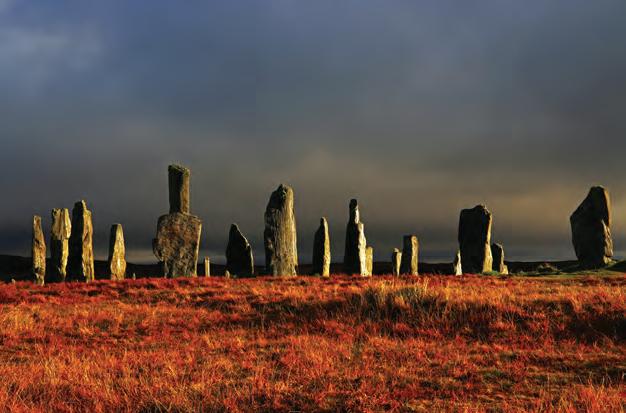
HIGHLY COMMENDED
This was our first visit to Calanais. The clouds parted, introducing stunning foreground sunlight on the stones against a dramatic sky.
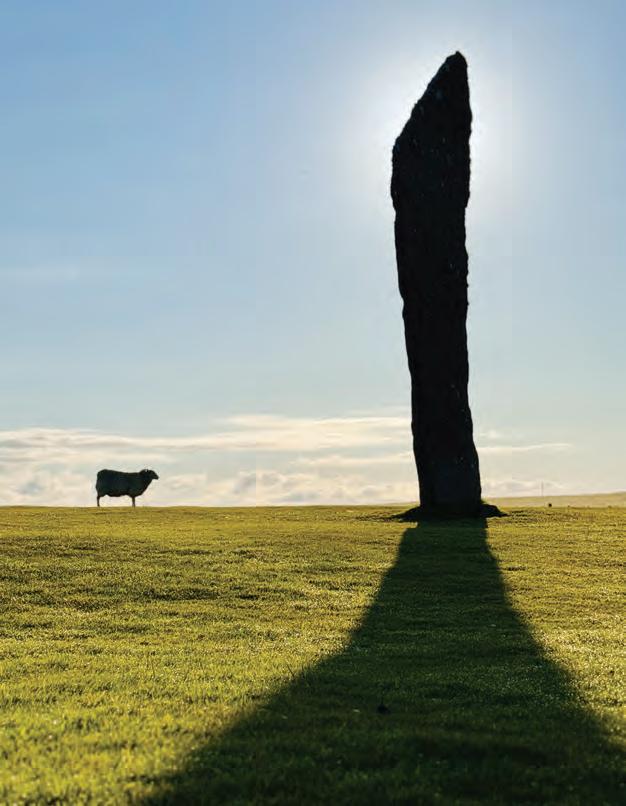
HIGHLY COMMENDED SHEEP AND STONE
Visiting Orkney in July, I got up early to have the Stones of Stenness to myself and loved finding this face-off in shadow form between sheep and stone.
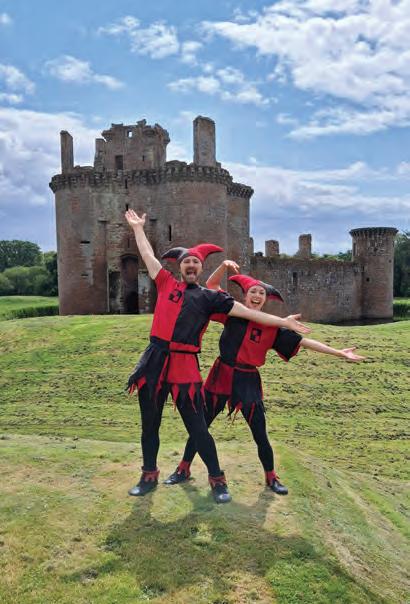
HIGHLY COMMENDED
Elizabeth Gibson
This image of the court jesters was taken at the 2025 Spectacular Jousting event at Caerlaverock Castle. I managed to get the performers to pose in front of the castle without other people in the frame.
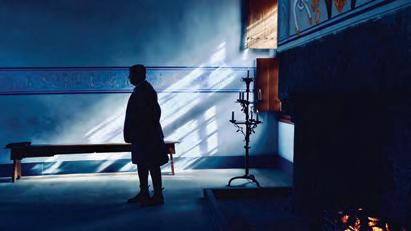
HIGHLY COMMENDED STIRLING
Robert Booth
I was taking photographs of the magical light in this room in Stirling Castle when a visitor wearing a kilt appeared. His joyous emotion at being there was very moving.
Have you been inspired by our winners? Get snapping when you’re out and about this season and share your adventures on our social media channels.
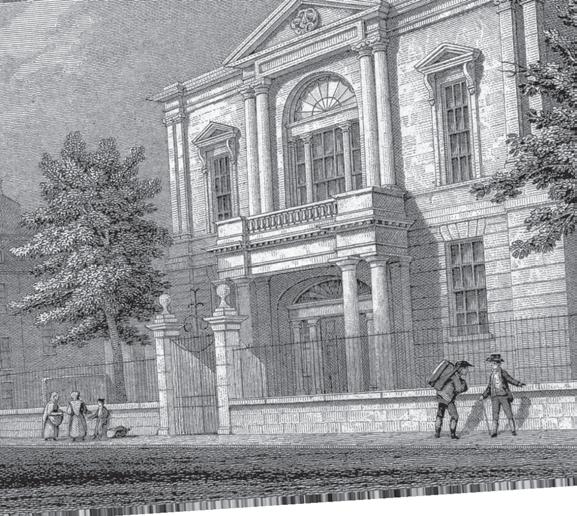

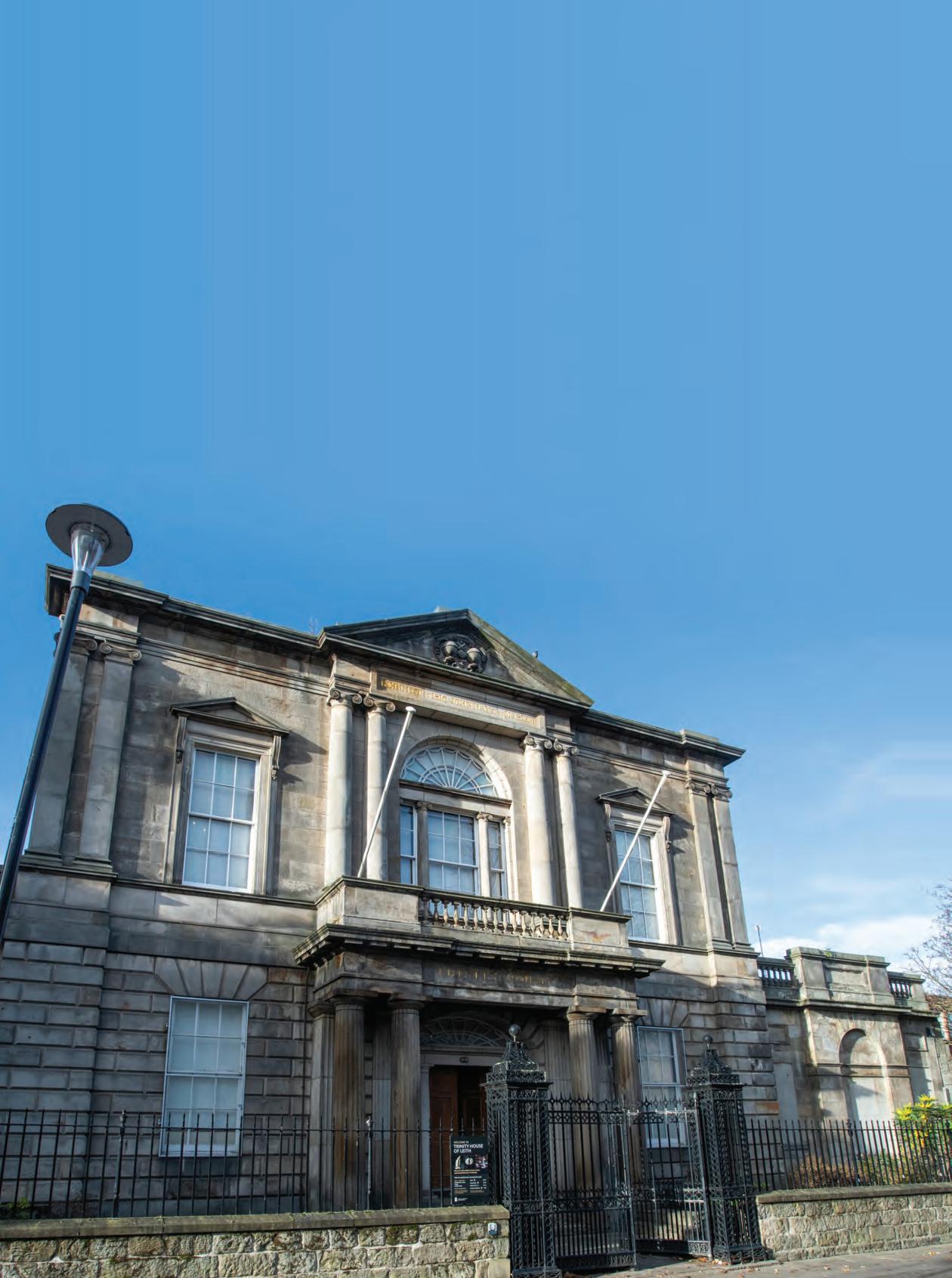
Join us on a tour of Trinity House in Leith, once a major hub of the maritime world, as new research throws light on the remarkable people and histories connected to its collections


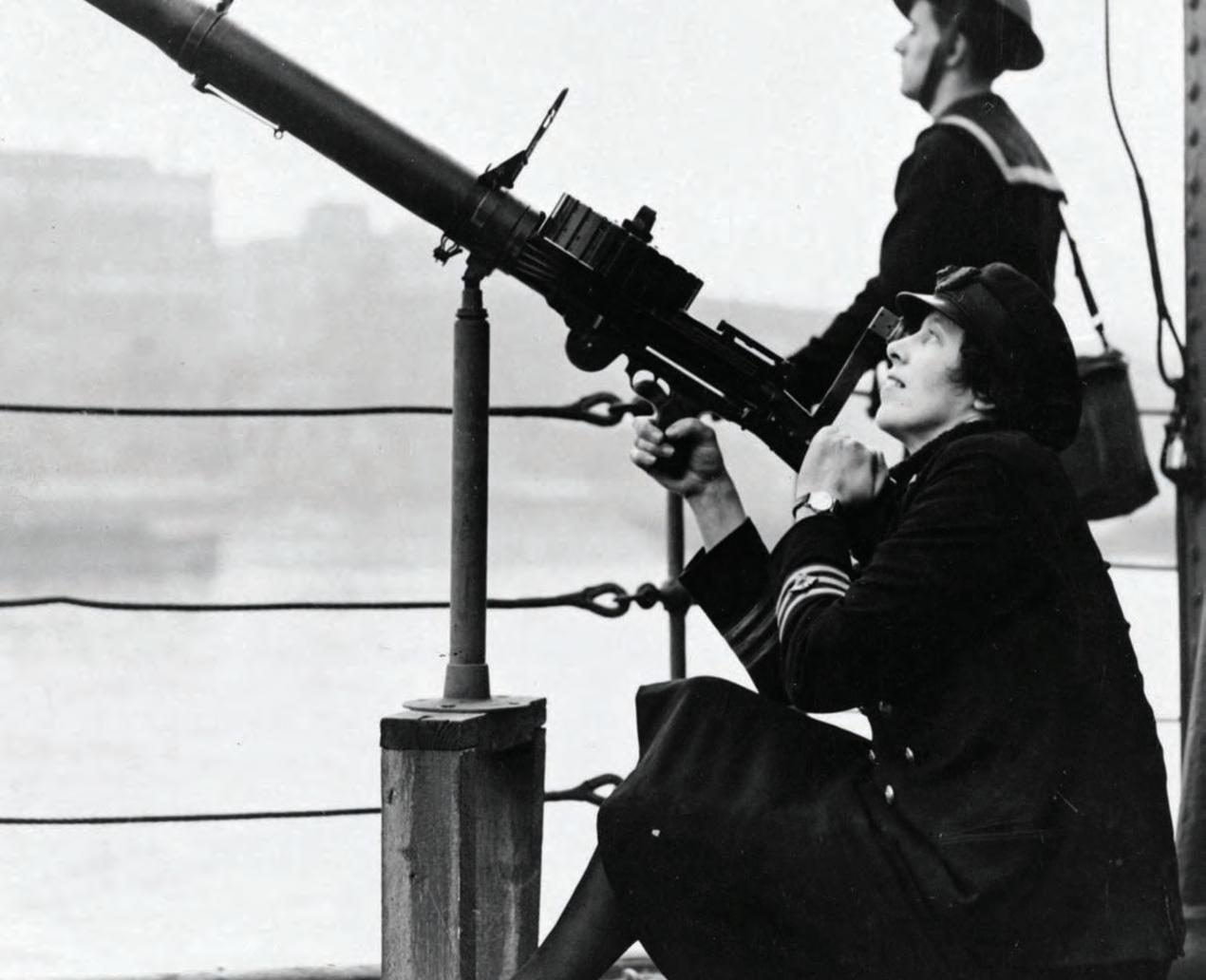
On 9 March 1942, 2nd Engineer Victoria Drummond prepares machinery and equipment aboard HMS Chrysanthemum for action against enemy forces
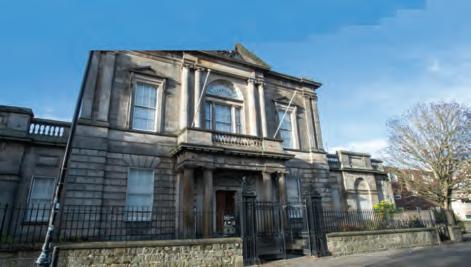
Completed in 1818, Trinity House was designed by the architect Thomas Brown as the headquarters for the Incorporation of Mariners and Shipmasters, a guild founded in 1380 to support the seafaring community connected to the Port of Leith.
Today, this classical and charming Georgian house on the Kirkgate in Leith is a maritime museum, home to ship models, paintings, navigational instruments and curios from all around the globe. “It’s an eclectic collection –almost like a cabinet of curiosities,” says Maddy Williamson, Collections Officer.
As the property reopens at Easter, visitors can enjoy a tour of ‘hidden histories’ emerging from ongoing research by our team. Valuable information has also been revealed through a doctoral partnership with the University of Stirling. “This collaboration has uncovered new knowledge about the house and its collection that helps us tell more of its complex stories,” says PhD student Alina Botezatu.
Collections Access Manager Lynsey Haworth adds: “There are people who have often been left out of the records. We can use the objects to bring their stories to life.”
One of the first objects to catch the eye in the entrance hall is a model of the SS Royal Fusilier, a steel steamship built by the Caledon Shipbuilding & Engineering Company in 1923. It links to a trailblazing figure: Victoria
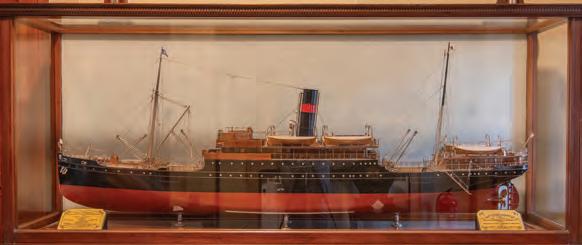
Drummond, the UK’s first female marine engineer. In 1916, she began an apprenticeship at the Northern Garage in Perth, joining the Dundee-based Caledon Shipbuilding & Engineering Company two years later.
“As a woman, she endured quite a bit of prejudice and discrimination, specifically from her immediate superiors, who actively delayed her career progression to become chief engineer by failing her
VICTORIA DRUMMOND
in her exams 37 times,” says Maddy.
Despite these early challenges, Drummond went on to have a stellar career spanning more than 40 years, including serving in the Merchant Navy. She travelled the world and worked in the engine rooms on many ships, managing the crew and undertaking a physically demanding job. Drummond was awarded an MBE and Lloyd’s War Medal for Bravery at Sea for her heroism during the Second World War.
DARIEN SCHEME
Another object of note in the entrance hall is a gleaming mahogany wallmounted cabinet. Tucked inside are seven teaching charts and maps. The areas they depict were prominent 1800s trade routes, including around the Baltic, the West Indies, the Mediterranean, Africa and the Americas.
Among them is a handcoloured map made in 1809, following the American War of Independence. It shows the 13 colonies that formed the original United States in 1776 and also British Canada.
A bit further south, you can see Panama. It was there, in what is known today as the Guna Yala region, that the first expedition of the Darien Scheme – an ambitious, illfated attempt by Scotland to establish a trading colony –
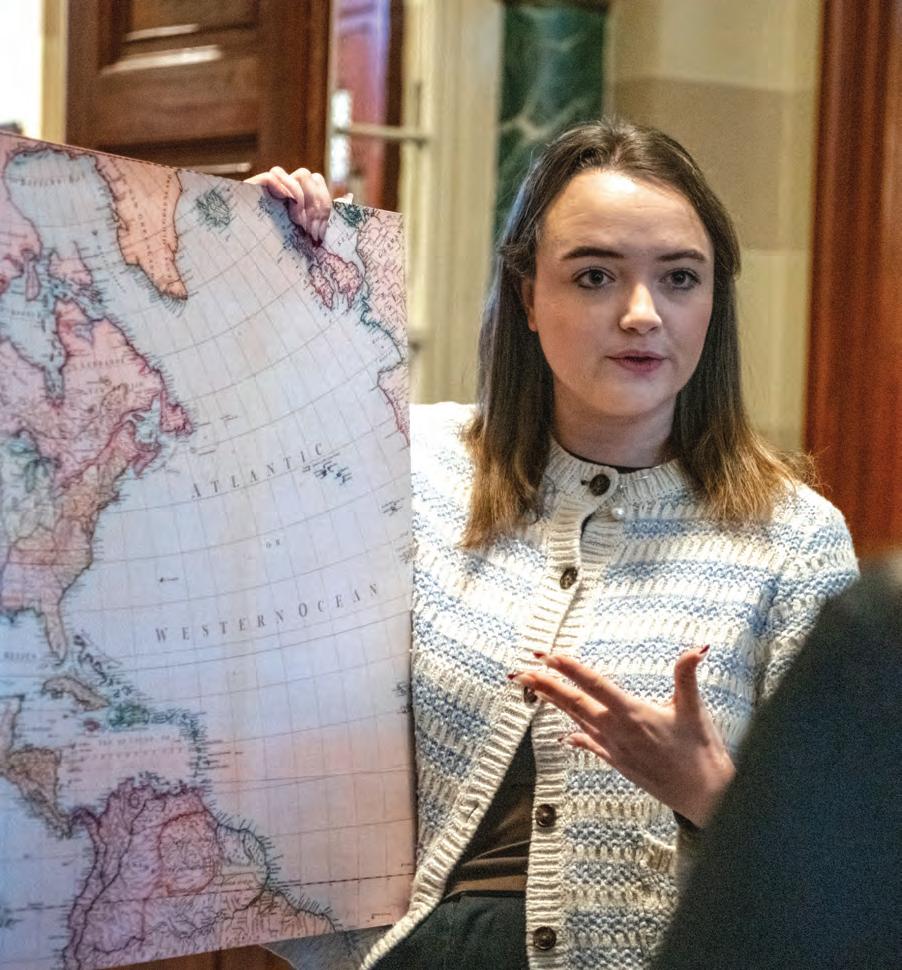
Reproduction of a handcoloured map from 1809; the fragile original is kept at Trinity
ordinary Scots flocked to be a part of it. “Trinity House was involved and contributed £200 to the scheme,” says Maddy. “Ultimately, though, it
was a disastrous period in Scottish history.”
Poor planning, inadequate supplies, rampant disease, inhospitable conditions and fierce English and Spanish
STARGAZER
Throughout Trinity House are curios that are pertinent reminders of how collecting natural history specimens, alongside the trade of plant and animal products, led to many species becoming critically endangered or even extinct.
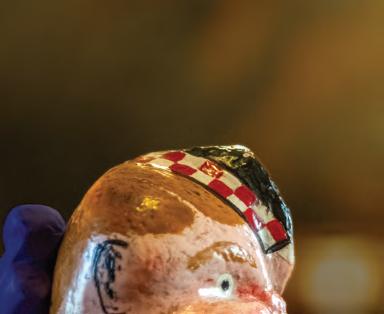
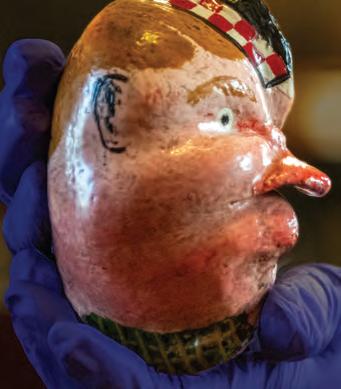
Examples include a Coco de Mer seed basket from the Seychelles and a whale
earbone painted to resemble a Scottish soldier.
The Master’s Room contains a penguin figurine, carved by a whaler from Leith, using a sperm whale tooth. This little penguin –nicknamed Stargazer –has become the Trinity House mascot. A penguin egg can also be seen within the collection.
opposition all contributed to a catastrophic outcome, ending in huge loss of life and financial ruin. It was a catalyst for the Acts of Union in 1707.
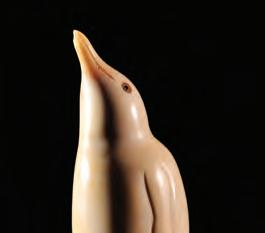
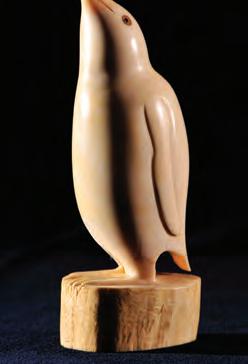
During the 1720s, a boom period of British furniture production in the Georgian era saw mahogany become synonymous with luxury.
It is a material that has a difficult history. Mahogany grew in the Caribbean, where enslaved men, women and children were forced to fell and prepare the wood for transport. It was imported
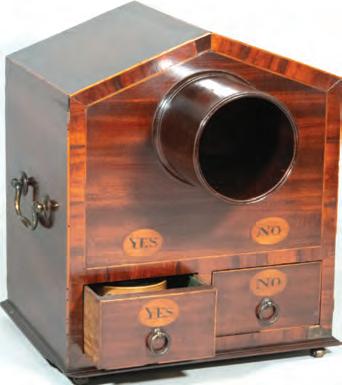
into ports such as Leith during the 18th and 19th centuries. The museum tour shines a spotlight on this dark past.
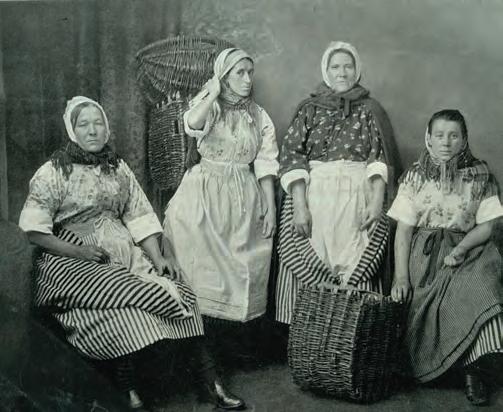
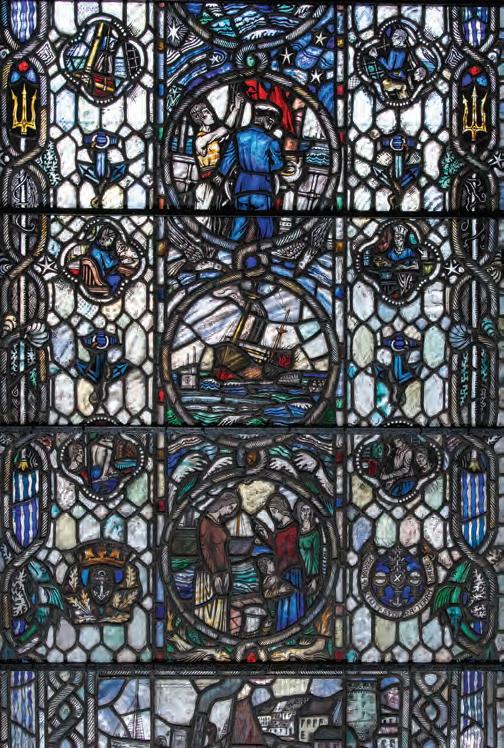
Not too far from Trinity House is a port and historic fishing village where a famous group of women lived and worked: the Newhaven Fishwives. Their story is told through the intricate stained-glass memorial window above the staircase in the inner hall –designed to commemorate the Leith seamen who died serving in the Merchant Navy during the First and Second World Wars.
The Newhaven Fishwives are identifiable by their distinctive dress, which
The collection includes a mahogany ballot box in the inner hall which, dating from 1792, was used for the voting of a master of Trinity House. Similar ballot boxes existed elsewhere, with wooden discs or balls often used for casting votes. For reasons unknown, Trinity House opted for tamarind seeds instead.
The tamarind tree originated in Africa and
followed the forced migration of people across the Atlantic to the Caribbean. On some ships carrying human cargo, African women were tasked with the preparation of food.
“They would use their knowledge of plants and herbs native to their homeland, which included tamarind seeds, to improve the taste of dishes and help fight diseases caused by vitamin deficiency, such as scurvy,” Maddy explains.
featured a gathered skirt with a striped petticoat worn underneath. They would walk miles to sell fish, carrying creels on their backs that weighed up to eight stone (50kg).
The memorial window has a strong connection to another pioneering woman: it was gifted by Colina Grant, the daughter of a wealthy Leith shipowner, in 1933.
“She would have been well-versed in the maritime world, championing the welfare of mariners and involved in charity work,” says Maddy.
Colina Grant is the only woman to have been made an honorary member of the Incorporation of
Mariners and Shipmasters. Her portrait hangs in the Convening Room, bequeathed by Grant herself in 1937.

Robert II grants the Incorporation of Master Mariners the right to levy a duty, ‘prime gilt’, on goods landed at Leith, to support sick or retired mariners and their families.
Trinity House is built on the Kirkgate for the Incorporation of Master Mariners, which also serves as an almshouse.
Mary Queen of Scots returns to Scotland from France after the death of her husband Francis, to take up her reign. She disembarks at the port of Leith.
The vaults at Trinity House are used to teach boys mathematics and navigation (until 1710).
The first five ships of Scotland’s ill-fated Darien Scheme sail from Leith.
Leith is threatened by a fleet led by John Paul Jones, often referred to as the “Father of the United States Navy”. He is forced to withdraw, but a fort is built against any future attacks.
Architect Thomas Brown designs the ‘new’ Trinity House as the Incorporation of Mariners and Shipmasters’ HQ. Thomas Beattie undertakes the building work at a cost of £2,500.
George IV lands at The Shore, Leith, the first British monarch to visit Scotland since Charles II (1660-1685), drawing the crowds.
Leith Navigation School is established (renamed Leith Nautical College in 1903), offering courses in navigation leading to Masters’ and Mates’ Certificates.
Edinburgh Zoo’s first penguins are brought back by Leith whalers from South Georgia in the South Atlantic Ocean.
The Trinity House Museum Trust is established, and the building becomes a museum.
Trinity House and its contents come into the care of Historic Scotland.

JOHN SAKEOUSE
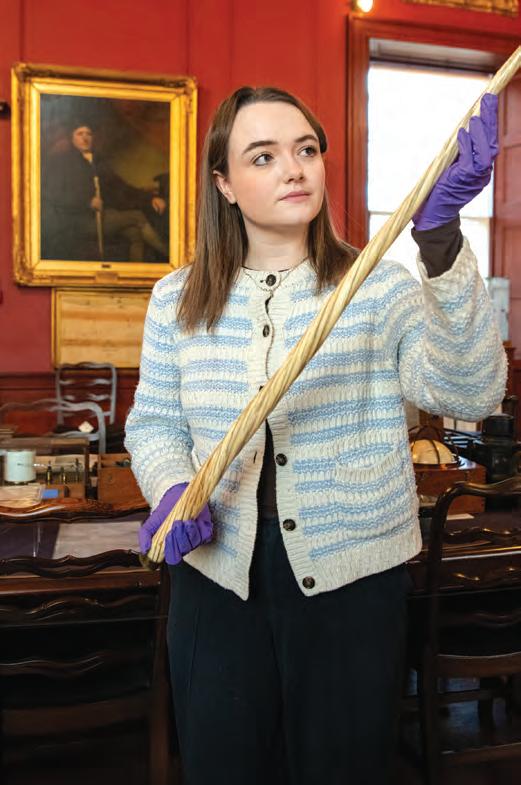
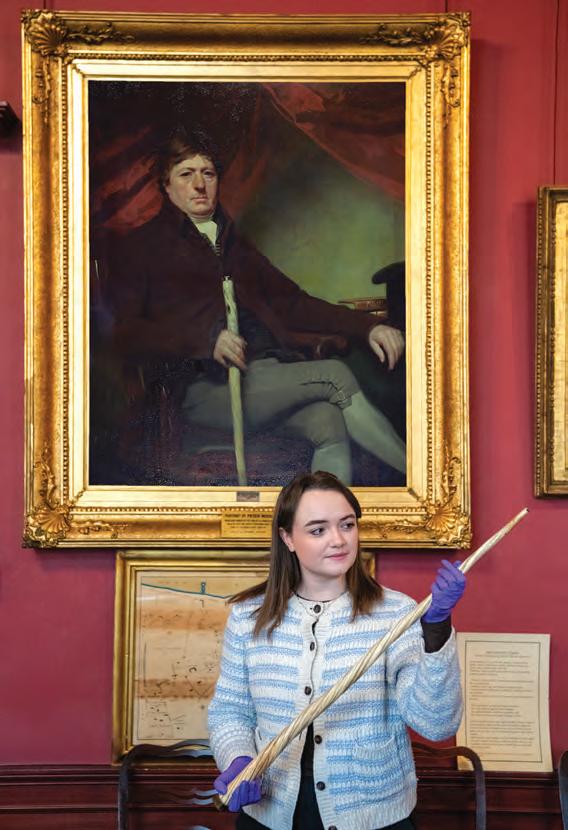
A portrait of whale ship owner Peter Wood by society painter Sir Henry Raeburn, dating from the early 1800s, hangs in the Convening Room. Wood is shown holding an unusual walking stick, carved from a narwhal tusk – it’s now displayed at Trinity House.
Dubbed the ‘unicorns of the sea’, narwhals are a whale species native to Arctic waters – an area where Wood, who owned a blubbersmelting business in Leith, would send ships during the 18th and 19th centuries.
It was on one of these vessels that the first Arctic Inuk who freely chose to travel to Scotland sought passage. John Sakeouse –

‘Sakæus, about 1792-1819. Inuit hunter, interpreter and artist’ by Alexander Nasmyth c.1818

referred to as Sakæus in some documents – came from western Greenland and stowed away on a whaling ship bound for Leith.
Arriving in 1816, Sakeouse soon began thrilling crowds with his kayaking and harpoon-throwing skills. He trained as an artist, later working as a guide and interpreter on an 1818 Arctic expedition to the Northwest Passage.
CROWDFUNDING
You can’t miss the giant painting that hangs in the Convening Room.
Titled ‘Vasco da Gama
Encountering the Spirit of the Storm’, it details a perilous voyage to access the lucrative spice trade. The Portuguese navigator departed Lisbon in July 1497, seeking a direct sea passage between Europe and India.
Painted by Scottish artist David Scott in 1842, the oil on canvas shows da Gama and his crew rounding the Cape of Good Hope, an area on the coast of modern-day South Africa. They became the first to successfully navigate the route, reaching Kozhikode (Calicut) in May 1498.
ENTERTAINMENT PROGRAMMES
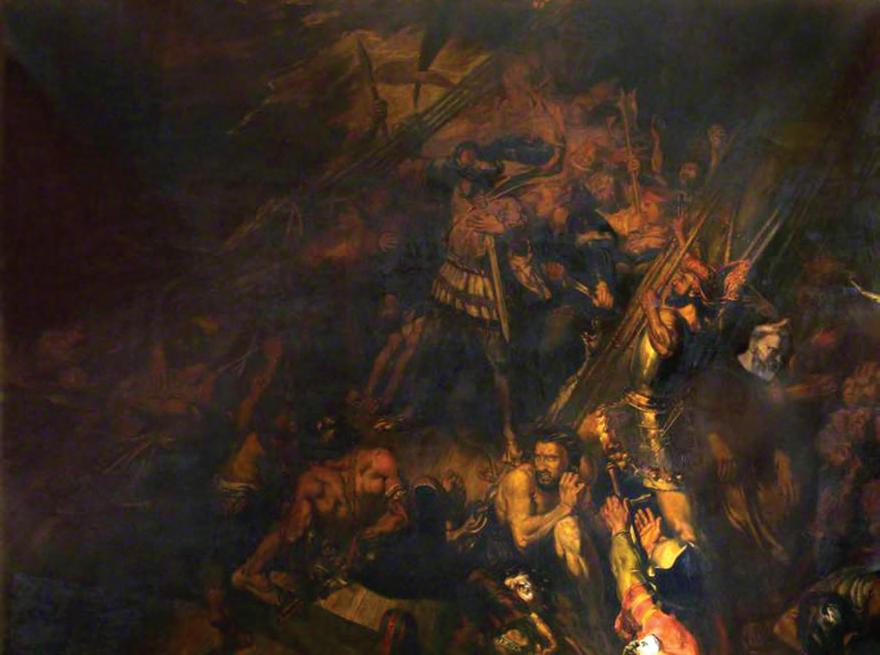
This enabled Portugal to establish itself as a colonial power in India and expand its reach in Africa, bringing economic growth and trade expansion. However, it came at a grave cost for many Indigenous peoples.
A series of entertainment programmes relate to Sir William Edward Parry’s Arctic explorations with the HMS Hecla and HMS Fury
Between 1819 and 1825, Parry undertook three attempts to navigate the Northwest Passage through the Arctic, linking the Atlantic and Pacific oceans.
The ships were sometimes frozen in place for many months. These programmes give insight into how these long winter evenings were spent, detailing a fancy ball, a grand masquerade and a Venetian carnival.
As the ships had predominantly male crews, a shift in traditional gender roles was common.
“Because these shows had female characters, the men would often dress in women’s clothes,” says Maddy. “This wasn’t unusual and still happens today as part of entertainment or seafaring ceremonies.”
Modern research suggests that, for some, the blurring of these gender boundaries may have provided an opportunity for self-expression.
The artwork arrived at Trinity House in 1849, purchased by public subscription – an early form of crowdfunding. It was the first painting in Scotland to be acquired this way.
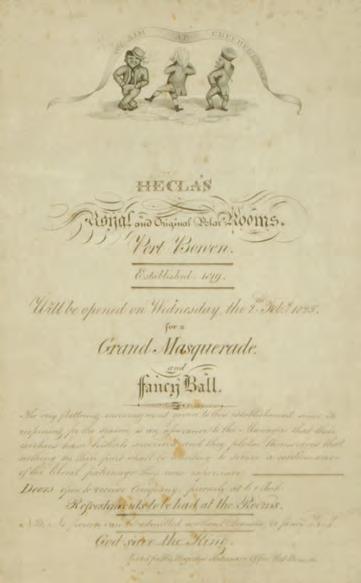
The framed programmes, including this one, can be seen in the Convening Room
Public tours every Friday at 11am and 1pm, from 10 April to 25 September
Two guided family tours on Wednesday 8 April and ‘Easter at Trinity House’ on Wednesday 15 April
Leith Festival open day on Saturday 13 June
Trinity House has built an excellent public engagement programme with the local community.
“By bringing in things like family tours, we are able to appeal to a broad audience and demonstrate that there are stories here for everyone,” says Lynsey Haworth, Collections Access Manager.
FIND OUT MORE
Listen to our Trinity House episode in season one of the Historic Scotland Podcast at hes.scot/memberspodcast
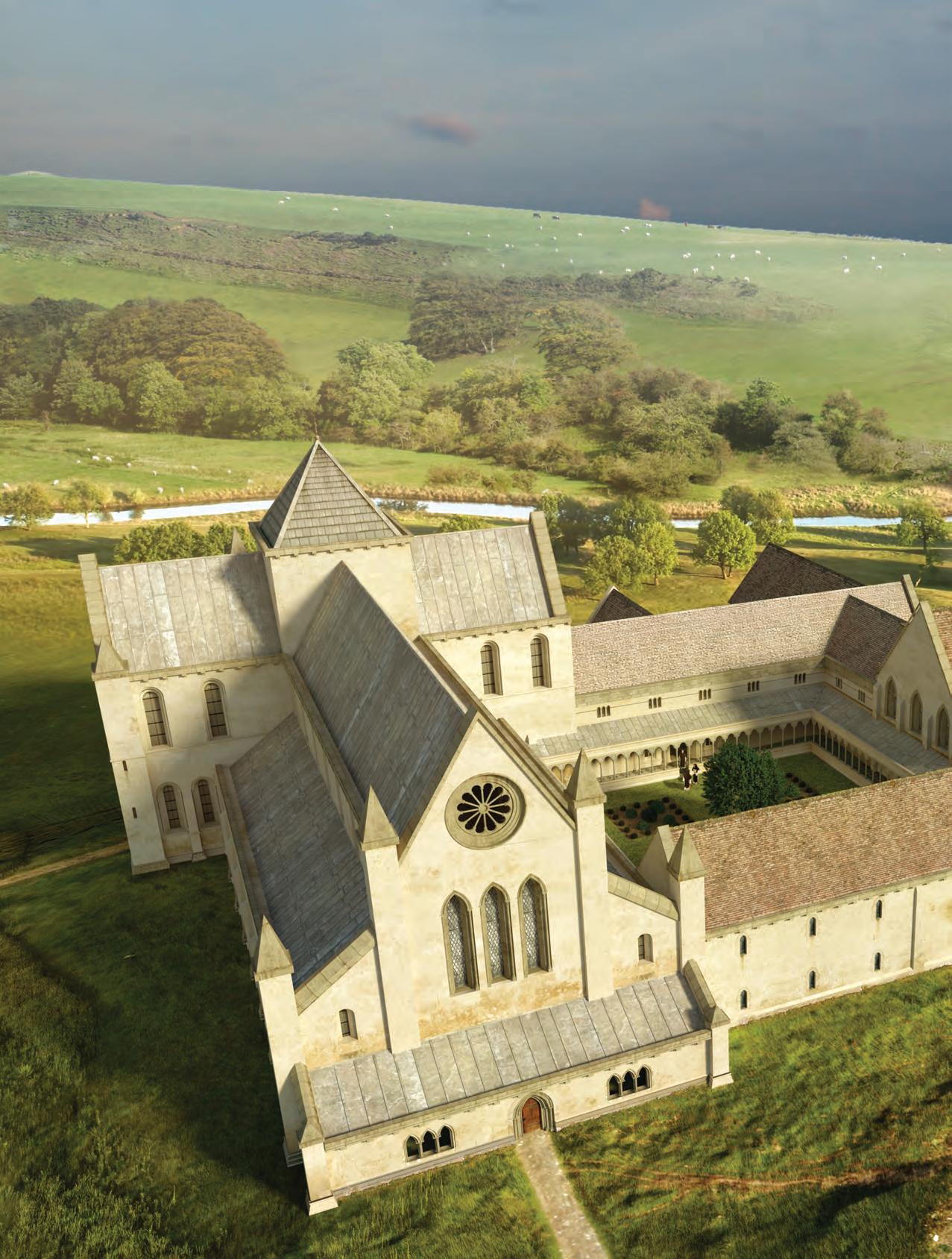
Our time traveller braves an unsettled 12th-century Galloway to witness great change at Dundrennan Abbey
WORDS: ANDREW BURNET, INTERPRETATION MANAGER
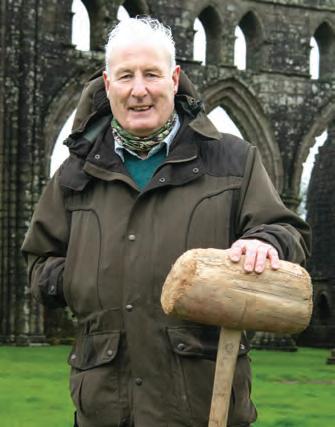
GLYN MACHON, FORMER SITE STEWARD
PHOTOGRAPHY: MATT CARTNEY
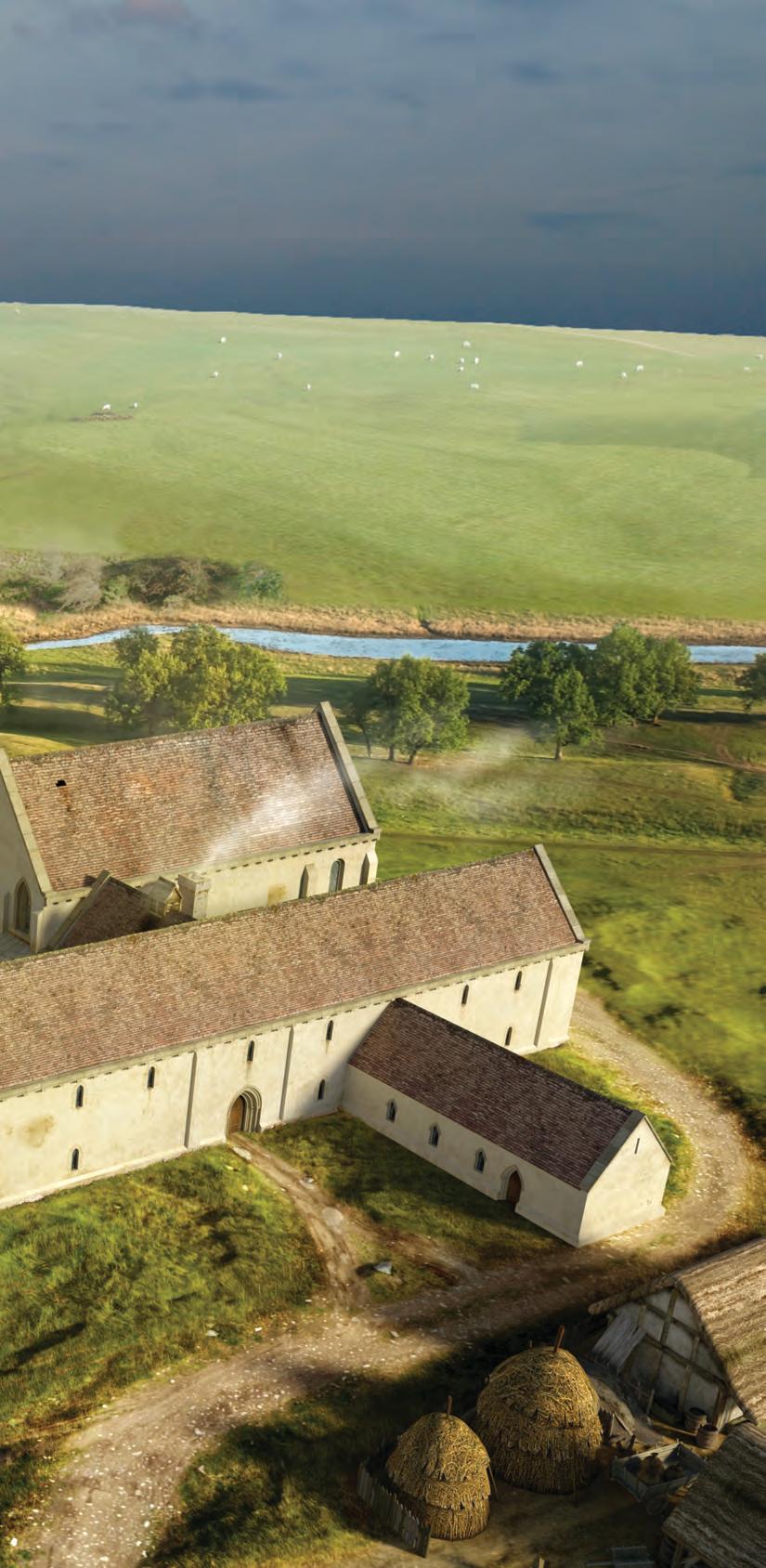
The first thing you notice is the sheep. Thousands of them, grazing on the slopes around Dundrennan Abbey, in the deep, fertile belly of Galloway. It’s just after Easter and lambing season is under way. Scattered among the flock are infant lambs, frisking cautiously as they find their newborn feet. It all spells profits for the abbey, which belongs to the Cistercian order, renowned for their business acumen, particularly in the lucrative wool trade.
The year is 1176 and I’ve travelled back 850 years to witness a grand medieval building in transition.
Dundrennan Abbey dates from 1142, when King David I and Fergus of Galloway invited monks from Rievaulx Abbey in Yorkshire to found a new monastery just north of the Solway Firth.
In 1164, Abbot Aelred of Rievaulx visited to assess progress. He was
unimpressed to find the church – the abbey’s main building – barely started, and the monks living in timber huts.
Then came a change in fortunes. In 1167, Aelred died and Abbot Silvanus of Dundrennan was appointed as his successor. Gaining access to Rievaulx’s wealth, Silvanus diverted funds to the Dundrennan project. He even sent a master mason to Galloway to oversee the scheme.
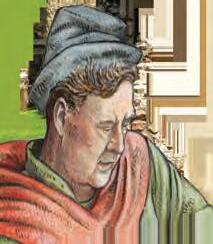
Our imaginary master mason Geoffrey Machon is an experienced builder of Norman descent – his surname translates as ‘mason’ – but his roots are in Yorkshire, where the Cistercians have established eight abbeys. They include Rievaulx in the east, Fountains in the north, Kirkstall in the west and Roche in the south.
His task has been to transform Dundrennan Abbey’s stonework from the Norman idiom to a new architectural language called Gothic. Where Norman buildings rely on massive walls, heavy piers and rounded arches, the Gothic
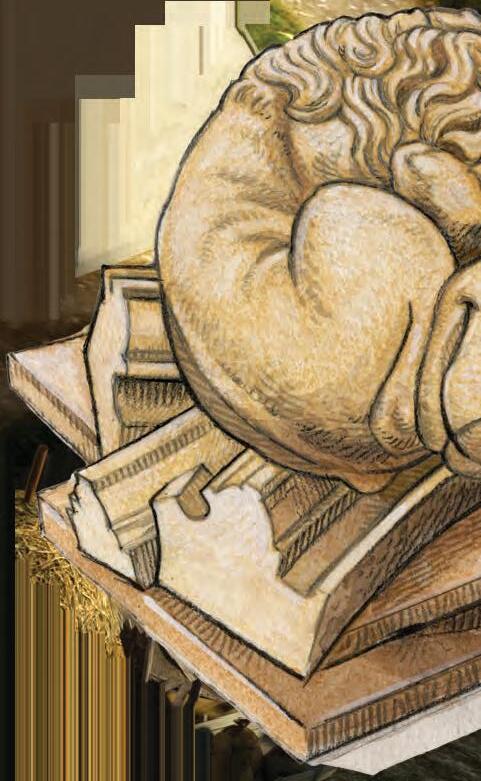
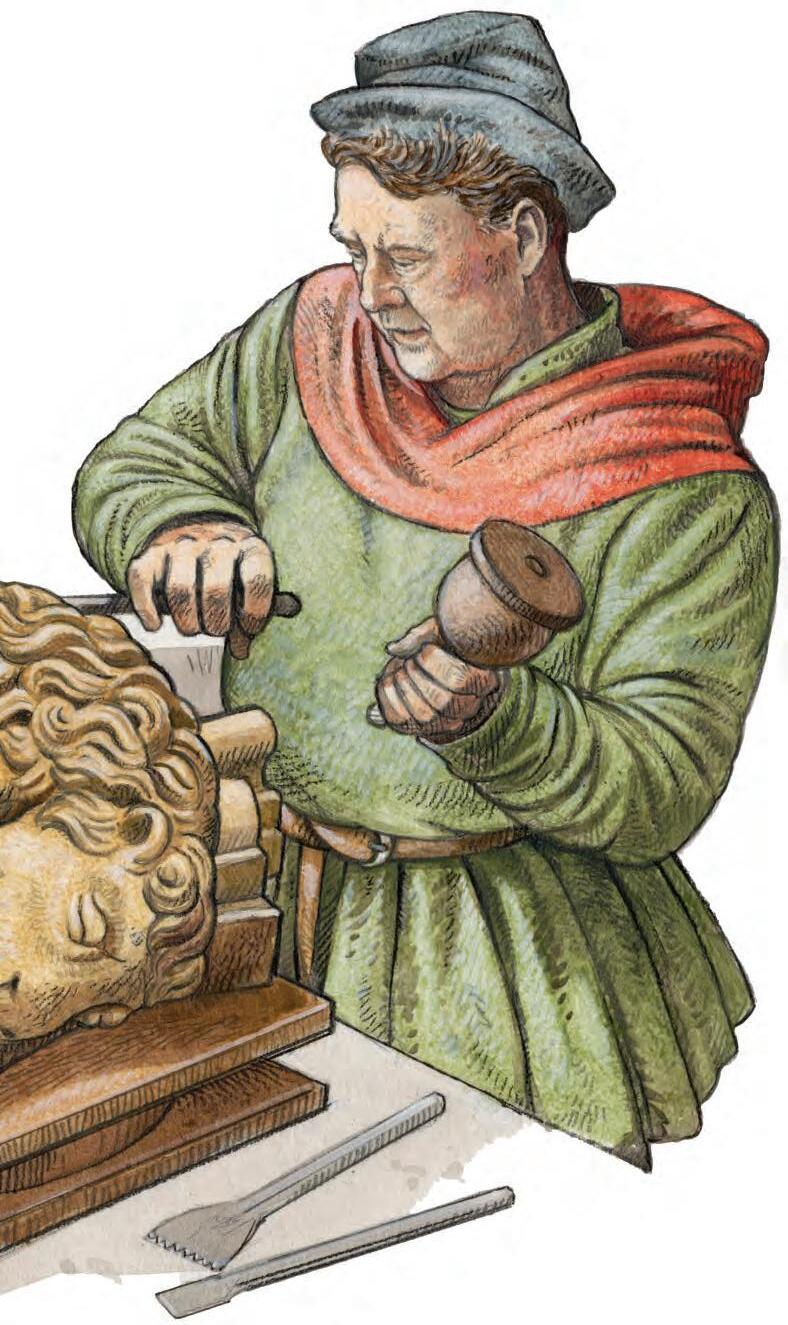
A medieval mason works on the finer details of a stone carving
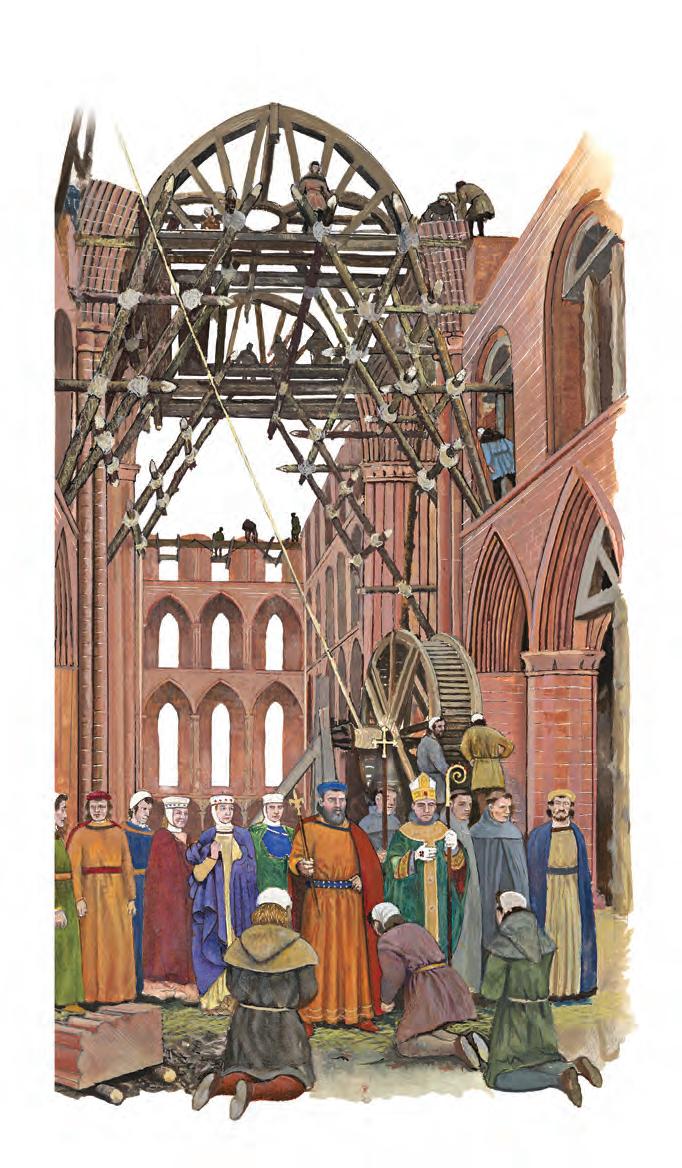
style is much lighter, with slender, pointed arches and vaults, soaring toward Heaven. The Cistercians are traditionally an austere order but they’ve always embraced innovation. In fact, most abbeys are in a state of constant renewal and adaptation, so what’s happening at Dundrennan is not unusual.
Geoffrey greets me at the gate of the abbey precinct and leads me past timber sheds that shield the building site from view.
“Lucky you got here safely,” he says, smiling grimly. It’s true: Galloway is a violent place. Until recently, it was ruled jointly by Fergus’s sons, Uhtred
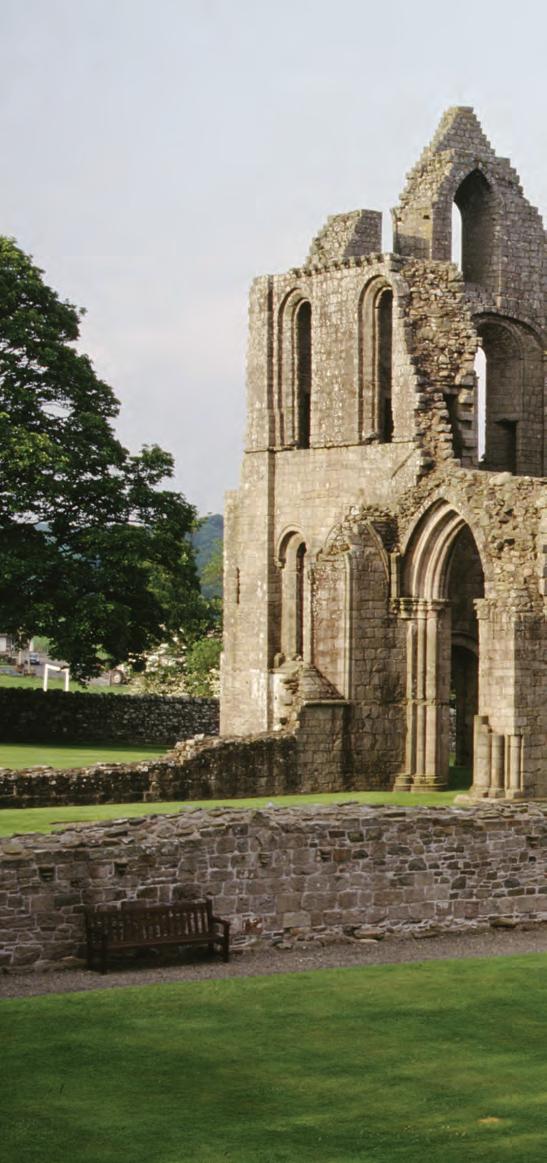
and Gille Brigte. Two years ago, Gille Brigte joined forces with William, King of Scots to support an uprising in England. The venture failed and William was taken prisoner. Galloway rebelled and, in the bloodshed that followed, Uhtred met a grisly death, possibly at his brother’s hands.
“Don’t worry,” Geoffrey says. “You’ll be safe here. They wouldn’t risk God’s wrath – or the abbot’s.”
Abbots are surprisingly influential in medieval society, where Christianity is woven into the fabric of politics. Abbot Aelred was never shy about curbing the ambitions of Fergus and his sons.
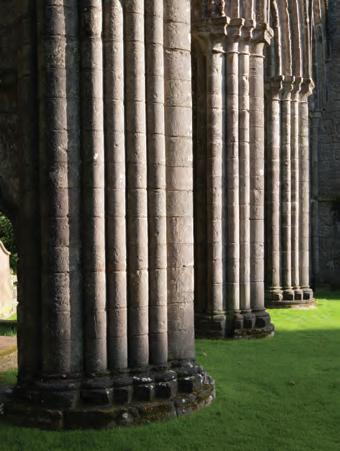
The abbey’s strong supporting 12-lobed piers, or pillars
“Easter isn’t just the high point of the Christian calendar,” Geoffrey tells me. “It’s also the start of the building season. A lot of the workers have been at the quarry all winter. It’s fine sandstone we get from Netherlaw, just a mile away. But they’re keen to get back to the site.”
I can hear the sounds of labour: the shouts and grunts of workers, the clang of hammers, the rasp of saws,
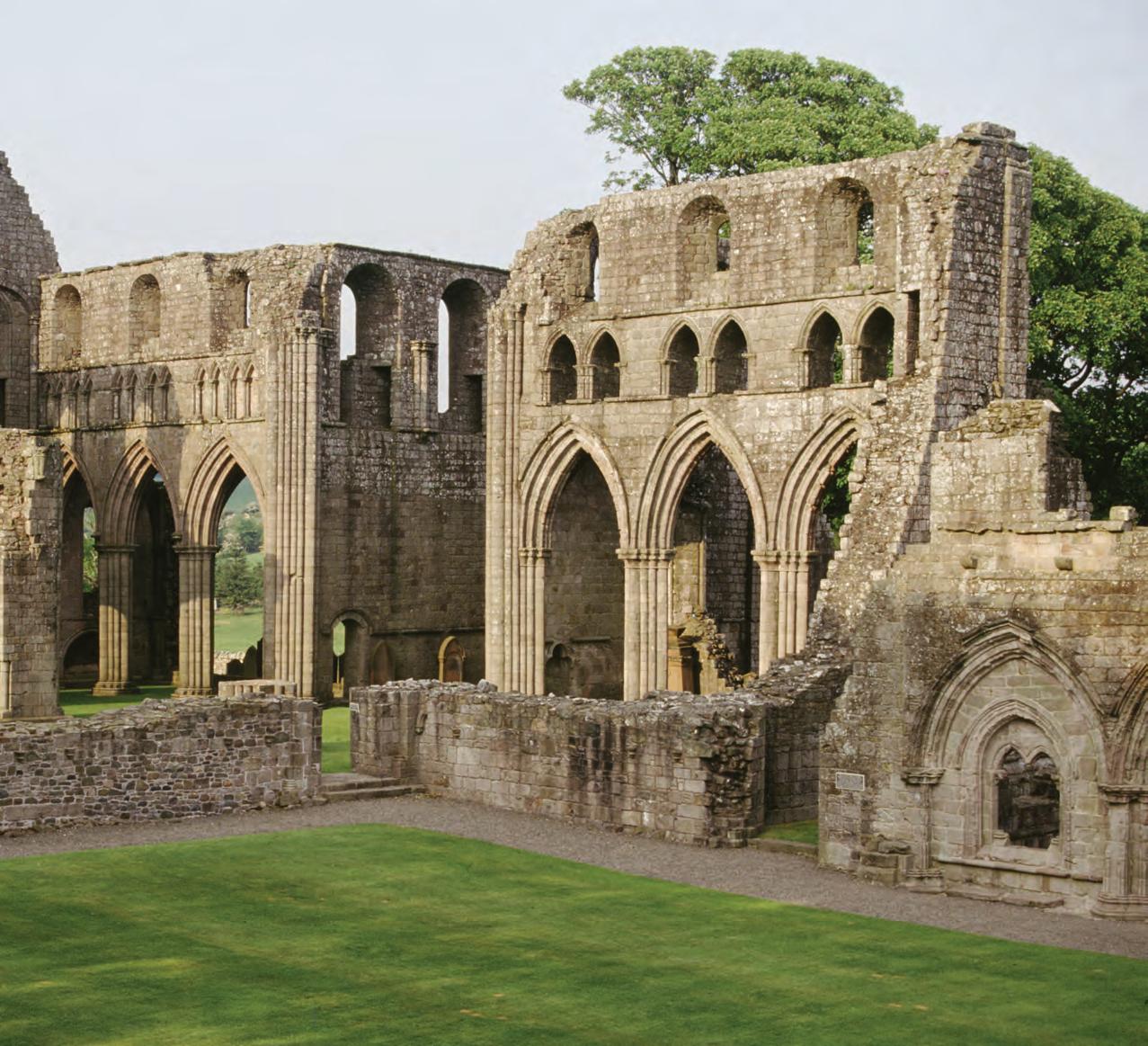
the clink-clink-clink of chisels on stone, the creak of heavy wooden machinery. Among the oak trees, the rooks add their hoarse caws to the mix. I can smell woodsmoke.
None of this prepares me for the scene as the abbey church comes into view. There’s still work to be done, but it takes the breath away. Layer upon layer of arches and vaults, leaping upwards, supported by a slender masonry skeleton.
The north transept and tower are still clad in wooden scaffolding, on which men are toiling, dolloping mortar and manoeuvring colossal stones into place. Below them, a huge treadmill rotates under the feet of two workers. It is linked to a pulley system over a towering A-frame, which hoists stones to the top.
In the enclosure between us and the church, a host of other activities
are taking place. Great chunks of stone have arrived on a cart – a simple frame is being used to lower them into the yard. Alongside the fresh sandstone, a dozen masons are working blocks into elegant, grooved curves or ornate foliage. Nearby, a blacksmith is making chisels and other tools. A group of carpenters are sawing, planing and chiselling wood.
Next to the building site is a group of larger timber buildings, where the monks live. They are arranged around a square that will become the cloister: a chapter house for daily meetings, a
The Cistercians are traditionally an austere order but they’ve always embraced innovation
dormitory for sleeping, a refectory for eating, a kitchen and bakehouse, a brewhouse, a hospital, stores.
Downhill, beside a river known as the Abbey Burn, stands a mill, which harnesses water power to provide the brethren with their daily bread. Downwind from the abbey is the latrine block, straddling an artificial stream that brings water through culverts from the nearby hills.
Further afield, I can see a fishpond, a doocot for pigeons and a scatter of small wooden structures attended by a monk in a large square hood.
“Beehives,” says Geoffrey. “The monks use honey as a sweetener. And beeswax helps preserve oak for beams and floorboards. They make candles from it, and it’s used in medicines too. And for sealing the abbot’s letters.”
Alongside the workers’ shacks there’s a large barn. “The marking-out shed,” explains Geoffrey, leading me inside. “You have to be a master of geometry in this job.” On the plaster floor, intricate patterns of circles, arcs, squares and straight lines have been drawn out – life-size blueprints for the masons to use.
Hanging from pegs are dozens of moulding templates, made from wood or metal, each one perfectly matching the profile of a pier, a vault rib or some other stone moulding. “Every profile, every shape in the abbey,” Geoffrey says. “They get used again and again. Perfection’s what we need. No good spending days shaping a stone, carving the details and hauling it up the scaffold if it doesn’t fit.
“Now,” he says, leading me to the heart of the building site, “Let’s have a look at a few details.”
He’s enthusiastic about the Gothic approach. “It lets in light to cast out the darkness,” he says. “That’s the Christian message for you right there. But pointed arches – they’re actually stronger.”
He cups his fingers to show how the weight is transferred more efficiently downwards, reducing horizontal stress. “But,” he grumbles, “the client’s making big demands, even if it is a big budget. That east end was nearly complete but Silvanus wanted it rebuilt in the Gothic style. Oh, and he wants a tower adding.”
In the crossing arch – the junction of the cross-shaped church –Geoffrey points to a pier, one of the huge pillars that will support the tower. “A bundled shaft,” he says, indicating how the pier is carved into 12 perfectly symmetrical lobes. “Very strong; very light. Do you see how every third lobe comes to a sharp
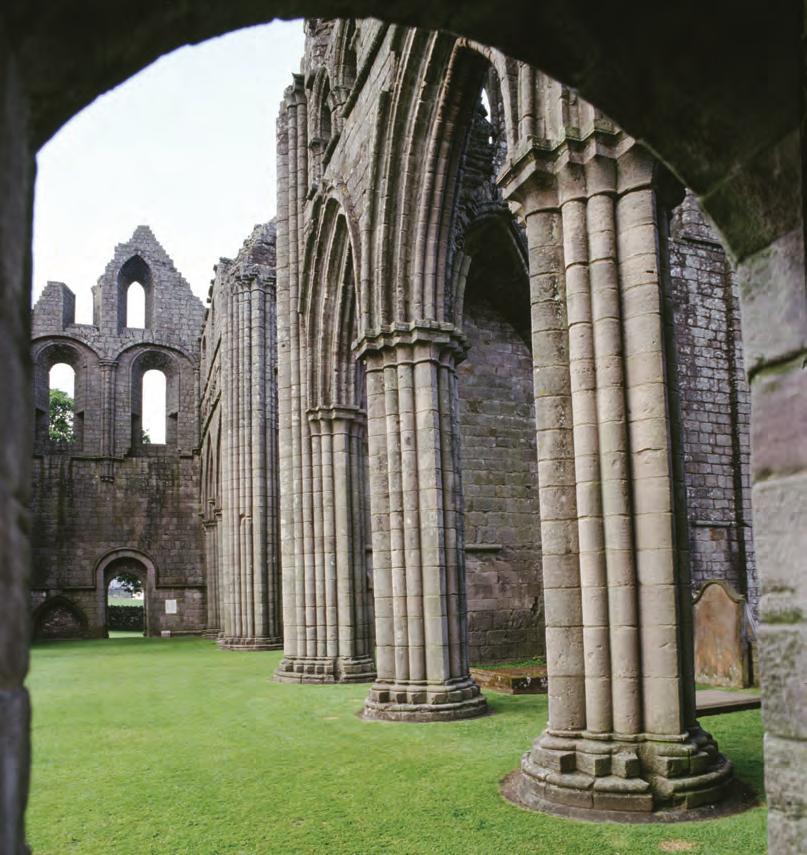
edge? That’s called ‘keeling’. It marks the compass points – see? North, east … Now, follow those lobes up.”
Each lobe forms a vertical shaft that is carried up, through the capital at the top of the pier; then each supports its own rib in the vaulting. Some ribs converge to meet the apex of a vault, others to form the tip of an enormous arch. It’s flawlessly executed, visually astonishing – and, if Geoffrey says it’s strong, I’m not going to argue.
Next to the building site is a row of stone arches laid out on the earth. They look well made, but heavy and rounded – Norman, not Gothic.
The builders are re-using Norman era fabric where possible, sometimes dismantling and rebuilding it in less prominent positions
The builders are re-using Norman era fabric where possible, sometimes dismantling and rebuilding it in less prominent positions. “Look where we’ll be putting the choir stalls,” he says, pointing to just east of the crossing. Norman masonry remains there, where it will hardly be seen, right next to some of the finest Gothic work. Two forms, seamlessly blended.
“I’ll show you my favourite hybrid,” Geoffrey says. I follow him outside, where he points to the towering gable of the north transept. At the foot is a doorway with a decorated round arch: fine Norman work.
Above are two tall windows, again with rounded arches. And at the top, two more tall windows, but these are Gothic lancets with pointed arches. The internal frame has a curved profile and the pointed top is shaped into a protective hood.
“Best work in the abbey is that,” says Geoffrey happily. “Simplicity. Hardest thing of all.”
I gaze up at the army of workers assembling this miraculous structure and shake my head. Complexity seems pretty tricky, too.
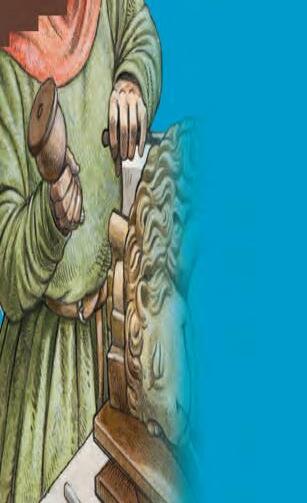
Stonemasonry is one of the world’s oldest crafts. For centuries, stonemasons have created some of Scotland’s most iconic buildings with tools that have changed little in form or function.
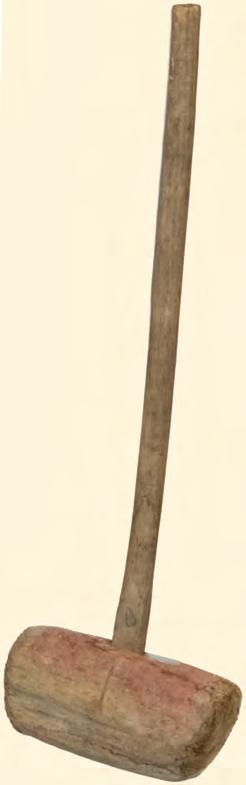
In Egypt, 4,000-year-old mallets and chisels have been found on archaeological sites. They remain the essential tools of a banker mason – a stonemason who cuts, carves and shapes stone for building projects.
Mallets are round so that each blow is consistent; the stonemason can then focus on the stone being worked rather than the chisel being hit. Traditionally, mallets were made of hard wood, such as resilient fruitwood like apple, to withstand repeated blows. Today, many are still made of wood while others are more durable compressed nylon. However, the shape has never changed.
A stonemason will use a selection of chisels to dress and shape the stone. This includes creating mouldings and carved details, such as those seen at Dundrennan Abbey and other abbeys in our care.
Chisels would once have been sharpened regularly by a blacksmith to keep them in good, sharp condition. Today, they are often tipped with tungsten carbide to keep them sharp for longer but, as with the mallet, the shape remains the same.
Chuck Jones, Technical Conservation Skills Programme Manager
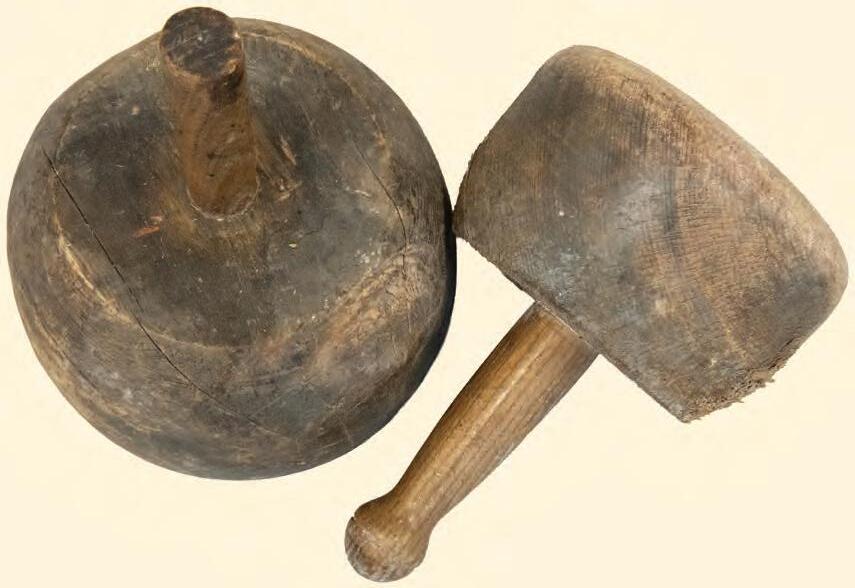
Used with a chisel for dressing, carving and finishing stone. The mallet would be light enough to be used for a full day’s work.
Flat chisels with teeth, used after the hammer point to work down the surface of the stone closer to the required finish.
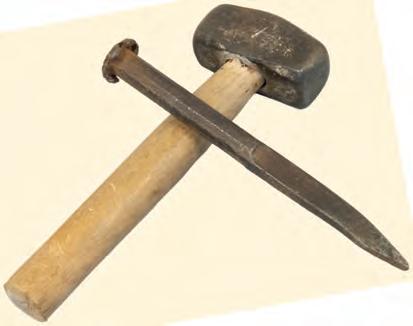
A pointed chisel used with the club hammer to take large amounts of rough waste stone away before using more accurate flat chisels.
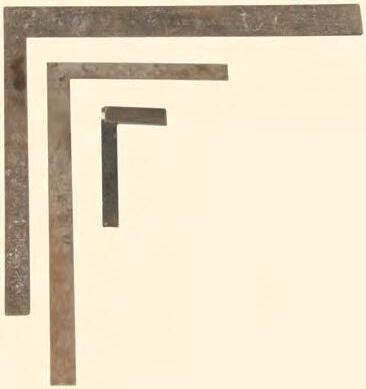
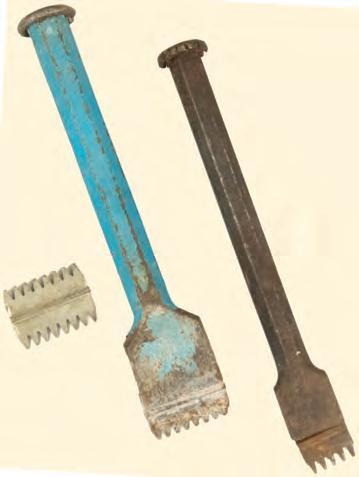
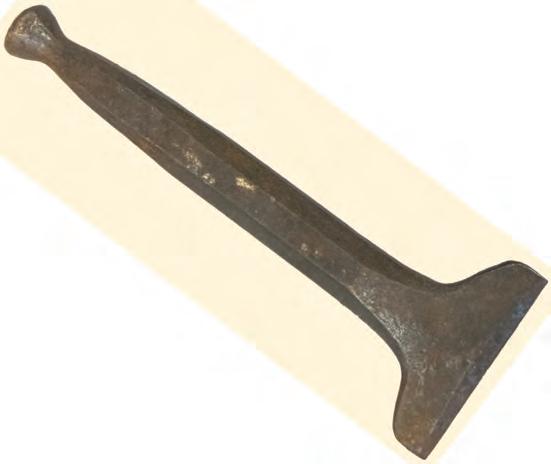
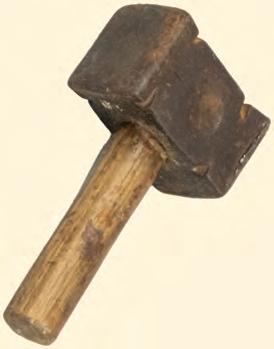
Left, a Bouchard hammer, used, for example, for fine carving (e.g. pinnacles or lettering); right, a plumb bob, used for accurate vertical alignment; and, far right, a maul, used for settling down flagstones laid on a thin bed of mortar and then adjusted with gentle blows.
Used by the stonemason for accuracy, to check that the stone blocks and worked drafts are square and true.

Our Craft Fellows and Trainees highlight the features that may forever change how you look at Doune Castle and Glasgow Cathedral
WORDS: ANDREW CATTANACH
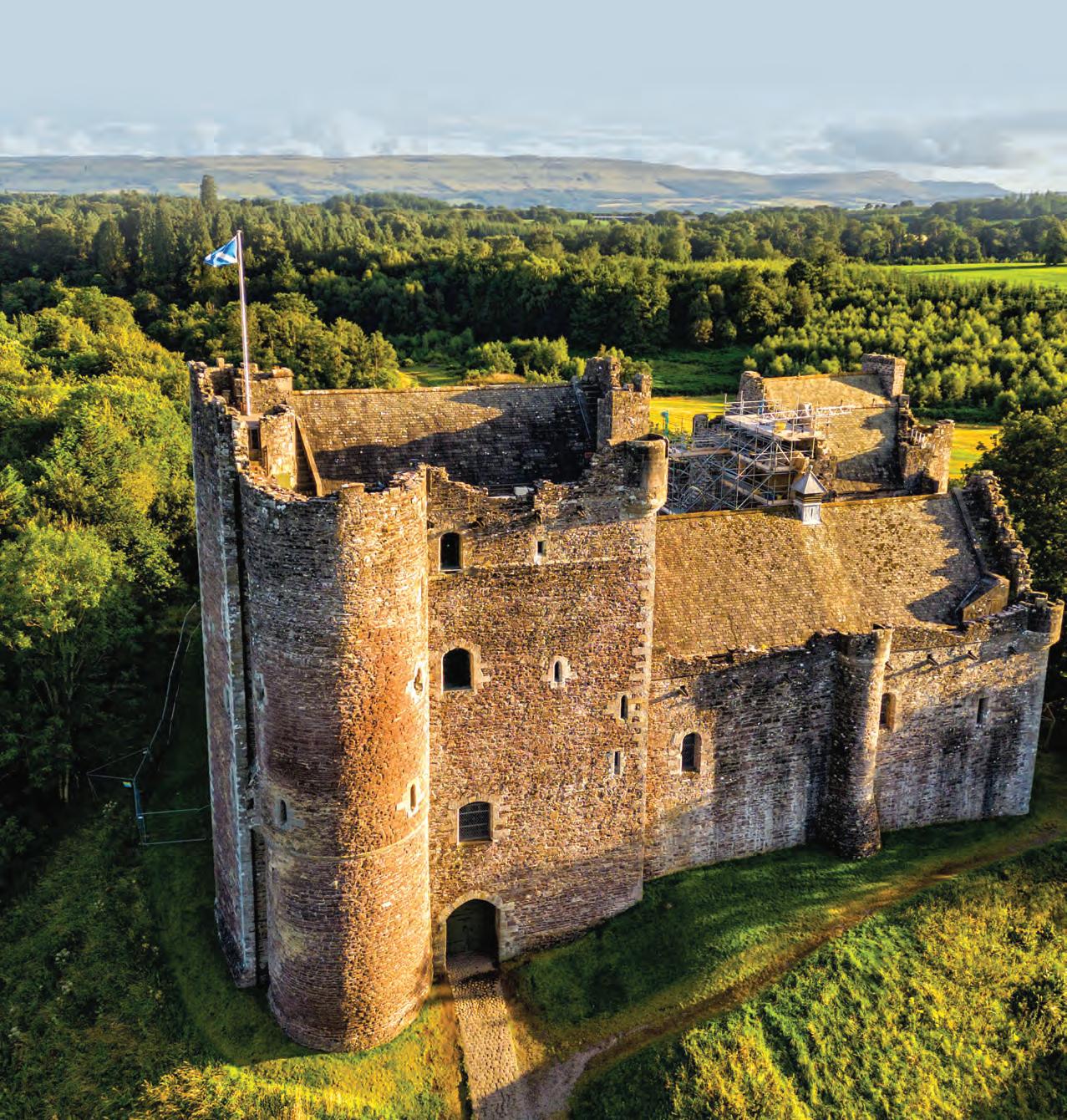

Since its launch in 1996, our Craft Fellowship Programme has helped safeguard the specialist skills needed to care for Scotland’s historic buildings.
Now marking its 30th anniversary, the programme supports traditional crafts that were – and still are – at risk of disappearing, including stonemasonry, stone carving, thatching, blacksmithing and stained glass. Working with expert hosts across the country, our Craft Fellow programme provides hands-on, work-based training for people who might otherwise have no route into these trades.
Alongside the Fellows, we also support a Trainee Programme designed to introduce participants to the principles and practice of caring for historic places. The programme offers space to learn, observe and develop a deeper understanding of how buildings work – and how traditional skills, materials and careful decision-making underpin their long-term survival.
As Craft Fellows Manager Sarah Heaton explains, the link between people and buildings is at the heart of both programmes: “There’s a strong connection between the people on the ground, who are learning and becoming those experts, and the future of the buildings themselves. If we don’t have these skills, we start to lose the buildings – and we start to lose the history.”
For many participants, that sense of purpose is what draws them in: a chance to
Our Trainees and Craft Fellows are helping to preserve sites such as Glasgow Cathedral in the 21st century
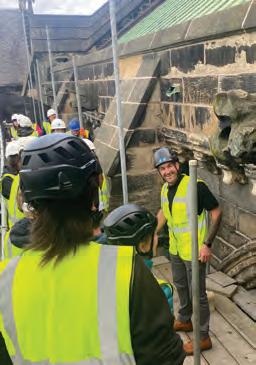
work with sustainable materials, contribute to climate-aware construction and use creative skills. These skills are no longer widely taught in schools or through apprenticeships and, elsewhere, qualifications and accreditation barely exist. These concerns came sharply into focus during last year’s Introduction to Building Conservation at the Engine Shed in Stirling –a week-long learning event on building conservation practices. Attended by our Trainees and Craft Fellows, the event was also open to the public, and included visits to Doune Castle and Glasgow Cathedral – two sites that reveal different aspects of Scotland’s built heritage.
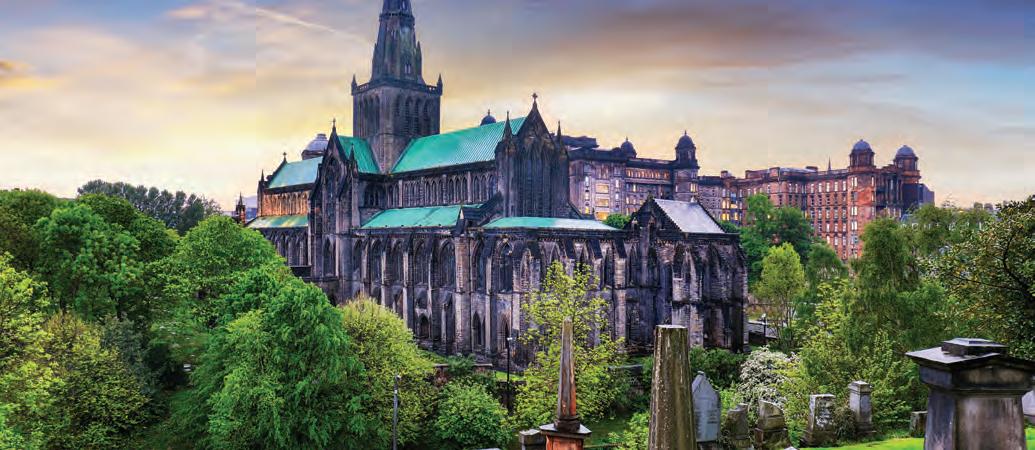
At Doune, recent conservation work has responded to increased footfall and weathering; at Glasgow Cathedral, centuries of craft are visible in everything from carved stone to the newly commissioned stained glass as part of celebrations marking 850 years since Glasgow became a burgh.
What united the week was how quickly participants began to notice details most visitors miss: leaded windows that don’t quite fit, historic graffiti carved into stone, and traces of a past shaped by slower, lower-impact ways of moving through the world.
On the next page, Craft Fellows and Trainees share the features that caught their eye – small details that reveal bigger stories about how our nation’s buildings are cared for, and why the skills used matter.
I’ve picked the tomb of St Mungo, Glasgow’s patron saint. It lies in the Lower Church of Glasgow Cathedral, directly beneath the high altar. Papal bulls issued in 1161 and 1211 required adult diocesan residents to make annual pilgrimages to his shrine, helping to establish Glasgow Cathedral as a major centre of pilgrimage.
I chose this site because my specialism is sustainable travel. Medieval pilgrimage can be seen as an early form of low-impact travel: pilgrims journeyed on foot or horseback, with very low environmental impact. While sustainability was not a medieval concept, these journeys offer a striking example of active, lowcarbon travel in practice.
While I expected to learn the fundamentals of traditional building conservation on the course, it exceeded my expectations, deepening my appreciation of the vital role traditional skills play in preserving historic buildings.


At Glasgow Cathedral, I noticed several examples of graffiti carved into the stonework. One stood out – what appears to be old Hebrew graffiti. Since visiting, I have found someone who might be able to translate it. It reminded me of the Viking graffiti at Maeshowe in Orkney, which are traces left by people wanting to leave their mark.
Today, graffiti and vandalism pose a much greater problem for historic buildings. With large numbers of visitors, these long-standing issues have been amplified, creating a significant challenge for conservation.
It’s striking that, aside from their architectural beauty, every stone, slate, lead lining or lime mortar joint has a crucial function. It’s important to help visitors understand how historic buildings work. Most of us have lived in, worked in, or visited a historic building –and if we want to continue doing so, they must be conserved.

The leaded windows at Doune Castle really interest me. This may be due to the way the lead quarries (the lattice) don’t seem to run through cleanly, as well as the fact that the windows don’t appear to fit neatly within the stone openings.
That’s interesting for a few reasons. They may have been removed from their original frames, reused from elsewhere or taken out temporarily while work was carried out on the surrounding stone. There are so many possible explanations.
If you’re interested in heritage crafts and restoration but don’t know where to start, this course could be a great opportunity. I love my job, and being around people working in other heritage crafts has given me the chance to think about different parts of the heritage sector in new ways. To be honest, I hadn’t realised that many of these crafts were considered heritage at all, so it’s been genuinely fascinating to learn more about them.



On our visit to Glasgow Cathedral, I got chatting to one of the guides. I asked him about what looked like a wooden prayer room inside the cathedral, curtained off at the front. He explained that it was, in fact, a new stained-glass window, due to be unveiled the following Sunday. I said I was disappointed that I wouldn’t be able to come along, as I was attending a glass-painting course.
“Hold on a minute,” he said. “Don’t tell anyone.” He wheeled over a large lighting rig, plugged it in, and positioned it behind the new window. Lifting the corner of the curtain, he gave me a sneak preview of the beautiful new stained-glass commission. It was a lovely experience –and a stunning window.
Also on our visit, the view from the cathedral scaffolding offered a close-up view of the masons’ conservation work and the stained glass from an entirely different perspective.
See images of the stained glass on page 12





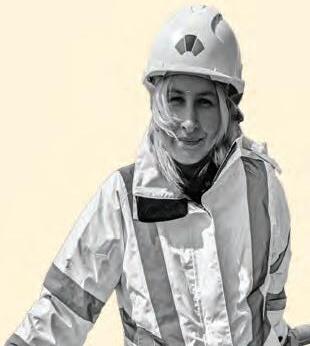
Through this training, I’ve become increasingly interested in the repair and conservation of historic buildings –particularly how they can be futureproofed for a changing climate.
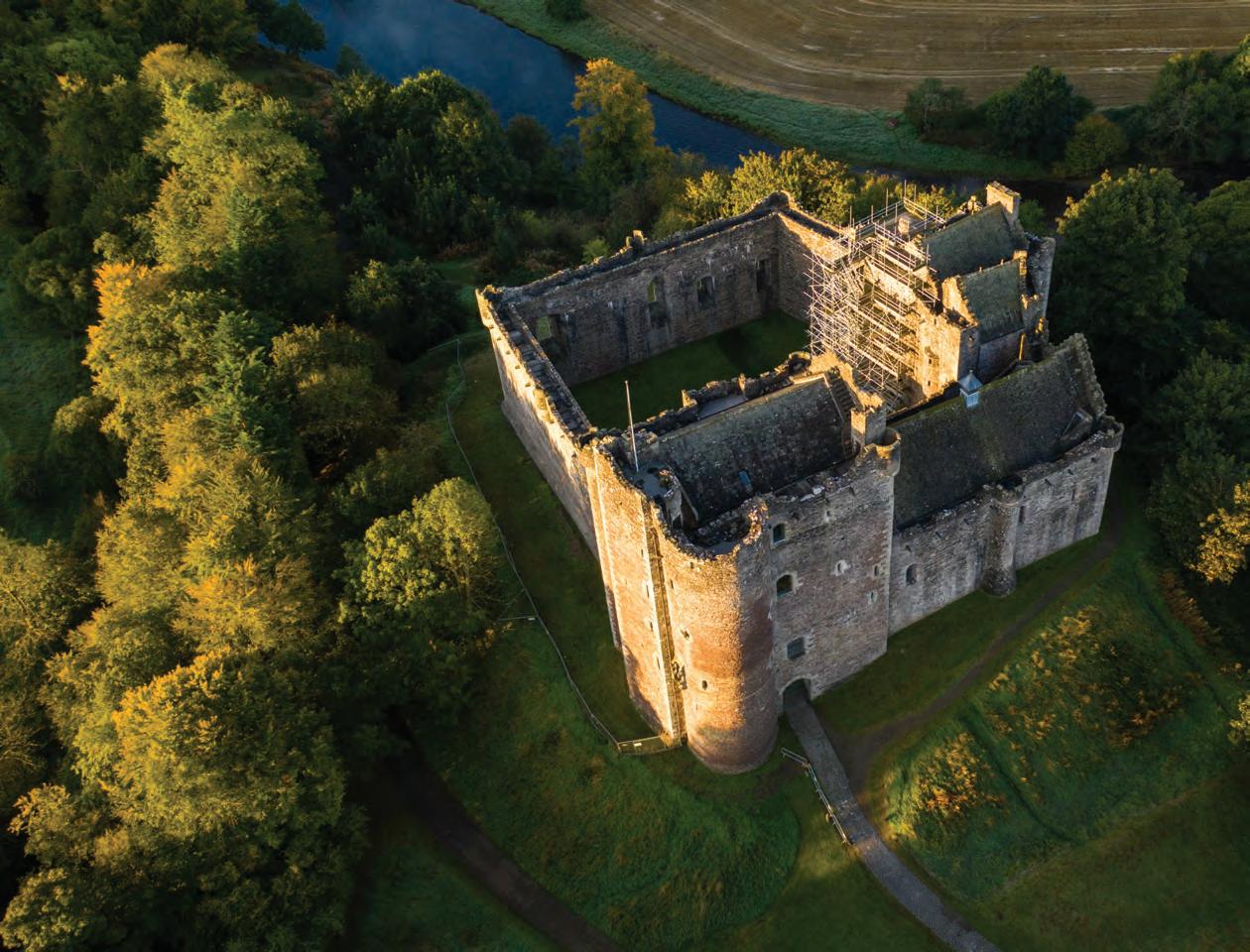
What particularly caught my attention at Doune Castle were the new coping stones. The stonemasons and Historic Landscapes and Monuments (HLM) team are using datasets produced by my team to create photogrammetric models, helping them generate precise digital representations and cut replacement stones accurately at ground level. It’s a fascinating and very practical application of our technology and outputs.
We’ve had a rare opportunity to access these sites in an unusually close and hands-on way. It was a huge privilege, and it really brought home what building conservation and traditional skills can do for Scotland’s built heritage.
New coping stones at Doune Castle will protect the tops of walls or structures from water damage and weathering
DID YOU KNOW?
Scenes from Monty Python and the Holy Grail were filmed at Doune Castle, and more recently the site has featured in Outlander, Game of Thrones – as Winterfell –and other productions.
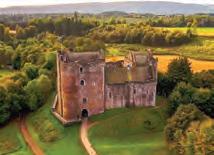
Built: Late 14th century Founder: Robert Stewart, 1st Duke of Albany (Earl of Menteith and Fife)
Doune Castle was rebuilt in the late 1300s for Robert Stewart, one of the most powerful figures in medieval Scotland and a key regent during the reigns of Robert II and Robert III.
The Gatehouse Tower dominates Doune Castle’s exterior and once housed its most luxurious living quarters. Above the entrance, a narrow slit in the roof marks a murder hole, from which defenders could attack intruders.
One of the castle’s best-preserved rooms, this chamber may have been used by Mary Queen of Scots during her visit on 13 September 1563.
A bit of an animal: one of the Doune gargoyles 2
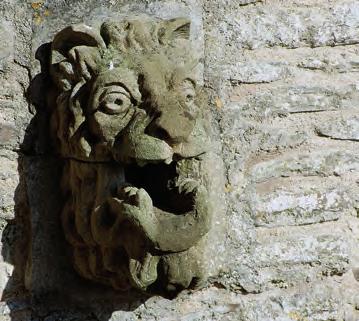
The expressive, animal-shaped gargoyles on the courtyard’s inner walls date from the 1880s. Functioning as waterspouts, they channel rainwater away from the building, replacing earlier, simpler spouts.
Founded: 12th century
Dedication: St Mungo (St Kentigern), Glasgow’s patron saint
Glasgow Cathedral is one of the finest surviving medieval churches in Scotland, largely built between the 12th and 15th centuries and remarkably intact following the Reformation.
1
THE TOWER AND SPIRE
Rebuilt after a lightning strike around 1406, the cathedral’s elegantly proportioned tower and spire once dominated the medieval city skyline and remain among Glasgow’s most recognisable landmarks.
2
THE PROCESSIONAL ENTRANCE
The richly moulded western entrance, surmounted by a vast traceried window, was reserved for ceremonial use on major feast days, marking the formal approach into the cathedral.
The tomb of St Mungo rests in the Lower Church of the cathedral
DID YOU KNOW?
Glasgow Cathedral has retained its title by tradition, despite no longer functioning as a cathedral since the Reformation.
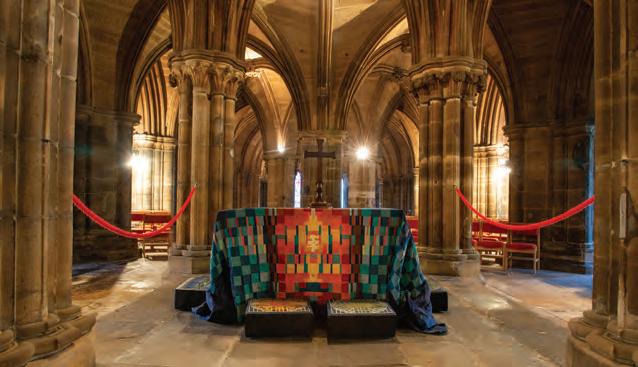
3
THE BLACADER AISLE
Intended as an undercroft (lower chamber) to an unbuilt upper chapel, the Blacader Aisle is noted for its tierceron (rib) vaulting.
A depiction of St Fergus, an early Scottish missionary saint, above the entrance suggests it was believed to be his burial place and was part of the pilgrim route.
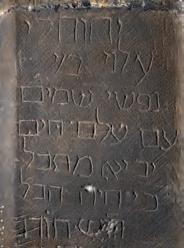
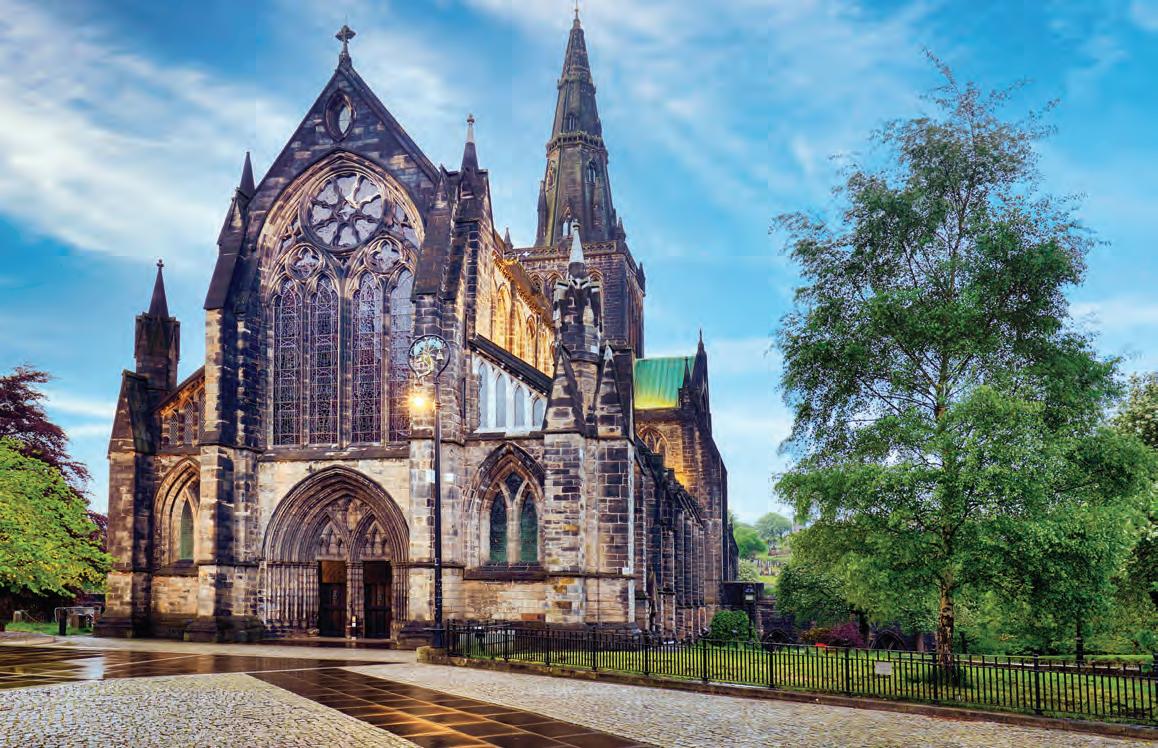
INTERESTED IN TAKING PART?
The Engine Shed will host Introduction to Building Conservation from 1-5 June this year. Packed with theory, opportunities to engage with subject matter experts and hands-on site visits, this accessible week-long course is a great way to boost your continued professional development. Funded places are available via application.
Visit engineshed.scot/ whats-on for details on how to apply and for early bird booking options
With up to 40 minutes runtime· on a single charge of its powerful 48V battery, adjustable cutting heights and a generous 50 litre bin, the CLMS0 has everything you need to achieve professional results, effortlessly.
Quick start, long run time
Up to 40 minutes* of run time, a quick 7-hour charge, and a simple push-button start for easy lawn care.
Your lawn, your way
The 10mm cutting increments, between 30mm and 80mm, offer a setting for every need.
Safety first
The safety switch key can be turned off for secure storage and added peace of mind when the mower is not in use.
Omni blade cutting technology
The counter-balanced carbon steel blade, paired with intelligent power delivery, ensures a clean cut, and maximizes runtime in all conditions.
Generous cutting width
The 420mm blade covers more ground with every pass, making mowing quicker and more efficient, leaving your lawn with a flawless finish.
"Simply the best" "The CLMSOGtech lawn mower isthe best purchase I have ever made for making my life so mucheasier,it cuts through the thicker of grass with ease and the battery life is unreal. Simplythe best."
ColinH

• Inventor & Owner, Nick Grey
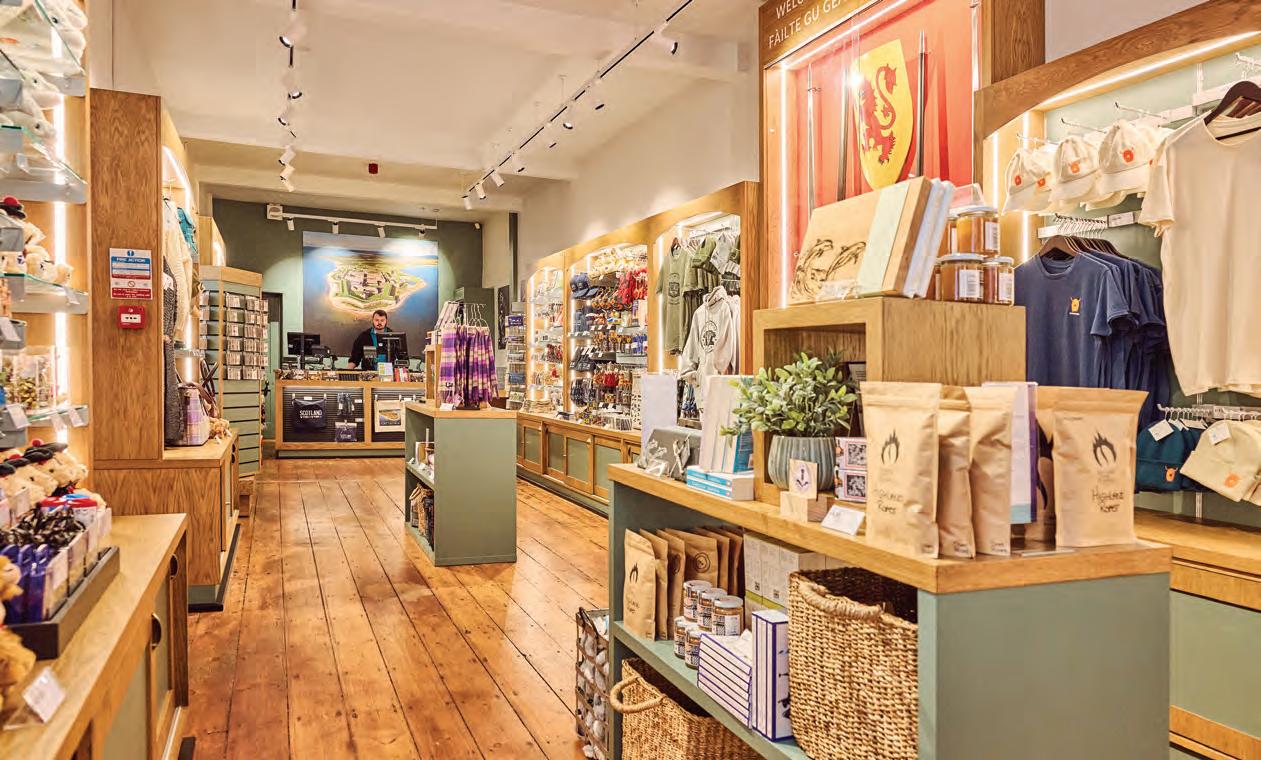
We’re delighted to share a brand-new look for our Fort George retail space. Preparations began back in late 2024 to design a shop interior that was inspiring for both visitors and staff alike. A space that would showcase our beautiful products, many of which are made in Scotland.
Refitting began in early October and, after much hard work by all the teams involved,
we reopened in early November. One of our early visitors to the new layout said, “It’s the best gift shop that I’ve seen in Scotland”.
Be sure to pay us a visit next time you’re in the area and browse our wonderful collection of bespoke and locally crafted products.
John, right, and his team are waiting to greet you with a warm Highland welcome!

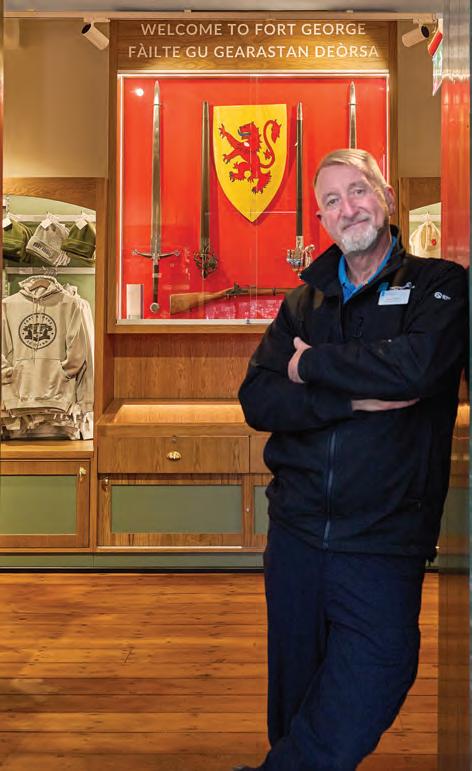
If you’re a fan of whisky, be sure to check out the Gunshot Scotch Whisky Liqueur by Bothy Distillery. This award-winning liqueur is crafted in small batches to give a rich, warming drink that captures the bold spirit of Scotland.
It is inspired by the tale of Old Jock, who enjoyed illicit drams in the Gunshot cave in the Angus Glens, at a time when the traditional ways were outlawed – including tartan, music and spirits.
Today, the distillery handcrafts the smooth whisky liqueur the old-fashioned way, infused with honey, cinnamon and mixed spice. Best enjoyed neat, chilled or over ice.

Are you ready for the brighter days and more time outside? Here are three ideas for little spring treats available online at stor.scot
From the Scottish author of Where are the Women?, this novel by Sara Sheridan takes you back to the summer of 1822, as a vibrant Edinburgh prepares for King George IV’s arrival. Elizabeth, recently widowed and newly settled from London, becomes captivated by the nearby Botanic Garden. She encounters Belle Brodie, an energetic
young woman devoted to botany and the profitable craft of perfume making. In this city of Enlightenment, any secrets are bound to surface.
£10.99
In cosmetics, organic gorse extract is said to help address the signs of ageing.
Elegant and light, this hand and body lotion is enriched with coconut, sunflower oil, shea butter, aloe vera and extracts of lavender, chamomile and nettle to soothe and moisturise your skin. And it’s made with over 89%
organic ingredients. The Wild Gorse range also includes a soap bar and a hand wash soap.
Hand and body lotion £15
Hand wash soap
£12.50
Soap bar £6.75
Give your feet a treat with some Scottish-inspired thistle socks. Produced using a sustainable bamboo viscose, these fun socks will keep your feet warm when it’s cold and cool when it’s warm. Featuring a bold print of Scotland’s national flower, Sock Therapy’s thistle socks also make a great gift for a loved one. £8




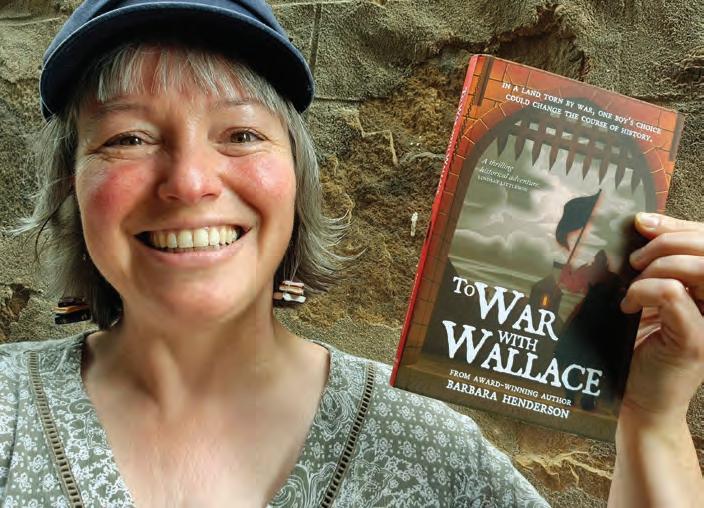
AuthorBarbaraHendersonrevealshowour sitesinspiredherlatestyoungadultnovel
What’s To War with Wallace about?
When we first meet the story’s central character, Harry – a 12-year-old apprentice armourer during the First War of Independence – the ruling English monarch King Edward I believes he’s crushed the Scottish resistance. But the war is far from over. After being kidnapped by the Scottish nobleman Andrew de Moray, Harry becomes embroiled in the 1297 Battle of Stirling Bridge with William Wallace. Harry must learn what he stands for – something we all have to do growing up. I think this will really resonate with young readers.
In what ways have our properties influenced this book?
I’m a Historic Scotland member, so I visit the sites often. During a visit to Urquhart Castle, I discovered a panel on Andrew de Moray.
I then dug deeper into his story on trips to Bothwell Castle and Stirling Castle and discovered he was William Wallace’s co-commander at the Battle of Stirling Bridge. I couldn’t understand why he wasn’t as well-known as Wallace. My story grew from here.
Why do you enjoy bringing Scotland’s history to life through your books?
“After nourishment, shelter and companionship, stories are the thing we need most in the world,” said Philip Pullman. I agree.
I studied Scottish literature at the University of Edinburgh and realised that you can’t understand stories without knowing their historical context. I love how history reveals how we once lived. And as a teacher, I know young people do too.
Why is our conservation work so important?
Understanding our history helps us make sense of the present and choose better decisions for our future. Our identities are integral to the places that Historic Environment Scotland protects. These places and their stories wouldn’t be so accessible without such care, which is why it’s vital they’re safeguarded.
Buy To War with Wallace in our shops at Stirling Castle and Urquhart Castle or online at stor.scot
Atrioofneweditions

Art Deco Scotland: Design and Architecture in the Jazz Age
Bruce Peter
In this beautifully illustrated paperback edition, Bruce Peter, Professor of Design History at Glasgow School of Art, charts Art Deco’s origins and how Scotland’s architects adopted its iconic elegance.
£25
Wanderings with a Camera in Scotland
Lesley Ferguson
Industrialist, historian and archaeologist Erskine Beveridge (1851–1920) was one of his generation’s finest amateur photographers. Featuring photographs taken between the 1860s and 1919 – spanning houses in the Western Isles to Fife harbour life – this collection is a fascinating record of a bygone era.
£18.99
Don’t forget your members’ 20% discount
The Small Isles: Rum, Eigg, Canna and Muck
John Hunter
A comprehensive paperback by the University of Birmingham’s Emeritus Professor of Ancient History and Archaeology, The Small Isles is packed with photographs, maps and drawings – revealing traces of the past on the Inner Hebridean Small Isles.
£18.99

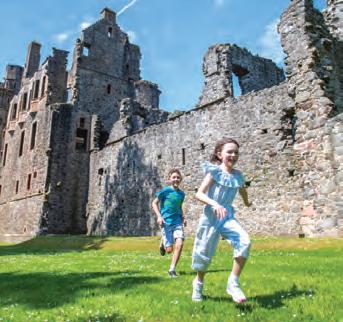

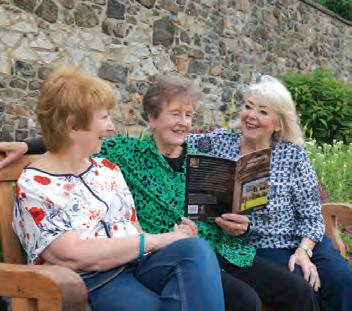

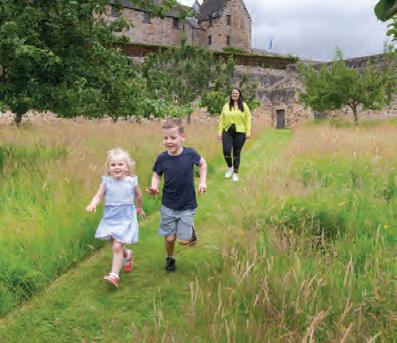

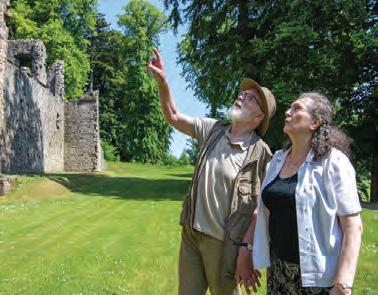

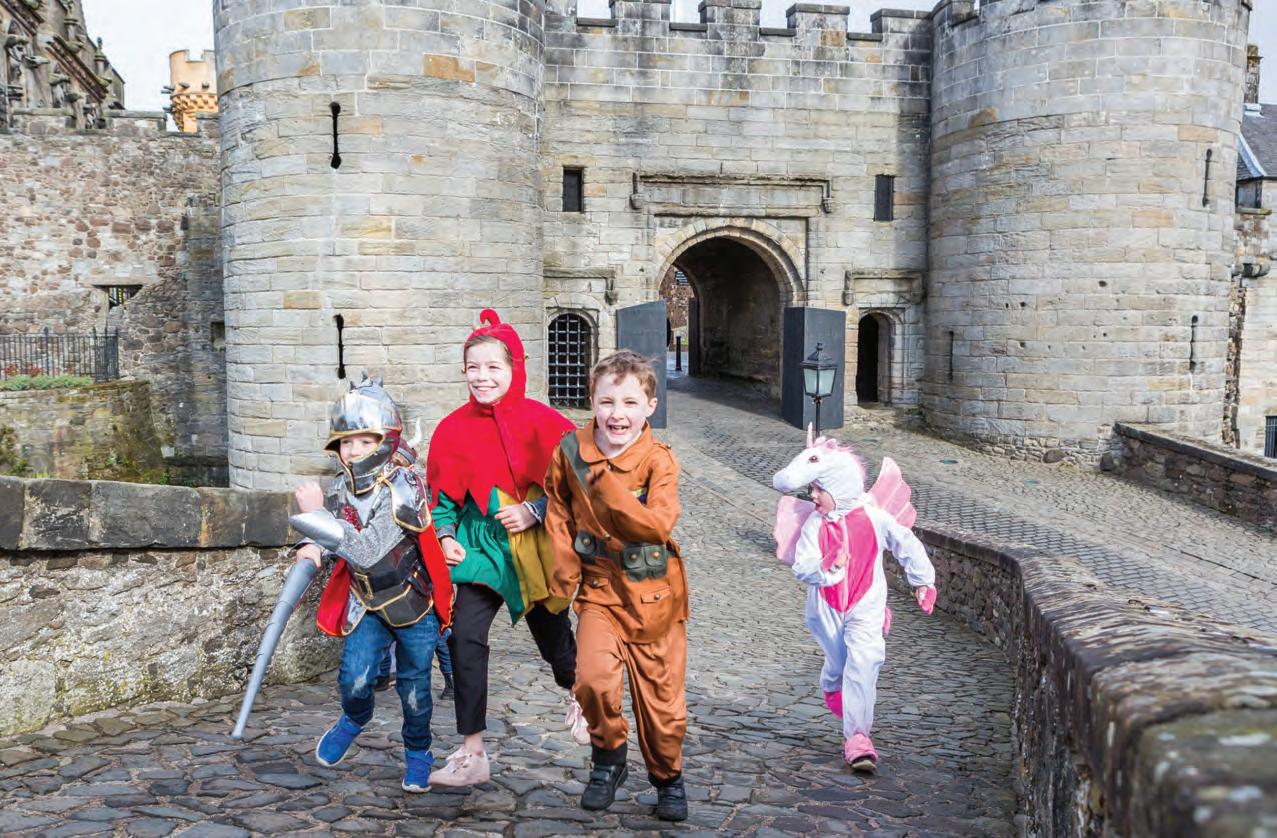
Summer
Lambs on the Loose!
The Easter Trail
VARIOUS SITES
This Easter join us at sites across the country for some baa-rilliant family friendly fun on our Easter Trails. The lambs are loose across the hoose and we need your help to find them. Ewe might even get a chocolatey reward!
l Fri 3-Mon 6 Apr, during site opening hours
VARIOUS SITES
Over the Easter Holidays, sites across Scotland will be welcoming our living history performers on various days. You’ll get to meet some vivid characters from Scotland’s past.
l Fri 3-Sun 19 Apr
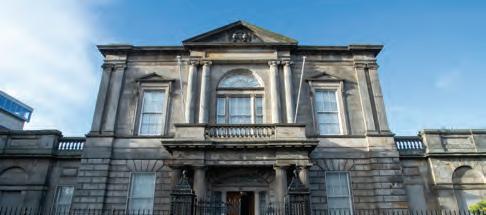
Discover the animals that sailors would meet on their travels, take part in our activity trail and handle nautical objects in our 16th-century vaults, which were once used as a school for children to learn mathematics and navigation.
l Wed 8 Apr, 11am-12pm, 1pm-2pm
Join us at Trinity House this Easter for a day of family fun. Take a selfguided tour of the house and join in with activities suitable for all ages, including drop-in crafts and children’s games. Turn to page 30 for more on Trinity House.
l Wed 15 Apr, 11am-4pm
STIRLING CASTLE
Our popular weekend returns to Stirling Castle and this time the unicorns are bringing some friends. Meet them in the Queen Anne Gardens, where there will be plenty of activities for the whole family. The castle esplanade will be closed during this event. Please visit hes.scot/events for alternative parking and travel information.
l Sat 11-Sun 12 Apr, 11am-5pm
National Mills Weekend
NEW ABBEY CORN MILL
STANLEY MILLS
Celebrate National Mills Weekend at Stanley Mills and New Abbey Corn Mill.
Explore milling heritage and, exclusively at Stanley Mills, join our Visitor Connector volunteers for spinning and textile activities, and enjoy a sensory experience with our Volunteer Musicians.
l New Abbey Corn Mill: Sat 9-Sun 10 May, free entry, tours throughout the weekend
l Stanley Mills: Sat 9-Sun 10 May, during site opening hours
Huntly Castle, ‘The Fairest in the Country’
JOHN SINCLAIR HOUSE, EDINBURGH
Huntly Castle in Aberdeenshire developed over centuries into a palatial Renaissance home for its noble residents. In this talk we will explore how we developed a new guidebook for Huntly Castle, and discuss some of the captivating characters who called it home.
l Mon 25 May, 2pm
Leith Festival Open Day
TRINITY HOUSE
During the Leith Festival, Trinity House will be open to the public. Visitors can take a self-guided tour, watch a film about Leith’s maritime history and see the fascinating objects that tell stories of life at sea. For younger visitors, there are games and activities in our historic vaults.
l Sat 13 Jun, 11am-4pm
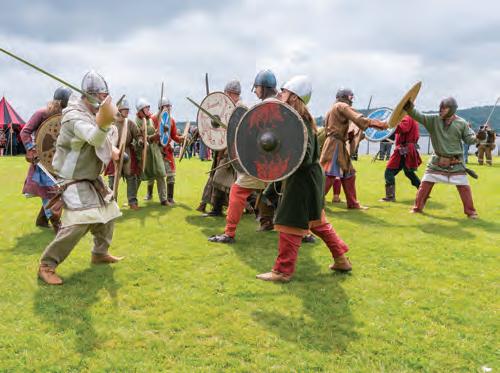
DUNSTAFFNAGE CASTLE
Watch fearless Viking warriors in thrilling clashes. Wander around the living history camp to find out how Vikings lived, and how they made their weaponry and clothing.
l Sat 23-Sun 24 May, 12 noon-4pm
DUFF HOUSE
EDINBURGH CASTLE
ELGIN CATHEDRAL
LINLITHGOW PALACE
STIRLING CASTLE
Enjoy productions of The Three Musketeers, Midsummer Night’s Dream and King Arthur at properties across the nation this summer.
VARIOUS SITES
Have you ever wanted to speak to someone from the past? Join us at selected sites this summer as our living history performers bring Scottish history to life.
l Sat 27 Jun-Sun 16 Aug, during site opening times
LINLITHGOW PALACE
CAERLAVEROCK CASTLE
Experience exhilarating horsemanship and impressive skills as the brave and courageous knights battle it out. Hear the thundering of hooves and the clash of lances as our four champions take to the arena for this spectacular show. Wander through the living history camp to experience life in medieval times, and be entertained by the antics
of the court jesters.
l Linlithgow Palace, Sat 27-Sun 28 Jun, 11.30am-4.30pm
l Caerlaverock Castle, Sat 25-Sun 26 Jul, 11am-4pm
Celebration of the Centuries FORT GEORGE
Fort George is once again set to host this living history extravaganza – our largest re-enactment event of the year.
Re-enactors will bring the mighty fortress to life with a living timeline depicting more than 2,000 years of Scottish history. Wander through the living history camps dating back to Pictish and Roman times, and experience how life would have been. New for 2026, we’re celebrating Scottish food and drink with the opportunity to ‘try and buy’ at our Grand Magazine fair.
l Sat 8-Sun 9 Aug, 11am-5pm
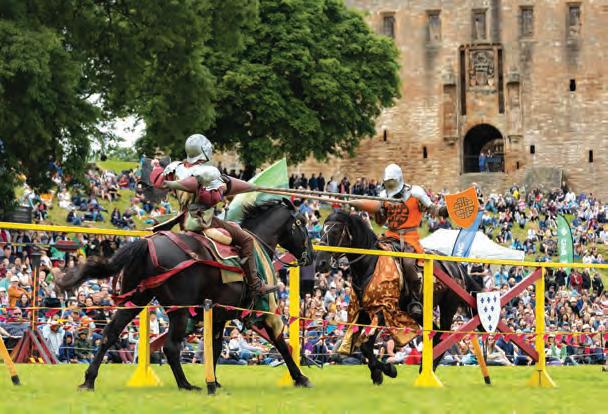
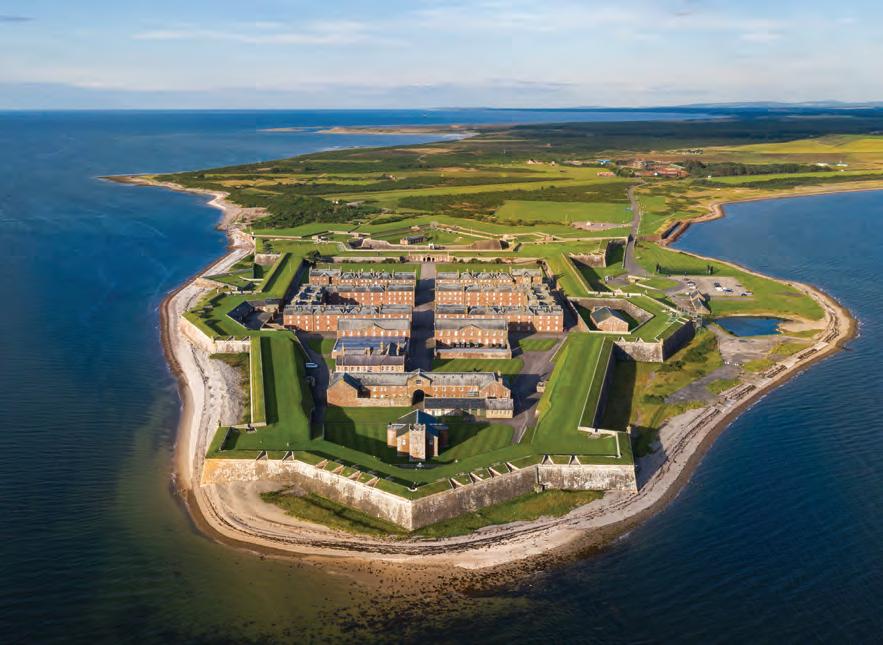
Marking Time: A Members’ Exclusive Exhibition Launch
FORT GEORGE
We are delighted to invite you to join co-curators Sace and Dr Alex Hale for the launch of our brandnew exhibition at Fort George. ‘Marking Time’ will take you on a journey from the present day to some of the oldest markings to be found in Scotland. Come along and explore the fascinating history of hidden marks and messages, from urban contemporary street art to prehistoric rock art, and learn how they can help us understand the world around us today.
l Thu 26 Mar, 11am, 3pm
Archaeology in Action: A Tour of Holyrood Park
HOLYROOD PARK
Discover the story of Edinburgh before it became the Edinburgh we know today. Join archaeologist Graeme Cavers for a Members’
Exclusive Tour of Holyrood Park, exploring its rich prehistory and connections to the wider Scottish landscape. As you walk across the park’s Iron Age hillforts, Graeme will share expert insights into the lives of past communities and highlight recent discoveries from the Archaeological Field School. Please note the walk includes trails and hills, and participants must be able to walk for 90 minutes. Sturdy footwear and weather appropriate clothing is advised.
l Thu 23 Apr, 11am, 2pm
Historical Baking at Kinneil House
KINNEIL HOUSE
Join us for this unique and immersive Members’ Exclusive Tour of Kinneil House, and discover the history of this remarkable building and the Hamilton family who once called it home. Members will get a guided tour of the house, uncovering its rich
Fortress on the Hill: Exploring Auchindoun Castle
AUCHINDOUN CASTLE
past and architectural highlights. The journey continues as you step back in time to meet a historical baker in the house’s wing. See traditional baking practices from days gone by and learn how bread was crafted at Kinneil House.
To top it all off, indulge in a taste of history by sampling some freshly baked treats.
l Sat 16 May, 10.30am, 1pm, 3pm
Join us for a Members’ Exclusive Tour of Auchindoun Castle in Moray, a 15th-century hilltop stronghold steeped in drama and intrigue. Come along and explore its lonely ruins and surrounding earthworks while hearing tales of Thomas Cochrane, Sir Adam Gordon, and the feud that left the castle derelict by 1725. Set amid a romantic, isolated landscape, this tour offers history, atmosphere and an invigorating half-mile walk over paths and tracks. Stout footwear is advised.
l Thu 28 May, 11am, 2.30pm
DON’T FORGET...
Members’ Exclusive Events have limited capacity and must be booked online in advance. Head to hes.scot/memberevents to book.
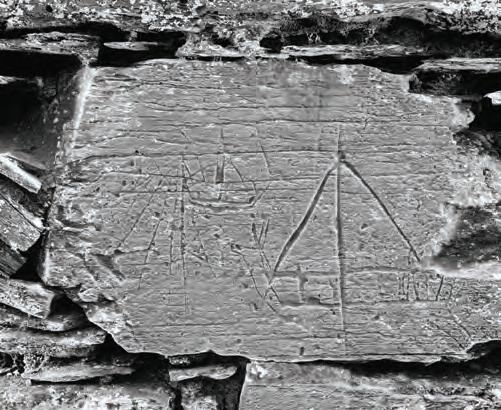
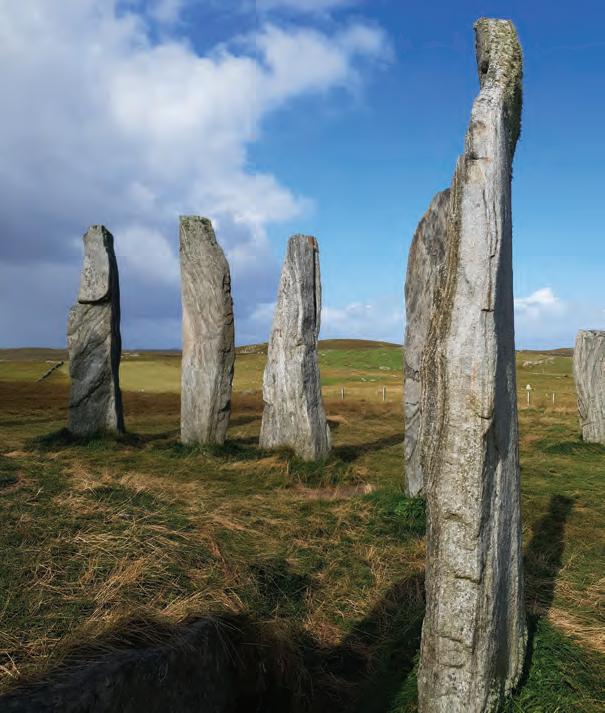
STANLEY MILLS
Co-curated by four community groups, this exhibition looks at how we can explore imperial histories, represent different voices and offer collective healing. ‘Traces of Empire’ is grounded in the lived experience of different communities, and tells the stories they are impacted by. The exhibition touches upon a breadth of different themes, including cotton, belonging, language, reclaiming past and future narratives, and healing. It looks to understand some of the legacies of empire still experienced today and explores how we might move forward together.
l Sat 4 Apr-Sun 28 Jun, during site opening hours
If you’re ready for some springtime exploration, we’ve something for everyone. Join our guided walks and activities for all ages and abilities, including a Water Safari at Linlithgow Peel, our Rangers on safari at Dryburgh Abbey and Tantallon Castle, and Ranger-led walks in Holyrood Park to learn about its rich and varied history.
Discover how Scotland’s complex imperial history is embedded in some of our oldest sites. Curated by independent Black curator and researcher, Dr Cat Dunn, ‘Archaeology and Empire’ the exhibition explores how the historic landscapes of the Scottish Highlands, Dumfries and Galloway, the Western Isles and Orkney have connections to Scotland’s imperial ambitions and forced displacement of people. The exhibition combines archival material with newly commissioned artwork.
l Sat 25 Apr-Mon 20 Jul, during site opening hours
Explore Orkney’s ancient landscape and discover five millennia of history and prehistory with the Orkney Rangers Service. Join their free walks at the Ring of Brodgar, the Stones of Stenness and Barnhouse Village.
l No booking required for Orkney Rangers Service walks. For other activities, pre-booking is advised.
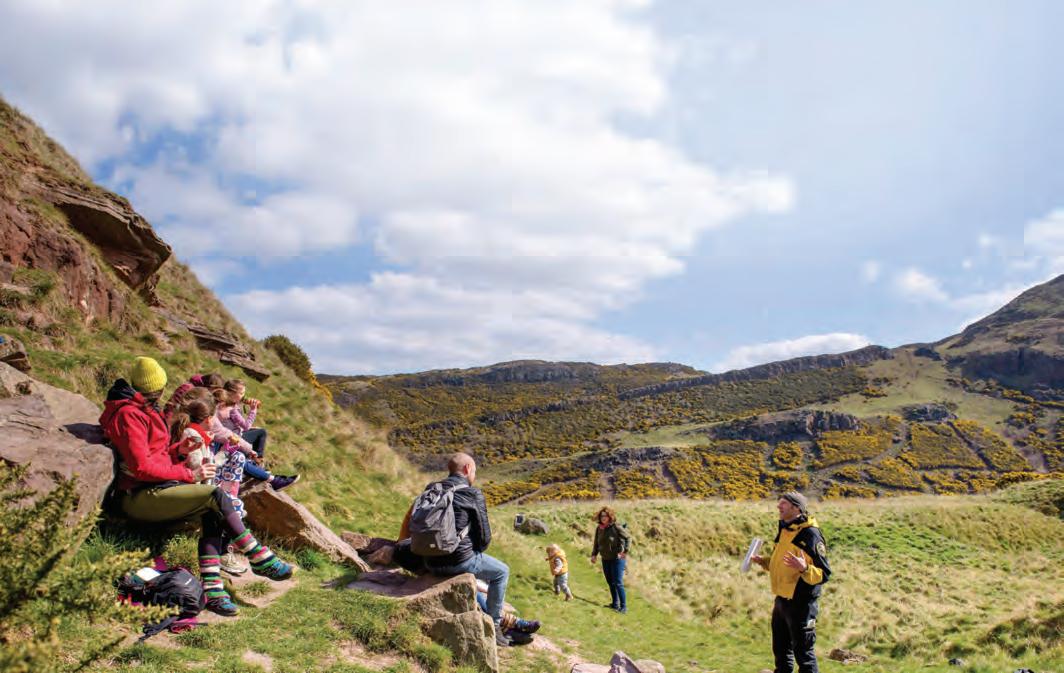

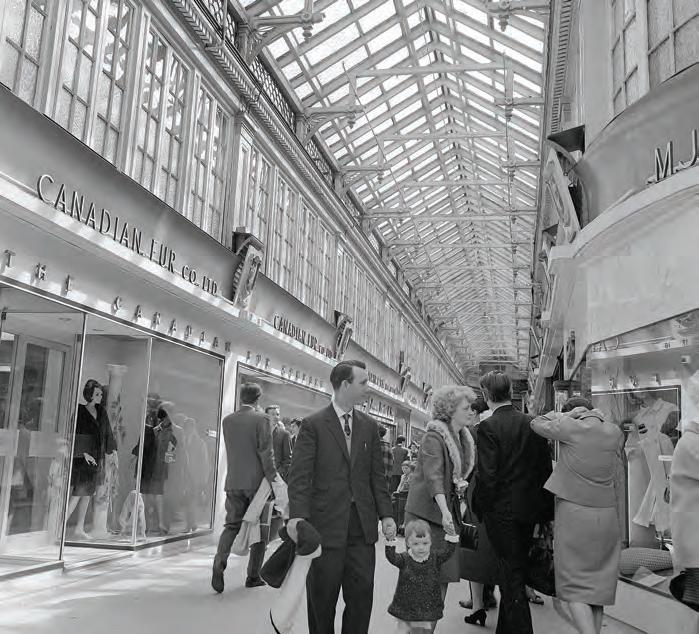

Above: 1955,twoboysbuy someessential groceriesfrom MrsMacIver,who atthattimeranthe onlyshopinLaxay, ontheislandofLewis. Notetheall-important scales,usedfor measuringoutvarious driedgoods.
Right: 1964,cleaningthe meatslicerinthe frontshopofJ.Petrie, Grocer,47Mid-street, Keith,Banffshire. Thegroceralso providedadelivery serviceforcustomers andtheshop’ssmall vanwasoftenseen aroundKeith.
HFind many more images from Scotland’s shared past at trove.scot
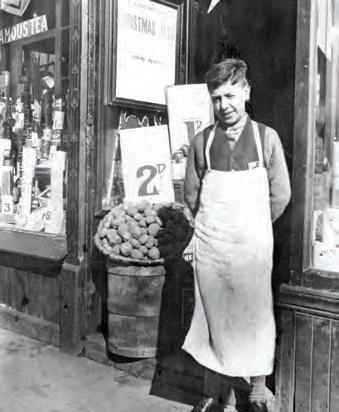
AGlasgowgrocer’sshopfront,witha youngassistantattheentrancebeside anoticetojointheshop’sChristmas Club,c.1930
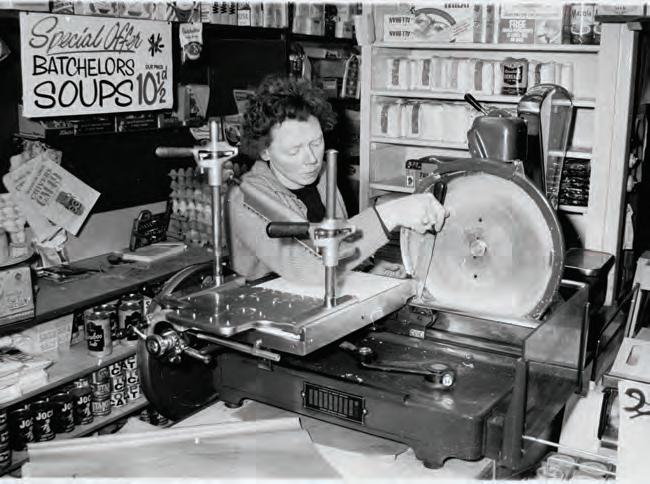
ypermarkets, online shopping and meal kit deliveries – it’s a far cry from how we once stocked up on provisions. Happily, a rich archive of images survives of the shops that once kept us fed.
Who remembers the vaguely terrifying meat slicer, cheese adroitly portioned with a cheese wire or dried goods, such as sugar and rice, being carefully measured out on scales? Sweets were sold as ‘penny mixtures’, and vegetables
were hand-selected then carried home in paper bags and wicker baskets.
The classic grocer’s shop – a taste of the supermarkets to come – stocked everything from tins, jars and fresh produce to teas, spirits and even brooms.
Shopfronts on our high streets, which now give access to repurposed spaces, contain clues to their original uses. Look for tiles from the Victorian era that, though mass-produced, created pleasing murals illustrating
a shop’s produce – for example, a dairy or butcher’s shop.
Cast iron supplied by Scotland’s foundries provided decorative beams and columns to replace heavy masonry and create taller, brighter shopping spaces.
The Art Deco frontages of the 1930s, clad in Vitrolite (a lustrous glass), polished granite or marble, gave a thoroughly modern look and a hardwearing finish that, in some cases, survives to this day.