Looking for HIPAA-Compliant AI Solutions? How We Build Custom AI Agents for Medical Practices Without Data Risks
Deploying custom AI agents in medical practices requires isolated private cloud architectures, zero-data retention policies, and countersigned Business Associate Agreements (BAAs). By integrating specialized hipaa compliant ai software, secure healthcare ai solutions, and private vector databases with electronic health records, partners AI for healthcare providers to automate workflows safely without exposing Protected Health Information.
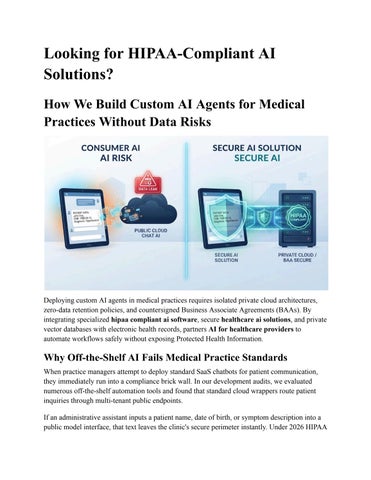
Why Off-the-Shelf AI Fails Medical Practice Standards When practice managers attempt to deploy standard SaaS chatbots for patient communication, they immediately run into a compliance brick wall. In our development audits, we evaluated numerous off-the-shelf automation tools and found that standard cloud wrappers route patient inquiries through multi-tenant public endpoints. If an administrative assistant inputs a patient name, date of birth, or symptom description into a public model interface, that text leaves the clinic's secure perimeter instantly. Under 2026 HIPAA
enforcement standards, this constitutes an unauthorized disclosure of Protected Health Information (PHI) because consumer platforms refuse to assume liability or execute a Business Associate Agreement (BAA). Ensuring rigorous healthcare AI security and compliance is vital for any modern medical organization.
What Makes a Custom AI Agent Truly Compliant? Building custom AI agents for healthcare demands a complete architectural shift away from consumer-grade software development. To ensure full adherence to the HIPAA Security Rule, every custom deployment relies on specific infrastructure components. Architectural Layer
Standard Consumer AI
Custom HIPAA-Compliant AI Agent
Data Storage
Persistent logging for model training
Zero-data retention (ZDR) APIs with immediate cache purging
Hosting Environment
Public multi-tenant cloud servers
Dedicated private cloud tenant utilizing a secure hipaa compliant ai platform
Legal Liability
No vendor accountability
Countersigned Business Associate Agreement (BAA)
Knowledge Retrieval
Broad public web crawl data
Isolated private vector database for secure ai solutions for medical records
By isolating data inside private vector databases, our engineering builds solutions where AI queries only local clinic guidelines or internal FAQs, ensuring patient data never mixes with public training sets or exposes vulnerabilities via non-compliant hipaa compliant ai tools.
How We Engineer Secure Workflows for Clinical Intake Automating patient intake without generating compliance exposure requires precise engineering. When we construct a specialized hipaa compliant ai agent or deploy a tailored HIPAA compliant AI chatbot, we implement a multi-step data-stripping and encryption pipeline: ● Edge-Level Data Sanitization: Incoming messages pass through secure local gateways that mask or strip direct personal identifiers before machine learning inference occurs.
● Encrypted EHR Handshakes: Client systems connect directly to electronic health record software using tokenized, TLS 1.3 encrypted API endpoints through advanced hipaa compliant automation. ● Granular Role-Based Access Control (RBAC): Front-desk staff, billing personnel, and clinical leads interact with distinct dashboard permissions, preventing unauthorized record visibility.
Balancing Operational Efficiency With Strict Security Private practices face immense pressure to reduce administrative overhead, but speed can never compromise data safety. In our practical deployments, custom hipaa compliant ai tools for healthcare and specialized HIPAA compliant generative AI models typically handle up to 65% of routine patient inquiries—such as insurance verification FAQs, pre-appointment preparation steps, and basic clinic hours—without human intervention. ● The Pros of Custom Builds: Complete ownership of data pipelines, zero risk of third-party model retraining on patient inputs, and customized clinical vocabulary matching your exact specialty. ● The Cons to Consider: Higher upfront development investment compared to monthly subscription tools, and the requirement for structured IT onboarding.
Why Expert HIPAA-Compliant AI Software Development Matters Deploying safe machine learning pipelines requires dedicated engineering experience. Through professional hipaa compliant ai software development and specialized hipaa compliance services, medical networks can bridge the gap between innovation and patient confidentiality. Barqsol Technologies focus on establishing robust, fully audited environments tailored to modern health systems.
FAQs Do custom AI agents require patient data to train local models? No. Custom implementations utilize pre-trained foundational models accessed exclusively via private, zero-retention enterprise APIs combined with localized vector embeddings, meaning your patient data is never used to train future public models.
How does a BAA protect a medical practice using custom AI? A Business Associate Agreement (BAA) is a legally binding contract where your AI software vendor accepts shared liability under HIPAA regulations for safeguarding electronic Protected Health Information (ePHI).
Can custom AI agents integrate directly with existing medical software? Yes. Custom development allows engineers to build secure API connectors that integrate smoothly with major electronic health record (EHR) and practice management systems while maintaining strict encryption standards.