Are AI Medical Scribes HIPAA Compliant? 7 Vendor Questions
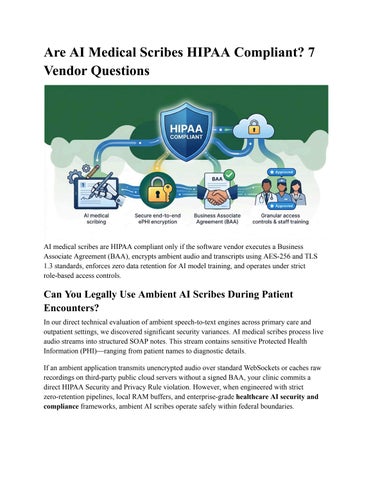
AI medical scribes are HIPAA compliant only if the software vendor executes a Business Associate Agreement (BAA), encrypts ambient audio and transcripts using AES-256 and TLS 1.3 standards, enforces zero data retention for AI model training, and operates under strict role-based access controls.
Can You Legally Use Ambient AI Scribes During Patient Encounters? In our direct technical evaluation of ambient speech-to-text engines across primary care and outpatient settings, we discovered significant security variances. AI medical scribes process live audio streams into structured SOAP notes. This stream contains sensitive Protected Health Information (PHI)—ranging from patient names to diagnostic details. If an ambient application transmits unencrypted audio over standard WebSockets or caches raw recordings on third-party public cloud servers without a signed BAA, your clinic commits a direct HIPAA Security and Privacy Rule violation. However, when engineered with strict zero-retention pipelines, local RAM buffers, and enterprise-grade healthcare AI security and compliance frameworks, ambient AI scribes operate safely within federal boundaries.
Deploying a HIPAA compliant AI agent or custom AI chatbot for ambient documentation requires moving away from generic off-the-shelf transcription tools and implementing specialized healthcare AI solutions built explicitly for medical environments.
The 7 Critical Questions to Ask AI Scribe Vendors Before Signing Never accept a vendor's blanket marketing claim that their tool is "HIPAA Certified" (a designation that does not officially exist in federal regulation). Put these seven precise questions to their compliance and engineering teams during procurement:
1. Will You Sign an Unconditional Business Associate Agreement (BAA)? A Business Associate Agreement is the legal cornerstone of any HIPAA compliant AI platform. If a vendor offers a "free tier" or self-service app where a BAA is unavailable, do not run live patient encounters through it. Ensure the BAA explicitly covers sub-processors, including third-party Large Language Model (LLM) API providers.
2. What Is Your Exact Policy on Audio File Retention and Deletion? Does the system record raw audio, transcribe it in real time, and immediately purge the audio buffer from volatile memory? In our testing, systems that enforce a zero data retention (ZDR) policy for raw audio streams pose significantly less exposure risk during subpoena requests or network breaches. [ Ambient Microphone Audio Input ] │ ▼ [ Volatile RAM Stream (In-Memory Processing) ] │ ▼ [ Speech-to-Text & Real-Time ePHI Scrubbing ] ──► [ Audio Purged Instantly ] │ ▼ [ Encrypted SOAP Note Draft Sent to EHR ]
3. Do You Use Patient Encounters or Note Data to Train AI Models? Ask explicitly: Is clinical data used to retrain your proprietary base models or fine-tune public LLMs? A compliant vendor offering HIPAA compliant generative AI must enforce strict training opt-out guarantees. Patient transcripts must never enter a shared global vector database.
4. How Is Data Encrypted in Transit and at Rest?
Verify that secure AI solutions for medical records enforce TLS 1.3 for data in motion (during live room audio streaming) and AES-256 bit encryption for data at rest (draft notes awaiting EHR sync). Request their cryptographic key management policies and confirm whether keys are managed via secure cloud hardware security modules (HSMs).
5. How Does Your Integration Architecture Connect to Our EHR? Does the vendor use direct SMART on FHIR protocols, secure browser extensions, or custom API endpoints? Ensure the integration pathway maintains granular Role-Based Access Control (RBAC) so scribes operate under individual clinician credentials rather than shared administrative keys.
6. Can You Produce SOC 2 Type II and ISO 27001 Audit Reports? A signed BAA is a legal commitment, but third-party security certifications prove operational execution. Demand a current SOC 2 Type II report detailing how the vendor evaluates access controls, network intrusion detection, and vulnerability patching over an extended monitoring window.
7. What Is Your Incident Response and Breach Notification Protocol? Under the HIPAA Breach Notification Rule, business associates must report security incidents without unreasonable delay. Ask for their documented Mean Time to Detect (MTTD) and explicit contractual notification windows (ideally within 24 to 48 hours of a confirmed incident).
Real-World Comparison: AI Scribe Architectural Approaches Evaluation Metric
Consumer Speech Tools (e.g., Standard Otter.ai)
Enterprise Ambient AI Scribe (e.g., Nabla / Scribeberry)
Custom Enterprise Build
Business Associate Agreement (BAA)
Not Offered
Included in Healthcare Plans
Fully Customizable Legal Terms
Audio File Lifecycle
Retained on Cloud Servers
Purged or Configurable Deletion
Zero Audio Logging (RAM Only)
Model Training Policy
Prompts ingested for training
Explicit Zero Retention Contract
Dedicated Private Instances & Zero Training
Encryption Levels
Standard HTTPS
AES-256 & TLS 1.3 Enforced
Custom Managed Encryption Keys
Workflow Capabilities
Unsecured text copy/paste
Pre-built API / SMART on FHIR
Deeply Integrated HIPAA Compliant Automation
What Operational Pitfalls Lead to AI Scribe Compliance Fines? Even when using HIPAA compliant AI solutions, clinic staff often inadvertently create compliance vulnerabilities through poor operational habits: ● Skipping Two-Party Patient Consent: Over 20 US states enforce strict wiretapping or two-party consent laws. Failing to obtain verbal or documented patient consent before turning on an ambient microphone exposes your practice to state-level civil and criminal liability. ● Unchecked AI Hallucinations in the Final Chart: Scribes generate preliminary draft summaries, not final medical records. If a clinician signs off on an auto-generated SOAP note containing hallucinated dosages without editing, the practice assumes full clinical and regulatory liability. ● Shared Staff Credentials: Allowing multiple medical assistants or mid-level providers to log into an AI scribe using a single account destroys audit log trails, making it impossible to trace who reviewed or modified specific note drafts. For practices requiring custom EHR workflows or proprietary clinical bots, partnering with experts in HIPAA compliant AI software development guarantees that zero-retention architectures and end-to-end audit trails are hardcoded directly into the system.
Final Checklist for Safe AI Scribe Deployment Deploying AI for healthcare providers offers massive relief from administrative burnout, but security must be locked down before launching live visits: 1. Execute the BAA: Confirm that both your primary vendor and any API sub-processors sign a comprehensive BAA. 2. Configure Zero-Audio Retention: Set the system settings to delete audio recordings immediately upon draft generation.
3. Establish Verbal Consent Workflows: Instruct clinical staff to state a standard consent script before enabling the ambient mic. 4. Mandate Physician Review: Enforce a strict policy where providers review, verify, and finalize every note before committing it to the EHR. 5. Leverage Expert HIPAA Compliance Services: Work with engineering partners like Barqsol Technologies to audit custom API integrations and maintain robust HIPAA compliant AI tools for healthcare. FAQ Questions & Answers: Q: Is verbal consent required from patients before using an ambient AI scribe? A: Yes. In many jurisdictions and under two-party consent laws, clinicians must inform patients and obtain consent before activating ambient recording or speech-to-text tools. Q: Can audio recordings from an AI scribe be subpoenaed in court? A: If raw audio files are stored or cached on cloud servers, they can potentially be subpoenaed during legal discovery. Choosing vendors with zero audio retention policies eliminates this risk by immediately purging audio from volatile memory upon transcription. Q: Are free AI scribe tools HIPAA compliant if they don't store data? A: No. Under HIPAA regulations, processing PHI through any third-party tool without a signed Business Associate Agreement (BAA) is an immediate violation, regardless of the software's storage policies. Q: How does Barqsol Technologies assist clinics with HIPAA compliant AI software development? A: Barqsol Technologies provides specialized hipaa compliance services and custom software engineering, building secure AI agents, ambient scribes, and automated EHR integration pipelines with zero-data-retention, AES-256 encryption, and full BAA compliance built directly into the codebase.