High-Profile Focus: Life Science Facilities
July 2025
19
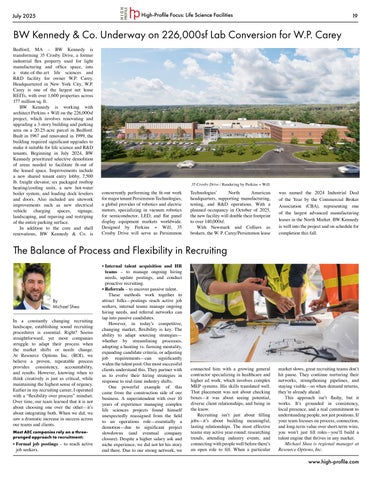
BW Kennedy & Co. Underway on 226,000sf Lab Conversion for W.P. Carey Bedford, MA – BW Kennedy is transforming 35 Crosby Drive, a former industrial flex property used for light manufacturing and office space, into a state-of-the-art life sciences and R&D facility for owner W.P. Carey. Headquartered in New York City, W.P. Carey is one of the largest net lease REITs, with over 1,600 properties across 177 million sq. ft. BW Kennedy is working with architect Perkins + Will on the 226,000sf project, which involves renovating and upgrading a 3-story building and parking area on a 20.25-acre parcel in Bedford. Built in 1967 and renovated in 1999, the building required significant upgrades to make it suitable for life science and R&D tenants. Beginning in July 2024, BW Kennedy prioritized selective demolition of areas needed to facilitate fit-out of the leased space. Improvements include a new shared tenant entry lobby, 7,500 lb. freight elevator, six packaged rooftop heating/cooling units, a new hot-water boiler system, and loading dock levelers and doors. Also included are sitework improvements such as new electrical vehicle charging spaces, signage, landscaping, and repaving and restriping of the entire parking surface. In addition to the core and shell renovations, BW Kennedy & Co. is
35 Crosby Drive / Rendering by Perkins + Will
concurrently performing the fit-out work for major tenant Persimmon Technologies, a global provider of robotics and electric motors, specializing in vacuum robotics for semiconductor, LED, and flat panel display equipment markets worldwide. Designed by Perkins + Will, 35 Crosby Drive will serve as Persimmon
Technologies’ North American headquarters, supporting manufacturing, testing, and R&D operations. With a planned occupancy in October of 2025, the new facility will double their footprint to over 140,000sf. With Newmark and Colliers as brokers, the W. P. Carey/Persimmon lease
was named the 2024 Industrial Deal of the Year by the Commercial Broker Association (CBA), representing one of the largest advanced manufacturing leases in the North Market. BW Kennedy is well into the project and on schedule for completion this fall.
The Balance of Process and Flexibility in Recruiting
By Michael Shea In a constantly changing recruiting landscape, establishing sound recruiting procedures is essential. Right? Seems straightforward, yet most companies struggle to adapt their process when the market shifts or needs change. At Resource Options Inc. (ROI), we believe a proven, repeatable process provides consistency, accountability, and results. However, knowing when to think creatively is just as critical, while maintaining the highest sense of urgency. Earlier in my recruiting career, I operated with a “flexibility over process” mindset. Over time, our team learned that it is not about choosing one over the other—it’s about integrating both. When we did, we saw a dramatic increase in success across our teams and clients. Most AEC companies rely on a threepronged approach to recruitment:
• Formal job postings – to reach active job seekers.
• Internal talent acquisition and HR teams – to manage ongoing hiring needs, update postings, and conduct proactive recruiting. • Referrals – to uncover passive talent. These methods work together to attract folks—postings reach active job seekers, internal teams manage ongoing hiring needs, and referral networks can tap into passive candidates. However, in today’s competitive, changing market, flexibility is key. The ability to adapt sourcing strategies— whether by streamlining processes, adopting a hunting vs. farming mentality, expanding candidate criteria, or adjusting job requirements—can significantly widen the talent pool. Our most successful clients understand this. They partner with us to evolve their hiring strategies in response to real-time industry shifts. One powerful example of this came from the construction side of our business. A superintendent with over 10 years of experience managing complex life sciences projects found himself unexpectedly reassigned from the field to an operations role—essentially a demotion—due to significant project slowdowns (and eventual company closure). Despite a higher salary ask and niche experience, we did not let his story end there. Due to our strong network, we
connected him with a growing general contractor specializing in healthcare and higher ed work, which involves complex MEP systems. His skills translated well. That placement was not about checking boxes—it was about seeing potential, diverse client relationships, and being in the know. Recruiting isn’t just about filling jobs—it’s about building meaningful, lasting relationships. The most effective teams stay active year-round: researching trends, attending industry events, and connecting with people well before there’s an open role to fill. When a particular
market slows, great recruiting teams don’t hit pause. They continue nurturing their networks, strengthening pipelines, and staying visible—so when demand returns, they’re already ahead. This approach isn’t flashy, but it works. It’s grounded in consistency, local presence, and a real commitment to understanding people, not just positions. If your team focuses on process, connection, and long-term value over short-term wins, you won’t just fill roles—you’ll build a talent engine that thrives in any market. Michael Shea is regional manager at Resource Options, Inc.
www.high-profile.com