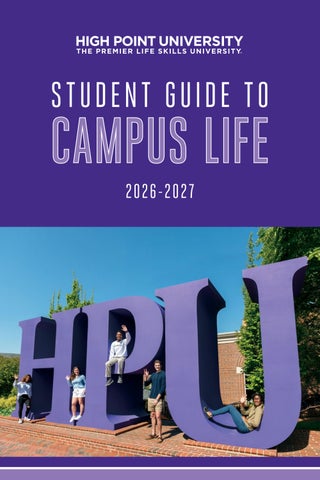
S T UDENT GUIDE T O
CAMPUS LIFE 2026-2027
1
Policy Statement The Guide to Campus Life and the University Code of Conduct applies to the entire student body, including those enrolled in undergraduate, graduate, and professional programs, as well as recognized student organizations. Jurisdiction begins at matriculation and continues through degree conferral, including periods between terms, approved leaves of absence, and University-sponsored experiences off campus. Certain professional schools within the institution maintain their own codes of conduct, professional standards, or fitness-for-the-profession requirements tied to clinical practice, licensure, or accreditation. These program-specific standards operate in addition to the Code of Conduct, not in place of it. All students enrolled in a professional program remain fully subject to the Code of Conduct regardless of any standards imposed by their school or program. A single incident may be reviewed under the Code of Conduct, under the relevant professional school’s standards, or under both, in parallel or sequentially. Each process operates independently and reaches its own findings, outcomes, and sanctions. A finding or outcome under one process does not preclude, replace, or limit action under the other, and no University policy automatically preempts another. Students may therefore be held accountable under each standard for the same underlying conduct. When a single incident is being addressed under both processes, the professional school and the Assistant Vice President of Student Services (or designated representative, including the Senior Director for Community Standards or the Threat Assessment Team) will communicate as needed to share information consistent with applicable privacy law, avoid procedural conflicts, and coordinate the sequencing of proceedings. Coordination does not alter the independent authority of either process to reach its own determination. The University reserves the right to take action under the Code of Conduct regardless of whether the conduct also gives rise to civil, criminal, accreditation, licensure, or professional school proceedings, and regardless of the outcome of those proceedings.
Contents Executive Administrative Offices.... 5
Fraternities and Sororities............. 76
Student Financial Information......... 6
Student Life...................................... 85
Federal and University Guidelines.......................................... 12
University Honor Code Preamble......................................... 104
Student Rights and Responsibilities................................ 28
Alcohol and Controlled Substance Education and Policies................... 111
Student Governance....................... 35
University Conduct Code Preamble......................................... 120
Student Organizations.....................41
University Conduct Procedure and Definitions................................135
Student Organization Event Guidelines......................................... 43
High Point University University Conduct Board, University Honor Board................................................145
Communications Guidelines .........50 Campus Student Resources........... 53
Pregnant and Parenting Students...........................................147
Accessibility Resources and Services......................................61
Resources For Students................152
Campus Police, Security, Safety, and Transportation........................... 71
Title IX and Sexual Misconduct Grievance Policies..........................154
4 Table of Contents
Executive Administrative Offices Office of the President
Office of Academic Affairs
Dr. Nido Qubein 210 Roberts Hall, 336-841-9201 nqubein@highpoint.edu
Dr. Daniel Erb 239 Roberts Hall, 336-841-4595 derb@highpoint.edu
Dr. Qubein’s visionary leadership has produced a complete transformation of High Point University since he became president in 2005. Since then, the student enrollment and number of faculty have more than quadrupled, eleven new academic schools have been added, and the campus size has grown from 91 to 580 acres. More than $800 million has been raised to support academic and student life facilities and programs, scholarships, and additional infrastructure and technological investments on campus. President Qubein and his family have also been among the University’s top philanthropic supporters. Additionally, Dr. Qubein teaches The Freshman Seminar on Life Skills, which focuses on preparing students to live a life of both success and significance. Students often refer to him as our chief inspirational officer!
Dr. Daniel Erb serves as the Provost and is the chief academic officer of all the academic departments of the University. The Deans of the following Schools report to him: • Congdon School of Health Sciences • David R. Hayworth School of Arts and Design • David S. Congdon School of Entrepreneurship • Douglas S. Witcher School of Humanities and Behavioral Sciences • Earl N. Phillips School of Business • Fred S. Wilson School of Pharmacy • Kenneth F. Kahn School of Law • Nido R. Qubein School of Communication • School of Optometry • Stout School of Education • Teresa Caine School of Nursing • Wanek School of Natural Sciences • Webb School of Engineering • Workman School of Dental Medicine • Executive Administrative Offices
5 Table of Contents
Student Financial Information Office of Student Financial Planning 100 Roberts Hall, 336-841-9124 finplan@highpoint.edu The Office of Student Financial Planning is responsible for verifying eligibility for and the packaging of financial assistance from institutional, federal, state, and outside sources. The application process requires the filing of the Free Application for Federal Student Aid (FAFSA). The results of this form will be received by our office electronically provided our school is included (code 002933). Please note that we must have your Social Security number in our system in order to receive your FAFSA data. Eligibility will be determined based on the FAFSA information we receive, and a financial aid offer will be developed to include available funding from the federal, state, and institutional programs which we administer. Non-need-based aid like merit scholarships, athletic awards, and departmental scholarships are the first component in the development of a student’s financial aid offer. Based on financial need demonstrated on completed FAFSA, federal and state grants are then packaged. If additional eligibility exists, the student will be considered for HPU’s need-based grant. Please note that eligibility for need-based aid is determined for a student each year that a FAFSA is completed and therefore is not automatically renewable. Federal Loans will be added according to the maximum amount allowed based on the student’s grade level. Federal work-study is a student work program with very limited funding, so it is targeted at students with the highest demonstrated need as long as the funds exist with first priority given to currently enrolled
students. Federal work-study is NOT a requirement to apply for and be accepted for on campus employment opportunities. It is also important to note that financial aid, to include merit aid, is distributed equally between fall and spring semesters. Students who graduate early (in December) cannot receive their full annual amount in one semester. The Office of Student Financial Planning is also responsible for monitoring students’ enrollment status and academic progress. All students must be making Satisfactory Academic Progress (SAP) as dictated by federal regulations and institutional policies to maintain continued eligibility for all financial aid. Undergraduate students must be full-time to receive institutional funding. Students admitted as freshman receive eight semesters of institutional aid eligibility; transfer students receive a prorated number of semesters of eligibility based on credit transferred. In addition, students receiving merit scholarship funds must maintain the minimum cumulative GPA requirement as indicated in the student’s original scholarship offer. We monitor academic progress at the end of each academic year. If a student fails to meet SAP or is below the minimum cumulative GPA to retain their merit scholarship, the student may lose some or all of their financial aid eligibility until the minimum requirements are met. Privacy Rights & Responsibilities I understand that High Point University is bound by the Family Educational Rights and Privacy Act (FERPA) which prohibits High Point University from releasing any Student Financial Information from
6
Table of Contents
my education record without my written permission. Therefore, I understand that if I want High Point University to share information from my Student Financial Information education record with someone else, I must provide written permission by following the established procedure. I further understand that I may revoke my permission at any time as instructed in the same procedure.
State Aid: I understand that any state aid I may be eligible for requires that I must complete the residency application through the North Carolina Residency Determination System online no later than 45 days from the start of the semester. Should I not complete the verification or it be determined by the system I am not a qualified resident, I understand I will have any state and related aid removed from my account and will be responsible for any balance created by their removal.
Financial Aid I understand that my Financial Aid Offer is contingent upon my continued enrollment and attendance in each class upon which my financial aid eligibility was calculated. If I drop any class before completion, I understand that my financial aid eligibility may decrease and some or all of the financial aid offered to me may be revoked. If some or all of my financial aid is revoked because I dropped or failed to attend class, I agree to repay all revoked aid that was disbursed to my account and resulted in a credit balance that may have been refunded to me.
Prizes, Awards, Scholarships, Grants: I understand that all prizes, awards, scholarships, and grants offered to me by High Point University will be credited to my student account and applied toward any outstanding balance. I further understand that my receipt of a prize, award, scholarship, or grant is considered a financial resource according to federal Title IV financial aid regulations, and may therefore reduce my eligibility for (i.e., loans, grants, work-study) which, if already disbursed to my student account, must be reversed and returned to the aid source.
Federal Aid: I understand that any federal Title IV financial aid that I receive, except for Federal Work Study wages, will first be applied to any outstanding balance on my account for tuition, fees, room and board. Title IV financial aid includes aid from the Pell Grant, Supplemental Educational Opportunity Grant (SEOG), Direct Loan, PLUS Loan, and TEACH Grant programs. When I accept or decline the federal loans I was offered, I authorize High Point University to apply my Title IV financial aid to other charges assessed to my student account such as student health insurance, parking permits, bookstore charges, service fees and fines, and any other education related charges. I further understand that this authorization will remain in effect until I rescind it in writing and that I may withdraw it at any time.
Office of Student Accounts 105 Roberts Hall, 336-841-9259 studentaccounts@highpoint.edu The Office of Student Accounts collects payments, assesses charges, maintains online billing statements, and administers the tuition payment plan. The Office of Student Accounts is responsible for ensuring that funds due to the University are billed, collected, and deposited timely and accurately in a manner that is compliant with not only University policy but also all applicable Federal and State Regulations. The staff is well trained and highly qualified to make the student/ parent experience with the Office of Student Accounts process a positive and rewarding one. The staff is available to address a broad range of financial issues
7 Table of Contents
pertaining to a student’s education at High Point University.
failure to review my e-bill does not constitute a valid reason for not paying my bill on time.
Student Financial Responsibility Agreement PAYMENT OF FEES/PROMISE TO PAY I understand that when I register for any course at High Point University or receive any service from High Point University, I accept full responsibility to pay all tuition, fees, and other associated costs assessed as a result of my registration and/or receipt of services. I further understand and agree that my registration and acceptance of these terms constitutes a promissory note agreement (i.e., a financial obligation in the form of an educational loan as defined by the U.S. Bankruptcy Code at 11 U.S.C. §523(a)(8)) in which High Point University is providing me educational services, deferring some or all of my payment obligation for those services, and I promise to pay for all assessed tuition, fees, and other associated costs by the published or assigned due date.
BILLING ERRORS I understand that administrative, clerical, or technical billing errors do not absolve me of my financial responsibility to pay the correct amount of tuition, fees, and other associated financial obligations assessed as a result of my registration at High Point University. RETURNED PAYMENTS/FAILED PAYMENT AGREEMENTS If a payment made to my student account is returned by the bank for any reason, I agree to repay the original amount of the payment plus a returned payment fee of $30.00. I understand that multiple returned payments and/or failure to comply with the terms of any payment plan or agreement I sign with High Point University may result in cancellation of my registration/housing assignment and/ or suspension of my eligibility to register for future courses at High Point University. This may also result in the requirement for certified funds and the ineligibility to enroll in future payment plans.
I understand and agree that if I drop or withdraw from some or all of the classes for which I register, I will be responsible for paying all or a portion of tuition and fees in accordance with the published tuition proration schedule and the drop/ add policy for each term. I have read the terms and conditions of the published tuition proration schedule and the drop/add policy for each term and understand and understand those terms are incorporated herein by reference. I further understand that my failure to attend class or receive a bill does not absolve me of my financial responsibility as described above.
DELINQUENT ACCOUNT/ COLLECTION Financial Hold: I understand and agree that if I fail to pay my student account bill or any monies due and owing High Point University by the scheduled due date, High Point University may place a financial hold on my student account which will prevent me from registering for future courses, registering for housing, requesting transcripts, or receiving my diploma. Collection Agency: I understand and accept that if I fail to pay my student account bill or any monies due and owing High Point University by the scheduled due date, and fail to make acceptable payment arrangements to bring my account current, High Point University may refer my
METHOD OF BILLING I understand that High Point University uses electronic billing (e-bill) to the student’s account portal as its official billing method, and therefore I am responsible for viewing and paying my student account e-bill by the scheduled due date. I further understand that
8 Table of Contents
delinquent account to a collection agency. I understand that my delinquent account may be reported to one or more of the national credit bureaus.
IRS FORM 1098-T I agree to provide my Social Security number (SSN) or taxpayer identification number (TIN) with High Point University upon request as required by Internal Revenue Service (IRS) regulations for form 1098-T reporting purposes. If I fail to provide my SSN or TIN to High Point University, I agree to pay any and all IRS fines assessed as a result of my missing SSN/TIN.
COMMUNICATION Method of Communication: I understand and agree that High Point University uses my student HPU email address as an official method of communication with me (the student), and therefore I am responsible for reading the emails I receive from High Point University on a timely basis.
I consent to receive my annual IRS form 1098-T, Tuition Statement, electronically from High Point University. I understand that if I do not consent to receive my form 1098-T electronically, a paper copy will be provided. I further understand that High Point University does not discuss any tax implications, how the form may relate to me, or give tax advice.
Contact: I authorize High Point University and its agents and contractors to contact me at my current and any future address(es), cell phone number(s), email address(es), or wireless device(s) regarding my delinquent student account(s)/loan(s), any other debt I owe to High Point University, or to receive general information from High Point University. I authorize High Point University and its agents and contractors to use automated telephone dialing equipment, artificial or prerecorded voice or text messages, and personal calls and emails, in their efforts to contact me. Furthermore, I understand that I may withdraw my consent from calling my cell phone by submitting my request in writing to the Business Office or in writing to the applicable contractor or agent contacting me on behalf of High Point University.
TUITION PROTECTION INSURANCE A college education represents a substantial investment of both time and money. At HPU, we are concerned for the student who suffers a serious illness or accident and has to leave the University before the semester is completed, resulting in a loss of time and money devoted to education. With this in mind, HPU offers a Tuition Protection Plan. To reduce the cost of the annual premium for tuition insurance, High Point University has implemented an opt-out policy. Please note that all undergraduate students are automatically enrolled in this tuition insurance program unless they complete the waiver to opt out online at: tuitionprotection.com/hpu by August 28, 2026. Further information can be found at www.highpoint.edu/studentaccounts/tuitioninsurance.
Updating Contact Information: I understand and agree that I am responsible for keeping High Point University records up to date with my current physical addresses, email addresses, and phone numbers. Upon leaving High Point University for any reason, it is my responsibility to provide High Point University with updated contact information for purposes of continued communication regarding any amounts that remain due and owing to High Point University.
9
The plan provides coverage for tuition, fees, housing and dining charges paid to the University. This plan, administered by A.W.G. Dewar, provides coverage of up to 75%. Refunds may be affected by financial aid award adjustments. This plan significantly extends and enhances the University’s tuition proration schedule.
Table of Contents
Student Health Insurance High Point University is concerned with the overall health and safety of our students. As a condition of enrollment, all full-time undergraduate students are required to maintain health insurance and provide evidence of a primary health insurance policy. Students without primary health insurance are required to enroll and purchase a health insurance plan offered by High Point University through partnership with United Healthcare/Student Resources, one of the largest student health insurance providers. A summary of benefits can be found at www.highpoint.edu/ studentaccounts/student-insurance.
Health Services operates like a family medicine practice and will bill for services. Families are encouraged to check benefit coverage for Novant Health. WITHDRAWAL & LEAVE OF ABSENCE FORM (LOA) If I decide to take a Leave of Absence (LOA) or completely withdraw from High Point University, I will follow the established procedure for doing so. A student who takes an LOA or officially withdraws during a semester may be entitled to a refund of certain charges as outlined in the Tuition and Fees Proration Schedule. An LOA or withdrawal (official or otherwise) also affects financial aid eligibility, as outlined in the federal Return of Title IV Program Funds Policy and the Return of NonTitle IV Program Funds Policy. A student using scholarships, grants, or loans to pay educational expenses, whose account was paid-in-full prior to withdrawal is likely to owe the University after withdrawal. Procedures for such changes of status are coordinated by the Office of Student Life and the Office of Academic Advising.
Student health insurance billing, as well as the acceptance/waiver process, is managed by the Office of Student Accounts. The initial billing invoice for the fall semester will include the charge for the fall portion of student health insurance. Once the invoice is received, the student must either accept the coverage or waive the coverage. The waiver process begins May 15 and must be completed by August 28, 2026. Students, who have “other Comparable Coverage” and wish to waive the HPU health plan, must complete the online waiver request through studentcenter.uhcsr. com. Comparable Coverage is defined as individual medical and sickness indemnity plans, employer-sponsored group insurance plans, Medicare, TriCare, or Medicaid (if allowed for out of state usage). The policy should cover both emergency and nonemergency treatment in North Carolina. All F1 and J1 International students are automatically enrolled in the United Healthcare Student Insurance Plan as well but have the option to waive with proof of international coverage in the US or a US based policy. Please note, if you waive United Healthcare insurance, the student’s individual out-of-area coverage may result in minimal coverage for medical costs incurred at HPU Student Health. HPU
Exchange or International students must speak with Global Education prior to submitting a withdrawal or LOA form. UNIVERSITY PRORATION SCHEDULE A student who takes an LOA or officially withdraws during a semester may be entitled to an adjustment to the semester charges depending on the date of the LOA/ withdrawal. If a tuition adjustment results in a credit balance after any financial aid adjustments are made, the student can elect to receive a refund of the credit balance or leave the balance on the account for future terms. Any adjustment of housing/dining charges is based on when the student has checked out of their residence hall. Tuition, fees, housing/dining, and related charges will be adjusted based on the
10
Table of Contents
University Proration Schedule for students who are involved in the undergraduate student judicial review process, however a student who appeals the decision of the disciplinary board must realize that the appeal process can be lengthy and will affect the amount of the adjustment should the board decision be upheld. Return of Title IV funds are handled in accordance with federal law.
student’s form and information provided by the Office of Student Life. The Office of Student Financial Planning calculates the amount of aid that needs to be returned also based on the date reported on the form. Financial Aid is not calculated based on the University Proration Schedule. Financial Aid earned is based on federal policy and information provided by the Office of Student Life. If charges originally paid by financial aid funds are no longer covered after financial aid funds are returned, the student is responsible for any remaining balance on their student account.
Schedule of Adjustments for Withdrawal or Leave of Absence for Undergraduate Fall and Spring Semesters
Regardless of the learning environment, the tuition and fees will be the same. The tuition and fees you provide are in exchange for learning, academic credit, and certain non-academic services that will be provided whether in person, in a hybrid environment, or entirely remote.
Official Date Amount Credited Before classes begin 100% less deposit First week of semester 75% Second week of semester 50% Third week of semester 25% Fourth week of semester 0% Applies to Summer Sessions I & II Before Session begins 100% First 3 Days of Session 50% After 3rd Day of Session 0% Summer Online Session Before Session begins First 5 Days of Session After 5th Day of Session
HOUSING DEPOSIT REFUNDS Housing deposits are only refundable for students who take and LOA or withdraw from the University through May 31 of the spring semester. Your request for a refund must be made in writing and should be emailed to the Assistant Vice President of Housing and Residence Life. This is a request and may not be able to be granted in all cases. Refunds are not provided to students who choose to commute or live off-campus. All housing deposit refunds will be processed by the Office of Student Accounts after June 1. Students who are not registered for classes by May 1 will lose their housing assignment for the future academic year. Additionally, students whose fall bill is not paid by the due date will lose housing deposit.
100% 50% 0%
For Graduate specific information, please refer to the website at www.highpoint.edu/ studentaccounts/withdrawal-information/ graduate/ Students are responsible for officially withdrawing from classes by completing an LOA or Withdrawal Form in order to be eligible for an account adjustment. Nonpayment for classes for which a student is registered or non-attendance in a registered class does not release the student from financial obligation and will not drop the student from the class. The Office of Student Accounts calculates the adjustment of charges based on the date reported on the
11
Table of Contents
Federal and University Guidelines Nondiscrimination Statement High Point University does not discriminate on the basis of race, color, national origin, sex, disability, religion, age, genetic information, veteran status, gender identity or expression, or sexual orientation in its education programs and activities as required by Title IX of the Educational Amendments of 1972, the Americans with Disabilities Act of 1990, Section 504 of the Rehabilitation Act of 1973, Title VII of the Civil Rights Act of 1964, and other applicable statutes and University policies.
Melissa Marion Deputy Title IX Coordinator, Assistant Vice President of Human Resources mmarion0@highpoint.edu 336-841-4698 Amy Epstein Deputy Title IX Coordinator, Director of Jewish Life aepstein@highpoint.edu 336-841-9421 Brian Falatko Deputy Title IX Coordinator, Assistant Director of Residence Life bfalatk1@highpoint.edu 336-841-9324
University programs and activities include but are not limited to athletics (NCAA and club sports), admissions, financial aid, and employment.
Vice President of Human Resources Marc Sears 207 North College Admin 336-841-9826 jsears@highpoint.edu
If a person believes that a violation has occurred, please report it to the appropriate High Point University Compliance Officer listed below. High Point University will not tolerate any form of retaliation toward a person reporting a violation or participating in the resolution of a complainant.
Director, Office of Accessibility Resources Anna Ward Smith Library, Fourth Floor award2@highpoint.edu 336-841-2897
Title IX Coordinator and 504 Coordinator Meghan Miles 327 Couch Hall, 336-841-9138 504@highpoint.edu TitleIX@highpoint.edu
After normal business hours and weekends please contact Campus Police/Security at 336-841-9112 to report any concerns. Complaints may also be filed with the Office of Civil Rights: U.S. Department of Education 400 Maryland Avenue, SW Washington, DC 20202-1475 202-453-6020 OCR.DC@ed.gov www.ed.gov/ocr
Deputy Title IX Coordinator(s) April Wines Deputy Title IX Coordinator, Assistant Athletic Director of Academics awines@highpoint.edu 336-841-4645
12 Table of Contents
Guide to Campus Life The online version of this campus guide contains the most current and accurate information available. Please refer to the webbased guide for all updates, changes, and the latest details, as it is continuously maintained to reflect current policies and procedures.
consistent with applicable privacy law, avoid procedural conflicts, and coordinate the sequencing of proceedings. Coordination does not alter the independent authority of either process to reach its own determination. The University reserves the right to take action under the Code of Conduct regardless of whether the conduct also gives rise to civil, criminal, accreditation, licensure, or professional school proceedings, and regardless of the outcome of those proceedings.
Campus Policy Jurisdiction The Code of Conduct applies to the entire student body, including those enrolled in undergraduate, graduate, and professional programs, as well as recognized student organizations. Jurisdiction begins at matriculation and continues through degree conferral, including periods between terms, approved leaves of absence, and Universitysponsored experiences off campus.
Classification of a Student High Point University identifies a student as an applicant who has accepted an offer of admission and is in attendance (i.e., enrolled in classes on campus, online, or by any method of correspondence or technology for students who are not physically present in the classroom or participating in official university student programming). Persons who are not officially enrolled for a particular term but who have a continuing relationship with the University are considered students. An individual is no longer a student when he/she is officially withdrawn with no intent to return, dismissed, or expelled from the university or has had his/her degree conferred by the Office of the University Registrar. Both students and applicants who have accepted offers of admission are responsible for knowing and adhering to the conduct standards and Honor Code of High Point University.
Certain professional schools within the institution maintain their own codes of conduct, professional standards, or fitnessfor-the-profession requirements tied to clinical practice, licensure, or accreditation. These program-specific standards operate in addition to the Code of Conduct, not in place of it. All students enrolled in a professional program remain fully subject to the Code of Conduct regardless of any standards imposed by their school or program. A single incident may be reviewed under the Code of Conduct, under the relevant professional school’s standards, or under both, in parallel or sequentially. Each process operates independently and reaches its own findings, outcomes, and sanctions. A finding or outcome under one process does not preclude, replace, or limit action under the other, and no University policy automatically preempts another. Students may therefore be held accountable under each standard for the same underlying conduct. When a single incident is being addressed under both processes, the professional school and the Assistant Vice President of Student Life (or designated representative) will communicate as needed to share information
13
Federal and University Guidelines Good Standing Good Standing A student shall be considered in “good standing” so long as they are not on disciplinary probation. Good standing is determined at the time of the application to any University sponsored program/activity (i.e. fraternity/sorority recruitment, homesteading, study abroad) or request for University action (i.e. letter of recommendation, transfer certification letter, request for information). Students who are suspended are not considered in good standing during the time of their
Table of Contents
suspension. Students who have been expelled are not in good standing. This term does not reflect a student’s academic standing. A student’s withdrawal from the University or lack of attendance at the University has no independent impact on whether a student is in “good standing” at the University. Any student with a record of honor or conduct code violations may be denied faculty recommendations for study abroad, internships, practicums, or any other activities that indicate the student will be an ambassador of the university.
HPU at the conclusion of their leave or they will be administratively withdrawn from the University. A Leave of Absence will be granted for a maximum of one academic year (including LOA extension), and students who have been granted a Leave of Absence extension are not eligible to request an LOA the semester following their return from the leave. Exchange or International students must speak with Global Education prior to submitting a LOA form. When a university student is utilizing a Leave of Absence for the semester and/or a Leave of Absence Extension, they are not eligible to participate in other university activities. Such activities may include Study Abroad and/or University sponsored events, such as Fraternity and Sorority Recruitment, Choral trips, Fall/Spring Break Alternative Break trips, etc.
Leave of Absence Students who wish to leave the University temporarily for academic, medical, religious or military service reasons may request a Leave of Absence for a specified period of time. Medical leaves will only be granted for one of the following: fall term or spring term. Other types of leaves may be approved for up to one academic year. Leaves planned in advance must be requested at least three weeks before the beginning of the term during which the student wants to be absent from HPU. Requests for unplanned (i.e., health-related) leaves must be made immediately and are not considered retroactively. Reinstatement is contingent upon good conduct in the interim and, if studying at another college or university, an acceptable academic record. Students who take medical leave need to include a statement by their care provider that they are medically cleared to return to High Point University.
Medical Leave of Absence Students seeking to return from a Medical Leave of Absence must submit a signed, dated statement from their treating provider on professional letterhead that includes the following: • An assessment of the student’s current status and readiness to return to the university environment. • Confirmation that the student has engaged in treatment recommendations relevant to the condition that necessitated the leave.
Students who do not return for the appointed term will be withdrawn retroactive to their leaving date, which may have financial consequences. Students who have applied for a Leave of Absence (LOA) may apply for a one-semester extension of the LOA. This extension is a one-time exception to the Leave of Absence policy, and students who have been granted an LOA extension are expected to return to
• Confirmation that the student is able to perform the essential functions of a student, with or without accommodations, in the academic and residential (if applicable) aspects of university life, including residing in shared living environments and meeting the expectations of campus participation.
14 Table of Contents
• Information regarding any current disability-related functional limitations that may affect the student’s participation in university programs, services, or activities, including any barriers those limitations create. If accommodations are needed upon return, provide an explanation of how the requested accommodations would mitigate those barriers and provide equal access.
reverse of enrollment. All accounts must be clear and academic records reviewed before withdrawal is complete. The University Withdrawal Form must be completed by the last class day of the semester. If you are an incoming student who has yet to move onto campus, please contact the Office of Undergraduate Admissions at admiss@highpoint.edu if you wish to withdraw from High Point University.
• Recommendations for ongoing treatment, support services, or follow-up care that may assist the student in maintaining their health and successful participation upon return.
Exchange or International students must speak with Global Education prior to submitting a withdrawal form. University-Initiated Leave of Absence Policy High Point University prohibits discrimination in educational programs and activities based on the basis of disability or any other characteristic protected by applicable law. The University provides a range of resources, support services, and accommodation for otherwise-qualified students experiencing medical, emotional, or mental health concerns with the goal of promoting their safe participation in the University’s educational program, including providing assistance to reduce disruptive behavior. The University will provide reasonable accommodations when properly requested and with appropriate documentation, as long as the accommodations do not require a fundamental alteration of the living or learning environment.
The University reserves the right to request additional information when necessary to determine whether the student is able to safely participate in the educational environment and to evaluate any requested accommodations through the interactive process. Applicants will be reviewed by the Vice President of Student Life. Appeals may also be reviewed by the Medical LOA Committee. Withdrawal A student may voluntarily withdraw from the University from all classes in which he/ she is currently enrolled and receive a final grade of W with the exception of those classes in which the grade of FA has already been earned if the withdraw is on or before the last day of class. Withdraws submitted after the last day of class will be processed after grades are recorded.
However, there may be situations that create significant and imminent risks and/or that require a level of support that exceeds what would be considered reasonable accommodation or support for the University to provide. When objective evidence indicates that there is a significant risk to the safety, health, or well-being of the individual student or the University community, the Threat Assessment Team
This is an extremely serious decision and a student contemplating this action should consult with the academic advisor, as well as the Vice President for Student Life, before making a final decision. The procedural requirements for withdrawal in good standing will be explained and coordinated by the Office of the University Registrar. The process is essentially the
15 Table of Contents
(TAT) has the authority to initiate the process for an involuntary leave of absence.
information that a reportable Clery Act Crime has occurred on the University’s campus that represents a serious or continuing threat to campus safety.
As part of this process, the TAT Team will require an individualized, objective assessment to determine the nature of the risk and review the results, along with any other documentation or information the student or other relevant parties provide, to determine if the student is able to safely continue their academic progress. If it is determined that the student poses a legitimate safety risk to themselves or direct threat to the safety, health, or well-being of others or the University community, and reasonable modifications would not mitigate the risk, the TAT Team will invoke a University-Initiated Leave of Absence.
The campus is defined as the public property within or immediately adjacent to and accessible from the campus, and the non-campus buildings or properties that are owned, operated, or controlled by the University (“Clery geography”). These crimes are evaluated on a case-bycase basis to determine if they represent an ongoing threat to the campus community and whether notification will aid in the prevention of similar crimes. Crimes for Clery Reporting Purposes The following are considered a crime for the purposes of the Clery Act reporting: possession of weapons, alcohol, and/or drugs, murder-manslaughter, negligent manslaughter, sex offenses, forcible sex offenses, non-forcible sex offenses, robbery, aggravated assault, burglary, motor vehicle theft, arson, dating/domestic violence, stalking, hazing and hate crimes.
Students who do not return from involuntary leave within 2 semesters will be withdrawn and must reapply to the University. Clery Disclosure Statement The (Jeanne Clery Campus Safety Act) requires colleges and universities that participate in federal financial aid programs to maintain transparency about campus crime and safety and to provide specific safety-related notifications and procedures. The High Point University Campus Police/ Security Department is responsible for preparing and distributing this report (Annual Security Report) in accordance with the Clery Act. A copy of High Point University’s campus safety report can be requested online at www.highpoint.edu/ campus-police/.
Unfounded Crimes An institution may withhold, or subsequently remove, a reported crime from its crime statistics in the rare situations where sworn or commissioned law enforcement personnel have fully investigated the reported crime and, based on the results of this full investigation and evidence, have made a formal determination that the crime report is false or baseless and therefore “unfounded.” Only sworn or commissioned law enforcement personnel may “unfound” a crime report for purposes of reporting under this section. The recovery of stolen property, the low value of stolen property, the refusal of the victim to cooperate with the prosecution, and the failure to make an arrest do not “unfound” a crime report.
Timely Warnings In compliance with the “Timely Warning” provisions of the federal Jeanne Clery Disclosure of Campus Security Policy and Campus Crime Statistics Act (20 U.S.C. § 1092(f )), High Point University issues timely warnings and emergency notifications to the campus community when there is
16 Table of Contents
Hate Crimes An offense against a person or property motivated in whole or in part by an offender’s bias against age, color, disability, gender, gender expression, gender identity, genetic information, national origin, race, religion, sex, sexual orientation or veteran status, or any other defining characteristic of an individual or group of individuals is prohibited.
hazing, how to report hazing incidents, the process used to investigate hazing incidents, and information on applicable laws on hazing; and (2) a statement of policy regarding prevention and awareness programs relating to hazing that includes a description of prevention programs. High Point University must also develop a campus hazing transparency report that summarizes findings concerning any student organization found to be in violation of the University’s policy regarding hazing. High Point University is not required to develop or update this report unless there is a finding of a hazing violation.
For Clery Act purposes, Hate Crimes include any of the following offenses that are motivated by bias. Murder and nonnegligent manslaughter, sexual assault, robbery, aggravated assault, burglary, motor vehicle theft, arson, hazing, larceny theft, simple assault, intimidation, and/or destruction/damage/vandalism of property.
Hazing The University prohibits hazing and any conduct that aids, abets, assists, or supports hazing. Hazing is a serious violation of the University’s Code of Conduct as well as federal and state law. The purpose of this policy is to prevent hazing in all forms, promote the safety and well-being of the University’s students, and affirm the University’s commitment to a safe, inclusive campus environment that promotes belonging and wellbeing.
Larceny theft, simple assault, intimidation, and destruction/damage/vandalism of property are included in the Clery Act statistics only if they are associated with a Hate Crime. Stop Campus Hazing Act The Stop Campus Hazing act requires High Point University to disclose hazing incidents that were reported to campus security authorities or local police agencies in its annual security report. The act defines the term hazing to mean any intentional, knowing, or reckless act committed by a person (whether individually or in concert with other persons) against another person or persons regardless of the willingness of such other person or persons to participate, that (1) is committed in the course of an initiation into, an affiliation with, or the maintenance of membership in, a student organization (e.g., a club, athletic team, fraternity, or sorority); and (2) causes or creates a risk, above the reasonable risk encountered in the course of participation in the Institute of Higher Education or the organization, of physical or psychological injury.
Hazing Definition Any action or situation that involves potential members, new members or active members with the goal of facilitating entry or affiliation, or performed as an expectation for maintaining active membership, status or standing within a recognized or unrecognized team or organization that jeopardizes the student’s psychological, emotional and/or physical well being. These actions or situations will be defined as hazing regardless of a person’s willingness to participate. Such acts or situations include: • Compromising a student’s ability to succeed by creating unreasonable expectations that disrupt academic performance, employment responsibilities, and/or essential personal commitments.
Additionally, High Point University must include in its annual security report (1) a statement of current policies relating to
17 Table of Contents
• Subjecting a student to emotional distress or social shame through actions intended to diminish their self-worth, dignity, or standing among peers.
• Required periods of silence, deprivation of privileges, social isolation, name-calling, assignment of duties not assigned to other members, including event preparation and/or clean up, driving requirements, and similar obligations or assignments.
• Forcing participation in activities that serve no constructive educational or teambuilding function.
• Sleep deprivation, exposure to the elements, confinement, extreme calisthenics, verbal abuse, threats or implied threats, sexual simulations or nudity, requiring situationally inappropriate attire or changes to physical appearance, such as the cutting of hair, wearing makeup or markers, or other alterations, or threats of such activities.
• Imposing demands or conditions that far exceed the normal expectations of membership. Spectrum of Hazing Hazing often results from a power imbalance between members of a group, organization or team. This imbalance can impact the psychological, emotional and/or physical well being of any member of the group, organization, or team, regardless of status. Hazing can take place in various forms, including Subtle/Intimidation Hazing, Harassment Hazing, and/or Violent Hazing.
• Assault, paddling, branding, tattooing, or other forms of battery, forced consumption of drugs, alcohol, or any other substance, forced or coerced sexual acts, bondage, kidnapping, forcing or coercing physical activity or exercise, creating a threatening circumstance such that a student reasonably fears for their personal safety, forced or coerced participation in illegal activity or in an activity that would otherwise violate the Student Code of Conduct or other University policy.
It is also recognized that acts or actions of hazing will impact students differently, and that impact can often be categorized in multiple forms: • Subtle/Intimidation hazing – acts or actions that ridicule, embarrass, humiliate, or interfere with academic progress or other educational experiences.
North Carolina Anti-Hazing Law (“Harrison’s Law”) • 14-35. Hazing; definition and punishment.
• Harassment hazing – acts or actions that cause emotional distress, mental anguish, or physical discomfort or confuses, frustrates, and causes undue stress.
• It is unlawful for any student in attendance at any university, college, or school in this State to engage in hazing, or to aid or abet any other student in the commission of this offense. Any violation of this subsection shall constitute a Class A1 misdemeanor.
• Violent hazing – acts or actions that cause, or have the potential to cause, physical, emotional, or psychological harm. Examples of Hazing Activities A non-comprehensive list of examples of conduct that could be considered hazing includes the following:
• It is unlawful for any school personnel, including, but not limited to, a teacher, school administrator, student teacher, school safety officer, or coach, at any
18 Table of Contents
university, college, or school in this State to engage in hazing or to aid or abet any other person in the commission of this offense. Any violation of this subsection shall constitute a Class I felony.
proceeding may determine outcomes for alleged violations of this policy and other University policies. Persons who cause physical injury by hazing, or who aid or abet others in causing physical injury by hazing, are also subject to arrest and criminal liability under North Carolina law.
• For the purposes of this section, hazing is defined as “subjecting a student to physical or serious psychological injury as part of an initiation, or as a prerequisite to membership, into any organized school group, including any society, athletic team, fraternity or sorority, or other similar group.”
Hazing Concern Report: highpoint.edu/studentlife/hazing Hazing Prevention and Education Members of the High Point University community have access to and are encouraged to participate in educational modules related to hazing. Online Hazing Modules can be accessed using a High Point email address. In-person Hazing Modules can be coordinated through the Office of Student Life.
14-38. Witnesses in hazing trials; no indictment to be founded on selfcriminating testimony. • In all trials for the offense of hazing any student or other person subpoenaed as a witness in behalf of the State shall be required to testify if called upon to do so: Provided, however, that no student or other person so testifying shall be amenable or subject to indictment on account of, or by reason of, such testimony.
Family Educational Rights and Privacy Act (FERPA) The Family Educational Rights and Privacy Act (FERPA) affords students in attendance at the University, as defined by the University, certain rights with respect to their education records.
Retaliation The University prohibits retaliation against any person who acts in good faith to stop, prevent, or report potential hazing activity, or who participates in an investigation involving hazing allegations. A person or organization can be found responsible for retaliation regardless of whether they are found responsible for hazing.
Education records include those records that are personally identifiable, and which are maintained by the University or a University official. Records could be information or data recorded in any medium, including but not limited to photos, handwriting, print, tapes, film, microfilm, and microfiche. Any University office or official may have an education record about a student.
Disciplinary suspension or expulsion will be strongly considered for students and/ or student organizations found responsible for hazing and/or retaliation. Additionally, students or student organizations who use deception or collude with others to obstruct a hazing investigation will be subject to disciplinary sanctions. The Office of Community Standards will coordinate hazing investigations with other appropriate University offices and officials and a
Students’ rights with respect to their education records include: 1.
The right to inspect and review your education records within 45 days after the day the University receives your request for access. a. A student should submit to the registrar, dean, or other appropriate
19 Table of Contents
University official a written request that identifies the record(s) the student wishes to inspect. The University official will make arrangements for access and notify you of the time and place where the records may be inspected.
connection with an application for financial aid. iv. Confidential letters of recommendation and confidential statements of recommendation in connection with admission to an institution, an application for employment, or the receipt of an honor or honorary recognition, provided that the student has waived his or her right to inspect and review those letters and statements of recommendation.
b. You will ordinarily not be provided with copies of any part of your record other than your transcript, unless the inability to obtain copies effectively prevents you from exercising this right to inspect and review your education records. In cases where copies will be provided, the University may impose a charge for making such copies at such uniform rates as it shall determine. c. There are a number of types of records that are specifically excluded from the scope of FERPA. For example, you are not entitled to examine the following:
v. Education records of other students, if included on the education record of the student. The student may only inspect his/ her own information. 2.
i. Records maintained personally by faculty members that are not available to others.
The right to provide written consent before the University discloses personally identifiable information (PII) from your education records, except to the extent that FERPA authorizes disclosure without consent. a. One exception to FERPA permits the University to disclose education records without your prior written consent to University officials with legitimate educational interests. In this context, a University official is any person employed by the University in an administrative, supervisory, academic, research, or support staff position (including campus safety personnel and health services staff); a person serving on the University Board of Trustees; or a student serving on an official committee, such as a disciplinary or grievance committee. A University official also may include an agent or contractor outside of the University who performs an institutional service or function for which the University would otherwise use its own employees and who is under
ii. Records that are created or maintained by a physician, psychologist, or other recognized professional or paraprofessional that are created, maintained, or used only in connection with the provisions of treatment to you and are not available to anyone other than persons providing such treatments. Such records, however, can be personally reviewed by a physician or other appropriate professional of your choice, and you may have a right to inspect such records under other laws. iii. Records containing financial information about your parents, such as information submitted in
20 Table of Contents
the direct control of the University with respect to the use and maintenance of PII from education records, such as an attorney, auditor, or a student volunteering to assist another University official in performing his or her tasks. A University official has a legitimate educational interest if the official needs to review an education record in order to fulfill his or her professional responsibilities for the University.
that are created, maintained, or used only in connection with the provisions of treatment to you and are not available to anyone other than persons providing such treatments. Such records, however, can be personally reviewed by a physician or other appropriate professional of your choice, and you may have a right to inspect such records under other laws
b. Another exception permits the University, upon request, to disclose education records without consent to officials of another school in which a student seeks or intends to enroll.
d. Other exceptions to the request of consent to disclosure may apply. Contact the Registrar’s Office about other exceptions. 3.
c. Another exception permits the University to disclose your “directory information”: your name; local and home address; local and home telephone listing; University-assigned email address; photograph, date, and place of birth; major field of study; dates of attendance; enrollment status (e.g. undergraduate, graduate, freshman, sophomore, junior, senior, first-year, second-year, third-year); participation in officially recognized activities and sports, weight and height of members of athletic teams; degrees, awards, and honors received; the most recent educational agency or institution attended; and for student employees: department where employed; employee status (i.e. Graduate Assistant, Instructional Student Assistant, Teaching Associate).
The right to request the amendment of your education records that you believe are inaccurate, misleading, or otherwise in violation of the student’s privacy rights under FERPA. You should submit any such request to amend a record to the University official responsible for the record, clearly identifying the part of the record that you want amended, and specifying why you believe they are inaccurate. a. The University will notify you of its decision and, if it decides not to amend the record as requested, the University will notify you in writing of your right to a hearing regarding the request for amendment. Additional information regarding the hearing procedures will be provided to you at that time.
4.
i. Records maintained personally by faculty members that are not available to others. ii. Records that are created or maintained by a physician, psychologist, or other recognized professional or paraprofessional
21 Table of Contents
The right to be provided with a list of the types of education records maintained by the University that relate to students. The Registrar’s Office has compiled such a list and will, on request, make copies of this list available to any student to assist the student in determining those records to which he or she may want
5.
6.
access. Generally, education records of a student will be maintained by the Office of the Registrar, the office of the school or department in which the student is enrolled, and the office of the department of the student’s major field of study. In addition, the University Health Services maintains records relating to students who have utilized its facilities. If a student has utilized a placement office at the University, such office may also maintain records relating to the student.
records, please notify the University Registrar, Danny Brooks, dbrooks@ highpoint.edu, 336-841-9300, or visit highpoint.edu/registrar.
The institution will disclose to the alleged victim of a crime of violence or a non-forcible sex offense the final results of a disciplinary proceeding related to a crime of violence or nonforcible sex offense if the student who is the alleged perpetrator is found to have violated the school’s rules or policies. The disclosure of the final results only includes: the name of the alleged perpetrator, the violation committed, and any sanction imposed against the alleged perpetrator. The disclosure must not include the name of any other student, including a victim or witness, without the written consent of that other student.
In addition to registering a general emergency contact, students residing in oncampus housing have the option to identify an individual to be contacted confidentially by High Point University in the event the student is determined to be missing for more than 24 hours.
The right to file a complaint with the U.S. Department of Education concerning alleged failures by the University to comply with the requirements of FERPA. The name and address of the Office that administers FERPA is: Family Policy Compliance Office, U.S. Department of Education, 400 Maryland Avenue, SW, Washington, DC 20202.
If you or your parents have questions regarding release of students’ education
Missing Persons Policy If a member of the University community has reason to believe that a student who resides in on-campus housing is missing, he or she should immediately notify the HPU Police/Security Department as soon as possible. HPU Police/Security and/or the Community Director will generate a missing person report and initiate an investigation.
A student who wishes to identify a confidential contact can do so through the account information - emergency contact located through my.highpoint.edu. A student’s confidential contact information will be accessible only by authorized campus officials and law enforcement in the course of the investigation. After investigating a missing person report, should High Point University determine that the student has been missing for 24 hours, High Point University will notify the High Point University Campus Police Department and the student’s emergency contact and/or confidential contact no later than 24 hours after the student is determined to be missing. If the missing student is under the age of 18 and is not an emancipated individual, High Point University will notify the student’s parent or legal guardian immediately after High Point University has determined that the student has been missing for 24 hours.
22 Table of Contents
Minor Policy Purpose High Point University is committed to the safety of all community members and strives to create a safe environment for all individuals visiting University property or participating in University programs and to provide for appropriate supervision and care of minors who visit University property or who are involved in University programs. This Policy establishes guidelines for those in the University community who may work or interact with individuals under 18 years of age, while on the University campus or through University sponsored events. In its efforts to fulfill this commitment, the University expects all employees, students, faculty, and staff to act in accordance with this Policy, applicable state and federal laws, Title IX of the Higher Education Amendments of 1972, and the University’s Sexual Misconduct Policy. I. Scope This Policy applies broadly to interactions between minors and University faculty, staff, students, interns, and volunteers, as well as to ongoing or planned events, programs, and activities that take place on campus, in University facilities, or under the supervision of the University, whether operated by the University or third parties (“Programs”). The term “Program” includes events that are designed to include minors such as camps, lessons, workshops, clubs, teams, projects, practices, etc. The term “Program” does not include: (1) performances or events open to the general public that are not targeted toward minors (such as varsity athletic competitions, plays, or concerts); (2) regularly scheduled classes or activities designed primarily for enrolled students who are age 17 and above. University faculty, students, staff, and volunteers and third parties with whom the University contracts and who operate
programs or activities involving minors on university property are responsible for understanding and complying with this Policy. Departments, programs or events may have additional and/or separate minor policies that one must adhere to. This Policy does not apply to students enrolled in High Point University who are under 18 years of age. II. Behavioral Expectations Adults should be positive role models for minors and act in a caring, honest, respectful, and responsible manner. University faculty, staff, students, interns, and volunteers, and any adults working in Programs covered by this Policy must comply with the following: • Do not engage in any sexual activity, make sexual comments, tell sexual jokes, or share sexually explicit material (or assist in any way to provide access to such material) with minors. • Do not be alone with a single minor. If one-on-one interaction is required, meet in open, well-illuminated spaces or rooms with windows observable by other adults, unless the one-on-one interaction is expressly authorized by the University. • Do not meet with minors outside of established Program times. Any exception requires written parental consent and must include more than one adult from the Program. • Do not invite individual minors to your home or residence. Any exception, including overnight recruiting or admissions visits, requires written parental consent. • Do not engage in or communicate with minors through email, text messages, social networking websites, internet chat
23 Table of Contents
rooms, or other forms of social media at any time, except unless there is an educational or programmatic purpose. • Do not touch minors in a manner that a reasonable person could interpret as inappropriate. Touching should generally only be open and in response to the minor’s needs, for a purpose that is consistent with the purpose of a Program, and/or for a clear educational, developmental, or health related (e.g., treatment of an injury) purpose. Any resistance from the minor should be respected. • Do not engage in any abusive conduct of any kind toward or in the presence of a minor including, but not limited to, verbal abuse, striking, hitting, punching, poking, spanking, or restraining. If restraint is necessary to protect a minor from harm, all incidents of restraint must be documented and disclosed to the minor’s parent or guardian. • Do not use, possess, or be under the influence of alcohol or illegal drugs while on duty or when responsible for a minor’s welfare. • When transporting minors in a Program, more than one adult from the Program must be present in the vehicle, except when multiple minors will be in the vehicle at all times through the transportation. Avoid using personal vehicles if possible. Training University students and faculty/staff shall complete training before working or interacting with minors as part of a university sponsored program or activity. Participation in training is documented, with the student/faculty/staff signing a statement indicating his/her understanding and receipt of the University’s policies and procedures regarding minors on campus.
Criminal Background Checks Students who will be or expected to interact with minors, must undergo a criminal background check, including checks of sex offender registries. These checks must be conducted and evaluated prior to the start of any overnight Program. If a criminal background check reveals a record of convictions or pending charges, the University will conduct an individualized assessment using criteria designed to identify potential risk to minors. A prior conviction shall not automatically disqualify a person from participating in a program or activity. Except where required by law, criminal background checks of university faculty, staff, and students that are conducted pursuant to this policy will be used only for purposes consistent with this policy and will otherwise be kept confidential. Records of background checks will be maintained separately from an individual’s personnel or student file. Mandatory Reporting Every member of the University community is required by North Carolina law to report any abuse or neglect or suspected abuse or neglect of minors to the director of the department of social services in the county where the minor resides or is found. Further, every member of the University community is required by this policy to report any such abuse or neglect or suspected abuse or neglect to University Security at 336-8419111 and to the Program Director. Abuse or neglect includes inappropriate interactions, or inadequate care provided by a parent, guardian, custodian, or caretaker. University Security can assist in providing contact information for reporting to the appropriate social services department. No individual making a good faith report of abuse or neglect or suspected abuse or neglect will be retaliated against in the terms and conditions of employment or in their educational program; nor will they be subject to criminal or civil liability for making such a good faith report.
24 Table of Contents
Program Requirements In addition to the foregoing, the following procedural requirements govern all Programs:
from Program to Program, but they must include a general description of the Program, indicate whether the Program is affiliated with the University, emergency contact information, and require parental consent for the minor to participate in the Program.
A. Register the Program The individual that is responsible for a Program (“Program Director”) or his or her designee shall register the Program with [the Responsible Department] at least (7) seven working days before the
2. Authorization for Obtaining Medical Treatment. Before a minor participates in a Program, the Program Director must obtain consent from the minor participant’s parent permitting the University to respond to any accidents or medical emergencies and to obtain the medical treatment required for the minor participant as decided by a medical professional at the medical facility. This authorization should include consent to the release of medical information as necessary for obtaining medical treatment and an acknowledgment that the cost of such treatment is the sole responsibility of the parent.
1. The name and purpose of the Program; 2. The start and end dates and/or times of the Program, including whether the Program will involve overnight activities; 3. The location of the Program; 4. A list of Program staff; 5. Certification that each staff member has received training that meets or exceeds the minimum requirements of Section IV of this Policy; 6. Certification that each staff member has undergone a criminal background check in the case of overnight programs;
3. Insurance Certificates. Where the Program is operated by a third party, the Program Director must submit insurance certificates to the University that comply with the University’s.
7. A list of the Program’s minor participants with emergency contact information for each minor participant; and
4. Minimum coverage requirements for Third-party Programs and lists the University as an additional insured during the period that the Program is to be provided at the University. The policy should cover sexual molestation claims by third parties.
8. A plan for contacting the appropriate parties in the event of an emergency. B. Obtain and submit appropriate documents. In connection with each Program, the Program Director or his or her designee shall obtain and submit the following documents: 1. Participation Agreement. Before a minor participates in a Program, the Program Director must obtain a written agreement signed by the minor and his or her parent or legal guardian (“Participation Agreement”). Participation Agreements may vary
Summary of Computing Rights and Responsibilities The University provides a wide array of technology resources for our students, faculty, and staff. Use of all University technology is subject to the Acceptable Use Policy, which acknowledges students as “learners in residence” and affords reasonable personal
25
Table of Contents
use of University information technology resources so long as it does not disrupt the primary academic and business functions that support the mission of the University, violate any legal statutes; or create an atmosphere of harassment for others.
university will lower campus perimeter flags of the United States, State of North Carolina, and HPU flags to half-staff when a national proclamation is issued by the President of the United States. In addition, to celebrate our global student population, the university displays international flag banners of the countries from which students hail on the International Promenade. These include United Nations Member States http://www.un.org/en/ member-states/ and “Observer States” defined by the United Nations Charter. http://www. un.org/en/sections/member-states/nonmember-states/.
You are permitted to use our electronic infrastructure and materials for educational purposes only. All internal or external illegal practices including illegal digital record access, break-in attempts, password sharing, illegal music sharing, illegal video sharing, unauthorized usage of copyrighted materials, or any activity threatening the stability of our network and services will be addressed with an escalating restriction of access. The High Point University Office of Information Technology reserves the right to remove access from users to its network prior to proper investigation in order to protect the integrity of our data, maintain security, and to guarantee service continuation. Software Duplication and Use Policy All students acquiring software through High Point University are bound to the copyright and licensing agreements put forth by the original software vendor. Campus Flag & Banner Policy As a university that honors God, family, and country, HPU flies the flag of the United States, throughout campus to celebrate our nation and the freedoms it bestows. When displaying the flag of the United States, the university will adhere to the United States flag code detailed in Title 4, Chapter 1 of the United States Code. The university also regularly flies the North Carolina state flag in accordance with state guidelines as seen on https://www.highpoint.edu/concierge/ american-flag-status/. To celebrate our own institution that brought us all together as a family, the university also flies HPU flags throughout campus. The
HPU community members and their guests are permitted to fly/display the national flag of the United States (American Flag), the state flag of North Carolina and the High Point University recognized flag, in their unaltered and official versions. Those flags are the exclusive categories of flags flown on the campus of High Point University. Displays of any other flags are prohibited. Marches, Rallies, Assemblies High Point University recognizes that current students living in the university residential campus community might request to assemble. The university has designated the space in Cottrell Amphitheater for marches, rallies, and assemblies by chartered student organizations. Non-chartered organizations or unrecognized groups may only have access to the designated space if sponsored by a chartered organization or campus department. In cases of inclement weather administration may find alternative space. The space must be reserved 48 hours in advance through the University Scheduler or the University Events Team and will be allowed from 8 a.m. – 7 p.m. based upon request and availability. In order to minimize disturbances in both academic and residential areas, the assembly shall not move from this reserved space (e.g., marches through campus are not permitted).
26 Table of Contents
University Security/Police will work to provide a safe space for assembling students and the entire campus community, ensuring that pedestrian flow, traffic flow, and emergency medical services are not impeded and that the gathering is in compliance with city noise ordinances. The assembly activities shall remain in the reserved area in order to allow for these safety measures. Any visitors invited to or participating in an assembly must be in accordance with the University’s visitation policy. Students attending any on-campus events, marches, rallies, or assemblies are prohibited from carrying signs mounted on sticks, wooden pegs, or similar rigid support structures. Non-Chartered Groups on Campus Non-chartered groups refers to groups that are not recognized by SGA, GSGA, Panhellenic, IFC or NPHC governing bodies on campus. They may access campus facilities or areas to advertise or promote their programs and activities. Such groups must contact University Events to access space on campus, and any actions and activities of such groups must comply with the responsibilities delineated for chartered organizations and with the university’s Freedom of Assembly/Expression policy. University Common Spaces Dress Code Students must wear shirts and bottoms (e.g. pants, shorts, skirts, or dresses) and shoes in all indoor common areas; clothing must provide appropriate coverage (e.g. no swimwear, sleepwear, or garments with excessive holes or see-through material). Staff may request clothing adjustments when necessary. University Teams CARE The CARE (Collaboration, Assessment, Response, and Education) Referral program is an early intervention system designed to support students who may be experiencing
academic, personal, emotional, or behavioral concerns. CARE provides a proactive and supportive way for faculty, staff, students, families, and community members to share concerns about a student’s well-being. Submitting a CARE Referral helps ensure that students who may be struggling are connected with appropriate campus resources as early as possible. CARE Referrals are appropriate when concerns arise about a student’s safety, behavior, emotional well-being, or overall ability to thrive at High Point University. When a referral is received, the Case Manager reviews the information and coordinates outreach to the student. The CARE Team may connect the student to campus resources such as academic support services, counseling, health and wellness services, or other supportive interventions as appropriate. CARE Referrals are reviewed and addressed with sensitivity and in compliance with the Family Educational Rights and Privacy Act (FERPA). Information shared through a CARE Referral is used solely to support the student and is only shared with individuals who have a legitimate educational interest, in accordance with FERPA guidelines. In some situations, students may be required to meet with the Case Manager prior to returning to campus to develop a support or transition plan. This plan is designed to assist the student’s successful return to their. The CARE Referral system is not disciplinary in nature. Its goal is to promote student safety, well-being, academic persistence, and overall success through coordinated and timely support. CARE is not an emergency response. In situations involving immediate danger to self or others, contact 911 or Campus Police immediately. To submit a CARE Referral or learn more, please visit: www.highpoint.edu/carealert Email: care@highpoint.edu Phone: 336-841-4631 In Person: Slane Student Center Third Floor Suite 320 (Monday -Friday 8:00am-5:00pm)
27 Table of Contents
Threat Assessment The Threat Assessment Team (TAT) is a multi-disciplinary group of specially trained HPU staff tasked with assessing concerning behaviors of HPU community members and guests who may pose a threat to self, others, or the HPU community and to recommend interventions accordingly. Students may be contacted by the TAT in various circumstances, including as a subject of concern if reports have been made about their behavior or wellbeing, as a witness to provide information about another community member’s concerning behavior, or as part of an interview or investigation to help the team gather facts about incidents
that may impact campus safety. TAT meetings are conducted professionally and confidentially, with the primary goal of accurate assessment and appropriate intervention, and students are expected to participate honestly and cooperatively in these processes. Based on their assessment, the TAT may recommend interventions including referral to law enforcement/HPU Police and Security, referral to the Office of Community Standards or Academic Services (students only), a University-Initiated Leave of Absence (students only), or connection with campus support resources, all designed to promote safety while ensuring individuals receive appropriate support.
28 Table of Contents
Student Rights and Responsibilities Student Rights and Responsibilities are set forth in writing in order to give students a clear and comprehensive understanding of some of their privileges and obligations at High Point University.
Students who are charged are responsible in understanding student rights and responsibilities as well as procedures and consequences of behaviors behaving in a manner that does do not conform to University rules whether that behavior occurs on or off campus.
High Point University identifies a student as an applicant who has accepted an offer of admission and is officially enrolled in courses. A student’s rights and responsibilities are set forth in University publications —including but not limited to the Guide to Campus Life, residence hall contracts, and bulletins. It is the responsibility of students to be aware of all University rules and processes; students should seek advice from Student Life or Academic Affairs if they have any questions about the interpretation or application of University rules and processes.
Student Rights High Point University is a community of learning that supports freedom of inquiry, freedom of thought, freedom from discrimination, freedom of expression, and the right to fair treatment. The University seeks to maintain and support an environment where students have rights; however, the following list of rights is not intended to be complete or exclusive.
Students are expected to conduct themselves in a manner that is respectful, inclusive, civil and reflects openness to educational experiences. As stated in High Point University’s mission statement, students can expect the university “to provide educational experiences that enlighten, challenge, and prepare students to lead lives of significance in complex global communities.” Additionally, students have the right to carry out their daily activities within a safe and welcoming campus environment. Moreover, High Point University is firmly committed to upholding principles of honor and ethical conduct as stated in the Honor Code that signed by all incoming students. By enrolling in the University, students acknowledge the commitment to the Honor Code and Conduct Code as well as to other University expectations and responsibilities.
• Expression: Students are able to freely examine and exchange diverse ideas in an orderly manner inside and outside of the classroom. • Association: Students can associate freely with other individuals, groups of individuals, and organizations for purposes that do not infringe on the rights of others. • Access: Students with a disability have the right to request reasonable accommodations ensuring equal access to courses, course content, programs, services, and facilities. • Freedom from Discrimination: Students can expect to participate fully in the University community free from discrimination as defined by or federal law or University regulations. • Safe Environment: Students have a right to learn in a safe campus community.
29 Table of Contents
• Discipline: Students can expect discipline and sanctions for misconduct; students have a right to a hearing regarding the misconduct. • Grievance Process: Students have access to established procedures for respectfully presenting and addressing their concerns or complaints to the University. • Learning Outside the Classroom: Students have access to a variety of activities beyond the classroom that support intellectual, spiritual, and personal development. • Education: Students have access to extraordinary education that includes excellent faculty, academic technology, classrooms, libraries, and other resources necessary for the learning process. • Personal Growth: Students live and study in an environment that emphasizes personal growth. • Service to the Community: Students have opportunities to provide service to the University community and beyond. • University Governance: Students participate in the governance of the University through student government association (SGA).
Freedom of Assembly/Expression High Point University is committed to the principles of free speech and free expression. As an educational institution, High Point University expects students and other members of the University community to exhibit civil behaviors when exercising freedoms of speech and expression. Students should be cognizant that as part of the High Point University community, they are representatives of the institution whether on or off campus. Students whose speech or freedom of expression disrupts the functioning or operations of the university or who interfere with the freedom of speech or expression of others may be subject to disciplinary action. • Students are expected to display materials (i.e. banners and stickers) and wear clothing that align with HPU’s community standards and do not violate university policies regarding harassment, discrimination, or disruption of the educational environment. Respect and Civility: • it is unacceptable to treat persons in a disrespectful manner;
• Prompt Responses from Administration: Students have the right to expect prompt and courteous responses from the University departments. • Academic and Administrative Policies: Students can expect academic and administrative policies that support intellectual inquiry, learning, and growth.
• it is unacceptable to litter, to allow garbage to accumulate, to dispose of trash or other refuse improperly or to otherwise degrade the campus or its surrounding neighborhood • it is unacceptable to be loud, boisterous or otherwise disruptive in the dining areas or common areas; • it is unacceptable to be disrespectful, demeaning, or uncivil to visiting athletic teams or other campus visitors; students are expected to demonstrate good sportsmanship and respectful engagement in all interactions with campus visitors.
30 Table of Contents
Student Responsibilities High Point University students have a responsibility to uphold the University Honor Code and Conduct Code, and all other policies and procedures. When students violate University Policies, the University will take appropriate action, up to and including suspension and expulsion from the University or the withholding or revocation of academic degrees.
Informal Resolution of a Complaint: Discussion, in many instances, can resolve a complaint. Students are encouraged to bring concerns directly to the individual responsible for the action, decision, or situation in question. This step is entirely optional and does not affect a student’s right to seek a formal resolution through University channels. Formal Resolution of a Complaint: When a student seeks the formal resolution of a complaint, the student must submit a written complaint via the HPU Student Complaint Form available on the HPU website. The form can be found at www. highpoint.edu/studentcomplaint. Once submitted, the complaint is routed to the appropriate designee within the Office of Student Services. Students should submit the Student Complaint Form as soon as possible following the event in question, ideally by the end of the semester in which the issue arose. Because a student complaint may involve multiple areas of the University, the Office of Student Services designee will appoint a University official to review and manage all written student complaints.
Additionally, students are responsible to self-advocate to University Administration regarding any alleged violations of the Guide to Campus Life that directly impact them. Reports submitted by third parties will not be accepted, except in cases where students require an advocate due to documented disabilities or extenuating circumstances. High Point University Rights and Responsibilities Student Complaints In order to fulfill its mission “to provide educational experiences that enlighten, challenge and prepare students to lead lives of significance in complex global communities,” High Point University has the authority to enforce its policies and maintain order. The University reserves the right to exclude students who are disruptive to the learning environment or campus community.
Facilitation of a Written Complaint: The Office of Student Services or designee reviews the complaint and determines if it should be directed to a more appropriate University office or official. The designee will advise the student accordingly. Some of the University officials responsible for specific types of complaints include:
When deemed necessary for continued enrollment or readmission to High Point University, a student may be required to enter into a Behavioral Agreement. A Behavioral Agreement will delineate specific conditions which must be met for the student to remain at High Point University. The Behavioral Agreement will define the period during which it remains in effect as well as the consequences for failing to meet the terms of the agreement.
• Athletics and NCAA Violations Athletic Director, Jerry and Kitty Steele Sports Center • Information Technology IT Services, Wilson Residence Hall • Dining Services Director of Hospitality Services, North College Administration Building
31 Table of Contents
• Accessibility Resources Director of Accessibility Resources and Services, Fourth Floor, Smith Library
Maintenance of Student Complaints: Submitted Student Complaint Forms are maintained by the Office of Student Services in a secure and confidential manner.
• Bias or Discrimination Complaints Assistant Vice President for Student Services, 3rd Floor, John and Marsha Slane Student Center
Retaliation: The University prohibits retaliation, including, but not limited to, threats, intimidation, and harassment, against anyone for filing a complaint of discrimination under this procedure or participating in an investigation of discrimination.
• Accessibility Related Discrimination ADA/504 Coordinator, Couch Hall • Facilities and Campus Operations Vice President for Facilities and Auxiliary Operations, North College Administration Building
Complaint Review and Recommendations: At the end of each academic year, the Office of Student Services’ designee will prepare a report that summarizes the nature and trends of student complaints from the past year. This report will be done in aggregate and will not include any identifying characteristics of the complainant. The report will be shared with the University Retention Committee and relevant campus leadership to identify any recurring concerns and develop long-term solutions to student concerns.
• Financial Aid Concerns Senior Director of Student Financial Services, Roberts Hall • Parking & Transportation Issues Chief of Campus Police/Security/ Transportation, North College Administration Building • Student Life Vice President for Student Life, Third Floor, John and Marsha Slane Student Center
In order to remain in compliance with consumer disclosures and as required by federal regulations under 34 CFR 600.9, the following link is provided to allow students the option of filing a formal complaint with the N.C. Department of Justice, Consumer Protection Division if they feel an injustice against them has occurred. You may go to http//ncdoj.gov/ Consumer.aspx or call 877-566-7220.
• Sexual Misconduct & Title IX Complaints Title IX Coordinator, Couch Hall or North College Administration • Student Accounts & Billing Issues Senior Director of Student Financial Services, Roberts Hall • Community Standards Policy Violations Senior Director of Community Standards, Panther Commons Timeline for Responding to a Complaint: The appropriate University official should respond to the student complaint generally within ten (10) business days following the receipt of the written complaint.
In order to remain in compliance with consumer disclosures and as required by federal regulations under 34 CFR 600.9, the following link is provided to allow students the option of filing a formal complaint with the N.C. Department of Justice, Consumer Protection Division if they feel an injustice against them has occurred. You may go to http//ncdoj.gov/ Consumer.aspx or call 877-566-7220.
32 Table of Contents
Procedure for Student Appeals Students may question a decision based on faculty or staff approved policies and made by faculty or administrative staff. All appeals must follow the outlined procedures in order to receive consideration.
Appeals are limited to 1,500 words including attachments. Grounds for the appeal must be clearly and concisely stated, and all relevant information supporting the appeal must be provided. 5. Appeals Process Outcomes and sanctions imposed by the a University Conduct Board/Title IX Hearing/Honor Code violation from a Guide to Campus Life violation may be appealed to the Executive Council of the University.
1. Classes of Appeal Appeal of administrative action: A student may appeal to the Executive Council of the University a decision of the Provost, University Official/Administrative Staff, Conduct Officer, or any student board decision provided they meet the criteria for an appeal. The decisions of the Executive Council are final.
Students who accept an administrative resolution with a Community Standards Administrator may not appeal their outcome to the Executive Council. An appeal must be based on one or more of the following • A procedural irregularity that affected the outcome; • New evidence that was not reasonably available at the time the determination regarding responsibility or dismissal was made, that could affect the outcome of the matter; or • The investigator, decision-maker or Title IX Coordinator (if applicable) had a conflict of interest or bias for or against the complainant or respondent generally or the individual complainant or respondent that affected the outcome of the matter. • Any sanction of suspension or expulsion may be appealed.
2. Grading Appeal Students who wish to appeal a grade awarded by a faculty member should discuss the matter first with the faculty member. If a satisfactory resolution is not reached, a student may appeal the matter to the department chair. The decision of the department chair is final. In the case where the faculty member is the department chair, the appeal is routed to the dean. 3. Time Limitations Appeals of administrative actions or grades must be made within five (5) calendar days of the time that the action or decision is communicated to the student by the appropriate officer. If the University is not in session at the time the decision is made, the time limitation will begin at the start of the next regular session (fall or spring).
Appeals must be written to explain what justifies the appeal.
4. Format of Appeals All appeals must be made using the following link: https://publicdocs. maxient.com/reportingform. php?HighPointUniv&layout_id=8. A basis for the appeal must be clearly stated, and evidence in support of the appeal must be included in the appeal.
Information regarding appeals will be provided at the time of the adjudication along with the link to properly submit the written statement and any supporting documentation. Appeals will be reviewed by the Senior Director of Community Standards or designee. If the appeal is properly filed based on this policy, and
33 Table of Contents
meets one (1) or more of the above listed criteria, the appeal will be referred to the Executive Council for review.
affirm the outcome; return the matter to the Senior Director of Community Standards or University Conduct Board with instructions to reconvene to cure a procedural error, call witness(es), consider newly discovered evidence, assess the weight and impact of
Mere dissatisfaction with the prior outcome is not a valid basis for appeal. In addition, appeals are not intended to be a rehearing of the matter. In the case of the sanctions of suspension or expulsion, the full scope of the hearing will be reviewed. The scope of the appeal is limited to the grounds for appeal included in the written appeal submissions. In any request for an appeal, the burden of proof lies with the party requesting the appeal, because the outcome will be presumed to have been decided reasonably and appropriately.
newly discovered information, or assess information not previously considered; where deemed necessary by the Executive Council, convene a hearing before a newly constituted hearing panel to rehear the matter; change the sanctions. Decisions by the Executive Council are by a majority vote of Executive Council members present and participating in the appeal consideration.
Once an appeal is received and determined to meet the criteria for filing an appeal, the Executive Council may, at its discretion, choose to hold a meeting, or it may decide the matter based on the written submissions.
The outcome of the Executive Council will be made in writing to the appellant within 15 business days of the meeting or, if no meeting was convened, within 15 business days from when all written appeal submissions were received. The decision of the Executive Council is final. The Executive Council of the University serves as the University’s committee of final appeal.
The Executive Council’s role is limited to reviewing the hearing record and the information presented in the appeal. After reviewing all written appeal submissions and the written outcome of the hearing panel, the Executive Council may:
34 Table of Contents
Student Governance The High Point University campus community encompasses students from undergraduate, graduate and professional degree programs. There are two nationally-recognized governing bodies to represent all students – the Student Government Association for undergraduate students and the Graduate Student Government Association for graduate and professional students. HPUSGA
@HPUSGA
Student Government Association Established in 1926, the Student Government Association (SGA) promotes community among students, faculty, and staff; embodies the principles of democracy through the practice of leadership and governance; represents the values of the university; and serves the University community. It serves as the primary link between students, faculty, staff, and administration of the University.
• Student Senate: Composed of elected and appointed members of the Executive Cabinet, elected Class Officers, and appointed Senators as representatives from each academic school and student organizations. The Senate serves as the legislative branch of SGA, voting on funding proposals, organizational matters, and policy recommendations. • Judicial Board: Consists of the appointed Chief Justice and Attorney General along with selected Student Justices to facilitate administrative board hearings for the Office of Community Standards.
Governance & Meetings SGA operates under the leadership of an elected Executive Cabinet, Class Officers and three boards: the Student Senate, Judicial Board, and University Community Affairs Board.
• University Community Affairs Board: Like Senate, this group seeks to recommend and implement, where appropriate, student feedback, new programs and solutions, and create a student driven campus culture.
• Executive Cabinet: Consists of elected officers, including the President, Vice President (and Speaker of the Senate), Secretary, Treasurer, and appointed members. The Cabinet is responsible for the day-to-day operations, budget oversight, and long-term planning of SGA.
Senate meetings are held regularly throughout the academic year (Fall and Spring) and are open to all undergraduate students. SGA Chartered / Recognized Organizations Chartered and recognized organizations must have purposes consistent with the Mission of the University and the Guide to Campus Life. Such organizations may
• Class Officers: Each undergraduate class will have five elected class officers, including the President, Vice President, Treasurer, Events Coordinator, and External Communications Coordinator.
35 Table of Contents
exist for a variety of purposes including, but not limited to, the following: academic, athletic, honorary, service, social, special interest, professional and religious. Chartered and recognized organizations have been approved by the HPU Student Affairs Committee (SAC), have an HPU employed faculty or staff advisor, and meet the minimum membership and attendance requirements communicated by the SGA.
• to be open to all members of the student body without respect basis of race, color, national origin (including shared ancestry or ethnicity), sex, disability, religion, age, genetic information, veteran status, gender identity or expression, sexual orientation, or pregnancy as consistent in its education programs and activities; • to remain in compliance with University codes and regulations, guidelines and policies;
Rights Organizations, once chartered or recognized, become de facto members of the SGA and enjoy the following privileges:
• to adhere to all governing documents, including Membership Bylaws and the Constitution of the Student Government Association.
• membership in the Student Senate of the Student Government Association;
New Charters and Recognition Undergraduate students who wish to seek charter or recognition for a new organization should be prepared to submit the following information to the Student Government Association for consideration:
• the right to submit requests for funding, subject to conditions enumerated in the Constitution and Bylaws of the Student Government Association; • the right to reserve on-campus facilities for meetings and events.
• a draft of a proposed constitution • the name of the faculty and/or staff advisor;
Responsibilities Chartered and recognized organizations have the following responsibilities:
• a list of at least 10 persons who are interested in becoming members of the proposed organization;
• to meet the minimum attendance and participation requirements outlined in the governing documents of the SGA;
• evidence that the new organization does not weaken existing organizations by unnecessarily proliferating organizations similar in type;
• to regularly update organization rosters at a minimum of once per semester or as organization membership changes;
• evidence that the goals of the proposed organization are consistent with the Mission of the University.
• to adhere to all University Events policies and properly reserve on-campus meeting/ event locations via 25Live and to follow the current SGA Event Registration Process for all organizational activities
For the full chartering and recognition process, please refer to the Student Government Association governing documents located on the Student Government Association website www.highpoint.edu/sga/.
• to maintain and submit a record of community service contact hours performed and fundraising efforts in support of organizational activities; @HPUSGA
36 Table of Contents
The Student Affairs Committee (SAC) shall review each request and render an opinion regarding the issuance of said charter/ recognition. Opinions of the SAC are subject to approval of the University Executive Council and/or the Vice President of Student Life. Decisions of the University Executive Council or Vice President of Student Life are subject to confirmation by designated representatives of the Board of Trustees. Once decisions are confirmed, the SGA Advisor will notify the SGA that a new organization has been chartered/recognized; the SGA will then add the name of the organization to its list of members.
GSGA chartered organizations may request funding from the GSGA Graduate Senate by submitting bills on an ad hoc basis. Such distributions must be approved by the GSGA Advisor in consultation with the GSGA Treasurer.
Finances WSGA and GSGA receive funding from appropriated student activity fees and are tasked with acting as good stewards of those funds. Each organization will have a university provided custodial account. Campus organizations are expected to be self-supporting, so only active chartered or recognized organizations are eligible to request funding from their governing body. These requests must follow established guidelines and are subject to approval of the SGA or GSGA Finance Committee. It is the responsibility of the organization to maintain their own finances and to ensure that the organization remains in good financial standing.
Audits. Organizational accounts will be audited annually as part of the institutional auditing process.
Accounts. Student groups that receive funding from the University, including their governing body, must maintain those funds in University custodial accounts. All funds, including dues, fundraising revenue, and other income, held in University accounts are subject to University financial policies and regulations.
Expenditures. All organizational expenditures must be authorized by the organization’s president and advisor of record. Fundraisers. All fundraisers are to be pre-approved by the SGA or GSGA Advisor. No solicitations are to be made without prior approval. Indebtedness. Neither the governing body nor the University is liable for debts incurred by a student organization. Should an organization have outstanding debt, that organization will be held in bad financial standing and will not be eligible for additional funding until the debt is cleared. SGA and GSGA do not pay for anything retroactively.
Student Government Appropriations While both SGA recognized and chartered organizations may request semester funding in the form of a budget from the SGA, only chartered organizations are eligible to request funding from the SGA Student Senate by submitting bills on an ad hoc basis. Such distributions must be approved by the SGA Advisor in consultation with the SGA Treasurer.
Petty Cash. Organizations are not allowed to retain petty cash. All funds are to be deposited using the appropriate procedures as quickly as possible. Reversion of Property. Where property is purchased via appropriation from the SGA or GSGA, it shall be considered the property of the University.
37 Table of Contents
For the full finance codes, including processes, guidelines and official forms, please refer to the following websites:
• Travel Release Waivers are required for all students and should be completed online prior to travel.
Student Government Association (www.highpoint.edu/sga) or Graduate Student Government Association (www.highpoint.edu/gsga).
• HPU Transportation should be utilized in all instances where HPU funds are being expended, including, but not limited to, airport shuttles, social events, academic conferences, competitions, and more. Organizations may not contract another transportation service without consulting HPU Transportation first.
SGA-Specific Branding Guidelines Approval from the Office of Communication is required for all organization logos. University branding guidelines may be found at www.highpoint.edu/ooc/branding.
• In collaboration with the SGA or GSGA Advisor after the Travel Request is approved, organization advisors will lead booking all travel arrangements.
• All promotional items (i.e., apparel) purchased via appropriation from SGA or GSGA must bear the respective governing body logo.
For complete guidelines and details on the Student Organization Travel, please refer to the following websites: Student Government Association (www.highpoint. edu/sga) or Graduate Student Government Association (www.highpoint.edu/gsga).
• Students should consult with the SGA or GSGA Advisor or the Office of Communications for a full list of approved, licensed and preferred vendors. For more information on University Communication Guidelines, including University Branding and Licensing, please refer to Campus Communications section of the Guide to Campus Life.
Additional Information To find additional policy and procedural information, resources, official documents, and up-to-date information, please refer to the following websites: Student Government Association (www.highpoint. edu/sga) or Graduate Student Government Association
Student Organization Travel All student organizations must adhere to a specified university-established process for approval, booking and reconciliation. This is to ensure the safety of students and faculty/staff, the best travel experience, and appropriate business accounting.
Graduate Student Government Association The High Point University Graduate Student Government Association (GSGA) is dedicated to inspiring leaders and igniting change both in and beyond our campus community. We strive to make our university a home for every graduate student by providing opportunities to get involved through our numerous organizations. The Graduate Student Government Association works tirelessly to foster a sense of community among graduate students, facilitate involvement at
• Submit a Travel Request online following the recommended timelines for the trip type and length. • Finance Requests will be required for payment of any associated registration fees. • Student contributions are expected for all student organization travel; a contribution calculator is available on the governing body website.
38 Table of Contents
the university and within the community, empower students’ voices on graduate affairs and provide resources for graduate student career and professional development.
Secretary, Treasurer, and appointed members. The Council is responsible for the day-to-day operations, budget oversight, and long-term planning of GSGA.
The Graduate Student Government Association (GSGA) serves as the official governing body for graduate students at High Point University. GSGA’s mission is to represent graduate student interests, promote engagement across graduate programs, provide opportunities for leadership, advocacy, and service, and build community for HPU graduate students. It functions as a liaison between graduate students and university administration and oversees the support and development of student-led initiatives and organizations.
• Program Representatives: Each graduate program will have one student representative approved by their respective Academic Dean or Program Director/Chair.
Graduate Student Government Association Established in 2016, the Graduate Student Government Association (GSGA) inspires leaders and ignites change both in and beyond our campus community. They strive to make our university a home for every graduate student by providing opportunities to get involved through our numerous organizations. GSGA works tirelessly to foster a sense of community among graduate students, facilitate involvement at the university and within the community, empower students’ voices on graduate affairs, and provide resources for graduate student career and professional development. GSGA serves as the official governing body for graduate students at High Point University. Governance & Meetings GSGA operates under the leadership of an elected Executive Council, appointed Program Representatives, and two boards: the Graduate Senate and Graduate Community Affairs Board. • Executive Council: Consists of elected officers including the President, Vice President (and Speaker of the Senate),
• Graduate Senate: Composed of elected and appointed members of the Executive Council, appointed Program Representatives, and representatives of chartered graduate student organizations. The Senate serves as the legislative branch of GSGA, voting on funding proposals, organizational matters, and policy recommendations. Senate meetings are held regularly throughout the calendar year (Fall, Spring, and Summer) and are open to all graduate students. Student Involvement in GSGA Graduate students are encouraged to participate in GSGA in the following ways: • Serve as a Senate representative for an academic program or recognized organization • Run for an Executive Council position during the annual spring election cycle • Attend GSGA-sponsored events, forums, and meetings • Propose and develop new graduate student organizations Chartering a Graduate Student Organization Students interested in forming a new GSGA-recognized organization must complete the following steps: 1. Identify a minimum of 10 graduate student members and secure a faculty or staff advisor;
39 Table of Contents
Additional Information GSGA policies, governing documents, budget request procedures, and organizational forms are available at www.highpoint.edu/gsga.
2. Attend at least five (5) Graduate Senate meetings; 3. Draft and submit a working constitution outlining the group’s purpose and structure;
For questions or further assistance, graduate students may contact the Graduate Student Government Association at gsga@highpoint. edu or the Office of Student Life.
4. Submit a Chartering Request Form and receive approval from the Student Affairs Committee (SAC) and Senate; 5. Submit evidence that the new organization does not weaken existing organizations by unnecessarily proliferating organizations similar in type; 6. Submit evidence that the goals of the proposed organization are consistent with the Mission of the University. Once chartered, organizations are eligible to request funding, reserve campus spaces, and participate in official GSGA activities.
40 Table of Contents
Student Organizations Student Organizations With over 200+ student organizations on campus, there are many options for everyone. Each organization has a unique purpose and mission to create positive impact, community and leadership within our student body and aligns with the mission of the University. They may exist for a variety of purposes including, but not limited to academic, athletic, honorary, service, social, special interest, professional, and religious.
selection criteria, such as the social and business fraternities and sororities. In addition, some may develop and use criteria to select a smaller set of the members to represent them on certain occasions, but to the greatest extent feasible, the full membership should be included in all activities. For example, competitive groups, such as club sports, may develop and use criteria for selecting travel teams to participate in competitions at other schools if funds are insufficient or it is otherwise not feasible for the entire team to travel. Accountability for members and officers of student organizations must be based on clearly established behavioral criteria. Sanctions against, or dismissal of members/officers, must be based on clearly established, written criteria in student organization by-laws, or manuals approved by the full membership (according to procedures specified in the by-laws). Reasons for holding a student accountable must be based on behaviors inconsistent with clearly defined criteria and not subjective questions of identity or belief.
A student organization is defined as a group of University students that are chartered or recognized by the High Point University Student Government Association (SGA) or Graduate Student Government Association (GSGA) and given recognition and/or charter through the Student Affairs Committee (SAC) or is an extension of a High Point University office of an academic school (i.e.: individual fraternity or sorority chapters, club sports, choirs, etc.). This also refers to: governing bodies and councils including, but not limited to, the SGA, GSGA, and all committees (whether chartered or recognized) and councils that are subsections of SGA, GSGA, the College Panhellenic Council (CPC), the Interfraternity Council (IFC), the National Pan-Hellenic Council (NPHC), and the United Greek Council (UGC).
All organizations have been approved by the High Point University Student Affairs Committee (SAC), have a university employed faculty or staff advisor, and meet the minimum membership and attendance requirements communicated by their governing body (i.e., SGA or GSGA).
Student organizations must comply fully with the University’s non-discrimination policy. Furthermore, student organizations must welcome any University student in good academic and social standing as members. There are a few exceptions to all members participating in all activities. Student organizations such as a cappella groups, dance groups, club sports, etc. may hold auditions or tryouts; honor societies may set GPA requirements; and some organizations may set
Rights Organizations, once approved by the SAC, become de facto members of their respective governing bodies with the following privileges: • membership in the Student Senate;
41
• the right to submit requests for funding, subject to conditions enumerated in the Constitution and Bylaws of the governing body;
Table of Contents
• the right to reserve on-campus facilities for meetings and events. SGA has two organization types: Chartered and Recognized. There are specific requirements for each type to establish and maintain an organization, including different benefits related to finance and participation.
New Organizations Students who wish to seek charter or recognition for a new organization should be prepared to submit the following information to SGA or GSGA for consideration: • a draft of a proposed constitution;
GSGA only has one organization type: Chartered.
• the name of the university employed faculty and/or staff advisor;
Responsibilities Organizations, once chartered or recognized, have the following responsibilities:
• a roster of people who are interested in becoming members of the proposed organization (SGA Recognition = 10; SGA Chartered = 15; GSGA Chartered = 10);
• to meet the minimum attendance and participation requirements of their governing body;
• evidence that the goals of the proposed organization are consistent with the mission of the University and do not duplicate other active organizations;
• to regularly update organization rosters at a minimum of once per semester or as organization membership changes;
• met the established attendance standards for their governing body.
• to adhere to all University Events policies and procedures, including properly reserving on- and off-campus meeting/event locations through the established approval process; • to maintain and submit a record of community service contact hours performed; • to seek approval for and submit a record of all fundraising efforts in support of organizational activities; • to be open to all members of the student body without respect basis of race, color, national origin (including shared ancestry or ethnicity), sex, disability, religion, age, genetic information, veteran status, gender identity or expression, sexual orientation, or pregnancy as consistent in its education programs and activities; • to remain in compliance with University codes and regulations, guidelines, and policies; • to adhere to all governing documents of their governing body, including the Constitution, Bylaws and associated Finance and Travel Codes.
For the full chartering and recognition process, please refer to the following websites: Student Government Association (www.highpoint.edu/sga) or Graduate Student Government Association (www.highpoint.edu/gsga). Once all requirements are met and submitted, the Student Affairs Committee (SAC) will review each request and render an opinion regarding the issuance of said charter/recognition. Opinions of the SAC are subject to approval of the University Executive Committee and/or the Vice President of Student Life, and decisions are subject to confirmation by designated representatives of the Board of Trustees. Once decisions are confirmed, the SGA or GSGA Advisor will notify their governing body a new organization has been chartered/recognized.
42 Table of Contents
Student Organization Event Guidelines Event Approval Events must be registered and approved by the University Scheduler and designee from the Office of Student Life. The Office of Student Life and/or the University Scheduler reserves the right to deny, amend, or cancel any previously approved event(s) if necessary. General Guidelines Compliance with the following event guidelines is mandatory for all student organization events. • Social, fundraising, or other large events are prohibited in shared or common spaces during special event weekends (such as Open House and Family Weekend), days with high campus visitor traffic, or when the university is closed for academic breaks. These restrictions aim to accommodate university-wide events and ensure campus safety. To determine specific restricted dates
and periods, student organizations should consult the Important Dates Calendar at (www.highpoint.edu/concierge/calendarof-events/) and/or contact the University Scheduler at event requests@highpoint.edu. • No events will be approved after the last day of classes and must end prior to midnight on the last day of classes per semester. • All BINGO games must be approved by the Office of Student Life in consultation with University Events and play must be free. (cannot charge an entry fee or donation of any kind, monetary or other, to play BINGO). A required annual record of all BINGO sessions is maintained by the Office of Student Life and all BINGO events must be reported accordingly. Email studentlife@highpoint. edu for more information.
43 Table of Contents
• Casino, casino-type events, Raffles, Games of Chance, or Pay-to-Play are not permitted on HPU property. Event activities and advertisements may not include Raffles, Casino Nights or Casino Games, Games of Chance, or Pay-to-Play Games. A raffle involves purchasing an opportunity to win a prize and are not permitted. All events of this nature must be entirely free to participate.
prizes. Submitted requests must have received appropriate Gift Request approval prior to purchase. www.highpoint.edu/ administration/giftrequest Fundraising Compliance with the following fundraising guidelines is mandatory for all student organizations. • All fundraising events/activities must be approved by the Senior Vice President for Development
• All events involving food trucks must adhere to the university’s Food Truck Policy.
• no raffles;
• Movies/Films/TV Programs must be properly licensed, and rights purchased to be shown outside of a student residence on campus.
• no auctions (live, online, or silent) • all sales of food or other items are subject to state sales tax at a rate of 6.75%;
• Student organizations that wish to host a guest speaker should refer to the Guest Speaker Policy found in a different section within the Guide to Campus Life.
• ticket sales or cost of admission are subject to state sales tax at a rate of 6.75%. Sales tax must either be shown separately on the ticket or included in the ticket price. If sales tax is included in the total ticket price, the following statement must be included on the ticket: “State and local sales and use tax is included in the stated cost.”
• Anything purchased with university funds and gifted at an event must be submitted via the Gift Request Form and have received appropriate approval prior to purchase. • Events with alcohol must conform to guidelines governing the availability of alcohol at off-campus events, including but not limited to, completing all appropriate forms and designating an Alcohol Education Officer.
Contracts Any contract or service agreement entered into by any organization and its agencies that involves the expenditure of University funds, including monies derived from the student activities fee, must be endorsed by the Manager of Contracts and Procurement. All contracts should be presented at least 30 days in advance or an event of payment. University students and student organizations have no authority to commit the University to the purchase of any product or service without the required approval of a faculty or staff member with approval rights. Authorization of any contracts or service agreements by anyone other than the Manager of Contracts and Procurement is strictly prohibited.
In addition to the policies referenced above, all events and participants must adhere to all other applicable University policies and local, federal, and state laws and regulations. Financial Gifts, Promotional Items, Apparel, etc. A Gift Request Form is required to be submitted when tangible or monetary gifts are being purchased with University funds. This includes, but is not limited to, organization apparel, admission tickets, gift cards, make-and-takes, and
44 Table of Contents
applicable University policies and local, federal, and state laws and regulations.
Food Truck Policy All events involving food trucks on campus must adhere to the university’s Food Truck Policy.
Athletic Events. During more than 40 years of NAIA — and/or NCAA — associated play, High Point University has established a reputation for good sportsmanship among coaches, players, and fans. Your attention is called to the following:
Scheduling. Campus organizations and individuals must register activities which utilize University facilities for purposes of assembly by contacting Campus Concierge or going online. Facilities may be reserved through www.highpoint.edu/concierge/ on-campus-facility-request-form. Campus Concierge reserves the right to consult with the Office of Student Life, Office of Events and/or HPU Police/Security to determine approval.
• it is unacceptable for your University to be crude, lewd, demeaning, or uncivil during athletic events; therefore, as a representative of the University, it is unacceptable for you to engage in such behaviors at athletic events, whether on campus or off;
University Calendar. In order to prevent scheduling conflicts, no University event should be considered confirmed or announced until it is listed on the University’s Important Dates .
• both the University and the NCAA prohibit tobacco use among players and coaches at NCAA athletic events; Tailgating. Students must register through athletics using the official tailgate registration form. Students must adhere to all the policies and procedures outlined in the official tailgating policy. Alcohol policies will be enforced at tailgating events. Violations may result in a referral to the Office of Community Standards.
Calendar. Contact the Campus Concierge to list an event www.highpoint.edu/ concierge/calendar-of-events. Meeting Areas. Organizations which reserve campus space are responsible for proper utilization of that space. When an individual, group, or organization occupies an on-campus space, that space should be returned to its original condition and room setup prior to the occupants leaving the space. This includes, but is not limited to, returning all furniture and equipment to the “home” position. Additional items brought in for an activity or meeting should be removed. For each work order submitted for “event setup,” there should also be a corresponding work order submission for a “room re-set and trash removal.
Sanctions. Violations of behavioral guidelines for intercollegiate athletic events may result in disciplinary sanctions pursuant to the University’s code of conduct, including, but not limited to, removal from the event, suspension of privileges, or exclusion from future events. If you are expelled or excluded from games, you must immediately vacate the premises. Social Media Social media sites are tools that allow users to express themselves and an opportunity to create new communities We offer the following suggestions regarding your use of social media sites.
General Student Guidelines Public Events Certain behaviors are routinely expected of University students and other persons attending public events, both on campus and off. When students are attending University events, they must adhere to all
• Present your identity in a manner that is legal, appropriate, and safe.
45 Table of Contents
• Remember that your postings on social media sites remain accessible to the public even if deleted or edited. Carefully consider how you want to represent yourself online - both now and in the future.
room, bathroom, kitchen, or cabinets. If alcohol is found in the common areas, the alcohol will be disposed of and additional sanctions may be imposed. Alcohol should not be available where fewer than 25% of the persons present are 21 years old or older.
• Watch what you say. Avoid publishing unverified claims about others, as this may lead to legal consequences for defamation or libel.
University Guidelines (on and off-campus) • Alcohol, whether in original or subsequent to the original containers and regardless of student’s age, may not be publicly displayed on campus;
• Do not post anything about others that you would not want posted about yourself. • Enjoy the platform, but always remain responsible and safe.
• Alcohol may not be used as an award, trophy or prize for any event or program of the University or by any University organization, group, or individual;
Alcohol and Events The University expects members of the University community to adhere to all university policies and guidelines, local ordinances, and state and federal laws and requirements and, therefore, prohibits:
• Individuals, groups of individuals, or organizations are not permitted to possess alcohol paraphernalia including, but not limited to: beer bongs, funnels, or any container or device specifically used to consume alcoholic beverages;
• The use of alcohol by persons who are younger than 21 at University related events either on or off-campus;
• Evidence of games leading to rapid consumption of alcohol such as beer pong, flip cup, etc. are prohibited;
• Furnishing, providing, aiding or abetting persons younger than 21 in securing alcohol;
• The sale of alcohol is prohibited unless the distributor is a third party vendor and is licensed by state or local authorities;
• Creating an environment in which persons younger than 21 can consume alcohol;
• The use of common source containers of alcoholic beverages, such as kegs, large bottles, punch bowls, trash cans, ice tubs, refrigerators, etc., by all students is prohibited on or off-campus;
Students in violation of these policies and laws may be responsible not only for aiding or abetting but also for any personal injury or property damage resulting from misconduct by those who are underage and/ or intoxicated. Although the University does not sanction the use of alcohol, and except as indicated, students who are 21 years old or older may consume alcohol in their rooms or house, provided they do so in a responsible manner and in compliance with the University’s Alcohol policy at all times. When an individual resides with residents who are under the age of 21, alcohol must not be present in common areas, such as the living
• The use of pure grain alcohol is prohibited; • The use of alcohol over 15% ABV is prohibited; unless through a third party vendor that is licensed by state or local authorities; • Individuals, groups of individuals, or organizations who influence excessive and/or harmful consumption of alcohol through games, peer pressure,
46
Table of Contents
subterfuge, or actions or actions that would otherwise constitute hazing;
• No collection of funds from organization members shall be used to purchase alcohol;
• Individuals, groups of individuals, or organizations which sponsors an event where alcohol is available should provide reasonable alternative food and beverages during the duration of time when alcohol is available;
• No collection of organization members shall purchase alcohol for, provide alcohol, or sell alcohol to minors; • Organizations are responsible for ensuring, via ID checks or other form of verification, that individuals under the age of 21 do not receive or consume alcohol at the organization’s event;
• Any organization which allows alcohol at any off-campus event must designate a Risk Management Officer at the beginning of each academic year. This officer must participate in a Social Host Training and must provide all members of the organization with information about state laws and University policies;
• Event monitors are expected to be sober throughout the event and for a period not less than ten (10) hours prior to the event; • An on-campus social event can be closed down at the discretion of High Point University at any time;
• Any organization hosting an event with alcohol must have sober monitors;
• High Point University reserves the right to suspend social hosting privileges based on conflicts with university-wide events.
• Individuals, groups of individuals, or organizations sponsoring or hosting social events on or off-campus are responsible for the actions of all members and guests during and sometime following a social event;
Fraternity and Sorority Hosting Guidelines In addition to the previously stated guidelines, High Point University (HPU) maintains protocols for fraternities and sororities hosting events with alcohol. These guidelines prioritize student safety, legal compliance, and organizational accountability. Chapters must adhere to all university policies and guidelines, local ordinances, and state and federal laws and requirements.
• Individuals, groups of individuals, or organizations must follow all University policies, local, state, and federal laws, including any policy set forth by a governing body or inter/national organization. When policies conflict, the organization is to use the stricter policy for enforcement. All organizations must utilize the appropriate registration process with the Office of Student Life by the deadline set forth in the social policy determined by the type of event being hosted;
Hosting Eligibility & Restrictions • Chapters are permitted to hold events on-campus, in Greek Village houses and off-campus if they have been registered with and been approved through the appropriate registration system;
• Organizations are not approved to host social functions on or off campus after the last day of classes in each semester;
• Only chapters located in the Greek Village that are explicitly permitted by their Inter/National Organization may host events with alcohol within their respective facilities;
• No organization may register more than one event with alcohol on any given day; • No organization funds may be used to purchase alcohol;
47 Table of Contents
Event Types & Scheduling Organizations must designate their events under one of two categories and adhere to the following timelines:
• Chapters are prohibited from co-hosting events with organizations that do not have alcohol privileges. This includes a strict ban on allowing unauthorized groups to utilize a chapter’s facility for social purposes; • Chapters are responsible for the actions of all members and their guests during the time following any organization event; • Social events with alcohol may only commence the Friday after Bid Day each semester. If Bid Day is a Friday, events begin the following Friday;
Event Type
Description
Permitted Days
B-Form
Organization only or closed events with specific guests.
Thursday – Sunday
S-Form
Invited guest events.
Friday – Sunday
• Events must be submitted for approval at least seven (7) days prior to the event date;
• No events are permitted on days the University is closed • The final day for social events is Sunday prior to the last day of classes
• The event registration must be completed in full, with supporting documentation provided
• Events must end by midnight if they occur on the last day of classes— whether preceding a holiday, a vacation, or the end of the semester;
• Chapters are limited to a maximum of two (2) events per weekend (defined as Thursday through Sunday);
• All campus social events in Greek Village are considered private. Attendance is limited to members of the HPU community and invited guests, unless made more restrictive by the sponsoring organization(s);
• If at any point the event changes from what was registered, the Office of Fraternity and Sorority Life must be notified immediately including but not limited to locations, date, time, transportation, sober monitor;
• Individuals attending a registered social function where alcohol is available must be at least 21 years of age to consume alcohol;
• High Point University retains the right to cancel, postpone, or alter specifics of event types based on university events, priorities, conflicts or circumstances;
• Themes for registered social functions (including publicity materials) may not be sexually, racially, religiously, or ethnically offensive;
Sober Monitor Requirements Every social event must have ten (10) Sober Monitors on duty who have completed the Social Host Training provided by the Office of Fraternity and Sorority Life; General Monitor Rules • Monitors must be at least 18 years of age and members of the host organization; • Monitors may not be under the influence or consume alcoholic beverages while on duty;
48 Table of Contents
• The Lead Sober Monitor must attend a pre-event planning meeting. Failure to attend will result in event cancellation;
• Guests may not enter with any container (open or closed), except for beverages being checked in for the event;
New Member Restrictions
• Hosts are responsible for preventing the transport of open containers into or out of the party area. Trash receptacles must be present at all exits.
• No more than 40% of the monitor team may be new members (or as stipulated by HQ);
Beverage & Food Regulations
• New members must be part of a formal, approved new member program and must complete Social Host Training prior to serving;
• All alcoholic beverages must be checked in with the bartenders; • Chapters must use an approved system to track remaining beverages. Once the checked-in stock is depleted, it may not be restored;
Mandatory Social Hosting Kit Organizations must pick up the University-provided Social Hosting Kit by 5:00 p.m. on the day of the event and return it by 12:00 p.m. the following Monday. Kits include:
• Must be in individual cans or cartons (no common sources/kegs); • Maximum 12 ounces per container; 15% ABV or less;
• Vests & Lanyards: Required for all Sober Monitors for visibility
• Water or soda must be available in individual containers;
• Wristbands: 250 bands for guest identification
• Chapters must provide substantial, nonsalty snacks/meals;
• Legal Signage: NC State law signs regarding 21+ consumption • Safety Signage: “Check for CUPS” signs (Cold hands, Unconscious, Puking, Slow breathing)
• Food and non-alcoholic drinks must remain in plain view and easily accessible. Alcohol may only be served as long as food and water remain available;
Guest Check-In & Entry
Closing Procedures
• Guests may only check in via the front door of the facility;
• Last call must occur 15 minutes prior to the end of the event;
• Guests must provide one of five forms of identification;
• Facility lights must be turned on, and music must cease 10 minutes prior to the end of the event;
• Driver’s License
• Host organizations must clean the area surrounding the facility (up to 50 feet away) immediately following the function;
• State-Issued Identification Card • Passport • Military Identification
• Host organizations must clean the facility by 12 noon the following day.
• High Point University Identification • Sober Monitors reserve the right to deny admission or ask a guest to leave at any time;
49 Table of Contents
Communications Guidelines Branding All University members should follow the University branding guidelines established by the Office of Communications found here: https://www.highpoint.edu/ooc/branding/
If an individual or group of individuals who are not part of a registered student organization seek to host a speaker, they must find a registered student organization to serve as a host sponsor and complete the process above.
The Office of Communications should review and approve all university branding and communications.
Invited speakers present their own views and do not speak for or on behalf of the University. The University embraces the principles and practices of the United States Constitution and the liberal arts tradition, including the principles of academic freedom and free speech. Neither the use of High Point University facilities nor the sponsorship of guest speakers implies approval or endorsement of the views expressed by the speaker, the attendees, or the sponsoring organization. This enjoyment of the freedom to express points of view on the widest range of public and private concerns must be subject to reasonable restrictions of time, place, and manner. An invitation to speak at the University does not include license for unlawful activity or activity that endangers or imminently threatens the safety of any member of the community or imminently threatens to damage any physical facility on campus, nor any activity that disrupts or obstructs the functions of the University or imminently threatens such disruption or obstruction. However, inherent in any effort to enable free speech and the open exchange of complex ideas, there is the possibility for an individual to be offended or to hold strong opposing viewpoints. In the unlikely circumstance where a speaker might create a public safety concern, a University Administrator may reschedule, relocate, or cancel the event. In the unlikely
Guest Speaker High Point University recognizes that student organizations or members of the campus community may desire to host speakers from diverse viewpoints and backgrounds. As an institution that values a diverse student body, a request process has been provided to facilitate bringing guest speakers to campus. With respect to hosting guest speakers on campus, safety will remain the top priority. The process for student groups [clubs and organizations] that are officially registered by High Point University is: Submit a request at (provide information on how to access link) no later than two weeks (14 calendar days) prior to the intended event date and await a response, which will be provided within five (5) business days. Fully transparent details, including the names of speakers, a brief description of each event, and a service agreement (contract) must be submitted to the University Scheduler via 25Live request submission and to the appropriate designee within the Office of Student Life [via email]. Student organizations are advised that consultation regarding (and approval for) speaker invitations should occur well in advance of any event.
50 Table of Contents
circumstance where a speaker might use the University as a platform to contradict the identity or the mission statement of the University, a University Administrator may take steps to ensure that the University’s institutional perspective is represented.
by the Campus Concierge. The following include helpful tips for printing publications and need to be submitted to the Campus Concierge: • the name of the person or organization distributing or posting any notice must appear on the notice;
Media. All media presence on campus is facilitated and approved by the Office of Communications. Student organizations seeking media coverage (television, print, radio, etc.) for events or other stories should contact the Office of Communications at communication@highpoint.edu or submit a news release request at www.highpoint.edu/ ooc/requests.
• all notices must contain the posting date and the removal date.; • notices should only be posted on bulletin boards; • Chalking is not permitted in any outdoor areas unless prior approval has been granted by the Office of Student Life;
The Office of Communications will work with student organizations on sharing stories such as their philanthropic and positive contributions to the community. All media presence on campus is facilitated and approved by the Office of Communications, and HPU Police/ Security does not permit access to campus for external media outlets without prior approval from the office.
• notices should not be posted on doors or walls; • notices should not be posted in the cafeteria; • notices and residue must be removed within 24 hours of the removal date indicated; • only official University notices may be distributed to students, faculty, and staff through the campus postal system.
Movies/Films The Federal Copyright Act specifies that copyrighted materials, like movies, can be used publicly if properly licensed. The film rights must be purchased for any movie/ film/TV program being shown on campus (regardless of the reserved location) that is not being shown as part of an academic course. Please contact the AVP of Student Experience, Dylan Denning at ddenning@ highpoint.edu if you wish to show a movie or film at your event.
Photo and Video Permissions High Point University reserves the right to take photos and video recordings of students, family members, and guests on campus. The images and video recordings may be used in University publications, marketing materials, or on the University website. HPU may edit the material for brevity, clarity, focus, and to enhance audio and visual formats for consistency and best results. The images and/or commentary may appear in any of the wide variety of formats and media available to the University or that may come available in the future, including print, DVD, social media channels, YouTube, and other
Notices/Posters. Persons and organizations distributing or posting printed notices on campus are responsible for the content and are expected to follow established policies as stated below. The printed materials must be approved
51 Table of Contents
electronic/ online media. High Point University is released and discharged from any and all claims and demands arising out of or in conjunction with the use of the photographs and/or video or other commentary, including any and all claims for libel. This policy will be implemented in compliance with FERPA guidelines. No High Point University student or guest may record or take video of any staff or faculty without their express permission.
For example, our name, “High Point University” is a registered trademark of the university and requires approval prior to use on materials or merchandise. If university funds are being used to produce the item, it must bear approved logos or wordmarks. This requirement covers all departments, offices, and student organizations. No departments, offices, or student organizations may sell items bearing the Student Organizations HPU brand unless approved by the Office of Communications.
Trademarks & Licensing Guidelines A trademark is any logo, symbol, slogan, word, or other elements that may be used to identify a brand. These marks are only used with the permission of the university.
Licensed Vendors Any vendor producing items bearing the High Point University brand must be licensed. This includes but is not limited to promotional products, signage, banners, and uniforms.
52 Table of Contents
Campus Student Resources Campus Concierge R.G. Wanek Center Cottrell Hall Panther Commons Slane Student Center, 336-841-4636 concierge@highpoint.edu Facebook: HPU Concierge Connector Instagram: hpuconcierge
functions. The card cannot be used to pay fines or tuition and is validated annually for each academic year. The HPU Passport is for use only by the cardholder whose name appears on the card. Copying, reproducing, or allowing others to use your Passport card is prohibited and violates University policy. The University provides Passport Kiosks that accept both cash and credit card deposits. These machines are located in the John and Marsha Slane Student Center, on the lower level, next to the Campus Concierge desk, at The Grille in The Village, and on the lower level of the R.G. Wanek Center near the Bertram L. Podell Extraordinaire Cinema.
The Campus Concierge provides students with a single, comprehensive information point on campus. From ticket distribution for cultural enrichment events, to signups for student activities, restaurant recommendations and reservations as well as general campus and local information, the Campus Concierge is dedicated to providing extraordinary service to our students. Weekly email announcements and Guidebook App messages are sent to students updating them on campus events. The Campus Concierge arranges reservations for airport shuttles. Other unique services include a library book drop location, complimentary iPad and calculator use, and dry-cleaning services.
Student ID – Allows any staff or faculty member on campus to easily identify you as a High Point University member. Security Safeguard – You will use your Passport card to gain access to exterior entrances of your residential hall and other important common areas on campus (library, computer labs, etc.). Do not permit unknown persons to enter behind you.
Cashless Campus Program To assure that services provided on our campus are for the exclusive use of the HPU family, we have a cashless campus program. Students are able to make deposits to their Passport Card “General Account” by visiting the HPU website and using a credit or debit card, 24 hours a day. There is also a free mobile app called Blackboard Transact Mobile. This app can be downloaded from the App Store. HPU Passport Card The High Point University Passport card is your exclusive access to the HPU Experience and serves multiple campus
Dining – The HPU Passport card holds your meal plan, including dining dollars, which will allow you to use the Passport card at multiple on-campus dining locations. Dining dollars must be used by the end of each semester. Printing – Use your Passport card for the ‘Follow Me’ Print Program. Student Responsibility – Do not loan or give your Passport card to any other individuals, students or non-students. Additionally, students must present Passport cards to University Staff or Faculty when requested.
53 Table of Contents
Additionally, your Passport card will provide you spending flexibility at over 100 off-campus Passport Partner locations by utilizing the card’s “general account.”
education brings changes and new choices. Our therapists are here to support students in navigating these adjustments. We recognize that during typical development, some students may experience more significant disruptions to adjustment that require specialized clinical approaches related to mental health. We provide clinical assessment, treatment, and crisis response for the safety and well-being of the campus community. All clinical staff are trained at a minimum of master’s level education and are licensed in the State of North Carolina to provide diagnosis and treatment of psychiatric disorders.
The general account of the HPU Passport is a versatile account. Money added to this account can be used anywhere the HPU card is accepted; it rolls over from semester to semester. You can dine at local restaurants, purchase items from local businesses such as drugstores, and utilize it anywhere on campus. General Account Funds do not expire until May 31st of the student’s graduation year. After May 31st, the remaining funds will be returned to the University. Visit www. facebook.com/HPUPassportPartners fan page to see the most up-to-date partners.
Counseling support sessions may include individual sessions for a short term in the center or referrals to local providers if needed for longer term care. We will connect students with psychiatric medication management through a partnership with a community provider. Counseling services at the center are provided at no cost to the students. Any charges or fees associated with referrals to community providers will be the responsibility of the student. The Office of Counseling Services provides groups and workshops related to various topics that focus on providing education to help students address current life-stage needs and build healthy behaviors.
Please note the fee to replace a lost Passport card is $50. There will be no refunds for found cards. Counseling The Office of Counseling Services supports students to enhance their personal growth and mental and emotional wellbeing. The experience of being a student often brings deep reflection and need for support in seeking to better understand yourself and others. At High Point University, Life Skills are viewed as foundational and taught concurrently with an academic curriculum. The Office of Counseling Services hopes to be an extension of Life Skills development by offering safe, confidential spaces in which students can actively reflect on how these newly learned skills can be integrated into their own lives. We seek to encourage holistic wellness and resilience for students to live a fulfilling life. Common concerns that students present to the counseling center include stress, anxiety, building healthy relationships, managing transitions, and questions regarding career and educational pursuits. We believe that these topics, along with many others, are part of normal human development. Higher
54
Whereas High Point University encourages students to consider abstinence in the recreational use of substances, we recognize that college can be a time of exploring life choices. We provide confidential assessment and support for students who may find themselves questioning their use of substances. We encourage students to learn about the harmful effects of alcohol and other drugs to make fully informed decisions. Students seeking safer choices and participation in substance free activities are invited to engage with staff through Panther Recovery or discuss this with a counseling center staff member.
Table of Contents
As a part of The Office of Counseling Services, Panther Prevention provides education and resources for mental, emotional, and behavioral well-being to students through life skills and strengths-based programming, supportive collaboration, and emphasizing compassionate care. Panther Prevention focuses on strengths-based, outreach efforts surrounding general mental health, suicide prevention, healthy relationships, substance use and misuse, and more. The goal of Panther Prevention is to create a safe culture of openness to self-discovery, commitment to compassionate care for others, and promotion of emotional health for future generations.
Drug Misuse Among College Students”. These standards inform the intention of building capacity with cross-campus partners, gathering data, defining the goals of each aspect of programming, and assessing effectiveness. The Office of Counseling Services also works to anticipate factors that may impact student development and well-being. Adjustment and growth are supported through prevention related activities across campus that invite all students to participate regardless of affiliation with the counseling center. Outreach and educational events will be advertised through the university activities calendar, social media, and online via the counseling center website.
As a part of The Office of Counseling Services, Panther Recovery seeks to educate, equip, and empower students to make safe decisions within a collegiate environment through harm reduction programming, therapeutic interventions, and peer support training and implementation. Panther Recovery provides support spaces, substance use assessments, and individualized brief programming to students that may not need referrals based on assessment. Referrals are also offered to students that require intensive support regarding their level of severity with substance use behavior. The goal of Panther Recovery is to create a substance-informed community focused on the safety and values of students to foster personal, professional, and relational development. Panther Recovery oversees harm reduction efforts. Students, staff, and faculty contribution to the Harm Reduction Committee is welcome, and necessary.
Accessing Counseling Services Our normal business hours are Monday – Friday from 8:00 am until 5:00 pm. Students may walk in at any time during business hours to receive support in determining what type of care is best. We respond quickly to urgent situations through a triage meeting. During the initial meeting we will ask questions related to safety and any immediate crisis needs. If you feel you are not in crisis, you may schedule an appointment with a clinician by calling the office at 336-888-6352 or online via our secure portal. If you need general after-hours counseling support, please call the office at 336-8886352 and dial 1 to be connected to a trained mental health clinician who can help you decide what you need.
Each program is strategically designed and ever-changing based on data collected nationally, regionally, and/or from High Point University students. The development of this program derives from “The Guide to the Eight Professional Competencies for Higher Education Substance Misuse Prevention” and “Prevention with Purpose: A Strategic Planning Guide for Preventing
Students also have access to 24/7 self help tools via the Welltrack Boost app. You may download this confidential and complimentary resource on any app store and use your HPU credentials. We provide these resources to students to encourage ownership in managing their stress and mental wellness.
55 Table of Contents
If you experience a mental health related emergency after normal business hours, we encourage you to seek support by contacting High Point University Campus Police and Security at 336-841-9111.
wireless options that best suits their needs. We have also updated our wireless coverage to include key outdoor spaces on campus so that students can maintain their connectivity. For specific information on all of the above or assistance with any technology needs such as TVs, laptops, phones, etc., please contact the Help Desk by submitting tickets at help.highpoint.edu, calling 336841-HELP (4357), emailing helpdesk@ highpoint.edu, or stopping by the Helpdesk on the lower level of Wilson Residence Hall.
Campus Police can coordinate with the Community Director on Duty. They will help connect you to after-hours support and determine what next steps need to be taken, including follow-up with Counseling Services or further assessment at a local medical center. Students may also contact 911 or seek care at the nearest emergency department.
HPU Libraries – Library Services Facebook: HPU Libraries Instagram: @hpu_library Facebook: @hpulibrary TikTok: @hpulibraries
Information Technology Wilson Hall 336-841-HELP (4357) helpdesk@highpoint.edu helpdesk.highpoint.edu
Smith Library (336-841-9102, hpulibraries@ highpoint.edu) is located next to Roberts Hall and is open 24 hours a day, five days a week, with extended weekend hours. Librarians and other staff are available in-person and online all hours the library is open to help with resources and research queries. Smith Library has many spaces for study and work. Students can use the technology labs with MACs and PCs where all the computers provide access to Office, SPSS, Adobe Photoshop, and more. Students can find quiet study spaces on the third floor or collaborative study spaces on the first floor. Also, the library houses a large collection of leisure reading in many genres, including mystery, young adult and graphic novels. All items from the physical collection are available to borrow, so students may use their Passport card to check out books, games, films, and music (vinyl and CD).
The Office of Information Technology (OIT) offers free services for students in need of technology assistance. High Point University is authorized by manufacturers such as Apple and Dell, to work on computers under warranty. Charges may apply for devices not under warranty. Best of all, if we need to keep a student’s computer overnight for repair or parts, we have a limited number of computers to loan. OIT has a campus-wide all-in-one follow-me (swipe-to-release) printing system that allows HPU faculty, staff, and students to print anytime from anywhere with the use of your Passport card. This process ensures printing is confidential to the user and reduces printed waste from documents left uncollected at the printer. Each multifunction printer is linked to a network print server, enabling users to print, copy, or scan from a multitude of locations across campus.
Other services found in the library include: Media Services (336-841-9103, media@ highpoint.edu) is located on the lower level of Smith Library. This is where we house the Film Collection, a collection of DVDs and Blu-Rays. Patrons can also access streaming video titles from our large
Staying connected is a priority. The OIT department offers three options for connecting to wireless internet while on HPU’s campus, HPU-Wi-Fi, HPU-Guest, and HPU-Gaming. A student can pick the
56 Table of Contents
online collection of films. There is a maker space lab with 3-D printing, button makers, sewing machines and more so students can work on media projects and presentations. It also houses video and audio equipment (digital and film cameras plus mobile phone and other digital accessories) that can be borrowed with a Passport card. Media Services provides access to the latest multimedia hardware and software and offers on-site technical expertise needed to use these resources.
School of Education Resource Center (336-841-4621, childrenslibrary@ highpoint.edu) provides access to the University’s children’s book collection. It is open mornings and afternoons during the fall and spring semesters. The Bassett Furniture Collection is housed in Norton Hall and is a collection of highquality resources in interior design and furniture styles. The Barry Schultheiss Hayworth Chapel Collection. This religion and philosophy resource collection is in the Chapel lounge housed on the main floor of the chapel.
Print Shop (336-841-9125, printshop@ highpoint.edu) is located on the lower level of Smith Library. Students, faculty, and staff can order poster and high-quality photo prints via the Print Shop online submission form. We offer 24-hour turnaround for most orders and HPU Libraries patrons can make a request or view the pricing guide online at https://www.highpoint.edu/ library/printing/.
Reach out at HPULibraries@highpoint.edu Religious Offerings Hayworth Chapel and Religious Life Office Rev. Dr. Preston Davis Vice President and Minister to the University 200A David Hayworth Hall, 336-841-9241 pdavis@highpoint.edu
Reference Services (336-841-9101, reference@highpoint.edu) provides help with papers and projects in-person, by video conference, phone, email, or chat. Walk-up or schedule an appointment online to work on a paper topic, find credible sources, get help with a citation, and more! In addition to project assistance, reference librarians work with students in class on research skills specific to their area of study.
Dr. Lakisha Elder, Director of Chapel Programs 200B, David Hayworth Hall, 336-841-9132 lelder2@highpoint.edu Rev. Dr. Al Ward Clergy-in-Residence 336-841-9828 jward1@highpoint.edu
Other library collections found on campus include: Martha Luck Comer Learning Commons R.G. Wanek Center, 3rd Floor (336-8419002, Learningcommons@highpoint.edu) The Learning Commons in the R.G. Wanek Center is a 6,000-square-foot facility that provides a comfortable, quiet study space for students. Open Monday through Friday, and available during the weekend, the librarian-staffed Learning Commons houses computers, a business center, and a large quiet study space.
Rev. Dr. Jim Smith Graduate Student Chaplain, jsmith19@highpoint.edu Facebook: /HPUCHAPEL X: @HPUCHAPEL Instagram: @HPUCHAPEL Or visit the website at www.highpoint.edu/ religiouslife.
57 Table of Contents
Hayworth Chapel and the Religious Life Office (aka “The Chapel”) of High Point University seeks to grow the heart and soul of High Point University. Our ambition is to build a beloved community at HPU through the following commitments:
Campus Life, and a department within the Office of Student Life. Our community of Jewish students arrives on campus from across the United States with diverse Jewish backgrounds including secular, reform, conservative, interfaith, and just Jewish. Our community is an inviting, welcoming, and inclusive space for students to explore their own individual Jewish journey while being a part of the greater Jewish community on campus. Key programs include Shabbat services and dinner, High Holidays, Passover, Birthright Israel, Havdalah, Tikkun Olam (repairing the world), and more.
• Experience and practice Belonging. • Become who we are called to be. • Behold God’s grace in all that we do. The Chapel, fostered by its Christian tradition, exists to deepen High Point University’s Christian character and practice, which also means being a place of hospitality to people of all traditions. In this way, HPU is Christian by tradition (and committed to that tradition) and interfaith in outlook, modeling inter-religious understanding and cooperation.
Student Employment Program Couch Hall – Suite 136 The Office of Student Employment, located off the Kester International Promenade in Couch Hall, offers on-campus employment opportunities to students who want to work while they attend college. Federal Work Study eligible or Institutional, all students have the ability to develop and enhance their professional skills without ever leaving campus. The program is designed for experiential learning that will inspire, mentor, and coach students for professional expectations and career endeavors. Student Employment focuses on professional life skills that employers seek. While we have the tools, resources, and staff to assist in the onboarding process, the first step ultimately begins with the student! In order for the SEP to be successful, we encourage every HPU student to take advantage of this opportunity and to get engaged.
Weekly Chapel takes place every Wednesday at 7 p.m., introducing students to the diversity of Christian worship and community. HPU Sunday is a “Worship Night” gathering every Sunday at 7 p.m. with inspiring music, prayer, and student preaching. Catholic Mass, hosted by Catholic Campus Ministries, is on Sunday evenings in Hayworth Chapel. The Jewish Life Office hosts a variety of Jewishspecific programming. Learn more at www. highpoint.edu/religiouslife/jewish-life. Get to know the robust interfaith movement at High Point University, too. The pastoral staff offers pastoral care by appointment. Contact any of the staff above for more information. Director of Jewish Life Ms. Amy Epstein 336-841-9421 aepstein@highpoint.edu Jewish Life at High Point University is the home for Jewish Life on campus. Our Hillel is a chartered member of the Student Government Association, Hillel International – the Foundation for Jewish
58
Student Health Services Parkway Commons, 336-841-4683 High Point University Student Health, powered by Novant Health, provides access to comprehensive health and wellness services. The Student Health Center is open for face-to-face appointments or virtually Monday through Friday 8:00 a.m. – 5:00 p.m. during the academic year. During summer sessions, health services are
Table of Contents
available from 8:00 a.m. – 12:00 p.m. Monday to Friday. Please contact the clinic by phone or via the MyChart app to schedule an appointment.
Located in the John and Marsha Slane Student Center, Second Floor, High Point University’s Outfitters is operated by Barnes & Noble. There are no textbooks in the store, all textbooks must be ordered online and shipped to the store. However, extraordinary High Point University gifts, clothing, and accessories are available.
The clinic is staffed by a full-time Medical Director, two Advanced Practice Providers, and clinical and clerical support teams. Students will experience services designed to care for their complete health and wellness needs. Should further specialized care be needed, students will be connected to Novant Health’s specialists or hospital facilities in the area.
Through use of High Point University’s Outfitters online website, highpoint. bncollege.com, you can pre-order your textbooks and have them waiting for you at the beginning of each semester. Many students find this a convenient benefit.
In addition to the appointments available at the clinic, students can access 24hour support through Novant Health’s OnDemand MyChart application.
University Mail Center Second Floor, John and Marsha Slane Student Center, 336-841-9235 postoffice@highpoint.edu The HPU Mail Center operates Monday – Friday, 8:30 a.m. – 5 p.m.
Visits to the student health center are filed through the student’s health insurance, with High Point University covering up to $30 of the copay per visit. Novant Health is in-network with the High Point University United Healthcare insurance plan. Families are encouraged to confirm benefits with your insurance plan provider to ensure your student has adequate coverage away from home.
Student campus mail virtual boxes are located in the John and Marsha Slane Student Center, but the residents of Centennial Square 1 & 2, Greek Village, North College Court, North College Terrace, North College Townhomes, Caffey, R.G. Wanek Panther Commons and University Center, and Aldridge Village 1 & 2 have mailboxes located at their respective residential locations. Mailboxes for University Village are at Slane. Students receive an email notification when packages have been processed and are ready for pickup at the HPU Mail Center or package lockers located at N. College station, Aldridge Village 1 & 2, or on the side plaza of the John and Marsha Slane Student Center. Students have access to their letter mailboxes seven days a week/24 hour a day. Box numbers, as well as lock combinations, may be found on the student’s my.highpoint.edu account. Students at John and Marsha Slane with Virtual Mailboxes will receive an email. Receiving mail and/ or packages from family and friends is an
IMMUNIZATIONS All High Point University® undergraduate and graduate students are required to submit an immunization form in accordance with North Carolina General Statutes (G.S. 130A-155.1). High Point University utilizes Magnus Health as our health record affiliate to review and approve immunization requirements are met. These requirements must be submitted, reviewed and approved prior to move-in or the first day of classes. Further information can be located online, www.highpoint.edu/ studenthealth/immunizations. University Bookstore Academic Year Hours Monday – Friday, 8:30 a.m. – 5 p.m. Saturday, 11 a.m. – 4 p.m.
59 Table of Contents
exciting part of the campus life experience. Below is a list of some helpful information regarding the HPU Mail Center, as well as security tips for receiving and/or sending letters and packages:
• When shipping valuables, it is wise to ask for a tracking number through the USPS (i.e. Insured Mail, Certified Mail, Delivery Confirmation, etc.). United Parcel Service (UPS) and Federal Express are also reliable methods of shipping that automatically track your package.
Mail and packages should be addressed as follows:
• Priority Mail generally takes two or three days to reach its destination, depending on the travel distance. It is quicker than regular First-Class but is not guaranteed.
High Point University ATTN: Student Name Campus Box (#) 1 University Parkway High Point, NC 27268
• The USPS only guarantees delivery of Express Mail, which is overnighted. Do not confuse Priority Mail with Express Mail.
• Make certain that the student’s first and last name, as well as middle initial are on all mail and packages. Nicknames are okay as long as they are accompanied by the student’s given name.
• Please limit packages to a maximum weight of 50 lbs.
Campus box number should be on all mail and packages to ensure timely processing. It is important to avoid writing/typing “P.O. Box” on student mail, as this implies to the U.S. Postal Service (USPS) that the recipient has a post office box at the main High Point branch rather than the University campus. The student’s mail box number will be the last four digits of the Student ID Number.
All reports will be addressed in accordance with University policy. Please note that the CARE Team is unable to provide you with follow-up about or information regarding a resolution to your concern. The CARE Team should not be contacted as first-response to emergencies. If there is an immediate threat or concern for someone’s health or safety, please call HPU Police/ Security 336-841-9111 or call 911
• Do not send cash through the mail.
60 Table of Contents
Accessibility Resources and Services The Office of Accessibility Resources and Services (OARS) aspires to remove barriers, promote self-advocacy, and engage in multi-disciplinary relationships to ensure equal access for all students at High Point University.
OARS achieves its mission by striving to create an inclusive environment at High Point University that ensures equal access to education and all aspects of university life for all students. This is accomplished by providing reasonable accommodations, participating in interactive student meetings, and promoting access for HPU students, staff, and faculty. High Point University will not discriminate in the recruitment, admission, educational process, or treatment of students with disabilities. In making reasonable accommodations, the Office of Accessibility Resources and Services consider educational academic accommodations, accessible housing, and other services available to all students.
Department of Justice and the Office of Civil Rights primarily provide oversight of ADA implementation.
Disability legislation protects individuals with disabilities against discrimination and retaliation, as well as mandates the provision of reasonable accommodations and auxiliary services. The Office of Accessibility Resources and Services is governed by the following laws: The Americans with Disabilities Act of 1990 (ADA), The Americans with Disabilities Act Amendments Act (ADAAA) of 2008, Section 504 of the Rehabilitation Act of 1973, Section 508 of the Rehabilitation Act of 1973 (related to information and communications technology), Family Educational Rights and Privacy Act (FERPA), the Fair Housing Act (FHA), as well as other state and local regulations. The Americans with Disabilities Act is chiefly civil rights legislation. The
Documentation All High Point University students requesting disability-related accommodations must register with OARS and provide up-to-date, appropriate, and objective documentation from a licensed medical professional that clearly substantiates a significant functional limitation to a major life activity. A substantial limitation is defined as a notable, significant, meaningful limit/difference to the manner in which the individual engages in the activity, the conditions necessary for them to engage in the activity, and/or the duration or frequency in which they can engage in the activity. Major life activities include, but are not limited to, caring for oneself, performing manual tasks, seeing, hearing, eating, sleeping, walking, standing, lifting, bending, speaking,
OARS aspires to empower students to receive equal access to education and all aspects of university life, through removing barriers to equal access and promoting self-advocacy through multidisciplinary partnerships. OARS is committed to helping students with disabilities achieve their academic goals by providing reasonable accommodations under appropriate circumstances. As part of the Office of Academic Services, the needs of students with disabilities will be handled in all seriousness and in a timely manner.
61 Table of Contents
breathing, learning, reading, concentrating, thinking, communicating, and the proper functioning of major bodily systems.
Current Impact and Functional Limitations Documentation should explain how the student’s diagnosis currently affects their access to academic and/or residential programs. Information should include whether symptoms are constant or episodic, how often they occur, and how long they last (frequency, intensity and duration). The explanation should show how the condition substantially limits a major life activity or bodily function. Include any treatments, medications, or assistive devices being used, along with their effects and possible side effects.
Documentation Elements Qualifications of Medical Provider Documentation must be typed on official letterhead, dated, and signed by a qualified medical professional. The provider must be licensed or certified in the field relevant to the student’s diagnosis. The documentation must include the provider’s name, title, and license/certification credentials. Please note that documentation from family members or individuals with a close personal relationship to the student will not be accepted.
Insufficient Documentation for Accommodations
Diagnosis and Medical History Provide the diagnosis, including the official ICD or DSM code, along with any relevant personal, medical, developmental, educational, or psychosocial history. Description of Diagnostic Methodology Provide a detailed explanation of how the diagnosis was made, including data and results from any evaluation tools used. The results should clearly show how they support the diagnosis and the student’s functional limitations. For cognitive disorders, evaluations should be based on adult norms.
1.
A brief note from a physician or health professional requesting an accommodation.
2.
Information or notes written on a prescription pad or aftercare instructions issued to the student.
3.
Reports or letters that only mention “problems or challenges” without outlining a clear learning disability diagnosis, evidence of significant functional limitations, or a history of accommodations are not considered comprehensive.
62 Table of Contents
4.
Screening tools or rating scales (e.g., QbCheck, CNS Vital Signs) are not accepted as the only form of documentation to substantiate the need for accommodation. These tools are helpful for diagnostics and treatment but are generally not sufficient for determining accommodations.
Communicating with Parents and Third-Party Providers of Students with Disabilities Disability legislation provides boundaries for appropriate parental involvement which maintains the long-term best interest of the developing adult at the forefront. A person with a disability is considered a “qualified” student with respect to postsecondary education services if the person meets the academic and technical standards requisite to admission or participation in the recipient’s education program or activity. 34 C.F.R. § 104.3(l)(3). For the student with a disability, directly engaging in the interactive process with the Office of Accessibility Resources and Services is a means of participation in the recipient’s educational program. Therefore, parental involvement, as it relates to the Office of Accessibility Resources and Services, should mainly involve parental advising and encouraging the student from the sidelines. It is imperative that the student learns self-advocacy skills that will translate to future employment and general life experiences. Self-advocacy skills include requesting reasonable accommodations, asking for assistance, and reporting concerns.
The Office of Accessibility Resources and Services will only take action when the student directly addresses needs. Only in extreme circumstances, such as situations that threaten the health and safety of the student or other students, staff, or faculty, should a parent become involved. A student who is engaged in the interactive process with OARS has the option to sign a general consent release (consent for medical or accommodation information to be shared) and a FERPA release giving OARS staff permission to share information with parents. However, these signed releases only allow for communication to occur in the presence of the parent. These releases do not allow for the OARS staff members to receive information from the parent or take action based on information given by the parent.
Interactive Process The interactive process will be utilized as the main component to determining appropriate reasonable accommodations. The Accessibility Specialist will engage in interactive dialogue (via in-person discussions, written communications, phone communications, etc.) with the student to evaluate the nature of the request and determine the most appropriate and reasonable accommodation. The Accessibility Specialist may need to ask the student additional questions to acquire a clear understanding of the student’s disability-related need.
Housing accommodations are provided to ensure accessibility in university housing. Students requesting accessible housing should register with OARS and submit a completed OARS Accessibility Housing Form (https://www.highpoint.edu/oars/ files/2023/08/OARS-Accessible-HousingForm.pdf ) by a licensed professional who is credentialed in the area related to the diagnosed condition for which the accommodation is being requested. Students are also asked to discuss with an Accessibility Specialist a rationale for the requested housing accommodation(s) and how this accommodation will remove institutional barriers and meet the disability-related need(s) while at High Point University.
Emotional Support Animal (ESA) Policy An Emotional Support Animal (ESA) is an animal that provides emotional support,
63 Table of Contents
well-being, comfort, or companionship that is directly related to a residential student’s disability.
prior to official approval from the Office of Accessibility Resources and Services. For the full ESA policy, please visit: https:// www.highpoint.edu/oars/emotionalsupport-animal-policy/.
High Point University (HPU) recognizes the importance of (ESAs) under the Fair Housing Act (FHA) that provides physical and/or emotional support to individuals with disabilities An ESA is a type of reasonable accommodation that affords a person with a disability an equal opportunity to use and enjoy University housing by alleviating one or more identified symptoms or effects of a person’s disability. This Policy, as subject to change from time to time, explains the specific requirements applicable to a campus resident’s request for and possession of an ESA in University housing. This Policy does not apply to “service animals” under applicable law.
Individuals with approved ESAs are responsible for the following: • Adhering to the University’s ESA policy. • The well-being of the animal as well as the cost of any damages as a result of the animal. • The immediate clean-up and proper disposal of all animal waste. • The control of the animal at all times. • Harnessing, leashing, or tethering the animal, unless an individual’s disability precludes the use of a restraint or if the restraint would interfere with the animal’s safe, effective performance of work or tasks.
Although it is the policy of HPU that residents are generally prohibited from having animals of any type in University housing, HPU will consider a request by a resident with a disability for reasonable accommodation to allow an ESA consistent with this Policy. Approval of an ESA and approval of the particular animal requested by the student is determined on a case-by-case basis. Students are not required to renew their request each academic year to have an ESA in University Housing (though updated veterinary or vaccination records may be required on a yearly basis). High Point University will accept and consider ESA requests for reasonable accommodation in university housing at any time. However, students must receive ESA approval from OARS at least 6 weeks before the first day of the semester in which you intend to bring the animal to campus. OARS recommends students begin the process no later than 8 weeks prior to the start of the semester. OARS will, in partnership with Student Life and other University units, determine, on a case by case basis, whether an animal is a reasonable accommodation in university housing. Animals must not be brought to campus
Following all requirements for the presence of animals in public places mandated by state or local ordinances (vaccination, license, animal health, leash). Previously approved ESAs can be excluded from campus if: 1.
The animal poses a direct threat to the health and safety of others.
2.
The animal is disruptive and not effectively controlled.
3.
The animal is not housebroken.
4.
The animal is not provided appropriate care to maintain health and well-being, and/or the animal is mistreated or abused.
5.
The animal causes or has caused excessive damage to university property or the property of others beyond reasonable wear and tear.
64 Table of Contents
6.
The animal’s presence results in a fundamental alteration to the nature of a university program or activity; or
7.
The Resident fails to comply with any of their responsibilities under the ESA Policy and the Rules and Responsibilities of a Resident with an Approved Emotional Support Animal.
If the individual answers the second question with a vague/undetailed response (e.g., “the animal provides me comfort”) rather than a specific, observable task, the individual should be referred to OARS to complete the ESA accommodation request process. This is because there is a distinction between service dogs that are trained to respond to an individual’s needs, and untrained “emotional support” animals whose mere presence may positively affect a person’s disability. Service Animals, with their recognition and response training, are covered under the Americans with Disabilities Act, while Emotional Support Animals–while potentially therapeutic–are not covered under the Act.
Service Animal In compliance with all applicable ADA laws, HPU allows Service Animals in its buildings, classrooms, residence halls, meetings, dining areas, recreational facilities, activities and events when the animal is accompanied by an individual with a disability who indicates the Service Animal is trained to provide, and does provide, a specific service to them that is directly related to their disability.
HPU will not require documentation, such as proof that the animal has been certified, trained, or licensed as a Service Animal, though vaccination records may be requested. Generally, HPU may not make any inquiries about a Service Animal when it is readily apparent that the animal is trained to do work or perform tasks for the individual with a disability. Students who disclose their use of a Service Animal will be strongly urged to pick up an animal identification tag and door decal to avoid any concerns with Residence Life.
The following animals are not considered service animals under federal law: • Any animals besides dogs (though there is a special provision permitting miniature horses in some cases) • Animals that serve solely to provide a crime deterrent effect
Service Animal in Training A Service Animal in Training (SAiT) is defined as an animal being trained to provide a specific service to an individual with a disability. The service(s) the animal is being trained to provide must be directly related to the individual’s disability.
• Emotional support, comfort, or companionship animals By law, HPU staff and faculty are not permitted to inquire about the nature or extent of a person’s disability requiring a Service Animal. Personnel may make two inquiries to determine whether an animal qualifies as a Service Animal: 1.
Is the animal required because of a disability?
2.
What work or task is the animal trained to perform?
In accordance with North Carolina statute NCGS 168-4.2, an animal in training to become a service animal is permitted in certain locations, along with the trainer, on HPU’s campus that are deemed “places of public accommodation” such as student centers, the Nido and
65 Table of Contents
Mariana Qubein Arena and Conference Center, HPU libraries, etc. Service Animalsin-Training are not permitted in places not deemed “public” such as residence halls and academic buildings (i.e., the classroom).
Animals. Though their tasks may not be outwardly visible, Service Animals are performing essential, and sometimes lifesaving, tasks for individuals with disabilities. Pre-emergency Preparedness by the Student with a Disability All students, faculty, and staff are automatically provided emergency and safety notifications through the Panther alert system: www.highpoint.edu/pantheralert.
While on campus, the SAiT is required to wear a collar and leash, harness, or cape that identifies the animal as a Service Animal in Training (this is not required of a fully trained Service Animal). The Service Animal in Training must be accompanied by the person who is training the Service Animal. Service Animals in Training must not pose a threat to others, must be under the control of the handler, and must be housebroken The SAiT, and its trainer must also adhere to all generally University policies and procedures applicable to ESAs and Service Animals at the University. The trainer will be responsible for any damage to HPU property caused by the animal.
If a situation is life-threatening: Dial ext. 9111 from a campus phone Call 336-841-9111 Push the emergency call button on any CARE pole Emergency Preparedness for Students with a Disability All students, faculty, and staff are automatically provided emergency and safety notifications through the Panther alert system: www.highpoint.edu/pantheralert.
The SAiT handler must provide an estimated amount of time the animal will be in training and let both OARS and Student Life know when the animal is no longer on campus.
If a situation is life-threatening: • Dial ext. 9111 from a campus phone
Service Animal Etiquette It is allowable to ask someone if he/she would like assistance if there seems to be confusion, however, faculty, staff, students, visitors, and members of the general public should avoid the following:
• Call 336-841-9111
• Petting a Service Animal, as it may distract them from the task at hand.
If you are a student with a disability and are concerned about your ability to evacuate in an emergency safely, you should:
• Push the emergency call button on any CARE pole • Emergency Preparedness for Students with a Disability
• Feeding the Service Animal.
Discuss your concerns and options with your Accessibility Specialist in the Office of Accessibility Resources and Services. OARS staff can assist you in developing a plan to meet your needs in case of an emergency and can include appropriate campus partners in that support.
• Talking to or calling the Service Animal. • Deliberately startling a Service Animal. • Separating or attempting to separate a handler from their Service Animal. It is important to follow these general guidelines when interacting with Service
Bring to the attention of your faculty members, Resident Assistants, Community
66 Table of Contents
Directors, employers, coaches, and roommates the extent of the assistance you may need in case of an emergency.
Moreover, individuals with disabilities requiring assistance during an emergency should take the time to develop a personal evacuation plan and should consider the following information when creating this plan:
It is Your Responsibility to Make Your Needs Known Become familiar with all emergency exits and evacuation routes in the buildings you frequent.
• Create a plan to shelter-in-place and a plan to get away depending on the type of emergency and your location (academic setting or residence);
Work with Accessibility Resources and Services on a personal emergency plan if you are unclear on how to manage an emergency evacuation. You are permitted to meet with your Accessibility Specialist as often as needed.
• Ensure your contact information and any alternate means of communicating information (e.g., email, phone/text, etc.) are up-to-date;
If you have difficulty speaking loudly or have a voice/speech impairment, you should carry a whistle or have other means of attracting others’ attention.
• Consider arranging a buddy system with a friend or colleague who can alert you of an emergency, knows your schedule, can check with you, and/or assist you as needed;
During any emergency, students with disabilities should take the following precautions:
• Know if emergency evacuation chairs are available in your building and be able to instruct others in how to operate as needed;
• Elevators should NOT be used in an evacuation unless instructed by emergency personnel.
• Consider wearing medical alert tags to inform others of pertinent health conditions to be aware of in an emergency;
• School materials or any accessories should be left in the classroom/room in the event of an evacuation; this may mean leaving a phone behind.
• Assemble a kit of emergency supplies necessary to self sustain for at least three days (e.g., water, non-perishable food, first aid kit, medication, etc.);
In the event of an evacuation, students who are unable to exit the building on their own accord should remain in a stairwell on either end of the building. Contact HPU Police/Security at 336-841-9111 or 336841-9112 and advise emergency personnel of your location. Students can also use the LiveSafe app to notify HPU Police/Security of their location. During a true emergency trained responders will conduct a systematic search of the building.
• Label your adaptive equipment with your current contact information; • Consider your service animal or ESA in your planning as needed; • Show others how to operate your wheelchair or other assistive devices; • Be able to clearly articulate your needs to emergency personnel and/or others providing volunteer assistance;
Let others know if you need assistance.
67 Table of Contents
• If you require life-sustaining medical treatment (e.g., dialysis, home health care, etc.), identify the availability of a location near campus;
Mobility Impairment (Wheelchair Users) • A wheelchair evacuation should only be attempted by a trained professional or unless it is necessary as a last resort in a life-threatening situation.
• Identify primary and secondary ways to evacuate campus facilities, including classrooms, labs, work areas, recreational facilities, libraries and residences (noting areas of refuge/stairwells);
• If located on an upper floor, individuals may be assisted to a stairwell landing or Area or Refuge to await evacuation or further instructions from Fire/Rescue, Security, and/or Police. Individuals should contact Police/Security (9111/9112) or police/fire (911) and advise safety personnel of their location. Students should use LiveSafe to contact HPU security and advise safety personnel of their location.
• Communicate your plan with campus emergency coordinators, including your preference for assistance during an evacuation; • Advocate for yourself; and • Practice your personal evacuation plan frequently and revise it as necessary.
• Do not evacuate persons in their wheelchairs; this is standard practice to ensure the safety of persons with disabilities and volunteers. Wheelchairs will be evacuated later if possible.
Guidelines for Assisting Students with Disabilities in an Emergency: The University has adopted these general guidelines to help evacuate individuals with disabilities. However, these guidelines may not apply in every circumstance due to specific individual needs.
• Trained professionals should conduct stairway evacuations of wheelchair users. • Only in situations of extreme danger should untrained people attempt to evacuate wheelchair users. Moving a wheelchair down the stairs is never safe. If a person prefers to be removed from their wheelchair, always ascertain their preference of the manner of being removed, the number of people needed for assistance, whether to extend extremities, whether a seat cushion or pad must be used, being carried forward or backward on stairs, and the need for immediate paramedic assistance upon exiting the building.
The highest priority will be given to evacuating students with disabilities in all emergency situations. If an individual wants to help a person with a disability, always ask the individual with a disability how you can help before attempting any rescue technique or giving assistance. Ask how they can best be assisted or moved and whether there are any special considerations or items that need to come with them. Environmental conditions such as smoke, debris, loss of electricity, etc., may complicate evacuation efforts. Before attempting to evacuate a person with a disability, consider your options and the risk of injury to yourself and others. Do not make an emergency situation worse.
Individuals With Mobility Limitations – (non-wheelchair user) • Inquire if they can evacuate using the stairs themselves or with minor assistance.
The following guidelines should be used in assisting individuals with specific disabilities:
68 Table of Contents
• If debris is present, it may be necessary to clear a path to the exit route. If there is no imminent danger, they may choose to remain in the building or wish to be directed to an Area of Refuge or stairwell until emergency personnel arrive. Ensure any mobility aids or devices are reunited with the person as soon as possible. Ensure you notify emergency personnel immediately of any individuals remaining in the building and their location.
and/or indicate directions with gestures. Alternatively, and with time permitting, write a note with evacuation instructions. The individual may need to be escorted outside the building if information cannot be clearly communicated. Individuals with Psychological Disabilities Note that alarms, smoke, and/or crowds may be overwhelming and offer assistance. Speak calmly and avoid touching the individual without permission. Ask how best to help and offer to stay with the person if needed once evacuated.
Blindness or Visual Impairment Tell the person the nature of the emergency and offer to guide the individual by providing an elbow. Do NOT grasp a visually impaired person’s arm.
Medical Emergency Response Should a student experience a medical emergency while at HPU (e.g., epileptic seizure, non-epileptic seizure, anaphylactic allergic reaction, etc.), HPU staff and faculty will take immediate and appropriate action. University protocol directs personnel to contact emergency services immediately by calling 911 or HPU Campus Police & Security and to provide the student’s location along with a description of the situation. HPU personnel will remain on the scene until emergency responders arrive and provide reasonable assistance within the limits of their knowledge and training (e.g., basic aid). HPU personnel will not attempt medical procedures beyond their level of training or administer medication unless specifically directed to do so by emergency dispatch personnel. Following the incident, Campus Police & Security will complete an incident report to ensure appropriate follow-up with the student.
Provide clear verbal instructions regarding the safest route or direction of travel using estimated distances and directional terms (e.g., “approximately 20 feet ahead,” “to your left,” or “through the doorway on your right”). During evacuation or emergency movement, continue to verbally orient the individual to their surroundings and communicate any obstacles, hazards, changes in terrain, stairs, doorways, or other environmental conditions that may impact safe navigation. If possible, someone should follow behind to protect the individual from being pushed down in the event of crowding. When you reach safety, orient the person to their surroundings and ask if they need further assistance. Deafness or hearing loss Depending on the level of hearing loss, individuals with impaired hearing may or may not be able to hear a regular fire alarm or see a flashing strobe emergency alarm. It may be necessary to use alternative warning techniques to gain the attention of individuals with hearing loss. Turning the lights off and on and using hand gestures or a written note should be used to communicate about and during an emergency. Face the person, speak clearly
Section 504 Complaint Procedure Section 504 Complaint Procedure High Point University actively works to foster an inclusive learning and living community and is committed to making sure that no otherwise qualified individual with a disability is excluded from participation in or denied the benefits of any programs or activities due
69 Table of Contents
to a disability. The University prohibits discrimination and harassment on the basis of disability in its educational programs and activities and retaliation against anyone who files a complaint of disability discrimination or cooperates in review of such complaint.
The complaint procedure involving accommodations is not intended to initiate a new review of the final determination of OARS; general dissatisfaction with OARS’ decision is not a ground for a complaint review. A complaint may be based only on the following grounds:
High Point University has both informal and formal mechanisms in place to resolve concerns about disability discrimination. Students who have questions about High Point University’s compliance with Section 504 of the Rehabilitation Act of 1973 or who wish to engage in an informal resolution of a concern involving access to the University’s program and activities may contact the 504 Coordinator, Meghan Miles, at 504@highpoint.edu, 327 Couch Hall, or 336-841-9138.
• There was a procedural error made during the accommodation determination process that impacted OARS’ decision (e.g., no interactive process occurred, no opportunity to submit supporting documentation); • There was a substantive error that occurred during the accommodation decision process that significantly impacted OARS’ decision (e.g., decision made on a request not made by the student, determination made based on inaccurate documentation); or
General Bias or Discrimination Complaints High Point University has adopted an internal procedure to review complaints by students alleging discrimination on the basis of disability in any University program or activity. Any student or applicant for admission who believes they have been subjected to discrimination on the basis of disability may file a complaint using the Bias or Discrimination Reporting Form. The reports are reviewed by the Assistant Vice President of Student Services.
• There was evidence of bias on the part of the person(s) who made the accommodation decision that rendered the person(s) unable to make an objective decision. For all Section 504 complaints, the 504 Coordinator (or designee) will conduct a review of the complaint. Such review may include seeking clarification or consultation from any individual deemed to have relevant information. As part of the review, the 504 Coordinator may seek to review additional information or evidence that the 504 Coordinator believes is relevant. The 504 Coordinator will respect the privacy of the party(ies). The decision of the 504 Coordinator is final with no further right of appeal.
Accessibility Complaints Any student who has been determined to be ineligible for an accommodation because of failure to establish a disability or who has been denied an accommodation request by the Office of Accessibility Resources and Services (OARS) may file a complaint by completing and submitting the on-line ADA/504 Complaint Form within ten (10) business days of OARS’ final determination on eligibility and/or requested accommodation. Complaints involving accommodations may only be submitted by applicants or students; complaints from parents or third parties will not be reviewed.
Applicants and students also have the right to file a complaint alleging a violation of Section 504 of the Rehabilitation Act of 1973 with the U.S. Department of Education’s Office of Civil Rights.
70 Table of Contents
Campus Police, Security, Safety, and Transportation North College Administration Building, 336-841-9112 security@highpoint.edu Additional Locations: Roberts Hall Reception Area R.G. Wanek Center Lobby http://highpoint.edu/campus-police
response procedures. The Police/Security Department is committed to responding to every tip in a timely manner and works with the Office of Student Life to address or respond to every report. Questions about the LiveSafe app can be directed to safety@highpoint.edu.
The mission of the High Point University Campus Police, Security, Transportation, and Office of Environmental Health, Safety, and Preparedness Departments is to care for and serve all who enter the University while preserving their property and University assets. In addition to a professional security force and state certified campus police officers, the University also utilizes over 80 blue light CARE poles. Along with vehicle patrols, the University also utilizes patrols on foot and on bicycles.
Transportation North College Admin 336-841-9182 High Point University is proud to provide complimentary transportation services for students. In addition to on-campus shuttle routes, students may also make reservations for: • Individualized service for special physical needs or injuries (on-campus only)
Students also have access to security escorts 24/7. Students are asked to take all necessary precautions and report issues or concerns. If you see something, say something!
• Airport transports for academic breaks (important terms and conditions, dates, and schedules are shown on the Campus Concierge webpage and the Transportation brochure)
The HPU Police/Security department also utilizes LiveSafe.
• Shuttles to local area shopping centers on Mondays
LiveSafe is a mobile safety app members of campus can download for Apple or Android devices to share safety concerns with High Point University Police/ Security. Users can share tips, photos, or videos (anonymously if desired) with Security. In addition to reporting safety concerns, users can access campus-specific safety and security information such as locations of AEDs, Blue Light CARE Poles, and emergency
• Transportation cannot provide bus or shuttle service for formals/galas or other events off campus Organizations will need to arrange for private transportation. No alcohol is permitted under any circumstances Campus Police, Security, Safety, and Transportation on University transportation services or in any University vehicles/buses.
71 Table of Contents
For reservation requests, or for further information, contact the Campus Concierge at 336-841-4636, or email transportation@ highpoint.edu.
Target, and Main Street including Congdon Yards and Sweet Old Bills Restaurant. See more on the website for shuttle times www. highpoint.edu/concierge/city-universityshopping-shuttles/.
Academic Breaks —Airport Service Shuttles travel to the Greensboro/High Point, Raleigh/Durham, and Charlotte airports for scheduled academic breaks. Additionally, Campus Police, Security, Safety, and Transportation will provide Greensboro/High Point airport and train station shuttle services every Friday and Sunday while school is in session. Please review the current shuttle schedules online at www.highpoint.edu/concierge.
Vehicle Registration Information for Students Students who bring a vehicle to campus must register with the University’s Police/ Security Department. (Freshman vehicles are permitted and may park in any studentdesignated space.) The possession and/or operation of vehicles on campus is a privilege, not a right. All vehicles should be driven cautiously while on campus with regard for safety at all times. Failure to drive in the expected manner or repeated parking violations can result in suspended campus driving privileges.
Airport shuttle fees are $95. HPU PRIDE = FREE RIDE! HPU will waive the airport shuttle fee when you place your reservation three days prior to travel, and wear HPU gear! When you wear a clearly visible HPU shirt, sweatshirt, or jacket, you help tell the world about the extraordinary education at High Point University.
For complete parking rules, visit: www. highpoint.edu/transportation/parking/ Overnight Guests Students hosting overnight guests must register their guest and guest’s vehicle online by going to my.highpoint.edu and signing in. Guests under the age of 18 are subject to the minor policy. Go to My Account, Quick Links menu, select Visitor Registration, and follow the prompts.
Students who wish to take advantage of this service should: 1) Complete their shuttle reservation at least three days in advance by going online to www.highpoint.edu/ concierge and selecting the Transportation link, 2) Receive a confirmation email, and 3) Provide a minimum of 24-hour notice for reservation cancellation.
Vehicle Registration Students are required to register any vehicle they plan to park on campus. This includes personal vehicles, rental cars, or any temporary vehicle being used. Even if the vehicle will only be on campus for a short period, short-term registration is still necessary.
Campus Shuttle Service HPU offers three campus shuttle lines making continuous loops around campus throughout the day and evening. A detailed shuttle time schedule is available at Campus Concierge locations and is also posted at each shuttle stop.
To register a vehicle, students should visit the R.G. Wanek Center Security Desk (open 8:00 am- 9:00 pm) or stop by the North College Administration Building during regular business hours.
Local Shopping Service HPU provides a shopping shuttle service on Monday nights to Walmart, Publix,
72 Table of Contents
For more details on the vehicle registration process, please refer to the University’s parking regulations, for complete parking rules, visit: www.highpoint.edu/ transportation/parking/
The absence of signage in a particular area does not imply that parking is permitted. It is the responsibility of the vehicle operator to understand and comply with the University parking regulations as outlined in the published Parking Terms and Conditions.
Important: Vehicle registration is not complete until the parking decals are properly affixed to the front and back of the vehicle. The front decal includes an Automated Vehicle Identification (AVI) component, which enables vehicle access through campus gates.
The University reserves the right to tow any vehicle that presents a hazard, obstructs operations, or otherwise violates these rules. Repeated violations may result in disciplinary referral, and/or revocation of campus parking privileges.
False Registration Violations. Providing false or misleading information when registering a vehicle is a violation of the Student Conduct Code. Sanctions may include a $500 fine and the loss of campus driving and registration privileges.
Prohibited Recreational Vehicles The operation or registration of personal recreational transport devices, including scooters, personal golf carts, electric bicycles, mini-bikes, and self-balancing electric boards (e.g., hoverboards), is strictly prohibited on University property. Possession or use of such devices will result in immediate removal and may include monetary fines and/or disciplinary action. This policy applies to all students, faculty, staff, and visitors.
Following the proper steps for registration helps ensure fairness and safety for the entire campus community. Complete parking guidelines can be found at: www.highpoint.edu/transportation/ parking/
Oversized Vehicles The parking of oversized vehicles, including campers, boats and recreational vehicles (RVs), is not permitted without prior authorization from the University’s Policy/Security Department. Individuals must coordinate with the appropriate University office to obtain permission and instructions on designated parking areas. Unauthorized oversized vehicles are subject to citation and removal.
Parking Violations. All individuals operating vehicles on University property are required to comply with the established University’s parking regulations. Violations include, but are not limited to: • Parking in areas where signage prohibits or restricts access • Parking on grass, sidewalks, or unmarked spaces without authorization
Vehicle Search Consent As a condition of being granted the privilege to register and park a personal vehicle on University property, the vehicle owner consents to searches conducted by authorized University officials. This may include inspection of the trunk, glove compartment, and any locked containers. Searches may be initiated to investigate suspected violations of University policy,
• Parking in fire lanes, no-parking zones, or construction/maintenance areas • Blocking access to moving or stationary vehicles Improper display or absence of required University-issued parking decals
73 Table of Contents
municipal or state law, or when there is reason to believe there is an imminent threat to health, safety, or property. Failure to comply with a lawful search may result in disciplinary action, including the revocation of parking privileges.
clearly private areas. In doing so, HPU shall respect the privacy of University community members and shall not install recording devices where there is a clear expectation of privacy (e.g., restrooms, locker rooms, or student residential rooms without resident student permission).
Video Surveillance Policy
Recording, Retention, and Distribution Any and all surveillance video recordings, hereafter referred to as data, shall be considered confidential and only shared with University officials or law enforcement with a need to know.
It is the policy of High Point University to utilize video surveillance and recording to help protect our students, assets, and entire campus community. The existence of video recording devices and/or this policy does not imply or guarantee that cameras will be monitored continuously or in “real-time.” This policy does not apply to academic use of video cameras for educational or athletic purposes.
System data may only be available for a limited time period unless otherwise preserved. Campus security video data held by Campus Police/Security is not considered an education record under FERPA.
Purpose The purpose of video monitoring/recording is for campus safety and security purposes and to deter criminal behavior, monitor enforcement efforts, aid in investigations, memorialize salient events, and provide alarm input for unauthorized entry.
HPU Video Release Procedure The University has received, and anticipates that it will continue to receive, requests for video captured by these recording and surveillance devices. Video captured and maintained by HPUCPS is considered a law enforcement record under FERPA; however, the release of campus video may also trigger compliance obligations with
Practice While on University property students should NOT expect privacy except in
74 Table of Contents
state and federal laws regarding the privacy of the University’s community members. To ensure the University remains compliant with all applicable laws, the University will follow internal processes for the release and/ or review of video recordings (including all information and images obtained therefrom) captured by HPU Police/Security.
during the drone flight on High Point University campus must be handled, stored, and used in accordance with applicable data protection laws and university policies. You are responsible for obtaining any required permissions before capturing images or videos of individuals, buildings, or sensitive areas on campus. The university reserves the right to review and approve the use of any collected data for research, educational, or promotional purposes.
Drone Policy. Prior to operating a drone on campus, the Drone Operating Request Form must be completed online. If approved, permission to operate a drone will be valid until the last day of final exams of that semester.
• Insurance Coverage: You understand that the university does not provide insurance coverage for drone operations conducted by individuals or groups on campus. You are encouraged to have liability insurance that covers drone operations and to provide proof of insurance upon request.
By submitting a request to fly a drone on the High Point University campus, you acknowledge and agree to the following terms and conditions: • Eligibility: To fly a drone on campus, you are expected to present your pilot license and/or evidence of completion of the TRUST exam to Don Moore, NQSC Building Manager.
• University Policies and Guidelines: You will adhere to all High Point University policies, guidelines, and protocols related to drone operations on campus. You agree to cooperate with university authorities, security personnel, and any designated contacts throughout the drone operation.
• Compliance with Regulations: You are aware of and will adhere to all local, state, and federal regulations governing drone operations, including those set forth by the Federal Aviation Administration (FAA) and any relevant aviation authorities. You understand that failure to comply with regulations may result in legal consequences and university sanctions.
• Compliance with University Authorities: You will obtain all necessary approvals and permissions from university authorities before conducting any drone flight on campus by submitting this form. The university reserves the right to deny or revoke permission to fly drones on campus at its discretion.
• Acknowledgment of Responsibility: You assume full responsibility for the safe and legal operation of the drone on High Point University premises. You will take all necessary precautions to ensure the safety of individuals, property, and other aircraft during the drone flight. You understand that any incidents, accidents, or damages resulting from the drone operation are your sole responsibility.
By submitting this request and agreeing to the terms outlined above, you affirm that you have read and understood the university’s drone flying policy. You further agree to abide by the rules and guidelines established to ensure safe and responsible drone operations on High Point University premises. For any questions or concerns, please contact Don Moore, building manager at dmoore@highpoint.edu 336-841-9171
• Data Management and Privacy: Any data, images, videos, or information collected
75 Table of Contents
Fraternities and Sororities Fraternities and sororities are an integral part of undergraduate University life. These organizations promote and engage students through leadership, academics, community service, and friendship. Primary recruitment for both College Panhellenic Council and Interfraternity Council is held in the fall semester. Intake for individual National Pan-Hellenic Council organizations are held at various times throughout the year. The United Greek Council holds both recruitment and intake in the fall and spring semester.
Recognition Recognition of fraternities and sororities is at the discretion of High Point University and the inter/national organization who has issued the organizational charter. Recognized Chapters can lose their recognition status by:
Social Greek-lettered Organizations with active chapters are:
• receiving a sanction of suspension or dismissal through the organizational conduct process.;
• United Greek Council (UGC)
• College Panhellenic Council (CPC) • Interfraternity Council (IFC) • National Pan-Hellenic (NPHC)
For individual chapter information, visit https://www.highpoint.edu/fraternitysorority-life/
• revocation of their charter from their inter/national headquarters.
Fraternity and Sorority Recruitment/Intake Policy To be eligible for recruitment or intake, students must meet the following minimum academic standards and requirements. Failure to submit complete and proper paperwork will result in the New Member Education or Membership Intake registration being denied. If New Member Education or Membership Intake activities commence without compliance with the outlined policies and procedures, these activities will be halted immediately, and the organization will be referred for conduct review..
Fraternities/Sororities that lose recognition must cease all activities and abide by all terms and conditions formally communicated to the organization by High Point University and/or their inter/national headquarters. No member of the High Point University community, nor any inter/ national fraternity or sorority, may solicit or recruit High Point University students to establish new or reestablish former fraternity/sorority organizations without the consent of the University. Members of the University community determined to be recruiting students for new/formerly recognized groups and/or continuing operations of such groups are subject to sanctioning by the University.
Academic/Conduct Eligibility Standards • A minimum cumulative GPA of 2.75 is required to join a fraternity or sorority.
76 Table of Contents
• A 2.75 high school GPA may be used only if the student is in their first semester of attendance at High Point University.
Course - College Edition 2026-2027, the Fraternity & Sorority Life Module (20262027) and Decisions: Alcohol & Other Drugs™ – Level 1 (2026-2027).
• If a student has completed a full semester of attendance at High Point University, they need a 2.75 college GPA and 12 credits.
• IFC and Panhellenic new members attend a session on and sign the New Member Bill of Rights.
• If a student is transferring into High Point University, they need a 2.75 GPA and 12 credits from their previous institution.
• NPHC or UGC interests must attend a Culturally-Based Fraternal Organization (CBFO 101) module.
• High School dual enrollment and Advanced Placement credits do not count toward the twelve (12) credit minimum.
Recruitment/Intake Accessibility and Accommodations
• Students must be taking at least 12 credits to participate in recruitment/intake. If students drop below 12 credits prior to initiation, they will be deemed ineligible.
• Disclosure: Initial accommodation requests must be disclosed via the University Recruitment Registration Form to facilitate preliminary logistics.
• Credits Earned via the High Point University Summer Advantage program will not be permitted as a college GPA for recruitment/intake.
• OARS Registration: Students who intend to utilize accommodations during the recruitment process must have those accommodations approved through the Office of Accessibility Resources and Services (OARS) before recruitment begins. FSL cannot grant formal accommodation without OARS verification.
• No exceptions will be granted for GPA or credit requirements unless a formal agreement exists with a specific High Point University academic department.
• Collaborative Review: FSL staff will partner with OARS to review specific student accessibility and accommodation needs.
• Individual chapters, national governing bodies and/or inter/national headquarters reserve the right to maintain higher GPA or credit requirements than university minimums. High Point University will not intercede in the exercising of these additional standards.
• Consultation: FSL staff will conduct private consultations with a student to determine the practical implementation of accommodation within the recruitment/intake schedule. Headquarters/Governing Body Policies
• Students currently on Disciplinary Probation or higher are ineligible to participate in the recruitment or intake process.
• High Point University defers all legacyrelated decisions and definitions to the respective inter/national organizations.
Recruitment/Intake Prerequisites
• National Panhellenic Conference Membership Recruitment Acceptance Binding Agreement (MRABA): If a potential new member has signed an MRABA, they remain ineligible to join
• Submit a University Recruitment/Intake Registration Form. • Complete Alcohol and Other Drug and Hazing Prevention Education. Required courses include Hazing Prevention 101
77 Table of Contents
any other chapter for the full duration specified in that agreement.
c. d.
• High Point University will not intercede in a partner organization’s exercising of any additional standards.
e. f.
Additional Requirements for Intake Based Organizations
Membership Intake Timeline Candidate’s Eligibility and AntiHazing Agreement Form Finalized Candidate Form Declined to Continue Membership (second indent of all bullets in bold)
• Intent Form & Letter of Approval • Intake Chapter Participants & Informational/Rush Session
• Intake Expectations: Chapters must conduct membership intake and initiation at least once every three (3) semesters.
• Membership Intake Timeline
• The three (3) semester window begins the semester following the initiation of a pledge class, line, or equivalent group, and is reset every time initiation occurs.
• Candidate’s Eligibility and Anti-Hazing Agreement Form
• The three (3) semester window closes at the end of the third consecutive semester that a group does not initiate a pledge class, line or equivalent group.
• Declined to Continue Membership
• Finalized Candidate Form
• If the inter/national organization and/ or regional director declares intake moratorium, the three-semester window will be paused for the duration of that moratorium. FSL will determine the timing of the resumption of the window.
Fraternity and Sorority New Member Education/ Membership Intake Policy New Member Education/Membership Intake is the process by which students are accepted and initiated into the fraternity or sorority of their choosing. New Member Education/Membership Intake is closely monitored by the Office of Fraternity and Sorority Life, as well as the inter/national headquarters of each respective chapter. Chapters that are conducting New Member Education/Member Intake must adhere to the following requirements.
National Pan-Hellenic/United Greek Council Intake Form Requirements
New Member Education/Intake Expectations for Chapter Leaders
• All submitted forms must include original signatures from all required parties. Incomplete forms lacking any of the necessary signatures will not be accepted. Failure to submit the proper paperwork will result in Intake being denied.
• The Chapter President, Risk Manager, New Member Educator, and additional chapter members as designated by FSL are required to attend required modules.
• Failure to Comply: Failure to comply with the three-semester window will result in the organization being placed in a onesemester intake-only probationary period.
• Leadership cohort members must review and sign the Commitment to a Hazing Free Experience Form semesterly with FSL Staff.
Forms include: a. Intent Form and Letter of Approval b. Intake Chapter Participants & Informational/Rush Session
• The leadership cohort must complete Hazing 101, Bystander Intervention Training,
78 Table of Contents
Social Host Training, and Expectations of the New Member Program Training.
and dates provided by FSL each semester. The process must be concluded within eight weeks. Inter/national headquarters and/or regions reserve the right to further truncate the new member education/ intake timeline.
• The leadership cohort must review and understand the Stop Campus Hazing Act and Harrison’s Law. • Training must be completed prior to New Member Education/Membership commencing.
• Activities will not occur between the hours of 12 a.m. and 8 a.m. without specific approval from FSL and inter/national headquarters and/or regional chapter.
Chapter-Wide Training
• Each organization must submit a full breakdown of all dues and fees associated with joining the chapter. This breakdown will be shared publicly.
• Every member of the chapter is required to participate in at least one designated Hazing Prevention training session per academic year. Members must complete either a High Point University or Inter/ national Headquarters for hazing prevention training.
• A comprehensive calendar of each new member activity must be submitted and approved by High Point University and the chapters’ Inter/National organization. Each activity must include the name, date, location, and start/end times. Each description must indicate if the event is a local or headquartersmandated activity. A version of the calendar will be shared publicly.
• High Point University reserves the right to require organizations to attend New Member/Intake education training based on specific campus needs. New Member Program Expectations • Chapters must be in good standing with High Point University, their inter/national headquarters and/or regional chapter, and their respective governing council to conduct new member activities.
• Chapters must submit that new members are informed of the specific timeline to initiation at the start of the program. • A formal document outlining the specific goals of the chapter’s education process. This serves to align the chapter’s actions with its values and mission.
• Members and new members are not permitted to consume alcohol at new member education events/activities.
• Current phone numbers and email addresses for the new member education team, chapter advisor, and inter/national headquarters staff member responsible for new member education.
• Activities will not interfere with formal class schedules and/or academic obligations. • New member education must be completed within guidelines provided by inter/national headquarters and/or governing bodies.
• Chapters must submit a notification form to the Office of Fraternity and Sorority Life within 24 hours of a new member dropping or being dropped from the new member education/intake process.
• The new member education/intake process must occur within the guidelines
79 Table of Contents
• Prevents them from obtaining adequate sleep or maintaining personal health.
Operational Requirements • All required paperwork and approval must be completed, without omission, prior to new member education/intake being approved.
• Demands personal services for undergraduate or alumni/ae members. • Subjects them to degrading, dehumanizing, or sadistic treatment.
• Any event held off-campus requires signed travel waivers from all new members and the chapter members in charge of the event.
• Violates local, state, or federal laws. • Is immoral or contrary to the university’s values.
• If an activity is changed, the office of Fraternity and Sorority Life must be notified of the change and provided with new activity information.
• Places them in physical danger or jeopardizes their safety. • Induces severe emotional or psychological stress.
New Member/Aspirant Bill of Rights: The new member education and membership intake process must be conducted in a way that upholds the dignity of new members or aspirants and safeguards their mental and physical well-being. Acceptable activities should exclude any form of hazing and instead focus on promoting positive outcomes such as academic achievement, community service, leadership development, social skill enhancement, career preparation, and meaningful engagement with alumni/ae. Additionally, activities should aim to improve relationships with others, deepen knowledge of fraternity or sorority history, foster a sense of brotherhood or sisterhood, strengthen chapter unity, and align with the mission and values of High Point University.
• Requires excessive participation in activities for unreasonable durations. • Involves individual questioning activities, line-ups, or other forms of public shaming. • Forces them to carry or wear items they would not normally use. • Prohibits them from speaking or communicating for an extended period. • Involves abandonment or leaving them to navigate their return to campus alone. • Require blindfolding, except as prescribed in writing for an inter/national ritual or during approved activities with trained facilitators. • Requires them to deface property or clean others’ property without justification.
No new member/aspirant shall be required by any individual or group to engage in any activity that:
• Mandates the use of specific entry points for certain locations.
• Interferes with their academic responsibilities, such as missing or being unprepared for classes, labs, study sessions, or exams.
• Forces group behaviors, such as eating, sleeping, exercising, or attending unscheduled meetings without proper authorization from High Point University or the inter/national office.
• Violates High Point University or inter/ national headquarters policies.
• Demands that they address or refer to members in a manner inconsistent with how general members address one another.
• Requires or pressures them to consume alcohol, drugs, or any other substance.
80 Table of Contents
• Encourages participation in scavenger hunts or similar activities that involve taking items or imposing unreasonable time deadlines.
Point University will adhere to the following guidelines: 1) Submission of Formal Letter of Interest and Application 2) Expansion Committee Review 3) Campus Visit & Council Review 4) Decision Notification and 5) Expansion Start and Provisional Phase Students, Alumni, or inter/national headquarters interested in establishing a new organization should contact the Director of Fraternity and Sorority Life. Additionally, the expansion materials provided on the Office of Fraternity and Sorority Life website should be reviewed.
THIS LIST IS IN NO WAY INCLUSIVE New Member Presentations • Any public new member presentation or program must take place on campus. • New member presentations may take place up to one week after members have been initiated into the organization.
Unrecognized Greek Organizations An unrecognized Greek organization is one that has lost their recognition from the Office of Fraternity and Sorority Life and/or Student Government Association. It can also be an organization that has never sought or received recognition. Unrecognized organizations are also known as “underground organizations,” and they are not permitted to operate under any circumstances. Chapters and their members that operate without recognition will be adjudicated under the Student Organization Code of Conduct. If a chapter has been closed either by their inter/ national headquarters or by the Office of Fraternity and Sorority Life, the following requirements must be followed:
• Presentations may not occur during University Holidays or during a period of time when the university is closed to students. • Presentations may be scheduled to begin no later than 7:00 pm. • Presentations may not exceed one hour. • Chapters are expected to follow all university guidelines regarding New Member presentations. The Office of Fraternity and Sorority Life is dedicated to ensuring that all students involved in the fraternity and sorority joining process have a successful experience. The Office of Fraternity and Sorority Life abides by the University Hazing Policy in the Guide to Campus Life and at https:// www.highpoint.edu/studentlife/hazing/. Any member of the campus community found to be participating in hazing activities, including hazing activities for chapters/teams other than their own, are subject to charges of individual and/or chapter wide charges of hazing and subject to sanctioning.
• May not continue to operate under the name of the fraternity, sorority, or chapter nomenclature; • May not hold, sponsor, or attend events as an organization; • Will not be counted in the general makeup of the fraternity/sorority population at High Point University;
Expansion/Extension at High Point University While each council will specifically have their own requirements for expansion, High
• May not form housing groups or intramural teams using organizational or chapter nomenclature; and
81
Table of Contents
• Underground pledging, new member education, or intake is strictly forbidden.
Village housing selection. Freshmen are not permitted to reside in the Greek Village until their second semester. If the Greek Village house is not filled entirely by a chapter, then any vacancies may be filled by the Office of Student Life.
If the Office of Fraternity and Sorority Life and the inter/national headquarters have a written agreement outlining a date of return for the organization to re-establish at High Point University, any violation (but not limited to) the requirements above will result in the return date being reevaluated or the denial of the organizations ability to return at all.
Decorations Fraternities and sororities are permitted to decorate the inside of their houses to their choosing so long as the decorations are not in violation of any policies in the Guide to Campus Life. Decorations must also abide by the Terms of Participation and must be removed within 24 hours of the end of an event.
If there is any indication that an unrecognized/underground organization is operating, the organization will be adjudicated through the student conduct process. In the case that students are operating and participating in an unrecognized/underground organization their name and email address along with evidence of their participation will be shared with the inter/national office. Students who participate in unrecognized/underground organizations may be subject to discipline pursuant to the University’s student conduct process. Greek Housing Greek Village housing is assigned prior to the housing selection process. Chapters are responsible for abiding by all policies as outlined in the Terms of Participation. Individuals who reside in the house must sign a copy of the Greek Housing Agreement. Individuals living in the Greek houses are responsible for following all University housing policies as outlined in the Guide to Campus Life. Additionally, chapters may have specific policies for housing that members must abide by. The Office of Fraternity and Sorority Life requires that each chapter has a policy for housing selection in Greek Village, which must be submitted to the office for approval. If the chapter changes its policy, an updated copy of the policy must be submitted to the Office of Fraternity and Sorority Life for approval prior to Greek
Any outdoor decorations must be pre approved by FSL. Furniture Any chapter owned furniture or items must be removed each year by May 15th. Chapters are permitted to store items in the chapter closet during summer months at the chapter’s risk. Patios and front entry ways must also have all items removed during the summer months. Housing Destruction Policy for Greek Village The residential facilities in Greek Village are owned and managed by High Point University. The facilities are assigned to the chapter to use. Residents of Greek Village facilities members of the respective organization and will be responsible for abiding by all chapter and organizational housing policies. This includes, but is not limited to, alcohol and substancefree housing, duties, responsibilities, and facilities operations in accordance with their national policies. Chapters will be responsible for any damage or destruction that occurs in common areas within the facility including the foyer, stairwells, laundry units, bathrooms, kitchen, living rooms, communal closets, chapter storage closets, and patios. Any charges accrued
82 Table of Contents
Role of Chapter Advisor Each organization must have a chapter advisor that is affiliated with the national organization and on-campus advisor affiliated with the institution (can be appointed by the chapter). If the organization’s advisor changes at any time, it is the responsibility of the chapter to notify the Office of Fraternity and Sorority Life with the new advisor’s contact information.
from destruction or damage will be charged to the chapter. Individual residents will be responsible for their own assigned spaces. Any destruction or damage that occurs in individual bedrooms will be charged to the resident(s) of the assigned room. All destruction and damage should be reported immediately to the Resident Assistant. Any unreported damage that is discovered either through Greek Village walkthroughs or Health and Safety inspections will be paid for by the chapter.
High Point University employees must get written support at the start of each year where they seek to serve as a Chapter Advisor from their supervisor or department head before they may serve as a Chapter Advisor. This letter of support must be sent to the Office of Fraternity and Sorority Life at the beginning of each academic year. Employees are not eligible for additional compensation or benefits for acting as an advisor for a fraternity or sorority organization. Employees recognize that if their responsibilities overlap, their responsibilities as High Point University employees take precedence above any national headquarters policies as an advisor.
Students who have received destruction charges to their Greek Village room and/ or the common areas of the Greek Village house as a resident, with restitution amounts totaling $200 or more within an academic year, are ineligible to participate in the Greek Village housing selection process for the following academic year and will be unable to live in the Greek Village. If the disqualifying sanction(s) occur after the Greek Village space has been selected, the assignment will be removed. Students who are not residents of the Greek Village house but receive destruction charges totaling to $500.00 or more within an academic year, are unable to participate in the Greek Village housing selection process for the following academic year and will be unable to live in Greek Village.
Community Involvement/ Graduate Advisor Involvement It is the responsibility of the Graduate Chapter to make the Office of Fraternity and Sorority Life aware of any events that the Graduate Chapter is planning to hold on campus. Prior to arriving on campus all guests must be registered in the University’s ivisitor system. While on campus, members of Graduate Chapters are expected to adhere to the rules outlined in the High Point University Student Guide to Campus Life.
Role of Fraternity and Sorority Life (FSL) Advisor The role of the FSL advisor includes, but is not limited to, advising their council on matters involving budgeting, programming activities, policy and organizational operations, and providing training and support for student leadership development. All requests, including permission to solicit funds on campus, reserve space in campus facilities, and budget request for the SGA Finance Team, must include the FSL advisor’s signature of approval.
National Consultant Policy The National Consultant or an appointed chapter consultant typically visits campus at least once every year. It is their responsibility to advise organizations or councils on ways they can improve themselves from the National Headquarters perspective.
83 Table of Contents
informing them of events happening within their respective council.
National Consultants are not permitted to reside in the organization’s university owned facility during their visit to High Point University. The Office of Fraternity and Sorority Life can assist with recommending lodging for consultants.
When on campus, Consultants are expected to be registered in ivisitor and adhere to the rules, policies, and procedures of the university. Failure to do so may result in the termination of the organization and investigation and referral to Campus Police/ Security or the Office of Community Standards.
If an organization is interested in chartering on the campus of High Point University, they must maintain, at a minimum, monthly contact with the Office of Fraternity Life. The Office of Fraternity and Sorority Life can assist chartering organizations with booking spaces, getting special access passes to get on campus, and
84 Table of Contents
Student Life Housing
3.
Commuters and Off-Campus Housing Request Students that would like to apply for commuter status must be living with a parent/guardian at their permanent residence within 50 miles of High Point University. The permanent residence must be on file with the University as the student’s permanent residence.
Students who are away from the University (e.g. CES, withdrawal) as of the census date cannot count that semester towards the six-semester requirement for living on campus.
4.
Summer sessions do not count toward the residency requirement.
5.
Students approved to live offcampus must live outside one-mile radius of the perimeter campus. This distance is calculated based on a mile from the security post closest to the requested address.
Students who request permission to live off campus must complete the off-campus application via the Housing Portal to be approved by the Office of Student Life. Students approved to live off-campus must live outside one-mile radius of the perimeter campus. This distance is calculated based on a mile from the security post closest to the requested address.
Exceptions to Residency Requirement Students who are 25 years of age or older will be eligible to live in undergraduate housing at the discretion and approval from the Office of Student Life.
Residency Requirement National studies of academic success support the position that a residential environment enhances student development and encourages continuation and graduation from college.
However, students who meet one of the following criteria are not required to live on campus and will qualify for the exception to live in university owned housing: • Living with and having parental responsibilities for a minor child.
High Point University has a six-semester or 96 credit hour requirement to live off-campus. 1.
2.
• Married and living with their spouse.
Students are expected to fulfill the residency requirement consecutively, barring time away from the University (e.g. Leave of Absence, withdrawal, etc.)
• Financially independent as determined by the Office of Student Financial Planning. All requests for students who qualify for an exception, must be submitted to the Assistant Vice President of Student Life by the first day of classes by sending an email to housing@highpoint.edu
Students living in University housing or studying abroad during the fall or spring semester may earn a semester’s credit towards their six semester housing requirement.
As a predominantly residential undergraduate campus, students 17-24 years
85 Table of Contents
to this policy if they need to drop below 12 credits mid semester. In this case, students will receive permission directly from the Housing Team by emailing housing@highpoint.edu. During this exemption period, students must still maintain a course load of at least 8 credits. Failure to abide by this could result in being required to move off campus.
of age are eligible to live in undergraduate housing. Undergraduate students outside this range are not allowed to live on campus unless specifically approved by the Office of Student Life. Students that would like to apply for commuter status must be living with a parent/guardian at their permanent residence or within 50 miles of High Point University. The permanent residence must be on file with the University as the student’s permanent residence.
Classification of Buildings High Point University has 3 distinct classifications of housing: First Year, Undergraduate Returning and Graduate. Each year, the university must look at each housing option to determine its appropriate classification. It is possible that these locations may change from year to year. This information will be shared via email and updated yearly on the Housing website Housing Selection
Students who request permission to live off campus must complete the off-campus application via the Housing Portal to be approved by the Housing Team. Students approved to live off-campus must live outside one-mile radius of the perimeter campus. This distance is calculated based on a mile from the security post closest to the requested address.
All returning students may participate in the housing selection process prior to the fall semester. In order to participate in the housing selection process, the student must have submit the required $750 deposit and have their student account balance paid in full. If you have an unpaid balance on your
Part-time Status Students are required to maintain full time status (12 or more credits) in order to be eligible to live on campus. As a courtesy, students are granted a one-time exception
86 Table of Contents
student account incurred you will not be able to participate in the housing selection process until it is cleared. The Office of Student Life will publish any changes to the housing process, guidelines, and resources via email and on the Housing Selection website. University Housing
Parties, unauthorized pet, or have destruction charges of more than $500, during and throughout the academic year forfeit their right to go through the Intent to Return process. If, after they have already been through the Intent to Return process and selected for Intent to Return, students subsequently come to have been charged with any combination of the disciplinary sanctions above, they will be removed from the space and will need to go through the general selection process.
University housing is any facility owned or operated by the University for the purpose of housing residential students, whether leased or owned by the University and regardless of location.
Full processes and procedures for graduate housing will be emailed to potential and current graduate students and will be available on the housing website
Graduate Housing High Point University provides housing for graduate students, offering a variety of single and double occupancy rooms in University Village and select University Neighborhood Houses with 10- and 12-month housing terms available.
Coed Housing High Point University does not offer coed or mixed gender housing within rooms or suites but does have coed housing by floor in some residential areas. For first-year students, the Women’s Complex (McEwen, Wesley, North, and Yadkin) is available as a female-only residence hall, and Millis Hall is a male-only residence hall. For housing options based on gender identity please see the Non-Discrimination Statement.
Students who are new incoming graduate students (or have not previously lived in HPU graduate housing), must have paid the enrollment deposit for their program in order to be eligible to participate in the graduate housing selection process. The housing selection process includes filling out the graduate housing application, selecting the academic term for which they wish to reside on campus, forming a housing group (if desired), and self-selecting their housing assignment based on availability. All returning graduate students who have lived in HPU graduate housing previously, and wish to continue doing so, are required to pay the $750 housing deposit in order to be eligible to participate in the housing selection process. Returning graduate students will be granted the opportunity to reclaim their current bedspace through the Intent to Return process, or, can be granted a specific date to re-select a new bedspace through the self-selection process. Students who are on disciplinary or housing probation, have been charged with two or more of any combination of Unauthorized
87
Wellness Living Wellness living in Finch, North College Court, and McCain Place Townhomes provides students a substance free environment that has modified quiet hours. Any student that elects to reside in this residential community must agree to abide by the requirements of living. Students who are found with alcohol, tobacco, controlled substances, and/or paraphernalia regardless of age, or are found to be contributing to excessive noise issues, will lose the privilege of living in that community and be moved to another residential community. Room relocations due to substance policy violations applicable to Wellness Communities are compulsory and cannot be appealed to the University Conduct Board or the Executive Council.
Table of Contents
residential facility will be fined at least the minimum fine amount for improper disposal of trash if trash is found in common areas or outside of your residential space.
Hall Amenities All residential halls are fully furnished, air conditioned, and provide wireless internet access if students wish to extend their services, they may seek additional service with a local provider at their expense. Each room provides free access to the University library catalog. Students receive access to free laundry facilities and printing in their residential buildings.
Routine housekeeping occurs daily on weekdays in public areas of residence halls only. Students are fully responsible for cleaning their personal living spaces, including rooms and suites. This responsibility covers bathroom, kitchen areas, dusting of all surfaces (including blinds, fans, and vents), and floor care. Students must prevent issues like mildew in showers and excessive dust accumulation. Shower liner replacement, after the initial provision, is the student’s duty. Housekeeping staff do not clean individual rooms or suites nor do they clean excessive messes in common spaces. Failure to maintain cleanliness in personal spaces or causing excessive mess in common areas may lead to disciplinary action or fines.
Maintenance If emergency maintenance is required Monday – Friday; 8 a.m. – 5 p.m., you should call the Office of Student Life (336-841-9231). If emergency maintenance is required after weekday business hours or during the weekend, you should contact HPU Police/Security at 336-841-9112. If you need assistance or have a request, you may submit a work order by going to the HPU portal page at my.highpoint.edu, sign in using your HPU username and password, and selecting Campus Enhancement from the Quick Links menu.. No students are allowed to perform maintenance or repair damages on their own or by hiring an outside company
Maintenance and Repairs The University has established procedures for routine, scheduled, and emergency maintenance throughout the academic year. To maintain campus facilities and ensure a safe living environment, Campus Enhancement staff may enter residence hall rooms, apartments, and university-owned houses to perform maintenance and repairs between the hours of 9:00 a.m. and 9:00 p.m.
Housekeeping Because the condition of your room can affect others including, but not limited to, your roommate, you are expected to keep your room clean and orderly at all times. Rooms will be inspected periodically by residence life staff. Sanctions, including, but not limited to, fines and exclusion from the residence hall, may be imposed for students fail to keep their rooms clean and orderly.
Submitting a Work Order If you need maintenance assistance or would like to report a repair issue, submit a work order through the HPU Portal:
Because trash can create problems related to health and safety and because used beverage and food containers invite insects, you should dispose of trash regularly. Receptacles are provided near each residence hall. Under no circumstances should trash be left in hallways, stairwells, outside your room, porches, patios, etc., even temporarily. Each resident in a
1.
Visit my.highpoint.edu
2.
Sign in using your HPU username and password
3.
Select Campus Enhancement from the Quick Links menu
4.
Complete and submit the work order request
88 Table of Contents
5.
Submitting a work order promptly helps ensure issues are addressed as quickly as possible.
campus. The expiration or termination of a student’s housing contract does not relieve the student of its obligations under that contract, including but not limited to the student’s obligation to pay for any damage the student causes to the housing.
Student Repairs Students are not permitted to perform maintenance, repairs, alterations, or modifications to University property. Students may not hire outside contractors, vendors, or repair companies to perform work on University-owned facilities or equipment.
Housing contracts may be canceled by the Office of Student Life for behavioral reasons or as a result of excessive University property damage. In the event of dismissal from the University or exclusion from campus housing for disciplinary reasons, any fees due or paid will not be canceled or refunded, in whole or in part.
Emergency Maintenance Emergency maintenance issues include situations that pose an immediate threat to health, safety, or property, such as flooding, loss of heat or air conditioning during extreme weather, electrical hazards, gas odors, or major plumbing failures.
By accepting a room assignment and living in the residence halls, a student agrees to abide by all rules and regulations set forth in this guide and to accept decisions and rulings made by the Office of Student Life. Sanctions for violations of residence hall policies vary according to the severity of the infraction, but may include community service, mandatory program attendance, counseling referrals, eviction from University housing, or suspension from the University. Students who reside in any University Housing, including University Owned Houses, and violate their housing contract may lose the ability to homestead that property in addition to other disciplinary sanctions. The Housing Contract is located on the Housing Portal at www.highpoint.edu/myhome. All housing rules and homesteading privileges are subject to change.
• During normal business hours: Contact the Office of Student Life at 336-841-9231. • After business hours, on weekends, or during University holidays: Contact HPU Police and Security at 336-841-9112. • Emergency maintenance requests will be evaluated and addressed as quickly as possible. Emergency Maintenance If emergency maintenance is required during the day, you should call the Office of Student Life (336-841-9231). If emergency maintenance is required during other hours, you should contact HPU Police/Security at 336-841-9112.
Liability and Renters Insurance The University assumes no responsibility for loss, theft, or damage to a resident’s personal property. Therefore, if your property is not otherwise insured, it is advised you purchase renter’s insurance.
Housing Contract Students residing in University housing are required to sign a housing contract prior to moving in. The housing contract expires within 24 hours of withdrawal from the University or semester completion, except in an event where earlier closing times may be announced at the end of a semester and in cases where the student is excluded from
General Housing Selection and Assignments Policies Housing Selection. All returning students may participate in the housing selection
89 Table of Contents
Team that addresses the functional limitations of their disability and meets the requirements of their accommodation(s). Housing preferences will not be able to be considered in the placement decision. If students accept the accommodation(s), they will be assigned to that location at a standard room rate. Students who decline their accommodations offer will participate in the traditional housing selection process. Students who apply for and receive their housing accommodations after the designated OARS deadline, may be placed on a priority housing accommodation waitlist until a space that meets their accommodation becomes available. Students who disagree with the initial accommodation determination or accommodation assignment will need to contact OARS regarding the specifics of their accommodations. If students in the same room or suite have competing housing accommodations and cannot live together, students will be encouraged to decide together who will need to relocate. If students cannot come to a consensus, both parties will be relocated to a new space that meets their accommodation.
process prior to the fall semester;. In order to participate in the housing selection process, the student must have submit the required $750 deposit and have their student account balance paid in full. If you have an unpaid balance on your student account incurred you will not be able to participate in the housing selection process until it is cleared. Office of Student Life will publish any changes to the housing process, guidelines, and resources via email and on the Housing Selection website. University Housing University housing is any facility owned or operated by the University for the purpose of housing residential students, whether leased or owned by the University and regardless of location. Housing Accommodations. Housing accommodations ensure that students with disabilities have equal access to college education and university life. Students who are registered with the Office of Accessibility Resources and Services (OARS), and approved for a housing accommodation(s), will be offered a housing assignment from the Housing
90 Table of Contents
placed there. If a vacancy opens in a student’s room or unit, the Office of Student Life will follow the appropriate procedures at that time of the year to fill the vacancy. Students may not have the ability to pull in another student to fill the space.
Homesteading. Homesteading is offered to upperclassmen undergraduate students in designated locations as a way to reclaim their same bed space each academic year. Homesteading privileges also include the ability to change rooms within your same unit and pull in other eligible students to vacancies in your same unit, so long as vacancies allow. Please note that residential communities that are eligible for homesteading are subject to change.
Students with vacancies in their unit are expected to actively engage in the roommate introduction process. Continued failure to engage in this process can result in housing probation and/or additional sanctions.
Students with the following violations throughout the academic year are not eligible to participate in homesteading:
Room Consolidation. The Office of Student Life must effectively utilize available spaces in the residence halls and other campus housing. To accommodate the needs of all students, the Office of Student Life will utilize the following consolidation policy. After the start of a semester, a student may find themselves without a roommate in a double bedroom. The student has the following consolidation options:
• Housing probation and Disciplinary Probation If a student obtains these violations after they have been through or pulled in via the homesteading process, they will be removed from the space and will go through the selection process.
• Single Out. Students in double rooms with a vacancy may have the opportunity to single out their space a few weeks into each semester (Fall and Spring). Student Life will notify eligible students and provide a designated timeframe to elect this option.
Housing Intimidation. Students do not have agency over any bed space in their housing unit that is not their own. Any student who is found to be acting in a way as to force another student to either move out of a space or to not move into a space or otherwise intimidating other students, will be relocated to a different housing assignment, lose homesteading, or assign other sanctions as necessary Forms of intimidation can include but are not limited to continued unwanted text, email or social media messages, verbal or physical threats, or via third parties which can include house/suite-mates, or giving students false information. Any allegation brought forth will be investigated through the housing team and could result in removal from the housing location in question.
Students who choose to single out their space will be responsible for the applicable singling out rate, as determined by Student Accounts. Students who do not elect to single out their space, or do not respond by the deadline, may be assigned a new roommate at any time.
Room Vacancies. Students with vacancies in their room are expected to only utilize one set of furniture and keep the space move-in ready in the event that another student is
91 Table of Contents
Students may not single out their space during designated housing freeze periods. During these times, room assignment changes and occupancy adjustments are temporarily suspended to support operational processes and occupancy management. Student Life reserves the right to assign a new roommate to any
vacant bed space based on occupancy needs.
due to violating the University housing contracts (wellness contract etc.), they are not eligible to appeal this violation to the University Conduct Board.
• Housing Selection Consolidation. Housing Selection Consolidation may occur during the Housing Selection process to maximize occupancy, create additional housing options, and meet institutional housing needs. As part of this process, Student Life may reclassify housing spaces between student populations based on demand and availability.
Check In Upon arrival to the University each semester, students living in University residence halls must complete designated check-in procedures. After a student has checked in, they will receive an email to complete the Room Condition Form (RCR). By electronically completing the form, students document any damage or issues with the condition of their room at the time of move in, agree that they are residing in their assigned space, and acknowledge that they have received a key. Students are expected to inspect their space and report any facility related concerns by submitting a work order and completion of the RCR so staff can address these concerns. Failure to complete the RCR by the indicated deadline will result in the inability to challenge fines incurred during move out. If students are not provided a key or are residing in a different space than listed on the Room Condition Report, they should contact their Community Director within 48 hours to receive a key or to update room assignments. Failure to pick up a key will result in a lost key fine at end of year checkout. Students found residing in rooms that they are not assigned to will incur an unauthorized room change charge and may result in further disciplinary action.
Additionally, students or roommate groups that do not fill all available bed spaces within their selected room, suite, or apartment may be matched with other students or groups seeking housing. Student Life may consolidate partially filled units to ensure available spaces are utilized efficiently. Housing Probation and Removal from Housing If a student has consistently violated policies and guidelines, The Housing Team, Office of Residence Life Staff or Office of Community Standards can sanction the student with Housing Probation. Violations will be reviewed by multiple levels of staff members. Frequency and/or egregiousness of violation(s) will be weighed in order to make this determination. Housing Probation will be for a designated period of time, which will be determined by a staff member. Any future violations while on Housing Probation will be reviewed for possible removal from Housing and/or other disciplinary sanctions. Students wishing to challenge their housing probation or removal from housing can do so through the challenge form listed in the letter.
Check Out When you move out of your room, whether during the semester or at the end of the term, you will need to follow the established checkout procedures. Your room needs to be clean and free of all personal items.. If a student has homesteaded a location for the following academic year, they are not permitted to leave items in the location. The Office of Student Life is not responsible for any personal items left behind and will not
A student who violates their roommate/ suitemates’ right to a healthy environment or violates the Code of Conduct may be asked to move to another housing assignment. If a student is asked to move
92 Table of Contents
acknowledge financial responsibility for lost keys, including the cost of replacement and a related fine. Failure to pick up a key for your room does not absolve personal responsibility for the key at the end of year checkout process. Under no circumstance should University keys be duplicated except by University personnel. Nor should your key be given or shared with any other person(s). Because copying or transferring the key to your residence hall jeopardizes the safety of all residents, such actions may result in the loss of housing privileges or other disciplinary sanctions.
assume responsibility to ship or store items. If you fail to follow established checkout procedures, an appropriate sanction will be imposed. Common spaces shared by multiple students are the responsibility of all students assigned to the space. Damages, items left behind, and cleanliness issues in the common space will be charged to all residents unless a resident takes full responsibility. All students are required to move out of their residence hall 24 hours after their final exam or 12 p.m. after graduation day If you need assistance with checking out or have questions regarding the protocols, please refer to the Office of Residence Life website or contact your Residence Life Staff.
In the event that you lose your room key, visit the Office of Student Life to receive a temporary replacement key. To maximize residential security, the suite will be rekeyed shortly after the report of a lost/missing key. Upon the rekeying of the unit, all residents of the unit will be directed to the Office of Student Life to pick up their new keys. The fine for lost keys will be as follows:
Withdrawals and Leave of Absence Move Outs Once a student files a withdrawal or leave of absence form, they will have 24 hours to move out of their housing assignment unless noted in the form that is effective at the end of the semester. Students who plan to transfer at the end of the semester will have 24 hours after their last final as their official withdrawal date. If a student does not move out within this timeframe, Residence Life will work with a local storage company to pack and store or pack and ship the items at the student’s expense. If a student takes a Leave of Absence in the fall semester, they can choose to keep their items in their current space, understanding that they will continue to pay for the unit if they choose to do so. If students do not return in the Spring and items are in the space by the first day of classes the Office of Student Life will pack up the students items. When a withdrawal or leave of absence form is completed, resources available to students become limited.
• 1st time lost - $100 • 2nd and 3rd times lost - $250 • 4th and more times lost - $500 Security of Rooms You should never leave your room unlocked, taped open, or unattended. Should you lock yourself out of your room, contact the Office of Police and Security. High Point University Passports will be programmed to permit access to the assigned residence hall. Students found modifying any residential doors to keep it unlocked will incur a fine or other disciplinary sanctions. Early Arrival Procedures for Groups Student organizations and/or departments needing members of their group to arrive on campus earlier than the scheduled move-in date must submit an Early Arrival Request Form to the Office of Student Life. This form must be submitted to the Housing Team by
Keys Upon check-in, you will be issued a key to your room and you will officially
93 Table of Contents
guest if not assigned as a resident to that particular residence hall.
a Faculty or Staff member of the University, and must include a student roster). Food must be arranged and paid for by the student organization and/ or departments arriving early as meal plans typically do not begin until closer to the start of classes.
All guests, aged 16 and up must be registered through the campus security i-visitor system. Guests may not bring their pets to campus. Unregistered visitors/ guests may be asked to leave campus. The University’s policies which apply to residents also apply to their guest(s). The host is responsible for the behavior of his or her guest(s), and, therefore, the host may be disciplined should a guest violate University policies. When hosting a guest, you are expected to conduct yourself in a considerate manner with regard to the rights and needs of your roommate or suitemate(s). Hosting a guest should not interfere with your roommate or suitemate’s right to his/her room. Communication and approval with your roommate or suitemate(s) is necessary when hosting a guest. Twenty-four-hour visitation is allowed in all residence halls as long as all residents ensure that their guest(s) comply with the following policies:
Early Arrival Procedures for Individuals. Returning students who desire to return to University residence halls earlier than the scheduled move-in date and are unaffiliated with a student organization, Welcome Week crew, and/or departments’ necessities must submit an Early Arrival Request through the housing portal. Students are only permitted to move in five (5) days prior to the official upperclassmen movein date. Additionally, a daily fee will be assessed for all individuals. Official Breaks If you live in a residence hall, you must vacate the hall by 12:00 p.m. on the day following the last day of class preceding official breaks (fall break, Thanksgiving, winter break, and spring break), at which time special security procedures go into effect. Students needing to stay on campus during official break(s)are required to complete the Break Contract accessible in the Housing Portal. Students will not be permitted in residence halls during the official break if they have not completed the Break Contract. Residence halls will reopen at noon on the Sunday preceding the first day of scheduled classes following the break. General Residence Life Policies Visitor Policy. High Point University students may host up to two visitors/guests at a time under HPU’s visitation policies. Family members visiting during daytime hours are exempt from this limit, and all minor visitors must follow the university’s minor policy. Guests are defined as any individual(s) who are not students of High Point University. Further, anyone visiting a residential hall is considered a visitor/
94
All guest(s) must be escorted throughout the campus and each building. A resident should never leave their guest(s) unattended. If an individual bathroom is not in the room/suite that a guest is visiting, the resident who has the guest(s) is responsible for escorting them to the common bathrooms for nonresidents located in the building. An overnight guest is only allowed to stay for two (2) consecutive nights. Guests staying overnight multiple times during the week must provide a 48-hour gap between their 2 consecutive night stay. Any student that has a guest(s) that exceeds two consecutive (2) nights and/or does not provide a 48-hour gap between their overnight stay is subject to losing visitation privileges and/or other disciplinary sanction. It is a violation of the visitation policy if there is evidence of cohabitation. Cohabitation exists when a
Table of Contents
times, including in common areas and bathrooms.
person who is not assigned to a particular room or suite uses that area as if he/she were living there. This includes, but is not limited to, keeping personal belongings of a person not assigned to the room/suite for long durations (e.g. keeping items in the closet, dresser, etc.), using room/suite facilities, and/or staying for long durations of time. The Office of Residence Life will determine if cohabitation exists based on the information available such as from roommates/suitemates and the Office of Residence Life Staff.
b. Overnight minor guests. Minors are not permitted as overnight guests in any residence hall. This includes the children of enrolled students, regardless of the host’s parental or guardianship relationship to the minor. This restriction is based on safety, supervision, fireevacuation, shared-bathroom, and roommate-rights considerations inherent to the residential model. c. Limited exceptions. Exceptions may be requested in writing to the Senior Administrative Official in the Office of Student Life. Exceptions are evaluated case-by-case considering the age of the minor, the residential configuration, documented roommate consent, fire and life-safety requirements, and operational capacity. Approval is not guaranteed.
A guest(s) is only allowed within an individual room/suite if the roommate/all suitemates agree. If a resident of the room does not agree to allow any visitors in the space, they are also forfeiting the ability to bring visitors in the space. At no point should a resident dictate who is brought in the space by other residents while bringing in guests of their own. If a visitor is causing a disruption to the residential space, those concerns should be brought to the attention of the RA to be reviewed by the Community Director. After review, the Community Director will determine is the visitor can continue to access the space with revised restrictions or possibly be banned from the residential space.
d. Student-parents. The University recognizes that some enrolled students are parents or legal guardians of minor child Residence halls are not designed or designated as family housing. Studentparents seeking visitation arrangements with their own children are encouraged to contact the Office of Residence Life to discuss available options and community resources.
The University retains the right to restrict guests to campus or university events as required to maintain the safety of the campus community. Such restrictions shall be made at the discretion of the Chief of Police, Senior Director of Community Standards or a designee.
Minor children of students are not allowed to be unsupervised at any time. Minor children of students are not permitted in classroom settings, laboratories, or any teaching spaces unless express written permission granted as stated above.
Visitors under the age of 18 are permitted in residence halls only as follows: a. Daytime family visits only. Minor family members visiting during daytime hours fall under the family exemption to the three-visitor limit. The host remains responsible for continuous direct supervision of the minor at all
e. Background checks and Program participation. Minors participating in registered University Programs are governed by the University Minor Policy
95 Table of Contents
room or bedspace on campus as needed without a roommate introduction. Each resident in a unit is entitled to live in their assigned room and cannot be asked to move out by another resident. The Office of Student Life reserves the right to relocate a student if there is a clear and/or immediate threat to the safety of any resident.
and are not addressed by this Visitation section. f. Visitors and Guests of High Point University Faculty and Staff are governed under this policy and also through Event(s) and Guest Speaker policies in the Guide to Student Life. The University retains the right to restrict guests to campus or university events as required to maintain the safety of the campus community. Such restrictions shall be made at the discretion of the Chief of Police, Senior Director of Community Standards or a designee.
Housing Freeze. In order to allow students to settle into the new academic year and allow for processes such as roommate workbook, community meetings, and Room Condition and Occupancy Verification to take place, students will not be able to change their housing assignments until after the add/drop period. After that time, any student that would like to participate in a room change will follow the Room Change Process. Additional room change freezes will occur at the end of the Fall semester, in order to house incoming students for the spring, the beginning of Spring semester until after the add/drop period, and the end of the Spring semester to prepare for student move-out.
Roommate conflict and mediation. If a roommate mediation regarding a failure to uphold items agreed upon in the roommate workbook escalates to the level of CD intervention, that conversation will serve as a formal warning. If a student fails to uphold items in the roommate workbook after this warning, students can be sanctioned, including but not limited to housing relocation.
Quiet Hours. Quiet hours are in effect from 11 p.m. to 8 a.m. on weekdays and 1 a.m. to 9 a.m. on weekends (except for examination periods, where quiet hours are extended to 24 hours). Wellness communities have quiet hours of 9 pm to 9 am on the weekends and 11 pm to 9 am on the weekends. Residents living in a residential building are encouraged to be respectful of all students and their surroundings, even when they may be utilizing the common living areas in each building. Courtesy hours are always in effect. If a student has an issue with a specific noise level or continual problem, they should contact their Resident Assistant or submit a tip through LiveSafe. Students who are found responsible for noise policy violations which result in fines during midterms or finals week shall have these fines doubled.
Room Changes. All room changes must be approved by Office of Student Life Community Director. The Office of Student Life Community Director will review the request and determine if a mediation or room change is appropriate. Appropriate openings and assist the resident with finding a new room. Typically, students moving into a new double room will have the opportunity to meet the student who has the vacancy prior to moving in through roommate introductions. However, with emergency situations this is not always a guarantee. Students who have open single rooms in their suite-style or apartment unit will be notified via email of the new, incoming roommate but will not engage in an introduction prior to the empty room being filled. The Office of Student Life reserves the right to assign students to any vacant
Noise. Students are expected to maintain
96 Table of Contents
reasonable noise levels at all times in the residence halls. During quiet hours (as defined below), noise should not escape your room (i.e. playing music out of the window). Students should respect requests from fellow residents to minimize noise. Any noise that causes a disturbance and infringes upon the rights of other residents to enjoy a reasonable living environment is prohibited and may result in sanctions ranging from a warning to fines and in extreme situations loss of housing. Examples of noise disturbances include, but are not limited to: excessive volume from electronic devices such as televisions, speakers, musical instruments, or radios. Yelling, shouting, engaging in loud conversations, or slamming doors in common areas, hallways or residential units. Devices such as speakers, drums, and amplified instruments are allowed in the residence halls as long as they are not causing a disturbance to other residents. Failure to maintain reasonable noise levels may result in sanctions and/or the confiscation of these devices.
temporary housing need. Unauthorized Occupancy. Students who reside in a half-empty double room are expected to leave half the room, including the bed, closet, and furniture that belong to the second side, clear of all personal belongings. Students who have an empty bedroom inside their suite should not enter or utilize the vacant room for any reason. If a student is found occupying a vacant room or utilizing the vacant space without approval, they will be asked to move their items and receive up to a $100.00 fine. If a student is noncompliant and continues to occupy both sides of double room after repeated warnings, the University reserves the right to clean your room and to make necessary accommodations, in which case you may be subject to sanctions and/or required to pay the additional single out rate. Laundry. All items should be removed from the laundry room in a timely fashion to ensure all students have the ability to use all amenities. Failure to do so will result in removal of those items. The laundry protocol outlines the guidelines for any items left in the laundry room, including, but not limited to, clothes, blankets, and linens.
Disruption of Community. All students are valued members of each residential community. If there are numerous complaints, destruction, or conduct referrals regarding a student, the student may be removed from the residential community, lose their University housing privileges, and/or be subject to additional disciplinary sanction.
From the time clothes/items are originally left in the laundry room, students have 48 hours to claim their items. Clothes/ items left unattended in the laundry room for more than 48 hours will be bagged and placed in the closet by Residence Life Staff. At this point, students will be able to retrieve their items from the building’s Residence Life Staff. If the clothes/ items are not claimed from our staff by the next university break, the items will be donated to a local charity by the Community Director.
Temporary Room Assignments. Situations may arise where a student would need to be temporarily relocated to a different space. Temporary housing locations are based on availability. The Office of Student Life may not be able to honor the current tier or room type that you are placed in. Students that are placed in temporary housing are encouraged to pack what they would need for at least two weeks. While they may still have access to the room in some cases, access cannot be guaranteed and would be based on
Damage of University Property and Facility. Students who live in residential housing are responsible for destruction to those facilities, including individual student
97 Table of Contents
rooms, limited access areas, common rooms, and public areas in residence halls such as hallways, lounges, bathrooms, etc. A damage charge is defined as damage to a residential or public area, or university property. Damage is defined as general wear and tear to a residential space as a result of living. Additionally, students will be financially responsible for the cost of repairs necessitated by any damage beyond reasonable wear and tear to their assigned space. All repairs must be completed by approved University contractors/vendors.
The University bases this policy on two understandings: Residents of a floor or residence hall make up a community and, as such, have certain responsibilities. Residents should look out for one another and work to keep integrity of the community. The possibility of incurring a common damage charge encourages residents to hold one another responsible or report the behavior. In the case of destruction by “trespassing” individuals, the Office of Student Life will pay for the damages, but only if the Office of Police/Security deems the situation feasible to submit a police report. If a student destroys something in a public area, he/she is honor bound to accept responsibility and report these actions and pay the resulting costs/damages.
Any student who destroys University property faces the possibility of sanctions including, but not limited to, restitution for destruction as assessed by campus enhancement, fines, or losing on-campus housing privileges. Additionally, students will be financially responsible for the cost of repairs necessitated by any damage beyond reasonable wear and tear to their assigned space. All repairs must be completed by approved University contractors/vendors.
Painting. You are not permitted to paint your room. If your room requires painting, please discuss with your Community Director. Violation of this policy can be considered destruction.
Where the individual responsible for destruction can be identified, the cost of repair or replacement will be assigned directly to the account(s) of the individual(s). Where furniture is broken beyond repair, charges may include the current cost of replacement as provided by Campus Enhancement. Monetary fines/charges added to a student account for destruction or damage cannot be substituted. Fines may be challenged through the Residence Life Challenge Process. Destruction and damage charges cannot be appealed or challenged past the normal five (5) day window. Residence Hall Common Space Damage and Housekeeping. When damage or housekeeping issues occur on the hallways or other common spaces and no one claims responsibility for such damage, the Community Director bills the charge for repair and/or cleaning to residents of the entire floor, residence hall, or apartment.
Painting materials/objects of any kind with any type of paint (spray paint, oil based paint, acrylic, etc.) is prohibited inside all residential facilities, lounges, and any/all Residence Life and Housing properties. Students wishing to spray paint/paint in approved areas must properly protect the outside surface of which you are painting. This policy applies to any/and all students and organizations who want to paint on or around Residence Life and Housing facilities. If you damage carpet, tile, furniture, or other University property while painting banners, coolers, or other items, you will be charged the full cost of replacement or repair under the destruction policy. Banners may not be painted in residence halls.
98 Table of Contents
Room Inspections. In order to encourage health, safety, and compliance with University rules, your room will be inspected periodically by authorized individuals, including, but not limited to, residence hall staff, to conduct inspections for reasons that include, but are not limited to, compliance with University rules; fire and safety reasons; student health and welfare reasons; and maintenance, repair, or inspection for damage. The fact that the University does or does not conduct room inspections for the purposes of maintenance, repair, or inspection for damage does not absolve students of their obligation to report the need for maintenance or repair or relieve them of any liability should damage occur to the students room.
aquariums (five gallons or less), service animals, and University authorized/approved Emotional Support Animals (ESAs). Animals found in HPU housing that are deemed unauthorized pets are ineligible to be approved as ESAs for the semester in which the violation occurred and the academic semester immediately following. Policy Violations If you violate this policy, you will face progressive administrative sanctions and fines. Continued or severe noncompliance may result in the loss of your privilege to live on campus. Students may also be referred to the Office of Community Standards for violations if there is evidence of abuse, neglect, or abandonment. Animal cruelty may also violate North Carolina criminal law (NCGS § 14-360).
Games. The use of balls, bikes, Frisbees, hoverboards, skateboards, and similar devices is strictly prohibited in residence halls. Balls, Frisbees, and snowballs may not be thrown in an area where they may cause damage to persons or property.
Sanctions & Enforcement Process If an unauthorized pet is discovered, Resident Assistants (RAs) and Residence Life staff will initiate the following response and documentation timeline:
Hanging Flyers and Donation Drive. Chartered student organizations through SGA, recognized fraternities and sororities, and University offices are permitted to hang flyers in the residence halls. Flyers can only hang on information or bulletin boards. Flyers posted on walls, windows, or doors will be removed. Flyers may not be slid underneath the doors of residents without prior approval from Vice President for Student Life.
1.
Initial Discovery (Day 1) • An automatic $100 per day fine will be imposed on the owner. • The resident is required to permanently relocate the animal off campus immediately. • The resident is officially notified that they are no longer eligible to participate in the homesteading process.
Organizations looking to host a donation drive in the residence halls must receive approval from an Assistant Director or Director in the Office of Residence Life.
• Residence Life staff will log the initial Incident Report (IR) and schedule a follow-up inspection within 24 hours.
Pets Prohibitions & Exceptions High Point University prohibits pets from any facility owned or operated by the University, whether leased or owned by the University regardless of location. The only exceptions are fish housed in small
2.
99 Table of Contents
The 24-Hour Follow-Up A Community Director (CD) or Residence Life staff member will
conduct a follow-up inspection. If the animal is still present:
of a room. Authorized individuals may enter your room for purposes of routine maintenance, housekeeping, emergency response inspection, or general search. These individuals include, but are not limited to, residence life staff, maintenance and housekeeping personnel, safety/ security officers, University officials, health inspectors, law enforcement representatives, and fire inspectors.
• Staff will submit a subsequent Incident Report (IR) including photographic evidence. • An additional $100 fine will be issued. • The student will receive a formal warning regarding the potential mandatory surrender of the animal and imminent housing probation.
Although room inspections are not for purposes of search, if, in the course of such inspections, items are discovered that suggest violation of University policies or legal statutes, they will be seized and disciplinary action may result. In the event that any students in a shared room are under age 21, alcohol will be considered an illegal substance. Students with a history of policy violations may be subject to an increased frequency of inspections until the concern is resolved.
• A follow-up inspection will be scheduled for the 48-hour mark. 3.
The 48-Hour Follow-Up A CD or Residence Life staff member will inspect the space. If the animal remains on campus: • Staff will submit a subsequent Incident Report (IR) with photographic evidence. • An additional $100 fine will be issued.
Regular Health and Safety checks will occur in all rooms the week prior to fall break, winter break, and spring break.
• The student will receive a secondary formal warning regarding animal surrender protocols and housing probation. • A follow-up inspection will be scheduled for the 72-hour mark. 4.
The 72-Hour Follow-Up &
Residence Hall Safety Security of Buildings. Although there are no curfews, residence halls are locked 24 hours. Students who prop open external doors to any residence halls or who otherwise violate the security of residence halls will be fined and referred to the Office of Community Standards, who may impose additional sanctions. Authorized Entry. While the University recognizes and respects students’ privacy, it reserves the right to enter a room and, if deemed necessary, to conduct a search
Room Search. Where reasonable cause or concern exists, authorized individuals including residence hall staff may enter and search your room to investigate potential or reported violations of University rules or policy, or the violation of any municipal, state or federal laws, or imminent risks or threats to life, health, and/or property. A student does not need to be present for his/ her room to be searched. During searches, authorized individuals have the authority to open and search safes and lockboxes. Prohibited Appliances. The following electrical devices are strictly prohibited: convection ovens, electric frying pans, extension cords which are not UL approved, halogen floor lamps, lava lamps, toaster ovens, hot pots, space heaters, toasters, and candles (that use an open flame), broiler ovens, and window air conditioners; other
100 Table of Contents
items may be added as necessary to ensure student and campus safety. Students found in violation of this policy will be charged a fine, have the item confiscated, and may be subject to additional disciplinary action. Apartment style communities (Blessing, York, Village, Point Place, Centennial, Greek, University Village, North College Townhomes, North College Terrace, and the University Owned Houses) are approved to have a toaster, toaster oven, convection oven, and griddle due to having more space in their kitchen area. Students are responsible for the safe operation of these appliances. These appliances are subject to removal if a student continues to use them improperly. All other residential buildings are not permitted to have these appliances or any appliances that have an open coil or hot plate. Confiscation. When prohibited by University policy or by federal, state, or municipal statutes, the University reserves the right to confiscate prohibited and/or illegal personal property, including, but not limited to, safes, lock boxes, appliances, pets, weapons, drug paraphernalia, flammable items, and materials which compromise the health, safety, or security of residents. Campus Police/Security will only return confiscated items that are not in violation of Federal/State law to possess. Items meeting that criteria will be returned at the end of each academic break for students to immediately remove from campus as they depart campus for the break. Property confiscated by Residence Life staff will be stored in a designated location until the next academic break. After the break, confiscated items will be donated to a local shelter. Possession of prohibited and/or illegal personal property may result in disciplinary sanction. Bicycles. Bicycles should be stored in designated areas only. Bicycles are not permitted in stairwells or hallways, as they can be a safety hazard, and can hinder
custodial staff. Outdoor bike racks are provided throughout the campus for your convenience. The registration of bicycles is required; students may register a bicycle at the Security desk in the R.G. Wanek Center. E-bikes are not permitted. Summer Bicycle Storage Guidance. When students leave campus for the summer, all bicycles must be removed from campus bike racks before departing. Bicycles may not be left on campus over the summer, whether they are locked or unlocked. Students who wish to keep their bicycles on campus during the summer must store them in the same manner as their other personal belongings. Bicycles should not be left in outdoor bike racks, near residence halls, academic buildings, parking areas, or any other campus location. Any bicycle left in a campus bike rack or other unauthorized area after students have departed for the summer may be considered abandoned and may be removed by Campus Police and Security. Students are encouraged to make arrangements in advance to properly store or take their bicycles home before leaving campus. Candles. Students may not burn or possess candles, or other substances, including incense, in the residence hall. Candle and wax warmers that have an electric hot plate are prohibited. Christmas Trees. Only UL (Underwriters Laboratories) approved artificial trees are permitted and may be used only in student rooms, study areas, or hall lounges. No trees may be placed in corridors, exits, or hallways. In student rooms, the height of the tree must not exceed six feet. All lights must be UL approved and free of broken or frayed wiring. Decorations. Except for flame-resistant curtains on windows, you may not hang
101
Table of Contents
materials from ceilings, lights, or walls, even on festive occasions. Students may not place items in/on or out of windows such as signs, banners, flags, clothing, window decals, etc. Students also cannot cover walls with wallpaper of any kind. Decorations and materials of any kind should not cover more than 50% of each wall to reduce the hazard of fire development or spread if not present, as advised by the Fire Marshal. Grills. The use or possession of propane/ charcoal grills is strictly prohibited in and around all University Residence Halls as well as all University Owned Houses.
Fire Protection Devices. Giving false alarms or willfully misusing, disabling, or abusing fire protection equipment is prohibited. It may also violate North Carolina criminal law (NCGS § 14-286), which provides a maximum fine of $500, imprisonment for not more than six (6) months, or both. Safety Equipment. Fire alarms and fire extinguishers are intended to encourage the safety of persons and property. North Carolina law [NCGS § 14-286] mandates a maximum fine of $500, or imprisonment for not more than six (6) months, or both, for persons who willfully misuse or abuse fire alarms and/or firefighting equipment.
Furniture. Except for normal wear, you are expected to leave the furniture in the condition in which you found it. No University asset may be moved or altered without University permission. You may not alter furniture (e.g. with nails or bolts) or move furniture from the room/building. If you violate these guidelines, you will be assessed destruction charges and/or fines, which may include the cost of replacement.
Fire Alarms. When a fire alarm has been activated, including false alarms or fire drills, students must exit the building immediately, using the most accessible exit and avoiding elevators. Students must remain outside the building until you are officially authorized to reenter. Failure to leave the building is a violation of the Conduct Code.
Beds. For safety reasons, beds are not to be lofted, stacked on dressers, desks or other furniture, and they may not be mounted on walls or furniture. Waterbeds are not permitted. Tents/Outdoor Inflatable Items. Students may not erect tents in any residential space, including the lawns of a university owned home. Special permission may be granted during graduation timeframes on campus but must be pre-approved by the Vice President for Facilities and Operations. Inflatable recreational items of any kind are not permitted inside or on the lawns of any residential facility. This includes, but is not limited to: furniture, bounce houses, pools, games, inflatable holiday decorations, movie screens, or waterslides. Fire Safety. Tampering with or misusing fire alarms or obstructing the functioning of fire
alarms, fire exits, fire-fighting equipment, smoke/heat detectors, or sprinkler systems on university premises is prohibited. Posters, paintings, and photographs affixed to the walls should cover no more than 50% of each wall to reduce the hazard of fire development or spread if not present.
False Alarms. For the safety of the community, all fire alarms will be treated as real alarms. False alarms create undue hardships for residents and staff. Reoccurring preventable fire alarm activations may result in charges and violations to the student responsible. If a student knows the identity of someone who causes a false alarm, you should either report violations or ask a member of the staff to talk with the individual. Tampering or disabling fire alarms is not permitted. Petroleum Products. Gasoline, oil, and similar petroleum products are not permitted
102 Table of Contents
in residence halls; and vehicles or motors which use such products, including, but not limited to, cars, trucks, motorcycles, and motorbikes, must be kept at least 15 feet from any structure/building. Because they are combustible, oil-based paint and oily rags
should not be stored in residence halls. For any violation related to combustible materials, students may face additional charges and may be subject to additional disciplinary sanction. The prohibited item(s) will be confiscated.
103 Table of Contents
University Honor Code Preamble Interpretation of the Honor Code
program or activity, including, but not limited to, University-sponsored study abroad, research, online, or internship programs; or the conduct occurs outside the context of a University employment or educational program or activity
History. The University Honor Code originated within the Senate of the Student Government Association (“SGA”) and was adopted by students in a general referendum, by the faculty (April 17, 1997), by the Administrative Council, and by the Board of Trustees. Revisions were approved by SGA faculty in spring 2009, 2010, and 2022.
University Honor Code Preamble
Authority. Although the University Honor Code cannot exist without the involvement of faculty and staff, the University Honor Code was created by students and shall be maintained and enforced by the Conduct Board of the SGA and the Office of Academic Affairs. The jurisdiction of High Point University extends to all students regardless if the conduct occurs on University premises, off University premises, or at University Sponsored activities. The focus is on the conduct that adversely affects, or is detrimental to, the University community and/ or the pursuit of its objectives, which can occur anywhere. A student will be subject to this Honor Code for any action that violates this Honor Code. This Policy pertains to acts of Prohibited Conduct committed by or against Students, Employees, and Third Parties (i.e., contractors, vendors, visitors, guests) when:
We, the students of High Point University, believe that honesty and integrity are essential to student development, whether personal, social, or academic. Therefore, we assert that: Every student is honor-bound to refrain from conduct which is unbecoming of a High Point University student and which brings discredit to the student and/or to the University; Every student is honor-bound to abstain from cheating; Every student is honor-bound to abstain from collusion; Every student is honor-bound to abstain from plagiarism; Every student is honor-bound to confront a violation of the University Honor Code;
• the conduct occurs on campus or property owned or controlled by the University;
Every student is honor-bound to report a violation of the University Honor Code.
• the conduct occurs in the context of a University employment or educational
I promise to be civil in all my relationships and to respect others
104 Table of Contents
whole or in part, as his/her own;
as I uphold the values of High Point University.
• submission of the same or similar work in two or more classes without the prior approval of the instructor(s) involved.
I will strive to be extraordinary in my academic studies and all other personal and professional pursuits. but has continuing adverse effects on or creates a hostile environment for students, employees, or third parties while on campus or University property owned or controlled by the University or in any employment or education program or activity. Pledge. A condition of acceptance of an offer of admission from High Point University is to agree to abide by the University Honor Code. Professors may ask students to sign the following pledge: “On my honor, I have abided by the High Point University Honor Code.” HPU Philosophy on Ethical AI Use and Human Agency. HPU provides educational experiences developing both AI literacy and timeless life skills, ensuring graduates leverage technology while maintaining the human engagement, defining excellence. We foster a culture of ethical AI use, teaching students to use AI for enhancement rather than replacement, augmenting capabilities while maintaining authenticity, transparency, and respect for intellectual property.
• agreements or conspiracies entered into for fraudulent purposes; • providing, discussing or otherwise describing the content of a test or examination with a student who will take a similar examination in the same course at a later time; • forgery for purposes of deception. Deliberate Deception: Intentionally concealing or misrepresenting the truth that leads to a misrepresentation of someone’s character or the facts of a situation. Examples include: • forgery for purposes of deception • falsification of documents • deliberate mischaracterization of events or other’s actions • perjury during Honor Board proceedings • misrepresentation of academic credentials. Plagiarism. Plagiarism involves the representation of someone else’s work (whether written, visual, or performative) as one’s own. In written work, this can include quoting or paraphrasing sources without proper acknowledgment. For the visual or performing arts, this can include the extensive copying of someone else’s art, design, or performance without recognition of their contribution.
Definitions. For purposes of interpreting the University Honor Code, the following definitions apply: Cheating. Cheating includes, but is not limited to the following: • the use of unauthorized information during testing or examination; • the submission, in whole or in part, of the ideas or work of another as one’s own; • completing academic work for another student who later submits said work, in
Collusion. Collusion includes, but is not limited to the following:
Plagiarism is subject to an Honor Code violation and is defined as submitting work without either the intent or attempt to document or credit any of the following:
105 Table of Contents
• part or all of written or spoken statements derived from sources, such as books, the internet, magazines, pamphlets, speeches, or oral statements; • part or all of written or spoken statements derived from files maintained by individuals, groups, or campus organizations;
• demonstrate academic integrity personally;
• the sequence of ideas, arrangement of material, or pattern of thought of someone else, even though you express such processes in your own words;
• confront violations of the University Honor Code;
• the substantial reproduction, copying, or derivative use of another artist’s work. NOTE: Plagiarism does not include patch writing which is an overreliance on sources, which have been cited and acknowledged, rather than the student’s own words. Consequences of patch writing or other errors are subject to the instructor’s determination within an individual course but not a subject of an Honor Code violation. Property violations. Property violations include, but are not limited to the following: • the misappropriation of patents, copyrights, trademarks, or computer software; • securing information from the internet or similar sources without paying the required fees or royalties, where prescribed; • the destruction or corruption of information technologies intended for common use; • the destruction or corruption of library resources; • forgery for purposes of theft.
Responsibilities and Rights of Students Because the University cannot perform its proper function in the absence of academic integrity and social responsibility and because you are a member of this University community, you are expected to:
• notify instructors when you believe that violations have occurred, regardless of whether you choose to identify the suspected offenders or yourself. Students who report violations of the University Honor Code will be responsible for meeting with the professor or University officials to assist in the investigation. Academic Integrity. Students can avoid being suspected of academic dishonesty by utilizing the following best practices: • when material is quoted, use quotation marks or indentation as appropriate to the style you are using; • where material is paraphrased, be sure to acknowledge the author and source and that the wording is distinctly different from the original source; you will have plagiarized if you use any word order and/ or grammatical structure original with the author of the source, except where material is indented or placed in quotation marks; • be sure that notes and texts are closed and out of sight during quizzes; • do not communicate with other students during a test or quiz; • do not take dictionaries, notes, textbooks, smart watches, cell phones, or other electronic devices into the classroom during a test without the consent/ direction of the instructor;
106 Table of Contents
sanctions have been imposed for violations of the University Honor Code. If present, the case may be referred to the University Honor Board.
• do not provide or discuss the content of a test or examination with a student who is scheduled to take a similar test or examination in a different section of the same course. Duty to Report. Students are required to report suspected violations directly to either the instructor in the class where the alleged violation occurred, the reporting student’s adviser, Senior Director for Community Standards, or designee; however, the student accuser may request anonymity. Original Jurisdiction. Violations of the University Honor Code may be academic or nonacademic in nature: Academic Violations. If you are suspected of academic violations of the University Honor Code, the instructor will meet with you to discuss the charges. If, after the conference, the instructor concludes that the charges have merit, they may (1) adjudicate the case directly, (2) refer the case to the University Honor Board through the Office of Community Standards, or (3) allow you to choose between the two options. Before meeting with you to discuss the charges and options, the instructor will check your file in the Office of Community Standards to determine whether prior
Nonacademic Violations. In cases involving nonacademic violations of the University Honor Code, the Senior Director for Community Standards or designee may (1) adjudicate the case directly, (2) assign the case to the University Honor Board, or (3) allow the student to choose between the two options. Typically the case will be assigned directly to the University Honor Board if prior sanctions have been imposed for violations of the University Honor Code. Process of Adjudication If you are suspected of violating the University Honor Code, the following procedures shall apply: 1. Within 10 business days of suspicion of violation of the University Honor Code, your instructor (or Senior Director of Community Standards or designee where cases involve nonacademic violations of the University Honor Code) will check your file in the Office of Community Standards to determine whether you have been found responsible previously for violating the University Honor Code;
107 Table of Contents
directly; (2) may refer the case to the University Honor Board; or (3) may allow you to choose between the two options;
2. Your instructor (or the Senior Director of Community Standards or designee where cases involve nonacademic violations of the University Honor Code) will promptly meet with you to discuss the issue. a. After this conference, if you do not accept responsibility for the alleged incident, the case will go to the Honor Board; b. In the case of a first offense, if you accept responsibility, the instructor (or the Senior Director of Community Standards) (1) may adjudicate the case
c. If you have previously been sanctioned for violating the University Honor Code, and d. your instructor (or the Senior Community Standards where cases involve nonacademic violations of the University Honor Code) concludes that charges have merit, the case will be referred to the University Honor Board; In any event, the case must be referred
108 Table of Contents
to the University Honor Board if the instructor believes that sanctions greater than failure in a course should be considered; 3. If the case is referred to the University Honor Board, the Office of Community Standards shall schedule a hearing; 4. When a case is referred to the University Honor Board, conduct procedures, as delineated for cases involving original jurisdiction, shall apply.
Sanctions Academic Violations. The following sanctions shall be imposed for academic violations of the University Honor Code, with the understanding that where extenuating circumstances exist, sanctions may be probated: NOTE: A student cannot withdraw from a class while an Honor Code violation is pending. First Infraction. At a minimum, a student who violates the University Honor Code shall receive sanctions that range from grade zero (0) on the assignment; at a maximum,
109 Table of Contents
the student shall receive an F(H) in the course. In the event the first infraction is committed by a student outside of a class (e.g. helping others cheat in a class (s)he is not currently enrolled), then the student could face financial penalty or a requirement to complete community service or educational rehabilitation, at a minimum.
Non Academic Violations. Where violations of the University Honor Code are non-academic in nature, the possible sanctions shall be the same as those which may be imposed for violations of the University Conduct Code, and these cases may be taken before a University Conduct Board. Typically, if prior sanctions exist, the case is assigned directly to the Honor Board.
Second Infraction. At a minimum, the student shall receive the grade F(H) in the course; at a maximum, the student shall be suspended for the semester. Other sanctions, such as, but not limited to community service, may be imposed at the discretion of the University Honor Board. In the event the student is suspended for the semester, (s) he shall receive the grade F(H) in the course where the infraction occurred. In other courses, the student shall receive the grade W and the University Registrar will be notified. Following a suspension from honor code violation, student will be assigned a sanction for academic integrity to be completed within 2 months of their return.
Academic Forgiveness. In the event a student repeats a course at High Point University that (s)he previously failed for violations of the University Honor Code, both the F or F(H) and the repeat grade will be computed in the grade-point average, with the result that the repeat policy does not apply. Appeals. Academic sanctions imposed by the instructor or by the University Honor Board/Conduct Board resulting from an Honor Code violation may be appealed to the Executive Council of the University. Grade disputes not related to Honor Code violations are not eligible for review by the Executive Council.
Third Infraction. At a minimum, the student shall be suspended for the semester; at a maximum, the student shall be expelled from the University. Other sanctions such as, but not limited to, community service, may be imposed at the discretion of the University Honor Board. In the event the student is suspended for the semester, (s) he shall receive the grade F(H) in the course where the infraction occurred. In other courses, the student shall receive the grade W and the University Registrar will be notified. Following a suspension from honor code violation, student will be assigned a sanction for academic integrity to be completed within 2 months of their return.
Records. When sanctions are imposed by the instructor, by the Senior Director of Community Standards, or by the University Honor Board /Conduct Board for violations of the University Honor Code, the University Registrar will be notified. A copy of the form must be sent to the student and to the instructor in cases where the instructor has referred the student to the University Honor Board. This form will be kept in the student’s file for a time that is consistent with the University’s record retention policy.
NOTE: Students must complete/satisfy all sanctions for academic violations and cannot have any pending Honor Code violations to be eligible to graduate.
110 Table of Contents
Alcohol and Controlled Substance Education and Policies As an institution related to The United Methodist Church, High Point University recommends abstinence concerning the recreational use of alcohol, tobacco, and other controlled substances. Furthermore, the University expects all students to comply with federal, state, and local laws related to the use of alcoholic beverages, narcotics, and other drugs. The standards and expectations in this section apply equally to individuals and Organizations.
Tobacco- and Nicotine-Free Campus High Point University is committed to maintaining a clean, healthy, and safe environment for all members of the campus community. Accordingly, the University maintains a tobacco- and nicotine-free campus.
Health and Safety Rationale The University recognizes the significant health risks associated with tobacco and nicotine use. Tobacco products have been linked to serious health conditions, including lung cancer, chronic bronchitis, emphysema, cardiovascular disease, and other illnesses. These risks apply to both smoked and smokeless products. While nicotine is highly addictive, many of the most harmful health effects result from additional chemicals found in these products.
Policy Statement The use of tobacco and nicotine products is prohibited on all University property. This policy applies to all students, faculty, staff, and visitors.
Expectations for Compliance All members of the University community are expected to comply with this policy and contribute to a campus environment that supports health and well-being.
Prohibited Products Prohibited items include, but are not limited to: • Cigarettes, cigars, pipes, and hookah
Drug-Free Schools and Communities Act. The Drug-Free Schools and Communities Act of 1989 requires that educational institutions publicize local, state, and federal consequences for the unlawful possession or distribution of alcohol or illegal drugs and that they provide information descriptive of health risks associated with substance abuse.
• Smokeless tobacco products • Electronic cigarettes, including vapes, Juuls, and similar devices • Nicotine delivery systems (e.g., Zyn and similar products)
Although summaries contained herein constitute good-faith efforts to provide information mandated by federal law and
• All related paraphernalia associated with these products
111 Table of Contents
although portions of the summaries were provided by the federal government, High Point University does not guarantee that they are error-free or exhaustive.
In addition to the sanctions imposed for the misuse of controlled substances, disciplinary action will be taken for misconduct which results from the misuse of alcohol. Members of the High Point University community also will be held accountable for damages that result from misconduct.
General Policy. The University prohibits the unlawful possession of alcohol and illegal substances by students, faculty, and staff either on University property or at any University-sponsored activity. This prohibition extends to activities sponsored by groups or organizations related to the University, and it extends to off-campus professional activities, including professional conferences where attendance by faculty, staff, or students, is sponsored, wholly or in part, by the University or by organizations related thereto. Furthermore, the University reserves the right to discipline members of the University community who, whether on campus or off, are found to violate federal, state, and local laws related to the use of substances.
In some cases, conditions of continuation or readmission may include the completion of an appropriate treatment program or inpatient care approved by the Office of Community Standards in conjunction with a recommendation from the Office of Counseling Services as indicated by a substance use assessment. Acute. Even low doses of alcohol may have acute effects: (1) most vehicular accidents among persons aged 15 to 24 are related to drinking; (2) aggressive acts, such as abuse of family/friends and acquaintance rape, are almost always related to alcohol abuse; (3) mental functions may be impaired, making it difficult for a person to process and remember information. High doses of alcohol can cause respiratory depression and death. If combined with other depressants of the central nervous system, much lower doses may produce similar effects.
General Sanctions. High Point University will impose disciplinary sanctions ranging from warning to expulsion, where members of the University community violates the University policy involving controlled substances. Where members of the university community are charged with such offenses, cases may also be referred to federal, state, or municipal agencies. In addition, the University reserves the right to impose sanctions, up to and including expulsion or termination, where members of the University community are found to be guilty of violating federal, state or local laws involving controlled substances, even where the activity was not University-related or on campus. Parental notification of the sanction may be made for any violation involving alcohol or other controlled substances such as narcotics or other drugs. This notification will only be made after a determination of responsibility has been made.
Chronic. Repeated use of alcohol can lead to dependence, in which case sudden cessation of alcohol intake is likely to produce withdrawal symptoms, including severe anxiety, tremors, hallucinations, and convulsions. Alcohol withdrawal can be life-threatening. Long-term consumption of large quantities of alcohol, particularly when combined with poor nutrition, can also lead to permanent damage to vital organs, such as the brain and the liver. Tips for Identifying Alcohol-Related Emergencies: Critical Signs for Alcohol Poisoning Include, but are not limited to, any of the following: • Unconscious or semi-conscious
112 Table of Contents
• Breathing less than 10 times per minute or irregular breathing
utilize abstinence-based efforts may not be effective, these programs serve to educate, equip, and empower students to make decisions that align with their values and HPU Community Standards.
• Cold, clammy, pale, or bluish skin • Can’t be awakened by pinching, prodding, or shouting
The Office of Student Services recognizes that alcohol and substance use is a rising issue nationally for students at the college level. With this concern in mind, the Office of Student Services will provide all students with a preemptive initiative that educates students about alcohol, its effects, and making well-informed decisions. An alcohol education program will be provided to assist in creating an educational and comfortable living-learning environment for students within their campus community. New students will participate in a series of transitional education presentations intended to introduce new students to High Point University. These modules include content that assists in the academic, social, and emotional transition from high school to college and cover alcohol and substance use.
Vomiting without waking up Know the danger signs. Do not wait for all symptoms to be present and be aware that a person who has passed out may die. Binge drinking is especially dangerous and can quickly result in overdose and the need for emergency medical care. If you suspect an overdose, call 9-1-1 immediately. Do not try to guess the level of intoxication, as blood alcohol levels continue to rise even after drinking ceases. Effects of Alcohol Abuse. Even minimal consumption of alcohol may affect behavior, but the abuse of alcohol ordinarily has acute or chronic effects. Proactive Education New students will participate in a series of transitional education presentations intended to introduce new students to High Point University. These modules include content that assists in the academic, social, and emotional transition from high school to college and cover alcohol and substance use.
The alcohol education programming for students is designed to: • Motivate positive behavior change and reset unrealistic expectations about the effects of alcohol
Panther Prevention supports the Harm Reduction Committee on campus. The goal for this committee is to create a culture that supports positive change and helps individuals avoid misuse of legal and illegal substances, free from coercion, control, or judgement.
• Link choices about drinking to academics and personal success • Help students practice safer decision-making • Engage students to create a healthier campus community • Alcohol
Harm Reduction is a public health strategy that aims to minimize/reduce negative consequences associated with substance misuse, including health, social, and legal issues. Harm reduction programming focuses on providing information and offering choices. The University acknowledges that to only
Recognizing that alcohol can create some of the most negative impacts on student success, the University recommends abstinence concerning the use of alcoholic beverages. Cognizant of the availability of and misuse of alcohol on college campuses, the University seeks to inform students
113 Table of Contents
about laws governing the use of alcohol, to discourage the illegal use and abuse of alcohol, whether on campus or off, and to educate persons who either misuse alcohol or enable other persons to misuse alcohol. Note: Parents and/or guardians will be notified of all student warnings, infractions, or offenses associated with alcohol if students are under 21 years of age. University Policies. Failure to Enforce University Policy, University Recommendations, or North Carolina General Statutes. Where organizations fail to enforce University policies, University recommendations, or legal requirements involving the distribution, possession, or use of alcohol, sanctions ranging from a warning to suspension or expulsion of the organization may be imposed. Where appropriate, municipal authorities and/or the national headquarters of the organization may be notified. University Policy. The University expects members of the University community to abide by North Carolina state law governing the use of alcohol; and, therefore, it prohibits the use of alcohol by persons who are under the age of 21 either on campus or at University-related events. Although the University does not sanction the use of alcohol, and except as indicated, students who are 21 years old or older may consume alcohol in their rooms or house, provided they do so in a responsible manner. In the event that alcohol is discovered in the room of a student who is under the age of 21, the alcohol will be disposed of and additional sanctions will be imposed. With respect to alcohol on campus, the University specifically prohibits the following: • Alcohol, whether in original or subsequent to the original containers and regardless of student’s age, may not be publicly displayed on campus; • Where the use of alcohol results in
behavior which is disruptive, disrespectful, destructive, loud, or threatening, sanctions up to and including probation, suspension or expulsion may be imposed; • Alcohol may not be used as an award or trophy for any event or program of the University or by any University organization, group, or individual; • When an individual resides with residents who are under the age of 21, alcohol must not be present in common areas, such as the living room, bathroom, kitchen, including inside furniture or cabinets. If alcohol is found in the common areas, the alcohol will be disposed of and additional sanctions will be imposed; • Students, regardless of age, are not permitted to possess alcohol paraphernalia including, but not limited to: beer bongs or funnels, tables that a reasonable person would believe are being utilized for drinking games, or any container or device specifically used to consume alcoholic beverages; • Common large volume containers, such as kegs, are not allowed on campus or at any University organization’s function off campus. Owners may be charged with distribution. Distribution is not limited to directly providing alcohol to minors but also includes creating an environment that encourages or makes it possible for minors to consume alcohol; • Evidence of games leading to rapid consumption of alcohol such as beer pong, flip cup, etc. are prohibited. Off-campus events. Although the University ordinarily does not regulate off-campus events, any person or any group of persons who aids or assists others in securing alcohol may be liable not only for aiding or abetting but also for personal injuries or property damages resulting from misconduct by those whose intoxication is a result of the alcohol provided.
114 Table of Contents
Furthermore, should it become evident that individuals, groups of individuals, or organizations who/which are members of the University are unlawfully furnishing alcoholic beverages to persons who are not of the legal drinking age or using alcohol in games or as prizes, such individuals, groups of individuals, or organizations may be subject to disciplinary action by the University. Such action may include the withdrawal or recommendation for withdrawal of the organizational charter or the expulsion or termination of groups or individuals.
Services, AlcoholEdu, or completion of a substance education group. If the terms and conditions for amnesty are not met, the student waives their right for medical amnesty and is subject to potential disciplinary action for violations of the Code of Conduct. Sanctions for failing to comply with the terms and conditions will range from disciplinary probation to suspension. Students receiving more than one (1) medical amnesty in a academic year may be referred to the Office of Community Standards for further review regarding substance misuse policies and may be sanctioned accordingly, including disciplinary probation, more comprehensive evidenced based assessment, Global Appraisal of Individual Needs (GAIN) battery of assessments, or suspension.
Medical Amnesty. High Point University recognizes that the potential for disciplinary repercussions may present a barrier for reaching out for medical assistance for another student in alcohol or other drug related emergencies. The institution recognizes the harmful and often dangerous health and safety concerns that can occur in regard to alcohol and controlled substances and does not condone under-age drinking or the illegal use of controlled substances or other drugs but recognizes it is occurring. Accordingly, medical amnesty has been put into place for the well-being and safety of all students. Students with or observing a student requiring medical attention are expected to seek out that assistance even if students are unsure about another’s safety. For assistance in these matters please contact Police/Security at 336-841-9112.
2. Individuals present/called for assistance—Students or individuals that call for assistance on behalf of an individual in need also qualify for medical amnesty and may not receive sanctions outside of parental notification. However, depending on the severity of the situation, counseling services or substance education may be recommended.
Three categories of situations qualify a student for medical amnesty at High Point University: 1. Person in need of assistance—Students who receive medical attention related to use of alcohol or drug related emergencies may be eligible to receive medical amnesty. All students will be referred to the Office of Student Services and may be referred to resources on campus such as completion of a substance abuse assessment with a licensed clinician with Counseling
3. Club or organization requesting assistance—Clubs and organizations hosting an event are required to seek assistance for individuals(s) experiencing an alcohol or drug related emergency. Medical amnesty for a club or organization is granted for that club or organization, not for the individuals. For individuals, they must meet the standards stated above in (2). Organizations may be required to participate in educational programming as a result of medical amnesty. Students should note that the Medical Amnesty policy only provides amnesty from violations of the High
115 Table of Contents
Point University Code of Conduct. Medical amnesty does not shield an individual or group from any criminal, civil, or legal consequences regarding local, state, or federal law from such incident.
reality. Marijuana is usually smoked and it is toxic to the lungs. Disorders of memory, including loss of memory and of mood, including apathy about life, school, or work, often occur in chronic users.
Sanctions. Members of High Point University that are granted medical amnesty can expect referral to substance education and parental notification. Repeated violations in one academic year a student can expect additional referrals up to and including suspension. Illegal Controlled Substances In compliance with the Drug-Free Schools and Communities Act of 1989, the University provides the following information descriptive of the effects of selected controlled substances and the types of sanctions which may be imposed either by the University or as a result of legal statutes. Although summaries contained herein constitute a good faith effort to provide information mandated by law, High Point University does not guarantee that they are error-free or exhaustive. University Policy. The illegal possession, use, manufacturing, or distribution of drugs or paraphernalia associated with drug use is prohibited. Cannabinol (CBD)/Delta 8 is a cannabinoid found in cannabis and hemp. High Point University acknowledges that states have different laws in regards to CBD/ Delta 8 and products. High Point University prohibits any substance that contains any amount of THC or THC extracts on its campus and any students possessing or using such substances shall be charged under this policy. This prohibition includes but is not limited to any CBD/Delta 8 product that can be consumed or ingested. Marijuana. Marijuana and related compounds are ordinarily used to encourage relaxation or to produce an altered sense of
The practice of “dabbing” has become a popular way to use marijuana. Dabbing occurs when a concentrated form of tetrahydrocannabinol (THC) is inhaled through butane extraction. This practice of marijuana use raises significant health concerns given the way it is processed for use. The preparation practices include the use of solvent-based or liquid gas-based chemicals that transform marijuana into a waxy chemical that is then inhaled through the use of an E-pen, vape pen, or vaporizer. These chemicals can be harmful to the physical body and materials used in this process can be flammable and can cause serious harm. Medical Marijuana. High Point University complies with all state and federal laws, including the Drug-Free Workplace Act of 1988 and the Drug-Free Schools and Communities Act of 1989 and its amendments. Although some state and local governments have legalized the use of various forms of marijuana under certain conditions, federal law continues to prohibit the manufacture, possession, distribution, sale, or use of marijuana on the property of educational institutions, including High Point University. In accordance with federal law, the possession, use, or consumption, and/or cultivation of all forms of marijuana, including prescription medical marijuana, are prohibited on all High Point University property or at university-sponsored events (either on or off campus). The University’s Policy regarding the use and possession of marijuana (medical or recreational) remains in effect. Violations are subject to sanctions according to the Code of Student Conduct.
116 Table of Contents
Cocaine (stimulant). Cocaine, crack, and related forms are usually used for stimulation or because they produce a sense of euphoria. All forms of cocaine are highly addictive, producing a habit that is extremely difficult to abandon. Criminal activity to support the habit often results. In some individuals, cocaine may produce fatal cardiac rhythm disturbances.
• any possession or use on campus of paraphernalia used to facilitate the rapid consumption of alcohol; • disruptive behavior beyond an individual’s control due to intoxication.
Prescription Drugs Misuse: Students who misuse legally prescribed substances through overconsumption or ingestion through means other than prescribed. This pertains to such drugs prescribed legally under North Carolina state law and does not apply to medical marijuana. Use of controlled substances that results in intoxication and/or subsequent behaviors or physical signs, including, but not limited to: staggering, difficulty standing or walking, slurred speech, passing out, loss of memory, vomiting, retching, physical injuries, or inappropriate behavior that exhibits a lapse or absence of judgment, without the request or denial of medical assistance but require a University response or intervention. Use of controlled substances in association with inappropriate behavior including, but not limited to:
Students that do receive medical assistance call for assistance on behalf of another student, or clubs or organizations that seek assistance may not receive sanctions under the medical amnesty policy. Positive results from random drug testing will be considered a violation of probation and will be referred to by the Senior Director of Community Standards. Fentanyl. Fentanyl is a potent synthetic opioid drug for use as an analgesic (pain relief ) and anesthetic. High risk for addiction and dependence and can cause respiratory distress or death when mixed with other substances and/or alcohol. Amphetamines (stimulants). Amphetamines and their derivatives, “crystal” and “ice,” are used for stimulation. These compounds are very addictive and may produce psychotic and violent behaviors. LSD and PCP (hallucinogens). These chemicals are used to produce “altered states,” in an effort to escape reality. They are very dangerous and can cause psychosis.
• verbal abuse;
Valium, Barbiturates, etc. (depressants). These and similar prescription drugs are ordinarily used for their sedative or hypnotic effects. Some of these drugs are highly addictive, and others can cause seizures (convulsions) in individuals who take them over long periods of time.
• physical abuse; • failure to comply with a University or other law enforcement official; • destruction of property; • any other behavior that violates the Student Code of Conduct of the University; • a pattern of recurring episodes of alcohol and/or other drug-related violations of the Student Code of Conduct; • intoxication to the point of endangering one’s own health or safety regardless of age;
Opioids. These are some of the most addictive known substances. They produce a high or euphoria. Withdrawal can produce convulsions or even coma. Overdose is common and can result in death. Other. Many medications and drugs, including those which are prescribed for you, have the potential for abuse.
117 Table of Contents
As members of the University community, we are responsible not only for ourselves but also for each other. While they are not always related to substance abuse, the following traits often are related; and, regardless of the cause, they are ordinarily indicative of a need for help:
• take the situation lightly or as a joke; • be offended if the person tries to “put you off;” • take “I don’t have a problem” as an answer; • try to assist the person without asking for professional help;
• withdrawal from social situations;
• promote guilty feelings about grades, etc.;
• increased boredom or drowsiness;
• gossip.
• change in personal appearance;
Panther Prevention As a part of The Office of Counseling Services, Panther Prevention provides education and resources for mental, emotional, and behavioral well-being to students through life skills and strengths-based programming, supportive collaboration, and emphasizing compassionate care. Panther Prevention focuses on strengths-based, outreach efforts surrounding general mental health, suicide prevention, healthy relationships, substance use and misuse, and more. The goal of Panther Prevention is to create a safe culture of openness to self-discovery, commitment to compassionate care for others, and promotion of emotional health for future generations.
• change in friends; • a defeatist attitude (easily discouraged); • low frustration tolerance (outbursts); • violent behavior or vandalism; • terse replies to questions or conversation; • sad or forlorn expression; • lying; • poor classroom attendance; • dropping grades or poor work; • apathy or loss of interest. Positive Response. When negative behaviors, such as those listed above, become prevalent in persons you know, you should: • express concern and caring; • be ready to listen; • communicate a desire to help; • make concrete suggestions about finding help or coping with specific problems; • encourage the person to seek professional help; • ask for assistance from campus resources; • be persistent. Negative Response. When negative behaviors, such as those listed above, become manifest in persons you know, you should not:
118
As a part of The Office of Counseling Services, Panther Recovery seeks to educate, equip, and empower students to make safe decisions within a collegiate environment through harm reduction programming, therapeutic interventions, and peer support training and implementation. Panther Recovery provides support spaces, substance use assessments, and individualized brief programming to students that may not need referrals based on assessment. Referrals are also offered to students that require intensive support regarding their level of severity with substance use behavior. The goal of Panther Recovery is to create a substance-informed community focused on the safety and values of students to foster personal, professional, and relational
Table of Contents
development. Panther Recovery oversees harm reduction efforts. Student, staff, and faculty contribution to the Harm Reduction Committee is welcome, and necessary. Each program is strategically designed and ever-changing based on data collected nationally, regionally, and/or from High Point University students. The development of this program derives from “The Guide to the Eight Professional Competencies for Higher Education Substance Misuse Prevention” and “Prevention with Purpose: A Strategic Planning Guide for Preventing Drug Misuse Among College Students”. These standards inform the intention of building capacity with cross-campus partners, gathering data, defining the goals of each aspect of programming, and assessing effectiveness.
Resources If you or a person you know is encountering difficulties because of substance abuse or other negative behaviors, you should seek help immediately. On Campus. You are encouraged to contact the Office of Counseling Services, located on the third floor of the John and Marsha Slane Student Center. You may call us at 336.888.6352 or email counseling@ highpoint.edu.
119 Table of Contents
University Conduct Code Preamble As members of the High Point University community, students and student organizations are responsible for adhering to University rules, regulations, and processes, including the University Conduct Code. The award of degrees is conditioned upon compliance with these rules, regulations, and processes, in addition to the satisfaction of all academic requirements.
disability, religion, age, genetic information, veteran status, gender identity or expression, sexual orientation, or pregnancy or related conditions in the administration of policies and programs involving admissions, educational services, financial aid, or other University Conduct Code Preamble We, the students of High Point University, shall seek excellence in the classroom, on the playing field, and in positions of leadership and service across our campus.
The High Point University Student Guide to Campus Life may have additional Periodic updates or changes throughout the academic year. The University considers the online version to be the most up-to-date version. This Conduct Code applies to both undergraduate and graduate students. In cases where the Conduct Code conflicts or differs with codes of conduct or policies within a professional/ graduate school, those codes and/or policies will supersede the policies listed in this guide. Graduate schools and professional programs may choose to collaborate with The Office of Community Standards in extenuating circumstances.
As a community of scholars, we shall work together with faculty to create an environment conducive to teaching and learning. As a community of persons, we shall treat each other with compassion, with dignity, and with civility—avoiding bigotry, racism, and sexism and learning from each through the diversity we bring to High Point. As persons, we shall be honest and just in all that we do, recognizing that we can never be greater than the integrity of our word and deed.
Students found not responsible for violations of the Conduct Code may still be subject to codes of conduct or policies within a professional/graduate school for the same alleged conduct. Uniform Guidelines High Point University shall not discriminate on the basis of race, color, national origin (including shared ancestry or ethnicity), sex,
As citizens of a global community, we shall act responsibly, both on campus and off–governing our actions not only by our personal needs and desires but also by a concern for the welfare of others, for the general good of humankind, and for the environment upon which we mutually depend.
120
Table of Contents
Recognizing that communities cannot exist without values and codes of conduct, we shall search for enduring values; and we shall adhere to those codes of conduct which have been established by and for the members of High Point University.
their assigned living spaces. This includes the presence or use of alcohol, controlled substances, and/or paraphernalia found in common spaces. In the event that the person(s) directly responsible does not come forward, the University may hold all residents of the space accountable as they have the most direct control of their space. Students who are over the age of 21 who bring alcohol into a first-year residence hall or living space may be charged for alcohol distribution.
When we leave High Point University, we shall leave it better than we found it – and in support of this goal, we pledge our loyalty and our service to this University which we have chosen as our own. Activities generally provided to undergraduate or graduate students at the University. The commission of any offense that is motivated on the basis of an individual’s actual or perceived status as listed above or any other defining characteristic of an individual or group of individuals (“Protected Characteristic”) is prohibited.
Conduct Code and Policies Alcohol Policies. North Carolina General Statutes: N.C. Gen. Stat. §18B-102. All members of the University community are expected to comply with North Carolina statutes prohibiting the use of alcoholic beverages by persons younger than 21 years of age. Specifically, it is against the law:
University Sanctions. Students found responsible for violating the Conduct Code can expect uniform sanctions ranging from a warning to suspension or expulsion unless otherwise stated.
• to sell or give beer, wine, liquor, or mixed beverages to anyone who is younger than 21 years of age;
Civil/Criminal Matters and the Student Conduct Process. A student may be involved in both the University Conduct Process and a civil/criminal matter concurrently. One process does not preempt or exclude the other. “Double Jeopardy” does not apply to the University conduct process as it is an administrative process, not a criminal one. Students found “not guilty” in a civil/criminal process may still be found responsible for a violation of University policy due to different standards of proof. A student’s disciplinary record shall not be accessible for the purpose of a civil/ criminal process without express written permission of the student or pursuant to a lawful subpoena.
• for a person younger than 21 years of age to purchase or possess beer, wine, liquor, or mixed beverages; • to use fraudulent identification or to permit the use of one’s identification by another in order to obtain alcohol illegally. §18B-302. Sale to or purchase by underage persons. (a) Sale. It shall be unlawful for any person to: (1) Sell malt beverages or unfortified wine to anyone less than 21 years old; or (2) Sell fortified wine, spirituous liquor, or mixed beverages to anyone less than 21 years old.
Statement on “Common Spaces.” Students are responsible for the people, items, and activities that occur within
(a1) Give. It shall be unlawful for any person to:
121 Table of Contents
amount contained), shall be a violation of this policy. In units in which persons are under the age of 21, self-made or purchased bars or any similar displays, are not permitted in common spaces. Owners may be charged with distribution. Distribution is not limited to directly providing alcohol to minors but also includes creating an environment in which minors are encouraged to consume alcohol. Purchasing alcohol at the request of a person under the age of 21 shall be considered a violation of this policy.
(1) Give malt beverages or unfortified wine to anyone less than 21 years old; or (2) Give fortified wine, spirituous liquor, or mixed beverages to anyone less than 21 years old. (b) Purchase, Possession, or Consumption. It shall be unlawful for: (1) A person less than 21 years old to purchase, to attempt to purchase, or to possess malt beverages or unfortified wine; or (2) A person less than 21 years old to purchase, to attempt to purchase, or to possess fortified wine, spirituous liquor, or mixed beverages; or
Alcohol Possession and/or Consumption. Possession of alcohol under the age of 21 is prohibited. Students shall be considered in possession when alcohol is in their direct possession areas over which they have direct control, including but is not limited to personal space, residential hall rooms, and vehicles.
(3) A person less than 21 years old to consume any alcoholic beverage. Any person younger than 21 who aids or abets another in violation of the above regulations shall be guilty of a misdemeanor, punishable by a fine of up to $500, or imprisonment for up to six months, or both. Any person 21 years old or older who aids or abets another in violation of the above regulations shall be guilty of a misdemeanor, punishable by a fine of up to $2,000, or imprisonment, or both. Any person who aids or abets another in securing alcohol may be liable for personal injuries or property damages resulting from misconduct by those who are intoxicated. Organizations and officers of such organizations may also have such liabilities.
Alcohol/Open Container. Students are not permitted to have open containers of alcohol outside their residential facility, regardless of age. This includes lawn areas, quads, the Promenade, athletic fields, streets, stairwells, walkways, or off campus. Alcohol Paraphernalia. Any possession or use on campus of paraphernalia used to facilitate the rapid consumption of alcohol. Alcohol paraphernalia may include but is not limited to beer bongs, keg taps, funnels, beer pong tables. Public Intoxication. Students who are publicly intoxicated and whose behavior becomes disruptive, disorderly, disrespectful, or poses a threat of safety to themselves or others will be considered a violation of this policy, regardless of their age.
Upon conviction, a report is sent to the North Carolina Division of Motor Vehicles. Any person convicted of violating the above regulations may automatically have his/her driver’s license revoked for a period of one year. Alcohol Distribution. The sale, willful provision, or creation/facilitation of an environment where alcohol is easily accessible to minors may be considered distribution. Possession of mass distribution/consumption items such as kegs (regardless of size or
Animal Cruelty. Animal cruelty is defined as intentionally, knowingly, or recklessly torturing or intentionally killing or causing serious bodily injury to an animal; failing to provide necessary food, water, or care for an animal in the person’s custody; abandoning unreasonably an animal in the
122
Table of Contents
person’s custody; transporting or confining an animal in a cruel manner; causing bodily injury to any animal; causing one animal to fight with another animal; or seriously overworking an animal. Intentionally, knowingly, or recklessly attacking, injuring, or killing an assistance animal or inciting another to attack, injure, or kill an assistance animal. Arson. Arson is defined as any willful or intended or malicious burning or attempting to burn, with or without intent to defraud, a University house or residence, educational/administrative building, University property, motor vehicle both personal or University owned or, personal property of another, etc. Acts of arson may also be referred to law enforcement as a violation of North Carolina state law (N.C.Gen. Stat. § 14-58). Assault/Bias-Motivated Assault. An overt act or attempt or the unequivocal appearance of attempt, with force and violence, to immediately physically injure another person, with the show of force or menace of violence being sufficient to put a reasonable person in fear of immediate physical injury and/or based upon protected characteristics outlined in the nondiscrimination statement. This may include, but is not limited to, slapping, punching, kicking, spitting, or using/throwing an object which causes physical injury. Students who engage in an unwanted attack by one person upon another for the purpose of inflicting severe or aggravated bodily injury may be charged with an Aggravated Assault under this policy. This type of assault is sometimes accompanied by the use of a weapon and may have the ability to produce death or great bodily harm. A student may be justified in using force
against another student when and to the extent that the person reasonably believes that the conduct is necessary to defend him/herself against another’s use of force. A preemptive act is not considered selfdefense. Self-defense is limited to blocking and removing one’s self from the area by reasonable means. Civil/Criminal Law Violations. Students who are issued criminal citations or found guilty for civil or criminal statutes as a result of behaviors not expressly covered under other policies outlined by the University may be considered a violation of this policy. If a student is charged with a violation of civil or criminal law, they may be temporarily trespassed or restricted from entering University property or suspended from campus at the discretion of the Senior Director of Community Standards (or designee)until the matter is adjudicated. Communicating Threats/Bias-Motivated Threats. Any threat of violence that is issued and communicated via any medium (including electronic communication) which the University interprets as posing a danger to High Point University property, people, or the community will not be tolerated. This includes any written or verbal threat of violence or actions that are communicated, issued, or committed based on the protected characteristics outlined in the nondiscrimination statement via any medium (including electronic communication and social media). Students who experience such threats should contact Police/Security, 336-841-9111, immediately. If a potential threat is evident and imminent, the violating student may be subject to immediate removal from campus and residential housing. Immediate intervention by the Student Life or Student Services staff and Police/Security will occur. Even when an amicable resolution is reached by all parties, a no contact agreement may be issued.
123
Table of Contents
Complicity. Students who have knowledge of a policy violation and fail to report it to appropriate university officials, or who actively or passively allow another to engage in policy violations may be held accountable under this policy. Drug Policies. With respect to drugs, the following are considered prohibited conduct for purposes of the Conduct Code: Illegal Possession/Use. Defined as illegal possession or use of controlled substances defined by N.C. Gen. Stat. § 90-86 through § 90-113.8 or by federal law. In addition, substances such as JWH-018 (K2, “Spice”), salvia, and pyrovalerone derivatives (found in substances marketed as “bath salts”) are not intended for human consumption and are prohibited for possession or use by any student. The possession and/or use of Delta 8 or CBD products with proof of purchase will be adjudicated separately from possession/use. Manufacture/Sale/Delivery. Defined as manufacturing, selling, or delivering any controlled substance or other prohibited substance with the intent to manufacture, sell, or deliver such controlled substance or other prohibited substance. Manufacturing is defined as the production, preparation, or processing of any controlled substance by extracting the substance from its natural origin, by chemical processes, or other means. Manufacturing is also defined as the packaging or repackaging of a controlled substance or the labeling or relabeling of the controlled substance’s container. The manufacturing of a counterfeit or a simulated substance includes the mixing, compounding, encapsulating, or tableting of the counterfeit or the simulated substance. Misuse of Prescription Drugs. Defined as the possession or use of a prescription drug in a manner not as directed or intended;
also includes a student’s possession without a prescription or that is prescribed to another individual but is in the possession of another student. Sniffing/Snorting/Huffing. Defined as knowingly breathing or inhaling any substance for the unlawful purpose of inducing intoxication. Drug Paraphernalia. Possession or use of drug-related paraphernalia including any equipment, tools, products or materials used to facilitate or designed to facilitate a violation of this policy. Paraphernalia includes but is not limited to roach clips, bongs, hookah pipes, grinders, pipes, vaporizers, digital scale, empty THC cartridges, or rolling papers. Students also should be aware of applicable state and federal laws regarding controlled substances/illegal drugs: North Carolina Statutes. Article 5 of Chapter 90 of the North Carolina General Statutes makes it unlawful for any person to manufacture, sell, deliver, or possess with the intent to manufacture, sell, or deliver drugs designated as “controlled substances.” Sanctions include terms of imprisonment and heavy fines. United States Statutes. It is a violation of federal law to possess, manufacture, or distribute a controlled substance. A student found responsible of possessing a controlled substance may be subject to some or all of the following sanctions under federal law. Portions of the summary which follows were provided by the federal government. Although the summary represents a goodfaith effort to provide information, High Point University does not guarantee that it is error-free or exhaustive. § 18 U.S.C. 922(g) Conviction: Ineligibility to receive or purchase a firearm.
124 Table of Contents
§ 21 U.S.C. 844(a) First conviction: Imprisonment for up to one year, a fine of at least $1,000 but not more than $100,000, or both.
possessed exceeds three grams; (c) third or subsequent crack conviction and the amount of crack possessed exceeds one gram. Miscellaneous. Authorization to revoke certain federal licenses and benefits, e.g., pilot licenses, public housing tenancy, are vested within the authorities of individual federal agencies.
After one prior drug conviction: Imprisonment for at least 15 days but not more than two years, a fine of at least $2,500 but not more than $250,000, or both. After two or more prior drug convictions: Imprisonment for at least 90 days but not more than three years, a fine of at least $5,000 but not more than $250,000, or both. See special sentencing provisions for possession of crack cocaine. § 21 U.S.C. 844(a) Civil fine of up to $10,000. § 21 U.S.C. 862(b) Denial of federal benefits, such as student loans, grants, contracts, and professional and commercial licenses, up to one year for first offense, up to five years for second and subsequent offenses. § 21 U.S.C. 853(a)2 and 881(a)7 Forfeiture of personal and real property used to possess or to facilitate possession of a controlled substance if that offense is punishable by more than one year imprisonment. See special sentencing provisions for the possession of crack cocaine. § 21 U.S.C. 881(a) Forfeiture of vehicles, boats, aircraft, or any other conveyance used to transport or conceal a controlled substance. [Vehicles may be impounded in cases involving any controlled substance in any amount.] Special sentencing provisions for possession of crack cocaine. Mandatory at least five years in prison, not to exceed 20 years, and fine of up to $25,000, or both, if (a) first conviction and the amount of crack possessed exceeds five grams; (b) second crack conviction and the amount of crack
Illegal Consumption/Use. Defined as any possession or use of controlled, prohibited, or illegal substances or use of (or intent to use) substances for purposes or in manners not as directed. Examples include but are not limited to: possession or use of illegal substances; possession or use of prescription drugs without a valid/current medical prescription; use of prescribed medication not as directed (over-use, snorting prescribed medication, and the like); huffing, snorting, smoking or otherwise possessing or using legal substances not as intended. Substances such as JWH-018 (K2, “Spice”), salvia, and pyrovalerone derivatives (found in substances marketed as “bath salts”) are not intended for human consumption and are prohibited for possession or use by any High Point University student. Controlled Substances: The consumption, distribution, manufacture, misuse, possession, or being knowingly in the presence of a controlled substance or illegal or illicit drug, narcotic, or hallucinogenic drug outlawed by federal or North Carolina state law is expressly prohibited. This includes possession of paraphernalia analogous with the consumption, distribution, or manufacture of such substances. This also includes operating motor vehicles under the influence of such substances. Distribution: The distribution, delivery, sale, or intent to distribute any narcotic, hallucinogenic drug, prescription drug (with or without a valid prescription), or
125 Table of Contents
other controlled substance concealed or knowingly distributed to another, including drug paraphernalia while on University property or while attending a Universityrelated event is strictly prohibited. Controlled Substance Paraphernalia: The illegal possession and/or use of manufactured or homemade drug paraphernalia, regardless if used or new includes, but is not limited to, roach clips, bongs, hookah pipes, grinders, pipes, vaporizers, digital scale, empty THC cartridges, or rolling papers, while on University property or while attending a University related function is prohibited. Possession/Consumption: The illegal possession and/or use of any narcotic drug, hallucinogenic drug, or other controlled substance by any person on University property or at University-related functions is prohibited. This includes medication that is in a student’s possession without a prescription or that is prescribed to another individual but is in the possession of another student. Positive results from random drug testing will be considered a violation of probation and will be referred to the Senior Director of Community Standards. Delta 8 and CBD: The possession and/or use of Delta 8 or CBD product with proof
of purchase will be adjudicated separately from possession/consumption. Illegal Manufacturing. Manufacturing is defined as the production, preparation, or processing of any controlled substance by extracting the substance from its natural origin, by chemical processes, or other means. Manufacturing is also defined as the packaging or repackaging of a controlled substance or the labeling or relabeling of the controlled substance’s container. The manufacturing of a counterfeit or a simulated substance includes the mixing, compounding, encapsulating, or tableting of the counterfeit or the simulated substance. North Carolina Statutes. Article 5 of Chapter 90 of the North Carolina General Statutes makes it unlawful for any person to manufacture, sell, deliver, or possess with the intent to manufacture, sell, or deliver drugs designated as “controlled substances.” Sanctions include terms of imprisonment and heavy fines. United States Statutes. It is a violation of federal law to possess, manufacture, or distribute a controlled substance. A student found responsible of possessing a controlled substance may be subject to some or all of the following sanctions under federal law. Portions of the summary which follows
126
Table of Contents
were provided by the federal government. Although the summary represents a goodfaith effort to provide information, High Point University does not guarantee that it is error-free or exhaustive. § 18 U.S.C. 922(g) Conviction: Ineligibility to receive or purchase a firearm. § 21 U.S.C. 844(a) First conviction: Imprisonment for up to one year, a fine of at least $1,000 but not more than $100,000, or both. After one prior drug conviction: Imprisonment for at least 15 days but not more than two years, a fine of at least $2,500 but not more than $250,000, or both. After two or more prior drug convictions: Imprisonment for at least 90 days but not more than three years, a fine of at least $5,000 but not more than $250,000, or both. See special sentencing provisions for possession of crack cocaine. § 21 U.S.C. 844(a) Civil fine of up to $10,000. § 21 U.S.C. 862(b) Denial of federal benefits, such as student loans, grants, contracts, and professional and commercial licenses, up to one year for first offense, up to five years for second and subsequent offenses. § 21 U.S.C. 853(a)2 and 881(a)7 Forfeiture of personal and real property used to possess or to facilitate possession of a controlled substance if that offense is punishable by more than one year imprisonment. See special sentencing provisions for the possession of crack cocaine. § 21 U.S.C. 881(a) Forfeiture of vehicles, boats, aircraft, or any other conveyance used to transport or conceal a controlled substance. [Vehicles may be impounded in cases involving any controlled substance in any amount.]
Special sentencing provisions for possession of crack cocaine. Mandatory at least five years in prison, not to exceed 20 years, and fine of up to $25,000, or both, if (a) first conviction and the amount of crack possessed exceeds five grams; (b) second crack conviction and the amount of crack possessed exceeds three grams; (c) third or subsequent crack conviction and the amount of crack possessed exceeds one gram. Miscellaneous. Authorization to revoke certain federal licenses and benefits, e.g., pilot licenses, public housing tenancy, are vested within the authorities of individual federal agencies. Cyber Harassment/Bullying. Cyber harassment or bullying is the use of information and communication technologies to support deliberate, repeated, and hostile behavior by an individual or group that is intended to harm others. Cyber harassment or bullying can be as simple as continuing to send email to someone who has said they want no further contact with the sender, but it may also include threats, sexual remarks, subtweeting, use of fake profiles or phone numbers (ghosting), pejorative labels (i.e., hate speech), ganging up on victims by making them the subject of ridicule in forums, and posting false statements as fact aimed at humiliation. Cyber harassment or bullying may take many forms, including, but not limited to: disclosing other’s personal data (e.g., real name, address, or workplace/schools) at websites or forums; posing as another using their identity for the purpose of publishing material in their name that defames or ridicules; sending threatening and/or harassing emails, instant messages or other communications to a complainant; posting rumors or gossip; and instigation of others to engage in similar behaviors toward a person or organization. Depending on the content of the
127 Table of Contents
information and/or images posted online, activity of this nature may violate N.C. Gen. Stat. § 14-190.5A.
Action. Students who believe that such behavior is occurring, should notify HPU Police/Security immediately by calling 336-841-9111.
Cyberstalking. Using electronic mail or electronic communication to convey any words or language threatening to inflict bodily harm to a person, or physical injury to the property of any person, or for the purpose of extorting money or other things of value from a person; to communicate to another repeatedly, for the purpose of abusing, annoying, threatening, terrifying, harassing, or embarrassing any person; to knowingly make any false statement concerning death, injury, illness, disfigurement, indecent conduct, or criminal conduct of the person electronically mailed or of any member of the person’s family or household with the intent to abuse, annoy, threaten, terrify, harass, or embarrass is prohibited. If committed with the intent and for the purpose of abusing, annoying, threatening, terrifying, harassing, or embarrassing, the following examples may constitute cyberstalking:
Deception. Knowingly using an element of another person’s identity with the intent to harm, falsify, and/or gain access to people or information one would not otherwise have access to. Deception can include, but is not limited to, altering University Staff/Faculty emails, forging University documents, or knowingly providing false information for federal documents (i.e. financial aid or scholarships).
• Unwanted/unsolicited email, phone calls, or text messages • Unwanted/unsolicited talk request in chat rooms • Disturbing messages on online bulletin boards • Unsolicited communications about a person, their family, friends, acquaintances, and coworkers • Identity theft (e.g., using someone’s Social Security number to obtain credit cards fraudulently in their name) • Sending/posting disturbing messages with another user name Cyberstalking may also violate North Carolina criminal law N.C. Gen. Stat.§ 14-269.3).
Decorum-Inappropriate Behavior. Inappropriate Behavior is defined as any unreasonable or reckless conduct by an individual or organization that is inherently or potentially unhealthy or unsafe to other individuals or property. It includes behavior(s) that fail to live up to the expectations of a High Point University student, and behavior that is unreasonable in the time, place, and manner in which it occurs. Any unruly behavior or unauthorized activity which unnecessarily disturbs or infringes upon the privacy, rights, privileges, health, or safety of other persons or their properties is prohibited. This charge can be Decorum - Inappropriate Behavior - Major, or Decorum - Inappropriate Behavior - Minor, according to the severity of the student’s actions. Decorum Disruption. No person or organization may interfere or disrupt normal activity and operations of, or promote the interference or disruption of community members in an academic setting that negatively affects the education experience or the educational mission of the University. Any form of expression that interferes with such activities and operations or invades the rights of persons is prohibited. Disruptive behavior may
128 Table of Contents
include, but is not limited to:, use of electronic devices when not approved, verbal outbursts, unnecessarily disturbing the class from the subject matter or discussion, or harassing behavior.
under the influence with passengers in the vehicle, or where others are injured or could have been injured by such an action, shall be considered especially egregious.
Decorum-Fighting. Fighting, physical abuse, or endangerment of another’s safety is prohibited. Fighting can include, but is not limited to, pushing, rough-housing, shoving, or tripping. A student may be justified in using force against another student when and to the extent that the person reasonably believes that the conduct is necessary to defend him/herself against the others’ use of force. A preemptive act is not considered self-defense. Self-defense is limited to blocking and removing one’s self from the area by reasonable means. Discrimination. Students can expect to participate fully in the University community without discrimination as defined by federal, state, or University regulations. Discrimination includes any unfair distinction, treatment, or detriment to an individual compared to others that is based upon the Protected Characteristics outlined in the University’s Nondiscrimination Statement, and which has the purpose or effect of unreasonably interfering with an individual’s work, living on campus, access to opportunities at High Point University, or educational performance.
Failure to Comply. Failure to comply with the directives of High Point University officials (e.g., security, faculty, residence life personnel and housing staff, etc.) or other appropriate off-campus authorities, including law enforcement officials acting in the performance of their duties, is a serious offense. Such conduct includes a failure to provide ID/HPU Passport when asked or at a University Welcome Center. Disrespectful, uncooperative, abusive, or threatening behavior in and out of the classroom may subject students to more severe discipline. Other examples of failure to comply: • When directed to do so, failing to appear before a University official or student conduct body;
DUI/DWI. Driving Under the Influence/ Driving While Intoxicated (DUI/ DWI). Students who operate motor vehicles (including, but not limited to, passenger vehicles, motorcycles, motorized bicycles, scooters, Vespa, or golf cart) after consuming alcohol while under 21, impaired driving for those over 21 may be charged under DUI/DWI. This charge can also include being under the influence of illegal or misused legal substances. Instances where students operate motor vehicles
• Disregarding the terms of a sanction by failing to uphold any requirements or deadlines related to sanctions in place due to a previous Conduct Code or policy violation. Such sanctions may include but are not limited to any program requirements, counseling requirements, random drug testing, etc. Students may receive one extension of a sanction deadline, but it must be requested in writing to the Senior Director of Community Standards. Deadlines for sanctions imposed by a Conduct Board or an Honor Board will not be extended. Incomplete sanctions will result in additional charges and will not be converted to a fine; • Failure to comply with a random drug test (positive test, failure to complete the test, refusal to test) will result in extended random drug testing, disciplinary probation, parental notification, and substance education assessment.
129 Table of Contents
EHS Department by emailing safety@ highpoint.edu.
Additionally, failure to comply includes, but is not limited to: any directive of the Office of Community Standards including all assigned sanctions, not just those linked to Disciplinary Probation (e.g., substance abuse assessment with a licensed clinician, Substance Education, Random Drug Tests); compliance with any University housing contracts and Terms of Participation. The use of any type of AI to complete any sanction imposed by the Office of Community Standards or a University Hearing or Honor Board will constitute failure to comply.
Forgery/Fraud. Students who possess or create false, altered, or fabricated materials for the purpose of deception of another. This may include, but is not limited to identification, university and/or admissions documents, possession of a fake ID, or timecards. Harassment. Harassment in general is any activity by any individual, group, or organization which is intended to annoy, antagonize, or torment other persons. Harassment may include but is not limited to frequent name calling, degradation of character, prank calls, or other activities which, by nature, cause or potentially cause anxiety, mental distress, panic, human degradation, public embarrassment, and/or humiliation.
Encampments. The university strives to balance free expression and campus safety and the academic mission. The university prohibits encampments on campus property. This includes temporary structures, tents, or occupation of outdoor/ indoor spaces outside of previously approved events. Violators will be asked to disperse; non-compliance may result in disciplinary action or removal by campus security. The university maintains the right to regulate the use of its private property to ensure safety, cleanliness, and unobstructed access to facilities for all community members. Fire Safety. Tampering with or misuse of fire alarm and firefighting equipment shall be prohibited. Causing preventable and repeated fire alarms is a violation of this policy. Students who fail to evacuate buildings during alarms or who obstruct the evacuation of others or of first responders may be held responsible under this policy. The possession or use of fireworks or other explosives is prohibited. Violations of this policy may result in university sanctions and/or criminal charges as deemed appropriate by local law enforcement. High Point University adheres to the requirements set forth by the High Point Fire Department and North Carolina Fire Code. For questions, please contact the
Students who believe that they are being harassed should, when feasible, first clearly advise the other student, if known, that the behavior is unacceptable. If the behavior continues or if the student is unknown, the student should then consult with the Senior Director of Community Standards or with another University administrator who shall seek investigation and resolution of the conflict. Hate Speech. Verbal or written speech including via email, text message, group message applications, and/or social media that is intended to vilify, humiliate, or incite discrimination or violence against an individual or group based on an actual or perceived Protected Characteristic as defined in the University’s Nondiscrimination Statement. Hate Crime. An offense against a person or property motivated in whole or in part by an offender’s bias against actual or perceived Protected Characteristic as defined in the University’s Nondiscrimination
130 Table of Contents
Statement or other defining characteristic of an individual or group of individuals is prohibited. For Clery Act purposes, Hate Crimes include any of the following offenses that are motivated by bias: murder and nonnegligent manslaughter, sexual assault, robbery, aggravated assault, burglary, motor vehicle theft, arson, larceny theft, simple assault, intimidation, hazing and/or destruction/damage/vandalism of property.
• improper removal of items from vending machines; • eating in campus dining facilities without paying; • improper removal of food or other items from The Café or The Market; • improper removal of items from the library; • unauthorized access to information technologies;
Insubordination. Verbal abuse of a faculty or staff member. This includes resisting, delaying, or obstructing the person in the execution of their duties or failing to follow direction from a faculty or staff member.
• falsifying time cards; • misappropriation of corporate or public property (e.g., signs, crates, carts).
Intimidation. To act in a manner that causes unreasonable pressure and/or invokes fear in a targeted person (or persons) in order to compel or deter certain activity or behavior by targeted person.
Misappropriation is a violation of both the University Conduct Code and the University Honor Code. Therefore, where a student is accused or misappropriation, the Senior Director of Community Standards or designee, or the Leadership of Student Services, at her/his discretion, may charge a student with the violation of either.
Lying. To deliberately tell an untruth. Students who knowingly provide false information to a member of the University community, including fellow students, faculty, staff, security, or the University Conduct Board shall be held responsible under this policy.
Misuse of University ID. Use of another student, faculty, or staff member’s Passport ID or state issued ID is strictly prohibited. Obstruction. Students who prevent the safe or normal operation of campus and its members.
Misappropriation. Misappropriation is the act of taking, without right or leave, that which belongs to another. If the property is sold, the seller remains responsible; but the buyer is also responsible.
Obstruction of Emergency Response. Students who obstruct entry/exits of buildings or disregard emergency instruction by a University, Law Enforcement, or other Emergency Responder.
In addition to ordinary theft of personal or public property, misappropriation includes, but is not limited to: • improper removal of furnishings or other items from public areas;
Obstruction of University Officials. Students who prevent a University Official from completing their job-required duties or prevent University Officials from maintaining campus safety/orderly operations. University Officials include Student Life staff, HPU Police/Security, University faculty, and staff.
• improper copying of computer software/ programs;improper removal of University signs or door plates; • copying or showing of videos in violation of copyright laws;
131 Table of Contents
Parking. Students who receive eight (8) or more citations within a semester, whether for breaking HPU Parking Terms and Conditions, committing moving violations, or failing to follow North Carolina laws related to vehicle safety on campus, may be placed on Parking Probation or lose the privilege of registering and keeping a car on campus. In addition, a hold may also be placed on the student’s account until all outstanding parking fines are paid in full.
continue to provide a healthy and clean atmosphere for all residents, the University prohibits the use of electronic cigarettes which includes vapes, Juuls, similar products and their paraphernalia. Nicotine delivery systems, such as, but not limited to, Zyns, are also prohibited. Social Media Misconduct. Students are cautioned that behavior conducted online, such as, but not limited to, harassment or bullying via email, can subject them to University conduct action. Students must also be aware that blogs, web page entries, social media posts, podcasts and other similar online postings are in the public sphere and are not private regardless of privacy settings used. Social media misconduct can include the abuse of location sharing features, private threatening messages, and subtweeting.
Retaliation/Bias-Motivated Retaliation. No student shall retaliate against any student, faculty, staff, or member of the community for any reason, including, but not limited to filing a report with Police/ Security, alleging a violation of the Conduct Code Honor Code, deliberately filing a false accusation of wrongdoing or of the University’s policies regarding Bias or Title IX, or Sexual Misconduct. Actions that threaten, harass, intimidate, or discriminate against another for filing a report or for participating in an investigation or student conduct process are expressly prohibited. Smoking. High Point University is a tobacco-free campus. The following is a summary of health risks associated with the use of tobacco. Although nicotine is addictive, most of the severe health effects of tobacco use come from other chemicals. Tobacco smoking can lead to lung cancer, chronic bronchitis, and emphysema. It increases the risk of heart disease, which can lead to stroke or heart attack. Smoking has also been linked to other cancers, leukemia, cataracts, and pneumonia. These risks apply to use of any smoked product, including hookah tobacco. Smokeless tobacco increases the risk of cancer, especially mouth cancers. In order to continue to provide a healthy and clean atmosphere for all residents, the University prohibits smoking and smokeless tobacco use. E-cig/Vaping Policy. High Point University is a tobacco-free campus. In order to
Solicitation. Solicitation of donations, business, or advertising the sale of items without express written permission from the Vice President for Student Life or designee is prohibited. Participation in approved fundraising events is not considered a violation of this policy. Sunbathing. Sunbathing should take place in University pool areas. Students are prohibited from utilizing the lawn in front of Roberts Hall for sunbathing. Tampering of Property and University Equipment. No University equipment may be moved, altered, or otherwise affected unless given permission by authorized personnel. Unauthorized Entry/Trespass. Entering a building, residential space, office, or other area not designated for student use or public access without proper authorization when the room or space is locked is prohibited. Such spaces include but are not limited to attic spaces, basements, balcony or roof areas, utility closets, and other areas of the residence hall/house any academic
132
Table of Contents
or instructional facility after hours or that should not be accessed by students whether locked or unlocked. Entry to any other prohibited University Managed property on or off campus (including construction sites), or any other property to which the student is not entitled entry, shall be a violation of this policy. Students who enter spaces through means other than the main door (ex. window) shall be held responsible under this policy. This policy includes areas classified as restricted. Except in case of fire, students may not use fire escapes; students may not sit on or hang from windowsills and may not access ledges or roofs.
nondiscrimination statement. Weapons. The University prohibits possession or carrying of weapons of any kind on campus, whether openly or concealed regardless of permit. Weapons include, but are not limited to, any gun, rifle, pistol, firearm of any kind (including BB guns, air rifle, Orbeez, or pistol), dynamite-cartridge, explosive of any sort, bomb, stun gun, taser, grenade, bowie knife, pocket knife with a 4-inch or longer blade, switchblade, or gravity knife (ex. butterfly knife), dagger, slingshot, razors, or razor blades (except for shaving), and any sharp pointed or edged instrument (except for tools which are non-bladed or instructional supplies used for instruction, food preparation, or maintenance of University property), mace, brass knuckles, sword, bow (composite or otherwise), club or bludgeon, collapsible baton or night stick, bow staff, nun chucks, or ammunition of any kind. Decommissioned or inoperable firearms are prohibited.
Unauthorized Party. An unauthorized party is defined as an excessive gathering of students or guests that meets one or more of the following criteria: violation of the alcohol and drug policies, use of DJ or music equipment, located in unreservable space, or other activities that violate campus policies or cause disruption that is excessive for the time and space of the event. This definition applies to all campus properties, locations, and events.
Any item as classified as a weapon under North Carolina law (NCGS § 14-269.2) is prohibited. Students who are found in possession of such an item may be referred to Law Enforcement as well as the Office of Student Life. Any item used in a threatening or harmful manner that may cause injury to another person or property may result in a charge under this policy.
University Safety. Failing to stop at a security checkpoint, violating perimeter security, allowing an unknown person to follow into a card access protected area, propping or taping a door lock, or failing to comply with other established security policies. Loitering/Solicitation. For your protection, loitering and solicitation are specifically prohibited. If you encounter people loitering or soliciting in your residence hall, you should contact campus Police/Security at 336-841-9112. Vandalism/Bias-Motivated Vandalism. An action involving deliberate destruction of or damage to public or private property; includes bias-motivated vandalism when motivated by Protected Characteristics outlined in the University’s
Nerf guns are permitted, but if any student is found to cause a disruption or bodily harm the item will be confiscated and destroyed. Students who are engaging in university approved performance pieces may request approval from the Chief of Police/Security to use prop items that may imitate prohibited items. Any and all prohibited weapons not confiscated by police pursuant to a criminal
133 Table of Contents
charge shall be confiscated by Police/Security and not returned. Pepper spray may be carried in quantities of 1.5 oz. or less. The use of pepper spray is only permitted for self-defense purposes. Any other use will be considered a violation of the weapons policy. Confiscation. When prohibited by University policy or by federal, state, or municipal law, the University reserves the right to confiscate such prohibited personal property, including, but not limited to, safes, lock boxes, appliances, pets, weapons, drug paraphernalia, flammable items, and any other materials which compromise the health, safety, or security of residents. Property confiscated by High Point University Security or Police may not be returned.
Criminal charges. If a student is charged with a felony they may be banned, restricted, or suspended from campus at the discretion of the Senior Director of Community Standards or designee until the matter is adjudicated. Statement on Parental Notification. All student educational records are protected by the Family Educational Rights and Privacy Act (FERPA) of 1974. The University reserves the right to contact the parent(s) and or guardian(s) of a student found responsible for alcohol or drug related incidents, or in cases of suspension or expulsion, or in instances where the health or safety of their student is in question. This notification will occur only after the conduct process has made a determination of responsibility
134 Table of Contents
University Conduct Procedure and Definitions Administrative Conduct Conference. Students shall initially meet with a Community Standards Administrator to discuss the incident and alleged charges. During this meeting a student will be affored the opportunity to provide any information they wish that is relevant to the incident in question. Students may provide witnesses, or evidence related to the incident for a Community Standards Administrator to consider. These meetings may not be recorded. The Community Standards Administrator may question the student and will discuss the information presented to them in an incident report or investigation report. If the Community Standards Administrator determines there is not enough evidence to suggest the student is responsible for the charges, they may dismiss the charge(s). If the accused student accepts responsibility for the charge(s), they may request Administrative Action by the Community Standards Administrator, where the Community Standards Administrator determines the appropriate sanctions. If the student accepts the sanctions of the Community Standards Administrator, they waive their right to a hearing with the University Conduct Board as well as any appeal to the Executive Council. If a student wishes to challenge these sanctions, they may request a “Sanctions- Only” hearing with the University Conduct Board. If a Community Standards Administrator determines there is sufficient evidence to find a student responsible for the alleged charge(s), but the student denies
responsibility, they may request or be referred to the University Conduct Board for review and adjudication of their case. A Community Standards Administrator reserves the right to refer any matter to a University Conduct/Honor Board at their discretion. Appeal. An appeal is a student’s ability to request a second review of a decision made by a University Administrator or University. The Executive Council is the University’s appellate board and all decisions rendered are final. Appeals of Interim Measures. Students may appeal interim measures to the Assistant Vice President for Student Services or designee within five (5) calendar days of the interim action. Appeals are submitted in writing and limited to 1,500 words. The Assistant Vice President for Student Services or designee may require the Senior Director of Community Standards or designee to respond to any questions or concerns raised in the appeal. The Assistant Vice President for Student Services or designee may meet in person with the student if deemed necessary. The Assistant Vice President for Student Services or designee will determine if the interim measure is appropriate and should remain in place, should be modified, or should be lifted. The Assistant Vice President for Student Services or designee will notify the student and the Senior Director of Community Standards of their decision in writing.
135 Table of Contents
Community Service. This frequently used sanction enables students to be able to assist others in the community without expectation of financial gain. Community Service hours may be completed with the aid of certain campus organizations or departments, or off campus; these hours must be completed with a not for profit entity. Community Standards Administrator. A “Community Standards Administrator” is a staff person designated by the Assistant Vice President for Student Services or Senior Director of Community Standards or designee to hear and adjudicate violations of the Code of Conduct, Bias policies, Organizational Code of Conduct, Sexual Misconduct policies, or the University Honor Code. Community Standards Advisor. A Community Standards Advisor is a trained student justice who has agreed to serve as an advisor for a respondent. Community Standards Advisors may assist in preparing a student for their hearing, however, they may not speak, question, answer, or argue on behalf of the respondent. An Advisor may only communicate with their assigned respondent. Advisors may attend the Respondent’s hearing. Advisors who disrupt a conduct proceeding will be excused and such removal may not be used as grounds for an appeal. Complainant. The term Complainant shall refer to those who report alleged policy violations, including, but not limited to, the Code of Conduct, Bias Policies, Honor Code, Organizational Code of Conduct, Residence Life Handbook, or Title IX/Sexual Misconduct Policies. Conduct Process. The conduct process is the formal procedure established to address alleged violations of University policy, including the Code of Conduct, the University Honor Code, University Bias Policies, and Student Organizational
Conduct. The Office of Community Standards shall be responsible for facilitating this process. Disciplinary Probation. The student has engaged in behavior that the University deems unacceptable. In contrast to being suspended or asked to leave an institution, disciplinary probation often lets students or student organizations remain at the school during a probationary period. Disciplinary probation requires students to remain free from additional disciplinary sanctions, including Residential Life charges, fines for destruction/damage, and more than 4 Passport cases, during a predetermined time period. Probationary periods can range depending on the nature of the incident. Violations while on disciplinary probation may result in suspension or expulsion and are considered at the time of the sanctioning phase of the subsequent offense. Students on Disciplinary Probation will not be able to homestead, be pulled into housing during the homesteading process, or participate in study abroad. Disciplinary Record. A record detailing any finding of responsibility where a student has violated the Code of Conduct, University Honor Code, University Bias policies, Student Organizational Code of Conduct, and/or the University’s Title IX/ Sexual Misconduct policies. This record does not include residence life policy violations. This record shall be maintained by the Office of Community Standards and shall be protected under the Family Education Rights and Privacy Act of 1974 and shall not be released, except in cases where prescribed by law (ex. legitimate educational interest), express written permission of a student, or lawful subpoena. Due Process. The set of rules and procedures that University Officials must follow in order to ensure that the decisions they make are fair and just. These procedures include, but
136 Table of Contents
are not limited to, notification of a possible offense, the opportunity to be heard, and an investigation to determine any wrongdoing. Executive Council. The Executive Council (EC) is the University’s appellate body. This committee is comprised of members of the HPU Community selected by the University President or designee. The EC is permitted to hear appeals of the University Conduct Board and Title IX/Sexual Misconduct hearing decision-maker(s) as well as those decisions made by University administrators. Decisions of the EC are considered final and cannot be further appealed. Faculty. The term “Faculty” includes any member of the University community designated by the Office of Academic Affairs to provide instruction for a course or courses for academic credit. This shall include adjunct instructors and teaching assistants. Faculty Justice. A faculty justice is a member of the University Faculty who has been appointed to serve as a voting member of the University Conduct Honor or Sanctions Only Board by the Provost or designee.
charges with restitution amounts totaling $200 or more or have been charged with a pet violation within an academic year are ineligible to participate in the homesteading process. If the disqualifying sanction(s) occur after the space has been homesteaded, the assignment will be removed. Housing Probation. Housing Probation is for a designated period of time. Any violation of the Code of Conduct or other University policies and procedures while on housing probation — no matter how minor — may result in additional sanctions. These sanctions may include, but are not limited to, temporary or permanent separation of the student from University-managed living properties, suspension, or expulsion. Housing Relocation. Changing a student’s housing assignment. This may be a relocation to a new room or residential community as deemed necessary. Homesteading Revocation. Students may have their homesteading privileges revoked for the upcoming housing selection process.
Fines. When fines are levied, they should be paid at the Office of Student Accounts or online through the Student Accounts Center. Fines are posted to student accounts within 72 hours of being assessed. Parental notification may take place when excessive fines have been received. Fines may be levied for destruction or damage to university property, or to cover the cost of educational courses or random drug testing if those sanctions have been applied to a student. Homesteading. Homesteading is defined as one student who is living in the room for the current semester that elects to renew their assignment for the following year. Students who are on housing or disciplinary probation, have received destruction/damage
Interim Measures. In certain instances the University may need to institute interim measures to preserve the safety and orderly function of the community. The Senior Director of Community Standards or designee shall determine when such measures are appropriate. Interim measures include, but are not limited to: No Contact Order (NCO) — A No Contact Order may be imposed at the request of a student at the conclusion of an investigation, or at the discretion of the Senior Director of Community Standards or designee. When a No Contact Order is put in place, the students must refrain from: 1.
Approaching one another at any time;
2.
Calling one another at any time;
137 Table of Contents
3.
4.
Communicating with one another electronically (email, text, social media);
• Investigation is resolved (if applicable)
Contacting or communicating with one another through a third party (including friends and/or family), in any way, at any time.
A No Contact directive implies no judgment or discipline and is enforceable on campus between registered students. The directive may include a ban from designated areas of campus. When a No Contact directive is issued, students may be required to move to a temporary living space or may be temporarily removed from a shared classroom create space for the situation to be resolved. For a No Contact directive to be issued, one or more of the following criteria must be met: • Evidence of threat of immediate harm; (which may result in an investigation • Students involved in an ongoing investigation; • For a No Contact directive to be removed: • Both parties must agree; AND/OR
High Point University is a residential campus and students may encounter one another in public spaces on campus. In keeping with the spirit of the No Contact directive, if students encounter one another in public spaces or events, including, yet not limited to, the cafeteria, Promenade, academic buildings, sporting events, food venues, cinema, or University concerts, they are to refrain from intentionally engaging one another visually, verbally, or through a third party. An NCO may remain in place temporarily or for a continued period based on the circumstances. NCOs are routinely reviewed and may be removed by the Office of Community Standards if it is determined they are no longer practicable or necessary. Students are expected to refrain from discussing the situation that led to an NCO in order to avoid escalating the situation. Interim Restriction(s): An interim restriction may be placed on a student by the Senior Director of Community Standards or their designee, at their
138 Table of Contents
discretion and shall become effective immediately. Interim restrictions may be placed on a student or organization to limit their social or residential privileges, including, but not limited to, a restriction of areas the student is permitted to be present in, temporary housing relocation, events they may attend, or events they may participate in while a conduct process is ongoing (including investigations). Interim restrictions may be reviewed and altered as necessary. Notice of interim restrictions may be shared with necessary University officials as permitted by FERPA. Interim Suspension: An interim suspension of a student from the University for allegations of nonacademic misconduct may be imposed by the Senior Director of Community Standards, or their designee, at their discretion and shall become effective immediately. This discretion shall be exercised to preserve and protect and preserve the safety and order of the campus community. Any student who receives an interim suspension will be required to remove themselves immediately from the residence halls. Students will not be permitted to attend class and will be excluded from University property and University events unless the student’s presence on campus or at University events is explicitly authorized by the Senior Director of Community Standards or their designee issuing the interim action.
Initiation of the Conduct Process. Any member of the University community may report a concern or alleged policy violation to the Office of Student Life, Office of Community Standards, or High Point University Police/Security at any time. While the University does not have a statute of limitations on policy violations, reports of concerning behaviors or policy violations after significant time has passed may limit the University’s ability to address or remedy the issue. Reports will be reviewed by the Senior Director of Community Standards or designee, and may be referred for further investigation or Adjudication. Matters referred for investigation will be held until the investigation is complete, after which the investigation will be reviewed for evidence to proceed with a conduct process. The Senior Director of Community Standards or designee, may at their discretion, issue interim measures until the matter can be adjudicated through the conduct process. Matters with enough information to move forward with the conduct process will be scheduled for an administrative conduct meeting first, but may be referred to a University Conduct/ Honor Board as needed. No student is allowed to have legal representation present at any of the University Conduct/Honor Board proceedings at High Point University. All hearings are closed proceedings.
Additional requirements may be issued on a case by case basis to properly determine whether the interim suspension should remain in place or be removed. The Senior Director of Community Standards or designee may review interim measures on a routine basis as information becomes available and may continue the interim measure, modify it, or lift the interim measure as deemed appropriate.
Jurisdiction. The jurisdiction of High Point University extends to all students regardless if the conduct occurs on/at University Managed Properties, off University premises, or at University-sponsored activities. The focus is on the conduct that adversely affects, or is detrimental to, the University community and/or the pursuit of its objectives, which can occur anywhere. A student will be subject to this Code for any action that violates this Code.
139 Table of Contents
This Policy pertains to acts of Prohibited Conduct committed by or against Students, Student Organizations, Employees, and Third Parties when:
IX/Sexual Misconduct policies. Sanction. A sanction is an outcome requirement given to a student found responsible for a violation of University policy. Sanctions may be issued by a Community Standards Administrator or the University Conduct Board. Sanctions can range from a warning to suspension or expulsion.
• the conduct occurs on campus or property owned or controlled by the University; • the conduct occurs in the context of a University employment or educational program or activity, including, but not limited to, University-sponsored study abroad, research, online, or internship programs; or
Staff. The term “Staff” includes any member of the University Community designated by the Office of Human Resources as an employee whose duties do not include classroom instruction. Staff shall include full-time administrators and support staff, part-time employees, and contract employees.
• the conduct occurs outside the context of a University employment or educational program or activity, but has continuing adverse effects on or creates a hostile environment for students, employees, or third parties while on campus or University property owned or controlled by the University or in any employment or education program or activity. Third parties include: contractors, vendors, visitors, guests, or other third parties.
Standard of Proof. The University shall use the preponderance of the evidence standard, often referred to as “more likely than not,” when determining if a policy violation has occurred.
Office of Community Standards. The office and staff who are designated by the Assistant Vice President of Student Services to investigate, adjudicate, and resolve alleged violations of the Code of Conduct, Honor Code, or other University policy. Privacy. Student privacy is guided by the Family Educational Rights and Privacy Act of 1974. Student educational records, which include a student’s academic transcript, grades, and conduct history/disciplinary record shall remain private unless released by a student through express written permission, lawful subpoena, or otherwise allowed by law. Respondent. A Respondent is a student accused of a violation of University policy, including the Code of Conduct, Bias Policies, Student Organizational Code of Conduct, Honor Code, or University Title
Student. The term “student” includes all persons taking courses at the University, either full-time or part-time, pursuing undergraduate, graduate, or professional studies. Persons who withdraw after allegedly violating the Code of Conduct, who are not officially enrolled in a particular term but who have a continuing relationship with the University, or have accepted an offer of admission, are considered students. Also see, Classification of a Student in the Federal and University Guidelines section. Student Hearing Chair. The Chief Justice of the Student Government Association or their designee shall serve as the Student Hearing Chair in cases referred to the University Conduct/Honor Board. The Student Hearing Chair shall preside over the hearing to ensure order and procedure is followed. The Student Hearing Chair may determine what evidence, witness, or
140 Table of Contents
testimony is relevant. The Student Hearing Chair shall only vote on responsibility in the case of tie.
of time they are not eligible to transfer coursework in from another institution. University Conduct Board. The University Conduct Board (UCB) is composed of members of the University community who have been selected and trained to hear cases of alleged misconduct of students and student organizations. The UCB is usually comprised of two (2) student justices, two (2) faculty justices, and one (1) Student Hearing Chair who shall only vote in the case of a tie. The UCB shall determine responsibility using the preponderance of the evidence standard in cases of alleged violations of the Code of Conduct, Bias Policies, and Organizational Code of Conduct. The UCB shall determine appropriate sanctions for students/ organizations found responsible for violation(s) of University policy.
Student Hearing Officer. The Attorney General of the Student Government Association or designee shall serve as the Student Hearing Officer in cases referred to the University Conduct/Honor Board. This person shall present information and evidence on behalf of the University, call witnesses, and question the Respondent. The Student Hearing Officer may provide sanction recommendations if a Respondent is found responsible for a policy violation. Student Justice. A student justice is a full-time member of the graduate or undergraduate community who has been selected to serve as a voting member of the University Conduct /Honor Board. Student justices shall be eligible to hear all cases of alleged violations of policy apart from University Title IX policy allegations.
University Honor Board. The University Honor Board (UHB) is composed of members of the University community who have been selected and trained to hear cases of alleged academic misconduct of students and student organizations. The UHB is usually comprised of two (2) student justices, two (2) faculty justices, and one (1) Student Hearing Chair who shall only vote in the case of a tie. The UHB shall determine responsibility using the preponderance of the evidence standard in cases of alleged violations of the University Honor Code. The UHB shall determine appropriate sanctions for students/ organizations found responsible for violation(s) of the University Honor Code.
Suspension. A student is removed from campus, residential areas, and classes for a specific period of time. During this time, the student is not allowed on campus, and must surrender their Passport, vehicle decals, and university residence keys. If they are found to be on campus, they can be arrested for trespassing and removed from campus. If a student needs to be on campus during the business day for official University business, they must receive approval from the Office of Student Life in advance. In order to be eligible for readmission, the student must be in compliance with the terms of their suspension. If a student violates the terms of their suspension, the last adjudicating board (student board or the appellate board) will review the case and sanctions and has the ability to increase or extended those sanctions. If a student is suspended through the conduct/academic process for any amount
141
University Conduct/Honor Board Hearings. University Conduct Hearings shall occur based on referral or request of an accused student. A panel of student and faculty justices shall be assembled to hear a student’s case. The accused student may bring witnesses to the University Conduct Board to their hearing, however, they must make witnesses known to the Office
Table of Contents
of Community Standards no less than three (3) business days in advance of their hearing. Students who attend University Conduct Board hearings have the right to consult and bring a University assigned advocate. Conduct Advisor. University Conduct/ Honor Board Hearings shall be scheduled to review alleged violations of the Code of Conduct, University Honor Code, Organizational Code of Conduct, and/or Bias related policies. 1. Notifications: The Office of Community Standards shall notify students of any Administrative Conduct Conference or University Conduct Hearing. 2. Administrative Conduct Conference notices will include a deadline by which the student must contact the Office of Community Standards to schedule a meeting regarding the matter. Students who do not schedule their meeting by the stated deadline will have a meeting scheduled on their behalf by the Office of Community Standards. Students are responsible for reviewing their notice and attending the scheduled meeting. Failure to do so will result in the case being adjudicated in the student’s absence, and the student will forfeit the right to a University Conduct Board hearing and any subsequent appeal to the Executive Council. 3. University Conduct Hearing notices will contain information on the date, time, and location of the hearing, the alleged charge(s), contact information for their assigned Hearing Advisor, and a copy of all relevant case files. Students who fail to read their notice and/or attend their University Conduct Hearing will have their case heard in their absence and will assume
responsibility for the charge(s) and appropriate sanctions. 4. Outcome Notifications: Students shall be notified in writing of the outcome of their conduct process (Administrative Conduct Conference or University Conduct/Honor Board hearing). This notice shall list the outcome(s) for the alleged charge(s) (i.e. “Responsible” or “Not Responsible”) and list any applicable sanctions or behavioral expectations. 5. Outcome Notices from University Conduct/Honor Board hearings where the Respondent is found “Responsible” for policy violations will include information on appeal to the Executive Council. University Housing. Any facility owned or operated by the University for the purpose of housing residential students, whether leased or owned by the University and regardless of location. University Managed Property – The term “University Managed Property” includes all land, buildings, facilities, and other properties in the possession of or owned, used, leased, or controlled by the University (including adjacent streets and sidewalks). The term includes property the University leases from third parties or contracts with third parties, and construction zones. Witness. A witness is a person who has direct knowledge of an event or action. Witnesses are able to present information to University investigators, Community Standard Administrators, and/or University Conduct/Honor Boards for the purpose of determining responsibility. Student Organization Misconduct Policy When a student organization engages in an act of misconduct (including but not
142 Table of Contents
limited to on-campus, off-campus, and virtual locations), the University may act not only against the student(s) involved but also against the organization itself. The University reserves the right to seek disciplinary action against an organization operating in a manner that any reasonable person would assume to be a registered student organization. Note: A group of individuals functioning together does not have to be registered or officially sanctioned Student Organizations by the University to be considered an “organization” under this section. The University reserves the right to seek disciplinary action against an organization for circumstances including, but not limited to the following:
that an action constituting a violation was occurring or would be occurring, fails to prevent that action; • one or more members of the organization fail to promptly report their knowledge or any reasonable information about a violation or criminal act to appropriate University or civil authorities; • the association between or the action of the individual(s) is under such circumstances that it draws attention to the organization rather than to the individual(s); Should the Organizational Misconduct Committee (OMC) determine that the violation or act of misconduct committed by an individual was unaffiliated with the organization, the OMC will refer the individual to the Office of Community Standards to be adjudicated through the University Community Standards Process.
• an event is held officially or unofficially, in the name of an unrecognized/ underground organization; • an event is held without proper approval from the University;
Student Organization Discipline and Sanctions for Member Behavior
• an individual acting as a member of the organization, with or without official sanction from the organization, rather than as an individual student, engages in an act of misconduct or commits a violation (this includes committees and guests of an organization);
A student organization may be disciplined for a member’s behavior under the following circumstances:
• The organization is responsible for the conduct of its members and guests, including ensuring that members do not violate federal, state, or local laws, as well as university regulations and policies, in connection with their involvement in the organization; • one or more members of the organization or its officers permit, encourage, aid, or assist any of its members in committing a violation or engaging in an act of misconduct; • one or more members of the organization or its officers, under circumstances where such persons knew or should have known
• An individual is acting as a member of the organization, with or without official sanction from the organization, rather than as an individual student, this includes guests of an organization; • An event is held officially or unofficially, in the name of the organization; • An event is held without proper approval from the University; • One or more of the student organization’s officers or authorized representatives acting in the scope of their organizational capacities commit a violation; • One or more of its members commit a violation after the action that constitutes the violation was approved by majority
143 Table of Contents
Unrecognized Organizations An unrecognized organization is one that has lost their recognition from the Office of Student Life and Student Government Association. It can also be an organization that has not sought or received recognition. Unrecognized organizations are also known as “underground organizations,” and they are not permitted to operate under any circumstances. Organizations or groups that operate without recognition will be adjudicated under the Student Organization Code of Conduct. If an organization has lost their recognition or charter, the following requirements must be followed:
vote of those members of the student organization present and voting; • One or more members of a committee of the student organization commit a violation while acting in the scope of the committee’s assignment; • A member of the student organization acting with apparent authority of the registered student organization commits a violation; • One or more members of the student organization or its officers permit, encourage, aid, or assist any of its members in committing a violation;
• May not continue to operate under the name of the organization.
• One or more members of the student organization or its officers, under circumstances where such persons knew or should have known that an action constituting a violation was occurring or about to occur, fails to prevent that action;
• May not hold, sponsor, or attend events as an organization.
• One or more members of a student organization fail to report to appropriate University or civil authorities promptly their knowledge or any reasonable information about a violation or criminal act; • The association between or the action of the individual(s) is under such circumstances that draws attention to the organization rather than to the individuals. A student organization’s liability for the behavior of its members and guests shall extend to responsibility for making certain that members do not violate federal, state, and local laws, as well as University regulations and policies in their associations with the organization.
• Will not be counted in the general makeup of the Student Senate within SGA. • May not form housing groups using organizational nomenclature. • Underground recruiting of members is strictly forbidden. If there is indication that an unrecognized/ underground organization is operating, the “organization” and its “members” will be disciplined and sanctioned through the student conduct process. Individuals who are participating in an unrecognized/ underground organization will be put through the University community standards process where the sanctions can range from a warning to suspension/expulsion.
144 Table of Contents
High Point University – University Conduct Board, University Honor Board If a case is assigned to the University Honor/Conduct Board, the student and faculty Justices of HPU will convene a meeting of the board. The board will consist of the appropriate members based on the type of board which is convened in accordance with the following structures. No student is allowed to have legal representation present at any hearing at High Point University with the exception of Title IX hearing panels. All hearings are closed proceedings, whether held virtually or in-person.
A student will meet with a representative of the University to discuss any alleged violations as related to the Student Guide to Campus Life. During this meeting, referred to as an administrative conduct conference, the student can take responsibility for the violation, or they can elect to attend one of the student board options described below. If a student elects or is sent to attend any type of University Conduct/Honor/ Sanctions Only Board they will have the option to be guided through the process of preparing for the board. The goal of scheduling University Conduct/Honor/ Sanctions Only Board is to have the proceeding in the semester in which the violation occurred. If you are currently receiving ADA accommodations through High Point University and feel that you will need those accommodations extended through the conduct process, please contact the Senior Director of Community Standards. After a board is held, the student has five (5) calendar days to appeal the decision to the Executive Council. The decision of the Executive Council is final.
Contempt of Conduct Process Contempt includes being found responsible in absence or failure to observe and comply with conduct sanctions. Also, students in cases involving certain violations of the Code of Conduct or Honor Code may not be informed of another student’s conduct hearing outcome. Any student found to have shared this information inappropriately would also be in contempt of the conduct process. Students found in contempt will be charged with failure to comply and appropriate sanctions will be rendered. University Conduct Board (UCB), or University Honor Board (UHB). The University Board is usually comprised of the SGA Chief Justice, or an appropriate designee, serving as the Hearing Chair, two (2) Student Justices, and two (2) Faculty Justices. Each Justice has a voice and vote in the decision-making process with the exception of the Hearing Chair who will only vote in the case of a tie. The SGA Attorney General, or an appropriate designee, will serve as Hearing Officer. A student can call witnesses in this type of hearing. Witnesses should not be character witnesses and should have actual information regarding the incident in question.
145 Table of Contents
University Conduct Board and Honor Board If a case is assigned to the University Honor/Conduct Board, the student and faculty Justices of HPU will convene the panel. The board will be composed of the appropriate members based on the type of board convened, in accordance with the established structures outlined below.
Subsidiary Conduct Boards Student Life, in conjunction with Community Standards may, on a year-toyear basis, establish additional subsidiary conduct boards made up of students to provide assistance and advice in handling organization or corporate discipline. These boards include but, are not limited to: The Interfraternity Council Judicial Board and The Panhellenic Council Judicial Board. These boards shall be constituted to hear cases involving their member organizations, or student organizations that are recognized by the University and do not come under another subsidiary conduct board. Student Life, in conjunction with the Office of Community Standards and leaders of the parent organizations (Interfraternity Council or Panhellenic Council as examples) will determine the composition and selection for members of these subsidiary boards. Community Standards, in conjunction with Student Life and leaders of the parent organizations, shall be responsible for determining which cases are referred to these boards based on time constraints, the severity of the alleged violation, and the ability of the subsidiary board to handle a particular case. In cases in which these subsidiary boards are resolving alleged violations of the Code of Conduct, their role shall be to make recommendations to Community Standards in both the determination of responsibility and the sanctions of a particular case. When the case involves internal rules of the parent organization, the decision of the subsidiary board shall be final, pending an appeal.
Students are not permitted to have legal representation present at any hearing at High Point University, except in Title IX hearing panels. All hearings are closed proceedings, whether conducted virtually or in person. The University Honor Board is composed of the SGA Chief Justice, or an appropriate designee, serving as the Hearing Chair, two (2) Student Justices, and two (2) Faculty Justices. Each Justice has a voice and vote in the decision-making process with the exception of the Hearing Chair who will only vote in the case of a tie. The SGA Attorney General, or an appropriate designee, will serve as Hearing Officer. Sanctions-Only Hearing Board When the Conduct Board is functioning as a Sanctions-Only Hearing Board, the board of Justices for each session is comprised of the SGA Chief Justice, or an appropriate designee, serving as the Hearing Chair, one (1) Student Justice, and one (1) Faculty Justice. Each Justice has a voice and vote in the decision-making process. The SGA Attorney General, or an appropriate designee, will serve as Hearing Officer. No witnesses can be called during this type of hearing.
146 Table of Contents
Pregnant and Parenting Students High Point University (HPU) is committed to creating and maintaining a community where all individuals enjoy freedom from discrimination, including discrimination on the basis of sex. Sex discrimination, which can include discrimination based on pregnancy, marital status, or parental status, is prohibited in admissions, educational programs and activities, hiring, leave policies, employment policies, and health insurance coverage. The University prohibits any action based on actual or potential parental, family, or marital status which discriminates on the basis of sex. HPU hereby establishes a policy and associated procedures for establishing the protection and equal treatment of pregnant individuals, persons with pregnancy-related conditions, and new parents.
Scope of Policy This policy applies to all aspects of HPU’s program, including, but not limited to, admissions, educational programs and activities, extracurricular activities, hiring, leave policies, employment policies, and health insurance coverage.
of these conditions., in accordance with federal law. Throughout this Policy, the use of the phrase “pregnancy, childbirth, and pregnancy-related conditions” encompasses all conditions within the non-exhaustive list above. f. Pregnant Student/Birth-Parent: refers to the student who is or was pregnant. This policy and its pregnancy-related protections apply to all pregnant persons.
Definitions a. Caretaking: caring for and providing for the needs of a child. b. Medical Necessity: a health care provider’s determination of a student’s need for reasonable modifications related to pregnancy or pregnancy-related conditions.
g. Reasonable Accommodations: (for the purposes of this policy) changes in the academic environment or typical operations that enables pregnant students or students with pregnancy-related conditions to continue to pursue their studies and enjoy the equal benefits of HPU.
c. Parenting: the raising of a child by the child’s parents in the reasonably immediate postpartum period. d. Child: Student’s biological, adopted, foster child, or legal ward. e. Pregnancy and Pregnancy-Related Conditions: include (but are not limited to) pregnancy, childbirth, false pregnancy, termination of pregnancy, conditions arising in connection with pregnancy, lactation, and recovery from any
Privacy Information about pregnant students’ requests for modifications or accommodations will be shared with faculty and staff only to the extent necessary to provide the reasonable modification or accommodation. Faculty and staff will regard all information associated with such requests as private and will not disclose this information unless necessary.
147 Table of Contents
Students’ Responsibility It is the student’s responsibility to affirmatively seek any necessary modifications or accommodations due to pregnancy or pregnancy-related conditions. Students should contact the Title IX Office to request modifications or accommodations, and the Title IX Coordinator will coordinate modifications or accommodations and maintain all related documentation in conjunction with the University’s Office of Accessibility Resources and Services (“OARS”), which will have primary responsibility for reviewing requests for modifications and accommodations.
Administrative responsibility for these modifications or accommodations lies with the Title IX Coordinator, who will maintain all appropriate documentation related to them. Participation in Classes and Programs Students are encouraged to work with their faculty members and HPU’s support systems to devise a plan for how to best address the conditions as pregnancy progresses, anticipate the need for leaves, minimize the academic impact of their absence, and get back on track as efficiently and comfortably as possible. The Title IX Coordinator will assist with plan development and implementation as needed. HPU and its faculty, staff, and other employees will not require students to limit their studies as the result of pregnancy or pregnancy-related conditions. Faculty are encouraged to allow students to take short-term absences related to pregnancy and pregnancy-related conditions and/or parenting. Such requests must be addressed without regard to the student’s sex or gender. To the extent possible, HPU will take reasonable steps to ensure that pregnant students who take a short-term absence or a leave of absence will return to the same position of academic progress that they were in when they took leave, including access to the same course catalog that was in place when the leave began. In situations such as clinical rotations, performances, labs, and group work, the University will work with the student to devise an alternative path to completion, if possible. In progressive curricular and/or cohort-model programs, medically necessary leaves are sufficient cause to permit the student to shift course order, substitute similar courses, or join a subsequent cohort when returning from leave.
Reasonable Modifications for Students Experiencing Pregnancy, Childbirth, Or Pregnancy-Related Conditions The University provides reasonable modifications for students because of parenting, pregnancy, childbirth, or other pregnancy-related conditions on an individualized and voluntary basis depending on the student’s needs when necessary to prevent discrimination and ensure equal access to the recipient’s education program or activity. Reasonable modifications are coordinated and documented by the Title IX Coordinator or designee. Reasonable modifications may include, but are not limited to, breaks during class to express breast milk, breastfeed, or attend to health needs associated with pregnancy or related conditions, including eating, drinking, or using the restroom; intermittent absences to attend medical appointments; access to online or homebound education; changes in schedule or course sequence; extensions of time for coursework and rescheduling of tests and examinations; allowing a student to sit or stand, or carry or keep water nearby; counseling; changes in physical space or supplies (for example, access to a larger desk or a footrest); elevator access; or other changes to policies, practices, or procedures.
148 Table of Contents
Students may take a voluntary leave of absence from their educational program or activity to cover, at minimum, the period of time deemed medically necessary by the student’s physician or other licensed healthcare provider. Upon the student’s return to the education program or activity, the student must be reinstated to the same academic status and, as practicable, to the extracurricular status that the student held when the leave began. The University provides reasonable time and spaces for students to express breast milk or breastfeed that are not bathrooms and are clean, shielded from view, and free from intrusion from others. University officials referenced in this Policy, including but not limited to the Title IX Coordinator, may delegate their authority by naming a designee. Reasonable Accommodation of Students Experiencing Pregnancy, Childbirth, Or Related Conditions The University provides reasonable academic accommodations due to pregnancy or pregnancy-related conditions, to the extent that such accommodations would not result in a fundamental alteration of the academic program or impose an undue burden on the university. Students with pregnancy-related disabilities, like any student with a short-term or temporary disability, are provided reasonable accommodations so that they will not be disadvantaged in their courses of study or research and may seek assistance from the Title IX Coordinator. No artificial deadlines or time limitations will be imposed on requests for accommodations, but HPU is limited in its ability to impact or implement accommodations retroactively.
1.
Providing accommodations requested by a pregnant student to protect the health and safety of the student and/ or the pregnancy (such as allowing the student to maintain a safe distance from hazardous substances);
2.
Making modifications to the physical environment (such as accessible seating or elevator access);
3.
Providing mobility support;
4.
Excusing medically necessary absences (this must be granted, irrespective of classroom attendance requirements set by a faculty member, department, or division);
5.
Granting leave per HPU’s medical leave policy or implementing incomplete grades for classes that will be resumed at a future date; or
6.
Providing for extensions on assignments, postponement of quizzes and exams, and excused absences for medical appointments and for pregnancy-related conditions for as long as the student’s medical or a licensed health care provider deems medically necessary.
7.
Affording the opportunity to make up any work missed due to pregnancy or pregnancyrelated conditions, including class participation and attendance credits, if the grading system in a course is based in part on class participation or attendance.
8.
Providing reasonable time and spaces for students to express breast milk or breastfeed that are not bathrooms and are shielded from view and free from intrusion from others.
Reasonable accommodations may include, but are not limited to:
149 Table of Contents
Inclusion of an accommodation in this list does not mean it would be a reasonable accommodation under all situations.
parenting student or applicant as compared to other parenting students that is based on the student’s sex.
The Title IX Coordinator has the authority to determine that such accommodations are necessary and appropriate, and to inform faculty members of the need to adjust academic parameters accordingly.
Harassment is a type of discrimination that occurs when verbal, physical, electronic, or other conduct based on a student’s or applicant’s pregnancy or pregnancyrelated conditions or based on sex related to parenting interferes with that student’s educational environment (e.g., admission, academic standing, grades, assignments) or participation in a university program or activity (e.g., campus housing).
Not all reasonable accommodations are appropriate for all students. The provision of reasonable accommodations will be based on individualized needs. Additionally, the University does not have to provide the specific accommodation that is requested as long as the University provides an alternative accommodation that is equally effective. Prohibited Conduct (Harassment, Retaliation, or Discrimination) Harassment, retaliation, and discrimination based on pregnancy or pregnancy-related conditions, or parenting status are prohibited. Discrimination is any unlawful distinction, preference, or detriment to a student or applicant as compared to others that is based on the student’s or applicant’s pregnancy or pregnancy-related condition and that is sufficiently serious to unreasonably interfere with or limit the student’s or applicant’s ability to participate in, access, or benefit from the university’s educational programs, services, or activities (e.g., admission, academic standing, grades, assignments, campus housing, financial assistance). Students affected by pregnancy or pregnancy-related conditions must be offered benefits and services equivalent to those provided to other students with a temporary medical condition. Discrimination also includes any unlawful distinction, preference, or detriment to a
Examples of harassment may include, but are not limited to, sexual jokes, comments, or name-calling related to pregnancy and related medical conditions, or on the basis of sex or gender related to parenting; comments about an individual’s intellectual or physical ability to complete coursework or commitment to their education or future profession due to pregnancy and related medical conditions, or parenting; withholding or threatening to withhold research funding or scholarships due to pregnancy and related medical conditions, or on the basis of sex or gender related to parenting; calling a pregnant individual sexually-charged names; spreading rumors about a pregnant individual’s sexual activity; and any other unwelcome behavior based on a student’s pregnancy and related medical conditions or based on sex or gender related to parenting that would be sufficiently serious to interfere with the student’s ability to fully participate in the educational environment. Retaliation includes acts or words taken against an individual because of the individual’s participation in a protected activity that would discourage a reasonable person from engaging in protected activity. Protected activity includes an individual’s good faith: (i) participation in the reporting, investigation, or resolution of an alleged violation of this policy;
150
Table of Contents
(ii) opposition to policies, practices, or actions that the individual reasonably believes are in violation of this policy; or (iii) requests for accommodations on the basis of pregnancy and related medication conditions or exercising the right to such accommodations. Retaliation may include intimidation, threats, coercion, or adverse employment or educational actions.
Incidents will be reviewed by the Title IX Coordinator and referred to the appropriate process (i.e., conduct, human resources, etc.) for adjudication. Contact Information Meghan Miles Title IX & 504 Coordinator Couch Hall 327, 336-841-9138 mmiles@highpoint.edu TitleIX@highpoint.edu
Complicity is any act that knowingly aids, facilitates, promotes, or encourages the commission of prohibited conduct by another person. Those found responsible for engaging in such conduct should expect sanctions ranging from a warning to expulsion/ termination.
151 Table of Contents
Resources For Students Student Health Services by Novant Health is committed to providing excellent, evidence-based medical care for acute and chronic conditions in a compassionate and supportive environment.
Meghan Miles Title IX & 504 Coordinator Couch Hall 327, 336-841-9138 mmiles@highpoint.edu TitleIX@highpoint.edu
Off-Campus Resources Family Service of the Piedmont (Sexual Assault Services) 1401 Long Street, High Point, NC 336-889-6161
Confidential Campus Resources The Office of Counseling Services John and Marsha Slane Student Center, Third Floor, 336-888-6352 The Office of Counseling Services provides confidential counseling services to currently enrolled University students. These services are included in student fees, with the exception of the cost of any medication which may be prescribed by our psychiatric provider. All clinicians are Board-licensed by the State of North Carolina. Vice President & Minister to the University Hayworth Chapel, 336-841-9241 Oversees the University’s Christian and interfaith initiatives and is passionate about helping people of all religious backgrounds discover the depths of faith, hope, and love in their own lives and stories. Chaplain to Graduate Students 336-259-7996 Minister/Clergy in Residence: 336-841-9828 Minister/Clergy for Athletics: 336-558-5251 Student Health Services Student Health Services is located at 1300 University Parkway in the new Parkway Commons, 336-841-4683. HPU
Family Justice Center 505 E. Green Drive High Point, NC 27262 336-641-SAFE= High Point Medical Center Wake Forest Baptist Health 601 N. Elm Street, High Point, NC 336-878-6000 Moses Cone Hospital 2630 Willard Dairy Road, High Point, NC 336-884-3777 N.C. Coalition Against Sexual Assault 919-871-1015 www.nccasa.org National Sexual Assault Hotline 24-hours: 800/656-HOPE (4673) National Domestic Violence Hotline 24-hours: 800/799-SAFE (7233) National Stalking Resource Center www.victimsofcrime.org/our programs/stalking-resource-center www.notalone.gov Smartphone app: Circle of 6
152 Table of Contents
destroy evidence). If you have not changed, keep the original clothes on and bring an extra set to wear home from the hospital. Most importantly, if you have been sexually assaulted, consider a Sexual Assault Forensic Examination (SAFE) and blood tests for drugs. This type of medical testing and preservation will assist the student in having the option of criminal prosecution.
High Point Police Department 1730 Westchester Dr. High Point, NC Emergency: 911 Non-Emergency: 336-883-3224 Frequently Asked Questions 1. What to do if you believe you have been sexually assaulted: a. Your safety is a priority. Go to a safe Resources For Students place and/or call 911 if you need immediate medical or police assistance. b. Even if you do not feel it is an emergency, consider calling Campus Police/Security at 336-841-9112 or Student Life. Get support from someone you trust, whether it is a friend, a Resident Assistant, or a family member. 2. Preserving Evidence after a Sexual Assault: a. You will want to make sure that you consider preserving evidence. Do not shower, eat, drink, and try not to urinate; additionally, do not change clothes. If you have already changed clothes, place the original clothes in a paper bag (plastic may
b. Medical examinations can be provided by hospitals without making a police report. This option allows the student to have evidence collected and preserved without giving his/her name to the police, or feeling obligated to pursue criminal charges. As far as reporting the assault, you may choose to do this at any time or in the future. You may report this incident to police, the Title IX Coordinator, HPU Police/Security or staff, and/or the Student Health and Office of Counseling Services. If you are unsure about whether or not to report the assault, consider calling 336-8897273 for Victim Services or explore online resources.
153 Table of Contents
Title IX and Sexual Misconduct Grievance Policies High Point University (“HPU” or the “University”) is committed to providing a safe and nondiscriminatory learning, working, and living environment for all University community members. HPU does not discriminate on the basis of sex in any of its programs or activities, including admissions and employment, and prohibits discrimination by members of its University community. HPU takes all allegations of discrimination on the basis of sex seriously and welcomes your involvement in fostering a campus community that strives to prevent discrimination on the basis of sex in all forms, including sexual harassment and sexual misconduct. All members of the University community are encouraged to take reasonable and appropriate actions to prevent, report, or stop an act of Prohibited Conduct. HPU will support and assist community members who take such actions. All forms of Prohibited Conduct under this Policy are regarded as serious offenses that are harmful to the safety and well-being of our University community. The University has developed this Policy and procedures to respond promptly and equitably to all allegations of Prohibited Conduct and, where such Prohibited Conduct has occurred, the University will act to stop the misconduct, prevent its recurrence, and discipline or take other appropriate action against those found to be responsible. Depending on the nature of the violation, employees or students who violate this Policy may face disciplinary action up to and including expulsion or termination of employment. Third parties who violate this Policy may be permanently barred from HPU, from HPU’s education programs or activities, or may be subject to other restrictions. High Point University’s grievance process can be found below and on High Point University’s Title IX and Sexual Misconduct webpage (www.highpoint.edu/title-ix).
The Title IX Coordinator is responsible for coordinating the University’s compliance with Title IX. The Title IX Coordinator can answer questions and address any concerns about Title IX, 34 CFR Part 106, and university policy. Responsibilities of the Title IX Coordinator include, but are not limited to: • Ensuring the University’s compliance with all administrative requirements of Title IX and other applicable state and federal laws;
• Being available to advise individuals about HPU’s policy and reporting options; • Being available to provide assistance to employees of HPU about how to respond to reports of sex discrimination; • Coordinating the HPU’s response to all complaints involving possible sex discrimination; • Explaining options, resources, and referrals to Complainants regardless of
154 Table of Contents
whether a grievance process is instituted;
Amy Epstein Deputy Title IX Coordinator Director of Jewish Life aepstein@highpoint.edu 336-841-9421
• Communicating with the parties about available supportive measures, both on and off campus; • Coordinating the provision of supportive measures; • Overseeing a process that is free from bias or conflicts of interest; • Communicating with the parties about the availability of informal resolution; and • Overseeing training, prevention and education efforts, and periodic reviews of the campus climate and culture. At High Point University, the Title IX Coordinator does not act alone. The Title IX Coordinator may appoint a designee to fulfill the functions of the Coordinator under this Policy. When this Policy references actions of the Title IX Coordinator, these actions may be fulfilled by the Title IX Coordinator or the Title IX Coordinator’s designee. The University’s Title IX Coordinator and Deputy Title IX Coordinator are: Meghan Miles Title IX Coordinator titleix@highpoint.edu 336-841-9138 Couch Hall, Room 327 One University Parkway High Point, NC 27268 April Wines Deputy Title IX Coordinator awines@highpoint.edu 336-841-4645
Brian Falatko Deputy Title IX Coordinator Assistant Director of Residence Life bfalatk1@highpoint.edu 336-841-9324 After normal business hours and weekends, you can also contact HPU Police/Security at 336-841-9111 to reach staff on call for an immediate response. Concerns about the University’s application of Title IX may be addressed to the Title IX Coordinator or to the U.S. Department of Education, Office for Civil Rights: 400 Maryland Avenue, SW Washington, DC 20202-1100 Telephone: (800) 421-3481 TDD#: (877) 521-2172 Email: OCR@ed.gov Jurisdiction This Policy applies to all conduct that occurs after August 17, 2025. For alleged incidents of Prohibited Conduct occurring prior to August 18, 2025, the definitions of prohibited conduct in place at the time of the alleged incident apply. This Policy applies to all members of the University community including students, employees, faculty, administrators, staff, trustees and third parties including contractors, vendors, visitors, applicants for admission or employment, guests, or others who are participating in or attempting to participate in High Point University education or employment programs or activities. It applies to conduct that takes place on campus or on property owned or controlled by HPU, at HPUsponsored events, and in buildings owned
155 Table of Contents
or controlled by HPU’s recognized student organizations.
impinges upon the rights, property, or achievements of oneself or others or significantly breaches the peace or causes social disorder;
All community members share in the responsibility for creating and maintaining an environment that promotes the safety and dignity of each person. All University community members are required to follow University policies and local, state, and federal law. A student is someone who has gained admission to the University. This Policy applies to the University’s education programs and activities, including locations, events, or circumstances in which the University exercises substantial control over both the Respondent and the context in which the conduct occurred; conduct occurring in a building owned or controlled by a student organization officially recognized by the University; and conduct subject to the University’s disciplinary authority. This Policy may also apply even when some conduct alleged to be contributing to the hostile environment occurred outside the recipient’s education program or activity or outside the United States. This Policy also applies to online conduct when the Title IX Coordinator determines that the conduct affects a substantial HPU interest. Regardless of where the conduct occurred, a substantial HPU interest may include the following: a.
Any action that constitutes a criminal offense as defined by law. This includes, but is not limited to, single or repeated violations of any local, state, or federal law;
b.
Any situation in which it is determined that there may be an immediate threat to the physical health or safety of any student or other individual;
c.
Any situation that significantly
d.
Any situation that is detrimental to the educational interests or mission of HPU; and
e.
Any situation where the conduct that occurs off HPU property and/or outside of a HPU-related program or activity, including off-campus or online conduct that is not part of a HPU program or activity if the alleged prohibited conduct is contributing to a hostile environment that occurs within a HPU program or activity.
Nothing in this Policy is intended to create a contract between High Point University and any student, employee, independent contractor, vendor, visitor, or other individual or entity. High Point University reserves its right to amend this Policy at any time for any reason. The procedures set forth in this Policy reflect the University’s desire to respond to complaints in good faith and in compliance with legal requirements. The University recognizes that each matter is unique and that circumstances may arise which require that it reserve some flexibility in responding to them. The University reserves the right to modify the procedures or to take other administrative action as appropriate to the circumstances. In instances where a complaint is made against an individual who is not a student or employee of the University, the University reserves discretion to use a process or procedures other than those outlined in this Policy. The Respondent must be a member of HPU’s community in order for the Title
156 Table of Contents
Party refers to a Complainant or Respondent.
IX Sexual Harassment provisions to apply. If the Respondent is unknown or is not a member of the HPU community, the Title IX Coordinator will assist the Complainant in identifying appropriate campus and local resources and support options, when criminal conduct is alleged, in contacting local or campus law enforcement if the individual would like to file a police report. Further, even when the Respondent is not a member of HPU’s community, supportive measures, remedies, and resources may be accessible to the Complainant by contacting the Title IX Coordinator. In addition, HPU may take other actions as appropriate to protect the Complainant against third parties, such as barring individuals from HPU property and/or events.
A Report is an account of prohibited conduct that has allegedly occurred that has been provided to the University by the complainant, a third party, or an anonymous source. A Formal Complaint is a document filed by a Complainant or signed by the Title IX Coordinator alleging a violation of this Policy and requesting that the University investigate the allegation of the Policy violation. A Formal Complaint begins the grievance process. Prohibited Conduct HPU prohibits the following forms of misconduct: Title IX Sexual Harassment, Non-Title IX Sexual Harassment, Sexual Exploitation, Sexual Assault, Domestic Violence, Dating Violence, and Stalking, as each term is defined below. Aiding others in such acts also violates this Policy. The University also prohibits Retaliation and Interference with Process, as defined below.
When the Respondent is enrolled in or employed by another institution, the Title IX Coordinator can assist the Complainant in liaising with the appropriate individual at that institution, as it may be possible to allege violations through that institution’s policies. When HPU receives reports from individuals who are not participating in HPU programs or activities, it will evaluate those reports promptly and determine the applicability of the Policy and what, if any, action is warranted. HPU retains the discretion to use any of its existing procedures, processes, and/ or alternate resolution mechanisms to address the reports and complaints of Prohibited Conduct committed by individuals who are affiliated with HPU, but who do not fall into the category of student, faculty, or staff respondent. Definition of Terms Complainant refers to an individual who is alleged to be the victim of conduct that could violate this Policy. Respondent refers to a person who is alleged to have engaged in conduct that could violate this Policy.
Title IX Sexual Harassment Title IX Sexual Harassment as defined by Title IX and in this Policy means conduct on the basis of sex that satisfies one or more of the following definitions, when the conduct occurs (1) in the HPU’s education program or activity and (2) against a person in the United States: 1. Title IX Quid Pro Quo Harassment: When an employee of HPU conditions the provision of an aid, benefit, or service on an individual’s participation in unwelcome sexual conduct. Such unwelcome sexual conduct could include, but is not limited to, sexual advances, requests for sexual favors, sexually motivated physical contact or other verbal, nonverbal, or physical conduct or communication of a sexual nature.
157 Table of Contents
2. Title IX Hostile Environment Harassment: Unwelcome conduct determined by a reasonable person to be so severe, pervasive, and objectively offensive that it effectively denies a person equal access to HPU’s education program or activity. Whether a hostile environment has been created is a fact-specific inquiry that includes consideration of the following: (a) the degree to which the conduct affected the Complainant’s ability to access the University’s education program or activity; (b) the type, frequency, and duration of the conduct; (c) the Parties’ ages, roles within the University’s education program or activity, previous interactions, and other factors about each Party that may be relevant to evaluating the effects of the conduct; (d) the location of the conduct and the context in which the conduct occurred; and (e) other sexual harassment in the University’s education program or activity. For the purposes of the definition of Title IX Hostile Environment Harassment, a determination about whether conduct is subjectively and objectively offensive includes consideration of whether a reasonable person in the shoes of the complainant, considering the ages, abilities, and relative positions of authority of the individuals involved in an incident, would deem the conduct offensive.
language, off-color jokes, unwelcome verbal commentary about an individual’s body, sexual innuendo, and gossip about sexual relations; • The display of derogatory or sexually suggestive pictures, posters, cartoons, drawings, objects, notes, letters, emails, or text messages; • Visual conduct such as leering or making gestures; • Unwanted kissing; • Unwelcome touching of a sexual nature such as patting, pinching, caressing, or brushing against another’s body; and • Cyber or electronic harassment. • The more severe the conduct, the less need there is to show multiple incidents or a pattern of incidents to prove a hostile environment, particularly when the alleged conduct is physical. A single verbal or written act on the basis of sex, standing alone, is typically not sufficient to constitute Hostile Environment Harassment. 3. Sexual Assault, Dating Violence, Domestic Violence, and Sex-Based Stalking, as those terms are defined below.
• Requests for sexual favors;
Non-Title IX Sexual Harassment HPU also prohibits unwelcome conduct of a sexual nature or based on sex (1) that may not rise to the level of Title IX Sexual Harassment (as defined above), (2) that did not occur in the University’s education program or activity, but may nevertheless cause or threaten to cause an unacceptable disruption or interfere with an individual’s right to a non-discriminatory educational or work environment, or (3) occurs outside of the United States.
• Verbal abuse of a sexual nature, obscene
As used in this Policy, Non-Title IX Sexual
Multiple instances of the following conduct, or other unwelcome conduct on the basis of sex, may constitute Title IX Hostile Environment Harassment: • Repeated and unwelcome sexual flirtations, advances, attention, or propositions;
158 Table of Contents
Harassment is unwelcome conduct of a sexual nature or based on sex, including sexual advances, requests for sexual favors, sexually motivated physical contact or other verbal, nonverbal, or physical conduct or communication of a sexual nature when:
6. Sexual Assault (defined as any actual/ attempted sexual contact), includes: 7. Sexual Assault is sexual contact with another person who does not or cannot give consent. This may or may not include force. Sexual assault includes, but is not limited to:
1. Submission to or rejection of that conduct or communication is made a term or condition, either explicitly or implicitly, of an individual’s educational experience or employment; (Quid Pro Quo); 2. Submission to or rejection of that conduct or communication is used as the basis for an educational program decision or employment decision affecting that individual; (Quid Pro Quo); 3. Unwelcome conduct determined by a reasonable person to be so severe or pervasive or objectively offensive that it unreasonably interferes with an individual’s functioning or creates an intimidating, hostile, or abusive working or learning environment. (Hostile Environment). 4. Examples of non-Title IX Hostile Environment Harassment may include the same type of conduct listed above for Title IX Hostile Environment Harassment, when such conduct (1) does not rise to the level of being so severe, pervasive, and objectively offensive that it effectively denies a person equal access to the College’s education program or activity; (2) does not occur in the University’s education program or activity; or (3) occurs outside of the United States. 5. Sexual Assault, Dating Violence, Domestic Violence, and Sex-Based Stalking, as those terms are defined below.
Rape is penetration, regardless of how slight, of the vagina or anus with any body part or object, or oral penetration by a sex organ of another individual, or by a sex-related object, without consent. A Complainant may be a person who is penetrated without consent or a person who is forced to penetrate another person without consent. Nonconsensual Sexual Contact is the intentional or forced touching of clothed or unclothed body parts without consent for the purpose of sexual degradation, sexual gratification, or sexual humiliation. This most commonly involves the touching of intimate body parts, including the genital area, groin, inner thigh, buttocks or breast. Incest is sexual intercourse between persons who are related to each other within the degrees wherein marriage is prohibited by law. Statutory rape is sexual penetration or other form of sexual contact with a person who is under the statutory age of consent. Consent is a clear expression in words or overt actions by a person affirmatively communicating a freely-given, present agreement to engage in a particular form of sexual contact. Words or overt actions clearly communicate consent when a reasonable person in the circumstances would believe those words or actions indicate a willingness to participate in the mutually agreed-upon sexual contact. Although consent does not need to be verbal, verbal communication is the most reliable form of asking for and obtaining consent.
159 Table of Contents
All parties to a particular form of sexual contact must provide consent, and such consent must be present throughout the activity. Individuals may experience the same interaction in different ways. Therefore, it is the responsibility of each party to determine that the other has consented before engaging in the activity.
be known to be—incapacitated, as defined by this Policy, cannot consent to sexual activity. Coercion or Force includes conduct, intimidation, and expressed or implied threats of physical or emotional harm that would reasonably place an individual in fear of immediate or future harm and that are used in order to compel someone to engage in sexual contact.
Consent to some sexual contact (such as kissing or fondling) cannot be presumed to be consent for other sexual activity (such as intercourse). A current or previous intimate relationship is not, by itself, sufficient to constitute consent. In cases of prior relationships, the manner and nature of prior communications between the parties and the context of the relationship may be factors in determining whether there was consent.
Any sexual contact occurring after a person has engaged in coercion or force will be presumed non-consensual, even if the particular sexual contact that occurs is different from the form of sexual contact in which the individual was attempting to engage, and even if the other individual uses words or actions that would otherwise appear to convey consent.
Silence or the absence of resistance alone is not consent. Although resistance is not required, it is a clear demonstration of a lack of consent. If an individual expresses conditions on their willingness to consent (e.g., use of a condom) or limitations on the scope of their consent, those conditions and limitations must be respected. Even when consent is given, it may be withdrawn at any time. When consent is withdrawn, the sexual contact for which consent was initially provided must stop immediately. Any words or overt actions can communicate withdrawal of consent. As is the case with communicating the existence of consent, verbal communication is usually the clearest way of communicating withdrawal of consent. Consent cannot be obtained, expressly or implicitly, by use of physical force, threats, intimidating behavior, or coercion, as defined by the Policy. An individual known to be—or who should
Examples of coercion or force include causing the deliberate incapacitation of another person; conditioning an academic benefit or employment advantage on submission to the sexual contact; threatening to harm oneself if the other party does not engage in sexual contact; or threatening to disclose an individual’s sexual orientation, gender identity, gender expression, or other personally sensitive information if the other party does not engage in the sexual contact. Incapacitation means the physical and/ or mental inability to understand the fact, nature, or extent of the sexual situation. Incapacitation may result from mental or physical disability, sleep, unconsciousness, involuntary physical restraint, or from the influence of drugs or alcohol. With respect to incapacitation due to the influence of alcohol or other drugs, incapacitation requires more than being under the influence of alcohol or other drugs; a person is not incapacitated just because they have been drinking or using other drugs. Where alcohol and other drugs are
160 Table of Contents
Domestic Violence Violence on the basis of sex committed by a current or former spouse or intimate partner of the Complainant, by a person with whom the Complainant shares a child in common, by a person who is cohabitating with or who has cohabitated with the Complainant as a spouse or intimate partner, or by a person similarly situated to a spouse of the Complainant under the domestic or family violence laws of North Carolina, or by any other person against an adult or youth Complainant who is protected from that person’s acts under the domestic or family violence laws of North Carolina.
involved, incapacitation is determined based on the facts and circumstances of the particular situation, looking at whether the individual was able to understand the fact, nature, or extent of the sexual situation; whether the individual was able to communicate decisions regarding consent, non-consent, or the withdrawal of consent; and whether such condition was known or reasonably should have been known to the Respondent or a reasonable, sober person in the Respondent’s position. Use of drugs or alcohol by the Respondent is not a defense to any violation of this Policy. Because the impact of alcohol or other drugs varies from person to person, evaluating whether an individual is incapacitated can be difficult. There are common signs that should alert a reasonable sober person as to whether an individual might be incapacitated. Those signs might include slurred or incomprehensible speech, disorientation of time, place, or location, clumsiness, difficulty walking, combativeness, emotional volatility, vomiting, or incontinence. A person who is incapacitated may not be able to understand some or all of the following questions: “Do you know where you are?” “Do you know how you got here?” “Do you know what is happening?” “Do you know who I am?” If there is any doubt as to the level or extent of one’s own or the other individual’s intoxication or incapacitation, the safest course of action is to forgo all sexual contact
Stalking Engaging in a course of conduct directed at a specific person (e.g., the Complainant) that would cause a reasonable person to fear for their safety or the safety of others or suffer substantial emotional distress. “Course of conduct” means two or more acts, including but not limited to acts in which a person directly, indirectly, or through third parties, by any actions, method, device, or means, follows, monitors, observes, surveils, threatens, or communicates to or about another person, or interferes with another person’s property. “Substantial emotional distress” means significant mental suffering or anguish that may but does not necessarily require medical or other professional treatment or counseling.
Dating Violence Violence on the basis of sex committed by a person (1) who is or has been in a social relationship of a romantic or intimate nature with the Complainant; and (2) where the existence of such a relationship shall be determined based on a consideration of the following factors: length of relationship; type of relationship; and frequency of interaction between the persons involved in the relationship.
Stalking includes “cyber stalking,” a particular form of stalking in which a person uses electronic media, such as the internet, social networks, blogs, cell phones, texts, or other similar devices or forms of contact. Examples of stalking might include: • Repeated, unwanted, intrusive, or frightening communications by phone,
161 Table of Contents
mail, text, email, and/or social media or related applications;
through electronic means.
• Repeatedly leaving or sending unwanted items or gifts; • Following or lying in wait for a person at places such as the person’s residence hall, school activities, work, or recreational places; • Making direct or indirect threats to harm a person or a person’s relatives, friends, or pets; • Damaging or threatening to damage a person’s property;
• Recording or photographing private sexual activity and/or a person’s intimate parts, including genitalia, groin, breasts, or buttocks, without consent, or reviewing such content without consent. • Disseminating or posting images of private sexual activity and/or a person’s intimate parts (including genitalia, groin, breasts, or buttocks) without consent.
• Excessive posting of information or spreading rumors about a person on the internet, in a public place, or by word of mouth; or
• Forcing a person to take an action against that person’s will by threatening to show, post, or share information, video, audio, or an image that depicts the person’s nudity or sexual activity.
• Unreasonably obtaining personal information about a person for no legitimate purposes. Sexual Exploitation Sexual Exploitation is taking nonconsensual or abusive sexual advantage of another for one’s own benefit or for the benefit of anyone other than the person being exploited, including extending the bounds of consensual contact without the knowledge or consent of the other person. Sexual Exploitation is conduct that does not otherwise constitute Prohibited Conduct under this Policy. Examples of Sexual Exploitation include, but are not limited to: • Causing the incapacitation of another person (through alcohol, drugs, or any other means) for the purpose of compromising that person’s ability to give consent to sexual activity. • Allowing third parties to observe private sexual activity from a hidden location or
• Engaging in voyeurism (e.g., watching private sexual activity without the consent of the participants or viewing another person’s intimate parts (including genitalia, groin, breasts, or buttocks) in a place where that person would have a reasonable expectation of privacy).
• Using artificial intelligence or other technology to create realistic images of another’s intimate parts, including genitalia, groin, breasts, or buttocks, without consent. • Publishing, viewing, or disseminating images of another’s intimate parts, including genitalia, groin, breasts, or buttocks, created by using artificial intelligence or other technology to create realistic images of another’s intimate parts, including genitalia, groin, breasts, or buttocks, without consent. • Prostituting or sex trafficking another person. • Exposing another person to a sexually transmitted infection or virus without the other person’s knowledge.
162 Table of Contents
Retaliation Intimidation, threats, coercion, or discrimination against any person by the University, a student, or an employee or other person authorized by the University to provide aid, benefit, or service under the University’s education program or activity, for the purpose of interfering with any right or privilege secured by this Policy, or because the person has reported information, made a complaint, testified, assisted, or participated or refused to participate in any manner in an investigation, proceeding, or hearing, including in an informal resolution process, in grievance procedures, and in any other actions taken by the University under this Policy.
reasonably may constitute Prohibited Conduct, in all its forms, with the Title IX Coordinator or a Deputy Title IX Coordinator. The information should be reported directly. The Responsible Employee should not attempt to investigate or gather any additional details about the alleged incident, in the moment or subsequently, beyond the information shared with them. Responsible Employees are encouraged to use High Point University’s online reporting system for Employees, which can be found here. Promptly reporting the information to the Title IX Office is important to helping the University provide timely support and assistance to those affected by the conduct. Responsible Employees should also respect the confidentiality of the individuals involved by not further disclosing information to any others without the reporting party’s authorization.
Interference with Procedures Interference includes, but is not limited to, the following: i. Knowingly falsifying, distorting, or misrepresenting information provided to the Title IX Coordinator, an investigator, hearing decision-maker(s), executive council, or appeal official; or
Responsible Employees are not permitted to report anonymously.
ii. Knowingly instituting a complaint without cause and in bad faith.
2. Confidential Employees and Resources
Reporting Allegations of Sexual Harassment and Sexual Misconduct Reporting Obligations of Employees and Students
Confidential Employees are employees who can receive confidential communications (such as a qualified counselor, medical professional, or pastor, for example) which, by law, cannot be disclosed to another person without the consent of the individual who provided the information, except in very limited circumstances such as allegations of the abuse of neglect of a minor or the imminent threat to the life of any person. The employee’s confidential status is only with respect to information received while functioning within the scope of their duties to which a privilege or confidentiality applies.
1. Responsible Employees High Point University employees (faculty, staff, administrators), except for the on-campus confidential resources detailed below, are Responsible Employees who must report Prohibited Conduct to the Title IX Coordinator. Responsible Employees are required to promptly report to and share all details known about any alleged conduct that
163 Table of Contents
Those who desire to keep the details of conduct that violates this Policy confidential should speak to Confidential Employees or seek out additional confidential resources such as a licensed medical professional, professional counselor, minister or other pastoral counselor, or trained victims’ advocates. In addition to resources found at the end of this Policy, on-campus resources who can provide confidentiality regarding a report of Prohibited Conduct are:
they are not required to notify the Title IX Coordinator about conduct that might reasonably constitute Prohibited Conduct; • How to contact the Title IX Coordinator and make a complaint; and • That the Title IX Coordinator may be able to offer Supportive Measures, as well as an Informal Resolution Process or an investigation under the HPU grievance procedures. 3. Students Generally, students are not required to report known or suspected incidents of conduct prohibited by this Policy but for the benefit of the High Point University community, students are strongly encouraged to report them to the Title IX Coordinator.
• Office of Counseling Services: Slane Center, 3rd Floor | Phone: 336-888-6352 counseling@highpoint.edu • Minister to the University: Hayworth Chapel | Phone: 336-841-9241 pdavis@highpoint.edu • Minister/Clergy in Residence: Hayworth Chapel | Phone: 336-841-9241 336-841-9828 | jward1@highpoint.edu
Students who are also employees and become aware of Prohibited Conduct as a result of performing their job for the University are deemed Responsible Employees, unless they are serving as Confidential Employees at the time.
• Minister/Clergy For Athletics: Hayworth Chapel | Phone: 336-841-9241 336-307-1629 | tkindred@highpoint.edu or rpayne@highpoint.edu
Making a Report on Prohibited Conduct
• Chaplain to Graduate Students: Hayworth Chapel | Phone: 336-841-9241 336-259-7996 | jsmith19@highpoint.edu • Student Health: 1300 University Parkway Parkway Commons | Phone: 336-841-4683 studenthealth@highpoint.edu Off campus Confidential Resources include: • RAINN (Rape, Assault, and Incest National Network)https://www.rainn.org/ (800) 656-HOPE 24-hour hotline; free and confidential Confidential Employees should explain to any person who informs them of conduct that reasonably may constitute a violation of this Policy: • Their status as a Confidential Employee, including the circumstances in which
1. Reports to High Point University A report may be made by any person who believes that Title IX Sexual Harassment or Sexual Misconduct may have occurred. The University strongly encourages anyone who becomes aware of an incident of Prohibited Conduct to report the incident immediately to enable the University to provide support and resources. Additionally, delays in reporting may compromise the ability to investigate the complaint, particularly if the individuals who are involved in or who are witnesses to the alleged conduct are no longer HPU community members. Reports can be made to the University through the following reporting options:
164 Table of Contents
• Through the University’s Title IX website for online reporting, which can be found here.
prevent its recurrence, and remedy its effects. Beyond losing the ability to preserve important evidence and to effectively address potential Policy violations by a Respondent, delays in reporting can cause Complainants to not obtain important resources or Supportive Measures that the University has reasonably available to assist them.
• By contacting the University’s Title IX Coordinator or Deputy Title IX Coordinator at any time (including during non-business hours) by telephone, mail, and email, or in person during regular office hours at their respective locations, email addresses and/or phone numbers listed. Upon receiving a report, the University will promptly contact the Complainant. A report of Title IX Sexual Harassment or Sexual Misconduct is not the equivalent of filing a Formal Complaint under this Policy and would not, without other steps, result in the initiation of the University’s grievance process. Absent exceptional circumstances, the Complainant is largely in control about whether a report becomes a Complaint and should not fear a loss of confidentiality or privacy by making a report, which creates the opportunity for HPU to discuss and/ or provide information about Supportive Measures and resources. 2. No Time Limits to Report to the University Although there is no time limit for reporting Title IX Sexual Harassment and Sexual Misconduct to the University under this policy, the University’s ability to effectively respond or investigate may diminish with the passage of time, as evidence may not be preserved, memories may fade, and Respondents may no longer be affiliated with the University. If the Respondent is no longer a Student or an Employee of the University, the University will provide reasonably appropriate Supportive Measures, assist the Complainant in identifying external reporting options, and take reasonable steps to eliminate Title IX Sexual Harassment and Sexual Misconduct,
3. Reports to Law Enforcement Behavior that violates this policy may also constitute a crime under the laws of the jurisdiction in which the alleged incident occurred. While Complainants have the right to notify (or decline to notify) law enforcement, the University encourages Complainants who believe they have been subjected to a crime of sexual violence, particularly Sexual Assault, Dating Violence, Domestic Violence, Stalking, or Sexual Exploitation, to report to local law enforcement as soon as possible by contacting: • 911 (for emergencies) • Guilford County Police 336-641-3694 • City of High Point Police 336-883-3224 • HPU Police/Security at 336-841-9111 The University is available to assist Complainants in notifying law enforcement. Reporting to law enforcement carries no obligation for the Complainant to initiate a Complaint or investigation as part of HPU’s grievance process. In contrast to the University, law enforcement has unique legal authority, including the power to seek and execute search warrants, collect forensic evidence, make arrests, and assist in seeking Emergency Protective Orders.
165 Table of Contents
Amnesty To encourage Complainants and witnesses to make reports of conduct prohibited under this Policy, individuals who, in good faith, report a violation of this Policy to the University, respond to allegations of a violation of this Policy, or participate as a witness in an investigation into allegations of violations of this Policy, will not be disciplined by the University for disclosure of their consumption of drugs or alcohol in connection with the reported incident. The University may still require the individual to participate in training or educational programming or pursue disciplinary action for the alleged violation of other University policies in instances where someone is harmed by the conduct. Confidentiality and Privacy High Point University is committed to protecting the privacy of individuals involved in a report on Prohibited Conduct. Allegations of policy violations will be considered private and will only be shared with other University employees on a needto-know basis, as permitted by law. The circle of people with this knowledge will be kept as tight as possible to preserve the parties’ rights and privacy. The University will keep confidential the identity of any individual who has made a report or filed a Formal Complaint alleging a violation of this Policy, as well as any Complainant, Respondent, or witness, except as permitted by law or as is necessary to carry out the grievance process pursuant to this Policy. Allegations of sexual harassment, in any of its forms, will not be shared with law enforcement without the consent of the individual who has alleged the misconduct, unless the allegations relate to physical abuse, sexual abuse, or neglect of a minor or unless compelled to do so pursuant to a subpoena or court order. In addition, although the University
will strive to protect the privacy of all individuals involved to the extent possible consistent with the University’s legal obligations, the University may be required to share information with individuals or organizations outside the University under reporting or other obligations under federal and state law, such as reporting of Clery Act crime statistics and mandatory reporting of child abuse and neglect. In addition, if there is a criminal investigation or civil lawsuit related to the alleged misconduct, the University may be subject to a subpoena or court order requiring the University to disclose information to law enforcement and/or the parties to a lawsuit. In these cases, personally identifying information will not be reported to the extent allowed by law and, if reported, affected students will be notified consistent with the University’s responsibilities under FERPA, as allowed by law. HPU may contact parents/guardians of students to inform them of situations in which there is a significant and articulable health and/or safety risk but will typically consult with the student first before doing so. Supportive Measures At any time after a report of Sexual Harassment of any kind has been received, the University will arrange for reasonable and appropriate Supportive Measures aimed at protecting the well-being and safety of the parties. Supportive Measures are individualized services to restore or preserve equal access to the University’s education program or activity without unreasonably burdening the other party, including measures that are designed to protect the safety of the Parties or the University’s educational environment, or measures intended to provide support during the grievance or informal resolution process. Supportive measures are offered as appropriate, as reasonably available, and without fee or charge. Generally, information about Supportive Measures
166 Table of Contents
is only shared with the Party to whom it applies and as is necessary to effectively implement the Supportive Measure(s).
• Academic support, extensions of deadlines, or other course/program related adjustments;
Supportive Measures are available regardless of whether a report proceeds with the Grievance Process. And Supportive Measures may be requested by a Party (to participate in the Grievance Process), or they may be initiated by the University.
• Support with extracurricular or other programs or activities; • Timely warnings; • Voluntary leaves of absence; • Class schedule modifications, withdrawals, or leaves of absence;
Appropriate supportive measures will vary depending upon the particular circumstances and based on a party’s confidentiality preferences. The range of potential supportive measures that HPU may take includes:
• Increased security and monitoring of certain areas of the campus;
• Referral to counseling, medical, and/or other health care services;
• Assistance in reporting to law enforcement or locating resources to petition a court for an order of protection;
• Referral to community-based service providers;
• Training and education programs related to Sex-Based Harassment; and
• Visa and immigration assistance;
• Any other actions deemed appropriate by the Title IX Coordinator.
• Student financial aid counseling;
Supportive measures are offered by the University based upon the information gathered during the report or made available to the University thereafter. They are not intended to be punitive or disciplinary.
• Education to the community or community subgroup(s); • Altering campus housing assignment(s); • Altering work arrangements, including status and job responsibilities, for employees or student-employees;
The Title IX Coordinator will maintain on-going contact with those who have requested Supportive Measures. The Title IX Coordinator retains the discretion to initiate and/or modify any Supportive Measures based on all available information. Parties should contact the Title XI Coordinator with any concerns about the effectiveness of the Supportive Measures or if there has been a change in circumstance.
• Safety planning; • Providing campus safety escorts; • Providing transportation accommodations; • Implementing contact limitations (No Contact Orders) between the parties; • Limiting access to certain residence halls, facilities or activities pending resolution of the matter;
The Grievance Process High Point University is committed to providing a safe and nondiscriminatory environment for all members of the
167 Table of Contents
University community and is committed to operating educational programs and activities that are free from Title IX Sexual Harassment and Sexual Misconduct. The University uses this Grievance Process to respond to, investigate, and adjudicate allegations of Prohibited Conduct and to impose disciplinary sanctions against Students and Employees found responsible for engaging in Prohibited Conduct in violation of this Policy.
Process may be consolidated when the allegations of misconduct arise out of the same facts or circumstances or when the Title IX Coordinator deems it prudent to consolidate cases. Likewise, the University may decide to process separately allegations raised in the same Formal Complaint.
The Title IX Coordinator is a resource for all Parties participating in the Grievance Process. Any questions about the Grievance Process should be directed to the Title IX Coordinator. For matters outside the scope of this Policy, the Title IX Coordinator may refer the matter to others at the University, as applicable. The procedures in the formal Grievance Process for all cases of Prohibited Conduct are the same through the investigation phase and begin upon the filing of a Formal Complaint by a Complainant or the Title IX Coordinator. Disability Accommodations in the Grievance Process HPU is committed to providing reasonable accommodation and support to qualified students, employees, or others with disabilities to ensure equal access to the Grievance Process. Anyone needing such accommodation or support should contact the Director of Accessibility Resources and Services who will review the request and, in consultation with the person requesting the accommodation and the Title IX Coordinator, determine which accommodations are appropriate and necessary for full participation in the process. Consolidation Formal Complaints, investigations, hearings, or other aspects of the Grievance
Initial Assessment of Allegations Within seven (7) calendar days of the receipt of a Report or Formal Complaint of Prohibited Conduct, the Title IX Coordinator will assess the information and respond to any immediate health or safety concerns, including contacting the Complainant (if known) to offer Supportive Measures, discuss the available options for addressing the alleged conduct, and understand how the Complainant would like to proceed. All Reports and Complaints of Prohibited Conduct will be reviewed by the Title IX Coordinator to determine the risk of harm to individuals or to the campus community. Steps will be taken to address these risks in consultation with other University officials. The process typically begins by meeting with the Complainant. As part of the initial meeting with the Complainant, the Title IX Coordinator will: • Assess the nature and circumstances of the allegation; • Address immediate physical safety and emotional well-being of the Complainant and the campus, in consultation with appropriate campus officials; • Notify the Complainant of the right to contact law enforcement and seek medical treatment; • Notify the Complainant of the importance of preservation of evidence; • Discuss the resources available to the complainant (on-campus and offcampus);
168 Table of Contents
• Notify the Complainant of the range of Supportive Measures, with or without filing a Complaint; • Explain the procedural options for resolution, including how to file a Formal Complaint, if not already filed, Informal Resolution, and the Grievance Process; • Discuss the Complainant’s preference for the manner of resolution and any barriers to proceeding; and • Explain the University’s Policy prohibiting Retaliation. The Grievance Process begins when a Formal Complaint is filed by a Complainant or the Title IX Coordinator. If the Title IX Coordinator determines that the Report or Formal Complaint, even if substantiated, will not be a violation of this Policy, the University may dismiss the matter or refer it to another applicable disciplinary procedure. The Parties will be notified of that determination, and the complainant will be informed of other procedures for resolving the Complaint and of other resources that may be available to the Complainant. Mandatory and Discretionary Dismissal of Formal Complaint of Title IX Prohibited Conduct Mandatory Dismissal - If the Title IX Coordinator determines that the conduct alleged in the Formal Complaint would not constitute Title IX Sexual Harassment, in any of its forms as defined by this Policy, even if proven; did not occur in the University’s education program or activity; or did not occur against a person in the United States, then the Title IX Coordinator must dismiss the Formal Complaint. Discretionary Dismissal – The Title IX Coordinator may dismiss a Formal
Complaint alleging Title IX Sexual Harassment, in any of its forms, if the Complainant notifies the Title IX Coordinator in writing that they would like to withdraw the formal complaint or any allegations in the complaint, if the respondent is no longer enrolled or employed by the University, or if specific circumstances prevent the University from gathering evidence sufficient to reach a determination as to the formal complaint or allegations in the complaint. Notice of Dismissal – In the event the Title Coordinator determines that dismissal of a Formal Complaint or a portion of the allegations is appropriate under this provision, the Title IX Coordinator will promptly send written notice of the dismissal, including the reason(s) for the dismissal to the parties. Dismissal does not impair the University’s ability to proceed with any appropriate or disciplinary actions under this Policy or another HPU policy or procedure and/or to provide supportive measures to the parties. The parties have the opportunity to appeal the dismissal of a Title IX Formal Complaint or any allegations in the Formal Complaint in the manner set forth in the Appeal Procedures section of this Policy. A dismissal does not preclude action under another provision of this Policy or the University’s Code of Conduct. Even if the University is unable to take disciplinary action, the University will seek to take appropriate steps to prevent sexual offenses from occurring. Emergency Removal and Administrative Leave High Point University can act to remove a Respondent from its education program or activities—partially or entirely—on an emergency basis when an individualized safety and risk analysis has determined that an imminent and serious threat to the health or safety of any Complainant or other individual arising from the allegations
169 Table of Contents
of Prohibited Conduct justifies removal. This risk analysis is performed by the Title IX Coordinator in conjunction with the University’s Threat Assessment Team.
leadership, or intercollegiate/intramural/ club athletics.
When an emergency removal is imposed, the Respondent will be given notice of the action and the option to request to meet with the Title IX Coordinator prior to such action/removal being imposed, or as soon as reasonably possible thereafter, to show cause why the action/removal should not be implemented or should be modified. A Respondent may be accompanied by an Advisor of their choice when meeting with the Title IX Coordinator for the show cause meeting. This meeting is not a hearing on the merits of the allegation(s), but rather is an administrative process intended to determine solely whether the emergency removal is appropriate. When this meeting is not requested within three (3) business days, objections to the emergency removal will be deemed waived. The Title IX Coordinator has sole discretion under this Policy to implement or modify an emergency removal and to determine the conditions and duration. Violation of an emergency removal under this Policy will be grounds for discipline within the student or employee conduct processes, which may include expulsion or termination. High Point University will implement the least restrictive emergency actions possible in the circumstances and safety concerns. As determined by the Title IX Coordinator, these actions could include, but are not limited to: removing a student from a residence hall, temporarily reassigning an employee, restricting a student’s or employee’s access to or use of facilities or equipment, allowing a student to withdraw or take incomplete grades without financial penalty, authorizing an administrative leave, and suspending a student’s participation in extracurricular activities, student employment, student organizational
The University may place a Respondent employee on administrative leave from employment or employment responsibilities during the pendency of the grievance procedures included in this Policy. Expectations for the Grievance Process High Point University seeks to ensure that all Parties involved in the Grievance Process are treated with dignity and respect as part of its effort to provide a process that is prompt, fair, and impartial. If parties have any concerns about how they are being treated during the Grievance Process, they should immediately report their concerns to the Title IX Coordinator. Parties to this Grievance Process can expect the following: • Prompt and equitable resolution of allegations of Prohibited Conduct; • Privacy afforded by this Policy and applicable legal requirements, including materials gathered during the Grievance Process; • Reasonably available Supportive Measures; • Freedom from Retaliation for making a good faith report of Prohibited Conduct or for participating in the Grievance Process; • Title IX Coordinator, investigators, and decision-makers that are free from bias or conflict of interest; • Written notice of the allegations giving rise to the Grievance Process, including the notice of potential violations of the Policy; • The opportunity to provide relevant evidence and identify witnesses during an investigation;
170
Table of Contents
• The opportunity to have timely and equal access to all relevant and permissible evidence gathered during the investigation and that may be used during any proceedings under the Grievance Process;
IX Coordinator maintains discretion to reasonably advance the process. HPU may undertake a short delay in its investigation if circumstances require. Such circumstances include but are not limited to: a request from law enforcement to temporarily delay the investigation, the need for language assistance, academic breaks, the absence of parties and/or witnesses, and/or health conditions.
• Reasonable time to prepare in advance of any interview or proceeding under the Grievance Process; • Reasonably prompt timeframes with written notice of any extension of timeframes for good cause;
Generally, HPU action(s) or processes are not typically delayed or impacted due to civil actions or criminal charges involving the underlying incident(s).
• A process for addressing the credibility of evidence when evidence is in dispute;
Ensuring Impartiality and Presumption of Not Responsible Any individual materially involved in the administration of the Grievance Process including the Title IX Coordinator, investigator(s), and decision-maker(s) may neither have nor demonstrate a conflict of interest or bias for a party generally, or for a specific Complainant or Respondent.
• Prompt and simultaneous written notice of decisions relating to a Complaint, including the decision about responsibility and any appeal; • Appropriate remedies and sanctions for any determination of a Policy violation; and • The right to timely appeal the decision of the decision-maker.
At any time during the Grievance Process, the parties may raise a concern regarding bias or conflict of interest, and the Title IX Coordinator will access the concern and make a determination. To raise any concern involving bias, conflict of interest, misconduct, or discrimination by the Title IX Coordinator, contact the High Point University Senior Vice President of Business Affairs.
• The opportunity to select an advisor of choice, who may be but is not required to be an attorney, including the right to have that advisor attend any meeting or proceeding at which the party’s presence is contemplated by the Grievance Process; • A reasonable opportunity to review relevant evidence; and • The right to a hearing for which the parties may suggest questions to be asked of witnesses and other parties.
The Formal Grievance Process involves an objective evaluation of all relevant evidence obtained, including evidence that supports that the Respondent engaged in a policy violation and evidence that supports that the Respondent did not engage in a policy violation. Credibility determinations may not be based solely on an individual’s status or participation as a Complainant, Respondent, or witness.
Promptness and Delays for Good Cause The Grievance Process allows for the reasonable extension of time frames for good cause and with written notice to the Complainant and Respondent of the delay and reason for the delay. The Title
171 Table of Contents
HPU operates with the presumption that the Respondent is not responsible for the reported misconduct unless and until the Respondent is determined to be responsible for a policy violation by the applicable standard of proof.
• The advisor may accompany their advisee to all meetings relating to the Grievance Process, including the Informal Resolution Process if applicable. • While advisors may assist their advisee in drafting written communications to the University, they may not directly or indirectly communicate with the University in the Grievance Process, including with the Title IX Coordinator, the investigator, any decision-maker (including appeals), or any witnesses except as specifically outlined in this Grievance Process.
Preponderance of the Evidence Standard The applicable standard for determining whether the Policy has been violated is the Preponderance of the Evidence Standard. Preponderance of the Evidence means that the available relevant evidence demonstrates that it is more likely than not that a Policy violation occurred.
• Advisors may not interrupt or otherwise unduly delay the Grievance Process. The University will strive to accommodate advisors’ schedules; however, if an advisor is not reasonably available to participate in and throughout the Grievance Process, HPU reserves the right to move forward with its process in order to ensure its prompt completion.
Advisor of Choice Both the Complainant and Respondent have the right to be accompanied to meetings by an advisor of their choice, who may be, but is not required to be, an attorney. Generally, the advisor selected by the Complainant or Respondent should be readily available to participate in an efficient Grievance Process and be free of conflicts of interest. If a member of the HPU community, the advisor should be free of conflicts in his or her position in the community. Parties must notify the Title IX Coordinator, in writing, of their advisor of choice and the parties and their advisors must complete HPU’s advisor agreement in advance of any meeting related to this Policy. A Party’s advisor must observe the following protocols, among others established by HPU: • The purpose of the advisor is to support a Party in the Grievance Process. • During the investigation phase of the Grievance Process or in any other meeting, advisors may confer with their advisee, but they may not speak on behalf of their advisee, advocate for their advisee, or otherwise actively participate in the process.
• With the permission of their advisee, advisors will be provided access to the same investigation materials and permissible evidence that is available to their advisee. This information frequently includes student records of participants beyond just their advisee and other confidential and highly sensitive information. Advisors’ access to such information is conditioned upon their agreement to maintain the confidentiality of these records, except when disclosure is legally authorized. Advisors may only discuss information disclosed through the investigation process with their advisee. For example, if a party’s advisor is an attorney, the attorney may not share any information obtained during the investigation process with other attorneys or staff associated with the attorney. • Violations of confidentiality or other forms of interference with the Grievance
172 Table of Contents
Process by the advisor may result in disqualification of an advisor, in addition other available actions.
If the investigation reveals additional allegations of Prohibited Conduct, whether by the Complainant toward the Respondent or by the Respondent toward the Complainant (and that Complaint is consolidated), the University will promptly issue an amended notice to the Parties containing the additional allegations and apply the applicable grievance procedures.
• The parties should expect that the University will disclose information about the identity of one party’s advisor to the other party in a Grievance Process. Notice of Investigation and Allegations of Prohibited Conduct Upon initiation of HPU’s Grievance Process for Complaints of Prohibited Conduct, HPU will simultaneously provide the Parties with a written Notice of Investigation and Allegations of Prohibited Conduct (NOIA), which will be updated throughout the process as necessary. The NOIA will notify the Parties of the following:
Investigations of Formal Complaints (Title IX and NonTitle IX Prohibited Conduct) The same investigation process applies for Formal Complaints alleging Title IX Prohibited Conduct and Non-Title IX Prohibited Conduct. HPU will assign a trained investigator free from bias or conflicts of interest to provide for an adequate, prompt, reliable, impartial, and focused investigation of the Formal Complaint. Assigned investigators may be University employees or external professionals. The Parties will be afforded two days to raise concerns, in detail and in writing, about perceived bias or conflict of interest of the investigator before the investigation begins.
• Information about the Grievance Process and the Informal Resolution Process; • Right to an advisor or choice who may be, but is not required to be, an attorney; • Sufficient information available at the time to allow the Parties to respond to the allegations, including the identities of the Parties involved in the incident(s), the conduct alleged to violate the Policy, and the date(s) and location(s) of the alleged incident(s);
HPU’s timeframe for completing an investigation is typically 60-90 business days from the disclosure of the investigator to the parties. This time frame may be extended depending on the circumstances of each case.
• The specific potential Policy violations; • Burden of proof and presumption of non-responsibility; • Retaliation is prohibited; • Knowingly making false statements is prohibited; and • The Parties are entitled to an equal opportunity to access the relevant and not otherwise impermissible evidence or an accurate description of this evidence.
As part of the investigation process, the burden is on the University (and not any Party) to conduct an investigation that gathers sufficient evidence to determine whether Prohibited Conduct occurred. The role of the investigator is to gather relevant information or evidence, including through interviews of parties and witnesses and the collection of other data and documentation, including information obtained directly from the Parties and witnesses or otherwise obtained from public and other resources. In
173 Table of Contents
most cases, the investigator will first seek to interview each Party to obtain their account of the facts and circumstances surrounding the Formal Complaint. The investigator may request information from the Parties or witnesses about additional witnesses who have not already participated in the process, what information they have to share, and how to contact them. Interview requests will typically be made in writing to participants, will include information about the arrangements and purpose of the meeting, and will give participants sufficient time to prepare to participate. The Parties will be afforded the opportunity to suggest questions to be asked of the other party, to suggest fact witnesses with relevant information, and to provide other inculpatory and exculpatory evidence that are relevant to the allegations and not otherwise impermissible. Questions are relevant when they seek evidence that may aid in showing whether the alleged Prohibited Conduct occurred, and evidence is relevant when it may aid a decisionmaker in determining whether the alleged Prohibited Conduct occurred. When expertise on a topic is needed in order to achieve a fuller understanding of the issues under investigation, the investigator may consult medical, forensic, technological, or other experts. Relevant information obtained through those efforts will be shared with the Parties. Information and opinions from experts may be sought by the investigator only as part of the Grievance Process. It is important to understand that the University cannot require or compel a student witness or witness from outside the Community to participate in the Grievance Process, but they are encouraged to participate and share their personal knowledge of information relevant to the allegations. The investigator will review all evidence
gathered through the investigation and determine what evidence collected is relevant and what evidence is impermissible (regardless of relevance). The parties will be informed of a close-of-evidence date. The parties must submit all information and evidence they would like considered as part of the investigation by the close-of-evidence date. After the close-of-evidence date, the parties will not be permitted to submit new or additional evidence that existed prior to the close-of-evidence date, unless the Investigator, in consultation with the Title IX Coordinator, determines otherwise. In cases involving allegations of Title IX Prohibited Conduct, all evidence a party wishes to offer or refer to at the hearing must have been provided as part of the investigation process, unless extraordinary circumstances exist as determined by the Title IX Hearing Officer(s) and the Title IX Coordinator. At the conclusion of the investigation, the Investigator(s) will prepare a final investigative report that fairly summarizes the relevant evidence. Absent good reason, the investigative report will also consist of all information, documents and other relevant evidence that will be provided to the Title IX Hearing Officer(s) / Adjudicator(s). At the Investigator(s)’ discretion, such information may include, as applicable: the Formal Complaint, the notice of allegations, any other evidence obtained during the investigation, and the Investigator(s)’ report of the investigation. The final investigative report will be forwarded to the Title IX Coordinator who will review the investigative report. Impermissible Evidence that Must be Excluded Certain types of evidence (and questions seeking that evidence), are impermissible and will not be sought by the investigator or considered by the University in the Grievance Process. Such evidence and information will not be accessed or
174 Table of Contents
considered, (except by the University to determine whether one of the exceptions listed below applies; will not be disclosed; and will not otherwise be used), regardless of whether they are relevant:
review all evidence obtained as part of the investigation that is directly related to the allegations raised in the Formal Complaint, including evidence on which the University does not intend to rely in reaching a determination regarding responsibility and inculpatory and exculpatory evidence whether obtained from a party or other source. The Title IX Coordinator will provide such evidence, and if applicable a draft investigative report, to each party and each party’s advisor in electronic format.
• Evidence that is protected under a privilege recognized by federal or state law or evidence provided to a confidential employee, unless the person to whom the privilege or confidentiality is owed has voluntarily waived the privilege or confidentiality; • A party’s or witness’s records that are made or maintained by a physician, psychologist, or other recognized professional or paraprofessional in connection with the provision of treatment to the party or witness, unless HPU obtains that party’s or witness’s voluntary, written consent for use in its Grievance Process; and • Evidence that relates to the Complainant’s sexual interests or prior sexual conduct, unless evidence about the Complainant’s prior sexual conduct is offered to prove that someone other than the Respondent committed the alleged conduct or is evidence about specific incidents of the Complainant’s prior sexual conduct with the Respondent that is offered to prove consent to the alleged Prohibited Conduct. The existence of prior consensual sexual conduct between the Complainant and Respondent does not by itself demonstrate or imply the Complainant’s consent to the alleged Prohibited Conduct or preclude a determination that Prohibited Conduct occurred. Matters involving Allegations of Title IX Prohibited Conduct Review of Directly Related Evidence For Formal Complaints involving allegations of Title IX Prohibited Conduct, including Title IX Sexual Harassment, the parties will have an equal opportunity to inspect and
The parties will have a ten (10) calendar day period to review the materials and prepare a written response to the evidence (the “Evidence Response”). The Evidence Response may be used as an opportunity to clarify information contained in the directly related evidence, to present the party’s viewpoint about whether the evidence directly related to the allegations is relevant and therefore whether it should be included in the final investigative report, and to identify evidence previously provided to the Investigator that the party believes is directly related and relevant. Although the parties may be assisted by their advisors in preparation of the Evidence Response, the Evidence Response must be submitted by the party, must be the party’s own statement, and may not be used to submit the statements of others on the party’s behalf. Parties may not address statements to one another in the Evidence Response. The parties and parties’ advisors may use the evidence reviewed only for purposes of participating in the Grievance Process and are prohibited from disseminating or otherwise sharing the evidence with any other individual. Any violation may be subject to disciplinary action, including termination or expulsion, as well as dismissal of an advisor. The Title IX Coordinator will review the parties’ Evidence Responses and may remove or redact any portions of the
175
Table of Contents
parties’ Evidence Responses that exceed the permitted scope of information that may be considered in the Grievance Process (such as treatment records without consent or information subject to a legal privilege without a waiver).
otherwise sharing the investigative report with any other individual. Prior to being provided the final investigative report, the parties and parties’ advisors will be required to sign an agreement related to the use of these records and the information contained. A violation of this agreement may be subject to disciplinary action, including termination or expulsion, as well as dismissal of an advisor.
The Investigator will consider the parties’ Evidence Responses prior to completion of the final investigative report. All the evidence made available for the parties’ review will be available during the hearing.
The Title IX Coordinator will review the parties’ Report Responses. Based on the statements, the Title IX Coordinator has the discretion to ask the Investigator(s) for clarification, additional investigation, and / or to have information removed or redacted from the investigative report. In addition, the Title IX Coordinator may remove or redact any portions of the parties’ Report Responses that exceed the permitted scope of information that may be considered in the Grievance Process (such as treatment records without consent, information subject to a legal privilege without a waiver, or evidence relating to the Complainant’s prior sexual history if an exception does not apply).
Review of Final Investigative Report For Complaints involving allegations of Title IX Prohibited Conduct, including Sexual Harassment, the Title IX Coordinator will provide the final investigative report to each party and each party’s advisor in electronic format or hard copy at least ten (10) days prior to the live hearing. The parties will have a seven (7) calendar day period to review the final investigative report and prepare a written response to the Report (the “Report Response”) and submit it to the Title IX Coordinator. The Report Response may be used as an opportunity to clarify points in the final investigative report, identify information previously given to the Investigator(s) that is not included in the final investigative report which the party believes should have been included, or raise other concerns regarding the evidence. Although the parties may be assisted by their advisors in preparation of the Report Response, the Report Response must be submitted by the party, must be the party’s own statement, and may not be used to submit the statements of others on the party’s behalf. Parties cannot address statements to one another or submit new evidence in Report Response. The parties and parties’ advisors may use the final investigative report only for purposes of participating in the Grievance Process and are prohibited from disseminating or
Upon completion of the investigation into cases involving allegations of Title IX Prohibited Conduct the matter will be submitted to the Hearing Board to promptly and equitably hold a live hearing and to make a determination regarding responsibility. Appointment of Hearing Board Formal Complaints alleging Title IX Prohibited Conduct, including Title IX Sexual Harassment will be decided by a Hearing Board of three decision-makers. The role of the Hearing Board is to provide all Parties with an equitable opportunity to be heard and to reach a full and fair determination as to responsibility and imposition of any sanction and/or remedy, should there be a finding of responsibility. HPU will assign trained Hearing Board
176
Table of Contents
members free from bias or conflicts of interest to determine whether the Respondent is responsible for violating the Policy. An assigned Hearing Board member may be a university employee, not including the investigator or Title IX Coordinator, an external professional, or both. The Parties will be afforded two (2) business days to raise concerns about the bias or conflict of interest of any member of the Hearing Board upon the University’s notification of the individuals assigned. Hearings For Formal Complaints alleging Title IX Prohibited Conduct, including Title IX Sexual Harassment, upon completion of the investigation in cases involving allegations of Title IX Prohibited Conduct, including Title IX Sexual Harassment, the matter will be submitted to the Hearing Board to promptly and equitably hold a live hearing and to make a determination regarding responsibility. Hearings will be conducted in accordance with HPU’s then-current hearing procedures. All parties will be offered the opportunity to conduct cross-examination of the other party and any witness participating in the hearing. At the live hearing, each party’s advisor will be permitted to ask the other party and any witnesses all relevant questions and follow-up questions, including those challenging credibility. Such questions will be conducted directly, orally, and in real-time by the party’s advisor and will never be conducted by a party personally. Only relevant cross-examination and other questions may be asked of a party or Witness by the advisor. Before a Complainant, Respondent, or witness answers a question at the hearing, the Hearing Board must first determine whether the question is relevant and explain any decision to exclude a question as not relevant. Questions and evidence about the Complainant’s sexual
predisposition or prior sexual behavior are not relevant, unless such questions and evidence about the Complainant’s prior sexual behavior are offered to prove that someone other than the Respondent committed the conduct alleged by the Complainant in the Formal Complaint, or if the questions and evidence concern specific incidents of the Complainant’s prior sexual behavior with the Respondent and are offered to prove Consent. All evidence obtained as part of the investigation that is directly related to the allegations raised in the Complaint will be made available at the hearing. The hearing will generally be held by video-conference with the parties, witnesses, and the Hearing Board located in separate locations and technology enabling the Hearing Board and parties to simultaneously see and hear the party or the witness answering questions. The University reserves the right to determine that a hearing will instead be conducted with all participants, including the parties, witnesses, and the Hearing Board physically present in the same location. If the live hearing is held with the participants in the same location, the University will provide for the parties to be located in separate rooms with technology enabling real-time live hearing with participation by parties. During questioning, neither a Party nor witness can be compelled to respond to any question posed. The Hearing Board may choose to place less or no weight upon statements by a Party or witness who refuses to respond to questions deemed relevant and not impermissible. The Hearing Board will not draw an inference about whether a Policy violation occurred based solely on a Party’s or witness’s refusal to respond to such questions. The University will create an audio or audiovisual recording, or transcript, of any live hearing.
177
Table of Contents
University Appointed Advisors If a party does not have an advisor present at the live hearing, the University will provide an advisor to the party, without fee or charge to that party, to conduct cross-examination and other questioning on behalf of that party. If a party will not have an advisor present at the hearing, the party must inform the Title IX Coordinator at least three (3) calendar days prior to the live hearing so that the University may appoint an advisor for the hearing. The appointed advisor’s role will be limited to relaying the party’s questions to be asked of parties and Witnesses.
Although the parties may be assisted by their advisors in preparation of the Response, the Response must be submitted by the party, must be the party’s own statement, and may not be used to submit the statements of others on the party’s behalf. Parties may not address statements to one another in the Response. The parties and parties’ advisors may use the investigative report reviewed at this step only for purposes of participating in the Grievance Process and are prohibited from disseminating or otherwise sharing the report with any other individual. Any violation may be subject to disciplinary action, including termination or expulsion, as well as dismissal of an advisor.
The University reserves the right to appoint any individual as the University deems it appropriate to act as an advisor at a live hearing. The University’s appointment of an advisor is final and refusal to work with an appointed advisor at the live hearing will forfeit the party’s right to conduct crossexamination or other questioning. Cases Involving Allegations of Prohibited Conduct Other than Title IX Prohibited Conduct Review of Investigative Report In cases involving allegations of Prohibited Conduct other than Title IX Prohibited Conduct, the parties will be provided ten (10) calendar days to access and review the investigative report and prepare a response to the investigative report. Both parties will have equal opportunity to provide a written response to the Report (the “Response”). The Response may be used as an opportunity to clarify points in the investigative report, identify information previously given to the Investigator that is not included in the investigative report which the party believes should have been included, identify questions a party believes the other party has not yet answered or evidence the other party has not explained, raise other concerns regarding the evidence, and to challenge the credibility of the other party and Witnesses.
The Title IX Coordinator will review the Responses. Based on the statements, the Title IX Coordinator has the discretion to ask the Investigator(s) for clarification, additional investigation, and / or to have information added, removed, or redacted from the investigative report. In addition, the Title IX Coordinator may remove or redact any portions of the parties’ written statements that exceed the scope of information that may be considered in the Grievance Process (e.g., treatment records without consent, information subject to a legal privilege without a waiver, or evidence relating to the Complainant’s prior sexual history if an exception does not apply). Appointment of Hearing Board Complaints alleging Non-Title IX Prohibited Conduct will be decided by a Hearing Board of three decision-makers. The role of the Hearing Board is to provide all Parties with an equitable opportunity to be heard and to reach a full and fair determination as to responsibility and imposition of any sanction and/or remedy, should there be a finding of responsibility. HPU will assign trained Hearing Board members free from bias or conflicts of interest to determine whether the Respondent is responsible for violating the
178 Table of Contents
Policy. An assigned Hearing Board member may be a university employee, not including the investigator or Title IX Coordinator, an external professional, or both. The Parties will be afforded two (2) business days to raise concerns about the bias or conflict of interest of any member of the Hearing Board upon the University’s notification of the individuals assigned.
conducted with all participants, including the parties, witnesses, and the Hearing Board physically present in the same location. If the live hearing is held with the participants in the same location, the University will provide for the parties to be located in separate rooms with technology enabling real-time live hearing with participation by parties. During questioning, neither a Party nor witness can be compelled to respond to any question posed. The Hearing Board may choose to place less or no weight upon statements by a Party or witness who refuses to respond to questions deemed relevant and not impermissible. The Hearing Board will not draw an inference about whether a Policy violation occurred based solely on a Party’s or witness’s refusal to respond to such questions.
Hearings For Formal Complaints alleging Non-Title IX Prohibited Conduct, upon completion of the investigation, the matter will be submitted to the Hearing Board to promptly and equitably hold a live hearing and to make a determination regarding responsibility. Hearings will be conducted in accordance with HPU’s then-current hearing procedures.
The University will create an audio or audiovisual recording, or transcript, of any live hearing.
Party and witness examinations will be conducted by the Hearing Board. All parties will be offered the opportunity to submit cross-examination examination questions of the other party and any witness participating in the hearing.
Decision Making Process (All Prohibited Conduct) Once the Hearing Board has reached its conclusion and prepared a written determination, the Parties will simultaneously receive the written determination, which will include the following:
Questions and evidence about the Complainant’s sexual predisposition or prior sexual behavior are not relevant, unless such questions and evidence about the Complainant’s prior sexual behavior are offered to prove that someone other than the Respondent committed the conduct alleged by the Complainant in the Formal Complaint, or if the questions and evidence concern specific incidents of the Complainant’s prior sexual behavior with the Respondent and are offered to prove Consent.
• A description of the alleged Prohibited Conduct; • Information about the policies and procedures that the University used to evaluate the allegations;
The hearing will generally be held by videoconference with the parties, witnesses, and the Hearing Board located in separate locations and technology enabling the Hearing Board and parties to simultaneously see and hear the party or the witness answering questions. The University reserves the right to determine that a hearing will instead be
• The Hearing Board’s evaluation of the relevant and not otherwise impermissible evidence and determination whether Prohibited Conduct occurred; • Disciplinary sanctions for determinations of responsibility, whether remedies other than the imposition of disciplinary sanctions will be provided by the University to the Complainant, and, to
179
Table of Contents
the extent appropriate, other students identified by university to be experiencing the effects of the Prohibited Conduct; • The Hearing Board’s rationale for its decision and any sanctions and remedies; and • Procedures and permissible bases for the Complainant and Respondent to appeal. When there is a finding of responsibility on one or more of the allegations, the decisionmaker(s), the parties, their Advisors, and appropriate administrators of High Point University may then consider the previously submitted party impact and/or mitigation statement(s) in determining appropriate sanction(s). Each of the parties will have an opportunity to review any submitted impact and/or mitigation statement(s). And, as part of the determination of sanctions and remedies, the Title IX Coordinator may, in their discretion, provide the decisionmakers with information regarding previous conduct violations by the Respondent. For Title IX Prohibited Conduct, the determination regarding responsibility becomes final either on the date that the University provides the parties with the written determination of the result of the appeal, if an appeal is filed, or if an appeal is not filed, the date on which an appeal would no longer be considered timely.
The University will not discipline a Party, witness, or others participating in the Grievance Process for making a false statement or for engaging in Prohibited Conduct based solely on the determination whether the Prohibited Conduct occurred (or did not occur). Sanctions Not all forms of Prohibited Conduct are deemed equally serious offenses and, as a result, different remedies or sanctions may be imposed depending on the severity of the offense and any previous conduct violations. Individuals who are found responsible under this Policy may face sanctions as appropriate for students, employees, visitors, or others, including, but not limited to, the sanctions listed in this section. Each of these sanctions and other sanctions may be imposed alone or in combination for a Respondent found responsible for Prohibited Conduct, as defined by this Policy: • Required assessment, education, or training; • Disciplinary or other Probation; • Warning; • Reprimand; • Loss of privileges; • Fines;
For Non-Title IX Prohibited Conduct, the Hearing Board will specify whether the determination becomes final on the date of the decision, on the date that the University provides the parties with the written determination of the result of the appeal, if an appeal is filed, or if an appeal is not filed, the date on which an appeal would no longer be considered timely.
• Restitution; • Community service hours;
HPU’s timeframe for the determination process of allegations of Prohibited Conduct is typically twenty (20) business days from the conclusion of the hearing.
• Campus housing suspension, with reinstatement requirements that could include behavioral contracts, required assessment or education, demonstrated rehabilitation, and conditions upon the individual’s presence on campus or at University events; • Temporary or permanent restricted access to areas of campus, and campus events, activities, organizations, or courses;
180 Table of Contents
• Conditions upon presence on campus or at University events;
• Revocation of tenure; • Demotion; and/or
• No trespass or no-contact orders;
• Termination of employment.
• Removal or non-renewal of scholarships or honors;
When an investigation reveals that a student campus organization (such as a student club or athletic team) has committed or promoted behavior involving Prohibited Conduct, the organization may be sanctioned. Sanctions to the organization may include, but are not limited to, loss of University privileges (including, but not limited to, prohibition on the organization’s participation in certain activities and the use of University facilities), educational requirements for organization members, required additional oversight of organization activities, temporary loss of organization recognition and/or funding, and permanent loss of organization recognition, in addition to individual members of the organization who are determined responsible for a Policy violation being subject to the sanctions listed above. All student campus organizations are responsible for the actions of its members when they are operating on behalf of the organization.
• Suspension from the University, with reinstatement requirements that could include behavioral contracts, required assessment or education, demonstrated rehabilitation, and conditions upon the individual’s presence on campus or at University events; • Expulsion from the University; • Temporary or permanent revocation of degree; • Revocation of admission to the University; • Loss of salary or benefit such as sabbatical or research or travel funding; • Suspension of promotion and salary increases, with reinstatement requirements that could include behavioral contracts, required assessment or education, demonstrated rehabilitation, and conditions upon the individual’s presence on campus or at University events;
Violations of imposed sanctions should be promptly reported to the Title IX Coordinator.
• Suspension or withdrawal of faculty privileges, with reinstatement requirements that could include behavioral contracts, required assessment or education, demonstrated rehabilitation, and conditions upon the individual’s presence on campus or at University events;
Remedies Remedies for the Complainant (and others) are designed to restore or preserve equal access to the University’s education program or activity. Remedies need not be nondisciplinary or non-punitive and need not avoid burdening the Respondent. Remedies, accommodations, and protective measures for the Complainant include implementing or extending supportive/interim measures, including, without limitation, the following examples:
• Suspension/Administrative Leave with Pay or Without Pay; • Transfer or change of job or responsibilities;
• A mutual or one-sided no-contact order;
• Reassignment or removal from an elected or appointed position;
• Prohibiting an individual involved from being on University property;
• Formal censure;
181 Table of Contents
• Prohibiting an individual involved from participating in University-sponsored events;
of when the Title IX Coordinator sent the Notice to the parties. A decision denying a request to dismiss a Formal Complaint or any allegations is not appealable.
• Changing an individual’s on campus residency, dining, or transportation arrangements; • Special parking arrangements; • Changing an individual’s student or employee status or job responsibilities; • Changing an individual’s work or class schedule; • Providing academic accommodations or providing assistance with academic issues; • Providing security escorts; • Access to counseling; • Making information about orders for protection and harassment restraining orders available to a complainant; and/or • Assistance identifying an advocate to help secure additional resources or assistance, including off campus and community advocacy, support, and services. The University will undertake, to the extent possible, additional remedies as dictated by the circumstances, such as increased training to prevent Prohibited Conduct; the development and publication of additional written education materials such as policies and resources; review campus security relative to monitoring, supervision, or security at locations where reported Prohibited Conduct occurred; and/or revisiting other policies and practices. Appeals Appealing the Dismissal of a Title IX Complaint A party wishing to appeal a decision to dismiss a Title IX Complaint or any allegations, may do so by completing the online form included in the Notice of Dismissal within three (3) business days
The appeal should state the grounds for appeal in detail and how the alleged appealable issue would have changed the outcome. The non-appealing party will have an opportunity to review and respond to the appeal. A non-appealing Party’s response must be submitted to the Title IX Coordinator, in writing, within three (3) business days of their receipt of the notice of the appeal. While the parties may be assisted by their advisors in preparation of the appeal, the appeal statement must be submitted by the party, must be the party’s own statement, and may not be used to submit the statements of others on the party’s behalf. Failure to file a timely appeal constitutes a waiver of any right to an appeal. Parties cannot address statements to one another in their appeal statement. The Title IX Coordinator will provide the Formal Complaint, Notice of Dismissal, and any other information relevant to the appeal to the Executive Council for review. The Executive Council will be properly trained and not be the Title IX Coordinator or anyone who has had any other previous involvement in the matter. If a Party has any concern that a member of the Executive Council has a conflict of interest, such concern should be reported to the Title IX Coordinator, in writing with sufficient detail about the basis, within two (2) business days after receiving the notice of the assigned members. Either or both parties may contest the dismissal determination on any one or more of the following grounds: • Procedural irregularity that would change the outcome;
182 Table of Contents
• New evidence that would change the outcome and that was not reasonably available when the determination or dismissal was made; and
parties may be assisted by their advisors in preparation of the appeal, the appeal statement must be submitted by the party, must be the party’s own statement, and may not be used to submit the statements of others on the party’s behalf. Failure to file a timely appeal constitutes a waiver of any right to an appeal. Parties cannot address statements to one another in their appeal statement.
• The Title IX Coordinator, investigator, or decision-maker had a conflict of interest or bias for or against complainants or respondents generally or the individual complainant or respondent that would change the outcome. Failure to comply with these procedures may result in the rejection of an appeal. If a party appeals the Notice of Dismissal, the Executive Council will review the appeal submissions, the Formal Complaint, the Notice of Dismissal and other relevant information to determine whether the appeal has merit. In reviewing any appeal, the Executive Council has the ability to affirm the dismissal or overturn the decision and remand the matter for further investigation and adjudication. The Executive Council will strive to simultaneously issue to both Parties a written decision describing the result of the appeal and the rationale for the result within ten (10) business days after receipt of all appeal documents, however in some cases more time may be required.
The only permissible grounds for appeal are: • Procedural irregularity that would change the outcome; • New evidence that would change the outcome and that was not reasonably available when the determination or dismissal was made; and • The Title IX Coordinator, investigator, or decision-maker had a conflict of interest or bias for or against complainants or respondents generally or the individual complainant or respondent that would change the outcome.
Appeals of Title IX Formal Complaint dismissals must be made under this appeal process and are not eligible for consideration under other grievance policies or processes. Appealing the Decision of a Hearing Board A party wishing to appeal a decision by a Hearing Board for Formal Complaints of Prohibited Conduct may do so by completing the online form included in the written determination within five (5) calendar days of receiving it and must explain which of the below grounds the party is invoking for the appeal. While the
Upon the filing of the appeal, the Title IX Coordinator will review the appeal statement to determine whether the appeal states a permissible ground for appeal such that the appeal will be considered.
The Title IX Coordinator may remove or redact any portions of the appeal statement that exceed the word limit or that otherwise exceed the scope of information that may be considered in the Grievance Process (such as treatment records without consent, information subject to a legal privilege without a waiver, or evidence relating to the Complainant’s prior sexual history if an exception does not apply). If the Title IX Coordinator determines that the appeal states a permissible ground for appeal, the non-appealing party will be notified of the appeal and provided an opportunity to review the appeal statement
183 Table of Contents
and submit a written response in support of the outcome. Any written response from the non-appealing party in support of the outcome must be submitted to the Title IX Coordinator within five (5) business days of receiving notice of the appeal. While the party may be assisted by their advisors in preparation of the responsive appeal statement, the responsive appeal statement must be submitted by the party, must be the party’s own statement, and may not be used to submit the statements of others on the party’s behalf. Parties cannot address statements to one another in their appeal statement. The Title IX Coordinator will review any responsive appeal statement and may remove or redact any portions of the statement that exceed the word limit or that otherwise exceed the scope of information that may be considered in the Grievance Process (such as treatment records without consent, information subject to a legal privilege without a waiver, or evidence relating to the Complainant’s prior sexual history if an exception does not apply).
and any other information determined to be necessary for the Executive Council’s decision, at the Title IX Coordinator’s discretion. The Executive Council will review the file to determine whether the appeal has merit. The Executive Council will not rehear the case but will review the appeal file and consider whether it is more likely than not that any of the above-listed grounds for appeal have been satisfied. The appeal file will be made available for review by the Complainant and Respondent. The Title IX Coordinator will provide a reasonable period for the Complainant and Respondent to have access to review the appeal file.
The Executive Council will decide the appeal. The Executive Council will be properly trained and not be the Title IX Coordinator or anyone who has had any other previous involvement in the matter. If a Party has any concern that a member of the Executive Council has a conflict of interest, such concern should be reported to the Title IX Coordinator, in writing with sufficient detail about the basis, within two (2) business days after receiving the notice of the assigned members. The Title IX Coordinator generally will compile an appeal file, which may consist of any information, documents, or other evidence. Such information will include, the appeal statement, any response, the notice of determination, the adjudication file in its entirety or in part, any previously undiscovered evidence (if discovery of new evidence is a ground for the appeal),
The parties and their advisors may use the appeal file reviewed at this step and any additional information reviewed during the consideration of the appeal (see below), only for purposes of participating in the Grievance Process and are prohibited from disseminating or otherwise sharing the appeal file or additional information with any other individual. Prior to being provided access to the appeal file or any additional information, the parties and parties’ advisors will be required to agree to the conditions on access to this confidential and protected information. A violation of this agreement may be subject to disciplinary action, including termination or expulsion. Failure to comply with these procedures may result in the rejection of an appeal. In reviewing any appeal, the Executive Council can affirm the decision, overturn the decision, or remand the matter, with instructions, for further investigation and adjudication by the same or different investigators, decision-makers, or Hearing Board or Adjudication Panel members, as applicable.
184 Table of Contents
The written decision describing the result of the appeal and the rationale for the result will be simultaneously issued to the parties. The University will strive to complete the appeal within twenty (20) business days following the Executive Council’s receipt of the appeal file from the Title IX Coordinator; however, in some cases, more time may be required.
notice that an informal resolution agreement is binding only on the parties; and • The information HPU will maintain and whether and how the recipient and how it could disclose such information for use in grievance procedures.
Informal Resolution Process (IRP) High Point University offers Parties the opportunity to participate in the Informal Resolution Process (IRP) to resolve allegations of Prohibited Conduct. The University has chosen to offer IRP as an option for parties to choose a resolution that is best for them, while still serving the safety and educational needs of the campus community. IRP is voluntary, and both the Complainant and Respondent must consent in writing to participating in IRP, and the University must also agree that the process is appropriate in the specific circumstances of the alleged Prohibited Conduct. IRP is available any time prior to a determination of whether Prohibited Conduct occurred. Participating in IRP Before initiation of IRP, the University will provide the parties with written notice that explains:
IRP may be conducted by any means (in-person, virtually, or email) the Title IX Coordinator determines to be appropriate, based on factors such as the nature of the Formal Complaint, the desires of the parties, and any other relevant considerations. The Title IX Coordinator may facilitate the IRP or assign a facilitator as appropriate. If either party believes that the assigned facilitator of the IRP has a conflict of interest or bias, they must notify the Title IX Coordinator, in writing and in detail, within two (2) of the identification of the facilitator. If the Title IX Coordinator is the facilitator, either party should notify the Senior Vice President of Business and Financial Affairs if a party believes that the Title IX Coordinator has a conflict of interest or bias. At any time prior to agreeing to a resolution in writing, the Title IX Coordinator has the right to end the IRP and each party also has the right to withdraw from the IRP and resume the formal complaint process.
• The allegations of Prohibited Conduct; • The IRP requirements; • That, prior to agreeing to a resolution, any Party has the right to withdraw from IRP and to initiate or resume the recipient’s grievance procedures; • That the Parties’ agreement to a resolution at the conclusion of IRP would preclude the Parties from initiating or resuming grievance procedures arising from the same allegations; • The potential terms that may be requested or offered in an IRP, including
An IRP request must be submitted, using the IRP form provided by the Title IX Coordinator.
As a condition of engaging in Informal Resolution, the statements made, or evidence shared, during the Informal Resolution process will not be considered in the formal Grievance Process unless all parties consent. The facilitator is prevented from otherwise participating in a formal Grievance Process as a witness or in any other capacity. Prior to implementing Informal Resolution,
185 Table of Contents
HPU will provide the parties with written notice of the reported misconduct and any sanctions (if the Respondent has accepted responsibility) or measures that may result from participating in such a process, including information regarding any records that will be maintained or shared by HPU. HPU maintains the right to reject any term or proposed term of the IRP agreement. HPU may provide suggested language to be included in the agreement.
Recordkeeping For a period of at least seven (7) years following the conclusion of the Grievance Process, HPU will maintain the following records of: • Each discrimination, harassment, and retaliation Grievance Process, including any determination regarding responsibility or appeal, and any audio or audiovisual recording or transcript required by law; • Any disciplinary sanctions imposed on the Respondent;
The Title IX Coordinator maintains records of any resolution that is reached, and failure to abide by the resolution agreement may result in appropriate responsive/disciplinary actions (e.g., referral for formal resolution, referral to the conduct process for failure to comply). The results or agreements resulting from an IRP are not appealable.
• Any Supportive Measures provided to the Parties and any remedies provided to the Complainant or the Community designed to restore or preserve equal access to the Recipient’s education program or activity;
Prevention and Education Programs The University is committed to the prevention of Prohibited Conduct through regular and ongoing education and awareness programs. All incoming students and new employees (faculty and staff) receive primary prevention and awareness programming, and returning students are offered and current employees receive ongoing training and related programming. For a description of the University’s Prohibited Conduct prevention and awareness programs, including programs on minimizing the risk of incidents of Prohibited Conduct and bystander intervention, see the University’s annual Clery reports. Individuals involved in the implementation of this Policy also receive regular, comprehensive training on this Policy and Resolution Processes, which incorporates all required training content, including specific training and, as applicable annual training, required by the Clery Act (as amended by the Violence Against Women Act), and Title IX.
• Any appeal and the result; • Any Informal Resolution and the result; • All materials used to provide training to the Title IX Coordinator, Investigators, Decision-makers, Executive Council member, Informal Resolution Facilitator, and any person who is responsible for implementing the HPU’s Grievance Process, or who has the authority to modify or terminate Supportive Measures. The University will make these training materials available for review upon request; • All materials used to train all employees consistent with the requirements in the 2020 Title IX Regulations; and • Any other records required in accordance with state and federal law. These records will be maintained in accordance with the privacy protections set forth in Title IX, Title VII, the Clery Act, FERPA, and applicable state law regarding the privacy of personnel records.
186 Table of Contents
Revision of this Policy and Procedures This Policy and procedures supersede any previous policies addressing harassment, sexual misconduct, discrimination, and/ or retaliation for incidents occurring on or after August 18, 2025, under Title IX and will be reviewed and updated annually by the Title IX Coordinator. During the Grievance Process, the Title IX Coordinator may make minor modifications to procedures that do not materially jeopardize the fairness owed to any party. The Title IX Coordinator may also vary procedures materially with notice (on the institutional website, with
the appropriate effective date identified) upon determining that changes to law or regulation require Policy or procedural alterations not reflected in this Policy and procedures. If laws or regulations change– or court decisions alter–the requirements in a way that impacts this document, this document will be construed to comply with the most recent laws, regulations, or applicable law. This document does not create legally enforceable protections beyond the protections of the background state and federal laws which frame such policies and codes, generally.
187 Table of Contents
ONE UNIVERSITY PARKWAY | HIGH POINT, NC, USA 27268 WWW.HIGHPOINT.EDU