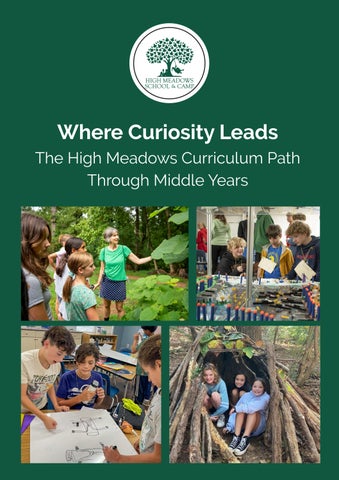
Where Curiosity Leads The High Meadows Curriculum Path Through Middle Years
How & What We Teach The Middle Years are a pivotal time of intellectual growth, increasing independence, and identity formation. In Grades 6 and 7, students investigate systems and engage globally, developing the ability to see connections, consider multiple perspectives, and understand their place within an increasingly complex world. By Grade 8, they are challenged to synthesize their learning, lead confidently, and prepare for the next chapter, bringing together the knowledge, skills, selfawareness, and sense of purpose that will enable them to enter high school as capable, curious, and confident learners. Tenets of Progressive Education at High Meadows School Social Justice and Sustainability At HMS, we empower students to take authentic action to bring change to their school community, city, state, and the world. Hands-On and Inquiry-Driven Learning Students at HMS learn to be an active partner in their education. They construct understanding by asking questions, investigating, experimenting, receiving feedback, and sharing their findings with an audience. Transdisciplinary Learning Our approach to teaching and learning connects subject areas, allowing students to connect new knowledge and deeper understanding to real-life experiences. Holistic Approach to Educating Children HMS cares about what kids know, who kids are, and what makes them feel safe, happy, and ready to thrive. The relationships we develop within the community contribute to the development of wellrounded individuals. Embracing the World HMS embraces the learning opportunities that exist outside the four walls of a classroom. Connecting with experts, the land, and the resources of the larger community allows students to experience the real-world applications of their education.
Learning Through Inquiry At High Meadows School, learning is about more than mastering academic content. As an International Baccalaureate (IB) Primary Years Programme (PYP) school, we help students develop the knowledge, skills, habits, and dispositions needed to become thoughtful, capable, and engaged learners. Learning is designed to be relevant, challenging, and connected to the world beyond the classroom through inquiry, reflection, collaboration, and action. The High Meadows Middle School curricular framework is shaped by a continued focus on inquiry, reflection, collaboration and meaningful action.
Approaches to Learning: Learning How to Learn
One of the most important goals of an IB education is helping students become confident, independent learners. The PYP emphasizes the development of transferable skills that students can apply across all subject areas and throughout their lives. Communication Skills - Students learn to express ideas clearly, listen actively, collaborate effectively, and communicate through speaking, writing, visual media, and presentations. Thinking Skills - Students develop critical and creative thinking, problem-solving abilities, decision-making skills, and the capacity to reflect on their learning. Research Skills - Students learn to ask meaningful questions, gather and evaluate information, investigate ideas, and use evidence to support their conclusions. Self-Management Skills - Students build organization, perseverance, responsibility, goal-setting, and reflection skills that support success in school and beyond. Social Skills - Students develop empathy, collaboration, relationship-building, and conflict-resolution skills while learning to work effectively with others.
Approaches to Teaching: How Teaching Happens at High Meadows The International Baccalaureate identifies six research-based approaches to teaching that guide learning across the High Meadows Elementary and Middle Years. At High Meadows, these approaches help create engaging, meaningful, and student-centered learning experiences. Teaching Based on Inquiry - Students build understanding by asking questions, investigating ideas, and actively exploring concepts rather than simply receiving information. Teaching Focused on Conceptual Understanding - Learning emphasizes big ideas and enduring concepts that help students make connections across subjects and apply understanding in new situations. Teaching Developed in Local and Global Contexts - Students connect learning to their own experiences, communities, and the wider world, helping them understand the relevance and purpose of what they learn. Teaching Focused on Effective Teamwork and Collaboration - Learning is strengthened through discussion, shared problem-solving, and collaboration among students, teachers, families, and the broader community. Teaching Differentiated to Meet the Needs of All Learners - Teachers create flexible learning experiences that recognize students' strengths, interests, backgrounds, and individual learning needs. Teaching Informed by Assessment - Ongoing assessment and reflection help teachers understand student progress and guide future learning, while helping students set goals and take ownership of their growth.
Grades 6/7 The High Meadows Learning Journey English Language Arts How do writers communicate effectively? How do our lives inform our writing? How does literature help us understand the larger world and human experience?
What Students Learn
Key Skills Students Develop
Grammar, vocabulary, and language conventions
Evaluating sources and synthesizing information
The relationship between literature, culture, and human experience
Analyzing and interpreting literary and informational texts
Novels, short stories, drama, poetry, nonfiction, film, advertising, and other media texts
Participating in discussions, debates, presentations, and dramatic readings
Literature and informational texts from diverse cultures, time periods, and perspectives, with connections to history, culture, and the social studies curriculum
Communicating effectively through speaking, writing, and multimodal formats, such as presentations, posters, and digital media
Personal narrative, argumentative, informative, research, and creative writing, including poetry, short stories, paragraphs, and essays
Developing empathy, cultural awareness, and criticalthinking skills
Literary elements such as theme, characterization, plot, setting, conflict, tone, mood, symbolism, and other techniques authors use to create meaning
Writing well-organized paragraphs, essays, and research-based pieces Analyzing arguments, claims, and multiple perspectives Close reading and annotation Supporting ideas with textual evidence
Spanish How do we expand our knowledge of ourselves and others through language? What Students Learn
Key Skills Students Develop
Cultural perspectives from Latin America and Spain
Reading authentic Spanish-language texts and media
Travel, food, clothing, and cultural traditions
Writing sentences, paragraphs, and short compositions
Practical vocabulary for everyday communication
Using vocabulary and grammar accurately in context
Spanish grammar, including present and past verb tenses
Developing pronunciation, fluency, and comprehension
Descriptive language and conversational skills
Asking and answering questions in Spanish
Traditions, celebrations, music, and history of Spanishspeaking countries
Developing global awareness and cross-cultural understanding
Words related to friendship, family, school, hobbies, and daily life
Comparing cultures and perspectives Building confidence using Spanish in authentic situations Presenting information through dialogues and projects
Grades 6/7 The High Meadows Learning Journey
Mathematics How do we use numbers and mathematical thinking to better understand our world?
What Students Learn
What Students Learn
6th Grade Math
Pre-Algebra (6th/7th)
Area of parallelograms and triangles
Exponents, square roots, and scientific notation
Statistics (collecting and analyzing data)
Surface area and volume
Percent concepts and relationships between fractions, decimals, and percentages
Coordinate geometry, including transformations
Integers, coordinate graphs, and simple linear equations
Algebraic expressions, equations, and inequalities
Number theory, order of operations, exponents, factors, and multiples
Linear functions, graphing, systems of equations, and mathematical modeling
Introduction to ratios and rates Whole number, decimal, and fraction fluency
Key Skills Students Develop Solving multi-step mathematical problems Evaluating multiple solution strategies Analyzing patterns and relationships Using algebraic reasoning and mathematical models Interpreting graphs, tables, and data displays Communicating mathematical thinking and reasoning Applying mathematical concepts to real-world situations Building fluency with numerical and algebraic operations Developing critical-thinking and problem-solving skills
Grades 6/7 The High Meadows Learning Journey Science How do we apply our knowledge of physical, chemical, and biological systems to live in harmony on Earth? How do we use cycles of scientific thinking to explain and gain a better understanding of the universe?
What Students Learn
Key Skills Students Develop
Chemistry and the properties of matter
Designing and conducting scientific investigations
Scientific inquiry and experimentation
Identifying variables and controlling experiments
Human body systems and life science concepts
Collecting, organizing, and analyzing data
Ecology, ecosystems, and environmental relationships
Building and using scientific models
Forces, motion, gravity, energy, and simple machines
Making evidence-based conclusions
Astronomy, the solar system, seasons, and moon phases
Applying scientific reasoning to solve problems
Density, states of matter, and physical and chemical changes
Connecting scientific concepts to real-world phenomena
Earth science, including geology, plate tectonics, earthquakes, and volcanoes
Collaborating effectively during laboratory work Communicating scientific findings through writing and discussion
Social Studies How do societies balance the needs/rights of the individual with the needs of the community? What does it mean to be American? How are civilizations created, organized, and changed? What Students Learn
Key Skills Students Develop
Ancient civilizations and early human societies
Analyzing primary and secondary sources
The Middle Ages and Renaissance
Conducting historical and social science research
Industrialization, the Civil War, and Reconstruction
Interpreting maps, timelines, and geographic information
Pre-colonial civilizations in the Americas and Africa
Developing informed citizenship and global awareness
World Wars and the Civil Rights Movement
Developing presentation skills for different audiences
The Neolithic Revolution and the development of agriculture
Evaluating evidence and multiple perspectives
Major world religions and their historical and cultural influence
Participating in debates, discussions, and simulations
The development of constitutional government and the foundations of American democracy
Identifying cause-and-effect relationships in history
The U.S. Constitution and its impact on American society, including its strengths and challenges
Comparing cultures, societies, and belief systems
Geography, economics, culture, government, and civic systems
Making connections between historical and contemporary issues
Grade 8 The High Meadows Learning Journey English Language Arts How do we use language to construct meaning and value?
What Students Learn
Key Skills Students Develop
Storytelling, myths, legends, folklore, and fairytales
Analyzing complex literary and informational texts
Creative writing and literary analysis
Comparing multiple viewpoints and perspectives
Gothic literature, poetry, and forms of poetry
Assessing the credibility of sources and information
Informational texts and media analysis
Thinking critically about media, messaging, and audience
Literary Elements - plot, theme, setting, symbolism, tone, mood, and characterization
Evaluating evidence and supporting claims with textual evidence
The Odyssey, allusions, foreshadowing, and figurative language
Participating in discussions, presentations, and collaborative projects
Shakespeare and dramatic literature
Communicating clearly through written, oral, and multimedia formats
Digital media literacy and persuasive communication
Writing effective arguments, narratives, and researchbased essays
Author's purpose, rhetoric, and persuasive techniques
Becoming thoughtful readers, writers, speakers, and consumers of media
Narrative, argumentative, and research writing Multiple perspectives across cultures and genres
Spanish How do we expand our knowledge of ourselves and others through language?
What Students Learn
Key Skills Students Develop
Health, wellness, and healthcare communication
Developing fluency, pronunciation, and comprehension
Home, family life, and daily responsibilities
Interpreting authentic texts, media, and cultural resources
Cities, communities, and navigation
Building cultural awareness and global understanding
Food, cooking, and cultural traditions
Writing detailed descriptions, reflections, and presentations
Media, movies, entertainment, and popular culture
Presenting information orally using a variety of vocabulary and increasingly complex grammatical structures
Travel, tourism, and communication in real-world situations
Communicating confidently through speaking, listening, reading, and writing
Traditions, history, and perspectives of Spanishspeaking cultures
Comparing and analyzing cultural traditions and perspectives
Advanced vocabulary, conversation, and writing skills through the use of a variety of tenses and grammatical structures, including commands, object pronouns, and other language features
Making meaningful connections between language, culture, and identity
Grade 8 The High Meadows Learning Journey
Mathematics How do we use algebra to generalize arithmetic? How do we use algebra to explain, model, and represent natural phenomena?
What Students Learn
What Students Learn
Algebra (scope and depth varies by level)
Geometry
Univariate and introductory bivariate statistics
Reasoning and logic in geometry
Linear equations and inequalities
Congruence, similarity, and proof
Ratios, rates, proportions, and probability
Coordinate geometry
Linear functions
Right triangles and trigonometry
Systems of equations
Area and volume
Exponents and radicals
Transformations
Exponential functions
Circles
Polynomials, quadratic equations, and quadratic functions
Real-world mathematical applications
Algebraic reasoning and mathematical modeling
Key Skills Students Develop Constructing logical mathematical arguments Modeling and analyzing real-world situations Communicating mathematical thinking clearly Preparing for higher-level mathematics coursework Applying algebraic and geometric reasoning Using technology and mathematical tools effectively Interpreting data and identifying patterns and relationships Evaluating the accuracy and reasonableness of solutions Developing advanced problem-solving and analytical skills Solving complex mathematical problems using multiple strategies
Grade 8 The High Meadows Learning Journey Science How do we investigate and understand the biological, chemical, and physical universe?
What Students Learn
Key Skills Students Develop
Scientific inquiry and experimental design
Designing and conducting scientific investigations
DNA, RNA, and protein synthesis
Collecting, analyzing, and interpreting data
Natural selection and evidence for evolution
Applying scientific reasoning to explain observations
Atomic theory and the periodic table
Evaluating evidence and drawing conclusions
Chemical bonding, reactions, and properties of matter
Using laboratory equipment and techniques safely
Connections between science and real-world issues
Applying mathematical models to scientific concepts
Velocity, acceleration, and projectile motion
Solving problems using evidence-based reasoning
Biology, including cells, genetics, heredity, and evolution
Collaborating effectively during investigations and projects
Physics concepts including force, motion, momentum, and energy
Connecting scientific principles to contemporary challenges Communicating scientific understanding through writing and presentations
Social Studies How are humans unique? How do social scientists study human behavior? What Students Learn
Key Skills Students Develop
Human origins, anthropology, and evolution
Analyzing primary and secondary sources
Neurology and the study of human behavior
Conducting research and evaluating evidence
Political philosophy and modern political theory
Comparing political systems and philosophies
Government systems and civic institutions
Investigating human behavior and decision-making
State and local government in the United States
Interpreting legal, civic, and economic issues
The Judicial Branch’s structure and function
Participating in discussions, simulations, and debates
Constitutional rights and civic responsibilities
Constructing evidence-based arguments
Microeconomic and macroeconomic concepts
Developing financial literacy and decision-making skills
Personal finance, budgeting, saving, and investing
Thinking critically about contemporary issues
Methods employed by social scientists to study human behavior
Becoming informed, responsible, and engaged citizens
The relationship between individuals, communities, and society
Grade 8
The High Meadows Learning Journey
Capstone The Capstone Inquiry Project serves as the culminating academic experience of High Meadows School. Drawing upon the knowledge, skills, and dispositions developed from Pre-K through Grade 8, students engage in an extended inquiry that challenges them to investigate a topic, issue, or question of personal interest and social significance. Capstone emphasizes student agency and intellectual curiosity, encouraging students to pursue original ideas, develop informed conclusions, and create authentic products or presentations that demonstrate deep understanding. Students engage in reflection throughout the process, refining their thinking, responding to feedback, and strengthening their ability to communicate complex ideas effectively. The experience culminates in a public presentation in which students share their research, insights, and learning journey with peers, teachers, families, and community members. More than a final project, the Capstone represents the synthesis of a High Meadows education—demonstrating students’ readiness to think critically, act responsibly, communicate confidently, and approach future academic challenges with independence and purpose.
Mini-Courses
The High Meadows Learning Journey Middle Years Grades 6-8
In Middle Years, Mini-Courses provide students with meaningful opportunities to pursue their interests, discover new passions, and take ownership of their learning. Designed around student choice and curiosity, these immersive experiences allow learners to explore a wide range of subjects, including the arts, wellness, outdoor education, technology, animal care, leadership, and more. Through creative challenges, collaborative problemsolving, and authentic experiences, students develop confidence, deepen their skills, and gain a greater understanding of themselves and the world around them. Mini-Courses celebrate the diverse talents, interests, and intelligences of every learner while fostering a lifelong love of discovery.
Mini-Course Examples Ceramics
Rock Band
Advanced Band
World Peace Game
Yoga
Theater Arts
Outdoor Living Skills
Debate
Avian Embryology
Cooking
Physical Education
Future Cities
Gardening
Laser Engraving
Woodworking
The High Meadows community celebrates and perpetuates each individual’s quest for knowledge and skill, sense of wonder, and connection to the natural environment. We empower each to be a compassionate, responsible, and active global citizen. Age 3 through Grade 8 Authorized IB PYP World School 1055 Willeo Road, Roswell, Georgia 30075 (770) 993-2940 info@highmeadows.org