The
YOU LIKE JAZZ?
Tiger HI-LINE
Friday, Feb. 9, 2018
All jazz bands , choirs perform on Saturday, Feb. 3. /pages 2-3 Follow us on Twitter at tigerhiline, Facebook at TigerHilineOnline and on our website at www.hiline.cfschools.org
Volume 58 Edition 17
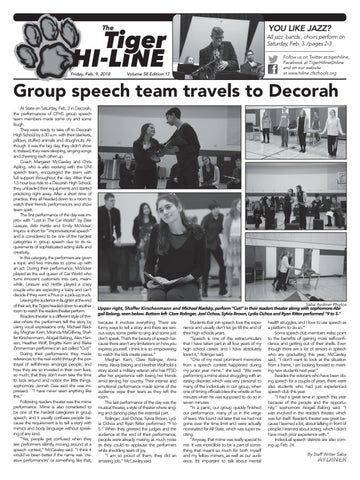
Group speech team travels to Decorah At State on Saturday, Feb. 3 in Decorah, the performances of CFHS group speech team members made some cry and some laugh. They were ready to take off to Decorah High School by 6.30 a.m. with their blankets, pillows, stuffed animals and doughnuts. Although it was the big day, they didn’t show it. Instead, they were sleeping, singing songs and cheering each other up. Coach Margaret McCawley and Chris Apling, who is also working with the UNI speech team, encouraged the team with full support throughout the day. After their 1.5 hour bus ride to a Decorah High School, they unloaded their equipments and started practicing right away. After a short time of practice, they all headed down to a room to watch their friends performances and show team spirit. The first performance of the day was improv with “Lost In The Car World” by Elise Leasure, Arlo Hettle and Emily McVicker. Improv is short for “improvisational speech” and is considered to be one of the hardest categories in group speech due to its requirements of sophisticated acting skills and creativity. In this category, the performers are given a topic and two minutes to come up with an act. During their performance, McVicker played as the evil queen of Car World who turns innocent customers into cars; meanwhile, Leasure and Hettle played a crazy couple who are expecting a baby and can’t decide if they want a Prius or a pick-up truck. Leaving the audience in laughter at the end of their act, the Tigers headed down to another room to watch the readers theater perform. Readers theater is a different style of theater where the performers tell the story by using vocal expressions only. Michael Riadsky, Meghan Kern, Miranda MaGillvray, Shaffer Kirschenmann, Abigail Balong, Alex Hanson, Heather Wolf, Brigitte Kern and Blake Zimmerman performed an act called “Cut!” During their performance they made references to the real world through the portrayal of selfishness amongst people, and how they are so invested in their own lives; so much, that they don’t even take the time to look around and notice the little things. sophomore Jenneh Gee said she was impressed. “I have never seen anything like this.” Following readers theater was the mime performance. Mime is also considered to be one of the hardest categories in group speech, and it usually confuses people because the requirement is to tell a story with mimics and body language without speaking of any kind. “Yes, people get confused when they see performers silently moving around at a speech contest,” McCawley said. “I think it would’ve been better if the name was ‘creative performances’ or something like that,
Saba Aydiner Photos Upper right, Shaffer Kirschenmann and Michael Riadsky, perform “Cut!” in their readers theater along with sophomore Abigail Balong, seen below. Bottom left Clare Rolinger, Joel Ochoa, Sylvia Brown, Lydia Ochoa and Ryan Ritter performed “9 to 5.” because it involves everything. There are funny ways to tell a story and there are serious ways; some prefer to sing and some just don’t speak. That’s the beauty of speech because there aren’t any limitations on how you express yourself, I think it is so empowering to watch the kids create pieces.” Meghan Kern, Clare Rolinger, Anna Hertz, Alexa Balong and Heather Wolf told a story about a military veteran who has PTSD after her experience with losing her friends amid serving her country. Their intense and emotional performance made some of the audience wipe their tears as they left the room. The last performance of the day was the musical theater, a style of theater where singing and dancing plays the essential part. Rolinger, Joel Ochoa, Sylvia Brown, Lydia Ochoa and Ryan Ritter performed “9 to 5.” When they greeted the judges and the audience at the end of their performance, people were already making as much noise as they could to applause the performers while shedding tears of joy. “I am so proud of them, they did an amazing job,” McCawley said.
Students that join speech love the experience and usually don’t let go till the end of their high schools years. “Speech is one of the extracurriculars that I have taken part in all four years of my high school career, and I have absolutely loved it,” Rolinger said. “One of my most prominent memories from a speech contest happened during my junior year mime,” she said. “We were performing a mime about struggling with an eating disorder, which was very personal to many of the individuals in our group, when one of timing officials blew the whistle at five minutes when he was supposed to do so in seven minutes. “In a panic, our group quickly finished our performance, many of us in the verge of tears. We found out later that we had not gone over the time limit and were actually nominated for All State, which was super exciting. “Anyway, that mime was really special to me. It was incredible to be a part of something that meant so much for both myself and my fellow mimers, as well as our audience. It’s important to talk about mental
health struggles, and I love to use speech as a platform to do so.” Some speech club members =also point to the benefits of gaining more self-confidence and getting out of their shells. Even though there are a lot of seniors in speech who are graduating this year, McCawley said, “I don’t want to look at the situation from a frame, I am looking forward to meeting new students next year.” Besides the veterans who have been doing speech for a couple of years, there were also students who had just experienced speech club this year. “I had a great time in speech this year because of the people and the opportunity,” sophomore Abigail Balong said. “I was involved in the reader’s theater, which was fun itself. Reader’s theater was great because I learned a lot, about talking in front of people. I learned about acting, which I didn’t have much prior experience with.” Individual speech districts are also coming up Feb. 24. By Staff Writer Saba
AYDINER
2
The
NEWS
Tiger
Friday, Feb. 9, 2018
HI-LINE
Jazz one will play for the Northeast Iowa Band Master Association conference representing as the best high school jazz band in Iowa. Below, sophomore Easton Sckerl plays drums, freshman Eli Smith plays guitar. To the right Michael Kremer plays saxophone as well as William Sims, soloing in a piece titled, The Next Chapter .
Jazz Show
Sydney Corson Photos
Jazz too, vocal jazz, and Jazz one all performed at the annual jazz concert on Saturday, Feb. 3. Bottom left, Johnny Hartleip soloing in the song Body and Soul.
The
Tiger
HI-LINE
NEWS
Friday, Feb. 9, 2018
3
Lockers fading from routines of students In classic high school movies, students almost always congregate around lockers. They are a key factor of what a high school experience is like. Whether it is someone decorating it for a birthday, being shoved into it or leaning on it between classes, the cliche moments of high school lockers no longer ring true with the reality of lockers and the millennial generation. Sophomore Austin Cross did not even know where his locker was until one day walking in the hallway he saw a football sign on a locker with his name written on it. “It was kind of a mistake finding my locker,” he said. “My classes are all too far apart in order to go to my locker. If we rebuild the high school, I don’t think we should have lockers. If it is such a big high school with so many students, there is no point in having lockers to get to them.” According to a poll of 195 students in Cedar Falls High School, 62.6 percent know where their locker is in the building, but 70 percent do not even use their lockers. Many students struggle with not having enough time between classes to switch out books. “I think a lot of people don’t use their lockers because they don’t have
Sabine Martin Photo
Lillian Schmid is one of the 29.2 percent of students still making use of her locker, accoding to a recent Hi-Line survey. time to stop by or don’t feel the need to, but I also get the sense that they think it’s dumb to use lockers because it’s not really a huge thing at the high school anymore,” sophomore Jade Pham said. The social aspect of stopping between classes and taking the time to see friends is no longer needed because of social media and accessibility to cell phones. Instead of stopping
at lockers to talk, one message can be sent in a fraction of the time in the 4-minute passing period. Pham is part of the 29.2 percent students that do use lockers. “I use my locker because it makes it way easier to carry my books around when I don’t have to take them all at once,” she said. For the few that use their lockers, they are not often used for academic reasons, and 40.4 percent of students
say that they use their locker for keeping sweatshirts and winter clothes in. At Thomas Jefferson High School in Fairfax County, Virg., lockers are not a problem because they don’t have any, according to the Washington Post. For part of a school renovation, communal cubbies were installed instead of lockers. As discussion of a new high school being built for the Cedar Falls school district continues, the value of lockers is something to consider. Out of a poll of 195 CFHS students, 46.7 percent said there should be lockers at the new high school, 37 percent said maybe and the remaining 16.3 percent say there should not. The nostalgic properties of lockers are not as important in high schools as they used to be, but they are also not something students need in order survive as textbooks start to become digital and communication is no longer set in one meeting spot between classes. “I don’t think that I absolutely need a locker to survive high school, but it definitely makes life easier not having to haul super heavy textbooks and stuff on my back all day,” Pham said. By Co-Editor-Chief Sabine
MARTIN
Early graduates share post high plans Twelve years. Thirteen counting kindergarten. Students spend on average 1,000 instructional hours per year in school according to the center for public education. As senior year, the grand finale, rolls around, some students decide to graduate punch out early, leaving the school and what they would once call a daily routine behind to submerge themselves into the “real world,” as they exit four months earlier than their peers. In the graduating class of 2018, 25 students made the choice to graduate early. Of those students, Abby Pashan, Majda Suljic and William Gage shared their experiences with graduating early. “I was getting to a point where I was sick of the same old thing,” Suljic said. “I had taken all of the classes I wanted to, and there was nothing else to spark my interest. Club Volley ball also takes a lot of my time and I have missed a lot of school in the past because of it. Now it is nice to not miss and be behind.” Similar to Suljic, Pashan simply lost interest in the high school setting. “I had friends who decided on graduating early, so I became interested. After talking with my counselor, I realized there weren’t any classes that I was interested in taking second semester, so I decided to graduate,” Pashan said. Gage had different intentions when graduating early. “I chose to graduate early because my plan was to join the military as soon
2018 Early Grads
Andersen, Bianca J Canfield, Riley M DeGroote, Shaden C Denney, Dean Michael Gage, William A Gray, Alexander Habnick, Ethan E Harris, Natalie J
Hendren, Kyle J Howard, Kaylee M Johnson, Kelsi A Johnson, Molly J Kouri, Kinsey E Lynch, Taylor R Meyers, Mason Pashan, Abigail C
as I could,” Gage said. Unfortunately, Gage’s plans were spoiled when he discovered that he could not join the military due to past hip injuries. “I wanted to join the military because my dad was in the military, and so was my grandpa. I just wanted to be involved in something bigger than myself,” Gage said. Instead of letting this defeat get the best of him, he changed plans and focused on a new future. “I got a full time job at Miracle Car Wash once I graduated high school and plan to start at Hawkeye Community College in the fall with a major in criminal justice,” Gage said. Similar to Gage, Pashan was pulled to the full time job aspect, along with the break before beginning four more years of school. “I babysit twin girls for a single mom, and that takes up a lot of time since I watch them for eight or more hours at a time,” she said. “I have also been spending a lot of time with family and friends again and just taking time
Roth, Nicholas L Sandell, Hunter M Sires, Caitlyn L Sires, Johnathan J Smiley, Austin J Smith, Kiara Rachelle Suljic, Madja VanRosendaal, Kyle R
for myself since I am no longer stressed or worried about school.” After this summer, Pashan has decided to attend Iowa State University with an undecided major but is looking at the human science field. Suljic also plans to attend school in the fall, but has taken her time off to also focus on her future paths. “I still don’t know where I want to go, so I’ve taken a lot of time to look into schools to make sure I live where I decide to go. I have also set up some job shadows at the hospital,” Suljic said. After a close friend died earlier this year, Suljic plans to go into the medical field, she just has to decide where. “I have been looking at Iowa, Grand View, Upper Iowa, Mount Mercy, Bemidji State, Mankato State and a few others. I’ve always wanted to be a hematologist and take the pre med route. After Evie passed away, I looked more into pathology and oncology side of it, and my passion for the career grew. All these schools will help me where I want to go,” Suljic said. While the pressure put on students is
high to finish with the class, these grads shared their advice on early graduation. “Definitely think it through and make sure it is the best option for you. Don’t just do it to get done with school sooner because you could be missing out on some good classes and opportunities at CFHS,” Pashan said. Similarly, Gage reflected on making sure it is the best option for one to consider. “Really make sure it is what you want. It’s a good idea to have a plan for once you graduate and make sure the plan is set in stone,” Gage said. Majda may not have a set plan at the moment for her future but has no regrets on her early graduation. “If you feel like you’ve had your dose of high school and have put in the work to be able to graduate early and you’re thinking about it, just go ahead and do it. CFHS was fun, and I love my friends, but I see the friends worth seeing outside of school. I still go to games and support the Tigers as well. I haven’t missed out on anything because I graduated early. I feel like I’ve gained so much Instead. My mental and emotional health was not a problem before necessarily, but my break has improved it anyway since I’m more focused on myself and not the pressures that high school may bring.” By Editor-in-Chief Rachel
SCHMID
4
The
FEATURE
Tiger
HI-LINE
Friday, Feb. 9, 2018
UNI speaker focuses on race
“I think we are on our way to a better place, but I think we have to roll up our sleeves and work to get there. When I say “we,” I am talking about the great, big, royal, capital “we.” It’s everybody’s work. Race is no longer a spectator sport for anybody. It impacts all of us. I don’t care if you came here on a luxury liner or a slave ship, or if you crossed a border, or if you entered on a Learjet. It doesn’t matter. We’re all on the same boat now. We need to figure out how to coexist with each other and remain tethered to each other, even if we don’t agree,” Michele Norris, the founder of the Race Card Project and former co-host of National Public Radio, said. Norris came to UNI and the Gallagher Bluedorn on January 30 to speak about “The Grace of Silence,” her memoir about the hidden stories of race within her family. Norris stumbled upon these stories accidently. She was planning to write a book about the average American’s view of race after Obama was elected; however, Norris was out to breakfast one morning with her grandfather when he became fussy that people weren’t as grateful, and he blurted out, “You know your father was shot.” Norris did not know this because her late father told almost no one in his family about this, including his then wife, so Norris did some digging. She found out that he was shot in the leg by a white policeman in 1946 while he was entering a building to vote. But she didn’t stop there. She also found out her grandmother was an Aunt Jemima representative. Her grandmother traveled around a six-state region, including Iowa and Minnesota, something that women, especially African American women did not do at the time. Her grandmother would go from town to town trying to convince people to switch from homemade pancakes to convenience cooking through demonstrations of how to use the simple Aunt Jemima complete pancake mix. Her parents kept these stories a secret from Norris and her siblings because they loved their country and wanted their children to be as successful as possible while also loving their country. However, these stories brought race to the forefront of Norris’ mind. They helped Norris realize that race was a conversa-
Meron Abebe
tion the world needed to have. Realizing that her own family had hidden stories, Norris saw that people didn’t want to have conversations about race or were fearful about having those conversations, so she knew she had to start it. “I was afraid that I would face people who would cross their arms and cross their legs and rather bite their toenails than engage in a conversation about race, so I thought I have to figure out how to lubricate this conversation somehow, and the thing that I came up with was the Race Card Project,” Norris said. Norris did some brainstorming and landed upon different exercises. She started with a one word exercise and worked her way up to six. She knew that people are often described by one word, a word that may be a genuine description, or a stereotype, so she gave people six words. “Sometimes that word feels good, and maybe you could own it, but sometimes it doesn’t feel so good because you’re so much more than that,” Norris said. “No one word could possibly describe us. So, we decided to give people six words. Think about the word race. Then whatever comes into your mind, your memories, your laments, your triumphs, your anthems, your perspective, your viewpoints. Whatever you want to say, but you only get six words.” Norris had formulated this idea, but she wanted to see if it would catch on. Thus, Norris created postcards that consisted of the six word exercise and the outlet where people could express their six word story. “I was on a 35 city book,” she said. “I would leave these postcards wherever, and I wondered if people would take the bait. Pretty quickly it became clear that people wanted to share their stories.” Soon life stories that were reflected in six words started flood-
Submitted photo ing Norris’ Inbox. “‘White not allowed to be proud,’ “I’m only Asian when it’s convenient,’ “Lady, I don’t want your purse,’ “Black children cost less to adopt,’ “No, you cannot touch my hair,’ “So, I knew I had to keep going,” Norris said. When the cards started to come in, they would send in their six words, and Norris also asked them to send in their back story and a picture. “Now more than eight years later,” Norris said. “We have 250,000 stories archived. They come from every state in our country. They come from more than 70 other countries and together create this wonderful archive. They help me understand perspectives that I could not get to when I was in Studio 2A in NPR. It becomes this tap root that helps me understand America in a different way.” Norris left her job at NPR for the Race Card Project and jumped in with no regrets. “I left my job at Public Radio, so I could dedicate my time to this crazy project. I spent so many years in public radio asking people to listen to me. Now I am asking them to listen to each other,” Norris said. She now reaps the benefits of taking this project head on. “I now stand before you as someone for whom race is at the center of my portfolio,” Norris said. “Because of this, my world did not get smaller. It got so much bigger. I was able to understand America in a particular way because I put my ear to a conversation that we often run away from.” To submit your six words, visit theracecardproject.com By Staff Writer Sophia
SCHILLINGER
Six words: Skin defines perception, can you see? Backstory: “I think just being African American, I notice the different ways people perceive me or the different ways they perceive their surroundings versus what I see based on experiences living a different life from them. I think it’s important to consider how your skin color and your physical features may lead people to interact with you differently than how they would interact with others in their lives. I think it is very important to know that some of these biases can affect people negatively, but they can also affect people positively. It’s just good to be conscious of how your treating other people. “
Jackson Kliewer
Six Words: Division, segregation, isolation, a “superior nation” Backstory: “I have not personally seen racism with my own eyes, but I have studied the history of it. I studied how it operates in society at this present time. I have very, very deep feelings about such inequality in society. I prize equality as one of the most important things to strive for and that we all need to focus on how these concepts engage in society, so then we can trace them back to these roots, to save society.
Jack Stichter
Six Words: Like potatoes, our outside’s skin deep Backstory: “I do think race is skin deep. I don’t think we should overlook it by any means or tell ourselves we should be color blind. Appreciating the skin tone of another person brings us closer to accepting it fully and making it another thing about a person, like someone has green eyes or brown eyes, but for myself, I know I come from a very diverse home, a lot of adoption, so I consider myself someone who really doesn’t take much consideration for race.”
Kyle Trunell
Six Words: We are all still homo sapiens Backstory: “If you look around in this room (Tigers Den), everyone’s coexisting peacefully. Not everyone’s straight white. Not everyone’s a guy. There is some things that matter about a person, like their personality, per se. The color of your skin, the color of your hair, in the long run it doesn’t really make that much of a difference.”
The
Tiger
HI-LINE
Fully Scripted
Friday, Feb. 9, 2018
ENTERTAINMENT
5
For anime fans looking to dive deeper, mangas might offer surprising discoveries
Anime is fun to watch, that is until the series comes to an end. Sure you could watch the series again, but wouldn’t it be a good time to get a new look into the storyline you love so much? Then perhaps give the manga a try, you never know, you could end up with more information than the anime gave you that leads to a new realization about one of your favorite characters or find one that has extra parts that the anime couldn’t fit in. So without further ado, here are some manga recommendations.
Death Note Most anime lovers are familiar with this dark title, but without reading the manga you’re only getting half of the story. A few of the plot holes that some caught onto in the anime can be found and explained in the manga. Not only that, but the manga also helps explain how the death note works in much more thorough detail than in the anime, which can help bring some things to light. (Pun not intended.) There’s another plus to reading the manga: you get to enjoy amazing art and clever punchlines that weren’t included in the anime.
Ga Kill This is one of the lesser known animes, but its one where the manga has quite a difference compared to the anime. Just like in some movies, the makers might change a few things to make it more dramatic or tragic than it really is to promote more emotion from the audience. That same thing happens in the anime, and if you have read the manga, you would notice these differences almost right away, but with the realization of the differences, you will find many secrets and have insight to things the anime had never shown.
Black Butler Reading this manga will not only let you in on more secrets and side stories, but it will also let you get ahead of the anime. “Black Butler” as an anime is still being made, meaning the series is not over yet like most popular animes are. This means that if you can catch up in time, you can be ahead of the anime and get to know what will happen next rather than just sitting around waiting for another season to be made. Not only that, but the manga is more in depth in the plot than the anime is. By Staff Writer Skylar
PROMER
Difficulty spikes may reveal what lies ahead A difficulty spike is when a game gets harder by a larger amount than it had been. For example, if in an RPG, you were fighting level 20 enemies, then all of a sudden the boss is level 35. This can also come in the form of limiting items dropped by enemies, items in chest, money you get from enemies, and so on. Difficulty spikes come in many forms, and can succeed and fail. This can be done correctly quite easily. A spike is a huge jump, yes, but that doesn’t mean it can’t be eased into. Slowly in a game, levels can get higher and items can be less plentiful, and then a very hard boss can come, after which the game has two paths it can take: continue with being hard or give the player a break with some easy enemies and bosses. Most games chose the middle road and continue to slowly climb up to another hard boss. Most games focus more on their story, and if a boss is hard, usually it’s for some sort of story relation. What this means is, the final boss won’t be one shotted no matter how
Submitted Photo
The difficulty of boss is a good way for video game players to predict what action may lie ahead. strong you are. The final boss is meant to be the last challenge of the main story, so the player will have difficulty, or annoyance, no matter what. The wrong way to do this is uncommon, and is considered right in some people
eyes. The way to do a difficulty spike “wrong” is to throw an optional, keyword, optional area into the game. After this, a main area has a level that’s reasonable, and, to proceed with the story, you skip over said extra area. The next
area is nearly double the level of the last area, and if you go to the optional area, it’s only a bit higher. This may be hard to understand, but basically what it means is that even though the game tells you an area is optional, it’s more or less required. Another bad way to throw a difficulty spike in is through bad tutorials. Let’s say, for example, you have something you can upgrade or you can get stronger somehow, but the game never officially teaches you this. By this means, a decently easy boss could be extremely hard. Though good or bad, difficulty spikes do help a game. If a game is too easy, it’s a bore to play unless the story is amazing. If the game is too hard, you won’t want to play it. A difficulty spike is kind of like a warning to say “the game is not going to get easier than this boss,” so you’re mentally prepared for the future. By Staff Writer Noah
FORKER
6
The
OPINION
Our View
Goodbye Chief Wahoo Now let’s ditch all racist mascots
Baseball is, and always has been, a celebration of the past. Its roots are soiled in a historic run of great athletes, and one of the first franchises to bring fanhood into the country. It’s a great odyssey that celebrates curse breakers and long balls. From the Sultan of Swat to Shoeless Joe, baseball celebrates the vivid late history of the United States. That being said, there is always a breaking point. The Cleveland Indians moved from Grand Rapids in 1900 and have stayed there ever since. After various name changes, the name “Indians” stuck. Rooted in the history of Native American tribes, the organization has kept the name through mass events of culture change. But the name wasn’t the biggest problem. The logo, eventually named “Chief Wahoo,” depicts a stereotypical Indian head with feather and cartoonish features. The logo originated in a local Cleveland newspaper during the ’30s to symbolize a big win. However, the club did not use that specific logo. Instead, in 1972, a caricature was hired to represent the image from all that time ago. Chief Wahoo was used as the primary logo from 1947 to 2013, being replaced by the “C” that dawns the cap today. Now the times have caught up with Cleveland, and times are changing. After adjusting the article to just be used as an alternate logo in 2013, the organization and league announced on Jan. 29 that the old logo will no longer be used to symbolize the team on-field; however, the logo will still be used in merchandising. It took them forever to relinquish the logo from the uniforms, and now it’s not even going to be banned from the organization. Just the uniforms. This is a step in the right direction, but it’s a small step. We think it’s too small a step. Teams like the Atlanta Braves and Washington Redskins are still behind in the times. Forget team history. Forget the culture. The only thing that should be considered is offense. Leagues need to take charge and force the organizations to change their names and logos. The discrimination of races and ethnicities on such a public statue is unneeded. The Indians made the right move, but they aren’t done. Franchises that use discriminating nicknames around American sports need to follow the Indians and make the change.
We think it’s too small a step. Teams like the Atlanta Braves and Washington Redskins are still behind in the times. Forget team history.
Tiger
HI-LINE
Friday, Feb. 9, 2018
Put a pause on the straws Over 500 million straws are used daily in America alone. In a lifetime, it is estimated that the average human will use over 35,000 straws, and this is a low estimate. If every American used two plastic straws a day for 70 years, that is over 51,100 plastic straws in a lifetime. Not only are these small tubes of plastic unnecessary for beverage consumption, but they are also the sixth most common type of litter. Since plastic straws are too small to recycle and usually made of other materials, they end up in garbage cans, landfills and most importantly the ocean. It is estimated that 8 million tons of plastic are dumped into the ocean annually. An estimated 71 percent of seabirds and 30 percent of turtles have been found with plastics in their stomachs. When they ingest plastic, marine life has a 50 percent mortality rate. Once Sophomore Sophia Schillinger and 2015 graduate Hiram Marquez heard about this issue, they decided to take action. “One day I went home and my dad told me, ‘Hey, stop using straws. They are bad for you.’ At first I was jokingly saying I wouldn’t use straws anymore. I would tell other people not to use straws, and they would ask me why do I decided to do my own research. I learned how bad they are and how stupid it is that people even use them,” Marquez said. Sophia saw the passion of Marquez through an Instagram post and was influenced by a funny picture with a powerful message. “Hiram Marquez, who is a small activist at UNI, posted a photo on Instagram about straws getting stuck in penguins’ throats. It was a funny photo because he is a really funny guy, but it really got my attention. I also look up to him, so I decided that I should stop using plastic,” Schillinger said. Schillinger has known Marquez for years and looks up to him
greatly as a runner and a person. His influence impacted her, and she decided not to only make changes herself, but influence her friends similar to the way Marquez influenced her. “Right after a cross country meet, my friends and I went to Rudy’s. They have a straw dispenser where you push the button and the straw comes out. They were all using straws, so I told them how they hurt the environment. Now every time we go out to eat, I tell them and everyone I see not to use a straw,” Schillinger said. Marquez also influences others not only through Instagram and Snapchat where he “exposes” people on his stories for using straws, while showing others the effects through real videos. “In the beginning, my approach wasn’t the greatest because I would just tell people not to use them and attacking them, which doesn’t work. Usually people will just use them more if you do that. I show people the sea turtle video with the straw in its nose and just educating others on the issue,” Marquez said. After a video of scuba divers pulling a small plastic straw from a turtle’s nose swept the Internet activists have jumped onto the “The Last Straw” campaign. This has sparked a chain reaction similar to Marquez and Schillinger for people to start making changes. California is trying to pass a bill where restaurants cannot give straws to customers without asking, and may different campaigns and companies have started to end the use of the plastic straw. With the amount of plastic being used daily increasing, it seems like one little straw would not make that big of an impact. However, both Schillinger and Marquez disagree. “People tell me that there is so much more than straws. It is a one step at a time type of deal. When you tell people about straws, they
usually start thinking about plastic in general, and that creates a movement,” Marquez said. The movement itself is not only a personal choice, but something much bigger than oneself. The use of a single plastic straw. “Think about if you really need this piece of plastic and not only how it will affect you, but the world around you,” Schillinger said. Schillinger and Marquez are also both very optimistic for a future without plastic straws. “I hope for a future without straws. I do see one, but not that close unless people do start caring. There are people who I tell how bad straws are, and they would rather suck on their smoothie with a straw without realizing,” Marquez said. Most of the plastic straw waste is a result of ignorance of many people across the nation. “I definitely see a future without straws. I feel like we will get there. It will take awhile to get people to adjust—especially if we keep taking things from the world and we want to keep living on it,” Schillinger said. Both Marquez and Schillinger have a growing straw collection where they pick up straws on tables at restaurants, the ground and other various places. Marquez simply keeps a box in the backseat of his car, but Schillinger has a bigger plan for her growing collection. “At first it was just a crazy idea that I had the night I went to the restaurant with my friends,” she said, “but then I started collecting more and more. I planned to build a penguin holding a straw, out of straws. This could be going on over years depending on how many I collect.” It is estimated that by the year 2050, there will be more plastic in the ocean than fish. However, Americans still persist on using straws full throttle. It is just a small piece of plastic anyway, right? By Co-Editor-In-Chief Rachel
Contact Us Do you use your locker?
The Tiger Hi-Line is a weekly publication of the journalism classes at Cedar Falls High School, 1015 Division Street, Cedar Falls, Iowa 50613. Our website is www.hiline.cfschools.org. The Hi-Line is distributed to CFHS students on Fridays to read during their third period classes. Columns and letters do not necessarily reflect the opinions of the Hi-Line staff or Cedar Falls Schools. The Hi-Line editorial is presented weekly in the editorial labeled Our View, and it is the view of the majority of the editors listed below. Reader opinions on any topic are welcome and should be sent to The Tiger Hi-Line staff or delivered to room 208. All letters must be signed. Letters must be submitted by 3 p.m. on Monday for publication in the following Friday edition. Letters may not exceed 300 words and may be edited to meet space limitations. Writers should include their contact information for verification. Editors-in-Chief: Elise Leasure, Sabine Martin, Rachel Schmid, Tehya Tournier Staff: Saba Aydiner, Benjamin Boezinger, Noah Forker, Chase Kline, Kendall Maslak, Sierra Miller, Skylar Promer, Sophia Schillinger, Matthew Walsh
“Yes, every day. Only in winter.”
—Hannah Spratt Senior
“I don’t use my locker.”
—John Glascock Junior
SCHMID
By Staff Writer Kendall
MASLAK
“Not at all.”
—Jack Moody Sophomore
“No.”
—Karlee Pagano Senior
The
Tiger
HI-LINE
SPORTS
Friday, Feb 9, 2018
7
Under lead of new CFHS alumni coach, swimmers double qualifiers at Districts
Excitement rushed through his body as the last swimmer of the 400 freestyle relay touched the wall and senior Sam Reinhart looked at the clock: a new fastest time for the relay and a tie with Sioux City for first place. On Saturday, Feb. 3 in Fort Dodge, the men’s swim team took on seven other teams, receiving the district title, the first since 2012. Going into the meet, the team did not have many expectations, except to qualify as many members as they could for State. “Honestly, I didn’t even think about what place we may get at the meet. My only focus was getting as many of my swimmers to State as possible. The fact that we tied for first was just a nice cap onto the meet,”head coach Jordan Wessels said. And the team definitely qualified. They doubled the amount of state qualifying events compared to last year, and first followed. With much success this season, sophomore Dawson Bremner credits the improvements to Wessels. “Our team really persevered despite some adversity, and we all competed to the best of our abilities the whole meet. We co-won Districts and were able to qualify a respectable amount of swimmers for State, and the relays all qualified. Our hard work the whole season and an amazing coach to guide us got us to where we are now,” Bremner said. Senior Sam Reinhart also credits success to Wessels and touches on how the availability of a familiar face has helped
Submitted Photo
Mens Swim team poses with their first place district banner, the first since 2012 the team adjust. “A lot of returning swimmers already knew Jordan from club swimming, so it was an easy transition to a new coach. Jordan is a lot more knowledgeable than other coaches we’ve had, and he’s young, so he understands what it is like to be in our position. He’s a great coach, and we’ve already had a lot of success in his first season,” Reinart said. Wessels notes his nerves going into the season as a first year coach, and the success that he has brought. “I really didn’t have too many expectations right from the start. This was my first year coaching, and I was more
nervous than anything. As the season progressed, that is when the expectations started to come about. One being getting a lot more swimmers to qualify for State,” Wessels said. Bremner also said he feels that Wessels’ experience as a CFHS swimmer has helped aim the team for success this season and the state meet ahead. “Jordan has really turned around the swim team in a matter of just one season. He was part of the iconic team that won three state titles in a row for Cedar Falls. He writes good workouts, explains our technique errors to us and gives us counsel on how to grow as athletes. He
is also a good friend, and we all enjoy his company. He has brought Cedar Falls swimming back to somewhat what it used to be when he swam,” Bremner said. Wessels had much anticipation building up for the districts meet, and with much success the team plans to gear up for State. “Districts is where I was able to let out a sigh of relief. The whole season is just a lead up to this one meet and to have the majority of my swimmers post best times and have double the number make it to State felt great,” Wessels said. Going into State this upcoming weekend in Iowa City, the team has high hopes with its 400 freestyle relay seeded 6th and other events seeded in the top 20. “It would be great to gain a few places in the 200 medley relay and free relays and to possibly get top 5 in the 400 free relay. We are feeling somewhat optimistic considering some of our fastest swimmers were not rested going into the districts meet,” Bremner said. Reinart also said has a positive outlook for his final high school state meet. “I definitely feel excited for State. After a couple best times at Districts, I think I can be competitive at State. I think everyone on the team has put in hard work the whole season, and now we just have to perform.” By Editor-in-Chief Rachel
SCHMID
Men’s basketball trounces Wahlert, 73-34
Junior Jack Campbell (left) and Logan Wolf (above) fight for rebounds during a game at Waverly-Shell Rock on Feb 4.
Logan Wolf (right) battles for possession. Senior AJ Green (below) goes up for a shot at a home gameagainst Dubuque Wahlert on Feb 6.
8
The
SPORTS
#MasonStrong It wasn’t just the warmth of Insomnia cookies brought to him that made junior Mason McCartan’s face light up, but the warmth of a room filled with love and support. On Dec. 29, 2017, McCartan was involved in a sledding accident when he was creating memories with friends. “It was a pure accident, a freak accident,” Jen McCartan, the mother of Mason, said. McCartan endured numerous skull fractures, five broken ribs, fractures around his spine and a lung contusion due to the accident. McCartan wasn’t fully conscious at the scene of the accident, but EMT’s later told his parents he was moaning, which was a good sign, and that he faced no bruising on his body when the ambulance arrived. His mother received a call at 1:30 p.m. from one of the friends who was sledding with her son. McCartan was taken to Sartori Memorial Hospital for his first stop, and his mother said the medical staff caught and diagnosed every injury on the CT scan, right away. “I assumed it was just a broken leg,” Ron McCartan, the father of Mason, said. McCartan’s parents were able to see him after an hour and a half of waiting at Sartori and were given the news that he would have to travel to Iowa City to the placed in the Intensive Care Unit. Leaving at 5:30 p.m. that night, McCartan and his family spent 21 days in Iowa City. “It was so overwhelming, it was hard to even put into words. There was so much disbelief, it was hard to seem real,” said both parents, Jen and Ron. McCartan spent the first 15 days on the third floor in the ICU, giving his brain and body a rest. It took a total of two weeks, after giving McCartan time to heal, for the doctors to slowly take him off all machines. “The support from the medical staff as well was unbelievably amazing,” Jen McCartan said. For the last six days, he moved down to the pediatrics floor until he was later able to transfer to Covenant Medical Center on Thursday, Jan. 18. “There was just genuine concern and support for the first 24ish hours,” Jen said. When arriving at Covenant Medical Center, McCartan wasn’t able to move the right side of his body or have memories of up until then. Two weeks ago, he wasn’t able to walk or talk. On Jan., 22, McCartan took his first steps with a walker on his own. Now, he is surpassing his estimated behavior and his long term memory is intact. In physical and recreational therapy, he is able to kick balls, play card games, bake cookies and play bags, and he has the opportunity to go to the River Hills pool and more. “We had no idea what Mason we would get back,” Ron said. McCartan is also doing well in other areas of therapy such as speech, activities for daily living, therapeutic and occupational, and everyone is pleased with his progress. “He has exceeded all of the doctors’ and therapists’ expectations,” Jen said. Since the accident, #MasonStrong has flooded social media platforms of all ages
Tiger
Friday, Feb 9, 2018
Wrestlers turn out to support team member’s recovery from December sledding accident
HI-LINE Athlete of The Week
Submitted Photo
Wrestlers Christian Simpson, Dakota Southworth, Jacob Berry and Jack Gilbert sport #masonstrong T-shirts as they support junior mason McCartan’s recovery from a sledding accident in December. To support the McCartan family you can visit www.youcaring.com/ masonmccartan to donate and learn more. throughout the Cedar Falls Community. McCartan’s aunt had sent the family a text message in the midst of the chaotic few weeks and ended with “#MasonStrong.” “She sent it one day, and we were like, ‘That’s it!’” Ron said. McCartan’s close knit friend group of boys—juniors Dakota Southworth, Jack Gilbert, Christian Simpson and Jacob Berry— also put out the #MasonStrong on T-shirts and posts around the same time. “I feel like when he sees the shirt and others wearing them, it makes him work harder at getting better,” Southworth said. McCartan and his parents said he doesn’t remember being in Iowa City and not much leading up to the accident, but they did mention that they have narrowed it down to 2:30 p.m. on Friday Jan. 19, when he started to remember certain things. One of his first memories is when his four best friends came to visit at Covenant and they all wore the #MasonStrong T-shirts that Gilbert’s parents had made for them. “I think it was the boys’ way to give back and show support to their friend,” Ron said. Among the daily visits, posts or messages from friends and classmates, McCartan has also received bundles of support from the wrestling community. With a wall aligned with posters, T-shirts and food, local wrestlers, teammates and coaches have added to McCartan’s collection of comfort. “It feels great, very good to have support,” McCartan said. South Polk and Union High School wrestling sent a signed poster and prayers to the family, and the Cedar Falls wrestling team also signed a poster. Many teammates have visited him, and his coaches have dropped by his room plenty of times. “It feels great that we are supporting him and the fact that he is getting better so fast,” Southworth said.
With all the support his wrestling team has given, McCartan is also committed to returning to cheer on his fellow friends and teammates at Districts this weekend. Coaches from UNI and Iowa have also visited and brought signed posters to hang amongst the other decor. McCartan’s favorite wrestler, Max Thompsen, also paid him a visit a few weeks ago. The Kelly family, who holds a big name in the wrestling world, has made a big impact in giving support and comfort to the McCartan family. “The support has been so incredibly overwhelming, but when you’re usually the people that give support, it was hard to take in at first, but we realized it was the only way we were gonna make it through this,” Jen said. Both parents stated that at least one Kelly has been with McCartan every night with meals, clothes or just to check in. They even had brought meals the night of the accident, Jen said. “They have been very generous and given more support than we could have asked for,” Ron said. Although he isn’t pinning his opponents on the mat, McCartan wrestles with different and new challenges, only regaining new strength and wins. Friday, Feb. 9 is the families’ discharge goal date. McCartan said he also wishes to gain back the weight he lost, start back up with school in a few months and get better as soon as possible. “I just wanna go home,” he said. With the five week mark since the accident coming up, Ron said that his son and the rest of the family still have a long road ahead of them, but he said he is confident in where they are heading. “He is a walking, talking, miracle.” By Editor-in-Chief Tehya
TOURNIER
Kole Latusick Hockey
How long have you been playing Hockey? I’ve been playing hockey for about 11 years now. What has been your biggest accomplishment from this season so far? I think my biggest accomplishment was scoring my first hat trick. What are some personal goals? Some personal goals are to finish top 10 in the league in scoring which I’m accomplishing at the moment, and just helping my team win state again. What are some team goals? To wim state again for the second year in a row. Best memory from this or previous seasons? My best hockey memory would have to be winning state last year as a freshman and just seeing the the emotion on the seniors faces.
Tigers in
Action
Bowling Friday, Feb. 9 @Colonial Bowling Lanes 3:15 p.m. Boys Basketball Friday, Feb. 9 vs East @ Cedar Falls 7:30 p.m. Girls Basketball Friday, Feb. 9 vs East @ Waterloo East 7:30 p.m. Men’s Swimming Saturday, Feb. 10 State Meet @ University of Iowa 12:30 p.m. Wrestling Saturday, Feb. 10 Districts @ Western Dubuque noon