2
THE
e n i l i h tiger
VOLUME 51 ISSUE 27 1015 Division St. Cedar Falls, Iowa 50613
Media Center move creates classrooms Sandra OmariBoateng Staff Writer
Next year there will be a lot of new changes to the school including the new gym floors, the late starts on Tuesdays and new classrooms too. The offices down from the library computer labs will now turn into some classrooms for next year. Currently the District Media is using this space, and next year they will be moving into a new building on Cedar Heights across from AEA 267. This move will allow the space for classes. So far nothing has been determined for which teachers
or departments will be using those classrooms, though the rooms will not be available for use until the second semester of next year. Construction for the new classrooms begins sometime this summer. This project is part of a district-wide plan for next year. Other changes that have been made that are part of the new project are the purchase of a new building that will house the District Media Center, Alternative School, and our new Education Behavior Center. Because all the projects are tied together, the budget isn’t just for the renovation of the current District Media Center rooms.
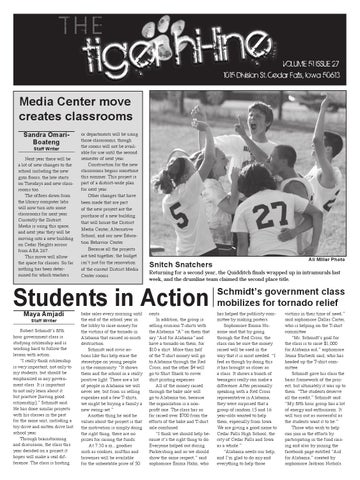
Returning for a second year, the Quidditch finals wrapped up in intramurals last week, and the drumline team claimed the second place title.
Students in Action Maya Amjadi Staff Writer
Robert Schmidt’s fifth hour government class is studying citizenship and is working hard to follow the lesson with action. “I really think citizenship is very important, not only to my students, but should be emphasized in any government class. It is important to not only learn about it but practice [having good citizenship],” Schmidt said. He has done similar projects with his classes in the past for the same unit, including a toy drive and mitten drive last school year. Through brainstorming and discussion, the class this year decided on a project it hopes will make a real difference. The class is hosting
bake sales every morning until the end of the school year in the lobby to raise money for the victims of the tornado in Alabama that caused so much destruction. Schmidt said civic actions like this help erase the stereotype on young people in the community. “It shows them and the school in a really positive light. There are a lot of people in Alabama we will never see, but from us selling cupcakes and a few T-shirts, we might be buying a family a new swing-set.” Another thing he said he values about the project is that the motivation is simply doing the right thing, there are no prizes for raising the funds. At 7:30 a.m., goodies such as cookies, muffins and brownies will be available for the unbeatable price of 50
Ali MIller Photo
Snitch Snatchers
cents. In addition, the group is selling crimson T-shirts with the Alabama “A” on them that say “Aid for Alabama” and have a tornado on them, for $10 a shirt. More than half of the T-shirt money will go to Alabama through the Red Cross, and the other $4 will go to Shirt Shack to cover shirt printing expenses. All of the money raised through the bake sale will go to Alabama too, because the organization is a nonprofit one. The class has so far raised over $700 from the efforts of the bake and T-shirt sale combined. “I think we should help because it’s the right thing to do. Everyone helped out during Parkersburg and so we should show the same respect,” said sophomore Emma Hahn, who
Schmidt’s government class mobilizes for tornado relief has helped the publicity committee by making posters. Sophomore Emma Husome said that by going through the Red Cross, the class can be sure the money raised will be used in the way that it is most needed. “I feel as though by doing this it has brought us closer as a class. It shows a bunch of teenagers really can make a difference. After personally speaking with a Red Cross representative in Alabama, they were surprised that a group of random 15 and 16 year-olds wanted to help them, especially from Iowa. We are giving a good name to Cedar Falls High School, the city of Cedar Falls and Iowa as a whole.” “Alabama needs our help, and I’m glad to do any and everything to help those
victims in their time of need,” said sophomore Dallas Carter, who is helping on the T-shirt committee. “Mr. Schmidt’s goal for the class is to raise $1,000 for Alabama aid,” sophomore Jenna Starbeck said, who has headed up the T-shirt committee. Schmidt gave his class the basic framework of the project, but ultimately it was up to them. “The students deserve all the credit,” Schmidt said. “My fifth hour group has a lot of energy and enthusiasm. It will turn out as successful as the students want it to be.” Those who wish to help can join in the efforts by participating in the fund raising and also by joining the facebook page entitled “Aid for Alabama,” created by sophomore Jackson Nichols.
e n i l i h r e tig THE
2 opinion our view D.E.A.R. no more What is the last book you read that wasn’t required for school? If you can’t answer this question right away, don’t feel too bad, because for many students this question is more difficult to answer than it should be. But it is also understandable; students today seem to have no time to enjoy a good book because of work, extracurricular activities and hours of homework. Plus the only time of our days that allows for this is D.E.A.R. However, let’s face it, many of us work on homework, sleep or talk during this time, making it in fact a study hall rather than time to catch up on a good book. That’s why students and staff decided that it was time to say good bye to D.E.A.R. From now on, D.E.A.R. time will be considered a study hall. Students during this time may get help from teachers, finish assignments, read or make up any work for other classes such as labs, tests or quizzes. The time, however, will not be used to socialize, text or play on computers. While this decision is beneficial and helpful for students, it, however, gives up part of the effort to attack the lack of reading among teenagers. Reading has numerous benefits such as helping with concentration, improving vocabulary, improving creativity and improving memory. And that is just the beginning. Reading can also help to boost those comprehension scores on tests like the ACT or SAT that so many of us dread. School isn’t the only place the lack of reading affects. The workplace is also a key contender. The National Endowment for the Arts reported that nearly two-thirds of employers ranked reading comprehension “very important” for high school graduates, yet 38 percent consider most high school graduates deficient in these skills. With today’s economy and the competitiveness in the job market, students cannot afford to lack these essential skills, so while it is nice to have the time to make up work and finish homework, it should also still be considered a chance for reading. As Oscar Wilde puts it, “It is what you read when you don’t have to that determines what you will be when you can’t help it.” And in high school, indeed, it truly does.
Contact the Tiger Hi-Line
The Tiger Hi-Line is a weekly publication of the journalism classes of Cedar Falls High School, 1015 Division St., Cedar Falls, Iowa 50613. Our website is www.hiline.co.nr. The Hi-Line is distributed to CFHS students on Tuesdays to read in their DEAR (Drop Everything and Read) classes. Columns and letters do not necessarily reflect the opinion of the Hi-Line or Cedar Falls Schools. The Hi-Line editorial staff view is presented weekly in the editorial labeled as Our View. Reader opinions on any topic are welcome and should be sent to the Tiger Hi-Line staff or delivered to room 208. All letters must be signed. Letters must be submitted by 3 p.m. on Thursday for publication the following Tuesday. Letters may not exceed 300 words and may be edited to meet space limitations. Include address and phone number for verification.
Editorial Staff
Editors-in-Chief: Sara Gabriele and Ellen Gustavson News Editor: Ben Olson and Sara Gabriele Opinion Editor: Meg Lane and Kaylee Micu Sports Editor: Ben Olson and Allyson Vuong Feature Editors: Ellen Gustavson Entertainment Editors: Meg Lane and Kaylee Micu Photo Editor: Tracy Lukasiewicz
June 1, 2011
Spiking world population, pending food problems demand global focus Karl Sadkowski Staff Writer
Often pushed to the back pages of major news publications, the increasing global crisis in food supply deserves far greater attention than what it gets. There are currently 1 billion chronically hungry people in the world, and the number is continually rising. A combination of climate change and the skyrocketing human population are major contributors to the crisis, as well as overfarming, overfishing and the growing popularity of biofuels. According to the World Bank, elevated food costs have driven some 44 million people in the Global South into extreme poverty since last June; according to a Des Moines Register story, with another 10 percent increase in costs, 10 million more people could fall into this category. Elevated food costs were in fact the case that aided in causing the recent revolts in the Middle East, such as in Egypt and Tunisia. As an agricultural powerhouse in the United States and a major exporter of corn, Iowa plays a significant role in food supply. In 2010, it produced 16.9 percent of the United States’ total corn production, at 2.1 billion bushels. According to the U.S. Agriculture Department, it also exported nearly two million bushels to other countries. However, Iowa faces uncertainties in the near future with draught or excessive flooding being likely possibilities that could affect crop yields. Iowa’s last draught occurred 23 years ago; however, major draughts tend to average every 16 years, putting Iowa roughly seven years overdue. Conversely, although the threat of flooding is not as great in comparison to the floods in 2008, excessive rainfall during the planting season may also pose difficulties as farmers work to begin growing crops. This too
would put production behind schedule and reduce corn yields. Climate change, an inescapable reality, is a factor in food production that cannot be controlled. However, it should not be blamed entirely for the crisis in food supply; it is humanity’s responsibility to fight global hunger. The amount of crops used for livestock is almost unfathomable. Last year, more than five million bushels of Iowa corn were used to feed livestock, in comparison to the 1.4 million used by consumers. The USDA predicts that by the end of the summer before the new harvest, an end surplus of 675 million bushels of corn will remain. Not only would this be the smallest surplus in 15 years, the Register reported it would also only be capable of feeding about 10 percent of U.S. livestock. If this prediction falls true, will cultural pastimes such as beef and pork come at higher costs to enjoy? Will “Meatless Mondays” become a regular part of school diets? According to David Pimentel, professor of ecology at Cornell University, nearly 800 million people could be fed if all the grain consumed by livestock were instead directed at people. It is far too inefficient to use so much farmland and crops for the sake of livestock. In this growing world, more productive means of growing food must be developed. Ethanol, the biofuel many claim will help wean the U.S. off its addiction to foreign oil, offshore drilling and tar sands, still has its own negatives in relation to food development. Ethanol has an insatiable appetite for corn and other plants. In 2010, nearly five million bushels of corn were consumed for ethanol production, according to the National Corn Growers Association. However, the corn required to fill one fuel tank with ethanol could instead feed one person for an entire year. In this perspective, producing ethanol
as a cleaner form of energy is certainly not worth the effort. But instead of resorting to fossil fuels once again, more efficient—albeit less powerful—car fuels should be sought after, such as electrical and solar power. Although “alternative energy” seems an excellent solution to the fuel crisis, it should not defeat its own purpose by amplifying other global issues. It will not be a long wait for the human population to reach 7 billion. In emerging markets such as India, the price of food is increasing parallel to its population. There, people spend a great deal of their incomes on food and are buying less of it. India recently lifted an export ban on onions in February, which had doubled in price to more than 40 rupees per kilogram. In China, soaring inflation on food prices has caused political tension, especially in its poorer regions, as people cannot buy even the most basic cooking essentials. Overpopulation is one culprit in causing food deficiencies, a sad truth spreading to other countries as well. Finding an effective way to curb this conflict, however, may foster social outrage in heavily populated areas. For example, laws limiting birth rates may become far more common around the world. Another possibility may be that nothing will change, and the rising world population will eventually collide with an extreme global food shortage that affects all of humanity. Whatever be the case, only so much food can be grown on this earth; the human population cannot continue at this rate forever. The global food crisis is very real. While it may not be apparent at the doorsteps of many people, it will eventually reach a point at which it cannot be ignored. If the race to feed humanity cannot be won soon, then what will be its condition when the race is lost?
e n i l i h r e tig THE
opinion
Junie 1, 2011
Reality Check
Internet no substitution for real world Lucas Hamiliton Staff Writer
Have you ever heard your parents talk about how all the things done nowadays are so much different then how they used to be? With the birth of the World Wide Web and widespread use of cell phones, everything technological has taken off. Social networking sites, in particular, have seen a massive spike in user numbers. Sites such as Facebook, MySpace, Twitter, Tumblr and YouTube have all grown incredibly popular within the last three years. For better or for worse, these sites are helping shape a new generation. Allowing people to share personal information about themselves, social networking provides a connection to friends when they aren’t right next door. Unfortunately, these sites have their
downfalls. People who find it perfectly acceptable to start flame wars and bash other people behind the safety of their computers are all over cyberspace. Not to mention the people who post things just to see people’s reactions. These sites were never meant to gauge popularity, so why do people use it this way? The number of followers or friends should not be what helps people sleep at night. The connections made in the real world really matter. The wonderful world of the Web can be great for getting information out to friends and sharing pictures with people, but when does our time with technology separate from our time with actual people? An important part of growing up is interacting with other people and developing social skills. When people are deprived of social interac-
tion, their growth is hindered. When all they know is how 2 tlk lke dis, something is clearly wrong. As easily the most recognizable and widely used social networking site, Facebook, boasts of its over 640 million users. We all know better than to judge people based on appearances, yet we can’t resist judging someone by their profile pictures. My Facebook profile picture is a picture of me around the age of 6 with my fingers up my nose. Now without knowing me on a more personal level, how would you react? Yes, I know it may seem a little foolish for me to have that picture be the first thing someone sees about me, but in all actuality, first impressions shouldn’t matter. There is always something more than what you can see through the pixels on the screen or the ink on the paper.
Start now for college application success Kaylee Micu Opinion Editor
And there it lies, the bible of scholarships. It haunts every junior coming close to senior year. It is also a reminder that high school is coming to a close, but next year’s seniors can stop their fretting now because the school counseling office highlights hundreds of scholarships that can be available for anyone, and the process can be viturally painless if you follow the right steps. Some advice the counselors have offered is simply check out the counseling websites where scholarship information can be found in abundance. Students will find what scholarships are due when as well as the “scholarship” book that is full of even more scholarships along with grants too. “It’s a process. Start it sooner. That way you give yourself time, the kids that take the time, it’s a payoff for
them,” counselor Susan Langan said. “Also be organized. I see many kids who don’t plan ahead, and they get extremely stressed and frustrated with the whole process.” Another key part of the process is asking teachers for recommendations, and many teachers are more than willing to help out, whether it’s for letters of recommendation or just some helpful tips on the application process. “I like the way it allows me to relive the experiences I’ve had with students, from plays they’ve been involved in to the writing or assignments that they’ve turned in.” English teacher Michelle Rathe said. Also, if you want your favorite teacher to send a letter of recommendation, it’s best to ask them at least two weeks before so that they have time to get it to you or mail it themselves. If you would like them to mail it, be sure to include postage.
Some final tips, remember to check out the websites of the colleges you’re thinking of attending; many offer scholarships for freshmen students to help to relieve finanical burdens. Also, build up your resume. If you keep yourself organized now, it will help in the long run. Keep track of awards, honors and activities you’ve done throughout high school. It could help earn you more scholarships. Plus, check to see if your parent or guardians’ place of employment offers any. Furthermore, during those senior meetings next year, remember to pay attention because the counselors will go over the process of applying with you. But perhaps the most important about scholarships is take it one step at a time. The process is long but worth it. College isn’t getting any cheaper and student loans can add up, so be smart and take the time to apply for any scholarships or even grants.
3
Seniors Say Good bye What I’ll always remember is ... ... I just love being around so many wonderful people, and I’m going to miss it a lot.
—Chris Kempf ('11) ... football games because of the unity in our school.
—Kristin Morris ('11) ... the times in class that we went off track but talked about good times.
—Brandan Leyh ('11) ... a lot of the goofy times at the lunch table.
—Krista Lee ('11) ... being on the swim team because we always had a lot of fun at swim meets.
—Anne Raecker ('11) ... I’m not sure I’m going to miss much.
—Ben Nevitt ('11) ... my friends the most and even the teachers. I will also miss cadet teaching quite a bit, as it gave me many ample opportunities.
—Rachel Lyman ('11) ... flagging with the color guard family.
—Carrie Traetow ('11) ... choir and art were two of my favorite
things, and I’m really going to miss them, as well as my friends.
—Eve Willett ('11)
4
Opinion
e n i l i h r e tig THE
June 1, 2011
Options abound for those new to CF Allyson Vuong Sports Editor
When picking up and settling in a new town, it could be very difficult. When life gives you lemons you make lemonade right? But the steps to making lemonade can be just as difficult as moving. In the last two years, Cedar Falls has gotten at least 50 new students coming from all sorts of places, big or small. The first step to moving is being informed. Junior Megan Lane, who moved here at the beginning of the ‘09-’10 school year said, “Well, since I lived in Georgia, I thought the last time I was in Iowa, all I saw was corn. Great, I hate corn and now I’m going to live in the corn state. I thought there would be a ton of farms everywhere. It turns out it’s just a small college town. It was a bit of a culture shock because it reminds me so much of Savannah except for the ocean and the beaches everywhere. I wasn’t necessarily scared to move. I’ve moved nine times so it was normal. I was upset because I wanted to finish high school there but moving has helped make my high school experience better. I’ve met so many people and I couldn’t image not moving now.” Sometimes weather can affect people’s emotions. “I was sad that I moved because Georgia was a nice place. However, at the same time, I was pretty happy because the climate over there in Georgia was too hot compared to Iowa,” Senior Philip Tran said. But that’s just the beginning. The struggles and fears begin to pile up. “I was extremely nervous about making friends. I
moved over the summer and didn’t meet anyone, so it was tough starting in the fall with no one to talk to,” said Lane. “It’s high school. Everyone by this
time has their best friends and people they enjoy being around, but if you introduce yourself and make the effort, I believe anyone could be friends.” Getting lost in a new town is normal, but it can
also be a huge fear. “The scariest thing about CF was figuring out where everything was at the school,” Junior Hali Weimerskirch said. Other things that make new students nervous could be the teachers. The way the teachers teach could be very different than what they are used to. Sometimes, moving in the middle of the year could be difficult because not every school has the same classes. Even if you could be put in the same class, there’s still the chance that the class might be ahead or behind of what you were learning. For example, at North Garland High School down in Garland, Texas, you can take anatomy and physiology as a sophomore but at Cedar Falls, you take it as a junior or senior. Another difference is that
anatomy is a full year course there while here the class is one semester long. Some students actually move during the middle of the year, and it makes it hard on our counselors to find the right class for them. At times, they can’t recreate a student’s schedule because Cedar Falls doesn’t offer the course. But they do try their hardest to fulfill a student’s wishes. Entering a class in the middle of the semester can be pretty difficult on students as well as teachers. Math Teacher Emily Wheeler said, “The most challenging part is figuring out what they already know (or don’t know) and finding time to get him or her caught up on any important missing concepts. Keeping in mind
that at the same time the student needs to stay on top of what we are currently doing.” Some students may think that teachers don’t understand the struggle, but they truly are there to help. “To help the students make this transition, I try to make these students feel as
comfortable as possible. I let them know that I’m willing to work with them and am flexible. I can only imagine how overwhelmed these students
would be feeling about their new situation, a new teacher, a new environment, new peers, new procedures, new expectations, etc.,” Wheeler said. “I think leaving their friends behind can be heartbreaking for most. The nice thing is that there are wonderful new people to meet wherever we go!” English teacher Teresa Martin said. At times, the challenges students face are the same as any other new student. “The most challenging part for the student is adapting to a new school. The adaptation process would include all of the following: school diversity, school policy, the size of the school, the size of the community, social customs, teaching styles, and academic expectations.” English teacher Troy Slater said. Teachers try their hardest It’s a lot easier moving when the school year first starts because each year before school actually starts, Cedar Falls counselors throw a new student party where they can interact with other new students and current Cedar Falls students. At this party, there’s pizza and ice breaker games. Current students give the new student tours which shows them the key points of the school: for example, the MRC, ERC, library, and the counselor’s office. Current students are welcomed to come and help. “The new student party
helped me because you got to talk to other CF students which helped you become more familiar with more things.” Weimerskirch said. What’s the final step in making this journey? The answer is simple. Get involved. “I met [my struggles] by starting a job and getting involved with groups. It’s the best way to really interact with people. Especially outside of school.” Lane said. “It got easier for me when I started CF Cheer because it got me involved and I met a lot of new people.” Weimerskirch said. When picking up and moving to a completely different place, things can be pretty hectic, but always remember to get involved. It helps. “Well, it sounds cliche, i’m sure, but really get involved. At first I didn’t want to get involved -- I wanted to be a hermit. That was not good, in fact, it made me really depressed, but as soon as I got my first job and joined different groups at school like Harmony, leadership teams and Big House, I started to enjoy CF much more. People aren’t going to come to you, you have to get up and introduce yourself.” Lane said. “Some advice for new students in the future would be to get involved in school activities and don’t be afraid to speak up and talk to others.” Weimerskirch said. “Get to know people as soon as they have transferred and get involved in activities whether it’s academic or athletic.” said Tran. The thing you have to remember when moving is it may be tough at first, but just give it some time. You’ll get used to it, and soon, it’ll become your home.
e n i l i h r e tig THE
feature
June 1, 2011
5
VS Two websites take PowerPoint presentations to the next level Chandal Geerdes Staff Writer
We have come a long way since the typical PowerPoint or poster. Because of the Internet and online sources, there are a multitude of ways to make a topic or presentation come to life. This not only benefits the audience, but the presenter as well. With new online sources, one can create a wide variety of topics and make them come to life. When students are able to make something come to life, it can give the audience a better understanding of a topic It’s also nice to be able to be interactive within a presentation. Through new fades and applications online, the interactions are endless. Two of the new fads online happen to be Prezi and Glogster. Out with the old PowerPoint or typical poster; there are now online ways to make a presentation come to life. Prezi lets users bring their ideas into one space and see how they relate, helping presenters and the audience connect. Zoom out to see the big picture and zoom in to see details. This online
website where students can create their own presentations through a multitude of creative steps is a bit like web-based maps. Prezi was founded in 2009 by Adam Somlai-Fischer. “It provides the user and audience a much more interactive application than PowerPoint,” health and PE teacher Van Hardy said. Hardy highly recommends Prezi for his students. “[Prezi] is an online application. It’s accessible, free, easy and intuitive,” Hardy said. While using Prezi, users come up with theirr topics and use their creativity with the help of Prezi to make their presentations come to life. They can make each text and topic of their presentations as large or small as they’d like and also create frames and different theme layouts. They can also add pictures and create paths to make the presentation flow just as
2oth Century
they’d like. “Prezi is more interactive [than Glogster] and has more room for creativity,” sophomore Hanno Fenech said. Glogster is a social network that allows users to create free interactive posters, or glogs, which is short for graphical blog. The glog, is an interactive multimedia image. It looks like a poster, but readers can interact with the content on the presentation. Glogster was founded in 2007. Currently this social network has hundreds of thousands of registered users. The targeted audience for Glogster users are teenagers. Glogster provides an environment to design interactive posters. The users insert text, images, photos, audio (MP3), videos, special effects and other elements into their glogs
2001
to generate a multimedia online creation. Each poster can be shared with other people. Glogs can also be exported and saved to computer-compatible formats. “[Glogsters] offer students all that’s good about posters and PowerPoints into a useable saveable genere,” English teacher Courtney Lubs said. Lubs recommends Glogster to her students as an outlet to express ideas. She said that posters serve their needs, but through Glogster, they can incorporate the computer and Internet, which students today are more accustomed to. “It allows students to be creative but still articulate ideas,” Lubs said.
Glogster also supports Glogster EDU. This is an education program that works similar to Glogster. Glogster EDU is a web 2.0 platform which enables users to create virtual posters. While original Glogster targets teenagers, Glogster EDU is intended mainly for teachers. Currently Glogster EDU is used by 7.5 million students and teachers. Teachers can create projects with their students across other schools.
2011
6
e n i l i h r tige THE
feature
June 1, 2011
Facing It Megan Lane
Student maintains optimism as she wrestles with Lyme disease
Opinion Editor
Normal. For senior Chelsea Larsen, normal has a special meaning. Larsen’s dad was diagnosed with Lyme disease when she was just 11 years old, and after that, she made a discovery of her own. “My dad had many complications, and we were unsure of the causes. Finally, after about three years of searching for a diagnosis for him, he was diagnosed with Lyme disease and began treatment. He finally started responding to that treatment. They figured that he had the disease for decades before he was diagnosed, so just to be careful, my sister and I were tested, and we were both coincidentally diagnosed with Lyme as well. It’s possible that we got Lyme when we camped and mushroom hunted a lot.” Lyme disease is rare disease in which the bacteria, Borrelia burgdorferi, is spread by deer ticks. It is not contagious between people, and, because it generally is transmitted from the bite of deer ticks, it is more prevalent in wooded or grassland areas. Lyme can be distinguish into two different types, first is infection. If the infection goes undetected then weeks or years later it will progress and become chronic Lyme disease. Dr. Jeffrey Piccirillo, a Lyme disease specialist and former orthopedic surgeon who is located in Chicago and Grinnell, treats Chelsea Larsen and other central Iowans explains, “ You can think of Lyme disease as having three categories: acute, early disseminated, and chronic. The sooner treatment is begun after the start of the infection, the higher the success rate. However, since it is easiest to cure early disease, this category of must be taken VERY seriously. Undertreated infections will inevitably resurface, usually as chronic Lyme, with its tremendous
Having Lyme disease has been a roller coaster ride for Larsen and her health. Every day brings new challenges to face. problems of morbidity, difficulty with diagnosis and treatment.” Dr. Piccirillo also caution however that, “The infection called Lyme Disease is only the tip of the iceberg. There are six other bacteria tha can transferred by a tick bite. So the illness is very multi-factorial.” Symptoms of Lyme range from the beginning stages of a rash at the bite site and flu-like symptoms to more advanced stage symptoms like irregular heartbeat and neurological problems like memory loss or temporary paralysis of the body. Larsen has experienced many of these symptoms, and they have taken quite the toll on her. “I’ve been through a lot psychologically. Through the depression, insomnia, anxiety, extreme fatigue, troubles concentrating, memory problems and some joint and heart issues, school is really hard,” Larsen said. “Before things got really bad, I was always at the top of my class. School came really easy for me. With Lyme, now I have to work very hard to keep my grades up. I forget things easily. I lose track in everyday conversations. I have troubles finding words in conversations. I can’t sleep. On top of it, I’m tired even if I do get good sleep. Most days I don’t know how I’m going to feel. But, life goes on.” But Larsen said the biggest struggle was getting diag-
nosed. “Sometimes it can be hard to diagnose because it can be mistaken for Fibromyalgia, MS, Chronic Fatigue Syndrome, Lupus and even a mental disorder, but it’s real. Lyme disease is a fairly new disease, so common family doctors are not always educated on the disease. It’s a good idea to go to a specialist,” Larsen said. That is why Larsen chose Dr. Piccirillo. Dr. Piccirillo has helped Larsen along with many other patients to find new and innovative ways to fight the disease. In fact, this summer Larsen will begin treatments in Chicago to help kill the bacteria that causes Lyme disease. “Since Lyme is such a slow evolving disease, it also dies slowly. Because of that, I have to take very large and long doses of strong antibiotics. I bet I’ve taken nearly every antibiotic out there, just to see if it’ll kill more bacteria,” Larsen said. “For the late stages of Lyme, like what I have, it can take years and years of antibiotics to kill most of the bacteria, and even then it can come back. This summer I will be using this machine called a Rife machine that emits high frequency sound waves to penetrate the bacteria. She will also use “hyperbaric oxygen chambers that blast very high concentrations of oxygen to kill the anaerobic
bacteria; and many herbal treatments for the periods of time when antibiotics start harming my body.” What has helped Larsen the most is her family. Both her sister, Abby, and father, have Lyme disease, which creates very stressful times. “This disease has made a hefty toll on my family. Because my dad’s case is so extreme, we never really know what the future holds. In the beginning of his diagnosis, he woke up paralyzed for a few hours, had to wear a mask wherever he went, and even lived in our basement for months because he was so sensitive to everything. As you may expect, he had to stop working so my mom picked up all responsibility financially. This whole situation has taught us to take life’s curve balls and make the best out of them. Ten years after the first diagnosis, my family still struggles with the unknown future every day,” Larsen said. And it has also brought them together as a family. “We’ve had times when everything seems like it’s looking up again, but it always turns out to be yet another roller coaster ride. Also, the disease itself has made my dad, my sister and I have many personality changes. It’s just a fact of the disease,” Larsen said. “And because of that, my family has learned
to laugh at the ‘Lymie’ days when our brains are moving so slowly that we can’t keep up with conversations, or we can’t find words to get across what we’re trying to say, or we get such bad ‘Lyme rage’ that everything trips our triggers and we go off into a tantrum or our brains are so dead that all we can do is sit and stare off into space. Though this disease sure gives us enough trouble, we’ve learned that everyone has to laugh at what life brings because it can be so unpredictable.” And this has also given the attitude that keeps Larsen motivated to still fight this disease. Larsen said, “For some reason, I’ve been one who doesn’t like to show others that I struggle with a lot of things, but, I’ve learned to be transparent and let people know that life isn’t easy for me. That makes me just like everyone else. I’ve also had a lot of times in my life where I just have lost all hope and nothing seems to be worth it. I’m normally a vibrant person, but I’ve been humbled a lot with this disease. I’ve learned to keep a positive attitude because life still happens, no matter what your attitude is, so you can be miserable or keep pushing on and channel that energy into something better.” Larsen also noted one of the ways she channels her energy is through dance, but with Lyme disease this is also another struggle for her. “Dance is pretty much all memory, so that has forced me to work through my memory problems. Dance is also very exhausting, so with the fatigue that comes with Lyme, I’ve learned to work through it because I just wanna dance, man. Fatigue isn’t gonna stop me.” All in all Larsen says, “Lyme hasn’t been a reason for me to stop doing what I love. In fact, it’s been a reason to keep pushing and enjoying life, in spite of the struggles I face. It’s all worth it.”
e n i l i h r e tig THE
7
sports
June 1, 2011
Crews make progress on gym floor renovation
Athlete Week of the
Sandra Omari- Boateng
Staff Writer
The high school is in the middle of installing new floors for the gym because the current floors are generations old and school staff saw for an update. The original plan was to put in new floors five years ago, but that was delayed until this spring. “The current gym floor is almost 40 years old, and you can only sand and re-finish it so many times,” Associate Principal Troy Becker said. According to Becker, there isn’t a total dollar amount for this project, but the money is being taken care of by the central administration. Aug. 1 is the expected completion date for the new gym, and right now, construction is slightly ahead of schedule. The project has been contracted out to a variety of construction crews who each focus on a special area of the project. The north gym floors were installed and painted at the end of last week. Now workers have moved the bleachers to that side and are focusing on the main south gym. The rubber gym is being replaced with new wooden floors because the coaches and PE teachers prefer to have a wood floor for safety and ease of use. “We felt like a wood floor on both sides would do the best job of meeting our needs,” Becker said. “[An upside to gaining a wooden floor] is the safety because there is a lot more spring in the floor, and there will no longer be holes in it. There is no [downside to losing the rubber gym]. The only thing that will have to be modified is floor hockey just so that we don’t scratch
Andy Kloos Baseball Junior
Starting two weeks ago with the rubber gym in the top photo, the new wooden floors are beginning to shape up in the high school. At left, the old wooden slats had to be torn torn out, and then the construction crew spent three days with jackhammers removing the old concentrate base below the floor before it will be replaced with new, and, if all goes to plan, it will be ready for action next August. the floors. I am in favor of [the new floors], especially the replacement of the rubber gym floor. It had holes in it, gum stuck to it and was just run down,” PE department chair Jamie Smith said. Overall, there won’t be too much of a change to the PE classes at the end of the year because of the new construction. “[The curriculum] hasn’t changed too much because in the spring we always plan to do games outside. However, we just don’t have the gym as an option if it rains. We [gym classes] either have to be in the cardio room or the weight room, which gets a little tedious,” Smith said. “Right now, with the work that’s being done in the gym, it’s way too loud to be in the cardio room or weight room and have it be a comfortable learning environment. We’re making it work though. Hats off to the kids currently in P.E. They are being awesome.” There will be some shift in
summer plans, too. “[The only changes are that we] just won’t be able to use the gym the rest of this year or this summer. All of our camps need to be moved to Holmes,” Becker said. During the whole process of deciding to redo the gym floors, there has been some question about whether the money for the floors would be better spent helping the school in more important ways. “As with any facility, you are going to have maintenance costs to keep it safe and usable. It would be irresponsible to not keep our facilities updated, because eventually they would get to the point where we couldn’t use them. We already waited five more years than recommended by our architects. The north gym was horrible and absolutely had to be done. The south gym was also in need. It just makes sense to do them both together, which makes the overall cost of the project less, and you only have to close
your gym for one summer instead of two,” Becker said. “Speaking directly from P.E., we could have had [the gyms] go longer. However, for competition sports, it needed an update. There were quite a few boards loose or warped, and the caps for the volleyball standards were not safe since they stuck out of the floor,” Smith said. There will be a few additional perks to this new remodel of the gyms. “I don’t think we will lose anything. We are getting a wireless sound system, which will be nice for all events and physical education. Competitions and practices that are held in the rubber gym will be greatly improved. It is overall more safe and cosmetically appealing,” Smith said. “Overall, the remodel will be beneficial to the school. It will bring in more district and community events and be a huge improvement for P.E. and our athletic teams.”
1. How did you get started with baseball? “I got started by getting involved in T-ball when I was 6 years old.” 2. What would be the perfect moment this season? “A perfect moment for me would definitely be winning State.” 3. What are you looking forward to this year? “I am really looking forward to trying to repeat the success of last year’s team.” 4. How does the team prepare? “We get prepared with extra batting practice and a lot of fielding. This is an extremely hard working team, and we love to get better.”
Tigersin
Action
Baseball 6/8, vs. Charles City @ Robinson Dresser Sports Complex 6/10, vs. Thomas Jefferson @ Robinson Dresser Sports Complex 6/13, vs. IC High, 5 p.m. Softball 6/7, vs. Waterloo West, 5:30 p.m. 6/8, vs Ames, 5 p.m. 6/9, vs. Thomas Jefferson @ Robinson Dresser Sports Complex
8 Captured
e n i l i h r tige THE
June, 1 2011
Partied Out Seniors celebrate last days at special high school gala
From watermelon eating to gelatin fights to bean bag tosses to Frisbee tosses to leaving a mark on the side of the school, seniors turned out for fun, games and food at the Senior Leadership-sponsored party on Sunday, May 22. Starting with the shot in the upper left corner and working clockwise, those pictured include Ashley Brown, Sam Doyle, Cassie Crotty, Kryie Dailey, Jon Martinson and Tracy Lukasiewicz. Photos by Darby Sheehan