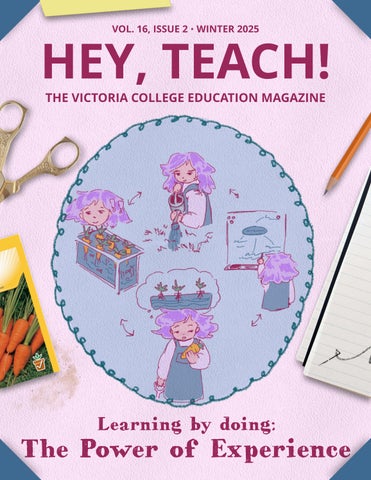
VOL. 16, ISSUE 2 ? WINTER 2025
HEY, TEACH! THE VICTORIA COLLEGE EDUCATION M AGAZINE
L ea r n i n g b y d oi n g :
T h e Pow er o f Ex p er i en c e
Let t er f r om t he Edit or s EXPERIENTIAL LEARNING? LEARNING BY DOING? is more than an educational trend; it is a proven approach that fosters critical thinking, problem-solving, and real-world application of knowledge. Whether through project-based learning, outdoor education, internships, service-learning, or study abroad programs, this method empowers students to connect theory with practice in meaningful ways. In this issue, we feature inspiring stories from classrooms and communities where experiential learning is making a difference. You will find an interview with PhD candidate Sarah Urquhart, written by our lovely features writer Arianne Rodriguez, focusing on how she implements experiential learning in her classrooms and how it has evolved throughout her career. Other articles focus on student experiences during their internships. Additionally, to hear more instructor perspectives, our lovely First-Year Representatives created a questionnaire asking how University of Toronto professors incorporate hands-on learning in their courses; flip to page 27 to read their responses! We would like to extend our gratitude to everyone involved in creating ?Learning by Doing: The Power of Experience.? We are so excited to present a magazine full of so many wonderful submissions, from testimonials highlighting the benefits of hands-on learning to instructor input on experiential learning from the perspective of the teacher. Thank you to our incredible contributors ? your insights, creativity, and research are so important, this magazine would be nowhere without you! To our amazing faculty advisor, Professor Julia Forgie ? thank you. We could not have done this without your reliable guidance, support, and encouragement. A huge thank you also goes out to our Editing Team, Productions Team, First-Year Representatives, Features Writer, and Social Media Representatives! Your hard work and dedication shine through in this issue. To our readers, thank you for picking up or virtually flipping through our magazine. We hope this edition sparks ideas, conversation, and action within your own learning communities.
Happy Reading! Sydney Pacheco & Nina Dawicki Co-Editor in Chiefs
Sydney Pacheco
01 HEYTEAcH! WINTER2025
Nina Dawicki
EDITORS IN CHIEF Sydney Pacheco Nina Dawicki SENIOR PRODUCTIONS MANAGERS Brisa Liu Melody Mo Ren Minamisono SENIOR EDITORS Amaan Baweja Austin Hewu INTERNAL RELATIONS Benjamin Gauntley FIRST YEAR REPRESENTATIVES Anne Chen Aryan Rajagopal Nicole Pacheco Nina Zambito ILLUSTRATOR Sunny Sien SOCIAL MEDIA REPRESENTATIVES Irene Hwang Lauren de Rango FEATURE WRITERS Arianne Rodriguez Erica Chong EVENTS COORDINATOR Alex Teschow JUNIOR PRODUCTIONS Charlize Marshall Molly Bibawy Olivia Cruickshank Sophia Huang
TABLE OF CONTENTS 1-2
Letter from the Editors & Table of Contents
3-6
Meet Your Contributors
7-10
Learning in Action: Bringing Kolb's Experiential Cycle to Life in Modern Early Literacy Instruction by Santhiya Kuganeswaran
11-12
Broadening Horizons: How Travel Shapes My Perspective on Experiential Learning by Aislinn Kuipers A Day in the Life: Teaching High School in Rural P.E.I. by Alex Teschow
13-16 17-20
We're Cooked: Interview with a Teacher by Aryan Rajagopal
21-22
Products of COVID-19 Education: Adolescent Social/ Emotional Development by Queenie Au
23-26
Getting in on the Act: My Experience With the Canadian Marketing Competition by Raya (Raisa) Harusova Professor Spotlight by Nicole Pacheco & Nina Zambito
27-30 31-34
Teach Talks! An Interview with Sarah Urquhart by Arianne Rodriguez
35-36
Experiential Learning Opportunities at Uoft by Benjamin Gauntley
37-40
Final Thoughts from the Executive Team
HEYTEAcH! WINTER2025
02
Meet Your Cont r ibut or s! I love st aying connect ed t hr ough educat ion clubs and societ ies like t his one! Wr it ing f or Hey, Teach! let s me engage dir ect ly wit h people in t he educat ion f ield on campus, while also enj oying var ious t eaching/ educat ion-r elat ed event s t hat keep t he communit y spir it alive!
Sant hi y a Kuganes war an
My f avour it e way t o st ay connect ed on campus is t hr ough at t ending all t he wonder f ul event s Vict or ia College of f er s. Fr omGat her in t he Goldr ing t o VCDS pr oduct ions t her e is always somet hing t o do!
Al ex Tes chow
03 HEYTEAcH! WINTER2025
W hat is you r favou r ite w ay to st ay conn ected on cam pu s?
Queeni e Au I love t o at t end Uof T event s! My f avour it e t hat I have been t o is t he Heat her s Musical put on by Tr init y College as well as commut er event s host ed by Univer sit y College!
Ar y an Raj agopal I couldn't live wit hout t he Vic quad. Ther e's not hing bet t er t han sit t ing out in t he quad on a sunny day wit h your f r iends!
Ai s l i nn Kui per s Ray a Har us ov a The Daniel's Ar chit ect ur e Facult y Caf e! The mat cha is delish, t he pr ices ar e gr eat and it 's a cool open space!
Queeni e Au I NEEDbot h Gr ahamLibr ar y as well as t he UC Libr ar y. Bot h ar e so per f ect f or f ocusing on assignment s and being a quiet place t o st ay f or a f ewhour s!
W hat is on e t hing/ place on cam pu s you can 't live w it hou t ?
One t hing on campus I cannot live wit hout is Ned's Caf e. It 's a place I only r eally discover ed lat er in my f ir st semest er but nowit has become synonymous wit h my Vic One exper ience. I always go t her e when I'mon or near by Vict or ia College t o chat wit h people f r omt he Educat ion st r eamwhich has r eally br ought t hat gr oup t oget her , t he Wednesday and Thur sday meals ar e my per sonal f avour it es!
The one place on campus I can't live wit hout is def init ely Caf f iends! It is such a war mand invit ing space t hat makes Vic f eel like home. I love going t her e t o do wor k or t o hang out on t heir comf y couch! Thankf ully, my shif t t his semest er aligns wit h my r oommat es and a f ewof our f r iends so being at Caf f iends is like a t wo-hour yap f est . My r ecommendat ion is t he st r awber r y hot chocolat e! Or
any of t he chocolat ey dr inks!
Ar i anne Rodr i guez HEYTEAcH! WINTER2025
04
Sant hi y a Kuganes war an I would def init ely r et ake my gr ade 11 APS cour se, which cover ed ant hr opology, psychology, and sociology! Taking t his cour se opened my eyes t o new per spect ives and ult imat ely ignit ed my passion f or sociology, making it a pivot al exper ience in my academic j our ney.
I would love t o have a second go at Gr ade 10 hist or y! The way it was t aught when I t ook it was so f un and t hat cur r iculumis exact ly t he er a of hist or y I enj oy st udying, apar t f r om 19t h-cent ur y Eur opean hist or y ( cr iminally under r at ed, in my opinion) .
Ar y an r aj agopal
05 HEYTEAcH! WINTER2025
W hat is on e cou r se in high school you w ish you cou ld r et ak e?
Ai s l i nn Kui per s I would love t o r et ake gr ade 11 Wor ld Hist or y. My t eacher was so passionat e and it r eally inspir ed me.
Ray a Har us ov a I wish I could r et ake my high school's cour se Cr eat ive Wr it ing! It was such a low-pr essur e and suppor t ive lear ning exper ience and we got an insider look int o unique wr it ing oppor t unit ies like childr en's books.
Ar i anne Rodr i guez Par t of me want s t o swit ch up t o a Dr ama maj or because as j ust a minor st udent I don't have pr ior it y f or any of t he hands-on st udio cour ses, but I don't t hink I act ually would at t his point . The wonder f ul t hing about English and Dr ama is t hat t her e is a lot of over lap, so I can complet e cr edit s f or bot h! I do, however , miss per f or ming a lot .
W ou ld you sw it ch you r pr ogr am at t his st age in you r degr ee? W hy or w hy n ot ? Sant hi y a Kuganes war an
Al ex Tes chow I would r at her r ead 100 books because t hen I might act ually develop t he abilit y t o f inish all t he books f or my english classes.
100 books! Ai s l i nn Kui per s
W ou ld you r at her r ead 10 0 book s or w at ch 10 0 m ovies?
Absolut ely not , I'mhappy wit h my pr ogr amchoices! Get t ing int o t he Educat ion and Societ y minor was all I dr eamed of , and pair ing t hat wit h my English minor and Sociology maj or has given me t he per f ect blend of subj ect s t hat keeps me bot h challenged and inspir ed in school.
Sant hi y a Kuganes war an I'd choose t o r ead 100 books wit hout a doubt ! I've loved r eading since I was lit t le, and cur ling up wit h a good book always br ings a unique j oy and dept h t hat movies j ust can't mat ch. I believe books of f er a r icher , mor e immer sive and imaginat ive exper ience ever y t ime!
HEYTEAcH! WINTER2025
06
L ea r n i n g i n A c t i o n : B r i n g i n g Kol b ?s Ex p er i en t i al Cy cl e t o L i f e i n M o d er n E a r l y L i t er acy I n st r uc t i o n (V i c R each / E D S3 6 0 I n t er n s h i p Ex p er i en c e)
David Kolb?s Exper ient ial Lear ning Cycle is a foundational theory in modern education, emphasizing that learning is an active and continuous process rather than passive knowledge absorption. His model consists of four stages: Concrete Experience, Reflective Observation, Abstract Conceptualization, and Active Experimentation, illustrating how learners process new information through direct engagement, reflection, theoretical connections, and application. Kolb?s theory is widely used in education because it highlights the importance of learning through experience, reinforcing the idea that students retain knowledge more effectively when they actively participate in their learning rather than solely receiving information.
Santhiya Kuganeswaran Third Year Sociology Major Education & Society Minor English Minor
07 HEYTEAcH! WINTER2025
Kolb?s theory has shaped modern education by promoting student-centered, experiential learning methods. Many contemporary instructional approaches, such as inquiry-based learning, project-based education, and hands-on literacy activities, are rooted in his model. His work has also influenced differentiated instruction and personalized learning, emphasizing that students have unique learning styles and benefit from structured opportunities to engage, reflect, and apply their knowledge. Educators today use Kolb?s model to design dynamic, research-based teaching strategies that foster deeper understanding and skill development in students.
During my Vic Reach and EDS360 internship at a Toronto public elementary school, I saw firsthand how Kolb?s Experiential Learning Cycle plays out in literacy instruction. In the Concrete Experience stage, I actively worked with students during literacy time, assisting them in their weekend writing activity by helping them edit spelling, grammar, and sentence structure. This hands-on engagement allowed students to see the direct impact of revisions while gaining confidence in their writing abilities. Additionally, my host teacher and I created literacy stations around the classroom, incorporating activities like Word Ladders, Read Roll N? Write, and Sorting Digraphs. These stations provided interactive opportunities for students to practice phonemic awareness, spelling, and vocabulary-building, reinforcing the idea that students learn best through structured, engaging activities rather than passive instruction. As a future educator, my philosophy of education is rooted in structured literacy
instruction, evidence-based teaching, and student-centered learning, all of which were reinforced by my experiences in the classroom. I strongly believe in the Science of Reading, which emphasizes the importance of phonemic awareness, systematic phonics instruction, and explicit teaching methods in early literacy development. My work in literacy stations and writing support demonstrated how structured, hands-on activities help students grasp foundational literacy concepts more effectively. By providing scaffolded instruction, such as guiding students through phonics-based word ladders or helping them refine their sentence structure, I witnessed how direct, research-based teaching strategies improve literacy retention and confidence. These experiences validated my belief that students need structured yet engaging instruction to develop strong reading and writing skills, reinforcing my commitment to responsive, differentiated teaching that adapts to the needs of diverse learners!
HEYTEAcH! WINTER Wint er 2025
08
In the Reflective Observation and Abstract Conceptualization stages, I connected my classroom experiences to Kolb?s cycle and literacy research.
WINTER er 2025 09 HEYTEAcH! Wint
I noticed that students retained more information when learning was interactive and multisensory, confirming my belief that student-centered instruction fosters stronger literacy development. For example, students who struggled with spelling patterns in writing activities benefited from engaging in phonemic awareness tasks like Sorting Digraphs, where they could physically manipulate words and sounds. This experience reinforced the importance of explicit literacy instruction and structured activities that align with research-backed reading strategies. Kolb?s theory helped shape my approach to early literacy instruction, emphasizing that effective learning happens through hands-on experiences, reflection, and the application of structured literacy practices. My internship reinforced my commitment to evidence-based, student-centered teaching that empowers young learners to build confidence and independence in literacy.
To further illustrate these experiences, I have attached photos of the literacy activities I implemented during my Vic Reach and EDS360 internship, demonstrating how Kolb?s Experiential Learning Cycle informed my approach to early literacy instruction. My experiences reinforced my philosophy of education, which emphasizes structured literacy instruction, the Science of Reading, and evidence-based teaching methods to support student success. Through hands-on engagement, I observed how interactive, student-centered learning enhances literacy retention and skill development, further validating the importance of explicit phonics instruction and scaffolded activities in building foundational literacy skills. These experiences deepened my understanding of how experiential learning fosters confidence and independence in young learners, highlighting the role of Kolb?s cycle in shaping effective, research-driven teaching practices that create meaningful and lasting literacy growth.
HEYTEAcH! WINTER Wint er 2025
10
BROADENI NG HORI ZONS: How Tr avel Shapes My Per spect i ve on Exper i ent i al Lear ni ng I WAS FORTUNATE ENOUGH to grow up traveling regularly, which had a profound influence on both my education and interests. Visiting museums and historical monuments played a large role in fostering my interest in history, ultimately leading me to pursue the study of it in University. My experiences abroad provided tangible connections with the lessons I learned in textbooks and in lectures and have therefore enhanced my learning by improving my retention of the material (De Lannoy, 2023). American philosopher John Dewey posited that experiential learning fosters intellectual learning and enables students to develop their unique perspectives of the world (Ranken et al., 2024). Having been raised in Canada and originating from France, the opportunity to visit countries in Europe, Africa, Asia, and South America allowed me to gain first hand exposure to diverse cultures, religious practices, traditions, and beliefs. Significantly shaping how I view the world while cultivating my growing interest in global cultures and history that shape the perspective and contributions I bring to the classroom. There is also substantial evidence to support the notion that experiential learning enhances long-term memory and retention of academic material (Ranken et al., 2024).
11 HEYTEAcH! WINTER2025
For example, I took a trip to the D-Day beaches and the WW2 memorial in Northern France prior to learning about it in high school. Witnessing primary sources and seeing firsthand how the war affected this region has had a lasting effect on me, further enriching my understanding once I encountered it formally. While this level of application is not always feasible in a classroom, research indicates a strong correlation between experiential learning and improved academic achievement (Ranken et al., 2024) and I believe my personal experiences demonstrates the power and impact that experience and experiential learning can have on a student?s educational experience. As aspiring teachers, we should strive to foster an environment where all students can thrive. Experiential learning unlocks opportunities for children who learn in ways not traditionally outlined by our standard model of teaching and by incorporating
Aislinn Kuipers First year
this into classrooms, teachers can cater to a larger audience of learners. Humanities Incorporating experiential learning into the classroom by applying science to the nature around them, performing science experiments, using mathematical skills to measure outdoor spaces, going on field trips to museums to enhance students? understanding of art or history, and so on (De Lannoy, 2023) will encourage students to flourish and develop deeper understanding of their school material. It is evident that there are many ways in which every subject, even those that appear to be more restrictive, can be altered to include an aspect of experiential learning. As an aspiring educator myself, I feel driven and empowered by my own positive experience to one day implement experience based learning in my future classroom, and I strongly encourage everyone to consider doing the same.
HEYTEAcH! WINTER2025
12
A MONTH
IN THE
LIFE:
TEACHING HIGH SCHOOL IN RURAL P.E.I. ALEX
TESCHOW
THIRD
YEAR
ENGLISH DRAMA
MAJ OR MINOR
EDUCATION SOCIETY
13 HEYTEAcH! wint er 2025
& MINOR
DESCRIPTION OF THE PLACEMENT MY EDS360 INTERNSHIP took place as a classroom volunteer at a public high school in Prince Edward Island. I spent the months of April, May, and June volunteering at Charlottetown Rural High School (referred to by many as ?The Rural?) under a host teacher, Charity Becker. The school is a rite of passage for many living around the area, and I frequently ran into people who shared memories of their time there. It is a part of PEI?s Public Schools Branch (PSB) and mainly serves students who live on the outskirts of Charlottetown and surrounding suburbs. On a typical day at my internship, I would be at the school for a full day and while reporting to Charity, and following her throughout her daily schedule. This consisted of a 12th-grade English class, a mixed Creative Writing class, a 9th and 10th Grade Crafts class, and prep time. When I was not working with Charity, I would find myself assisting in other classrooms, most frequently a 10th-grade English class, a 12th-grade Tourism on PEI class, and a Civics and Careers class. Charity remained my main point of contact with
the school throughout my placement, and she would connect me with teachers whom she felt could benefit from my assistance. As my placement continued, I gained more autonomy in selecting classes to support, often working with the same teacher for multiple days to help students complete projects or lessons from start to finish.
KEY LEARNING/CHALLENGES EXPERIENCED CONCERNING THE LITERATURE One key challenge that I experienced was the way student mobile phones affect the dynamic of the classroom. Nearly every student had a phone with them during class, often using it regardless of its relevance to the task at hand.. According to Thomas and O?Bannon (2013), while cell phones can be beneficial in creating a culture of lifelong learners through the ease of access to information, they can have a negative impact on performance in testing and process work. They continue to say that the problem remains the lack of digital natives in educator roles and the use of technology as a
HEYTEAcH! wint er 2025
14
supplemental tool rather than something instructional and integrated into the work (Thomas and O?Bannon, 2013). I spent the majority of my time in Ms. Becker?s art class attempting to re-engage students in their work. As an intern, I was not in a position to confiscate devices or enforce strict rules, so I sought to incorporate technology in meaningful ways. For the crafts class, that meant suggesting that students take time to use their phones or devices to search for inspiration (i.e., looking at pictures of cross-stitching or paintings to borrow from for their own creations). I was not able to reach every student this way, but I found that acknowledging the technology and considering its usefulness was more effective than telling their students to simply ?focus? or get back on task.
15 HEYTEAcH! wint er 2025
WAYS I BENEFITED FROM & CONTRIBUTED TO THE INTERNSHIP Completing this internship was incredibly beneficial for my professional development. In my time at Charlottetown Rural, I was able to connect with many students from grades 9 to 12 and practice engaging older students at a time of year when many of them start to lose interest.While I wish I had been able to take on a larger role outside the classroom, however, I did have the opportunity to help students in a film club and assist on field trips. I feel as though I provided some students with a new perspective on learning, and I think for many of them, it was a breath of fresh air to see someone younger in a ?leadership? position. Many of them asked me questions about my schooling and career interests. I think my biggest contribution to the school was that I made students excited about their future. To be completely transparent, I wish I had the opportunity to complete more tangible teaching work. My site supervisor?s style of classroom management did not provide me with many opportunities to teach. Reflecting on my previous placement experiences with younger students, I feel that I am best suited for a classroom teaching role where I can take a more active role in instruction. . Despite this, I have no regrets about taking this opportunity to work with older students. Overall, I would consider my internship a success. I learned a lot about practical classroom management, assessment, engaging students, applying standards of practice, and being a better educator. This experience has strengthened my ability to be an effective educator in the future.
REFERENCES Stanfill, M., & Klean Zwilling, J. (2023). Critical Considerations for Safe Space in the College Classroom. College Teaching, 71(2), 85?91. https:/ / doi.org/ 10.1080/ 87567555.2023.2179011 Thomas, K., & O?Bannon, B. (2013). Cell Phones in the Classroom: Preservice Teachers?Perceptions. Journal of Digital Learning in Teacher Education, 30(1), 11?20. https:/ / doi.org/ 10.1080/ 21532974.2013.10784721
HEYTEAcH! wint er 2025
16
WE?RECOOKED: INTERVIEWWITHA TEACHER INTRODUCTION
ARYANRAJAGOPAL FIRSTYEAR SOCIALSCIENCES
17 HEYTEAcH! wint er 2025
ASSESSMENTS OF LEARNING are among the most long-lasting pedagogical tools in education. They are among the most disputed elements of the modern education system, with scholars, students and teachers expressing differing opinions of their effectiveness. Seeking insight into this debate, I spoke with a secondary-school English teacher from my Vic One placement, who will hereafter be referred to as ?Mr. C.? Through this interview and corresponding connections to scholarship, I contend that traditional assessments inherently suppress students? creative freedoms. I note these detrimental impacts and advocate for assessment methods that simulate the hard and soft skills students need to succeed after graduating from post-secondary studies.
THEORETICALCOMPONENT A common critique of student assessments is their standardization, both in the formats of assessments and the criteria used to evaluate performance. In an interview with Mr. C, I asked how his teaching philosophy affects the format of assessments. He began by noting that he did not
have a particular teaching philosophy but instead tried to choose ?engaging and interesting? texts for lessons and assessments. He acknowledged that not all students share a passion for Shakespearean texts and was prepared to adapt his pedagogy to suit student interests first. Mr. C shared that keeping students engaged was often ?half the battle? and that, most often, capturing their attention was as important as teaching skills. In our discussions, we agreed on how important active listening can be when giving lessons and assessing learning. These opinions align with Sir Ken Robinson (2011), who asserted that common forms of education actively ?stifle the conditions that are essential to creative development? in young people (p. 49). Robinson and Mr. C agree that standardized assessments suppress creativity and that formative assessments should serve as tools for skill development rather than mere knowledge recall. Technological advancements have further complicated assessment practices. In our interview, Mr. C commented that technology has ?[kicked] down the door to cheating,? turning traditionally amicable assignments into safe havens for AI chatbots. This reality has made the concept of creativity-driven assessment a ?logistical challenge.? Mr. C added that, in an ideal world, there would be no assessments based purely on knowledge retention. Prioritizing assignments where students can express their creativity and have several assessment options available would be preferable for them and educators alike.
assignment. Whether it be deciding between a set of prompts for an essay, roles for a group project or formats for a creative assignment, giving students direct control over their success often led to more expressive and unique results. Academia validates this opinion, as illustrated by Neil Noddings? theories on humanistic education. Noddings (2005) argued that the best way for teachers to educate students was to connect with them, while fellow humanists advocated for a system that put learners at the forefront of their education. Noddings saw teachers as guides, not instructors, who would provide genuine care and interest in students? success. The prioritization of student choice and emotional well-being supported by humanists is applied daily by Mr. C. He often incorporates different forms of instruction to accommodate different learning styles, including small group-based activities and rotating stations to keep students moving and conversing with each other. While he acknowledged that it is impossible to tailor every assignment to every student, offering varied assessment formats has been an effective strategy to ensure all students have opportunities to succeed. Perhaps the most influential component of Mr. C?s approach to student assessment is grading. As much as the main goals of education revolve around learned knowledge and skill development, Mr. C acknowledged students?ambitions to achieve academic success. When I asked which assessments bring the greatest enjoyment out of students, he noted that it usually correlates to the marks
STUDENTCHOICEAND LEARNINGSTYLES Regarding the level of choice available in education, Mr. C mentioned that the ability of students to guide the trajectory assessments on their own is a key influence behind how he teaches. When asked about the benefits and difficulties of incorporating different learning styles into a classroom, he noted that the best solution was often to give students choices over how to tackle an
HEYTEAcH! wint er 2025
18
students associate with them. Mr. C communicated that the promise of academic achievement was a major extrinsic motivator for students. He explained that his job is to tie skills and curriculum expectations to marks, especially for grade 12 students who need certain abilities to succeed in their post-secondary endeavours. This mindset is boosted when students have sustained self-efficacy, a philosophy supported by intellectuals in the education field. In a paper by Lisa Linnenbrink-Garcia and Erika A. Patall (2015), self-guided motivation is discussed as a primary factor in students? ability to succeed. Self-efficacy and self-regulation are as important as learning content, and even more so when it comes to completing assessments (p. 91). The effort put into assignments is intertwined with the amount of choice students have and their drive to perform highly, principles that are in line with Achievement Goal Theory (p. 93). Mr. C added that skill development and in-class participation would be inherent in an ideal world, but that he ends up attaching a mark to both to ensure students remain engaged. He also shared the stark contrast in effort between formative and summative/ culminating assessments, noting that students tended to increase the effort put into assignments when they counted towards final grades. Mr. C knows how much time and effort his students put into marked assignments, adding that his primary goal was to teach necessary study habits and life skills in the
19HEYTEAcH! wint er 2025
fairest way possible. While the link between enjoyment and performance is not universally positive? as some high-achieving students experience stress and anxiety? the reality is that grades remain a major driver of student effort. Mr. C strives to balance the need for assessment to teach essential study habits and life skills in a fair and supportive manner. In line with Advancement Goal Theory, Mr. C would agree that students?motivators are almost always tied to their academic performance and ability to master certain concepts, for better or for worse.
PRACTICALAPPLICATIONSOF ASSESSMENT In reviewing my interview notes and comparing them with relevant scholarship, I noted the specific ways Mr. C executes his assessment philosophy. A major assignment in his grade 12 class is the seminar project, which involves discussion-based learning based on a text read in class. Students spend weeks preparing visual aids for these seminars in small groups, but they are forbidden from bringing notes or a script to their seminars. Conducted similarly to university tutorials, students gather in a circle of tables and speak to their assigned subtopic, inviting opportunities for questions and extended conversation. Mr. C marks students based on their contributions, visual aids, and overall engagement, with students generally scoring highly on the project. Reflecting on my experiences as a student and a volunteer teacher in his class, I can confidently say that this was the only assessment in my grade 12 year that truly prepared me for university-level discussions in tutorials. However, Mr. C does not stop at university preparation? he makes a strong effort to make assignments engaging and unique for students, a highlight being the ?myth election? project for grade 10 students. This assessment transformed seemingly mundane content into a contest where students vie to ?elect? a mythological character by crafting
campaign-style arguments on their traits and past actions. This project alone encourages communication within groups while motivating students through healthy competition. Despite the challenges of implementing learning assessments that are engaging and adaptable while encouraging skill development and collaboration, Mr. C remains committed to preparing students for future academic and professional challenges.
CONCLUSION
students need to succeed. He allows students to dictate their projects through group activities and provides a variety of assessment formats, allowing for increased creativity and enjoyment in the work they do. There are still challenges he faces, particularly with the advent of technology and Artificial Intelligence. Regardless, however, Mr. C maintains a preference for assignments where students can express themselves freely while achieving curriculum expectations, and beliefs that are in line with relevant scholarship, further proving why the status quo of standardized testing is in favour of humanistic assessment formats that put student choice and motivations at the forefront.
No format of pedagogy or assessment is inherently flawless, but there are ways for educators to improve the process for students and themselves. Mr. C?s approach to assessment accommodates extrinsic motivators like academic achievement by attaching marks to the skills and knowledge
REFERENCES Linnenbrink-Garcia, E & Patall, E. A. (2015). Motivation. Handbook of Educational Psychology, (pp. 91-103). Noddings, N. (2005). Identifying and responding to needs in education. Cambridge Journal of Education, 35(2), 147?159. Robinson, K (2008). The Trouble with Education. Out of our Minds: Learning to be creative, S.K. Robinson (Ed.).
HEYTEAcH! wint er 2025
20
Q ue e nie Au S e c o n d Ye a r r His t o r y M a j o S o c ie t y E d uc a t io n & M in o r S t ud ie s R e n a is sa n c e M in o r
Products of COVID-19 Education: Adolescent Social/Emotional Development IMAGINE it?s March of 2020; you?re a student in Ontario, and excited for a longer March break. More time to game, binge-watch your comfort show, while hearing about rumours of a lockdown... I?m kidding, don?t be so excited; it?s not a pretty thing that ensued afterwards. Most of us remember how the world shut down, and our main source of interaction was social media, online calls, and the introduction of AI into our lives.
Now that we are a few years distant from the prime days of the COVID-19 pandemic, and are starting to see the effects on students who went through the isolation and unfortunately never developed the social and emotional skills grasped through physical interaction.
21HEYTEAcH! WINTER2025
The reality is that the COVID-19 pandemic has greatly affected teens' social and emotional growth. Studies show that 36% of teens are now more worried about their mental health, with more reports of anxiety, trouble focusing, and feeling less happy overall. Visits to the emergency room for mental health issues among teens shot up, with a notable increase in suicidal thoughts, especially among girls.
Based on the Mental Health Commission of Canada, the main concerns for youth during the pandemic were isolation (49%), School closures to virtual learning (33%) and limited access to mental health & other health-related services (9%). The report also discussed how some students felt worried because they could no longer attend in-person therapy sessions, which benefited emotional development and mental health. Parents, guardians and educators in Canada can access valuable support for their teens' mental health through resources like **Kids Help Phone**, offering free, confidential counselling via phone, text, and chat, plus peer forums and mental health tools. **CAMH** provides guides for parents on managing youth anxiety, depression, and resilience-building. **Jack.org** offers **Be There**, an online tool that teaches parents how to recognize signs of mental distress in teens, start supportive Adolescence is a key time for building conversations, and know when to seek help. resilience, relationships, and learning. In short, COVID-19 has impacted the Disruptions during this phase can have lasting education experience for students as physical and effects. Bas younger students struggling with isolation and stress. The pandemic has made social isolation inevitably had an impact on their support from educators and caregivers more emotional well being. It is the responsibility of important than ever. The report done by the educators, parents and established systems to commission suggests schools encourage students provide support for students who may be to interact more with their peers as well as with struggling with the same issues years after the their teachers at school to foster social skills. pandemic. Considering online, school and familial Furthermore, the teaching of self-filtering of resources to combat and assist students with concepts or actions seen on social media can help their mental health is crucial for a fully healthy mediate adolescent children?s behaviours, learning experience. manners and habits. Refer ences Call us. Kids Help Phone. (2023, June 20). https:/ / kidshelpphone.ca/ call Contact CAMH. CAMH. (n.d.). https:/ / www.camh.ca/ en/ driving-change/ aboutcamh/ contact camh Hamilton, L., & Gross, B. (2021). How Has the Pandemic Affected Students?Social Emotional Well-Being? A Review of the Evidence to Date. CRPE Reinventing. https:/ / crpe.org/ wp content/ uploads/ SEL-report2021-final-8-10.pdf LOCKDOWN LIFE Mental Health Impacts of COVID-19 on Youth in Canada. Mental Health Commission of Canada. (2023). https:/ / www.mentalhealthcommission.ca/ wp content/ uploads/ drupal/ 2021-02/ lockdown_life_eng.pdf That Impatient for Change Feeling. Jack.org. (n.d.).
HEYTEAcH! WINTER2025
22
GETTI NG I N ON THE ACT: MY EXPERI ENCE WI TH THE CANADI AN MARK ETI NG LEAGUE CASE COMPETI TI ON
ear Th i r d Y er c e m m o C n Ro t ma ent m e g a n a M st Sp e c i a l i i n ( Fo c u s e sn g a n d Ma r k e t i y & St r a t e g i o n ) I nnov at nor i M s c i Ec o n o m i es d u t S l Vi s u a Mi n o r
23 HEYTEAcH! wint er 2025
Raya (Raisa) Harusova
REAL WORLD REALITY CHECK - Ever since
procrastinator,
my
favourite
part
of
case
starting university, I have been a huge advocate for
competitions is the team based time management
learning through hands-on practical application
aspect. With pressure building on the last few days
rather than just sitting behind a desk. I constantly
of a month-long case competition, while everyone is
seek out
leadership, creativity, and real-life
still managing academics and jobs alongside case
research opportunities, ranging from volunteer to
work, working in a team efficiently and cohesively
corporate,
event
becomes a growing challenge. Additionally case
organization portioning just enough time for
competitions have taught me much about managing
academics . Most recently, I participated in the
relationships and differing opinions. Usually, you get
Canadian Marketing League Case Competition and
to pick the teams yourself, which requires you to
placed in the top 25 out of 250+ submissions,
balance your existing friendship and respect with
currently awaiting the second round. Conducting
everyone?s independent
real-world trend based research on an open-ended
solutions for the case. While school group projects
question to construct a creative, yet realistic
are often more clear-cut, case competitions can
largely
in
marketing
and
solution, which judges in the industry review has been an amazing learning experience.
opinions on the best
often present a completely open world of possibility with goals such as ?increase sales by 20%? or ?double engagement?, which each member can interpret
Case competitions serve as a low-risk sweet spot to merge traditional learning settings with open-ended real world challenges. As a lifelong
differently. As a result, even if the whole team is striving for the same general solution, everyone may have a completely different set of priorities on how
HEYTEAcH! wint er 2025
24
to get there. To manage the relationships, I focus on
check it can act as a very powerful lesson. I
making everyone feel their presence is valued and
remember back in my first year of university when I
respected by hearing everyone out and putting
signed up for a finance case competition. After
effort into finding ways to combine our thoughts
procrastinating for two weeks, it came down to the
cohesively. After completing a total of seven
last two days. We worked overtime, watching hours
competitions, placing in three, I have accrued
of YouTube tutorials on financial modelling, and
tangible hands-on experience that have taught me
after a painful all-nighter in Robarts Commons,
how to combine and prioritize time management,
finally submitted at the 7 AM deadline. The next
creativity, and teamwork simultaneously.
day, we were there at the company office bright and
Ranging anywhere from 24 hours to 3
early, ready to listen to all of our competitors. As
months, case competitions allow you to become a
each team would finish, some would get big-picture
temporary consultant and mini-expert on a narrow
feedback, but mainly a few questions, and it was on
subject. They?re an excellent way to gain and apply
to the next case. When the turn finally came down
current
and workable knowledge and then
to us, we stood tall and proud while delivering our
stress-test the solution with real current experts -
suspiciously optimistic numbers earned through
working professionals in that industry. Although
blood, sweat, and tears. As we finished right on
getting immediately exposed to objective feedback
time, the judges paused for a second and asked us to
might sometimes serve as a rather harsh reality
go back to the main projection slide. After asking a
25 HEYTEAcH! wint er 2025
couple of pointed questions and realizing we barely understood the terms, the judges told us the numbers made no sense, and they could not begin to understand where we got any of them. While it stung a little bit after putting so many days and hours into this, it was a rewarding touch of a real-life banking experience and a memorable start to case competitions. Though I never did figure out how wrong our solutions really were,, the feeling of learning through a tangible experience with influential working professionals is one that I constantly seek out since. Continuing to put yourself out there to DO, opening yourself up to a potential reality check is the only way to grow. I believe my experience with case competitions is a great demonstration of how beneficial low-risk soft skill building experiences that push your boundaries really are.
HEYTEAcH! wint er 2025
26
Pr ofessor Spot li ght How Experim ent al Learning i s Used in Hi gher Educat i on Hey, Teach! First-year representatives Nicole and Nina created a questionnaire to ask professors from the University of Toronto and the University of Saskatchewan what they think about experiential learning and how they use it. These quotes are taken verbatim from their responses
What does experiential learning mean to you? engi neer ing "To me, for teachi ng ns to showing concepts, it pert ai through use of where theory fail s si gn pr oj ects using experi ments or de ., e by compani es (e.g ad m ly al tu ac s rt pa theoreti cal part s." gear s, bear ings) vs
"I t means lear ning by doi ng, often out in the co mmunit y."
"it is a vague concept that is used to peddle professional orientations and credentials... or something that should be part of any education..."
27 HEYTEAcH! WINTER2025
"It means engaging one's senses in meaningful and purposeful ways. Being aware of our physi cal exper ience and how it affect s us ment ally as we learn something new..."
rning "Exper ienti al lea ther than means 'doing' ra ing. I am a watching or li st en li fe sciences professor in the te this so it s easy to rela onents of laboratory comp courses..."
Att empts to gi ve st udents some ?real li fe?tr ai ning and skil ls in cl asses.
How do you incorporate experiential learning in the "I tr y to incorpor at e a course(s) you teach? cooking/ tast e el ement in ever y cl ass. For my course on the Span ish Sensori um, the en ti re semester is founded on acti ve sensi ng and doi ng."
"For Machine Design I (a core course), I use a design project centered around an intermediate shaft of a gearbox, with the design requiring students to identify gears and bearings from established companies..."
"Everything I do is ing exper ienti al lear n cr it ical reading, wri ti ng, at ion, thinki ng, convers ake lear ning how to m an ar gument." "...My classes mostly aim at developing refined intellectual and communication skills. I do that in many "...I also often bring props to the different ways. Training in reading, in classes I teach so that students can interpretation, in active free or structured handle the equipment used to do the discussion, in oral presentation."
science that we are discussing..."
In your experience, what have been the biggest challenges you have faced when implementing experiential learning in your course(s)? "Sometimes, it's difficult getting buy-i n from students who just want a slate of power point slides to memorize. A lot more time is requi red to creat e activi ties, etc. Also, organizing trips to the Culinarian Research Centr e can be tough..."
"Student s' bad lear ni ng habi t (teachers ar e in part resp onsible for that ); st udents' st rugg le to get out of the comfort zone; st udents' low soci al abili ties."
"Other than the import an t et hi cal questions I noted above, I have never found this very ch al lenging. And it is al ways rewardin g."
"With labs, students are often in a rush to be done, and will have little-to-no idea what it was that they did, or why they did it."
"It is hard to evaluate and students are not that interested in taking the extra effort that it requires."
HEYTEAcH! WINTER2025
28
Have you observed notable differences in how students perform in a course when implementing experiential "The students who do buy in to the ideas of courses with these features are much more engaged and uniformly excited to work on projects that interest them personally."
udents wi th "It s real ly gr eat to see st al izing how thei r eyes wi de open, re actual ly works. I've what they were reading e experiences for had st udents recall thes gement is gr eatly year s later. I believe enga l lear ni ng." incr eased by experient ia
"They can be d." mor e engage
sessing "I am in the middl e of as larshi p of teachi ng such a thing vi a the scho itoring how well on m e ar e W . ng ni ar le d an wi th and wi thout they do on the final exam the pr oj ect."
"Yes, I have. They come out of thei r sh el ls and st ar t devel oping ab il it ies."
How do you ensure that experiential learning is accessible for all of your students? "...It 's par t of th e cour se and e student is task ver y ed wit h comp le ti n g the pr oject. They must als o get a gr ade o f at least 50% or der to pass in the cour se, inli ne wit h comp etency based assessm ent."
"I don't believe I can ensure that I encourage them to try. But minimally, students have to be willing."
29 HEYTEAcH! WINTER2025
"Flexi bility in evaluation and planning."
"I am very fort unat e to te ach smal ler upper year cl asse s of fewer than 25 st udents. With some careful pl anni ng, smal l gr oup work, and some ener gy, accessibili ty is no ta pr oblem."
How does experiential learning in your course(s) prepare students for life after university? "Hopeful ly they ar e bette r able to reason, solve pr oblem s, and communicat e effect ivel y." sensi ng that e v ti c a f o e p ty "The classes gives y m in rn a le st udents ver te advantage o ia d e m im n a them ett er rms of being b te in rs e e p e th d analyse the n a e b ri sc e d able to them." worl d around
"It shows the connection between what we are learning and the real world."
"I hope that all my students are bet ter abl e to assess the result s of life sci enc es resear ch they read in the media aft er the experi ent ial learni ng we do in my cla sses...I hope my use of experi ent ial learni ng instill s a lifelong int erest in pursuing some lev el of resear ch in their chosen car eer or pro fession."
lly "Readi ng, thinki ng cr iti ca and ideas, being about compl ex concepts them, being able to form opinions on inions cl early able to expr ess those op th or al and and wi th evidence in bo ng to feedback on wr itt en forms, respondi ents to compl et e work, managing assignm zi ng one's cour se pr oj ects on time, or gani skill s that work, et c., ar e al l cr ucial any pr ofession..." em wit h veesin st ud"Ienfetselwiitllgius them "I t pr ovides th ." confi dence that th sfer able skil ls n a tr y ll a s r ey can e Cr eat ed by :univ tackle big problem s. It Nicol e Pacheco al so gi ves them a bet ter under st anding of Fir st Year wher e theory may fail , an d Kinesiol ogy when it is (and isn 't) OK to make si mpli fyin g Nina Zambit o assumpti ons." Fir st Year
Humanit ies
HEYTEAcH! WINTER2025
30
Teach Tal ks! An Int er view w it h Sar ah Ur quhar t
Sa r a h Ur q uha r Ar i a nne Ro d r i gue z
Secon d Year English M ajor Dr am a M in or Edu cat ion & Societ y M in or s
31 HEY HEYTEAcH! TEAcH!WINTER Wint er 2025 2025 31
t
Sar ah Ur quhar t is a PhD candidate at the University of Toronto?s Ontario Institute for Studies in Education (OISE) studying curriculum and pedagogy, specifically focusing on environmental and climate justice education. She is an Ontario Certified Teacher in spanning junior, intermediate, and senior divisions. Her teachables are science, math, and chemistry. Sarah Urquhart has also taught in Mexico, Hong Kong and Japan. In and outside of the classroom, Sarah loves to spend time outside. In her free time you can find her on a yoga mat, on a hike, or curled up with a good book. I would like to thank Sarah for taking the time to meet with me on behalf of Hey, Teach!
If you could gr ab a coffee wit h any educat ional philosopher , who would it be, and why?
I liked this question. It really made me think and I was split on how to answer it. So I actually have two answers? I?d love to have coffee with Paulo Freire ? in particular I would like to talk to him about his developing theories and discussion of something called ecopedagogy, he passed away before he wrote extensively on it. [Freire was a Brazilian educator and philosopher. His book Pedagogy of the Oppressed was highly influential in the development of critical pedagogy. Sarah recommends this book to teachers!] Freire was interested in the political and justice components of education. Towards the end he was starting to think about how we can extend this idea of justice to not just people but the more-than-human world as well. From other species, to land, trees, plants, animals and to things like rivers, rocks and land. I would love to get his thoughts on [conversations] about planetary well-being, or what does the future look like, one that's really justice-oriented? How can we do that for considering people but also beyond just people? Then another [person] I would love to talk to, and there are still opportunities for this, [is]
indigenous elders about land-based learning and continuing to learn about land-based learning ? It's leaning into what the land can actually teach us and what we can learn about education, teaching and learning from the land. I think that that would be quite a different orientation than a lot of western notions of education. [I would like] to lean into how we can change our thinking and learn from land. Maybe we wouldn't have coffee. Maybe we'd go berry foraging or something.
How have you been able t o t r ansfor m t r adit ional classr oom lear ning int o exper ient ial lear ning in your car eer ?
I came up with three areas that I think support experiential learning. The first is place-based learning. I think it's important to have students engage with the places that they live and learn. Let's say in Toronto, what learning looks like might be very different depending on the neighborhoods that you're teaching in. So really leaning into what the place can offer as an ?additional teacher?in a way. OISE?s Sandra D. Styres [calls it] ?land as first teacher.? So engaging students in the places that they're that they're living, working, living and learning in is really important. The second is project or problem based learning. I lean more towards project [based learning] because I think that there is a lot that can be learned as students go through a design process. [Students need to participate in] an inquiry process to identify ?what do I want to learn here, how am I going to learn it, how am I going to understand the content through this particular project and then demonstrate my knowledge.? The third would be community-engaged learning, sometimes called service learning. [This can look like] connecting with particular community needs and having students engage in learning about those particular issues and feeling like they have a part to play in some of the solutions. I think it makes experiential learning really meaningful. I've done this a lot in
32 32
HEY TEAcH! HEY TEAcH!WINTER Wint er2025 2025
environmental science, for example connecting students with different citizen science projects, or different environmental organizations to help collect data and share it with organizations so that it becomes part of a bigger picture and solutions can actually be implemented to address environmental challenges. [All three areas are] all interconnected. How have you seen exper ient ial lear ning cont r ibut e meaningfully t o t he sur r ounding communit y of a school?
I really love this question too because it indicates that you're thinking about schools as being important parts of larger society, and [thinking] of schools as democratizing spaces where students learn who they are within their community and the role that they have to play; I think connecting with community is really important for schools and for students. So I've done this quite a bit, particularly at the schools I worked at in Asia, to develop community partnerships where students can connect their curricular learning to different local issues and a lot of those local issues connect to bigger global challenges as well? I'll share a couple of examples. We had many different student groups who would work on different United Nations Sustainable Development Goals, the SDGs. There was one group that partnered with a local organization that tackled food insecurity in the area for people who were unhoused and who needed support. They would go down and help prepare and serve food every week. And then we had a couple of groups focused; one was focused on environmental justice in the area and they worked on different environmental activism campaigns, another group did ocean conservation work with an organization. A few other groups looked at human rights. One of those groups was partnered with Amnesty International. Another group was partnered with a group looking at children's rights. So all really diverse topics but I think they fit within the UN SGDs, [this was done] outside of class time. The students would choose to be part of these different social justice and environmental justice groups.
33 HEYTEAcH! Wint er 2025
Then we also had some partnerships that aligned with the curriculum that happened during class time. So for example, we had a Grade Eight partnership with a special needs school in Japan ? We partnered with that school and had the students come together in community. It really helped our students identify that we have a lot of commonalities there. We can form friendships with people that at the surface level might look a little different than us or behave a little bit different than us, but we actually have a lot in common with and can develop those partnerships and friendships. That fits into their curriculum as well. [In the classroom they were] talking about Autism Spectrum Disorder and different neurodiversities as they studied The Curious Incident of the Dog in the Nighttime. So it was really a nice partnership that was an extension of their curricular learning in English class, but then also some of the social emotional learning that they would be doing anyways. All of this really helps to show how the schools can't really be just a bubble where they're really insulated and separate from their communities. Schools really need to be integrated. It also reminds the community that young people? students, children and youth? have a lot to offer as well. A lot of ideas and empathy, a lot of energy that they can bring to different things that they're seeing in their communities, too. Luckily, a lot of those partnerships are still going on, even though I'm no longer there. It?s nice to see. I can follow along on social media, which is cool.
How might you encour age aspir ing t eacher s t o implement exper ient ial lear ning in t heir classr ooms? Ar e t her e any specific st r at egies t hat have wor ked for you in your exper ience?
If we think broadly about experiential learning, there's many different starting points. I think an important one that's a little less tangible
but more reflective is for [teachers] to think about the why: why are we teachers? Why do we want to have experiential learning? Ultimately it's because we want students to feel connected to their learning; you want to always be reflective and ask ?how does my teaching align and reflect my values?? So for me, I want students to feel a sense of connection to each other and to their communities? experiential learning is a way to do that, [which] keeps me motivated. So rather than just having lessons be all chalk and talk ? how can we make it more student-directed and have experiential learning be central to the student experience. [Secondly] maybe look for natural extensions of the curriculum where the content might connect to the local community. I heard [it said that] many teachers know where the nearest Starbucks is in their community, but they might not know where the nearest creek is or where there's a forest area or where there's different living species. So, how can we really connect to our community? I think a small step that a teacher can take is to get to know the neighborhood around the school, what's there in terms of green spaces, community organizations, senior centers or community centers and figure out what's going on outside of just the school. Then another [strategy] that I thought about would be to find allies in other teachers who are open to experiential learning. They may be in your department but maybe not? that's where some interesting cross-curriculum connections can open up in secondary. I think it's actually a little bit easier in elementary to find some of those cross-curricular connections. [Sarah recommends] finding the administrators or other teacher colleagues who might be willing to partner with you and help new teachers try to experiment within their classes. And what I think is actually a benefit of the Ontario curriculum is [generally] there's the what to teach, but there's a lot of flexibility in the how to teach aspect. It doesn't say you must teach this lesson by doing this particular activity and this
particular slide lecture and then this particular test. So I would encourage teachers, new teachers especially, instead of getting into habits where we are just replicating more traditional models of [teaching], [we should] approach it [as an opportunity] to offer new experiences to students. Experience leads and then the curriculum supports that. [In subjects like English] there's actually a lot of flexibility in your text and media choice that you draw from to meet those curriculum expectations. I was r eally int er est ed by what you said about finding allies in ot her t eacher s and how it may not be in your depar t ment . What sor t of combinat ions have you seen befor e?
I always started as a science teacher but I found really great collaboration experiences with a teacher who worked in the geography department. We collaborated to plan an experience for our Grade Nine geography and science students to go out and do a multi-day fieldwork experience where they were working in teams, collecting data, and organizing their information? it actually really aligned nicely with both geography and science. Any of the arts can actually be really great collaborators with any kind of experiential learning because how we engage people, reflect and demonstrate understanding can be shown in so many different artistic ways. So maybe you find synergies between a Grade 12 Challenge and Change [class] and a visual arts or a dramatic arts class to explore how they might demonstrate those social movements and in creative ways. I think there can be many [collaborations] and, like I said, I think for elementary it might actually be a little bit more natural because it might be one educator who's leading the learning in different subject areas. But in many ways, we artificially put knowledge into different subject areas when really a lot of big conceptual knowledge that we really want students to learn can transfer across different disciplines.
HEYTEAcH! Wint er 2025
34
Ex p e r ie n t ia l L e a r n in g Op p o r t u n i t i e s a t U o f T Second Year
Cr iminology & Sociolegal St udies Major Hist or y Major
R e s e a r c h Op p o r t u n i t i e s P r o g r a m (R OP )
Ben jamin Gau n tl
ey
UofT?s Research Opportunities Program, or ROP for short, is one example of the schools? many ?beyond the classroom? learning experiences. Students would join an instructor in their designated research project for which they would either earn 0.5 or 1.0 credits. Only students in their second or third year?s at UofT can apply for a position.
w h y r op?
How
Not only is the ROP a great way to branch out of your normal learning experiences, but it serves as a meaningful addition to your academic record: this is important for students who are planning to apply for graduate school!
- Students must first head to UofT?s CLNx platform and log in to their account (using their UTORid and password) - Clicking on the ?FACULTY OF ARTS AND SCIENCE? tab on the far left toolbar will open a new page which provides more info about the ROP at UofT - The page provides a direct link for students to ?Apply Now?
Su m m e r
a b r oa d
t o j oin ?
pr og r a m s
The Summer Abroad Programs at UofT provide students with an opportunity to branch out their learning on an international level. By involving yourself in a summer abroad program, you are able to earn a full UofT credit within just 3-4 weeks!
How
t o j oin ?
- Head straight to summerabroad.utoronto.ca - Click the ?Login to Application? button on the upper right hand corner of the website to create your account and search for specific programs! - This page is where you will apply as well!
35HEYTEAcH! WINTER2025
W h y su m m e r
a b r oa d ?
UofT?s summer abroad programs give students an opportunity to explore new territory while simultaneously advancing their academic prowess. Even in different countries, all courses are still taught in English (except specific language courses). Looking to meet new friends, sight see or get ahead on studies, UofT?s summer abroad programs embody experimental learning to the fullest capacity.
in t e r n sh ip oppor t u n it ie s As a student of the Arts and Science faculty at UofT, you are given three distinct types of internship opportunities: the Arts & Science Internship Program (ASIP), course-based internships, and independent internships.
w h y i n t e r n s h i p s ? A N D H OW
T O J OI N !
As a student of the Arts and Science faculty at UofT, you are given three distinct types of internship opportunities: the Arts & Science Internship Program (ASIP), course-based internships, and independent internships. - Look up ?Experiential Learning at UofT" in your search bar - Head to the ?Experiential Learning - Faculty of Arts & Science? page and click on ?internship opportunities? - Under the ?Arts & Science Internship Program? heading, click on ?Learn more about ASIP? - On this page, you will learn more about what ASIP really is and if it?s the right thing for you! - Scroll to the bottom of the page, there are few links which will direct you to specific information, such as how to apply, FAQ?s, and associated costs/ fees in joining - Look up ?Experiential Learning at UofT" in your search bar - Under the ?Course-based Internships? heading, click on ?learn more about course-based opportunities? - This page provides information regarding course-based internship opportunities and eligibility - Under the ?Next Steps? heading on this same page, students are told to ?Consult with their department? to learn of possible spaces for them to take part in - Click on the associated link, you will see a full list of UofT departments for them to get in touch with! - Look up ?Experiential Learning at UofT" in your search bar - Head to the ?Experiential Learning - Faculty of Arts & Science? page and click on ?internship opportunities? - Under the ?Independent Internships? heading, click on ?learn more about independent internships? - Much of the same information is provided here: eligibility details, costs and a description of benefits. - Independent internships are found on your own and have no relationship to the school itself - UofT gives additional support in finding supporting documentation that your company may need to ensure that you are a student and eligible for hire
I N D I G E N OU S o p p o r t u n i t i e s Indigenous experiential learning opportunities at UofT provide students with an option to participate in field trips which are designed to instill deeper levels of understanding for Indigenous Peoples and their cultures. These field trips can be international or local, and will typically take place over weekends or reading weeks. In order to be a part of these field trips, you must be enrolled in what is called a ?Indigenous Course Module.?
W H Y I N D I G E N OU S OP P OR T U N I T I E S ? Indigenous Course Modules are a way for students to get in touch with a rich history of culture and creativity while exploring new regions. Students may pick up on a new passion for environmental learning, or merely enjoy the break from a typical classroom environment.
H OW
T O J OI N
- Look up ?Experiential Learning at UofT" in your search bar - Head to the ?Experiential Learning - Faculty of Arts & Science? page and click on ?Indigenous Opportunities? - If you scroll down, there is a ?Dates and Application Process? heading, with two separate links: one giving details about the ?Requirements to Travel,? and the other regarding ?Dates and Application Process? - Under the ?Dates and Application Process?, there are several links to help studetns successfully apply for an Indigenous Course Module. - To see a list of the available Indigenous Course Modules at UofT, find the ?Courses with Indigenous Course Modules? heading, and click on the ?Current Courses? link below it.
HEYTEAcH! WINTER2025
36
Final Thoughts from the Executive Team In this issue, we asked the executive team of Hey, Teach! Magazine to answer the following questions on experiential learning: 1. What does lear ning by doing mean t o you? 2. What was a lesson or assignment you had t o do t hat involved exper ient ial lear ning? Do you t hink you r et ained t he infor mat ion bet t er t han you would have if a differ ent t eaching met hod had been applied?
Sy dney Pacheco: Edit or in Chief
Q2) I am currently taking SOC254H1: Intermediate Qualitative Methods in Sociology. In this course, students learn about key methods of qualitative research and then have to conduct their own research project based on the methodology learned. Through this course, I have gained practical experience by conducting my own literature review, interviews, and ethnography and creating a polished report. Having the opportunity to hone these skills through practice as opposed to learning them through a test format has been invaluable to my learning.
Q2) The entire EDS360 internship course was a huge lesson in teaching and child development for me, and it was almost entirely an experiential learning opportunity! Personally I don?t think I would have been able to retain all that I learned during my internship, specifically, because so much of what I learned only happened because I was actively learning while doing.
Nina Dawicki: Edit or in Chief
Br isa Liu: Senior Pr oduct ions Manager
37 HEYTEAcH! WINTER2025
Q1) Learning by doing means being an active participant in your own education. By carrying out a lesson in a way that incorporates action, students can see first-hand the impact of their learning.
Q1) Learning by doing means putting what you learn in a classroom into practice such as a personal project or a lab setting! This really solidifies your understanding by allowing the experience to identify areas that might not be clearly understood.
Ren Minamisono Senior Pr oduct ions Manager
Senior Pr oduct ions Manager
Q1) To me, learning by doing means actively engaging in something through hands-on experience to reinforce and deepen one?s understanding. I believe having a genuine interest or determination to improve also further enhances this process, making the learning dynamic and lasting.
Q2) As a computer science student most of my classes are very theoretical, meaning most of my concrete learning much come from outside the classroom through experiential learning by coding. By making my own projects I get hands on and practical experiences that reinforce my learning in the classroom.
Aust in Hewu
Mel ody Mo
Amaan Bawej a Senior Edit or
Q1) To me, it?s about active engagement? getting involved, making mistakes, and growing from them. That?s how I retain what I learn and improve.
Senior Edit or
Q1) To me,? learning by doing? is another way of expressing a sort of hands-on academic experience. A lot of the time, students are taught in a linear manner, following the expression, ?the teacher?s way is the only way.? We must understand that some students learn better when they are given the opportunity to be ?hands on? or ?do? what they are being taught. Providing students with the physical building blocks to their learning will ensure a smoother and more equitable school system for all.
Benj amin Gaunt l ey Int er nal r el at ions
HEYTEAcH! WINTER2025
38
AnneChen
Q1) Learning by doing, to me, means having a tangible experience or artifact I can relate my studies. For instance, field trips and projects!
Fir st Year Repr esent at iv e
Ar yan Raj agopal
Q1) I think learning by doing involves students Fir st Year engaging with and connecting to their learning in Repr esent at iv e unique ways. Ultimately, you can only learn so much by reviewing concepts in flashcards or a cheat sheet, and the skills you can learn through hands-on and experiential learning experiences are far more invaluable than any test or quiz will be. Q2) In my Future Workplace Trends and Preparations
Nicol e Pacheco Fir st Year Repr esent at iv e
course we learned about career chats and how to network with people in the field that we are interested in. Our Prof has us conduct our own career chats with alumni and other members of the Kinesiology faculty. This gave me an applicable example of what we are learning about in class while also giving me experience in speaking with professionals. The experience this opportunity provided me left a greater impact on me than a typical lecture or assignment would.
Q2) In middle school, after studying ecosystems, my class took a trip to a park where a guide walked us through the area, highlighting real life examples of the concepts we'd learned in class. This experience allowed me to retain the information so much better, as it demonstrated how what we studied in the classroom directly connects to the natural world around us everyday . It helped to grow my love for science!
Sunny Sien Il l ust r at or
39 HEYTEAcH! WINTER2025
Nina Zambit o Fir st Year Repr esent at iv e
Q2) I am a classroom assistant for a course, and we run a simulation every year where the class is split into two groups to learn about global peace and conflict. With limited information, they have to decide whether to retaliate to a threat by the other group or to hold fire (they eventually learn the threat is a false alarm). I think this kind of simulation is a very hands-on way to implement experimental learning, and I always find it interesting to see how groups come to the conclusion they do!
Q1) Learning by doing means that one can gain knowledge or acquire different skills in different hands-on experiences rather than sticking to studying only theoretical frameworks and passively learning through listening, writing, or watching. By actively involving yourself with learning material, your mind and body are both engaged, which can help keep you active and involved in your learning.
Laur en DeRango Social Media Repr esent at iv e
Ir eneHwang Social Media Repr esent at iv e
Q1) To me, learning by doing is being immersed in a learning environment that allows learning beyond the confines of a comfort zone. I can especially reflect upon my experiences through the education minor as I was able to teach students, providing me with a rich understanding of the teaching profession, which could not have been learnt without actively teaching.
Q2) This year, I've had the opportunity to participate in experiential learning in ENG202 because Professor Matthew Sergi allows students to stage the medieval dramas we study in class through what he calls "the embodied track" as an option instead of traditional essay writing. I have found this helps my understanding of the medieval language, provides me with a stronger connection to my learning, and has been a wonderful way to know my classmates better!
Er ica Chong Feat ur eWr it er
Q1) Learning by doing means engaging with new ideas in a way that promotes self-discovery. It's about creating those "ah-hah" moments for students that make them fall in love with learning.
Ar ianne Rodr iguez Feat ur eWr it er
Q2) One of my favourite memories from elementary school was building bridges with my peers in science class. Getting to apply my knowledge from a lesson about constructing strong, resistant bridges was what made the learning experience so fun and memorable!
Al ex Teschow Ev ent s Coor dinat or
HEYTEAcH! WINTER2025
40
HEY, TEACH! ISDEDICATEDTODEVELOPINGTHE PHILOSOPHIESANDIDEASOFASPIRINGTEACHERS. THESTAFFOFHEY, TEACH! MAGAZINEEXTEND THEIRDEEPESTGRATITUDETOVICTORIACOLLEGE FAcULTYADVISORPROFESSORJULIAFORGIE, THE SUPPORTINGSTAFFOFTHEOFFICEOFTHE PRINCIPAL, ANDVUSAC.THANKYOU! EMAILUSAT HEYTEACH@UTORONTO.CA