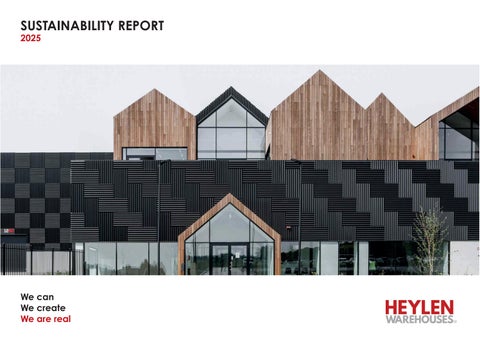
SUSTAINABILITY REPORT 2025
We can We create We are real
We’ve been there. We’ve walked in your shoes. And that makes all the difference. Our founder Wim was born and raised in retail. Learning first hand the secret to excellence: Superior logistics and smart warehouses. This became the foundation of our company.
2
Trust our unique way of working. Our in-house knowledge and experience. Leave the troubleshooting to us. We love a challenge or two along the road. We can.
Up till today, we share your passion for entrepreneurship. Understand your quest for flexibility. Drive your ideas to the next level.
You demand more from spaces. That’s why we help minimise costs. Maximise sustainability. Create a future-proof project. If we can dream it, we can make it. We create.
We don’t work for you. We work with you. All the way. From development to construction. And beyond. Because we don’t actually build buildings. We build relationships.
Just like you, we get straight to the point. Go for the long run, not hit and run. We think along, like an entrepreneur. We put ourselves in your shoes. We’ve never stopped doing that. Never will. We are real.
HEYLEN WAREHOUSES SUSTAINABILITY REPORT 2025
3
4
TABLE OF CONTENTS 1. A LETTER FROM WIM HEYLEN
06
2. FOREWORD FROM OUR CEOs
07
3. ABOUT US 3.1 Our value proposition 3.2 History 3.3 Values 3.4 Our team 3.5 About Heylen Group
09 10 18 21 22 25
4. STRATEGY AND SUSTAINABILITY 4.1 Challenges 4.2 CSRD 4.3 VSME 4.4 An integrated strategy
27 28 30 38 41
5. PILLAR I: WE ADD VALUE FOR OUR CLIENTS 5.1 We build energy-efficient warehouses 5.2 We build custom modular warehouses 5.3 We are a creative growth partner for our clients 5.4 We align with sustainability standards
44 46 50 51 52
6. PILLAR II: WE TAKE CLIMATE ACTION 6.1 We aim for CO2 neutrality 6.2 We reduce our environmental impact 6.3 We are committed to efficient land use
60 62 72 73
7. PILLAR III: WE ARE A COMPANY OF PEOPLE, FOR PEOPLE 7.1 We see safety and wellbeing as our priorities 7.2 We aim to grow together as a team
79 81 82
8. PILLAR IV: WE EMBRACE CORPORATE RESPONSIBILITY 8.1 We guarantee governance as a trusted partner 8.2 We support various good causes 8.3 We embed ESG in governance and decision-making
90 92 93 95
9. SUSTAINABILITY PERFORMANCE DATA
101
10. VSME REPORTING STANDARDS
108 HEYLEN WAREHOUSES SUSTAINABILITY REPORT 2025
5
1. A LETTER FROM WIM HEYLEN
“Sustainability is not a target. It’s a journey, a daily commitment. Every day, we strive to do better and push boundaries. We are dedicated to Building Better Buildings.”
We are not brokers. We are long-term developing investors. Built on the entrepreneurial spirit of the Heylen Group, our “can-do” mentality and deep expertise define who we are. We don’t just oversee; we engineer, develop and execute projects ourselves. From foundation to construction and beyond, we control every aspect, ensuring flexibility and quality at every stage. Our roots lie in retail, giving us firsthand experience as warehouse users before becoming developers. We understand our clients’ needs and provide solutions that adapt to evolving needs. With our in-house expertise, we manage the full development cycle. Together with our partners, we invest in stability, not short-term gains. Our goal is to create intelligent buildings that minimise operational costs while integrating renewable energy solutions. From efficient waste management to carbon-neutral construction, we continuously innovate to reduce our environmental footprint.
6
At Heylen Warehouses, we don’t oversell; we deliver. We focus on real solutions, leveraging our experience and extensive network to support our clients. We are not just developers, we are partners, guides and problem-solvers. Sustainability is not a target. It’s a journey, a daily commitment. Every day, we strive to do better and push boundaries. We are dedicated to Building Better Buildings, creating value that lasts and businesses that thrive. Wim Heylen Entrepreneur / investor Heylen Group
2. FOREWORD FROM OUR CEOs
We are pleased to present the 2025 edition of our Sustainability Report. Once again, we bring together our efforts, progress and ambitions in a document that reflects both who we are and where we are heading. We truly have a strong belief in transparency, shared responsibility and the value of collaboration. Sustainability remains an integral part of our longterm strategy. As a family-owned company, we feel a strong responsibility towards people, the environment and society. That responsibility is embedded in our DNA. The challenges remain significant. Climate change, grid congestion, space scarcity, shifting regulations and rising expectations from society and the market require thoughtful and forward-looking solutions. We want to lead the way, not simply because the context demands it, but because we are convinced that this is the right course for our business and for the wider world. With this updated 2025 edition, we present the latest figures and performance data and also strengthen the way we structure and communicate our sustainability approach. Over the past year, our reporting has continued to mature and several new elements have been added to reflect that evolution.
We want to create tangible impact every single day by investing in future-proof logistics real estate and by helping our clients grow more sustainably. This report covers our activities and projects across Europe and addresses the environmental, social and governance aspects of our operations, together with the values and strategic choices that guide our work. Our strategy continues to rest on four clear pillars: We add value for our clients.
“We want to create impact, tangible and every single day by investing in future-proof logistics real estate and by helping our clients grow more sustainably.”
We take climate action. We are a company of people, for people. We embrace corporate responsibility. This report shows where we stand today and just as importantly, how we continue to move forward. The direction is clear. The work continues. We hope this updated report inspires you. Sincerely, Philippe Deschilder, CEO Ralph Caspanni, CEO
One of these additions is our alignment with the VSME framework, which we have adopted as a practical and forward-looking reporting structure. This helps us to further improve the consistency, relevance and transparency of our sustainability disclosures, while also preparing for future regulatory expectations at group level.
HEYLEN WAREHOUSES SUSTAINABILITY REPORT 2025
INTRODUCTION
STRATEGY
OUR CLIENTS
OUR PLANET
OUR PEOPLE
OUR GOVERNANCE
7
8
3. ABOUT US
Your creative partner for logistics and light-industrial real estate Heylen Warehouses invests in flexible and sustainable logistics and light-industrial real estate solutions at the best logistics hotspots in the Benelux, France and Spain. Our core business is the development, leasing and management of warehouses and logistics distribution centres.
Investing
Developing
Property & asset management
HEYLEN WAREHOUSES SUSTAINABILITY REPORT 2025
INTRODUCTION
STRATEGY
OUR CLIENTS
OUR PLANET
OUR PEOPLE
OUR GOVERNANCE
9
3.1 OUR VALUE PROPOSITION The core of our business model Growing together with our clients... That actually sums up our philosophy well. We offer clients tailor-made logistics real estate and manage it so they can focus on their core business. We serve multiple client segments: 3PL players (third-party logistics), retail brands, manufacturing companies and investors. Our clients value our expertise in solid, future-proof logistics real estate, as well as our reliable, service-oriented approach and experience in financing and management models. Our value proposition combines: Operational excellence in management Product leadership in terms of architecture, flexibility, modularity, sustainability and energy efficiency Customer intimacy in terms of knowledge, co-thinking, unburdening and simply offering pleasant contact based on mutual respect and goodwill
10
11
3.1 OUR VALUE PROPOSITION Investing When making an investment we always keep our core values in mind. We always focus on long-term investments by homing in on innovation, sustainability, quality and operational excellence. We set high standards for our services and our real estate solutions while working in a transparent way with respect for the local communities and the environment. Heylen Warehouses is constantly in search of new land and investments. We are interested in large-scale (re)developments of greenfield and brownfield sites, renovation, rehabilitation and sale and lease back operations.
Sale and lease back Heylen Warehouses can assist you in concluding a sale and lease back transaction. We buy your property and you lease it back for an agreed period. You can then focus again on your core business, while having the financial leeway to invest the released capital in operations and the strategic growth of your company.
Renewable energy We invest in renewable energy projects to offset CO2 emissions from energy consumption on our sites and premises.
Land bank - building plots Besides existing logistics premises, Heylen Warehouses also invests in a land bank with building plots. Heylen Warehouses has a land reserve of over one and a half million m² at strategic locations. With this building land at our disposal we can respond at speed to customers seeking premises exactly in line with their needs.
“Long term value creation is what drives us. We are in it for the long run, not hit and run. Investments must be sustainable, meaning they also bring returns in the long term.”
12
3.1 OUR VALUE PROPOSITION Developing Heylen Warehouses is the ultimate one-stop-shop for developments tailored to logistics real estate. Our multidisciplinary team is ready to help you in finding the most suitable solution for your particular development needs. Examples here can include redevelopment or far-reaching renovation on your own site, or a development at a new location. Our developments are always achieved according to our high quality standards and always with the second-life principle in mind. We not only think as an owner or developer, our approach is particularly based on your perspective, your wishes and your requirements. This is how we have demonstrated our ability to come up with creative and flexible solutions.
Built-to-suit We have a number of building plots at top logistics locations in Belgium and the Netherlands to be able to respond at speed to our customers’ requirements. These site locations offer numerous options to develop and shape your business premises according to your requirements.
Redevelopment of existing sites As far as Heylen Warehouses is concerned, efficient land use is one of the main driving forces towards a more sustainable future. On acquiring clear available space, so-called greenfield developments, we offer the ultimate response to this evolution with our campus model and double use of the land surface area with the development of PV installations on the roofs. The authorities are becoming increasingly reluctant about new land develoment. We at Heylen Warehouses also believe that greenfield space development must be compensated to a maximum. This means we put more emphasis on the redevelopment of existing obsolete industrial buildings or sites, the so-called brownfield developments.
“The buildings we develop and in which we invest must be functional and attractive so they also satisfy the requirements of the future besides those of today. This is what we call the second-life principle.”
HEYLEN WAREHOUSES SUSTAINABILITY REPORT 2025
INTRODUCTION
STRATEGY
OUR CLIENTS
OUR PLANET
OUR PEOPLE
OUR GOVERNANCE
13
3.1 OUR VALUE PROPOSITION Property & asset management We also take care of all our partners’ concerns after completion of the buildings. Our asset and property management teams work on the continuous improvement of operational performance at our sites and premises. To achieve this we equip our sites with the Heylen Warehouses Building Technology Platform. This enables us to improve the energy efficiency of the buildings together with planned preventive maintenance so your downtime is minimised.
“Great property management isn’t just about solving problems. We offer peace of mind, so our clients can focus on growing their business.”
“True asset management is about more than buildings. It’s about earning trust, proving value and making sure our clients never want to leave.”
14
With a total of 2,604,480 m² of developed assets and 119,026 m² under construction, we are continuing to build a strong and forward-looking portfolio. Projects such as WAPI Unit 1 & 2 (30,587 m²), Heat LDC (44,332 m²), Waterfront SHIP (36,316 m²) and Center Court (7,791 m²) demonstrate how we combine scale with targeted investments. In this way, we create value not only in square footage, but above all in sustainable, high-performance environments that support our clients’ growth.
3.1 OUR VALUE PROPOSITION Key figures per 31.12.2025
25,01%
40
62
BREEAM certified *of the leased surface
Fantastic employees
PV installations
14,33%
2.604.480 m2
74 GWh
Very good
Assets developed sq.m
Production in 2025
119.026 m2
20.857
Buildings under construction
Equivalent of annual energy consumption for this number of households
1.804.751 m2
30.341
10,69% Excellent
Leased space in portfolio sq.m
These percentages are expected to decline further as a result of a revision of our strategy. From 2025, our focus is no longer on certification, but on the use of quick scans. As a result, additional square metres will no longer automatically translate into new BREEAM scores.
CO2
Tons of CO2 avoided (based on grey electricity emission factors)
230+ Charging points
15
3.1 OUR VALUE PROPOSITION Key figures
OUR LOCATIONS
5
4
8
+30
+50
+110
Countries
Sites
16
Seaports
Tenants
Terminals
Warehouses
3.1 OUR VALUE PROPOSITION Our partners
“We don’t actually build buildings... We build partnerships”
HEYLEN WAREHOUSES SUSTAINABILITY REPORT 2025
INTRODUCTION
STRATEGY
OUR CLIENTS
OUR PLANET
OUR PEOPLE
OUR GOVERNANCE
17
3.2 HISTORY
2001
2003
18
2008
First development in the Netherlands
2014
First development in Belgium
2012
Collaboration with Ralph Caspanni
Founded by Wim Heylen
Collaboration with Philippe Deschilder
2018
2015
Launch of Heylen Warehouses
50/50 joint venture with AG Insurance
HEYLEN WAREHOUSES SUSTAINABILITY REPORT 2025
2019
2022
Expansion to Spain
2023
Launch of Heylen Energy
INTRODUCTION
STRATEGY
OUR CLIENTS
2025
Co-founder of Belgian Green Building Council
Expansion to France
OUR PLANET
OUR PEOPLE
OUR GOVERNANCE
19
20
3.3 VALUES Our core values Professionalism
Sustainability
We have the knowledge and the know-how to find a fitting solution for each real estate question, however challenging it may be, while completing each project properly and with respect for timing, budget and the various laws.
Working sustainably is in our DNA. We have respect for the environment and the people we work with. That’s how we make the difference, for future generations too.
Respect
Creativity We are a company of entrepreneurs for entrepreneurs. We join up with the customer and boldly offer solutions that exceed all expectations.
We are a business of people for people. We treat everyone with respect, be they employees, suppliers or customers. We always look for win-win solutions in our work. We use direct and clear communication and first and foremost are reliable partners.
Pride
Work hard, play hard
We are proud of what we do and what we achieve. We are proud of our people and the quality we deliver.
Success is a team effort, we are proud of our successes and enjoy celebrating them.
HEYLEN WAREHOUSES SUSTAINABILITY REPORT 2025
INTRODUCTION
STRATEGY
OUR CLIENTS
OUR PLANET
OUR PEOPLE
OUR GOVERNANCE
21
3.4 OUR TEAM
Philippe Deschilder CEO
CEO
Nicolas Van Damme CFO
Caroline Schouwenaars
Conny Van Hool
Head of legal
Senior accountant
Project manager
Anne-Katrien Welters
Gunther Hofkens
Hannah De Becker
Jarno Vandermeren
Sebastien De Sutter
Legal counsel
Jens Roziers
Project manager
22
Ralph Caspanni
Project developer
Business development manager
Sam Broekx
Project manager
Project manager
Dries Van Dyck
John Derweduwe
General manager
Managing partner Spain & Portugal
Damien Delbeek
David Batens
Project analyst
Jan Huysmans
Asset manager
Jarne Heylen
Abdulrahman Alhusseini
Head of project management
Cedric Michiels
Vincent Van Ruijssevelt
Project coordinator
Bart Duchi
Head of design & engineering
BMS & sustainbility coordinator
Project coordinator
Yordi Van den Brande
Lore Uten
Maite Calado-Reyes
Business development manager
Accountant
Dries Claes
Project Engineer
HR business partner
Project developer
Jordy Grundel
Head of business development
Jan Luyckx
Renewable asset controller
Justin Bours
Property coordinator
Wai Wah Chan Office manager
Soraya Godart Property manager
Sarah Dierick
Marketing & communication manager
Max Naber
Senior accountant
Willem Jan van Amersfoort
Business development manager
Matthias D’Hoore Accountant
Yannick Goos Project manager
Sebastiaan Boschmans Innovation manager
Wim Kennis
Project manager POWERmc
Nick Oude Aarninkhof
Business development manager
Andres Montalvo
Technical and development director Spain
HEYLEN WAREHOUSES SUSTAINABILITY REPORT 2025
INTRODUCTION
STRATEGY
OUR CLIENTS
OUR PLANET
OUR PEOPLE
OUR GOVERNANCE
23
“Opportunities don’t happen. You create them.”
24
3.5 ABOUT HEYLEN GROUP
Heylen Group is a Belgian industrial holding company that invests in ambitious companies and entrepreneurs. It uses a buy-build-and-hold strategy focused on innovation, internationalisation and operational excellence. Heylen Group was founded in 2000 by a born entrepreneur. Thanks to a clear vision and the right people, Heylen Group has grown into a holding company consisting of more than 40 companies, which are active in 14 different sectors and approximately 3.000 employees. Today, Heylen Group is active in several European countries and a wide range of industries including consumer products, staffing, food, fintech, business & events and logistics real estate. Heylen Group’s DNA backbone is formed by cross-generational thinking. The combination of passionate entrepreneurship, a long-term vision and a presence in various countries and sectors makes Heylen Group’s business model flexible, shockproof and future-proof.
3.000 Employees
+ 40
Enterprises
14
Sectors
25
26
4. STRATEGY AND SUSTAINABILITY
Strategy and sustainability go hand in hand. That’s why we often speak about our sustainable strategy rather than merely our sustainability strategy. Considering our strategy in the context of an ever-changing world with all its challenges and opportunities is nothing new to us; it is an ongoing task. Reflecting on ESG in combination with our business strategy is no longer optional. Regulations such as the CSRD clearly define what we must report and how. For us, this represents a logical step in a process we initiated long before it became a compliance requirement. While we focus on the Voluntary Sustainability Reporting Standard for SMEs (VSME) as a practical framework to structure and guide our sustainability efforts, we also take into account the requirements of the CSRD. In particular, we build on the results of the double materiality assessment required by the CSRD. Based on these insights, we outline our business and ESG strategy across four pillars, which we describe in detail in the following sections.
OUR CORPORATE STRATEGY CONTRIBUTES POSITIVELY TO THE REALISATION OF THE SDGs
16
17 3
15
4 5
13 6
12 7
11 9
HEYLEN WAREHOUSES SUSTAINABILITY REPORT 2025
INTRODUCTION
STRATEGY
OUR CLIENTS
OUR PLANET
OUR PEOPLE
8
OUR GOVERNANCE
27
4.1 CHALLENGES
We are operating in turbulent times, that is the least we can say about the past few years. Climate change, COVID-19, the scarcity of energy resources, demographic shifts and emerging technologies like AI will continue to profoundly reshape our society and economy. On top of that, geopolitical dynamics have come under increasing pressure. The wars in Ukraine and Iran, tensions in global trade, disrupted supply chains, resource scarcity and fluctuating interest rates and inflation across Europe are placing additional strain on our economic foundations. Energy insecurity, fluctuating construction costs, financial market volatility and a cooling economy are making the business landscape more complex than ever. Strong risk management, a solid capital base and high agility are the key ingredients to navigate this environment. We are determined to continue creating sustainable value, especially in times like these. Existing frameworks and policies offer guidance. We have highlighted the Green Deal, the EU Taxonomy and the CSRD.
The Green Deal The European Green Deal aims to cut transport emissions by 55% by 2030 and transform the EU into a resource-efficient, competitive economy. Our clients face rising pressure to reduce their carbon footprint, while supply chains grow more complex. We support them with energy-efficient, strategically located warehouses powered by our own renewable energy. This makes us climate-positive and helps them operate more sustainably, soon across their entire chain.
28
EU Taxonomy The EU Taxonomy defines which economic activities are considered environmentally sustainable. It aims to guide investments towards more climate-friendly initiatives, prevent greenwashing and reduce market fragmentation. We align our efforts with the six environmental objectives of the regulation: Climate change mitigation Climate change adaptation Sustainable use of water resources Transition to a circular economy Pollution prevention Protection of biodiversity and ecosystems This framework helps us sharpen our sustainability strategy and align with future-proof financing.
29
4.2 CSRD
Heylen Group will report under the Corporate Sustainability Reporting Directive (CSRD) starting in 2028, covering data from the financial year 2027. Although the CSRD was originally expected to apply this year, the revised timeline offers us the opportunity to refine our approach and further embed sustainability into all layers of our organisation. The CSRD acts as a catalyst for long-term sustainable growth. It encourages us to translate our ambitions into clearly defined targets, supported by robust data, risk assessments and transparent communication. It also provides us with a broader and more structured set of KPIs, covering both financial and non-financial dimensions, enabling us to monitor progress across all pillars of sustainability: environmental, social and governance (ESG). As we prepare for our first CSRD-compliant report on Heylen Group level, we are already working towards: Integrating the European Sustainability Reporting Standards (ESRS) into our internal processes Enhancing our data collection and monitoring systems Engaging stakeholders and management around material sustainability risks and opportunities Strengthening our reporting governance and assurance mechanisms
30
Our roadmap A key element of the CSRD is the concept of double materiality. This means companies must report both how sustainability factors affect their financial performance (financial materiality) and how their activities impact people and the environment (impact materiality). Financial materiality considers how sustainability issues such as climate change or resource scarcity influence our financial position and results. For example, stricter environmental regulations may lead to higher operational costs, while changing weather patterns can impact warehouse infrastructure and logistics operations. Impact materiality assesses how our business activities affect the environment and society, including energy consumption, CO2 emissions from our logistics chain and the economic and environmental impact of our warehouses.
4.2 CSRD DMA Our approach
Stakeholder engagement
The list of 16 priority sustainability topics on the next page is the outcome of a structured Double Materiality Assessment (DMA), conducted in preparation for compliance with the Corporate Sustainability Reporting Directive (CSRD). This assessment helped us identify the topics that are material both in terms of our impact on people and the environment (impact materiality) and their influence on Heylen Warehouses’ financial position (financial materiality).
To ensure the robustness of the materiality exercise, we engaged a broad range of internal and external stakeholders. Internally, we consulted teams across sustainability, operations, HR and general management. Externally, we distributed a structured digital survey to over 40 stakeholders throughout our value chain. We received valuable input from logistics service providers, construction partners, property managers, technical suppliers, public agencies and other key actors. Although we do not list them by name here, we acknowledge the contributions of partners in areas such as: logistics, real estate development, technical systems, infrastructure, municipal services and facility management.
The process began with a full scan of the European Sustainability Reporting Standards (ESRS) and led to a focused selection of key issues within the environmental, social and governance domains. These are reflected in the topic overview on this page.
Prioritised topics for CSRD reporting The topics shown in the upper right quadrant of the graph on the next page represent the most material sustainability topics for Heylen Warehouses. These topics are considered highly relevant both in terms of their impact on our business model and our ability to influence them through control mechanisms. They cover themes across environment, social responsibility and business conduct. These priority topics are directly mapped to the corresponding European Sustainability Reporting Standards (ESRS) and we will formally report on them in our CSRD disclosures. While other topics scored lower in the materiality assessment, they remain important to our broader sustainability strategy. These topics are continuously monitored and integrated into our internal management systems, even though they will not be included in our formal CSRD reporting going forward.
HEYLEN WAREHOUSES SUSTAINABILITY REPORT 2025
INTRODUCTION
STRATEGY
OUR CLIENTS
OUR PLANET
OUR PEOPLE
OUR GOVERNANCE
31
4.2 CSRD 6
Together with all the other companies of Heylen Group we have conducted a personalised Double Materiality Analysis (DMA) to identify the most relevant ESG topics. Our materiality matrix maps out the financial relevance (vertical axis) and impact (horizontal axis) of various topics.
5
11 12
Financial materiality
03 01
10
02
09
15 14 16
06
4 07
05 13
08
04
3
2 2
3
4 Impact materiality
32
5
6
Environment
Social
01 01
Climate mitigation - reducing current emissions and plans to reduce emissions.
07 07
Our own workforce - circumstances relating to social dialogue (forms of exchange between employees and others), freedom of association (works council, right to information) and collective bargaining (e.g. trade unions).
02 02
Climate adaptation - adapting to the impacts of climate change, e.g., global warming, flooding.
02 08 08
Our own workforce - disability employment and inclusion.
03 03
Energy consumption - use of various renewable or non-renewable energy sources such as electricity, gas, petrol, ...
03 09 09
Our own workforce - gender equality and equal pay for work of equal value.
04 04
Water & marine resources - consumption and abstraction of water.
04 10 10
Our own workforce - training and skills development.
05 05
Biodiversity & ecosystems - direct factors of biodiversity loss such as climate change, land use, use of fresh water, exploitation, pollution, invasive alien species, etc.
11 11
06 06
Resource use & circular economy - waste generation and management.
06 12 12
Our own workforce - work-life balance, health and safety in the company.
13 13
(Local) communities - impact on surrounding communities with regard to land and/or safety.
Governance 14 14
Business conduct - company culture.
15 15
Business conduct - relationship management with suppliers, including payment behaviour.
16 16
Business conduct - corruption and bribery.
HEYLEN WAREHOUSES SUSTAINABILITY REPORT 2025
INTRODUCTION
STRATEGY
Our own workforce - working conditions such as job security (e.g. contract type, temporary work, social protection), working hours (situation, satisfaction, flexibility) and correct remuneration.
OUR CLIENTS
OUR PLANET
OUR PEOPLE
OUR GOVERNANCE
33
4.2 CSRD From priority topics to ESRS reporting The materiality assessment highlights the topics that have the greatest financial and societal impact. Several environmental issues (such as CO2 emissions, energy consumption and the circular economy), social topics (such as health, safety, wellbeing and diversity) and governance aspects (such as ethical business practices and supplier relationships) surpass the threshold for reporting. These are the topics located in the upper right quadrant of the materiality matrix, where both potential business impact and influence through management mechanisms are high. For these priority topics, we have established a clear link with the European Sustainability Reporting Standards (ESRS). They form the foundation for our CSRD disclosures and will be addressed through transparent reporting, measurable targets and concrete action plans.
ESRS E1 (Climate change) We will report our CO2 and other greenhouse gas emissions (scope 1, 2 and relevant scope 3), set reduction targets and demonstrate how we integrate climate risks and opportunities into our strategy.
ESRS E3 (Water & marine resources) We report on our policies to manage and reduce water consumption, ensuring responsible abstraction and preservation of marine resources.
Although some topics scored lower in the double materiality assessment and are therefore not included in our formal CSRD reporting, they remain integral to our broader sustainability strategy. We continue to monitor these areas and integrate them into our internal operations and performance tracking systems.
ESRS E4 (Biodiversity & ecosystems)
This dual approach enables us to ensure regulatory compliance while upholding our commitment to long-term value creation across environmental, social and governance dimensions.
ESRS E5 (Resource use & circular economy)
We monitor the impact of business activities on biodiversity, including measures to reduce negative effects on ecosystems.
We report the use of circular building materials and methods, the proportion of recycled or reusable materials and our approach to minimizing and reusing waste streams.
ESRS S1 (Own workforce) We report on health, safety, diversity, pay equity, training, career development and employee retention to ensure social justice and a motivating work environment.
ESRS G1 (Business conduct) We report on general governance topics such as ethical conduct, integrity, anti-corruption policies, supplier relationships, transparency, responsible risk management and legal compliance.
34
35
36
4.2 CSRD Action plan In Q3 and Q4 2024, we performed the DMA and mapped the data points with our existing strategy and reporting system. In this way we can align existing to working groups on CO2 emissions (scope 1, 2 and 3), circularity, workforce data and governance with CSRD reporting. Additionally, we plan to engage stakeholders for broader insights. Clear objectives and an internal control system are essential. These will be established at the corporate level. Before our reporting period begins, we will conduct a pre-audit to ensure compliance.
Through this engagement, we translate market experience into practical recommendations. The objective is clear: to ensure that the EU Taxonomy remains ambitious, workable and aligned with the operational realities of the real estate sector. In parallel, we support the development of Belgian EU Taxonomy guidance, responding to the need for clarity and practical tools in the market. This is how we give substance to our commitment. Not only by applying sustainable standards in our projects, but also by helping shape the regulatory framework that defines them.
EU Taxonomy and next steps Alongside CSRD reporting, we are preparing for EU Taxonomy compliance, which requires insights into “green” revenue, investments (CapEx) and operational expenses (OpEx). Our sustainability report will incorporate a significant number of KPIs and data points, leading to a fully CSRD-compliant report in 2028. With this, Heylen Warehouses takes a significant step towards professional and transparent sustainability management.
Walk the talk We do not remain on the sidelines when sustainability frameworks evolve. As an active member of the Belgian Green Building Council, we contributed to the collective feedback submitted to the European Commission on the updated EU Taxonomy criteria for construction and real estate.
HEYLEN WAREHOUSES SUSTAINABILITY REPORT 2025
INTRODUCTION
STRATEGY
OUR CLIENTS
OUR PLANET
OUR PEOPLE
OUR GOVERNANCE
37
4.3 VSME What VSME covers in practice Basic module VSME is the Voluntary Sustainability Reporting Framework for Small and Medium-Sized Enterprises (SMEs). It offers a pragmatic structure for sustainability reporting with a limited core set of disclosures, designed for companies that are not subject to the full CSRD reporting regime on a stand-alone basis. In a group context, CSRD requirements can become relevant at consolidated level, which changes the reporting expectations for subsidiaries and operating entities. Heylen Warehouses sits, as an operating company, close to the intended scope and logic of VSME. Group membership creates a different dynamic, since CSRD can surface through consolidated reporting duties and stakeholder expectations. This makes an early and disciplined VSME approach strategically useful: it builds internal reporting maturity, strengthens data governance and prepares the organisation for more demanding frameworks without waiting for formal triggers. For the practical implementation of our reporting standard, VSME has therefore been selected as the working framework. The intention is not completeness in the first iteration. The intention is credible alignment with an emerging European standard and evidence of serious reporting practice without postponement narratives. To support transparency, the report will include a concordance table at the end. The table will map reported content to the VSME structure across the Basic Module, the Comprehensive Module and the AFI datapoints for sustainable finance. Where an item is not covered in this report, a reference will be added to internal follow up, ownership, or the relevant management process. This remains a first step, with a clear pathway for progressive expansion in future reporting cycles.
• B1 Basis for preparation covers reporting choices and boundaries, key organisational profile data, primary geographies and site information and relevant certificates or labels. • B2 Practices, policies and future initiatives captures whether policies and practices exist across sustainability themes, whether they are public and whether they include objectives. • • B3 Energy and greenhouse gas emissions includes total energy consumption with a split by energy type, scope 1 and location based scope 2 emissions and GHG intensity. • • B4 Pollution of air, water and soil applies where emissions are legally required or reported via an environmental management system, including pollutant emissions by type. • • B5 Biodiversity focuses on the number and area of sites in or near biodiversity sensitive areas, with optional land use breakdowns. • • B6 Water covers total water withdrawal, withdrawal in high water stress areas and water consumption where relevant. • • B7 Resource use, circular economy and waste management covers circular practices, total waste split hazardous and non hazardous, recycled or reused volumes and material flows where relevant. • • B8 Workforce general characteristics covers headcount or FTE by contract type, gender and country, plus turnover rate for larger workforces. • • B9 Workforce health and safety covers recordable incident frequency and fatalities linked to occupational incidents and work related health issues. • B10 Workforce remuneration, collective bargaining and training covers minimum wage alignment, gender pay gap where applicable, collective bargaining coverage and training hours. • • B11 Convictions and fines for corruption and bribery covers convictions and fines, where applicable, with counts and total amounts.
38
4.3 VSME Comprehensive module
AFI module
• C1 Strategy and business model summarises the business model, markets, key relationships and sustainability related strategic initiatives. • • C2 Description of practices and governance detail expands B2 with short descriptions and the highest responsible level. • • C3 GHG reduction targets and climate transition captures targets, baseline, scope coverage, key actions and transition plan elements where relevant. • • C4 Climate risks documents identified physical and transition risks, assessment method, time horizons and adaptation actions. • • C5 to C7 provide additional workforce and human rights information, including policies, grievance mechanisms and severe incidents where relevant. • • C8 captures revenue exposure to specific sensitive sectors and any exclusion from EU reference benchmarks aligned with the Paris Agreement, where applicable. • • C9 reports gender diversity in the governance body, where such a body exists.
The AFI module translates selected disclosures into a concise set of finance-oriented datapoints, aligned with SME operations and European reporting expectations.
HEYLEN WAREHOUSES SUSTAINABILITY REPORT 2025
INTRODUCTION
AFI1 Energy production covers energy generation where applicable. AFI2 Vehicle fleet focuses on fleet composition and related impacts. AFI3 Hazardous waste management addresses handling of hazardous waste, including radioactive material where relevant. AFI4 Workforce diversity reports on diversity within the organisation. AFI5 Exclusion from EU benchmark sectors identifies excluded activities. AFI6 EU taxonomy alignment outlines the approach towards future EU Taxonomy alignment.
STRATEGY
OUR CLIENTS
OUR PLANET
OUR PEOPLE
OUR GOVERNANCE
39
40
4.4 AN INTEGRATED STRATEGY Strategy doesn’t arise out of the blue.
PILLAR III
It is the result of carefully assessing external challenges and opportunities and formulating an appropriate response. Since we first communicated our strategy in 2022, much has happened, but our approach to the market has proven to be the right one.
We are a company of people, for people
Our strategy is built on four pillars:
People are at the heart of everything we do. That may sound obvious, but it’s a message we cannot repeat enough. It starts with our employees, who together form a strong and welcoming team. Our two areas of work:
PILLAR I
We see safety and wellbeing as our priorities We aim to grow together as a team
We add value for our clients We are building logistics real estate today that is ready for the future. Our goal is to fully support and unburden our clients during every growth phase and in the face of new challenges. This allows them to focus on their core business and generate social and economic value as efficiently as possible. We achieve this by building energy-neutral, smart, modular and innovative spaces. Our four areas of work: We build energy-efficient warehouses We build custom modular warehouses We are a creative growth partner for our clients We align with sustainability standards
PILLAR IV We embrace corporate responsibility Good governance is key to long-term success. Our values are reflected in how we address societal challenges and in how we collaborate respectfully with construction partners. In Belgium, The Netherlands, Spain and France, we are committed to working with various stakeholders to help build a better society. Our three areas of work: We guarantee good governance as a trusted partner We support various good causes We embed ESG in governance and decision-making
PILLAR II
In this way, we address various societal, economic and environmental challenges, as well as the needs and expectations of our clients and other stakeholders.
We take climate action As a company, we aim to be part of the solution to several climate- and environment-related challenges. Based on our expertise and business activities, we believe we can make a significant and positive contribution. Our three areas of work: We aim for CO2 neutrality We reduce our environmental impact We are committed to efficient land use
HEYLEN WAREHOUSES SUSTAINABILITY REPORT 2025
INTRODUCTION
STRATEGY
OUR CLIENTS
OUR PLANET
OUR PEOPLE
OUR GOVERNANCE
41
4.4 AN INTEGRATED STRATEGY The table below illustrates how we align the key IRO (Impact, risk, opportunity) topics from our double materiality assessment with our strategic framework. By explicitly connecting these two perspectives, we ensure that each topic is not only embedded in our core strategy and organisational goals, but also actively managed through clearly defined KPIs. These indicators are fully integrated into our governance and performance management processes, allowing us to track progress, steer actions and deliver impact in a structured and accountable way.
Pillar
Linked IRO topics
We add value for our clients • • • •
We build energy-efficient warehouses We build custom modular warehouses We are a creative growth partner for our clients We align with sustainability standards
1, 2, 3, 4, 5, 13
We take climate action • • •
We aim for CO2 neutrality We reduce our environmental impact We are committed to efficient land use
5, 6, 13
We are a company of people, for people • •
We see safety and wellbeing as our priorities We aim to grow together as a team
7, 8, 9, 10, 11, 12
We embrace corporate responsibility • • • 42
We guarantee governance as a trusted partner We support various good causes We embed ESG in governance and decision-making
14, 15, 16
Sustainable Development Goals
43
5. WE ADD VALUE FOR OUR CLIENTS Strategy pillar I We construct buildings with minimal environmental impact, that are energy-efficient and retain their long-term value. This is achieved through careful site selection, sustainable construction methods and materials, modular design and smart building management systems. To realise this ambition, we have defined the following key objectives: We build energy-efficient warehouses We build custom modular warehouses We are a creative growth partner for our clients We align with sustainability standards
44
HEYLEN WAREHOUSES SUSTAINABILITY REPORT 2025
INTRODUCTION
STRATEGY
OUR CLIENTS
OUR PLANET
OUR PEOPLE
OUR GOVERNANCE
45
5.1 WE BUILD ENERGY-EFFICIENT WAREHOUSES Heylen Warehouses designs buildings with the lifecycle in mind, investing in long-lasting, energy-efficient solutions that lower both operating costs and environmental impact.
Key features include: Monitoring and analysis of energy consumption per installation Benchmarking of performance across buildings or systems
Low energy demand
Real-time tracking of energy use and CO2 emissions Adjustment of HVAC settings and control of lighting Central dashboards with clear insights
Our ambition is to significantly reduce the baseline energy demand of all buildings, using internal benchmarks and performance standards. We integrate high-performance insulation, energy-efficient HVAC systems, LED lighting with sensors and smart design choices such as optimal building orientation and airtight construction. These measures are guided by the Trias Energetica principle: reduce demand, generate renewably and optimise what remains. As long-term investors and property managers, we focus on low operating costs and maximum lifecycle value, choosing proven, high-quality materials and systems for every building.
Smart buildings We equip our buildings with a smart monitoring platform for building management. This system enables detailed monitoring, analysis and benchmarking of energy consumption across various building installations. It provides users with clear insights into energy performance, allowing them to implement targeted optimisations. The platform tracks energy use and CO2 emissions in real time and offers intuitive dashboards for owners and property managers. It also allows users to adjust certain technical settings, such as HVAC systems and lighting, making it easy to balance comfort and efficiency. By centrally collecting and analysing data, the system helps compare consumption, detect deviations and support informed decision-making. Energy production, such as from solar panels, is also monitored, including its associated CO2 impact.
46
Monitoring of energy production (e.g. solar panels) and CO2 impact Users are notified of potential issues before they occur, ensuring uptime and tenant satisfaction. The system also tracks energy generation from solar panels and calculates the related CO2 offset.
BREEAM assessment All new developments are assessed using a BREEAM quick scan. This scan covers sustainability categories such as energy, materials, water, waste, health and wellbeing, land use and biodiversity. The quick scan helps identify opportunities to improve environmental performance, employee wellbeing and overall project quality.
47
5.1 WE BUILD ENERGY-EFFICIENT WAREHOUSES Heylen Energy Heylen Energy was established in 2019 as a business unit within Heylen Warehouses, with the objective of exploring and implementing renewable energy solutions in logistics real estate. Since 2024, we have been operating as an independent entity, with a clear mission: to support companies and organisations in our energy transition by offering innovative and sustainable solutions.
Contribution to the EU Green Deal goals We actively contribute to the achievement of European climate objectives. The energy market is at a tipping point, where regulation, economic incentives and environmental awareness are accelerating the shift to renewable energy. We play an important role by helping businesses to implement renewable energy sources and to optimise their energy management systems. In Flanders, companies consuming more than 1 GWh per year are legally required to install solar panels. We guide businesses through the implementation and optimisation of such installations. Beyond consultancy, we also allocate funds to invest in these projects, even at sites not owned by Heylen Warehouses. In this way we pursue sustainability ambitions beyond our own portfolio.
One-stop renewable energy partner We offer an integrated approach for businesses seeking to accelerate their energy transition. From analysing energy consumption to implementing renewable energy systems, we manage the entire process.
48
Our key offerings include: Virtual Power Plant (VPP): We integrate various renewable energy sources and storage systems into a smart network, optimising the use of generated energy and aligning it with energy demand. Sustainable Energy Solutions: We implement solar energy systems, battery storage and intelligent energy control, helping companies reduce their reliance on fossil fuels. Strategic Partnerships: We collaborate with energy providers, research institutions and technology partners and offer a holistic and future-proof approach to energy management.
Sustainable impact and ESG goals We pursue a 360° approach where economic optimisation and ecological sustainability go hand in hand. This translates into tangible ESG impact: Environment (E): Reduction of CO2 emissions through the implementation of renewable energy sources and intelligent energy management. Social (S): Supporting companies in achieving their sustainability goals and enhancing their appeal as green employers. Governance (G): Transparent and responsible energy management strategies that comply with national and European regulations. We play a leading role in the energy transition by unburdening companies and supporting their shift to renewable energy. By investing in innovative technologies and strategic collaborations, we continue to build a circular energy ecosystem without investment barriers, creating positive impact for both businesses and the planet.
HEYLEN WAREHOUSES SUSTAINABILITY REPORT 2025
INTRODUCTION
STRATEGY
OUR CLIENTS
OUR PLANET
OUR PEOPLE
OUR GOVERNANCE
49
5.2 WE BUILD CUSTOM MODULAR WAREHOUSES
We build right from the first time by anticipating growth and change. We achieve this through our modular design approach and the campus model we apply.
Strategically located, multimodal sites Heylen Warehouses develops logistics buildings at key multimodal hubs, connecting road, rail, water and air transport. These A-locations are chosen to maximise efficiency and synergies between clients, cities and ports, enhancing cost-effectiveness, speed, safety and accessibility. The company invests not only in existing logistics assets but also holds a land bank of over 1.5 million m² in Belgium and the Netherlands, with additional land positions in Spain and France.These sites allow for fast, custom development in response to client needs, offering flexibility and strategic readiness.
“In the past, buildings were developed for a single client on just enough land. Once the business grew, the customer had to move elsewhere, creating inefficiencies. Our campus model allows for flexibility.”
50
Built for change – ready for a second life All projects are designed with flexibility and long-term value in mind, following the ‘second-life principle’ from day one. Buildings are modular and future-proof , enabling clients to scale up or down and reconfigure space without costly relocations. Heylen’s campus model features large, connected units (collaborative warehouses) that allow multiple users to operate independently or together under shared management. This design offers long-term flexibility, efficient land use and seamless growth opportunities. Facilities are built to the highest functional standards, suitable for a wide range of logistics activities, from heavy pallet storage to e-commerce, production, or automation. High ceilings, strong floor loads and adaptable layouts ensure long-term usability and reusability.
5.3 WE ARE A CREATIVE GROWTH PARTNER FOR OUR CLIENTS
Thinking alongside our clients
We support our clients with planning, management, financing, technical expertise and automation. And we believe they deserve buildings that are both functional and beautiful.
Our mission is to deliver tailored real estate solutions backed by deep expertise and close collaboration. We continually strengthen our team to offer:
Maximum support
Strategic advice and planning
Clients value our expertise in developing durable, future-proof logistics spaces, but just as much, they appreciate our hands-on support and financial structuring capabilities.
Personalised guidance Timely and proactive communication Execution aligned with budget, timeline and regulations
Even after handover, our asset and property management teams continue to optimise building performance. Using our proprietary Building Technology Platform, we enhance energy efficiency, enable predictive maintenance and minimise downtime of installations.
We add value for our clients and partners through an in-house 360° approach, covering all disciplines of the real estate cycle. What we do: Provide the right technologies and solutions Help design high-performance warehouses Support procurement and coordinate special works (e.g. automation, robotics) Offer financing options if needed Integrate digital and smart technologies that automate processes, leverage data and enable systems to work together Capture and interpret building data to optimise performance
“We believe logistics buildings should not merely be functional, they should inspire. That’s why we use high-quality materials and design for timeless visual appeal. Our buildings are warm, inviting and recognisably Heylen.”
HEYLEN WAREHOUSES SUSTAINABILITY REPORT 2025
INTRODUCTION
STRATEGY
OUR CLIENTS
OUR PLANET
OUR PEOPLE
OUR GOVERNANCE
51
5.4 WE ALIGN WITH SUSTAINABILITY STANDARDS We remain fully convinced of the value of BREEAM as a robust and internationally recognised framework for defining, assessing and communicating sustainable performance in the built environment. BREEAM provides a structured methodology that translates environmental ambition into verifiable criteria across a broad set of themes, including energy, water, materials, waste, transport, health and wellbeing, management and ecology. Its strength lies in the combination of technical rigour and comparability, enabling stakeholders to situate a building’s performance within a transparent reference system. Over the past years, a significant share of our portfolio has been delivered and operated in line with BREEAM requirements and several buildings have obtained certification at different levels. This experience has reinforced our confidence in the framework and has informed our internal practices. At the same time, we have concluded that pursuing formal certification as a default pathway is not always the most effective choice. The certification process entails additional administrative workload, coordination effort and direct costs that are not consistently proportionate to the incremental value created for every project and every tenancy situation. For that reason, we will no longer proceed automatically to certification for each building. Instead, we will adopt a building-specific approach. For every asset, we will carry out an assessment to determine the extent to which the building would meet BREEAM criteria and at which potential performance level. This assessment will provide a clear, evidence-based picture of alignment with BREEAM, without imposing the full certification trajectory by default. On that basis, the decision to proceed to formal certification can be made where it is genuinely useful, particularly in response to tenant demand or market expectations.
52
This approach is complemented by our own monitoring and performance management practices, which are designed to ensure continuity, operational relevance and accountability. We follow our buildings through systematic internal processes that reflect the substance of internationally recognised standards and current best practice. In doing so, we rely on our operational strengths and on a governance model that emphasises measurable performance, continuous improvement and transparent documentation. This is consistent with the expectations and direction of the Belgian Green Building Council and with the broader evolution towards credible, standards-aligned sustainability management that remains fit for purpose in day-to-day operations. In summary, we continue to use BREEAM as an important reference framework and a shared language for sustainability. Our future model combines asset-level assessments with a targeted certification decision, ensuring that effort and expenditure are deployed where they produce tangible value for tenants and for the long-term performance of the portfolio.
Beyond buildings: a holistic view of the future of logistics Heylen Warehouses shares knowledge with customers and stakeholders because progress in logistics depends on shared learning. Better buildings and better operations emerge faster when clients, designers, operators, technology partners and energy specialists develop solutions together. The Beyond Buildings whitepaper argues that logistics is entering a structural transition in which isolated improvements no longer suffice. An integrated, end-to-end approach is required, linking processes, infrastructure, technology, energy systems and collaboration into one coherent development logic. The paper highlights three catalysts that shape this transition. • Labour scarcity is becoming structural, which forces a redesign of work organisation and accelerates automation. Technology remains a means, not an end; strong processes come first and automation should reinforce them. • • Energy becomes a dominant design variable. Automated and electrified logistics increases power demand, continuity requirements and charging needs. Grid capacity constraints make early energy planning essential, alongside local generation, storage and smart energy management. • • Investment logic shifts from pure square metre and location thinking to total cost of ownership and future proofing. Long term value depends increasingly on automation readiness, resilient energy and digital infrastructure and the capacity to adapt to new flows and tenants. • Several market and supply chain trends reinforce this picture. Mass customisation and higher service expectations increase operational complexity and push fulfilment towards real time responsiveness. Nearshoring and reshoring support resilience and emissions reduction, while they also create a more decentralised hub landscape with shorter chains and higher coordination needs. Logistics increasingly behaves as an ecosystem rather than a linear chain, with shared data, shared infrastructure and tighter coupling between warehousing and transport. Digital trust technologies, including blockchain use cases, play a role in traceability and coordination, while governance, GDPR constraints and cybersecurity requirements raise the bar for compliance by design.
HEYLEN WAREHOUSES SUSTAINABILITY REPORT 2025
INTRODUCTION
STRATEGY
OUR CLIENTS
OUR PLANET
OUR PEOPLE
OUR GOVERNANCE
53
This leads to practical implications for the logistics building and its delivery model. • Process dictates design. Automation architecture influences floors, heights, loads, routing corridors, connectivity and power delivery. Functional performance becomes a defining quality parameter. • • Flexibility becomes a strategic asset. Technology cycles shorten and user needs evolve faster, which increases the value of modularity, reconfiguration capacity and scalable infrastructure provisions. • • Energy infrastructure becomes part of the building’s core value proposition. Scalability, smart control, storage integration and charging readiness shape operational viability and resilience. • • Real estate and technology converge. The shell and the operational technology stack need integrated planning, commissioning and maintenance. New commercial models follow, including bundled solutions that combine building, automation, energy and IT into one coherent offer. The closing outlook towards 2035 sketches a sector shaped by advanced automation and AI orchestration, broad electrification powered by renewables and storage and net zero expectations that become baseline. Circularity grows through modular design and reuse, supported by better data on assets and materials. The underlying message remains consistent: future performance depends on decisions taken early in design, especially on adaptability, energy intelligence and integrated project delivery.
54
55
Delta 21 We continue to invest in sustainable building development and strong environmental performance across our logistics real estate portfolio. Delta 21 offers a clear example of this approach. The sustainability measures incorporated into the project, structured around nine clusters, reflect our commitment to delivering resilient, future-ready logistics real estate. Sustainability is not limited to formal external certification schemes. While reporting frameworks continue to evolve and while the EU Taxonomy and other relevant regulations are still being further defined, we have chosen a pragmatic approach. For each building, we conduct a BREEAM quick scan and assess both the measures already implemented and the areas where further improvement remains possible. This approach allows us to respond promptly and effectively once future requirements become more clearly defined. To illustrate our holistic approach to sustainability we sum up the main features of project Delta 21:
1. Sustainable design and project management This cluster focuses on embedding sustainability throughout the project lifecycle: • Integration of sustainability principles into the design process through collaboration between designers, contractors and users • Application of sustainable construction practices during the execution phase • Monitoring of energy and water consumption during construction • Use of timber sourced from certified sustainable forest management • Collaboration with contractors that operate ISO 14001 environmental management systems • Preparation of a building user guide • Post-occupancy evaluations after handover 2. Health and comfort of building users This cluster aims to provide a healthy, safe and comfortable environment for building users: • Installation of energy-efficient LED lighting with intelligent zoning • Maximum use of daylight in office spaces • Reduction of glare and improvement of visual comfort • Implementation of an indoor air quality plan • Monitoring of volatile organic compounds after completion • Thermal modelling and zoning of climate control systems • Preventive measures against legionella in water systems • Safe infrastructure for pedestrians and cyclists
56
6. Materials and circularity
3. Energy efficiency and climate
This cluster focuses on responsible material choices and lifecycle thinking: This cluster is centred on reducing energy demand and improving climate performance: • Energy performance studies and energy modelling in the design phase • Installation of energy-efficient building systems and technologies • Implementation of a Building Management System • Sub-metering for the monitoring of energy use by function • Energy-efficient lifts with standby mode and LED lighting • Integration of renewable energy solutions such as photovoltaic panels • Energy-efficient outdoor lighting with automatic controls 4. Sustainable mobility This cluster supports lower-emission and more sustainable mobility choices on site:
• Life Cycle Assessment for the building • Use of materials with Environmental Product Declarations • Use of sustainably certified timber • Use of insulation materials compliant with environmental standards • Design measures to reduce damage from impact in logistics areas 7. Waste management This cluster aims to reduce waste generation and improve recovery: • Construction waste management plan during the building phase • Separation of multiple waste streams on site • Maximum recycling and recovery of construction waste • Dedicated waste areas within the buildings
• Charging infrastructure for electric vehicles • Parking spaces for shared vehicles • Bicycle parking facilities for site users • Development of a mobility plan for the site
8. Biodiversity and ecology
5. Water management
• Ecological study of the site • Protection of existing natural features during construction • Integration of biodiversity zones and natural habitats • Nesting and shelter facilities for fauna • Long-term biodiversity management plan
This cluster supports the protection and enhancement of ecological value on and around the site:
This cluster addresses efficient water use and improved operational control: • Installation of water-saving sanitary fixtures • Water meters connected to the building management system • Leak detection systems with automatic alerts • Automatic shut-off of water supply in sanitary areas when not in use • Planting of native vegetation with low irrigation demand
9. Reduction of environmental impacts This cluster addresses a broader range of environmental risks and nuisance effects: • Use of refrigerants with low climate impact • Analysis of flood risk and water management • Oil and hydrocarbon separators for rainwater from parking areas • Reduction of light pollution through smart lighting solutions • Measures to minimise noise disturbance for the surrounding areas
HEYLEN WAREHOUSES SUSTAINABILITY REPORT 2025
INTRODUCTION
STRATEGY
OUR CLIENTS
OUR PLANET
OUR PEOPLE
OUR GOVERNANCE
57
58
LINK TO CSRD
ENV. NR 3 Climate change – energy consumption
Our approach to logistics real estate is deeply rooted in long-term value creation, not only for our clients and investors, but also for the environment and the broader economy. Through our design philosophy, material choices, energy strategy and client services, we directly address key Impact, Risk and Opportunity (IRO) topics under the CSRD framework.
We continuously reduce energy demand through smart insulation, HVAC systems, LED lighting and airtight envelopes. Our Building Technologies 21 platform supports energy monitoring, data-driven optimisation and real-time performance tracking. We design for low total cost of ownership and long-term energy efficiency.
Below is an overview of how the ambitions and actions under Pillar I relate to these CSRD IRO topics:
ENV. NR 1 Climate change – climate mitigation
SOC. NR 13 (Local) communities – impact on surrounding communities: land use and safety
We reduce greenhouse gas emissions by designing energy-neutral buildings, equipping rooftops with PV systems and applying the Trias Energetica principle in every project. We aim to lower both operational and embodied carbon through intelligent design, material selection and building lifecycle management.
We consciously design our buildings to enhance the quality of their surroundings, with a focus on spatial integration, traffic safety, green buffers and architectural quality. We separate freight and pedestrian flows on our campuses and use lighting and layout to reduce disruption to the local environment.
ENV. NR 2 Climate change – climate adaptation Our real estate is built for resilience. We anticipate climate risks such as temperature extremes, energy shortages and network congestion by integrating passive design features, smart energy infrastructure and modular layouts that can adapt over time. Our buildings are also assessed through BREEAM for climate resilience criteria.
HEYLEN WAREHOUSES SUSTAINABILITY REPORT 2025
INTRODUCTION
STRATEGY
OUR CLIENTS
OUR PLANET
OUR PEOPLE
OUR GOVERNANCE
59
6. WE TAKE CLIMATE ACTION Strategy pillar II We aim to be part of the solution, not the problem. Our goal is to create economic and societal value without causing environmental harm. More than that, we strive to generate a positive environmental impact. This mindset should be second nature to everyone in our organisation and something we actively share with our clients. To achieve this, we have set the following key objectives: We aim for CO2 neutrality We reduce our environmental impact We are committed to efficient land use
60
61
6.1 WE AIM FOR CO2 NEUTRALITY Our roadmap for CO2 reduction The focus on CO2 reduction in scopes 1, 2 and 3 plays a major role in our climate action commitment. We have formulated three key objectives:
We own hundreds of hectares of roof, making solar panels an obvious choice. But we go further. We aim to be CO2 neutral ourselves and to help our clients achieve the same.
Reducing CO2 emissions at the operational level (scope 1 + 2)
Our position allows us to have an outsised impact, not only through energy efficiency but as a producer of green energy. That’s why we’ve set the ambition to become climate-positive as a company and to help our clients to meet or even exceed the CO2 reduction targets of the European Green Deal, preferably by 2030.
Improving the energy efficiency of our warehouses (scope 3) Generating our own green energy for tenants
To that end, we have established our own emission reduction goals.
2025
2022 62
Baseline measurement scope 1+2
2026
First electric cars
Green electricity contract
2029
Entire fleet electric
2030
85% reduction 15% offset scope 1+2
63
64
6.1 WE AIM FOR CO2 NEUTRALITY Reducing scope 1 & scope 2 CO2 emissions
Natural gas Diesel
In 2025, Heylen Warehouses again experienced strong business growth. This expansion, however has not had an impact on our absolute nor on our elative CO2 emissions. The emissions per employee have decreased by a negligible 1,8%. Absolute CO2 emissions have dropped to 66,43 tons in 2025, a decrease of 2,82 tons compared to the previous year. We are quite pleased to note that the growth in emissions was significantly lower than our overall business growth, indicating an increasingly efficient carbon performance. The high share of fossil fuel related CO2 emissions, however, remains a serious point of concern.
11%
Scope 1 & 2 2025
54%
27%
Electricity
8%
Gasoline
SCOPE 1 & 2
2021
2022
2023
2024
2025
Natural gas (m3)
5.017
2.730
2.394
2.188
3.312
Electricity (kWh)
111.375
116.416
122.789
114.709
88.254
Diesel (liter)
12.722
15.469
12.705
15.589
14.509
Gasoline (liter)
0
0
0
0
2.531
R410A (kg)
0
3,10
0
2,38
0
R134A (kg)
0
0
2,62
0
0
Total emissions CO2 (tons)
59,20
68,78
64,81
69,25
66,43
Relative emissions CO2 (tons) per employee
1,97
2,08
1,85
1,69
1,66
HEYLEN WAREHOUSES SUSTAINABILITY REPORT 2025
INTRODUCTION
Relative emissions CO2 (tons) per employee
2,08 1,97 1,85 1,69
2021
STRATEGY
OUR CLIENTS
2022
OUR PLANET
2023
2024
OUR PEOPLE
1,66
2025
OUR GOVERNANCE
65
66
6.1 WE AIM FOR CO2 NEUTRALITY Emission table 2025
Consumption
CO2 emission: kg CO2/unit
Ton CO2
Office BE: Herentals
88.254
0,167
14,74
Site office
19.562
0,167
3,27
Electricity (kWh) (generated)
Office BE: Herentals
7.362
0
0
Natural gas (m3)
Office BE: Herentals
3.312
2,2
7,29
Diesel (l)
Company vehicles
14.509
2,462*
35,72
Gasoline (l)
Company vehicles
2.531
2,139*
5,41
Electricity (kWh) (purchased)
Total: 66,43 ton CO2
*For Diesel and Gasoline we use the Well-to-Wheel (WTW) emission factors
HEYLEN WAREHOUSES SUSTAINABILITY REPORT 2025
INTRODUCTION
STRATEGY
OUR CLIENTS
OUR PLANET
OUR PEOPLE
OUR GOVERNANCE
67
6.1 WE AIM FOR CO2 NEUTRALITY Scope 3 CO2 emissions In 2022, we conducted our first scope 3 CO2 baseline measurement for the years 2020 and 2021 as a basis for our first sustainability report. This baseline and the formulation of our goals were based on the Greenhouse Gas Protocol (GHG Protocol). The GHG Protocol is the most widely used global standard for calculating greenhouse gas emissions. The reduction in gas consumption and especially the shift to 100% green electricity, has had an enormous impact on our scope 3 CO2 emissions. In total, these emissions fell from 5,151 tonnes in 2021 to 771.21 tonnes in 2025. In absolute terms, this represents a reduction of 85%. The decline in relative CO2 emissions per m² is even more striking: from 7.8 kg/m² in 2021 to 0.43 kg/ m² in 2025, which amounts to a reduction of 94.5%.
85 % reduction in absolute CO2 emissions
94,5 % reduction in relative CO2 emissions per m²
At this stage, we do not yet perform a full calculation of all scope 3 emissions. This means that upstream and downstream emissions, including embodied carbon in construction materials, are not yet included. However, we are committed to expanding our scope 3 accounting in the near future, with particular attention to emissions related to construction activities and material use.
68
Energy efficiency of our warehouses In 2022, we formulated two objectives to map the energy efficiency of our warehouses. We measure this based on the consumption of natural gas and electricity. This is done across the entire portfolio of our warehouses. The objective therefore reflects the average consumption per m². The target is to achieve a reduction of 25% in kWh per m² of surface area per year for electricity and 25% in m³ per m² of surface area per year for natural gas. This objective is directly linked to our scope 3 CO2 emissions. The table on page 103 shows the continuous decrease in these numbers. In 2025 we achieved a reduction of 18% kWh per m2 in comparison to 2021. We are very close to our goal of 25%. The use of natural gas saw an even further reduction. Here we achieved a reduction of 87% m3 per m2 in comparison to 2021.
Green energy for our tenants We aim for a portfolio in which more than 90% of managed properties are equipped with a PV installation. In 2022, the percentage stood at 87,5%. In 2023, it dropped to 64,42%. Due to grid congestion in the Netherlands our ability to install new solar panels is limited. In 2024 this stood at 61,28%. In 2025 it stood at 72%. In addition, we track how much solar energy we generate. This figure is expected to continue rising. When related to the energy consumption of our tenants, the ratio came to 226% in 2021, 308% in 2022, 193% in 2023, 165,5% in 2024 and 175% in 2025.
1OO% 18%
771,21 tons CO2
Natural gas Electricity
Our scope 3 CO2 emissions fell sharply in 2025. This reduction was driven by a full contractual switch to green electricity, resulting in zero emissions from electricity consumption. Natural gas consumption also declined. Our continued expansion has not led to an increase in CO2 emissions, neither in relative terms (per m2) nor in absolute terms.
100% green
Generated solar energy
771,21 tons CO2 0 tons CO2
2022
72.907.678 kWh
Scope 3
2021
2023
Natural gas
957.847 m3
1,45 m3/m2
346.101 m3
0,41 m3/m2
335.001,1 m3
Electricity
18.580.742 kWh
28,15 kWh/m2
20.518.323 kWh
23,52 kWh/m2
Generated solar energy
41.969.722 kWh
63,58 kWh/m2
63.218.246 kWh
Total emissions CO2 (tons)
5.151 tons
7,8 kg/m2
1.560 tons
2024 0,36 m3/m2
388.564 m3
0,283 m3/m2
350.550 m3
0,19 m3/m2
35.335.026 kWh
29,26 kWh/m2
36.281.494 kWh
26,42 kWh/m2
41.644.565 kWh
23,07 kWh/m2
65,18 kWh/m2
68.347.993 kWh
55 kWh/m2
60.051.857 kWh
71 kWh/m2
72.907.678 kWh
80 kWh/m2
1,61 kg/m2
4.407 tons
3,53 kg/m2
4.796 tons
3,41 kg/m2
771,21 tons
0,43 kg/m2
**
table to the activities of a specific tenant with an energy-intensive production process, accounting for 20% of the total consumption. As of 2023, upstream emissions have also been included in the calculation of the CO2 footprint. This results in a shift in both quantity and proportion.
explanation is quite simple: In 2024 there were not that many sunny days. In fact it was the worst year for solar energy production since 2012.
INTRODUCTION
*
** The increase in electricity consumption is attribu-
* The reduction in 2024 was remarkable given the extra installed capacity. The
HEYLEN WAREHOUSES SUSTAINABILITY REPORT 2025
2025
STRATEGY
OUR CLIENTS
OUR PLANET
OUR PEOPLE
OUR GOVERNANCE
69
Digital CO2 strategy and data platform Heylen Warehouses is actively developing a digital CO2 platform as part of a broader energy and data strategy, in close collaboration with Heylen Energy. This initiative aims to collect, manage and analyse climate data in a structured and consistent manner across the entire life cycle of our buildings. This includes both operational emissions from energy consumption and the embodied carbon associated with materials and construction processes. As a first step in this process, a Life Cycle Assessment (LCA) was carried out for the Ghent Logistic Campus site in Evergem. This analysis provides valuable insight into the CO2 impact of our buildings and helps identify opportunities for optimisation in design, material use and execution. Based on these insights, a clear roadmap has been developed towards an integrated digital CO2 platform. This roadmap includes, among other things, the phased integration of data sources, the improvement of monitoring capabilities and the development of a structured reporting framework aligned with future CSRD requirements. Further details on the practical development and implementation of this approach will be provided from 2026 onwards.
Steps in our CO2 roadmap Understanding the CO2 impact of our buildings Carrying out LCA analyses on selected projects, such as Ghent Logistic Campus in Evergem Analysing both operational emissions and embodied carbon Identifying the main sources of emissions Detecting CO2 hotspots across the full life cycle Assessing reduction opportunities in design, materials and energy use Building a structured data framework Defining data requirements for scope 1, 2 and relevant scope 3 emissions Aligning with ESRS and CSRD requirements Developing a digital platform approach Structuring data flows across buildings and stakeholders Preparing for integration with energy management through Heylen Energy Towards data-driven decision-making Enabling scenario analysis and CO2 reduction strategies Supporting targets and future reporting
70
71
6.2 WE REDUCE OUR ENVIRONMENTAL IMPACT
We aim to avoid any environmental harm and where avoidance isn’t possible, to minimise our impact. With groundwater becoming increasingly scarce and the construction sector being a major waste producer, we take proactive steps to lead by example through responsible water and material management.
Water management and rainwater recovery Our water strategy is based on the Trias Aquatica principle: limit water use, utilise natural resources and build sustainable water systems. In our developments, we reduce and delay stormwater discharge into public sewers to lower the risk of flooding, pollution and other environmental damage. We actively collect rainwater at all our sites, exceeding legal requirements and filter it where needed for optimal reuse. Our facilities are equipped with smart water tracking, water-saving technologies and leak detection systems to ensure efficient and sustainable management.
72
Material circularity and waste reduction We aim to use resources more efficiently and responsibly across all phases of a building’s life cycle, from design and construction to operation, repurposing and eventual deconstruction. This approach reduces the operational impact and the embodied carbon associated with the materials we use. To support this, we promote efficient material use by implementing robust waste management systems and encouraging high-quality reuse of materials. Waste is minimised wherever possible and we ensure 100% sorting and separation of all waste streams. These practices are standard on all our construction sites and in our office operations. We take circularity into account at the design stage by selecting materials based on life cycle assessments (LCA) and embodied carbon calculations. Our goal is to reduce the environmental footprint of every building component, from structural elements to finishes. Where possible, we prioritise materials with recycled content, long service life and low carbon intensity, while designing for flexibility, disassembly and reuse at the end of life.
6.3 WE ARE COMMITTED TO EFFICIENT LAND USE
Ecosystem protection and green integration
Developable land is becoming increasingly scarce. Public discourse around urban sprawl and land sealing reflects a broader societal concern about land use. Where greenfield developments are still permitted, we aim to maximise their long-term value through creative and multifunctional design. At the same time, we actively seek out brownfield redevelopment and site reconversion opportunities that allow us to revitalise underutilised or contaminated land, often with significant social and environmental benefits.
We value the ecological and natural potential of every site. In line with BREEAM standards, we conduct biodiversity assessments with ecological experts and implement design, construction and maintenance measures to allow nature to thrive. Features such as green façades, ponds, native trees, birdhouses, bee hotels and wildflower meadows are integrated into our sites to restore ecological balance and enhance visual and recreational value. Crucially, we work in close collaboration with tenants to ensure long-term maintenance and shared responsibility for the landscape. We also address light pollution by using targeted outdoor lighting and minimising upward light emission, protecting nocturnal habitats and improving environmental quality.
Maximising land use in greenfield projects Where greenfields are developed, we aim for optimal land use. This is achieved by applying our campus model, which enables high density, flexible expansion and shared infrastructure on a single site. We also promote dual land use, for example by installing photovoltaic (PV) systems on rooftops to turn every warehouse into an energy generator. In one pilot project, we’re exploring the integration of greenhouse farming on rooftops, combining logistics with food production to add ecological and societal value.
Kuipersveer Nature Reserve
Redevelopment of brownfields
For the fourth consecutive year, Heylen Warehouses supports the Kuipersveer Nature Reserve, located next to the SHIPP 21 campus in the municipality of Hoeksche Waard. This long-term sponsorship helps maintain and protect the area through practical measures such as habitat and fence maintenance, herd management and animal care, educational activities and volunteer support.
We show our responsibility for the environment and the beauty of nature. Alongside our operational sustainability agenda, we deliberately reserve space for local initiatives that strengthen biodiversity and protect landscapes close to its sites.
Our development model always starts with identifying top-tier, multimodal locations, ideally near major road, rail and inland waterway infrastructure. Increasingly, this includes the reconversion of existing sites. Brownfields, abandoned or underused industrial sites, are often left idle due to environmental or economic constraints. Yet they represent a unique opportunity to restore land and create new economic activity. In urban settings, they support urban renewal; in business zones, they enable the next generation of industrial activity. We actively seek projects where we can transform brownfield sites into future-proof logistics campuses with measurable positive impact.
HEYLEN WAREHOUSES SUSTAINABILITY REPORT 2025
INTRODUCTION
The initiative reflects a simple conviction: responsible business includes active stewardship of the natural surroundings in which the company operates.
STRATEGY
OUR CLIENTS
OUR PLANET
OUR PEOPLE
OUR GOVERNANCE
73
Proud sponsor of Kuipersveer Nature Reserve
74
75
Putting theory into practice At the Ghent Logistic Campus in Evergem, Heylen Warehouses integrated biodiversity objectives into the project from the earliest design phase. In partnership with Ecoscan bvba and Cocquyt bvba and under the guidance of ecologist Marijke Wouters, the team translated an ecological vision into a practical action plan aligned with BREEAM. The aim was clear: to preserve and strengthen the site’s ecological value over the long term. The development transformed former agricultural land with limited ecological quality into a green campus with varied habitats. What we did:
We developed a green plan from the conceptual phase onwards, with clear ecological targets. We transformed former agricultural land of limited ecological value into a campus with diverse habitats. We prioritised native, layered planting with varied structures, avoiding monotonous landscaping. We created green buffers using mixed shrubs and willow coppices to connect the campus with the surrounding landscape. We introduced species rich grassland along ditches and swales using a native flower mix, managed extensively without fertilisers or pesticides. We designed ecological water features, including infiltration and buffer ditches with gentle slopes and ecological functioning. We added targeted wildlife facilities, including kestrel nesting boxes, hedgehog passages integrated into fencing and insect hotels near office areas.
76
A post-construction inspection confirmed that 95% of the ecological recommendations were effectively implemented. Long-term performance is safeguarded through a management plan covering at least five years, including cyclical maintenance of hedges, wildflower areas and water features. The assessment confirmed compliance with nature conservation requirements, avoidance of impacts on valuable habitats during construction and the creation of new ecotopes suited to the local environment.
77
77
LINK TO CSRD
Our approach to logistics real estate is deeply rooted in long-term value creation, not only for our clients and investors, but also for the environment and the broader economy. Through our design philosophy, material choices, energy strategy and client services, we directly address key environmental Impact, Risk and Opportunity (IRO) topics under the CSRD framework. Below is an overview of how the ambitions and actions under Pillar II relate to these CSRD IRO topics:
ENV. NR 5 Biodiversity & ecosystems Our buildings are designed with green infrastructure in mind. BREEAM assessments include biodiversity metrics and we incorporate native planting, green façades and ecological buffer zones where possible. Our land use strategy also prioritises the reactivation of brownfields, minimising ecosystem disruption on undeveloped land.
ENV. NR 6 Resource use & circular economy We integrate circularity into every building from day one, using life cycle assessments (LCA) to guide material choices, designing for disassembly and minimising construction waste. Modular construction and secondlife use scenarios are standard in our developments. All waste streams are separated and managed.
78
SOC. NR 13 (Local) communities – impact on surrounding communities: land use and safety We consciously design our buildings to enhance the quality of their surroundings, with a focus on spatial integration, traffic safety, green buffers and architectural quality. We separate freight and pedestrian flows on our campuses and use lighting and layout to reduce disruption to the local environment.
7. WE ARE A COMPANY OF PEOPLE, FOR PEOPLE Strategy pillar III We are a company built by entrepreneurs, for entrepreneurs, but above all, we are a company of people. We believe that business success is powered by personal growth, shared purpose and a deep commitment to the people behind the work. Our team, our partners, our clients, each plays a central role in shaping the way we operate and grow. Long-term relationships, mutual respect and shared ambition are at the heart of how we do business. We invest in our people, support wellbeing and foster a positive, open culture that values every contribution. In everything we do, the human dimension comes first, because buildings are nothing without the people who design, build, operate and experience them. Our two areas of work: We see safety and wellbeing as our priorities We aim to grow together as a team
HEYLEN WAREHOUSES SUSTAINABILITY REPORT 2025
INTRODUCTION
STRATEGY
OUR CLIENTS
OUR PLANET
OUR PEOPLE
OUR GOVERNANCE
79
80
7.1 WE SEE SAFETY AND WELLBEING AS OUR PRIORITIES
Safe and clean construction sites
A healthy business starts with healthy people. That’s why physical safety, mental wellbeing and inclusiveness are business-critical foundations of our success.
We hold ourselves and our partners to the highest standards of construction site safety. Accidents are not inevitable. They are preventable and we work to eliminate them completely.
Safe and welcoming working environments for clients and staff
Our safety approach includes: Mandatory check-ins
We design our buildings to be high-performing, pleasant, inspiring and healthy places to work, for both white and blue collar teams. Every project integrates natural light, quality materials and outdoor spaces such as terraces or green roofs, creating a positive environment that boosts wellbeing and productivity.
Strict access control and PPE requirements Clear codes of conduct for everyone on site Full sanitary facilities, heated rest areas and break rooms Satellite site offices with Wi-Fi and cooling systems
We take inspiration from high-end production environments like Ferrari’s Modena factory or the Lely robotics plant in the Netherlands, not because of luxury, but because of the care given to those who work there. Functional and visual quality go hand in hand with worker satisfaction and performance.
Our goal is zero workplace accidents. We provide every subcontractor team with a clean, respectful, well-equipped working environment , because good work requires good conditions. Respect for one’s own work starts with respect for the work of others.
In line with the WELL standard, we consider ten dimensions of wellbeing, including air, water, light, sound, comfort, mental health and community. For example: Windows and light sources to maximise daylight in warehouses
“What we strive for is nothing less than a sense of privilege. We want our customers’ employees to feel lucky to work at one of our sites.”
Safe circulation with separated pedestrian and logistics flows Generous and green outdoor areas for staff breaks Access to healthy food and shared spaces to foster connection
HEYLEN WAREHOUSES SUSTAINABILITY REPORT 2025
INTRODUCTION
STRATEGY
OUR CLIENTS
OUR PLANET
OUR PEOPLE
OUR GOVERNANCE
81
7.2 WE AIM TO GROW TOGETHER AS A TEAM
Our people are the heartbeat of our organisation. We are a fast-growing, entrepreneurial company with strong family values, where people feel seen, supported and challenged to be their best. We believe in teamwork, in learning by doing and in sharing both success and responsibility.
Passion, entrepreneurship and personal development We nurture a culture that balances high performance with high engagement. We set ambitious goals and we support each other to meet them. From Friday ‘bier’ breaks to client events and from personal mentorship to serious career mobility, we make space for both results and joy. Everyone is encouraged to grow through: Autonomy and ownership Training and coaching across hard and soft skills Access to knowledge through internal networks and external partners Room to fail, learn and try again We know that roles evolve and so must our people. That’s why we invest in upskilling, cross-functional learning and leadership development. We also involve suppliers and contractors in our knowledge ecosystem, encouraging knowledge-sharing across our extended team.
82
A strong team, not just on paper Our company values are not buzzwords, they are guiding principles that shape how we work together. These include: Perform above expectations, give more than what’s promised Communicate openly, honestly and respectfully Be positive, constructive and solution-driven Know your craft, love your craft and share your knowledge Work on trust, not control “Work hard, play hard”, effort and enjoyment go hand in hand Respect deadlines, agreements and each other Stay curious and commercially alert, great opportunities often come from outside
83
84
7.2 WE AIM TO GROW TOGETHER AS A TEAM
Mental and physical wellbeing Our employees’ well being goes beyond safety. It’s about feeling good, respected and supported every day. We encourage open communication, conduct regular performance and feedback sessions and promote inclusivity in everything we do. We don’t distinguish by gender, background, religion or identity. Everyone is welcome and equally valued. A couple of years ago, we introduced remote work options, health awareness campaigns and protective measures to ensure our teams could continue working safely, both on-site and from home.
Recently, we tried something new: not BYOD (Bring Your Own Device), but BYOB (Bring Your Own Baby). No extra screens, just tiny visitors, big smiles and a quick office moment that reminded us growth happens on every front. We toasted and captured this beautiful moment in a picture. Just like in our work, parenthood requires care, dedication, perseverance and a whole lot of love.
We also create opportunities for health and vitality through: Free fruit every day Weekly team lunches Sporting events like cycling tours, rowing clinics and running clubs A warm, informal company clubhouse with a bar and pool table Our office is a living space that reflects who we are: open, collaborative and energetic. Our people are the heartbeat of our organisation. The past weeks on site show how strongly we translate plans into execution through teamwork and shared ownership. On the Waterfront project in Puttershoek, the team made clear progress for the client and kept the momentum by staying focused on delivery and cooperation. To acknowledge that effort, the crew paused briefly together for a simple token of appreciation: shared fries on site. A similar moment took place in Herentals, where a distribution centre is under construction. Colleagues, contractors and workers came together around the same modest gesture of recognition and then continued with a guided walk-through of the building. That shared visit emphasised a practical culture of learning by doing, alignment on site and pride in realisation through teamwork and craft.
HEYLEN WAREHOUSES SUSTAINABILITY REPORT 2025
INTRODUCTION
STRATEGY
OUR CLIENTS
OUR PLANET
OUR PEOPLE
OUR GOVERNANCE
85
86
In 2025 we ran a structured wellbeing survey to ensure that employees can give input on what works well and what should improve. Participation was high. The overall picture is positive. Most respondents report role clarity, meaningful work and an approachable manager or client. Collaboration is generally experienced as constructive. At the same time, the survey indicates a limited set of recurring improvement themes, mainly linked to the physical work environment, practical support for learning and progression and a continued focus on work pressure and work life balance.
Work environment
This input feeds directly into our prevention planning and targeted objectives for the coming year.
A new company car policy has been drafted. We will also review our salary policy to remain market competitive.
In addition to the makeover of the 3rd floor, we will also upgrade the 1st floor of our office building.
Benefits
Growth opportunities and training Project Future 21 was launched to gain clearer insight into development and feedback needs. We will develop a training plan, both individually and collectively.
Work life balance Through Future 21, we are gaining better insight into our workforce and reviewing, per team, how to restore and maintain a healthy balance. We are documenting emergency procedures, key contacts and processes so everyone knows where to find support and guidance. This will be finalised in Q1 2026.
HEYLEN WAREHOUSES SUSTAINABILITY REPORT 2025
INTRODUCTION
STRATEGY
OUR CLIENTS
OUR PLANET
OUR PEOPLE
OUR GOVERNANCE
87
88
LINK TO CSRD
Our people-first approach is not only embedded in our values and operations, it also responds directly to several material topics as defined under the CSRD framework.
SOC. NR 11 Our own workforce – working conditions
Below is an overview of how the ambitions and actions under Pillar III relate to these CSRD IRO topics:
We go beyond minimum standards to create a safe, clean and respectful working environment, both in our offices and on our construction sites. We offer full sanitary facilities, flexible working arrangements and a workspace designed to promote wellbeing, safety and productivity.
SOC. NR 7 Our own workforce – social dialogue
SOC. NR 12 Our own workforce – work-life balance, health & safety
We foster open, two-way communication across all levels of the organisation. Employees are encouraged to share feedback, raise concerns and participate in shaping our workplace culture. Regular performance reviews and dialogue between staff and management are core to our HR practice.
Mental and physical wellbeing is a core pillar of our people strategy. From free fruit and sport events to hybrid working and ergonomic design, we promote a healthy balance between professional responsibilities and personal needs. Safety protocols, health awareness and team culture reinforce this commitment daily.
SOC. NR 9 Our own workforce – gender equality and equal pay Our HR policy is built on principles of inclusion and non-discrimination. We offer equal opportunities in hiring, development and compensation regardless of gender, background, ethnicity, or identity. Fairness and transparency guide our wage structures and career progression.
SOC. NR 10 Our own workforce – training and skills development We actively invest in both technical and soft skill development. Our training strategy includes tailored learning paths, mentoring, leadership development and access to external expertise. We believe learning is lifelong and that development opportunities are essential to engagement and retention.
HEYLEN WAREHOUSES SUSTAINABILITY REPORT 2025
INTRODUCTION
STRATEGY
OUR CLIENTS
OUR PLANET
OUR PEOPLE
OUR GOVERNANCE
89
8. WE EMBRACE CORPORATE RESPONSIBILITY Strategy pillar IV Good governance is essential to long-term success. At Heylen Warehouses, our values are reflected in how we address societal challenges and in the way we collaborate, transparently and respectfully with clients, contractors and communities. In both Belgium and the Netherlands, we take responsibility not just for what we build, but for how we build it and the impact we have on the world around us. Our three areas of work: We guarantee governance as a trusted partner We support various good causes We embed ESG in governance and decision-making
90
91
8.1 WE GUARANTEE GOVERNANCE AS A TRUSTED PARTNER
We believe every business is part of a broader ecosystem. Our responsibility extends beyond our own walls to the communities and partners we work with. We aim to cultivate strong relationships with stakeholders based on transparency, respect and mutual growth. We engage in open dialogue with our contractors, suppliers, educational institutions and other partners, not only to align with their needs and expectations, but also to learn from their expertise. Together, we strive for ethical, long-term partnerships that benefit all parties involved.
Our construction partners can count on: A culture of mutual respect, shared goals and fair cooperation Well-equipped, safe and clean worksites with proper facilities Clear communication and consistency in delivery We share our goals and progress in our annual sustainability report and we keep stakeholders informed through direct updates and sector events. Alongside formal reporting, we increasingly invest in internal communication and capability building, so that sustainability becomes part of professional craftsmanship. Training, onboarding and practical guidance support employees in applying sustainability principles in everyday decisions, from selecting materials and organizing logistics to managing waste streams and improving site practices. This growing internal engagement reinforces our culture and it helps translate strategic ambitions into consistent execution. We also work closely with educational institutions by offering guest lectures, site visits and internship opportunities , helping the next generation of professionals understand the evolving world of sustainable logistics real estate.
“Together, we strive for ethical, longterm partnerships that benefit all parties involved.”
92
8.2 WE SUPPORT VARIOUS GOOD CAUSES
Olivia Fund
While our core business is the greatest source of impact, we also act on our values through targeted social engagement. We support charitable initiatives linked to the personal commitments of our employees, helping amplify the causes they care about.
We proudly support the Olivia Fund, an organisation dedicated to advancing paediatric cancer research and improving outcomes for children affected by this devastating disease. Our engagement is driven by a strong sense of responsibility and solidarity with families facing childhood cancer and by our conviction that sustained support for research can deliver long-term impact.
In the medium term, we are developing initiatives that promote public participation in renewable energy, supporting a broader transition to a low-carbon society. We regularly contribute time, expertise and financial support to initiatives that align with our values, including:
We contribute through several recurring initiatives. We participate in and sponsor the Neteland Natuurloop, a running event that combines health, community engagement and fundraising for the Olivia Fund. We also sponsor and attend the Olivia Fund Concert, which brings partners and supporters together to raise funds for vital research. In addition, we sponsor and actively take part in the Olivia Fund Cycling Tour, mobilising colleagues and stakeholders around a shared commitment to this cause.
Local charities and employee-led fundraising efforts Educational partnerships that support vocational training and sustainability Public dialogue on sustainable construction, safety and spatial quality
Through these initiatives, we help strengthen the Olivia Fund’s capacity to finance innovative research and to accelerate progress in the fight against childhood cancer. Our ambition is practical and clear: to contribute to better prospects for children and to support the families whose lives are profoundly affected by cancer.
Charity padel tournament We had the pleasure of participating in a charity padel tournament in Illescas, Spain! We believe in the power of collaboration and making a positive impact beyond our business endeavours. The proceeds from the tournament will be split between KOKARI, an NGO in Illescas providing educational scholarships to 650 underprivileged children in Benin and Manos Unidas Illescas.
HEYLEN WAREHOUSES SUSTAINABILITY REPORT 2025
INTRODUCTION
STRATEGY
OUR CLIENTS
OUR PLANET
OUR PEOPLE
OUR GOVERNANCE
93
94
8.3 WE EMBED ESG IN GOVERNANCE AND DECISION-MAKING
We recognise that sustainability must be deeply embedded in the way we govern and manage our business. That’s why we’ve structured our organisation so that environmental, social and governance (ESG) considerations are part of every strategic decision. Our ESG team ensures that sustainability is a guiding principle that shapes our long-term value creation. This includes formalised responsibilities, regular reporting cycles and continuous engagement on emerging ESG topics. We operate under a clearly defined sustainability policy that aligns with European and international standards. We are fully committed to compliance with the Corporate Sustainability Reporting Directive (CSRD) and adhere to EPRA Sustainability Best Practices for real estate.
Transparency and ethical conduct are non-negotiable. Our internal code of conduct covers anti-corruption, conflict of interest policies and transparent communication with investors, tenants and partners. We aim to create trust through openness and integrity. To manage ESG-related risks, we follow a structured risk assessment process identifying, monitoring and mitigating risks across climate, resource use, social impact and regulatory compliance. These insights help us strengthen resilience, anticipate future developments and continually improve our performance. Through this governance structure, we ensure that ESG is a shared responsibility embedded at every level of the organisation.
Our responsibility extends beyond our own walls to the communities and partners we work with. Over time, our sustainability governance has matured from a set of commitments into a structured way of working, with clearer accountability, stronger internal controls and more consistent decision making across the organisation. As this maturity has grown, sustainability has moved closer to day-to-day operations. More colleagues now take it into account in routine choices, on site, in procurement, in project planning and in how we collaborate with partners. Sustainability reporting is now embedded in annual business operations. It has developed from periodic disclosure into a recurring management cycle that supports planning, performance monitoring and continuous improvement. This means that: • Data collection and validation follow a more systematic approach each year. • • Priorities are translated into measurable objectives with clear ownership. • Progress is reviewed through internal governance structures. • • Outcomes from the reporting cycle feed directly into policy refinement, procedure updates and stronger implementation. • • Reporting serves as an operational management tool, not a stand-alone communications exercise. • •
HEYLEN WAREHOUSES SUSTAINABILITY REPORT 2025
INTRODUCTION
STRATEGY
OUR CLIENTS
OUR PLANET
OUR PEOPLE
OUR GOVERNANCE
95
Belgian Green Building Council The Belgian real estate sector faces substantial sustainability challenges. To accelerate the necessary transition, the sector must unite and speak with one voice. This is precisely why the Belgian Green Building Council (BGBC) was founded: a new national platform to align ambitions and coordinate efforts towards a more sustainable built environment. Heylen Warehouses is a proud founding member of the BGBC, motivated by the conviction that sector-wide collaboration is key to accelerating sustainability. We recognise that shared definitions, aligned standards and practical guidance are essential for real change. Our commitment is underscored by the leadership role of Wim Heylen, who serves as a vice-chair within the BGBC, helping to shape its agenda and deliverables. We actively contribute to the collective work, including the EU Taxonomy feedback process and the development of practical guidance for the Belgian market. The BGBC is supported by a broad coalition of major players from real estate and construction, alongside sector organisations and academic partners. Around thirty leading companies have already joined, along with industry federations and universities, reflecting a sector-wide recognition that collaboration is essential. The Council provides a platform where stakeholders share expertise and set a clear direction for sustainable building in Belgium. The BGBC’s core objectives are structured around three priorities. • The Council aims to establish common sustainability standards for the real estate sector and clearly define what is understood by “sustainable building.” • • The BGBC prioritises administrative simplification. The Council advocates for less complex regulation, freeing up capacity for real progress. • • The BGBC emphasises the critical role of the financial sector. Successful sustainability transitions require the alignment of financing mechanisms, as sustainability is also an economic matter for both the industry and building users.
96
The BGBC has already submitted feedback to the European Commission on the updated EU Taxonomy criteria for construction and real estate. This proactive engagement ensures the Belgian market’s specific needs are represented. In parallel, the Council is working on Belgian EU Taxonomy Guidance to meet strong market demand for clarity and practical tools. This effort aims to provide the sector with concrete frameworks that facilitate taxonomy compliance and sustainable investment decisions. The BGBC has joined the World Green Building Council network. This affiliation connects Belgium to a global community of Green Building Councils, enabling the exchange of best practices and expertise. It allows active participation in international initiatives and ensures Belgium’s voice is heard in strategic discussions. By aligning with the global network, BGBC strengthens its role as the national reference platform for sustainability in real estate, helping translate global ambitions into locally tailored solutions.
HEYLEN WAREHOUSES SUSTAINABILITY REPORT 2024
INTRODUCTION
STRATEGY
OUR CLIENTS
OUR PLANET
OUR PEOPLE
OUR GOVERNANCE
97
8.3 WE EMBED ESG IN GOVERNANCE AND DECISION-MAKING Building Better Business Charter of Heylen Group Heylen Group embraces a long-term entrepreneurial vision in which sustainability is embedded in the core of the business strategy. Our foundational principle, Business Beyond Generations, reflects a deep commitment to creating lasting value not only for the present, but for future generations. The group recognises the unique responsibility of companies to contribute meaningfully to society and the environment, going beyond profitability to address broader systemic challenges.
The 3B framework To operationalise this vision, Heylen Group developed the 3B framework, a governance tool that integrates sustainability across three dimensions of capital:
Nine ambitions Governance is structured around nine clear ambitions that translate the sustainability vision into concrete actions: Conduct a sustainability baseline assessment for each business unit. Identify and commit to material topics aligned with the 3B framework. Develop a sustainability action plan based on priorities and impact. Appoint a sustainability ambassador or establish a working group per business. Monitor key metrics: carbon intensity, employee engagement and sustainability performance (via EcoVadis or B Impact Assessment).
Financial capital: responsible investment, ethical conduct, attention to carbon intensity and sustainable sourcing.
Participate in the Club CSR network for peer learning and collaboration.
Strategic capital: climate action, circular economy and sustainable product and service development.
Communicate progress transparently, using reports, dashboards, or websites.
Human capital: employee engagement, leadership and community connection.
Actively share best practices to accelerate collective learning.
These pillars provide a consistent reference point for sustainability-related decision-making throughout our group, guiding both strategy and daily operations.
Regularly reassess ESG materiality, ensuring continued relevance and responsiveness. Follow-up Each company within the group retains ownership of its sustainability roadmap while working within the shared framework of the Charter. This enables a flexible yet coherent approach across diverse sectors and geographies. Regular performance tracking, internal collaboration and transparent communication ensure the Charter remains a living document that drives continual progress.
98
99
LINK TO CSRD
Our approach to governance responds directly to several material topics as defined under the CSRD framework. Below is an overview of how the ambitions and actions under Pillar IV relate to these CSRD IRO topics:
GOV. NR 14 Business conduct – company culture Our company culture is rooted in entrepreneurship, responsibility and respect. We foster a positive, open environment where employees are encouraged to grow, take initiative and collaborate. This culture drives our long-term success and is reflected in our daily operations and interactions.
GOV. NR 15 Business conduct – relationship management with suppliers We see our suppliers and contractors as partners. Relationships are built on fairness, safety and shared values. We ensure respectful collaboration, clear expectations and safe working conditions on every project.
GOV. NR 16 Business conduct – corruption and bribery We maintain a strict zero-tolerance policy on corruption and bribery. A clear code of conduct guides ethical behaviour across the company, supported by internal controls, training and transparent reporting. Integrity and transparency are central to our governance.
100
9. SUSTAINABILITY PERFORMANCE DATA
We aim to systematically enhance our positive impact. Therefore, in 2022, we formulated a series of concrete objectives covering three pillars and nine working domains. These objectives include timelines running from 2022 until 2030. We have attempted to describe these objectives according to SMART principles (specific, measurable, acceptable, realistic and timebound). In 2022, we started mapping out these objectives to implement processes systematically, enabling us to measure and monitor progress. The achieved progress is presented in the table. Over the past years we found that some objectives required further refinement. Several earlier choices also proved to be neither achievable nor measurable. In 2024, however the measurement methodology was nearly finalised, allowing straightforward monitoring. In 2025 we reassessed our strategy, resulting in four strategy pillars with 11 working domains. Our plan is ambitious and not all objectives are immediately achievable. Hence, we have not yet taken action on every single objective. 2025 saw a small update in strategic pillar IV with an extra working domain added. We also dropped the BREEAM goal as a result of our change in strategy.
HEYLEN WAREHOUSES SUSTAINABILITY REPORT 2025
INTRODUCTION
STRATEGY
OUR CLIENTS
OUR PLANET
OUR PEOPLE
OUR GOVERNANCE
101
102
Pillar
Subject
Short description
As is 2021
As is 2022
As is 2023
As is 2024
As is 2025
To be
Electricity Demand
By 2025, we will reduce the electricity demand of our existing warehouses based on an internal benchmark. (scope 3 emissions)
28,15 kWh / m2 / year
23,52 kWh / m2/ year 16,45% decrease
29,26 kWh/m²/ year 3,94% increase
26,42 kWh/ m²/ year 6,2 % decrease
23,07 kWh/ m²/ year 18 % decrease
25% decrease compared to 2021
Natural Gas Demand
By 2025, we will reduce the natural gas demand of our existing warehouses based on an internal benchmark.
1,45 m3/ m2/ year
0,41 m3/ m2/ year 71,72% decrease
0,36 m³ / m²/ year 75,17% decrease
0,28 m³/m² /year 80,7% decrease
0,19 m³/m² / year 87% decrease
25% decrease compared to 2021
Energy & Water Monitoring System
By 2025, we will equip all existing locations in our portfolio with a monitoring system for electricity, gas and water.
26,70%
45,05%
56,12%
100%
100%
100%
HW Building Technologies System
From 2022 onwards, our newly developed warehouses will be made smart by installing and activating the latest version of the Heylen Warehouses Building Technologies system for tenants.
no data
92,31%
100%
100%
100%
100%
Multimodal Transport Networks
From 2022, we will select the locations of our new developments based on the presence of multimodal transport options within 20 kilometers of a barge or rail terminal, seaport, or airport.
78,75%
100%
75%
100%
100%
75%
Customer Retention
Once a customer, always a customer. From 2022, we aim for 100% retention each year through our unburdening and proactive approach.
100%
100%
97%
99,8%
90,17%
100%
Customer Satisfaction Survey
From 2024, we will have a system in place to measure customer satisfaction.
0%
0%
0%
0%
100%
100%
HEYLEN WAREHOUSES SUSTAINABILITY REPORT 2025
INTRODUCTION
STRATEGY
OUR CLIENTS
OUR PLANET
OUR PEOPLE
OUR GOVERNANCE
103
Pillar
104
Subject
Short description
As is 2021
As is 2022
As is 2023
As is 2024
As is 2025
To be
Solar Panels on 90% of Managed Properties
By 2025, we aim for a portfolio where 90% of our warehouses are equipped with photovoltaic (PV) installations.
68,42%
87,50%
64,42%
61,28%
72%
90%
PV Installations Covering 100% of Electricity Needs
By 2023, our PV installations will be able to fully meet the electricity needs of our customers.
226%
308%
193%
165,52%
197,47%
100%
Electric Charging Stations
From 2023 onwards, we will provide electric charging stations for cars and bicycles in our newly delivered buildings.
53%
60%
100%
100%
100%
100%
75% Off-Grid Development
By 2025, we will realise at least one development that can operate 75% off-grid, based on the end-user’s needs.
0
0
0
0
0
1
100% Off-Grid Development
By 2030, we will realise at least one development that can operate 100% off-grid, based on the end-user’s needs.
0
0
0
0
0
1
100% CO2 Reduction (scope 1 & 2)
By 2030, we will reduce our scope 1 & 2 CO2 emissions to zero tons.
59,2 ton
68,78 ton
64,81 ton
69,25 ton
66,43 ton
0 Ton
Sustainable and Impact-Based Procurement Policy
By 2030, we will apply selection criteria based on sustainability and CO2 impact in our purchasing decisions and supplier selection.
0%
0%
0%
0%
80%
80%
Minimum 100m³ Rainwater Collection per Unit
From 2022, our new construction projects will include at least 100 m³ of rainwater storage capacity per unit for reuse.
80%
100%
100%
100%
100%
100%
Redevelopment or Repurposing
From 2022, we will carry out at least one redevelopment or repurposing project to compensate for greenfield developments and the open space we occupy.
0
1
1
1
1
1
Onboarding
From 2024, all new employees will begin with an onboarding process that ensures a smooth and positive start. They will be surveyed within three months of starting.
0%
0%
67%
100%
100%
100%
Personal Objectives
From 2023, personal objectives will be defined for all employees through mutual and periodic consultations.
0%
0%
43%
100%
100%
100%
Employee Satisfaction Surveys and Scoring
From 2024, we aim to conduct an employee satisfaction survey for our own staff.
0%
0%
0%
0%
100%
100%
Code of Conduct
From 2023, 100% of contractors and suppliers with a purchasing value above €50,000 will be required to endorse our Code of Conduct for contractors and suppliers.
0%
0%
100%
100%
100%
100%
105
105
106
107
10. VSME: BASIC MODULE VSME topic
B1 – Basis for preparation
All four pillars
B2 – Practices, policies and future initiatives
Pillars I, II and IV
B3 – Energy consumption and greenhouse gas emissions
Pillar II
B4 – Pollution of air, water and soil
108
Strategic pillars
Pillar II
Motivation
We build our sustainability approach around an integrated ESG strategy and VSME reporting as a stepping stone towards CSRD.
We focus on energy-efficient buildings, renewable energy, circular construction and strong governance.
Climate action focuses on reducing CO₂ through energy, buildings and mobility.
Current status
Concrete objectives
VSME is used as a reporting framework. ESG is integrated into stra-
Further professionalise ESG reporting, improve
tegy and decision-making. Preparation for CSRD and EU Taxonomy
data quality and evolve towards full CSRD
is ongoing.
compliance by 2028.
BREEAM-based projects, 62 PV installations, digital monitoring, biodiversity measures and a Code of Conduct in place.
Further expand renewable energy, increase circular construction, strengthen ESG governance and improve performance monitoring.
66,43 tons CO₂ (scope 1 & 2) in 2025; 1.66 tons per employee; 62 PV
85% reduction in scope 1 & 2 by 2030; fully
installations producing >60 million kWh; electrification of vehicle
electric vehicle fleet by 2029; expansion of
fleet started.
renewable energy and improved scope 3 data. Improve monitoring, further reduce impact
We limit impact through emission reduction, water management and
Emissions are monitored; rainwater harvesting is applied; compli-
regulatory compliance.
ance with environmental regulations. Green façades, water features, bee hotels, wildflower meadows and ecological studies are implemented. Brownfield development is prioritised.
Systematically integrate biodiversity into new projects and strengthen ecological monitoring.
Trias Aquatica principle applied; rainwater harvesting with minimum
Further reduce water consumption, improve
100 m³ per unit.
monitoring and expand reuse.
B5 – Biodiversity and impact on ecosystems
Pillar II
We integrate biodiversity into our projects and limit environmental impact.
B6 – Water use and management
Pillar II
Water management focuses on reuse and reducing consumption.
B7 – Resource use, circular economy and waste management
Pillars I and II
We build circularly and reduce material use and waste.
B8 – General characteristics of the workforce
Pillar III
Employees are crucial for growth and sustainability.
B9 – Employee health and safety
Pillar III
Safe collaboration with employees and partners is essential.
B10 – Remuneration, collective bargaining and training
Pillar III
B11 – Convictions and fines for corruption and bribery
Pillar IV
We invest in employee development, engagement and growth.
Integrity and transparency are essential for trust.
LCA and embodied carbon are considered; waste is sorted by contractors; buildings are designed for flexibility and reuse.
from construction and operations and strengthen environmental management.
Reduce embodied carbon, strengthen circular construction and improve waste stream monitoring.
40 employees; wellbeing survey conducted in 2025 to assess satis-
Increase engagement, strengthen talent deve-
faction and needs.
lopment and further grow the organization.
Safety is integrated in collaboration with contractors and projects; focus on safe working environment and value chain collaboration.
Initiatives such as Project Future 21 and the wellbeing survey support development and engagement.
Strengthen monitoring of contractors’ ESG performance and structurally improve safety across the entire value chain. Further structure training and development and involve employees more strongly in organizational growth.
Code of Conduct in place; no reported convictions or fines for corrup-
Further strengthen governance and compli-
tion or bribery.
ance and maintain a zero-tolerance policy.
10. VSME: COMPREHENSIVE MODULE VSME topic
Strategic pillars
Motivation
Current status
C1 – Strategy:
2.604.480 m² assets developed, 119.026 m² under construction,
Business model and sustaina-
Concrete objectives
All four pillars
bility-related
Sustainability is embedded in the business model and long-term
1.804.751 m² leased space, 62 PV installations, 230+ charging points,
value creation.
40 employees, active in 5 countries, 30+ sites, 50+ tenants and 110+ warehouses.
initiatives C2 – Practices, policies and transition initiatives
Pillars I, II and IV
Transition towards a sustainable economy requires structured policies and reporting frameworks.
C3 – GHG reduction targets and climate transition
Pillar II
Reduce CO₂ emissions from operations, buildings and mobility.
C4 – Climate risks
Pillar II
Climate risks impact developments and operations.
C5 – Workforce characteristics (general)
Pillar III
C6 – Workforce: human rights policies and processes
Pillar III
C7 – Severe negative human rights incidents
Pillar III / IV
C8 – Revenues and exclusion from EU reference benchmarks
Pillars I, II and IV
C9 – Gender diversity in the governance body
Pillar IV
VSME framework applied; ESG integrated in operations; 62 PV installations; Code of Conduct in place.
Scope 1 & 2: 66,43 ton CO₂ (2025); 1,62 ton CO₂ per employee. Scope 3: 771,21 ton CO₂. Scope 3 reduced by 85% vs 2021; 94,5% reduction per m².
Further integrate sustainability across the full project lifecycle and strengthen sustainability in development decisions.
Further professionalise ESG reporting, improve data quality and move towards full CSRD compliance by 2028. Electric fleet by 2029; 85% reduction of scope 1 & 2 by 2030; improve scope 3 data and further integrate emission reduction.
No quantified KPI reported; climate considerations integrated through
Further integrate climate resilience and strengthen infra-
water management and site design.
structure robustness.
Employees are key to sustainable growth.
40 employees; wellbeing survey conducted in 2025.
Increase engagement, strengthen talent development and further grow the organisation.
Respect for people, inclusion and equal opportunities are core
No quantified KPI reported; inclusive HR approach and employee
Further structure training, development and employee
principles.
dialogue are in place.
support processes.
Transparency on incidents is part of responsible governance.
No reported figures on severe human rights incidents.
Further formalise monitoring and reporting processes.
Alignment with EU benchmarks and taxonomy is key for future
No quantified revenue breakdown reported; EU Taxonomy preparation
Improve insight into green revenue, CapEx and OpEx and
reporting.
ongoing.
align with EU frameworks.
Diversity in governance supports better decision-making.
No reported gender diversity ratio for governance body.
Improve monitoring and reporting of governance diversity.
HEYLEN WAREHOUSES SUSTAINABILITY REPORT 2025
INTRODUCTION
STRATEGY
OUR CLIENTS
OUR PLANET
OUR PEOPLE
OUR GOVERNANCE
109
10. VSME: AFI MODULE VSME topic
AFI1 – Energy production
Strategic pillars
Pillar II
AFI2 – Vehicle fleet
Pillar II
AFI3 – Hazardous waste management
Pillars I & II
AFI4 – Workforce diversity
Pillar III
Motivation
Energy production directly impacts emissions and operational performance.
Current status
62 PV installations producing 72.907.678 kWh of solar energy.
Concrete objectives
Further expand renewable energy production and optimise performance.
Fleet emissions contribute to overall carbon footprint.
No quantified fleet KPI reported; emissions from mobility are included in scope 1 & 3.
Electrify fleet by 2029 and reduce mobility-related emissions.
Proper handling of hazardous waste is essential for environmental and
No quantified hazardous waste KPI reported; waste is managed via
Improve monitoring of waste streams and
safety compliance.
contractors in line with regulations.
increase circularity.
No quantified diversity KPI reported; inclusive HR approach and
Improve monitoring and reporting of diversity
equal opportunities in place.
indicators.
Alignment with EU benchmarks is relevant for sustainable finance and
No quantified exclusion KPI reported; preparation for EU frameworks
Further align with EU benchmarks and improve
reporting.
is ongoing.
transparency.
Diversity contributes to an inclusive and high-performing organisation.
AFI5 – Exclusion from EU benchmark
Pillars I & IV
sectors AFI6 – EU taxonomy alignment
110
Pillar IV
EU Taxonomy defines future reporting and investment criteria.
No quantified taxonomy KPI reported; preparation and analysis
Further develop taxonomy alignment and inte-
ongoing.
grate into reporting and decision-making.
We can We create We are real
Strategy and design by Sustacon www.sustacon.be
Heylen Warehouses HQ BE FRAME21 Diamantstraat 8, bus 214 2200 Herentals Belgium +32 (0)14 75 23 65 info@heylenwarehouses.com www.heylenwarehouses.com Heylen Warehouses HQ NL Het Pakhuis Reduitlaan 46 4814 DC Breda The Netherlands +31 (0)851 301 728 info@heylenwarehouses.com Heylen Warehouses HQ SP Avenida Diagonal, 605 08028 Barcelona Spain Visiting address: Calle del Camino de los Vinateros, 8, 13B 28030 Madrid Spain +34 666 580 466 info@heylenwarehouses.com