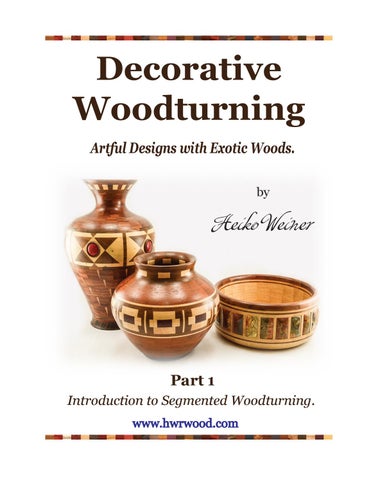
Decorative Woodturning Artful Designs with Exotic Woods. by
Heiko Weiner
Part 1 Introduction to Segmented Woodturning. www.hwrwood.com
No part of this manual may be reproduced for commercial purposes without prior obtaining a written permission of the author. The patterns and instructions in this manual are intended for the personal use of the reader, and may be reproduced for that purpose only.
HWR
®
© 2018 Heiko Weiner / HWRWood. All Rights Reserved.
Using hand tools, and operating machinery carry a serious risk of injury. The content described here is for informative purpose only. The reader releases and discharges the author, associates, owners and affiliates, their successors and assigns, of and from any and all claims or demands for injury to his/her person or property, resulting directly, or indirectly by reason of participation in the activities described, and hereby assumes full responsibility for his safety, and for all risk of injury to persons or property by reason thereof. Contact Information: Heiko Weiner • 4827 Baywood Dr., TX 77505 www.hwrwood.com • Phone (989) 859-0052
Part 1 Introduction to Segmented Woodturning. Table of Contents Page No.
Basics of Segmented Woodturning
4
Domestic & Exotic Hardwoods
9
Common Hardwoods & Properties
13
Synthetic Materials
32
Adhesives & Glues
40
Finishing
43
Tools & Acessories
48
Shop Safety
51
Summary
55
3
Basic Terms & Formulas Some general steps are almost always part of a segmented turning project, regardless of the size or its complexity. The projects descriptions in this series will outline these basic sequences, and introduce certain techniques that can be used or modified for more advanced designs later on. I do recommend starting small, and getting familiar with some of the terminologies, calculations, and techniques. Some basic terms and formulas are introduced in Scheme 1.
Segment Length (L) = {Diameter (d) x 3.1416} / No. of Segments (n) = {Circumference (CF)} / No. of Segments (n) Miter Angle (MA) = 360 degree / (n) / 2 Scheme 1. Basic terms and calculations. Several values are used to determine the materials needed for a segmented ring: Number of Segments (n); Segment Length (L); Segment angle (MA). You will also need the Segment Height, and it’s Width.
6
The basic principle of designing segmented bowls is to construct individual rings, also referred to as Layers, then stacking the rings of varying diameter and thickness in order to achieve a desired layout, and then finish by turning it on a lathe. While extensive turning experience is not required to get started, it is a good idea to familiarize yourself with some basic turning techniques. After all, some significant work and time will go into assembling the three-dimensional layout of a segmented bowl, and you would want to be confident in finishing it successfully. Number of Segments (n). The number of segments for a desired ring largely depends on its design. For average size turnings with diameters of 6 – 12 inches, this can be a number as low as 8 and all the way up to 80. Good average values are between 16 and 24, if the ring is made from the same size segments. It is a good idea to pick a number than can be divided by 4, such as 12, 16, 20, 24 and so on, which will allow to construct quarter rings that then can be assembled into halves and subsequently, whole rings. Segment Length (L). The length for a single segment is calculated by dividing the circumference (diameter x 3.14) by the number of segments (n). This value is also needed for calculating the amount of material (i.e., the total length of a board) that is needed to obtain a certain number of segments of this length. Segment Angle (MA). The angles for all segments (each segment has two) has to total 360 degree, regardless of their individual length. For a given number of segments, the segment angles (miter angles, MA) are obtained by dividing 360 by the number of segments (n) and dividing again by two (since two miter angles are needed for each segment). 7
Katalox has exeptional strength properties, is ideal for an Ebony substitute in stringed instruments and is nearly as dense as Ebony. Region: Yucatan Peninsula – Mexico. Availability is average, and pricing is in the modest to upper range with $24 - $28 per board foot. Lacewood, "Brazilian Lacewood" (Roupala brasiliensis). Lacewood is also known as Leopardwood, but there are several other species. Lacewood is pale pinkish brown to medium brown with flaky, speckled figure with dark flecks, varying from a small lacelike pattern to a larger "splashy" figure. The texture of Lacewood is fairly coarse. It is moderately hard, fairly easy to work with and takes a lustrous finish. Common uses are for veneer, musical instruments, ornamental turnings, and for high end cabinetry. Region: Chile, Brazil. Lacewood is fairly rare, and pricing is in the medium range with $15 - $20, largely depending on dimensions. Lignum Vitae “Genuine” (Guaiacum officinale). Lignum Vitae heartwood is dark greenish-brown to almost black, the pale yellow sapwood is clearly demarcated. The wood tends to darken with age, and upon exposure to direct sunlight. The wood has a high content of natural oils, and can be polished to a fine luster. The wood turns well, however, gluing may be problematic at times. Common usages are for bearings, mallet heads, tool handles, and other objects that require durability and hardness. Genuine Lignum Vitae is generally considered the heaviest, and the hardest wood in the world, and unsurpassed in its durability. It has been classified as endangered species, and is restricted in trading, thus prices are generally high. Care should be taken when buying since it often stems from questionable sources. Smaller dimensioned boards and turning blanks are available, and sometimes are sold based on weight, rather than dimensions in board foot, expect around $10 for a piece measuring 4” x 4” x 2”. Lignum Vitae, Argentine (Bulnesia sarmientoi). This wood is a close relative to the famous tropical Lignum Vitaes, and is similar in its appearance and working properties. The olive-green wood (Verawood) is typically highly figured, and tends to darken with age. The resinous wood has an oily feel and a strong spicy-sweet fragrance. It is considered difficult to work with, both due to its high density and high oil content. Often used for turning, Argentine Lignum Vitae wood provides an excellent polish. The Argentine name Palo Santo literally means, Saint Wood. Region: Argentina. Argentine Lignum Vitae lumber is priced in the upper range with $40 -$50 per board foot.
20
Maple, Birds eye (Acer saccharum). There are eighteen different species of Maple. It is so named because the figure resembles small bird's eyes. Bird's-eye figure is a phenomenon that occurs within several kinds of wood, most notably in hard maple. The figure is reportedly caused by unfavorable growing conditions for the tree. The sugar maple attempts to start numerous new buds to get more sunlight, but with poor growing conditions the new shoots are aborted, and afterward a number of tiny knots remain. It turns well on a lathe, allowing it to be shaped into decorative canes, bottle stoppers and pens. Typical Uses: Refined specialty products, such as in automobile trim, both in solid form and veneer, boxes and bowls for jewelry, thin veneer, humidors, furniture inlays, handles, guitars, and pool cues. Region: North America. Pricing is around $25.- per board foot. Maple (Curly, Western Maple) (Acer saccharuin). The Curly Maple wood is cream-colored white with a reddish tinge. Fine brown lines give attractive growth ring figure on plain sawn surfaces. Other names for this phenomenon are Tiger maple, Fiddleback maple, or Flamed maple. Its texture is fine and even. It is a dimensionally stable wood with good strength. The wood glues well, and has average workability with both hand, and machine tools. Region: North America. Pricing for Curly Maple is varying considerably, depending on color, frequency of curls, and intensity. Expect $10 - $18 per board foot. Maple, Hard (Acer saccharum). Hard Maple is one of the eighteen Maple species. Unlike most other hardwoods, the sapwood is most commonly used, rather than the heartwood, which tends to be of a darker brown. Its sapwood color ranges from nearly white to an off-white cream color, sometimes with a reddish or golden hue. The heartwood tends to be a darker reddish brown. The wood machines well, but Maple also has a tendency to burn when being machined with high-speed cutters such as in a router. It turns, glues, and finishes well, although blotches can occur when staining, and a pre-conditioner, gel stain, or toner may be necessary to get an even color. Typical Uses: Flooring (from basketball courts and dance floors to bowling alleys and residential), veneer, pulpwood, musical instruments, cutting boards, butcher blocks, workbenches, baseball bats, and other turned objects and specialty wood items. Region: USA, Canada. Pricing is moderate, expect around $10 per board foot. Bird’s eye, curly, and quilted maple are considerably more expensive.
21
About the Artist: Heiko Weiner Heiko started his woodworking journey in Germany more than 30 years ago. His grandpa was an avid carpenter, and he had the fortune of being taught the traditional European craft starting at a young age. The woodworkers he learned from at the time were making a living building toys and carving figurines. After coming to the US from Germany in 1994, he spent the following years between Colorado, West Virginia, and Michigan, moving to Texas in 2008. Over the years, Heiko has succeeded in developing his own, distinctive style. He combines wood with various other materials, such as semi-precious stones, metals, and acrylic resins. The resulting style is colorful and ornamental, much resembling that of decorative pottery. Multiple precise techniques are required for his work, and each individual piece, regardless of size and complexity, is an original, and one-of-a-kind. His artwork is shown in fine art shows across the country. Under his registered trademark Heiko serves clients worldwide with an interest in unique and one-of-a-kind decor. Heiko is married, and lives with his wife Katrina and two children in Pasadena, Texas. 56