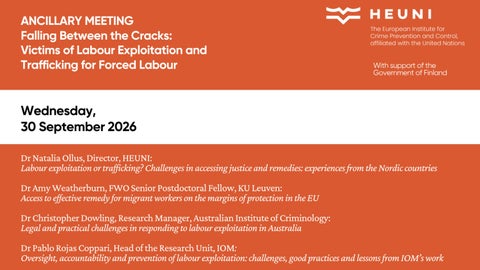
Labour exploitation or trafficking? Challenges in accessing justice and remedies: experiences from the Nordic countries Dr Natalia Ollus, Director 30 September 2026 Ancillary meeting at the UN Crime Congress
Helsinki, Finland
Sisältö:
European Institute for Crime Prevention and Control, affiliated with the United Nations (HEUNI) • The European Institute for Crime Prevention and Control, affiliated with the United Nations (HEUNI) is an independent research and development institute, working across Europe.
• Functions under the Finnish Ministry of Justice and has an official affiliation with the UN. • We have researched labour exploitation, human trafficking and forced labour since 2008. • We cooperate closely with authorities, labour market parties, businesses, public procurement units, and NGOs to develop targeted responses and concrete tools. • All publications are freely available at www.heuni.fi
From research to practice
www.heuni.fi/publications
4
How to distinguish between trafficking and “mere” labour exploitation 5
Study on the concept of trafficking • Study by the EU Anti-Trafficking Hub 2025 (Anniina Jokinen/HEUNI):
• Examines jurisprudence on trafficking for labour exploitation in Italy, Finland, France, Spain, and the Netherlands. • Legal rules across the EU are complex, making it difficult to distinguish trafficking in human beings from other forms of labour exploitation.
Download the report here 6
The spectrum of harmful practices
7
The criminalisation gap • A key challenge is the lack of criminal offences to address serious labour exploitation if it cannot be qualified as trafficking. → The gap between mere infringements of labour law and trafficking is big. → Has significant impact on the rights of victims.
• The threshold for trafficking for forced labour is particularly high in many countries, e.g., Sweden and the Netherlands. 8
Access to remedy for exploited workers
10
Study on exploited migrant workers’ access to remedy (Haapasaari et al 2024) • We mapped the different complaint mechanisms in Finland, Sweden, and Norway that exploited migrant workers can use to seek remedy. • We identified challenges and gaps in light of the UN Guiding Principles for business and human rights. • How do the mechanisms function? Are they effective? Does an exploited worker receive remedy?
UN Guiding Principles on Business and Human Rights
“Graphic courtesy of Shift Project, Ltd. All rights reserved”.
12
Different laws, policies, institutions, mechanisms and actors form a larger “remedy ecosystem” Courts
Crime victim compensation
Prosecutor Chancellor of Justice
Wage guarantee
Ombuds men
Tribunals NHRI
NCP
Multistakeholder initiatives
Police
Labour inspectorate
Migration agency Human trafficking assistance
Affected stakeholder / exploited worker
Legal aid
NGOs Public buyers
Businesses
Trade unions
The size of the circle does not reflect the perceived role of the organization. 13
Barriers to remedy
(Haapasaari et al 2024)
• For migrant workers the most important issue is to have effective means of obtaining their unpaid wages. • In theory, there are several grievance mechanisms existing, but in practice, there are different barriers in (migrant) workers’ access to remedy through them. • The criminal process is generally slow, uncertain, and it takes years to get compensation; yet the civil process is risky and expensive. • Third parties are crucial: • Trade unions are effective in negotiating unpaid wages for their members and, in some cases, also for non-members. • The role of NGOs and legal aid is essential, especially in providing information on migrant workers' rights and assisting them in accessing remedy, however, legal aid is often not free of charge for persons whose experiences are not qualified as trafficking. → When state-based mechanisms are ineffective, companies must take stronger action to address exploitation and ensure remedy. 14
Examples of remedy, e.g. • Sweden: the Swedish Real Estate Employees Union established a regional network to identify new cleaning jobs for victims of exploitation. • Denmark: Copenhagen City Task Force inspects the city’s public contracts to ensure suppliers follow collective agreements; the city can fine suppliers, withhold payments and terminate contracts, and has claimed unpaid wages for hundreds of suppliers’ employees. • Finland: One-year residence permit type created for persons who are suspected to have been exploited by their employer. • Estonia and Lithuania: Labour dispute committees (extrajudicial authority) seeks to resolve disputes between employees and employers in an impartial manner. 15
Thank you
Natalia Ollus natalia.ollus@om.fi natalia-ollus
16
ACCESS to effective REMedy for migrant workers on the margins of protection. What role for the EU and its Member States? Falling Between the Cracks: Victims of Labor Exploitation and Trafficking for Forced Labor, 30 September 2026 Dr. Amy Weatherburn | FWO Senior Postdoctoral Fellow Institute for European Law | KU Leuven
Grant Agreement No. 1245925N
The margins of protection: the Borealis case • Summer 2022, labour inspectors halted operations on Borealis construction site in Antwerp. • 100s of migrant workers had employment terminated, pending investigation into human trafficking • 174 suspected victims of human trafficking.
• Group of Turkish workers, with right to work and reside, presented themselves to authorities, not all recognised as victims of trafficking. • Flemish government cancelled 500 work permits (to sanction the employer), employment terminated, “VDAB to come to the aid of these workers” and “actively reorient them in our labour market” (Flemish Minister of Employment, Brouns, CD&V) • Workers sent to recruitment agency and sent to work in same conditions as on Borealis site, due to pressure of 90 day limit to find a new job in accordance with residence permit conditions. • Still no compensation or payment of unpaid wages. © Shutterstock
18
Institute for European Law
A failure to prevent: Normalising abuse and exploitation in the EU labour market • Lack of capacity and resources to deal with scale of the phenomenon e.g., inspection services adopt an intelligence-led approach to monitoring compliance relying on reporting of alleged infringements • A diversity in tackling labour exploitation across the EU in terms of sanctions and other legal consequences for both migrant workers and employers • Legal migration laws do not foresee specific mechanisms to ensure enforcement of fundamental labour and social rights Sources: COM(2026) 260 final (ESD); HIVA, 2024; EMN, 2021 19
Institute for European Law
A failure to protect: Migrant workers’ rights • Fundamental labour and social rights • Right to equal treatment in relation to working conditions and social security • Right to decent work e.g., OSH • Protection from exploitation or abuse, including trafficking in human beings. • Migration-related vulnerabilities, including restrictive migration regimes, create migrant worker precarity and increase the risk of exploitation Sources: Weatherburn 2026; HEUNI, 2025; PICUM, 2025 20
Institute for European Law
A failure to remedy: (In)access to justice for migrant worker exploitation • Unsatisfactory legal redress as most are positioned in EU criminal law • For access to human trafficking victim status, there is a high threshold to the identification of victimisation • Protective measures provided for under Employers Sanctions Directive are only available for illegally residing third-country nationals. E.g., Borealis • Procedural safeguards and protection measures are only triggered ex post exploitation. • Migrant workers need access to safe reporting mechanisms without fear of consequences from authorities (firewalls) and employers. Sources: Wintermayr & Weatherburn 2021; Weatherburn 2025 21
Institute for European Law
ACCESS to effective REMedy for migrant workers on the margins of protection. What is the role of the EU and its member states in guaranteeing access to effective complaints mechanisms for migrant workers who are on the margins of protection?
22
Institute for European Law
Barriers to reporting for migrant workers Inter alia…..
• Lack of information and/or awareness of rights and availability of complaints mechanisms compounded by language barriers and lack of language proficiency • Burden of proof on employee to provide evidence of employment relationship; working conditions etc. • Dependency on employer or temporary work agency/labour market intermediary • Lack of trust in authorities & limited protection against deportation • Lengthy procedures and uncertainty of outcome coupled with risk to livelihood and accommodation • Limited availability of specialised (and good quality) legal support. Sources: COM(2026) 260 final (ESD); COM(2026) 261 final (SWD); EMN, 2025; HEUNI, 2025; EMN, 2020; FRA, 2021 23
Institute for European Law
Complaints mechanisms: a trend in EU law? Art. 25 Seasonal Workers Directive (2014) Art. 14 Single Permit Directive (2024) Talent Pool Regulation (2026)
Art. 16 Transparent & Predictable Working Conditions Directive (2019)
Internal Market Law
Art. 16 Transparent and Predictable Working Conditions Directive (2019)
Art. 13 Employers’ Sanctions Directive (2009)
Labour Migration Law Labour Law
24
Criminal Law
Institute for European Law
Facilitation of complaints by Member States
Member States shall ensure that there are effective mechanisms through which third-country nationals […] may lodge complaints against their employers, directly or through third parties designated by Member States or a competent authority of the Member State when provided for by national legislation.
25
Faculty, department, unit ...
The legislative design of complaints mechanisms • Direct and indirect access to lodge complaints • Access to information on migration status, employment conditions and access to legal redress • Protection from dismissal, adverse treatment or consequences, or retaliation by the employer as a reaction to reporting breaches • Extended period of unemployment where reasonable grounds to believe experienced particularly exploitative working conditions • Recission of minimum period of employment (not exceeding 6 months) for serious breach by the employer of the terms and conditions of the employment relationship • Grant or extend temporary residence permit for duration of relevant national proceedings 26
Institute for European Law
The implementation of complaints mechanisms • All MS have procedures for lodging complaints, mostly general procedures which apply to both EU and non-EU workers, but accessibility and effectiveness varies • Most allow for direct and indirect lodging of complaints • Protective measures and safeguards against retaliation are available, often equal to those of nationals • Improvements are being made in the accessibility of and information about complaints mechanisms • Seasonal workers are the most protected with specific mechanisms in place in 11 member states • Efforts are being made to improve the safe-reporting of alleged violations by illegally residing TCNs Sources: COM(2026) 260 final (ESD); COM(2026) 261 final (SWD); EMN, 2025; HEUNI, 2025; EMN, 2020; FRA, 2021 27
Institute for European Law
OFFICIAL
Legal and practical challenges in responding to labour exploitation in Australia Dr Christopher Dowling Research Manager 30 September 2026 www.aic.gov.au OFFICIAL
OFFICIAL
Legislative context • Divisions 270 and 271 of the Criminal Code Act 1995 (Cth) • •
•
Slavery offences Slavery-like offences – servitude, forced labour, deceptive recruiting and debt bondage Trafficking – aggravating circumstances
• Fair Work Act 2009 (Cth) • Migration Act 1958 (Cth) & Migration Regulations 1994 (Cth) • Modern Slavery Act 2018 (Cth) • State/territory criminal and labour laws OFFICIAL
29
OFFICIAL
Labour exploitation in Australia: A snapshot Reports of slavery and slaverylike offences to Australian Federal Police (AFP) 1 July 202430 June 2025 (n=265)
12
$358 million in back-pay recovered for over 249,000 underpaid employees by Australia’s Fair Work Ombudsman in 2024-25
18
106 83 5
41
Slavery
Domestic servitude
Sexual servitude
Forced labour
Deceptive recruiting
Forced marriage
Over one in four workers in Australia were underpaid their superannuation in 2023-24
70%
Of migrant workers had been paid below their individual minimum entitlements
36%
Of migrant workers had been paid below the National Minimum Wage
OFFICIAL
30
OFFICIAL
Addressing cases of labour exploitation in Australia Awareness- Monitoring and Non-criminal Criminal justice Support and raising, training recovery penalty detection and guidance and remedy AFP & Commonwealth Department of Public Prosecutions Department of Home Affairs Fair Work Ombudsman Department of Social Services w/civil society
OFFICIAL
31
OFFICIAL
Challenges in responding to labour exploitation
Legislation Access to and provision of assistance Coordination and information-sharing
OFFICIAL
32
OFFICIAL
Recent developments → New laws → Inter-agency agreements and protocols for information-sharing and cooperation → New functions and enhanced capacities
→ Improved support provision
OFFICIAL
33
OFFICIAL
Christopher Dowling christopher.dowling@aic.gov.au
OFFICIAL
Oversight, Accountability, and Prevention of Labour Exploitation: Challenges, Good Practices, and Lessons from IOM's Work XV UN Congress on Crime Prevention and Criminal Justice September 30th, 2026 – Abu Dhabi, UAE
Pablo Rojas Coppari, PhD
Research Unit - Head
Global Estimates of Modern Slavery: Forced Labour and Forced Marriage 50 million
people living in situations of modern slavery on any given day
27.6 million
in forced labour
22.0 million
in forced marriage
What the estimates tell us • Scale: nearly 1 in every 150 people globally • Persistence: exploitation can last years; forced marriage can be lifelong • Trend: millions more people were in situations of modern slavery in 2021 than in 2016 • Evidence: estimates combine nationally representative surveys with IOM's Counter Trafficking Data Collaborative (CTDC) data
Labour exploitation as a human security issue World Migration Report 2024: Chapter 5 – Migration and human security: Unpacking myths and examining new realities and responses Exploitation is a migration governance issue — not only a trafficking issue
What does this mean for prevention? 1
Identify risks earlier Address vulnerabilities before exploitation occurs, including during recruitment and migration processes.
2
Connect systems Migration governance, labour protection, anti-trafficking and human rights mechanisms need to work together.
3
Protect beyond trafficking identification People experiencing exploitation may require protection and remedies even when they are not identified as trafficking victims.
Prevention from labour exploitation
From recruitment to employment: identifying and reducing risks early BEFORE DEPARTURE
DURING RECRUITMENT
BEFORE / AT EMPLOYMENT
Involving Businesses across supply chains Labour exploitation does not occur only through direct employment relationships. Recruitment agencies, labour intermediaries, suppliers and businesses can all influence the risks faced by migrant workers.
3 areas for business action 1
2
3
Responsible recruitment Ensure recruitment is ethical, transparent and free from practices that shift costs and risks onto workers. Supply-chain due diligence Identify and address risks of exploitation throughout recruitment, employment and subcontracting arrangements. Worker voice & remedy Provide accessible grievance mechanisms and ensure workers can raise concerns without retaliation.
Access to justice for migrant workers and victims of trafficking for labour exploitation Exploitation only becomes an accountability issue when workers can access effective remedies
What does IOM evidence tell us? Three lessons for preventing and addressing labour exploitation 1
SEE IT EARLIER Better data and evidence make hidden exploitation visible. From global estimates to administrative and case data, better evidence helps identify who is at risk, where risks emerge and where systems are failing.
2
ACT BEFORE EXPLOTATION Prevention starts well before the workplace. Ethical recruitment, worker information, effective labour inspection and supply-chain due diligence can address vulnerabilities before they become exploitation or forced labour.
2
MAKE REMEDY POSSIBLE Identification must lead to protection and justice. Workers need safe channels to report abuse and meaningful access to protection, legal assistance, unpaid wages, compensation and other remedies.
Questions?
Thank You !
Dr. Pablo Rojas Coppari - projascoppari@iom.int IOM Research – research@iom.int
Discussion themes: • Is labour exploitation sufficiently recognised and identified by law enforcement and oversight bodies? • How are the cases defined, and how does the definition affect how cases – and victims – are dealt with? • What practical barriers exist for victims in accessing justice and remedy, and how can these challenges be resolved? • What avenues exist for enhanced prevention of labour exploitation, and how can this be strengthened? 45