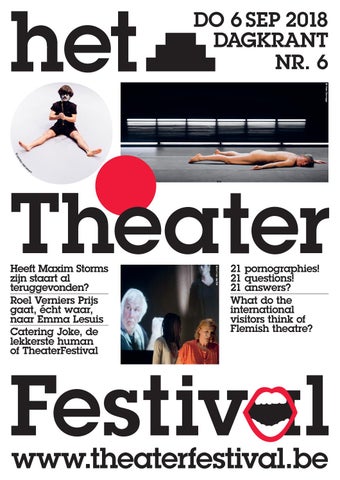
DO 6 SEP 2018 DAGKRANT NR. 6 © Marc Domage
nt eo ©L ien
m le Al
ee rsc h
© Kurt Van der Elst © Sanne Peper
Heeft Maxim Storms zijn staart al teruggevonden? Roel Verniers Prijs gaat, écht waar, naar Emma Lesuis Catering Joke, de lekkerste human of TheaterFestival
21 pornographies! 21 questions! 21 answers? What do the international visitors think of Flemish theatre?
www.theaterfestival.be
Š Marc Domage
21 pornographies Mette Ingvartsen
6 september 2018 1
‘Pleasure and frustration — the mechanics of porn can be found everywhere’ There was probably no other time in history that is as progressive as the 21st century, especially in terms of effectiveness and information-spreading. We desperately want to find purpose in our jobs while maintaining a #relationshipgoals relationship. We worship alternativeness, yet seem to be unable to find alternatives outside our comfort zones. It seems that in times where time itself moves so fast, we should take time to stand still and rethink certain beliefs we have about structures within us and our environment. In our interview with Mette Ingvartsen on her research for the piece 21 porno graphies, we came across 21 questions that are in desperate need of 21 exclamation points. Regina Janzen
2 6 september 2018
21 pornographies Mette Ingvartsen
© Jens Sethzman
Mette Ingvartsen is a Danish dancer and choreographer who is currently based in Brussels. She dedicated herself to a profound research on topics like sexuality, intimacy and how they influence infra structural power mechanisms in politics and our society. 21 pornographies is the fourth piece out of a series that’s called The Red Pieces. It is about the journey through important moments of porno graphy and how to understand its mechanisms. What exactly was driving Mette to investigate this topic? Although topics like sexuality, intimacy, identity and androgyny were already important for her in her early career, it was the birth of her children that created a new awoken urge to keep on questioning our relations to one another and the existing societal models. ‘When I became a mother, there was something that happened in relation to how we view societal structures in relation to sexuality, family structures and the expectations that come along with it. All of a sudden I felt the urge again to think about societal structures that determine how sexual practices exist between people, but also within society. I felt that there was a strong societal push towards certain forms of sexual practice and family structure, which I didn’t find liberating at all. I found it quite restrictive in the way that society deter mines specific structures as the dominant ones.’ Concerning the many diverse ways, one could choose to continue this research, what were the starting points for Mette? Her profound personal research started from the sexual liberation movement of the 1960s, where nudity was often used as a tool to protest against war, capitalism and nuclear power. Afterwards, sex became big business and could be found in your everyday entertainment tool-kit: TV, Internet and advertisement. One might wonder how it could have
become that popular and all-consuming? There is definitely pornography in disguise in our daily lives, but where? Mette tried an experiment: ‘Imagine if you would consider the whole world as being pornographic, not in a sexually explicit way, but in how pornography wants to do something to your affective body; it wants to produce an orgasm. It works through excitation and once you have that orgasm, then afterwards there’s a certain frustration and you want to have another one. In a way, you can compare it, amongst other things, to shopping, or the instant gratifica tion we experience when we actively use social media, when we play video games, or watch TV series that work with cliff hangers.’ Pleasure and frustration — the mechanics of porn can be found every where. Your brain releases dopamine and after a short while there is again a craving for a dopamine dose. Are you asking yourself if that’s the reason why you binge-watched another series, instead of being social with your friends? Absolutely! One might really get carried away by the way we receive information. It is built on peaks of excitement that make you want to come back and consume more; more news, more food, more clothes — more life? Consumerism truly gives us the feeling of being rewarded. It does make us feel good and that’s why it’s so difficult to detect those little tricks that are being played on us. There are many people spending hours trying to find more produc tive ways on how to sell us things we don’t need to impress people we don’t like and look for happiness that seems to proac tively hide. But shopping is one of the less harmful ways that micro-mechanisms are working in our subconsciousness. What about violent movies or video games? In Mette’s opinion, the general research on exposure
of violent movies and video games is still incomplete: ‘You won’t become automati cally violent after watching a horror movie or playing a virtual serial killer, but who really knows about the long-term effects or consequences that will occur in the long run?’ Could these be the micro early stages of a possible warboner in the future? War pornography was another topic Mette took a look at during her research. It is definitely on the more extreme side on the scale of power abuse and we might all still remember the pictures of the US soldiers and the tortured prisoners in Abu Ghraib, Iraq. Unpleasant as it is, Mette always prefers to look at cruelty and violence directly: ‘I think in our society, we live in a privileged part of the world, where in a way it’s quite easy to live a nice life and to not deal with the forms of cruelty that exist all over the world, especially in war situations, but I think there is something troubling about the way we look at violent images from that perspective. The way news images are reaching us. Are they actually truly reaching us? I know from myself that I have a difficult time with brutal imagery and sometimes I also wonder what it does to look at it without doing anything about it. Then I am thinking about how media also circulate violent images as a kind of machinery that produces news and I find this to be very questionable. To me it’s a kind of pornographic use of emotional imagery that is repeated over and over again. It creates cycles of consumptions, of news consumption. I was looking at this form of war pornography and sexualized torture in war, because it is something that has existed throughout history and I felt like I needed to understand it. Sexuality is not just someting nice, experimental and inventive. It is also an area full of abuse and violence and perverse versions of the misuse of power. Are these people actually enjoying torturing?’
6 september 2018 3
21 pornographies Mette Ingvartsen
© Jens Sethzman
also part of how our society is functioning”, but I think it’s still a real thing how it’s connected to affect.’ What exactly is affect? Affect has to do with sensations in the body that are not being felt clearly enough to actually name them just yet. Anger, fear, happiness — those are clear emotions. Prior to that we are somewhat moved by something, but we are not quite sure what we’re moved by. Yet, we still act. ‘This grey area, this is where a lot of power structures become active. In that place where it’s difficult to define what it is doing to me. Why am I feeling like this? Is this abuse or not?’ The #MeToo Movement is in a way the biggest feminist movement we experi enced until today, but in order for it to not only stay a hashtag, we need to have changes, but which ones? ‘We need to increase the number of women who are directing structures, who are politicians. Power is being distributed in a certain way and I think it needs to be seriously recon sidered. It’s a real effort, it’s not something that will happen by itself. Certain feministic issues that were brought up in the 60s, are still not completely resolved. Of course, it has improved, but it’s still not anywhere near being equal. Those are simple political questions and that’s not even going into all the details of microstructures of power. It’s bluntly out there in the open and we still didn’t manage to improve the situation. We have to address structures. Also, we have to teach girls to grow up and to have the confidence in being able to direct huge structures. That’s part of it as well. It’s a whole societal way of building confidence, of building skill, of building mental structures as well and that takes some time.’ One might want to imagine a bestcase scenario, an ideal situation, but how does it look like? It would be utopian and unrealistic to imagine a world without power. Yet, there needs to be an equal
power distribution, which is able to ‘shift positions’, according to Mette. ‘There’s a question of how power is being exercised. There needs to be a certain fluidity in those shifting constellations, where it’s not about certain people ending up at the top and others at the bottom, with no possibility of movement. It has to do with a world where there is a possibility of changing positions of power: between the sexes, genders, rich and poor and different races. If you believe in democracy, then you also believe in giving your power over to politicians you have elected. You think that being guided by that person, is the right way. Someone else actually decides for you and you only can agree wholeheartedly to this, if you trust in the other and in the system.’ In 21 pornographies, Mette is also letting the audience experience a roleplay of a special kind. The perpetrators in her piece are being located as mem bers of the audience. ‘It is slightly violent to turn someone into it without them knowing, but for me it’s also a strategy of softly forcing and challenging the audience to take up these positions and imagine “What if I were this character?”. Entertain this imagination. For some people, this can be very difficult, but as it’s all imaginary, it’s also in a way a proposal of how to picture yourself in this situation, because many people refuse to think that they might be abusing power.’ Are we having blurry lines or a blurry vision? The truth is, that it’s very likely that we all come across situations where we might slightly use or abuse power, but because they at times appear microscopi cally, we might not be able to spot them right way. Mette gives you the chance. Are you willing to take it? © Kurt Van der Elst
Mette continues. ‘I’ve been gathering a lot of information on the practices of torture in exchange for valuable informa tion, but how valuable is it in the end? It is proven to not actually work, so one tortures for a different reason. One might torture to show an example of an ideology and to brutalize as a state politics, but one might also torture to make people afraid and to feel one’s own power over these bodies. All these mechanisms around power, which have to do with demonstrat ing power that is somehow connected to pleasure; I find that extremely disturbing.’ One might wonder, is this a societal issue or human nature? ‘In a way, one could say that sexual violence is something that existed throughout history, so it surely is part of human nature and sexualised torture is one of the most extreme cases of abuse of power. In 21 pornographies, I work through these extremes to talk about microstructures that we live every day. The ones, that are more difficult to sense and change. My work on sexuality has been about trying to find the link between the microstructures and what we actually experience intimately with our partners. There is something that we do when we are sexually together. We practice a certain form of politics by being submissive or being in power, by being open or closed, by saying yes or no and by setting our boundaries or not. All these things we practice inside our bedrooms are what forms societal structures. I believe that power abuse happens on many levels. Now with the #MeToo Movement we’ve seen that it’s a huge topic that lots of women experience and that it’s definitely not new. It gets attention now, but it existed throughout history. I think we all can be more aware of how these micro managements take place, and that could potentially change how politics function. In a way, it’s an old feminist stand of saying “The personal is political and the intimate is
4 6 september 2018
Brother Blue Maxim Storms
The day got lost and we lost it all We hebben een staartbeentje. Daaraan een staart die niet meer bestaat. Misschien zijn we gaandeweg nog wel meer verloren. Maxim Storms probeert in Brother Blue deze brokken niet te lijmen, maar zaait nog meer verwarring. Zijn nonsenstaal en klanken worden afgewisseld met ritmische bewegingen en soms zelfs verstaanbaar Engels. ‘I wish I was a rock, but we all know that I’m not rocky,’ klinkt het zelf bewust. Het publiek lacht. Zwijgt dan weer. Denkt zelf misschien: een staart hebben we nooit gehad en rotsen zijn we evenmin. Lotte Ogiers
© Leontien Allemeersch
6 september 2018 5
Staat van de Stad
Brother Blue is de eerste solovoorstelling van Maxim Storms, die voor zijn andere projecten graag met vrouwen werkt. Met Katrien Valckenaers heeft hij in 2010 Ballet Dommage opgericht. Als je geluk hebt, bellen ze bij jou aan. Of moet de auto in de garage wijken voor een geïmproviseerde bühne. De naam van hun project VOLK zegt het al: ze brengen theater naar de mensen. Ook voor Het TheaterFestival is hij geen onbekende. Vorig jaar werd hij al eens geselecteerd voor de voorstelling Another One, die hij samen met actrice Lobke Leirens maakte. Klutserkrakkekilililokatastrof met Katrien Valckenaers was uitgenodigd voor Circuit X. Nu, alleen. Eenzaam. De grote speelruimte voor zichzelf. Geen vrouwen. Geen staart. Nonsens en een tekst. Wat gebeurt er als je iets verliest terwijl je dacht dat het er altijd zou zijn? In zijn voorstel ling maakt Maxim er een hyperbool van. ‘The day got lost, and we lost it all,’ declameert zijn personage. Hij kijkt rond. Voorzichtig. Neemt zijn stok in beide handen als houvast. Mensen verzinnen graag termen. En kaders waar alles in past. Een doos die nu en dan uitgeladen kan worden, afgesloten, zodat het sorteren makkelijker gaat. Dit geldt ook voor het werk van Maxim Storms, dat afwijkt, soms zelfs moeilijk leesbaar is. Om ons gerust te stellen bedacht hij zelf de term ‘dadaïstisch treurspel’ voor Brother Blue. Daar komt hij nu op terug. ‘Dat dadaïsme wil ik eigenlijk een beetje achter me laten. Het is te nauw. Absurdisme is een beter woord. Ik heb een voorliefde voor personages die absurd zijn. Ik probeer die uit te vergroten om iets diepmenselijker te maken. Het is niet de bedoeling om de man in de straat te spelen, maar eerder een figuur die het menselijke overstijgt. In Brother Blue ben ik een figuur die zijn staart verliest. Het kan evengoed een dier zijn. Ik ben wel zo getransformeerd dat ik in een fictieve wereld zit. In een ander universum.’ Dat andere universum is leeg. Alleen het personage huppelt er rond. Geen idee waar, de tijd is niet van tel. ‘Aristoteles bestaat niet in mijn voorstellingen,’ lacht Maxim. Een ijsschots wordt het genoemd. Of: een Niemandsland. ‘Lijkt het ook niet op een fotos hoot?’ vraagt hij zelf. Retorisch, net geen knipoog. Hij weet het zelf: ‘Ik wou de focus leggen op het personage. Je krijgt het gevoel dat het een soort portret wordt.’ Het is een foto met veel pixels. Een duidelijke afdruk is er niet van het mannetje zonder staart. In zijn zwarte pakje en met zijn blauw gezicht is Maxim bijna onherkenbaar. Zijn snor beweegt net niet mee wanneer hij de lichtpaarse scène oversteekt. Die snor is er altijd. Al zijn alter ego’s, van de oude man in Siberië in Another One, tot zijn carnavalspersonages in VOLK, ze scheren zich niet. Zou Maxim bang zijn om zijn snor ooit te verliezen? De Gentse maker houdt van al zijn verschillende alter ego’s. Hij is liever iemand helemaal anders op het podium. Die verschil lende identiteiten schuilen ook in Brother Blue, maar dan in de psychologische crisis van één man: ‘Het personage weet zelf ook niet altijd goed wie hij is. Hij is nieuwsgierig en angstig. Hij twijfelt en is eenzaam. Hij is zijn staart verloren. Is dat zijn schuld of die van iemand anders? Moet hij boete doen? Misschien is het een uitvergrote versie van de mens van vandaag.’ Maxim Storms wordt vaak aangekondigd als ‘de nieuwe Charlie Chaplin’. Misschien omdat ze even groot zijn, of door hun lichaamstaal. De humor die ook lacht met de tijd. Voor Maxim geen Modern Times, geen Chaplin-snor (die van de Gentenaar is dikker). ‘Eerlijk gezegd ken ik hem niet zo goed. Er is eigenlijk niets bij mij dat vertrekt uit humor. Doordat het grotesk is, krijgt het een humoristische laag. Evelyne (Coussens nvdr.) zei in een recensie over Brother Blue dat de vergelijking niet helemaal klopt voor haar. Ik ben er zelf soms door in de war. Als de mensen anders reageren dan ik verwacht had, ben ik bang: is het nog wel goed?’ De twijfel van de maker valt samen met wat hij toont. Nadat het personage gemerkt heeft dat hij zijn staart verloren is, draagt hij een blonde pruik. Er beweegt iets om hem heen, hij wil het met zijn stok bedwingen. De maat slaan. Het juiste ritme vinden. ‘Misschien is dat wel de tweede fase. In plaats van where is my tail nu: where is my hair? De dingen zijn aan het veranderen, en je hebt het zelf niet door.’ De blonde pruik is een kleine rekwisiet wisseling, maar valt op in de gestileerde ruimte. Het lijkt een anekdote in de voorstelling. Dat was het ook: ‘Jan Steen, mijn coach, vertelde over een vriend die heel veel krullen had. Op een dag gebeurde er iets dat zijn leven zou veranderen. Zijn lichaam reageerde. En hij werd wakker met sluik haar.’ In een anekdote schuilt vaak iets groters. Er wordt iets kleins verteld, zodat we andere dingen beter begrijpen. Zoals hier: het haar dat verdwijnt. Het lichaam dat door een gigantische impact iets geks doet. Zoals mensen die vallen en hun staartbeentje voelen. Voor het eerst. En dat doet pijn. Achteromkijken en de herinnering aan wat er ooit was.
Buiten de lijnen van de stad Jonge kunstenaars, nieuwe collectieven en bruisende locaties blijven vaak verborgen voor het grote publiek. In Staat van de Stad Antwerpen kan je kennismaken met wat er buiten het institutionele kunstenlandschap borrelt. Quinsy Gario tekent een levende plattegrond van de stad. Lotte Bode Hoorde u al van A School Called Tribe, Mama’s Open Mic, Mestizo Arts Platform/WIPCOOP of Sorry vzw? Deze buitengewone kunsten circuits willen Chris Keulemans en Quinsy Gario, in samenwerking met Kunstenpunt, aan de Antwerpenaar voorstellen. Vandaag vond de kick-off van Staat van de stad Antwerpen plaats in Het Bos. Staat van de Stad Antwerpen vormt het tweede traject van Nieuwstedelijke Grond. In 2017 ging Keulemans, een Nederlander die Brussel nauwelijks kende, een maand lang op stap in de hoofdstad om nieuwe culturele dynamieken en kruisbestuivingen te beschrijven, met Kunstenpocket #1 Brussel als resultaat. Met Nieuwstedelijke Grond wil Kunstenpunt initiatieven los van de gevestigde waarden in kaart brengen. Zeg niet ‘artistieke plekken’ maar wel ‘territoria van nieuw stedelijke creatie’. Een territorium is niet vast omlijnd, maar wordt doorkruist en overschreden. Keulemans benadrukt het belang om buiten de traditionele criteria te kijken. ‘Wat je te zien krijgt, speelt zich lang niet altijd af binnen het format van een voorstelling of een expositie. De dynamiek van het snel veranderende stadsleven levert naast heel veel anders ook kunst op, zij het in vormen die niet altijd meteen als kunst worden gecategoriseerd.’ Chris Keulemans was directeur van de Balie, centrum voor cultuur en politiek in Amsterdam. Hij doet onderzoek naar de manier waarop kunstenaars een stad heruitvinden na een oorlog of ramp. De Curaçaos-Nederlandse Quinsy Gario is kunstenaar en activist. Met zijn project ‘Zwarte Piet is racisme’ ontketende hij mee het Zwarte Pietendebat in Nederland. Keulemans en Gario gaven samen een city talk om Staat van de Stad Antwerpen in te leiden. Of er een Kunstenpocket #2 Antwerpen zal komen, durven we nog niet te veronderstellen. Als het product van Staat van de Stad Antwerpen even dynamisch is als de territoria van nieuwstedelijke creatie, is niets nog zeker.
6 6 september 2018
Highlights from the Lowlands
‘Flemish theatre leaves the audience feeling disturbed in the right way’ We all know what’s typical for Belgium: fries, beer and chocolate, but what is actually typical for the Belgian performing arts scene? We asked that question to some of the international programmers from Highlights from the Lowlands, a visiting program organised by TheaterFestival, Kunstenpunt and Dutch Performing Arts. For the next three days, it will focus on theatre and interdisciplinary work. Regina Janzen
Vikram Iyengar, dancer, choreo grapher, arts manager and curator based in Calcutta, India ‘I’ve seen very little Belgian work in India itself and that’s one of the reasons why I’m interested in a closer dialogue between Belgium and India, especially because the contemporary dancers that I know in India, who are connected to Europe, keep talking about Belgian work specifically. They are very interested in the unique voice that is coming out of Belgium, specifically in the dance scene. Of course, you have household names like Anne Teresa De Keersmaeker, but also young contemporary voices are being heard. The first time that I saw Belgian work was last month at Edinburgh Festival Fringe. For me that was quite eye-opening. What I found unique about the Belgian voice is that there is a quirky sense of the unreal and real mixed together. There is a gentle and yet very radical way of looking at the world. There’s a very self-ironic way of looking at who we’ve become and what the world is going through. It leaves the audience feeling disturbed in the right way.’
Kasia Torz, curator of Malta Festival Poznan, Poznan, Poland ‘The strength for me in the Belgian scene is that there are no specific leading topics in general. In Poland for instance, the topics are based on history and are often times very specific to our culture. It has massive narratives and I think that the Belgian performing scene is different in this aspect. I don’t want to generalise it, but I feel there’s more space for universal and existential questions. It’s investigating more the presence of the body, also in relation to the space and in the context we live in. The field is more international and it is visible in their productions. People come from many different contexts, other countries, other realities and therefore the scene becomes more diverse and less specified on a country. There is in many performances a lightness, an irony, a safeness. There is air to breath. It’s more abstract and therefore more universal. In Polish theatre, work focuses on our problems, our issues. Of course, Polish theatre has many strengths and brilliant directors, but it’s difficult to translate these into foreign contexts. That’s for me the main difference, but I am not a critic or theatre historian who is specialized in this. My opinion is based purely on intuition.’
Tobias Brenk, curator of the Theaterfestival in Basel, Switzerland ‘I like the Belgian theatre scene for its content. There are many similarities between the Belgian and the Swiss scene: first of all, in both countries there are three official languages. Both countries are buffer zones in between the others and there is a big cultural diversity in the country in itself. Belgians are a mirror of the Swiss. The field is strong in its diversity and established household names exist next to young artists, which are being supported. In Basel, I programmed many Belgian pieces like Requiem pour L. from Les Ballets C de la B or Voicing Pieces from Begüm Erciyas, amongst others.’
Nefeli Myrodia, Onassis Foundation, Athens, Greece ‘What is characteristic for the Belgian, and more particularly Flemish contemporary performance and dance scene, is that it is one of the most dynamic communities in the world. There is actually a “scene” with all what that entails: a cohesive artistic policy, a healthy network of institutions of varying sizes that to a large degree find ways to collaborate, a community of makers, performers, and artists from all over the world that make the scene truly inspiring, a truly impressive system which allows public support (of course support within the arts is never proportionate to other budget lines such as military complex, etc.) for a variety of organi sations that all together make up the very sophisticated and thought out scene — where else could Campo and State of the Arts exist?’
Cis Bierinckx, Belgian independent arts curator, Düsseldorf, Germany ‘The Belgian theatre scene has gone through many shifts since the so-called “Belgian Wave” in the late 70s. In the early 80s, it started to gain international attention. It is enormously hard to character ise the, may I say, Flemish theatre under one label. At the same time, the international theatre scene, as well as the Flemish one, is under a permanent shift linked to time. Next to the contemporary spoken word theatre developed by companies as De Koe, Tg STAN and others, one can observe a new development within the Flemish performing arts that’s deeply rooted in personal histories, socio-political urgencies, flirts with visual arts and which show an eagerness in bending forms and ideas. It would be hard to state that the Belgian theatre scene is unique in what they are doing. One thing, which is for sure, is that over the years the Belgian theatre artists organised themselves pretty well and got well backed up by organisations, theatres, agents and festivals who really take care of them. This, and the fact that artists dare to take risks and aren’t afraid to go for exactly the form they want their work to have, might be a factor which characterises them with all ups and downs included.’
Roel Verniers Prijs
6 september 2018 7
De Roel Verniers Prijs: and the winner is… Het leven van een jonge theatermaker is niet gemakkelijk. Duiken, vliegen, rennen, vallen, opstaan en weer doorgaan in een niet aflatende mallemolen van subsidies, programmatoren en jawel: prijzen. Een van de meest prestigieuze prijzen voor jonge theatermakers is al jaar en dag de Roel Verniers Prijs. Waar die vroeger nog aan de beste CircuitX-voorstelling werd uitgereikt, dienen jonge makers nu met een ijzersterke pitch af te komen om kans te maken op de winst. Wederom de mallemolen op, dus? Of net dé kans om je dromen waar te maken? Jonathan van der Horst
Waar zouden ze het prijzengeld voor willen gebruiken? ‘We willen graag met coaches en een scenograaf werken. Maar als je die mensen wilt engageren, wil je die ook wel gewoon kunnen betalen.’ En wat vinden ze ervan om voor dat geld een pitch te moeten houden? ‘Ik vind dat heel bizar,’ zegt Tim. ‘Ik denk ook dat je dat zo weinig mogelijk moet doen. Dat je eigenlijk niet moet pitchen. Ik heb ook niet het gevoel dat wij gepitched hebben. Het was zo hakkelend.’ (lacht) Op het moment dat Vincent van Meenen, die samen met Julien Neirynck het project ATHENS, A BELGIAN DIORAMA heeft voorgesteld, bij mij aanschuift voor een interview, gebeurt er iets
© Tina Herbots
Vincent Van Meenen: ‘De winnaar is net bekend gemaakt. Kijk maar in je mail.’
© Tina Herbots
Na een fietstocht door het klamme Antwerpen strompel ik zwaar zwetend DE Studio binnen. Daar beland ik meteen tussen een pitch over de winkelketen ALDI en een ‘high quality pussy’ vogueing act. Dit wat absurde geheel wordt strak geleid door ex-Roel-Verniers-winnares Suzanne Grotenhuis, die na elke pitch vragen stelt en het publiek daar ook toe uitnodigt. ‘Suzanne had net een heel interessante openingsspeech’, zegt jurylid en artistiek coördinator van Productiehuis Theater Rotterdam Selm Wenselaers. ‘Ze zei dat het maken van een theatervoorstel ling is als het oprichten van een klein bedrijf. Een pitch is daarin eigenlijk het verkopen van iets wat nog niet bestaat. Maar voor ons als jury is het natuurlijk wel belangrijk om ook een beetje door die businesskant heen te kijken en de kwetsbaarheid van de kunste naar te blijven zien.’ Daar voegt hen nog aan toe: ‘Maar we zijn pas halverwege en ik heb toch al 3 sterretjes staan. Dus het zal nog moeilijk worden om een keuze te maken.’ Of Tijmen Govaerts en Tim Taveirne een van de gelukkigen zijn die zo’n sterretje van Selm op hun borst mogen plakken, zullen we helaas nooit weten. Ze zijn hier met een pitch voor hun voorstelling Stay, waarvoor ze hun eigen online chatgesprekken op sociale media als theatertekst gaan gebruiken. ‘Dingen die eigenlijk niet bedoeld zijn om uit te spreken, gaan wij dus uitspreken,’ roepen ze in koor.
vreemds. Terwijl boven de pitches nog in volle gang zijn, zegt Vincent: ‘De winnaar is net bekendgemaakt. Kijk maar in je mail.’ En warempel: Ik heb inderdaad een zeer officieel persbericht in mijn mailbox dat vermeldt dat Julien en Vincent de prijs net gewonnen hebben. Met overwinningsfoto en al. Na heel wat heen en weer gebel en een halve hartaanval van zowel de festivaldirectrice als onze hoofdredacteur, blijkt het e-mailadres nep en de prijs op de foto niet meer dan een bak steen. De jongens hadden zichzelf zomaar even tot winnaar uitgeroepen. In een verklaring vertelt Vincent dat hun voorstelling de machtsposities binnen het culturele landschap in vraag stelt en dat ze met hun actie de machtspositie van het TheaterFestival als een van de meest prestigieuze presentatieplekken in dat land schap wilde ondervragen. En dat is gelukt. Dagblad De Morgen heeft vanochtend namelijk hun ‘fake’ persbericht overgenomen. Maar daarna is het dan toch echt tijd voor de ‘officiële’ prijsuitreiking. Na een juryrapport van nog geen minuut staat winnares Emma Lesuis glunderend met een houten plakkaat (geen baksteen dus) tussen de andere deelnemers. En nog geen minuut later druk ik mijn microfoon onder haar neus. Als ik open met de uber clichématige vraag ‘hoe ze zich nu voelt?’, antwoordt ze verrassend genoeg met: ‘Nou ik voel me wel verheugd! Want ik vond het een hele leuke dag met al die pitches. Ik vond het heel leuk om te zien wat de anderen hebben gemaakt. Dan denk ik: mooi theater komt eraan.’ ‘Ik wil graag een documentaire voorstelling maken’, vervolgt ze. ‘Een combinatie van beeld, woord en muziek. Mijn trigger daarvoor was dat mensen elkaar in de samenleving steeds minder lijken te begrijpen en de heftige discussies die daar dan uit volgen. Ik wilde terug gaan naar waar die gevoeligheid vandaan komt. Daarom ben ik begonnen in Suriname. Daar ben ik teruggegaan naar de plantage waar mijn voor-voor-voorouders als tot slaafgemaakte mensen moesten werken. Ik wil onderzoeken hoe die geschiedenis impact heeft op het hier en nu. Je gaat mee met mij op reis door mijn gedachten en zo probeer ik via een persoonlijk verhaal een breder maatschappelijk probleem aan te kaarten.’ Onderdeel van de prijs is dat Emma in 2019 met haar voorstel ling op het TheaterFestival in Gent mag spelen. Iets om naar uit te kijken dus.
8 6 september 2018
Humans of TheaterFestival
Humans of TheaterFestival
De hormonen daarentegen, die gieren door ons redactie lokaal. Redactrice L.H. heeft haar hart verpand aan acteur Stijn Van Opstal, bij wie ze met succes hengelde naar een ‘To watch’-kijktip (zie volgende pagina). Groot was haar verbazing dan ook toen ze hoorde dat concullega’s D.D. en X.v.d.B., die de posterboy uit Poquelin II strikten voor een interview in de dagkrant van gisteren, naast zijn correcties ook nog deze, niet mis te verstane boodschap van Stijn toegestuurd kregen in hun mailbox: ‘Dit gesprek was een begin, wordt vervolgd, lieve groet.’ @Kaatje Tralalalaatje: kijk maar goed uit je doppen, want nu zijn er al drie redactrices met een boon voor jouw man.
Het TheaterFestival bestaat niet enkel uit de voorstellingen die ’s avonds voor het grote publiek spelen, overdag werkt een groot team samen om dit mogelijk te maken. Ze hebben één ding met elkaar gemeen: een hart voor theater. Om u hier ook deel van uit te laten maken, stellen we elke dag iemand voor. Vandaag: Joke Michielsen (Kapitän catering) Uitputtende dagen vol theater vragen om energieleveranciers. Ongetwijfeld hebt u al aangeschoven achter de rij hongerige buikjes in het festivalcentrum, misschien zelfs geprobeerd een tweede ronde te versieren. Kapitein Joke staat dit jaar aan het roer van het keukenschip. We troffen haar aan tijdens een piekmoment, lustig schept ze de borden vol en waarschuwt ze dat ‘er nog een dessertje aankomt’. Dat reilen en zeilen kent elke dag ongeveer hetzelfde stramien. ’s Ochtends doet ze de boodschappen, daarna vertrekt ze naar deSingel en rond de middag begint het eten vorm te krijgen. Daarna is het ‘gas geven en keihard koken’ geblazen, aangezien ze steeds met verse producten werkt. Vanaf half zes vertrekken er meeneempakketjes naar andere locaties en gaat de keuken buiten open voor de gulzige theatermondjes vóór de voorstelling. Nadien ruimt ze alles terug op en kan er nage dacht worden over de volgende dag. En dan staat ze weer voor u klaar.
‘Met dat schoon weer van de afgelopen week doe ik niemand worst met bloemkool aan.’
de afgelopen week doe ik niemand worst met bloemkool aan.’ Haar klassieker is zonder twijfel de choripán, een Argentijnse vleesspecialiteit die ze voor de opening zelf had klaargemaakt. De vegetarische optie voorziet ze dan van een falafelburger. Hapklaar en aanpasbaar naar ieders wens, ideaal festivalfood voor een volle Rode Zaal. Al zijn haar vogelnestjes — volgens collega/pr-manager/‘wingwoman’ Lena — ook niet te versmaden. Tijdens het lezen van deze dagkrant likt u waarschijnlijk nog uw vingers af na de Marokkaanse groenteschotel met citroen, olijven, pompoen, courgette, zoete aardappel en hummus. En hopelijk bent u uw dessertje niet vergeten. Bij dezen weet u wie u kan vragen voor al uw huis-, tuin- en sinds kort dus ook theater feesten. Yo no soy marinero, soy Kapitän!
Lieselore Remans © Lotte Bode
Dat het gisteren een chaotische avond was, is nog een understatement. Vanaf 19u hield een onweer lelijk huis boven Antwerpen. Poquelin II in deSingel begon een kwartier later, om de automobilisten in de file niet nog meer te frustreren (al zagen we ook sommige bezoekers die nat van het zweet en de regen naar de Rode Zaal holden en daar dan weer gefrustreerd arriveerden omdat ze dus een kwartier ‘te vroeg’ waren). Toen de toeschouwers uiteindelijk naar binnen schuifelden, werd er een vrouw onwel. Festivaldirecteur Kathleen Treier wist niet waar eerst ter hulp te schieten, want als de, euh, bliksem moest ze zich ook reppen naar Monty, waar een elektriciteitsstoring de start van Amnes(t)ie lam legde. Daarbij kwam, als een donderslag bij heldere hemel, ook de hoax-mail waarin Julien Neyrinck en Vincent Van Meenen valselijk victorie kraaiden over hun overwinning bij de Roel Verniers Prijs en met hun fake persbericht wel mooi De Morgen om de tuin leidden. Vandaag zijn er nog geen noemenswaardige incidenten gemeld. Of wacht, ook wij hebben te vroeg victorie gekraaid: terwijl we dit typen, valt de wifi in deSingel uit. En wachten we met een klein hartje af of het interview artikel over Mette Ingvartsen wel groen licht krijgt. De adrenaline blijft hier maar pieken. Maar stress? Nee hoor.
Vanaf haar uitkijkkeukentje houdt ze de theaterfestivalganger nauwgezet in de gaten. ‘Op dit centraal punt zie ik iedereen passeren. Dezelfde gezichten keren steeds terug en zijn snel te herkennen.’ Joke is meestal druk in de weer, maar op een vrij moment kan u er altijd heen voor kookadvies of levenstips. Zo zal ze u ongetwijfeld aanraden om naar Argentinië te reizen. Is er typisch eten dat ze associeert met Het TheaterFestival? Niet per se, iedereen eet hier gretig wat Joke voorbereidt en dat levert haar tot nu toe enkel lof op. ‘Met dat schoon weer van
45
international curators are here for Highlights from the Low lands, a visiting program which will focus on theatre and interdisciplinary work. Our foreign guests come from countries such as Greece, India, South Africa and Taiwan amongst others. Welcome to Belgium!
18 - 21 & 24 - 27 / 10 / 2018 — 20:00 Tempelgebouw - Royal Academy of Fine Arts Mutsaardstraat 31 – 2000 Antwerp www.antwerpenbarok2018.be
Lees de artikels uit deze festivalkrant en ontdek meer op theaterfestival.be/blog f Het TheaterFestival t @theaterfestival tickets: theaterfestival.be donderdag 6 september
To watch or not to watch Stijn Van Opstal
The Act of Killing Joshua Oppenheimer Deze keer hebben we zelfs — per ongeluk weliswaar — de repetitie van Tg STAN verstoord om jullie een nieuwe kijktip te bezorgen. Voor de festivalgangers die last hebben van keuzestress, legt acteur en theatermaker Stijn Van Opstal uit waarom jullie zeker naar The Act of Killing van Joshua Oppenheimer moeten kijken.
De Biechtstoel biedt een veilige haven voor de ongezouten meningen van het publiek over podiumkunst.
Stijn Van Opstal: ‘Toen jullie me een kijktip vroegen, was Oppenheimers The Act of Killing het eerste waar ik aan dacht. Het is een documentairefilm over de Indonesische genocide die plaatsvond in de jaren zestig. Maar wat Oppenheimer met die materie doet en vooral hoe hij het doet, maakt de documentairefilm zo bewonderenswaardig. Oppenheimer laat de idee van objectieve registratie van een documentairemaker volledig los. De invloed van een camera of van de aanwezigheid van eender welk individu is onontkoombaar.’ ‘Vandaar dat Oppenheimer net voor fictie kiest om een soort waarheid en objectiviteit te bekomen. Een zeer Dolstojevskiaanse manier van werken dus. In The Act of Killing vraagt hij aan Anwar, een van de daders van de doodseskaders, of hij een fictieverhaal wil maken over zijn leven. Bovendien laat hij Anwar ook de scènes die ze gemaakt hebben, becommentariëren, waardoor je tegelijk een soort making of krijgt. Net door fictie te integreren, krijg je als kijker zo’n getroebleerd inzicht in de wensen, verlangens en worstelingen van een massamoordenaar, die tegelijk een held is.’ ‘Het onderwerp in combinatie met de Oppenheimeriaanse documentairestijl maakt The Act of Killing zo ongelooflijk doeltreffend. Het toont de kracht van fictie. Als maker voel ik me heel verwant met die werkwijze, al beschik ik helaas niet over zo’n grote geest.’ (lacht)
Vanavond kan u in deSingel biechten over
Liessa Huyskens
De voorbije vijf jaar werd er al heel wat gebiecht. Dat resulteerde in zo’n honderd online podcasts en tekeningen. In de expo ‘Theater (op)getekend’ brengt kunstkritiekcollectief De Zendelingen twintig memorabele voorstellingen opnieuw tot leven. Ontdek de tekeningen van onder meer Para, Van den vos en Het Hamiltoncomplex door Eva Vaes, Koen Aelterman, Judith Mertens, Jannes De Schrijver, Younes van den Broeck/Spitlart en Dimitri Sakelaropoulos/Jangojim.
redactie Lotte Ogiers, Xandry van den Besselaar, Lars Brinkman, Ans Van Gasse, Lieselore Remans, Daan Borloo, Matthias Corneillie, Liessa Huyskens, Dina Dooreman, Lotte Bode, Jonathan van der Horst, Regina Janzen, Eline Van Lancker, Mia Vaerman hoofdredactie Filip Tielens grafisch ontwerp Mies Van Roy identiteit festival Laura Bergans V.U. het TheaterFestival Vlaanderen, Kathleen Treier, Jan Van Rijswijcklaan 155, 2018 Antwerpen
14u00 20u00 20u00 20u30 21u30
Staat van de Stad Antwerpen Kunstenpunt Het Bos 21 pornographies Mette Ingvartsen deSingel Theaterstudio Brother Blue Maxim Storms De Studio Amnes(t)ie Action Zoo Humain Monty Nagesprek 21 pornographies deSingel Theaterstudio/gang
vrijdag 7 september 13u30 14u00 19u00 20u00 20u00 20u30 22u00
ONE BOG./Lisa Verbelen deSingel Zwarte Zaal Staat van de Theatertekst 2018 & Toneelschrijfprijs 2018 Taalunie, VFL & NLF / FPK & De Tekstsmederij deSingel Blauwe Foyer Voicing Pieces Begüm Erciyas deSingel Muziekstudio (tot 23u00) 21 pornographies Mette Ingvartsen deSingel Theaterstudio CONVERSATIONS (at the end of the world) A Two Dogs Company & Het Zuidelijk Toneel deSingel Rode Zaal HOUSE ARIAH LESTER Monty PERMANENT DESTRUCTION – The SK Concert Naomi Velissariou De Studio
De Biechtstoel 21 pornographies
De expo is doorlopend te bezichtigen tijdens het TheaterFestival in de inkomhal van deSingel.