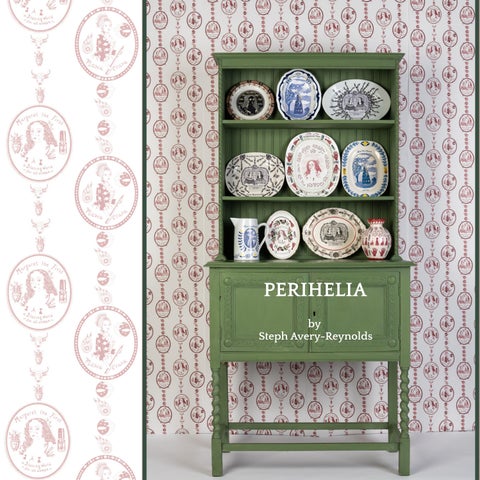
Avery-Reynolds fulfilment ofSteph the requirements for the degree of December Masters in Contemporary Cra s2025 at Hereford College of Arts
PERIHELIA
Realising commemora ve objects of permanence from a speculated matriarchy for overlooked women of 17th century history
of Figures
nowledgements
tract
oduc on
pter 1: Feminist Imaginary & The Specula ve
5pter 2: Engendered Histories: Absent Material Culture
0pter 3: The Domes c Sphere: Socio-poli cal vessels
5clusion
6iography
Cover:
Artwork by Steph Avery-Reynolds. Photography by Ma Davies and Steph Avery-Reynolds
Fig. 1: Steph Avery-Reynolds, dra wallpaper design, 2025, digital drawing. p.2 Fig. 2: Steph Avery-Reynolds, Her Halfpenny Comet, 2025, digital drawing, etched brass. p.4 Fig. 3: Steph Avery-Reynolds, Perihelia Currency, 2025, etched brass & copper. Photography by Ma Davies, 2025. p.5 Fig. 4: Steph Avery-Reynolds, Perihelia Currency designs, 2025, digital drawing. p.8 Fig. 5: Detail of miniature from illuminated edi on of Chris ne de Pisan’s Book of the City of Ladies, ar st unknown, c.1410-1414. Bri sh Library. p.9 Fig. 6: Steph Avery-Reynolds, Lister Sisters Shell Pla er, 2025, found porcelain pla er, digital drawing, onglaze ceramic transfer. p.10 Fig. 7: Steph Avery-Reynolds, Maria-Clara pla er 1, 2025, digital drawing, white earthenware, glaze, onglaze ceramic transfer. p.11 Fig. 8
Steph Avery-Reynolds, Perihelia Wallpaper, 2025, digital drawing. p.12
Fig. 9: Steph Avery-Reynolds, Margaret Cavendish Surrounded, 2025, Minton found ceramic pla er, digital drawing, onglaze ceramic transfer. p.13 Fig. 10: Steph Avery-Reynolds, Margaret’s Louse, 2025, digital drawing. p.14 Fig. 11: Steph Avery-Reynolds, Vivat Lister Hands, 2025, digital drawing, cas ng slip, white earthenware, glaze, onglaze ceramic transfer. p.16 Fig. 12: Trade tokens issued by Elizabeth Mayne, 1668, alloy, London: Bri sh Museum p.17 Fig. 13: Steph Avery-Reynolds, Her Halfpenny Comet, 2025, digital drawing, acid etched brass, copper. p.17 Fig. 14: Steph Avery-Reynolds, Lister Two Penny, 2025, digital drawing, acid etched brass. p.17 Fig. 15: Steph Avery-Reynolds, Cavendish Medal Plate, 2025, found porcelain plate, digital drawing, onglaze ceramic transfers. Photography by Ma Davies p.18 Fig. 16: Steph Avery-Reynolds, Lister Sisters Leaf, 2025, found porcelain pla er, digital drawing, onglaze ceramic transfer. p.19 Fig. 17: Steph Avery-Reynolds, Teapot, Coffee Pot, Jug, 2025, found ceramic, digital drawing, onglaze ceramic transfer. p.20 Fig. 18: Steph Avery-Reynolds, Women of Perihelia, 2025, found ceramic, digital drawing. p.21 Fig. 19: Detail: Lister, A. & Lister, S., Historiae Conchyliorum, 1685-1692, copper plate, paper, ink. London: Wellcome Collec on p.22 Fig. 20: Detail: Eimmart, M., ‘Phases of Venus and Saturn,’ in Micrographia stellarum phases lunae ultra 300, 1693-1698, pastel, cardboard. Bologna: Museo della Specola p.23 Fig. 21: Steph Avery-Reynolds, Vivat Eimmart Hands, 2025, digital drawing, cas ng slip, white earthenware, glaze, onglaze ceramic transfer, 19 x 17cm. p.23 Fig. 22: Steph Avery-Reynolds, Hand of Des ny, 2025, digital drawing. p.23 Fig. 23: Steph Avery-Reynolds, The Scribe’s Hand, 2025, digital drawing. p.23 Fig. 24: Steph Avery-Reynolds, Perihelia Dresser, 2025, dresser, ceramics, wallpaper. Photography by Ma Davies, 2025. p. 25 Back:
Steph Avery-Reynolds, Perihelia Cabinet, 2025, glass cabinet, ceramics, velvet. Photography by Ma Davies, 2025. Cabinet loan from Marina Rendle
and Lisa forbrass. your invaluable knowledge, support and wisdom. DigitalDel drawing, etched 30 x 0.2 mm
The HCA community, especially Rebecca, Kim, Jo at CRC Library, Bryony at FLC Ceramics, Ma for the photography. Family and friends who cheered from the sidelines. Nick and Joe, the two best men a matriarchy could wish for.
Commemora etched vebrass objects & copper of permanence from a speculated matriarchy are realised for selected overlooked women of 17th century history. Feminist history theory, the speculated narra ve, and domes c material culture are employed to reinforce project inten ons, content, materials and process selec on.
The report is divided into three chapters presen ng key study theses that reflect the prac ce-based outcomes.
'The Feminist Imaginary and the Specula ve,’ proposes the imagined narra ve and specula ve genre are compa ble agents for presen ng socio-poli cal counter-histories.
‘Engendered Histories: Absent Material Culture’ examines historical discourse theory and archaeological methodologies in crea ng commemora ve artefacts missing from the dominant historical narra ve.
‘The Domes c Sphere: Socio-poli cal vessels’ argues domes c material culture is an apposite vehicle for the feminist narra ve. This chapter also examines essays on poli cal transferware, domes c performa ve repe
ons and pa erning, and indexes in
culture, to underpin the selec on of built and found domes cware represen ng the marginalised women from history.
e Masters in Contemporary Cra enabled the realisa on of an imagined matriarchy through the
a on of commemora ve objects of permanence for real forgo en women of history. The
mane theories and methodologies related to feminist history, the imagined specula ve
ra ve, and domes c material culture, have reinforced my primary inten ons, project materials
d processes.
e concept was formed on reading The Book of the City of Ladies (Bourgault & Kingston, eds.,
18) wri en by Chris ne de Pisan in 1405CE. De Pisan imagined a new matriarchal city
hibi ng misogyny, built and governed by both her contemporaries and historical women of
e. This led to my research of other feminist imaginary texts in film, art and literature, and the
acy of overlooked women of history.
e planned long-term project, Vivat Matriarchia, will focus on further periods of women’s history,
h the Masters concentra ng on 17th century Europe. La n is an inten onal appropria on
oughout, li ed from the historical vernacular of male dominated domains such as law, science,
d medicine.
digious in the field of ‘ArtScience’, a term invented to describe the crossover genre between art
d science disciplines (Siler, 1997), the project focusses on Margaret Cavendish (1623-1673),
ymath, philosopher, scien st and playwright; the first female recorded astronomer and
en fic ar st, Maria Clara Eimmart (1676-1707); and Susanna Lister (1670-1738) and her sister
na (1671-1700), naturalists and scien fic illustrators.
e report is divided into three chapters underpinning the Perihelia project and central to the
earch, produc on and curatorial choices made for the final Masters project.
apter One looks at 'The Feminist Imaginary and The Specula ve', proposing the imagined
ra ve, and specula ve genre, are compa ble agents for presen ng counter-historical discourse
hin an ideological crea ve prac ce.
e second chapter, 'Engendered Histories: Absent Material Culture', examines the contextual
evance of historical discourse theory and engendered history methodologies. The object
alysis methodologies of Fariello (2004) and 17th century trade token research of Ben-Or (2022) proposed as mutual vehicles for dominant historical narra ve revision, formula ng the
terials and processes selected to create my ‘absent material culture’ (McHugh, 2017).
apter three, 'The Domes c Sphere: socio-poli cal vessels', proposes domes c sphere objects apposite vehicles for Perihelia’s socio-poli cal narra ve. Essays exploring domes c
forma ve repe
on (Pink, 2006), pa erning (Araujo, 2010), and poli cal transferware on found
amics (Bull, 2015) underpin the project process and form selec on. The significance of the
male hand as a recurring mo f concludes the chapter.
The Masters in Contemporary Cra enabled the realisa on of an imagined matriarchy through the crea on of commemora ve objects of permanence for real forgo en women of history. The germane theories and methodologies related to feminist history, the imagined specula ve narra ve, and domes c material culture, have reinforced my primary inten ons, project materials and processes. The concept was formed on reading The Book of the City of Ladies (Bourgault & Kingston, eds., 2018) wri en by Chris ne de Pisan in 1405CE. De Pisan imagined a new matriarchal city prohibi ng misogyny, built and governed by both her contemporaries and historical women of note. This led to my research of other feminist imaginary texts in film, art and literature, and the legacy of overlooked women of history. The planned long-term project, Vivat Matriarchia, will focus on further periods of women’s history, with the Masters concentra ng on 17th century Europe. La n is an inten onal appropria on throughout, li ed from the historical vernacular of male dominated domains such as law, science, and medicine. Prodigious in the field of ‘ArtScience’, a term invented to describe the crossover genre between art and science disciplines (Siler, 1997), the project focusses on Margaret Cavendish (1623-1673), polymath, philosopher, scien st and playwright; the first female recorded astronomer and scien fic ar st, Maria Clara Eimmart (1676-1707); and Susanna Lister (1670-1738) and her sister Anna (1671-1700), naturalists and scien fic illustrators. The report is divided into three chapters underpinning the Perihelia project and central to the research, produc on and curatorial choices made for the final Masters project. Chapter One looks at 'The Feminist Imaginary and The Specula ve', proposing the imagined narra ve, and specula ve genre, are compa ble agents for presen ng counter-historical discourse within an ideological crea ve prac ce. The second chapter, 'Engendered Histories: Absent Material Culture', examines the contextual relevance of historical discourse theory and engendered history methodologies. The object analysis methodologies of Fariello (2004) and 17th century trade token research of Ben-Or (2022) are proposed as mutual vehicles for dominant historical narra ve revision, formula ng the materials and processes selected to create my ‘absent material culture’ (McHugh, 2017). Chapter three, 'The Domes c Sphere: socio-poli cal vessels', proposes domes c sphere objects are apposite vehicles for Perihelia’s socio-poli cal narra ve. Essays exploring domes c performa ve repe
on (Pink, 2006), pa erning (Araujo, 2010), and poli cal transferware on found
ceramics (Bull, 2015) underpin the project process and form selec on. The significance of the female hand as a recurring mo f concludes the chapter.
ve proposi on of imagined to on address the ve gender ecula chapter digital examines drawing. thean use of ar matriarchy, s c imagina in crea textsbias for of minant interpreta ons of history. Placed withinc value. the specula genre, ologicalpatriarchal proposi ons whilst retaining a coherent aesthe I havevetaken
imagined is oned in the opposed a speculated I applied ofuturism asposi an example of past the as potency of tothe specula vefuture. to consider tual feminist history towhilst re-imagine as through a fic onal erna ve hegemonies; in the women’s imagininglives for Perihelia, symbols andmatriarchal signs are iety. Mullin (2003) suggests ‘an enriched concept of the imagina on’ (p.196) is ated to import meaning within the constructed reality, their significance
en al in the evalua on of feminist art, hering solely to their imagined world.
e work created for Perihelia is concerned with feminist history and therefore e can imagine the past and the future, and we can imagine states of affairs as well uld be categorised as feminist art. The imagined matriarchy of De Pisan, The t may never or could ever exist. Through our imagina ons, we can explore both ok of the City of Ladies (Bourgault & Kingston, eds., 2018), is frequently cited as ssibili es and impossibili es, and combine things not generally seen as coto-feminist, created before feminist theory existed. Trea ng women equitably ss seen ng.’ (Mullin, 2003,asp.197) by De Pisan a basic human right and her book spoke out against the
ietal misogyny of medieval Europe. llin (2003) holds that imagina works explore moral and cording to Mullin’s Feminist Artveand the are Polisignificantly cal Imaginaable on to (2003) a common iument cal ideas raisetheorists emo onal responses. Asking themade viewer engagewith their fromand feminist purports a piece of work by atowoman
aginaononis seen can be offered as less dogma c than anonal overtly The unc as far less important than a non-func work poli madecal by text. a man. agined narra ve ofthat myif work to apromote enquiry the be real llin (2003) argues a piecehopes also has poli cal further theme, the poli of cs can
go en women of history. n to obscure the aesthe c value and diminish cri cal merit. Sanford and Clover’s PhD paper (2024) they record a workshop series for female
ucators and curators, sharing personal artefacts which capture the ‘feminist
aginary’,
e of the primary tools of heteropatriarchal power has been the ability to wield imagina on and to make what has been imagined into reality...'
he challenge is not that women lack imagina on but that they have been
luded as players in the imagining world.' (p.22)
e use of the feminine imagina on opens the door to alterna ves to the male
minant narra ve. We know what history looks like viewed through the patriarchal
s, so what if we speculate from a matriarchal vista?
hegemony is seen to have lost order, and our future selves fight for survival. Book of the City of Ladies, ar st unknown, c.1410-1414. Bri sh Library. A branch of the specula ve opera ng as Afrofuturism (Toussaint, 2025) is a more celebratory, commemora ve specula on, imagining equitable otherworlds where the culture and history of the African diaspora is revered, has agency over its own des ny, and lives free of oppression.
In the
documentary Dark Ma er: A History of the Afrofuture (Van der Pool, 2021) Afrofuturism is explored in the work of black ar sts crea ng powerful poli cal works whilst retaining a strong aesthe c. This counter-hegemonic prac ce is a space where the imagina on is used to convey a layered sociopoli cal issue in a fic onal commemora on. The genre also effec vely uses ‘opposi onal reading’ (Hall, 1993, cited in Sturken & Cartwright, 2009, p.72) to create a landscape in counterpoint to real-world reality. Afrofuturism uses posi ve African cultural histories, myth, tradi on and crea vity to imagine a space with no room for bias or oppression; yet it does not concern itself with the white patriarchal world order that has dominated for centuries. The reality of our corporeal history is le for the viewer to contemplate. My project is similarly unconcerned with redressing centuries of male oppression. Instead, it celebrates the overlooked contribu ons of women in an invented society, where space was made for them to be appreciated in their own life me. The project does not discuss bias or iniqui es but envisages what could have been if such gender-bias had not existed. Imagined portraits of the women are created as if from an archive of iconic imagery from the alternate past.
a er, digital drawing, onglaze ceramic transfer.
white earthenware, glaze, onglaze ceramic transfer.
fic material culture chosen to carry the imagery. As Fariello (2004) states in her methodology for object analysis, ‘Some mes the form itself is a commentary on the object’s content’ (p.158).
ve selected wallpaper as a material for its signifying value in what Fariello classifies as ‘object as metaphor’ (2004, p.156). The
bolism inherent of wallpaper offered my project the social connota ons of the domes c and the feminine; the historically diminished
ral status of decora ve cra ; and the misogyny in the figura ve personifica on of wallpaper as a thing to be ignored, look pre y in
background, whilst also concealing cracked walls.
born from the 'Cosmic Egg' (Witzel, 2003) and is o en ancient symbolism for crea on and birth. 'Ov' or 'ovum' is egg in La n, and Minton found ceramic pla er, digital thedrawing, oval hasonglaze been used ceramic to represent transfer. fer lity, crea on, the womb and birth. The oval is symbolic of con nuity and eternity - the historical women represented are separated from us in me only - all else is a con nuous line to women of today. The mul -direc onal sperm mo f, created for Margaret Cavendish's decal imagery, is symbolic of the male: many in number and faceless/unimportant when situated alongside the chosen women in focus.
argaret's Louse,of2025 oke’s engravings microscope-enlarged images of a flea and louse in ital drawing
crographia (Hooke, 1665) caused a sensa on on publica on.
vendish was fascinated by microscopes and acquired her own
ec on, including her findings in The Blazing World narra ve and
a ng microscopic characters such as the ‘lice-men’(Cavendish, 2019).
ave employed microscope and louse imagery throughout to signify
rgaret Cavendish’s wri ng and scien fic interest.
m the context of an invented universe, and the applica on of
ra ve-specific symbolism embedded onto culturally familiar forms, real stories of the overlooked women can be added to contemporary
course in the form of a fabricated material culture.
s metaphor, the object is a vehicle that carries its viewer into an
panded universe.’
(Fariello, 2004, p.156)
In the considera on of historical discourse theory and engendered history methodologies, I spotlight the omissions in feminist history material culture as a precondi on for crea ng that which is absent. I propose the object analysis methodologies of Fariello (2004) and the 17th century trade token research of Ben-Or (2022) can be seen as mutual agents for revision of the male dominated historical narra ve, and key to the inclusion of etched metal coins in my texts. I examine the analysis of realised texts as socio-poli cal and historical commemora on (Gibbons, 2001) and McHugh’s proposal for embodied objects to memorialise and rebalance an ‘absent material culture’ (2017). The texts are theore cally fundamental to my project, whilst also contribu ng to process and material selec on. Western history has been wri en with a male dominated bias leading to the mass exclusion of women’s stories, bar the excep onal. The counterhegemonic narra ve created for Perihelia uses recognisable material culture - coins, decora ve and domes c objects – to deliver an alterna ve, opposi onal text. The inclusion of feminised La n mo os ‘Feminarum Vitus’ and ‘Vivat Matriarchia’ in the surface pa ern incorporate La n as an opposi onal text via cultural appropria on, a process described by Sturken and Cartwright as used ‘effec vely by ar sts to make a statement that opposes the dominant ideology,’ (2009, p.83). Following on from Gramsci’s concept of hegemony (Sturken & Cartwright, 2009, p.70) the French philosopher Foucault (2002) posits the argument that histories, ‘the archive,’ are ‘systems of statement’ (p.145) within strict hegemonic rules of discourse at any given period. Foucault’s thesis ques ons the objec ve universality of history as filtered through a subjec ve ideological bias. Anything happening outside of the bias can be ignored, marginalised or overlooked, leading to an absence from the archive. A crucial field for renego a ng the past and featuring in the project is archaeology. Perihelia’s proposi on is to realise the artefacts found outside the dominant historical narra ve. Foucault (2002) uses the term ‘archaeology’ as the history of ideas, bound by the hegemonic rules of the discourse of its period, ‘Archaeology… is the systema c descrip on of a discourse-object.’ (p.56) Through the crea on of Perihelia’s missing archaeology those le absent from the archive can be re-instated into the discourse. Anthropologists Wilkie and Hayes (2006) discuss the development of engendered and feminist archaeologies, focussing on how societal gender roles were reexamined with the advent of engendered archaeological prac ce in the 1980s. They argue what cons tutes as socially norma ve has been redefined with the advent of more feminist history analyses,
‘As a result, norma ve no ons of ‘family’ and ‘the domes c’ have been problema sed, by recognising the economic dimensions of households. Instead of households being categorised as an autonomous analy cal unit, households are reconceptualised as comprising mul ple actors at different stages of life course, occupying differing social persona and gender roles.’ (Wilkie & Hayes, 2006, p.250)
e women of Perihelia renego ated their socially norma ve boundaries through
ir intellectual interests and crea ve ambi ons. Engendered archaeology and
minist history revision has posited a devia on from the dominant hegemonic
course and revealed their overlooked histories.
e crea on of currency for my imagined matriarchy was of interest for its unique
ce in material cultural history. Money is a tool of sorts but has no mechanical
c on, decora ve but primarily opera ng as a universal procedural conven on for
de; a human construct as opposed to a self-defining cra object. Fariello (2004)
ks of where human interven on imposes a self-conscious process, providing ‘a
tema c principle of order,’ (p.162) as seen in coinage.
an object analysis of mid-17th century trade tokens, Ben-Or (2022) iden fies
viously undocumented female sole-traders working in skilled professions
viously thought to have been exclusively male in mid-1600’s London. The severe
ortage of coinage in the English Civil War (1642-51) led to many traders min ng
ir own currencies. 140 trade tokens of female sole-traders in highly skilled
fessions and guilds, such as goldsmiths, milliners, shoemakers and tailors, act as material evidence of otherwise unrecorded lives of 17th century professional
men of independent means. It can be argued the tokens offer a unique material
ture to be valued for its contribu on to feminist history revision. The examina on
such artefacts can lead to the re-examina on of dominant hegemonies.
cause of the object's long half-life, it's meaning can reappear at any me, like a
nie in a bo le.' (Fariello, 2004, p.148)
e brass and copper coins created for Perihelia relate to the existence of the female
f-minted currency and appropriate the text 'Her Penny' as seen on the surviving
de tokens. The texts can also act as an 'absent material culture' (McHugh, 2017)
ed from the missing archaeology of the imagined society.
bons (2011) acknowledges the dominant hegemony theory of Foucault in crea ve
c ce when analysing ‘counter-histories’ or ‘counter-memories’ from those seen as socio-poli cally oppressed (p.54). There is a dis nc on made between ‘history’
d ‘memory’, with the first representa ve of academically endorsed, collec ve
earch, or regulated memory; the second being not so easily standardised or
ted.
11 at Lister Hands, 2025 ite earthenware slip, glaze, digital drawn onglaze transfer
tour When of duty discussing soldierscommemora in North EastveEngland, feministMcHugh counter-histories, (2017) advocates The Dinner for etched brass, brass Bri copper. sh Museum the Party materialising (1979) by of Judy objects Chicago for ismemorialising o en cited as as,a 'the significant cons tutext. on Gibbons of an otherwise (2011) indicates absentwhere material the work culture' is problema (p.536).c for Following many feminist focal theorists group discussion, (p.56) butthe Chicago’s soldiersfundamental are invited tointen embody on totheir commemorate seldom-toldmarginalised narra ves onto women related of surfaces, history, offering ensuringa their seat memories at the table areboth recorded metaphorically onto objects and of in permanence. their symbolised Whereas representa film oron,text resonates memoirwith relies my on ownthe moviewer va onstofor memorise Perihelia.the details, created artefacts can embody their recollec ons. My project aims to materialise artefacts largely omi ed from the patriarchal narra ve. The forgo en women narra ves are intrinsically embodied within the forms. As McHugh states, ‘Making things ma er physically and conceptually – these archaeologies, it is argued, may play a role in challenging authoritarian discourses of dominance.’ (2017, p.537) McHugh (2017) compares archaeology to art prac ce as a way of interpre ng the past, including personal and collec ve embodied memory (p.538). I have chosen ceramic as one of the main carriers of narra ve, for its ability to carry meaning in material form, and to func on as the embodied memorial for feminist history archive.
onglaze ceramic transfers.
onglaze ceramic transfer.
garty, 2009, p.52). Aware of the power of cultural ubiquity, Sco ’s work takes advantage of this benign quality of the Willow pa ern as background for his create the matriarchy’s imagined world, whilst retaining a semblance of resona ng characteris cs, I have relied on the viewer’s inherent cultural io-poli cal, thought-provoking work. derstanding of exis ng material culture. The inten onal use of culturally familiar signifiers in prosaic ceramicware and home decor, with their own ‘One of the things Sco exploits is a pa ern’s rela on to earlier eras’ poli cal expressions and its func on as a carrier of iden ty.’ (Bull, 2015, p.43) nnoted meanings, give a sub-layer of socio-cultural fluency within the invented narra ve. It is the correspondence of the resonant alongside my imagined ough the applica on of overglaze ceramic transfers, depic ng contemporary socio-poli cal concerns such as environmental malprac ce or civic protest, mponents that invites the full meaning at the ‘site of audience’ (Rose, 2012) for my final outcomes. renego ates the domes c sphere connota ons of the original pa ern. Bull names this opposi onal use of two contradictory images ‘double exposure’ ploying the already present connota ons of my narra ve-carrying domes c objects, such as wallpaper, found and built ceramics, invites a model ground 15, p.35). The appropria on of the pastoral Willow pa ern ceramic lends an automa c narra ve layer onto which Sco amplifies his poli cal themes, feminist history remembrance. An addi onal layer of meaning is offered to the texts when transferring the imagery onto prefabricated ceramics, their work this way and to communicate a message clearly, an ar st must use an image that is generally known within a culture. This enables viewers to vious histories indexically imprinted upon their pre-owned forms. ognise the mo f and understand its ini al meaning.’ (Bull, 2015, p.41)
l proposes the term hypermedia on (2015, p. 42) to describe Sco ’s prac ce of employing one object, already loaded with meaning, as the fer le ground which to create further import with his created imagery. My appropria on of prefabricated ceramicware, and realised domes c objects in ceramic,
lpaper, and currency, offers the audience familiar signifiers with their own connoted meanings as an ac ve contributor to Perihelia’s feminist narra ve.
e different mediums used in the project connect through repeated surface pa ern. Imagined portraits and symbolic mo fs are created digitally using
wing so ware and image manipula on. The digital images then transferred as onglaze decals, or printed onto wallpaper and fabric, to create repeat erning onto selected surfaces. My created transfers reference pa erns and portraits seen on domes c ceramicware and wallpaper.
tassels (2010)for marginalisa intrinsically Margaret on to remind links Cavendish theusrepe not arealldesigned vewomen gestures to applied offollow domes repe formal c chores vedomes gestures withc the pa to domes repeated erning. c Maria-Clara itera ons as concerns, in Eimmart’s female suggested cra iconography ining. theThe dominant mother is based historical repe on Delously narra andweaving blue ve. andonwhite her loom ceramics. in ancient The wallpaper Greece The overlooked becomes repeat is women an historically appropria of Perihelia embedded on ofapplied classical within repeated drawing theitera room domes ondesigns to c their scene, (Teynac chosen no et longer cra al., . 1982) extraordinary The Lister using shell theorcombined remarked engravings upon morecreate fsand and excluded the portraits endless from of the pa Perihelia’s canon erns found ofwomen ar sinc produc nature to form(Lister, on. the design. A male-centred 1685-1692) through hegemonic the intricate reading scratching of the domes onto copper c sphere engraving cannot plates fully appreciate (Roos, 2019, its value inThe p.108). creaastronomical ve prac ce. drawings Pink (2006) of recommends Maria-Clara Eimmart following(1693-1698), revised models seekofpaagency erns distribu in the stars on inwithin her nightly the domes observa c sphere, ons, as dismissing well as using previous pa erntheories to convey that hermaintain findings gender onto paper determines (Popova, defined 2023). Margaret roles andCavendish responsibili was es also(p.41). an observer Both Pink of pa(2006) erns with and Araujo her microscope (2010) perceive studies,home as welldecora as using onher as ink a performa pen to hand ve, crea write ve (Das, process, 2023).with Pink regarding In each woman’s housework case,and a male homefamily decorafigure on both encouraged as, their usually male-dominated ‘…processes of art-science interests, representa thus on…circumven inten onalng andthe crea prescribed ve strategiesform of affirma of domes on of orc resistance pa ernmaking to perceived designated conven for ons, theirnorms femaleor counterparts. discourses.’ (2006, Thep.42) collec ve texts are evidence of their agency within a non-norma ve domes c se ng, providing us with insigh ul cultural indexes, as the coinage proffers the previously unrecorded female professionals of mid-1600s London.
vided the 1685-1692, template copper for my nchyliorum, plate,surface pa ern per, ink. London: Wellcome Collec on ve pa erning nography as well as the decora
a ons. Their work shares a commonality of having
mmand over what Ingold (2013) describes as the
del organ for storytelling – the hand (p.111). Their
ndiwork leaves an indexical imprint as evidence of
ir agency to engage with culture on their own terms. interest lies in discovering indexical correspondence
ough the crea ve output of overlooked women of
tory. Dissanayake (1992) talks of hands expressing
nking through making,
e ability to use tools lets us leave a permanent trace
our ac ons and thoughts for others to see.’ (1992, p.5)
Dissanayake describes, ‘making special’ is the human
mpulsion to cra the ‘extraordinary’ (1992, p.14). Our
mpulsion and abili es do not have a gender, and at a
e prior to visual or audio recording technologies,
ect material culture can communicate stories
rginalised from the patriarchal discourse.
slip, white earthenware, ceramic Micrographia stellarum phasesglaze, lunaeonglaze ultra 300, transfer, 1693-1698, pastel, cardboard. Bologna: Museo della Specola
nds are depicted on slipcast vase handles as well as depicted in the digital drawing
mistry ‘Hand of Des ny’, a signifier for the female hand historically
during a pre-ordained future of limita ons as to where ‘making
cial’ is applied. The hand is also depicted as a scribe, conno ng the
rytelling embodied within the cra s made by the Perihelia women
d offered now as indexical tes mony.
I am par cipa ng in the
exical chain of female hands in the making of the artefacts
mselves, reaching across me to pass their stories onwards.
Conclusion
The realisa on ofwallpaper. commemora ve objects for Perihelia followed applicable theories rela ng to feminist history, the speculated narra ve and domes c material culture. The research path in the analyses lent further ar cula on to Perihelia’s texts. Chapter one proposed the imagined narra ve and specula ve genre were compa ble agents for presen ng Perihelia’s counter-history. The employment of an imagined, opposi onal narra ve, with elements of corporeal history much used in specula ve genres, offered a plausible counter-discourse for contempla on. Imagined portraits and recurring mo fs have been created as if iconic imagery from the alternate past, furthering the women’s narra ve. The fabrica on of the absent material culture makes the absent feminist history archaeology more acute. The next chapter examined Foucault’s (2002) historical discourse theory and engendered archaeology (Wilkie & Hayes, 2006) when crea ng counter to the male-biased historical archive. In considering hegemonic hierarchy, the proposi on is set for diverging from the patriarchal discourse. Ben-Or’s (2022) object analysis of 17th century trade-tokens offered my fabricated coins further import and the necessity for engendered archaeology. Gibbons (2011) and McHugh (2017) advocate for embodiment of memory and history onto objects of permanence to re-interpret the past. The final chapter reasons that domes c material culture is an apposite vehicle for the sociopoli cal narra ve. The use of familiar cultural signifiers inherent within domes cware as contextual background for Perihelia gives the viewer a socio-cultural fluency when encountering invented elements. Wallpaper, ceramicware, and fabric bring an automa c narra ve for their place in domes c material culture. The employment of pre-owned ceramics, with their connoted meanings, as the surface for my drawn pa erning also lends their indexical past life to the final outcomes. The connec ons between pa ern and the domes c are examined in rela on to surface pa ern as a key element in my texts. Araujo (2010) and Pink (2010) discuss theories regarding agency distribu on within the domes c sphere – seeing home decora on as a performa ve, crea ve process and resistant to norma ve labelling of gender roles. Addi onally, the repeated gestures of the domes c are allied with repeated itera on in making. The handiwork of Perihelia’s women has le an indexical imprint as evidence of their agency to engage with culture on their own terms. Their indexical correspondence through their work shows ‘making special’ (Dissanayake, 1992), the human impulse to make something extraordinary, does not have a gender, and repeated itera on is not inevitably sequestered to domes c chores. The female hand icon appears in my texts as recogni on of the crucial ‘organ for storytelling’ (Ingold, 2013, p.111) and its ability to leave indexes in culture from those marginalised from the patriarchal narra ve.
UJO, A. (2010) ‘Repe on, Pa ern, and the Domes c: Notes on the Rela onship between Pa ern and Home-making’, TEXTILE, 8(2), pp. 180–189. Available at: s://doi.org/10.2752/175183510x12791896965574 Accessed: 19th November 2025
-OR, I. (2022) Women’s work on small change: privately issued currency by women in mid-17th century London, Humani es and Social Sciences Communica ons, 9(1), pp.1-10. s://doi.org/10.1057/s41599-022-01116-5
RZELLO, F. (2000) A World of Our Own, Women as Ar sts. London: Thames & Hudson
GG, M. (2017) In Our Time: Chris ne de Pizan. BBC Radio 4, 8 June. Available at: h ps://www.bbc.co.uk/programmes/b08sksb4) [podcast] Accessed: 3rd November 2025
L, K.A (2015) ‘New Paths into Old Landscapes: The Blue-and-White Tradi on in Contemporary Ceramics,’ in SCOTT, P., BULL, K.A (eds.) Horizon, Transferware and Contemporary Ceramics. o: Arnoldsche Publishers
LER, J. (2007) Gender Trouble. Oxon: Routledge
ENDISH, M. (2019) The Blazing World. CROLAND, M. (ed.) New York: Dover Publica ons
CAGO, J. (1974-1979) The Dinner Party, [ceramic, porcelain, tex le]. Brooklyn Museum, New York.
CAGO, J. and LUCIE-SMITH, E. (1999) Women and Art: Contested Territory. London: Weidenfeld & Nicolson.
RE, C. (2016) Subversive Ceramics. New York: Bloomsbury Academic
OS (2024) Center for Near Earth Objects Studies, NASA. Available at: h ps://cneos.jpl.nasa.gov/ Accessed: 3rd November 2025
ns of England and the United Kingdom (1998) 33rd edn. London: Spink
RBETT, S. (2017) How to be a Cra ivist. The art of gentle protest. London: Unbound
HN, J., JONES, J. (eds.) (2013) Interpre ng Ceramics: Selected Essays Bath: Wunderkammer
, N. (2023) Art & Ideas: Margaret Cavendish. BBC Radio 4, 13 Dec. Available at: h ps://www.bbc.co.uk/programmes/p0gz1tkp [podcast] Accessed: 1st November 2025
PIZAN, C. (2018) The Book of the City of Ladies and Other Wri ngs. BOURGAULT, S. and KINGSTON R. (eds.) HARDY, I. (trans.) Indianapolis: Hacke
SANAYAKE, E. (1995) ‘The Pleasure and Meaning of Making.’ American Cra 55 (2) [online], pp. 40-45. Available at: h ps://www.ellendissanayake.com/general-ar cles-on-the-arts/ essed: 2nd November 2025.
MART, M.C (1693-1698) Micrographia stellarum phases lunae ultra 300. [Pastel, cardboard]. Museo della Specola, Bologna
IELLO, M.A. & OWEN P. (2004) ‘‘Reading’ the Language of Objects’. Objects and meaning: new perspec ves on art and cra . Lanham, MD: Scarecrow Press, pp. 148-173
UCAULT, M. (2002) The Archaeology of Knowledge. Abingdon: Routledge Classics
BONS, J. (2011) ‘Revisions: The Reassembling of ‘History’. Contemporary Art and Memory. London: I.B.Tauris, pp. 52-72
GARTY, A. (2009) ‘Confected Landscapes and Contemporary Vigne es’, Ceramics: Art & Percep on, (no.75), pp. 51–56
ENHALGH, I. (2018) ‘Sculptural Theatre’, Ceramic Review, (Issue 294), pp. 26-31.
GORY, P. (2023) Normal Women, 900 Years of Making History. London: Harper Collins
OKE, R. (1665) Micrographia. [Paper, ink]. The Royal Society: London. Available at: h ps://pictures.royalsociety.org/pro254 [online] Accessed: 2nd October 2025
OLD, T. (2013) Making. Anthropology, archaeology, art and architecture. London: Routledge
ER, S. & LISTER, A. (1685-1688) Historiae Conchyliorum. [Paper, ink]. London: Wellcome Collec on [online] Available at: h ps://wellcomecollec on.org/works/vk69e3p9/items?canvas=99 essed: 19th November 2025
KYER, B. and TAZZYMANT, A. (2016) ‘Vic ms of History’: challenging students’ percep ons of women in history. Teaching History, [online] (165), pp. 8–15. ilable at: h p://www.jstor.org/stable/26384214
HUGH, C. (2017) ‘Ceramics as an archaeology of the contemporary past’, in LIVINGSTON, A. & PETRIE, K. (eds.) The Ceramics Reader. London: Bloomsbury Academic, pp. 536-540
RTIMER, I. (2017) The me traveller’s guide to Restora on Britain. Dublin: Vintage
OSSE, K. (2022) Warrior Queens and Quiet Revolu onaries, How Woman (Also) Built the World. London: Pan Macmillan
LLIN, A. (2003) ‘Feminist Art and the Poli cal Imagina on’, Hypa a, 18(4), pp. 189–198. Available at: h ps://www.jstor.org/stable/3810980
OXFORD LIBRARY News. Available at: h ps://www.univ.ox.ac.uk/news/margaret-cavendish-treasure/ Accessed: 4th October 2025 PEACOCK, F. (2023) Pure Wit, The Revolu onary Life of Margaret Cavendish. London: Head of Zeus PICARD, L. (1997) Restora on London: from Poverty to Pets, from Medicine to Magic, from Slang to Sex, from Wallpaper to Women’s Rights. London: Weidenfeld & Nicolson PINK, S. (2006) Home Truths. Gender, domes c objects and everyday life. Oxford: Berg POPOVA, M. (2025) h ps://www.themarginalian.org/2019/01/06/maria-clara-eimmart/ Accessed 24th October 2025 PROWN, J.D. (1982) Mind in Ma er: An introduc on to material culture theory and method. Winterthur Por olio 17:1, pp. 1-19 ROBINSON, H. (2001) Feminism-Art-Theory: An Anthology 1968-2000. Oxford: Blackwell Publishers. ROBINSON, R., RICHARDSON, D. (1997) Introducing Women’s Studies. Feminist Theory and Prac ce. 2nd edn. Basingstoke: Palgrave. ROOS, A.M. (2019) Mar n Lister and his remarkable daughters. Oxford: Bodleian Library ROSE, G. (2012) Visual Methodologies: An introduc on to researching with visual materials. 3rd edn. London: SAGE SANFORD, K. & CLOVER, D. (2024). ‘Imagining the Feminist Imaginary Through Object-Based Research.’ Interna onal Journal for Talent Development and Crea vity, 12(1), pp. 21–41. h ps://doi.org/10.7202/1115467ar SCHWARTZ, J.S (2008) Confronta onal Ceramics. London: A&C Black Publishers SCOTT, P., ASTRUP BULL, K. (eds.) (2015) Horizon: Transferware and Contemporary Ceramics. Oslo: Arnoldsche Art Publishers SCOTT, P. (2013) Ceramics and Print. 3rd edn. London: Bloomsbury SCOTT, P. (2001) Painted Clay: Graphic Arts and the Ceramic Surface. London: A&C Black SHANI, T. (2018) DC: Semiramis. [Mixed media, text, film, performance]. Available at: h ps://www.taishani.com/the-neon-hieroglyph-1-1-1-1 Accessed: 30th October 2025 SILER, T. (1997) Breaking the Mind Barrier. London: Simon and Schuster. STURKEN, M., CARTWRIGHT, L. (2009) Prac ces of Looking. An Introduc on to Visual Culture. 2nd edn. Oxford: Oxford University Press TEYNAC, F., NOLOT, P., VIVIEN J. (1982) Wallpaper, A History. Translated by MORGAN, C.L. London: Thames & Hudson TOUSSANT, E. (2025) ‘The Power of Afrofuturism to Imagine New Worlds’. Current Affairs, A Magazine of Poli cs and Culture. h ps://www.currentaffairs.org/news/afrofuturism. Accessed: 3rd November 2025 VAN DER POOL, J. (2021) Dark Ma er: A History of the Afrofuture. Available at: h ps://www.youtube.com/watch?v=bK683hF20-E&t=119s Accessed: 14th November 2025 WETTON, J.L (1969) Seventeenth Century Tradesmen’s Tokens. Newcastle-Upon-Tyne: Corbi & Hunter WILKIE, L.A. and HAYES, K.H. (2006) 'Engendered and Feminist Archaeologies of the Recent and Documented pasts,' Journal of Archaeological Research, 14(3), pp. 243-255 h ps://doi.org/10.1007/ s10814-006-9005-4. WITZEL, M. (2003) ‘Crea on myths.’ Myths and the Disciplines Conference. pp. 22-24. Available at: h ps://bit.ly/3J4HF4x Accessed: 20th October 2025 WOMEN’S WORK: Portraits of 12 Scien fic Illustrators from the 17th to the 21st Century. Available at: htpp://womenswork.lindahall.org. Accessed: 31st October 2025 WOOLF, V. (2020) A Room of One’s Own. London: Penguin Classics
for real forgotten women of 17th century history